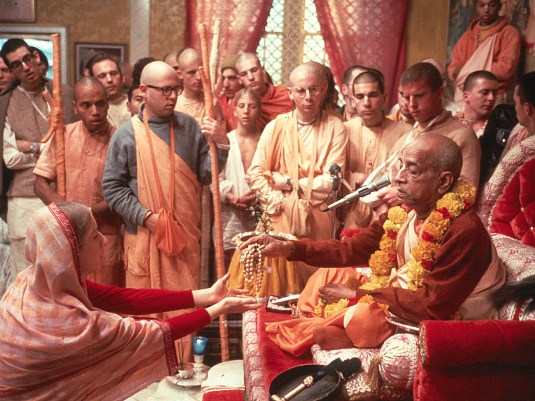
Arsha Prayoga – Part IV


Arsha Prayoga – Part IV
By Sriman Locanananda Prabhu

For those who saw the Hare Krishna movement spread from city to city and from country to country, it was clear that the original version of Srila Prabhupada’s books was full of spiritual potency and did not require to be changed in any way for his words to act upon the hearts of the conditioned souls.

The question as to whether the writings of the Acharya may or may not be revised by his disciples after his disappearance is answered by the rule of arsha-prayoga.

This principle states that one should not see mistakes in what the spiritual master has written or think that his writings may be changed to make them more effective or politically correct. To preserve his teachings in their originally published form is the way by which the Acharya is honored, and to do otherwise is to dishonor him. That is the rule of arsha-prayoga, a principle that devoted followers of a bona fide spiritual master must adhere to without deviation.

The rationale for changing Srila Prabhupada’s books was based on a series of false arguments, many of which were defeated by Srila Prabhupada himself as this article will show. To justify their actions, the BBT editors created the illusion that Srila Prabhupada’s books were defective and in need of extensive editing even though they knew His Divine Grace had never authorized anyone to revise his books after his disappearance. Subsequent to his departure, they conveniently overlooked the principle of arsha-prayoga and proceeded to do exactly what Vaishnava tradition strictly prohibits.

More

Srila Prabhupada is the Guru, Acarya and Actual Initiator in ISKCON

Srila Prabhupada is the Guru, Acarya and Actual Initiator in ISKCON
By Mahesh Raja

Regarding parampara system: there is nothing to wonder for big gaps. Just like we belong to the Brahma Sampradaya, so we accept it from Krishna to Brahma, Brahma to Narada, Narada to Vyasadeva, Vyasadeva to Madhva, and between Vyasadeva and Madhva there is a big gap. But it is sometimes said that Vyasadeva is still living, and Madhva was fortunate enough to meet him directly. In a similar way, we find in the Bhagavad-gita that the Gita was taught to the sungod, some millions of years ago, but Krishna has mentioned only three names in this parampara system–namely, Vivasvan, Manu, and Iksvaku; and so these gaps do not hamper from understanding the parampara system. We have to** pick up the prominent acaryas, and follow from him.** There are many branches also from the parampara system, and it is not possible to record all the branches and sub-branches in the disciplic succession. We have to pick up from the authority of the acharya in whatever sampradaya we belong to. (68-04-12.Day Letter: Dayananda)

The **only** injunction from scriptures is to worship the acarya. Its only the acarya that is able to give diksa ( spiritual initiation) to the Madhyama-adhikari (see antya CC 4.192-4.194) where he relishes loving mellows(in his svarupa) with krsna. Acarya is not voted by the GBC 2/3 majority votes. The acarya has direct communication with Krsna- Krsna speaks through him. It is therefore only the acarya that can actually be expected to be worshiped as good as Krsna. So the photo worship is not sanctioned of one who is not an acarya. (conditioned soul worship — idol worship where is the difference?).
   
Adi 1.45 “According to the deliberate opinion of all revealed scriptures, the spiritual master is nondifferent from Krsna. Lord Krsna in the form of the spiritual master delivers His devotees.”

Adi 1.46 **acaryam** mam vijaniyan navamanyeta karhicit na martya-buddhyasuyeta sarva-deva-mayo guruh “One should know the acarya as Myself and never disrespect him in any way. One should not envy him, thinking him an ordinary man, for he is the representative of all the demigods.” Purport:This is a verse from Srimad-Bhagavatam (11.17.27)

Note: It is significant the same text has been quoted In NoD Ch7 but in reference to **accepting initiation**. So this shows Initiation is from Acarya not from 2/3 majority voted spiritual masters.

Ch7 Nectar of Devotion; Serving the Spiritual Master with Faith and Confidence Regarding ACCEPTING INITIATION from the spiritual master, in the Eleventh Canto of Srimad-Bhagavatam, Seventeenth Chapter, verse 27, it is stated by Lord Krsna, “My dear Uddhava, the spiritual master must be accepted not only as My representative, but as My very self. He must never be considered on the same level with an ordinary human being. One should never be envious of the spiritual master, as one may be envious of an ordinary man. The spiritual master should always be seen as the representative of the Supreme Personality of Godhead, and by serving the spiritual master one is able to serve all the demigods.”

Adi 1.35 A devotee must have only one initiating spiritual master because in the scriptures acceptance of more than one is always forbidden.
Note:We know it is only the uttama adhikari acarya Prabhupada that is able to transmit diksa (spiritual Initiation) into the madhyam adhikaris heart whereby he is enabled to see Krsna and relish loving mellows in his svarupa. (television in the heart).

Here it is understood that the spiritual master disciplic succession is of acaryas. And Srila Prabhupada is the current acarya. SB 3.29.17 In Bhagavad-gita, Thirteenth Chapter, it is clearly stated that one should execute devotional service and advance on the path of spiritual knowledge by accepting the acarya. Acaryopasanam: one should worship an acarya, a spiritual master who knows things as they are. The spiritual master must be in the disciplic succession from Krsna. The predecessors of the spiritual master are his spiritual master, his grand spiritual master, his great-grand spiritual master and so on, who form the disciplic succession of acaryas.

Srila Prabhupada is the prominent acarya.

More

Characteristics of the Bona Fide Guru and the Bona Fide Disciple


The guru must be situated on the topmost platform of devotional service. There are three classes of devotees, and the guru must be accepted from the topmost class. The first-class devotee is the spiritual master for all kinds of people.

The disciple must have the following qualifications. He must give up interest in the material bodily conception. He must give up material lust, anger, greed, illusion, madness and envy. He should be interested only in understanding the science of God, and he should be ready to consider all points in this matter. He should no longer think, “I am this body,” or, “This thing belongs to me.” One must love the spiritual master with unflinching faith, and one must be very steady and fixed. The bona fide disciple should be inquisitive to understand transcendental subject matter. He must not search out faults among good qualities, and he should no longer be interested in material topics. His only interest should be Kṛṣṇa, the Supreme Personality of Godhead.

From Sri Caitanya-caritamrta – 1975 Edition
Madhya 24.330
By His Divine Grace A.C. Bhaktivedanta Swami Prabhupada

TEXT 330

guru-lakṣaṇa, śiṣya-lakṣaṇa, doṅhāra parīkṣaṇa
sevya–bhagavān, sarva-mantra-vicāraṇa

SYNONYMS

guru-lakṣaṇa—the symptoms of a bona fide spiritual master; śiṣya-lakṣaṇa—the symptoms of a bona fide disciple; doṅhāra—of both; parīkṣaṇa—the testing; sevya-bhagavān—the Supreme Personality of Godhead is worshipable; sarva-mantra-vicāraṇa—consideration of the different types of mantras.

TRANSLATION

“In your book there should be the characteristics of the bona fide guru and the bona fide disciple. Then, before accepting a spiritual master, one can be assured of the spiritual master’s position. Similarly, the spiritual master can also be assured of the disciple’s position. The Supreme Personality of Godhead, Kṛṣṇa, should be described as the worshipable object, and you should consider the bīja-mantra for the worship of Kṛṣṇa, Rāma or any other expansion of the Supreme Personality of Godhead.

PURPORT

In the Padma Purāṇa, the characteristics of the guru, the bona fide spiritual master, have been described:

mahā-bhāgavata-śreṣṭho
brāhmaṇo vai gurur nṛṇām
sarveṣām eva lokānām
asau pūjyo yathā hariḥ

mahā-kula-prasūto ‘pi
sarva-yajñeṣu dīkṣitaḥ
sahasra-śākhādhyāyī ca
na guruḥ syād avaiṣṇavaḥ

The guru must be situated on the topmost platform of devotional service. There are three classes of devotees, and the guru must be accepted from the topmost class. The first-class devotee is the spiritual master for all kinds of people. It is said: gurur nṛṇām. The word nṛṇām means “of all human beings.” The guru is not limited to a particular group. It is stated in the Upadeśāmṛta of Rūpa Gosvāmī that a guru is a gosvāmī, a controller of the senses and the mind. Such a guru can accept disciples from all over the world. Pṛthivīṁ sa śiṣyāt. This is the test of the guru.

More

Arsha Prayoga Part II

Arsha Prayoga Part II
By Sriman Locanananda Prabhu

Srila Prabhupada’s desire was to see his books translated into all of the major languages of the world. By 1970, numerous centers had opened in countries outside of the United States and translation work had begun in Germany, France, Canada, South America and Japan. When the German devotees undertook the translation of the Srimad Bhagavatam, they discovered what they thought were grammatical discrepancies in the original English. The translators reasoned that if their spiritual master could publish his books with flaws included, then their own translation work could also contain mistakes and no harm would be done. In a very strongly-worded letter, Srila Prabhupada chastised his disciples for thinking they could imitate their spiritual master and explained that to avoid this offense, they must follow the principle of arsha prayoga.

One should not see mistakes in the books written by his spiritual master, nor should one think he is able take the same liberties taken by him. His Divine Grace warned his disciples that only if they were able to spread Krishna consciousness all over the world as he had done could discrepancies in their translation work be overlooked, otherwise not.

More

Visitor From Calcutta (Chapter 1)

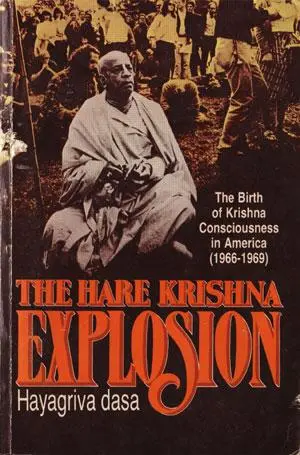
The Hare Krishna Explosion
by Hayagriva dasa

Part I: New York, 1966
Chapter 1

Visitor From Calcutta

I first see him just after crossing the Bowery at Houston Street. As he passes before the iron-mesh fence of a playground, I distinctly glimpse the aura of saintliness. I watch him through the rushing traffic and stumbling derelicts.

He strolls almost jauntily down the sidewalk. He is an old man whom age has never touched. Aloof from the people and bustle about him, he walks proudly, independently, his hand in a cloth beadbag. He wears the saffron robes of a sannyasi, and on his feet are quaint, pointed white shoes.

Only seven months ago, I had seen many saffron-robed monks and holymen walking the dirt roads of Hardwar and Rishikesh, and stopping beside the Ganges to bathe. For me, that had been a futile journey to the mystic East in search of the all-knowing guru.

But now—what’s this?

I look again at the pointed white shoes. Did this man follow me all the way from North India? Or did he just suddenly descend from the clouds onto Manhattan sidewalks? I decide I must speak to him.

More

Krishna is the only Liberation

SRIMAD BHAGAVATAM (1.7.22) “Arjuna said: O my Lord Sri Krishna, You are the almighty Personality of Godhead. There is no limit to Your different energies. Therefore only You are competent to instill fearlessness in the hearts of Your devotees. Everyone in the flames of material miseries can find the path of liberation in You only.”

More

Remembering Srila Prabhupada

Your Ever Well Wisher


My First Book
by Vyasasan das

I think we all remember very clearly where we were and what we were doing the day Srila Prabhupada first entered our lives. Many of the older devotees remember where they were when President John F. Kennedy was shot, or where they were when “The Beatles” appeared on the Ed Sullivan show. But our remembrance of Srila Prabhupada will outlive any mundane event in our lives, as our relationship with our Srila Prabhupada is an eternal relationship.

More

Connecting with Srila Prabhupada


Prabhupada connect
by Padmapani Prabhu

Yet many times we still receive letters asking us how to connect with Srila Prabhupada now that he is apparently absent from our material vision. This should not be a mystery, since after all, Srila Prabhupada is a bona fide spiritual master, i.e. a master of spirit.

“A pure devotee of the Lord does not live on any planet of the material sky, nor does he feel any contact with material elements. His so-called material body does not exist, being surcharged with the spiritual current of the Lord’s identical interest, and thus he is permanently freed from all contaminations of the sum total of the mahat-tattva. He is always in the spiritual sky, which he attains by being transcendental to the sevenfold material covering by the effect of his devotional service. The conditioned souls are within the coverings, whereas the liberated soul is far beyond the cover.”

More

Hope and Change


Hope and Change
Posted by krishnasmercy on July 13, 2010

“A conditioned soul cannot deliver another conditioned soul. Only Krishna or His bona fide representative can deliver him.” (King Prithu, The Nectar of Devotion, Ch 9)

Most of us are familiar with the term “the blind leading the blind.” This refers to a person who has no vision directing others on where to go. The people that are lost are considered blind in the sense that they cannot see the light, the true path in life. When they ask for help, directions to the supreme destination, they are led astray by someone who is also blind. In order to find the proper path, we must seek out someone who has eyes, a vision which allows them to see things as they are. The Vedas tell us that only God possesses this vision and that He is kind enough to grant these spiritual eyes to His faithful adherents, the bona fide spiritual masters.

What are the prescriptions given by the liberated souls? In this age, the primary recommendation is that we should constantly engage in Krishna’s service. This discipline is known as bhakti-yoga, and its primary component is the regular chanting of God’s names, “Hare Krishna Hare Krishna, Krishna Krishna, Hare Hare, Hare Rama Hare Rama, Rama Rama, Hare Hare”. We shouldn’t mistakenly take bhakti-yoga to be a passing fad or a part-time activity. The liberated souls are free from conditioned life because they spend all their time working for Krishna. Obviously this is a very high level of devotion which can’t be achieved overnight, but the desire to reach this end must be there. The reason that chanting is the foremost spiritual practice is that it can be performed anywhere and at any time of the day. Moreover, there is no time limit to this chanting. We can take up the various gymnastics exercises that are part of hatha-yoga, but after half an hour we’ll get tired and move on to something else.

Bhakti-yoga, or devotional service, is meant to take up all of our time. The key is to always be conscious of God, no matter what we are doing. This is the difference between bhoga/tyaga and bhakti. Bhakti also brings about enjoyment and involves things that we like to do, but the difference is in the area of consciousness. With bhoga, we think of ourselves as the lord and master, and the same with tyaga. Many people take great pride in their renunciation capabilities. “I can go without eating anything for days; I only sleep four hours a day; I don’t eat meat”, etc. These things are certainly very nice, but our renunciation must have a purpose, otherwise the false ego kicks in and we start taking ourselves to be the masters of everything.

Bhakti-yoga involves service. We can’t see God in our conditioned state, so we are advised to consult with those who can. Our first business is to serve the eternally liberated soul, the spiritual master. How do we tell who is a bona fide spiritual master? Aside from being liberated, the spiritual master is a pure devotee of Krishna. What does it mean to be a pure devotee? This is actually quite easy to figure out. To gauge whether or not someone is a devotee, simply ask yourself what their aim in life is. What is the driving force behind that person’s activities? If the answer to these questions is love for Krishna, then you know the person is a devotee. A spiritual master may rub us the wrong way from time to time, saying things that offend us, but if their intention is to make Krishna happy, then we must take them to be liberated.

The liberated souls are so kind that they don’t want to hog the glory for themselves. Their business is to make other people liberated as well. In this way, they are the greatest freedom fighters, helping the distraught living entities out of the ditch. A spiritual master that all of us can approach is His Divine Grace A.C. Bhaktivedanta Swami Prabhupada. He lives forever through His countless books and recorded lectures. We should all make good use of these resources and fix ourselves up to the highest position.

Kirtan: Ancient Medicine for Modern Man

Kirtan: Ancient Medicine for Modern Man
By Hansadutta Prabhu 

 The singing and dancing of Hare Krishna is known as Kirtan. My spiritual master Srila Prabhupada said, “This is not ordinary dancing; this is the dancing of the soul, a soul awakened to his original consciousness, Krishna consciousness.” There is no motive in performing Kirtan. It is the song and dance of ecstasy, the dance of the soul. The soul is dancing; therefore the body is dancing. Actually, the body cannot dance without the soul. A body without the soul is a dead body.

More

Next Newer Entries

108 Imporant Slokas from the 1972 Bhagavad-gita As It Is

Click on image to go to Post

Click on image to go to Post

The Hare Krishna Cookbook

Songs of the Vaisnava Acaryas

Bhagavad-gita As It Is 1972 Edition “Online”

click on image

click on image to visit site

Srimad Bhagavatam Online

click on image

Raja-Vidya the King of Knowledge

click on image

click on image

Blog Stats

  • 4,856,274 hits

Enter your email address to subscribe to this blog and receive notifications of new posts by email.

Join 3,965 other subscribers

Important Slokas from the Brahma-samhita

click on image

click on image

Slokas from the Sri Isopanisad

click on image

click on image

Prayers By Queen Kunti (Slokas)

click on image

Gajendra’s Prayers of Surrender (Slokas)

click on image

A Short Statement of the Philosophy of Krishna Consciousness

click on image

click on image

July 9th Letter

click on image

click on image

The Hare Krishna Explosion

Reference Material/Study Guide

click on image

click on image

  • LINKS