“So don’t be worried, do your best and success or failure does not matter. Krishna is absolute, so there is no such thing as success or failure in Krishna Consciousness, or in other words, there is no question of failure in Krishna Consciousness, whatever we do it is success. Whatever one may do in the material world, if he is even Rockefeller, it is all failure, defeat, because it will not exist beyond this body. He does not know that next life I may be dog or cat. But whatever service we can do for Krishna, even if somebody is not able to execute fully Krishna Consciousness, whatever amount of service he does it never goes in vain. It will eternally remain. And it will act. Even somebody does small amount of service, and not even very willingly, still, he is assured to get human body in next birth, and chance to execute some service further. So there is no question of failure in Krishna Consciousness. It is only success. Krishna says, My devotee is never vanquished. So we must try sincerely, that’s all.” (Srila Prabhupada Letter, November 15, 1968)
In the following conversation, taped at George’s home in England on September 4, 1982, George reveals some memorable experiences he has had chanting Hare Krishna and describes in detail his deep personal realizations about the chanting. He reveals what factors led him to produce “The Hare Krishna Mantra” record, “My Sweet Lord,” and the LPs All Things Must Pass and Living in the Material World, which were all influenced to a great extent by the Hare Krishna chanting and philosophy. He speaks lovingly and openly about his association with His Divine Grace A. C. Bhaktivedanta Swami Prabhupada, Founder-Acarya (spiritual master) of the Hare Krishna movement. In the following interview George speaks frankly about his personal philosophy regarding the Hare Krishna movement, music, yoga, reincarnation, karma, the soul, God, and Christianity. The conversation concludes with his fond remembrances of a visit to the birthplace of Lord Krishna in Vrndavana, India, home of the Hare Krishna mantra, and with George discussing some of his celebrity friends’ involvement with the mantra now heard and chanted around the world.
Conversations with George Harrison
London, England – July 26, 1976
Srila Prabhupada: “Are you reading sometimes my books? Which one?”
George Harrison: “Mainly Krsna.”
Srila Prabhupada: “That is the main book.” [laughs)
George Harrison: “Mukunda gave me the new books, but there’s so much to read.”
Srila Prabhupada: “Philosophy.”
George Harrison: “I don’t know how anybody could have written it, it’s is difficult to read all that amount”
Srila Prabhupada: “Sometimes, they are surprised how one man can write so many books, but it is Krsna’ s grace. Otherwise, not possible. Human being, it is not possible.”
The Nectar of Devotion
given by His Divine Grace A. C. Bhaktivedanta Swami Prabhupada
Vṛndāvana, October 16, 1972
Pradyumna (reading): “The Nectar of Devotion is a summary study of Bhakti-rasāmṛta-sindhu, which was written in Sanskrit by Śrīla Rūpa Gosvāmī Prabhupāda. He was the chief of the six Gosvāmīs who were the direct disciples of Lord Caitanya Mahāprabhu. When he first met Lord Caitanya, Śrīla Rūpa Gosvāmī Prabhupāda was engaged as a minister in the Muhammadan government of Bengal. He and his brother Sanātana were then named Sākara Mallika and Dabira Khāsa respectively, and they held responsible posts as ministers of Nawab Hussain Shah. At that time, five hundred years ago, the Hindu society was very rigid and if a member of the brāhmaṇa caste accepted the service of a Muhammadan ruler he was at once rejected from brāhmaṇa society. That was the position of the two brothers, Dabira Khāsa and Sākara Mallika. They belonged to the highly situated sārasvata-brāhmaṇa…”
Today, being Janmastami, we thought we should include a lecture given by Srila Prabhupada on Janmastami. The following lecture given on August 16, 1968, in Montreal Canada, is very sweet and reminiscent of how this society grew in a very personal and organic way. With Srila Prabhupada inviting his students and guests to speak on their realizations of Krsna, and Krsna Consciousness.
…So today is that auspicious day, Janmāṣṭamī, when Lord Kṛṣṇa appeared five thousand years ago in India, Mathurā. Those who are Indian ladies and gentlemen present, they know very well where is Mathurā. It is about ninety miles south of New Delhi. Mathurā is still existing and it is eternally existing. Kṛṣṇa appeared in Mathurā in His maternal uncle’s house in a very precarious condition. That birthplace, Lord Kṛṣṇa’s birthplace, is now maintained very nicely. One who goes to India, they see.
So anyway, Lord Kṛṣṇa appeared on this planet five thousand years ago. Now Kṛṣṇa says, janma karma me divyam [Bg. 4.9]. Divyam means “not ordinary.” It should not be understood just like we take our birth. Kṛṣṇa does not take his birth like us.
…So we shall invite today to speak about Kṛṣṇa from our students, as well as all the members who are present here. So I shall request Janārdana to speak something about his realization of Kṛṣṇa. (pause) All right. Let him speak.
This very beautiful translation of “Sri Hamsadutta” by Srila Rupa Goswami, is the work of His Grace Kusakratha prabhu (ACBSP).
Some of the literature, that Kuskratha Prabhu has translated, is so confidentially elevated that many devotees are not yet ready to grasp it. Nevertheless, these immortal works now stand as a vast body of reference material for the Vaisnava community to consult. Aside from accurately transmitting the words of the acaryas, Kusakratha has also rendered thousands of pages of glorification of Krishna through his personal English poetic composition. Some of these compositions have been published though many have not, as of yet.
More on Kuskratha Prabhu at bottom of post…but this is just a sampling of the Sri Hamsadutta before we post it here in its entirety.
May a certain blissful person in splendid yellow silk garments, the soles of His lotus feet glorious as a host of red roses, His form dark as a tamala tree, and His mouth playfully curved in a gentle smile, appear in my heart. (Text One)
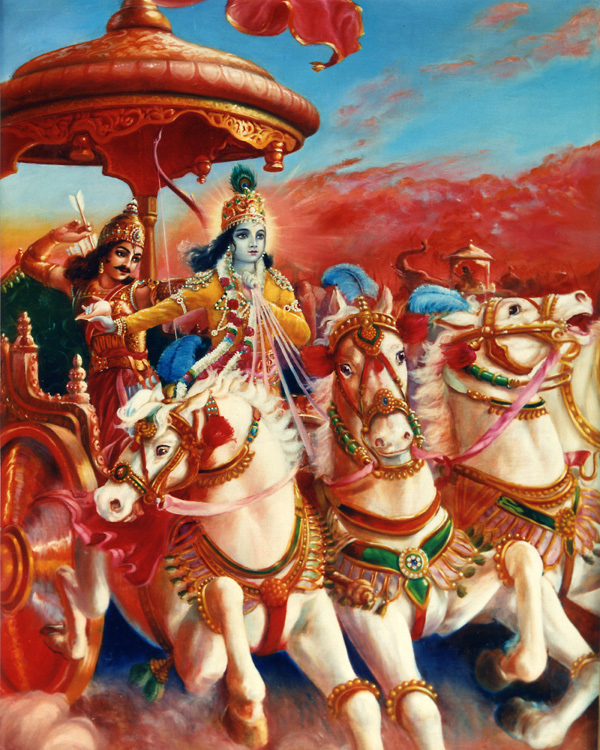
O son of Kuntī, either you will be killed on the battlefield and attain the heavenly planets, or you will conquer and enjoy the earthly kingdom. Therefore get up and fight with determination.
PURPORT
Even though there was no certainty of victory for Arjuna’s side, he still had to fight; for, even being killed there, he could be elevated into the heavenly planets.
TEXT 38
sukha-duḥkhe same kṛtvā
lābhālābhau jayājayau
tato yuddhāya yujyasva
naivaṁ pāpam avāpsyasi
sukha—happiness; duḥkhe—in distress; same—in equanimity; kṛtvā—doing so; lābhālābhau—both in loss and profit; jayājayau—both in defeat and victory; tataḥ—thereafter; yuddhāya—for the sake of fighting; yujyasva—do fight; na—never; evam—in this way; pāpam—sinful reaction; avāpsyasi—you will gain.
TRANSLATION
Do thou fight for the sake of fighting, without considering happiness or distress, loss or gain, victory or defeat-and, by so doing, you shall never incur sin.
PURPORT
Lord Kṛṣṇa now directly says that Arjuna should fight for the sake of fighting because He desires the battle. There is no consideration of happiness or distress, profit or gain, victory or defeat in the activities of Kṛṣṇa consciousness. That everything should be performed for the sake of Kṛṣṇa is transcendental consciousness; so there is no reaction to material activities. He who acts for his own sense gratification, either in goodness or in passion, is subject to the reaction, good or bad. But he who has completely surrendered himself in the activities of Kṛṣṇa consciousness is no longer obliged to anyone, nor is he a debtor to anyone, as one is in the ordinary course of activities. It is said:
devarṣi-bhutāpta-nṛṇāṁ pitṝṇāṁ
na kiṅkaro nāyamṛṇī ca rājan
sarvātmanā yaḥ śaraṇaṁ śaraṇyaṁ
gato mukundaṁ parihṛtya kartam
(Bhag. 11.5.41)
“Anyone who has completely surrendered unto Kṛṣṇa, Mukunda, giving up all other duties, is no longer a debtor, nor is he obliged to anyone-not the demigods, nor the sages, nor the people in general, nor kinsmen, nor humanity, nor forefathers.” That is the indirect hint given by Kṛṣṇa to Arjuna in this verse, and the matter will be more clearly explained in the following verses.
As the passengers file through the gate into the terminal, we all wait anxiously, wondering how Swamiji will look. Somehow, we cannot imagine him gaunt, disabled or feeble. It is difficult for us to accept that his body, the medium for his teaching, could in any way break down, in defiance of the great spiritual personality within.
He is the last off the plane, accompanied by Kirtanananda. Despite the severity of his stroke, he looks virtually unchanged, only a little weary. The girls rush toward him and burst into tears. We throw flowers taken from Golden Gate Park: rhododendrons and hibiscus. He smiles appreciatively, but says nothing, and this is strange. Instead of giving his usual airport talk, he looks to us to show him the direction out. He chants Hare Krishna softly, his fingers incessantly caressing the japa beads in the beadbag, counting the rounds.
Golden Gate Park is redolent with March flowers. The morning fog disperses early, and the days are cloudless and blue. Thousands continue to flock to San Francisco from the midwest and east, and our Sunday kirtans attract big crowds.
Sunday is always a day for strolling in the park, and as soon as we start ringing cymbals and chanting, people follow. Christian, Moslem, Jewish, Buddhist and ISKCON banners, flying from long poles, proclaim our ecumenism. We stake these in the field below Hippy Hill and set up the kettledrum. Haridas, Mukunda, Shyamasundar, Subal, and Upendra sit in a circle on the grass. We beat the rhythm slowly on the kettledrum, the cymbals clash, and the kelp horn announces the beginning of kirtan.
After we chant about an hour, Swamiji walks over from his apartment and enters the center of the circle, clapping his hands and dancing, appearing wonderfully bright in his saffron robes. He leads the chanting, playing his own personal set of cymbals, a large pair with slightly flared rims that resonate loudly. Although he is a half century older than everyone around him, his presence is dynamically youthful. As the kirtan soars, Swamiji is a child amongst children, dancing with hands upraised to the blue sky, placing one foot before the other, dipping slightly, encouraging everyone to dance.
January 17, 1967. When Swamiji descends from the plane and enters the San Francisco airport, he is greeted by a group of about fifty young people. As he is questioned by the press, he extends his usual transcendental invitations.
“We welcome everyone, in any condition of life, to come to our temple and hear the message of Krishna consciousness,” he says.
“Does that include Haight-Ashbury hippies and bohemians?” a reporter asks.
“Everyone, including you or anyone else,” Swamiji says. “Whatever you are—what you call an acid-head, or hippy, or whatever—what you are doesn’t matter. Once you are accepted for training, you will change.”
Remembering George Harrison
By Lokadrsti devi dasi
Haribol!
I’ll try to put it down in print.
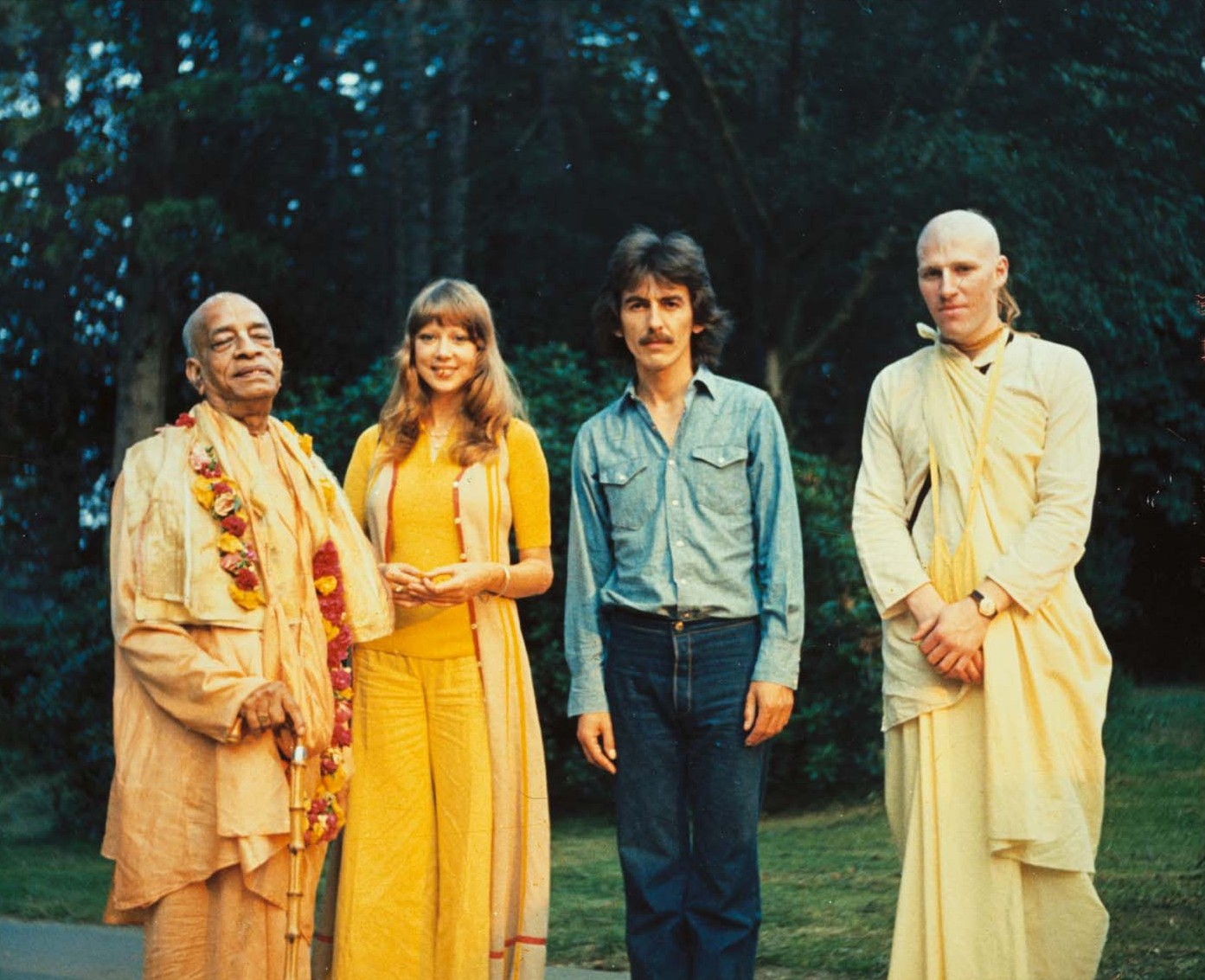
It was at Bhakitivedanta Manor in England 1993. The first Prabhupada reunion they had. So it was the first time the original devotees who went to England met up for the first time for 10 yrs. or more. Malati, Shyamasundar, Guru das, Mukunda Maharaja and alot of old Prabhupada disciples who had alot of association with Srila Prabhupada in England.
We had set up a large stage outside so everyone sat on the grass in the cow field. My service was decorating the stage to give it a more transcendental appearance. So I was a bit tired and sat at the back of all the devotees with my friend Bala Gopal to the left of me and my daughter, Sri Gandhari to the right.
Everyone was dressed in devotee garb so I noticed this person dressed in blue jeans and blue jean jacket and looked him straight in the eye. He seemed a little scared so I thought he was a new guest. Timidly, he sat right next to Sri Gandhari. Then my friend whispers “there’s George” and a fool as I am, says out loud ” George who?”











 The Hare Krishna Movement