04 Sep 2011
by The Hare Krishna Movement
in Devotional Service, Science of Self Realization, Srimati Radharani
Tags: Devotees in Vrndavana, His Divine Grace A.C. Bhaktivedanta Swami Prabhupada, Krishna, Madana-mohana-mohani, Nectar of Devotion, Radharani, Srimati Radharani

From; The Nectar of Devotion – 1970 Edition
By His Divine Grace A.C. Bhaktivedanta Swami Prabhupada
Attracting Krsna
Śrīla Rūpa Gosvāmī has stated that devotional service attracts even Kṛṣṇa. Kṛṣṇa attracts everyone, but devotional service attracts Kṛṣṇa. The symbol of devotional service in the highest degree is Rādhārāṇī. Kṛṣṇa is called Madana-mohana, which means that He is so attractive that He can defeat the attraction of thousands of Cupids. But Rādhārāṇī is still more attractive, for She can even attract Kṛṣṇa. Therefore devotees call Her Madana-mohana-mohanī-the attractor of the attractor of Cupid.
To perform devotional service means to follow in the footsteps of Rādhārāṇī, and devotees in Vṛndāvana put themselves under the care of Rādhārāṇī in order to achieve perfection in their devotional service. In other words, devotional service is not an activity of the material world; it is directly under the control of Rādhārāṇī. In Bhagavad-gītā it is confirmed that the mahātmās, or great souls, are under the protection of daivī prakṛti, the internal energy-Rādhārāṇī. So, being directly under the control of the internal potency of Kṛṣṇa, devotional service attracts even Kṛṣṇa Himself.
This fact is corroborated by Kṛṣṇa in the Eleventh Canto of Śrīmad-Bhāgavatam, 12th Chapter, 1st verse, where He says, “My dear Uddhava, you may know it from Me that the attraction I feel for devotional service rendered by My devotees is not to be attained even by the performance of mystic yoga, philosophical speculation, ritualistic sacrifices, the study of Vedānta, the practice of severe austerities or the giving of everything in charity. These are, of course, very nice activities, but they are not as attractive to Me as the transcendental loving service rendered by My devotees.”(from Nectar of Devotion: Chapter One, Characteristics of Pure Devotional Service, Attracting Krsna)
30 Aug 2011
by The Hare Krishna Movement
in Bhagavad-gita, Book Changes
Tags: Bhagavad-gita As It Is, His Divine Grace A.C. Bhaktivedanta Swami Prabhupada, Krsna, Krsna consciousness movement, Macmillan 1972 Edition

If personally I have any credit in this matter, it is only that I have tried to present Bhagavad-gītā as it is, without adulteration. Before my presentation of Bhagavad-gītā As It Is, almost all the English editions of Bhagavad-gītā were introduced to fulfill someone’s personal ambition. But our attempt, in presenting Bhagavad-gītā As It Is, is to present the mission of the Supreme Personality of Godhead, Kṛṣṇa.
Bhagavad-gita As It Is – Macmillan 1972 Edition
By His Divine Grace A. C. Bhaktivedanta Swami Prabhupada
Preface
Originally I wrote Bhagavad-gītā As It Is in the form in which it is presented now. When this book was first published, the original manuscript was, unfortunately, cut short to less than 400 pages, without illustrations and without explanations for most of the original verses of the Śrīmad Bhagavad-gītā. In all of my other books-Śrīmad Bhāgavatam, Śrī Īśopaniṣad, etc.-the system is that I give the original verse, its English transliteration, word-for-word Sanskrit-English equivalents, translations and purports. This makes the book very authentic and scholarly and makes the meaning self-evident. I was not very happy, therefore, when I had to minimize my original manuscript. But later on, when the demand for Bhagavad-gītā As It Is considerably increased, I was requested by many scholars and devotees to present the book in its original form, and Messrs. Macmillan and Co. agreed to publish the complete edition. Thus the present attempt is to offer the original manuscript of this great book of knowledge with full paramparā explanation in order to establish the Kṛṣṇa consciousness movement more soundly and progressively.
More
25 Aug 2011
by The Hare Krishna Movement
in Krishna, Spiritual World, Srimad Bhagavatam
Tags: bhakti-vedantas, His Divine Grace A.C. Bhaktivedanta Swami Prabhupada, Kali, Krsna, Sri Narada, Srimad Bhagavatam, transcendental pastimes, Vyasadeva

Srimad Bhagavatam
By His Divine Grace A.C. Bhaktivedanta Swami Prabhupada
Canto 1, Chapter 5, Text 26
The Lord descends on this material world out of His causeless mercy and displays His various transcendental pastimes as a human being so that human beings attracted towards Him become able to go back to Godhead.
O Vyāsadeva, in that association and by the mercy of those great Vedāntists, I could hear them describe the attractive activities of Lord Kṛṣṇa And thus listening attentively, my taste for hearing of the Personality of Godhead increased at every step.
Lord Śrī Kṛṣṇa, the Absolute Personality of Godhead, is attractive not only in His personal features, but also in His transcendental activities. It is so because the Absolute is absolute by His name, fame, form, pastimes, entourage, paraphernalia, etc. The Lord descends on this material world out of His causeless mercy and displays His various transcendental pastimes as a human being so that human beings attracted towards Him become able to go back to Godhead. Men are naturally apt to hear histories and narrations of various personalities performing mundane activities, without knowing that by such association one simply wastes valuable time and also becomes addicted to the three qualities of mundane nature. Instead of wasting time, one can get spiritual success by turning his attention to the transcendental pastimes of the Lord. By hearing the narration of the pastimes of the Lord, one contacts directly the Personality of Godhead, and, as explained before, by hearing about the Personality of Godhead, from within, all accumulated sins of the mundane creature are cleared. Thus being cleared of all sins, the hearer gradually becomes liberated from mundane association and becomes attracted to the features of the Lord. Nārada Muni has just explained this by his personal experience. The whole idea is that simply by hearing about the Lord’s pastimes one can become one of the associates of the Lord. Nārada Muni has eternal life, unlimited knowledge and unfathomed bliss, and he can travel all over the material and spiritual worlds without restriction. One can attain to the highest perfection of life simply by attentive hearing of the transcendental pastimes of the Lord from the right sources, as Śrī Nārada heard them from the pure devotees (bhakti-vedāntas) in his previous life. This process of hearing in the association of the devotees is especially recommended in this age of quarrel (Kali).
22 Aug 2011
by The Hare Krishna Movement
in Festivals, Srila Prabhupada, Vyas-puja
Tags: Founder Acarya of the International Society for Krishna Consciousness, His Divine Grace A.C. Bhaktivedanta Swami Prabhupada, spiritual master, Sri Vyasa Puja, Vyas-puja, Vyasasan das
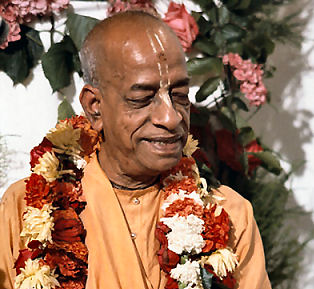
The Most Blessed Event
Sri Vyasa-Puja August 23rd, 2011
The Appearance Day of Our Beloved Spiritual Master
His Divine Grace A.C. Bhaktivedanta Swami Prabhupada
Founder Acarya of the International Society for Krishna Consciousness
Dear Srila Prabhupada
On this most auspicious day, please accept my humble obeisance’s, and kindly forgive my offences. Although I am and insignificant disciple of your Divine Grace, and full of faults, still I am constantly awaiting your causeless mercy to be bestowed upon me. I have never given up my faith, or my love, nor the hope that someday I may be a worthy disciple. As you know my daily prayers always include the words “please forgive my offences”, as I am always feeling myself unworthy to be receiving your mercy. Srila Prabhupada you have been the one constant in my entire adult life, my best friend and ever well wisher. And I remain chaste to you, my lord and master, unconditionally.
Today I was reading from the Letters books, and there was one letter dated November 12th, 1968 addressed to Malati that is the basis for my offering today. In this letter you said;
“Yes, we should always think of ourselves as the most fallen, the most ignorant and it is simply by the mercy of Lord Caitanya that we have even the opportunity to serve Krsna. We have no qualification of our own; it is simply by the merciful glance of this most munificent appearance of the Supreme Personality of Godhead, Sri Caitanya Mahaprabhu, that we have been given the chance to serve Radha and Krsna”
Due to your great humility, you give the credit to Lord Sri Caitanya, but I think it is simply by your mercy that we have received the benediction of Sri Caitanya. It was you who brought a trunk of Srimad Bhagavatams to the West, to open our eyes with the torchlight of knowledge. And it was you who first brought this Chanting of the Hare Krishna Mantra to Tomkins Square Park and due to your beautiful and pure chanting of the Holy Names of God caused the young Bramananda das to dance under the Hare Krishna Tree. It was you who turned the most fallen and most ignorant western hippies into vaisnava scholars and priests. It was simply by your munificent appearance and merciful glance, that the most fallen in this age were given the chance to know Lord Caitanya, and thus were given the chance to serve Radha and Krsna.
More
20 Aug 2011
by The Hare Krishna Movement
in Ajitananda das, Devotee's, Srila Prabhupada
Tags: 26 qualities of a pure devotee, Ajitananda das, His Divine Grace A.C. Bhaktivedanta Swami Prabhupada, Srila Prabhupada, trancendental qualities, Vyasa Puja

Srila Prabhupada’s Trancendental Qualities
By Ajitananda dasa
His Divine Grace A.C. Bhaktivedanta Swami Prabhupada, who successfully distributed the message of Lord Krsna throughout the world, was not an ordinary conditioned soul, governed by the harsh laws of material nature. Although to the unenlightened he may have appeared to exhibit commonplace characteristics, it is evident through the careful study of his life and activities, that Srila Prabhupada perfectly displayed the twenty-six qualities of a pure devotee of Lord Krsna. We learn from Vedic literature that one who possesses these qualities is necessarily free from material bondage, and enjoys an eternal position in the intimate association of the Supreme Lord. Such a great soul is very rarely found within this material realm, and owing to his unparalleled purity and exalted status, he is worshipable by the entire world. Individually, and as a collective society of aspiring devotees, we must always strive to appreciate Srila Prabhupada’s divine qualities, teach this application to others, and perform all of our devotional activities for his satisfaction. This treatise is an imperfect but hopeful attempt to please Srila Prabhupada by illustrating, in a practical way, how he perfectly displayed the twenty-six qualities of a pure devotee of Lord Krsna.
More
14 Jul 2011
by The Hare Krishna Movement
in Devotional Service, Krishna Consciousness, Nectar of Devotion
Tags: Bhakti-rasamrta-sindhu, causless mercy, devotional service, devotional service is ecstasy, His Divine Grace A.C. Bhaktivedanta Swami Prabhupada, Nectar of Devotion, pure love of Godhead, Srila Rupa Goswami

Nectar of Devotion
by His Divine Grace A. C. Bhaktivedanta Swami Prabhupāda
Chapter Two
We should always try to mold the activities of our lives in such a way that we will constantly remember Viṣṇu, or Kṛṣṇa. That is Kṛṣṇa consciousness. Whether one concentrates his mind on the four-handed form of Viṣṇu or on the form of two-handed Kṛṣṇa, it is the same. The Padma Purāṇa recommends: somehow or other always think of Viṣṇu, without forgetting Him under any circumstances. Actually this is the most basic of all regulative principles. For, when there is an order from a superior about doing something, there is simultaneously a prohibition. When the order is that one should always remember Kṛṣṇa, the prohibition is that one should never forget Him. Within this simple order and prohibition, all regulative principles are found complete.
The First Stages of Devotion
The three categories of devotional service which Śrīla Rūpa Gosvāmī describes in Bhakti-rasāmṛta-sindhu are listed as devotional service in practice, devotional service in ecstasy and devotional service in pure love of Godhead. There are many subheadings in each of these categories. Generally it is understood that in the category of devotional service in practice there are two different qualities, devotional service in ecstasy has four qualities, and devotional service in pure love of Godhead has six qualities. These qualities will be explained by Śrīla Rūpa Gosvāmī later on.
In this connection, Śrīla Rūpa Gosvāmī suggests that the person eligible for Kṛṣṇa consciousness, or devotional service, can be classified by his particular taste. He says that devotional service is a continual process from one’s previous life. No one can take to devotional service unless he has had some previous connection with it. For example, suppose in this life I practice devotional service to some extent. Even though it is not one-hundred-percent perfectly performed, whatever I have done will not be lost. In my next life, from the very point where I stop in this life, I shall begin again. In this way there is always a continuity. But even if there is no continuity, if only by chance a person takes interest in a pure devotee’s instruction, he can be accepted and can advance in devotional service. Anyway, for persons who have a natural taste for understanding books like Bhagavad-gītā and Śrīmad-Bhāgavatam, devotional service is easier than for those who are simply accustomed to mental speculation and argumentative processes.
More
06 Jul 2011
by The Hare Krishna Movement
in Diksha, Iskcon Bangalore, Siksa, The Struggle for Truth
Tags: battle over Iskcon Bangalore, current dispute, Diksha Guru, Founder Acharya, His Divine Grace A.C. Bhaktivedanta Swami Prabhupada, ISKCON Bangalore, ISKCON Mumbai, Madhu Pandit, ritvik, spiritual master
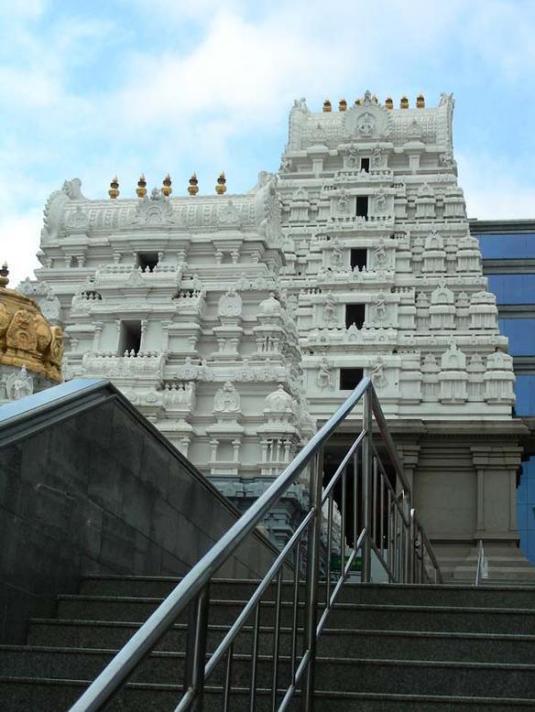
Communication to all stakeholders, regarding the current dispute between ISKCON Bangalore and ISKCON Mumbai
This communication is aimed at bringing into focus the core issue behind the current dispute between Iskcon Bangalore and Iskcon Mumbai, As a customer, donor, supplier, banker, faculty, consultant, employee or any other stakeholder in ISKCON Bangalore society, we believe you should be informed about the factual position of both disputing parties and be reassured about the safe guard of your interest in your relationship with ISKCON Bangalore.
From the time, His Divine Grace A.C.Bhaktivedanta Swami Prabhupada, reverentially addressed as Srila Prabhupada, founded ISKCON in New York in 1966, ISKCON grew into a large, transnational organization spanning many countries, having 108 centers and more than 10,000 members, in a matter of 10 years. This was due to the immense spiritual stature and vision of our Founder Acharya, Srila Prabhupada.
While the growth of the organization was impressive, in 1977, just prior to Srila Prabhupada’s leaving this world, it was a young organization and most of the members and devotees, mainly westerners, had not developed the required spiritual stature, knowledge, realization, immense purity and gravity that is required to occupy the post of his spiritual successor, as an “Acharya”.
More
30 Jun 2011
by The Hare Krishna Movement
in Krishna, Krishna Consciousness
Tags: Balarama, gopis, His Divine Grace A.C. Bhaktivedanta Swami Prabhupada, Krishna, Krsna, Krsna Book, Lord Caitanya, Siksastaka, The Supreme Personality of Godhead

Krishna Nectar
From; KRSNA, The Supreme Personality of Godhead – 1970 Edition
By; His Divine Grace A. C. Bhaktivedanta Swami Prabhupada
Chapter23
Delivering the Wives of the Brahmanas Who Performed Sacrifices
The brāhmaṇas’ wives saw Kṛṣṇa putting on a garment glittering like gold. He wore a nice garland of forest flowers and a peacock feather on His head. He was also painted with the minerals found in Vṛndāvana, and He looked exactly like a dancing actor on a theatrical stage. They saw Him keeping one hand on the shoulder of His friend, and in His other hand, He was holding a lotus flower. His ears were decorated with lilies, He wore marks of tilaka, and He was smiling charmingly. With their very eyes, the wives of the brāhmaṇas saw the Supreme Personality of Godhead, of whom they had heard so much, who was so dear to them, and in whom their minds were always absorbed. Now they saw Him eye to eye and face to face, and Kṛṣṇa entered within their hearts through their eyes.
…”For a long time the wives had been anxious to see Kṛṣṇa. However, when they were preparing to leave home to go see Him, their husbands, fathers, sons and relatives asked them not to go. But the wives did not comply. When a devotee is called by the attraction of Kṛṣṇa, he does not care for bodily ties. The women entered the forest of Vṛndāvana on the bank of the Yamunā, which was verdant with vegetation and newly grown vines and flowers. Within that forest, they saw Kṛṣṇa and Balarāma engaged in tending the cows, along with Their very affectionate boy friends.
More
26 Jun 2011
by The Hare Krishna Movement
in Caitanya Mahaprabhu, Festivals, Sri Caitanya-Caritamrta
Tags: Balarama, ecstatic dancing of Lord Caitanya, His Divine Grace A.C. Bhaktivedanta Swami Prabhupada, Lord Jaganath, Ratha-yatra, Sri Caitanya-carimrta, Sri Jagannatha, Subadra, Surpreme Personality of Godhead
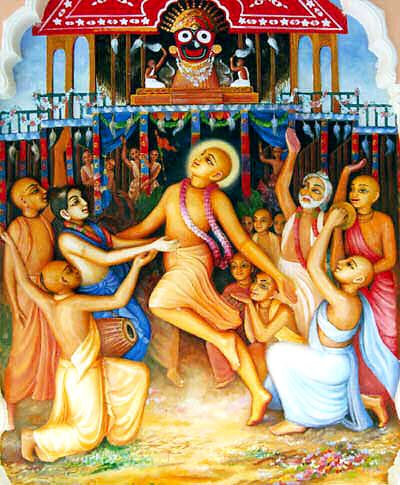
Śrī Caitanya-caritāmṛta: Madhya-līlā Text 1-69
By His Divine Grace A. C. Bhaktivedanta Swami Prabhupada
The Ecstatic Dancing of the Lord at Ratha-yātrā
May the Supreme Personality of Godhead, Śrī Kṛṣṇa Caitanya, who danced in front of the car of Śrī Jagannātha, be all glorified! By seeing His dancing, not only was the whole universe held in wonder, but Lord Jagannātha Himself became very much astonished.
All glories to Śrī Kṛṣṇa Caitanya and Prabhu Nityānanda! All glories to Advaitacandra! And all glories to the devotees of Lord Śrī Caitanya Mahāprabhu!
All glories to the listeners of Caitanya-caritāmṛta. Please hear the description of the dancing of Lord Caitanya Mahāprabhu at the Ratha-yātrā festival. His dancing is very enchanting. Please hear of it with great attention.
More
23 Jun 2011
by The Hare Krishna Movement
in Books by Srila Prabhupada, The Hare Krishna Movement
Tags: 1972 Macmillan edition, Arjuna, Bhagavad-gita As It Is, classic edition, Gita, His Divine Grace A.C. Bhaktivedanta Swami Prabhupada, India's Spiritual Wisdom, Lord Sri Krsna, The Hare Krishna Movement

“Classic Edition”
Bhagavad-gita As It Is
By His Divine Grace A. C. Bhaktivedanta Swami Prabhupada
The Original “Classic” 1972 Bhagavad-gita “As It Is” In High Quality Hard Bound Cover.
This is the compact , Complete Edition of Srila Prabhupada’s 1972 Macmillan edition. This edition is the most widely read Gita in the world. Written by His Divine Grace A.C. Bhaktivedanta Swami Prabhupada, who is the world’s foremost Vedic scholar and teacher. He represents an unbroken chain of fully self-realized spiritual masters beginning with Lord Krsna Himself. Thus, unlike other editions of the Gita, his edition conveys Lord Krsna’s profound message as it is-without the slightest taint of adulteration or personally motivated change. Replete with sixteen full-color plates, this new edition is certain to stimulate and enlighten any reader with its ancient yet thoroughly timely teachings.
Bhagavad-gita is universally renowned as the jewel of India’s spiritual wisdom. Spoken by Lord Sri Krsna, the Supreme Personality of Godhead, to His intimate devotee Arjuna, the Gita’s seven hundred concise verses provide a definitive guide to the science of self-realization. Indeed, no work even compares in its revelations of man’s essential nature, his environment and, ultimately, his relationship with God.
Special Features
• Original Sanskrit Text
• English transliterations for each Sanskrit word
• Elaborate commentary
• Complete glossary
• Complete verse index
• High readability
• Profuse full-color illustrations
Original 1972 Complete edition. With translations and elaborate purports by His Divine Grace A.C. Bhaktivedanta Swami Prabhupada.
Hard-cover, 981 pages, 48 color plates. 5″ x 7.5″
Note; Also available in High Quality Soft Bound or Hard Bound, Wholesale by the case!!!
Shop on-line at http://www.theharekrishnamovement.com
17 Jun 2011
by The Hare Krishna Movement
in Krsna is the Source of All Incarnations
Tags: bhagavad-gita, birth, death, Garbhodakasayi, His Divine Grace A.C. Bhaktivedanta Swami Prabhupada, innumerable universes, Karanodakasayi, Krsna Is The Source of All Incarnations, Ksirodakasayi Visnu, old age disease, Personality of Godhead, Srimad Bhagavatam

Śrīmad-Bhāgavatam: Canto 1: “Creation”
By: His Divine Grace A. C. Bhaktivedanta Swami Prabhupada
Chapter 3
Kṛṣṇa Is the Source of All Incarnations
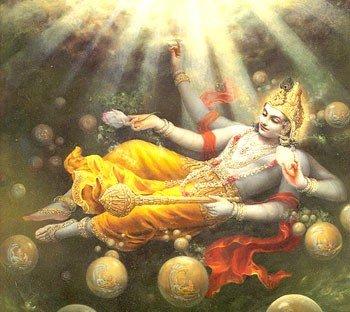
Therefore, the conclusion is that the puruṣa-avatāra is manifested in three features — first the Kāraṇodakaśāyī who creates aggregate material ingredients in the mahat-tattva, second the Garbhodakaśāyī who enters in each and every universe, and third the Kṣīrodakaśāyī Viṣṇu who is the Paramātmā of every material object, organic or inorganic. One who knows these plenary features of the Personality of Godhead knows Godhead properly, and thus the knower becomes freed from the material conditions of birth, death, old age and disease, as it is confirmed in Bhagavad-gītā.
Chapter 3
TEXT 2
yasyāmbhasi śayānasya
yoga-nidrāṁ vitanvataḥ
nābhi-hradāmbujād āsīd
brahmā viśva-sṛjāṁ patiḥ
SYNONYMS
yasya—whose; ambhasi—in the water; śayānasya—lying down; yoga-nidrām—sleeping in meditation; vitanvataḥ—ministering; nābhi—navel; hrada—out of the lake; ambujāt—from the lotus; āsīt—was manifested; brahmā—the grandfather of the living beings; viśva—the universe; sṛjām—the engineers; patiḥ—master.
TRANSLATION
A part of the puruṣa lies down within the water of the universe, from the navel lake of His body sprouts a lotus stem, and from the lotus flower atop this stem, Brahmā, the master of all engineers in the universe, becomes manifest.
PURPORT
The first puruṣa is the Kāraṇodakaśāyī Viṣṇu. From His skin holes innumerable universes have sprung up. In each and every universe, the puruṣa enters as the Garbhodakaśāyī Viṣṇu. He is lying within the half of the universe which is full with the water of His body. And from the navel of Garbhodakaśāyī Viṣṇu has sprung the stem of the lotus flower, the birthplace of Brahmā, who is the father of all living beings and the master of all the demigod engineers engaged in the perfect design and working of the universal order. Within the stem of the lotus there are fourteen divisions of planetary systems, and the earthly planets are situated in the middle. Upwards there are other, better planetary systems, and the topmost system is called Brahmaloka or Satyaloka. Downwards from the earthly planetary system there are seven lower planetary systems inhabited by the asuras and similar other materialistic living beings.
From Garbhodakaśāyī Viṣṇu there is expansion of the Kṣīrodakaśāyī Viṣṇu, who is the collective Paramātmā of all living beings. He is called Hari, and from Him all incarnations within the universe are expanded.
Therefore, the conclusion is that the puruṣa-avatāra is manifested in three features — first the Kāraṇodakaśāyī who creates aggregate material ingredients in the mahat-tattva, second the Garbhodakaśāyī who enters in each and every universe, and third the Kṣīrodakaśāyī Viṣṇu who is the Paramātmā of every material object, organic or inorganic. One who knows these plenary features of the Personality of Godhead knows Godhead properly, and thus the knower becomes freed from the material conditions of birth, death, old age and disease, as it is confirmed in Bhagavad-gītā, In this śloka the subject matter of Mahā-Viṣṇu is summarized. The Mahā-Viṣṇu lies down in some part of the spiritual sky by His own free will. Thus He lies on the ocean of kāraṇa, from where He glances over His material nature, and the mahat-tattva is at once created. Thus electrified by the power of the Lord, the material nature at once creates innumerable universes, just as in due course a tree decorates itself with innumerable grown fruits. The seed of the tree is sown by the cultivator, and the tree or creeper in due course becomes manifested with so many fruits. Nothing can take place without a cause. The Kāraṇa Ocean is therefore called the Causal Ocean. Kāraṇa means “causal.” We should not foolishly accept the atheistic theory of creation. The description of the atheists is given in the Bhagavad-gītā. The atheist does not believe in the creator, but he cannot give a good theory to explain the creation. Material nature has no power to create without the power of the puruṣa, just as a prakṛti, or woman, cannot produce a child without the connection of a puruṣa, or man. The puruṣa impregnates, and the prakṛti delivers. We should not expect milk from the fleshy bags on the neck of a goat, although they look like breastly nipples. Similarly, we should not expect any creative power from the material ingredients; we must believe in the power of the puruṣa, who impregnates prakṛti, or nature. Because the Lord wished to lie down in meditation, the material energy created innumerable universes at once, in each of them the Lord lay down, and thus all the planets and the different paraphernalia were created at once by the will of the Lord. The Lord has unlimited potencies, and thus He can act as He likes by perfect planning, although personally He has nothing to do. No one is greater than or equal to Him. That is the verdict of the Vedas.
More
05 Jun 2011
by The Hare Krishna Movement
in A.C. Bhaktivedanta Swami Prabhupada, The Nectar of Instruction, Upadesamrta
Tags: anger, Gaudiya Vaisnavas, goswamis, His Divine Grace A.C. Bhaktivedanta Swami Prabhupada, knowledge, Sri Caitanya Mahaprabhu, Srila Rupa Goswami, The Nectar of Instruction, Upadesamrta

…anger can be controlled. We cannot stop anger altogether, but if we simply become angry with those who blaspheme the Lord or the devotees of the Lord, we control our anger in Kṛṣṇa consciousness. Lord Caitanya Mahāprabhu became angry with the miscreant brothers Jagāi and Mādhāi, who blasphemed and struck Nityānanda Prabhu. In His Śikṣāṣṭaka Lord Caitanya wrote, tṛṇād api sunīcena taror api sahiṣṇunā: “One should be humbler than the grass and more tolerant than the tree.” One may then ask why the Lord exhibited His anger. The point is that one should be ready to tolerate all insults to one’s own self, but when Kṛṣṇa or His pure devotee is blasphemed, a genuine devotee becomes angry and acts like fire against the offenders.
The Nectar Of Instruction
By His Divine Grace A.; C. Bhaktivedanta Swami Prabhupada
Text One
More
25 May 2011
by The Hare Krishna Movement
in Bhagavad-gita
Tags: Arjuna, as it is, Battlefield of Kuruksetra, bhagavad-gita, Bhismadeva, Draupadi, Dronacarya, His Divine Grace A.C. Bhaktivedanta Swami Prabhupada, Krishna, Kurus, Pandavas

Bhagavad-gita As It Is
By His Divine Grace A.C. Bhaktivedanta Swami Prabhupada
Observing the Armies on the Battlefield of Kurukṣetra
Duryodhana clearly felt that the victory of the Kurus depended on the presence of Bhīṣmadeva. He was confident of the full support of Bhīṣmadeva and Droṇācārya in the battle because he well knew that they did not even speak a word when Arjuna’s wife Draupadī, in her helpless condition, had appealed to them for justice while she was being forced to strip naked in the presence of all the great generals in the assembly.
…it is already concluded that all of them would die in the Battle of Kurukṣetra for joining the party of the sinful Duryodhana. Duryodhana was, of course, confident of his victory on account of the above-mentioned combined strength of his friends.
TEXT 1
TRANSLATION
Dhṛtarāṣṭra said: O Sañjaya, after assembling in the place of pilgrimage at Kurukṣetra, what did my sons and the sons of Pāṇḍu do, being desirous to fight?
PURPORT
Bhagavad-gītā is the widely read theistic science summarized in the Gītā-māhātmya (Glorification of the Gītā). There it says that one should read Bhagavad-gītā very scrutinizingly with the help of a person who is a devotee of Śrī Kṛṣṇa and try to understand it without personally motivated interpretations. The example of clear understanding is there in the Bhagavad-gītā itself, in the way the teaching is understood by Arjuna, who heard the Gītā directly from the Lord. If someone is fortunate enough to understand Bhagavad-gītā in that line of disciplic succession, without motivated interpretation, then he surpasses all studies of Vedic wisdom, and all scriptures of the world. One will find in the Bhagavad-gītā all that is contained in other scriptures, but the reader will also find things which are not to be found elsewhere. That is the specific standard of the Gītā. It is the perfect theistic science because it is directly spoken by the Supreme Personality of Godhead, Lord Śrī Kṛṣṇa.
The topics discussed by Dhṛtarāṣṭra and Sañjaya, as described in the Mahābhārata, form the basic principle for this great philosophy. It is understood that this philosophy evolved on the Battlefield of Kurukṣetra, which is a sacred place of pilgrimage from the immemorial time of the Vedic age. It was spoken by the Lord when He was present personally on this planet for the guidance of mankind.
The word dharma-kṣetra (a place where religious rituals are performed) is significant because, on the Battlefield of Kurukṣetra, the Supreme Personality of Godhead was present on the side of Arjuna. Dhṛtarāṣṭra, the father of the Kurus, was highly doubtful about the possibility of his sons’ ultimate victory. In his doubt, he inquired from his secretary Sañjaya, “What did my sons and the sons of Pāṇḍu do?” He was confident that both his sons and the sons of his younger brother Pāṇḍu were assembled in that Field of Kurukṣetra for a determined engagement of the war. Still, his inquiry is significant. He did not want a compromise between the cousins and brothers, and he wanted to be sure of the fate of his sons on the battlefield. Because the battle was arranged to be fought at Kurukṣetra, which is mentioned elsewhere in the Vedas as a place of worship—even for the denizens of heaven—Dhṛtarāṣṭra became very fearful about the influence of the holy place on the outcome of the battle. He knew very well that this would influence Arjuna and the sons of Pāṇḍu favorably, because by nature they were all virtuous. Sañjaya was a student of Vyāsa, and therefore, by the mercy of Vyāsa, Sañjaya was able to envision the Battlefield of Kurukṣetra even while he was in the room of Dhṛtarāṣṭra. And so, Dhṛtarāṣṭra asked him about the situation on the battlefield.
Both the Pāṇḍavas and the sons of Dhṛtarāṣṭra belong to the same family, but Dhṛtarāṣṭra’s mind is disclosed herein. He deliberately claimed only his sons as Kurus, and he separated the sons of Pāṇḍu from the family heritage. One can thus understand the specific position of Dhṛtarāṣṭra in his relationship with his nephews, the sons of Pāṇḍu. As in the paddy field the unnecessary plants are taken out, so it is expected from the very beginning of these topics that in the religious field of Kurukṣetra where the father of religion, Śrī Kṛṣṇa, was present, the unwanted plants like Dhṛtarāṣṭra’s son Duryodhana and others would be wiped out and the thoroughly religious persons, headed by Yudhiṣṭhira, would be established by the Lord. This is the significance of the words dharma-kṣetre and kuru-kṣetre, apart from their historical and Vedic importance.
TEXT 14
TRANSLATION
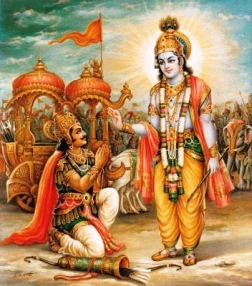
On the other side, both Lord Kṛṣṇa and Arjuna, stationed on a great chariot drawn by white horses, sounded their transcendental conchshells.
PURPORT
In contrast with the conchshell blown by Bhīṣmadeva, the conchshells in the hands of Kṛṣṇa and Arjuna are described as transcendental. The sounding of the transcendental conchshells indicated that there was no hope of victory for the other side because Kṛṣṇa was on the side of the Pāṇḍavas. Jayas tu pāṇḍu-putrāṇāṁ yeṣāṁ pakṣe janārdanaḥ. Victory is always with persons like the sons of Pāṇḍu because Lord Kṛṣṇa is associated with them. And whenever and wherever the Lord is present, the goddess of fortune is also there because the goddess of fortune never lives alone without her husband. Therefore, victory and fortune were awaiting Arjuna, as indicated by the transcendental sound produced by the conchshell of Viṣṇu, or Lord Kṛṣṇa. Besides that, the chariot on which both the friends were seated was donated by Agni (the fire-god) to Arjuna, and this indicated that this chariot was capable of conquering all sides, wherever it was drawn over the three worlds.
15 May 2011
by The Hare Krishna Movement
in Book Distribution, Books by Srila Prabhupada
Tags: His Divine Grace A.C. Bhaktivedanta Swami Prabhupada, Prabhupada books, Science of Self Realization, wholesale books

The Science of Self Realization
By His Divine Grace A.C. Bhaktivedanta Swami Prabhupad
This High Quality Hard Bound is a reproduction of the book first published by the Bhaktivedanta Book Trust in 1977
In this book you will discover the timeless science of the soul, information on practicing yoga and meditation in this Age l, finding the cure for todays social ills, choosing a spiritual master, understanding Krsna and Christ, and reaching life’s perfectional stage.
4×7 hardbound
360 pages
Appendixes: About the Author, Glossary, Guide to Sanskrit Pronunciation, and Index, 44 to the case!
Wholesale Price of $130.00 per case
Available for sale on line at; http://www.theharekrishnamovement.com
10 May 2011
by The Hare Krishna Movement
in Books by Srila Prabhupada, Srimad Bhagavatam
Tags: His Divine Grace A.C. Bhaktivedanta Swami Prabhupada, original pre-1978, Set, Srila Prabhupada wholesale, Srimad Bhagavatam
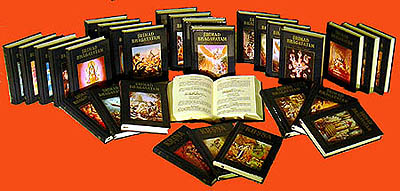 Srimad Bhagavatam Compact 30 Vol 1977 Edition
Cantos 1-9, plus the Original Krsna Book in 3 Volumes comprising the 10th Canto
Srimad Bhagavatam , an “Epic Philosophical and Literary Classic”, holds a prominent position in India’s voluminous written wisdom. The timeless wisdom of India is expressed in the Vedas, ancient Sanskrit texts that touch upon all fields of human knowledge. Originally preserved through oral tradition, the Vedas were first put into writing by Srila Vyasadeva, the “literary incarnation of God.” After compiling the Vedas, Srila Vyasadeva was inspired by his spiritual master to present their profound essence in the form of Srimad-Bhagavatam. Known as “the ripened fruit of the tree of Vedic Literature, Srimad-Bhagavatam is the most complete and authoritative exposition of Vedic Knowledge.
This 12,000 page, 30 vol. set, comes in High Quality Hard Bound 5×7 size. with over 600 beautiful full color plates.
For a limited time selling at the reduced Wholesale rate of $149.95
No home library is complete without a set.
Get one today!
Go to http://www.theharekrishnamovement.com To buy a set online!
14 Apr 2011
by The Hare Krishna Movement
in Diksha, Disciplic succession, Guru & Disciple, Siksa
Tags: Founder Acarya, GBC, Hare Krishna, Hare Krishna Society, His Divine Grace A.C. Bhaktivedanta Swami Prabhupada, Iskcon, July 9th Letter, krishnaconsciousnessmovement.com, Krsna consciousness movement, prabhupadanugas, Will

I, A.C. Bhaktivedanta Swami Prabhupada, founder-acarya of the International Society for Krishna consciousness, Settlor of the Bhaktivedanta Book Trust, and disciple of Om Visnupada 108 Sri Srimad Bhaktisiddhanta Sarasvati Gosvami Maharaja Prabhupada, presently residing at Sri Krsna-Balarama Mandir in Vrndavana, make this my last will:
ANALYSIS OF SRILA PRABHUPADA’S LAST WILL AND JULY 9TH LETTER
Dear Maharajas and Prabhus,
Please accept my humble obeisances. All glories to Srila Prabhupada.
We would like to present two papers signed and approved by His Divine Grace Srila Prabhupada. The will of His Divine Grace and his last instructions for continuing the process of initiation. We ask only that you read the following statements of Srila Prabhupada with an open heart. Instead of analyzing his words to fit today’s circumstances, try to take these instructions just as they have been written. Without reading between the lines, try simply to accept his words. Rather than imagining esoteric meanings try to understand his commands, as they are. Srila Prabhupada often said that Krishna Consciousness is a simple process. The instructions that he gave us were always straightforward and clear. His language was never obscure or lacking in explanation. If something was important he always gave us a clear cut presentation. Before reading these last instructions of Srila Prabhupada’s, try to take to heart the following explanation from Caitanya Caritamrita on the nature of direct and indirect meanings. In it, Srila Prabhupada, Srila Bhaktisiddhanta Sarasvati Thakura and Lord Chaitanya, clearly explain the difference between a true understanding and an imaginary interpretation.
More
23 Mar 2011
by The Hare Krishna Movement
in A.C. Bhaktivedanta Swami Prabhupada, Poetry of Srila Prabhupada, Viraha Astaka, Vyas-puja
Tags: Dasaratha-suta das, Hindu ceremonies, His Divine Grace A.C. Bhaktivedanta Swami Prabhupada, Lord Nityananda, materialists, maya, Poetry of Srila Prabhupada, Sankirtan mission, Srila Bhaktisiddhanta Saraswati Goswami Thakur

Viraha Astaka
By His Divine Grace A.C. Bhaktivedanta Swami Prabhupada
Recently translated and published from the Bengali into English by Dasaratha-suta dasa, the following is an offering of eight prayers to Srila Prabhupada’s spiritual master, His Divine Grace Srila Bhaktisiddhanta Saraswati Goswami Thakur, composed sometime in December, 1958.
First Octet: The Flood of Krishna Prema
1) O Srila Prabhupada! You personally suffer
to see the suffering
of the fallen conditioned souls.
On this anniversary of your separation
I am utterly despondent.
2) “The ocean of mercy was previously held back by a dam,
but Lord Nityananda personally cut a channel in it
and thereby released the outpouring flood
of pure ecstatic love of God.”
(from Lochana dasa’s song “Nitai Guna Mani”)
3) Those devotees to whom the responsiblity was given
to continue spreading this flood of love
somehow became overpowered by Maya
and were thus reduced to simply performing
ritualistic Hindu ceremonies
for the benefit of the materialists.
More
25 Feb 2011
by The Hare Krishna Movement
in Teachings of Pralada Maharaja
Tags: bhakti yoga, devotional service, His Divine Grace A.C. Bhaktivedanta Swami Prabhupada, krsna consciousness, liberation, material world, sense enjoyment, spiritual happiness, Transcendental Teachings of Prahlada Maharja
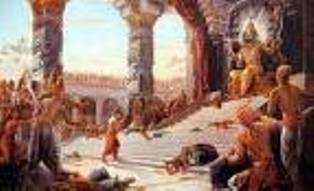
Transcendental Teachings of Prahlāda Mahārāja
by His Divine Grace A. C. Bhaktivedanta Swami Prabhupāda
Chapter 2
“We Are Spoiling Our Lives”
Therefore, instead of being very anxious to stimulate our senses to increase material happiness, we should try to attain spiritual happiness by practicing Kṛṣṇa consciousness. As Prahlāda Mahārāja says, “Although your life in this human body is temporary, it is very valuable. So instead of trying to increase your material sense enjoyment, your duty is to dovetail your activities in some way in Kṛṣṇa consciousness.”
Our higher intelligence comes with his human body. Because we have higher consciousness, we should try for the higher enjoyment in life, which is spiritual enjoyment. And how can that spiritual enjoyment be achieved? One should absorb himself in serving the Supreme Lord, who gives the pleasure of liberation. We should turn our attention to achieving the lotus feet of Kṛṣṇa, who can give us liberation from this material world.
More
Next Newer Entries










 The Hare Krishna Movement