One of the most used books in our temple room is the songbook. Everyday it seems, I am flipping through the “Songs of the Vaisnava Acaryas”, singing one of the many songs or reciting some of the numerous pranams (prayers) as part of my daily sadhana. The following post is the first 13 pages of songbook, which in my mind is a nice way to start the day and is a good prelude to other devotional service.
Pranams from the Songs of the Vaisnava Acaryas
SRI GURU PRANAMA
om ajnana-timirandhasya jnananjana-salakaya caksur unmilitam yena tasmai sri-gurave namah
om-address; ajnana-of ignorance; timira-by the darkness; andhasya-of one who was blinded; jnana-anjana-by the ointment of spiritual knowledge; salakaya-by a medical instrument called a salaka, which is used to apply medical ointment to eyes afflicted with cataracts: caksuh-eyes; unmilitam-were opened; yena-by whom; tasmai-unto him; sri-gurave-unto my spiritual master; namah-obeisances.
I offer my respectful obeisances unto my spiritual master, who has opened my eyes, which were blinded by the darkness of ignorance, with the torchlight of knowledge.
SRI RUPA PRANAMA
sri-caitanya-mano-‘bhistam sthapitum yena bhtu-tale svayam rupah kada mahyam dadati sva-padantikam
sri-caitanya-of Lord Caitanya; manah- mind; abhistam-what is desired; sthapitam-established; yena-by whom; bhu-tale-on the surface of the globe; svayam-himself; rupah-Srila Rupa Gosvami; kada-when; mahyam-unto me; dadati-will give; sva-his own; pada-lotus feet; antikam-proximity to.
When will Srila Rupa Gosvami Prabhupada, who has established within this material world the mission to fulfill the desire of Lord Caitanya, give me shelter under his lotus feet?
MANGALACARANA
vande ‘ham sri-guroh sri-yuta-pada-kamalam sri-gurun vaisnavams’ ca sri-rupam sagrajatam saha-gana-raghunathanvitam tam sa jivam sadvaitam savadhutam parijana-sahitam krsna-caitanya-devam sri-radha-krsna-padan saha-gana-lalita-sri-visakhanvitams’ ca
vande–offer my respectful obeisances; aham–I; sri-guroh–of my spiritual master; sri-yuta-pada-kamalam–unto the lotus feet; sri-gurun–unto the spiritual masters; vaisnavan–unto all the Vaisnavas; ca–and; sri-rupam–unto Srila Rupa Gosvami; sa-agra-jatam–with his elder brothers Sri Sanatana Gosvami; saha-gana-raghunatha-anvitam–with Raghunatha Dasa Gosvami and his associates; tam–unto him; sajivam–with Jiva Gosvami; sa- advaitam–with Advaita Acarya; sa-avadhutam–with Nityananda Prabhu; parijana-sahitam–and with Srivasa Thakura and all the other devotees; krsna-caitanya-devam–unto Lord Sri Caitanya Mahaprabhu; sri-radha-krsna-padan–unto the lotus feet of Radha and Krsna, saha-gana–with associates; lalita-sri-visakha-anvitan–accompanied by Lalita and Sri Visakha; ca–also.
“I offer my respectful obeisances unto the lotus feet of my spiritual master and unto the feet of all Vaisnavas. I offer my respectful obeisances unto the lotus feet of Srila Rupa Gosvaml, along with his elder brother Sanatana Gosvami, as well as Raghunatha Dasa , Raghunatha Bhatta, Gopal Batta and Srila Jiva Gosvami. I offer my respectful obeisances to Lord Sri Caitanya Mahaprabhu and Lord Nityananda along with Advaita Acarya, Gadadhara, Srivasa, and other associates. I offer my respectful obeisances to Srimati Radharani and Sri Krsna along with Their associates Sri Lalita and Visakha.”
Happy New Year to all are readers. Wishing you all a prosperous new year filled with happiness and love. And may your Krishna Consciousness increase with each passing day.
When I think of New Years, I am reminded of what a short time a year is in the greater scheme of eternity. In the Bhagavad-gita there is a brief description of the duration of time in the material universe.
…The duration of the material universe is limited. It is manifested in cycles of kalpas. A kalpa is a day of Brahmā, and one day of Brahmā consists of a thousand cycles of four yugas or ages: Satya, Tretā, Dvāpara, and Kali. The cycle of Satya is characterized by virtue, wisdom and religion, there being practically no ignorance and vice, and the yuga lasts 1,728,000 years. In the Tretā-yuga vice is introduced, and this yuga lasts 1,296,000 years. In the Dvāpara-yuga there is an even greater decline in virtue and religion, vice increasing, and this yuga lasts 864,000 years. And finally in Kali-yuga (the yuga we have now been experiencing over the past 5,000 years) there is an abundance of strife, ignorance, irreligion and vice, true virtue being practically nonexistent, and this yuga lasts 432,000 years. (from purport Bg 8.17)
Even if I could grasp the extent of time in the material universe, that is just a fraction of the unlimited eternal time that continues after the termination of the yuga.
…Then the process is set rolling again. These four yugas, rotating a thousand times, comprise one day of Brahmā, the creator god, and the same number comprise one night. Brahmā lives one hundred of such “years” and then dies. These “hundred years” by earth calculations total to 311 trillion and 40 million earth years. By these calculations the life of Brahmā seems fantastic and interminable, but from the viewpoint of eternity it is as brief as a lightning flash. In the causal ocean there are innumerable Brahmās rising and disappearing like bubbles in the Atlantic. Brahmā and his creation are all part of the material universe, and therefore they are in constant flux. (from purport Bg 8.17)
The above calculations Srila Prabhupada uses and I quote;
…seems fantastic and interminable, but from the viewpoint of eternity it is as brief as a lightning flash.
When we were in Butler PA, this summer for thefor the 60th aniversary of Srila Prabhupada’s arrival in the USA, We visited the home of Sally Agarwal, where Srila Prabhupada first stayed as their guest when he arrived in America. We heard many sweet stories of his stay in Butler, and how Sally’s daughter referred to Srila Prabhupada as Swami Jesus.
…I am obliged to your good daughter for awarding me a good degree as SWAMIJESUS which is actually a great honour for me. Some time the Lord speaks through innocent child and I take this honour as sent by Lord Jesus through an innocent child free from all formalities of the current society. Lord Jesus preached the message of God and I have taken up the same mission, and it would be a good luck for me if I can follow the foot prints of Lord Jesus who preached the message of God in spite of all persecution. Lord Jesus is a living example how one has to suffer in this material world simply for the matter of preaching the message of God… (letter to Sally Agarwal)
His Divine Grace Śrīla Bhaktisiddhānta Sarasvatī Gosvāmī Prabhupāda’s Disappearance Day, Lecture By His Divine Grace A. C. Bhaktivedanta Swami Prabhupāda Los Angeles, December 13, 1973
Prabhupāda:
nama oṁ viṣṇu-pādāyakṛṣṇa-preṣṭhāya bhūtaleśrīmate bhaktisiddhāntasarasvatīti nāmine
Bhaktisiddhānta Sarasvatī Ṭhākura passed away from this material world on 31st December, 1936. So almost forty years past. So there are two phases, prakaṭa and aprakaṭa, appearance and disappearance. So we have nothing to lament on account of disappearance because Kṛṣṇa and Kṛṣṇa’s devotee… Not only devotees, even the nondevotees, nobody disappears. Nobody disappears because every living entity… As Kṛṣṇa is eternal… It is confirmed in the Vedic literature, nityo nityānāṁ cetanaścetanānām. The description of the Supreme Lord is that He is also nitya, eternal, and the living entities are also eternal. But He is the chief eternal. Nityo nityānāṁ cetanaś cetanānām. So qualitatively, there is no difference between Kṛṣṇa and the living entities. And quantitatively, there is difference. What is the difference between nitya, the singular number nitya, and the plural number nitya? The plural number nitya is subordinate, eternal servants of the singular number nitya. Just like if you want to serve somebody, so the master is also exactly like you. He has got two hands, two legs, or the same sentiments. He also eats. Everything is same there. But the difference is the master and the servant. That’s all. Otherwise, equal in every respect.
A Summary of Srila Prabhupada’s Miraculous Accomplishments from 1965 to 1977
In reading many of the profiles of Srila Prabhupada, I’m saddened that a number of his important projects, programs and achievements are never mentioned. In the following summary I’ve tried to compile a more comprehensive list of his credits. Although this list is also incomplete, I hope it presents a fuller picture of Srila Prabhupada’s greatness.
In 1965, at seventy years of age, he ventured outside India for the first time to fulfill the order of his spiritual master. During his voyage at sea, he suffered two severe heart attacks. He reached the shores of America with virtually no money to his name.
He founded the International Society for Krsna Consciousness with a small group of disciples, after a year of struggling alone in New York City. This marked the only time in history that a Krsna devotee successfully trained non-Indians in the strict disciplines of Vaisnavism. Amazingly, this was achieved during the blossoming of America’s hedonistic counterculture movement.
He sent his followers, chanting the names of God, into the streets of cities and towns everywhere and Hare Krsna became famous in every corner of the earth.
So today we honor the Disappearance Day of our Srila Prabhupada. We honor this day with a half day fast and remembrances.
He reasons ill who says that Vaiṣṇavas die, When thou art living still in sound! The Vaiṣṇavas die to live, and living try To spread the holy name around.
Srila Prabhupada is still present through his words and instructions. We would like to share with youthe following speech was delivered in 1936 Bombay by the pure devotee who three decades later will become the world-renowned spiritual master of The Hare Krishna Movement. Abhay Charan das who latter becomes His Divine Grace A.C. Bhaktivedanta Swami Prabhupada glorifies his own spiritual master Śrīla Bhaktisiddhānta Sarasvatī Goswami Maharaja with this Appearance day (Vyasa-puja) homage. Thus we learn the time-honored meaning of spiritual master, disciple and their relationship.
Chanting the Maha Mantra, or the great “chant for deliverance”, is very easy, and can be preformed anywhere, anytime. Srila Prabhupada has said “from your lips to your ears”, it is that easy. It is the kind of yoga (union), or meditation, one can easily practice anywhere, anytime.
Chanting of the Hare Kṛṣṇa mantra is the easiest process of meditation. (from purport to Srimad Bhagavatam 4.8.53)
No other means of spiritual realization is as effective in this age of quarrel and hypocrisy as the chanting of the mahā-mantra: Hare Kṛṣṇa, Hare Kṛṣṇa, Kṛṣṇa Kṛṣṇa, Hare Hare / Hare Rāma, Hare Rāma, Rāma Rāma, Hare Hare. (BTG #30 1970)
Chanting the Hare Kṛṣṇa Mantra
(appeared as a separate pamphlet in 1967 and reproduced from the article “On Chanting the Hare Krishna Mantra” published in the 1970 Back to Godhead Magazine number 34)
“This simplest method of meditation is recommended for this age. By practical experience also, one can perceive that by chanting this mahā-mantra, or the Great Chanting for Deliverance, one can feel a transcendental ecstasy coming through from the spiritual stratum.”
I had to laugh, this came up on my Whats Up App. I followed this with some quotes from Srila Prabhupada on the definition of Paramahamsa.
“We are such lucky souls! Prabhupada was giving class and began to define Paramahamsa and their qualities: swanlike men who are so spiritually exalted that they appear like swans among the ravens and crow-like men. Then he looked at the devotees sitting in front of him and smiled his smile and he said, “And who knows, among you there may be some Paramahamsa’s. And, then he gave an even bigger smile that included all of us and said, “And, the rest of you are just lucky ducks.”
Today marks the disappearance day of Srila Bhaktivinoda Thakura. We honor it with a half day fast followed by a nice vegetarian feast. We share with you one of my favorite songs composed by Srila Bhaktivinoda.
When, oh when, will that day be mine? When my offenses ceasing, taste for the name increasing, when in my heart will your mercy shine? When, oh when will that day be mine?
Lower than a blade of grass, more tolerant than a tree. When will my mind attain this quality? Respectful to all, not expecting their honour, then shall I taste the name’s nectar sublime. When oh when will that day be mine?
jaya–all glories to: rādhā-mādhava–Rādhā and the Lord of sweetness; kuñja-bihārī–He who enjoys loving pastimes in the groves of Vṛndāvana; gopī-jana-vallabha–the lover of the cowherd maidens of Vraja; giri-vara-dhārī–the holder of the great hill named Govardhana;
Krsna is the lover of Radha. He displays many amorous pastimes in the groves of Vrndavana, He is the lover of the cowherd maidens of Vraja, and the holder of the great hill named Govardhana.
yaśodā-nandana–the beloved son of mother Yaśodā; vraja-jana-rañjana–the delighter of the inhabitants of Vraja; yāmuna-tīra-vana-cārī–who wanders in the forests along the banks of the river Yamunā
He is the beloved son of mother Yasoda, the delighter of the inhabitants of Vraja, and He wanders in the forests along the banks of the River Yamuna!
This is a nice description of Lord Kṛṣṇa’s transcendental counchshell, and of how He was received by the citizens of Dvārakā. Beautiful!
Sūta Gosvāmī said: Upon reaching the border of His most prosperous metropolis, known as the country of the Ānartas [Dvārakā], the Lord sounded His auspicious conchshell, heralding His arrival and apparently pacifying the dejection of the inhabitants.
The white and fat-boweled conchshell, being gripped by the hand of Lord Kṛṣṇa and sounded by Him, appeared to be reddened by the touch of His transcendental lips. It seemed that a white swan was playing in the stems of red lotus flowers.
The citizens of Dvārakā, having heard that sound which threatens fear personified in the material world, began to run towards Him fast, just to have a long desired audience with the Lord, who is the protector of all devotees.
…The sound heralded by Lord Kṛṣṇa was something like the heralding of the sunrise in the morning. This sound of the Lord is identical with the Lord. We are always fearful due to our ignorance of the next problem. The whole material existence is full of problems, and thus the fear problem is always prominent. This is due to our association with the illusory energy of the Lord, known as māyā or external energy, yet all fear is vanished as soon as there is the sound of the Lord, represented by His holy name, as it was sounded by Lord Śrī Caitanya Mahāprabhu in the following sixteen words:
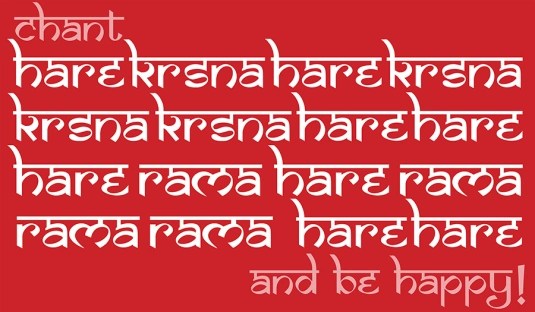
Hare Kṛṣṇa, Hare Kṛṣṇa, Kṛṣṇa Kṛṣṇa, Hare Hare Hare Rāma, Hare Rāma, Rāma Rāma, Hare Hare
We can take advantage of these sounds and be free from all threatening problems of material existence.
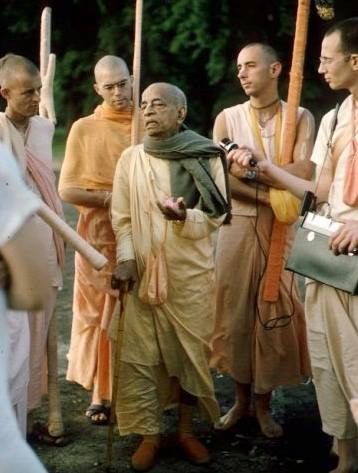
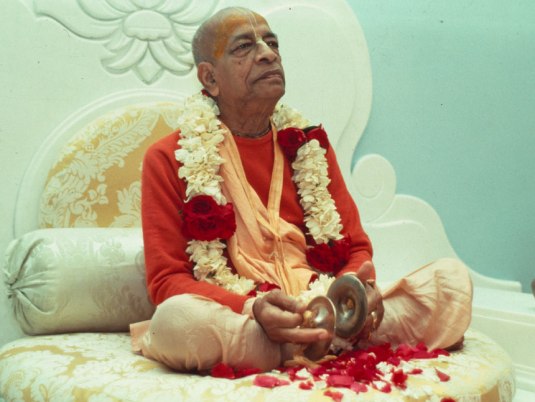
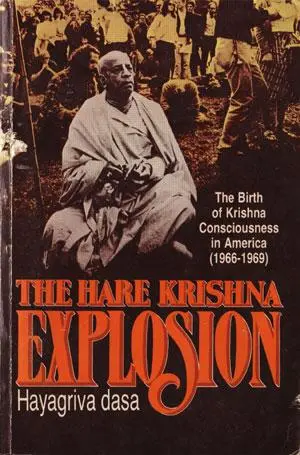
I’m sure everyone has a favorite picture of Srila Prabhupada, I particularly like this one in the morning when I am chanting Japa. It reminds me of the promise I made to chant every day.
When a mantra or hymn is chanted softly and slowly, that is called japa. The same mantra, when chanted loudly, is called kīrtana. For example, the mahā-mantra (Hare Kṛṣṇa, Hare Kṛṣṇa, Kṛṣṇa Kṛṣṇa, Hare Hare/ Hare Rāma, Hare Rāma, Rāma Rāma, Hare Hare) when uttered very softly only for one’s own hearing is called japa. The same mantra, when chanted loudly for being heard by all others, is called kīrtana. The mahā-mantra can be used for japa and kīrtana also. When japa is practiced it is for the personal benefit of the chanter, but when kīrtana is performed it is for the benefit of all others who may hear.
In the Padma Purāṇa there is a statement: “For any person who is chanting the holy name either softly or loudly, the paths to liberation and even heavenly happiness are at once open.” (Nectar of Devotion Chapter 9)
Of all the sacrifices, the chanting of Hare Kṛṣṇa, Hare Kṛṣṇa, Kṛṣṇa Kṛṣṇa, Hare Hare/ Hare Rāma, Hare Rāma, Rāma Rāma, Hare Hare is the purest representation of Kṛṣṇa. (from purport; Bhagavad-gita 10.25)
At various times people have called him a scholar, a philosopher, a cultural ambassador, a prolific author, a religious leader, a spiritual teacher, a social critic, and a holy man. In truth, he was all these things and more.
Over five hundred years ago, Lord Sri Krishna appeared as Sri Chaitanya Mahaprabhu in Navadvipa, a village in West Bengal. The purpose of His appearance was to inaugurate the Sankirtana Movement, the Yuga Dharma for this age of Kali. He declared that the chanting of His holy names would spread beyond the shores of India to every town and village in the world. He predicted that His commander-in-chief would appear to accomplish this mission.
Yes… Srila Prabhupada appeared to fulfill this prophecy.
Recently, while discussing Srila Prabhupada and his glories with a younger devotee, I was surprised to hear him say, “You’re so lucky. You got Srila Prabhupada, but what about us?” Startled by hearing such a despondent remark by a newcomer who should be brimming with hope and enthusiasm in Krsna consciousness, I proceeded to explain that Srila Prabhupada is, in fact, as present now as he has ever been. Throughout his books, letters and conversations, Srila Prabhupada emphasized this point again and again, so there should be no cause for misunderstanding.
In 1975, when asked by a reporter in Berkeley what would happen to the movement after his departure, Srila Prabhupada replied, “I will never die. I will live forever in my books.” In the Caitanya-caritamrta (Adi-lila 1.35, purport), Srila Prabhupada explains, “There is no difference between the spiritual master’s instructions and the spiritual master himself.” Further assuring us all, Prabhupada spoke the following words just prior to his departure in 1977: “If I depart, there is no cause for lamentation. I will always be with you through my books and my orders. I will always remain with you in that way.”
I have been reading the Krsna Book lately, and just yesterday we were reading chapter 14 “Prayers Offered by Lord Brahma to Lord Krsna”, and I was reminded this was the last chapter Srila Prabhupada was working on in the Srimad Bhagavatam series before his passing. So I had another look at the Tenth Canto, part 3, and thought it a good idea to share it with all our readers.
This is the final Śrīmad-Bhāgavatam volume translated by His Divine Grace A. C. Bhaktivedanta Swami Prabhupada, Founder-Acarya of the International Society for Krishna Consciousness, before his untimely departure. We share it with you as a free PDF download. You can click on the above link to view the complete volume or save it to your computer.
Foward
This is the final Śrīmad-Bhāgavatam volume translated by His Divine Grace A. C. Bhaktivedanta Swami Prabhupada, founder-acarya of the International Society for Krishna Consciousness. It is smaller than the earlier volumes because it ends where the renowned author stopped translating just before his departure from this mortal world on November 14, 1977, at the Krsna-Balarama Mandira in Vrndavana, India.
The first part of this volume was produced in the usual fashion. Srila Prabhupada would sit and read silently from the Sanskrit text and then speak the translation and commentary into his dictaphone. Later, due to illness, it became necessary for his disciples to assist him personally.
In these last days Srila Prabhupada was gravely ill. Unable to eat for weeks, his health had deteriorated, making even the slightest movement excruciatingly painful.
As he lay still, a devotee would softly read the Sanskrit to him. Another disciple, sitting on his bed, held the microphone to him, nearly touching his mouth. And then Srila Prabhupada would speak, voice sometimes barely audible.
These recordings, made in his quarters at the temple, constitute the balance of this book.
In these final moments, the physician attending His Divine Grace confided that an ordinary man in such critical condition would have been crying out from the intense pain. Srila Prabhupada’s disciples were awestruck as they watched their spiritual master work quietly, undisturbed.
In the last part of the book we find Srila Prabhupada’s usual clarity of thought, constant scriptural references, scrupulous attention to detail, and rigorous philosophical exposition fully intact, just as they were in the preceding twenty-nine volumes of the Śrīmad-Bhāgavatam.
Srila Prabhpada’s last days and this translation will stands an inspiring reminder that even the severest material circumstances cannot impede the activities of a pure devotee of the Supreme Personality of Godhead.
“I liked Prabhupada’s humbleness. I always liked his humility and his simplicity. The servant of the servant of the servant is really what it is, you know. None of us are God—just His servants. He just made me feel so comfortable. I always felt very relaxed with him, and I felt more like a friend. I felt that he was a good friend. Even though he was at the time seventy-nine years old, working practically all through the night, day after day, with very little sleep, he still didn’t come through to me as though he was a very highly educated intellectual being, because he had a sort of childlike simplicity. Which is great, fantastic. Even though he was the greatest Sanskrit scholar and a saint, I appreciated the fact that he never made me feel uncomfortable. In fact, he always went out of his way to make me feel comfortable. I always thought of him as sort of a lovely friend, really, and now he’s still a lovely friend.
“That was the thing about Prabhupada, you see. He didn’t just talk about loving Krishna and getting out of this place, but he was the perfect example. He talked about always chanting, and he was always chanting. I think that that in itself was perhaps the most encouraging thing for me. It was enough to make me try harder, to be just a little bit better. He was a perfect example of everything he preached.
For many of us we struggle to chant our prescribed 16 rounds of japa daily. I know for me it is a daily struggle, if I wake up to late, if I am traveling, if I am sick, or have a headache, or just feeling lazy and unmotivated. But I try.
This morning my japa was pretty good, I felt inspired, and I was knocking of the rounds rather effortlessly, and I was thinking about Haridas Thakur who daily chanted 300,000 names or about 175 rounds. I can’t even imagine. But I felt inspired by thinking about him, and wanted to do a post about him. -V
“Haridāsa Ṭhākura is known as nāmācārya because it is he who preached the glories of chanting hari-nāma, the holy name of God.”
“Haridas Thakur chanted 3 lakhs of names each day, that means 16 names in the mantra, 108×16 or 1,728 names in each round of mala, dividing 300,000 by 1,728 comes to roundabout 175 rounds on beads daily. And for us it is even difficult to chant 16 rounds! That is why Haridas Thakur is namacharya. We find in Chaitanya Charitamrta information that both Lord Chaitanya and Haridas Thakur were constantly absorbed in chanting the Hare Krishna mantra: Hare Krishna, Hare Krishna, Krishna Krishna Hare Hare/ Hare Rama Hare Rama Rama Rama Hare Hare.” (Srila Prabhupada Letter, January 2, 1972)
I remember years ago when I was just a young new devotee, and we were asked to go out and distribute books, we were asked so many questions by people we met. One question I will never forget; “What does the mantra mean?” How to explain this to someone who has never heard of Krishna? So I replied; “O Lord please engage me in Your loving devotional service”. Even as a new devotee I knew there was more I could have said, but I left it at that.
But that basic question always stayed with me.
Hare Krishna, Hare Krishna, Krishna Krishna, Hare Hare, Hare Rama, Hare Rama, Rama Rama, Hare Hare
Another definition I discovered is;
Hare– Srimati Radharini (the divine energy of the Lord)
Krishna– The All Attractive Supreme Personality of Godhead
Rama– Name of Lord Krishna who is the reservoir of pleasure. (as in Radha-Ramana, the giver of pleasure to Srimati Radharani) The name Rama also means Lord Ramacandra, and Lord Balarama.
But for me, I like this verse I discovered in my reading;
“O Srimati Radharani, O All Attractive Reservoir of Pleasure, Lord Sri Krishna, please engage me in your loving devotional service”
This morning this verse kept going through my head:
Whatever inauspicious things I have done out of ignorance or unknowingly, please forgive that, and accept me as Your insignificant servant.
I had a hard time remembering where it came from. Then I remembered it was from the Sri Aparada-shodhana prayers. So I share them with you again. Hare Krishna!
Sri Aparadha-shodhana (Verses for Requesting Forgiveness for One’s Offences)
mantra-hinam kriya-hinam bhakti-hinam janardana yat pujitam maya deva paripurnam tad astu me
O my Lord, O Janardana, whatever little puja or worship that has been performed by me, although it is without devotion, without proper mantras, and without the proper performance, please let that become complete.














 The Hare Krishna Movement