06 Jun 2012
by The Hare Krishna Movement
in Uncategorized
Tags: 1972 Macmillan edition, A.C. Bhaktivedanta Swami Prabhupada, Arjuna, as it is, bhagavad-gita, Contents of the Gita Sumarized, Krishna, Krishna consciousness, Krsna, Madhusudana, material compassion, real self, Sanjaya, self realization
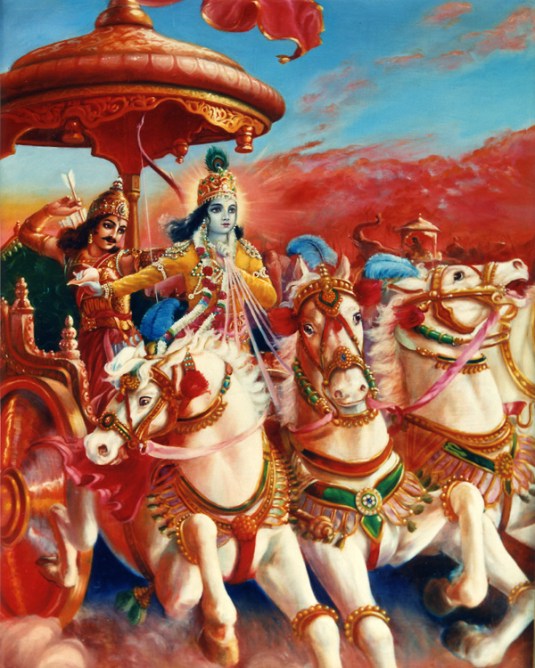
As this is a very long chapter we are posting it in two parts. Today we are posting text 1-35, and tomorrow we will conclude the chapter entitled “Contents of the Gita Summarized”
Bhagavad-gita As It Is 1972 Macmillan Edition
By His Divine Grace A.C. Bhaktivedanta Swami Prabhupada
Chapter Two, Text and Purports 1-35
Contents of the Gita Summarized
TEXT 1
sañjaya uvāca
taṁ tathā kṛpayāviṣṭam
aśru-pūrṇākulekṣaṇam
viṣīdantam idaṁ vākyam
uvāca madhusūdanaḥ
sañjayaḥ uvāca—Sañjaya said; tam—unto Arjuna; tathā—thus; kṛpayā—by compassion; āviṣṭam—overwhelmed; aśru-pūrṇa—full of tears; ākula—depressed; īkṣaṇam—eyes; viṣīdantam—lamenting; idam—this; vākyam—words; uvāca—said; madhusūdanaḥ—the killer of Madhu.
TRANSLATION
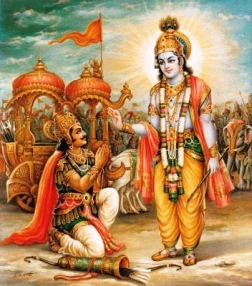
Sañjaya said: Seeing Arjuna full of compassion and very sorrowful, his eyes brimming with tears, Madhusūdana, Kṛṣṇa, spoke the following words.
PURPORT
Material compassion, lamentation and tears are all signs of ignorance of the real self. Compassion for the eternal soul is self-realization. The word “Madhusūdana” is significant in this verse. Lord Kṛṣṇa killed the demon Madhu, and now Arjuna wanted Kṛṣṇa to kill the demon of misunderstanding that had overtaken him in the discharge of his duty. No one knows where compassion should be applied. Compassion for the dress of a drowning man is senseless. A man fallen in the ocean of nescience cannot be saved simply by rescuing his outward dress-the gross material body. One who does not know this and laments for the outward dress is called a śūdra, or one who laments unnecessarily. Arjuna was a kṣatriya, and this conduct was not expected from him. Lord Kṛṣṇa, however, can dissipate the lamentation of the ignorant man, and for this purpose the Bhagavad-gītā was sung by Him. This chapter instructs us in self-realization by an analytical study of the material body and the spirit soul, as explained by the supreme authority, Lord Śrī Kṛṣṇa. This realization is made possible by working with the fruitive being situated in the fixed conception of the real self.
More
25 May 2012
by The Hare Krishna Movement
in Krishna Consciousness, Lectures, Practicing Krishna Consciousness at Home
Tags: A.C. Bhaktivedanta Swami Prabhupada, Bg 7.8, bhagavad-gita, everywhere is Krishna, I am the light of Sun and Moon, I am the taste of water, Krishna consciousness, raso ham apsu kunteya, remembering Krishna, simple meditation, Srila Prabhupada, Srimad Bhagavatam

…Thus when a devotee drinks water or any other liquid, he immediately remembers Kṛṣṇa. For a devotee there is no difficulty in awakening Kṛṣṇa consciousness twenty-four hours a day. If you simply drink water, and practice the simple meditation of remembering that Krishna says in the Bhagavad-gita 7.8 “raso ‘ham apsu kaunteya prabhāsmi śaśi-sūryayoḥ”, “I am the taste of water, the light of the sun and the moon”. It is easy to remember Krishna (God)
Is there any land within this universe where there is no sunshine, moonshine? Everywhere. So where is the difficulty to become Kṛṣṇa conscious? You are practicing meditation. Why not this simple meditation?
“How I can think of Kṛṣṇa constantly? Kṛṣṇa says that you think of Kṛṣṇa while drinking water, you think of Kṛṣṇa when you see the sunshine, think of Kṛṣṇa when you see the moonshine, day and night. So at daytime there is sunshine, at night there is moonshine. So day and night you can think of Kṛṣṇa. So, so many ways…
Because our only business is to remember Kṛṣṇa. That we can do any stage of life. It does not require that you have to become a brāhmaṇa, an Indian, and so on, so on, great learned scholar in Vedic scripture. No. You may be in the far away country, in Europe, America, or you may not be in brāhmaṇa family. It doesn’t matter. But you can remember Kṛṣṇa. We are teaching this art through Kṛṣṇa consciousness, that you may remain in whichever position Kṛṣṇa has put you. It doesn’t matter. But try to understand Kṛṣṇa. “How can I understand?” Well, you are drinking water. You can understand Kṛṣṇa. Where is the difficulty? Raso ‘ham apsu kaunteya [Bg. 7.8]. Kṛṣṇa says that “I am the taste of water.” Then where there is a person who does not drink water? Is there any land where people do not drink water? Is there any land?
So many ways we can remember Kṛṣṇa always.
A devotee who has purified his existence through devotional service sees only Kṛṣṇa in every step of life. (Paraphrased from Lecture by His Divine Grace A.C. Bhaktivedanta Swami Prabhupada given in Vrndavan India August 17, 1974)
Full Bhagavad-gita verse 7.8 and Lecture follow More
22 May 2012
by The Hare Krishna Movement
in Teachings of Queen Kunti
Tags: A.C. Bhaktivedanta Swami Prabhupada, Arjuna, Asvatthama, bhagavad-gita, Bhima, Bhisma, cannibals, Devaki, Draupadi, Drona, Dronacarya, exile in the forest, Karna, Kunti, Lord Krishna, man-eater Hidimba, My devotee is never vanquished, Pandavas, Queen Kunti, sons of Pandu, Srila Prabhupada, Teachings of Queen Kunti

…Here Kuntī remembers all the dangers through which she passed before the Pāṇḍavas regained their kingdom. In Bhagavad-gītā Lord Kṛṣṇa says, kaunteya pratijānīhi na me bhaktaḥ praṇaśyati: “My dear Arjuna, you may declare to the world that My devotee is never vanquished.” The Pāṇḍavas, the sons of Pāṇḍu, were great devotees of Lord Kṛṣṇa, but because people in the material world are interested in material things, the Pāṇḍavas were put into many dangers. Their materialistic uncle Dhṛtarāṣṭra was always planning to kill them and usurp the kingdom for his own sons. That was his policy from the very beginning.
Teachings of Queen Kunti
By His Divine Grace A.C. Bhaktivedanta Swami Prabhupada
Chapter 7
Dangerous Encounters
viṣān mahāgneḥ puruṣāda-darśanād
asat-sabhāyā vana-vāsa-kṛcchrataḥ
mṛdhe mṛdhe ’neka-mahārathāstrato
drauṇy-astrataś cāsma hare ’bhirakṣitāḥ
My dear Kṛṣṇa, Your Lordship has protected us from a poisoned cake, from a great fire, from cannibals, from the vicious assembly, from sufferings during our exile in the forest, and from the battle where great generals fought. And now You have saved us from the weapon of Aśvatthāmā.
—Śrīmad-Bhāgavatam 1.8.24
The list of dangerous encounters is submitted herein. Devakī was once put into difficulty by her envious brother, otherwise she was well. But Kuntīdevī and her sons were put into one difficulty after another for years and years together. They were put into trouble by Duryodhana and his party due to the kingdom, and each and every time the sons of Kuntī were saved by the Lord. Once Bhīma was administered poison in a cake, once they were put into the house made of shellac and set afire, and once Draupadī was dragged out, and attempts were made to insult her by stripping her naked in the vicious assembly of the Kurus. The Lord saved Draupadī by supplying an immeasurable length of cloth, and Duryodhana’s party failed to see her naked. Similarly, when they were exiled in the forest, Bhīma had to fight with the man-eater demon Hiḍimba Rākṣasa, but the Lord saved him. So it was not finished there. After all these tribulations, there was the great Battle of Kurukṣetra, and Arjuna had to meet such great generals as Droṇa, Bhīṣma, and Karṇa, all powerful fighters. And at last, even when everything was done away with, there was the brahmāstra released by the son of Droṇācārya to kill the child within the womb of Uttarā, and so the Lord saved the only surviving descendant of the Kurus, Mahārāja Parīkṣit.
More
16 May 2012
by The Hare Krishna Movement
in Karma
Tags: A.C. Bhaktivedanta Swami Prabhupada, action and reaction, as it is, bhagavad-gita, cause and effect, karma, law of karma, Urdhvaga das, yoga philosophy

This begins a new series on Karma (cause and effect) which was compiled by Urdhvaga Prabhu, based on the teachings of the Bhagavad-gita As It Is by His Divine Grace A.C. Bhaktivedanta Swami Prabhupada. Urdhvaga Prabhu has kindly allowed us to reprint it here.
The Law of Karma – cause and effect
Karma is the great law of “cause and effect”, of “action and reaction”, which controls the destiny of all living entities.
This great law functions on the principle, that any action performed produces an equal and opposite reaction, which directly influences our very existence.
Karma, like time and gravity, is a universal principle and every one is effected by its influence. While the law of physics applies to the interaction of material objects only, the law of karma however, applies to any action performed by living entities and governs the interrelations of all living beings. The state laws for example, are grossly observed; but the law of material nature [karma] being subtle to our gross understanding, cannot be experienced grossly or understood by mental speculation.
The law of karma states, that every action performed in life creates another reaction which in turn produces a new counter action. Thus an endless chain of actions and reactions is produced which binds the living entity to his good and bad deeds. This is the way how karma works. It creates an action and another reaction simultaneously and this increases the chain of material activities, keeping the performer in material bondage.
More
26 Apr 2012
by The Hare Krishna Movement
in Bhagavad-gita
Tags: A.C. Bhaktivedanta Swami Prabhupada, Arjuna, Bg. 1, bhagavad-gita, Dhrtarastra, disciplic succession, Gita, gita-mahatmya, Glorification of the Gita, Krishna, Lord Sri Krsna, Sanjaya, scriptures, theistic science, Vedic wisdom

Dhrtarastra inquires from Sanjaya
We are posting the First Chapter of the Original Bhagavad-gita As It Is 1972 Macmillian Edition complete with the corresponding pictures.
Bhagavad-gita As It Is 1972 Edition
By His Divine Grace A.C. Bhaktivedanta Swami Prabhupada
Chapter 1: Observing the Armies on the Battlefield of Kuruksetra
TEXT 1
dhṛtarāṣṭra uvāca
dharma-kṣetre kuru-kṣetre
samavetā yuyutsavaḥ
māmakāḥ pāṇḍavāś caiva
kim akurvata sañjaya
dhṛtarāṣṭraḥ—King Dhṛtarāṣṭra; uvāca—said; dharma-kṣetre—in the place of pilgrimage; kuru-kṣetre—in the place named Kurukṣetra; samavetāḥ—assembled; yuyatsavaḥ—desiring to fight; māmakāḥ—my party (sons); pāṇḍavāḥ—the sons of Pāṇḍu; ca—and; eva-certainly; kim—what; akurvata—did they do; sañjaya—O Sañjaya.
TRANSLATION
Dhṛtarāṣṭra said: O Sañjaya, after assembling in the place of pilgrimage at Kurukṣetra, what did my sons and the sons of Pāṇḍu do, being desirous to fight?
PURPORT
Bhagavad-gītā is the widely read theistic science summarized in the Gītā-māhātmya (Glorification of the Gītā). There it says that one should read Bhagavad-gītā very scrutinizingly with the help of a person who is a devotee of Śrī Kṛṣṇa and try to understand it without personally motivated interpretations. The example of clear understanding is there in the Bhagavad-gītā itself, in the way the teaching is understood by Arjuna, who heard the Gītā directly from the Lord. If someone is fortunate enough to understand Bhagavad-gītā in that line of disciplic succession, without motivated interpretation, then he surpasses all studies of Vedic wisdom, and all scriptures of the world. One will find in the Bhagavad-gītā all that is contained in other scriptures, but the reader will also find things which are not to be found elsewhere. That is the specific standard of the Gītā. It is the perfect theistic science because it is directly spoken by the Supreme Personality of Godhead, Lord Śrī Kṛṣṇa.
The topics discussed by Dhṛtarāṣṭra and Sañjaya, as described in the Mahābhārata, form the basic principle for this great philosophy. It is understood that this philosophy evolved on the Battlefield of Kurukṣetra, which is a sacred place of pilgrimage from the immemorial time of the Vedic age. It was spoken by the Lord when He was present personally on this planet for the guidance of mankind.
More
13 Apr 2012
by The Hare Krishna Movement
in Krishna, Krishna Consciousness, The Hare Krishna Movement, The Reservoir of Pleasure
Tags: A.C. Bhaktivedanta Swami Prabhupada, bhagavad-gita, devotional service, His Divine Grace, Krishna consciousness, Krsna The Reservoir of Pleasure, pure consciousness, real life, real pleasure, Sri Krsna

Kṛṣṇa, the Reservoir of Pleasure
by His Divine Grace A. C. Bhaktivedanta Swami Prabhupāda
Kṛṣṇa—this sound is transcendental. Kṛṣṇa means the highest pleasure. All of us, every living being, seeks pleasure. But we do not know how to seek pleasure perfectly. With a materialistic concept of life, we are frustrated at every step in satisfying our pleasure because we have no information regarding the real level on which to have real pleasure. For the last few weeks we have been learning that we are not this body; we are consciousness. Not exactly consciousness, for consciousness is actually the symptom of our real identity: we are pure soul, now merged within this material body. Modern material science lays no stress on this; therefore the scientists are sometimes misled in their understanding of spirit soul. But spirit soul is a fact, which anyone can understand by the presence of consciousness. Any child can understand that consciousness is the symptom of the spirit soul.
Now the whole process we are trying to learn from the Bhagavad-gītā (The Song of God) is how to bring ourselves to this level of consciousness. And if we act from the level of consciousness, then we may not be pushed again into the level of this bodily conception; and, if we can continue on that level, if we can continue to act in pure consciousness, then, at the end of this body we shall be free from material contamination, our spiritual life will be revived, and the ultimate result will be that in our next life, after leaving this body, we shall have our full, eternal spiritual life. Spirit, as we have already discussed, is described as eternal.
More
10 Apr 2012
by The Hare Krishna Movement
in Bhagavad-gita, Devotional Service, Free Downloads, Raja-Vidya
Tags: Arjuna, Bg. 9.2, bhagavad-gita, books by Srila Prabhupada, chanting Hare Krishna, confidential knowledge, devotional service, Krishna, Raja-Vidya

click on link at bottom for a free download on entire book to read online or save in pdf format
…It is said that the execution of devotional service is so perfect that one can perceive the results directly. This direct result is actually perceived, and we have practical experience that any person who is chanting the holy names of Kṛṣṇa (Hare Kṛṣṇa, Hare Kṛṣṇa, Kṛṣṇa Kṛṣṇa, Hare Hare/ Hare Rāma, Hare Rāma, Rāma Rāma, Hare Hare)in course of time feels some transcendental pleasure and very quickly becomes purified of all material contamination. This is actually seen. Furthermore, if one engages not only in hearing but in trying to broadcast the message of devotional activities as well, or if he engages himself in helping the missionary activities of Kṛṣṇa consciousness, he gradually feels spiritual progress. This advancement in spiritual life does not depend on any kind of previous education or qualification. The method itself is so pure that by simply engaging in it one becomes pure.
Bhagavada-gita As It Is Macmillan Edition 1975
By His Divine Grace A.C. Bhaktivedanta Swami Prabhupada
Chapter 9, Text 2
rāja-vidyā rāja-guhyaṁ
pavitram idam uttamam
pratyakṣāvagamaṁ dharmyaṁ
su-sukhaṁ kartum avyayam
rāja-vidyā—the king of education; rāja-guhyam—the king of confidential knowledge; pavitram—the purest; idam—this; uttamam—transcendental; pratyakṣa—directly experienced; avagamam—understood; dharmyam—the principle of religion; susukham—very happy; kartum—to execute; avyayam—everlasting.
This knowledge is the king of education, the most secret of all secrets. It is the purest knowledge, and because it gives direct perception of the self by realization, it is the perfection of religion. It is everlasting, and it is joyfully performed.
Purport
This chapter of Bhagavad-gītā is called the king of education because it is the essence of all doctrines and philosophies explained before. There are seven principal philosophers in India: Gautama, Kaṇāda, Kapila, Yājñavalkya, Śāṇḍilya, Vaiśvānara, and, finally, Vyāsadeva, the author of the Vedānta-sūtra. So there is no dearth of knowledge in the field of philosophy or transcendental knowledge. Now the Lord says that this Ninth Chapter is the king of all such knowledge, the essence of all knowledge that can be derived from the study of the Vedas and different kinds of philosophy. It is the most confidential because confidential or transcendental knowledge involves understanding the difference between the soul and the body. And the king of all confidential knowledge culminates in devotional service.
More
09 Apr 2012
by The Hare Krishna Movement
in A.C. Bhaktivedanta Swami Prabhupada, Back to Godhead, The Hare Krishna Movement, Varnasrama Dharma
Tags: back to Godhead, bhagavad-gita, Hindu, Krsna Balarama Mandir, Lord Caitanya, Ramananda Raya, Srila Prabhupada, The Hare Krishna Movement, varnasrama dharma, varnasrama-dharma
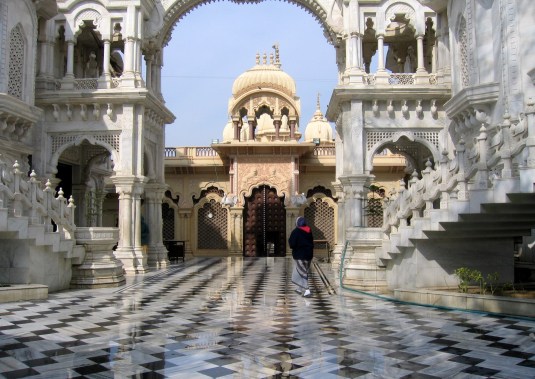
…When Lord Caitanya talked with the great devotee Ramananda Raya, the Lord asked him, “What is the basic principle of human life?” Ramananda Raya answered that human civilization begins when varnasrama-dharma is accepted. Before coming to the standard of varnasrama-dharma there is no question of human civilization. Therefore, the Krsna consciousness movement is trying to establish this right system of human civilization, which is known as Krsna consciousness, or daiva-varnasrama—divine culture.
Divine Culture
By His Divine Grace A.C. Bhaktivedanta Swami Prabhupada
Excerpted from ‘Back To Godhead 1974, Vol 1, No. 68
There is a misconception that the Krsna consciousness movement represents the Hindu religion. In act, however, Krsna consciousness is in no way a faith or religion that seeks to defeat other faiths or religions. Rather, it is an essential cultural movement for the entire human society and does not consider any particular sectarian faith. This cultural movement is especially meant to educate people in how they can love God.
Sometimes Indians both inside and outside of India think that we are preaching the Hindu religion, but actually we are not. One will not find the word “Hindu” in Bhagavad-gita. Indeed, there is no such word as “Hindu” in the entire Vedic literature. This word has been introduced by the Muslims from provinces next to India, such as Afghanistan, Baluchisthan and Persia. There is a river called “Sindhu” bordering the northwestern provinces of India, and since the Muslims there could not pronounce “Sindhu” properly, instead they called the river “Hindu,” and the inhabitants of this tract of land they called “Hindus.” In India, according to the Vedic language, the Europeans are called mlecchas or yavanas. Similarly, “Hindu” is a name given by the Muslims.
More
24 Mar 2012
by The Hare Krishna Movement
in A.C. Bhaktivedanta Swami Prabhupada, Back to Godhead, Remembering Srila Prabhupada, Srila Prabhupada
Tags: back to Godhead, bhagavad-gita, devotional service, Krsna conscious person, krsna consciousness, part and parcel, spritual sky, Srila Prabhupada, suffering of conditioned soul

…Someone asked, “What is the Krsna conscious person’s attitude towards others?” Srila Prabhupada replied, “He sees everyone as part and parcel of Krsna. The Krsna conscious person thinks, ‘They are suffering from not knowing Krsna, so let me bring them to Krsna.’ This is the highest service. Everyone is suffering, so to act in Krsna consciousness is the highest service. After all, they are suffering on account of detachment from Krsna.”
“Krsna consciousness never becomes old, it is fresh eternally. Do you know of any book five thousand years old that reads as fresh as Bhagavad-gita? Live in spiritual understanding and you’ll never become faded.”
The Great Soul Who Walked Among Us
Excerpted from Back To Godhead Magazine Vol. 13 No. 1-2
“Consider this example: when the sun is in the sky, there is no question of darkness. Similarly, when the Hare Krsna mantra is vibrating on your tongue and you are hearing attentively, then your consciousness becomes Krsna consciousness, or clear consciousness, and there is no question of maya, or hazy consciousness. Just as when light and darkness come together the darkness cannot stand before the light, maya cannot remain in the presence of Krsna.
More
20 Mar 2012
by The Hare Krishna Movement
in Bhagavad-gita
Tags: A.C. Bhaktivedanta Swami Prabhupada, Bg. 10.35, bhagavad-gita, flwoers and trees blossom, Krsna's pastimes, of seasons I am flower-bearing spring, Spring, spring is the most joyful of all seasons

…Of course spring is a season universally liked because it is neither too hot nor too cold, and the flowers and trees blossom and flourish. In spring there are also many ceremonies commemorating Kṛṣṇa’s pastimes; therefore this is considered to be the most joyful of all seasons, and it is the representative of the Supreme Lord Kṛṣṇa.
Bhagavad-gita As It Is – Macmillan 1972 Edition
By His Divine Grace A.C. Bhaktivedanta Swami Prabhupada
Chapter 10, Text 35
The Opulence of the Absolute
bṛhat-sāma tathā sāmnāṁ
gāyatrī chandasām aham
māsānāṁ mārga-śīrṣo ‘ham
ṛtūnāṁ kusumākaraḥ
bṛhat-sāma—the Bṛhat-sāma; tathā—also; sāmnām—of the Sāma-veda song; gāyatrī—the Gāyatrī hymns; chandasām—of all poetry; aham—I am; māsānām—of months; mārga-śīrṣo ‘ham—the month of November-December; aham—I am; ṛtūnām—of all seasons; kusumākaraḥ—spring.
Of hymns I am the Bṛhat-sāma sung to the Lord Indra, and of poetry I am the Gāyatrī verse, sung daily by brāhmaṇas. Of months I am November and December, and of seasons I am flower-bearing spring.
Purport
It has already been explained by the Lord that amongst all the Vedas, the Sāma-veda is rich with beautiful songs played by the various demigods.
One of these songs is the Bṛhat-sāma, which has an exquisite melody and is sung at midnight.
In Sanskrit, there are definite rules that regulate poetry; rhyme and meter are not written whimsically, as in much modern poetry. Amongst the regulated poetry, the Gāyatrī mantra, which is chanted by the duly qualified brāhmaṇas, is the most prominent. The Gāyatrī mantra is mentioned in the Śrīmad-Bhāgavatam. Because the Gāyatrī mantra is especially meant for God realization, it represents the Supreme Lord. This mantra is meant for spiritually advanced people, and when one attains success in chanting it, he can enter into the transcendental position of the Lord. One must first acquire the qualities of the perfectly situated person, the qualities of goodness according to the laws of material nature, in order to chant the Gāyatrī mantra. The Gāyatrī mantra is very important in Vedic civilization and is considered to be the sound incarnation of Brahman. Brahmā is its initiator, and it is passed down from him in disciplic succession.
The months of November and December are considered the best of all months because in India grains are collected from the fields at this time, and the people become very happy. Of course spring is a season universally liked because it is neither too hot nor too cold, and the flowers and trees blossom and flourish. In spring there are also many ceremonies commemorating Kṛṣṇa’s pastimes; therefore this is considered to be the most joyful of all seasons, and it is the representative of the Supreme Lord Kṛṣṇa.
18 Mar 2012
by The Hare Krishna Movement
in Bhagavad-gita, Book Changes, Vyasasan das
Tags: A.C. Bhaktivedanta Swami Prabhupada, Arjuna, bhagavad-gita, book changes, disciplic succession, Parampara, Sri Krishna, Srila Prabhupada, Vedic knowledge


My heart laments with deep sorrow whenever I think of how the Books of His Divine Grace A.C. Bhaktivedanta Swami are being changed, and re-edited. But I think Srila Prabhupada has said it best in his introduction to Bhagavad-gita As It Is;
Vedic knowledge is not a question of research. Our research work is imperfect because we are researching things with imperfect senses. We have to accept perfect knowledge which comes down, as is stated in Bhagavad-gītā, by the paramparā disciplic succession. We have to receive knowledge from the proper source in disciplic succession beginning with the supreme spiritual master, the Lord Himself, and handed down to a succession of spiritual masters. Arjuna, the student who took lessons from Lord Śrī Kṛṣṇa, accepts everything that He says without contradicting Him. One is not allowed to accept one portion of Bhagavad-gītā and not another. No. We must accept Bhagavad-gītā without interpretation, without deletion and without our own whimsical participation in the matter. The Gītā should be taken as the most perfect presentation of Vedic knowledge. Vedic knowledge is received from transcendental sources, and the first words were spoken by the Lord Himself. The words spoken by the Lord are different from words spoken by a person of the mundane world who is infected with four defects. A mundaner 1) is sure to commit mistakes, 2) is invariably illusioned, 3) has the tendency to cheat others and 4) is limited by imperfect senses. With these four imperfections, one cannot deliver perfect information of all-pervading knowledge.( From Introduction to the Bhagavad-gita As It Is)
More
13 Mar 2012
by The Hare Krishna Movement
in A.C. Bhaktivedanta Swami Prabhupada, Back to Godhead, Sankirtan, Sri Siksastakam, Yoga
Tags: A.C. Bhaktivedanta Swami Prabhupada, Back to Godhead Magazine, bhagavad-gita, Hari Kirtana, Kali-yuga, Lord Caitanya Mahaprabhu, perfection of yoga, religion, sankirtan movement, The Yoga for the Modern Age
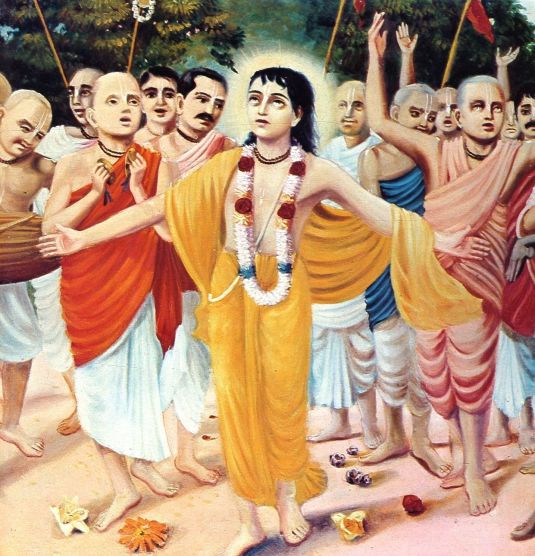
..When Rupa Gosvami first met Lord Caitanya Mahaprabhu at Prayag, Lord Caitanya was chanting and dancing in the street “Hare Krsna, Hare Krsna.” At that time also he offered one prayer. Namo maha-vadanyaya krsna-prema-pradaya te. “O You are the most munificent of all incarnations because You are distributing love of Godhead.” Krsna-prema-pradaya te krsnaya krsna-caitanya-namne gaura-tvise namah. “You are Krsna Himself because if You were not Krsna You could not distribute Krsna-prema or love of God, for love of Krsna is not so easily acquired. But You are distributing this love freely to everyone.”
Hari Kirtana: The Yoga for the Modern Age
By His Divine Grace A.C. Bhaktivedanta Swami Prabhupada
Excerpted from ‘Back To Godhead’ Magazine
1970, Vol., 1 No. 34
Ceto-darpana-marjanam bhava-mahadavagni-nirvapanam sreyah kairava candrika vitaranam vidyavadhu jivanam anandambudhi-vardhanam pratipadam purnamrtasvadanam sarvatma-snapanam param vijayate sri-krsna-sankirtanam. All glories to the sankirtana movement. Param vijayate sri-krsna-sankirtanam. Lord Caitanya Mahaprabhu, when He was only a sixteen-year-old boy, introduced this sankirtana movement 500 years ago in Navadvipa, India. It was not that He manufactured some religious system, just as nowadays so many religious systems are being manufactured.
Actually religion cannot be manufactured. Dharmam tu saksad-bhagavat-pranitam. Religion means the codes of God, the laws of God, that’s all. Certainly we cannot live without obeying the state laws, and similarly, we cannot live without obeying the laws of God. And in the Bhagavad-gita the Lord says, “yada yada hi dharmasya glanir bhavati bharata abhyutthanam adharmasya,” and there is a predominance of irreligious activities, “tadatmanam srjamy aham,” at that time I (Krsna) appear. And in the material world we can see the same principle demonstrated, for whenever there is disobedience of state laws, there is the advent of some particular state officer or police man to “set things right.”
More
11 Mar 2012
by The Hare Krishna Movement
in Bhagavad-gita, Raja-Vidya, Spiritual Life
Tags: A.C. Bhaktivedanta Swami Prabhupada, Arjuna, bhagavad-gita, faith, guru, Krishna, material world, Raja-Vidya, spiritual knowledge, spiritual master, Spiritual world, surrender, the king of knowledge

As spirit souls we are part and parcel of the Supreme Spirit, but due to our desire to enjoy this material world, we have been put into material nature. Yet in whatever species of life we may be, Kṛṣṇa is the Father. Thus Bhagavad-gītā is not meant for any particular party or nation but for everyone all over the world… In this way people may realize their true spiritual nature and their relationship to the supreme spiritual whole.
“And when you have thus learned the truth, you will know that all living beings are but parts of Me—and that they are in Me, and are Mine. Even if you are considered to be the most sinful of all sinners, when you are situated in the boat of transcendental knowledge, you will be able to cross over the ocean of miseries. As a blazing fire burns firewood to ashes, O Arjuna, so does the fire of knowledge burn to ashes all the reactions to material activities.” (Bg. 4.35–37)
Raja-vidya: The King of Knowledge
By His Divine Grace A.C. Bhaktivedanta Swami Prabhupada
Chapter 7
Knowledge as Faith in Guru and surrender to Kṛṣṇa
In the Fourth Chapter of Bhagavad-gītā Śrī Kṛṣṇa concludes that of all sacrifices, the best is the acquisition of knowledge.
śreyān dravya-mayād yajñāj
jñāna-yajñaḥ parantapa
sarvaṁ karmākhilaṁ pārtha
jñāne parisamāpyate
“O chastiser of the enemy, the sacrifice of knowledge is greater than the sacrifice of material possessions. O son of Pṛthā, after all, the sacrifice of work culminates in transcendental knowledge.” (Bg. 4.33)
Knowledge is the best sacrifice because this conditional life is due to ignorance. The purpose of sacrifice, penance, yoga and philosophical discussion is to acquire knowledge. There are three stages of transcendental knowledge by which one realizes the impersonal aspect of God (Brahman realization), the localized aspect of God within the heart and within every atom (Paramātmā or Supersoul realization) and the realization of the Supreme Personality of Godhead (Bhagavān realization). But the very first step in acquiring knowledge is coming to understand that “I am not this body. I am spirit soul, and my aim of life is to get out of this material entanglement.” The point is that whatever sacrifice we make is intended to enable us to come to the point of real knowledge. The highest perfection of knowledge is given in Bhagavad-gītā as surrender to Kṛṣṇa (bahūnāṁ janmanām ante jñānavān māṁ prapadyate) (Bg. 7.19). The jñānavān, not the fool, surrenders unto Kṛṣṇa, and that is the highest stage of knowledge. Similarly, at the end of Bhagavad-gītā Śrī Kṛṣṇa advises Arjuna:
More
29 Feb 2012
by The Hare Krishna Movement
in A.C. Bhaktivedanta Swami Prabhupada, Bhagavad-gita, Divine and Demoniac Natures
Tags: A.C. Bhaktivedanta Swami Prabhupada. As It Is, anger, Bg. 16. 10-12, bhagavad-gita, Demoniac, Divine, greed, human civilization, lust, Original 1972 Edition, sense gratificiation, The Divine and Demoneac Natures
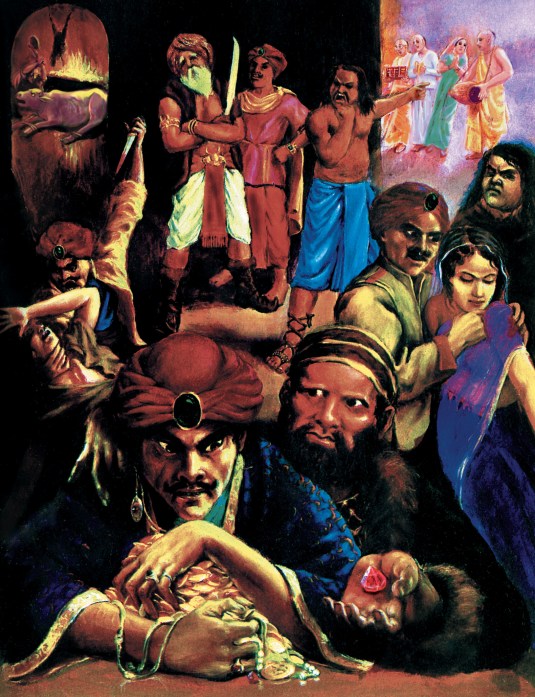
They believe that to gratify the senses unto the end of life is the prime necessity of human civilization. Thus there is no end to their anxiety. Being bound by hundreds and thousands of desires, by lust and anger, they secure money by illegal means for sense gratification.
Bhagavad-gītā As It Is
By His Divine Grace A. C. Bhaktivedanta Swami Prabhupāda
Chapter 16, Text 10-12
The Divine and Demoniac Natures
TEXT 10
kāmam āśritya duṣpūraṁ
dambha-māna-madānvitāḥ
mohād gṛhītvāsad-grāhān
pravartante ’śuci-vratāḥ
kāmam—lust; āśritya—taking shelter of; duṣpūram—insatiable; dambha—pride; māna—false prestige; mada-anvitāḥ—absorbed in conceit; mohāt—by illusion; gṛhītvā—taking; asat—nonpermanent; grāhān—things; pravartante—flourish; aśuci—unclean; vratāḥ—avowed.
The demoniac, taking shelter of insatiable lust, pride and false prestige, and being thus illusioned, are always sworn to unclean work, attracted by the impermanent.
Purport
The demoniac mentality is described here. The demons’ lust is never satiated. They will go on increasing and increasing their insatiable desires for material enjoyment. Although they are always full of anxieties on account of accepting nonpermanent things, they still continue to engage in such activities out of illusion. They have no knowledge and cannot tell that they are heading the wrong way. Accepting nonpermanent things, such demoniac people create their own God, create their own hymns and chant accordingly. The result is that they become more and more attracted to two things—sex enjoyment and accumulation of material wealth. The word aśuci-vratāḥ, unclean vow, is very significant in this connection. Such demoniac people are only attracted by wine, women, gambling and meat eating; those are their aśuci, unclean habits. Induced by pride and false prestige, they create some principles of religion which are not approved by the Vedic injunctions. Although such demoniac people are most abominable in the world, still, by artificial means, the world creates a false honor for them. Although they are gliding toward hell, they consider themselves very much advanced.
More
21 Feb 2012
by The Hare Krishna Movement
in Lectures, The Hare Krishna Movement
Tags: actual religion, bhagavad-gita, devotional service, His Divine Grace A.C. Bhaktivedanta Swami Prabhupada, krsna consciousness, love for God, Song of God, Srila Prabhupada lecture
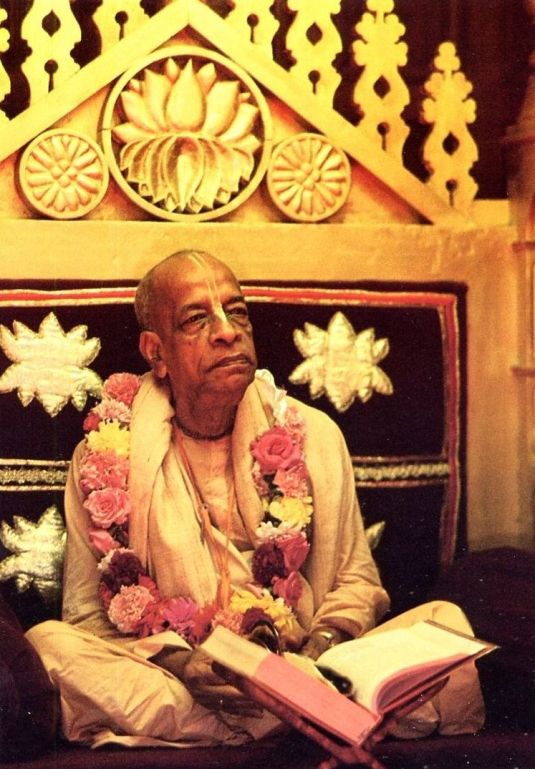
…so far our movement is concerned, you know, more or less, about our movement. But you should know that this is the most scientific, authorized movement in the human society, because the movement is based on the authority of Bhagavad-gita. Bhagavad-gita is spoken by the Supreme Personality of Godhead for the benefit of the whole human society.
“Actual Religion means to understand God and to develop your Love for God”
Lecture by His Divine Grace A.C. Bhaktivedanta Swami Prabhupada
New York, April 5, 1973
Ladies and Gentlemen, I thank you very much for kindly receiving me in this honorable way. According to our Vaisnava philosophy, whatever honor is offered to the spiritual master, that is transferred to the Supreme Personality of Godhead. Yasya prasadad bhagavat-prasado yasyaprasadan na gatih kuto ’pi. Our this philosophy, Vaisnava philosophy, it teaches that if you please your spiritual master, then God is also pleased. Because the spiritual master is the most confidential servant of God, therefore by honoring the spiritual master, the Supreme Personality of Godhead is honored. Just like in English language there is the word, “If you love me, love my dog.” So the spiritual master is the “dog” of God; therefore if the spiritual master is patted, God is very much pleased.
More
17 Feb 2012
by The Hare Krishna Movement
in Book Distribution, Books by Srila Prabhupada, Quotes by Srila Prabhupada
Tags: A.C. Bhaktivedanta Swami Prabhupada, bhagavad-gita, Book Distribution, Krsna Book, Letters by Srila Prabhupada, quotes by Srila Prabhupada, sankirtan, Srila Prabhupada's books, Srimad Bhagavatam

I am glad to hear that you are distributing nicely books and magazines. The more we sell books, the more we advance in Krishna Consciousness, and the more we help others to have solid information how they may take advantage of their human form of life and achieve the supreme perfection. So I want that you should now increase very greatly this selling of books and literatures. (S.P.L. to Kulasekhara 20/1/72)
One Krishna book sold means we go forward one step in our Krishna Consciousness. We should always remember this. (S.P.L. to Visnujana Maharaja 4th April 1971)
I am very glad to hear all the good news, especially that you want to sell books more and more. That is the best preaching work; each book sold means there is some practical effect of preaching, there is some tangible progress. So try to sell books as many as possible in your country, and in this way, so long you remain active but not for your personal sense-gratification, so long you remain active only satisfying Krishna’s senses, then this movement will be successful without any doubt. As soon as someone wants to satisfy his own senses, then he fails at everything. (S.P.L. to Kuruksetra 23/11/72)
More
08 Feb 2012
by The Hare Krishna Movement
in Disciplic succession, Raja-Vidya
Tags: A.C. Bhaktivedanta Swami Prabhupada, bhagavad-gita, Brahma, disciplic succession, Indra, Parampara, Raja-Vidya, Srila Prabhupada, the king of knowledge
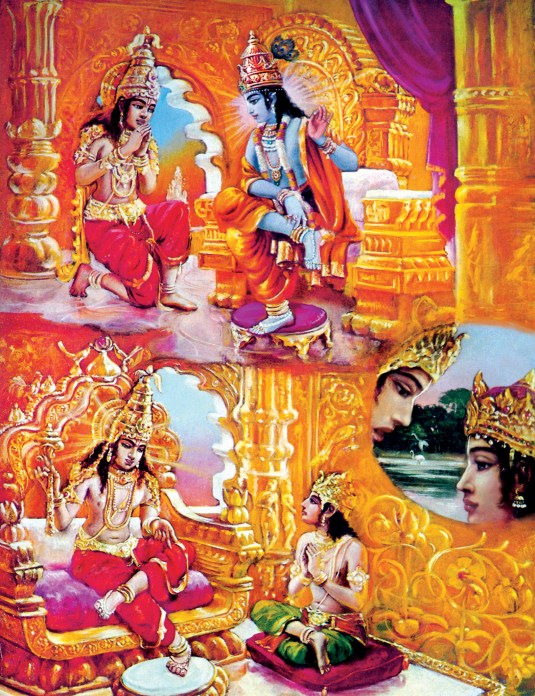
click on image to enlarge
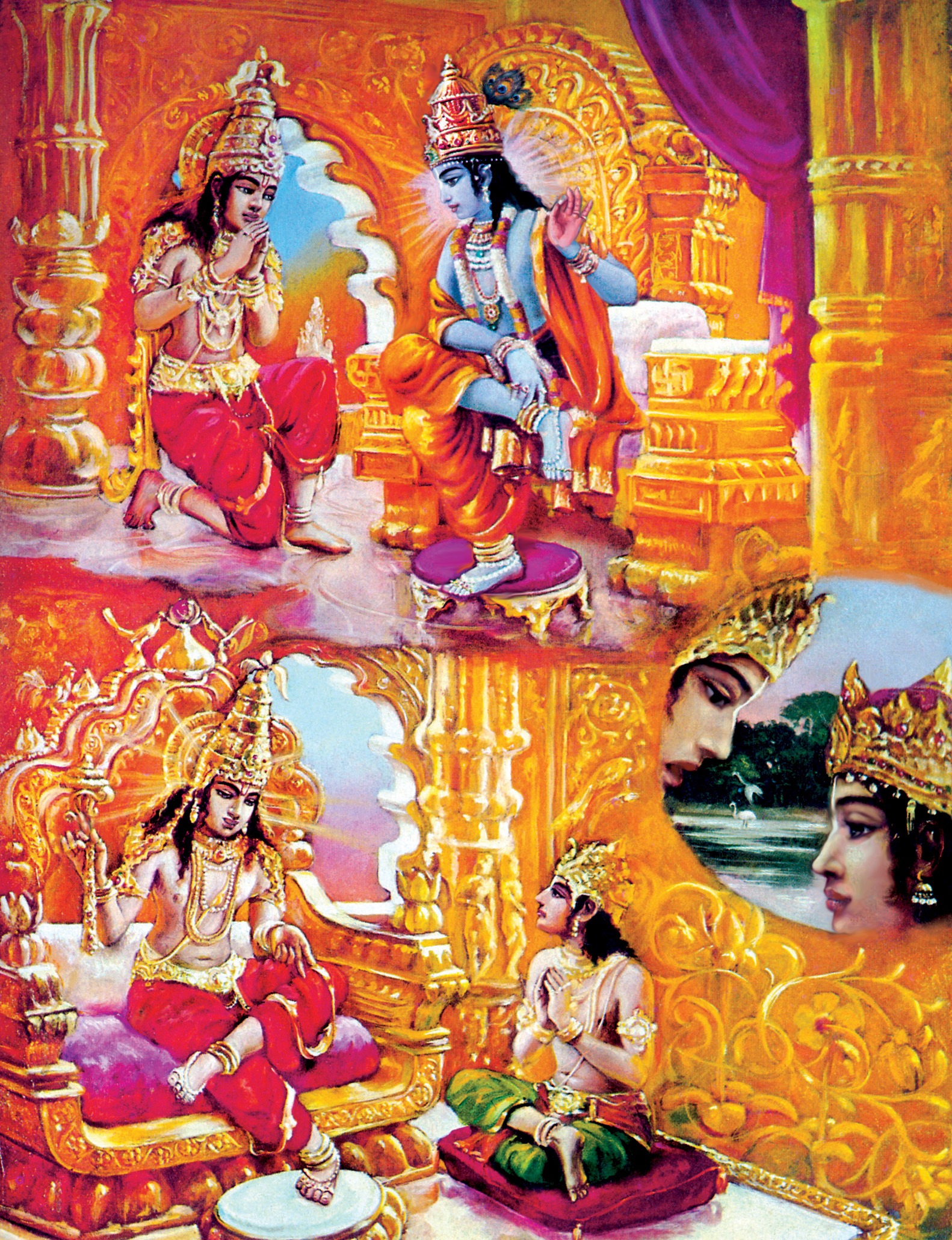
At one time, Indra, the king of heaven, committed an offense at the feet of his spiritual master, and his spiritual master cursed him to take the birth of a hog. Thus the throne of the heavenly kingdom became empty as Indra went to earth to become a hog. Seeing the situation, Brahmā came to earth and addressed the hog: “My dear sir, you have become a hog on this planet earth. I have come to deliver you. Come with me at once.” But the hog replied:. “Oh I cannot go with you. I have so many responsibilities—my children, wife and this nice hog society.” Even though Brahmā promised to take him back to heaven, Indra, in the form of a hog, refused. This is called forgetfulness. Similarly, Lord Śrī Kṛṣṇa comes and says to us, “What are you doing in this material world? Sarva-dharmān parityajya mām ekaṁ śaraṇaṁ vraja [Bg. 18.66]. Come to Me, and I’ll give you all protection.” But we say, “I don’t believe You Sir. I have more important business here.” This is the position of the conditioned soul—forgetfulness. This forgetfulness is quickly dissipated by following in the path of disciplic succession.
Raja-vidya: The King of Knowledge
By His Divine Grace A.C. Bhaktivedanta Swami Prabhupada
Chapter 5
Parampara: Knowledge Through Disciplic Succession
śrī bhagavān uvāca
imaṁ vivasvate yogaṁ
proktavān aham avyayam
vivasvān manave prāha
manur ikṣvākave ’bravīt
“The Blessed Lord said: I instructed this imperishable science of yoga to the sun-god, Vivasvān, and Vivasvān instructed it to Manu, the father of mankind, and Manu in turn instructed it to Ikṣvāku.” (Bg. 4.1)
Many ages ago Kṛṣṇa imparted the divine knowledge of Bhagavad-gītā to Vivasvān, the god of the sun. To the best of our knowledge, the sun is a very hot place, and we do not consider it possible for anyone to live there. It is not even possible to approach the sun very closely with these bodies. However, from the Vedic literatures we can understand that the sun is a planet just like this one but that everything there is composed of fire. Just as this planet is predominately composed of earth, there are other planets which are predominately composed of fire, water and air.
The living entities on these various planets acquire bodies composed of elements in accordance with the predominating element on the planet; therefore those beings who live on the sun have bodies which are composed of fire. Of all beings on the sun, the principal personality is a god by the name of Vivasvān. He is known as the sun-god (sūrya-nārāyaṇa). On all planets there are principal personalities, just as in the United States the chief person is the President. From the history called the Mahābhārata we understand that formerly there was only one king on this planet by the name of Mahārāja Bharata. He ruled some 5,000 years ago, and the planet was named after him. Subsequently the earth has become divided into so many different countries. In this way there is usually one and sometimes many controllers of the various planets in the universe.
More
05 Jan 2012
by The Hare Krishna Movement
in A.C. Bhaktivedanta Swami Prabhupada, Bhagavad-gita, Krishna Consciousness, Yoga
Tags: bhagavad-gita, bhajete, His Divine Grace A.C. Bhaktivedanta Swami Prabhupada, Krishna, Krishna consciousness, prabhupada, yoga, yogi, yoginam api sarvesam

It is by great fortune that one comes to Kṛṣṇa consciousness on the path of bhakti-yoga to become well situated according to the Vedic direction. The ideal yogī concentrates his attention on Kṛṣṇa, who is called Śyāmasundara, who is as beautifully colored as a cloud, whose lotus-like face is as effulgent as the sun, whose dress is brilliant with jewels and whose body is flower garlanded. Illuminating all sides is His gorgeous luster, which is called the brahmajyoti. He incarnates in different forms such as Rāma, Nṛsiṁha, Varāha and Kṛṣṇa, the Supreme Personality of Godhead, and He descends like a human being, as the son of Mother Yaśodā, and He is known as Kṛṣṇa, Govinda and Vāsudeva. He is the perfect child, husband, friend and master, and He is full with all opulences and transcendental qualities. If one remains fully conscious of these features of the Lord, he is called the highest yogī.
Bhagavad-gita As It Is – Macmillan 1972 Edition
By His Divine Grace A.C. Bhaktivedanta Swami Prabhupada
Chapter 6, Text 47
yoginām api sarveṣāṁ
mad-gatenāntar-ātmanā
śraddhāvān bhajate yo māṁ
sa me yuktatamo mataḥ
yoginām—of all yogīs; api—also; sarveṣām—all types of; mat-gatena—abiding in Me; antaḥ-ātmanā—always thinking of Me within; śraddhāvān—in full faith; bhajate—renders transcendental loving service; yaḥ—one who; mām—Me (the Supreme Lord); saḥ—he; me—Mine; yuktatamaḥ—the greatest yogī; mataḥ—is considered.
Translation
And of all yogīs, he who always abides in Me with great faith, worshiping Me in transcendental loving service, is most intimately united with Me in yoga and is the highest of all.
More
01 Jan 2012
by The Hare Krishna Movement
in Bhagavad-gita, Time
Tags: Arjuna, As It Is 1972 Edition, bhagavad-gita, His Divine Grace A.C. Bhaktivedanta Swami Prabhupada, Krishna, past present and future, Srila Prabhupada, supersoul, supreme soul

…Anyone with a material body cannot remember his past life, nor can he foretell his future life, nor can he predict the outcome of his present life; therefore he cannot know what is happening in past, present and future. Unless one is liberated from material contamination, he cannot know past, present and future.
…out of millions and millions of men, some try to become perfect in this human form of life, and out of thousands and thousands of such perfected men, hardly one can understand what Lord Kṛṣṇa is. Even if one is perfected by realization of impersonal Brahman or localized Paramātmā, he cannot possibly understand the Supreme Personality of Godhead, Śrī Kṛṣṇa, without being in Kṛṣṇa consciousness.
Bhagavad-gita As It Is 1972 Edition
By His Divine Grace A.C. Bhaktivedanta Swami Prabhupada
Chapter 7, Text 26
vedāhaṁ samatītāni
vartamānāni cārjuna
bhaviṣyāṇi ca bhūtāni
māṁ tu veda na kaścana
veda—know; aham—I; sama—equally; atītāni—past; vartamānāni—present; ca—and; arjuna—O Arjuna; bhaviṣyāṇi—future; ca—also; bhūtāni—living entities; mām—Me; tu—but; veda—knows; na—not; kaścana—anyone.
Translation
O Arjuna, as the Supreme Personality of Godhead, I know everything that has happened in the past, all that is happening in the present, and all things that are yet to come. I also know all living entities; but Me no one knows.
Purport
Here the question of personality and impersonality is clearly stated. If Kṛṣṇa, the form of the Supreme Personality of Godhead, is considered by the impersonalists to be māyā, to be material, then He would, like the living entity, change His body and forget everything in His past life. Anyone with a material body cannot remember his past life, nor can he foretell his future life, nor can he predict the outcome of his present life; therefore he cannot know what is happening in past, present and future. Unless one is liberated from material contamination, he cannot know past, present and future.
More
31 Dec 2011
by The Hare Krishna Movement
in Bhagavad-gita, Time
Tags: Bg 10.33, Bg. 10.30, Bg. 11.32, bhagavad-gita, Bhaktivedanta Swami Prabhupada, His Divine Grace A.C, I am time, inexhaustable time, Krishna is Time, New Years Eve, Time, Time I Am

Happy New Year to all of our readers. Krishna has this to say about Time…
More
Previous Older Entries Next Newer Entries










 The Hare Krishna Movement