28 Dec 2012
by The Hare Krishna Movement
in A.C. Bhaktivedanta Swami Prabhupada
Tags: A.C. Bhaktivedanta Swami Prabhupada, Arjuna, Bg.7, bhagavad-gita, four kinds of men, Gita, Knowledge of the Absolute, Krsna, krsna consciousness, practicing yoga in full consciousness of Me, Spiritual world, yoga

click on image to enlarge
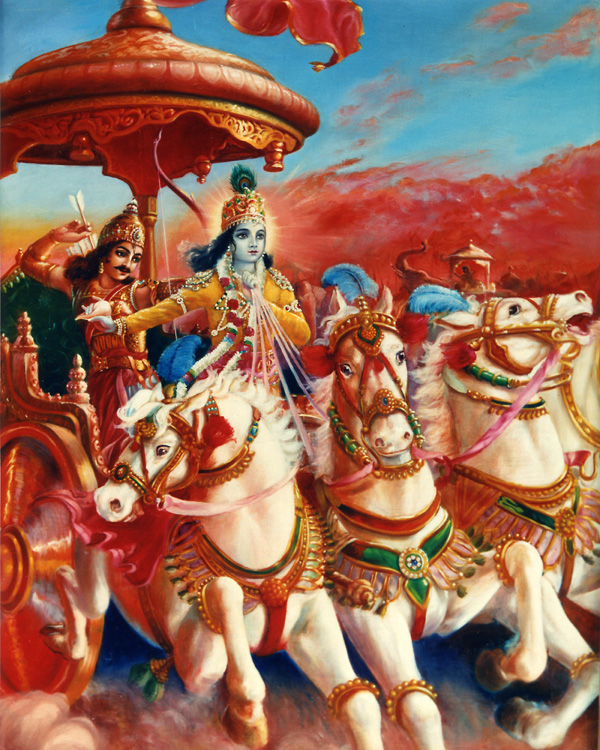
…In this Seventh Chapter of Bhagavad-gītā, the nature of Kṛṣṇa consciousness is fully described. Kṛṣṇa is full in all opulences, and how He manifests such opulences is described herein. Also, four kinds of fortunate people who become attached to Kṛṣṇa, and four kinds of unfortunate people who never take to Kṛṣṇa are described in this chapter.
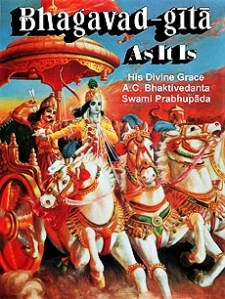
Bhagavad-gītā As It Is Complete 1972 Edition
By His Divine Grace A. C. Bhaktivedanta Swami Prabhupāda
Chapter 7
Knowledge of the Absolute
More
11 Dec 2012
by The Hare Krishna Movement
in A.C. Bhaktivedanta Swami Prabhupada, Yoga
Tags: A.C. Bhaktivedanta Swami Prabhupada, age of kali, Arjuna, as it is, ascetic, be a yogi, Bg. 6, bhagavad-gita, bhakti yoga, Collier Macmillan Publishers, complete 1972 edition, control the mind and senses, eightfold yoga system, empiricist, English equivalents, fruitive worker, krsna consciousness, Krsna consciousness is the highest stage of yoga practice, Macmillan Publishing Co., Paramatma, pratyahara, Sankhya-yoga, Sri Bhagavan uvaca, transcendental form of Krsna, translation and elaborate purports, true mystic, Vedānta philosophy, with Roman transliteration of the original Sanskrit text, yoga, yogi, yoginam api sarvesam

A yogī is greater than the ascetic, greater than the empiricist and greater than the fruitive worker. Therefore, O Arjuna, in all circumstances, be a yogī.
And of all yogīs, he who always abides in Me with great faith, worshiping Me in transcendental loving service, is most intimately united with Me in yoga and is the highest of all.
Bhagavad-gītā As It Is 1972 Edition
By His Divine Grace A. C. Bhaktivedanta Swami Prabhupāda
Chapter Six
Sāṅkhya-yoga More
11 Oct 2012
by The Hare Krishna Movement
in Bhagavad-gita, Ganges
Tags: A.C. Bhaktivedanta Swami Prabhupada, Arjuna, as it is, bhagavad-gita, essence of the Vedas, Ganges River, ganges water, great sages, Lord Krsna, nectarean milk of the bhagavad-gita, pure devotees

One cleanses himself daily by taking a bath in water, but one who takes his bath only once in the sacred Ganges water of the Bhagavad-gītā cleanses away all the dirt of material life. Because Bhagavad-gītā is spoken by the Supreme Personality of Godhead, one need not read any other Vedic literature. One need only attentively and regularly hear and read Bhagavad-gītā. In the present age, mankind is so absorbed with mundane activities that it is not possible to read all of the Vedic literatures. But this is not necessary. This one book, Bhagavad-gītā, will suffice because it is the essence of all Vedic literatures and because it is spoken by the Supreme Personality of Godhead. It is said that one who drinks the water of the Ganges certainly gets salvation, but what to speak of one who drinks the waters of Bhagavad-gītā? Gītā is the very nectar of the Mahābhārata spoken by Viṣṇu Himself, for Lord Kṛṣṇa is the original Viṣṇu. It is nectar emanating from the mouth of the Supreme Personality of Godhead, and the Ganges is said to be emanating from the lotus feet of the Lord. Of course there is no difference between the mouth and the feet of the Supreme Lord, but in our position we can appreciate that the Bhagavad-gītā is even more important than the Ganges.
More
17 Aug 2012
by The Hare Krishna Movement
in Uncategorized
Tags: A.C. Bhaktivedanta Swami Prabhupada, Arjuna, as it is, bhagavad-gita, Bhagavan, Iksvaku, imam vivasvate yogam, Krishna, Macmillan Edition, Manu, Original 1972 Macmillan, science of yoga, the blessed Lord said, The Supreme Personality of Godhead, transcendental knowledge, Vivasvan, yoga

Bhagavad-gītā As It Is
By His Divine Grace A. C. Bhaktivedanta Swami Prabhupāda
Chapter 4
Transcendental Knowledge
More
15 Aug 2012
by The Hare Krishna Movement
in Bhagavad-gita, Krishna, Krishna Consciousness
Tags: A.C. Bhaktivedanta Swami Prabhupada, Absolute Truth, Arjuna, Asita, Bg 10.12-14, bhagavad-gita, Devala, eternal divine person, great sages, Narada, param brahma, param dhama, primal God, supreme abode and purifier, transcendental and original, unborn and all-pervading beauty, Universal Form, Vyasa
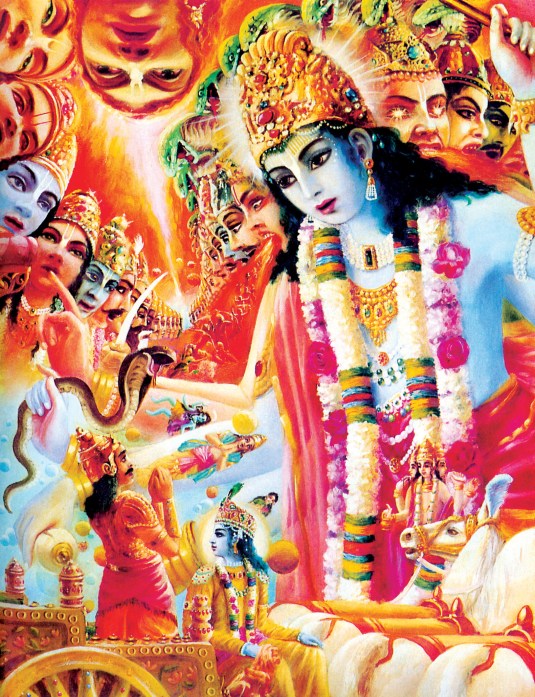
Click on image to enlarge
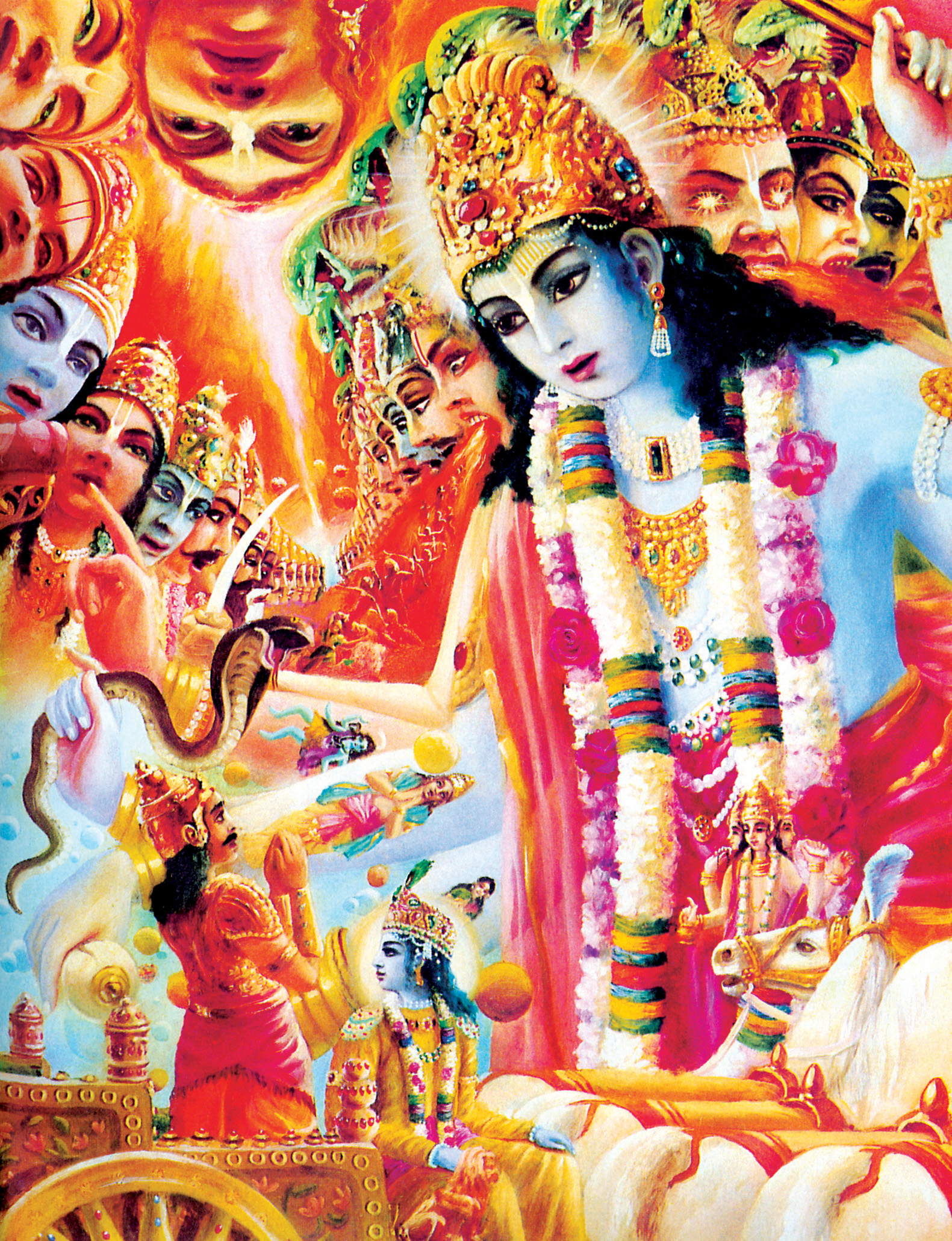
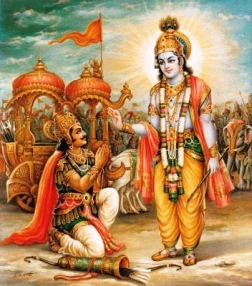
Arjuna said: You are the Supreme Brahman, the ultimate, the supreme abode and purifier, the Absolute Truth and the eternal divine person. You are the primal God, transcendental and original, and You are the unborn and all-pervading beauty. All the great sages such as Nārada, Asita, Devala, and Vyāsa proclaim this of You, and now You Yourself are declaring it to me.
O Kṛṣṇa, I totally accept as truth all that You have told me. Neither the gods nor demons, O Lord, know Thy personality.
Full verse and purport More
03 Aug 2012
by The Hare Krishna Movement
in Bhagavad-gita, Death and Dying, Practicing Krishna Consciousness at Home
Tags: A.C. Bhaktivedanta Swami Prabhupada, ananda, anta-kale ca mam eva, Arjuna, asat, Attaining the Supreme, Bg 8.5, chanting Hare Krishna, cit, death, He attains My nature, Krishna, Krishna's form, Krishna's names, material activities, nirananda, quits his body, remembering Me alone, sac-cid-ananda-vigraha, sat
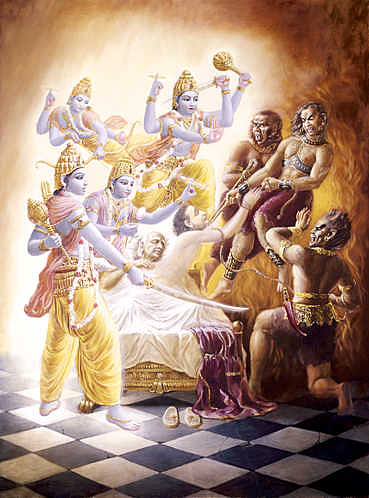
Next, one may raise the question of how one goes about approaching that abode of the Supreme Lord. Information of this is given in the Eighth Chapter of the Bhagavad-gita. It is said there:
And whoever, at the time of death, quits his body, remembering Me alone, at once attains My nature. Of this there is no doubt.
Whatever state of being one remembers when he quits his body, that state he will attain without fail.
Therefore, Arjuna, you should always think of Me in the form of Kṛṣṇa and at the same time carry out your prescribed duty of fighting. With your activities dedicated to Me and your mind and intelligence fixed on Me, you will attain Me without doubt.
…This instruction to Arjuna is very important for all men engaged in material activities. The Lord does not say that one should give up his prescribed duties or engagements. One can continue them and at the same time think of Kṛṣṇa by chanting Hare Kṛṣṇa. This will free one from material contamination and engage the mind and intelligence in Kṛṣṇa. By chanting Kṛṣṇa’s names, one will be transferred to the supreme planet, Kṛṣṇaloka, without a doubt.
More
04 Jul 2012
by The Hare Krishna Movement
in Uncategorized
Tags: A.C. Bhaktivedanta Swami Prabhupada, Arjuna, as it is, bhagavad-gita, buddhi-yoga, chant the holy name of the Lord, constitution of the soul, Hare Krishna, karma, karma yoga, Krishna, krsna consciousness, material grief, philosophy of the soul, spiritual advancement, Sri Krsna, The Supreme Personality of Godhead
Bhagavad-gita As It Is – Macmillan 1972 Edition
By His Divine Grace A.C. Bhaktivedanta Swami Prabhupada
Chapter 3
TEXT 1
arjuna uvāca
jyāyasī cet karmaṇas te
matā buddhir janārdana
tat kiṁ karmaṇi ghore māṁ
niyojayasi keśava
arjunaḥ—Arjuna; uvāca—said; jyāyasī—speaking very highly; cet—although; karmaṇaḥ—than fruitive action; te—your; matā—opinion; buddhiḥ—intelligence; janārdana—O Kṛṣṇa; tat—therefore; kim—why; karmaṇi—in action; ghore—ghastly; mām—me; niyojayasi—engaging me; keśava—O Kṛṣṇa.
TRANSLATION
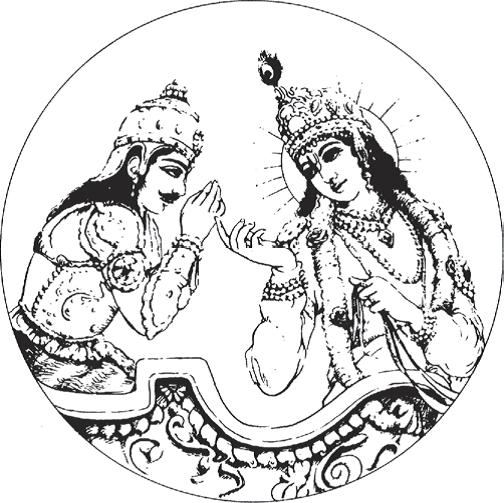
Arjuna said: O Janārdana, O Keśava, why do You urge me to engage in this ghastly warfare, if You think that intelligence is better than fruitive work?
PURPORT
The Supreme Personality of Godhead Śrī Kṛṣṇa has very elaborately described the constitution of the soul in the previous chapter, with a view to deliver His intimate friend Arjuna from the ocean of material grief. And the path of realization has been recommended: buddhi-yoga, or Kṛṣṇa consciousness. Sometimes Kṛṣṇa consciousness is misunderstood to be inertia, and one with such a misunderstanding often withdraws to a secluded place to become fully Kṛṣṇa conscious by chanting the holy name of Lord Kṛṣṇa. But without being trained in the philosophy of Kṛṣṇa consciousness, it is not advisable to chant the holy name of Kṛṣṇa in a secluded place where one may acquire only cheap adoration from the innocent public. Arjuna also thought of Kṛṣṇa consciousness or buddhi-yoga, or intelligence in spiritual advancement of knowledge, as something like retirement from active life and the practice of penance and austerity at a secluded place. In other words, he wanted to skillfully avoid the fighting by using Kṛṣṇa consciousness as an excuse. But as a sincere student, he placed the matter before his master and questioned Kṛṣṇa as to his best course of action. In answer, Lord Kṛṣṇa elaborately explained karma-yoga, or work in Kṛṣṇa consciousness, in this Third Chapter.
More
25 Jun 2012
by The Hare Krishna Movement
in Bhagavad-gita, Salvation, Srimad Bhagavatam
Tags: A.C. Bhaktivedanta Swami Prabhupada, Arjuna, Battlefield of Kuruksetra, bhagavad-gita, Bhisma, liberation from material bondage, merciful glance, salvation, SB 1.9.35, Srimad Bhagavatam, The Passing Away of Bhismadeva in the Presence of Lord Krsna

…The Lord diminished the duration of life of the opposite party by His merciful glance. It is said that all the fighters who assembled on the Battlefield of Kurukṣetra attained salvation by personally seeing the Lord at the time of death. Therefore, His diminishing the duration of life of Arjuna’s enemy does not mean that He was partial to the cause of Arjuna. Factually He was merciful to the opposite party because they would not have attained salvation by dying at home in the ordinary course of life. Here was a chance to see the Lord at the time of death and thus attain salvation from material life. Therefore, the Lord is all good, and whatever He does is for everyone’s good.
Srimad Bhagavatam
By His Divine Grace A.C. Bhaktivedanta Swami Prabhupada
Canto 1, Chapter 9, Text 35
The Passing Away of Bhismadeva in the Presence of Lord Krsna
sapadi sakhi-vaco niśamya madhye
nija-parayor balayo rathaṁ niveśya
sthitavati para-sainikāyur akṣṇā
hṛtavati pārtha-sakhe ratir mamāstu
sapadi—on the battlefield; sakhi-vacaḥ—command of the friend; niśamya—after hearing; madhye—in the midst; nija—His own; parayoḥ—and the opposite party; balayoḥ—strength; ratham—chariot; niveśya—having entered; sthitavati—while staying there; para-sainika—of the soldiers on the opposite side; āyuḥ—duration of life; akṣṇā—by looking over; hṛtavati—act of diminishing; pārtha—of Arjuna, son of Pṛthā (Kuntī); sakhe—unto the friend; ratiḥ—intimate relation; mama—my; astu—let there be.
In obedience to the command of His friend, Lord Śrī Kṛṣṇa entered the arena of the Battlefield of Kurukṣetra between the soldiers of Arjuna and Duryodhana, and while there He shortened the life spans of the opposite party by His merciful glance. This was done simply by His looking at the enemy. Let my mind be fixed upon that Kṛṣṇa.
Purport
In the Bhagavad-gītā (1.21-25) Arjuna ordered the infallible Lord Śrī Kṛṣṇa to place his chariot between the phalanxes of the soldiers. He asked Him to stay there until he had finished observing the enemies he had to face in the battle. When the Lord was so asked, He at once did so, just like an order carrier. And the Lord pointed out all the important men on the opposite side, saying, “Here is Bhīṣma, here is Droṇa,” and so on. The Lord, being the supreme living being, is never the order supplier or order carrier of anyone, whoever he may be. But out of His causeless mercy and affection for His pure devotees, sometimes He carries out the order of the devotee like an awaiting servant. By executing the order of a devotee, the Lord becomes pleased, as a father is pleased to carry out the order of his small child. This is possible only out of pure transcendental love between the Lord and His devotees, and Bhīṣmadeva was quite aware of this fact. He therefore addressed the Lord as the friend of Arjuna.
More
07 Jun 2012
by The Hare Krishna Movement
in Uncategorized
Tags: 1972 Macmillan edition, A.C. Bhaktivedanta Swami Prabhupada, Arjuna, as it is, bhagavad-gita, Bhagavad-gita text and purports, happiness of distress, heavenly planets, Krishna, Krishna consciousness, loss or gain, material activities, Mukunda, sense gratification, son of Kunti, victory or defeat

This is the second half of Chapter Two “Contents of the Gita Sumarized”
Bhagavad-gita As It Is 1972 Macmillan Edition
By His Divine Grace A.C. Bhaktivedanta Swami Prabhupada
Chapter 2, Text & Purports 37-72
TEXT 37
hato vā prāpsyasi svargaṁ
jitvā vā bhokṣyase mahīm
tasmād uttiṣṭha kaunteya
yuddhāya kṛta-niścayaḥ
hataḥ—being killed; vā—either; prāpsyasi—you gain; svargam—the heavenly kingdom; jitvā—by conquering; vā—or; bhokṣyase—you enjoy; mahīm—the world; tasmāt—therefore; uttiṣṭha—get up; kaunteya—O son of Kuntī; yuddhāya—to fight; kṛta—determination; niścayaḥ—uncertainty.
TRANSLATION
O son of Kuntī, either you will be killed on the battlefield and attain the heavenly planets, or you will conquer and enjoy the earthly kingdom. Therefore get up and fight with determination.
PURPORT
Even though there was no certainty of victory for Arjuna’s side, he still had to fight; for, even being killed there, he could be elevated into the heavenly planets.
TEXT 38
sukha-duḥkhe same kṛtvā
lābhālābhau jayājayau
tato yuddhāya yujyasva
naivaṁ pāpam avāpsyasi
sukha—happiness; duḥkhe—in distress; same—in equanimity; kṛtvā—doing so; lābhālābhau—both in loss and profit; jayājayau—both in defeat and victory; tataḥ—thereafter; yuddhāya—for the sake of fighting; yujyasva—do fight; na—never; evam—in this way; pāpam—sinful reaction; avāpsyasi—you will gain.
TRANSLATION
Do thou fight for the sake of fighting, without considering happiness or distress, loss or gain, victory or defeat-and, by so doing, you shall never incur sin.
PURPORT
Lord Kṛṣṇa now directly says that Arjuna should fight for the sake of fighting because He desires the battle. There is no consideration of happiness or distress, profit or gain, victory or defeat in the activities of Kṛṣṇa consciousness. That everything should be performed for the sake of Kṛṣṇa is transcendental consciousness; so there is no reaction to material activities. He who acts for his own sense gratification, either in goodness or in passion, is subject to the reaction, good or bad. But he who has completely surrendered himself in the activities of Kṛṣṇa consciousness is no longer obliged to anyone, nor is he a debtor to anyone, as one is in the ordinary course of activities. It is said:
devarṣi-bhutāpta-nṛṇāṁ pitṝṇāṁ
na kiṅkaro nāyamṛṇī ca rājan
sarvātmanā yaḥ śaraṇaṁ śaraṇyaṁ
gato mukundaṁ parihṛtya kartam
(Bhag. 11.5.41)
“Anyone who has completely surrendered unto Kṛṣṇa, Mukunda, giving up all other duties, is no longer a debtor, nor is he obliged to anyone-not the demigods, nor the sages, nor the people in general, nor kinsmen, nor humanity, nor forefathers.” That is the indirect hint given by Kṛṣṇa to Arjuna in this verse, and the matter will be more clearly explained in the following verses.
More
06 Jun 2012
by The Hare Krishna Movement
in Uncategorized
Tags: 1972 Macmillan edition, A.C. Bhaktivedanta Swami Prabhupada, Arjuna, as it is, bhagavad-gita, Contents of the Gita Sumarized, Krishna, Krishna consciousness, Krsna, Madhusudana, material compassion, real self, Sanjaya, self realization
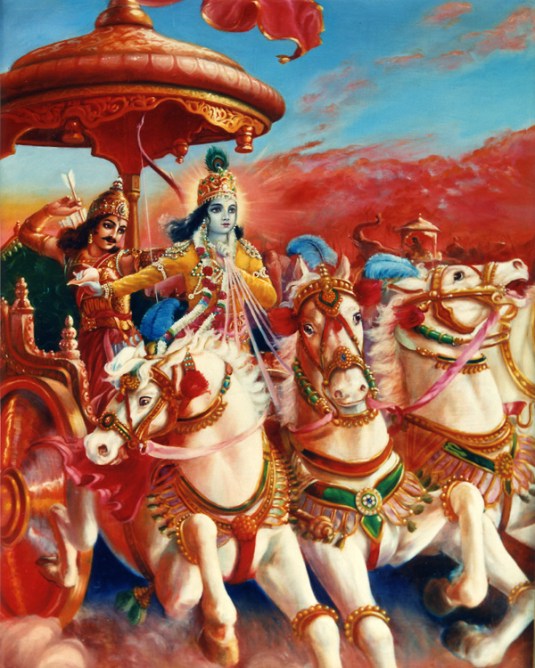
As this is a very long chapter we are posting it in two parts. Today we are posting text 1-35, and tomorrow we will conclude the chapter entitled “Contents of the Gita Summarized”
Bhagavad-gita As It Is 1972 Macmillan Edition
By His Divine Grace A.C. Bhaktivedanta Swami Prabhupada
Chapter Two, Text and Purports 1-35
Contents of the Gita Summarized
TEXT 1
sañjaya uvāca
taṁ tathā kṛpayāviṣṭam
aśru-pūrṇākulekṣaṇam
viṣīdantam idaṁ vākyam
uvāca madhusūdanaḥ
sañjayaḥ uvāca—Sañjaya said; tam—unto Arjuna; tathā—thus; kṛpayā—by compassion; āviṣṭam—overwhelmed; aśru-pūrṇa—full of tears; ākula—depressed; īkṣaṇam—eyes; viṣīdantam—lamenting; idam—this; vākyam—words; uvāca—said; madhusūdanaḥ—the killer of Madhu.
TRANSLATION
Sañjaya said: Seeing Arjuna full of compassion and very sorrowful, his eyes brimming with tears, Madhusūdana, Kṛṣṇa, spoke the following words.
PURPORT
Material compassion, lamentation and tears are all signs of ignorance of the real self. Compassion for the eternal soul is self-realization. The word “Madhusūdana” is significant in this verse. Lord Kṛṣṇa killed the demon Madhu, and now Arjuna wanted Kṛṣṇa to kill the demon of misunderstanding that had overtaken him in the discharge of his duty. No one knows where compassion should be applied. Compassion for the dress of a drowning man is senseless. A man fallen in the ocean of nescience cannot be saved simply by rescuing his outward dress-the gross material body. One who does not know this and laments for the outward dress is called a śūdra, or one who laments unnecessarily. Arjuna was a kṣatriya, and this conduct was not expected from him. Lord Kṛṣṇa, however, can dissipate the lamentation of the ignorant man, and for this purpose the Bhagavad-gītā was sung by Him. This chapter instructs us in self-realization by an analytical study of the material body and the spirit soul, as explained by the supreme authority, Lord Śrī Kṛṣṇa. This realization is made possible by working with the fruitive being situated in the fixed conception of the real self.
More
22 May 2012
by The Hare Krishna Movement
in Teachings of Queen Kunti
Tags: A.C. Bhaktivedanta Swami Prabhupada, Arjuna, Asvatthama, bhagavad-gita, Bhima, Bhisma, cannibals, Devaki, Draupadi, Drona, Dronacarya, exile in the forest, Karna, Kunti, Lord Krishna, man-eater Hidimba, My devotee is never vanquished, Pandavas, Queen Kunti, sons of Pandu, Srila Prabhupada, Teachings of Queen Kunti

…Here Kuntī remembers all the dangers through which she passed before the Pāṇḍavas regained their kingdom. In Bhagavad-gītā Lord Kṛṣṇa says, kaunteya pratijānīhi na me bhaktaḥ praṇaśyati: “My dear Arjuna, you may declare to the world that My devotee is never vanquished.” The Pāṇḍavas, the sons of Pāṇḍu, were great devotees of Lord Kṛṣṇa, but because people in the material world are interested in material things, the Pāṇḍavas were put into many dangers. Their materialistic uncle Dhṛtarāṣṭra was always planning to kill them and usurp the kingdom for his own sons. That was his policy from the very beginning.
Teachings of Queen Kunti
By His Divine Grace A.C. Bhaktivedanta Swami Prabhupada
Chapter 7
Dangerous Encounters
viṣān mahāgneḥ puruṣāda-darśanād
asat-sabhāyā vana-vāsa-kṛcchrataḥ
mṛdhe mṛdhe ’neka-mahārathāstrato
drauṇy-astrataś cāsma hare ’bhirakṣitāḥ
My dear Kṛṣṇa, Your Lordship has protected us from a poisoned cake, from a great fire, from cannibals, from the vicious assembly, from sufferings during our exile in the forest, and from the battle where great generals fought. And now You have saved us from the weapon of Aśvatthāmā.
—Śrīmad-Bhāgavatam 1.8.24
The list of dangerous encounters is submitted herein. Devakī was once put into difficulty by her envious brother, otherwise she was well. But Kuntīdevī and her sons were put into one difficulty after another for years and years together. They were put into trouble by Duryodhana and his party due to the kingdom, and each and every time the sons of Kuntī were saved by the Lord. Once Bhīma was administered poison in a cake, once they were put into the house made of shellac and set afire, and once Draupadī was dragged out, and attempts were made to insult her by stripping her naked in the vicious assembly of the Kurus. The Lord saved Draupadī by supplying an immeasurable length of cloth, and Duryodhana’s party failed to see her naked. Similarly, when they were exiled in the forest, Bhīma had to fight with the man-eater demon Hiḍimba Rākṣasa, but the Lord saved him. So it was not finished there. After all these tribulations, there was the great Battle of Kurukṣetra, and Arjuna had to meet such great generals as Droṇa, Bhīṣma, and Karṇa, all powerful fighters. And at last, even when everything was done away with, there was the brahmāstra released by the son of Droṇācārya to kill the child within the womb of Uttarā, and so the Lord saved the only surviving descendant of the Kurus, Mahārāja Parīkṣit.
More
08 May 2012
by The Hare Krishna Movement
in Devotional Service
Tags: A.C. Bhaktivedanta Swami Prabhupada, Akura, arcanam, Arjuna, atma-nivedanam, Bali Maharaja, dasyam, goddess of fortune, Hanuman, kirtanam, Laxmi, pada-sevanam, Pariksit Maharaja, Prahlada Maharaja, Prthu Maharaja, sakhyam, SB 7.5.23-24, sravanam, Srimad Bhagavatam, Sukadeva Goswami, vandanam, visnu smaranam

“Parīkṣit Mahārāja attained salvation simply by hearing, and Śukadeva Gosvāmī attained salvation simply by chanting. Prahlāda Mahārāja attained salvation by remembering the Lord. The goddess of fortune, Lakṣmīdevī, attained perfection by worshiping the Lord’s lotus feet. Pṛthu Mahārāja attained salvation by worshiping the Deity of the Lord. Akrūra attained salvation by offering prayers, Hanumān by rendering service, Arjuna by establishing friendship with the Lord, and Bali Mahārāja by offering everything to the service of the Lord.”
The Nine Processes of Devotional Service
They are described by Prahlada Maharaja in the 7th Canto of the Srimad Bhagavatam as follows:
To hear about Sri Visnu’s transcendental name, His form, His characteristics, His possessions and His pastimes and to hear and chant about His pastimes, to remember them, to serve the lotus feet of the Lord, to respectfully offer service to the Lord, to offer prayers to the Lord, to become His servant, to consider the Lord one’s best friend and to offer Him everything-these nine processes are recognized as pure devotional service.
1. HEARING (sravanam) Maharaja Pariksit(the last seven days of his life, he constantly heard the Srimad Bhagavatam).
2. CHANTING (kirtanam) Sukadeva Goswami(spoke the Bhagavatam to Maharaja Pariksit)
More
26 Apr 2012
by The Hare Krishna Movement
in Bhagavad-gita
Tags: A.C. Bhaktivedanta Swami Prabhupada, Arjuna, Bg. 1, bhagavad-gita, Dhrtarastra, disciplic succession, Gita, gita-mahatmya, Glorification of the Gita, Krishna, Lord Sri Krsna, Sanjaya, scriptures, theistic science, Vedic wisdom

Dhrtarastra inquires from Sanjaya
We are posting the First Chapter of the Original Bhagavad-gita As It Is 1972 Macmillian Edition complete with the corresponding pictures.
Bhagavad-gita As It Is 1972 Edition
By His Divine Grace A.C. Bhaktivedanta Swami Prabhupada
Chapter 1: Observing the Armies on the Battlefield of Kuruksetra
TEXT 1
dhṛtarāṣṭra uvāca
dharma-kṣetre kuru-kṣetre
samavetā yuyutsavaḥ
māmakāḥ pāṇḍavāś caiva
kim akurvata sañjaya
dhṛtarāṣṭraḥ—King Dhṛtarāṣṭra; uvāca—said; dharma-kṣetre—in the place of pilgrimage; kuru-kṣetre—in the place named Kurukṣetra; samavetāḥ—assembled; yuyatsavaḥ—desiring to fight; māmakāḥ—my party (sons); pāṇḍavāḥ—the sons of Pāṇḍu; ca—and; eva-certainly; kim—what; akurvata—did they do; sañjaya—O Sañjaya.
TRANSLATION
Dhṛtarāṣṭra said: O Sañjaya, after assembling in the place of pilgrimage at Kurukṣetra, what did my sons and the sons of Pāṇḍu do, being desirous to fight?
PURPORT
Bhagavad-gītā is the widely read theistic science summarized in the Gītā-māhātmya (Glorification of the Gītā). There it says that one should read Bhagavad-gītā very scrutinizingly with the help of a person who is a devotee of Śrī Kṛṣṇa and try to understand it without personally motivated interpretations. The example of clear understanding is there in the Bhagavad-gītā itself, in the way the teaching is understood by Arjuna, who heard the Gītā directly from the Lord. If someone is fortunate enough to understand Bhagavad-gītā in that line of disciplic succession, without motivated interpretation, then he surpasses all studies of Vedic wisdom, and all scriptures of the world. One will find in the Bhagavad-gītā all that is contained in other scriptures, but the reader will also find things which are not to be found elsewhere. That is the specific standard of the Gītā. It is the perfect theistic science because it is directly spoken by the Supreme Personality of Godhead, Lord Śrī Kṛṣṇa.
The topics discussed by Dhṛtarāṣṭra and Sañjaya, as described in the Mahābhārata, form the basic principle for this great philosophy. It is understood that this philosophy evolved on the Battlefield of Kurukṣetra, which is a sacred place of pilgrimage from the immemorial time of the Vedic age. It was spoken by the Lord when He was present personally on this planet for the guidance of mankind.
More
10 Apr 2012
by The Hare Krishna Movement
in Bhagavad-gita, Devotional Service, Free Downloads, Raja-Vidya
Tags: Arjuna, Bg. 9.2, bhagavad-gita, books by Srila Prabhupada, chanting Hare Krishna, confidential knowledge, devotional service, Krishna, Raja-Vidya

click on link at bottom for a free download on entire book to read online or save in pdf format
…It is said that the execution of devotional service is so perfect that one can perceive the results directly. This direct result is actually perceived, and we have practical experience that any person who is chanting the holy names of Kṛṣṇa (Hare Kṛṣṇa, Hare Kṛṣṇa, Kṛṣṇa Kṛṣṇa, Hare Hare/ Hare Rāma, Hare Rāma, Rāma Rāma, Hare Hare)in course of time feels some transcendental pleasure and very quickly becomes purified of all material contamination. This is actually seen. Furthermore, if one engages not only in hearing but in trying to broadcast the message of devotional activities as well, or if he engages himself in helping the missionary activities of Kṛṣṇa consciousness, he gradually feels spiritual progress. This advancement in spiritual life does not depend on any kind of previous education or qualification. The method itself is so pure that by simply engaging in it one becomes pure.
Bhagavada-gita As It Is Macmillan Edition 1975
By His Divine Grace A.C. Bhaktivedanta Swami Prabhupada
Chapter 9, Text 2
rāja-vidyā rāja-guhyaṁ
pavitram idam uttamam
pratyakṣāvagamaṁ dharmyaṁ
su-sukhaṁ kartum avyayam
rāja-vidyā—the king of education; rāja-guhyam—the king of confidential knowledge; pavitram—the purest; idam—this; uttamam—transcendental; pratyakṣa—directly experienced; avagamam—understood; dharmyam—the principle of religion; susukham—very happy; kartum—to execute; avyayam—everlasting.
This knowledge is the king of education, the most secret of all secrets. It is the purest knowledge, and because it gives direct perception of the self by realization, it is the perfection of religion. It is everlasting, and it is joyfully performed.
Purport
This chapter of Bhagavad-gītā is called the king of education because it is the essence of all doctrines and philosophies explained before. There are seven principal philosophers in India: Gautama, Kaṇāda, Kapila, Yājñavalkya, Śāṇḍilya, Vaiśvānara, and, finally, Vyāsadeva, the author of the Vedānta-sūtra. So there is no dearth of knowledge in the field of philosophy or transcendental knowledge. Now the Lord says that this Ninth Chapter is the king of all such knowledge, the essence of all knowledge that can be derived from the study of the Vedas and different kinds of philosophy. It is the most confidential because confidential or transcendental knowledge involves understanding the difference between the soul and the body. And the king of all confidential knowledge culminates in devotional service.
More
18 Mar 2012
by The Hare Krishna Movement
in Bhagavad-gita, Book Changes, Vyasasan das
Tags: A.C. Bhaktivedanta Swami Prabhupada, Arjuna, bhagavad-gita, book changes, disciplic succession, Parampara, Sri Krishna, Srila Prabhupada, Vedic knowledge


My heart laments with deep sorrow whenever I think of how the Books of His Divine Grace A.C. Bhaktivedanta Swami are being changed, and re-edited. But I think Srila Prabhupada has said it best in his introduction to Bhagavad-gita As It Is;
Vedic knowledge is not a question of research. Our research work is imperfect because we are researching things with imperfect senses. We have to accept perfect knowledge which comes down, as is stated in Bhagavad-gītā, by the paramparā disciplic succession. We have to receive knowledge from the proper source in disciplic succession beginning with the supreme spiritual master, the Lord Himself, and handed down to a succession of spiritual masters. Arjuna, the student who took lessons from Lord Śrī Kṛṣṇa, accepts everything that He says without contradicting Him. One is not allowed to accept one portion of Bhagavad-gītā and not another. No. We must accept Bhagavad-gītā without interpretation, without deletion and without our own whimsical participation in the matter. The Gītā should be taken as the most perfect presentation of Vedic knowledge. Vedic knowledge is received from transcendental sources, and the first words were spoken by the Lord Himself. The words spoken by the Lord are different from words spoken by a person of the mundane world who is infected with four defects. A mundaner 1) is sure to commit mistakes, 2) is invariably illusioned, 3) has the tendency to cheat others and 4) is limited by imperfect senses. With these four imperfections, one cannot deliver perfect information of all-pervading knowledge.( From Introduction to the Bhagavad-gita As It Is)
More
11 Mar 2012
by The Hare Krishna Movement
in Bhagavad-gita, Raja-Vidya, Spiritual Life
Tags: A.C. Bhaktivedanta Swami Prabhupada, Arjuna, bhagavad-gita, faith, guru, Krishna, material world, Raja-Vidya, spiritual knowledge, spiritual master, Spiritual world, surrender, the king of knowledge

As spirit souls we are part and parcel of the Supreme Spirit, but due to our desire to enjoy this material world, we have been put into material nature. Yet in whatever species of life we may be, Kṛṣṇa is the Father. Thus Bhagavad-gītā is not meant for any particular party or nation but for everyone all over the world… In this way people may realize their true spiritual nature and their relationship to the supreme spiritual whole.
“And when you have thus learned the truth, you will know that all living beings are but parts of Me—and that they are in Me, and are Mine. Even if you are considered to be the most sinful of all sinners, when you are situated in the boat of transcendental knowledge, you will be able to cross over the ocean of miseries. As a blazing fire burns firewood to ashes, O Arjuna, so does the fire of knowledge burn to ashes all the reactions to material activities.” (Bg. 4.35–37)
Raja-vidya: The King of Knowledge
By His Divine Grace A.C. Bhaktivedanta Swami Prabhupada
Chapter 7
Knowledge as Faith in Guru and surrender to Kṛṣṇa
In the Fourth Chapter of Bhagavad-gītā Śrī Kṛṣṇa concludes that of all sacrifices, the best is the acquisition of knowledge.
śreyān dravya-mayād yajñāj
jñāna-yajñaḥ parantapa
sarvaṁ karmākhilaṁ pārtha
jñāne parisamāpyate
“O chastiser of the enemy, the sacrifice of knowledge is greater than the sacrifice of material possessions. O son of Pṛthā, after all, the sacrifice of work culminates in transcendental knowledge.” (Bg. 4.33)
Knowledge is the best sacrifice because this conditional life is due to ignorance. The purpose of sacrifice, penance, yoga and philosophical discussion is to acquire knowledge. There are three stages of transcendental knowledge by which one realizes the impersonal aspect of God (Brahman realization), the localized aspect of God within the heart and within every atom (Paramātmā or Supersoul realization) and the realization of the Supreme Personality of Godhead (Bhagavān realization). But the very first step in acquiring knowledge is coming to understand that “I am not this body. I am spirit soul, and my aim of life is to get out of this material entanglement.” The point is that whatever sacrifice we make is intended to enable us to come to the point of real knowledge. The highest perfection of knowledge is given in Bhagavad-gītā as surrender to Kṛṣṇa (bahūnāṁ janmanām ante jñānavān māṁ prapadyate) (Bg. 7.19). The jñānavān, not the fool, surrenders unto Kṛṣṇa, and that is the highest stage of knowledge. Similarly, at the end of Bhagavad-gītā Śrī Kṛṣṇa advises Arjuna:
More
19 Feb 2012
by The Hare Krishna Movement
in Krishna Consciousness, Krsna is the Source of All Incarnations, Raja-Vidya
Tags: A.C. Bhaktivedanta Swami Prabhupada, Arjuna, ilusory energy, Krishna, Krishna consciousness, Krsna, Krsna's appearance, maya, Raja-Vidya, spiritual advancement

Kṛṣṇa’s birth, His appearance and disappearance, are likened unto the appearance and disappearance of the sun. In the morning it appears as if the sun is born from the eastern horizon, but actually it is not. The sun is neither rising nor setting; it is as it is in its position. All risings and settings are due to the rotation of the earth. Similarly, in Vedic literatures there are prescribed schedules for the appearance and disappearance of Śrī Kṛṣṇa. Kṛṣṇa’s rising is just like the sun. The sun’s rising and setting are going on at every moment; somewhere in the world people are witnessing sunrise and sunset. It is not that at one point Kṛṣṇa is born and at another point He is gone. He is always there somewhere, but He appears to come and go. Kṛṣṇa appears and disappears in many universes. We only have experience of this one universe, but from Vedic literatures we can understand that this universe is but a part of the infinite manifestations of the Supreme Lord.
Raja-vidya: The King of Knowledge
By His Divine Grace A.C. Bhaktivedanta Swami Prabhupada
Chapter 6
Knowledge of Kṛṣṇa’s Appearances and Activities
There are two forces of nature working in us. By one we decide that in this lifetime we will make spiritual advancement, but at the next moment the other force, māyā, or illusory energy, says, “What is all this trouble that you’re going to? Just enjoy this life and be easy with yourself.” This tendency to fall into forgetfulness is the difference between God and man. Arjuna is a companion and associate of Kṛṣṇa’s, and whenever Kṛṣṇa appears on any planet, Arjuna also takes birth and appears with Him. When Kṛṣṇa spoke Bhagavad-gītā to the sun god, Arjuna was also present with Him. But, being a finite living entity, Arjuna could not remember. Forgetfulness is the nature of the living entity. We cannot even remember what we were doing at this exact time yesterday or a week ago. If we cannot remember this, how is it possible to remember what happened in our previous lives? At this point we may ask how it is that Kṛṣṇa can remember and we cannot, and the answer is that Kṛṣṇa does not change His body.
More
21 Jan 2012
by The Hare Krishna Movement
in Raja-Vidya
Tags: Arjuna, Bhagavad-gita As It Is, His Divine Grace A.C. Bhaktivedanta Swami Prabhupada, kirtana, Krishna, mahatmas, material conditioning, Raja-Vidya, spiritual knowledge, spiritual progress, the king of knowledge

No one can be equal to God, and no one can be above Him. Even Lord Brahmā and Śiva, the most exalted demigods, are subservient to Him and pay their respectful obeisances. Instead of trying to become God by some meditational process or other, we had better hear about God submissively and try to understand Him and our relationship to Him. The representative of God or the incarnation of God never claims to be God but the servant of God. This is the sign of the bona fide representative.
Raja-Vidya: The King of Knowledge
By His Divine Grace A.C. Bhaktivedanta Swami Prabhupada
Chapter 4
Knowledge by Way of the Mahātmās, Great Souls
The presence of Kṛṣṇa in all aspects of the creation is perceived by the mahātmās, the great souls, who are always engaged in the worship of Kṛṣṇa. As Kṛṣṇa Himself states, these great souls are conversant with the confidential knowledge found in the Ninth Chapter of Bhagavad-gītā, and they know Kṛṣṇa to be the source of all things.
mahātmānas tu māṁ pārtha
daivīṁ prakṛtim āśritāḥ
bhajanty ananya-manaso
jñātvā bhūtādim avyayam
“O son of Pṛthā, those who are not deluded, the great souls, are under the protection of the divine nature. They are fully engaged in devotional service because they know Me as the Supreme Personality of Godhead, original and inexhaustible.” (Bg. 9.13)
More
01 Jan 2012
by The Hare Krishna Movement
in Bhagavad-gita, Time
Tags: Arjuna, As It Is 1972 Edition, bhagavad-gita, His Divine Grace A.C. Bhaktivedanta Swami Prabhupada, Krishna, past present and future, Srila Prabhupada, supersoul, supreme soul

…Anyone with a material body cannot remember his past life, nor can he foretell his future life, nor can he predict the outcome of his present life; therefore he cannot know what is happening in past, present and future. Unless one is liberated from material contamination, he cannot know past, present and future.
…out of millions and millions of men, some try to become perfect in this human form of life, and out of thousands and thousands of such perfected men, hardly one can understand what Lord Kṛṣṇa is. Even if one is perfected by realization of impersonal Brahman or localized Paramātmā, he cannot possibly understand the Supreme Personality of Godhead, Śrī Kṛṣṇa, without being in Kṛṣṇa consciousness.
Bhagavad-gita As It Is 1972 Edition
By His Divine Grace A.C. Bhaktivedanta Swami Prabhupada
Chapter 7, Text 26
vedāhaṁ samatītāni
vartamānāni cārjuna
bhaviṣyāṇi ca bhūtāni
māṁ tu veda na kaścana
veda—know; aham—I; sama—equally; atītāni—past; vartamānāni—present; ca—and; arjuna—O Arjuna; bhaviṣyāṇi—future; ca—also; bhūtāni—living entities; mām—Me; tu—but; veda—knows; na—not; kaścana—anyone.
Translation
O Arjuna, as the Supreme Personality of Godhead, I know everything that has happened in the past, all that is happening in the present, and all things that are yet to come. I also know all living entities; but Me no one knows.
Purport
Here the question of personality and impersonality is clearly stated. If Kṛṣṇa, the form of the Supreme Personality of Godhead, is considered by the impersonalists to be māyā, to be material, then He would, like the living entity, change His body and forget everything in His past life. Anyone with a material body cannot remember his past life, nor can he foretell his future life, nor can he predict the outcome of his present life; therefore he cannot know what is happening in past, present and future. Unless one is liberated from material contamination, he cannot know past, present and future.
More
28 Dec 2011
by The Hare Krishna Movement
in Krishna Consciousness, Raja-Vidya
Tags: Arjuna, His Divine Grace A.C. Bhaktivedanta Swami Prabhupada, Krishna, krsna consciousness, Raja-Vidya, samsara, susukham, the king of knowledge, Yudhisthira Maharaja

When Yudhiṣṭhira Mahārāja was asked, “What is the most wonderful thing in the world?” he replied, “The most wonderful thing is that every day, every moment, people are dying, and yet everyone thinks that death will not come for him.”
Raja – Vidya: The King of Knowledge
By His Divine Grace A.C. Bhaktivedanta Swami Prabhupada
Chapter 2
Knowledge Beyond Saṁsāra
Kṛṣṇa specifically states that this process of Kṛṣṇa consciousness is susukham, very pleasant and easy to practice. Indeed, the devotional process is very pleasant; we melodiously sing with instruments, and someone will listen and also join (śravaṇaṁ kīrtanam). Of course the music should be in relation with the Supreme Lord, in glorification of Him. Hearing Bhagavad-gītā is also part of devotional service, and in addition to hearing it one should be eager to apply it in his life. Kṛṣṇa consciousness is a science and should not be accepted blindly. There are nine processes of devotional service recommended (hearing, chanting, remembering, worshiping, praying, serving, engaging as a servitor of the Lord, establishing friendly relations with the Lord, offering everything to the Lord). These are all easy to practice and should be joyfully performed.
Of course if one thinks that Bhagavad-gītā and the Hare Kṛṣṇa mantra are part of the Hindu system and doesn’t want to accept them because of this, he can nonetheless attend the Christian church and sing there. There is no difference between this process and that process; the point is whatever process one follows, he must become God conscious. God is neither Moslem nor Hindu nor Christian—He is God. Nor are we to be considered Hindu, Moslem or Christian. These are bodily designations. We are all pure spirit, part and parcel of the Supreme. God is pavitram, pure, and we are also pure. Somehow or other, however, we have fallen into this material ocean, and as the waves toss, we suffer. Actually we have nothing to do with the tossing waves of material miseries. We must simply pray, “Kṛṣṇa, please pick me up.” As soon as we forget Kṛṣṇa, the ocean of illusion is there, and it at once captures us. The chanting of Hare Kṛṣṇa is most important in order to escape from this ocean. Hare Kṛṣṇa, Hare Kṛṣṇa, Kṛṣṇa Kṛṣṇa, Hare Hare/ Hare Rāma, Hare Rāma, Rāma Rāma, Hare Hare is a sound (śabda) that is non-different from Kṛṣṇa. The sound Kṛṣṇa and the original Kṛṣṇa are the same. When we chant Hare Kṛṣṇa and dance, Kṛṣṇa is also dancing with us. Of course we may say, “Well, I do not see Him,” but why do we put so much stress on seeing? Why not hearing? Seeing, tasting, smelling, touching, and hearing are all instruments for experience and knowledge. Why do we put such exclusive stress on seeing? A devotee does not wish to see Kṛṣṇa; he is satisfied by simply hearing of Kṛṣṇa. Seeing may eventually be there, but hearing should not be considered any less important. There are things which we hear but do not see—the wind may be whistling past our ears, and we can hear it, but there is no possibility of seeing the wind. Since hearing is no less an important experience or valid one than seeing, we can hear Kṛṣṇa and realize His presence through sound. Śrī Kṛṣṇa Himself says, “I am not there in My abode, or in the heart of the meditating yogī but where my pure devotees are singing.” We can feel the presence of Kṛṣṇa as we actually make progress.
More
Previous Older Entries Next Newer Entries











 The Hare Krishna Movement