04 Feb 2012
by The Hare Krishna Movement
in Krishna Consciousness
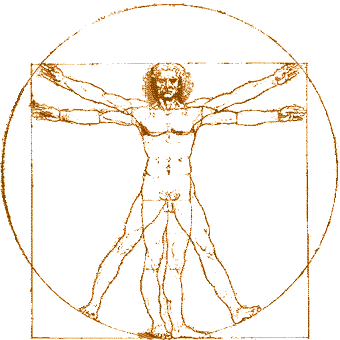
Tags: A.C. Bhaktivedanta Swami Prabhupada, consciousness, human body, human form of life, Leonardo da Vinci, Srila Prabhupada, we are not this body

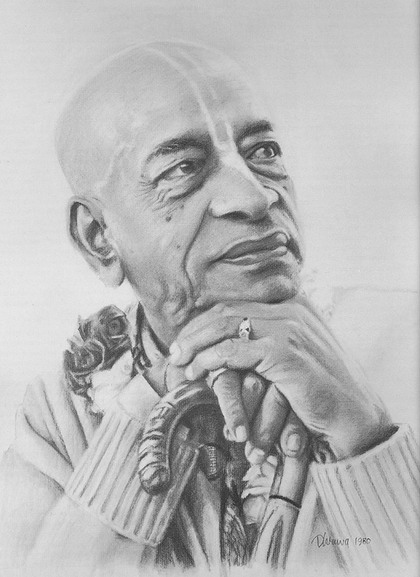
“The very first step in self-realization is realizing one’s identity as separate from the body. “I am not this body but am spirit soul” is an essential realization for anyone who wants to transcend death and enter into the spiritual world beyond. It is not simply a matter of saying “I am not this body,” but of actually realizing it. This is not as simple as it may seem at first. Although we are not these bodies but are pure consciousness, somehow or other we have become encased within the bodily dress. If we actually want the happiness and independence that transcend death, we have to establish ourselves and remain in our constitutional position as pure consciousness.” (from Beyond Birth and Death)
THE HUMAN FORM OF LIFE
Srila Prabhupada would often pose the question: ‘what is the difference between a live body and a dead one?’ He would point out that if we are nothing but chemicals, then these chemicals are also present in the dead body. What is it that distinguishes a living form from a non-living form? The answer, Srila Prabhupada taught, is consciousness, or awareness. All living forms display this symptom of consciousness to one degree or another. That is why we call them living rather than dead. Even the small microbial germ or the common houseplant shows signs of consciousness, whereas our dining table and chairs do not.
Srila Prabhupada would stress that although different forms of life display different degrees and levels of consciousness, it is in the human form that we find the highest development of consciousness. He taught that since humans had the highest level of self-awareness it was a complete waste if he simply engaged in the same activities as the animals.
But what is it about our consciousness that makes it so different from that of the insect, the bird, the beast, or even the monkey? These creatures eat and we also eat; they sleep and we also sleep; they reproduce and we reproduce; they defend themselves and so do we. That we can perform these functions with greater sophistication may be one indicator that we possess higher consciousness, but it does not fully explain our excellence above all other forms of life.
Srila Prabhupada explained that the real difference is found in our ability to question our existence, reflect upon our selves, and inquire into our own nature and the nature of God. We can create languages, ponder the meaning of life, and puzzle in wonderment over the night sky. Such an endowment is not present in any other form of life.
The Vedas therefore advise that in this human form of life we should be inquisitive to know who we are, what the universe is, what God is, and what the relationship is between ourselves, the universe, and God.
We should inquire about the solution to the ultimate problems of life, namely birth, death, old age, and disease. Such questions cannot be asked by the cats and dogs, but they must arise in the heart of a real human being.
YOU ARE NOT THIS BODY
Without exception, all material phenomena have a beginning and an end. A prominent idea of modem culture is that consciousness is another such material phenomenon. Thus it is believed that consciousness (or the self) also ends with the death of the material body. This point of view, however, remains only an assumption. It has not been proven true by any scientific observation or experiment. Srila Prabhupada was highly critical of Western culture’s strong identification of the self with the material body as he explains in the second canto of Srimad-Bhagavatam:
“The whole materialistic world, based on the conception of the material body as the self, is ignorant of the science of God. The materialist is always busy working for the welfare of the material body, not only his own but also those of his children, kinsmen, communitymen, countrymen, etc. The materialists have many branches of philanthropic and altruistic activities from a political, national and international angle of vision, but none of the field work can go beyond the jurisdiction of the misconception of identifying the material body with the spirit soul. Unless, therefore, one is saved from the wrong conception of the body and the soul, there is no knowledge of Godhead, and unless there is knowledge of God, all advancement of material civilization, however dazzling, should be considered a failure.”
More
02 Feb 2012
by The Hare Krishna Movement
in Krishna, Teachings of Queen Kunti
Tags: A.C. Bhaktivedanta Swami Prabhupada, asuras, Krsna, Nrsimha, Putana, Rama, residents of Vrndavana, Srila Prabhupada, Srimad Bhagavatam, Teachings of Queen Kunti, Varaha

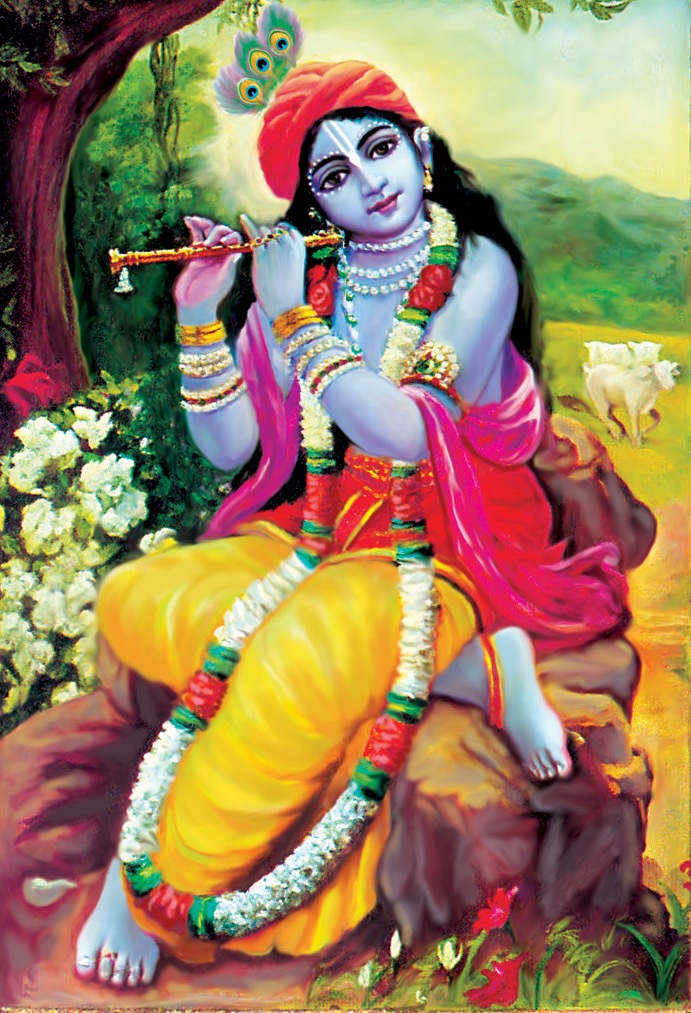
…Krishna is accepted as the Supreme Personality of Godhead by such authoritative personalities as Vyāsa, Devala, Asita, Nārada, Madhva, Śaṅkara, Rāmānuja, Śrī Caitanya Mahāprabhu, Jīva Gosvāmī, Viśvanātha Cakravartī, Bhaktisiddhānta Sarasvatī, and all other authorities of the line. He Himself has declared as much in many places of the authentic literatures. And yet there is a class of men with demoniac mentality who are always reluctant to accept the Lord as the Supreme Absolute Truth. This is partially due to their poor fund of knowledge and partially due to their stubborn obstinacy, which results from various misdeeds in the past and present. Such persons could not recognize Lord Śrī Kṛṣṇa even when He was present before them.
Teachings of Queen Kunti
By His Divine Grace A.C. Bhaktivedanta Swami Prabhupada
Chapter 2, Beyond the Senses
māyā-javanikācchannam
ajñādhokṣajam avyayam
na lakṣyase mūḍha-dṛśā
nato nāṭya-dharo yathā
Being beyond the range of limited sense perception, You are the eternally irreproachable factor covered by the curtain of deluding energy. You are invisible to the foolish observer, exactly as an actor dressed as a player is not recognized. —Śrīmad-Bhāgavatam 1.8.19
In the Bhagavad-gītā Lord Śrī Kṛṣṇa affirms that less intelligent persons mistake Him to be an ordinary man like us, and thus they deride Him. The same is confirmed herein by Queen Kuntī.
The less intelligent persons are those who rebel against the authority of the Lord. Such persons are known as asuras. The asuras cannot recognize the Lord’s authority. When the Lord Himself appears among us, as Rāma, Nṛsiṁha, Varāha, or in His original form as Kṛṣṇa, He performs many wonderful acts which are humanly impossible. As we shall find in the Tenth Canto of this great literature, Lord Śrī Kṛṣṇa exhibited His humanly impossible activities even from the days of His lying on the lap of His mother. He killed the Pūtanā witch, although she smeared her breast with poison just to kill the Lord. The Lord sucked her breast like a natural baby, and He sucked out her very life also. Similarly, He lifted the Govardhana Hill, just as a boy picks up a frog’s umbrella, and stood several days continuously just to give protection to the residents of Vṛndāvana.
More
01 Feb 2012
by The Hare Krishna Movement
in Books by Srila Prabhupada, Srimad Bhagavatam, The Hare Krishna Movement
Tags: A.C. Bhaktivedanta Swami Prabhupada, books by Srila Prabhupada, Kali, Kali-yuga, literary incarnation, Lord Sri Krsna, Srimad Bhagavatam
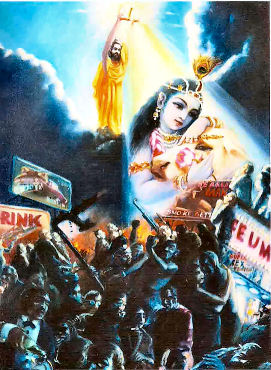
…Śrīmad-Bhāgavatam is the literary incarnation of Lord Śrī Kṛṣṇa and is therefore nondifferent from Him. Śrīmad-Bhāgavatam should be worshiped as respectfully as we worship the Lord. Thereby we can derive the ultimate blessings of the Lord through its careful and patient study…
The Srimad Bhagavatam
By His Divine Grace A.C. Bhaktivedanta Swami Prabhupada
Canto 1, Chapter 3, Text 40
idaṁ bhāgavataṁ nāma
purāṇaṁ brahma-sammitam
uttama-śloka-caritaṁ
cakāra bhagavān ṛṣiḥ
niḥśreyasāya lokasya
dhanyaṁ svasty-ayanaṁ mahat
idam—this; bhāgavatam—book containing the narration of the Personality of Godhead and His pure devotees; nāma—of the name; purāṇam—supplementary to the Vedas; brahma-sammitam—incarnation of Lord Śrī Kṛṣṇa; uttama-śloka—of the Personality of Godhead; caritam—activities; cakāra—compiled; bhagavān—incarnation of the Personality of Godhead; ṛṣiḥ—Śrī Vyāsadeva; niḥśreyasāya—for the ultimate good; lokasya—of all people; dhanyam—fully successful; svasti-ayanam—all-blissful; mahat—all-perfect.
This Śrīmad-Bhāgavatam is the literary incarnation of God, and it is compiled by Śrīla Vyāsadeva, the incarnation of God. It is meant for the ultimate good of all people, and it is all-successful, all-blissful and all-perfect.
Lord Śrī Caitanya Mahāprabhu declared that Śrīmad-Bhāgavatam is the spotless sound representation of all Vedic knowledge and history. There are selected histories of great devotees who are in direct contact with the Personality of Godhead. Śrīmad-Bhāgavatam is the literary incarnation of Lord Śrī Kṛṣṇa and is therefore nondifferent from Him. Śrīmad-Bhāgavatam should be worshiped as respectfully as we worship the Lord. Thereby we can derive the ultimate blessings of the Lord through its careful and patient study. As God is all light, all bliss and all perfection, so also is Śrīmad-Bhāgavatam. We can have all the transcendental light of the Supreme Brahman, Śrī Kṛṣṇa, from the recitation of Śrīmad-Bhāgavatam, provided it is received through the medium of the transparent spiritual master. Lord Caitanya’s private secretary Śrīla Svarūpa Dāmodara Gosvāmī advised all intending visitors who came to see the Lord at Purī to make a study of the Bhāgavatam from the person Bhāgavatam Person Bhāgavatam is the self-realized bona fide spiritual master, and through him only can one understand the lessons of Bhāgavatam in order to receive the desired result. One can derive from the study of the Bhāgavatam all benefits that are possible to be derived from the personal presence of the Lord. It carries with it all the transcendental blessings of Lord Śrī Kṛṣṇa that we can expect from His personal contact.
To purchase a complete set of original 1977 edition Srimad Bhagavatam’s go to;
More
30 Jan 2012
by The Hare Krishna Movement
in Bhismadeva, Krishna Consciousness, Srimad Bhagavatam
Tags: A.C. Bhaktivedanta Swami Prabhupada, Bhismadeva, Bhismastami, Dhisma's Passing Away, mystics, SB 1.9.29, Srimad Bhagavatam, yogis
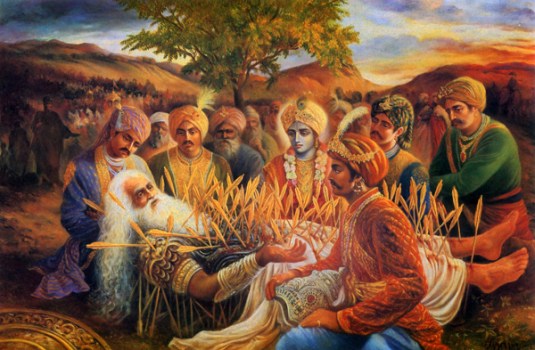
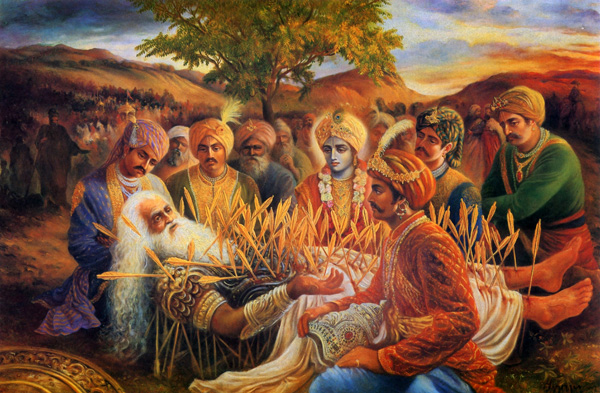
Today we observe the Disappearance of Bhismadeva or “Bhismastami” with these verses from the Srimad Bhagavatam describing this monumental event.
The perfect yogīs or mystics can leave the material body at their own sweet will…
In the momentous hour of leaving his material body, Bhīṣmadeva set the glorious example concerning the important function of the human form of life. The subject matter which attracts the dying man becomes the beginning of his next life. Therefore, if one is absorbed in thoughts of the Supreme Lord Śrī Kṛṣṇa, he is sure to go back to Godhead without any doubt. This is confirmed in the Bhagavad-gītā (8.5-15):
Srimad Bhagavatam
By His Divine Grace A.C. Bhaktivedanta Swami Prabhupada
Canto 1, Chapter 9, Text 29-30
Bhisma’s Passing Away
dharmaṁ pravadatas tasya
sa kālaḥ pratyupasthitaḥ
yo yoginaś chanda-mṛtyor
vāñchitas tūttarāyaṇaḥ
dharmam—occupational duties; pravadataḥ—while describing; tasya—his; saḥ—that; kālaḥ—time; pratyupasthitaḥ—exactly appeared; yaḥ—that is; yoginaḥ—for the mystics; chanda-mṛtyoḥ—of one who dies according to one’s own selection of time; vāñchitaḥ—is desired by; tu—but; uttarāyaṇaḥ—the period when the sun runs on the northern horizon.
While Bhīṣmadeva was describing occupational duties, the sun’s course ran into the northern hemisphere. This period is desired by mystics who die at their will.
The perfect yogīs or mystics can leave the material body at their own sweet will at a suitable time and go to a suitable planet desired by them. In the Bhagavad-gītā (8.24) it is said that self-realized souls who have exactly identified themselves with the interest of the Supreme Lord can generally leave the material body during the time of the fire-god’s effulgence and when the sun is in the northern horizon, and thus achieve the transcendental sky. In the Vedas these times are considered auspicious for quitting the body, and they are taken advantage of by the expert mystics who have perfected the system. Perfection of yoga means attainment of such supermental states as to be able to leave the material body as desired. Yogīs can also reach any planet within no time without a material vehicle. The yogīs can reach the highest planetary system within a very short time, and this is impossible for the materialist. Even attempting to reach the highest planet will take millions of years at a speed of millions of miles per hour. This is a different science, and Bhīṣmadeva knew well how to utilize it. He was just waiting for the suitable moment to quit his material body, and the golden opportunity arrived when he was instructing his noble grandsons, the Pāṇḍavas. He thus prepared himself to quit his body before the exalted Lord Śrī Kṛṣṇa, the pious Pāṇḍavas and the great sages headed by Bhagavān Vyāsa, etc., all great souls.
More
30 Jan 2012
by The Hare Krishna Movement
in A.C. Bhaktivedanta Swami Prabhupada, Advaita Acarya, Sri Caitanya-Caritamrta
Tags: A.C. Bhaktivedanta Swami Prabhupada, Adi. 12-13, Advaita Acarya, devotional service, Lord Advaita Acarya, Lords devotee, Maha-Visnu, maya, Sri Caitanya-caritamrta

Thinking of the lotus feet of Śrī Kṛṣṇa, He constantly offered tulasī buds in water from the Ganges.
While most of the world celebrated the Appearance day of Advaita Acarya yesterday…according to the BBT Art Calendar the variant date for our area is today. (go figure?) So we are posting some verses from the Sri Caitanya-caritamrta in honor of His appearance.
Sri Caitanya-caritamrta – 1975 Edition
By His Divine Grace A.C. Bhaktivedanta Swami Prabhupada
Adi-lila Chapter 1, Text 12-13
mahā-viṣṇur jagat-kartā
māyayā yaḥ sṛjaty adaḥ
tasyāvatāra evāyam
advaitācārya īśvaraḥ
mahā-viṣṇuḥ—Mahā-Viṣṇu, the resting place of the efficient cause; jagat-kartā—the creator of the cosmic world; māyayā—by the illusory energy; yaḥ—who; sṛjati—creates; adaḥ—that universe; tasya—His; avatāraḥ—incarnation; eva—certainly; ayam—this; advaita-ācāryaḥ—of the name Advaita Ācārya; īśvaraḥ—the Supreme Lord, the resting place of the material cause.
Lord Advaita Ācārya is the incarnation of Mahā-Viṣṇu, whose main function is to create the cosmic world through the actions of Māyā.
advaitaṁ hariṇādvaitād
ācāryaṁ bhakti-śaṁsanāt
bhaktāvatāram īśaṁ tam
advaitācāryam āśraye
advaitam—known as Advaita; hariṇā—with Lord Hari; advaitāt—from being nondifferent; ācāryam—known as Ācārya; bhakti-śaṁsanāt—from the propagation of devotional service to Śrī Kṛṣṇa; bhakta-avatāram—the incarnation as a devotee; īśam—to the Supreme Lord; tam—to Him; advaita-ācāryam—to Advaita Ācārya; āśraye—I surrender.
Because He is nondifferent from Hari, the Supreme Lord, He is called Advaita, and because He propagates the cult of devotion, He is called Ācārya. He is the Lord and the incarnation of the Lord’s devotee. Therefore I take shelter of Him.
Pasted from; Prabhupada Books
29 Jan 2012
by The Hare Krishna Movement
in Kali Yuga, Srimad Bhagavatam
Tags: A.C. Bhaktivedanta Swami Prabhupada, age of quarrel, devotees, Kali, Kali-yuga, Naimisaranya, SB 1.1.10, spiritual master, Srimad Bhagavatam

One day after finishing their morning duties by burning a sacrificial fire and respectfully offering a seat to Srila Suta Goswami. the great sages, headed by Saunaka Rsi, earnestly addressed him: “Respected Suta Goswami, you are completely free from all vice. You are well versed in all the scriptures famous for religious life, and in the Puranas and the histories as well, for you have gone through them under proper guidance and have also explained them. Being the eldest learned Vedantist, O Suta Goswami, you are acquainted with the knowledge of Vyasadeva, who is the incarnation of Godhead, and you also know other sages who are fully versed in all kinds of physical and metaphysical knowledge. And because you are submissive, your spiritual masters have endowed you with all the favors estowed upon a gentle disciple. Therefore you can tell us all that you have scientifically learned from them”
Srimad Bhagavatam
By His Divine Grace A.C. Bhaktivedanta Swami Prabhupada
Canto 1, Chapter 1, Text 10
prāyeṇālpāyuṣaḥ sabhya
kalāv asmin yuge janāḥ
mandāḥ sumanda-matayo
manda-bhāgyā hy upadrutāḥ
prāyeṇa—almost always; alpa—meager; āyuṣaḥ—duration of life; sabhya—member of a learned society; kalau—in this age of Kali (quarrel); asmin—herein; yuge—age; janāḥ—the public; mandāḥ—lazy; sumanda-matayaḥ—misguided; manda-bhāgyāḥ—unlucky; hi—and above all; upadrutāḥ—disturbed.
O learned one, in this iron age of Kali men have but short lives. They are quarrelsome, lazy, misguided, unlucky and, above all, always disturbed.
The devotees of the Lord are always anxious for the spiritual improvement of the general public. When the sages of Naimiṣāraṇya analyzed the state of affairs of the people in this age of Kali, they foresaw that men would live short lives. In Kali-yuga, the duration of life is shortened not so much because of insufficient food but because of irregular habits. By keeping regular habits and eating simple food, any man can maintain his health. Overeating, over-sense gratification, overdependence on another’s mercy, and artificial standards of living sap the very vitality of human energy. Therefore the duration of life is shortened.
The people of this age are also very lazy, not only materially but in the matter of self-realization. The human life is especially meant for self-realization. That is to say, man should come to know what he is, what the world is, and what the supreme truth is. Human life is a means by which the living entity can end all the miseries of the hard struggle for life in material existence and by which he can return to Godhead, his eternal home. But, due to a bad system of education, men have no desire for self-realization. Even if they come to know about it, they unfortunately become victims of misguided teachers.
More
26 Jan 2012
by The Hare Krishna Movement
in Krishna Consciousness, KRSNA The Supreme Personality of Godhead, Spiritual Life, Spiritual World
Tags: A.C. Bhaktivedanta Swami Prabhupada, Balarama, Dvaraka, Krishna, Krsna and Balarama, Krsna The Supreme Personality of Godhead, Kuruksetra, Lord Parasurama, Vrndavana, Yadu dynasty
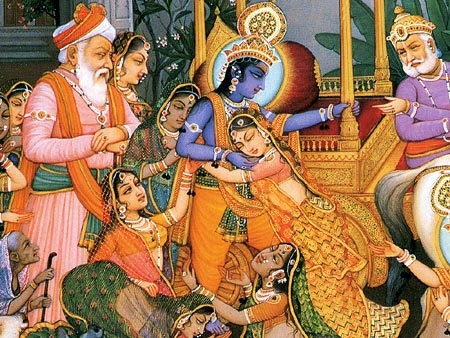
“For one who remembers Me without deviation, I am easy to obtain, O son of Prtha, because of his constnt engagement in devotional service. (Bhagavad-gita 8.14)
…The special qualification of the pure devotee is that he is always thinking of Kṛṣṇa without considering the time or place. There should be no impediments. He should be able to carry out his service anywhere and at any time. Some say that the devotee should remain in holy places like Vṛndāvana or some holy town where the Lord lived, but a pure devotee can live anywhere and create the atmosphere of Vṛndāvana by his devotional service. It was Śrī Advaita who told Lord Caitanya, “Wherever You are, O Lord-there is Vṛndavana.” (From Purport)
So to help us in remembering the Lord, we are posting this very nice chapter from “KRSNA The Supreme Personality of Godhead” by His Divine Grace A.C. Bhaktivedanta Swami, who is teaching us how to always think of Krishna.
…All the members of the Yadu dynasty were naturally very beautiful, and yet on this occasion, when they appeared duly decorated with gold necklaces and flower garlands, dressed in valuable clothing and properly armed with their respective weapons, their natural beauty and personalities were a hundred times enhanced. The members of the Yadu dynasty came to Kurukṣetra in their gorgeously decorated chariots resembling the airplanes of the demigods, pulled by big horses that moved like the waves of the ocean, and some of them rode on sturdy, stalwart elephants that moved like the clouds in the sky. Their wives were carried on beautiful palanquins by beautiful men whose features resembled those of the Vidyādharas. The entire assembly looked as beautiful as an assembly of the demigods of heaven…
KRSNA The Supreme Personality of Godhead (1970 Edition)
By His Divine Grace A.C. Bhaktivedanta Swami Prabhupada
Vol.2 Chapter 27
Lord Kṛṣṇa and Balarāma Meet the Inhabitants of Vṛndāvana
Once upon a time while Lord Kṛṣṇa and Balarāma were living peacefully in Their great city of Dvārakā, there was the rare occasion of a full solar eclipse, such as takes place at the end of every kalpa, or day of Brahmā. At the end of every kalpa the sun is covered by a great cloud, and incessant rain covers the lower planetary systems up to Svargaloka. By astronomical calculation, people were informed about this great eclipse prior to its taking place, and therefore everyone, both men and women, decided to assemble at the holy place in Kurukṣetra known as Samanta-pañcaka.
More
24 Jan 2012
by The Hare Krishna Movement
in Back to Godhead, Guru & Disciple, Hayagriva das, Spiritual Master, Uncategorized
Tags: A.C. Bhaktivedanta Swami Prabhupada, Back to Godhead Magazine, dharma of Kali Yuga, God, guru, hayagriva das, Krishna, prabhupada, religion, spiritual master

I like these early articles published in Back to Godhead Magazine. The mood was different in the early days of this movement, as the emphasis was on preaching. We understood the importance of Hari Nama Sankirtan, Book and Prasadam distribution, and there was not so much politics and internal wrangling, as we see today. Devotees had such profound appreciation for Srila Prabhupada, and the Mission of Lord Caitanya. We were unified; “Srila Prabhupada built a house the whole world could live in”, and we were in a unique position to change the world. To go back to those early days, we need only to put Srila Prabhupada and Krishna, back in the center of all our activities.
The Guru: Via Media to God
By Hayagriva das
“Excerpted from ‘Back To Godhead’ magazine, courtesy of The Bhaktivedanta Book Trust International, Inc., http://www.Krishna.com.” 1970 Vol. 1, No. 34
It is always best to assume that we are in the modes of ignorance, and at least we will be right on that point. When knowledge is staggeringly finite, humility is the best policy. On the spiritual path one tries to make progress to the modes of goodness and then transcend, for it is not always possible to transcend the modes all at once. God alone is perfect, and we are always imperfect, even in our so-called liberated state. It is because we are imperfect that we have to take shelter of the perfect.
Lord Caitanya advises that we take shelter of a sadhu, who is a holy man of spotless character, sastra, which is scripture, and guru, who is the perfect spiritual master. The scriptures should be the guidelines for the other two. The guru is liberated because he follows scriptures, and the sadhu is pure and honest because he accepts scriptural principles. The insistence on the authority of the scripture is to discourage people from inventing their own religions and to warn others against following such fabricators.
Actually, only God can establish a religion that is bona fide. Religion refers to man’s relationship with God or the Supreme Absolute Truth; it is neither a mere ritual, nor a set of regulations, nor a conglomeration of mental speculations concocted by man. Actual religion is to know God and one’s relationship to Him. And this is not possible unless God reveals who and what He is and reveals man’s relationship to Him. It is not that we can artificially say, “Oh, I think God is this, so I think if I do this or this I will become God, and then I’ll be happy.” One who invents in this way may be well intentioned, but he is actually misguiding himself and others.
More
22 Jan 2012
by The Hare Krishna Movement
in Books by Srila Prabhupada, Krishna Consciousness, The Path of Perfection
Tags: A.C. Bhaktivedanta Swami Prabhupada, bhakti yoga, Durga, Krishna Consciousness Society, Krsna, lotus feet, O son of Maharaja Nanda, Radha and Krsna, Srila Prabhupada, The Path of Perfection, yoga

Thanks to Sudarshan das for submitting this picture
…We have formed this International Society for Krishna Consciousness in order to teach people what they have forgotten. In this material world, we have forgotten the service of Rādhā-Kṛṣṇa; therefore we have become servants of māyā, the senses. Therefore, in this Society we are saying, “You are serving your senses. Now just turn your service to Rādhā and Kṛṣṇa, and you will be happy. You have to render service—either to māyā [illusion], the senses, or to Śrī Śrī Rādhā-Kṛṣṇa.”
In this world, everyone is serving the senses, but people are not satisfied. No one can be satisfied, because the senses are always demanding more gratification, and this means that we are constantly having to serve the senses. In any case, our position as servant remains the same. It is a question of whether we want to be happy in our service. It is the verdict of Bhagavad-gītā and the other Vedic scriptures that we will never be happy trying to serve our senses, for they are only sources of misery. Therefore Lord Caitanya Mahāprabhu prays to be situated in Kṛṣṇa’s service. He also prays,
ayi nanda-tanuja kiṅkaraṁ
patitaṁ māṁ viṣame bhavāmbudhau
kṛpayā tava pāda-paṅkaja-
sthita-dhūlī-sadṛśaṁ vicintaya
“O son of Mahārāja Nanda [Kṛṣṇa], I am Your eternal servitor, yet somehow or other I have fallen into the ocean of birth and death. Please pick me up from this ocean of death and place me as one of the atoms at Your lotus feet.” (Śikṣāṣṭaka 5) This is another way of asking Kṛṣṇa to engage us in His service…
The Path of Perfection
By His Divine Grace A.C. Bhaktivedanta Swami Prabhupada
Chapter 8
Failure and Success in Yoga
full chapter More
21 Jan 2012
by The Hare Krishna Movement
in A.C. Bhaktivedanta Swami Prabhupada, Teachings of Lord Kapila
Tags: A.C. Bhaktivedanta Swami Prabhupada, happiness and distress, Son of Devahuti, Teachings of Lord Kapila, The Symptoms of a Sadhu, winter, winter and summer seasons

click to enlarge image
“O son of Kuntī, the nonpermanent appearance of happiness and distress and their disappearance in due course are like the appearance and disappearance of winter and summer seasons. They arise from sense perception, O scion of Bharata, and one must learn to tolerate them without being disturbed.”
In summer we suffer, and in winter we suffer. In the summer, fire brings suffering, and in the winter the same fire is pleasing. Similarly, in the winter, water is suffering, but in the summer it is pleasing. The water and the fire are the same, but sometimes they are pleasing, sometimes they are not….The more we are in the bodily conception, the more we suffer.
Teachings of Lord Kapila, the Son of Devahuti
By His Divine Grace A.C. Bhaktivedanta Swami Prabhupada
Chapter 11, Text 23
mad-āśrayāḥ kathā mṛṣṭāḥ
śṛṇvanti kathayanti ca
tapanti vividhās tāpā
naitān mad-gata-cetasaḥ
Engaged constantly in chanting and hearing about Me, the Supreme Personality of Godhead, the sādhus do not suffer from material miseries because they are always filled with thoughts of My pastimes and activities.
More
21 Jan 2012
by The Hare Krishna Movement
in A.C. Bhaktivedanta Swami Prabhupada, Back to Godhead, Poetry of Srila Prabhupada
Tags: A.C. Bhaktivedanta Swami Prabhupada, Founder Acharya, International Society for Krishna Consciousness, Poetry of Srila Prabhupada, Prabhupada's arrival in USA, spiritual master, Srila Prabhupada

Poem by Srila Prabhupada on His First Arrival in the USA
The spiritual master and founder of the International Society for Krishna Consciousness, His Divine Grace A.C. Bhaktivedanta Swami Prabhupada, is now engaging thousands of men and women in America and throughout the world in the science of bhakti-yoga, transcendental loving service to God. Prabhupada had no personal motive in first beginning ISKCON; he so vigorously preaches the philosophy of God consciousness simply because he has been ordered to do so by his own spiritual master, Srila Bhaktisiddhanta Sarasvati Gosvami Maharaja.
His Divine Grace A.C. Bhaktivedanta Swami Prabhupada first arrived in the United States in 1965 with seven dollars, a letter of introduction to an Indian family in Pennsylvania, and a suitcase with some volumes of Srimad-Bhagavatam. In the following poem, written in Bengali on the day of his arrival in the USA, Srila Prabhupada addresses the Supreme Lord Krsna, asking Him His purpose in sending His servant to America. The translation from Bengali was done by Srila Prabhupada himself.
As Follows; More
19 Jan 2012
by The Hare Krishna Movement
in Books by Srila Prabhupada, Devotional Service, Nectar of Devotion
Tags: A.C. Bhaktivedanta Swami Prabhupada, bhakti, bhakti yoga, Bhakti-rasamrta-sindhu, Hari-bhakti-vilasa, Nectar of Devotion, Sanatana Goswami, spiritual master, Srila Rupa Goswami, Vaisnavas

The Nectar of Devotion is a summary study of Srila Rupa Goswami’s Bhakti-rasāmṛta-sindhu, or “the nectar that is derived from the ocean of devotion (bhakti).” It fully contains the complete science of bhakti-yoga, or linking with the Supreme by transcendental loving devotion. Bhakti-yoga is the highest path of attaining God consciousness, and it is simultaneously simple and sublime. It is recommended for everyone in this age.
The Nectar of Devotion 1970 Edition
By Hia Divine Grace A.C. Bhaktivedanta Swami Prabhupada
Chapter 6
How to Discharge Devotional Service
Śrīla Rūpa Gosvāmī states that his elder brother (Sanātana Gosvāmī) has compiled Hari-bhakti-vilāsa for the guidance of the Vaiṣṇavas and therein has mentioned many rules and regulations to be followed by the Vaiṣṇavas. Some of them are very important and prominent, and he will now mention these very important items for our benefit. The purport of this statement is that Śrīla Rūpa Gosvāmī proposes to mention only basic principles, not details. For example, a basic principle is that one has to accept a spiritual master. Exactly how one follows the instructions of his spiritual master is considered a detail. For example, if one is following the instruction of his spiritual master and that instruction is different from the instructions of another spiritual master, this is called detailed information. But the basic principle of acceptance of a spiritual master is good everywhere, although the details may be different. Śrīla Rūpa Gosvāmī does not wish to enter into details here, but wants to place before us only the principles.
He mentions the basic principles as follows: 1) accepting the shelter of the lotus feet of a bona fide spiritual master, 2) becoming initiated by the spiritual master and learning how to discharge devotional service from him, 3) obeying the orders of the spiritual master with faith and devotion, 4) following in the footsteps of great ācāryas (teachers) under the direction of the spiritual master, 5) inquiring from the spiritual master how to advance in Kṛṣṇa consciousness, 6) being prepared to give up anything material for the satisfaction of the Supreme Personality of Godhead, Śrī Kṛṣṇa (This means that when we are engaged in the devotional service of Kṛṣṇa, we must be prepared to give up something which we may not like to give up, and also we have to accept something which we may not like to accept.), 7) residing in a sacred place of pilgrimage like Dvārakā or Vṛndāvana, 8) dealing with the material world only as far as necessary, 9) observing the fasting day on Ekādaśī, and 10) worshiping sacred trees like the banyan tree.
More
18 Jan 2012
by The Hare Krishna Movement
in Back to Godhead, Guru & Disciple, Srila Prabhupada
Tags: A.C. Bhaktivedanta Swami Prabhupada, books of His Divine Grace, guru, guru's life, guru's teachings, prabhupada, spiritual master, Srila Prabhupada

Among the naive, of course, one may pass for a spiritual master by wearing robes and a beard, bearing a twinkle in one’s eye, performing some magic tricks, or speaking riddles. But intelligent people won’t settle for these outer trappings
Since we are all servants of the Supreme Lord, a bona fide guru must be a devotee of the Supreme Lord and teach others how to become His devotees. In fact, unless the guru is a devotee of Lord Krsna, he cannot understand transcendental knowledge—what to speak of imparting it to others.
Establishing the Proof: Who Is a Real Guru?
Excerpted from Back to Godhead Magazine 1977, Vol.12, No. 8
A recent Gallup poll revealed that more than nineteen million American adults are now practicing some form of yoga, meditation, or other “self-renewal” process. To meet this great demand, many “gurus” have appeared on the scene, each teaching his version of spiritual truth. Some have attracted large followings, and every disciple undoubtedly feels that his guru is the best. But for the serious seeker of truth, choosing a spiritual master cannot be a matter of mere sentiment. Spiritual life is factual and scientific, and we have to test the qualifications of any spiritual teacher by referring to the standard authority. This authority is scripture, especially the Sanskrit Vedic scriptures, which throughout history have provided the philosophical basis for the guru-disciple relationship. By referring to Vedic scriptures we can know the criteria for a bona fide spiritual master. Then we can easily see who is actually a spiritual master, and who is a fraud.
Examining the Guru’s Teachings
The first criterion, according to the Vedic scriptures, is the quality of the words the teacher speaks. (Even a fool may be highly esteemed—until he speaks.) In the Bhagavad-gita Lord Sri Krsna, the original spiritual master, tells his disciple Arjuna, “The self-realized soul can impart knowledge unto you because he has seen the truth.” In other words, a genuine guru must have realized the Absolute Truth, the Personality of Godhead, and he must be able to impart this truth to his disciple, thus freeing him (or her) from repeated birth and death.
We should therefore immediately reject as outright charlatans those so-called gurus who pretend to have some spiritual knowledge, but who teach their disciples only how to gain some material advantage—a slimmer body, better sex life, success in business, and so on. Real spiritual life means getting free from the agony of birth and death. How can a common man, unable to distinguish spirit from matter—and thus himself caught in the cycle of birth and death—claim to be a spiritual master? Such cheaters generally take up the “guru business” just to earn a living. But the Srimad-Bhagavatam, the essence of all Vedic scriptures, sternly warns, “No one should become a guru unless he can free his disciple from birth and death.”
More
17 Jan 2012
by The Hare Krishna Movement
in Krishna, Krishna Consciousness, Spiritual World, Srimad Bhagavatam
Tags: A.C. Bhaktivedanta Swami Prabhupada, brahmanas, chariots, conchshells, elephants, Krishna, Krsna enters Dwaraka, Lord Krishna, lotus flowers, Srimad Bhagavatam, The Supreme Personality of Godhead, unbroken seeds, Vedic hymns
Srimad Bhagavatam
By His Divine Grace A.C. Bhaktivedanta Swami Prabhupada
Canto 1, Chapter 11
Lord Kṛṣṇa’s Entrance into Dvārakā
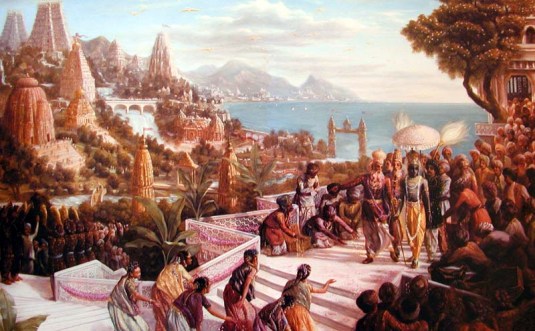
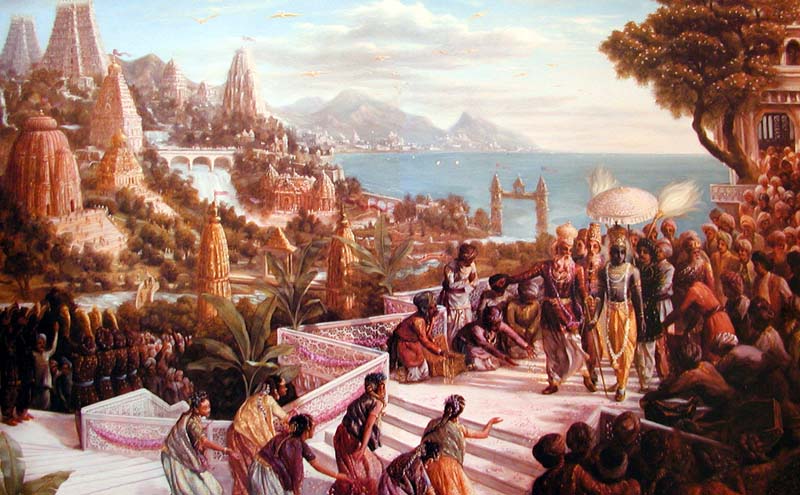
While entering the city of Dvaraka, Lord Krishna acknowledged all the inhabitants’ by casting His transcendental glance over them. The city was filled with the opulences of all seasons. There were hermitages, orchards, flower gardens, parks and reservoirs of water filled with lotus flowers. The highways, subways, lanes, markets and public meeting places were all thoroughly cleansed and then moistened with scented water, And to welcome the Lord, the residents of Dvaraka strew flowers, fruits and unbroken seeds everywhere. The residents hastened toward the Lord on chariots, upon which rode brahmanas bearing flowers, In front of the chariots were elephants, which are emblems of good fortune. Conchshells and bugles were sounded, and Vedic hymns were chanted. Thus, the residents offered their respects, which were saturated with affection, In return, Lord Krishna, the Personality of Godhead, approached them and offered due honor and respect to each and every one of the friends, relatives, citizens and others who came to receive and welcome Him. As the Lord passed along the public road of Dvaraka, His head was protected from sunshine by a white umbrella. White feathered fans moved in semicircles, and showers of flowers fell upon the road. His yellow garments and garlands of flowers made it appear as if a dark cloud were surrounded simultaneously by the sun, the moon, lighting and rainbows.
Lord Kṛṣṇa’s attraction is so powerful that once being attracted by Him one cannot tolerate separation from Him. Why is this so? Because we are all eternally related with Him as the sun rays are eternally related with the sun disc. The sun rays are molecular parts of the solar radiation. Thus the sun rays and the sun cannot be separated. The separation by the cloud is temporary and artificial, and as soon as the cloud is cleared, the sun rays again display their natural effulgence in the presence of the sun. Similarly, the living entities, who are molecular parts of the whole spirit, are separated from the Lord by the artificial covering of māyā, illusory energy. This illusory energy, or the curtain of māyā, has to be removed, and when it is so done, the living entity can see the Lord face to face, and all his miseries are at once removed. Every one of us wants to remove the miseries of life, but we do not know how to do it. The solution is given here, and it rests on us to assimilate it or not. (Srimad Bhagavatam 1.11.10 Purport)
Painting by-Ramadasa Abhirama dasa
16 Jan 2012
by The Hare Krishna Movement
in Bhagavad-gita, Krishna
Tags: A.C. Bhaktivedanta Swami Prabhupada, Atlas, Atlas holding the globe, Bg 9.5, Bhagavad-gita As It Is, creation, material manifestation, Spiritual world, Visnu
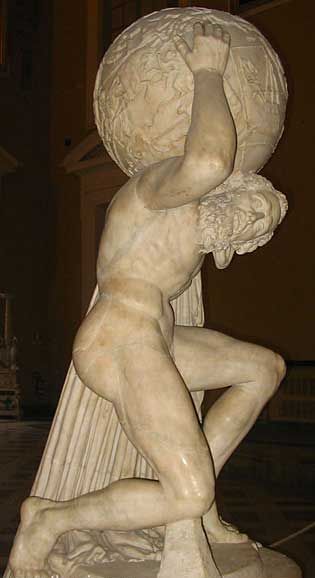
The Lord says that everything is resting on Him. This should not be misunderstood. The Lord is not directly concerned with the maintenance and sustenance of this material manifestation. Sometimes we see a picture of Atlas holding the globe on his shoulders; he seems to be very tired, holding this great earthly planet. Such an image should not be entertained in connection with Kṛṣṇa’s upholding this created universe. He says that although everything is resting on Him, still He is aloof.

Bhagavad-gita As It Is – Macmillan 1972 Edition
By His Divine Grace A.C. Bhaktivedanta Swami Prabhupada
Chapter 9, Text 5
na ca mat-sthāni bhūtāni
paśya me yogam aiśvaram
bhūta-bhṛn na ca bhūta-stho
mamātmā bhūta-bhāvanaḥ
na—never; ca—also; mat-sthāni—situated in Me; bhūtāni—all creation; paśya—just see; me—My; yogam aiśvaram—inconceivable mystic power; bhūta-bhṛt—maintainer of all living entities; na—never; ca—also; bhūta-sthaḥ—in the cosmic manifestation; mama—My; ātmā—Self; bhūta-bhāvanaḥ—is the source of all manifestations.
Translation
And yet everything that is created does not rest in Me. Behold My mystic opulence! Although I am the maintainer of all living entities, and although I am everywhere, still My Self is the very source of creation.
More
12 Jan 2012
by The Hare Krishna Movement
in Krishna, Teachings of Queen Kunti
Tags: A.C. Bhaktivedanta Swami Prabhupada, Krsna, kunty uvaca, Srimad Bhagavatam, Srimati Kuntidevi, Teachings of Queen Kunti, The Original Person
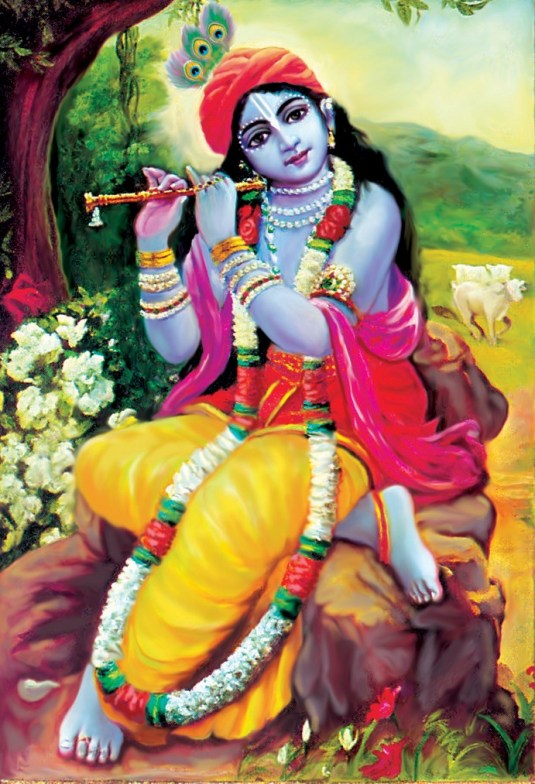
Teachings of Queen Kunti
By His Divine Grace A.C. Bhaktivedanta Swami Prabhupada
Chapter 1, The Original Person
kunty uvāca
namasye puruṣaṁ tvādyam
īśvaraṁ prakṛteḥ param
alakṣyaṁ sarva-bhūtānām
antar bahir avasthitam
Śrīmatī Kuntī said: O Kṛṣṇa, I offer my obeisances unto You because You are the original personality and are unaffected by the qualities of the material world. You are existing both within and without everything, yet You are invisible to all. —Śrīmad-Bhāgavatam 1.8.18
Śrīmatī Kuntīdevī was quite aware that Kṛṣṇa is the original Personality of Godhead, although He was playing the part of her nephew. Such an enlightened lady could not commit a mistake by offering obeisances unto her nephew. Therefore, she addressed Him as the original puruṣa beyond the material cosmos. Although all living entities are also transcendental, they are neither original nor infallible. The living entities are apt to fall down under the clutches of material nature, but the Lord is never like that. In the Vedas, therefore, He is described as the chief among all living entities (nityo nityānāṁ cetanaś cetanānām). Then again He is addressed as īśvara, or the controller. The living entities or the demigods like Candra and Sūrya are also to some extent īśvara, but none of them is the supreme īśvara, or the ultimate controller. Kṛṣṇa is the parameśvara, or the Supersoul. He is both within and without. Although He was present before Śrīmatī Kuntī as her nephew, He was also within her and everyone else. In the Bhagavad-gītā (15.15) the Lord says, “I am situated in everyone’s heart, and only due to Me one remembers, forgets, and is cognizant, etc. Through all the Vedas I am to be known because I am the compiler of the Vedas, and I am the teacher of the Vedānta.” Queen Kuntī affirms that the Lord, although both within and without all living beings, is still invisible. The Lord is, so to speak, a puzzle for the common man. Queen Kuntī experienced personally that Lord Kṛṣṇa was present before her, yet He entered within the womb of Uttarā to save her embryo from the attack of Aśvatthāmā’s brahmāstra. Kuntī herself was puzzled about whether Śrī Kṛṣṇa is all-pervasive or localized. In fact, He is both, but He reserves the right of not being exposed to persons who are not surrendered souls. This checking curtain is called the māyā energy of the Supreme Lord, and it controls the limited vision of the rebellious soul. It is explained as follows.
11 Jan 2012
by The Hare Krishna Movement
in Books by Srila Prabhupada, Krishna, Raja-Vidya
Tags: A.C. Bhaktivedanta Swami Prabhupada, Banyan tree, jivas, Krsna, material energy, Narada Muni and cobbler, prakrti, Raja-Vidya, spiritual energy, the king of knowledge

Banyan Tree by Herb Kawainui Kane
Click to enlarge
It is not very difficult to see God everywhere in the creation, for He is everywhere present…those who are conversant with the science of Kṛṣṇa can see Him in every atom of the creation.
…You can see that there is this banyan tree, and you can see that so many fruits are falling daily, and in each fruit there are so many seeds, and in every seed there is a banyan tree like this one. If, within a small seed there can be a big tree like this, is it difficult to accept that the Lord is in every atom of creation…
So this is called faith. It is not a question of blindly believing. There is reason behind the belief. If Kṛṣṇa can put a large tree within so many little seeds, is it so astounding that He is keeping all the planetary systems floating in space through His energy?
Raja-Vidya: The King of Knowledge
By His Divine Grace A.C. Bhaktivedanta Swami Prabhupada
Chapter 3
Knowledge of Kṛṣṇa’s Energies
It may be noted at this point that the Ninth Chapter of Bhagavad-gītā is especially meant for those who have already accepted Śrī Kṛṣṇa as the Supreme Personality of Godhead. In other words, it is meant for His devotees. If one does not accept Śrī Kṛṣṇa as the Supreme, this Ninth Chapter will appear as something different from what it actually is. As stated in the beginning, the subject matter of the Ninth Chapter is the most confidential material in the entire Bhagavad-gītā. If one doesn’t accept Kṛṣṇa as the Supreme, he will think the chapter to be a mere exaggeration. This is especially the case with the verses dealing with Kṛṣṇa’s relationship with His creation.
More
26 Dec 2011
by The Hare Krishna Movement
in A.C. Bhaktivedanta Swami Prabhupada, Nectar of Instruction, The Nectar of Instruction
Tags: A.C. Bhaktivedanta Swami Prabhupada, capitalism, human life, Lords energy, materialistic communism, Nectar of Instruction, Rupa Goswami, sense gratification, spiritual development

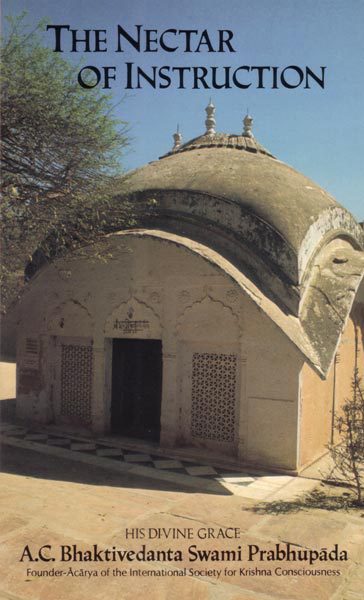
…Kṛṣṇa conscious devotees know very well that this material world is designed by the complete arrangement of the Lord to fulfill all the necessities of life for all living beings, without their having to encroach upon the life or rights of one another. This complete arrangement affords the proper quota of wealth for everyone according to his real needs, and thus everyone may live peacefully according to the principle of plain living and high thinking. Unfortunately, materialists who have neither faith in the plan of God nor any aspiration for higher spiritual development misuse their God-given intelligence only to augment their material possessions. They devise many systems—such as capitalism and materialistic communism—to advance their material position. They are not interested in the laws of God or in a higher goal. Always anxious to fulfill their unlimited desires for sense gratification, they are conspicuous by their ability to exploit their fellow living beings…
The Nectar of Instruction
By His Divine Grace A.C. Bhaktivedanta Swami Prabhupada
Text 2
atyāhāraḥ prayāsaś ca
prajalpo niyamāgrahaḥ
jana-saṅgaś ca laulyaṁ ca
ṣaḍbhir bhaktir vinaśyati
ati-āhāraḥ—overeating or too much collecting; prayāsaḥ—overendeavouring; ca—and; prajalpaḥ—idle talk; niyama—rules and regulations; āgrahaḥ—too much attachment to (or agrahaḥ—too much neglect of); jana-saṅgaḥ—association with worldly-minded persons; ca—and; laulyam—ardent longing or greed; ca—and; ṣaḍbhiḥ—by these six; bhaktiḥ—devotional service; vinaśyati—is destroyed.
One’s devotional service is spoiled when he becomes too entangled in the following six activities: (1) eating more than necessary or collecting more funds than required; (2) overendeavoring for mundane things that are very difficult to obtain; (3) talking unnecessarily about mundane subject matters; (4) Practicing the scriptural rules and regulations only for the sake of following them and not for the sake of spiritual advancement, or rejecting the rules and regulations of the scriptures and working independently or whimsically; (5) associating with worldly-minded persons who are not interested in Kṛṣṇa consciousness; and (6) being greedy for mundane achievements.
More
23 Dec 2011
by The Hare Krishna Movement
in Free Downloads, Free eBooks, The Hare Krsna Cookbook, Vegetarian Cooking, Vegetarian Recipies, Vegetarianism
Tags: A.C. Bhaktivedanta Swami Prabhupada, devotional service, Krishna, krsna consciousness, Krsna devi dasi, Prasadam, Sama devi dasi, singing dancing and feasting, The Hare Krsna Cookbook, vegetarian cooking, vegetarian recipies, vegetarianism

click on link at bottom to download entire book in pdf format
The Hare Krsna Cookbook
1973 Bhaktivedanta Book Trust
Compiled by Krsna devi dasi and Sama devi dasi
“The Hare Krsna Cookbook”, originally published in 1973, was the first widely distributed book of vegetarian recipes, throughout the Movement. This was the book myself and many early devotees learned to cook from, and remains today my all time favorite cookbook, and is a constant companion in our kitchen. We offer the complete book on a PDF Format as a gift to all our readers this Holiday Season.
Dedication
Prasadam means mercy, and this Prasadam Cookbook is dedicated to the fountainhead of all mercy, the spiritual master, His Divine Grace A.C. Bhaktivedanta Swami Prabhupada. He is by nature kind to every living entity, but that ocean of mercy becomes fully visible in his devotees.
Srila Prabhupada has not given us some dry, canned philosophy to chew; he has given us the nectar for which we have sought so long: he has taught us how to render transcendental loving service to the Lord in all our daily activities. This book illustrates on of them.
The Process of Krsna Consciousness is usually described as one of dinging, dancing and feasting. We have already demonstrated to the world how anyone can sing and dance to the holy names of God, Hare Krsna, and now, with the publication of this Prasadam Cookbook, we hope that the whole world will feast in honor of the Supreme Lord. That will make this world like Vrndavana, the transcendental abode of Krsna, where Krsna, Balarama and the monkeys visit every kitchen with thieving intend and bless the devotees with pure love of God. (Dedication from The Hare Krsna Cookbook)
Dwonload PDF Format 5.6MB The Hare KRSNA Cookbook
16 Nov 2011
by The Hare Krishna Movement
in Nectar of Devotion
Tags: A.C. Bhaktivedanta Swami Prabhupada, bhagavad-gita, Nectar of Devotion, occupational duties, Purity of Devotional Service, Supreme Personality of Godhead, surrender

In the Bhagavad-gītā also the Lord says: “Give up all your occupations and just become surrendered unto Me. I give you assurance that I shall give you protection from all sinful reactions.” One may think that because he is surrendering unto the Supreme Personality of Godhead, he will not be able to perform all of his other obligations. But the Lord says repeatedly, “Don’t hesitate. Don’t consider that because you are giving up all other engagements there will be some flaw in your life. Don’t think like that. I will give you all protection.” That is the assurance of Lord Kṛṣṇa in the Bhagavad-gītā.
The Nectar of Devotion – 1970 Edition
By His Divine Grace A.C. Bhaktivedanta Swami Prabhupada
Chapter 5
Purity of Devotional Service
All of the previous instructions imparted by Śrīla Rūpa Gosvāmī in his broad statements can be summarized thus: as long as one is materially inclined or desirous of merging into the spiritual effulgence, one cannot enter into the realm of pure devotional service. Next, Rūpa Gosvāmī states that devotional service is transcendental to all material considerations and that it is not limited to any particular country, class, society or circumstance. As stated in Śrīmad-Bhāgavatam, devotional service is transcendental and has no cause. Devotional service is executed without any hope for gain, and it cannot be checked by any material circumstances. It is open for all, without any distinction, and it is the constitutional occupation of the living entities.
More
Previous Older Entries Next Newer Entries












 The Hare Krishna Movement