02 May 2012
by The Hare Krishna Movement
in Journey of Self-Discovery, Lectures, Spiritual World
Tags: A.C. Bhaktivedanta Swami Prabhupada, journey of self-discovery, journey through life, Krishna, material world, Radha Krishna, self realization, Spiritual world

“Everything in the spiritual world is substantial and original. This material world is only an imitation…. It is just like a cinematographic picture, in which we see only the shadow of the real thing.” In this lecture, delivered in October 1966 in New York City, Śrīla Prabhupāda gives an amazing glimpse into the nature of the spiritual world and some positive instructions on how to arrive there at the end of life’s perilous journey.
The Journey of Self-Discovery
By His Divine Grace A.C. Bhaktivedanta Swami Prabhupada
paras tasmāt tu bhāvo ’nyo
’vyakto ’vyaktāt sanātanaḥ
yaḥ sa sarveṣu bhūteṣu
naśyatsu na vinaśyati
“Yet there is another unmanifest nature, which is eternal and is transcendental to this manifested and unmanifested matter. It is supreme and is never annihilated. When all in this world is annihilated, that part remains as it is.” [Bhagavad-gītā 8.20]
We cannot calculate the length and breadth of even this universe, yet there are millions and millions of universes like this one within the material sky. And above this material sky there is another sky, which is called the spiritual sky. In that sky all the planets are eternal, and life is eternal, also. We cannot know these things by our material calculations, so we must take this information from the Bhagavad-gītā.
More
01 May 2012
by The Hare Krishna Movement
in Spiritual World, Srimad Bhagavatam
Tags: A.C. Bhaktivedanta Swami Prabhupada, bhagavate, Brahma, Devaki, Krishna, Krsna, om namo bhagavate vasudevaya, Personality of Godhead, primeval Lord, SB 1.1.1, Sri Krsna, Srimad Bhagavatam, Vasudeva, Vyasadeva

Śrīmad-Bhāgavatam:
by His Divine Grace A. C. Bhaktivedanta Swami Prabhupāda
Canto 1: “Creation”, Chapter 1, Text 1
Questions by the Sages
oṁ namo bhagavate vāsudevāya
janmādy asya yato ’nvayād itarataś cārtheṣv abhijñaḥ svarāṭ
tene brahma hṛdā ya ādi-kavaye muhyanti yat sūrayaḥ
tejo-vāri-mṛdāṁ yathā vinimayo yatra tri-sargo ’mṛṣā
dhāmnā svena sadā nirasta-kuhakaṁ satyaṁ paraṁ dhīmahi
om—O my Lord; namaḥ—offering my obeisances; bhagavate—unto the Personality of Godhead; vāsudevāya—unto Vāsudeva (the son of Vasudeva), or Lord Śrī Kṛṣṇa, the primeval Lord; janma-ādi—creation, sustenance and destruction; asya—of the manifested universes; yataḥ—from whom; anvayāt—directly; itarataḥ—indirectly; ca—and; artheṣu—purposes; abhijñaḥ—fully cognizant; sva-rāṭ—fully independent; tene—imparted; brahma—the Vedic knowledge; hṛdā—consciousness of the heart; yaḥ—one who; ādi-kavaye—unto the original created being; muhyanti—are illusioned; yat—about whom; sūrayaḥ—great sages and demigods; tejaḥ—fire; vāri—water; mṛdām—earth; yathā—as much as; vinimayaḥ—action and reaction; yatra—whereupon; tri-sargaḥ—three modes of creation, creative faculties; amṛṣā—almost factual; dhāmnā—along with all transcendental paraphernalia; svena—self-sufficiently; sadā—always; nirasta—negation by absence; kuhakam—illusion; satyam—truth; param—absolute; dhīmahi—I do meditate upon.
TRANSLATION
O my Lord, Śrī Kṛṣṇa, son of Vasudeva, O all-pervading Personality of Godhead, I offer my respectful obeisances unto You. I meditate upon Lord Śrī Kṛṣṇa because He is the Absolute Truth and the primeval cause of all causes of the creation, sustenance and destruction of the manifested universes. He is directly and indirectly conscious of all manifestations, and He is independent because there is no other cause beyond Him. It is He only who first imparted the Vedic knowledge unto the heart of Brahmājī, the original living being. By Him even the great sages and demigods are placed into illusion, as one is bewildered by the illusory representations of water seen in fire, or land seen on water. Only because of Him do the material universes, temporarily manifested by the reactions of the three modes of nature, appear factual, although they are unreal. I therefore meditate upon Him, Lord Śrī Kṛṣṇa, who is eternally existent in the transcendental abode, which is forever free from the illusory representations of the material world. I meditate upon Him, for He is the Absolute Truth.
PURPORT
Obeisances unto the Personality of Godhead, Vāsudeva, directly indicate Lord Śrī Kṛṣṇa, who is the divine son of Vasudeva and Devakī. This fact will be more explicitly explained in the text of this work. Śrī Vyāsadeva asserts herein that Śrī Kṛṣṇa is the original Personality of Godhead, and all others are His direct or indirect plenary portions or portions of the portion. Śrīla Jīva Gosvāmī has even more explicitly explained the subject matter in his Kṛṣṇa-sandarbha. And Brahmā, the original living being, has explained the subject of Śrī Kṛṣṇa substantially in his treatise named Brahma-saṁhitā. In the Sāma-veda Upaniṣad, it is also stated that Lord Śrī Kṛṣṇa is the divine son of Devakī. Therefore, in this prayer, the first proposition holds that Lord Śrī Kṛṣṇa is the primeval Lord, and if any transcendental nomenclature is to be understood as belonging to the Absolute Personality of Godhead, it must be the name indicated by the word Kṛṣṇa, which means the all-attractive. In Bhagavad-gītā, in many places, the Lord asserts Himself to be the original Personality of Godhead, and this is confirmed by Arjuna, and also by great sages like Nārada, Vyāsa, and many others. In the Padma Purāṇa, it is also stated that out of the innumerable names of the Lord, the name of Kṛṣṇa is the principal one. Vāsudeva indicates the plenary portion of the Personality of Godhead, and all the different forms of the Lord, being identical with Vāsudeva, are indicated in this text. The name Vāsudeva particularly indicates the divine son of Vasudeva and Devakī. Śrī Kṛṣṇa is always meditated upon by the paramahaṁsas, who are the perfected ones among those in the renounced order of life.
More
29 Apr 2012
by The Hare Krishna Movement
in Rama
Tags: A.C. Bhaktivedanta Swami Prabhupada, goddess of fortune, Laksmiji, Lord Ramachandra, Ravana, Sita, sita rama, Sitaji, Sri Ramacandra, Srimad Bhagavatam

In honor of the Appearance Day of Sita Devi, Wife of Lord Ramachandra, we post a short excerpt from Srila Prabhupada’s Srimad Bhagavatam.
…Sītā is Lakṣmījī, or the goddess of fortune, but she is never to be enjoyed by any living being. She is meant for being worshiped by the living being along with her husband, Śrī Rāmacandra. A materialistic man like Rāvaṇa does not understand this great truth, but on the contrary he wants to snatch Sītādevī from the custody of Rāma and thus incurs great miseries. The materialists, who are after opulence and material prosperity, may take lessons from the Rāmāyaṇa that the policy of exploiting the nature of the Lord without acknowledging the supremacy of the Supreme Lord is the policy of Rāvaṇa. Rāvaṇa was very advanced materially, so much so that he turned his kingdom, Laṅkā, into pure gold, or full material wealth. But because he did not recognize the supremacy of Lord Rāmacandra and defied Him by stealing His wife, Sītā, Rāvaṇa was killed, and all his opulence and power were destroyed.
Srimad Bhagavatam
By His Divine Grace A.C. Bhaktivedanta Swami Prabhupada
Canto 2, Chapter 7, Text 23
Scheduled Incarnations with Specific Functions
asmat-prasāda-sumukhaḥ kalayā kaleśa
ikṣvāku-vaṁśa avatīrya guror nideśe
tiṣṭhan vanaṁ sa-dayitānuja āviveśa
yasmin virudhya daśa-kandhara ārtim ārcchat
asmat—unto us, beginning from Brahmā down to the insignificant ant; prasāda—causeless mercy; sumukhaḥ—so inclined; kalayā—with His plenary extensions; kaleśaḥ—the Lord of all potencies; ikṣvāku—Mahārāja Ikṣvāku, in the dynasty of the sun; vaṁśe—family; avatīrya—by descending in; guroḥ—of the father or spiritual master; nideśe—under the order of; tiṣṭhan—being situated in; vanam—in the forest; sa-dayitā-anujaḥ—along with His wife and younger brother; āviveśa—entered; yasmin—unto whom; virudhya—being rebellious; daśa-kandharaḥ—Rāvaṇa, who had ten heads; ārtim—great distress; ārcchat—achieved.
Due to His causeless mercy upon all living entities within the universe, the Supreme Personality of Godhead, along with His plenary extensions, appeared in the family of Mahārāja Ikṣvāku as the Lord of His internal potency, Sītā. Under the order of His father, Mahārāja Daśaratha, He entered the forest and lived there for considerable years with His wife and younger brother. Rāvaṇa, who was very materially powerful, with ten heads on his shoulders, committed a great offense against Him and was thus ultimately vanquished.
More
26 Apr 2012
by The Hare Krishna Movement
in Bhagavad-gita
Tags: A.C. Bhaktivedanta Swami Prabhupada, Arjuna, Bg. 1, bhagavad-gita, Dhrtarastra, disciplic succession, Gita, gita-mahatmya, Glorification of the Gita, Krishna, Lord Sri Krsna, Sanjaya, scriptures, theistic science, Vedic wisdom

Dhrtarastra inquires from Sanjaya
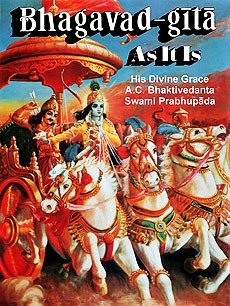
We are posting the First Chapter of the Original Bhagavad-gita As It Is 1972 Macmillian Edition complete with the corresponding pictures.
Bhagavad-gita As It Is 1972 Edition
By His Divine Grace A.C. Bhaktivedanta Swami Prabhupada
Chapter 1: Observing the Armies on the Battlefield of Kuruksetra
TEXT 1
dhṛtarāṣṭra uvāca
dharma-kṣetre kuru-kṣetre
samavetā yuyutsavaḥ
māmakāḥ pāṇḍavāś caiva
kim akurvata sañjaya
dhṛtarāṣṭraḥ—King Dhṛtarāṣṭra; uvāca—said; dharma-kṣetre—in the place of pilgrimage; kuru-kṣetre—in the place named Kurukṣetra; samavetāḥ—assembled; yuyatsavaḥ—desiring to fight; māmakāḥ—my party (sons); pāṇḍavāḥ—the sons of Pāṇḍu; ca—and; eva-certainly; kim—what; akurvata—did they do; sañjaya—O Sañjaya.
TRANSLATION
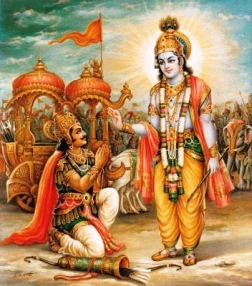
Dhṛtarāṣṭra said: O Sañjaya, after assembling in the place of pilgrimage at Kurukṣetra, what did my sons and the sons of Pāṇḍu do, being desirous to fight?
PURPORT
Bhagavad-gītā is the widely read theistic science summarized in the Gītā-māhātmya (Glorification of the Gītā). There it says that one should read Bhagavad-gītā very scrutinizingly with the help of a person who is a devotee of Śrī Kṛṣṇa and try to understand it without personally motivated interpretations. The example of clear understanding is there in the Bhagavad-gītā itself, in the way the teaching is understood by Arjuna, who heard the Gītā directly from the Lord. If someone is fortunate enough to understand Bhagavad-gītā in that line of disciplic succession, without motivated interpretation, then he surpasses all studies of Vedic wisdom, and all scriptures of the world. One will find in the Bhagavad-gītā all that is contained in other scriptures, but the reader will also find things which are not to be found elsewhere. That is the specific standard of the Gītā. It is the perfect theistic science because it is directly spoken by the Supreme Personality of Godhead, Lord Śrī Kṛṣṇa.
The topics discussed by Dhṛtarāṣṭra and Sañjaya, as described in the Mahābhārata, form the basic principle for this great philosophy. It is understood that this philosophy evolved on the Battlefield of Kurukṣetra, which is a sacred place of pilgrimage from the immemorial time of the Vedic age. It was spoken by the Lord when He was present personally on this planet for the guidance of mankind.
More
25 Apr 2012
by The Hare Krishna Movement
in Srila Prabhupada
Tags: A.C. Bhaktivedanta Swami Prabhupada, Bhaktivedanta Book Trust, captain of the ship, Founder Acarya of the International Society for Krishna Consciousness, His Divine Grace, ocean of Kali, pure devotee, Srila Prabhupada, Vedic literature

“By the mercy of the spiritual master one receives the benediction of Kṛṣṇa. Without the grace of the spiritual master, one cannot make any advancement. Therefore, I should always remember and praise the spiritual master. At least three times a day I should offer my respectful obeisances unto the lotus feet of my spiritual master.”
Dedication to
His Divine Grace A. C. Bhaktivedanta Swami Prabhupāda
Founder-Ācārya of the International Society for Krishna Consciousness
tvaṁ naḥ sandarśito dhātrā
dustaraṁ nistitīrṣatām
kaliṁ sattva-haraṁ puṁsāṁ
karṇa-dhāra ivārṇavam
“We think that we have met Your Goodness by the will of providence, just so that we may accept you as captain of the ship for those who desire to cross the difficult ocean of Kali, which deteriorates all the good qualities of a human being.” (Śrīmad-Bhāgavatam 1.1.22)
On the order of his spiritual master, His Divine Grace A. C. Bhaktivedanta Swami Prabhupāda began translating and writing Vedic literature in the English language to bring the message of Lord Kṛṣṇa to the Western countries. After decades of struggle in India, he came to the West and started the International Society for Krishna Consciousness. Later on he created the Bhaktivedanta Book Trust, to publish his writings and recordings of his lectures, conversations, etc. The VedaBase has been created so that this great treasurehouse of knowledge may be preserved and propagated and so that all may take advantage of the wisdom and association of the pure devotee of Lord Krishna.
More
13 Apr 2012
by The Hare Krishna Movement
in Krishna, Krishna Consciousness, The Hare Krishna Movement, The Reservoir of Pleasure
Tags: A.C. Bhaktivedanta Swami Prabhupada, bhagavad-gita, devotional service, His Divine Grace, Krishna consciousness, Krsna The Reservoir of Pleasure, pure consciousness, real life, real pleasure, Sri Krsna

Kṛṣṇa, the Reservoir of Pleasure
by His Divine Grace A. C. Bhaktivedanta Swami Prabhupāda
Kṛṣṇa—this sound is transcendental. Kṛṣṇa means the highest pleasure. All of us, every living being, seeks pleasure. But we do not know how to seek pleasure perfectly. With a materialistic concept of life, we are frustrated at every step in satisfying our pleasure because we have no information regarding the real level on which to have real pleasure. For the last few weeks we have been learning that we are not this body; we are consciousness. Not exactly consciousness, for consciousness is actually the symptom of our real identity: we are pure soul, now merged within this material body. Modern material science lays no stress on this; therefore the scientists are sometimes misled in their understanding of spirit soul. But spirit soul is a fact, which anyone can understand by the presence of consciousness. Any child can understand that consciousness is the symptom of the spirit soul.
Now the whole process we are trying to learn from the Bhagavad-gītā (The Song of God) is how to bring ourselves to this level of consciousness. And if we act from the level of consciousness, then we may not be pushed again into the level of this bodily conception; and, if we can continue on that level, if we can continue to act in pure consciousness, then, at the end of this body we shall be free from material contamination, our spiritual life will be revived, and the ultimate result will be that in our next life, after leaving this body, we shall have our full, eternal spiritual life. Spirit, as we have already discussed, is described as eternal.
More
12 Apr 2012
by The Hare Krishna Movement
in Narada-bhakti-sutra
Tags: A.C. Bhaktivedanta Swami Prabhupada, devotional service., gopis, Krishna, Narada Muni
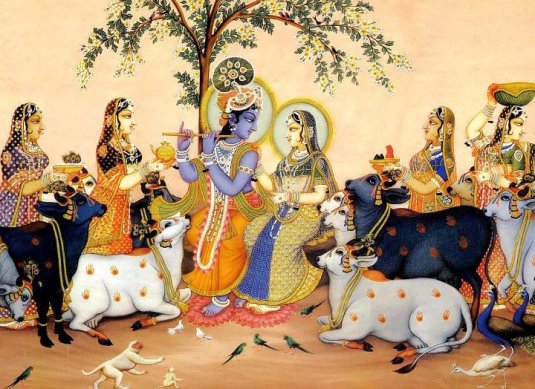
click to enlarge picture
“My dear gopīs, I am not able to repay My debt for your spotless service, even within a lifetime of Brahmā. Your connection with Me is beyond reproach. You have worshiped Me, cutting off all domestic ties, which are difficult to break. Therefore please let your own glorious deeds be your compensation.”
Narada-bhakti-sutra
By His Divine Grace A.C. Bhaktivedanta Swami Prabhupada
Text 7
sā na kāmayamānā nirodha-rūpatvāt
sā—that devotional service in pure love of God; na—not; kāmayamānā—like ordinary lust; nirodha—renunciation; rūpatvāt—because of having as its form.
There is no question of lust in the execution of pure devotional service, because in it all material activities are renounced.
PURPORT
In pure devotional service there is no question of sense gratification. Some people mistake the loving affairs between Kṛṣṇa and the gopīs (cowherd girls) for activities of ordinary sense gratification, but these affairs are not lustful because there is no material contamination. As Rūpa Gosvāmī states in his Bhakti-rasāmṛta-sindhu (1.2.285),
premaiva gopa-rāmāṇāṁ kāma ity agamat prathām
ity uddhavādayo ’py etaṁ vāñchanti bhagavat-priyāḥ
“Although the dealings of the gopīs with Kṛṣṇa are wrongly celebrated by many as lust, great sages and saintly persons like Uddhava hanker for such loving affairs with Kṛṣṇa.” Śrīla Kṛṣṇadāsa Kavirāja, the author of Caitanya-caritāmṛta, has therefore said,
kāma, prema,—doṅhākāra vibhinna lakṣaṇa
lauha āra hema yaiche svarūpe vilakṣaṇa
“As there is a difference between iron and gold, so there is a difference between material lust and Kṛṣṇa’s loving affairs with the gopīs” (Cc. Ādi 4.164). Although such loving affairs may sometimes resemble material lust, the difference is as follows:
ātmendriya-prīti-vāñchā—tāre bali ‘kāma’
kṛṣṇendriya-prīti-icchā dhare ‘prema’ nāma
“The desire to satisfy one’s own senses is called lust, while the desire to satisfy the senses of Kṛṣṇa is called prema, love of God” (Cc. Ādi 4.165).
More
05 Apr 2012
by The Hare Krishna Movement
in Caitanya Mahaprabhu, Chanting Hare Krishna, Sri Caitanya-Caritamrta
Tags: 1975 edition, A.C. Bhaktivedanta Swami Prabhupada, Adi-lila 7.95-56, chanting Hare Krishna, chanting the holy names of the Lord, Hare Krishna, Kali-yuga, Lord Sri Caitanya Mahaprabhu, Sri Caitanya-caritamrta

…It is to be understood that when Śrī Caitanya Mahāprabhu chanted and danced, He did so by the influence of the pleasure potency of the spiritual world. Śrī Caitanya Mahāprabhu never considered the holy name of the Lord to be a material vibration, nor does any pure devotee mistake the chanting of the Hare Kṛṣṇa mantra to be a material musical manifestation. Lord Caitanya never tried to be the master of the holy name; rather He taught us how to be servants of the holy name…I firmly believe that simply chanting the holy name of the Lord can remove all misconceptions of the material world. I believe that simply by chanting the holy name of the Lord one can attain the shelter of the lotus feet of the Lord. In this age of quarrel and disagreement, the chanting of the holy names is the only way to liberation from the material clutches.
Sri Caitanya-caritamrta – 1975 Edition
By His Divine Grace A.C. Bhaktivedanta Swami Prabhupada
Adi-lila 7. 95-96
Lord Caitanya in Five Features
“I firmly believe in these words of My spiritual master, and therefore I always chant the holy name of the Lord, alone and in the association of devotees. That holy name of Lord Kṛṣṇa sometimes causes Me to chant and dance, and therefore I chant and dance. Please do not think that I intentionally do it. I do it automatically.
Purport
A person who cannot keep his faith in the words of his spiritual master but acts independently never receives the authority to chant the holy name of the Lord. It is said in the Vedas (Śvetāśvatara Upaniṣad 6.23):
yasya deve parā bhaktir
yathā deve tathā gurau
tasyaite kathitā hy arthāḥ
prakāśante mahātmanaḥ
“Only unto those great souls who have implicit faith in both the Lord and the spiritual master are all the imports of Vedic knowledge automatically revealed.” This Vedic injunction is very important, and Śrī Caitanya Mahāprabhu supported it by His personal behavior. Believing in the words of His spiritual master, He introduced the saṅkīrtana movement, just as the present Kṛṣṇa consciousness movement was started with belief in the words of our spiritual master. He wanted to preach, we believed in his words and tried somehow or other to fulfill them, and now this movement has become successful all over the world. Therefore faith in the words of the spiritual master and in the Supreme Personality of Godhead is the secret of success. Śrī Caitanya Mahāprabhu never disobeyed the orders of His spiritual master and stopped propagating the saṅkīrtana movement. Śrī Bhaktisiddhānta Sarasvatī Gosvāmī, at the time of his passing away, ordered all his disciples to work conjointly to preach the mission of Caitanya Mahāprabhu all over the world. Later, however, some self-interested, foolish disciples disobeyed his orders. Each one of them wanted to become head of the mission, and they fought in the courts, neglecting the order of the spiritual master, and the entire mission was defeated. We are not proud of this; however, the truth must be explained. We believed in the words of our spiritual master and started in a humble way-in a helpless way-but due to the spiritual force of the order of the supreme authority, this movement has become successful.
More
30 Mar 2012
by The Hare Krishna Movement
in Lectures, Rama
Tags: A.C. Bhaktivedanta Swami Prabhupada, appearance of Lord Ramacandra, Lord Ramacandra, Rama, Rama Navami, Ramacandra, Ramadi, Sri Rama-navami lecture, Treta-yuga

…So Rāmacandra’s life, God’s activities, pastimes, if we hear, that means we are associating with Rāmacandra. There is no difference between His form, His name, His pastimes, and Himself. He’s absolute. Therefore either you chant the holy name of Rāma or you see the statue of Rāma or you talk of His pastimes, transcendental pastimes, everything, that means you are associating with the Supreme Personality of Godhead. So we take advantage of these days when the incarnation of God appears or disappears, and we try to associate with Him. By His association we become purified. Our process is purification. Kṛṣṇa consciousness means simply we are purifying our consciousness.
Śrī Rāma-Navamī, Lord Rāmacandra’s Appearance Day
By His Divine Grace A.C. Bhaktivedanta Swami Prabhupada
Hawaii, March 27, 1969
(kīrtana)
Prabhupāda: (chants maṅgalācaraṇa prayers)
rāmādi mūrtiṣu kalā-niyamena tiṣṭhan
nānāvatāram akarod bhuvaneṣu kintu
kṛṣṇaḥ svayaṁ samabhavat paramaḥ pumān yo
govindam ādi-puruṣaṁ tam ahaṁ bhajāmi
[Bs. 5.39]
This is a verse from Brahma-saṁhitā in which the incarnation of Lord Rāmacandra is described. Rāmādi. Not only Rāma, but there are many other, innumerable incarnations. They are compared with the waves of a river. As the waves of the river or the waves of the ocean cannot be counted, similarly, how many incarnations are there of the Supreme Lord it is not possible to count. But out of them, the principal names are mentioned in the śāstras. Therefore it is said rāmādi. Rāmādi means Rāma and also other, many incarnations. And they are existing. Not that one incarnation appeared and it is finished. No. Not like that. Just like Lord Rāmacandra appeared on this planet, say millions of years before. He appeared in the Treta-yuga. Treta-yuga means… We have passed only five thousand years of this age, Kali-yuga. Before that, there was Dvāpara-yuga. Dvāpara-yuga means 800,000 years. And before that, there was Tretā-yuga, which continued for twelve hundred thousands of years. That means at least two million years before Lord Rāmacandra appeared on this planet.
More
29 Mar 2012
by The Hare Krishna Movement
in Krsna is the Source of All Incarnations, Rama
Tags: A.C. Bhaktivedanta Swami Prabhupada, Hanuman, Rama, Ravana, Sita, Sri Rama, Srimad Bhagavatam, The Pewrsonality of Godhead

Srimad Bhagavatam
By His Divine Grace A.C. Bhaktivedanta Swami Prabhupada
Canto 1, Chapter 3, Text 22
Krsna Is the Source of All Incarnations
nara-devatvam āpannaḥ
sura-kārya-cikīrṣayā
samudra-nigrahādīni
cakre vīryāṇy ataḥ param
nara—human being; devatvam—divinity; āpannaḥ—having assumed the form of; sura—the demigods; kārya—activities; cikīrṣayā—for the purpose of performing; samudra—the Indian Ocean; nigraha-ādīni—controlling, etc.; cakre—did perform; vīryāṇi—superhuman prowess; ataḥ param—thereafter.
In the eighteenth incarnation, the Lord appeared as King Rāma. In order to perform some pleasing work for the demigods, He exhibited superhuman powers by controlling the Indian Ocean and then killing the atheist King Rāvaṇa, who was on the other side of the sea.
Purport
The Personality of Godhead Śrī Rāma assumed the form of a human being and appeared on the earth for the purpose of doing some pleasing work for the demigods or the administrative personalities to maintain the order of the universe. Sometimes great demons and atheists like Rāvaṇa and Hiraṇyakaśipu and many others become very famous due to advancing material civilization by the help of material science and other activities with a spirit of challenging the established order of the Lord. For example, the attempt to fly to other planets by material means is a challenge to the established order. The conditions of each and every planet are different, and different classes of human beings are accommodated there for particular purposes mentioned in the codes of the Lord. But, puffed up by tiny success in material advancement, sometimes the godless materialists challenge the existence of God. Rāvaṇa was one of them, and he wanted to deport ordinary men to the planet of Indra (heaven) by material means without consideration of the necessary qualifications. He wanted a staircase to be built up directly reaching the heavenly planet so that people might not be required to undergo the routine of pious work necessary to enter that planet. He also wanted to perform other acts against the established rule of the Lord. He even challenged the authority of Śrī Rāma, the Personality of Godhead, and kidnapped His wife, Sītā. Of course Lord Rāma came to chastise this atheist, answering the prayer and desire of the demigods. He therefore took up the challenge of Rāvaṇa, and the complete activity is the subject matter of the Rāmāyaṇa. Because Lord Rāmacandra was the Personality of Godhead, He exhibited superhuman activities which no human being, including the materially advanced Rāvaṇa, could perform. Lord Rāmacandra prepared a royal road on the Indian Ocean with stones that floated on the water. The modern scientists have done research in the area of weightlessness, but it is not possible to bring in weightlessness anywhere and everywhere. But because weightlessness is the creation of the Lord by which He can make the gigantic planets fly and float in the air, He made the stones even within this earth to be weightless and prepared a stone bridge on the sea without any supporting pillar. That is the display of the power of God.
26 Mar 2012
by The Hare Krishna Movement
in Chanting Hare Krishna, Devotee's, Diksha, Guru & Disciple, Hare Krishna Maha Mantra, Rupanuga das
Tags: A.C. Bhaktivedanta Swami Prabhupada, bhakti, Caitanya Caritamrta, disciples of Srila Prabhupada, Mad-lila 15. 105-111, Rupanuga das, spiritual master, Srila Prabhupada, vaisnava, vani

The Param-guru
By Sriman Rupanuga Prabhu (ACBSP)
Jan 20, 2012 (SUN)
Those sincere souls who have been submitting for decades to disciples of Srila Prabhupada as spiritual masters, only to be disappointed, need not leave the proven path of Bhakti as revealed by Srila Prabhupada (who is not at all at fault). Because of such disappointments, one may have doubts about success in Krsna consciousness. But the path is not to be abandoned. Instead, under the complete shelter of Srila Prabhupada one will be saved for sure from material existence.
There is no need to get initiated again and again. One can take complete shelter of Srila Prabhupada and the Holy Name, Nama Prabhu. Nama Rupe is independent, as confirmed in Caitanya-caritamrta Madhya lila, Chapter 15, verses 105 through 111 with purports, a must read carefully. These verses and purports below, clearly indicate that a sincere soul, initiated or not, can take shelter of Srila Prabhupada-vani and Lord Krsna, the Holy Name, directly.
The disappointed disciples of our Godbrothers remain on duty to give Srila Prabhupada’s mercy to the suffering masses of conditioned souls on this planet, which is known as Martyaloka or the planet of death. Krsna consciousness is a matter of life and death for everyone. Srila Prabhupada wanted millions, he said “a hundred million” devotees.
Respectful obeisances must go out to all the recently disappointed 1,500+ disciples, with the prayer to please take care to remain disciples under the direct protection of their Param-guru, Srila Prabhupada, who said that the grandfather is more kind to the sons than the father. So be it.
Pasted from; http://www.harekrsna.com/sun/editorials/01-12/editorials8173.htm
Caitanya-caritamrta Madhya lila, Chapter 15, text 105-111 with purports
More
25 Mar 2012
by The Hare Krishna Movement
in Bhagavad-gita, Krishna Consciousness, Raja-Vidya, Spiritual Life
Tags: A.C. Bhaktivedanta Swami Prabhupada, Action in Knowledge of Krsna, bound by karma, Brahma-samhita, fruitive reaction, karma, Krishna, material body, nature's arrangment, Raja-Vidya, the king of knowledge

…We must understand the meaning of relationships with Kṛṣṇa. In this material world we have many relationships as father, mother, wife or husband. Whatever relationship we find here is but a perverted reflection of the relationship we have with the Supreme Lord. Whatever we find in this material world is born of the Absolute Truth, but here it is pervertedly reflected in time. Whatever relationship we have with Kṛṣṇa goes on. If we have a relationship in friendship, that friendship is eternal and continues from life to life. In the material world, a friendship exists for a few years and then breaks; therefore it is called perverted, temporal, or unreal. If we make our friendship with Kṛṣṇa, it will never break. If we make our master Kṛṣṇa, we will never be cheated. If we love Kṛṣṇa as our son, He will never die. If we love Kṛṣṇa as our lover, He will be the best of all, and there will be no separation. Because Kṛṣṇa is the Supreme Lord, He is unlimited and has an unlimited number of devotees. Some are trying to love Him as lover or husband, and therefore Kṛṣṇa accepts this role. In whatever way we approach Kṛṣṇa, He will accept us, as He states in Bhagavad-gītā.
ye yathā māṁ prapadyante
tāṁs tathaiva bhajāmy aham
mama vartmānuvartante
manuṣyāḥ pārtha sarvaśaḥ
“All of them—as they surrender unto Me—I reward accordingly. Everyone follows My path in all respects, O son of Pṛthā.” (Bg. 4.11)
Raja-Vidya: The King of Knowledge
By His Divine Grace A.C. Bhaktivedanta Swami Prabhupada
Chapter 8
Action in Knowledge of Kṛṣṇa
na māṁ karmāṇi limpanti
na me karma-phale spṛhā
iti māṁ yo ’bhijānāti
karmabhir na sa badhyate
“There is no work that affects Me; nor do I aspire for the fruits of action. One who understands this truth about Me also does not become entangled in the fruitive reactions of work.”(Bg. 4.14)
The whole world is bound by karma. We all know of the existence of microbes or germs which exist by the million within the measurement of one millimeter. In the Brahma-saṁhitā it is stated that beginning with the microbe, which is called indragopa, up to Indra, the king of the heavenly planets, all are bound by karma, the reaction of work. We all have to suffer or enjoy the reactions of our work, be they good or bad. As long as we have to suffer or enjoy these reactions, we are bound to these material bodies.
By nature’s arrangement the material body is given to the living entity for his suffering or enjoying. Different types of bodies are acquired for different purposes. The body of a tiger is made for killing and eating raw meat. Similarly, the hogs are made in such a way that they can eat stool. And as human beings our teeth are made for eating vegetables and fruits. All of these bodies are made according to the work done in past lives by the living entity. Our next bodies are being prepared according to the work which we are now doing, but in the previously quoted verse Śrī Kṛṣṇa indicates that one who knows the transcendental nature of His activities becomes free from the reactions of activities. Our activities should be such that we will not again become entangled in this material world. This can be made possible if we become Kṛṣṇa conscious by studying Kṛṣṇa, learning of the transcendental nature of His activities, and understanding how He behaves in this material world and in the spiritual world.
More
22 Mar 2012
by The Hare Krishna Movement
in Diksha, Guru & Disciple, July 9th Letter, Siksa
Tags: A.C. Bhaktivedanta Swami Prabhupada, guru, His Divine Grace, initiated disciples, initiations, ISKCON Bangalore, ISKCON Mumbai, July 9th Letter, representative of the acarya, rittik initiation, spiritual master, Srila Prabhupada

Some of our readers may or my not be familiar with the famous July 9th Letter; which was Srila Prabhupada’s final instruction on initiation. This is also the main point of contention in the Battle over ISKCON Bangalore. ISKCON Bangalore’s position is that Srila Prabhupada is the Founder-Acarya of ISKCON, and will continue to give diksha (initition) through the process of Rittik initiation, and guide all devotees in ISKCON to the abode of Lord Sri Krishna. Whereas ISKCON Mumbai’s position is that since Srila Prabhupada is no longer physically present, one should take diksa (initiation) from one of the present ISKCON gurus.
I applaud the devotees of ISKCON Bangalore in their Struggle for Truth, and their courageous stand for honesty and justice.
July 9th Letter Text More
20 Mar 2012
by The Hare Krishna Movement
in Sri Caitanya-Caritamrta
Tags: 1975 edition, A.C. Bhaktivedanta Swami Prabhupada, Adi-lila 4.224, season of Spring, Sri Caitanya-caritamrta, Sri Krsna, The Confidential Reasons of Lord Caitanya's Appearance
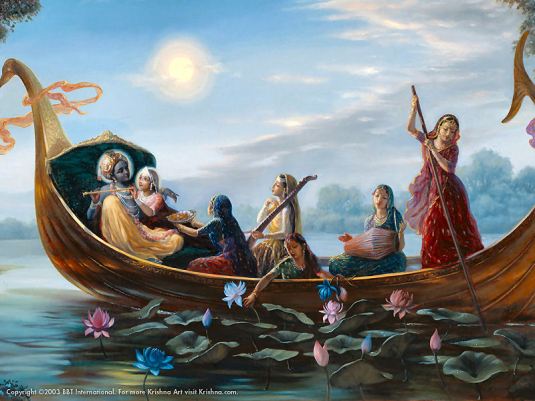
“My dear friends, just see how Śrī Kṛṣṇa is enjoying the season of spring! With the gopīs embracing each of His limbs, He is like amorous love personified. With His transcendental pastimes, He enlivens all the gopīs and the entire creation. With His soft bluish-black arms and legs, which resemble blue lotus flowers, He has created a festival for Cupid.”
Sri Caitanya-caritamrta – 1975 Edition
By His Divine Grace A.C. Bhaktivedanta Swami Prabhupada
Adi-lila 4.224
The Confidential Reasons for Lord Caitanya’s Appearance
viśveṣām anurañjanena janayann ānandam indīvara-
śreṇī-śyāmala-komalair upanayann aṅgair anaṅgotsavam
svacchandaṁ vraja-sundarībhir abhitaḥ praty-aṅgam āliṅgitaḥ
śṛṅgāraḥ sakhi mūrtimān iva madhau mugdho hariḥ krīḍati
viśveṣām—of all the gopīs; anurañjanena—by the act of pleasing; janayan—producing; ānandam—the bliss; indīvara-śreṇī—like a row of blue lotuses; śyāmala—bluish black; komalaiḥ—and soft; upanayan—bringing; aṅgaiḥ—with His limbs; anaṅga-utsavam—a festival for Cupid; svacchandam—without restriction; vraja-sundarībhiḥ—by the young women of Vraja; abhitaḥ—on both sides; prati-aṅgam—each limb; āliṅgitaḥ—embraced; śṛṅgāraḥ—amorous love; śakhi—O friend; mūrtimān—embodied; iva—like; madhau—in the springtime; mugdhaḥ—perplexed; hariḥ—Lord Hari; krīḍati—plays.
“My dear friends, just see how Śrī Kṛṣṇa is enjoying the season of spring! With the gopīs embracing each of His limbs, He is like amorous love personified. With His transcendental pastimes, He enlivens all the gopīs and the entire creation. With His soft bluish-black arms and legs, which resemble blue lotus flowers, He has created a festival for Cupid.”
This is a verse from Jayadeva Gosvāmī’s Gīta-govinda (1.11).
Text Pasted from; Prabhupada Books
20 Mar 2012
by The Hare Krishna Movement
in Bhagavad-gita
Tags: A.C. Bhaktivedanta Swami Prabhupada, Bg. 10.35, bhagavad-gita, flwoers and trees blossom, Krsna's pastimes, of seasons I am flower-bearing spring, Spring, spring is the most joyful of all seasons

…Of course spring is a season universally liked because it is neither too hot nor too cold, and the flowers and trees blossom and flourish. In spring there are also many ceremonies commemorating Kṛṣṇa’s pastimes; therefore this is considered to be the most joyful of all seasons, and it is the representative of the Supreme Lord Kṛṣṇa.
Bhagavad-gita As It Is – Macmillan 1972 Edition
By His Divine Grace A.C. Bhaktivedanta Swami Prabhupada
Chapter 10, Text 35
The Opulence of the Absolute
bṛhat-sāma tathā sāmnāṁ
gāyatrī chandasām aham
māsānāṁ mārga-śīrṣo ‘ham
ṛtūnāṁ kusumākaraḥ
bṛhat-sāma—the Bṛhat-sāma; tathā—also; sāmnām—of the Sāma-veda song; gāyatrī—the Gāyatrī hymns; chandasām—of all poetry; aham—I am; māsānām—of months; mārga-śīrṣo ‘ham—the month of November-December; aham—I am; ṛtūnām—of all seasons; kusumākaraḥ—spring.
Of hymns I am the Bṛhat-sāma sung to the Lord Indra, and of poetry I am the Gāyatrī verse, sung daily by brāhmaṇas. Of months I am November and December, and of seasons I am flower-bearing spring.
Purport
It has already been explained by the Lord that amongst all the Vedas, the Sāma-veda is rich with beautiful songs played by the various demigods.
One of these songs is the Bṛhat-sāma, which has an exquisite melody and is sung at midnight.
In Sanskrit, there are definite rules that regulate poetry; rhyme and meter are not written whimsically, as in much modern poetry. Amongst the regulated poetry, the Gāyatrī mantra, which is chanted by the duly qualified brāhmaṇas, is the most prominent. The Gāyatrī mantra is mentioned in the Śrīmad-Bhāgavatam. Because the Gāyatrī mantra is especially meant for God realization, it represents the Supreme Lord. This mantra is meant for spiritually advanced people, and when one attains success in chanting it, he can enter into the transcendental position of the Lord. One must first acquire the qualities of the perfectly situated person, the qualities of goodness according to the laws of material nature, in order to chant the Gāyatrī mantra. The Gāyatrī mantra is very important in Vedic civilization and is considered to be the sound incarnation of Brahman. Brahmā is its initiator, and it is passed down from him in disciplic succession.
The months of November and December are considered the best of all months because in India grains are collected from the fields at this time, and the people become very happy. Of course spring is a season universally liked because it is neither too hot nor too cold, and the flowers and trees blossom and flourish. In spring there are also many ceremonies commemorating Kṛṣṇa’s pastimes; therefore this is considered to be the most joyful of all seasons, and it is the representative of the Supreme Lord Kṛṣṇa.
19 Mar 2012
by The Hare Krishna Movement
in Devotional Service, Sri Caitanya-Caritamrta, Srimad Bhagavatam
Tags: A.C. Bhaktivedanta Swami Prabhupada, affection, love and affection, Mad. 10. 139, SB 10.11.11, Sri Caitanya-caritamrta, Srimad Bhagavatam, veneration, worship God with love

“Kṛṣṇa, You have come to me to take some fruit in exchange for grains. All the grains have fallen, but still You may take whatever You like.” Thus she filled Kṛṣṇa’s palms with whatever fruits He could carry. In exchange, Kṛṣṇa filled her whole basket with jewels and gold.
Srimad Bhagavatam
By His Divine Grace. A.C. Bhaktivedanta Swami Prabhupada
Canto Ten, Chapter 11, Text 11
phala-vikrayiṇī tasya
cyuta-dhānya-kara-dvayam
phalair apūrayad ratnaiḥ
phala-bhāṇḍam apūri ca
While Kṛṣṇa was going to the fruit vendor very hastily, most of the grains He was holding fell. Nonetheless, the fruit vendor filled Kṛṣṇa’s hands with fruits, and her fruit basket was immediately filled with jewels and gold.
In Bhagavad-gītā (9.26) Kṛṣṇa says:
patraṁ puṣpaṁ phalaṁ toyaṁ
yo me bhaktyā prayacchati
tad ahaṁ bhakty-upahṛtam
aśnāmi prayatātmanaḥ
Kṛṣṇa is so kind that if anyone offers Him a leaf, a fruit, a flower or some water, He will immediately accept it. The only condition is that these things should be offered with bhakti (yo me bhaktyā prayacchati). Otherwise, if one is puffed up with false prestige, thinking, “I have so much opulence, and I am giving something to Kṛṣṇa,” one’s offering will not be accepted by Kṛṣṇa. The fruit vendor, although a woman belonging to the poor aborigine class, dealt with Kṛṣṇa with great affection, saying, “Kṛṣṇa, You have come to me to take some fruit in exchange for grains. All the grains have fallen, but still You may take whatever You like.” Thus she filled Kṛṣṇa’s palms with whatever fruits He could carry. In exchange, Kṛṣṇa filled her whole basket with jewels and gold.
From this incident one should learn that for anything offered to Kṛṣṇa with love and affection, Kṛṣṇa can reciprocate many millions of times over, both materially and spiritually. The basic principle involved is an exchange of love. Therefore Kṛṣṇa teaches in Bhagavad-gītā (9.27):
More
18 Mar 2012
by The Hare Krishna Movement
in Bhagavad-gita, Book Changes, Vyasasan das
Tags: A.C. Bhaktivedanta Swami Prabhupada, Arjuna, bhagavad-gita, book changes, disciplic succession, Parampara, Sri Krishna, Srila Prabhupada, Vedic knowledge
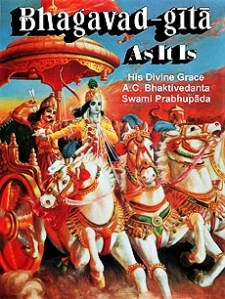


My heart laments with deep sorrow whenever I think of how the Books of His Divine Grace A.C. Bhaktivedanta Swami are being changed, and re-edited. But I think Srila Prabhupada has said it best in his introduction to Bhagavad-gita As It Is;
Vedic knowledge is not a question of research. Our research work is imperfect because we are researching things with imperfect senses. We have to accept perfect knowledge which comes down, as is stated in Bhagavad-gītā, by the paramparā disciplic succession. We have to receive knowledge from the proper source in disciplic succession beginning with the supreme spiritual master, the Lord Himself, and handed down to a succession of spiritual masters. Arjuna, the student who took lessons from Lord Śrī Kṛṣṇa, accepts everything that He says without contradicting Him. One is not allowed to accept one portion of Bhagavad-gītā and not another. No. We must accept Bhagavad-gītā without interpretation, without deletion and without our own whimsical participation in the matter. The Gītā should be taken as the most perfect presentation of Vedic knowledge. Vedic knowledge is received from transcendental sources, and the first words were spoken by the Lord Himself. The words spoken by the Lord are different from words spoken by a person of the mundane world who is infected with four defects. A mundaner 1) is sure to commit mistakes, 2) is invariably illusioned, 3) has the tendency to cheat others and 4) is limited by imperfect senses. With these four imperfections, one cannot deliver perfect information of all-pervading knowledge.( From Introduction to the Bhagavad-gita As It Is)
More
17 Mar 2012
by The Hare Krishna Movement
in Krishna, Teachings of Queen Kunti
Tags: A.C. Bhaktivedanta Swami Prabhupada, garland of lotus flowers, lotus feet, lotus flower, Personality of Godhead, SB 1.8.22, spiritual body, Srimad Bhagavatam, symbolic marks, Teachings of Queen Kunti, The Vision of Lotuses

Teachings of Queen Kuntī
By His Divine Grace A. C. Bhaktivedanta Swami Prabhupāda
Chapter Five
The Vision of Lotuses
namaḥ paṅkaja-nābhāya
namaḥ paṅkaja-māline
namaḥ paṅkaja-netrāya
namas te paṅkajāṅghraye
My respectful obeisances are unto You, O Lord, whose abdomen is marked with a depression like a lotus flower, who are always decorated with garlands of lotus flowers, whose glance is as cool as the lotus, and whose feet are engraved with lotuses. Śrīmad-Bhāgavatam 1.8.22
Here are some of the specific symbolical marks on the spiritual body of the Personality of Godhead which distinguishes His body from the bodies of all others. They are all special features of the body of the Lord. The Lord may appear as one of us, but He is always distinct by His specific bodily features.
More
13 Mar 2012
by The Hare Krishna Movement
in A.C. Bhaktivedanta Swami Prabhupada, Back to Godhead, Sankirtan, Sri Siksastakam, Yoga
Tags: A.C. Bhaktivedanta Swami Prabhupada, Back to Godhead Magazine, bhagavad-gita, Hari Kirtana, Kali-yuga, Lord Caitanya Mahaprabhu, perfection of yoga, religion, sankirtan movement, The Yoga for the Modern Age
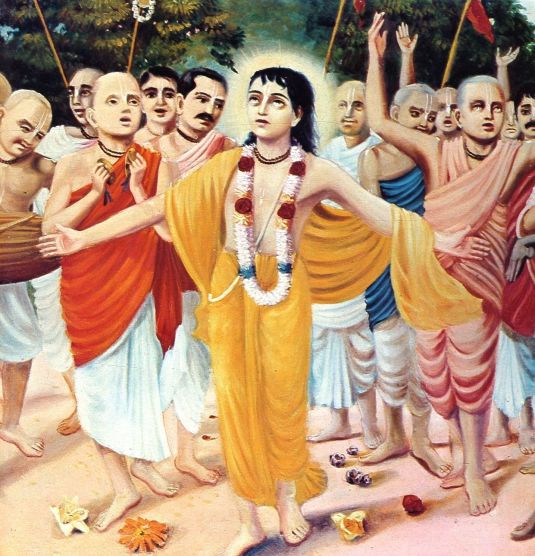
..When Rupa Gosvami first met Lord Caitanya Mahaprabhu at Prayag, Lord Caitanya was chanting and dancing in the street “Hare Krsna, Hare Krsna.” At that time also he offered one prayer. Namo maha-vadanyaya krsna-prema-pradaya te. “O You are the most munificent of all incarnations because You are distributing love of Godhead.” Krsna-prema-pradaya te krsnaya krsna-caitanya-namne gaura-tvise namah. “You are Krsna Himself because if You were not Krsna You could not distribute Krsna-prema or love of God, for love of Krsna is not so easily acquired. But You are distributing this love freely to everyone.”
Hari Kirtana: The Yoga for the Modern Age
By His Divine Grace A.C. Bhaktivedanta Swami Prabhupada
Excerpted from ‘Back To Godhead’ Magazine
1970, Vol., 1 No. 34
Ceto-darpana-marjanam bhava-mahadavagni-nirvapanam sreyah kairava candrika vitaranam vidyavadhu jivanam anandambudhi-vardhanam pratipadam purnamrtasvadanam sarvatma-snapanam param vijayate sri-krsna-sankirtanam. All glories to the sankirtana movement. Param vijayate sri-krsna-sankirtanam. Lord Caitanya Mahaprabhu, when He was only a sixteen-year-old boy, introduced this sankirtana movement 500 years ago in Navadvipa, India. It was not that He manufactured some religious system, just as nowadays so many religious systems are being manufactured.
Actually religion cannot be manufactured. Dharmam tu saksad-bhagavat-pranitam. Religion means the codes of God, the laws of God, that’s all. Certainly we cannot live without obeying the state laws, and similarly, we cannot live without obeying the laws of God. And in the Bhagavad-gita the Lord says, “yada yada hi dharmasya glanir bhavati bharata abhyutthanam adharmasya,” and there is a predominance of irreligious activities, “tadatmanam srjamy aham,” at that time I (Krsna) appear. And in the material world we can see the same principle demonstrated, for whenever there is disobedience of state laws, there is the advent of some particular state officer or police man to “set things right.”
More
11 Mar 2012
by The Hare Krishna Movement
in Bhagavad-gita, Raja-Vidya, Spiritual Life
Tags: A.C. Bhaktivedanta Swami Prabhupada, Arjuna, bhagavad-gita, faith, guru, Krishna, material world, Raja-Vidya, spiritual knowledge, spiritual master, Spiritual world, surrender, the king of knowledge

As spirit souls we are part and parcel of the Supreme Spirit, but due to our desire to enjoy this material world, we have been put into material nature. Yet in whatever species of life we may be, Kṛṣṇa is the Father. Thus Bhagavad-gītā is not meant for any particular party or nation but for everyone all over the world… In this way people may realize their true spiritual nature and their relationship to the supreme spiritual whole.
“And when you have thus learned the truth, you will know that all living beings are but parts of Me—and that they are in Me, and are Mine. Even if you are considered to be the most sinful of all sinners, when you are situated in the boat of transcendental knowledge, you will be able to cross over the ocean of miseries. As a blazing fire burns firewood to ashes, O Arjuna, so does the fire of knowledge burn to ashes all the reactions to material activities.” (Bg. 4.35–37)
Raja-vidya: The King of Knowledge
By His Divine Grace A.C. Bhaktivedanta Swami Prabhupada
Chapter 7
Knowledge as Faith in Guru and surrender to Kṛṣṇa
In the Fourth Chapter of Bhagavad-gītā Śrī Kṛṣṇa concludes that of all sacrifices, the best is the acquisition of knowledge.
śreyān dravya-mayād yajñāj
jñāna-yajñaḥ parantapa
sarvaṁ karmākhilaṁ pārtha
jñāne parisamāpyate
“O chastiser of the enemy, the sacrifice of knowledge is greater than the sacrifice of material possessions. O son of Pṛthā, after all, the sacrifice of work culminates in transcendental knowledge.” (Bg. 4.33)
Knowledge is the best sacrifice because this conditional life is due to ignorance. The purpose of sacrifice, penance, yoga and philosophical discussion is to acquire knowledge. There are three stages of transcendental knowledge by which one realizes the impersonal aspect of God (Brahman realization), the localized aspect of God within the heart and within every atom (Paramātmā or Supersoul realization) and the realization of the Supreme Personality of Godhead (Bhagavān realization). But the very first step in acquiring knowledge is coming to understand that “I am not this body. I am spirit soul, and my aim of life is to get out of this material entanglement.” The point is that whatever sacrifice we make is intended to enable us to come to the point of real knowledge. The highest perfection of knowledge is given in Bhagavad-gītā as surrender to Kṛṣṇa (bahūnāṁ janmanām ante jñānavān māṁ prapadyate) (Bg. 7.19). The jñānavān, not the fool, surrenders unto Kṛṣṇa, and that is the highest stage of knowledge. Similarly, at the end of Bhagavad-gītā Śrī Kṛṣṇa advises Arjuna:
More
Previous Older Entries Next Newer Entries








 The Hare Krishna Movement