04 Jan 2013
by The Hare Krishna Movement
in A.C. Bhaktivedanta Swami Prabhupada, Poetry of Srila Prabhupada
Tags: A.C. Bhaktivedanta Swami Prabhupada, Gaudiya Patrika, I gradually deprive him of his wealth, maya-samsara, realizations, Srila Prabhupada, the magazine of the gaudiya vedanta samiti, Vrndavana Bhajana, vrndavana-dhama, yasyaham anugrhnami
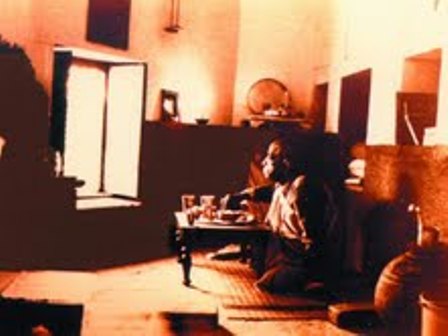
Vṛndāvana Bhajana
Written by A.C. Bhaktivedanta Swami in 1958,
Published December of that Year in Gauḍīya Patrika,
The Magazine of the Gauḍīya Vedānta Samiti.
Verse 1.
I am sitting alone in Vṛndāvana-dhāma
In this mood I am getting many realizations.
I have my wife, sons, daughters, grandsons, everything,
But I have no money so they are a fruitless glory.
Kṛṣṇa has shown me the naked form of material nature,
By his strength it has all become tasteless to me today.
yasyāham anugṛhṇāmi hariṣye tad-dhanaṁ śanaiḥ
“I gradually take away all the wealth of those upon whom I am merciful.”
How was I able to understand this mercy of the All-merciful?
Verse 2.
Everyone has abandoned me, seeing me as penniless,
Wife, relatives, friends, brothers, everyone.
This is misery, but it gives me a laugh. I sit alone and laugh.
In this māyā-saṁsāra, whom do I really love?
Where have all my loving father and mother gone to now?
And where are all my elders, who were my own folk?
Who will give me news of them, tell me who?
All that is left of this family life is a list of names.
More
03 Jan 2013
by The Hare Krishna Movement
in Chanting Hare Krishna, Quotes by Srila Prabhupada, Sankirtan
Tags: chanting, chanting Hare Krishna, kirtan, life and soul, Madhudvisa dasa, rayarama dasa, sankirtan, Srila Prabhupada, Ssatsvarupa dasa, street chanting
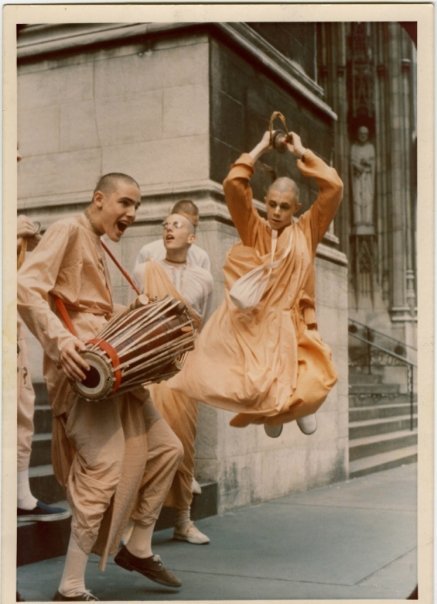
Importance of Hari Nama Sankirtan
Excerpted from letters and lectures by Srila Prabhupada
…I think you should try to always have Sankirtana going on. All other things are subsidiary. This chanting is our life and soul, so we must arrange our program now so that there will be as much chanting on the streets and at college engagements as possible.
…Outdoor kirtana must be done, even at the cost of suspending all editorial work. That is your first and foremost business. Temple worship is not so important. If need be, the whole temple can be locked, but the outdoor kirtana cannot be stopped.
…Your business is not to, I mean to say, satisfy the crowd. Your business is satisfy Kṛṣṇa, and then crowd will be automatically satisfied. We are not going to please the crowd. We are going to give them something, Kṛṣṇa. So you should be very much careful whether you are delivering Kṛṣṇa in the right way. Then they’ll be satisfied. Your only business should be to satisfy Kṛṣṇa.
More
03 Jan 2013
by The Hare Krishna Movement
in A.C. Bhaktivedanta Swami Prabhupada, Gajendra, Gajendra's Prayers of Surrender, Gajendra's Prayers of Surrender, Srimad Bhagavatam
Tags: A.C. Bhaktivedanta Swami Prabhupada, elephant and the crocodile, Gajendra, indradyumna, king of the elephants, SB 8.3.1-29, Srimad Bhagavatam, Supreme Lord, The Supreme Personality of Godhead
click on image to enlarge
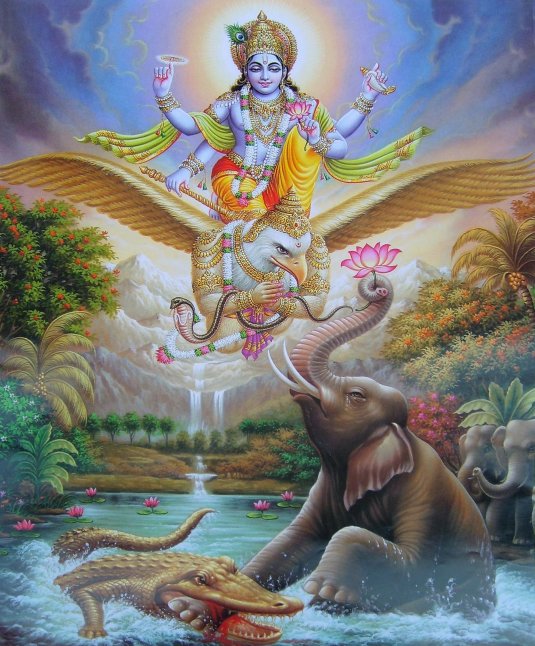
The following are the prayers by Gajendra, the King of the elephants, offered to the Supreme Personality of Godhead, during his difficult struggle with the crocodile. It appears that the King of the elephants was formerly a human being known as Indradyumna and that he learned a prayer to the Supreme Lord. Fortunately he remembered that prayer and began to chant it. First he offered his respectful obeisances to the Supreme Personality of Godhead, and because of his awkward position in having been attacked by the crocodile, he expressed his inability to recite prayers nicely. Nonetheless, he tried to chant the mantra and expressed himself in the prayers that follow.
…It is imperative that all devotees in Kṛṣṇa consciousness practice chanting some mantra. Certainly one should chant the Hare Kṛṣṇa mantra, which is the mahā-mantra, or great mantra, and also one should practice chanting cintāmaṇi-prakara-sadmasu or the Nṛsiṁha strotra (ito nṛsiṁhaḥ parato nṛsiṁho yato yato yāmi tato nṛsiṁhaḥ). Every devotee should practice in order to chant some mantra perfectly so that even though he may be imperfect in spiritual consciousness in this life, in his next life he will not forget Kṛṣṇa consciousness, even if he becomes an animal. Of course, a devotee should try to perfect his Kṛṣṇa consciousness in this life, for simply by understanding Kṛṣṇa and His instructions, after giving up this body one can return home, back to Godhead. Even if there is some falldown, practice of Kṛṣṇa consciousness never goes in vain. For example, Ajāmila, in his boyhood, practiced chanting the name of Nārāyaṇa under the direction of his father, but later, in his youth, he fell down and became a drunkard, woman-hunter, rogue and thief. Nonetheless, because of chanting the name of Nārāyaṇa for the purpose of calling his son, whom he had named Nārāyaṇa, he became advanced, even though he was involved in sinful activities. Therefore, we should not forget the chanting of the Hare Kṛṣṇa mantra under any circumstances. It will help us in the greatest danger, as we find in the life of Gajendra. (From Purport to text 1)
Śrīmad-Bhāgavatam
By His Divine Grace A. C. Bhaktivedanta Swami Prabhupāda
Canto 8, Chapter Three, Text 1-29
Gajendra’s Prayers of Surrender More
02 Jan 2013
by The Hare Krishna Movement
in A.C. Bhaktivedanta Swami Prabhupada, Devotional Service, Srila Prabhupada, Twenty-Six Qualities of a Devotee
Tags: 1.kind to everyone, 10.benevolent, 11.peaceful, 12.completely attached to Krsna, 13.has no material hankering, 14.meek, 15.steady, 16.self-controlled, 17.does not eat more than required, 18.sane, 19.respectful, 2.does not quarrel with anyone, 20.humble, 21.grave, 22.compassionate, 23.friendly, 24.poetic, 25.silent, 26 qualities of a devotee, 26.expert, 3.fixed in the Absolute Truth, 4.equal to everyone, 5.faultless, 6.charitable, 7.mild, 8.clean, 9.simple, A.C. Bhaktivedanta Swami Prabhupada, Sri Caitanya Mahaprabhu, Srila Prabhupada, without material possession

“A New Year’s resolution is a commitment that a person makes to one or more personal goals, projects, or the reforming of a habit. A key element to a New Year’s resolution that sets it apart from other resolutions is that it is made in anticipation of the New Year and new beginnings.” (Wikipedia definition)
Every year it seems I make the fruitless attempt to write down my New Year’s Resolutions, vowing to do less of this and more of that. But this year, I am just going to try to be a better human being. I am just going to try to develop the qualities of a devotee, which are 26 in number, and try to get myself free from material entanglement and go Back Home, Back to Godhead.
The Twenty-Six Qualities of a Devotee
The Lord is satisfied by the development of the transcendental qualities of the living entities and not by artificial performance of sacrifices and mystic yoga. In other words, unless one is fully qualified to become a pure devotee of the Lord, one cannot expect to be liberated from material entanglement.
These qualities of a devotee, twenty-six in number, are listed by Sri Caitanya Mahaprabhu:
1) Kind to Everyone, 2) Does not Quarrel with Anyone, 3) Fixed in the Absolute Truth, 4) Equal to Everyone, 5) Faultless, 6) Charitable, 7) Mild, 8) Clean, 9) Simple, without Material Possession, 10) Benevolent, 11) Peaceful, 12) Completely Attached to Krsna, 13) Has no Material Hankering, 14) Meek, 15) Steady, 16) Self-controlled, 17) Does not Eat More than Required, 18) Sane, 19) Respectful, 20) Humble, 21) Grave, 22) Compassionate, 23) Friendly, 24) Poetic, 25) Silent, 26) Expert
More
01 Jan 2013
by The Hare Krishna Movement
in Bhaktisiddhanta Sarasvati Thakura
Tags: 1983 Jagannatha Puri, biography of Bhaktisiddhanta Sarasvati, Dr. Kalidas Nag, Kedar Dutta Bhaktivinoda Thakura, living encyopidia, Srila Bhaktisiddhanta Sarasvati Thakura

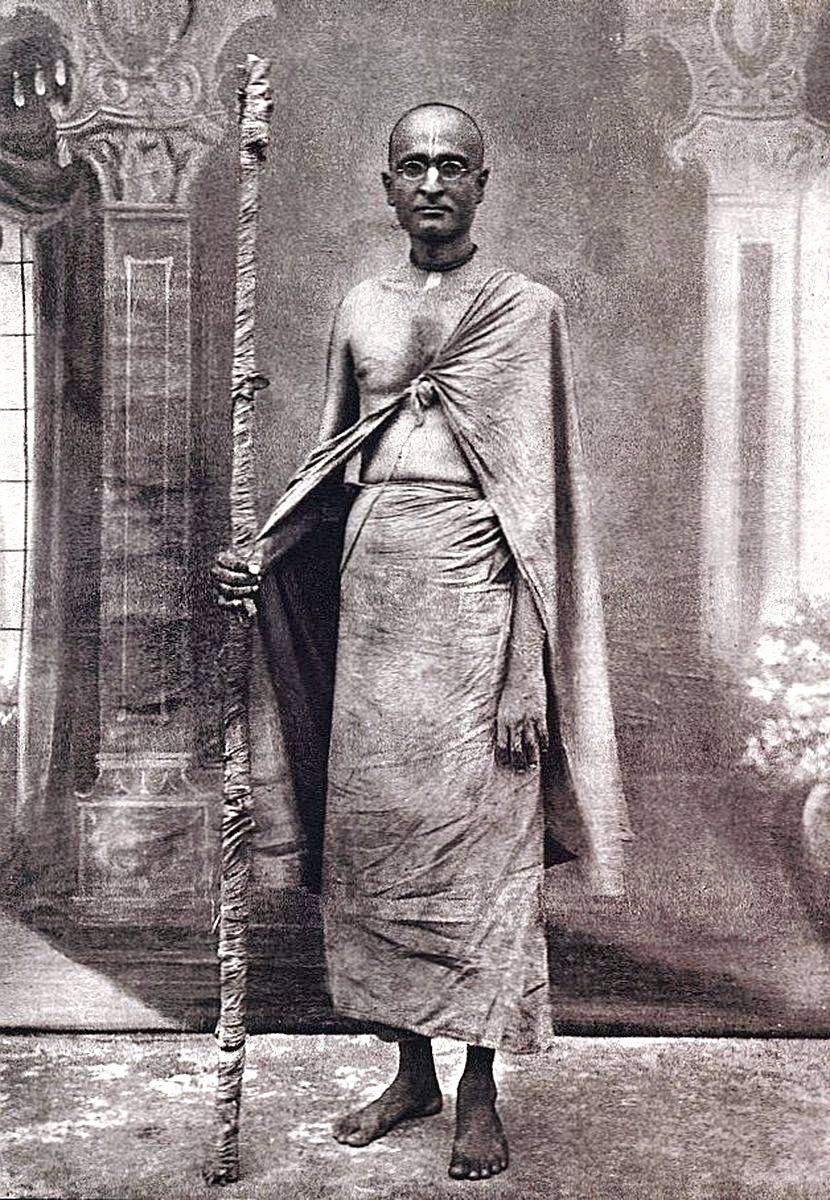
Brief Biography of the Life of Srila Bhaktisiddhanta Sarasvati Thakura
Srila Bhaktisiddhanta Sarasvati Thakura Prabhupada was born in 1873 at Jagannatha Puri. His father, Kedar Dutta Bhaktivinoda Thakura, was magistrate of the city and superintendent of Jagannatha temple. Once, during the Ratha yatra festival, the car stopped in front of the family’s house. Taking the opportunity, the mother of Srila Bhaktisiddhanta Sarasvati Thakura came out with the baby and put him on the Lotus Feet of Jagannatha. A garland from the hand of Jagannatha fell down on the baby.
More
01 Jan 2013
by The Hare Krishna Movement
in Bhaktisiddhanta Sarasvati Thakura, Srila Bhaktisiddhanta Sarasvati Pranati
Tags: Bhaktisiddhanta Sarasvati Thakur, Pranati, Sri Caitanya's mercy, Sri Varshabhanavi-devi- dayita dasa, Srila Bhaktisiddhanta, Srila Bhaktisiddhanta Sarasvati Pranati, srimate bhaktisiddhanta-sarasvatiti namine
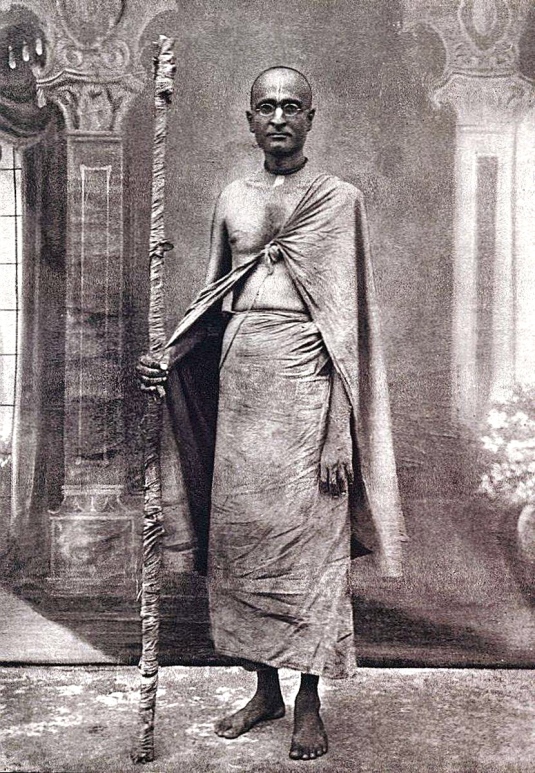
Today on the “New Year” day of 2013, we begin our celebration by honoring the Disappearance of Srila Bhaktididdhanta Sarasvati, with the Srila Bhaktisiddhanta Sarasvati Pranati (prayers).
Srila Bhaktisiddhanta Sarasvati Pranati
nama om vishnu-padaya krishna-preshthaya bhu-tale
srimate bhaktisiddhanta-sarasvatiti namine
namah–obeisances; om-address; visnu-padaya–unto him who is at the feet of Lord Visnu; krsna-presthaya–who is very dear to Lord Krsna; bhu-tale–on the earth; srimate–all-beautiful; bhaktisiddhanta sarasvati–Srila Bhaktisiddhanta Sarasvati; iti–thus; namine– who is named.
I offer my respectful obeisances unto His Divine Grace Bhaktisiddhanta Sarasvati, who is very dear to Lord Krishna, having taken shelter at His lotus feet.
sri-varshabhanavi-devi-dayitaya kripabdhaye
krishna-sambandha-vijnana-dayine prabhave namah
sri-varsabhanavi-devi-dayitaya–unto Sri Varsabhanavi-devi-dayita Dasa, the servant of the lover of Srimati Radharani; krpa-abdhaye–who is an ocean of mercy; krsna-sambandha–(of) the relationship with Krsna; vijnana–(of) the science; dayine–who is the deliverer; prabhave–unto the master; namah–obeisances.
I offer my respectful obeisances to Sri Varshabhanavi-devi-dayita dasa [another name of Srila Bhaktisiddhanta Sarasvati], who is favored by Srimati Radharani and who is the ocean of transcendental mercy and the deliverer of the science of Krishna.
madhuryojjvala-premadhya-sri-rupanuga-bhaktida
sri-gaura-karuna-sakti-vigrahaya namo ’stu te
madhurya–conjugal; ujjvala–brilliant; prema–love; adhya– enriched with; sri-rupa-anuga–following Srila Rupa Gosvami; bhakti-da–delivering devotional service; sri-gaura–(of) Lord Caitanya Mahaprabhu; karuna–(of) the mercy, sakti–energy; vigrahaya–unto the personified; namah–obeisances; astu–let there be; to–unto you
I offer my respectful obeisances unto you, the personified energy of Sri Caitanya’s mercy, who deliver devotional service which is enriched with conjugal love of Radha and Krishna, coming exactly in the line of revelation of Srila Rupa Gosvami.
namas te gaura-vani-sri-murtaye dina-tarine
rupanuga-viruddhapasiddhanta-dhvanta-harine
namah–obeisances; to–unto you; gaura-vani–teachings of Lord Caitanya; sri-murtaye–unto the personified; dina–(of) the fallen; tarine–unto the deliverer; rupa-anuga–the philosophy which follows the teachings of Srila Rupa Gosvami; viruddha–against; apasiddhanta–(of) unauthorized statements; dhvanta–the darkness; harine–unto you who are removing.
I offer my respectful obeisances unto you, who are the personified teachings of Lord Caitanya. You are the deliverer of the fallen souls. You do not tolerate any statement which is against the teachings of devotional service enunciated by Srila Rupa Gosvami.
30 Dec 2012
by The Hare Krishna Movement
in A.C. Bhaktivedanta Swami Prabhupada, Cow Protection, Sri Caitanya-Caritamrta
Tags: A.C. Bhaktivedanta Swami Prabhupada, Balarama, cows and calves, Krishna, Krishna Balarama and cows, only shelter for the fallen conditioned soul, opulence and sweetness, real goal of life, Sri Caitanya Mahaprabhu, The Opulence and Sweetness of Lord Śrī Kṛṣṇa

click on image to enlarge
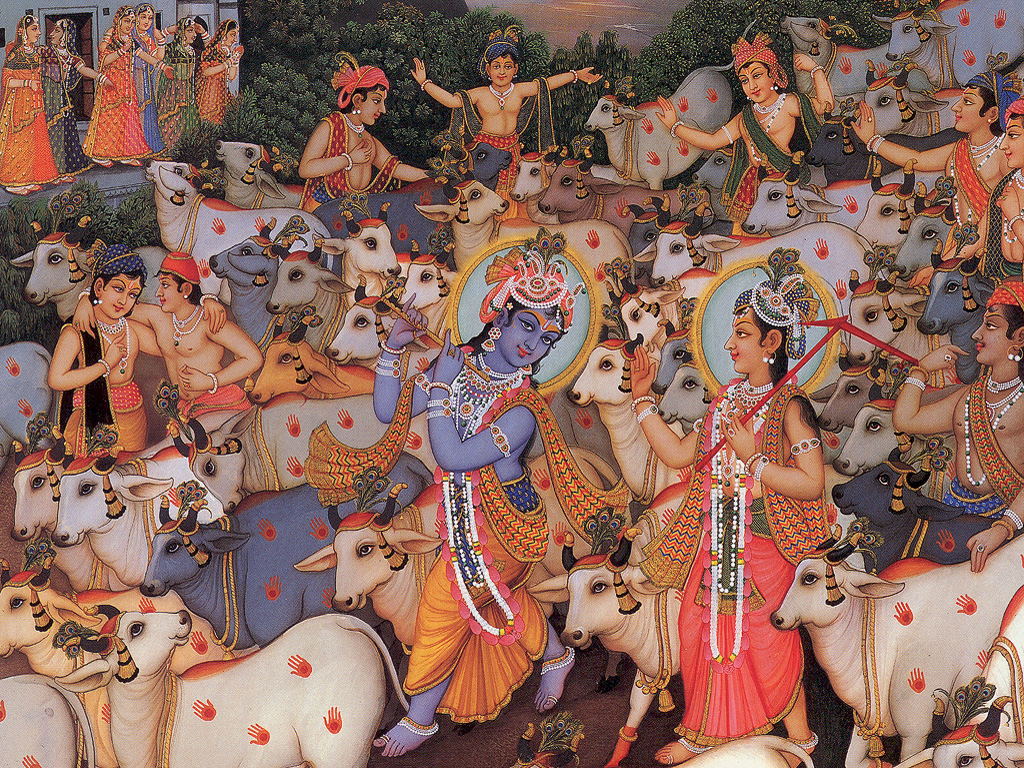
“According to Śukadeva Gosvāmī, Kṛṣṇa had unlimited cows and cowherd boys with Him. No one could count their actual number.
“All the cowherd boys had unlimited calves. Similarly, their canes, flutes, lotus flowers, horns, garments and ornaments were all unlimited. They cannot be limited by writing about them.
More
28 Dec 2012
by The Hare Krishna Movement
in A.C. Bhaktivedanta Swami Prabhupada
Tags: A.C. Bhaktivedanta Swami Prabhupada, Arjuna, Bg.7, bhagavad-gita, four kinds of men, Gita, Knowledge of the Absolute, Krsna, krsna consciousness, practicing yoga in full consciousness of Me, Spiritual world, yoga

click on image to enlarge
…In this Seventh Chapter of Bhagavad-gītā, the nature of Kṛṣṇa consciousness is fully described. Kṛṣṇa is full in all opulences, and how He manifests such opulences is described herein. Also, four kinds of fortunate people who become attached to Kṛṣṇa, and four kinds of unfortunate people who never take to Kṛṣṇa are described in this chapter.
Bhagavad-gītā As It Is Complete 1972 Edition
By His Divine Grace A. C. Bhaktivedanta Swami Prabhupāda
Chapter 7
Knowledge of the Absolute
More
28 Dec 2012
by The Hare Krishna Movement
in A.C. Bhaktivedanta Swami Prabhupada, Back to Godhead, Salvation, Sankirtan
Tags: A.C. Bhaktivedanta Swami Prabhupada, An Address to American Youth, chant and be happy, chanting Hare Krishna, Kirtanananda das brahmachary, Prasadam, Swami A.C. Bhaktivedanta, Tompkins Square Park

click on image to enlarge
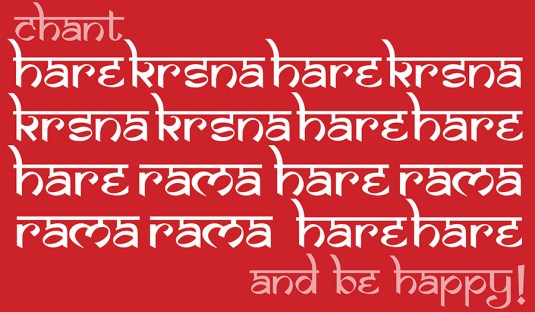
…So we invite you to please chant with us it is such a nice thing; come to our temple if you like; take a little prasadam; and be happy. It is not very difficult if you just chant this HARE KRISHNA, HARE KRISHNA, KRISHNA KRISHNA, HARE HARE, HARE RAMA, HARE RAMA, RAMA RAMA, HARE HARE. That will save you. Thank you very much, and God bless you.
Swami A.C. Bhaktivedanta
An Address to American Youth
By His Divine Grace A.C. Bhaktivedanta Swami Srila Prabhupada
Excerpted from Back to Godhead Magazine 1967, Vol 1, No.13
My dear young beautiful boys and girls of America. I have come to your country with great hope and a great mission. My Spiritual Master, Om Vishnupad Paramhansa Paribrajaka Acharya Sri Sriman Bhakti Siddhanta Saraswati Goswami Maharaj, asked me to preach this cult of Lord Sri Chaitanya Mahaprabhu in the Western World. That was the seed-giving incident. Gradually the seed fructified, and I was prepared to come to the Western World. Still, I do not know why I was so much attracted by the land of America. But from within Krishna dictated that instead of going to Europe I should better go to America. So you can see that I have come to your country under order of superior authority. And even after arriving here, when I perceived that some of the youngsters are being misled, confused and frustrated this is not the condition in your country only, but in every country, the young people are neglected, although it is they who are the flower and future hope of everyone so I thought to myself that if I go the American youth with my message and they join with me in this movement, then it will spread all over the world and then all the problems of the world will be solved. How I would like to be with you in person today, but Krishna has prevented that, so please pardon me and accept my blessings in this written form.
More
27 Dec 2012
by The Hare Krishna Movement
in A.C. Bhaktivedanta Swami Prabhupada, Bhismadeva
Tags: A.C. Bhaktivedanta Swami Prabhupada, battlefield, Battlefield of Kuruksetra, Bhismadeva, Lord Sri Krsna, SB 1.9.38, sharp arrows., Srimad Bhagavatam

…The dealings of Lord Kṛṣṇa and Bhīṣmadeva on the Battlefield of Kurukṣetra are interesting because the activities of Lord Śrī Kṛṣṇa appeared to be partial to Arjuna and at enmity with Bhīṣmadeva; but factually all this was especially meant to show special favor to Bhīṣmadeva, a great devotee of the Lord. The astounding feature of such dealings is that a devotee can please the Lord by playing the part of an enemy.
Srimad Bhagavatam
By His Divine Grace A.C. Bhaktivedanta Swami Prabhupada
First Canto, Chapter 9, Text 38
The Passing Away of Bhismadeva
More
26 Dec 2012
by The Hare Krishna Movement
in Chanting Hare Krishna, Sri Nandanandana das, Stephen Knapp
Tags: age of kali, age of quarrel and anxiety, chanting Hare Krishna, Hare Krishna, Hare Rama, Maha Mantra, mantra meditation, sixteen words, Sri Nandanandana das, Stephen Knapp, Vedic Scriptures, yoga
This is Part 2 in the series on chanting by Sri Nandanandana Prabhu. This is a collection of quotes from the Vedic Scriptures advocating the merits of chanting the Holy Names. To read Part 1
Chanting the Maha-Mantra
by Stephen Knapp (Sri Nandanandana dasa)
Part 2
There are many Vedic references which specifically recommend the chanting of the Hare Krishna maha-mantra as the most effective and advantageous means of reaching spiritual realization and counteracting all the problems of this age. Some of these verses are the following:
These sixteen words–Hare Krishna, Hare Krishna, Krishna Krishna, Hare Hare/Hare Rama, Hare Rama, Rama Rama, Hare Hare–are especially meant for counteracting the ill effects of the present age of quarrel and anxiety. (Kali-santarana Upanishad)
More
25 Dec 2012
by The Hare Krishna Movement
in A.C. Bhaktivedanta Swami Prabhupada, Bob Cohen, Guru & Disciple, Srila Prabhupada, Srila Prabhupada Conversations
Tags: A.C. Bhaktivedanta Swami Prabhupada, Bob Cohen, Christ, disciple, disciples, Jesus, Jesus Christ, Krishna, perfect questions perfect answers, spiritual master, young American Peace Corps worker
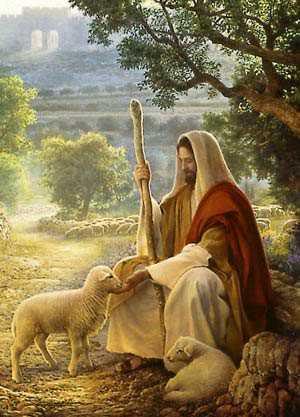
Continuing with our series of a True account entitled Perfect Questions, Perfect Answers… A search for meaning carries Bob Cohen, a young American Peace Corps worker halfway around the world, to an ancient village in the midst of West Bengal. There, in a small bamboo hut, he finds a teacher who is able to tell him everything he ever wanted to know.
…The spiritual master has to take the responsibility for all the sinful activities of his disciples…He takes responsibility for all the fallen souls. That idea is also in the Bible. Jesus Christ took all the sinful reactions of the people and sacrificed his life. That is the responsibility of a spiritual master.
Perfect Questions Perfect Answers
By His Divine Grace A.C. Bhaktivedanta Swami Prabhupada
February 29, 1972, evening
Chapter Six
More
20 Dec 2012
by The Hare Krishna Movement
in Astrology, Krishna Consciousness
Tags: 12-21-2012, Dec. 21 2012, God, Krishna, Mayan Age, mayan age ends, new age of spiritual enlightment

Well today is 12-21-2012, or as one web site declared “Mayan Age Ends 12-21-2012 but heralds in a New Age of spiritual enlightenment” Good! Glad to hear it. Hare Krishna! This is our last post for a while as we thought 12-21-2012 was a good day to start an adventure, travel, take a short journey, and just go for some walks, read and chant more, etc. Or as one great thinker put it, “Today is the begining of the rest of my life” So we will be back to post some more Krishna Nectar soon.
We will leave you with this small bit of Krishna Nectar:
…Since it was almost night, and all the inhabitants of Vṛndāvana, including the cows and calves, were very tired, they decided to take their rest on the river bank. In the middle of the night, while they were taking rest, there was suddenly a great forest fire, and it quickly appeared that the fire would soon devour all the inhabitants of Vṛndāvana. As soon as they felt the warmth of the fire, they immediately took shelter of Kṛṣṇa, the Supreme Personality of Godhead, although He was playing just like their child. They began to say, “Our dear Kṛṣṇa! O Supreme Personality of Godhead! Our dear Balarāma, the reservoir of all strength! Please try to save us from this all devouring and devastating fire. We have no other shelter than You. This devastating fire will swallow us all!” Thus they prayed to Kṛṣṇa, saying that they could not take any shelter other than His lotus feet. Lord Kṛṣṇa, being compassionate upon His own townspeople, immediately swallowed up the whole forest fire and saved them. This was not impossible for Kṛṣṇa because He is unlimited. He has unlimited power to do anything He desires.
“Please try to save us from this all devouring and devastating fire. We have no other shelter than You.”
Yes this is Krishna Consciousness…in whatever situation we are thrown if we simply remember Krishna (God) we can consider ourselves fortunate.
20 Dec 2012
by The Hare Krishna Movement
in A.C. Bhaktivedanta Swami Prabhupada, Brahma-samhita, Govinda, Govindam Prayers, Songs of the Vaisnava Acaryas, Sri Brahma-samhita
Tags: A.C. Bhaktivedanta Swami Prabhupada, Apple Records, George Harrison, Govinda, govindam adi-purusam tam aham bhajami, I worship Govinda, The Radha Krishna Temple, venum kvanantam, Yamuna devi

The verses 30 and 32 from the Brahma-samita are sung in the morning Srngara Arati in all ISKCON temples, while the first track of the 1970 album “Radha Krsna Temple” is played. Srila Prabhupada enjoyed this track very much and was so moved that he said that this track will play at all ISKCON temples for the Srngara Arati. As a result, no one ever leads kirtan for this song, as it is played through that track.
Govinda
The Radha Krsna Temple Album
Sung by Yamuna devi
Produced by George Harrison
veṇuṁ kvaṇantam aravinda-dalāyatākṣam-
barhāvataṁsam asitāmbuda-sundarāṅgam
kandarpa-koṭi-kamanīya-viśeṣa-śobhaṁ
govindam ādi-puruṣaṁ tam ahaṁ bhajāmi
veṇum—the flute; kvaṇantam—playing; aravinda-dala—(like) lotus petals; āyata—blooming; akṣam—whose eyes; barha—a peacock’s feather; avataṁsam—whose ornament on the head; asita-ambuda—(tinged with the hue of) blue clouds; sundara—beautiful; aṅgam—whose figure; kandarpa—of Cupids; koṭi—millions; kamanīya—charming; viśeṣa—unique; śobham—whose loveliness; govindam—Govinda; ādi-puruṣam—the original person; tam—Him; aham—I; bhajāmi—worship.
I worship Govinda, the primeval Lord, who is adept in playing on His flute, with blooming eyes like lotus petals with head decked with peacock’s feather, with the figure of beauty tinged with the hue of blue clouds, and His unique loveliness charming millions of Cupids.
aṅgāni yasya sakalendriya-vṛtti-manti
paśyanti pānti kalayanti ciraṁ jaganti
ānanda-cinmaya-sad-ujjvala-vigrahasya
govindam ādi-puruṣaṁ tam ahaṁ bhajāmi
aṅgāni—the limbs; yasya—of whom; sakala-indriya—of all the organs; vṛtti-manti—possessing the functions; paśyanti—see; pānti—maintain; kalayanti—manifest; ciram—eternally,; jaganti—the universes; ānanda—bliss; cit—truth; maya—full of; sat—substantiality; ujjvala—full of dazzling splendor; vigrahasya—whose form; govindam—Govinda; ādi-puruṣam—the original person; tam—Him; aham—I; bhajāmi—worship.
I worship Govinda, the primeval Lord, whose transcendental form is full of bliss, truth, substantiality and is thus full of the most dazzling splendor. Each of the limbs of that transcendental figure possesses in Himself, the full-fledged functions of all the organs, and eternally sees, maintains and manifests the infinite universes, both spiritual and mundane.

More
19 Dec 2012
by The Hare Krishna Movement
in Bhaktisiddhanta Sarasvati Thakura, Brahma-samhita, Brahma-samhita, Govindam Prayers, Prayers & Verses, Sri Brahma-samhita
Tags: ananda, Bhaktisiddhanta Sarasvati Thakura, Brahma, brahma samihita, cit, eternal blissful spiritual body, Govindam Prayers, isvarah, isvarah paramak krsna, Krishna Govinda, Lord Brahma, Lord Krsna, sac-cid-ananda-vigrahah, sat, Sri Brahma-samhita, supreme, Supreme Godhead, the controller, vigrahah
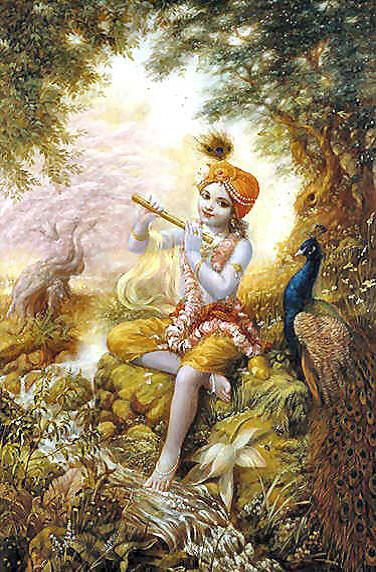
The Govindam Prayers
From Śrī Brahma-saṁhitā
By His Divine Grace Bhaktisiddhānta Sarasvatī Ṭhākura
This collection is taken from the fifth chapter of the Hymns of Brahma, and includes verse 1, and 29-56. There were 100 chapters in the Brahma Samhita. This 5th chapter of the Brahma Samhita was discovered by Lord Caitanya during His appearance. The other chapters have not yet been revealed.
More
19 Dec 2012
by The Hare Krishna Movement
in Book Changes, Diksha, Remembering Srila Prabhupada, Rupanuga das, Siksa, Spiritual Master, Srila Prabhupada
Tags: A.C. Bhaktivedanta Swami Prabhupada, confidential servants of God, devotee, guru, literary incarnation of God, Prabhupada Direct, Rupanuga das, Siksa guru, spiritual master, Srila Prabhupada, Srila Prabhupada vani

click on image to enlarge
I like reading the articles written by Sriman Rupanuga Prabhu, as he has a very good appreciation for the potency and attributes of Srila Prabhupada. So we took the liberty of posting another one here to share with our readers.
…The conclusion is that in the same way Lord Krsna is identical with His words in the Gita, even though He spoke them long ago, Srila Prabhupada is actually present in his purports, even though he is no longer physically present. And those purports are as much sastra as the verses they explain. Those books are as good as Deities in the temple. They are not the playthings of editors, but the literary incarnations of God and His most confidential servants. Therefore, they must be approached with all respect and reverence.
Srila Prabhupada’s books and recordings are a consistent and constant source of revelation for anyone who follows him. If one is able to follow Srila Prabhupada’s instructions to chant 16 rounds, follow the four regulative principles, systematically study his teachings and then help others do the same, that person will undoubtedly remember Lord Krsna at the time of death. Such a bhakta may be unable to discover a guru fully qualified to give diksa and specific name. Those who factually meet the standards required by Srila Prabhupada to become a genuine spiritual master may be few and far between. But by honestly and seriously accepting Srila Prabhupada as siksa guru, anyone can obtain freedom from the material conception of life, be inspired to action in Krsna consciousness, and learn to think of Srila Prabhupada and Lord Krsna always.
More
18 Dec 2012
by The Hare Krishna Movement
in Art, Back to Godhead, Srila Prabhupada
Tags: A.C. Bhaktivedanta Swami Prabhupada, Back to Godhead Magazine, Bharadraja das, bona fide spiritual master, Devahuti devi, Govinda dasi, ISKCON Press, Jadurani devi, Krishna art, Krishna Consciousness Artists, Lord Visnu, Maralidhara das, Srila Prabhupada, Transcendental Art, transcendental devotional service, utilize whatever talent in the service of the Lord

click on image to enlarge
This is perhaps the first picture I ever saw of Radha & Krishna. I remember thinking at the time: “This is the most beautiful picture I have ever seen in my life.” Since then I have been fortunate to have relished so many other beautiful pictures of Radha and Krishna, but one always remembers his first love. Srila Prabhupada by his causless mercy, has given us so much in the way of Art, Music, Knowledge, etc. that I am simply in awe!
Transcendental Art
Excrpted from Back to Godhead Magazine 1971, Vol. 1, No. 39
One of the basic principles of Krsna consciousness is that one may utilize whatever talent he has in the service of the Supreme Lord. And it is a symptom of a bona fide spiritual master that he is expert in engaging everyone in practical transcendental devotional service. His Divine Grace A.C. Bhaktivedanta Swami Prabhupada has thus engaged a number of very talented artists in the service of the Lord by asking them to use their natural artistic inclination in painting pictures of the Supreme Godhead. According to all the revealed Vedic scriptures, God is not formless or void, but on the contrary He has the most attractive personal form. In fact He has many transcendental forms. Krsna appears and expands Himself in multi expansions and incarnations, and these are described in Vedic literatures such as Bhagavad-gita and Srimad-Bhagavatam.
More
16 Dec 2012
by The Hare Krishna Movement
in A.C. Bhaktivedanta Swami Prabhupada, Kali Yuga, Time
Tags: A.C. Bhaktivedanta Swami Prabhupada, as it is, bhagavad-gita, constant flux, cycle of time, duration of the material universe, dvapara-yuga, Kali-yuga, Macmillan 1972 Edition, material universe, satya-yuga, Srimad Bhagavatam, Time, transcendental knowledge, Treta-yuga, yuga

click on image to enlarge
Is It The End of The World or Just Kali Yuga?
As devotees, or rather as disciples of His Divine Grace A.C. Bhaktivedanta Swami Prabhupada, we do not accept the theory of “The End of the World”. There is too much scriptural evidence to counter such a speculative conclusion. There is ample description of “Time”, as given in the Vedic Scriptures such as the Bhagavad-gita and the Srimad Bhagavatam to confirm that there is no end to this age for another 427,000 years.
Once when Srila Prabhupada was asked by one devotee…
Lokamangala dasa: In your books you explain that we are in the Kali-yuga age. Is the Kali-yuga age coming to a close now?
Srila Prabhupada: No. It will continue for another 427,000 years. The duration of Kali-yuga is 432,000 years. Out of that, we have passed only 5,000 years. The balance is 427,000 years. And during this time the condition of society will be worse-not better but worse. In the last stage of Kali-yuga there will be no food grains, no milk, no fruits. It will be a very horrible time. People will kill their own children and eat them, just like animals. The last stage of Kali-yuga will be like that. So before coming to that stage, better to take Krsna consciousness and go back to Krsna. That is our program. We don’t wish to wait for the worst things. The worst things are already happening, and it will be still worse. Instead of waiting for that time, better to become perfect by chanting Hare Krsna and go back home, back to Godhead. That is our position.
Also in the books we find:
At the present moment we have just passed through five thousand years of the Kali-yuga, which lasts 432,000 years. Before this there was Dvāpara-yuga (800,000 years), and before that there was Tretā-yuga (1,200,000 years). Thus, some 2,005,000 years ago, Manu spoke the Bhagavad-gītā to his disciple and son Mahārāja lkṣvāku, the King of this planet earth. The age of the current Manu is calculated to last some 305,300,000 years, of which 120,400,000 have passed. (Bhagavad-gita 4.1)
The duration of the material universe is limited. It is manifested in cycles of kalpas. A kalpa is a day of Brahmā, and one day of Brahmā consists of a thousand cycles of four yugas or ages: Satya, Tretā, Dvāpara, and Kali. The cycle of Satya is characterized by virtue, wisdom and religion, there being practically no ignorance and vice, and the yuga lasts 1,728,000 years. In the Tretā-yuga vice is introduced, and this yuga lasts 1,296,000 years. In the Dvāpara-yuga there is an even greater decline in virtue and religion, vice increasing, and this yuga lasts 864,000 years. And finally in Kali-yuga (the yuga we have now been experiencing over the past 5,000 years) there is an abundance of strife, ignorance, irreligion and vice, true virtue being practically nonexistent, and this yuga lasts 432,000 years. In Kali-yuga vice increases to such a point that at the termination of the yuga the Supreme Lord Himself appears as the Kalki avatara, vanquishes the demons, saves His devotees, and commences another Satya-yuga. Then the process is set rolling again. These four yugas, rotating a thousand times, comprise one day of Brahmā, the creator god, and the same number comprise one night. Brahmā lives one hundred of such “years” and then dies. These “hundred years” by earth calculations total to 311 trillion and 40 million earth years. By these calculations the life of Brahmā seems fantastic and interminable, but from the viewpoint of eternity it is as brief as a lightning flash. In the causal ocean there are innumerable Brahmās rising and disappearing like bubbles in the Atlantic. Brahmā and his creation are all part of the material universe, and therefore they are in constant flux. (Bhagavad-gita 8.17)
There are four yugas: Satya-yuga, Tretā-yuga, Dvāpara-yuga and Kali-yuga. During the first yuga, Satya-yuga, people were very pious. Everyone practiced the mystic yoga system for spiritual understanding and realization of God. Because everyone was always absorbed in samādhi, no one was interested in material sense enjoyment. During Tretā-yuga, people enjoyed sense pleasure without tribulations. Material miseries began in Dvāpara-yuga, but they were not very stringent. Stringent material miseries really began from the advent of Kali-yuga. (Srimad Bhagavatam 5.17.12)
After the Battle of Kurukṣetra, at which Bhagavad-gītā was spoken, Kali-yuga continues for 432,000 years, of which only 5,000 years have passed. Thus there is still a balance of 427,000 years to come. Of these 427,000 years, the 10,000 years of the saṅkīrtana movement inaugurated by Śrī Caitanya Mahāprabhu 500 years ago provide the opportunity for the fallen souls of Kali-yuga to take to the Kṛṣṇa consciousness movement, chant the Hare Kṛṣṇa mahā-mantra and thus be delivered from the clutches of material existence and return home, back to Godhead. (Srimad Bhagavatam 8.5.23)
Full Text and Purports More
16 Dec 2012
by The Hare Krishna Movement
in A.C. Bhaktivedanta Swami Prabhupada, Back to Godhead, Conversation with Srila Prabhupada, The Hare Krishna Movement
Tags: A.C. Bhaktivedanta Swami, Back to Godhead Magazine, BTG Vol.1 No.49, disciple, International Society for Krishna Consciousness, Iskcon, Krishna consciousness movement, krsna consciousness, spiritual master, Srila Prabhupada, The Hare Krishna Movement, Vedic formula

The Search for the Divine
By His Divine Grace A.C. Bhaktivedanta Swami Prabhupada
Excerpted from Back to Godhead Magazine Vol. 1, No. 49
[On his way from Los Angeles to London to attend the annual Jagannatha Car Festival, His Divine Grace A.C. Bhaktivedanta Swami Prabhupada, the founder and spiritual master of the International Society for Krishna Consciousness, paused for three days at ISKCON’s East Coast Headquarters in New York City. There he delivered a short series of public lectures, initiated twenty new disciples, gave personal directions to many of his students, and granted audience to selected guests and visitors. The following is a conversation, held in Srila Prabhupada’s personal quarters on the second afternoon of his visit, between His Divine Grace and A Newsman.]
[A newsman, with two assistants and electronic equipment, has been trying to see Srila Prabhupada.]
Newsman (whispering to Syamasundara dasa, Srila Prabhupada’s secretary): Can I ask a couple of questions, and then I’ll leave?
Syamasundara: Please, ask, yes.
More
14 Dec 2012
by The Hare Krishna Movement
in People, Ravi Shankar
Tags: clasical Indian music, Indian music, ravi and george harrison, Ravi Shakar died at the age of 92, Ravi Shankar, sitar composer, sitar virtuoso, world music
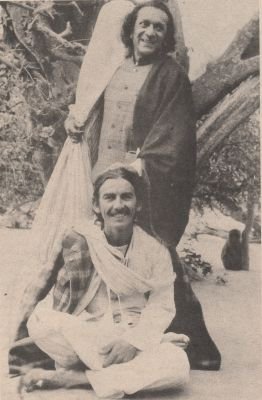
Remembering Ravi Shankar
The legendary Indian sitar player, Ravi Shankar, died this week at the age of 92. His music touched a wide range of people – from rock musicians to international ambassadors. He is best known as the friend of the Beatle George Harrison and the Sitarist who helped introduce Indian Music to the Western World.
Previous Older Entries Next Newer Entries








 The Hare Krishna Movement