28 Aug 2013
by The Hare Krishna Movement
in A.C. Bhaktivedanta Swami Prabhupada, Festivals, Janmastami, Lectures
Tags: A.C. Bhaktivedanta Swami Prabhupada, Gaurasundara, govindam adi-purusam, Hamsaduta, Hasn, Janmastami, krishna's birthday, Lecture by Srila Prabhupada, Lord Krsna's appearance day, Lord Sri Krsna, Mukunda, prabhupada, Pradyumna, Yamuna devi

click on image to enlarge
Today, being Janmastami, we thought we should include a lecture given by Srila Prabhupada on Janmastami. The following lecture given on August 16, 1968, in Montreal Canada, is very sweet and reminiscent of how this society grew in a very personal and organic way. With Srila Prabhupada inviting his students and guests to speak on their realizations of Krsna, and Krsna Consciousness.
…So today is that auspicious day, Janmāṣṭamī, when Lord Kṛṣṇa appeared five thousand years ago in India, Mathurā. Those who are Indian ladies and gentlemen present, they know very well where is Mathurā. It is about ninety miles south of New Delhi. Mathurā is still existing and it is eternally existing. Kṛṣṇa appeared in Mathurā in His maternal uncle’s house in a very precarious condition. That birthplace, Lord Kṛṣṇa’s birthplace, is now maintained very nicely. One who goes to India, they see.
So anyway, Lord Kṛṣṇa appeared on this planet five thousand years ago. Now Kṛṣṇa says, janma karma me divyam [Bg. 4.9]. Divyam means “not ordinary.” It should not be understood just like we take our birth. Kṛṣṇa does not take his birth like us.
…So we shall invite today to speak about Kṛṣṇa from our students, as well as all the members who are present here. So I shall request Janārdana to speak something about his realization of Kṛṣṇa. (pause) All right. Let him speak.
Full Lecture More
27 Aug 2013
by The Hare Krishna Movement
in A.C. Bhaktivedanta Swami Prabhupada, Festivals, Krishna, KRSNA The Supreme Personality of Godhead
Tags: A.C. Bhaktivedanta Swami Prabhupada, auspicious birth of the lord, baby krisnha, Birth of Lord Krsna, Janmastami, Krishna Janmastami, Krsna Janmastami, Lord's appearance, Mother Yasoda, Yashoda
Please click on image to enlarge
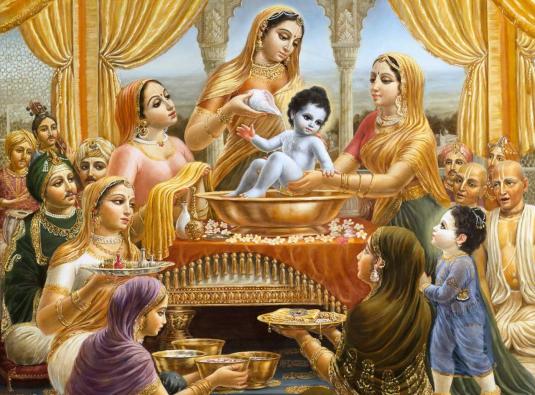
Today we honor the Birth of Lord Krishna, otherwise known as Krishna Janmastami. On Janmastami, the devotees of Lord Krishna observe a fast till midnight, followed by an Ekadasi Feast. Today we honor the auspicious event with this beautiful image of Mother Yaśodā bathing Lord Krishna, and the very first chapter of Krsna Book, entitled “Birth of Lord Kṛṣṇa”.
Full Chapter More
26 Aug 2013
by The Hare Krishna Movement
in A.C. Bhaktivedanta Swami Prabhupada, Bhagavad-gita, Spiritual Life, Spiritual World
Tags: A.C. Bhaktivedanta Swami Prabhupada, bhakti, buddhi-yoga, karma yoga, Krishna, liberation, lotus feet of the Lord, material world, mukti, Personality of Godhead, Radha, Spiritual Life, spiritual sky, Spiritual world, Vaikuntha planets, vikunthaloka, yoga

please click on image to enlarge!
The liberated living entities seek that place where there are no material miseries. The Bhāgavatam says:
samāśritā ye padapallava-plavaṁ
mahat-padaṁ puṇya-yaśo murāreḥ
bhāvambudhir vatsa-padaṁ paraṁ padaṁ
paraṁ padaṁ yad vipadāṁ na teṣām
(Bhāg. 10.14.58)
“For one who has accepted the boat of the lotus feet of the Lord, who is the shelter of the cosmic manifestation and is famous as Mukunda or the giver of mukti, the ocean of the material world is like the water contained in a calf’s hoofprint. Param padam, or the place where there are no material miseries, or Vaikuṇṭha, is his goal, not the place where there is danger in every step of life.” (From purport to Bg. 2.51)
Full verse and purport More
25 Aug 2013
by The Hare Krishna Movement
in A.C. Bhaktivedanta Swami Prabhupada, Letters by Srila Prabhupada, Yoga
Tags: A.C. Bhaktivedanta Swami, asana, astanga-yoga, Bg 6.47, bhakti yoga, dhayana yoga, dhyana, hatha yoga, jnana-yoga, karma yoga, Krishna consciousness, link, link-up, meaning of yoga, meditation, pranayama, raja yoga, yoga, yoga meaning, yoga systems

click on image to enlarge
When we think of Yoga, we used to think of some old bearded yogi standing on his head, or more recently of young beautiful men & women in athletic clothing posing serenely, or a class full of people stretching on yoga mats. But actually the meaning of yoga is far beyond any of the physical gymnastics we tend to associate with the word. There are many systems of yoga, namely; karma yoga, jnana yoga, dhayana yoga, hatha yoga, bhakti yoga, and so many patterns of yoga. But as we understand from the Bhagavad-gita:
…in the Bhagavad-gītā it is clearly stated that…yoga means to get into touch with the Supreme Lord. The process, however, includes several bodily features such as āsana, dhyāna, prāṇāyāma and meditation (from purport SB 1.2.28-29)
…The word yoga means “link.” Any system of yoga is an attempt to reconnect our broken relationship with the Supreme Personality of Godhead. There are different types of yoga, of which bhakti-yoga is the best. In other yoga systems, one must undergo various processes before attaining perfection, but bhakti-yoga is direct. (from purport SB 10.2.6)
…The culmination of all kinds of yoga practices lies in bhakti-yoga. All other yogas are but means to come to the point of bhakti in bhakti-yoga. Yoga actually means bhakti-yoga; all other yogas are progressions toward the destination of bhakti-yoga. From the beginning of karma-yoga to the end of bhakti-yoga is a long way to self-realization. Karma-yoga, without fruitive results, is the beginning of this path. When karma-yoga increases in knowledge and renunciation, the stage is called jñāna-yoga. When jñāna-yoga increases in meditation on the Supersoul by different physical processes, and the mind is on Him, it is called aṣṭāṅga-yoga. And, when one surpasses the aṣṭāṅga-yoga and comes to the point of the Supreme Personality of Godhead Kṛṣṇa, it is called bhakti-yoga, the culmination. Factually, bhakti-yoga is the ultimate goal, but to analyze bhakti-yoga minutely one has to understand these other yogas. The yogī who is progressive is therefore on the true path of eternal good fortune. One who sticks to a particular point and does not make further progress is called by that particular name: karma-yogī, jñāna-yogī or dhyāna-yogī, rāja-yogī, haṭha-yogī, etc. If one is fortunate enough to come to the point of bhakti-yoga, it is to be understood that he has surpassed all the other yogas. Therefore, to become Kṛṣṇa conscious is the highest stage of yoga, just as, when we speak of Himalayan, we refer to the world’s highest mountains, of which the highest peak, Mount Everest, is considered to be the culmination.
It is by great fortune that one comes to Kṛṣṇa consciousness on the path of bhakti-yoga to become well situated according to the Vedic direction. The ideal yogī concentrates his attention on Kṛṣṇa, who is called Śyāmasundara, who is as beautifully colored as a cloud, whose lotus-like face is as effulgent as the sun, whose dress is brilliant with jewels and whose body is flower garlanded. Illuminating all sides is His gorgeous luster, which is called the brahmajyoti. He incarnates in different forms such as Rāma, Nṛsiṁha, Varāha and Kṛṣṇa, the Supreme Personality of Godhead, and He descends like a human being, as the son of Mother Yaśodā, and He is known as Kṛṣṇa, Govinda and Vāsudeva. He is the perfect child, husband, friend and master, and He is full with all opulences and transcendental qualities. If one remains fully conscious of these features of the Lord, he is called the highest yogī. (Bhagavad-gita 6.47)
The very word yoga means connecting link with the supreme being. We accept Krishna as the supreme being, and nobody is equal to him or greater than him. (Letter to Sri Krishna C. Batra – Vrindaban 8 December, 1975)
Full Letter + References More
24 Aug 2013
by The Hare Krishna Movement
in A.C. Bhaktivedanta Swami Prabhupada, Krsna Consciousness, KRSNA The Supreme Personality of Godhead, Krsna-katha, Spiritual Life, Spiritual World
Tags: A.C. Bhaktivedanta Swami Prabhupada, bees and drones, gopis, gopis in Vrndavana, Krishna and Balarama, krsna tending the cows, Krsna The Supreme Personality of Godhead, Krsna's flute, The Gopīs Attracted by the Flute
please click on image to enlarge
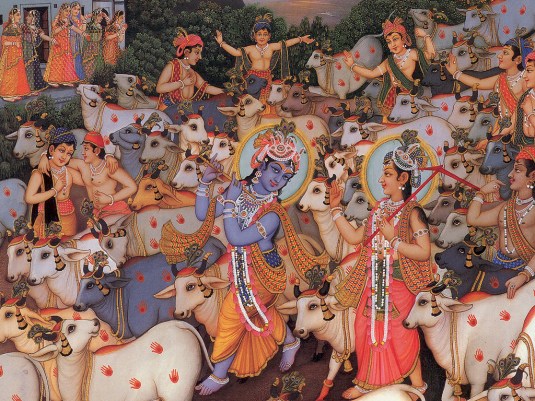
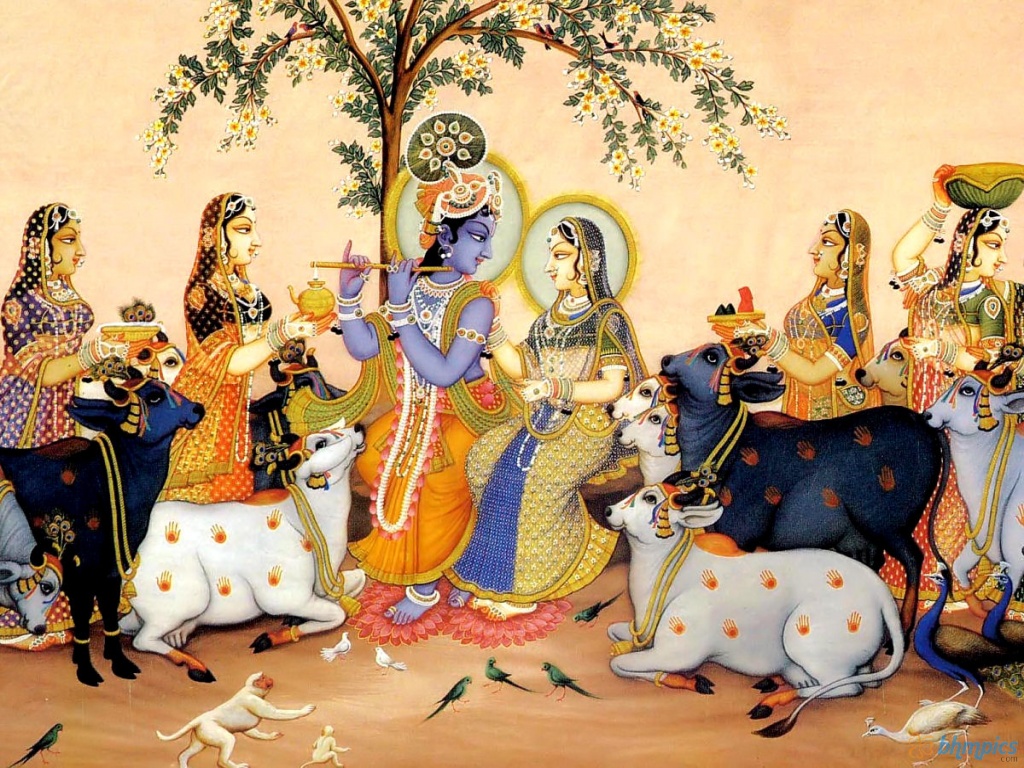
Kṛṣṇa was very pleased with the atmosphere of the forest where flowers bloomed and bees and drones hummed very jubilantly. While the birds, trees and branches were all looking very happy, Kṛṣṇa, tending the cows, accompanied by Śrī Balarāma and the cowherd boys, began to vibrate His transcendental flute. After hearing the vibration of the flute of Kṛṣṇa, the gopīs in Vṛndāvana remembered Him and began to talk amongst themselves about how nicely Kṛṣṇa was playing His flute. When the gopīs were describing the sweet vibration of Kṛṣṇa’s flute, they also remembered their pastimes with Him; thus their minds became disturbed, and they were unable to describe completely the beautiful vibrations. While discussing the transcendental vibration, they remembered also how Kṛṣṇa dressed, decorated with a peacock feather on His head, just like a dancing actor, and with blue flowers pushed over His ear. His garment glowed yellow-gold, and He was garlanded with a vaijayantī necklace. Dressed in such an attractive way, Kṛṣṇa filled up the holes of His flute with the nectar emanating from His lips. So they remembered Him, entering the forest of Vṛndāvana, which is always glorified by the footprints of Kṛṣṇa and His companions.
Kṛṣṇa was very expert in playing the flute, and the gopīs were captivated by the sound vibration, which was not only attractive to them, but to all living creatures who heard it. One of the gopīs told her friends, “The highest perfection of the eyes is to see Kṛṣṇa and Balarāma entering the forest and playing Their flutes and tending the cows with Their friends.”
Persons who are constantly engaged in the transcendental meditation of seeing Kṛṣṇa, internally and externally, by thinking of Him playing the flute and entering the Vṛndāvana forest, have really attained the perfection of samādhi. Samādhi (trance) means absorption of all the activities of the senses on a particular object, and the gopīs indicate that the pastimes of Kṛṣṇa are the perfection of all meditation and samādhi. It is also confirmed in the Bhagavad-gītā that anyone who is always absorbed in the thought of Kṛṣṇa is the topmost of all yogīs. (KRSNA The Supreme Personality of Godhead, Vol 1, Chapter 21)
Full Chapter More
23 Aug 2013
by The Hare Krishna Movement
in A.C. Bhaktivedanta Swami Prabhupada, Caitanya Mahaprabhu, Devotional Service, Sanatana Goswami, Teachings of Lord Chaitanya
Tags: A.C. Bhaktivedanta Swami Prabhupada, devotee of the Lord, devotional service, disciple, Lord Caitanya Mahaprabhu, Sanatana Goswami, spiritual master, spiritual science, spiritual subject matters, Teachings of Lord Caitanya
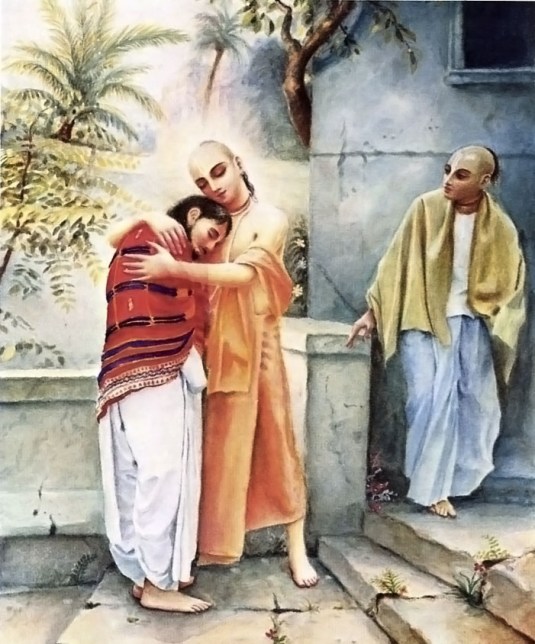
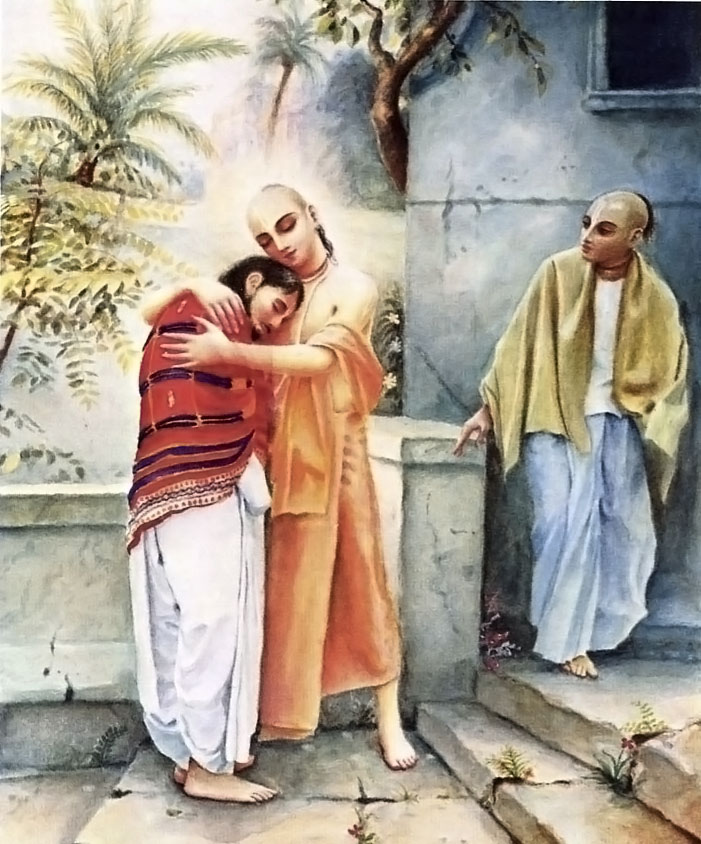
This morning I was inclined to do a post about the special mercy of the devotee of the Lord, by whose mercy one can make spiritual advancement. So we chose the chapter from “Teachings of Lord Caitanya” entitled “Sanātana Gosvāmī”
The instructions and teachings of Lord Caitanya are very important for people in general. He teaches the process of devotional service, which is the constitutional occupation of every living entity, for it is every man’s duty to advance in spiritual science. Many subjects were thoroughly discussed in the talks between Lord Caitanya and Sanātana Gosvāmī. Due to the mercy of Lord Caitanya, Sanātana was able to put important questions before Him, and these questions were replied to properly.
“I offer my respectful obeisances unto Lord Caitanya Mahāprabhu, by whose mercy even a person in the lowest form of life can find direction in transcendental devotional service to the Lord.” (Cc. Madhya 20.1)
…when Sanātana entered the courtyard, Lord Caitanya hurriedly came to see and embrace him. When the Lord embraced him, Sanātana became overwhelmed with spiritual ecstasy, and he said, “My dear Lord, please do not touch me.” But both of them embraced each other and began to cry. Seeing Sanātana and Lord Caitanya acting thus, Candraśekhara was struck with wonder. At length, Caitanya Mahāprabhu asked Sanātana to sit down with Him on a bench. He was touching the body of Sanātana with His hand, and Sanātana asked Him again, “My dear Lord, please do not touch me.”
“I am touching you just for My purification,” the Lord replied, “for you are a great devotee. By your devotional service you can deliver the whole universe and enable everyone to go back to Godhead.”
The Lord proceeded to quote a verse from Śrīmad-Bhāgavatam to the effect that a person who is a devotee of Lord Kṛṣṇa and is one hundred percent engaged in devotional service is far better than a brāhmaṇa who is versed in all the Vedic literatures but who does not engage in the devotional service of the Lord. Because he is carrying the Supreme Lord within his heart, the devotee can purify everyplace and everything.
Full Chapter More
22 Aug 2013
by The Hare Krishna Movement
in Prema-dhvani Prayers
Tags: ananta loti vaisnava-vrnda, astottara-sata, ki jaya, om visnu-pada, paramahamsa, parivrajakacarya, prema-dhvani prayers, Srila Bhaktisiddhanta, Srila Prabhupada

click on image to enlarge
Prema-dhvani Prayers
(Obeisnaces & Respects)
jaya oṁ viṣṇu-pāda paramahaṁsa parivrājakācārya aṣṭottara-śata śrī śrīmad a.c. bhaktivedānta svāmī mahārāja prabhupāda—kī jaya.
(108 glories to the wandering mendicant and topmost swanlike devotee, the great preceptor His Divine Grace A. C. Bhaktivedanta Swami Prabhupada, who has taken shelter at the feet of Lord Viṣṇu)
jaya oṁ viṣṇu-pāda paramahaṁsa parivrājakācārya aṣṭottara-śata śrī śrīmad bhaktisiddhānta sarasvatī gosvāmī mahārāja prabhupāda—kī jaya.
(108 glories to the wandering mendicant and topmost swanlike devotee, the great preceptor His Divine Grace Srila Bhaktisiddhānta Sarasvatī Gosvami Maharaja Prabhupada, who has taken shelter at the feet of Lord Viṣṇu)
ananta koṭi vaiṣṇava-vṛnda—kī jaya.
(All glories to the unlimited millions of Vaiṣṇavas.)
nāmācārya śrīla haridāsa ṭhākura—kī jaya.
(All glories to the Nāmācārya Śrīla Haridāsa Ṭhākura.)
ISKCON-Founder-Ācārya Śrīla Prabhupāda—kī jaya.
(All glories to Śrīla Prabhupāda, the Founder-Ācārya of the International Society for Kṛṣṇa Consciousness.)
prem-se kaho śrī-kṛṣṇa-caitanya prabhu nityānanda śrī advaita, gadādhara, śrīvāsādi gaura-bhakta-vṛnda—kī jaya.
(Call out with love the names Śrī Kṛṣṇa Caitanya, Prabhu Nityānanda, Śrī Advaita, Śrī Gadādhara, Śrīvāsa and all the devotees of Lord Caitanya.)
śrī śrī rādha-kṛṣṇa, gopa-gopīnatha, śyāma-kuṇḍa, rādhā-kuṇḍa giri-govardhana—kī jaya.
(All glories to Rādhā and Kṛṣṇa, the Lord of the gopas and gopis. All Glories to Śyāma-kuṇḍa, Rādhā-kuṇḍa and Govardhana Hill.)
[One may glorify the Deities of the temple at this time.]
śrī vṛndāvana dhāma—kī jaya.
(All glories to the abodes Śrī Vṛndāvana-dhāma.)
śrī māyāpur dhāma—kī jaya.
(All glories to Śrī Māyāpur-dhāma.)
jagannatha-puri-dhama-ki jaya.
(All glories to the temple of the Lord of the universe at Puri)
gaṅgā-mayī—kī jaya.
(All glories to Gaṅgā-devī.)
yamunā-mayī—kī jaya.
(All glories to Yamunā-devī.)
tulasī-devī—kī jaya.
(All glories to Tulasī-devī.)
bhakti-devī—kī jaya.
(All glories to bhakti, devotional service to the Lord)
śrī hari-nāma saṅkīrtana—kī jaya.
(All glories to the congregational chanting of the holy name of Hari.)
brhad-mrdanga-ki yaya.
(All glories to the publication and distribution of transcendental literatures glorifying the Supreme Personality of Godhead, Lord Sri Krishna.)
[Srila Bhaktisiddhānta Sarasvatī likened this activity to playing on a big mrdanga drum which can be heard around the world]
samāveta bhakta-vṛnda—kī jaya.
(All glories to the assembled devotees.)
(All glories to the assembled devotees.)
(All glories to the assembled devotees.)
gaura-premānande hari-haribol.
(Chant the names Hari! Hari! in the ecstasy of Caitanya-prema.)
All glories to Śrī Guru and Śrī Gaurāṅga.
All glories to Śrīla Prabhupāda.
More
20 Aug 2013
by The Hare Krishna Movement
in A.C. Bhaktivedanta Swami Prabhupada, Krishna Nectar, KRSNA The Supreme Personality of Godhead, Krsna-katha, Queens of Dwarka
Tags: A.C. Bhaktivedanta Swami Prabhupada, back to Godhead, blooming lotus flowers, ducks and cranes, ever-blissful, goddesses of fortune, gopis, impesonalists, Krishna, Krsna, Krsna The Supreme Personality of Godhead, kunkuma, lakes were full of beautiful swans, queens of Dwarka, red vermilion, saffron powder, Spiritual world
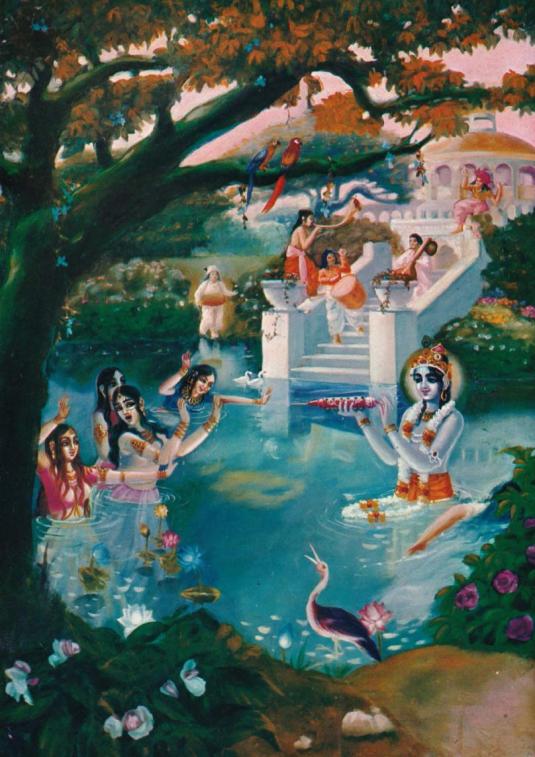
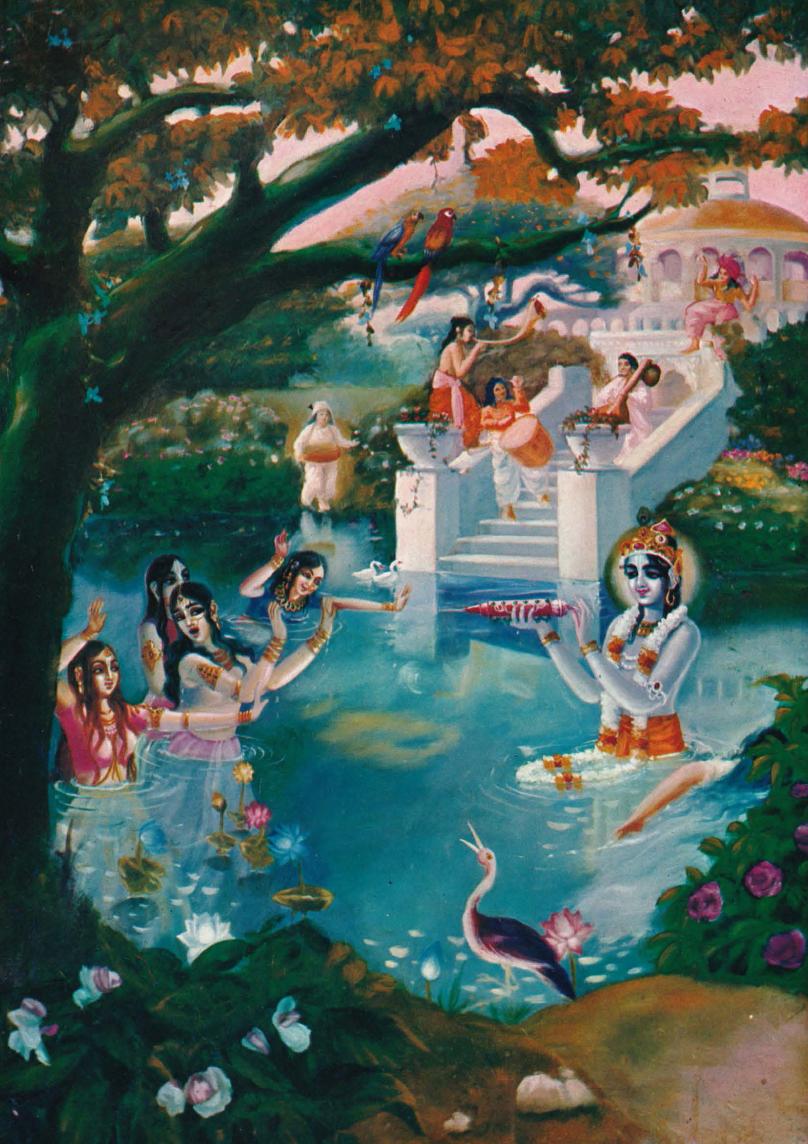
This is a post I have wanted to do for some time, and have waited for an auspicious day like today, on Lord Balarama’s appearance to post it. This is some of the nectar from the concluding chapter of Krsna, The Supreme Personality of Godhead, by our Srila Prabhupada. And the above image is one of my most favorite pictures from the book. This picture has always captivated my imagination and I am convinced that if ever I return Home, Back to Godhead, life with God (Krsna) would be very enjoyable. Eternal, full of knowledge and bliss (sat-cit-ananda)
…The crystal-clear water of the lakes contained many blooming lotus flowers of different colors like blue, yellow, white and red, and the saffron powder from the lotus flowers was blown all around by the breeze. All the lakes were full of beautiful swans, ducks and cranes, crying occasionally with melodious sounds. Lord Śrī Kṛṣṇa sometimes entered those lakes, or sometimes the rivers, with His wives and enjoyed swimming pastimes with them in full jubilation. Sometimes the wives of Lord Kṛṣṇa, who were all goddesses of fortune, would embrace the Lord in the midst of the water while swimming or taking bath, and the red vermilion of kuṅkuma decorating the beauty of their breasts would adorn the chest of the Lord with a reddish color.
The impersonalists would not dare believe that in the spiritual world there are such varieties of enjoyment, but in order to demonstrate the factual, ever-blissful enjoyment in the spiritual world, Lord Kṛṣṇa descended on this planet and showed that the spiritual world is not devoid of such pleasurable facilities of life. The only difference is that in the spiritual world such facilities are eternal, never-ending occurrences, whereas in the material world they are simply impermanent perverted reflections. When Lord Kṛṣṇa was engaged in such enjoyment, the Gandharvas and professional musicians would glorify Him with melodious musical concerts, accompanied by mṛdaṅgas, drums, kettledrums, stringed instruments and brass bugles, and the whole atmosphere would change into a greatly festive celebration. In a festive mood, the wives of the Lord would sometimes sprinkle water on the Lord’s body with a syringe-like instrument, and the Lord would similarly wet the bodies of the queens.
More
20 Aug 2013
by The Hare Krishna Movement
in Balarama, Photos, Temples, Vrindavan
Tags: Balarama, ISKCON Vrindavan, Krishna and Balarama, Krishna Balarama Mandir, Lord Balarama, Lord Sri Krsna, original form of Godhead, primeval Lord, Sri Balarama, The Supreme Personality of Godhead
click on images to enlarge
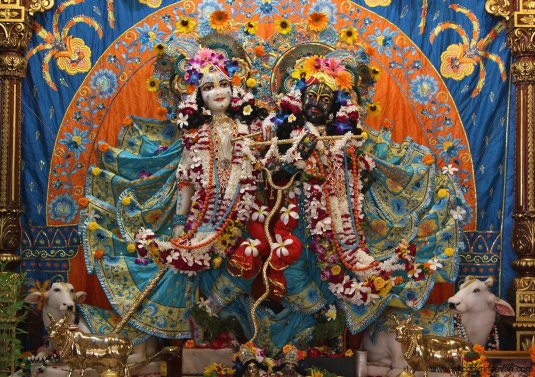
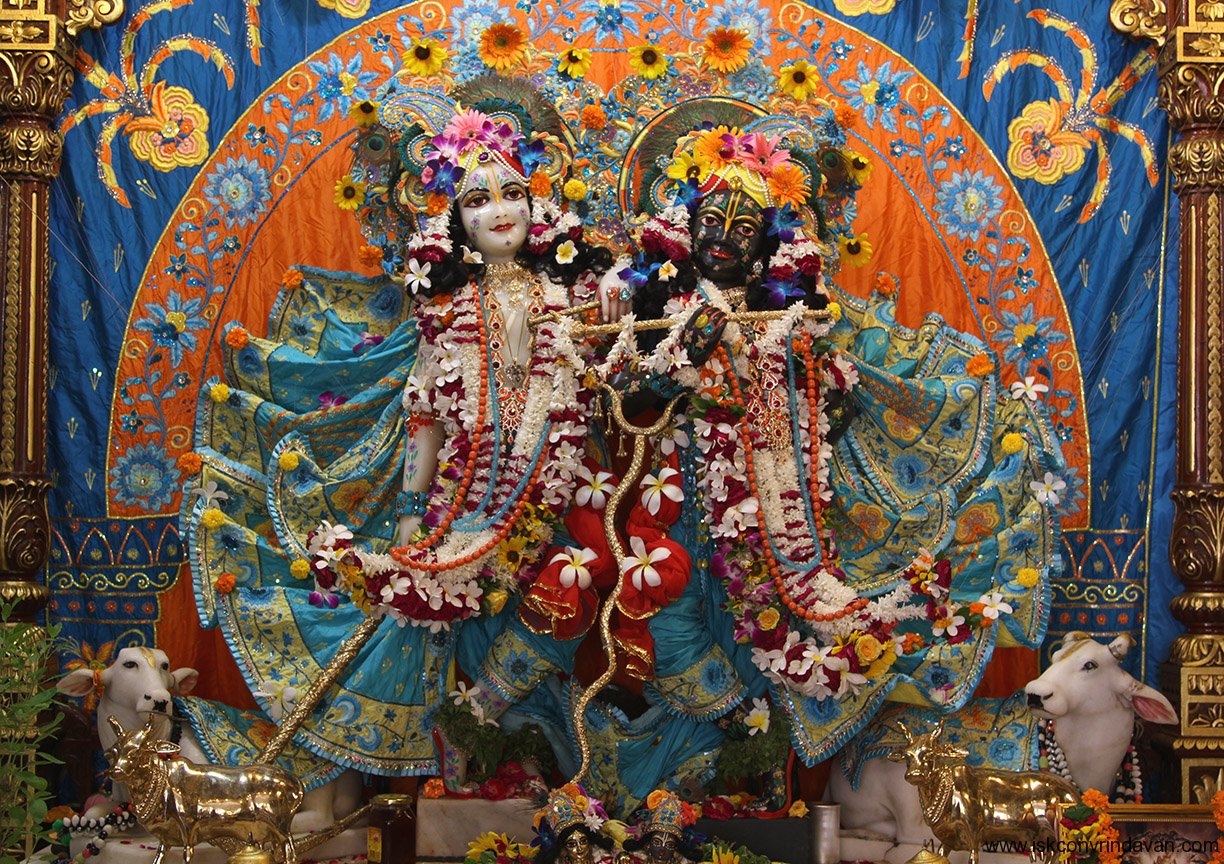
Here in the West we are celebrating the Appearance Day of Lord Balarama. What better way to honor the occasion than with some images of Krishna and Balarama from the Krishna Balarama Mandir in Vrindavan. The folowing are from the last few days of the Darshan Gallery
The Supreme Personality of Godhead, Kṛṣṇa, is the fountainhead of all incarnations. Lord Balarāma is His second body.
Lord Śrī Kṛṣṇa, the absolute Personality of Godhead, is the primeval Lord, the original form of Godhead, and His first expansion is Śrī Balarāma. The Personality of Godhead can expand Himself in innumerable forms. ( Verse and purport Sri Caitanya-caritamrta Adi-lila 5.4)

More
19 Aug 2013
by The Hare Krishna Movement
in A.C. Bhaktivedanta Swami Prabhupada, Balarama, Festivals, KRSNA The Supreme Personality of Godhead
Tags: A.C. Bhaktivedanta Swami Prabhupada, Balvala, Dantavakra, Krsna The Supreme Personality of Godhead, ksatriya, Lord Balarama, military etiquette, plow, Romaharsana, Viduratha, Vyasadeva, Vyasasana

In honor of the Appearance Day of Lord Balarama, we are posting a chapter from the Krsna Book, entitled ” The Killing of Dantavakra, Vidūratha and Romaharṣaṇa”. Some of the pastimes the Lord performed during His advent was the killing of demons. As is stated in the Bhagavad-gita:
“In order to deliver the pious and to annihilate the miscreants, as well as to reestablish the principles of religion, I advent Myself millennium after millennium.” (Bg. 4.8)
The following chapter has some nice pastimes of Lord Balarama in His glorious role as Statesman, Sage, and Kṣatriya. In the above image from the Krsna Book, Lord Balarama is seen dragging the Deamon Balvala down with his plow.
“…Our dear Lord, there is a demon of the name Balvala. He is the son of Ilvala, but he visits this sacred place of sacrifice every fortnight on the full moon and moonless days and creates a great disturbance to the discharge of our duties in the sacrifice… The demon occasionally comes here and profusely throws upon us contaminated, impure things like pus, blood, stool, urine and wine, and he pollutes this sacred place by showering such filth upon us.”
All Glories to Lord Balarama and His plow!
Full Chapter More
18 Aug 2013
by The Hare Krishna Movement
in Chanting Hare Krishna, Harinama Sankirtan, Sankirtan, The Hare Krishna Movement
Tags: chanting Hare Krishna, Hare Krishna, harinama sankirtan, His Divine Grace A.C. Bhaktivedanta Swami Prabhupada, Krishna consciousness movement, Lord Caitanya, Radha-Damodar Traveling Sankirtan Party, RDTSKP, sankirtan, The Hare Krishna Movement, traveling temple

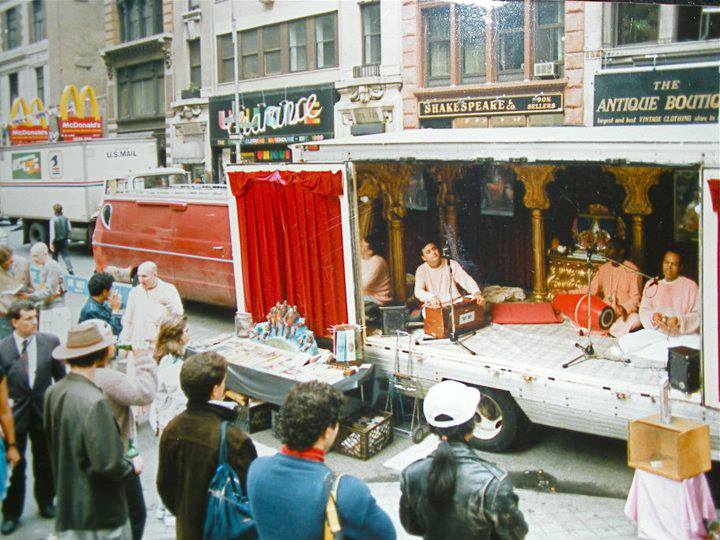
Harinam Sankirtana
A friend shared these images with me on Facebook and we thought we would share them with you. I loved this idea of a traveling temple, and in the 1970’s I traveled on one of the famous Radha-Damodara bus’s. This idea of bringing the holy name to every Town & Village should be encouraged throughout our society more and more. This would help unite devotees under the banner of Lord Caitanya, and bring peace to the world.
In pursuance of the order of Lord Caitanya, the devotees of the Krishna Consciousness movement should try to introduce the chanting of the Hare Krishna maha-mantra throughout the world. It is only by chanting Hare Krishna that one may get free from the disease of forgetfulness of Krishna, which is the root cause of all suffering. However one is situated, whether one is single, married or renounced, one should have the determination to go out and preach Krishna consciousness. That was the instruction of our spiritual master, His Divine Grace A.C. Bhaktivedanta Swami Prabhupada. (Locanananda das)
“We are saying that this Hare Krishna maha-mantra can save everyone, and we are therefore distributing it publicly, free of charge… The devotees are preaching without charge, declaring in the streets, parks, and everywhere. “Here! Here is the Hare Krishna maha-mantra. Come on, take it!” (POP p. 72)
More
16 Aug 2013
by The Hare Krishna Movement
in A.C. Bhaktivedanta Swami Prabhupada, Caaitanya-caritamrta, Vrndavana
Tags: cowherd girls, goddesses of fortune, Gopinatha, gopis, Govinda, Krsna, Radha-Krsna, surabhi wish-fulling trees, touchstone, Vrndavana
click on image to enlarge
It is late at night and I was searching for some late night reading…The Teachings of Lord Caitanya was there on the shelf, so I opened it and began to read the Introduction. The Introduction was originally delivered by Srila Prabhupada as five morning lectures on Caitanya-caritāmṛta before the International Society for Krishna Consciousness, New York City, April 10–14, 1967. This is the conclusion of the Introduction and proved to be a good choice for late night reading and an early morning post.
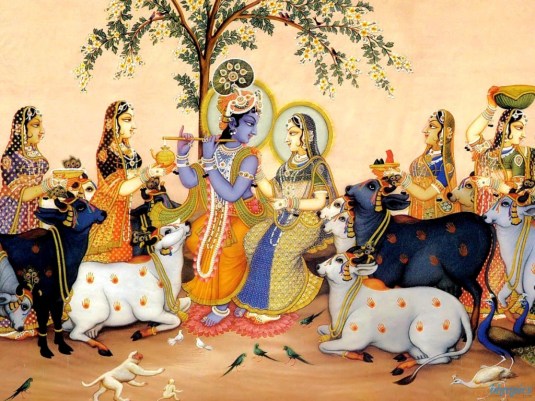
Kṛṣṇadāsa Kavirāja Gosvāmī petitions the blessings of Lord Gopīnātha: “May that Gopīnātha, the master of the gopīs, Kṛṣṇa, bless you. May you become blessed by Gopīnātha.” The author of the Caitanya-caritāmṛta prays that just as Kṛṣṇa attracted the gopīs by the sweet sound of His flute, He will also attract the reader’s mind by His transcendental vibration.
…Govinda resides eternally in Vṛndāvana. In the spiritual world of Vṛndāvana the buildings are made of touchstone, the cows are known as surabhi cows, givers of abundant milk, and the trees are known as wish-fulfilling trees, for they yield whatever one desires. In Vṛndāvana, Kṛṣṇa herds the surabhi cows, and He is worshiped by hundreds and thousands of gopīs, cowherd girls, who are all goddesses of fortune. When Kṛṣṇa descends to the material world, this same Vṛndāvana descends, just as an entourage accompanies an important personage. Because when Kṛṣṇa comes His land also comes, Vṛndāvana is not considered to exist in the material world. Therefore devotees take shelter of the Vṛndāvana in India, for it is considered to be a replica of the original Vṛndāvana. Although one may complain that no kalpa-vṛkṣa, wish-fulfilling trees, exist there, when the Gosvāmīs were there, kalpa-vṛkṣa were present. It is not that one can simply go to such a tree and make demands; one must first become a devotee. The Gosvāmīs would live under a tree for one night only, and the trees would satisfy all their desires. For the common man this may all seem very wonderful, but as one makes progress in devotional service, all this can be realized.
More
15 Aug 2013
by The Hare Krishna Movement
in A.C. Bhaktivedanta Swami Prabhupada, Lectures, The Hare Krishna Movement
Tags: A.C. Bhaktivedanta Swami Prabhupada, Arrival Lecture, Hare Krishna, in every town and village, Krishna, Krsna Caitanya, krsna consciousness, Radha-Krsna, Srila Prabhupada, svayan krsna

Arrival Lecture
By His Divine Grace A.C. Bhaktivedanta Swami Prabhupada
Los Angeles, May 18, 1972
Prabhupada: (airport noises) (leads Prema-dhvani; says “Los Angeles bhakta-vrnda ki jaya!”)
So my dear boys and girls, about six years ago I came to your country single-handed, with this pair of cymbals. Now you are so many chanting Hare Krsna. That is my success. It was the prediction of Lord Caitanya Mahaprabhu:
prthivite ache yata nagaradi grama
sarvatra pracara hoibe mora nama
Lord Caitanya desired that “In all the towns, in as many towns and villages as there are on the surface of the globe, My name will be broadcast.” He is Krsna Himself, svayam krsna, krsna caitanya-namine, simply changing His name as Krsna Caitanya. So His prediction will never go in vain. That’s a fact. So my plan was that “I shall go to America. America is the leading country of the world. If I can convince (the) younger generation of America, they will take up.” I am old man. I came here at the age of seventy years; now I am seventy-six. So my warning is already there. In nineteen hundred and seventy-one, I had a severe heart attack. You know, all. So the mission of Caitanya Mahaprabhu is now in your hands. You are American boys and girls, very intelligent and graced by Krsna. You are not poverty-stricken. You have enough resources, prestige. Everything materially, you are all well-equipped. If you kindly take this Krsna consciousness movement seriously, your country will be saved, and the whole world will be saved.
More
15 Aug 2013
by The Hare Krishna Movement
in Dalai Lama, Dalai Lama, Iskcon Bangalore, Spiritual Master, Srila Prabhupada
Tags: Dali Lama, His Holiness the Dalai Lama, ISKCON Bangalore, Krishna consciousness, Madhu Pandit Das, non-sectarian movement, Tibet
click on image to enlarge
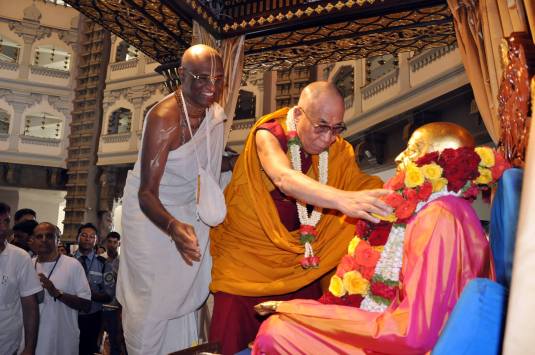
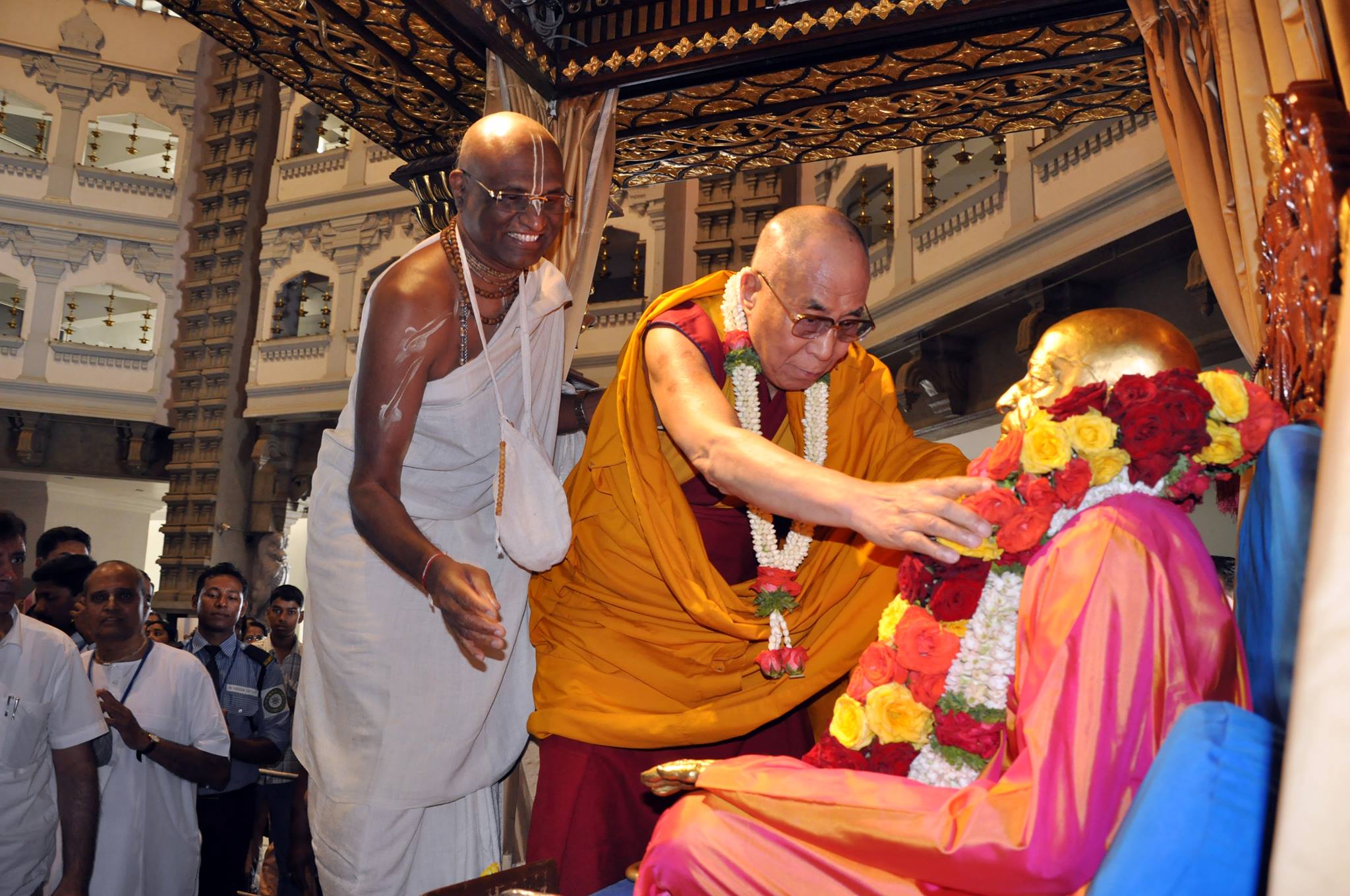
Even though this is old news, still we are posting this because the image of His Holiness the Dalai Lama of Tibet placing a flower garland around the neck of Srila Prabhupada, at the ISKCON Bagalore center, is so beautiful. The Dalai Lama is a generous and compassionate human being, an inspiration to all spiritual seekers, and is a world ambassador for peace.
Bangalore, June 05, 2013. His Holiness the Dalai Lama – the spiritual leader of Tibet paid a visit to the Radha Krishna Chandra temple at the International Society for Krishna Consciousness (ISKCON) Bangalore, Rajajinagar as part of a cultural exchange inititiative. His Holiness the Dalai Lama, while at the temple, said he was impressed by the peace and tranquillity that encompasses the holy place and added that the mission of this non-sectarian movement in promoting the well being of society by teaching the science of Krishna Consciousness is admirable.
His Holiness Dalai Lama was welcomed by the Temple President Shri Madhu Pandit Dasa. After a brief visit to the main shrine of Shri Radha Krishna Chandra, His Holiness interacted with Shri Madhu Pandit Dasa on the need for spirituality, compassion and the role of spirituality in moulding the behavior and thoughts of youth. The discussion also dwelt on the importance of promoting world peace and compassion.
More
15 Aug 2013
by The Hare Krishna Movement
in A.C. Bhaktivedanta Swami Prabhupada, Babajis and Sahajiyas, Letters by Srila Prabhupada, Sahajiya
Tags: A.C. Bhaktivedanta Swami Prabhupada, asatsanga tyagi, babajis, Letters by Srila Prabhupada, mixing with babajis in Vrindaban, Nitai, sahajiyas, siddha-deha
Mixing with the Babajis and Sahajiyas is to be Avoided
Letter to: Nitai
From A.C. Bhaktivedanta Swami Prabhupada
7 June, 1976
My dear Nitai das,
Please accept my blessings. I have received information that some of our devotees are mixing with the babajis in Vrindaban. This has produced so many problems amongst our men and women who visit Vrindaban. Here in Los Angeles, we have found that there is a group of about 40 devotees who privately meet to discuss the intimate pastimes artificially thinking that they can enter into the understanding of the gopis prematurely. This will create havoc in our society, and the result will be that if this is allowed to go on, our preaching work will be greatly hampered. This premature desire to understand the lila of Krishna is due to mundane sex-life desire as we have seen amongst many of the babajis and sahajiyas in Vrindaban. Our Jagannatha das came back from Vrindaban asking me that he had heard some babaji speaking about siddha-deha and he also was listening to these babajis. So I want this immediately stopped. If it continues, this mixing with the babajis, then it will mean spoiling. In many cases, these babajis keep 2 or 3 women. Asatsanga tyagi. Their association is to be avoided and prohibited amongst all of our devotees who visit Vrindaban.
I hope that this meets you in good health.
Your ever well-wisher,
A.C. Bhaktivedanta Swami
ACBS/pks
More
14 Aug 2013
by The Hare Krishna Movement
in A.C. Bhaktivedanta Swami Prabhupada, Dhira Govinda das, Diksha, Guru & Disciple, Siksa, Srila Prabhupada, The Prominent Link
Tags: A.C. Bhaktivedanta Swami Prabhupada, Dhira Govinda das, disciplic succession, guru disciple relationship, guru tattva, guru-disciple, Iskcon, knowledge, murti, Parampara, self realization, spiritual knowledge, spiritual master, Srila Prabhupada, The Hare Krishna Movement, transcendental knowledge
Srila Prabhupada: The Prominent Link
by Dhira Govinda dasa
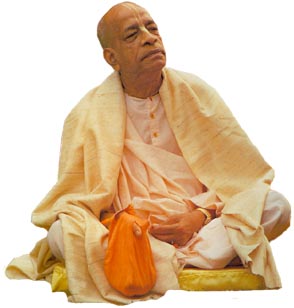
Recently I had the good fortune to meet one of my God brothers, Dhira Govinda Prabhu. It was on the appearance day of Srila Bhaktisiddhanta Sarasvati Thakur. I had heard of him and had posted the following article some time back and had read some of his book “Srila Prabhupada; The Prominent Link”, but had not meet him yet. But I found him to be a very nice devotee of good character. Just to give his voice a broader rang we decided to post his book Srila Prabhupada The Prominent Link as well as the Prominent Link Supplementary Articles Click on either of the above links to read or save the pdf files.
Many members of Srila Prabhupada’s movement who did not receive formal initiation from him experience Srila Prabhupada as the primary giver of direct transcendental knowledge. This empirical reality forms the basis of recognizing Srila Prabhupada as the prominent link to the parampara. Such a conception is supported by sastric descriptions of the essence of the initiation process, and by the delineation of the parampara described by Srila Prabhupada and Srila Bhaktisiddhanta Sarasvati Thakura.
Introduction
This paper presents a framework for understanding Srila Prabhupada’s position that is derived from a comprehension of Srila Prabhupada’s direct and personal relationship with the members of his movement. The central idea is that Srila Prabhupada is the prominent link to the parampara by virtue of being the prime deliverer of transcendental knowledge. We present these ideas in a mood of open-minded discussion and ask that the reader approach the material with a fresh perspective and a willingness to reexamine the issues.
More
13 Aug 2013
by The Hare Krishna Movement
in A.C. Bhaktivedanta Swami Prabhupada, Bhagavad-gita, Prasadam, Slokas
Tags: A.C. Bhaktivedanta Swami Prabhupada, Krishna, Krsna prasadam, leaf flower fruit or water, love and ecstasy, offering to God, patram puspam phalam toyam, with love and devotion
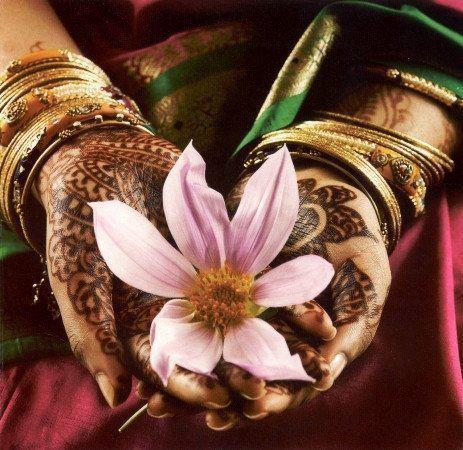
One of the first slokas I ever memorized from the Bhagavad-gita was 9.26 patraṁ puṣpaṁ phalaṁ toyaṁ… “If one offers Me with love and devotion a leaf, a flower, fruit or water, I will accept it.” (Full text and purport follows). This was practically the beginning of my spiritual life. ‘Just try to love God by offering Him something, with devotion. A leaf, a flower, fruit or water.’
One does not need great wealth, education or opulence to satisfy the Supreme Personality of Godhead. If one is fully absorbed in love and ecstasy, he need offer only a flower and a little water. As stated in Bhagavad-gītā, patraṁ puṣpaṁ phalaṁ toyaṁ yo me bhaktyā prayacchati: “If one offers Me with love and devotion a leaf, a flower. fruit or water, I will accept it.” (Bg. 9.26)
The Supreme Lord can be pleased only by devotional service: therefore it is said here that the Lord is surely satisfied by devotion and nothing else. Quoting from the Gautamīya-tantra, the Hari-bhakti-vilāsa states:
tulasī-dala-mātreṇa
jalasya culukena vā
vikrīṇīte svam ātmānaṁ
bhaktebhyo bhakta-vatsalaḥ
“Śrī Kṛṣṇa, who is very affectionate toward His devotees, sells Himself to a devotee who offers merely a tulasī leaf and a palmful of water.” The Supreme Lord is causelessly merciful upon His devotee, so much so that even the poorest of men can offer Him a little water and a flower in devotion and thus please Him. This is due to His affectionate dealings with His devotees. (SB 5.3.6 purport)
Everyone is searching after peace of mind. This is obtainable only when one is completely freed from the desire for material sense gratification and is engaged in the devotional service of the Lord. As stated in Bhagavad-gītā: patraṁ puṣpaṁ phalaṁ toyaṁ yo me bhaktyā prayacchati (9.26). Worship of the Lord is not at all expensive. One can offer the Lord a leaf, a flower, a little fruit and some water. The Supreme Lord accepts these offerings when they are offered with love and devotion. In this way, one can become freed from material desires. As long as one maintains material desires, he cannot be happy. As soon as one engages in the devotional service of the Lord, his mind is purified of all material desires. Then one becomes fully satisfied. (SB 5.7.11, purport)
More
12 Aug 2013
by The Hare Krishna Movement
in Acyutanananda das, Devotee Books
Tags: Achyutananda das, blazing, Blazing Sadhus, Charles M Barnett, CMB Books, never trust a holy man who can't dance, sadhus, Srila Prabhupada, swami
click on image to purchase
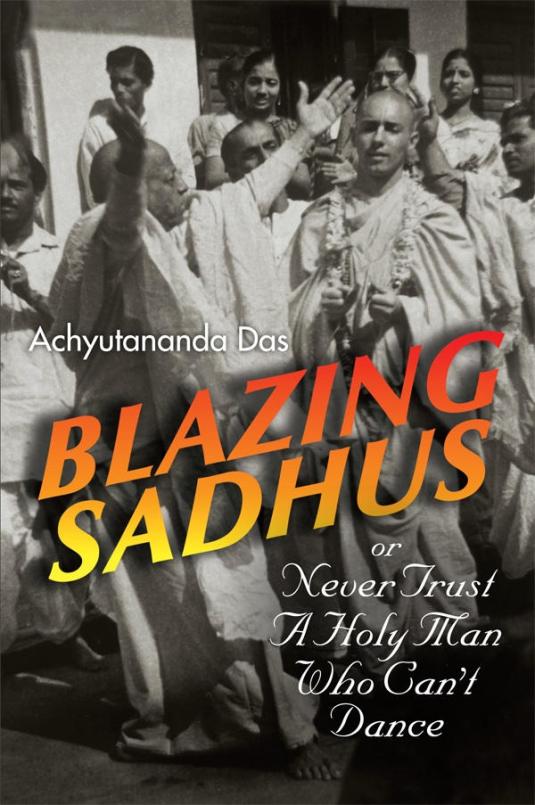
Blazing Sadhus
or
Never Trust A Holy Man Who Can’t Dance
by Achyutananda Das
We are now offering this extraordinary book for sale on our web page www.theharekrishnamovement.com. We liked it so much we are offering Free Shipping. Highly Recomended!
Excerpt from back cover;
“Do you know what just happened in there? Do you know what he just did? He gave me the answers to the most cosmic, theological, universal, eternal questions ever asked! And like it was just matter-of-fact! Then he thanks me for asking! I gotta tell people about this.” (-from Chapter Two)
More
11 Aug 2013
by The Hare Krishna Movement
in A.C. Bhaktivedanta Swami Prabhupada, Aksauhini, Lectures, Vaisnava Vocabulary
Tags: 109, 21, 600 cavalry is called an akṣauhiṇī, 650 infantry and 65, 870 chariots, 870 elephants, A.C. Bhaktivedanta Swami Prabhupada, aksauhini, bhakta, bhaktas, isvarah paramah, Krishna, mukti, solid phalanx of 21, Srila Prabhupada, Srimad Bhagavatam lecture
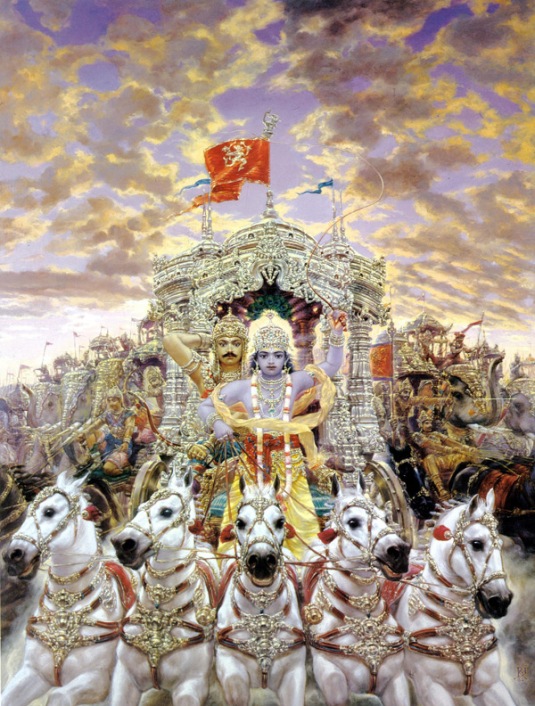
Here is a word for your vaisnava vocabulary: Aksauhini (akṣauhiṇī).
The word akṣauhiṇī refers to a military phalanx consisting of 21,870 chariots and elephants, 109,350 infantry soldiers and 65,610 horses. An exact description is given in the Mahābhārata, Ādi parva, Second Chapter, as follows:
“One chariot, one elephant, five infantry soldiers and three horses are called a patti by those who are learned in the science. The wise also know that a senāmukha is three times what a patti is. Three senāmukhas are known as one gulma, three gulmas are called a gaṇa, and three gaṇas are called a vāhinī. Three vāhinīs have been referred to by the learned as a pṛtanā, three pṛtanās equal one camū, and three camūs equal one anīkinī. The wise refer to ten anīkinīs as one akṣauhiṇī. The chariots of an akṣauhiṇī have been calculated at 21,870 by those who know the science of such calculations, O best of the twice-born, and the number of elephants is the same. The number of infantry soldiers is 109,350, and the number of horses is 65,610. This is called an akṣauhiṇī.” (SB 9.15.30)
A solid phalanx of 21,870 chariots, 21,870 elephants, 109,650 infantry and 65,600 cavalry is called an akṣauhiṇī. (SB 1.8.48 purport)
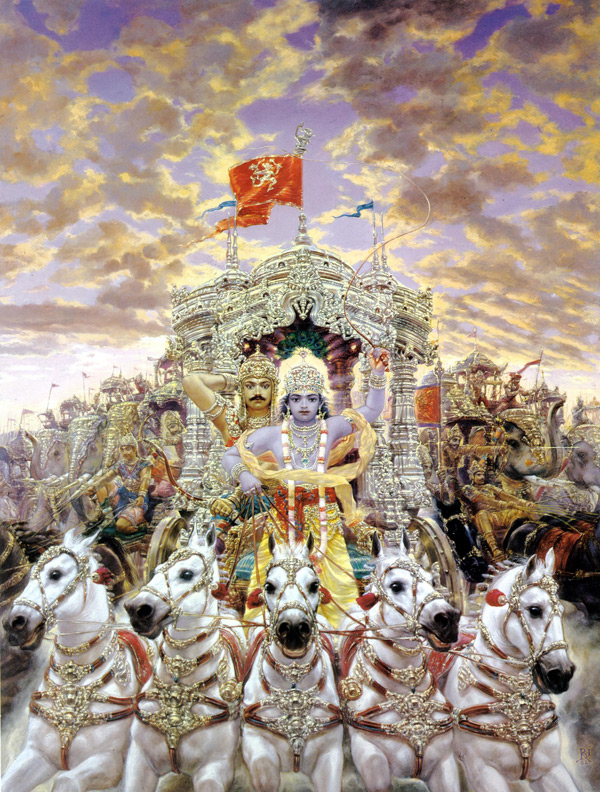
What makes this word so noteworthy, is the fact that many akṣauhiṇīs were killed on the Battlefield of Kurukṣetra. Such was the enormity of the battle.
Following is a lecture by His Divine Grace describing the lamentation of King Yudhisthira. Mahārāja Yudhiṣṭhira, as the most pious king of the world, takes for himself the responsibility for killing such a huge number of living beings because the battle was fought to reinstate him on the throne.
More
10 Aug 2013
by The Hare Krishna Movement
in A.C. Bhaktivedanta Swami Prabhupada, Free Downloads, Free eBooks, KRSNA The Supreme Personality of Godhead
Tags: A.C. Bhaktivedanta Swami Prabhupada, cowheard boys, free boooks, free eBooks, free pdf download, gopis, Krishna, pdf, Spiritual Life, Spiritual world, Vrndavan
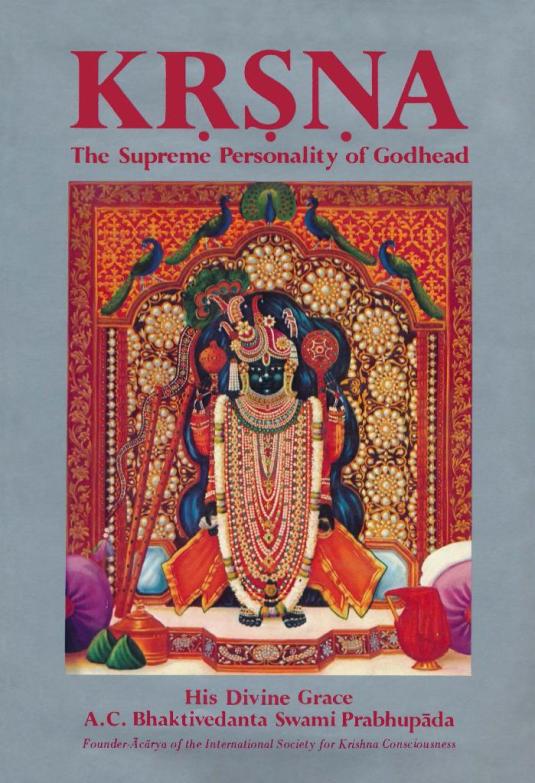
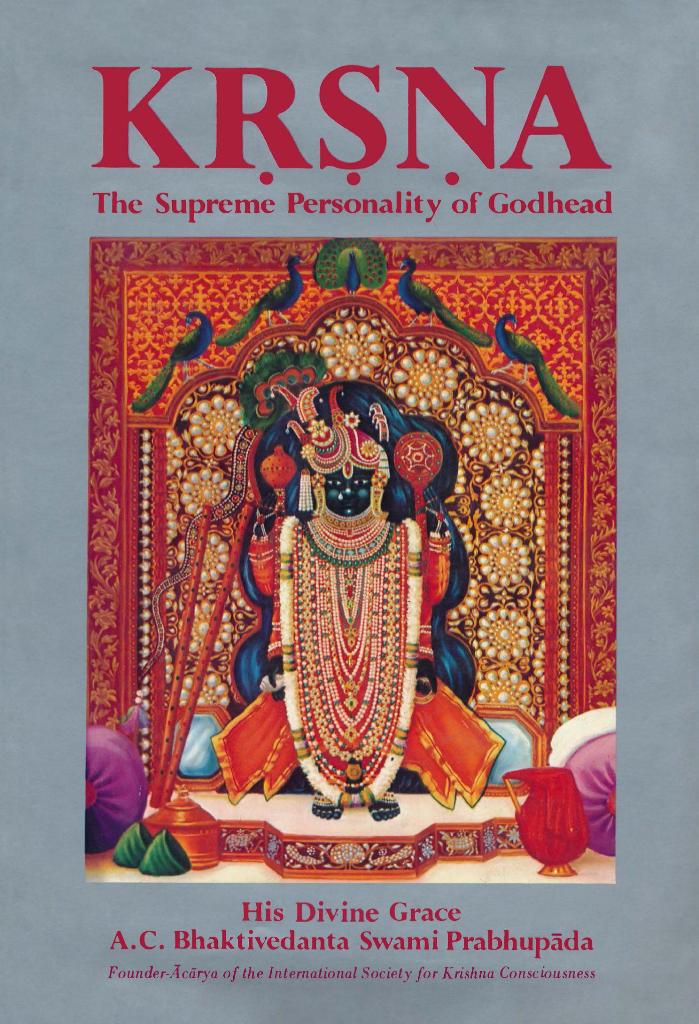
Recently I have been reading one chapter from the Krsna Book everyday, something I haven’t done since my children were young. But now in my old age, reading alone and out loud, in front of our deities, I am finding an even deeper appreciation of this beautiful book. To be honest, I am in awe of this Krsna Book, it is not of this world. Rather it is a window to the Spiritual World. With great joy we are posting a scanned version of Vol. 2 of the Krsna Book, in the pdf format, for a free download.
KRSNA_Book_Vol.2_1970_ISKCON
Click on above link and give it a few moments to load…then you can view it or save it to your files. Hare Krishna!
excerpt from book:
…After being received by the cowherd men and boys, the gopīs, and King Nanda and Yaśodā, Lord Balarāma sat down, feeling satisfied, and they all surrounded Him. First Lord Balarāma inquired from them about their welfare, and then, not having seen Him for such a long time, they began to ask Him different questions. The inhabitants of Vṛndāvana had sacrificed everything for Kṛṣṇa, simply being captivated by the lotus eyes of the Lord. Because of their great desire to love Kṛṣṇa, they never desired anything like elevation to the heavenly planets or merging into the effulgence of Brahman to become one with the Absolute Truth. They were not even interested in enjoying a life of opulence, but were satisfied in living a simple life in the village as cowherd men. They were always absorbed in thoughts of Kṛṣṇa and did not desire any personal benefits, and they were all so much in love with Him that in His absence their voices faltered when they began to inquire from Balarāmajī. (Chapter 11, Lord Balarāma Visits Vṛndāvana)
Previous Older Entries Next Newer Entries










 The Hare Krishna Movement