Today we visited Radha Kund, as well as many other places of pilgrimage in Vraja; the district of Vrindavan. We were greatly surprised at how everything around Krishna Balarama Mandir, has grown and changed. So much construction, so many more people, and worst, so many motorized vehicile’s. I took some pictures of Radha Kund today, which I will share at bottom of post.
Rādhā-kuṇḍa
It is stated that a devotee will at once develope pure love of Kṛṣṇa in the wake of the gopīs if he once takes a bath in Rādhā-kuṇḍa.
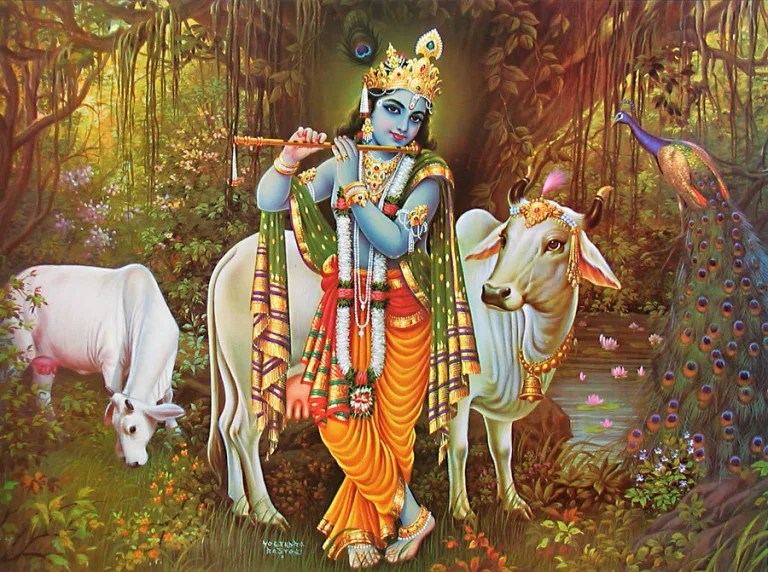
jaya–all glories to: rādhā-mādhava–Rādhā and the Lord of sweetness; kuñja-bihārī–He who enjoys loving pastimes in the groves of Vṛndāvana; gopī-jana-vallabha–the lover of the cowherd maidens of Vraja; giri-vara-dhārī–the holder of the great hill named Govardhana;
Krsna is the lover of Radha. He displays many amorous pastimes in the groves of Vrndavana, He is the lover of the cowherd maidens of Vraja, and the holder of the great hill named Govardhana.
yaśodā-nandana–the beloved son of mother Yaśodā; vraja-jana-rañjana–the delighter of the inhabitants of Vraja; yāmuna-tīra-vana-cārī–who wanders in the forests along the banks of the river Yamunā
He is the beloved son of mother Yasoda, the delighter of the inhabitants of Vraja, and He wanders in the forests along the banks of the River Yamuna!
Srila Prabhupada said that this song is “a picture of Vrndavana. Everything is there–Srimati Radharani, Vrndavana, Govardhana, Yasoda, and all the cowherd boys.
So this is the original nature of Kṛṣṇa, original nature of Kṛṣṇa. He is Rādhā-Mādhava. He is the lover of Śrīmatī Rādhārāṇī. And kuñja-vihārī, always enjoying the company of the gopīs within the bushes of Vrndavana forest. Rādhā-mādhava kuñja-vihārī. So He’s not only lover of Rādhārāṇī, but braja-jana-vallabha. The whole residents of Vṛndāvana, they love Kṛṣṇa.(from Srila Prabhupada Lecture NY July 20, 1971)
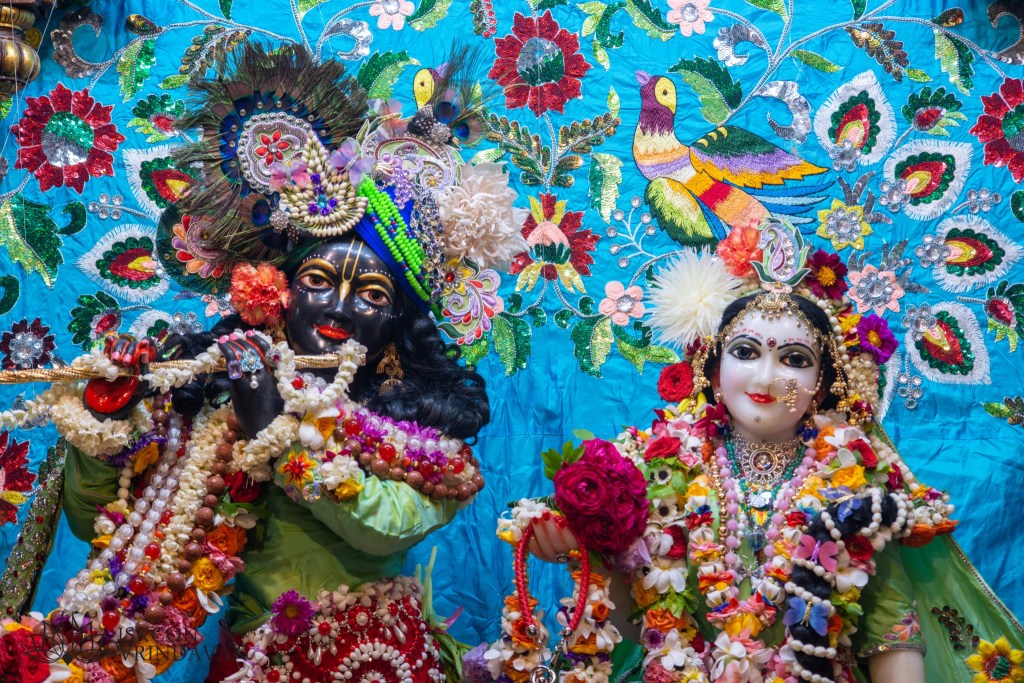
We spent the last week at the Sri Sri Radha Madhava Temple in Mayapur. It was an incredible week! Bathing Lord Caitanya Mahaprabhu on His Appearance Day, attending aroti at Srila Prabhupada’s Samadhi, Guru-puja at temple, etc. but the take away for me was the Radha Madhava altar. To see Radha and Krishna surrounded by the beautiful Ashtasakhi’s (the 8 principle gopis) was a sight to behold. And I wanted to know more about these beautiful personality’s.
The list of Ashtasakhi include: Lalita, Vishaka, Champaklata, Chitra, Tungavidhya, Induleka, Rangadevi, and Sudevi. All of these eight prominent gopis are regarded to be an expansion of Radha, the chief consort of Krishna.
Srimati Radharani is considered the topmost devotee of Lord Krishna, His eternal consort, and the root of pure, selfless devotion, embodying the supreme devotional Bliss of seeking Krishna’s pleasure.
Well today we are in Mayapura Dham, at the Shri Shri Radha Madhava Temple, celebrating the Appearance Day of Lord Caitanya Mahaprabhu. It is a full day fast, followed by a nice Vegetarian feast at Sunset. The devotees here have been so kind and accommodating. And of course the deities are all spectacularly beautiful, and the prasadam is first class.We feel very grateful, and blessed to be here on such an auspicious occasion.
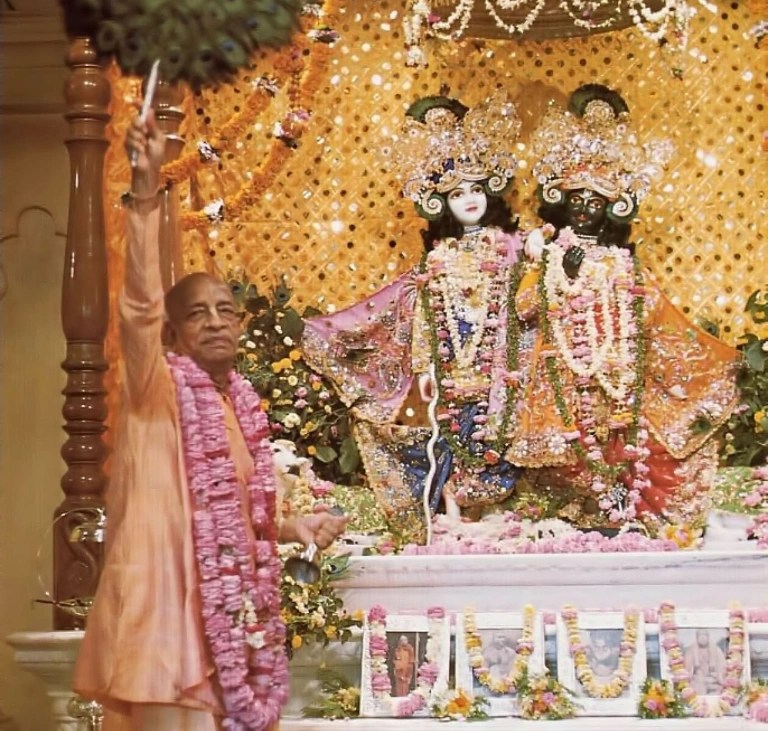
Probably because we leave for India today, and probably because we are going for the 50th Aniversity of the opening of the Sri Sri Krishna Balarama Temple in Vrindavan, but every morning I think about this Iconic picture of Srila Prabhupada offering the first Arotika to Krishna and Balarama.
We share with you some of thepastimes of the two transcendental brothers.
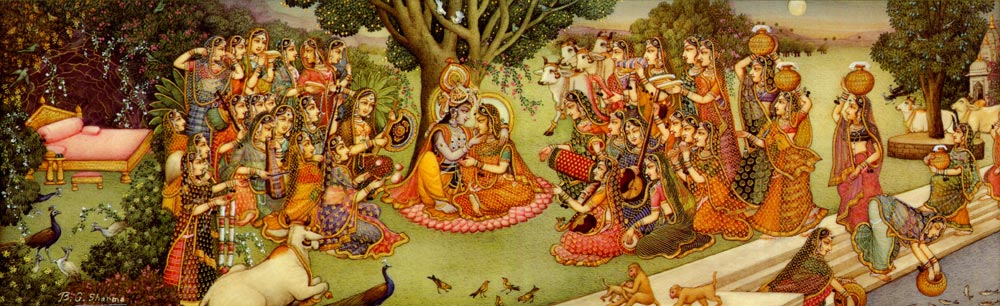
While Kṛṣṇa was engaged in tending the cows in the forest of Vṛndāvana or on Govardhana Hill, the gopīs in the village were always absorbed in thinking of Him and discussing His different pastimes. This is the perfect example of Kṛṣṇa consciousness: to somehow or other remain always engrossed in thoughts of Kṛṣṇa. The vivid example is always present in the behavior of the gopīs; therefore Lord Caitanya declared that no one can worship the Supreme Lord by any method which is better than the method of the gopīs. The gopīs were not born in very high brāhmaṇa or kṣatriya families; they were born in the families of vaiśyas, and not in big mercantile communities but in the families of cowherd men. They were not very well educated, although they heard all sorts of knowledge from the brāhmaṇas, the authorities of Vedic knowledge. The gopīs’ only purpose was to remain always absorbed in thoughts of Kṛṣṇa. (“The Gopīs Attracted by the Flute.”)
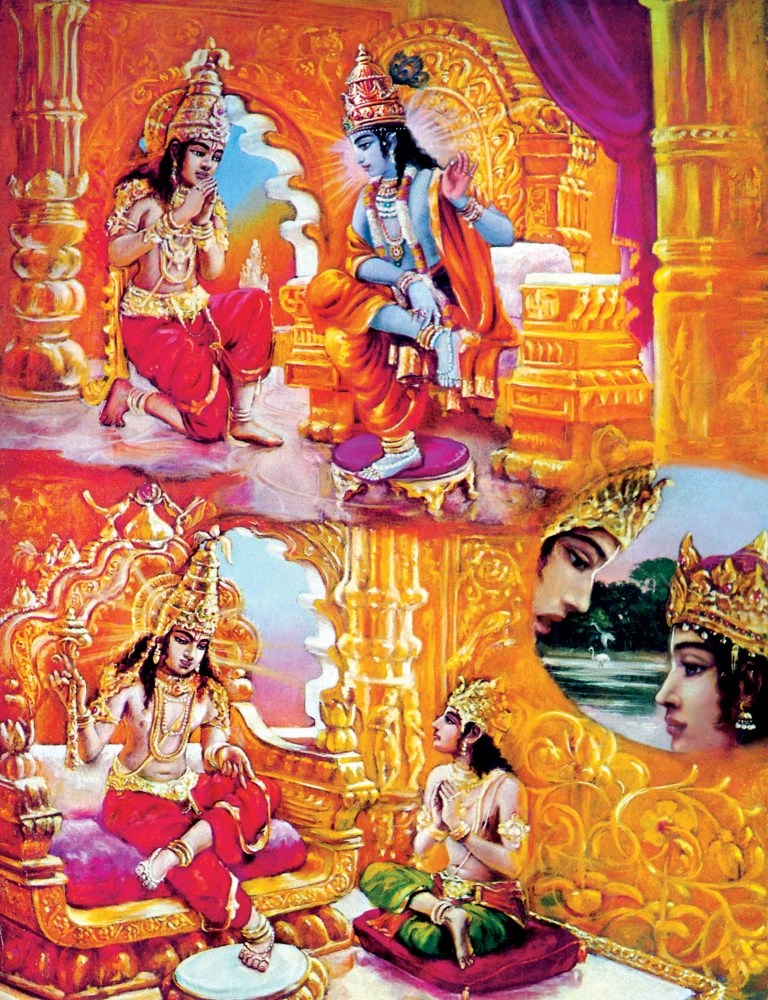
Those who are followers of His Divine Grace A.C. Bhaktivedanta Swami Prabhupada, and read from his books with faith and conviction, are receiving Transcendental Knowledgethrough the disciplic succession.Evaṁ paramparā-prāptam imaṁ rājarṣayo viduḥ. (Bhagavad-gīta, 4.2)
We are leaving for India next week. First stop Kolkota. We want to visit the birthplace of Srila Prabhupada, so I went to the webpage: Birthplace Temple and found this nice Biography which we share today with you.
A Short Biography of Srila Prabhupada
His Divine Grace A.C. Bhaktivedanta Swami Srila Prabhupada is the Founder-Acharya of International Society for Krishna Consciousness (ISKCON) which brought a spiritual dimension to the lives of thousands of his followers. He was a rare personality who appeared on the earth and dedicated his life to spreading God consciousness all over the world.
The scriptures recommend the chanting of the holy name of Lord Krishna (Harinama sankirtan) as the devotional practice best suited for the present age for spiritual perfection. Sri Chaitanya Mahaprabhu who appeared over 500 years ago in West Bengal, India was the greatest exponent of this method. He predicted that His message will be carried to every town and village of this world by a powerful spiritual ambassador. The life and activities of Srila Prabhupada prove beyond doubt that he was the empowered personality who appeared to fulfil this prediction.
When His Divine Grace A.C. Bhaktivedanta Swami Srila Prabhupada entered the port of New York City on September 17, 1965 few Americans took notice — but he was not merely another immigrant. He was on a mission to introduce the ancient teachings of Vedic India into mainstream America. Before Srila Prabhupada passed away on November 14, 1977 at the age of 81, his mission proved successful. He had founded the International Society for Krishna Consciousness (ISKCON) and saw it grow into a worldwide confederation of more than 100 temples, ashrams and cultural centers.
This is a very nice song composed by Narottama dasa Thakura, which is sung daily in all of the Hare Krishna Temples around the world. What is interesting about transcendental sound vibration, is that it never gets old. This song is as relishable today, as it was 50 years ago. Actually even more relishable, as the meaning of the words become more and more realized.
The lotus feet of our spiritual master are the only way by which we can attain pure devotional service. I bow to his lotus feet with great awe and reverence. By his grace one can cross the ocean of material suffering and obtain the mercy of Krsna
. My only wish is to have my consciousness purified by the words emanating from his lotus mouth. Attachment to his lotus feet is the perfection that fulfills all desires.
He opens my darkened eyes and fills my heart with transcendental knowledge. He is my Lord birth after birth. From him ecstatic prema emanates; by him ignorance is destroyed. The Vedic scriptures sing of his character.
Our spiritual master is the ocean of mercy, the friend of the poor, and the lord and master of the devotees. O master! Be merciful unto me. Give me the shade of your lotus feet. Your fame is spread all over the three worlds.
…”Your time is so valuable that you cannot get back your life, one day of your life or one moment of your life, by paying millions of dollars. (Srila Prabhupada lectureSB 1.2.19 New Vrindaban)
I have been thinking lately about about my life. I am 70 years old, or to break it down; 25,550 days, 613,200 hours, 36,792,000 minutes, 2,207,520.000 seconds. How much of my life have I wasted? When I wasn’t thinking about Krsna, when I was not engaged in devotional service. How many hours did I spend sleeping, or engaged in fruitive labor, intoxication or sense gratification? Really, I have wasted so much valuable time, and can never get that back.
“If such valuable time you simply waste, then just estimate it what is your loss, practically, from monetary point. One moment of your life cannot be returned by millions of dollars.
Therefore our Rūpa Gosvāmī also teaches, avyartha-kālatvam (CC Madhya 23.18). A Kṛṣṇa conscious person should see, “Whether my time has become wasted? Whether I am utilizing my time, the short duration of my life, properly?” All Kṛṣṇa conscious persons should be vigilant to see that the time is not wasted. Śrī Caitanya Mahāprabhu therefore advises, kīrtanīyaḥ sadā hariḥ.
tṛṇād api sunīcenataror api sahiṣṇunāamāninā mānadenakīrtanīyaḥ sadā hariḥ (CC Adi 17.31)
We have therefore introduced chanting Hare Kṛṣṇa twenty-four hours. I am glad to see all the devotees, they are carrying the beads, that this is nice practice. It must be. Chant Hare Kṛṣṇa, Hare Kṛṣṇa, for twenty-four hours: while working, even in sleeping. If you practice, in sleep also you will chant Hare Kṛṣṇa. That is possible. It is not impossible, it is fact.” (lecture SB 1.2.19 New Vrindaban)
..”So we should be very much careful in discharging the duty. The devotee should be so much careful that he’ll always see, “Whether this moment is spoiled or utilized?”Avyartha-kālatvam (CC Madhya 23.18). Avyartha-kālatvam, that “My time may not be wasted.” He should be so careful, “Whether my time is being wasted?” And time wasted, the time we engage for our bodily necessities, that is wasted. Generally, conditioned souls, they are simply wasting their time. Only the period which we are engaged in Kṛṣṇa consciousness, that is utilized. So we should be very much careful whether time is being wasted or being utilized.”… (Morning walk San Francisco, 1968)
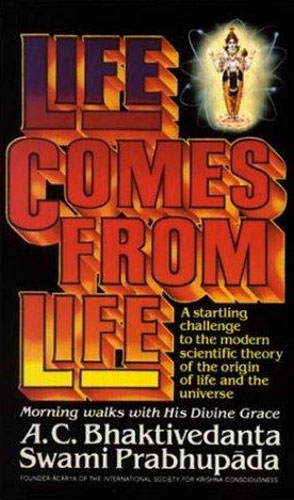
This morning I just happened to open this small book entitled “Life comes from Life”, which has been sitting quietly on our bookshelf for many, many years. For some reason today, I opened it and began to read. It is based on morning walk conversations with Srila Prabhupada and his disciples on the origins of life, and is very interesting. We are posting the first chapter as well as a free pdf download of entire book, that you can read or save to your computer.
For many of us we struggle to chant our prescribed 16 rounds of japa daily. I know for me it is a daily struggle, if I wake up to late, if I am traveling, if I am sick, or have a headache, or just feeling lazy and unmotivated. But I try.
This morning my japa was pretty good, I felt inspired, and I was knocking of the rounds rather effortlessly, and I was thinking about Haridas Thakur who daily chanted 300,000 names or about 175 rounds. I can’t even imagine. But I felt inspired by thinking about him, and wanted to do a post about him. -V
“Haridāsa Ṭhākura is known as nāmācārya because it is he who preached the glories of chanting hari-nāma, the holy name of God.”
“Haridas Thakur chanted 3 lakhs of names each day, that means 16 names in the mantra, 108×16 or 1,728 names in each round of mala, dividing 300,000 by 1,728 comes to roundabout 175 rounds on beads daily. And for us it is even difficult to chant 16 rounds! That is why Haridas Thakur is namacharya. We find in Chaitanya Charitamrta information that both Lord Chaitanya and Haridas Thakur were constantly absorbed in chanting the Hare Krishna mantra: Hare Krishna, Hare Krishna, Krishna Krishna Hare Hare/ Hare Rama Hare Rama Rama Rama Hare Hare.” (Srila Prabhupada Letter, January 2, 1972)
So today we celebrate the Appearance Day of Srila Bhaktisiddhanta Sarasvati Thakura, the Spiritual Master of our Srila Prabhupada. We honor it today with a half day fast a Pushpanjali (offering of prayers and flowers) followed by a nice vegetarian feast.
The Absolute Necessity of a Spiritual Master—The Universal Teacher By His Divine Grace A.C. Bhaktivedanta Swami Prabhupada Founder-Acharya of the world-wide Hare Krishna Movement
In February 1936, in Bombay, India, the members of a reputed religious society, the Gaudiya Matha, were astonished by the powerful and eloquent words of a young member who spoke in honor of his spiritual master, Srila Bhaktisiddhanta Sarasvati Gosvami. Three decades later, the young speaker would become the world-renowned founder and spiritual master of the Krishna consciousness movement. Srila Prabhupada’s presentation is a memorable statement on the importance of the guru in spiritual life.
sakshad-dharitvena samasta-shastrair uktas tatha bhavyata eva sadbhih kintu prabhor yah priya eva tasya vande guroh sri-charanaravindam
“In the revealed scriptures it is declared that the spiritual master should be worshiped like the Supreme Personality of Godhead, and this injunction is obeyed by pure devotees of the Lord. The spiritual master is the most confidential servant of the Lord. Thus let us offer our respectful obeisances unto the lotus feet of our spiritual master.”
The following is a Vayas-puja address offered by Srila Prabhupada to his spiritual master Srila Bhaktisiddhanta Sarasvati Goswami Prabhupada.
This morning as I was looking at a picture of Srila Prabhupada, this verse from the Bhagavad-gita just came into my mind:
O Kṛṣṇa, I totally accept as truth all that You have told me. Neither the gods nor demons, O Lord, know Thy personality. (Bg 10.14)
And I was thinking, that is exactly how I think of Srila Prabhupada’s instructions, to us. “I totally accept as truth all that You have told me“. Ever since I picked up my first book by Srila Prabhupada, I have just accepted every thing he has written as truth. I didn’t always believe my school teachers, or the nuns, or my parents for that matter. Sure they knew some things, and much of it true, but they didn’t know everything.
For some reason I just accepted as truth everything Prabhupada told us. He told us who was God (Krsna), then he told us what God looked like, what God was doing, where God lived, who’s Gods friends were, and much much more. There wasn’t a question he couldn’t answer, and he backed it up with sastric evidence.These were questions I asked of the nuns and priests, of parents and college professors, but I never got a reasonable answer from anyone when I asked; ‘Who is God, who am I, what is my relationship with Him?’
I am sure that many of you have your favorite Bhagavad-gita slokas, and I was thinking about it this morning. I was trying to recall my top 8 slokas, (which is hard to select only 8). But I have listed them below, in no particular order.
For the list the 108 most important Bhagavad-gita slokas click on following link:1972 Bhagavad-gita
patraṁ puṣpaṁ phalaṁ toyaṁ yo me bhaktyā prayacchati tad ahaṁ bhakty-upahṛtam aśnāmi prayatātmanaḥ
If one offers Me with love and devotion a leaf, a flower, fruit or water, I will accept it.
I was thinking about it this morning, how in the Material world everything is temporary and limited, whereas is the Spiritual world everything is eternal and unlimited. For instance:
…In the Caitanya-caritāmṛta it is said that when Kṛṣṇa comes before Rādhārāṇī, She becomes so much engladdened by seeing the beauty of Kṛṣṇa that She becomes more beautiful, and as soon as Rādhārāṇī becomes beautiful, Kṛṣṇa becomes engladdened and He becomes more beautiful. So unlimitedly there is competition of becoming more beautiful. That is the state. Competition. Because in the spiritual world everything is unlimited. So unlimitedly both of them becoming more beautiful and both of them enjoying unlimitedly. ((Lecture on SB 1.2.8 New Vrindaban, September 6, 1972)
Yesterday was the Appearance Day of Lord Nityananda, but this morning I was still thinking about some of His pastimes. One was the story of the deliverance of Jagai and Madhai. Nityananda Prabhu reminded Lord Caitanya of His mission to deliver the hopelessly fallen souls of the age, of whom Jagai and Madhai were typical examples. Ninety-nine percent of the population of the age resemble these brothers, despite high birth and apparent respectability. We also include the story of the Lord Caitanya “Inspiring the Jungle Animals”to chant the holy names of the Lord.
The Special Kindness of Lord Caitanya
Sri Caitanya Mahaprabhu, an incarnation of the Supreme Lord, appeared in India in the fifteenth century. His mission was to freely distribute pure love of God to everyone without considering who was qualified or unqualified. He predicted that the whole world would one day hear the chanting of the Lord’s holy names. The first of the following two narratives is excerpted from Srila Prabhupada’s introduction to Srimad-Bhagavatam. The second taken from his English translation of Sri Caitanya-caritamrta, an extensive account of Lord Caitanya’s life and teachings.
Today we celebrate the Appearance of Lord Nityananda with a few select verses from the Sri Caitanya-caritamrta, Adi Lila Chapter 5, entitled “The Glories of Lord Nityananda Balarama”.
“Let me offer my obeisances to Lord Śrī Nityānanda, the Supreme Personality of Godhead, whose opulence is wonderful and unlimited. By His will, even a fool can understand His identity.” (Adi 5.1) “The Supreme Personality of Godhead, Kṛṣṇa, is the fountainhead of all incarnations. Lord Balarāma is His second body.” (Adi 5.4) “That original Lord Kṛṣṇa appeared in Navadvīpa as Lord Caitanya, and Balarāma appeared with Him as Lord Nityānanda.” (Adi 5.6)
Śrī Caitanya-caritāmṛta By His Divine Grace A. C. Bhaktivedanta Swami Prabhupāda Ādi-līlā, Chapter 5, Text 1-12
This is such a beautiful song, it is a meditation in itself.
Krishna is very pleased when we call on Him by His Names, which are associated with His devotees, qualities and pastimes. This song by Bhaktivinoda Thakura is composed of the Nanes of Krsna in different aspects. (from the Songs of the Vaisnava Acaryas)
Śrī Nāma-kīrtana Chanting of the Holy Names by Srila Bhaktivinoda Thakura
yaśomatī-nandana–Lord Kṛṣṇa is the beloved son of mother Yaśodā; vraja-vara-nāgara–most beloved of the inhabitants of Vraja; gokularañjana–the attractor of the people of Gokula; kāna–(an intimate nickname); gopī-parāṇa-dhana–the wealth of the lives of the gopīs; madana-manohara–who can attract even the mind of Cupid; kāliyadamana-vidhāna–the chastiser of the Kāliya serpent.
Lord Kṛṣṇa is the beloved son of mother Yaśodā; the transcendental lover in the land of Vraja; the delight of Gokula; Kāna [a nickname of Kṛṣṇa]; the wealth of the lives of the gopīs. He steals the mind of even Cupid and punishes the Kāliya serpent.
amala harinām amiya-vilāsā vipina-purandara, navīna nāgara-bora, baṁśī-badana suvāsā
amala harinām–these pure holy names; amiya vilāsā–are full of sweet, nectarean pastimes; vipina-purandara–He is the monarch of the garden groves; navīna nāgara-bora–He is the best of youthful lovers; vaḿśīvadana–He is seen with His flute placed to His lips; suvāsā–He is an excellent dresser.
These pure, holy names of Lord Hari are full of sweet, nectarean pastimes. Kṛṣṇa is the Lord of the twelve forests of Vraja, He is ever-youthful and is the best of lovers. He is always playing on a flute, and He is an excellent dresser.
braja-jana-pālana–the protector of the inhabitants of Vraja; asura-kula-nāśana–the destroyer of demonic dynasties; nanda-godhana-rākhaoyālā– the keeper of Nanda Mahārāja’s valuable cows; govinda–the giver of pleasure to the cows; mādhava–the husband of the goddess of fortune; navanīta-taskara–the butter thief; sundara nanda-gopālā–the beautiful cowherd son of Nanda Mahārāja.
Kṛṣṇa is the protector of the inhabitants of Vraja; the destroyer of various demoniac dynasties; the keeper and tender of Nanda Mahārāja’s cows; the giver of pleasure to the cows, land, and spiritual senses; the husband of the goddess of fortune; the butter thief; and the beautiful cowherd boy of Nanda Mahārāja.
yāmuna-taṭa-cara–He wanders along the banks of the river Yamunā; gopī-vasana-hara–He steals the garments of the gopīs; rāsa-rasika–He delights in the mellows of the rāsa dance; kṛpāmoya–He is very merciful; śrī-rādhā-vallabha–the most beloved of Srīmatī Rādhāraṇī vṛndāvananaṭabara–the great dancer of Vṛndāvana; bhakativinod-āśraya–the shelter of Bhaktivinoda
Kṛṣṇa wanders along the banks of the River Yamunā. He stole the garments of the young damsels of Vraja who were bathing there. He delights in the mellows of the rāsa dance; He is very merciful; the lover and beloved of Śrīmatī Rādhārāṇī; the great dancer of Vṛndāvana; and the shelter and only refuge of Ṭhākura Bhaktivinoda.
So today we recognize the Disappearance day of Madhvacarya, who is in our line of Disciplic Succession dating back to Krsna. His philosophy and writings have distinguished him as one of India’s greatest spiritual teachers. He is the Acarya of the Madhva Sampradaya. So this following post by Chanchalapathi Prabhu is very timely.
“Srila Prabhupada is the Deliverer of all ISKCON Devotees”
By Chanchalapathi Dasa -ISKCON Bangalore
Recently I had the opportunity of interacting with a few scholars of Madhva sampradaya in Bangalore and Udupi. One of them was an elderly Sanskrit scholar, a seventy year old retired university professor, a respected teacher and follower of Madhva philosophy in Bangalore.
The discussion with him led to the subject of the theological differences between ISKCON Bangalore and ISKCON Mumbai.
…The process of meditation recommended in the Śrīmad-Bhāgavatam is not to fix one’s attention on something impersonal or void.
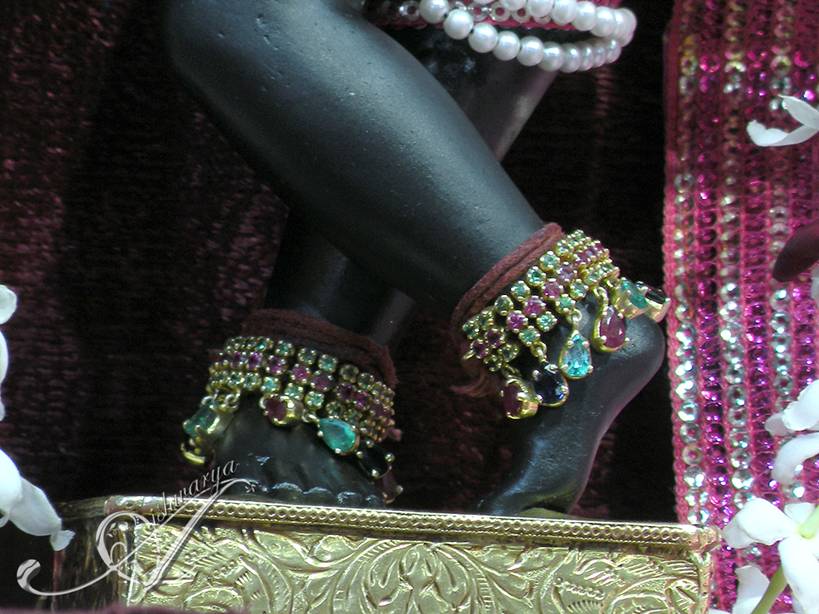
The process of meditation should begin from the lotus feet of the Lord and progress to His smiling face. The meditation should be concentrated upon the lotus feet, then the calves, then the thighs, and in this way higher and higher. The more the mind becomes fixed upon the different parts of the limbs, one after another, the more the intelligence becomes purified. (SB 2.2.13)
Śrīmad-Bhāgavatam By His Divine Grace A. C. Bhaktivedanta Swami Prabhupāda Canto Two, Chapter 2, Text 13-14













 The Hare Krishna Movement
