For many of us we struggle to chant our prescribed 16 rounds of japa daily. I know for me it is a daily struggle, if I wake up to late, if I am traveling, if I am sick, or have a headache, or just feeling lazy and unmotivated. But I try.
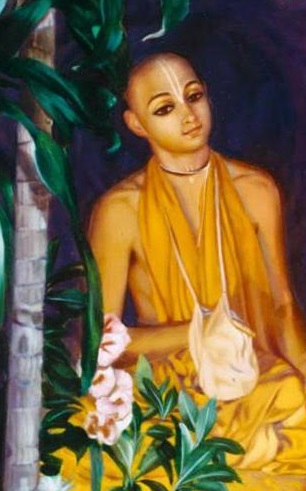
This morning my japa was pretty good, I felt inspired, and I was knocking of the rounds rather effortlessly, and I was thinking about Haridas Thakur who daily chanted 300,000 names or about 175 rounds. I can’t even imagine. But I felt inspired by thinking about him, and wanted to do a post about him. -V
“Haridāsa Ṭhākura is known as nāmācārya because it is he who preached the glories of chanting hari-nāma, the holy name of God.”
“Haridas Thakur chanted 3 lakhs of names each day, that means 16 names in the mantra, 108×16 or 1,728 names in each round of mala, dividing 300,000 by 1,728 comes to roundabout 175 rounds on beads daily. And for us it is even difficult to chant 16 rounds! That is why Haridas Thakur is namacharya. We find in Chaitanya Charitamrta information that both Lord Chaitanya and Haridas Thakur were constantly absorbed in chanting the Hare Krishna mantra: Hare Krishna, Hare Krishna, Krishna Krishna Hare Hare/ Hare Rama Hare Rama Rama Rama Hare Hare.” (Srila Prabhupada Letter, January 2, 1972)
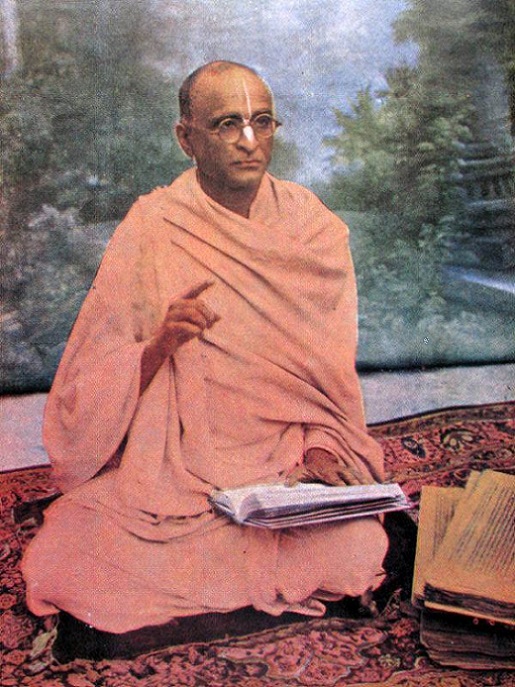
So today we celebrate the Appearance Day of Srila Bhaktisiddhanta Sarasvati Thakura, the Spiritual Master of our Srila Prabhupada. We honor it today with a half day fast a Pushpanjali (offering of prayers and flowers) followed by a nice vegetarian feast.
The Absolute Necessity of a Spiritual Master—The Universal Teacher By His Divine Grace A.C. Bhaktivedanta Swami Prabhupada Founder-Acharya of the world-wide Hare Krishna Movement
In February 1936, in Bombay, India, the members of a reputed religious society, the Gaudiya Matha, were astonished by the powerful and eloquent words of a young member who spoke in honor of his spiritual master, Srila Bhaktisiddhanta Sarasvati Gosvami. Three decades later, the young speaker would become the world-renowned founder and spiritual master of the Krishna consciousness movement. Srila Prabhupada’s presentation is a memorable statement on the importance of the guru in spiritual life.
sakshad-dharitvena samasta-shastrair uktas tatha bhavyata eva sadbhih kintu prabhor yah priya eva tasya vande guroh sri-charanaravindam
“In the revealed scriptures it is declared that the spiritual master should be worshiped like the Supreme Personality of Godhead, and this injunction is obeyed by pure devotees of the Lord. The spiritual master is the most confidential servant of the Lord. Thus let us offer our respectful obeisances unto the lotus feet of our spiritual master.”
The following is a Vayas-puja address offered by Srila Prabhupada to his spiritual master Srila Bhaktisiddhanta Sarasvati Goswami Prabhupada.
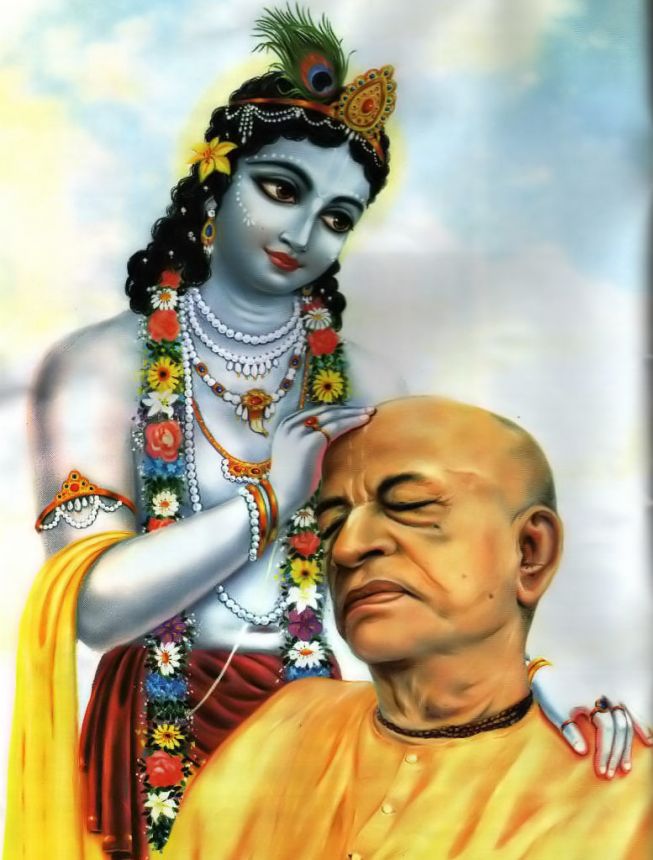
This morning as I was looking at a picture of Srila Prabhupada, this verse from the Bhagavad-gita just came into my mind:
O Kṛṣṇa, I totally accept as truth all that You have told me. Neither the gods nor demons, O Lord, know Thy personality. (Bg 10.14)
And I was thinking, that is exactly how I think of Srila Prabhupada’s instructions, to us. “I totally accept as truth all that You have told me“. Ever since I picked up my first book by Srila Prabhupada, I have just accepted every thing he has written as truth. I didn’t always believe my school teachers, or the nuns, or my parents for that matter. Sure they knew some things, and much of it true, but they didn’t know everything.
For some reason I just accepted as truth everything Prabhupada told us. He told us who was God (Krsna), then he told us what God looked like, what God was doing, where God lived, who’s Gods friends were, and much much more. There wasn’t a question he couldn’t answer, and he backed it up with sastric evidence.These were questions I asked of the nuns and priests, of parents and college professors, but I never got a reasonable answer from anyone when I asked; ‘Who is God, who am I, what is my relationship with Him?’
“Be patient and return home. Don’t be a crazy fellow. By and by you will be able to cross the ocean of material existence. You should not make yourself a showbottle devotee and become a false renunciant. For the time being, enjoy the material world in a befitting way and do not become attached to it. Śrī Caitanya Mahāprabhu continued: “Within your heart, you should keep yourself very faithful, but externally you may behave like an ordinary man. Thus Kṛṣṇa will soon be very pleased and deliver you from the clutches of māyā.” (Sri Caitanya-caritamrta: Madhya-lila Chapter 16, Text 237-239)
I have always liked this verse, it is sage advise for anyone practicing spiritual life (self-realization), in this age. “Within your heart, you should keep yourself very faithful, but externally you may behave like an ordinary man.” It is not that everyone who is interested in practicing Krishna Consciousness must artificially renounce the world, shave their head, put on robes, become a nun or monk, and live in a temple. No the instruction is here; “enjoy the material world in a befitting way and do not become attached to it.”
The peace and happiness for which we are all hankering for life after life, moment after moment, we will get when our desires become purified, and dovetailed with the Lord. One who desires sense gratification, the enjoyment of material satisfaction, will never be happy. That is not possible. If you want peace, if you want happiness, if you want perfection in your life, then just begin to dovetail your desires, activities, and potentials with the Supreme Personality of Godhead. Then you will see what real happiness is, and can tell who is really crazy.
I am sure that many of you have your favorite Bhagavad-gita slokas, and I was thinking about it this morning. I was trying to recall my top 8 slokas, (which is hard to select only 8). But I have listed them below, in no particular order.
For the list the 108 most important Bhagavad-gita slokas click on following link:1972 Bhagavad-gita
patraṁ puṣpaṁ phalaṁ toyaṁ yo me bhaktyā prayacchati tad ahaṁ bhakty-upahṛtam aśnāmi prayatātmanaḥ
If one offers Me with love and devotion a leaf, a flower, fruit or water, I will accept it.
I was thinking about it this morning, how in the Material world everything is temporary and limited, whereas is the Spiritual world everything is eternal and unlimited. For instance:
…In the Caitanya-caritāmṛta it is said that when Kṛṣṇa comes before Rādhārāṇī, She becomes so much engladdened by seeing the beauty of Kṛṣṇa that She becomes more beautiful, and as soon as Rādhārāṇī becomes beautiful, Kṛṣṇa becomes engladdened and He becomes more beautiful. So unlimitedly there is competition of becoming more beautiful. That is the state. Competition. Because in the spiritual world everything is unlimited. So unlimitedly both of them becoming more beautiful and both of them enjoying unlimitedly. ((Lecture on SB 1.2.8 New Vrindaban, September 6, 1972)
Today we celebrate the Appearance of Lord Nityananda with a few select verses from the Sri Caitanya-caritamrta, Adi Lila Chapter 5, entitled “The Glories of Lord Nityananda Balarama”.
“Let me offer my obeisances to Lord Śrī Nityānanda, the Supreme Personality of Godhead, whose opulence is wonderful and unlimited. By His will, even a fool can understand His identity.” (Adi 5.1) “The Supreme Personality of Godhead, Kṛṣṇa, is the fountainhead of all incarnations. Lord Balarāma is His second body.” (Adi 5.4) “That original Lord Kṛṣṇa appeared in Navadvīpa as Lord Caitanya, and Balarāma appeared with Him as Lord Nityānanda.” (Adi 5.6)
Śrī Caitanya-caritāmṛta By His Divine Grace A. C. Bhaktivedanta Swami Prabhupāda Ādi-līlā, Chapter 5, Text 1-12
So today we recognize the Disappearance day of Madhvacarya, who is in our line of Disciplic Succession dating back to Krsna. His philosophy and writings have distinguished him as one of India’s greatest spiritual teachers. He is the Acarya of the Madhva Sampradaya. So this following post by Chanchalapathi Prabhu is very timely.
“Srila Prabhupada is the Deliverer of all ISKCON Devotees”
By Chanchalapathi Dasa -ISKCON Bangalore
Recently I had the opportunity of interacting with a few scholars of Madhva sampradaya in Bangalore and Udupi. One of them was an elderly Sanskrit scholar, a seventy year old retired university professor, a respected teacher and follower of Madhva philosophy in Bangalore.
The discussion with him led to the subject of the theological differences between ISKCON Bangalore and ISKCON Mumbai.
Last night I was having a discussion with a fellow vaisnava, and the following, important sloka, came up in the course of our conversation. I was reminded of a story that once Gurukrpa Swami asked Srila Prabhupada what was the most important sloka in our literature, and Srila Prabhupada responded:
yasya deve parā bhaktir yathā deve tathā gurau tasyaite kathitā hy arthāḥ prakāśante mahātmanaḥ
“Only unto those great souls who have implicit faith in both the Lord and the spiritual master are all the imports of Vedic knowledge automatically revealed.” (Śvetāśvatara Upaniṣad 6.23)
I wanted to see how many times Srila Prabhupada used this sloka in his books and lectures so I went to Vani Quotes and did a search. It appears that this verse was used in:
Bhagavad-gita; 2 times Srimad Bhagavatam; 11 times Sri Caitanya-caritamrta; 12 times Lectures; 43 times Letters; 7 times Morning Walks and Conversations; 22 times Other books; twice
We share with you some of the the results of the Vani Quotes Research team, and thank Visnu Murti and Mayapur prabhu’s efforts.
I remember years ago when I was just a young new devotee, and we were asked to go out and distribute books, we were asked so many questions by people we met. One question I will never forget; “What does the mantra mean?” How to explain this to someone who has never heard of Krishna? So I replied; “O Lord please engage me in Your loving devotional service”. Even as a new devotee I knew there was more I could have said, but I left it at that.
But that basic question always stayed with me.
Hare Krishna, Hare Krishna, Krishna Krishna, Hare Hare, Hare Rama, Hare Rama, Rama Rama, Hare Hare
Another definition I discovered is;
Hare– Srimati Radharini (the divine energy of the Lord)
Krishna– The All Attractive Supreme Personality of Godhead
Rama– Name of Lord Krishna who is the reservoir of pleasure. (as in Radha-Ramana, the giver of pleasure to Srimati Radharani) The name Rama also means Lord Ramacandra, and Lord Balarama.
But for me, I like this verse I discovered in my reading;
“O Srimati Radharani, O All Attractive Reservoir of Pleasure, Lord Sri Krishna, please engage me in your loving devotional service”
This morning I was reading through one of my old devotional journals. And there was one page I titled “Destiny”. I was asking myself ‘is it preordained, or is it free choice?’ So I had looked through Srila Prabhupada’s books to find the answer.
…Free choice makes destiny. If I act in goodness, then my future is good. And if I act badly, my future is bad. That is destiny. Man is the Architect of his own destiny. Future destiny depends on present action. -SP
Of late, there are some devotees I know, who are having difficulties in life; health issues, impoverishment, depression, etc. Sometimes I am asked for advice or support. I generally don’t like to give advice, as I consider myself fallen by nature. But thinking along these lines of ‘advice and support’ I did a search in Srila Prabhupada’s books to see how a devotee of the Lord deals with suffering. I have posted a couple of nice verses that deal with the Lords Mercy.
The mountains, although being struck by torrents of rain during the rainy season, are not shaken, just as those whose hearts are dedicated to the transcendental Personality of Godhead are never disturbed, even when harassed by great misfortune. (Light of the Bhagavata 12)
Because a person who is spiritually advanced accepts any adverse condition of life as the mercy of the Lord, he is completely eligible to enter into the spiritual kingdom. Even though a person takes to the devotional service of the Supreme Lord, he may sometimes become diseased, impoverished, or disappointed by life’s events. A true devotee of the Lord always considers these sufferings to be due to past sinful activities, and thus without becoming disturbed he patiently awaits the mercy of the Supreme Lord. Such devotees are compared to high mountains, which are never agitated in any way, even when struck by powerful torrents of rain in the rainy season. Rather, such devotees remain humble in spiritual enlightenment. Free from pride and envy, they easily gain the mercy of the Lord and go back home, back to Godhead.
This picture hangs in our temple room, not only is this one of my most favorite pictures from the Śrī Caitanya-caritāmṛta, but this is one of the most nectarian chapters as well. I always marvel at how fortunate this Ramananda Raya is.
After embracing Rāmānanda Rāya, the Lord pacified him, informing him, “But for you, no one has ever seen this form.”
“I am never manifest to the foolish and unintelligent. For them I am covered by My internal potency [yogamāyā], and so they do not know Me, who am unborn and infallible.”
The Lord always reserves the right of not being exposed to everyone. The devotees, however, are always engaged in the service of the Lord, serving with the tongue by chanting the Hare Kṛṣṇa mantra and tasting mahā-prasāda. Gradually the sincere devotee pleases the Supreme Personality of Godhead, and the Supreme Lord reveals Himself. One cannot see the Supreme Lord by making personal efforts. Rather, when the Lord is pleased by the service of a devotee, He reveals Himself.
This is a continuation from our previous post Drops of Nectar, and includes texts 279-289 from chapter eight of the Madhya-lila entitled “Talks Between Śrī Caitanya Mahāprabhu and Rāmānanda Rāya”.
Lord Śrī Kṛṣṇa is the reservoir of all pleasure, and Śrīmatī Rādhārāṇī is the personification of ecstatic love of Godhead. These two forms has combined as one in Śrī Caitanya Mahāprabhu. This being the case, Lord Śrī Caitanya Mahāprabhu revealed His real form to Rāmānanda Rāya.
Śrī Caitanya-caritāmṛta 1975 Edition By His Divine Grace A. C. Bhaktivedanta Swami Prabhupāda Madhya-līlā, Chapter 8, Text 279-289
There are so many nice pictures of Lord Nrsmha and Prahlada Maharaja, but this is my favorite. The following is the song that is sung daily in all the ISKCON temples. I like to sing it as well, here at home.
Śrī Nṛsiṁha Praṇāma Translation from the Songs of the Vaisnava Acaryas 1972 Edition
namas te narasiḿhāya prahlādāhlāda-dāyine hiraṇyakaśipor vakṣaḥ-śilā-ṭańka-nakhālaye
ito nṛsiḿhaḥ parato nṛsiḿho yato yato yāmi tato nṛsiḿhaḥ bahir nṛsiḿho hṛdaye nṛsiḿho nṛsiḿham ādiḿ śaraṇaḿ prapadye
“I offer my obeisances to Lord Nṛsiṁha -deva, who is always giving bliss to His devotees like Prahlada Maharaja and chiseling at the hearts of demons like Hiraṇyakaśipu. The devotee always sees Lord Nṛsiṁha everywhere. Lord Nṛsiṁha is within and without. Therefore let us take shelter of Lord Nrsimha.”
tava kara-kamala-vare nakham adbhuta-śṛṅgaṁ dalita-hiraṇyakaśipu-tanu-bhṛṅgam keśava dhṛta-narahari-rūpa jaya jagadīśa hare
“O my lord Nṛsiṁha-deva, Your hands are very beautiful, like the lotus flower, but with Your longs nails You have ripped apart the wasp Hiraṇyakaśipu. Unto You, Lord of the Universe, I offer my humble obeisances.” (Prayers to Lord Nṛsiṁha from Dasavatara by Jayadeva Gosvami)
This morning I was reading from the “Nectar of Devotion”, about devotional service. Srila Prabhupada was explaining the nine processes of performing devotional service and referenced the “Teachings of Lord Kapila”, which was a book I have not read for such a long time, so I thought I would share a chapter with you today. And also this very important verse from the Srimad Bhagavtam.
“Hearing, chanting and remembering the holy name, form, pastimes, qualities and entourage of the Lord, offering service according to the time, place and performer, worshiping the Deity, offering prayers, always considering oneself the eternal servant of Kṛṣṇa, making friends with Him and dedicating everything unto Him—these are the nine processes of devotional service.” (Bhāg. 7.5.23)
There are nine basic processes of devotional service—hearing and chanting about the Supreme Lord, remembering Him, serving His lotus feet, worshiping Him, offering prayers to the Lord, acting as His servant, becoming His friend, and surrendering everything to Him. The beginning is śravaṇaṁ kīrtanam, hearing and chanting. One must be very eager to hear and chant.
Teachings of Lord Kapila, the Son of Devahūti By His Divine Grace A. C. Bhaktivedanta Swami Prabhupāda Chapter Three, Text 3
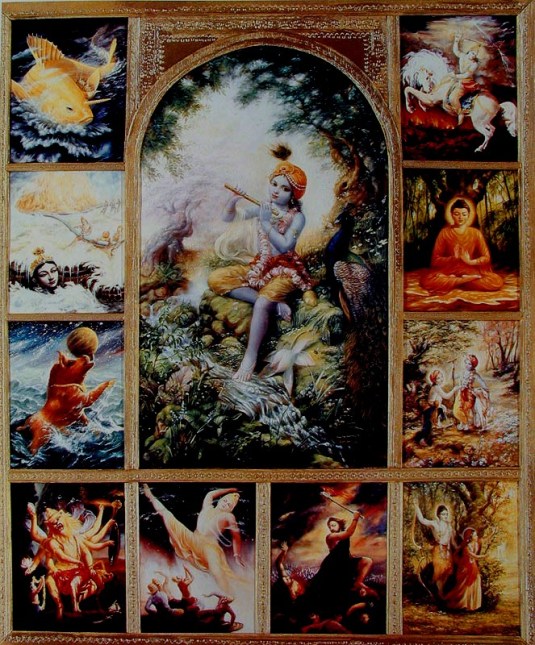
Lord Krsna appears in every millennium, in various incarnations, to annihilate the demons, protect the devotees and reestablish the principles of religion. From upper left-hand corner: Lord Matsya, the fish incarnation; Lord Kurma, the tortoise incarnation; Lord Varaha, the boar incarnation; Lord Nrsimhadeva, the man-lion incarnation; Lord Vamana, the dwarf-brahmana incarnation; Lord Parasurama, the warrior incarnation; Lord Ramacandra; Lord Krishna and Lord Balarama; Lord Buddha; and Lord Kalki, who destroys all demons at the end of the millennium.
In order to deliver the pious and to annihilate the miscreants, as well as to reestablish the principles of religion, I advent Myself millennium after millennium. (Bhagavada-gita As It Is 4.8)
Last night was the Full Moon (Purnima), and as I saw it appear over the Eastern Horizon, I was reminded of the chapter of the Bhagavad-gita entitled: “The Opulence of the Absolute”. And this verse came to mind.
“Know that all beautiful, glorious, and mighty creations spring from but a spark of My splendor.”
PURPORT
Any glorious or beautiful existence should be understood to be but a fragmental manifestation of Kṛṣṇa’s opulence, whether it be in the spiritual or material world. Anything extraordinarily opulent should be considered to represent Kṛṣṇa’s opulence.” (Bg. 10.41)
In another verse Krishna states: “…of lights I am the radiant sun, … and among the stars I am the moon.” (Bg. 10.21)
So really Krishna Consciousness is not so difficult. Every time we see the sun, or moon, we can be reminded of Krishna.
“I am the source of all spiritual and material worlds. Everything emanates from Me. The wise who know this perfectly engage in My devotional service and worship Me with all their hearts.” (Bg. 10.8)
I love reading these memories of the very early disciples of Srila Prabhupada. Prabhupada once said that Krishna sent some of you to assist me in this movement, and some of you were just lucky. I guess I was just lucky.
The following is the Foreward to “The Science of Self Realization” written by Mukunda das Goswami. I have read this countless times. Very Beautiful.
The Science of Self Realization Foreword By Mukunda Das
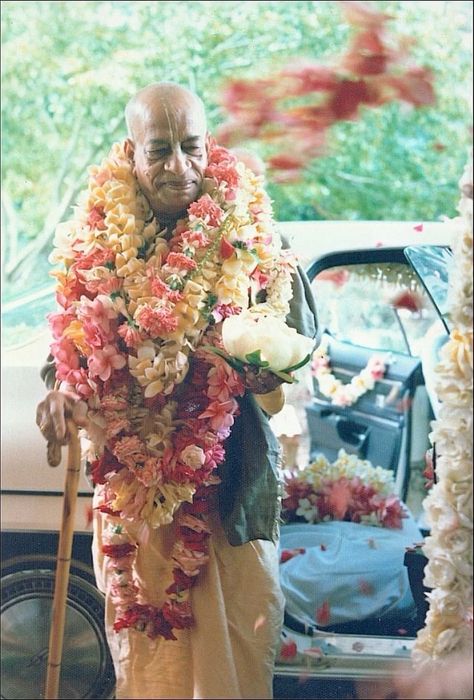
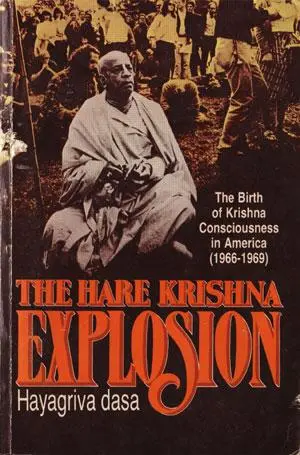
From the very start, I knew that His Divine Grace A. C. Bhaktivedanta Swami Prabhupāda was the most extraordinary person I had ever met. The first meeting occurred in the summer of 1966, in New York City. A friend had invited me to hear a lecture by “an old Indian svāmī” on lower Manhattan’s Bowery. Overwhelmed with curiosity about a svāmī lecturing on skid row, I went there and felt my way up a pitch-black staircase. A bell-like, rhythmic sound got louder and clearer as I climbed higher. Finally I reached the fourth floor and opened the door, and there he was.
About fifty feet away from where I stood, at the other end of a long, dark room, he sat on a small dais, his face and saffron robes radiant under a small light. He was elderly, perhaps sixty or so, I thought, and he sat cross-legged in an erect, stately posture. His head was shaven, and his powerful face and reddish horn-rimmed glasses gave him the look of a monk who had spent most of his life absorbed in study. His eyes were closed, and he softly chanted a simple Sanskrit prayer while playing a hand drum. The small audience joined in at intervals, in call-and-response fashion. A few played hand cymbals, which accounted for the bell-like sounds I’d heard. Fascinated, I sat down quietly at the back, tried to participate in the chanting, and waited.
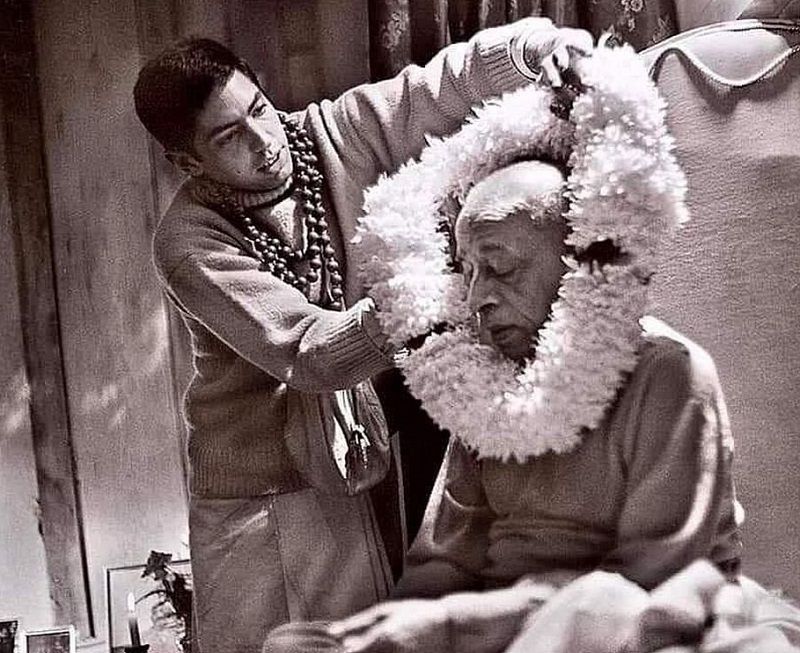
The Spiritual Master is present wherever his sincere disciple is trying to serve his instructions. This is possible by the mercy of Krishna.
In your attempts to serve me, and in all your sincere devotional sentiments, I am with you, as my Guru Maharaja is with me. Remember this always…I shall never leave you. You are my disciple and I am your Spiritual Master, so there is no question, as long as you follow my instructions, that I shall never leave you.
Who is that smiling women in the middle? Why its Lady Subhadra!
Subhadra : Daughter of Vasudeva and sister of Lord Śrī Krsna. She was not only a very dear daughter of Vasudeva, but also a very dear sister to both Krsna and Baladeva. The two brothers and sister are represented in the famous Jagannatha temple of Puri, and the temple is still visited by thousands of pilgrims daily. This temple is in remembrance of the Lord’s visit at Kuruksetra during an occasion of solar eclipse and His subsequent meeting with the residents of Vrndavana. The meeting of Radha and Krsna during this occasion is a very pathetic story, and Lord Śrī Caitanya, in the ecstasy of Rādhārāṇī, always pined for Lord Śrī Krsna at Jagannatha Puri. While Arjuna was at Dvaraka, he wanted to have Subhadra as his queen, and he expressed his desire to Lord Krsna. Śrī Krsna knew that His elder brother, Lord Baladeva, was arranging her marriage elsewhere, and since He did not dare to go against the arrangement of Baladeva, He advised Arjuna to kidnap Subhadra. So when all of them were on a pleasure trip on the Raivata Hill, Arjuna managed to kidnap Subhadra according to the plan of Śrī Krsna. Śrī Baladeva was very angry at Arjuna, and He wanted to kill him, but Lord Krsna implored His brother to excuse Arjuna. Then Subhadra was duly married with Arjuna, and Abhimanyu was born of Subhadra. At the premature death of Abhumanyu, Subhadra was very mortified, but on the birth of Pariksit she was happy and solaced. (from purport to SB 1.13.3-4)













 The Hare Krishna Movement