Nārada then said, "Yes, you shall become trees, arjuna trees, and you will stand at the courtyard of Nanda Mahārāj. But Kṛṣṇa Himself will appear in time as the foster son of Nanda, and He will deliver you."
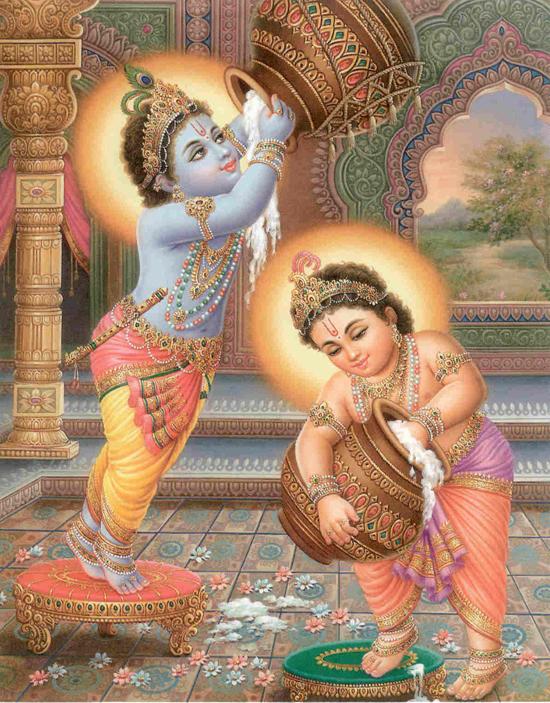
The story behind the two sons of Kuvera, Manigriva, and Nalakuvera, is they were puffed up on account of the opulence of their father, and so once on a heavenly planet they were enjoying themselves in a lake with some naked damsels of heaven. At that time the great saint Nārada Muni was passing on the road and was sorry to see the behavior of the sons of Kuvera. Seeing Nārada passing by, the damsels of heaven covered their bodies with cloth, but the two sons, being drunkards, did not have this decency. Nārada became angry with their behavior and cursed them thusly: “You have no sense, so it is better if you become trees instead of the sons of Kuvera.” Upon hearing this, the boys came to their senses and begged Nārada to be pardoned for their offenses. Nārada then said, “Yes, you shall become trees, arjuna trees, and you will stand at the courtyard of Nanda Mahārāj. But Kṛṣṇa Himself will appear in time as the foster son of Nanda, and He will deliver you.” In other words, the curse of Nārada was a benediction to the sons of Kuvera because indirectly it was foretold that they would be able to receive the favor of Lord Kṛṣṇa. After that, Kuvera’s two sons stood as two big arjuna trees in the courtyard of Nanda Mahārāj until Lord Dāmodara, in order to fulfill the desire of Nārada, dragged the milling pestle to which He was tied and struck the two trees, violently causing them to fall down. From out of these fallen trees came Nalakūvara and Maṇigrīva, who had by then become great devotees of the Lord.
The Nectar of Devotion – 1970 Edition
By His Divine Grace A.C. Bhaktivedanta Swami Prabhupada
Chapter 4
Devotional Service Surpasses All Liberation
How much a devotee is seriously attached to the devotional service of the Supreme Personality of Godhead can be understood from the statement of Mahārāj Pṛthu (Ādirāja) which is described in Śrīmad-Bhāgavatam, Fourth Canto, 20th Chapter, 21st verse. He prays to the Supreme Personality of Godhead thusly: “My dear Lord, if after taking liberation I have no chance of hearing the glories of Your Lordship, glories chanted by pure devotees from the core of their hearts in praise of Your lotus feet, and if I have no chance for this honey of transcendental bliss, then I shall never ask for liberation or this so-called spiritual emancipation. I shall simply always pray unto Your Lordship that You may give me millions of tongues and millions of ears so that I can constantly chant and hear of Your transcendental glories.”
The impersonalists desire to merge into the existence of the Supreme, but without keeping their individuality they have no chance of hearing and chanting the glories of the Supreme Lord. Because they have no idea of the transcendental form of the Supreme Lord there is no chance of their chanting and hearing of His transcendental activities. In other words, unless one is already beyond liberation, one cannot relish the transcendental glories of the Lord, nor can one understand the transcendental form of the Lord.
You then freed the sons of Kuvera, Manigriva, and Nalakuvera, who were cursed to stand as trees, and You gave them the chance to become Your devotees.
kuverātmajau baddha-mūrtyaiva yadvat
tvayā mocitau bhakti-bhājau kṛtau ca
tathā prema-bhaktiḿ svakāḿ me prayaccha
na mokṣe graho me ‘sti dāmodareha
kuvera-ātmajau–the two sons of Kuvera (named Nalakūvara and Maṇigrīva); baddha-mūrtyā-eva–by He whose divine form was bound with ropes to the grinding mortar; yat-vat–since they were like that (cursed by Nārada to take birth as twin arjuna trees); tvayā–by You; mocitau–they who were liberated; bhakti-bhājau–the recipients of devotional service; kṛtau–You made them; ca–also; tathā–then; premabhaktim–loving devotion; svakām–Your own; me–unto me; prayaccha– please give; na mokṣe–not for liberation; grahaḥ–enthusiasm; me–my; asti–is; dāmodara–O Lord Dāmodara!; iha–this.
7) O Lord Damodara, in Your form as a baby, Mother Yasoda bound You to a grinding stone with a rope for tying cows, You then freed the sons of Kuvera, Manigriva, and Nalakuvera, who were cursed to stand as trees, and You gave them the chance to become Your devotees. Please bless me in this same way, I have no desire for liberation into Your effulgence.
Purport
This verse reveals deep truths about prema-visesa, pure ecstatic love for Krishna. Beginning with kuveratmajau, the two sons of Kuvera are introduced. They were able to obtain the direct vision of the Lord. But isn’t prema-bhakti the only means for seeing the Lord face to face? And having once seen the Lord, doesn’t the agony of separation set in upon losing that vision? This is the feature of prema-bhakti that brings the Lord under the sway of the pure devotee’s love.
How did the two reprobates get such mercy? The answer is that by the quality of Sri Krishna’s love, bhakta-vatsala, the impossible becomes possible. To honor the word of His pure devotee Narada Muni, who gave the benediction that they would see the Lord face to face, the Lord actually delivers these two brothers. Did they ever do anything to deserve this? No. It is simply causeless mercy!
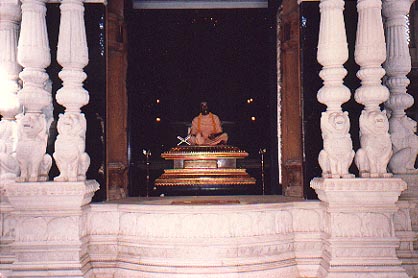
Srila Prabhupada Samadhi Mandir
BY: PARVATI DEVI DASI
Oct 20, 2011 — VRNDAVANA DHAM, INDIA (SUN)
Announcement of the unveiling of the bronze bas relief panels depicting the life, works and mission of His Divine Grace A.C. Bhaktivedanta Swami Prabhupada, Founder-Acharya of the International Society for Krishna Consciousness, to take place at the Krishna Balarama Mandir in the divine Samadhi at Raman Reti, Vrndavana, Dist. Mathura, U.P., on 29 October 2011, 5 p.m.
We would be privileged if you would kindly grace our function with your esteemed presence for this momentous occasion. Nothing of this magnitude, import, beautiful artistry and craft has ever been produced before anywhere in the world at any time. Created by esteemed American sculptor Bhaktisiddhanta das, it will make an historic landmark in the art world as well as the culture of Vrndavana, Land of Krishna and Srila Prabhupada’s ISKCON culture.
Please take time out of your busy schedule to honour us by attending this brief but extraordinary cultural event.
Your servants for ISKCON
and the Samadhi Mandir,
Pancagauda das, Temple President
Parvati devi dasi, Samadhi Servant
namo deva dāmodarānanta viṣṇo
prasīda prabho duḥkha-jālābdhi-magnam
kṛpā-dṛṣṭi-vṛṣṭyāti-dīnaḿ batānu
gṛhāṇeṣa mām ajñam edhy akṣi-dṛśyaḥ
namaḥ–I bow down; deva–O divine Lord!; dāmodara–O Lord whose belly is bound with a rope!; ananta–O limitless Lord!; viṣṇo–O allpervading Lord!; prasīda–be pleased; prabho–O my Master!; duḥkhajāla–a network of material miseries; abdhi-magnam–immersed in the ocean; kṛpā-dṛṣṭi-vṛṣṭyā–by the rain of merciful glances; āti-dīnam–very fallen; bata–alas!; anugṛhāṇa–please accept; īśa–O supremely independent Lord!; mām–me; ajñam–ignorant; edhi–please come; akṣidṛśyaḥ–perceptible to my eyes.
6) O unlimited Visnu! O master! O Lord! Be pleased upon me! I am drowning in and ocean of sorrow and am almost like a dead man, Please shower the rain of mercy on me; uplift me and protect me with Your nectarean vision.
Purport
Feelings of love arise from the purity and potency of longing, and then is only satisfied to behold the beauty of Sri Krishna directly (saksat darsana). The supreme method (param-sadhana) to attain this goal is chanting the Holy Name (sri-nama-sankirtana). Satyavrata Muni begins this verse chanting the Holy Names. In his ecstasy, feelings of awe and reverence are abandoned by the elimination of the word tubhyam (unto You). This creates the mood of being in the personal presence of the Lord.
Lord Kṛṣṇa used to lie down with His sixteen thousand wives, but also He would rise up from bed very early in the morning, three hours before sunrise. By nature’s arrangement the crowing of the cocks warns of the brāhma-muhūrta hour. There is no need of alarm clocks; as soon as the cocks crow early in the morning, it is to be understood that it is time to rise from bed. Hearing that sound, Kṛṣṇa would get up from bed, but His rising early was not very much to the liking of His wives. The wives of Kṛṣṇa were so much attached to Him that they would lie in bed embracing Him, but as soon as the cocks crowed, Kṛṣṇa’s wives would be very sorry and would immediately condemn the crowing.
After rising from bed, Lord Kṛṣṇa would wash His mouth, hands and feet and would immediately sit down and meditate on Himself. This does not mean, however, that we should also sit down and meditate on ourselves. We have to meditate upon Kṛṣṇa, Rādhā-Kṛṣṇa. That is real meditation, Kṛṣṇa is Kṛṣṇa Himself; therefore He was teaching us that brāhma-muhūrta should be utilized for meditation on Rādhā-Kṛṣṇa. By doing so, Kṛṣṇa would feel very much satisfied, and similarly we will also feel transcendentally pleased and satisfied if we utilize the brāhma-muhūrta period to meditate on Rādhā and Kṛṣṇa and if we think of how Śrī Rukmiṇīdevī and Kṛṣṇa acted as ideal householders to teach the whole human society to rise early in the morning and immediately engage in Kṛṣṇa consciousness.
KRSNA, The Supreme Personality of Godhead – 1970 Edition
By His Divine Grace A.C. Bhaktivedanta Swami Prabhupada
Vol. 2, Chapter 15
Lord Kṛṣṇa’s Daily Activities
From the Vedic mantras we learn that the Supreme Personality of Godhead has nothing to do: na tasya karyaṁ kranaṁ ca vidyate. If the Supreme Lord has nothing to do, then how can we speak of the activities of the Supreme Lord? From the previous chapter it is clear that no one can act in the way that Lord Kṛṣṇa does. We should clearly note this fact: the activities of the Lord should be followed, but they cannot be imitated. For example, Kṛṣṇa’s ideal life as a householder can be followed, but if one wants to imitate Kṛṣṇa by expanding into many forms, that is not possible. We should always remember, therefore, that Lord Kṛṣṇa, although playing the part of a human being, nevertheless simultaneously maintains the position of the Supreme Personality of Godhead. We can follow Lord Kṛṣṇa’s dealing with His wives as an ordinary human being, but His dealing with more than sixteen thousand wives at one time cannot be imitated. The conclusion is that to become ideal householders we should follow in the footsteps of Lord Kṛṣṇa as He displayed His daily activities, but we cannot imitate Him at any stage of our life.
It is stated that a devotee will at once develope pure love of Kṛṣṇa in the wake of the gopīs if he once takes a bath in Rādhā-kuṇḍa.
The Nectar of Instruction
By His Divine Grace A.C. Bhaktivedanta Swami Prabhupada
Text 11
kṛṣṇasyoccaiḥ praṇaya-vasatiḥ preyasībhyo ’pi rādhā
kuṇḍaṁ cāsyā munibhir abhitas tādṛg eva vyadhāyi
yat preṣṭhair apy alam asulabhaṁ kiṁ punar bhakti-bhājāṁ
tat premedaṁ sakṛd api saraḥ snātur āviṣkaroti
kṛṣṇasya—of Lord Śrī Kṛṣṇa; uccaiḥ—very highly; praṇaya-vasatiḥ—object of love; preyasībhyaḥ—out of the many lovable gopīs; api—certainly; rādhā—Śrīmatī Rādhārāṇī; kuṇḍam—lake; ca—also; asyāḥ—of Her; munibhiḥ—by great sages; abhitaḥ—in all respects; tādṛk eva—similarly; vyadhāyi—is described; yat—which; preṣṭhaiḥ—by the most advanced devotees; api—even; alam—enough; asulabham—difficult to obtain; kim—what; punaḥ—again; bhakti-bhājām—for persons engaged in devotional service; tat—that; prema—love of Godhead; idam—this; sakṛt—once; api—even; saraḥ—lake; snātuḥ—of one who has bathed; āviṣkaroti—arouses.
Of the many objects of favored delight and of all the lovable damsels of Vrajabhūmi, Śrīmatī Rādhārāṇī is certainly the most treasured object of Kṛṣṇa’s love. And, in every respect, Her divine kuṇḍa is described by great sages as similarly dear to Him. Undoubtedly Rādhā-kuṇḍa is very rarely attained even by the great devotees; therefore it is even more difficult for ordinary devotees to attain. If one simply bathes once within those holy waters, one’s pure love of Kṛṣṇa is fully aroused.
Why is Rādhā-kuṇḍa so exalted? The lake is so exalted because it belongs to Śrīmatī Rādhārāṇī, who is the most beloved object of Śrī Kṛṣṇa. Among all the gopīs, She is the most beloved. Similarly, Her lake, Śrī Rādhā-kuṇḍa, is also described by great sages as the lake that is as dear to Kṛṣṇa as Rādhā Herself. Indeed, Kṛṣṇa’s love for Rādhā-kuṇḍa and Śrīmatī Rādhārāṇī is the same in all respects. Rādhā-kuṇḍa is very rarely attained, even by great personalities fully engaged in devotional service, not to speak of ordinary devotees who are only engaged in the practice of vaidhī bhakti.
It is stated that a devotee will at once develope pure love of Kṛṣṇa in the wake of the gopīs if he once takes a bath in Rādhā-kuṇḍa. Śrīla Rūpa Gosvāmī recommends that even if one cannot live permanently on the banks of Rādhā-kuṇḍa, he should at least take a bath in the lake as many times as possible. This is a most important item in the execution of devotional service. Śrīla Bhaktivinoda Ṭhākura writes in this connection that Śrī Rādhā-kuṇḍa is the most select place for those interested in advancing their devotional service in the wake of the lady friends (sakhīs) and confidential serving maids (mañjarīs) of Śrīmatī Rādhārāṇī. Living entities who are eager to return home to the transcendental kingdom of God, Goloka Vṛndāvana, by means of attaining their spiritual bodies (siddha-deha) should live at Rādhā-kuṇḍa, take shelter of the confidential serving maids of Śrī Rādhā and under their direction engage constantly in Her service.
This is the most exalted method for those engaged in devotional service under the protection of Śrī Caitanya Mahāprabhu. In this connection Śrīla Bhaktisiddhānta Sarasvatī Ṭhākura writes that even great sages and great devotees like Nārada and Sanaka do not get an opportunity to come to Rādhā-kuṇḍa to take their baths. What, then, to speak of ordinary devotees? If, by great fortune, one gets an opportunity to come to Rādhā-kuṇḍa and bathe even once, he can develop his transcendental love for Kṛṣṇa, exactly as the gopīs did. It is also recommended that one should live on the banks of Rādhā-kuṇḍa and should be absorbed in the loving service of the Lord. One should bathe there regularly and give up all material conceptions, taking shelter of Śrī Rādhā and Her assistant gopīs. If one is thus constantly engaged during his lifetime, after giving up the body he will return back to Godhead to serve Śrī Rādhā in the same way as he contemplated during his life on the banks of Rādhā-kuṇḍa. The conclusion is that to live on the banks of the Rādhā-kuṇḍa and to bathe there daily constitute the highest perfection of devotional service. It is a difficult position to attain, even for great sages and devotees like Nārada. Thus there is no limit to the glory of Śrī Rādhā-kuṇḍa. By serving Rādhā-kuṇḍa, one can get an opportunity to become an assistant of Śrīmatī Rādhārāṇī under the eternal guidance of the gopīs.
1972 Nectar of Devotion lecture at Rupa Goswami Samadi
The real Initiation
Reported by Vaikunthanatha Dasa
In 1972, when Prabhupada gave a series of lectures on The Nectar of Devotion for one month in Vrindavan, a thought was plaguing me. When I first joined, I’d been taught that the parampara system is like a chain, and if you’re not initiated, if you’re not linked up to this chain, then you can’t go back to Godhead. I thought, “We’re distributing so many books, but if the people who read them are not initiated, then they can’t go back to Godhead.” So, one day I followed Prabhupada from Rupa Goswami’s samadhi, where he lectured, and just before Prabhupada stepped onto his courtyard, I said, “We’re distributing so many books but if people aren’t initiated, then they can’t go back to Godhead.” Prabhupada turned, looked at me right in the eyes and said, “Just by reading my books they are initiated.” I thought, “That is an incredible example of compassion.
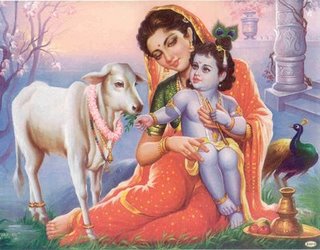
O Lord, the cheeks of Your blackish lotus face, which is encircled by locks of curling hair, have become reddened like bimba fruit due to Mother Yasoda’s kisses
idaḿ te mukhāmbhojam atyanta-nīlair
vṛtaḿ kuntalaiḥ snigdha-raktaiś ca gopyā
muhuś cumbitaḿ bimba-raktādharaḿ me
manasy āvirāstām alaḿ lakṣa-lābhaiḥ
idam–this; te–Your; mukha-ambhojam–lotus-like face; avyakta-nīlaiḥ–by very dark blue; vṛtam–surrounded; kuntalaiḥ–by curling locks of hair; snigdha–soft and glossy; raktaiḥ–by reddish-tinted; ca–also; gopyā–by the gopī (Srī Yaśodā); muhuḥ–again and again; cumbitam–kissed; bimbarakta-adharam–with lips red as the bimba fruit; me–my; manasi–in the heart; āvirāstām–may it be manifest; alam–useless (there is no need for me); lakṣa-lābhaiḥ–by millions of attainments of other boons.
5) O Lord, the cheeks of Your blackish lotus face, which is encircled by locks of curling hair, have become reddened like bimba fruit due to Mother Yasoda’s kisses. What more can I describe than this? Millions of opulences are of no use to me, but may this vision constantly remain in my mind.
Purport
The poet demonstrates in this verse that longing for the association of the Lord in the heart is the best means to achieve Him. The longing to see the beautiful lotus face of the Lord, which is supremely enchanting, is stated first (idam te mukhambhojam). The indescribably sweet face of Sri Krishna resembles a lotus flower in full bloom. Simply by seeing His face, which is the treasure house of supreme bliss, all anxiety and distress disappear.
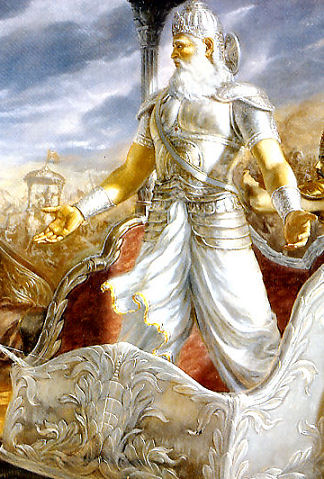
Even a great fighter like Bhīṣma could not win the Battle of Kurukṣetra because the Lord wanted to show that vice cannot conquer virtue, regardless of who tries to execute it.
Srimad-Bhagavatam
By His Divine Grace A.C. Bhaktivedanta Swami Prabhupada
Canto 1″Creation”, Chapter 9, Text 16
The Passing Away of Bhismadeva in the Presence of Lord Krsna
na hy asya karhicid rājan
pumān veda vidhitsitam
yad vijijñāsayā yuktā
muhyanti kavayo ‘pi hi
O King, no one can know the plan of the Lord [Śrī Kṛṣṇa]. Even though great philosophers inquire exhaustively, they are bewildered.
The bewilderment of Mahārāja Yudhiṣṭhira over his past sinful acts and the resultant sufferings, etc., is completely negated by the great authority Bhīṣma (one of the twelve authorized persons). Bhīṣma wanted to impress upon Mahārāja Yudhiṣṭhira that since time immemorial no one, including such demigods as Śiva and Brahmā, could ascertain the real plan of the Lord. So what can we understand about it? More
(New York, July 20, 1971)
By His Divine Grace A.C. Bhaktivedanta Swami Prabhupada
[Sings Jaya Radha-Madhava.] (song lyrics follow this post)
Srila Prabhupada: So this is the original nature of Krsna. He is Radha-Madhava. He is the lover of Srimati Radharani. And kunja-vihari, always enjoying the company of the gopis within the bushes of Vrdavana forest. Radha-madhava kunja-vihari. So He’s not only lover of Radharani, but braja-jana-vallabha. The whole residents of Vrndavana, they love Krsna. They do not know anything else. They do not know whether Krsna is God, or not; neither they are very much harassed, that “I shall love Krsna if He is God.” “He may be God or He may be whatever He is. It doesn’t matter, but we love God, Krsna.” That’s all. That is called unnalloyed love. “If Krsna is God, then I shall love Him” — this is conditional love. This is not pure love. Krsna may be God or whatever He may be, but by His wonderful acts, the Vrajavasi, they are thinking, “Oh Krsna, He is very wonderful child, maybe some demigod. Maybe some demigod.” Because people are generally under impression that the demigods are all-powerful.
The following is a letter sent to me earlier today by Pralada-Nrsimha Prabhu, informing me and our readers that the Originial 1968 Edition of “Teachings of Lord Chaitanya” are now available for the first time ever online, as they have been digitized. They are available for free, thanks to a lot of hard work by Ahaituki Bhakti dd who simply asks for your well wishes and blessings in return. This original authorized edition of The Teachings Of Lord Caitanya is being presented free for everyones benefit.
Originial 1968 Edition of “Teachings of Lord Chaitanya”
Letter by Pralada-Nrsimha Prabhu
Please accept my humble obeisances, all glories to Srila Prabhupada!
I am happy to offer (attached below) a digitized (FREE) file of the original 1968 TLC!
As far as I know this is the first time it has been available in any digitized format to any one, ever!
My only prayer is that Your childhood pastimes may constantly appear in my mind
varaḿ deva mokṣaḿ na mokṣāvadhiḿ vā
na canyaḿ vṛṇe ‘haḿ vareṣād apīha
idaḿ te vapur nātha gopāla-bālaḿ
sadā me manasy āvirāstāḿ kim anyaiḥ
varam–boons; deva–O Lord!; mokṣam–liberation; na–not; mokṣāavadhim–the highest pinnacle of liberation (the realm of Srī Vaikuṇṭhaloka); vā–or; na–not; ca-anyam–or anything else; vṛṇe aham–I pray for; vara-īśāt–from You Who can bestow any boon; api–also; iha–here in Vṛndāvana; idam–this; te–Your; vapuḥ–divine bodily form; nātha–O Lord!; gopāla-bālam–a young cowherd boy; sadā–always; me manasi–in my heart; āvirāstām–may it be manifest; kim anyaiḥ–what is the use of other things (mokṣā, and so forth.)
4) O Lord, although You are able to give all kinds of benedictions, I do not pray to You for liberation, nor eternal life in Vaikuntha, nor any other boon. My only prayer is that Your childhood pastimes may constantly appear in my mind. O Lord, I do not even want to know Your feature of Paramatma. I simply wish that Your childhood pastimes may ever be enacted in my heart.
Purport
Both verses four and five describe the poet’s innermost desires, beginning with, varam, boons. No benedictions of any kind are requested even here in Vrindavan (lila) from He who can bestow any boon (varesad). Satyavrata Muni does not seek liberation (moksa na), nor does he desire the highest conception of liberation (moksa-avadhim), which is eternal life in Vaikuntha. Neither is he interested in any other benediction (na ca anyam), referring to the nine processes of devotional service, beginning with sravanam kirtanam, and the benefits they bestow. If others desire these, or even if Krishna wants to bestow these upon him, he has no attraction for them.
The three benedictions referred to – moksa (liberation), moksavadhim (eternal life in Vaikuntha), and anyam (any other boon) – reflect an ascending order of superiority. Eternal life in Vaikuntha is clearly superior to impersonal liberation. The position of other boons, such as the nine processes of devotional service, are described in Srimad Bhagavatam.
“O Lord, we pray that You let us be born in any hellish condition of life, just as long as our hearts and minds are always engaged in the service of Your lotus feet, our words are made beautiful [by speaking of Your activities] just as Tulasi leaves are beautified when offered unto Your lotus feet, and as long as our ears are always filled with the chanting of Your transcendental qualities.” Srimad Bhagavatam 3.15.49.
By these words spoken by the four Kumaras, we can understand that the nine processes of devotion can be perfected even in hell. So in any condition of life, one can experience the perfection that is available in the eternal abode, Vaikuntha, through bhakti-yoga.
Salvation from the Material World
By Sriman Padmapani Prabhu
On November 2nd, 1974, ex-Beatle George Harrison launched his North American tour in Vancouver, Canada. Since George was a follower of Krishna consciousness, the Vancouver devotees were eager to distribute Srila Prabhupada’s books and magazines to local fans attending the concert. George was expected to play a number of hits from his latest record (“Living in the Material World”), which contained many songs of devotion to the Lord:
“I’m living in the material world
Living in the material world
I hope to get out of this place
By the Lord Sri Krishna’s grace
My salvation from the material world.”
As we entered the Pacific Coliseum, Mahesh Prabhu and I headed for the floor, our saffron bags filled with books, magazines and incense. The crowd was obviously excited as we gradually walked to the front of the stage, distributing our spiritual goods along the way. “Hare Krishna” people shouted. Many of George’s fans knew that he had an affinity towards our movement, so they were very friendly and supportive. When the concert began, George appeared onstage wearing a number of buttons containing spiritual pictures and “om” signs. His neck was adorned with tulasi beads.
Mahesh Prabhu pulled out a large hardbound edition of Srila Prabhupada’s Krishna Book, which had been published with the help of a kind donation by George Harrison himself. When Mahesh got to the front row, he held the Krishna Book high in the air so that George could possibly see it from the stage. As he made his way towards Mahesh, George in fact noticed Srila Prabhupada’s book. His eyes lit up and a large smile beamed across his face as he bowed his head in respect. Since Mahesh was a big fan of the Beatles before joining ISKCON, he was thrilled to have this simple transcendental exchange with one of his old heroes. What an auspicious start to George Harrison’s 1974 tour.
Today we honor the disappearance day of Narottama Das Thakur, who is well know as the composer of many Vaisnava Songs. So we post one of his well known songs along with a purport by His Divine Grace A.C. Bhaktivedanta Swami Prabhupada
Sri Krsna Caitanya Prabhu Doya Koro More
śrī-kṛṣṇa-caitanya prabhu doyā koro more
tomā binā ke doyālu jagat-saḿsāre
My dear Lord Caitanya, please be merciful to me, because who can be more merciful than Your Lordship within these three worlds?
patita-pāvana-hetu tava avatāra
mo sama patita prabhu nā pāibe āra
Your incarnation is just to reclaim the conditioned, fallen souls, but I assure You that You will not find a greater fallen soul than me. Therefore, my claim is first.
My dear Lord Nityananda, You are always joyful in spiritual bliss. Since You always appear very happy, I have come to You because I am most unhappy. If You kindly put Your glance over me, then I may also become happy.
O Svarupa Damodara, personal secretary of Lord Caitanya, O six Gosvamis O Sri Rupa Gosvami, Sri Sanatana Gosvami, Sri Raghunatha Bhatta Gosvami, Sri Gopala Bhatta Gosvami, Sri Jiva Gosvami, and Sri Raghunatha dasa Gosvami! O Lokanatha Gosvami, my beloved spiritual master! Narottama dasa also prays for your mercy.
O Srinivasa Acarya, successor to the six Gosvamis! Please be merciful to me. Narottama dasa always desires the company of Ramacandra Cakravarti.
Purport
By His Divine Grace A.C. Bhaktivedanta Swami Prabhupada
This is a song composed by Narottama Dasa Thakura. He prays to Lord Caitanya “My dear Lord, please be merciful to me, because who can be more merciful than Your Lordship within these three worlds?” Actually, this is a fact. Not only Narottama Dasa Thakura but Rupa Gosvami also prayed to Lord Caitanya in this way. At the time of the first meeting of Lord Caitanya and Rupa Gosvami at Prayaga (Allahabad), Srila Rupa Gosvami said, “My dear Lord, You are the most munificent of all incarnations, because You are distributing love of Krsna, Krsna consciousness.” When Krsna was personally present He simply asked us to surrender, but He did not distribute Himself so easily. He made conditions–“First of all you surrender.” But this incarnation, Lord Caitanya, although Krsna Himself, makes no such condition. He simply distributes: “Take love of Krsna.” Therefore Lord Caitanya is approved as the most munificent incarnation. Narottama Dasa Thakura says, “Please be merciful to me. You are so magnanimous, because You have seen the fallen souls of this age, and You are very much compassionate to them, but You should know also that I am the most fallen. No one is more greatly fallen than me.” Patita-pavana-hetu tava avatara. “Your incarnation is just to reclaim the conditioned, fallen souls, but I assure You that You will not find a greater fallen soul than me. Therefore, my claim is first.”
iti īdṛk–displaying in this way (childhood pastimes such as the Dāmodara-līlā and so forth); sva-līlābhiḥ–by His own pastimes; ānandakuṇḍe–in a pool of bliss; sva-ghoṣam–His own family and the other residents of Gokula; nimajjantam–immersing; ākhyāpayantam–makes known; tadīya-īśita-jñeṣu–to those desirous of knowing His majesty (aiśvarya); bhaktaiḥ jitatvam–His quality of being conquered by His loving devotees (who are devoid of aiśvarya-jñāna); punaḥ–again; premataḥ–with love and devotion; tam–unto that Lord Dāmodara; śataāvṛtti–hundreds and hundreds of times; vande–I praise.
3) Those superexcellent pastimes of Lord Krsna’s babyhood drowned the inhabitants of Gokula in pools of ecstasy. To the devotees who are attracted only to His majestic aspect of Narayana in Vaikuntha, the Lord herein reveals: “I am conquered and overwhelmed by pure loving devotion.” To the Supreme Lord, Damodara, my obeisances hundreds and hundreds of times.
Purport
The attributes of His excellent qualities, guna-visesa, are described in this verse. The first word, iti, indicates this Damodara lila, or all of His childhood pastimes like the Damodara lila. Next, sva-lilabhih denotes His own transcendental pastimes by which (sva-ghosam) all the residents of Gokula become immersed in pools of ecstatic mellows (ananda-kunde nimajjantam). The word sva connotes svasya, His own glory, or svanam, the glories of the residents of Gokula, which are displayed by these pastimes (akyapayantam). Moreover, sva-ghosam may refer to child Krishna, since He is also a resident of Gokula.
Then a warning to those who cultivate knowledge of His majesty and opulence (tadiyesita-jnesu). He only reveals Himself to the pure devotees (bhaktair jitatvam), being conquered by their love. Again, this is proclaimed for all to know (akhyapayantam).
Srila Prabhupada receiving Macmillan Bhagavad-gita As It Is
The chief editor at the Macmillan Company said, “Bring in the manuscript tomorrow morning,” he said, “and we’ll publish it.”
The Books of His Divine Grace A.C. Bhaktivedanta Swami Prabhupada
Originally published in Back to Godhead No. 52
Bhaktivedanta Book Trust 1973
By Brahmananda Swami ISKCON East Africa
Part 5
Bhagavad-gita As It Is stands as a challenge to all the mental speculators who depart from the Gita’s central teaching of devotional service to the Personality of Godhead, Lord Sri Krsna. Even Mahatma Gandhi stands accused, since his ingenious metaphorical interpretation is simply designed to support his mundane political movement of nonviolence. In India Srila Prabhupada personally requested Gandhi to preach the Gita for what it teaches, Krsna consciousness, just as Srila Bhaktisiddhanta Sarasvati Gosvami Maharaja had personally requested the most famous Indian poet of his time, Rabindranath Tagore.
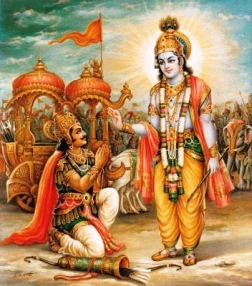
In the Gita’s Ninth Chapter Lord Krsna categorically advises Arjuna to surrender to Him and to love and worship Him only. He specifically uses the Sanskrit word mam, meaning “unto Me.” Yet one commentator, a renowned Indian philosopher and political leader, begins his commentary on this crucial verse, “It is not to Krsna that we have to surrender…” It is very clear that Krsna and Arjuna are standing on the Battlefield of Kuruksetra and that Krsna is telling Arjuna to surrender unto Him. But this scholar wants to turn the reader away from Krsna by insidiously implying that Krsna actually means to surrender to the eternal unmanifested essence within Himself. But Krsna didn’t say this. Significantly, Srila Prabhupada entitles his comments “purports,” not interpretations. In his purports he gives the actual significance of the verses. Srila Prabhupada informs all deluded scholars that because Krsna is absolute, there is no qualitative difference between His within and His without as there is with conditioned living entities like ourselves.
rudantam–crying; muhuḥ–again and again; netra-yugmam–His two eyes; mṛjantam–rubbing; kara-ambhoja-yugmena–with His two lotus-like hands; sa-ātańka-netram–with very fearful eyes; muhuḥ–again and again; śvāsa–quick breathing and sighing; kampa–trembling; tri-rekhaańka-kaṇṭha–neck marked with three lines (just like a conchshell); sthita–situated; graiva–pearl necklaces and other neck-ornaments; dāma-udaram–unto He with a rope around His belly; bhakti-baddham– who is bound by devotion.
2) Upon seeing His mothers whipping stick, He cried and rubbed His eyes again and again with His two lotus hands. His eyes were fearful and His breathing quick, and as Mother Yasoda bound His belly with ropes, He shivered in fright and His pearl necklace shook. To this Supreme Lord, Sri Damodara, who is bound with His devotee’s love, I offer my humble obeisances.
Purport
The second verse continues describing the lila-visesa. He is crying (rudantam) because He sees the stick in Mother Yasoda’s hand. Perceiving that she may strike Him, He appears fearful, hoping her natural empathy may save Him from punishment. Due to fear, tears are forming in His eyes, so He rubs his eyes with his lotus-like hands in the normal manner of children to wipe away the tears that are beginning to flow.
Then (satanka-netram) His fearful eyes reveal how much He is dreading punishment. It also indicates His glancing here and there in great fear, trying to avoid being punished. The confidential pastime is revealed in this way. Therefore, due to his continual sobbing He is trembling, (muhuh svasa-kampa) and thus, (sthita-graiva) the pearl necklaces and earrings that adorn Him are also shaking.
Chanting Hare Krishna
By His Divine Grace A.C. Bhaktivedanta Swami Prabhupada
Founder-Acarya of the International Society for Krishna Consciousness
“In the sastra it is said this Kali-yuga is full of faults, so many faults. It is the ocean of faults. But there is a very nice thing, asti hy eko mahan gunah, a very great quality. What is that? Kirtanad eva krsnasya mukta-sangah param vrajet [SB 12.3.51]. If you simply chant Hare Krishna mantra, then you become perfect. Is it very difficult? Chant Hare Krishna and you become perfect. But we are so unfortunate, we are not even prepared to chant. This is our position. So you have to make little determination that ‘I shall chant henceforward Hare Krishna mantra.’ Then everything is all right.“
This will be an eight part series, with an explanation on each of the eight verses of the Sri Damodarastakam, given by Visnujana Swami. This eight sloka prayer is sung morning and evening during the month of Damodara, and which began today.
Sri Damodarastakam as explained by Visnujana Swami
namāmi–I bow down; īśvaram–to the supreme controller; sat-cit-ānandarūpam–whose form is composed of eternity, knowledge and bliss; lasatkuṇḍalam–whose earrings play and swing; gokule bhrājamānam–who is splendrously manifest in Gokula; yaśodā-bhiyā–in fear of mother Yaśodā; ulūkalāt-dhāvamānam–who gets down from the wooden ricegrinding mortar and runs away; para-āmṛṣṭam–catching Him by the back; atyam–very much; tatam drutya–chasing after Him quickly; gopyā–by the gopī (Srī Yaśodā).
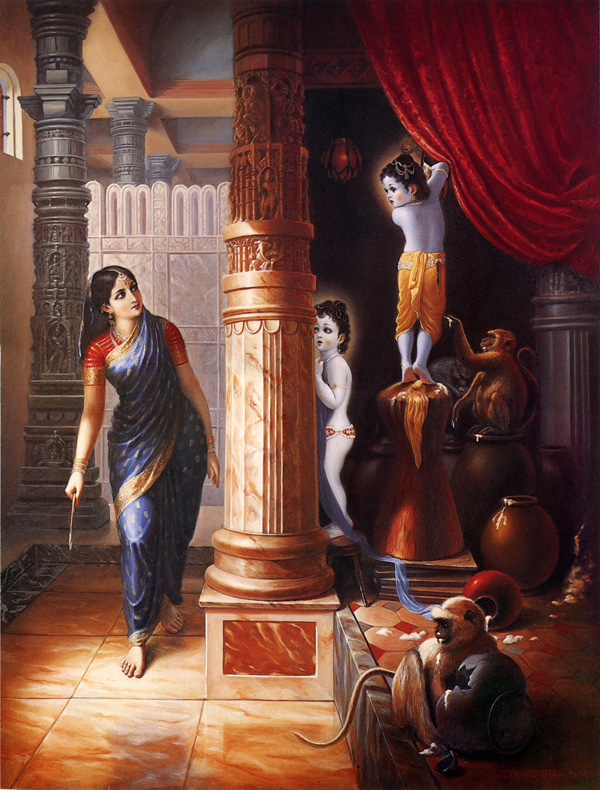
1) To the supreme controller who possesses an eternal form of blissful knowledge, whose glistening earrings swing to and fro, who manifested Himself in Gokula, who stole the butter that the gopis kept hanging from the rafters of their storerooms and who then quickly jumped up and ran in retreat in fear of Mother Yasoda, but was ultimately caught. To that Supreme Lord, Sri Damodara, I offer my humble obeisances.
Purport
The specific attributes of the Absolute Truth of the Lord, tattva-visesa, are addressed first. Satyavrata Muni begins with the offering of obeisances (namami) as an auspicious invocation, mangalacarana. He invokes the mercy of Lord Damodara to empower him to offer this prayer by the word isvara, the supreme controller. It also indicates that the Supreme Lord alone is worthy of the highest praise. It further implies the specific nature of devotional service, bhakti. The Lord manifests Himself in a form that embodies eternal existence, knowledge, and bliss. Thus, His supreme sovereignty is established.
The attribute of His enchanting beauty, rupa visesa, is described next. As He runs from Mother Yasoda, His earrings begin to swing back and forth lasat-kundalam. The earrings naturally sport upon His cheeks as He plays in the courtyard of Mother Yasoda. All the ornaments that adorn the Lord have become super-excellent by contact with His divine body, yet these earrings have attained superiority overall by the great fortune of constantly kissing His divine cheeks while swinging. They are glistening (lasanti) due to being enriched with the effulgence from the Lord’s complexion.
Uddhava describes Krishna’s beauty as so supremely enchanting that His transcendental body is the ornament of all ornaments.
Only in Gokula does Krishna display His most splendid pastimes that surpass all other manifestations of His excellence (gokule bhrajamanam) The word, gokule, indicates the place where cows and cowherds reside. The attributes of His family, parivara-visesa, thus further portray His unique excellence.
The last two lines of the verse describe the lila-visesa, the attributes of His excellent pastime as the butter thief. In fear of Mother Yasoda (yasoda-bhiya) He quickly runs away dhavamanam) from the mortar (ulukalat). Then, she also runs very swiftly (atyantato drutya).
“Krishna, at that time, was sitting on an upside-down wooden mortar for grinding spices and was distributing milk preparations, such as yogurt and butter, to the monkeys as He liked. Because of having stolen, He was looking all around with great anxiety, suspecting that He might be chastised by His mother. Mother Yasoda, upon seeing Him, very cautiously approached Him from behind. When Lord Sri Krishna saw His mother, stick in hand, He very quickly got down from the top of the mortar and began to flee as if very much afraid. Although yogis try to capture Him as Paramatma by meditation, desiring to enter into the effulgence of the Lord with great austerities and penance, they fail to reach Him. But Mother Yasoda, thinking that same Personality of Godhead Krishna, to be her son, began following Krishna to catch Him.













 The Hare Krishna Movement