When we speak of yoga we refer to linking up our consciousness with the Supreme Absolute Truth. Such a process is named differently by various practitioners in terms of the particular method adopted. When the linking up process is predominantly in fruitive activities, it is called karma-yoga, when it is predominantly empirical, it is called jñāna-yoga, and when it is predominantly in a devotional relationship with the Supreme Lord, it is called bhakti-yoga. Bhakti-yoga or Kṛṣṇa consciousness is the ultimate perfection of all yogas, as will be explained in the following verse.
And of all yogīs, he who always abides in Me with great faith, worshiping Me in transcendental loving service, is most intimately united with Me in yoga and is the highest of all. (Bhagavad-gita 6.47)
The culmination of all kinds of yoga practices lies in bhakti-yoga. All other yogas are but means to come to the point of bhakti in bhakti-yoga. Yoga actually means bhakti-yoga; all other yogas are progressions toward the destination of bhakti-yoga. From the beginning of karma-yoga to the end of bhakti-yoga is a long way to self-realization. Karma-yoga, without fruitive results, is the beginning of this path. When karma-yoga increases in knowledge and renunciation, the stage is called jñāna-yoga. When jñāna-yoga increases in meditation on the Supersoul by different physical processes, and the mind is on Him, it is called aṣṭāṅga-yoga. And, when one surpasses the aṣṭāṅga-yoga and comes to the point of the Supreme Personality of Godhead Kṛṣṇa, it is called bhakti-yoga, the culmination. Factually, bhakti-yoga is the ultimate goal, but to analyze bhakti-yoga minutely one has to understand these other yogas. The yogī who is progressive is therefore on the true path of eternal good fortune. One who sticks to a particular point and does not make further progress is called by that particular name: karma-yogī, jñāna-yogī or dhyāna-yogī, rāja-yogī, haṭha-yogī, etc. If one is fortunate enough to come to the point of bhakti-yoga, it is to be understood that he has surpassed all the other yogas. Therefore, to become Kṛṣṇa conscious is the highest stage of yoga, just as, when we speak of Himalayan, we refer to the world’s highest mountains, of which the highest peak, Mount Everest, is considered to be the culmination.
I have read and re-read this chapter many times this election year, and this is a perfect description on the demoniac man.
dambho darpo ’bhimānaś ca krodhaḥ pāruṣyam eva ca ajñānaṁ cābhijātasya pārtha sampadam āsurīm
dambhaḥ—pride; darpaḥ—arrogance; abhimānaḥ—conceit; ca—and; krodaḥ—anger; pāruṣyam—harshness; eva—certainly; ca—and; ajñānam—ignorance; ca—and; abhijātasya—one who is born; pārtha—O son of Pṛthā; sampadam—nature; āsurīm—demoniac.
Arrogance, pride, anger, conceit, harshness and ignorance—these qualities belong to those of demonic nature, O son of Pṛthā. (Bg 16.4)
In this verse, the royal road to hell is described. The demoniac want to make a show of religion and advancement in spiritual science, although they do not follow the principles. They are always arrogant or proud in possessing some type of education or so much wealth. They desire to be worshiped by others, and demand respectability, although they do not command respect. Over trifles they become very angry and speak harshly, not gently. They do not know what should be done and what should not be done. They do everything whimsically, according to their own desire, and they do not recognize any authority. These demoniac qualities are taken on by them from the beginning of their bodies in the wombs of their mothers, and as they grow they manifest all these inauspicious qualities. (From purport to Bg. 16.4)
The demoniac man knows no limit to his desire to acquire money. That is unlimited. He only thinks how much assessment he has just now and schemes to engage that stock of wealth farther and farther. For that reason, he does not hesitate to act in any sinful way and so deals in the black market for illegal gratification. He is enamoured by the possessions he has already, such as land, family, house and bank balance, and he is always planning to improve them…
One of the most used books in our temple room is the songbook. Everyday it seems, I am flipping through the “Songs of the Vaisnava Acaryas”, singing one of the many songs or reciting some of the numerous pranams (prayers) as part of my daily sadhana. The following post is the first 13 pages of songbook, which in my mind is a nice way to start the day and is a good prelude to other devotional service.
Pranams from the Songs of the Vaisnava Acaryas
SRI GURU PRANAMA
om ajnana-timirandhasya jnananjana-salakaya caksur unmilitam yena tasmai sri-gurave namah
om-address; ajnana-of ignorance; timira-by the darkness; andhasya-of one who was blinded; jnana-anjana-by the ointment of spiritual knowledge; salakaya-by a medical instrument called a salaka, which is used to apply medical ointment to eyes afflicted with cataracts: caksuh-eyes; unmilitam-were opened; yena-by whom; tasmai-unto him; sri-gurave-unto my spiritual master; namah-obeisances.
I offer my respectful obeisances unto my spiritual master, who has opened my eyes, which were blinded by the darkness of ignorance, with the torchlight of knowledge.
SRI RUPA PRANAMA
sri-caitanya-mano-‘bhistam sthapitum yena bhtu-tale svayam rupah kada mahyam dadati sva-padantikam
sri-caitanya-of Lord Caitanya; manah- mind; abhistam-what is desired; sthapitam-established; yena-by whom; bhu-tale-on the surface of the globe; svayam-himself; rupah-Srila Rupa Gosvami; kada-when; mahyam-unto me; dadati-will give; sva-his own; pada-lotus feet; antikam-proximity to.
When will Srila Rupa Gosvami Prabhupada, who has established within this material world the mission to fulfill the desire of Lord Caitanya, give me shelter under his lotus feet?
MANGALACARANA
vande ‘ham sri-guroh sri-yuta-pada-kamalam sri-gurun vaisnavams’ ca sri-rupam sagrajatam saha-gana-raghunathanvitam tam sa jivam sadvaitam savadhutam parijana-sahitam krsna-caitanya-devam sri-radha-krsna-padan saha-gana-lalita-sri-visakhanvitams’ ca
vande–offer my respectful obeisances; aham–I; sri-guroh–of my spiritual master; sri-yuta-pada-kamalam–unto the lotus feet; sri-gurun–unto the spiritual masters; vaisnavan–unto all the Vaisnavas; ca–and; sri-rupam–unto Srila Rupa Gosvami; sa-agra-jatam–with his elder brothers Sri Sanatana Gosvami; saha-gana-raghunatha-anvitam–with Raghunatha Dasa Gosvami and his associates; tam–unto him; sajivam–with Jiva Gosvami; sa- advaitam–with Advaita Acarya; sa-avadhutam–with Nityananda Prabhu; parijana-sahitam–and with Srivasa Thakura and all the other devotees; krsna-caitanya-devam–unto Lord Sri Caitanya Mahaprabhu; sri-radha-krsna-padan–unto the lotus feet of Radha and Krsna, saha-gana–with associates; lalita-sri-visakha-anvitan–accompanied by Lalita and Sri Visakha; ca–also.
“I offer my respectful obeisances unto the lotus feet of my spiritual master and unto the feet of all Vaisnavas. I offer my respectful obeisances unto the lotus feet of Srila Rupa Gosvaml, along with his elder brother Sanatana Gosvami, as well as Raghunatha Dasa , Raghunatha Bhatta, Gopal Batta and Srila Jiva Gosvami. I offer my respectful obeisances to Lord Sri Caitanya Mahaprabhu and Lord Nityananda along with Advaita Acarya, Gadadhara, Srivasa, and other associates. I offer my respectful obeisances to Srimati Radharani and Sri Krsna along with Their associates Sri Lalita and Visakha.”
Most of us have an understanding of “The age of Kali”. There is a nice article at the bottom of this post taken fro Back to Godhead Magizine, wherein Srila Prabhupada lectures on the “Predictions for the Age of Hypocrisy” But an interesting post appeared on Facebook recently, “How Can Kali Destroy ISKCON”, posted by Govinda dasi we share with you.
tatas canu-dinam dharmah satyam saucam ksama daya kalena balina rajan nanksyaty ayur balam smrtih
“My dear King, with each day religion, truthfulness, cleanliness, forgiveness, mercy, duration of life, bodily strength, and memory will all decrease more and more by the mighty force of time.” (Srimad-Bhagavatam 12.2.1)
So here Sukadeva Gosvami is describing the chief symptoms of this age. He says, tatas canudinam: with the progress of this age (Kali-yuga), dharma, religious principles; satyam, truthfulness; saucam, cleanliness; ksama, forgiveness; daya, mercifulness; ayur, duration of life; balam, bodily strength; smrti, memory—these eight things will gradually decrease to nil or almost nil.
How Can Kali Destroy ISKCON
We have heard it all about how Kali entered ISKCON. Here is a detailed, crystal-clear analysis from my good friend. Remember, where there is a disease, there is a cure, which Srila Prabhupada prescribed: “Your love for me will be shown by how you cooperate with one another.” and all its auxiliaries. And don’t say that because it’s AI, it is not valid. Then stay ignorant. Note this. AI gives solid, substantial research of available sources and spits out realized instructions that you will not hear from, adored by the ordinary public, esteemed and prominent preachers, who at best have nothing to say, talk trash, or worse, go against Srila Prabhupada in a covert way.
My question to AI: If you would be the demon Kali how would you destroy ISKCON?
Answer: In Hindu eschatology, the demon Kali (the personification of the Kali-yuga) does not destroy through brute force or external warfare. Kali’s power lies in Dharma-vyadha—the corruption of righteousness from within.
If I were to approach this from the perspective of that archetypal energy, the strategy to dismantle an organization like ISKCON would not be to attack it, but to “poison the roots” by encouraging the four specific vices Kali resides in, as described in the Srimad Bhagavatam.
According to the texts, Kali resides where there is: gambling, intoxication, illicit sex, and animal slaughter. To destroy a spiritual movement, Kali would work to subtly integrate these or their psychological equivalents into the structure:
1. The Corruption of “Truth” (Gambling)
I would encourage intellectual gambling. This means moving away from the “Absolute Truth” of the shastra (scriptures) and instead fostering speculation and corporate politics. By making the leadership more concerned with “winning” organizational power struggles than with spiritual realization, the internal trust—the glue of the movement—would dissolve into suspicion.
2. The Loss of “Austerity” (Intoxication)
I wouldn’t use drugs; I would use the intoxication of prestige. I would make the followers drunk on the idea of being “chosen” or “spiritually superior.” When pride takes over, austerity (the discipline of the mind and senses) vanishes. A movement that seeks fame (pratistha) more than purity is already hollowed out.
3. The Loss of “Cleanliness” (Illicit Connection)
I would foster hypocrisy. By creating a culture where external appearance is strictly monitored but internal struggles are buried in shame, I would create a pressure cooker. When scandals are covered up rather than addressed with “cleanliness” (honesty and accountability), the moral authority of the movement collapses in the eyes of the public and the youth.
4. The Loss of “Mercy” (Cruelty)
I would replace compassion with bureaucracy. I would make the institution so rigid and focused on “rules” and “management” that it forgets to be merciful to its members. When the devotees feel like cogs in a machine rather than souls being cared for, they will naturally drift away, feeling spiritually starved.
The Ultimate Weapon: Internal Strife
In the Puranas, Kali’s greatest success is Bheda (division).
The Strategy: Split the organization into “liberal” and “conservative” camps.
The Result: Instead of chanting the names of God, they would spend their energy arguing with each other on the internet.
The “Kali-yuga” way to destroy ISKCON is simply to wait for it to forget its essence and become just another worldly business.
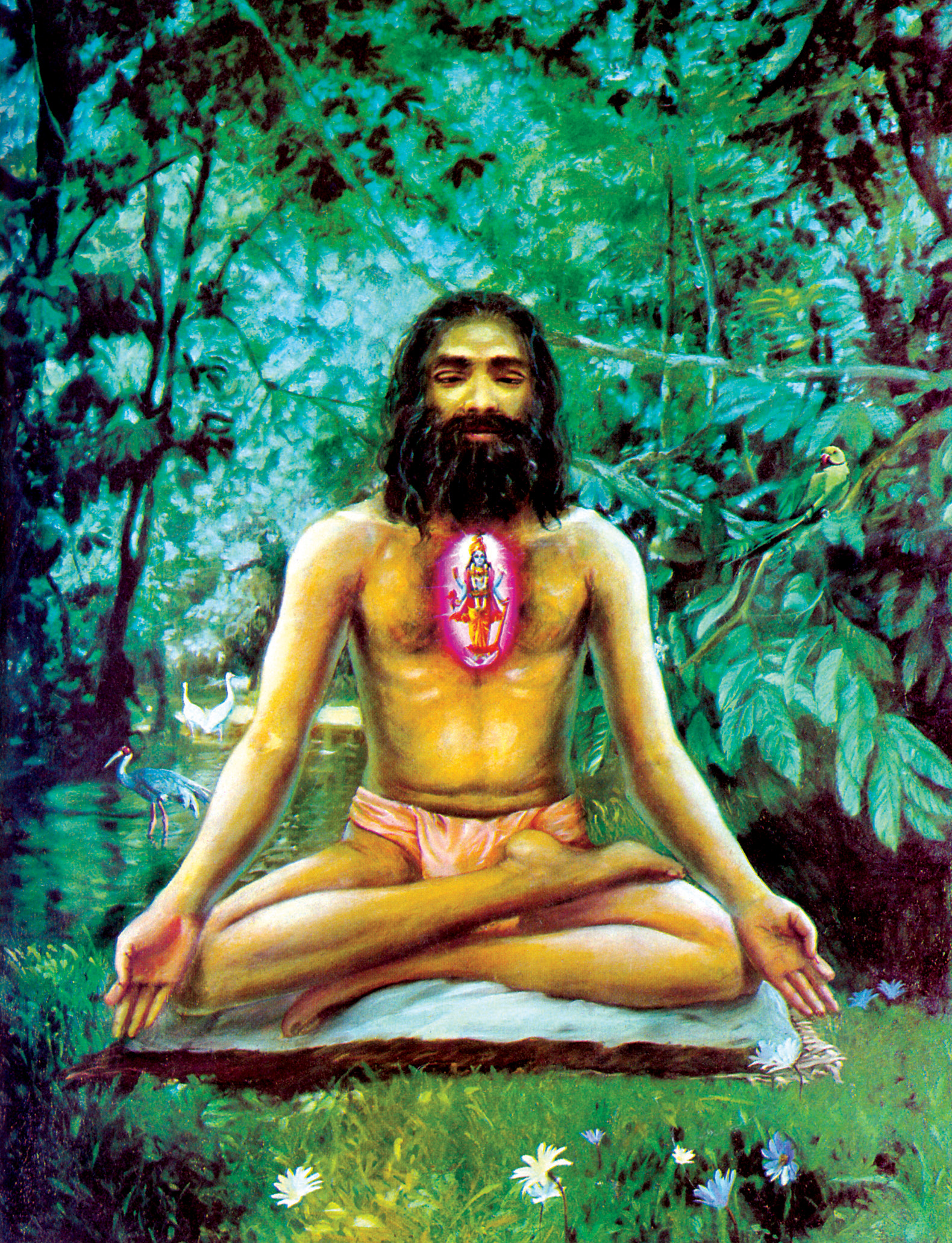
sarva-bhūta-stham—situated in all beings; ātmānam—the Supersoul; sarva—all; bhūtāni—entities; ca—also; ātmani—in the Self; īkṣate—does see; yoga-yukta-ātmā—one who is dovetailed in Kṛṣṇa consciousness; sarvatra—everywhere; sama-darśanaḥ—seeing equally.
TRANSLATION A true yogī observes Me in all beings, and also sees every being in Me. Indeed, the self-realized man sees Me everywhere.
PURPORT
A Kṛṣṇa conscious yogī is the perfect seer because he sees Kṛṣṇa, the Supreme, situated in everyone’s heart as Supersoul (Paramātmā).
Īśvaraḥ sarva-bhūtānāṁ hṛd-deśe ’rjuna tiṣṭhati.
The Supreme Lord is situated in everyone’s heart, O Arjuna, and is directing the wanderings of all living entities.
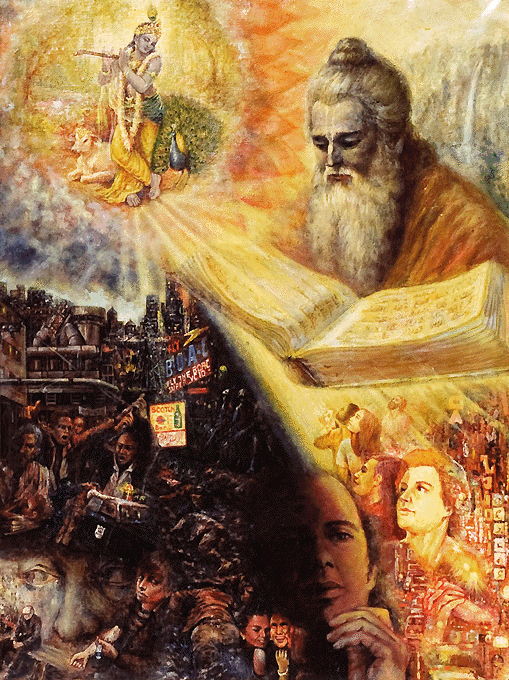
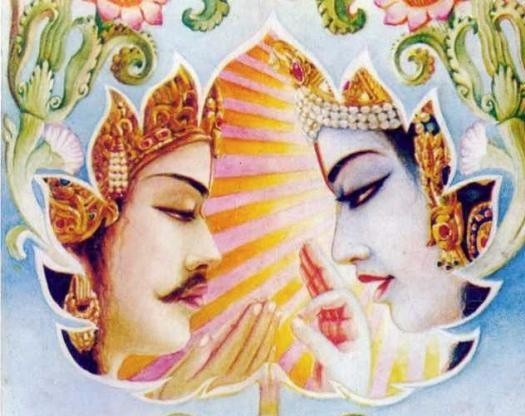
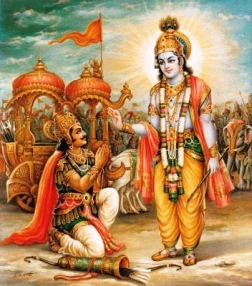
Whenever I think about the Bhagavad-gita, this image comes to mind. It is the “Song of God”, the words spoken by the Supreme Personality of Godhead to His dear friend and disciple Arjuna.
Bhagavad-gītā As It Is 1972 Edition By His Divine Grace A. C. Bhaktivedanta Swami Prabhupāda Chapter Ten, Text 12-13
Arjuna said: You are the Supreme Brahman, the ultimate, the supreme abode and purifier, the Absolute Truth and the eternal divine person. You are the primal God, transcendental and original, and You are the unborn and all-pervading beauty. All the great sages such as Nārada, Asita, Devala, and Vyāsa proclaim this of You, and now You Yourself are declaring it to me.
PURPORT
In these two verses the Supreme Lord gives a chance to the modern philosopher, for here it is clear that the Supreme is different from the individual soul. Arjuna, after hearing the essential four verses of Bhagavad-gītā in this chapter, became completely free from all doubts and accepted Kṛṣṇa as the Supreme Personality of Godhead. He at once boldly declares, “You are Parambrahma, the Supreme Personality of Godhead.” And previously Kṛṣṇa states that He is the originator of everything and everyone. Every demigod and every human being is dependant on Him. Men and demigods, out of ignorance, think that they are absolute and independant of the Supreme Lord Kṛṣṇa. That ignorance is removed perfectly by the discharge of devotional service. This is already explained in the previous verse by the Lord. Now by His grace, Arjuna is accepting Him as the Supreme Truth, in concordance with the Vedic injunction. It is not because Kṛṣṇa is an intimate friend of Arjuna that he is flattering Him by calling Him the Supreme Personality of Godhead, the Absolute Truth. Whatever Arjuna says in these two verses is confirmed by Vedic truth. Vedic injunctions affirm that only one who takes to devotional service to the Supreme Lord can understand Him, whereas others cannot. Each and every word of this verse spoken by Arjuna is confirmed by Vedic injunction.
People often think that The Hare Krishna Movement (ISKCON) is a Hindu Religion, but it is not. Sometime back in 1968, one reporter asked Srila Prabhupada, “What is this Hare Krishna Movement?”. Srila Prabhupada replied: “We are not a buissness , we are not a Religion”.
…I am not very interested to establish a Hindu temple. Perhaps you know from the very beginning I never described my movement as Hindu religion. Religion means the bona fide process by which we understand God and the first class religion is that which teaches people to develop love for God. To know or accept the authority of God is one thing, but to love God is another. Generally, people are interested in material comforts and they make God as the supplying agent. This kind of devotion is not purified. It is contaminated by material desires, but when one is elevated to the position of giving everything to God out of love and affection, that is the first class position. We are teaching this philosophy in the name of Krishna Consciousness, and it is applicable to all sober persons. The Bhagavat principle is that because we can be happy simply by developing our dormant love of God, this is our first business. (Letter to: Mukunda June 3, 1969)
In the eighteenth Chapter of Bhagavad-gita, Lord Krishna in conclusion states:
Abandon all varieties of religion and just surrender unto Me. I shall deliver you from all sinful reaction. Do not fear. (Bg 18.66)
PURPORT
The Lord has described various kinds of knowledge, processes of religion, knowledge of the Supreme Brahman, knowledge of the Supersoul, knowledge of the different types of orders and statuses of social life, knowledge of the renounced order of life, knowledge of nonattachment, sense and mind control, meditation, etc. He has described in so many ways different types of religion. Now, in summarizing Bhagavad-gītā, the Lord says that Arjuna should give up all the processes that have been explained to him; he should simply surrender to Kṛṣṇa. That surrender will save him from all kinds of sinful reactions, for the Lord personally promises to protect him.
Food prepared for and offered to Krishna with love and devotion becomes completely spiritualized. Such food is called Krishna prasadam, which means “the mercy of Lord Krishna.”
Lord Caitanya said of prasadam…”now that they have been prepared for Krishna and offered to Him with devotion, these foods have acquired extraordinary tastes and uncommon fragrances. Just taste them and see the difference! Apart from the taste, even the fragrance pleases the mind and makes one forget any other fragrance. Therefore, it should be understood that the spiritual nectar of Krishna’s lips must have touched these ordinary foods and imparted to them all their transcendental qualities.”
Eating only food offered to Krishna is the perfection of vegetarianism. In the Bhagavad-gita Lord Krishna says that unless one eats only food that has been offered to Him in sacrifice, one will suffer the reactions of karma. He also states, “If one offers Me with love and devotion a leaf, a flower, a fruit, or water, I will accept it.”
Wwe can offer Krishna foods prepared from milk products, vegetables, fruits, nuts, and grains. Meat, fish and eggs are not offerable. And a few vegetarian items are also forbidden— garlic and onions, for example, which are in the mode of darkness. (Hing, or asafoetida, is a tasty substitute for them in cooking.) Nor can you offer Krishna coffee or tea.
In preparing food, cleanliness is the most important principle. Nothing impure should be offered to God, so keep your kitchen very clean. Always wash your hands thoroughly before entering the kitchen. While preparing food, do not taste it, for you are cooking the meal not for yourself but for the plea¬sure of Krishna. Arrange positions of the food on dinnerware kept especially for this purpose; no one but the Lord should eat from these dishes. The easiest way to offer food is simply to pray, “My dear Lord Krishna, please accept this food,” and to chant each of the following prayers three times while ringing a bell.
With all this cold weather, I have been spending more time in the kitchen. Instead of the quick meal that often took place after a long days work, we are finding renewed pleasure in going through our vegetarian cookbooks and planning nice well balanced meals. One thing we have been eating more of is chapatis. They go well with almost every vegetable dish, are easy to prepare, and are a healthy alternative to bread which usually contains yeast.
From The Hare KRSNA Cookbook 1972
Basic Chapati 1 cup Whole Weat Flour 1/4 cup Melted Butter Warm water
Mix the flour and water together, adding water gradually until dough is soft but not wet, and can be kneaded. Knead the dough until it’s fairly soft (8 to 10 minutes). Cover and let dough rest for one hour. Sprinkle flour on rolling area and makes 1-1/2 inch balls out of dough. Flatten balls and roll out to about 4-5″ diameter. Place the chapati on a heated skillet (dry, free from oil) and cook until bubbles appear. Turn chapati quickly and let cook until bubbles appear again. Using tongs, remove chapati from pan, and hold over an open flame or burner to make it puff up. Heat it first on the side that was first cooked. You can lay directly on the burner for a brief moment, but don’t let it stick. When chapati puffs up, turn quickly and repeat on other side till it puffs. Remove, butter both sides, and cover with a clean cloth to keep in heat while remaining chapatis are cooked.
This is a nice Study Guide on the Bhagavad-gita As It Is. It begins with the Introduction to the Bhagavad-gita, some notes on the Original Edition, the significance of the Bhagavad-gita, a philosophical synopsis, chapter by chapter summary, Q & A, and a suguested teaching syllabus. All in all ,a very nice presentation prepared by disciples and followers of His Divine Grace A. C. Bhaktivedanta Swami Prabhupada.
We are offing it here as a free pdf download that you can view, save or print, by clicking on the following link:
Today we celebrate the Appearance of Srila Bhaktisiddhanta Saraswati Thakura, the son of Srila Bhaktivinoda Thakura, and Spiritual Master of our Srila Prabhupada. We will honor it with a half day fast, rememberances and readings. I happened upon the following post some years ago on the Sampradaya Sun, and because it was so nicely assembled, we will share it with you here today.
The Appearance of Srila Bhaktisiddhanta by Sun Staff CANADA (SUN)
Srila Bhaktisiddhanta Saraswati Thakura appeared in Purusottam Ksetra, Jagannatha Puri, Orissa, on February 6, 1874. He was born in the family home next to the Narayan-chhata of Sri Jagannatha Temple, which always reverberated with the chanting of the Holy Name. Named Bimala Prasad, He was the fourth son of Srila Bhaktivinoda Thakura and Srimati Bhagavati Devi.
By the age of twelve, Bhaktisiddhanta Sarasvati was well versed in astronomy. Hearing news of this, Srila Jagannatha dasa Babaji summoned him one day and instructed him to make a Vaisnava calendar that included the appearance and disappearance days of all Lord Caitanya Mahaprabhu’s and Visnupriya Thakurani’s associates. Following these instructions, Srila Bhaktisiddhanta Sarasvati made the necessary calculations and began publication of “Sri Nabadvipa Panjica”.
Excerpted from Back to Godhead Magazine 1975 Vol. 10 No. 2
Five hundred years ago, Sri Krsna, the Supreme Personality of Godhead, appeared in West Bengal in the role of His own pure devotee—Sri Krsna Caitanya Mahaprabhu. Lord Caitanya is considered the most munificent incarnation of Godhead because He made love for Krsna easily available through the chanting of the maha-mantra—Hare Krsna, Hare Krsna, Krsna Krsna, Hare Hare/ Hare Rama, Hare Rama, Rama Rama, Hare Hare.
When Lord Krsna appeared as Lord Caitanya, His principal associate in spreading the Krsna consciousness movement was Lord Nityananda Prabhu. Lord Nityananda is Lord Caitanya’s expansion. In other words, He is nondifferent from Lord Caitanya. The same Supreme Lord appeared in different forms—as Lord Caitanya and Lord Nityananda—to bestow mercy upon the fallen souls of the material world. This song, therefore, describes the benefits of taking shelter of Lord Nityananda Prabhu.
Srila Narottama dasa Thakura was a great devotee and spiritual master in the disciplic chain coming down from Lord Caitanya. He has written many songs, and they are recognized as authoritative by all Krsna conscious devotees. He sang these songs in simple Bengali language, but the purport—the deep meaning of his songs—is very significant. His Divine Grace A.C. Bhaktivedanta Swami Prabhupada has therefore explained many of these songs in English and taught them to his disciples. (Cassette recordings of Srila Prabhupada singing and explaining these songs are available from Golden Avatar Productions in Los Angeles.)
…Sometimes an ever-liberated personal associate of the Supreme Personality of Godhead descends into this universe just as the Lord descends. Although working for the liberation of conditioned souls, the messenger of the Supreme Lord remains untouched by the material energy. Generally ever-liberated personalities live in the spiritual world as associates of Lord Kṛṣṇa, and they are known as kṛṣṇa-pāriṣada, associates of the Lord. Their only business is enjoying Lord Kṛṣṇa’s company, and even though such eternally liberated persons come within this material world to serve the Lord’s purpose, they enjoy Lord Kṛṣṇa’s company without stoppage. The ever-liberated person who works on Kṛṣṇa’s behalf enjoys Lord Kṛṣṇa’s company through his engagement.
… The conditioned soul subjected to the threefold material miseries is ceaselessly kicked by māyā, and this is his disease. If by chance he meets a saintly person who works on Kṛṣṇa’s behalf to deliver conditioned souls, and if he agrees to abide by his order, he can gradually approach the Supreme Personality of Godhead, Kṛṣṇa.(from purport to Madhya-lila 22.14-15)
The following article I found very interesting. It is very informative, and is worth reprinting here.
The Samurai: Protectors of the Cow by Jahnava Nitai das
If I were to tell you, that once, no other country, save India, revered the cow as much as Japan, I could understand your disbelief. Today, we think of Japan as a meat-eating culture. However, this image is a product of the last 150 years of American influence. The traditional Japanese culture held the cow as the most sacred animal. What follows next is the true story of among the greatest protectors of the cow – the Samurai.
In The Footsteps Of The Buddha
When Buddhism left India for the Far East it had a profound influence on all of the countries it encountered including China, Korea and Japan. Buddhism entered Japan around the year 552 A.D. In April 675 A.D. the Japanese Emperor Tenmu banned the consumption of all meat from four legged animals including cows, horses, dogs, and monkeys, as well as domestic birds such as chickens and roosters. Each succeeding emperor would periodically reinforce this ban until by the 10th Century all meat eating had been eliminated.
In mainland China and Korea the Buddhist monks adhered to the principle of ‘ahimsa’ or non-violence in their eating habits but theses strictures were not placed on the population as a whole. In Japan, however, the Emperor was very strict in guiding his subjects towards the Buddha’s teachings of non-violence. The killing of mammals was considered extremely sinful, birds moderately sinful, and fish somewhat sinful. The Japanese did eat whale, which today we know are mammals, but at the time were considered very large fish.
The Japanese also made a distinction between animals reared in the household and wild animals. To kill a wild animal such as a bird was sinful. However, to kill an animal raised from birth was considered abominable – tantamount to killing a member of the family. As such, the diet of the Japanese was mostly rice, noodles, fish, and on occasion wild fowl.
Last night as I was falling asleep, this prayer just popped into my head:
SRI RUPA PRANAMA
sri-caitanya-mano-‘bhistam sthapitum yena bhtu-tale svayam rupah kada mahyam dadati sva-padantikam
sri-caitanya-of Lord Caitanya; manah– mind; abhistam-what is desired; sthapitam-established; yena-by whom; bhu-tale-on the surface of the globe; svayam-himself; rupah-Srila Rupa Gosvami; kada-when; mahyam-unto me; dadati-will give; sva-his own; pada-lotus feet; antikam-proximity to.
When will Srila Rupa Gosvami Prabhupada, who has established within this material world the mission to fulfill the desire of Lord Caitanya, give me shelter under his lotus feet?
And as I drifted off to sleep I was thinking about Srila Rupa Goswami, I don’t know why. But I woke still thinking about him. The following is an article from Back to Godhead Magizine.
Obstacles on the Path of Eternity An Excerpt from Srila Rupa Gosvami’s Upadesamrta from Back to Godhead Magazine Vol. 1, No.88, 1973
[SRILA RUPA GOSVAMI was one of six exalted devotees especially chosen through the Krsna conscious chain of spiritual masters to teach the devotional service of the Supreme Lord in a scientific manner. Although all of these six great devotees were erudite scholars and prolific writers, Srila Rupa Gosvami is the most prominent, for he most greatly appreciated the nectar of Krsna consciousness. His Upadesamrta (Nectarean Instructions), a short work of only eleven verses, teaches the basic principles for arousing one’s dormant love of Krsna, the Supreme Lord. Written in Sanskrit some 400 years ago, it has now been translated into English, with an illuminating explanation of each verse, by His Divine Grace A.C. Bhaktivedanta Swami Prabhupada.]
The following is one of the most quoted verses by Srila Prabhupada, from the Srimad Bhagavatam, and it is also one of the longest purports as well. Very important verse!
śrī-prahrādaḥ uvāca—Prahlāda Mahārāja said; śravaṇam—hearing; kīrtanam—chanting; viṣṇoḥ—of LordViṣṇu (not anyone else); smaraṇam—remembering; pāda-sevanam—serving the feet; arcanam—offering worship (with ṣoḍaśopacāra, the sixteen kinds of paraphernalia); vandanaṁ—offering prayers; dāsyam—becoming the servant; sakhyam—becoming the best friend; ātma-nivedanam—surrendering everything, whatever one has; iti—thus; puṁsā arpitā—offered by the devotee; viṣṇau—unto Lord Viṣṇu (not to anyone else); bhaktiḥ—devotional service; cet—if; nava-lakṣaṇā—possessing nine different processes; kriyeta—one should perform; bhagavati—unto the Supreme Personality of Godhead; addhā—directly or completely; tat—that; manye—I consider; adhītam—learning; uttamam—topmost.
Prahlāda Mahārāja said: Hearing and chanting about the transcendental holy name, form, qualities, paraphernalia and pastimes of Lord Viṣṇu, remembering them, serving the lotus feet of the Lord, offering the Lord respectful worship with sixteen types of paraphernalia, offering prayers to the Lord, becoming His servant, considering the Lord one’s best friend, and surrendering everything unto Him (in other words, serving Him with the body, mind and words)—these nine processes are accepted as pure devotional service. One who has dedicated his life to the service of Kṛṣṇa through these nine methods should be understood to be the most learned person, for he has acquired complete knowledge.
When Prahlāda Mahārāja was asked by his father to say something from whatever he had learned, he considered that what he had learned from his spiritual master was the best of all teachings…(from purport)
O son of Kuntī [Arjuna], I am the taste of water, the light of the sun and the moon, the syllable om in the Vedic mantras; I am the sound in ether and ability in man.(Bg 7.8)
“Water is our life. So when you take water, quench your thirst, you can immediately thank God because that taste is God. So immediately you can remember, “O my dear Lord, You have created so nice thing, water. Oh, I am so thirsty. It is quenching my thirst. Thank You.” Is it very difficult? But the nonsense, they will not do even this. They’ll say, “Oh, God is dead.” Therefore we are suffering. We are so ungrateful that we even do not give thanks. In the ordinary way, if somebody gives me a glass of water when I am thirsty—it is etiquette—I say, “Thank you.” And God has given us so vast mass of water in the ocean, in the sea, in the sky. Without water we cannot live. There is no thanksgiving. There is no thanksgiving.” (Śrīla Prabhupāda, 68/08/20 – Lecture SB 07.09.12-13 – Montreal)
Recently I was staying at a friends house, and in the room where I was spending the night there was one book by Giriraj Swami entitled “Watering the Seed”. I happened to open it and began reading from the Preface:
…from that first meeting with Srila Prabhupada, my whole life’s purpose became to bring people to meet Srila Prabhupada. And I was able to do that for many years. But when he passed away, I wondered ‘what will be my service now?’. My whole service had been to bring people to Srila Prabhupada.
Now I understand that Srila Prabhupada is always present, and that by speaking of him, hearing about him, remembering him, and, most significantly, by studying his books and following his instructions, we can experience his presence. So I can continue doing what I was doing when he was personally present-introducing soul’s to Srila Prabhupada-and that is what I feel most natural doing. Because I know that somehow or other, if someone comes in touch with Srila Prabhupada, his life will become successful. (Watering the Seed, Preface)
Now, I am always encouraged when I hear my Godbrothers speaking in this way, because this is how I have always felt, and continue to feel. That my main purpose, as a disciple, is to bring people to Srila Prabhupada, and there-by bringing them to Krishna.
Sometime ago, I ran across this wonderful web site Prabhupada.io. It has it all, images, text, conversations, lectures, letters, etc. It is truly an Archive of Srila Prabhupada’s Original unedited words. Highly Recommended!
Building a Sacred Digital Archive for the Next 10,000 Years
The path to creating Prabhupada.io began with a simple recognition: Srila Prabhupada’s teachings are not merely books—they are eternal law books that deserve preservation and accessibility for millennia to come.
The Vision: A True Digital Archive
What distinguishes a true digital archive from a mere collection of files? It requires, among other things:
Comprehensive indexing that reveals the interconnected web of spiritual knowledge
Clean, searchable source texts extracted with care from the original works
Intuitive navigation that serves both newcomers and scholars
Open accessibility that removes barriers between seekers and sacred wisdom
Future-proof architecture built to endure for generations
Question: How Many Persons are Benefitted from Book Distribution?…………
Prabhupada: Whoever gets a book is benefitted. If he reads the book he is benefitted still more, or if he gives the book to someone else for reading, both he and the other person is benefitted. Even if one does not read the book but simply holds if and sees it, he is benefitted. If he simply gives small donation towards the work of Krsna consciousness he is benefitted. And anyone who distributes these transcendental literatures, he is also benefitted. ( Letter to: German Disciples — Bombay May 6, 1977)













 The Hare Krishna Movement