17 Oct 2014
by The Hare Krishna Movement
in A.C. Bhaktivedanta Swami Prabhupada, Srila Prabhupada's Books, Srimad Bhagavatam
Tags: A.C. Bhaktivedanta Swami Prabhupada, Bhaktivedanta purports, brahmajyoti effulgence, Brhaspati, conditioned soul, intelligent man, Lord Brahma, Lord Siva, Maharaja Pariksit, material world, pure devotional service, SB 2.3, Sri Sukadeva Gosvami, Srimad Bhagavatam, threshold of death, Vedas
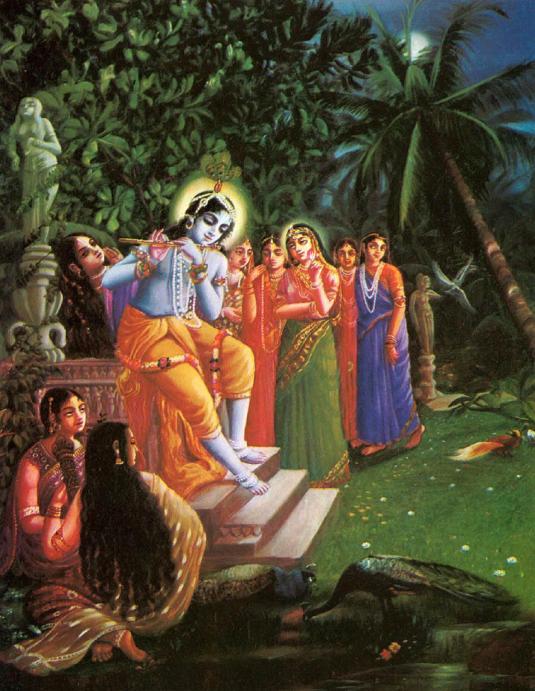
click on image to enlarge
As we continue to update our (one of our other sites) Śrīmad-Bhāgavatam by posting a chapter at a time, of that great literary work by His Divine Grace Srila Prabhupada, we will continue to share the progress with our readers here at The Hare Krishna Movement.
Śrīmad-Bhāgavatam
by His Divine Grace A. C. Bhaktivedanta Swami Prabhupāda
Canto 2, Chapter Three
Pure Devotional Service: The Change in Heart
More
16 Oct 2014
by The Hare Krishna Movement
in A.C. Bhaktivedanta Swami Prabhupada, B. G. Sharma Art, Kartika, KRSNA The Supreme Personality of Godhead
Tags: A. C. Bhaktivedanta Swami Pabhupada, Bakasura, bifurcate, bifurcated, bifurcating his mouth, cameli flower, cowherd boys, dakasura demon, denizens of the heavenly planets, drums and conchshells, Kamsa, Kartika, Krsna and Balarama, Krsna Book, Krsna The Supreme Personality of Godhead, month of Damodara, river yamuna, The Krishna Art of B. G. Sharma, vibration of bugles

So…continuining our month long attempt to stay focused on the childhood pastimes of Krsna, during this month of Damodara (Kartika), we bring you another exciting chapter from; Kṛṣṇa, the Supreme Personality of Godhead. Today we are posting the chapter entitled “Killing the Demons Vatsāsura and Bakāsura”.
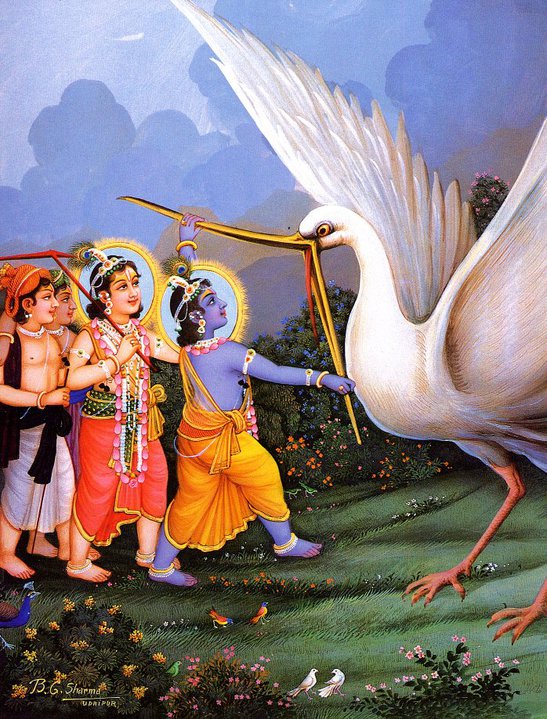
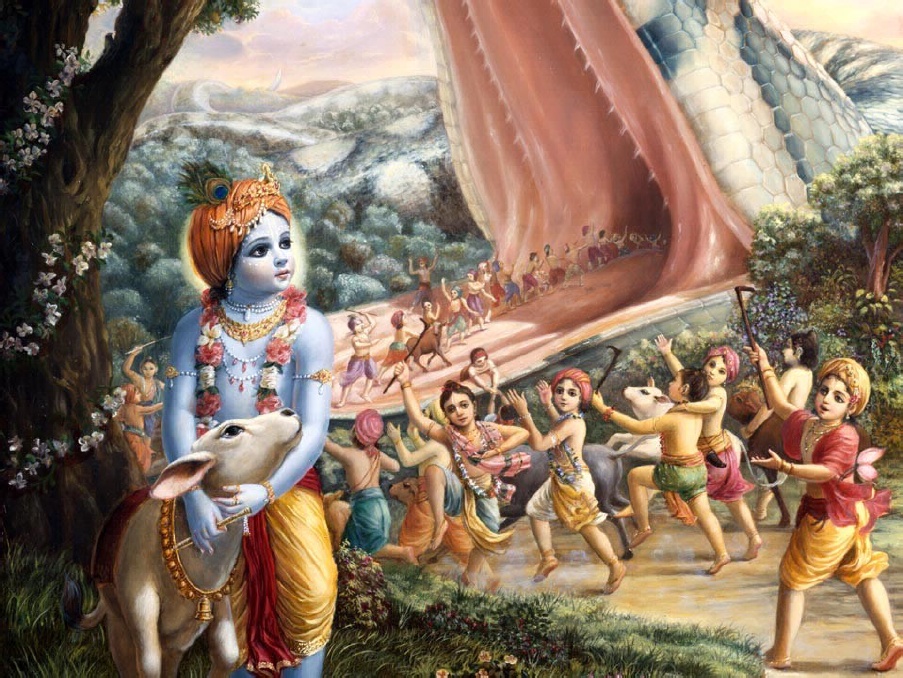
…All the cowherd boys would daily go to the bank of the river Yamunā to water their calves. Usually, when the calves drank water from the Yamunā, the boys also drank. One day, after drinking, when they were sitting on the bank of the river, they saw a huge animal which looked something like a duck and was as big as a hill. Its top was as strong as a thunderbolt. When they saw that unusual animal, they became afraid of it. The name of this beast was Bakāsura, and he was a friend of Kaṁsa’s. He appeared on the scene suddenly and immediately attacked Kṛṣṇa with his pointed, sharp beaks and quickly swallowed Him up. When Kṛṣṇa was thus swallowed, all the boys, headed by Balarāma, became almost breathless, as if they had died. But when the Bakāsura demon was swallowing up Kṛṣṇa, he felt a burning fiery sensation in his throat. This was due to the glowing effulgence of Kṛṣṇa. The demon quickly threw Kṛṣṇa up and tried to kill Him by pinching Him in his beaks. Bakāsura did not know that although Kṛṣṇa was playing the part of a child of Nanda Mahārāja, He was still the original father of Lord Brahmā, the creator of the universe. The child of mother Yaśodā, who is the reservoir of pleasure for the demigods and who is the maintainer of saintly persons, caught hold of the beaks of the great gigantic duck and, before His cowherd boy friends, bifurcated his mouth, just as a child very easily splits a blade of grass. From the sky, the denizens of the heavenly planets showered flowers like the cāmeli, the most fragrant of all flowers, as a token of their congratulations. Accompanying the showers of flowers was a vibration of bugles, drums and conchshells.
This description of Krishna killing the demon Bakasura by bifurcating his mouth, has always intriged me, and after years of hearing and reading this story I finially decided to look up the word bifurcate.
bi·fur·cate
verb
past tense: bifurcated; past participle: bifurcated
ˈbīfərˌkāt/
divide into two branches or forks.
“just below Cairo the river bifurcates”
(from Merriam Webster dictionary)
Full chapter More
14 Oct 2014
by The Hare Krishna Movement
in A.C. Bhaktivedanta Swami Prabhupada, Chanting Hare Krishna, The Hare Krishna Movement, Yoga
Tags: A.C. Bhaktiveanta Swami Prabhupada, chanting Hare Krishna, God realization, Hare Rama, Hari Kirtana, Kali-yuga, kirtan, sankirtan, self relization, supreme absolute truth, Vedic literatures, Visnu

harer nāma harer nāma
harer nāmaiva kevalam
kalau nāsty eva nāsty eva
nāsty eva gatir anyathā
In this Age of Kali there is no other means, no other means, no other means for self-realization than chanting the holy name, chanting the holy name, chanting the holy name of Lord Hari.
[Adi 17.21]
…
This hari-kīrtana was started five hundred years ago in Bengal by Lord Caitanya. In Bengal there is competition between the Vaiṣṇavas and the śāktas. The śāktas have introduced a certain type of kīrtana called kālī-kīrtana. But in the Vedic scriptures there is no recommendation of kālī-kīrtana. Kīrtana means hari-kīrtana. One cannot say, “Oh, you are Vaiṣṇava. You can perform hari-kīrtana. I shall perform śiva-kīrtana or devī-kīrtana or gaṇeśa-kīrtana.” No. The Vedic scriptures do not authorize any kīrtana other than hari-kīrtana. Kīrtana means hari-kīrtana, the glorification of Kṛṣṇa.
So this process of hari-kīrtana is very simple: Hare Kṛṣṇa, Hare Kṛṣṇa, Kṛṣṇa Kṛṣṇa, Hare Hare/ Hare Rāma, Hare Rāma, Rāma Rāma, Hare Hare. Actually there are only three words: Hare, Kṛṣṇa, and Rāma. But they are very nicely arranged for chanting so that everyone can take the mantra and chant Hare Kṛṣṇa, Hare Kṛṣṇa, Kṛṣṇa Kṛṣṇa, Hare Hare. Since we have started this movement in the Western countries, Europeans, Americans, Africans, Egyptians, and Japanese are all chanting. There is no difficulty. They are chanting very gladly, and they are getting the results. What is the difficulty? We are distributing this chanting free of charge, and it is very simple. Simply by chanting, one can have self-realization, God realization, and when there is God realization, then nature realization is included also. (from The Science of Self Realization)
More
14 Oct 2014
by The Hare Krishna Movement
in A.C. Bhaktivedanta Swami Prabhupada, Damodara, Kartika, Krishna Consciousness, Krsna Consciousness, KRSNA The Supreme Personality of Godhead
Tags: A.C. Bhaktivedanta Swami Prabhupada, damodarastka prayers, Kartika, Krsna, Krsna The Supreme Personality of Godhead, month of Damodara, Mother Yasoda Binds Lord Krsna, spiritual subject matter, spiritually enlivening, transcendental subject matter

click on image to enlarge
The beauty of Transcendental subject matter is that it never gets old, but rather, becomes more relishable with every reading. For instance, every year we celebrate the month of Damodara or Kartika, with the reading of “Mother Yasoda Binds Lord Krsna”, and singing the Damodarastka prayers, and every year, it becomes more enjoyable and spiritually enlivening. That is the nature of Spiritual Subject Matter.
Kṛṣṇa, the Supreme Personality of Godhead
By His Divine Grace A. C. Bhaktivedanta Swami Prabhupāda
Chapter Nine
Mother Yaśodā Binds Lord Kṛṣṇa
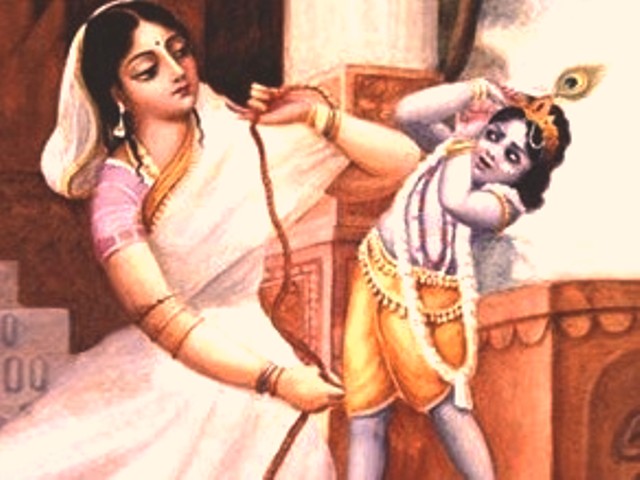
Once upon a time, seeing that her maidservant was engaged in different household duties, mother Yaśodā personally took charge of churning butter. And while she churned butter, she sang the childhood pastimes of Kṛṣṇa and enjoyed thinking of her son.
More
12 Oct 2014
by The Hare Krishna Movement
in A.C. Bhaktivedanta Swami Prabhupada, Books by Srila Prabhupada, Mukunda=mala-stotra
Tags: A.C. Bhaktivedanta Swami Prabhupada, and death, books by prabhupada, disease, four principal miseries—birth, Krsna, lotus feet, mukunda mala stotra, mukunda murdhna, old age, spirit soul, sutra 3

This evening I was reading from the “Mukunda mala storta”. Using a Sanskrit edition published by Śrīla Bhaktivinoda Ṭhākura in 1895, Śrīla Prabhupāda began translating the Mukunda-mālā-stotra in the late 1950’s. But after completing six verses with commentary, he suspended it to work on the Śrīmad-Bhāgavatam. He never resumed it. The following is verse 3 with Srila Prabhupāda’s translations and purport. It is a very sweet verse, and powerful purport.
O Lord Mukunda! I bow down my head to Your Lordship and respectfully ask You to fulfill this one desire of mine: that in each of my future births I will, by Your Lordship’s mercy, always remember and never forget Your lotus feet.
…To forget one’s relationship with the Lord and thus to remain overwhelmed by material hankerings is the most condemned mode of life. This is exactly the nature of animal life. When the living entity is born in a species of lower animals, he completely forgets his relationship with the Lord and therefore remains always busy in the matter of eating, sleeping, fearing, and mating. Modern civilization promotes such a life of forgetfulness, with an improved economic condition for eating and so on. Various agents of the external energy make explicit propaganda to try to root out the very seed of divine consciousness. But this is impossible to do, because although circumstances may choke up a living being’s divine consciousness for the time being, it cannot be killed. In his original identity the living entity is indestructible, and so also are his original spiritual qualities. One can kill neither the spirit soul nor his spiritual qualities. To remember the Lord and desire to serve Him are the spiritual qualities of the spirit soul. One can curb down these spiritual qualities by artificial means, but they will be reflected in a perverted way on the mirror of material existence. The spiritual quality of serving the Lord out of transcendental affinity will be pervertedly reflected as love for wine, women, and wealth in different forms. The so-called love of material things—even love for one’s country, community, religion, or family, which is accepted as a superior qualification for civilized human beings—is simply a perverted reflection of the love of Godhead dormant in every soul. The position of King Kulaśekhara is therefore the position of a liberated soul, because he does not want to allow his genuine love of God to become degraded into so-called love for material things. (from purport)
More
11 Oct 2014
by The Hare Krishna Movement
in Free Downloads, Kartika, Krishna
Tags: Damodara, flowers, free download, free pdf download, Give in charity, glories of kartika, incense, Kartika, Krishna, month of Damodara, mother yashoda, Perform austerities, Worship Krsna by offering ghee lamps, Worship of Tulsidevi, Yashodha

click on image to enlarge
A friend sent me this pdf file, proclaiming the glories of the the month of Damodara or Kartika. Click on the following link to view or save it to your computer.
click on following link; The Glories of Kartik
More
10 Oct 2014
by The Hare Krishna Movement
in A.C. Bhaktivedanta Swami Prabhupada, Kartika, Krishna, Krishna Consciousness, Krsna, Krsna Consciousness, Yoga
Tags: A.C. Bhaktivedanta Swami Prabhupada, devotional service, fraternal mellow, God, Kartika, linking up with the Lord, month of Damadora, Nectar of Devotion, relationship with the Supreme Personality of Godhead, symptoms of ecstasy, yoga

click on image to enlarge
When Kṛṣṇa and His devotees meet, the meeting is technically called yoga, or linking up with the Lord. (Nectar of Devotion Chapter 39)
Durning the month of Damadora (Kartika) I like to focus my attention on the childhood pastimes of Krsna in Vrndavan. So with this in mind we decided to post a chapter from the Nectar of Devotion which focus’s on the Lords relationships with His devotees in the fraternal mellow or better known as friendship.
When a devotee is permanently situated in devotional service, and by different symptoms of ecstasy he has developed and matured a fraternal mellow or flavor in relationship with the Personality of Godhead, his feeling is called fraternal love of Godhead.
The impetus for such fraternal love of God is God Himself. When one is liberated and discovers his eternal relationship with the Supreme Lord, the Lord Himself becomes the impetus for increasing fraternal love. The eternal associates of the Lord in Vṛndāvana have described this as follows: “The Lord, Hari, whose bodily hue is like the indranīla jewel, whose smiling is as beautiful as the kunda flower, whose silk dress is as yellow as golden autumn foliage, whose chest is beautified with garlands of flowers and who is always playing upon His flute—this enemy of the Agha demon is always attracting our hearts by wandering about Vṛndāvana.” (Nectar of Devotion Chapter 41)
More
09 Oct 2014
by The Hare Krishna Movement
in Krishna Consciousness, Krishna Consciousness Movement, Meditation, The Hare Krishna Movement, What Happened to the Hare Krishna's?, Yoga
Tags: Brendan O'connor, cult, Hare Krishna, Hare Krishna's, Krishna consciousness, krishnas, meditation, The Hare Krishna Movement, yoga

We are All Hare Krishnas now, Meditation goes Mainstream
by Brendan O’Connor
Sunday Independent
Gradually they are coming out the woodwork. And suddenly it seems that half the people I know are secretly meditating. They range from casual transcendental meditators to practically full-blown Buddhists or Hare Krishnas.
And the strange thing is that these are not hippies or crusties or drop-outs or people living alternative lifestyles on an ashram-inspired commune near Sligo. Just regular blokes, a few of them quite senior in what they do. There are thrusting business types and entrepreneurs and generally pretty serious people. These are not people who go for reiki or acupuncture or any of the other usual trappings of the “I’m not religious but I am a very spiritual person” lifestyle. They are fairly practical people. And meditation is just one of their tools, a technology for modern living.
More
08 Oct 2014
by The Hare Krishna Movement
in Damodara, Damodarastakam, Kartika, Songs of the Vaisnava Acaryas, Visnujana Swami
Tags: damodarastakam by vishnujana swami, Kartika, Krishna in Vrndavan, Krishna's childhood pastimes, month of Damodara, songs of the vaisnava acharys, Sri Damodarastaka, Vishnujana Swami sings the Damodarastakam prayers
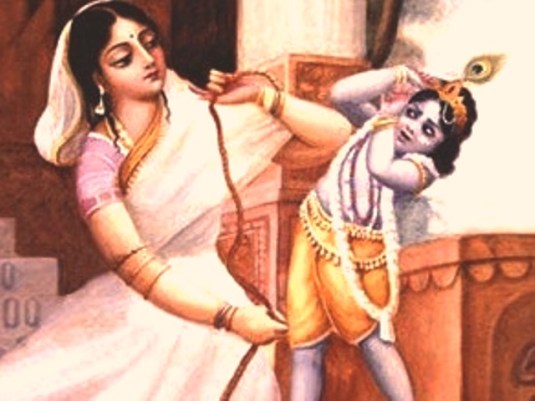
Today marks the begining of the month of Damodara (Kartika). In honor and in celebration of the month of Damodara, we will be focusing our attention on the pastimes of Krishna in Vrndavan. Especially Krishna’s childhood pastimes. The following song is sung morning and evening and it is customary to offer a candle or gee lamp as well to a picture of Lord Krsna and Mother Yasoda.
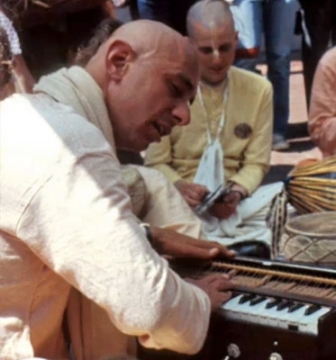
click on underlined link to listen
Sri Damordastaka sung by Vishnujana Swami
after clicking on above link you can return to page and sing along with the words listed below
More
03 Oct 2014
by The Hare Krishna Movement
in A.C. Bhaktivedanta Swami Prabhupada, Back to Godhead, Founder-Acarya, Srila Prabhupada, The Hare Krishna Movement
Tags: A.C. Bhaktivedanta Swami Prabhupada, Back to Godhead Magazine, bhagavad-gita, BTG, discipline of God consciousness, God consciousness, Hare Krsna, Hare Rama, krsna consciousness, Srimad Bhagavatam, The Hare Krishna Movement, the krsna consciousness movement
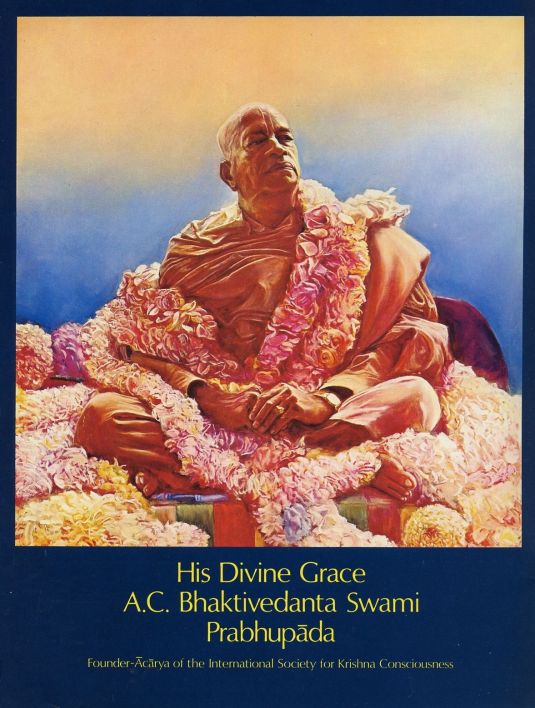
click on image to enlarge
The Krsna Consciousness Movement
Excerpted from Back to Godhead Magazine Vol. 1, No. 48
The Krsna consciousness movement is now being increasingly recognized throughout the world as a spiritual force of great potency, purity and importance to human society. With the simultaneous publication of the first two cantos of Srimad-Bhagavatam and the complete 1,000-page edition of Bhagavad-gita As It Is, the public is becoming increasingly aware that the boys and girls whom they see chanting and dancing on their city streets are students of a most serious discipline of God consciousness which is established on the basis of a philosophical system of considerable completeness, consistency and depth.
Hare Krsna Hare Krsna Krsna Krsna Hare Hare
Hare Rama Hare Rama Rama Rama Hare Hare
More
02 Oct 2014
by The Hare Krishna Movement
in A.C. Bhaktivedanta Swami Prabhupada, Bhagavad-gita in Spanish, Free Downloads, Free eBooks, Spanish Bhagavad-gita
Tags: A. C. Bhaktivedanta Swami Pabhupada, bhagavad-gita, Bhagavad-gita in Spanish, free download, free scanned copy, Free to the Spanish speaking world, Krishnapath, spanish 1975 edition of bhagavad gita, spanish bhagavad gita, tal como es

Hare Krishna
Our friends over at Krishna Path have done it again, and this time have put up the scanned copy of the Spanish Bhagavad-gita As It Is for all the Spanish speaking world. We have decided to share this Free Download with everyone today, as we have had many letters in the past asking for a copy of the Bhagavad-gita in Spanish. So here is one you can save to your computer or read online.
Just click on the link below.
Spanish Bhagavad-gita As It Is 1975 Edition: Bhagavad-gita_Tal_Como_Es-Spanish-1975_edition
02 Oct 2014
by The Hare Krishna Movement
in A.C. Bhaktivedanta Swami Prabhupada, Krishna Consciousness, Krsna Consciousness, KRSNA The Supreme Personality of Godhead
Tags: A.C. Bhaktvedanta Swami Prabhupada, aghasura demon, associates of the Lord, cowherd boyfriends, cows and calves, Krsna Book, Krsna The Supreme Personality of Godhead, Lord Krsna, pious activities, residents of Vrndavan

click on image to enlarge
This story of the Killing of the Aghasura Demon, has always been one of my all time favorite stories in the Krsna Book. It is a good example of faith and trust.
….Only after accumulating heaps of pious activities were those boys promoted to personally associate with the Supreme Personality of Godhead. Who can estimate the transcendental fortune of the residents of Vṛndāvana? They were personally seeing the Supreme Personality of Godhead face to face, He whom many yogīs cannot find even after undergoing severe austerities, although He is sitting within their hearts.
… “Dear friends, this figure appears to be a great animal, and he is sitting in such a posture just to swallow us all. Just see—is it not a big snake that has widened his mouth to eat all of us?”
Then they further consulted among themselves:
“If we all at one time entered into the mouth of this great serpent, how could it possibly swallow all of us? And even if it were to swallow all of us at once, it could not swallow Kṛṣṇa. Kṛṣṇa will immediately kill him” (excerpted from chapter 12 “The Killing of the Aghāsura Demon”)
Full Chapter follows More
29 Sep 2014
by The Hare Krishna Movement
in A.C. Bhaktivedanta Swami Prabhupada, Books by Srila Prabhupada, Free Downloads, Free eBooks, Nectar of Devotion
Tags: A.C. Bhaktiveanta Swami Prabhupada, Bhakti-rasamrta-sindhu, free downloads, free eBooks, Hare Krishna, ISKCON Press, Krishna Path, Lord Caitanya Mahaprabhu, Nectar of Devotion, Rupa Goswami, Srila Rupa Gosvami. Krsna consciouness movement, Sriman Jayananda brahmacari
click on image to enlarge
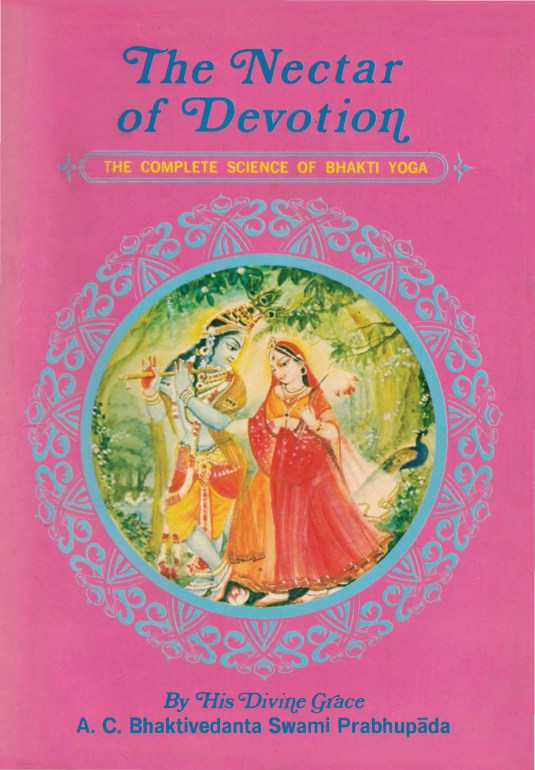
This morning I wanted to share with you all one of my most favorite books The Nectar of Devotion. I began re-reading it this morning, and feel very inspired to practice my bhakti yoga with new enthusiasm. You can click on following links to read or save to your computer the scanned version or the pdf version.
From Preface
…The Nectar of Devotion is a summary study of Bhakti-rasāmṛta-sindhu, which was written in Sanskrit by Śrīla Rūpa Gosvāmī Prabhupāda. He was the chief of the six Gosvāmīs, who were the direct disciples of Lord Caitanya Mahāprabhu. …The Nectar of Devotion is specifically presented for persons who are now engaged in the Kṛṣṇa consciousness movement. I beg to offer my sincere thanks to all my friends and disciples who are helping me to push forward the Kṛṣṇa consciousness movement in the Western countries, and I beg to acknowledge, with thanks, the contribution made by my beloved disciple Śrīman Jayānanda brahmacārī. My thanks are due as well to the directors of ISKCON Press, who have taken so much care in publishing this great literature. Hare Kṛṣṇa.
A. C. Bhaktivedanta Swami
ISKCON Headquarters
Los Angeles, California
Scanned The_Nectar_of_Devotion-1970_ISKCON_Press_edition-Hardcover-SCAN (1)
PDF Nectar-of-Devotion-1970-Edition
More
27 Sep 2014
by The Hare Krishna Movement
in Sahajiya, Vaisnava Vocabulary
Tags: 72-07-14, Bhavananda, by the grace of Krsna, cheater, Dr Patel, impersonalism, Lord Caitanya, sahajiyas, sahijiya, Srila Prabhupada
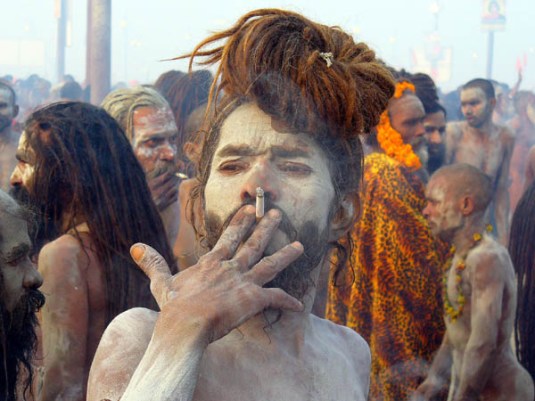
Sahajiyā is a word I have been researching lately, trying to come up with a clear understanding of its meaning, and to better understand why Srila Prabhupada has warned us to ‘avoid the association of Sahajiyā’s and Māyāvādīs, and not to become Sahajiyā’. So the following post is the beginning of our research.
Dr. Patel: What is sahajiyā?
Prabhupāda: Sahajiyā… Sahaj means easy. Easy-going. They will smoke cigarette at the same time they will play rasa-līlā. This is sahajiyā. This is sahajiyā. They will do all nonsense; still, they will become God, imitation of God. (Morning Walk Excerpts; May 1, 1974, Bombay)
…One thing, on the invitation card you have written All Glories to Our Guru Maharaja. This is impersonalism. As soon as we offer obeisances to guru, the name should be there. We are strictly personalists. The sahajiya’s, they write Glories to Guru. Why you are learning this impersonalism, who has taught you? Daily I am offering obeisances to my Guru by vibrating his real name, Srila Bhaktisiddhanta Sarasvati, otherwise it is impersonal. (Letter to: Bhavananda London 14 July, 1972)
Prabhupāda: These sahajiyās will come out of so many devotees. What can be done? From my Guru Mahārāja’s disciples, so many sahajiyās came. These are called sahajiyās. Very easily they capture thing. So my Guru Mahārāja used to say, “When my disciples will be sahajiyā, it will be more dangerous.”
More
24 Sep 2014
by The Hare Krishna Movement
in A.C. Bhaktivedanta Swami Prabhupada, Founder-Acarya, Lectures
Tags: A. C. Bhaktivedanta Swami Pabhupada, as it is, astanga yogi, avajananti, bhagavad-gita, bhakti yoga, bhakti yogi, devotion, Govinda, hatha yogi, in yoga, jnana yogi, karma yogi, Krsna, krsnaconsciousness, Lecture by Srila Prabhupada, Rama, The Supreme Personality of Godhead, transcendental loving service, Vasudeva, yoga, yoginam api sarvesam, yogis

Devotion – The Highest Yoga
A lecture given by His Divine Grace A.C. Bhaktivedanta Swami Prabhupada
Founder-Acarya of the International Society for Krishna Consciousness
1968
The word yoga has become synonymous in Western vernacular with a lithe figure, radiant health, peace of mind, and other material benefits. But the original meaning of the Sanskrit term carries a different, higher import: linking with the Supreme. In this lecture from 1968, Srila Prabhupada distinguishes the true goal of yoga—loving devotion to the Supreme Lord—from the physical and psychological elements of yoga practice.
Full Lecture More
24 Sep 2014
by The Hare Krishna Movement
in Back to Godhead, Narahari das, Simple Living, Spiritual Life
Tags: Back to Godhead Magazine, bonafide religion, BTG, chant Hare Krsna, every town and village, God, Iskcon, Krsna, Narahari, narahari das, read Srila Prabhupada's books daily, Sailing Back to Godhead, Spiritual Life, spiritual master, Srila Prabhupada, The Hare Krishna Movement, the hare krsna's, transcendental knowledge

Yesterday I was cleaning out the abandoned barn at Bahulavan, which is now being put back together again, and I found an old issue of Back to Godhead Magazine mixed in with so much debris. I pulled it out, cleaned it off, and added it to my collection of Back to Godhead Magazines. I had always heard of this famous sailing ship, and finally got a chance to see it.
Sailing Back to Godhead
Article excerpted from Back to Godhead Magazine Vol. 16, No. 6, 1981
A teakwood ketch and a devotee’s determination help bring Lord Krsna’s message to the Hawaiian Islands.
“…Krsna consciousness is the only established religion I know of that openly respects all other bonafide religions. My wife and I chant Hare Krsna and read Srila Prabhupada’s books daily. It’s added a dimension to my life that I feel is essential.”
More
23 Sep 2014
by The Hare Krishna Movement
in A.C. Bhaktivedanta Swami Prabhupada, Places of Pilgrimage, Srimad Bhagavatam
Tags: A.C. Bhaktivedanta Swami Prabhupada, duty of a pilgrim, Krsna, pilgrim, pilgrim's journey, pilgrim's progress, post office, postal system, postboxes, SB 3.1.18, traveling as a pilgrim

This morning I was reading from the 3rd Canto of the Srimad-Bhagavatam about Vidura and the beginning of his journey to the great places of pilgrimage. The following is excerpted from some of my reading.
He began to travel alone, thinking only of Kṛṣṇa, through various holy places like Ayodhyā, Dvārakā and Mathurā. He traveled where the air, hill, orchard, river and lake are all pure and sinless and where the forms of the Unlimited decorate the temples. Thus he performed the pilgrim’s progress. (SB 3.1.18)
…Places of pilgrimages are meant for eradicating the sins of the pilgrims, and they are distributed all over the universe just to give facility to all concerned for attaining pure existence and God realization. One should not be satisfied, however, merely by visiting the places of pilgrimage and performing one’s prescribed duties; he should be eager to meet the great souls who are already there, engaged in the service of the Lord. In each and every place of pilgrimage, the Lord is present in His various transcendental forms.
…The first and foremost duty of a pilgrim is to satisfy the Supreme Lord Hari. While traveling as a pilgrim, one should not be worried about pleasing society. There is no need to depend on social formalities or occupation or dress. One should remain always absorbed in the function of pleasing the Lord. Thus sanctified by thought and action, one is able to realize the Supreme Lord by the process of a pilgrim’s journey.
More
20 Sep 2014
by The Hare Krishna Movement
in A.C. Bhaktivedanta Swami Prabhupada, Bhagavad-gita, Draupadi
Tags: A.C. Bhaktivedanta Swami Prabhupada, Bg 1.2, Bhagavad-gita As It Is, blindness, Dhrtarastra, Draupadi, Duhsasana, King Yudhisthira, Krsna, Pandavas, progressive path of human life, SB 3.1.6, SB 3.1.7, spiritual blindness, Spiritual Life, spiritual vision

click on image to enlarge
The Insulting of Draupadi
I have always found this story of the disrobing of Draupadī, the wife of the godly King Yudhiṣṭhira, to be and example of how Krsna always protects his pure devotees. This incident contributes greatly to the Great Battle of Kurukṣetra, which almost completely annihilated the Kuru’s. And is a very good example of Spiritual Blindness. The following is a few select verses from the Srimad-Bhagavatam and Bhagavad-gita As It Is.
Dhṛtarāṣṭra was blind from birth, but his blindness in committing impious activities to support his dishonest sons was a greater blindness than his physical lack of eyesight. The physical lack of sight does not bar one from spiritual progress. But when one is blind spiritually, even though physically fit, that blindness is dangerously detrimental to the progressive path of human life. (SB 3.1.7 purport)
Dhṛtarāṣṭra was blind from birth. Unfortunately, he was also bereft of spiritual vision. He knew very well that his sons were equally blind in the matter of religion, and he was sure that they could never reach an understanding with the Pāṇḍavas, who were all pious since birth. (Bg 1.2 purport)
More
18 Sep 2014
by The Hare Krishna Movement
in A.C. Bhaktivedanta Swami Prabhupada, Nama Sankirtan, Narottama das Thakur, Six Goswamis, Songs of the Vaisnava Acaryas
Tags: A.C. Bhaktivedanta Swami Prabhupada, giridhari, gopala govinda rama, Gopinatha, Hari, hari haraye namah, kesavaya, krsna yadavaya namah, Madana-mohana, madhavaya, namah, six goswami's, Songs of the Vaisnava Acaryas, sri madhusudana, Srila Narottama Dasa Thakur, yadavay

Nāma-saṅkīrtana
by Śrīla Narottama Dāsa Ṭhākura
I have always liked the following song by Srila Narottama Dasa Thakur. And this song describes very simply, the beginning of the Sankirtan Movement, or The Hare Krishna Movement. The first four lines of the song, are the ones most often sung, with the first verse repeated as refrain.
Full Song and Purport follow.
…“You say that everything means Kṛṣṇa and we should ultimately always be chanting the names of Kṛṣṇa. Just how should we do this?” Then Lord Caitanya began to sing the names of Kṛṣṇa and clap His hands, and He began His nāma-saṅkīrtana movement. The names He sang are the first two lines of this song, and Narottama Dāsa Ṭhākura and others have placed these names in the beginning of their writings to immortalize these events in the memory of everyone.
…Then Śrīla Narottama Dāsa chants the names of the six Gosvāmīs. “I offer my obeisances at their feet,” he sings, “which destroy sufferings accumulated over many long years. I am the servant of these six Gosvāmīs, and the dust of their lotus feet is my five kinds of foodstuffs. To serve their lotus feet and keep the association of devotees is my only business, birth after birth.” (from purport to song by His Divine Grace A. C. Bhaktivedanta Swami Prabhupada)
Song & Purport More
16 Sep 2014
by The Hare Krishna Movement
in A.C. Bhaktivedanta Swami Prabhupada, Caaitanya-caritamrta, Caitanya Mahaprabhu, Sri Caitanya-Caritamrta, Srimati Radharani
Tags: Adi1.5, buddhi yogam, devotee, esoteric, God, isvarah sarva-bhutanam, Krsna, magnum opus, philosophy, Radharani, scientist, servant of God, spiritual master, spiritual philosophy, spiritual science, Sri Krsna Caitanya Mahaprabhu, tesam satata-yuktanam

click on image to enlarge
Lately, I have been absorbed in reading Sri Caitanya-caritamrta. For me it is a hard book to pick up, but after I begin reading…it is a hard book to put down. Sometimes it seems so esoteric (1 intelligible only to those with special knowledge. 2 intended only for the initiated), but I cannot help but to be thrown into complete and utter awe of the masterful writing, it seems to be Srila Prabhupada’s magnum opus (1 great work of art, literture. 2 the most important work of an artist, writer, etc.). Yes, I have the Oxford Dictionary open on my desk.
The loving affairs of Śrī Rādhā and Kṛṣṇa are transcendental manifestations of the Lord’s internal pleasure-giving potency. Although Rādhā and Kṛṣṇa are one in Their identity, They separated Themselves eternally. Now these two transcendental identities have again united, in the form of Śrī Kṛṣṇa Caitanya. I bow down to Him, who has manifested Himself with the sentiment and complexion of Śrīmatī Rādhārāṇī although He is Kṛṣṇa Himself. (Śrī Caitanya-caritāmṛta, Ādi-līlā 1.5)
The following is a Lecture given on this important verse, and the complete text.
…You cannot understand God, or Kṛṣṇa, without being a faithful servant. This is the secret. And if we become faithful servant under the guidance of proper spiritual master, then we can understand what is Kṛṣṇa, what is Parabrahman, and what is loving affairs with Rādhārāṇī, what is Śrī Kṛṣṇa Caitanya Mahāprabhu. These things are revealed. It is not acquired by so-called mundane knowledge. That is not possible… So we should always remain faithful servant of Kṛṣṇa. And Kṛṣṇa is within everyone’s heart, and He will be pleased by your service, and then He will reveal Himself, what He is. Otherwise it is not possible. (from Śrī Caitanya-caritāmṛta Lecture Ādi-līlā 1.5)
Adi-lila 1.5 Lecture and Verse More
Previous Older Entries Next Newer Entries












 The Hare Krishna Movement