21 Oct 2014
by The Hare Krishna Movement
in A.C. Bhaktivedanta Swami Prabhupada, Lord Rsabhadeva, Srimad Bhagavatam, Threefold Miseries, Transcendental Knowledge, Varnasrama Dharma
Tags: A.C. Bhaktiveanta Swami Prabhupada, amhita, devotional service, eternal blissful life, living entities, Lord Rsabhadeva, material bodies, rsabha uvaca, Srimad Bhagavatam, transcendental knowledge
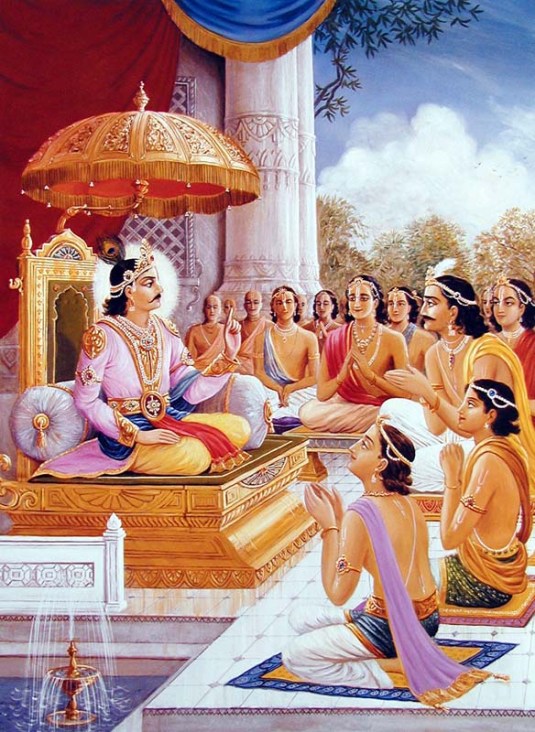
This morning by chance, I happened upon the teachings of Lord Rsabhadeva to His sons. It was in an old notebook that I opened just to see what was inside. Inside were prayers from the Vaisnava Songbook, the Brahma-samhita, Teachings of Pralada Maharaja, and these teachings of Lord Rsabhadeva. It was Sri Gandhari’s old gurukula study notebook, and what she was studying 30 years ago was very useful and timely today. It was just what I needed to read this morning and I share it with you today. It is verses 1-27, from the Fifth Canto of the Srimad Bhagavatam, chapter five.
Lord Ṛṣabhadeva told His sons: My dear boys, of all the living entities who have accepted material bodies in this world, one who has been awarded this human form should not work hard day and night simply for sense gratification, which is available even for dogs and hogs that eat stool. One should engage in penance and austerity to attain the divine position of devotional service. By such activity, one’s heart is purified, and when one attains this position, he attains eternal, blissful life, which is transcendental to material happiness and which continues forever.
More
18 Oct 2014
by The Hare Krishna Movement
in A.C. Bhaktivedanta Swami Prabhupada, Dharma, Dream
Tags: A. C. Bhaktivedanta Swami Pabhupada, dharma, happiness, living being's eternal occupation, occupation, root meaning of the word dharma, Srimad Bhagavatam, Supreme Lord, that which sustains

This morning I awoke early, and before rising, I was just going over the dreams in my head. I was dreaming about the following verse from the Srimad Bhagavatam.
“The supreme occupation [dharma] for all humanity is that by which men can attain to loving devotional service unto the transcendent Lord. Such devotional service must be unmotivated and uninterrupted to completely satisfy the self.” (SB 1.2.6)
I have been very much absorbed in my worldly occupation of late, writing up contracts, submitting bills, paying employees etc. and have mostly been waking up with thoughts of work. But this morning I was dreaming about a specific verse from the Srimad Bhagavatam. Interesting! So I went to the Bhagavatam, and read the purport to this verse.
…We have purposely denoted dharma as occupation because the root meaning of the word dharma is “that which sustains one’s existence.” A living being’s sustenance of existence is to coordinate his activities with his eternal relation with the Supreme Lord Kṛṣṇa. Kṛṣṇa is the central pivot of living beings, and He is the all-attractive living entity or eternal form amongst all other living beings or eternal forms. Each and every living being has his eternal form in the spiritual existence, and Kṛṣṇa is the eternal attraction for all of them. Kṛṣṇa is the complete whole, and everything else is His part and parcel. The relation is one of the servant and the served. It is transcendental and is completely distinct from our experience in material existence. This relation of servant and the served is the most congenial form of intimacy. One can realize it as devotional service progresses. Everyone should engage himself in that transcendental loving service of the Lord, even in the present conditional state of material existence. That will gradually give one the clue to actual life and please him to complete satisfaction.
Somehow I feel more satisfied, more complete, after my reading.
Full Verse and Purport More
17 Oct 2014
by The Hare Krishna Movement
in A.C. Bhaktivedanta Swami Prabhupada, Srila Prabhupada's Books, Srimad Bhagavatam
Tags: A.C. Bhaktivedanta Swami Prabhupada, Bhaktivedanta purports, brahmajyoti effulgence, Brhaspati, conditioned soul, intelligent man, Lord Brahma, Lord Siva, Maharaja Pariksit, material world, pure devotional service, SB 2.3, Sri Sukadeva Gosvami, Srimad Bhagavatam, threshold of death, Vedas
click on image to enlarge
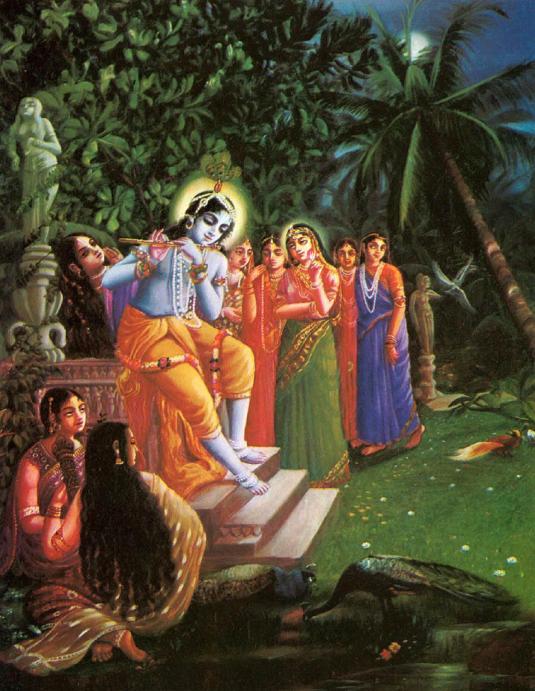
As we continue to update our (one of our other sites) Śrīmad-Bhāgavatam by posting a chapter at a time, of that great literary work by His Divine Grace Srila Prabhupada, we will continue to share the progress with our readers here at The Hare Krishna Movement.
Śrīmad-Bhāgavatam
by His Divine Grace A. C. Bhaktivedanta Swami Prabhupāda
Canto 2, Chapter Three
Pure Devotional Service: The Change in Heart
More
03 Oct 2014
by The Hare Krishna Movement
in A.C. Bhaktivedanta Swami Prabhupada, Back to Godhead, Founder-Acarya, Srila Prabhupada, The Hare Krishna Movement
Tags: A.C. Bhaktivedanta Swami Prabhupada, Back to Godhead Magazine, bhagavad-gita, BTG, discipline of God consciousness, God consciousness, Hare Krsna, Hare Rama, krsna consciousness, Srimad Bhagavatam, The Hare Krishna Movement, the krsna consciousness movement
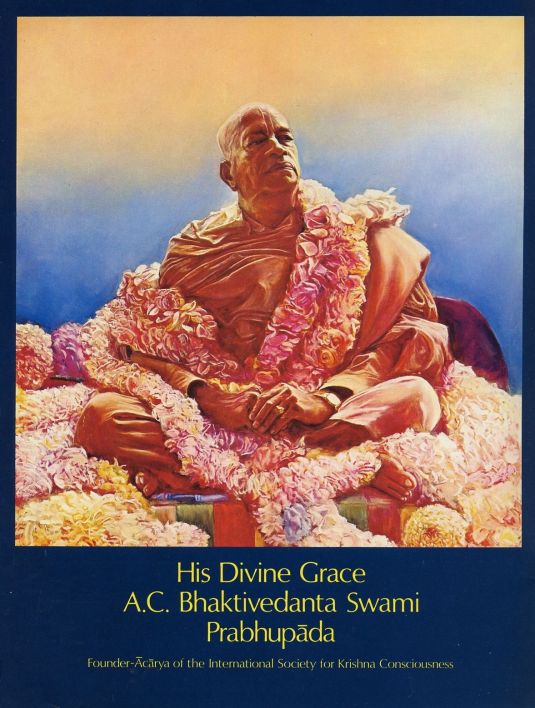
click on image to enlarge
The Krsna Consciousness Movement
Excerpted from Back to Godhead Magazine Vol. 1, No. 48
The Krsna consciousness movement is now being increasingly recognized throughout the world as a spiritual force of great potency, purity and importance to human society. With the simultaneous publication of the first two cantos of Srimad-Bhagavatam and the complete 1,000-page edition of Bhagavad-gita As It Is, the public is becoming increasingly aware that the boys and girls whom they see chanting and dancing on their city streets are students of a most serious discipline of God consciousness which is established on the basis of a philosophical system of considerable completeness, consistency and depth.
Hare Krsna Hare Krsna Krsna Krsna Hare Hare
Hare Rama Hare Rama Rama Rama Hare Hare
More
02 Sep 2014
by The Hare Krishna Movement
in A.C. Bhaktivedanta Swami Prabhupada, B. G. Sharma Art, Radha Krishna, Radhastami, Srimati Radharani
Tags: A.C. Bhaktivedanta Swami Prabhupada, appearance day of srimati radharani, beauty of krsna, beauty of radharani, Lord Caitanya, Radha, Radha-Krsna, Radharani, Ramananda Raya, SB 2.3.23, Spiritual world, Srila Prabhupada, Srimad Bhagavatam, Srimati Radharani

click on image to enlarge
So today being the appearance day of Srimati Radharani, my mind has been absorbed in thoughts of Radha and Krsna. It is described that she is the beloved consort of Krsna, Krsna’s pleasure potency, and the spiritual energy of Krsna.
…Lord Caitanya requested Rāmānanda Rāya to explain something more: “What are the transcendental features of Kṛṣṇa and Rādhārāṇī, and what are the transcendental features of the reciprocation of Their feelings, and what is the love between Them? If you kindly describe all this to Me, I will be very much obliged. But for you, no one can describe such things.” (Teachings of Lord Caitanya Chapter 30)
…In the Caitanya-caritāmṛta it is said that when Kṛṣṇa comes before Rādhārāṇī, She becomes so much engladdened by seeing the beauty of Kṛṣṇa that She becomes more beautiful, and as soon as Rādhārāṇī becomes beautiful, Kṛṣṇa becomes engladdened and He becomes more beautiful. So unlimitedly there is competition of becoming more beautiful. That is the state. Competition. Because in the spiritual world everything is unlimited. So unlimitedly both of them becoming beautiful and both of them enjoying unlimitedly. ((Lecture on SB 1.2.8 New Vrindaban, September 6, 1972)
…Śrīmatī Rādhārāṇī is a tenderhearted feminine counterpart of the supreme whole, resembling the perfectional stage of the worldly feminine nature. Therefore, the mercy of Rādhārāṇī is available very readily to the sincere devotees, and once She recommends such a devotee to Lord Kṛṣṇa, the Lord at once accepts the devotee’s admittance into His association. (Srimad-Bhagavatam Canto 2, Chapter 3, Text 23)
…She is Kṛṣṇa. Kṛṣṇa divided Himself into His energy and Himself. That energy, original spiritual energy, is Rādhārāṇī. ((Lecture on SB 2.1.1-5 Melbourne, June 26, 1974)
More
15 Aug 2014
by The Hare Krishna Movement
in A.C. Bhaktivedanta Swami Prabhupada, Festivals, Janmastami, Krishna, Krsna Consciousness, Krsna God, KRSNA The Supreme Personality of Godhead
Tags: A.C. Bhaktivedanta Swami Prabhupada, birth of Lord Krishna, Janmastami, janmastami festival, Krishna, Krsna, Krsna Book, Sri Krishna Janmastami, Srimad Bhagavatam

click on image to enlarge
With the advent of Lord Krsna’s birthday celebration (Janmastami) rapidly approaching, it seemed fitting that we do a post on the birth of Lord Krsna. So the following is the entire third chapter from the Krsna Book entitled “The Birth of Lord Kṛṣṇa”.
…As stated in the Bhagavad-gītā, the Lord says that His appearance, birth, and activities, are all transcendental, and one who understands them factually becomes immediately eligible to be transferred to the spiritual world. The Lord’s appearance or birth is not like that of an ordinary man who is forced to accept a material body according to his past deeds. The Lord’s appearance is explained in the Second Chapter: He appears out of His own sweet pleasure. When the time was mature for the appearance of the Lord, the constellations became very auspicious. The astrological influence of the star known as Rohiṇī was also predominant because this star is considered to be very auspicious. Rohiṇī is under the direct supervision of Brahmā. According to the astrological conclusion, besides the proper situation of the stars, there are auspicious and inauspicious moments due to the different situations of the different planetary systems. At the time of Kṛṣṇa’s birth, the planetary systems were automatically adjusted so that everything became auspicious. ( from Kṛṣṇa, the Supreme Personality of Godhead Chapter 3)
Full Chapter More
22 Jul 2014
by The Hare Krishna Movement
in A.C. Bhaktivedanta Swami Prabhupada, Srimad Bhagavatam
Tags: A.C. Bhaktivedanta Swami Prabhupada, Bhagavata-dharma, Brahmaloka, conditioned souls, fruitive activities, heavenly planets, incarnation, kingdom of God, Krsna, Lord Brahma, material ezistence, material world, meditate upon the virat-rupa, Patalaloka, phantasmagoria, Spiritual world, sri suka uvaca, Sri Sukadeva Gosvami, Srimad Bhagavatam, The Lord in the Heart, virat-rupa
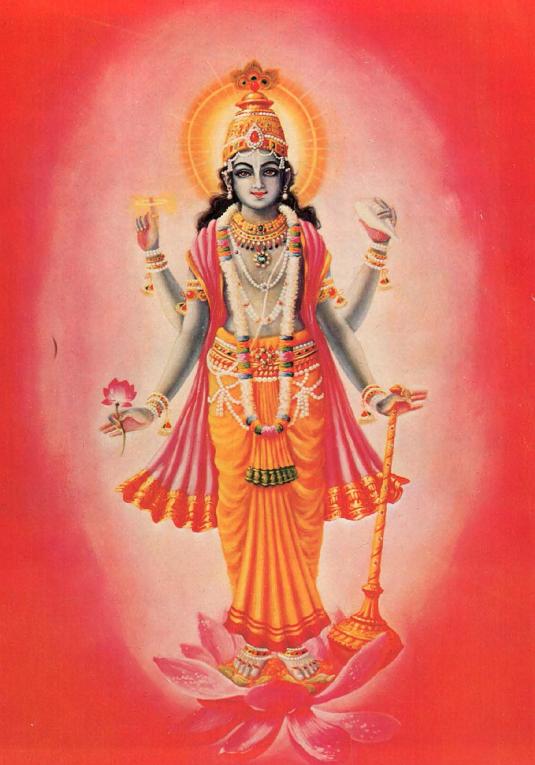
Śrīmad-Bhāgavatam
By His Divine Grace A. C. Bhaktivedanta Swami Prabhupāda
Canto Two, Chapter 2
The Lord in the Heart
Full Chapter More
03 Jul 2014
by The Hare Krishna Movement
in A.C. Bhaktivedanta Swami Prabhupada, Demigod, Durga, Laksmi, Sarasvati, Srimad Bhagavatam, Uma
Tags: 1972 Edititon, A.C. Bhaktivedanta Swami Prabhupada, as it is, bhagavad-gita, demigods, God, goddess durga, goddess of fortune, goddess of learning, intelligence to see God, Laksmi, Lord Shiva, mother of the universe, Siva, Srimad Bhagavatam, Supreme Personality of Godhead, the Mother of the Universe, Uma the wife of Lord Shiva

Sarasvatī, the Goddess of Learning
click on image to enlarge
The other day I was doing some service at the Hare Krishna Temple here in New Vrindavan, West Virginia, and I ran into some Indian guests. After we greeted each other one of them asked me “when did you become a Hindu?” “I never became a Hindu” I replied, “I am a Hare Krishna devotee, a disciple of His Divine Grace A. C. Bhaktivedanta Swami Prabhupada. I am not a Hindu. I worship the Supreme Personality of Godhead Lord Kṛṣṇa.”
So just to make things a little clearer…both to myself and others, I did some research from Srila Prabhupada’s books to find the proper understanding of Goddess Worship, or worship of the demigods.
…Worship of demigods is discouraged herein because even the greatest demigods like Brahmā and Śiva only represent part of the opulence of the Supreme Lord. (Bg 10.42)
…The goddess of fortune, Lakṣmī, and all-powerful demigods like Brahmā and Śiva are engaged in the worship of Viṣṇu or Lord Kṛṣṇa; therefore who can be more powerful than Mukunda (Lord Kṛṣṇa) to be factually called the Supreme Personality of Godhead? The goddess of fortune, Lakṣmījī, Lord Brahmā and Lord Śiva are not independently powerful; they are powerful as expansions of the Supreme Lord, and all of them are engaged in the transcendental loving service of the Lord, and so also are the living entities. (from purport SB 1.18.21)
…Both the living entity and the demigods are subordinate to the will of the Supreme Personality of Godhead…not a blade of grass moves without the will of the Supreme Personality of Godhead. Generally, persons who are distressed in the material world go to the demigods, as they are advised in the Vedic literature. A person wanting some particular thing may worship such and such a demigod. For example, a diseased person is recommended to worship the sun-god; a person wanting education may worship the goddess of learning, Sarasvatī; and a person wanting a beautiful wife may worship the goddess Umā, the wife of Lord Śiva. In this way there are recommendations in the śāstras (Vedic scriptures) for different modes of worship of different demigods. And because a particular living entity wants to enjoy a particular material facility, the Lord inspires him with a strong desire to achieve that benediction from that particular demigod, and so he successfully receives the benediction. The particular mode of the devotional attitude of the living entity toward a particular type of demigod is also arranged by the Supreme Lord. The demigods cannot infuse the living entities with such an affinity, but because He is the Supreme Lord or the Supersoul who is present in the heart of all living entities, Kṛṣṇa gives impetus to man to worship certain demigods. (from purport Bg 7.21)
…Everyone thinks that his intelligence is perfect. Sometimes one employs his intelligence in the worship of Umā, the wife of Lord Śiva, in order to obtain a beautiful wife. Sometimes, when one wants to become as learned as Lord Brahmā, he employs his intelligence in the worship of the goddess of learning, Sarasvatī. Sometimes, when one wishes to become as opulent as Lord Viṣṇu, he worships the goddess of fortune, Lakṣmī.
Intelligence should be employed in the service of the Supreme Personality of Godhead. As soon as one uses his intelligence in this way, the goddess of fortune automatically becomes favorable to him. The goddess of fortune, Lakṣmī, never remains without her husband, Lord Viṣṇu. Consequently, when one worships Lord Viṣṇu he automatically obtains the favor of the goddess of fortune. (from purport SB 4.25.28)
Full text and purports from above excerpts More
27 Jun 2014
by The Hare Krishna Movement
in A.C. Bhaktivedanta Swami Prabhupada, Krishna Nectar, Krsna Consciousness
Tags: A.C. Bhaktivedanta Swami Prabhupada, celebrated flute, cowherd boys, friends of krsna, Krishna, Krsna, remembrance of Lord Krsna, SB 3.2.27, Srimad Bhagavatam, Third Canto, transcendental flute, transcendental pleasure, Yamuna river
click on image to enlarge
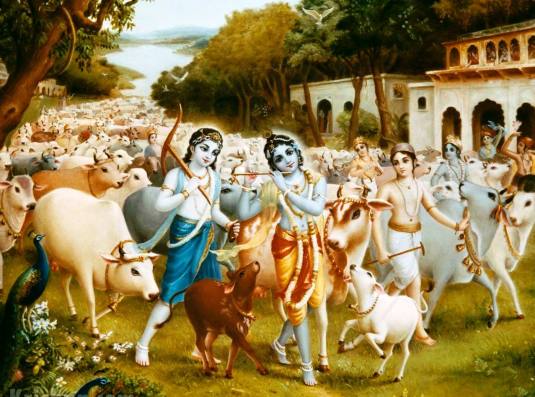
This morning I was reading from the Srimad Bhagavatam Third Canto, Chapter Two. It was so enlivening, that I read out-loud, the entire chapter. The following is just three verses and purports from the chapter entitled ” Remembrance of Lord Kṛṣṇa”.
In His childhood, the Almighty Lord was surrounded by cowherd boys and calves, and thus He traveled on the shore of the Yamunā River, through gardens densely covered with trees and filled with vibrations of chirping birds. (SB 3.2.27)
…the Lord used to play His celebrated flute. The sound vibrated by His flute would give His friends such transcendental pleasure that they would forget all the talks of the brahmānanda which is so praised by the impersonalists. These cowherd boys, as will be explained by Śukadeva Gosvāmī, were living entities who had accumulated heaps of pious acts and thus were enjoying with the Lord in person and were hearing His transcendental flute. The Brahma-saṁhitā (5.30) confirms the Lord’s blowing His transcendental flute. (from purport to SB 3.2.29)
veṇuṁ kvaṇantam aravinda-dalāyatākṣaṁ
barhāvataṁsam asitāmbuda-sundarāṅgam
kandarpa-koṭi-kaminīya-viśeṣa-śobhaṁ
govindam ādi-puruṣaṁ tam ahaṁ bhajāmi
Brahmājī said, “I worship Govinda, the primeval Lord, who plays on His transcendental flute. His eyes are like lotus flowers, He is decorated with peacock plumes, and His bodily color resembles a fresh black cloud although His bodily features are more beautiful than millions of cupids.” These are the special features of the Lord.
More
14 Jun 2014
by The Hare Krishna Movement
in A.C. Bhaktivedanta Swami Prabhupada, Demigod, Demons, Devaki
Tags: A.C. Bhaktivedanta Swami Prabhupada, Anantadeva, Baladeva, demigods, Devaki, devaki's womb, Garbha-stuti prayers, Jarasandha, Kamsa, Lord Krsna, saktas, Sankarsana, Srimad Bhagavatam, Vaisnavas, yogamaya

click on image for full size resolution
This morning I was reading Chapter Two in the Krsna Book, the chapter entitled “Prayers by the Demigods for Lord Kṛṣṇa in the Womb” and I was reminded of this above image from the Tenth Canto of Srimad Bhagavatam, that I like very much. So I thought I would share this image with you, along with the brief chapter description. Hare Krishna!
…when the Supreme Personality of Godhead entered the womb of Devakī to kill Kaṁsa, all the demigods understood that the Lord was living within Devakī’s womb, and therefore in veneration they offered Him the Garbha-stuti prayers. (from chapter description SB 10.2)
More
07 Jun 2014
by The Hare Krishna Movement
in A.C. Bhaktivedanta Swami Prabhupada, Dream, Srila Prabhupada's Books, Uncategorized
Tags: A.C. Bhaktivedanta Swami Prabhupada, awakenes to discover the self, deep sleep, dreaming, dreams, human form of life, Krsna, Le Reve, original creator, Srimad Bhagavatam, Supreme Lord, The Dream, The Supreme Personality of Godhead, The Wynn, vasudevah sarvam, wynn las vegas, Wynn theater

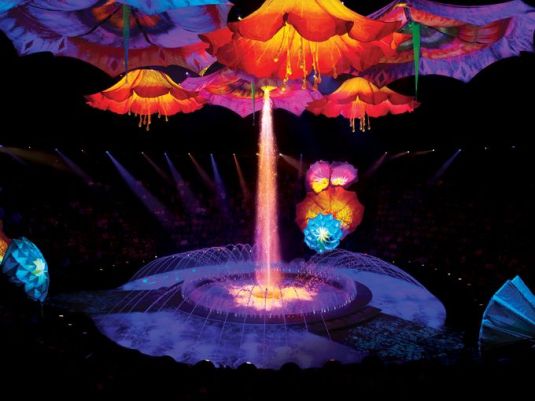
Recently we were in Las Vegas for a wedding celebration, and after dinner we went to the show “Le Reve” at the Wynn. “Le Reve” is French for; “The Dream”. It was the most amazing theatrical performance we have seen in years. My mind was swept away by the magnificence of the production, and it was in fact, dream-like. I was transported to another dimension; phantasmagoria. A.C. Bhaktivedanta Swami uses this word in his books, to describe the dream-like nature of this material world.
I would highly recommend seeing Le Reve at the Wynn, if you are in Las Vegas, and as always…recommend reading the books by His Divne Grace A. C. Bhaktivedanta Swami Prabhupada for further advancement and enlightenment in life.
When a person is in deep sleep, he dreams and sees in himself many other objects, such as great mountains and rivers or perhaps even the entire universe, although they are far away. Sometimes when one awakens from a dream he sees that he is in a human form, lying in his bed in one place. Then he sees himself, in terms of various conditions, as belonging to a particular nationality, family and so on. All the conditions of deep sleep, dreaming and wakefulness are but energies of the Supreme Personality of Godhead. One should always remember the original creator of these conditions, the Supreme Lord, who is unaffected by them. (SB 6.16.53-54_
More
13 May 2014
by The Hare Krishna Movement
in A.C. Bhaktivedanta Swami Prabhupada, Lord Nrsimhadeva, Nrsimha
Tags: A.C. Bhaktiveanta Swami Prabhupada, appearance day of lord nrsimhdeva, Lord Nrsimha, Nrsimhadeva, Pralada, Srimad Bhagavatam, Supreme Personality of Godhead

Today we honor the Appearance day of Lord Nṛsiṁhadeva, with a fast till sunset and the following text from the Śrīmad-Bhāgavatam. So shortly after the Lord killed Hiraṇyakaśipu, and his armies, the Lord sat Himself on the throne of Hiraṇyakaśipu, and was offered prayers by all the assembled saintly persons and demigods.
…The Lord not only killed Hiraṇyakaśipu, the King of the demons, but also killed many of his followers. When there was no one else to fight, the Lord, roaring with anger, sat down on Hiraṇyakaśipu’s throne.
The entire universe was thus relieved of the rule of Hiraṇyakaśipu, and everyone was jubilant in transcendental bliss. Then all the demigods, headed by Lord Brahmā, approached the Lord. These included the great saintly persons, the Pitās, the Siddhas, the Vidyādharas, the Nāgas, the Manus, the prajāpatis, the Gandharvas, the Cāraṇas, the Yakṣas, the Kimpuruṣas, the Vaitālikas, the Kinnaras and also many other varieties of beings in human form. All of them stood not far from the Supreme Personality of Godhead and began offering their prayers unto the Lord, whose spiritual effulgence was brilliant as He sat on the throne. (from the chapter summary)
More
20 Mar 2014
by The Hare Krishna Movement
in A.C. Bhaktivedanta Swami Prabhupada, Spring, Srimad Bhagavatam
Tags: A.C. Bhaktivedanta Swami Prabhupada, enchantment with material energy, material existence, SB 4.25.18, Spring, spring air, spring fever, Srimad Bhagavatam, waterfall

click on image to enlarge
Like many of you, I am happy about the first day of Spring. It was a long hard winter for many places in the country and I am sure that most everyone welcomes the coming of spring. The following is a verse from the Srimad Bhagavatam which describes our enchantment with the material existence. A symptom of this enchantment is our spring fever.
The branches of the trees standing on the bank of the lake received particles of water carried by the spring air from the falls coming down from the icy mountain. (SB 4.25.18)
…The spring air (kusumākara) is smell. All these varieties of enjoyment make life very pleasing, and thus we become captivated by material existence. (from purport)
Full text and purport More
03 Mar 2014
by The Hare Krishna Movement
in A.C. Bhaktivedanta Swami Prabhupada, Places of Pilgrimage, Sadhu, Srimad Bhagavatam, Vidura
Tags: A. C. Bhaktivedanta Swami Prabhuada, ananta-linga, arca forms, archa-vigraha form, forms of the Lord, holy places, Holy places of pilgrimage, idols, pilgrimage, pilgrims, SB 3.1.17-18, Srimad Bhagavatam, Vidura

click on image to enlarge
With the coming of Spring I am always inclined to travel. Spring always seems like a good season to began a journey. With this in mind, I was reading this morning from the Srimad Bhagavatam about how Vidura left the home of his brother to devote himself completely to the transcendental loving service of the Lord.
Places of pilgrimages are meant for eradicating the sins of the pilgrims, and they are distributed all over the universe just to give facility to all concerned for attaining pure existence and God realization. One should not be satisfied, however, merely by visiting the places of pilgrimage and performing one’s prescribed duties; he should be eager to meet the great souls who are already there, engaged in the service of the Lord. In each and every place of pilgrimage, the Lord is present in His various transcendental forms.
In the land of Bhāratavarṣa (India) there are many hundreds and thousands of places of pilgrimage distributed all over the country, and by traditional practice the common man visits such holy places during all seasons of the year. Some of the arcā representations of the Lord situated in different places of pilgrimage… There are millions and billions of such arcā forms of the Lord distributed all over the universe. All these arcā-mūrtis are summarized in the Caitanya-caritāmṛta in the following words:
“The Lord has so distributed Himself all over the universe just to give pleasure to the devotees, to give the common man facility to eradicate his sins, and to establish religious principles in the world.” (from purports to SB 3.1.17-18)
More
22 Feb 2014
by The Hare Krishna Movement
in A.C. Bhaktivedanta Swami Prabhupada, Ananda, Spiritual World
Tags: A.C. Bhaktivedanta Swami Prabhupada, all-pervasive, ananda, Bg 18.55, bhagavad-gita, bhakta, Brahman realization, impersonalist, jnani, Lord in the heart, mystics, Paramatma, pleasure potency, pure devotees, SB 2.10.44, Srimad Bhagavatam, the devotee, the impersonalist, the meditator, transcendental humors, Vaikuntha planets, yogi

click on beautiful image to enlarge
This morning as I was finishing the Tenth Chapter of the Second Canto, the following verse and purport jumped out at me from the pages. And I realized for the thousandth time, what great good fortune we have in that we can hear directly from the pure devotee of the Lord, about the eternal pastimes of the Lord, through the pages of the Srimad Bhagavatam.
Of the three types of Transcendentalist’s, namely the jñānī, the yogī and the bhakta, or the impersonalist, the meditator and the devotee. It is only the devotee who can factually know the Lord as He is and thus be trained in the bona fide service of the Lord and be allowed to enter into the direct association of the Lord in so many capacities. The highest glorious association with the Lord is made possible in the planet of Goloka Vṛndāvana, where Lord Kṛṣṇa enjoys Himself with the gopīs and His favorite animals, the surabhi cows.
… The impersonalist is satisfied simply by understanding the all-pervasive influence of the Lord. This is called Brahman realization. Greater than the impersonalist is the mystic who sees the Lord situated in his heart as Paramātmā, the partial representation of the Lord. But there are pure devotees who take part in the direct pleasure (ānanda) potency of the Lord by factual reciprocation of loving service. The Lord in His abode called the Vaikuṇṭha planets, which are eternal manifestations, always remains with His associates and enjoys transcendental loving services by His pure devotees in different transcendental humors.
So we are pleased to present the following Texts and Purports More
18 Feb 2014
by The Hare Krishna Movement
in A.C. Bhaktivedanta Swami Prabhupada, Paramatma, Srimad Bhagavatam
Tags: A.C. Bhaktivedanta Swami Prabhupada, devotee, Lord Krsna, Lord within the heart, lust anger and hankering, material association, Paramatma, Personality of Godhead, self-realized souls, spiritual master, Srimad Bhagavatam, Sukadeva Goswami

A friend of mine was asking me how we could realize Paramātmā or the Lord within the heart? How would I explain it to someone? I immediately thought of the following verses from the Second Canto of the Srimad Bhagavatam, and I replied to his question by saying ‘by reading about the glories of the Lord and chanting His names, we can begin to purify our hearts and come to understand through His mercy, the Lord within our hearts’. After getting home and looking up these verses…it was clear I gave him the correct answer.
O greatly fortunate Śukadeva Gosvāmī, please continue narrating Śrīmad-Bhāgavatam so that I can place my mind upon the Supreme Soul, Lord Kṛṣṇa, and, being completely freed from material qualities, thus relinquish this body.
Persons who hear Śrīmad-Bhāgavatam regularly and are always taking the matter very seriously will have the Personality of Godhead Śrī Kṛṣṇa manifested in their hearts within a short time.
The sound incarnation of Lord Kṛṣṇa, the Supreme Soul [i.e. Śrīmad-Bhāgavatam], enters into the heart of a self-realized devotee, sits on the lotus flower of his loving relationship, and thus cleanses the dust of material association, such as lust, anger and hankering. Thus it acts like autumnal rains upon pools of muddy water. (Srimad Bhagavatam 2.8.3-5)
Full test and purports More
26 Jan 2014
by The Hare Krishna Movement
in A.C. Bhaktivedanta Swami Prabhupada, Srila Prabhupada's Books, Srimad Bhagavatam
Tags: A.C. Bhaktivedanta Swami Prabhupada, all pervading personality of Godhead, BBT, Canto Two Chapter One, cosmic manifestation, om namo bhagavate vasudevaya, planetary systems, post creation, Second Canto, Srila Prabhupada's books, Srimad Bhagavatam, The Cosmic Manifestation, The First Step in God Realization, universal body of the Lord

Śrīmad-Bhāgavatam
By His Divine Grace A. C. Bhaktivedanta Swami Prabhupāda
Canto Two, Chapter One
The First Step in God Realization
More
22 Jan 2014
by The Hare Krishna Movement
in A.C. Bhaktivedanta Swami Prabhupada, Free Downloads, Free eBooks, Srila Prabhupada's Books, Srimad Bhagavatam
Tags: A.C. Bhaktivedanta Swami Prabhupada, free download of prabhupadas books, original books by srila prabhupada, Second Canto, second canto part one, second canto part two, Srimad Bhagavatam
Free Download of Second Canto of Srimad Bhagavatam

Click on underlined links below to view or save More
11 Jan 2014
by The Hare Krishna Movement
in A.C. Bhaktivedanta Swami Prabhupada, Books by Srila Prabhupada, Free Downloads, Free eBooks, Srila Prabhupada's Books, Srimad Bhagavatam
Tags: 1972 original edition, A.C. Bhaktivedanta Swami Prabhupada, Bhaktivedanta Book Trust, copyright 1972 Bhaktivedanta Book Trust, First Canto, free pdf download srimad-bhagavatam, free scanned copy first canto, SB 1.1, SB 1.2, SB 1.3, Srimad Bhagavatam

For a Free pdf download of the entire First Canto of the Srimad-Bhagavatam Original 1972 Editions (scanned copiess), click on the following underlined links;
More
Previous Older Entries Next Newer Entries





 The Hare Krishna Movement