12 Dec 2013
by The Hare Krishna Movement
in A.C. Bhaktivedanta Swami Prabhupada, Bhagavad-gita, Bhagavad-gita As It Is 1972 Edition, Gita Jayanti
Tags: A.C. Bhaktivedanta Swami Prabhupada, Advent of Bhagavad-gita, Arjuna, as it is, bhagavad-gita, ekadasi, gita jayanti, Krishna, Krsna, Original 1972 Edition, prabhupada gita, Srimad Bhagavad-gita

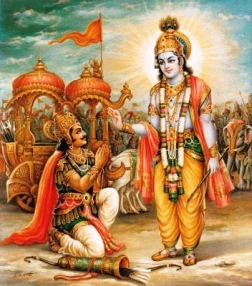
So today is The Advent of Srimad Bhagavad-gita; Gita Jayanti. It is celebrated on the Ekadasi, 11th day of the waxing moon of Margashirsha month (November-December). I just so happens, that today is also Christmas Day. So merry Christmas to all.
In honor of this day, Gita Jayntia, we present the Complete 1972 Edition of the Bhagavad-gita As It Is, by His Divine Grace A.C. Bhaktivedanta Swami in the PDF format for you to read or save to your computer. Also we include a link to our other page Prabhupadagita Where you can read the entire book online a chapter at a time with the original illustrations.
click on links below:
More
11 Dec 2013
by The Hare Krishna Movement
in A.C. Bhaktivedanta Swami Prabhupada, KRSNA The Supreme Personality of Godhead
Tags: A.C. Bhaktivedanta Swami Prabhupada, devotee of Krsna, features of Krsna, gopis, Krsna, Krsna-katha, Nanda Maharaja, Srimati Radharani, topics about Krsna, Uddhava, Yasoda

I like this image very much and found the text to go with it. It is from the 46th chapter of Krsna The Supreme Personality of Godhead. We have posted the entire chapter for anyone who has the time or inclination to read it. Enjoy!
…When the gopīs understood that Uddhava had a message from Kṛṣṇa, they became very happy and called him to a secluded place to sit down. They wanted to talk with him very freely and did not want to be embarrassed before unknown persons. They began to welcome him with polite words, in great submissiveness.
…Uddhava understood that the gopīs of Vṛndāvana were all simply absorbed in the thought of Kṛṣṇa and His childhood activities. While talking about Kṛṣṇa with Uddhava, they forgot all about their household business. They even forgot about themselves as their interest in Kṛṣṇa increased more and more.
Full Chapter More
05 Dec 2013
by The Hare Krishna Movement
in A.C. Bhaktivedanta Swami Prabhupada, Narada Muni, Srimad Bhagavatam
Tags: A.C. Bhaktivedanta Swami Prabhupada, Krsna, Liberated souls, meditate on the lotus feet of the lord, Narada Muni, Personality of Godhead, supersoul, The Supreme Personality of Godhead, Vyasa, Vyasadeva
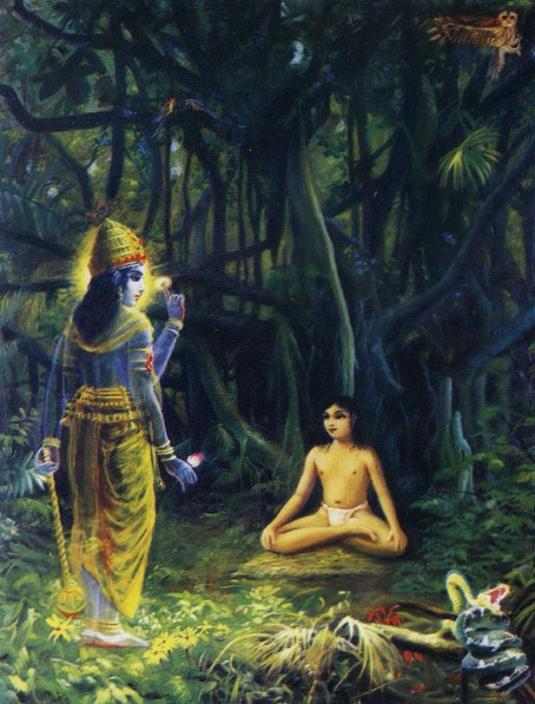
This morning I was reading from the First Canto, sixth chapter of the Srimad Bhagavatam entitled “Conversation Between Nārada and Vyāsadeva”. Here Śrī Nārada Muni is explaining how it is, he attained his present transcendental body, and his encounter with the Personality of Godhead Śrī Kṛṣṇa. This is a beautiful chapter and I find myself reading it again and again.
After that, under the shadow of a banyan tree in an uninhabited forest I began to meditate upon the Supersoul situated within, using my intelligence, as I had learned from liberated souls.
As soon as I began to meditate upon the lotus feet of the Personality of Godhead with my mind transformed in transcendental love, tears rolled down my eyes, and without delay the Personality of Godhead Śrī Kṛṣṇa appeared on the lotus of my heart.
O Vyāsadeva, at that time, being exceedingly overpowered by feelings of happiness, every part of my body became separately enlivened. Being absorbed in an ocean of ecstasy, I could not see both myself and the Lord.
The transcendental form of the Lord, as it is, satisfies the mind’s desire and at once erases all mental incongruities. Upon losing that form, I suddenly got up, being perturbed, as is usual when one loses that which is desirable.
I desired to see again that transcendental form of the Lord, but despite my attempts to concentrate upon the heart with eagerness to view the form again, I could not see Him any more, and thus dissatisfied, I was very much aggrieved.
Seeing my attempts in that lonely place, the Personality of Godhead, who is transcendental to all mundane description, spoke to me with gravity and pleasing words, just to mitigate my grief.
O Nārada [the Lord spoke], I regret that during this lifetime you will not be able to see Me anymore. Those who are incomplete in service and who are not completely free from all material taints can hardly see Me.
O virtuous one, you have only once seen My person, and this is just to increase your desire for Me, because the more you hanker for Me, the more you will be freed from all material desires.
Srimad Bhagavatam
By His Divine Grace A. C. Bhaktivedanta Swami Prabhupada
First Canto, Chapter 6, Text 15-22
full text and purports More
22 Nov 2013
by The Hare Krishna Movement
in A.C. Bhaktivedanta Swami Prabhupada, Durga
Tags: A.C. Bhaktivedanta Swami Prabhupada, demigods, Durga, durga-devi, external energy of Krishna, goddess durga, Krsna, material enjoyment, saktas, servants of the lord, spiritual salvation, Vaisnavas

This morning I ran across this nice image of the Goddess Durgā. Durgā-devī, is actually the external energy of Kṛṣṇa, the shadow energy of the Lord. People in general worship goddess Durgā, the wife of Lord Śiva, for material prosperity. As devotees of Krishna, we do not worship the demigods or demigoddess’s. As Srila Prabhupada points out;
There is a misconception that there are many Gods. Actually that is not a fact. God is one, but there are many other powerful living entities who are in charge of different departments of administration. They are called demigods. All the demigods are servants who carry out the orders of the Supreme Lord, the Personality of Godhead.
Only the less intelligent worship the demigods for their various purposes. The most intelligent worship only the Supreme Personality of Godhead, Kṛṣṇa.
Sometimes we, the members of the Kṛṣṇa consciousness movement, are accused of not approving of the worship of demigods….
…Because Kṛṣṇa and His energy appeared simultaneously, people have generally formed two groups—the śāktas and the Vaiṣṇavas—and sometimes there is rivalry between them. Essentially, those who are interested in material enjoyment are śāktas, and those interested in spiritual salvation and attaining the spiritual kingdom are Vaiṣṇavas. Because people are generally interested in material enjoyment, they are interested in worshiping Māyādevī, the energy of the Supreme Personality of Godhead. Vaiṣṇavas, however, are śuddha-śāktas, or pure bhaktas, because the Hare Kṛṣṇa mahā-mantra indicates worship of the Supreme Lord’s energy, Harā. A Vaiṣṇava prays to the energy of the Lord for the opportunity to serve the Lord along with His spiritual energy. Thus Vaiṣṇavas all worship such Deities as Rādhā-Kṛṣṇa, Sītā-Rāma, Lakṣmī-Nārāyaṇa and Rukmiṇī-Dvārakādhīśa, whereas durgā-śāktas worship the material energy under different names. ( from purport SB 10.2.11-12)
…But he also points out that we offer all respect to the demigods as they are all servants of the Lord.
More
16 Nov 2013
by The Hare Krishna Movement
in A.C. Bhaktivedanta Swami Prabhupada, Childhood Pastimes of Krsna
Tags: A.C. Bhaktivedanta Swami Prabhupada, childhood pastimes, Krsna, month of Damodar, Mother Yasoda, Sampradaya sun, Srila Prabhupada lecture, Universal Form, vatsalya rasa, Yasoda Vishvarupa-darshan
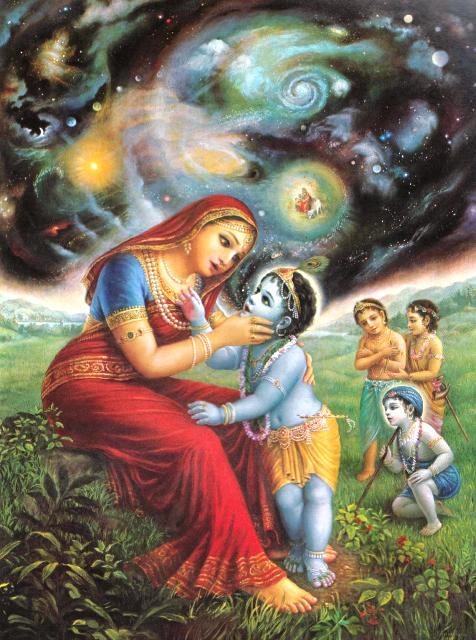
We are reprinting here a nice article which appeared on the Sampradaya Sun a few days ago, entitled “The Glorious Month of Damodara”. These are excerpts from Srila Prabhupada’s Lectures and a question and answer discussion, concerning the childhood pastime of Mother Yasoda seeing the Universal form in Krsna’s mouth.
Yasoda Vishvarupa-darshan
One of the Krsna-lila pastimes glorified during the month of Damodar is that of Yasoda Ma getting vishvarupa-darshan in Krsna’s mouth. In a lecture on Bhagavad-gita 2.25, Srila Prabhupada explained the pastime in terms of vatsalya-rasa:
“When Kṛṣṇa was playing as a child, He ate earth and the playmates complained to mother Yaśodā: “Mother, your son Kṛṣṇa is eating earth.” Mother Yaśodā called for explanation: “Kṛṣṇa, why You are eating earth? I have given You sandeśa. ” Kṛṣṇa said, “No, mother, I have not eaten.” “No, Your friends are complaining.” “No, they have become My enemies this morning. We had some quarrel. Therefore they have combined together to make Me chastised by you.” So in this way… Then mother Yaśodā wanted to solve this problem: “All right, show Your mouth, open Your mouth. I want to see.” And when Kṛṣṇa opened the mouth, the mother saw innumerable universes are within the mouth. This is Kṛṣṇa. Aṇor aṇīyān mahato mahīyān. Kṛṣṇa enters within the universe, but at the same time, millions of universes are within His mouth. This is the explanation of “the greater than the greatest and the smaller than the smallest.” Of course, mother Yaśodā, although she saw, she could not believe it because mother Yaśodā never thought of that Kṛṣṇa is the Supreme Personality of Godhead. She always thought that “He is my teeny child.” That’s all. “I have to take care of Him.” This is called paternal feelings. Vātsalya-rasa.” (Lecture on Bhagavad-gita 2.25 — Hyderabad, November 29, 1972)
More
12 Nov 2013

…There is no parallel to His childhood pastimes as exhibited at Vrajabhūmi, which are the prototypes of His eternal affairs in the original Kṛṣṇaloka described as the cintāmaṇi-dhāma in the Brahma-saṁhitā [Bs. 5.29]. Lord Śrī Kṛṣṇa descended Himself at Vrajabhūmi with all His transcendental entourage and paraphernalia. Śrī Caitanya Mahāprabhu therefore confirmed that no one is as fortunate as the residents of Vrajabhūmi, and specifically the cowherd girls, who dedicated their everything for the satisfaction of the Lord. His pastimes with Nanda and Yaśodā and His pastimes with the cowherd men and especially with the cowherd boys and the cows have caused Him to be known as Govinda. (from purport to SB 1.8.21)
Full Text and Purport More
Image
by The Hare Krishna Movement
10 Nov 2013
by The Hare Krishna Movement
in A.C. Bhaktivedanta Swami Prabhupada, Cow Protection, Festivals, Gopastami, KRSNA The Supreme Personality of Godhead
Tags: A.C. Bhaktivedanta Swami Prabhupada, Balarama, childhood age known as kaumara, cowherd boy, gopa, gopastami, gosthastami, Krishna, Krsna, Krsna Book, pauganda, The killing of Dhenukasura, vaisnava calender, Vrndavan

Please click on image to enlarge
Today on the Vaisnava Calender marks the day known as Gopastami or Gosthastami. On this day lord Sri Krishna became a qualified cowherd and took the cows out to Govardhana to graze. Previously He was the keeper of the calves. It was on this day that He became a gopa, or cowherd boy.
In this way, Śrī Kṛṣṇa, along with His elder brother Balarāma, passed the childhood age known as kaumāra and stepped into the age of paugaṇḍa, from the sixth year up to the tenth. At that time, all the cowherd men conferred and agreed to give those boys who had passed their fifth year charge of the cows in the pasturing ground. Given charge of the cows, Kṛṣṇa and Balarāma traversed Vṛndāvana, purifying the land with Their footprints.
…When Kṛṣṇa, Balarāma and Their friends entered the village of Vṛndāvana, They played Their flutes, and the boys praised Their uncommon activities in the forest. Their faces were decorated with tilaka and smeared with the dust raised by the cows, and Kṛṣṇa’s head was decorated with a peacock feather. Both He and Balarāma played Their flutes, and the young gopīs were joyous to see Kṛṣṇa returning home. All the gopīs in Vṛndāvana remained very morose on account of Kṛṣṇa’s absence. All day they were thinking of Kṛṣṇa in the forest or of Him herding cows in the pasture. When they saw Kṛṣṇa returning, all their anxieties were immediately relieved, and they began to look at His face the way drones hover over the honey of the lotus flower. When Kṛṣṇa entered the village, the young gopīs smiled and laughed. Kṛṣṇa, while playing the flute, enjoyed the beautiful smiling faces of the gopīs. (from Kṛṣṇa, the Supreme Personality of Godhead, Chapter 15)
To honor this day we are posting some further childhood pastimes of Sri Krishna from the Kṛṣṇa Book entitled “The Killing of Dhenukāsura”
Full Chapter More
01 Nov 2013
by The Hare Krishna Movement
in A.C. Bhaktivedanta Swami Prabhupada, Festivals, Govardhana-puja, Krishna
Tags: A.C. Bhaktiveanta Swami Prabhupada, Annakuta, circumambulate Govardhana Hill, Govardhana Hill, Govardhana-puja, Krsna, Krsna consciousness movement, Krsna The Supreme Personality of Godhead, Lord Caitanya, Madhya 4.86, Prasadam, temples of Vrndavana
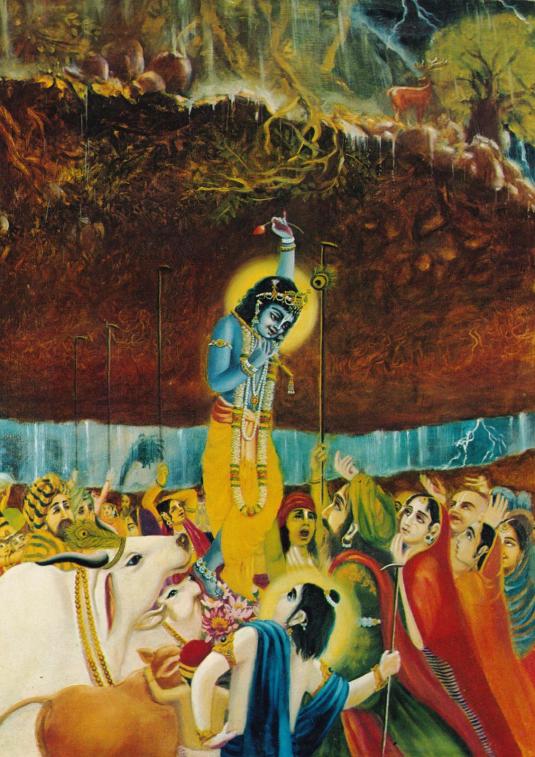
On November 3rd the festival known as Govardhana Pūjā is celebrated.
The sacrifice known as Govardhana Pūjā is observed in the Kṛṣṇa consciousness movement. Lord Caitanya has recommended that since Kṛṣṇa is worshipable, so His land, Vṛndāvana and Govardhana Hill, are also worshipable. To confirm this statement, Lord Kṛṣṇa said that Govardhana Pūjā is as good as worship of Him. From that day, the Govardhana Pūjā has been still going on and is known as Annakūṭa. In all the temples of Vṛndāvana or outside of Vṛndāvana, huge quantities of food are prepared in this ceremony and are very sumptuously distributed to the general population. Sometimes the food is thrown to the crowds, and they enjoy collecting it off the ground. From these instances, we can understand that prasādam offered to Kṛṣṇa never becomes polluted or contaminated, even if it is thrown on the ground. The people, therefore, collect it and eat with great satisfaction. (Kṛṣṇa, The Supreme Personality of Godhead, chapter 24)
…Formerly, at the end of Dvāpara-yuga, all the cowherd men of Vṛndāvana had arranged to worship King Indra, but they gave this worship up, following the advice of Kṛṣṇa. Instead, they performed a ceremony whereby they worshiped the cows, brāhmaṇas and Govardhana Hill. At that time Kṛṣṇa expanded Himself and declared, “I am Govardhana Hill.” In this way He accepted all the paraphernalia and food offered to Govardhana Hill. (from purport of Sri Caitanya-caritamrta, Madhya-lila 4.86)
More
30 Oct 2013
by The Hare Krishna Movement
in A.C. Bhaktivedanta Swami Prabhupada, Childhood Pastimes of Krsna, Krsna Consciousness, Spiritual World, Srimad Bhagavatam, Vrndavana
Tags: A.C. Bhaktivedanta Swami Prabhupada, asura, Bakasura, BBT, Bhaktivedanta purports, cowheard boys, fruit vendor, go carana, Gokula, Krishna and Balarama, Krsna, Mother Yasoda, Nanda, Nanda Maharaja, pastimes of krsna, SB 10.11, Srimad Bhagavatam, Vatsasura, yamala arjunas, Yasoda

Today is Rama Ekadasi (fast from grains and beans), so on this auspicious day, in the auspicious month of Damodara, we wanted to do a special post. The following is the entire 11th chapter of the Tenth Canto of Srimad Bhagavatam entitled “The Childhood Pastimes of Kṛṣṇa”.
The following two verses are just an example of the nectar one will find in the following chapter…
…The gopīs would say, “If You dance, my dear Kṛṣṇa, then I shall give You half a sweetmeat.” By saying these words or by clapping their hands, all the gopīs encouraged Kṛṣṇa in different ways. At such times, although He was the supremely powerful Personality of Godhead, He would smile and dance according to their desire, as if He were a wooden doll in their hands. Sometimes He would sing very loudly, at their bidding. In this way, Kṛṣṇa came completely under the control of the gopīs.(Text 7)
…To pure devotees throughout the world who could understand His activities, the Supreme Personality of Godhead, Kṛṣṇa, exhibited how much He can be subdued by His devotees, His servants. In this way He increased the pleasure of the Vrajavāsīs by His childhood activities. (Text 9)
Srimad Bhagavatam
By His Divine Grace A. C. Bhaktivedanta Swami Prabhupada
Canto 10, Chapter 11
More
26 Oct 2013
by The Hare Krishna Movement
in A.C. Bhaktivedanta Swami Prabhupada, Damodara, KRSNA The Supreme Personality of Godhead
Tags: A.C. Bhaktivedanta Swami Prabhupada, Bhaktivedanta purport, Dhara, Drona, gopis, Krishna, krishna pastimes, Krsna, Krsna Book, Lord Balarama, Lord Damodara, Lord Krishna, month of Kartika, Mother Yasoda, Nanda Maharaja, residents of Vrndavana, SB 10.8, transcendental pleasure, Vision of the Universal Form
…continuing with our attempt to post Krsna’s childhood pastimes, throughout the duration of the “Month of Damodara”
…Another day, when Kṛṣṇa and Balarāma were playing with Their friends, all the boys joined Balarāma and told mother Yaśodā that Kṛṣṇa had eaten clay. On hearing this, mother Yaśodā caught hold of Kṛṣṇa’s hand and said, “My dear Kṛṣṇa, why have You eaten earth in a solitary place? Just see, all Your friends including Balarāma are complaining about You.” Being afraid of His mother, Kṛṣṇa replied, “My dear mother, all these boys, including My elder brother Balarāma, are speaking lies against Me. I have never eaten clay. My elder brother Balarāma, while playing with Me today, became angry, and therefore He has joined with the other boys to complain against Me. They have all combined together to complain so you will be angry and chastise Me. If you think they are truthful, then you can look within My mouth to see whether I have taken clay or not.” His mother replied, “All right, if You have actually not taken any clay, then just open Your mouth. I shall see.”
More
23 Oct 2013
by The Hare Krishna Movement
in A.C. Bhaktivedanta Swami Prabhupada, Damodara, Krishna Consciousness, KRSNA The Supreme Personality of Godhead, Srimad Bhagavatam
Tags: A.C. Bhaktivedanta Swami Prabhupada, Balarama, clay and saffron, Damodara, gopis, Krishna, Krsna, Krsna The Supreme Personality of Godhead, Lord Damodara, naughty babies, Rohini, sandalwood pulp, Yasoda

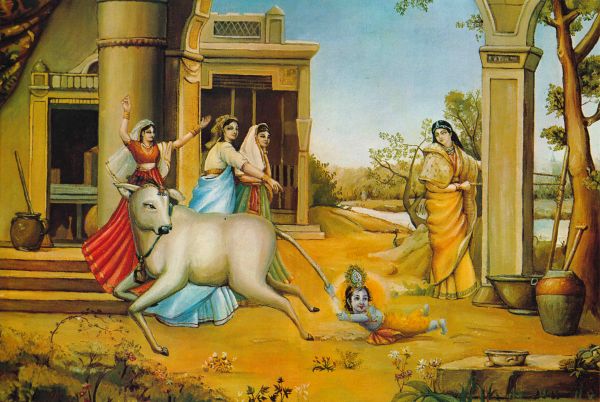
Within the house of Nanda Mahārāja, the cowherd ladies would enjoy seeing the pastimes of the babies Rāma and Kṛṣṇa. The babies would catch the ends of the calves’ tails, and the calves would drag Them here and there. When the ladies saw these pastimes, they certainly stopped their household activities and laughed and enjoyed the incidents. (SB 10.8.24)
These childhood pastimes of Krsna are so sublime and pleasing to the consciousness. We will continue to post Krsna’s childhood pastimes throughout the duration of the “Month of Damodara”.
…both Balarāma and Kṛṣṇa began to crawl on Their hands and knees. When They were crawling like that, They pleased Their mothers. The bells tied to Their waist and ankles sounded fascinating, and They would move around very pleasingly. Sometimes, just like ordinary children, They would be frightened by others and would immediately hurry to Their mothers for protection. Sometimes They would fall into the clay and mud of Vṛndāvana and would approach Their mothers smeared with clay and saffron. They were actually smeared with saffron and sandalwood pulp by Their mothers, but due to crawling over muddy clay, They would simultaneously smear Their bodies with clay. As soon as They would come crawling to Their mothers, Yaśodā and Rohiṇī would take Them on their laps and, covering the lower portion of their saris, allow Them to suck their breasts. When the babies were sucking their breasts, the mothers would see small teeth coming in. Thus their joy would be intensified to see their children grow. Sometimes the naughty babies would crawl up to the cowshed, catch the tail of a calf and stand up. The calves, being disturbed, would immediately begin running here and there, and the children would be dragged over clay and cow dung. To see this fun, Yaśodā and Rohiṇī would call all their neighboring friends, the gopīs. Upon seeing these childhood pastimes of Lord Kṛṣṇa, the gopīs would be merged in transcendental bliss. In their enjoyment they would laugh very loudly. (excerpted from Krsna Book Chapter 8)
Also from the Srimad Bhagavatam More
22 Oct 2013
by The Hare Krishna Movement
in A.C. Bhaktivedanta Swami Prabhupada, Damodara, Kartika, Srila Prabhupada's Books, Srimad Bhagavatam
Tags: A.C. Bhaktivedanta Swami Prabhupada, austerities, bagavata, bhakta, black ointment around His eyes, Damodara, Krsna, Mother Yasoda, Mother Yasoda Binds Lord Krsna, mystics, Paramatma, penances, SB 10.9, Srila Prabhupada, Srimad Bhagavatam, yogis
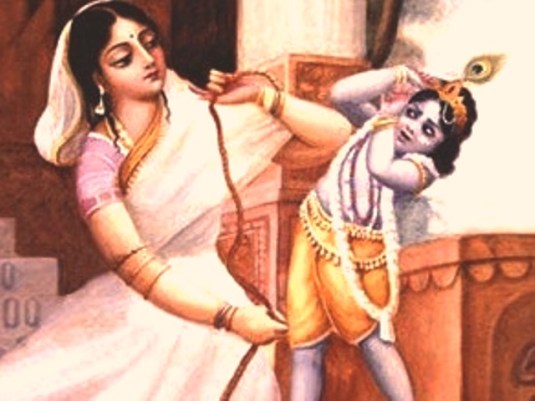
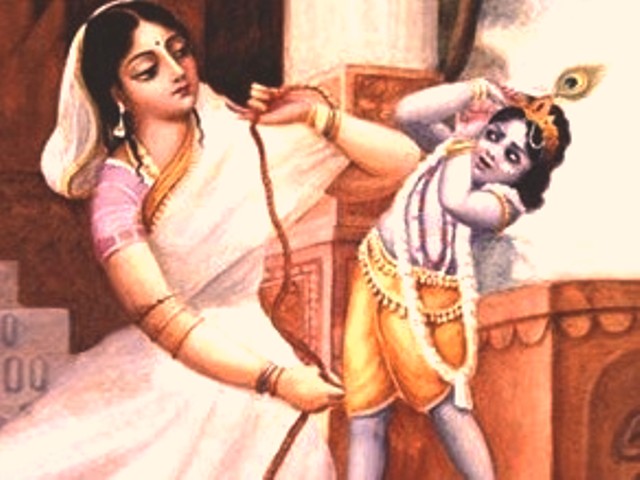
In celebration of the month of Damodara (Kartika) we are focusing our attention on the pastimes of Krishna in Vrndavan. Especially Krishna’s childhood pastimes. So with this in mind we are posting the entire 9th chapter from the Tenth Canto of Srila Prabhupada’s Srimad Bhagavatam entitled Mother Yaśodā Binds Lord Kṛṣṇa.
When caught by mother Yaśodā, Kṛṣṇa became more and more afraid and admitted to being an offender. As she looked upon Him, she saw that He was crying, His tears mixing with the black ointment around His eyes, and as He rubbed His eyes with His hands, He smeared the ointment all over His face. Mother Yaśodā, catching her beautiful son by the hand, mildly began to chastise Him. (SB 10.9.11)
Yogīs, mystics, want to catch Kṛṣṇa as Paramātmā, and with great austerities and penances they try to approach Him, yet they cannot. Here we see, however, that Kṛṣṇa is going to be caught by Yaśodā and is running away in fear. This illustrates the difference between the bhakta and the yogī. Yogīs cannot reach Kṛṣṇa, but for pure devotees like mother Yaśodā, Kṛṣṇa is already caught. (from purport to SB 10.9.9)
Srimad-Bhagavatam
By His Divine Grace A.C. Bhaktivedanta Swami Prabhupada
Tenth Canto, Chapter 9
More
17 Oct 2013
by The Hare Krishna Movement
in A.C. Bhaktivedanta Swami Prabhupada, Akrura, Gallery, Krishna Consciousness, Krsna Consciousness, KRSNA The Supreme Personality of Godhead
Tags: A.C. Bhaktivedanta Swami Prabhupada, Akrura, Krishna Balarama, Krsna, Krsna and Balarama, Krsna enters Mathura, Krsna The Supreme Personality of Godhead, Mathura, Vrndavana

Please click on image to enlarge
This mornings post is actually about the picture. I love this image and just wanted to put it on our page. And the words from Srila Prabhupada’s Kṛṣṇa Book, are like the music to the song.
…Akrūra said, ”My dear Lord, all wonderful things that are happening within this world, either in the sky or in the water or on the land, are factually appearing in Your universal form. So when I have seen You, what wonderful things have I not seen?“ This statement confirms the Vedic version that one who knows Kṛṣṇa knows everything, and one who has seen Kṛṣṇa has seen everything, regardless of how wonderful a thing may be. ”My dear Lord,“ Akrūra continued, ”there cannot be anything more wonderful than Your transcendental form. When I have seen Your transcendental form, what is there left to see?“
When passing from Vṛndāvana to Mathurā, all passersby along the way who saw Kṛṣṇa and Balarāma could not help but look at Them again and again. In the meantime, the other inhabitants of Vṛndāvana, headed by Nanda and Upananda, had already reached Mathurā by going through forests and rivers, and they were awaiting the arrival of Kṛṣṇa and Balarāma.
More
14 Oct 2013
by The Hare Krishna Movement
in A.C. Bhaktivedanta Swami Prabhupada, Caaitanya-caritamrta, Caitanya Mahaprabhu, Ramananda Raya, Sri Caitanya-Caritamrta
Tags: 1975 edition, A.C. Bhaktivedanta Swami Prabhupada, Govinda-mohini, Krsna, maha-bhagavata, pleasure potency, Radha-Krsna, Ramananda Raya, Sri Caitanya Mahaprabhu, Sri Caitanya-caritamrta, Sri Krishna, Srila Prabhupada, Srimati Radharani, Talks between Sri Caitanya Mahaprabhu and Ramananda Raya
click on image to enlarge
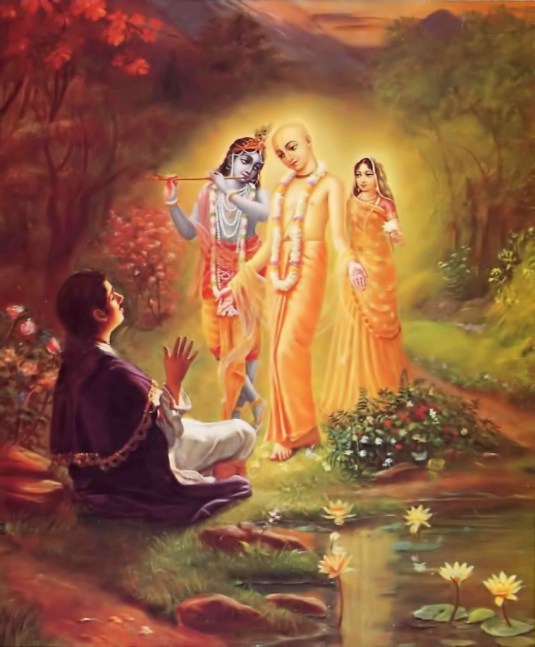
Not only is this one of my most favorite pictures from the Śrī Caitanya-caritāmṛta, but this is one of the most nectarean chapters as well. This is a continuation from our previous post Drops of Nectar, and includes texts 279-289 from chapter eight of the Madhya-lila entitled “Talks Between Śrī Caitanya Mahāprabhu and Rāmānanda Rāya”.
Lord Śrī Kṛṣṇa is the reservoir of all pleasure, and Śrīmatī Rādhārāṇī is the personification of ecstatic love of Godhead. These two forms has combined as one in Śrī Caitanya Mahāprabhu. This being the case, Lord Śrī Caitanya Mahāprabhu revealed His real form to Rāmānanda Rāya.
More
01 Oct 2013
by The Hare Krishna Movement
in A.C. Bhaktivedanta Swami Prabhupada, Devotional Service, Teachings of Lord Kapila
Tags: A.C. Bhaktivedanta Swami Prabhupada, bhakti, Bharatavarsa, devotional service, hearing and chanting, India, Kapila, Krishna, Krsna, nine processes of devotional service, parampara system, sravanam kirtanam visnoh, Teachings of Lord Kapila, the son of devahuti, the supreme Lord

…We can understand the pastimes of the Lord by following one or some of the authorized devotional processes.
śravaṇaṁ kīrtanaṁ viṣṇoḥ
smaraṇaṁ pāda-sevanam
arcanaṁ vandanaṁ dāsyaṁ
sakhyam ātma-nivedanam
[SB 7.5.23]
“Hearing, chanting and remembering the holy name, form, pastimes, qualities and entourage of the Lord, offering service according to the time, place and performer, worshiping the Deity, offering prayers, always considering oneself the eternal servant of Kṛṣṇa, making friends with Him and dedicating everything unto Him—these are the nine processes of devotional service.” (Bhāg. 7.5.23)
…hearing and chanting, are the beginning of bhakti, devotional service. Therefore it is said: tāni me śraddadhānasya kīrtanyāny anukīrtaya. The word anukīrtaya means to follow the paramparā system… The Supreme Lord is more anxious to give us education and enlightenment than we are to receive them. He gives us His literature, His devotees and the paramparā system, but it is up to us to take advantage of these. The Kṛṣṇa consciousness movement is intended to give society the proper understanding of the Absolute Truth. We are not presenting a manufactured, bogus philosophy. Why should we unnecessarily waste our time concocting some philosophy? There is so much to be learned that has already been given by the supreme authority. All we have to do is take this Vedic literature, try to learn it and distribute it. That is Caitanya Mahāprabhu’s mission.
Teachings of Lord Kapila, the Son of Devahūti
By His Divine Grace A. C. Bhaktivedanta Swami Prabhupāda
Chapter Three, Text 3
Full chapter More
30 Sep 2013
by The Hare Krishna Movement
in A.C. Bhaktivedanta Swami Prabhupada, Krishna Consciousness, Krsna Consciousness, KRSNA The Supreme Personality of Godhead
Tags: A.C. Bhaktivedanta Swami Prabhupada, Dwarka, Jarasandha, Kamsa, king jarasandha, kingdom of Mathura, Krishna, Krsna, Krsna erects the Dvaraka fort, Krsna The Supreme Personality of Godhead, military strength capital of the Yadu kings, Sri Krishna, Vedic civilization

click on image to enlarge
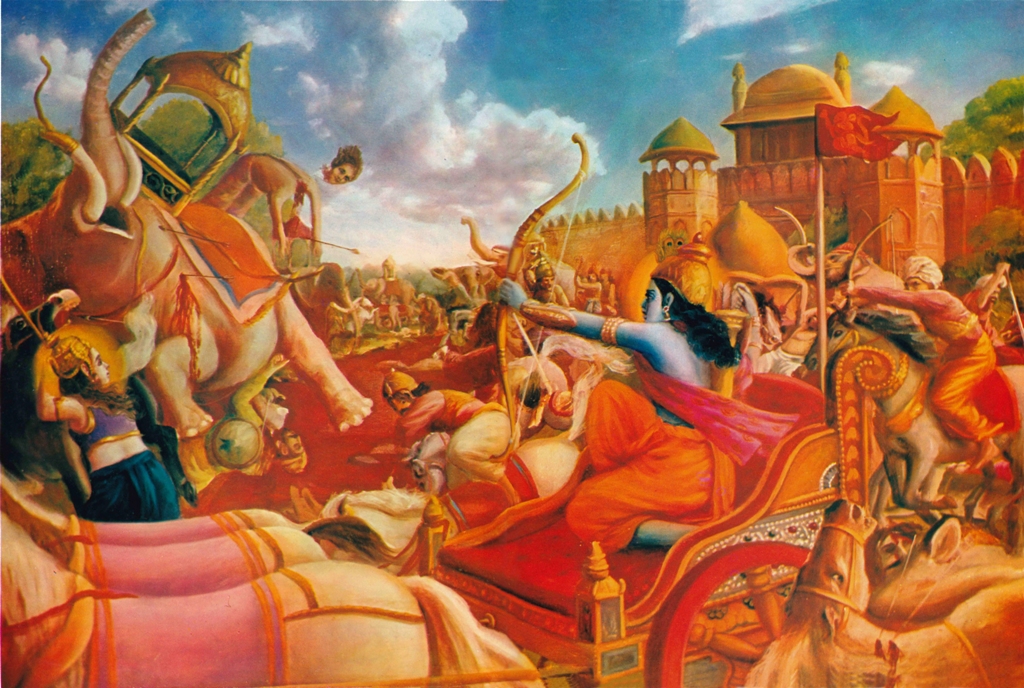
I often lament that as a child growing up my hero’s were fictional characters, like Flash Gordan and Superman, without any Krsna Consciousness. And I often think how fortunate are the children who grew up instead with stories from the Krsna Book, or the Mahabharata. With great battle scenes, real drama, and romance. Not just fictional stories but eternal pastimes of the Lord and His devotees. Here is one such example:
…In order to fight with Kṛṣṇa, Jarāsandha surrounded Him from all sides with great military strength, and the sun appeared covered by the cloudy air and dust. Similarly, Kṛṣṇa, the supreme sun, was covered by the military strength of Jarāsandha. Kṛṣṇa’s and Balarāma’s chariots were marked with pictures of Garuḍa and palm trees. The women of Mathurā were all standing on the tops of the houses and palaces and gates to see the wonderful fight, but when Kṛṣṇa’s chariot was surrounded by Jarāsandha’s military force, they became so frightened that some of them fainted. Kṛṣṇa saw Himself overwhelmed by the military strength of Jarāsandha. His small number of soldiers was being harassed by them, so He immediately took up His bow, named Śārṅga.
He began to take His arrows from their case, and one after another He set them on the bowstring and shot them toward the enemy. They were so accurate that the elephants, horses and infantry soldiers of Jarāsandha were quickly killed. The incessant arrows thrown by Kṛṣṇa appeared as a whirlwind of blazing fire killing all the military strength of Jarāsandha.
Wow!
Kṛṣṇa, the Supreme Personality of Godhead 1970 Edition
By His Divine Grace A. C. Bhaktivedanta Swami Prabhupāda
Chapter Fifty
Full Chapter More
28 Sep 2013
by The Hare Krishna Movement
in A.C. Bhaktivedanta Swami Prabhupada, Back to Godhead, Interview with Srila Prabhupada, Newton Minnow
Tags: A.C. Bhaktivedanta Swami Prabhupada, Back to Godhead Magazine, btg vol.1 no.56, interview with His Divine Grace, Krsna, Lord Caitanya, Newton Minnow, prabhupada, surcharged with bliss, television, tv interview, vast wasteland
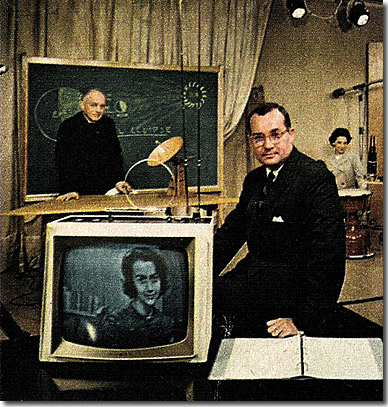
Transcendental Broadcast
A television interview with His Divine Grace A.C. Bhaktivedanta Swami Prabhupada
Excerpted from ‘Back To Godhead’ magazine, 1973, Vol. 1 No. 56
Newton Minnow, former director of the FCC, described the world of TV viewing as a “vast wasteland.” But when a pure devotee of Krsna (God) appears on television, the whole performance becomes surcharged with bliss. When television, with its complex technological set-up for reproducing a picture in thousands of TV sets, is used by a pure devotee for the purpose of glorification of the Supreme Lord, it becomes spiritualized. Whoever sees and hears a pure devotee talking about the nature of God and the eternal soul becomes liberated from all misery.
More
23 Sep 2013
by The Hare Krishna Movement
in A.C. Bhaktivedanta Swami Prabhupada, Ecstasy, Krishna Nectar, Spiritual Life, Vrndavana
Tags: A.C. Bhaktivedanta Swami Prabhupada, divine ecstasies, Krishna's friends, Krsna, Krsna-katha, lotus flower, lunch with krssn, Pariksit, SB 10, Srila Prabhupada's divine ecstasies, Srimad Bhagavatam, Sukadeva Goswami, whorl of a lotus flower

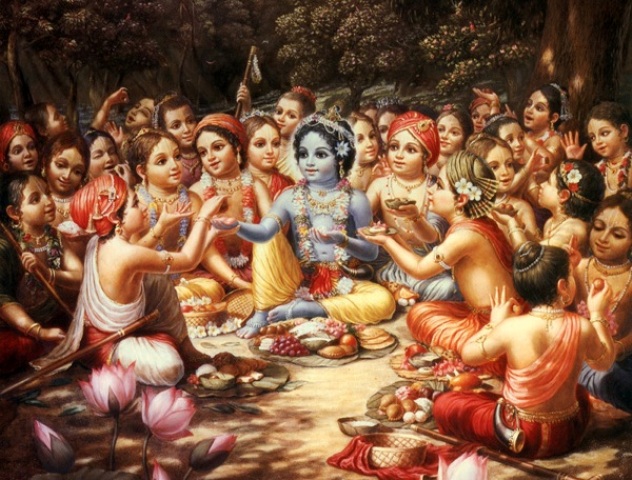
Today, being Monday, and the start of another workday week, I wanted to focus my mind, not on all the work ahead, but rather, on some Krishna Nectar from Srila Prabhupada’s Srimad Bhagavatam. We share with you a few of Srila Prabhupada’s divine ecstasies. As we mentioned is a previous post, there are two kṛṣṇa-kathās; narrations spoken by Kṛṣṇa, and narrations spoken about Kṛṣṇa. Please note text 5 & 6 which is spoken by Krsna.
…devotees who have accepted the essence of life, are attached to Kṛṣṇa in the core of their hearts, and He is the aim of their lives. It is their nature to talk only of Kṛṣṇa at every moment, as if such topics were newer and newer.
Like the whorl of a lotus flower surrounded by its petals and leaves, Kṛṣṇa sat in the center, encircled by lines of His friends, who all looked very beautiful. Every one of them was trying to look forward toward Kṛṣṇa, thinking that Kṛṣṇa might look toward him. In this way they all enjoyed their lunch in the forest.
Among the cowherd boys, some placed their lunch on flowers, some on leaves, fruits, or bunches of leaves, some actually in their baskets, some on the bark of trees and some on rocks. This is what the children imagined to be their plates as they ate their lunch.
Srimad Bhagavatam
By His Divine Grace A. C. Bhaktivedanta Swami Prabhupada
Canto 10, Chapter 13, Text 1-12
Translations and purports More
17 Sep 2013
by The Hare Krishna Movement
in A.C. Bhaktivedanta Swami Prabhupada, Kapila, Teachings of Lord Kapila
Tags: A.C. Bhaktivedanta Swami Prabhupada. Kapila, bhaktya mam abhijanati, birth death old age and disease, blissful life, eternal life, janma karma ca me, Krsna, sac-cid-ananda, Teachings of Lord Kapila, Vaikunthaloka, vigraha

…Anyone who is associated with the Supreme Lord is accepted as a first-class yogī.
…people are unaware of the miserable conditions of material life. Kṛṣṇa says in Bhagavad-gītā (13.9), janma-mṛtyu jarā-vyādhi-duḥkha-doṣānudarśanam. Real knowledge means knowing that however great one may be, the four principles of material life are present: birth, old age, disease and death.
The Kṛṣṇa consciousness movement is an attempt to make people fortunate. In this age, everyone is unfortunate (manda-bhāgyāḥ), but now we are trying to reverse the situation.
Teachings of Lord Kapila, the Son of Devahūti
By His Divine Grace A. C. Bhaktivedanta Swami Prabhupāda
Chapter Two
More
17 Sep 2013
by The Hare Krishna Movement
in Bhaktivinoda Thakura, Suddha-bhakata
Tags: bhaktivinoda, devotional practices, enthusiastic devotional service, kirtan, Krsna, Lord Caitanya, Lord Madhava, lotus feet of pure devotees, Songs of the Vaisnava Acaryas, Srila Bhaktivinoda Thakura, suddha-bhakta, tulasi tree

Today marks the appearance day of Srila Bhaktivinoda Thakura. To honor this day, we are posting a very nice song written by Srila Bhaktivinoda entitled “Suddha-bhakta”, and are observing a 1/2 day fast.
The dust of the lotus feet of pure devotees, enthusiastic devotional service, and service to the pure devotees of the highest order are the roots of the creeper of devotion. The holy days like Ekadasi and Janmastami are the mother of devotion for those devotees who respect them. Let the holy places of Krsna’s pastimes be my places of worship, and bless me. May I always visit all the holy places associated with the lila of Lord Caitanya and His devotees. When I hear the sound of the mrdanga in my heart I always desire to join in kirtana; and when I hear the bonafide songs describing Lord Caitanya’s pastimes, my heart dances in ecstasy. Whenever I see the transcendental sri-vigrahas of Radha-Krsna I am in bliss, for by taking Their Lordships’ prasada we can conquer over the material elements. One day while performing devotional practices, I saw my house transformed into Goloka Vrndavana. When I take the caranamrta of the Deity, I see the holy Ganges waters that come from the feet of Lord Visnu, and my bliss knows no bounds. By seeing the tulasi tree my heart feels joy and Lord Madhava (Krsna) is also satisfied. When I eat the prasada favored by Lord Caitanya it is a new life’s experience. (Lord Caitanya was very fond of a green vegetable preparation called sak, and there is another song in this book that tells of the amazing effects of this type of prasada). Bhaktivinoda concludes by saying: “Whosoever attains the stage of enthusiasm for these devotional practices will be supremely blissful wherever he may be.”
Full song lyrics More
Previous Older Entries Next Newer Entries












 The Hare Krishna Movement