This is a very important verse, and often quoted by Srila Prabhupada in Lectures.
“One who knows the transcendental nature of My appearance and activities does not, upon leaving the body, take his birth again in this material world, but attains My eternal abode, O Arjuna.” (Bg 4.9)
…“The one Supreme Personality of Godhead is eternally engaged in many, many transcendental forms in relationships with His unalloyed devotees.”
…the devotee, simply by understanding the transcendental nature of the body and activities of the Lord, attains the abode of the Lord after ending this body and does not run the risk of returning again to this material world.
…One can attain the perfect stage of liberation from birth and death simply by knowing the Lord, the Supreme Personality of Godhead. (from purport)
When I first began reading this verse from the Srimad Bhagavatam this morning, I thought it was just about hearing, but as I read and re read the purport, it was also about love.
“Simply by giving aural reception to this Vedic literature, the feeling for loving devotional service to Lord Kṛṣṇa, the Supreme Personality of Godhead, sprouts up at once to extinguish the fire of lamentation, illusion and fearfulness.” (Srimad Bhagavatam 1.7.7.)
There are various senses, of which the ear is the most effective. This sense works even when a man is deep asleep. One can protect himself from the hands of an enemy while awake, but while asleep one is protected by the ear only. The importance of hearing is mentioned here in connection with attaining the highest perfection of life, namely, getting free from three material pangs…
…And it is definitely suggested herein that simply by hearing the message of Śrīmad-Bhāgavatam one gets attachment for the Supreme Personality of Godhead Śrī Kṛṣṇa, and as soon as this is effected the symptoms of the material diseases disappear. Śrīla Vyāsadeva saw the all-perfect Personality of Godhead, and in this statement the all-perfect Personality of Godhead Śrī Kṛṣṇa is clearly confirmed.
The ultimate result of devotional service is to develop genuine love for the Supreme Personality. Love is a word which is often used in relation with man and woman. And love is the only word that can be properly used to indicate the relation between Lord Kṛṣṇa and the living entities.
Loving devotional service to the Lord begins with hearing about the Lord. (from purport)
I ran across this offering to Srila Prabhupada some years ago. I don’t know the author, but he most certainly is a devotee.
Srila Prabhupada Stotra by Ananta Shastri
krsnaika ceta mada moha vinasa karin mad drsti gocara prabho prabhupada swamin, dosa nivritti para duhsita manda budhim sanchintayami caranau tava bhakti hetoh
Oh Srila Prabhuapada ! You have kindly awakened us to Krishna consciousness and have destroyed madness and illusion from the root, oh my master Srila Prabhupada, please have your kind glance upon me. Only by your kind mercy will I be able to free myself from the materialistic faults, fully impure and have very dull intelligence, hence constantly thinking of your lotus feet, I will try to perform devotional service.
vrndavane-ramanareti prasiddha bhumau tatrapi krsna-balarama supada mule, jnanam param parama krsna sudharmi tyuktam dantastu deva prabhupada namo namaste
The place known as Ramanareti in Sri Vrindavana Dham and is situated in the middle of the famaus pious Vraja mandal area. (Uttar Pradesh). Srila Prabhupada established Sri Krishna Balaram Mandir at the place where Krishna Balarama perform many pastimes like tending the calves, their divine lotus feet has sanctified the sand in that area. He prepared the place where one can pursue knowledge and devotion to Krishna by the supreme religious devotees who aspire for supreme destination. I offer my respectful obeisances with straw between teeth to that divinely empowered Srila Prabhupada.
Oh Prabhupada, obeisances unto you again and again, please bestow your merciful glance, please bestow divine bliss, please protect me from all types dangers, if with your supreme kindness I will obtain the expertise to perform devotional service. I offer my obeisances to your divine grace again and again.
bhakti-siddhanta sisyaya, bhaktivedanta namine prasantaya prasanmaya tasmai sri gurave nama
Srila Prabhupada ! You are the dearest disciple of your Guru Maharaja Srila Bhakti-Siddhanta Saraswati Goswami, your divine name is A.C. Bhaktivedanta Swami, your are always peaceful and content, I offer my respectful obeisances unto you who is my spirtual master.
aksino phala tvadrsam darsanam hi tano phalam tvadrsam gatra sangah, jihva phalam tvadrsam kirtanam hi sudurlabha bhagavatam hi loke
The perfection of the eyes are certainly to have glance of your form (darsanam), the perfection of body is to have your kind and direct association, the perfection of the tongue is to chant your divine glories since it is certainly very rare to find a Bhagavata devotee in this world.
The following are the prayers by Gajendra, the King of the elephants, offered to the Supreme Personality of Godhead, during his difficult struggle with the crocodile. It appears that the King of the elephants was formerly a human being known as Indradyumna and that he learned a prayer to the Supreme Lord. Fortunately he remembered that prayer and began to chant it. First he offered his respectful obeisances to the Supreme Personality of Godhead, and because of his awkward position in having been attacked by the crocodile, he expressed his inability to recite prayers nicely. Nonetheless, he tried to chant the mantra and expressed himself in the prayers that follow.
…It is imperative that all devotees in Kṛṣṇa consciousness practice chanting some mantra. Certainly one should chant the Hare Kṛṣṇa mantra, which is the mahā-mantra, or great mantra, and also one should practice chanting cintāmaṇi-prakara-sadmasu or the Nṛsiṁha strotra (ito nṛsiṁhaḥ parato nṛsiṁho yato yato yāmi tato nṛsiṁhaḥ). Every devotee should practice in order to chant some mantra perfectly so that even though he may be imperfect in spiritual consciousness in this life, in his next life he will not forget Kṛṣṇa consciousness, even if he becomes an animal. Of course, a devotee should try to perfect his Kṛṣṇa consciousness in this life, for simply by understanding Kṛṣṇa and His instructions, after giving up this body one can return home, back to Godhead. Even if there is some falldown, practice of Kṛṣṇa consciousness never goes in vain. For example, Ajāmila, in his boyhood, practiced chanting the name of Nārāyaṇa under the direction of his father, but later, in his youth, he fell down and became a drunkard, woman-hunter, rogue and thief. Nonetheless, because of chanting the name of Nārāyaṇa for the purpose of calling his son, whom he had named Nārāyaṇa, he became advanced, even though he was involved in sinful activities. Therefore, we should not forget the chanting of the Hare Kṛṣṇa mantra under any circumstances. It will help us in the greatest danger, as we find in the life of Gajendra.(From Purport to text 1)
Śrīmad-Bhāgavatam By His Divine Grace A. C. Bhaktivedanta Swami Prabhupāda Canto 8, Chapter Three, Text 1-29
This morning as I was making a breakfast offering, and was offering a nice glass of fresh milk, my mind just seemed to go to this picture of Krsna milking a cow. And I thought ‘milk is such a wonderful food, miraculous really. One can live on milk, and as small children milk is all that is required, and as we develop as yogis, we can subsist on the gifts of God, such as fruits, grains and milk, without a need for killing.
The above picture is one of my very favorites from the Krsna Book, because it is so simple and sweet, and there is a noticeable absence of technology.
The following are two verses from the Bhagavad-gita As It Is describing the healthy diet, and activities of the yogi.
There is no possibility of one’s becoming a yogī, O Arjuna, if one eats too much, or eats too little, sleeps too much or does not sleep enough.
He who is temperate in his habits of eating, sleeping, working and recreation can mitigate all material pains by practicing the yoga system. (Bg. 6.16-17)
This morning as I was finishing the Tenth Chapter of the Second Canto, the following verse and purport jumped out at me from the pages. And I realized for the thousandth time, what great good fortune we have in that we can hear directly from the pure devotee of the Lord, about the eternal pastimes of the Lord, through the pages of the Srimad Bhagavatam.
Of the three types of Transcendentalist’s, namely the jñānī, the yogī and the bhakta, or the impersonalist, the meditator and the devotee. It is only the devotee who can factually know the Lord as He is and thus be trained in the bona fide service of the Lord and be allowed to enter into the direct association of the Lord in so many capacities. The highest glorious association with the Lord is made possible in the planet of Goloka Vṛndāvana, where Lord Kṛṣṇa enjoys Himself with the gopīs and His favorite animals, the surabhi cows.
… The impersonalist is satisfied simply by understanding the all-pervasive influence of the Lord. This is called Brahman realization. Greater than the impersonalist is the mystic who sees the Lord situated in his heart as Paramātmā, the partial representation of the Lord. But there are pure devotees who take part in the direct pleasure (ānanda) potency of the Lord by factual reciprocation of loving service. The Lord in His abode called the Vaikuṇṭha planets, which are eternal manifestations, always remains with His associates and enjoys transcendental loving services by His pure devotees in different transcendental humors.
So we are pleased to present the following Texts and Purports
Sometimes when I am sitting and reading from Srila Prabhupada’s Srimad Bhagavatam, a verse or sentence from the purport just jumps out from the page almost like it is in 3D, and I catch a glimpse of what the Spiritual World must be like. It is beyond even my imagination, but sometimes I catch a glimmer of light, through a transcendental window, by the grace of my spiritual master His Divine Grace A. C. Bhaktivedanta Swami Prabhupada.
…The transcendental abode of the Lord where the trees are all desire trees and the buildings are made of touchstone. The Lord Govinda is engaged there in herding the surabhi cows as His natural occupation.
“I worship Govinda, the primeval Lord, the first progenitor who is tending the cows, yielding all desire, in abodes built with spiritual gems, surrounded by millions of purpose trees, always served with great reverence and affection by hundreds of thousands of lakṣmīs or gopīs.” (Bs 5.29)
…The Lord Govinda is engaged there in herding the surabhi cows as His natural occupation. And those who are artists, overtaken by the beautiful creation, should better see to the beautiful face of the Lord for complete satisfaction. The face of the Lord is the embodiment of beauty. What they call beautiful nature is but His smile, and what they call the sweet songs of the birds are but specimens of the whispering voice of the Lord.
I remember some years ago (1979), Bob Dylan released this song entitled “Gotta Serve Somebody”. I’m sure many of you remember it.
[Chorus] But you’re going to have to serve somebody, yes indeed You’re going to have to serve somebody Well, it may be the devil or it may be the Lord But you’re going to have to serve somebody
I chose to serve the Lord, Krishna. Service ts our eternal nature, our dharma. And like Bob says “You’re going to have to serve somebody”
The following are some quotes from the Srimad Bhagavatam, ant the Bhagavad-gita, on our eternal relationship (sanātana-dharma) with the Lord.
At the last stage of one’s life, one should be bold enough not to be afraid of death. But one must cut off all attachment to the material body and everything pertaining to it and all desires thereof. (SB 2.1.15)
The foolishness of gross materialism is that people think of making a permanent settlement in this world, although it is a settled fact that one has to give up everything here that has been created by valuable human energy. Great statesmen, scientists, philosophers, etc., who are foolish, without any information of the spirit soul, think that this life of a few years only is all in all and that there is nothing more after death. This poor fund of knowledge, even in the so-called learned circles of the world, is killing the vitality of human energy, and the awful result is being keenly felt. And yet the foolish materialistic men do not care about what is going to happen in the next life. The preliminary instruction in the Bhagavad-gītā is that one should know that the identity of the individual living entity is not lost even after the end of this present body, which is nothing but an outward dress only. As one changes an old garment, so the individual living being also changes his body, and this change of body is called death. Death is therefore a process of changing the body at the end of the duration of the present life. An intelligent person must be prepared for this and must try to have the best type of body in the next life. The best type of body is a spiritual body, which is obtained by those who go back to the kingdom of God or enter the realm of Brahman. (from purport)
This is a nice Study Guide on the Bhagavad-gita As It Is. It begins with the Introduction to the Bhagavad-gita, some notes on the Original Edition, the significance of the Bhagavad-gita, a philosophical synopsis, chapter by chapter summary, Q & A, and a suguested teaching syllabus. All in all ,a very nice presentation prepared by disciples and followers of His Divine Grace A. C. Bhaktivedanta Swami Prabhupada.
We are offing it here as a free pdf download that you can view, save or print, by clicking on the following link:
Last night as I was falling asleep, this prayer just popped into my head:
SRI RUPA PRANAMA
sri-caitanya-mano-‘bhistam sthapitum yena bhtu-tale svayam rupah kada mahyam dadati sva-padantikam
sri-caitanya-of Lord Caitanya; manah– mind; abhistam-what is desired; sthapitam-established; yena-by whom; bhu-tale-on the surface of the globe; svayam-himself; rupah-Srila Rupa Gosvami; kada-when; mahyam-unto me; dadati-will give; sva-his own; pada-lotus feet; antikam-proximity to.
When will Srila Rupa Gosvami Prabhupada, who has established within this material world the mission to fulfill the desire of Lord Caitanya, give me shelter under his lotus feet?
And as I drifted off to sleep I was thinking about Srila Rupa Goswami, I don’t know why. But I woke still thinking about him. The following is an article from Back to Godhead Magizine.
Obstacles on the Path of Eternity An Excerpt from Srila Rupa Gosvami’s Upadesamrta from Back to Godhead Magazine Vol. 1, No.88, 1973
[SRILA RUPA GOSVAMI was one of six exalted devotees especially chosen through the Krsna conscious chain of spiritual masters to teach the devotional service of the Supreme Lord in a scientific manner. Although all of these six great devotees were erudite scholars and prolific writers, Srila Rupa Gosvami is the most prominent, for he most greatly appreciated the nectar of Krsna consciousness. His Upadesamrta (Nectarean Instructions), a short work of only eleven verses, teaches the basic principles for arousing one’s dormant love of Krsna, the Supreme Lord. Written in Sanskrit some 400 years ago, it has now been translated into English, with an illuminating explanation of each verse, by His Divine Grace A.C. Bhaktivedanta Swami Prabhupada.]
Recently I was staying at a friends house, and in the room where I was spending the night there was one book by Giriraj Swami entitled “Watering the Seed”. I happened to open it and began reading from the Preface:
…from that first meeting with Srila Prabhupada, my whole life’s purpose became to bring people to meet Srila Prabhupada. And I was able to do that for many years. But when he passed away, I wondered ‘what will be my service now?’. My whole service had been to bring people to Srila Prabhupada.
Now I understand that Srila Prabhupada is always present, and that by speaking of him, hearing about him, remembering him, and, most significantly, by studying his books and following his instructions, we can experience his presence. So I can continue doing what I was doing when he was personally present-introducing soul’s to Srila Prabhupada-and that is what I feel most natural doing. Because I know that somehow or other, if someone comes in touch with Srila Prabhupada, his life will become successful. (Watering the Seed, Preface)
Now, I am always encouraged when I hear my Godbrothers speaking in this way, because this is how I have always felt, and continue to feel. That my main purpose, as a disciple, is to bring people to Srila Prabhupada, and there-by bringing them to Krishna.
In the following conversation, taped at George’s home in England on September 4, 1982, George reveals some memorable experiences he has had chanting Hare Krishna and describes in detail his deep personal realizations about the chanting. He reveals what factors led him to produce “The Hare Krishna Mantra” record, “My Sweet Lord,” and the LPs All Things Must Pass and Living in the Material World, which were all influenced to a great extent by the Hare Krishna chanting and philosophy. He speaks lovingly and openly about his association with His Divine Grace A. C. Bhaktivedanta Swami Prabhupada, Founder-Acarya (spiritual master) of the Hare Krishna movement. In the following interview George speaks frankly about his personal philosophy regarding the Hare Krishna movement, music, yoga, reincarnation, karma, the soul, God, and Christianity. The conversation concludes with his fond remembrances of a visit to the birthplace of Lord Krishna in Vrndavana, India, home of the Hare Krishna mantra, and with George discussing some of his celebrity friends’ involvement with the mantra now heard and chanted around the world.
I remember back many years ago, when I was a new devotee traveling with the RDTSP, we attended a Rainbow Festival in Oregon. There were many hippy type personalities, and aspiring spiritualists, and I meet this one man, who looked like Jesus, with long hair and sandals, with a sign around his neck that said, “I Am God”.
So I said to him, “If you are God, then show me your Universal Form”. It was stunned silence. He could not reply. I guess maybe he wasn’t God after all. Or I didn’t have the divine vision to see. But either way, he wasn’t still wearing the sign at the end of the day.
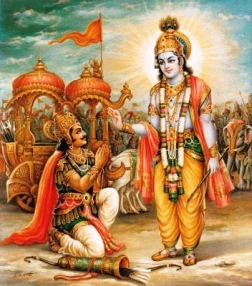
O greatest of all personalities, O supreme form, though I see here before me Your actual position, I yet wish to see how You have entered into this cosmic manifestation. I want to see that form of Yours. (Bg. 11. 3)
If You think that I am able to behold Your cosmic form, O my Lord, O master of all mystic power, then kindly show me that universal self. (Bg 11 .4)
The Blessed Lord said: My dear Arjuna, O son of Pṛthā, behold now My opulences, hundreds of thousands of varied divine forms, multicolored like the sea. (Bg 11. 5)
But you cannot see Me with your present eyes. Therefore I give to you divine eyes by which you can behold My mystic opulence. (Bg. 11. 8)
Arjuna saw in that universal form unlimited mouths and unlimited eyes. It was all wondrous. The form was decorated with divine, dazzling ornaments and arrayed in many garbs. He was garlanded gloriously, and there were many scents smeared over His body. All was magnificent, all-expanding, unlimited. This was seen by Arjuna. (Bg 11. 10-11
I first ran across this book some twenty years ago, although it was printed in 1970, I was surprised to learn there was a handbook for devotees. I found it to be a treasure house of basic guidelines for developing our Krsna consciousness, as well as presenting the philosophy very simply. Nice little book.
Introduction This is the first annual edition of The Krsna Consciousness Handbook. The International Society for Krishna Consciousness (ISKCON) was founded in 1966 by His Divine Grace A.C. Bhaktivedanta Swami Prabhupada and is now becoming firmly established, with centers in thirty major cities around the world and world headquarters in Los Angeles,California. The goal of the Society’s members is to attain love of God by following the principles of bhakti-yoga,as ·taught by the Vedic scriptures and the disciplic succession of spiritual masters, and to spread love of God to all people through the process of sankirtana (public chanting of the holy names of God). Another important goal of the Society is to present authoritative literature on the science of God in English and other major languages.
Today we celebrate Govardhana-puga, when Krishna exhibited His transcendental pastime of lifting Govardhana Hill to protect the inhabitants of Vrndavan.
…The sacrifice known as Govardhana Pūjā is observed in the Kṛṣṇa consciousness movement. Lord Caitanya has recommended that since Kṛṣṇa is worshipable, so His land, Vṛndāvana and Govardhana Hill, are also worshipable. To confirm this statement, Lord Kṛṣṇa said that Govardhana Pūjā is as good as worship of Him. From that day, the Govardhana Pūjā has been still going on and is known as Annakūṭa. In all the temples of Vṛndāvana or outside of Vṛndāvana, huge quantities of food are prepared in this ceremony and are very sumptuously distributed to the general population. Sometimes the food is thrown to the crowds, and they enjoy collecting it off the ground. From these instances, we can understand that prasādam offered to Kṛṣṇa never becomes polluted or contaminated, even if it is thrown on the ground. The people, therefore, collect it and eat with great satisfaction. (from Kṛṣṇa, The Supreme Personality of Godhead, chapter 24)
On this auspicious day, we like to read from KRSNA Book, and I have included the entire 25th chapter emtitled, “Devastating Rainfall in Vrndavana”.
All the gopī friends of Yaśodā and Rohiṇī enjoyed the naughty childish activities of Kṛṣṇa and Balarāma in Vṛndāvana. In order to enjoy further transcendental bliss, they all assembled and went to mother Yaśodā to lodge complaints against the restless boys. When Kṛṣṇa was sitting before mother Yaśodā, all the elderly gopīs began to lodge complaints against Him so that Kṛṣṇa could hear. They said, “Dear Yaśodā, why don’t you restrict your naughty Kṛṣṇa? He comes to our houses along with Balarāma every morning and evening, and before the milking of the cows They let loose the calves, and the calves drink all the milk of the cows. So when we go to milk the cows, we find no milk, and we have to return with empty pots. If we warn Kṛṣṇa and Balarāma about doing this, They simply smile charmingly. We cannot do anything. Also, your Kṛṣṇa and Balarāma find great pleasure in stealing our stock of yogurt and butter from wherever we keep it. When Kṛṣṇa and Balarāma are caught stealing the yogurt and butter, They say, ’Why do you charge Us with stealing? Do you think that butter and yogurt are in scarcity in Our house?’ Sometimes They steal butter, yogurt and milk and distribute them to the monkeys. When the monkeys are well fed and do not take any more, then your boys chide, ’This milk and butter and yogurt are useless–even the monkeys won’t take it.’ And They break the pots and throw them hither and thither. If we keep our stock of yogurt, butter and milk in a solitary dark place, your Kṛṣṇa and Balarāma find it in the darkness by the glaring effulgence of the ornaments and jewels on Their bodies. If by chance They cannot find the hidden butter and yogurt, They go to our little babies and pinch their bodies so that they cry, and then They go away. If we keep our stock of butter and yogurt high on the ceiling, hanging on a swing, although it is beyond Their reach, They arrange to reach it by piling all kinds of wooden crates over the grinding machine. And if They cannot reach, They make a hole in the pot. We think therefore that you better take all the jeweled ornaments from the bodies of your children.”
This morning I was reminded of something that I heard Srila Prabhupada say in a lecture. He was describing that Krishna Consciousness is very simple, you just need to do four things.Always think of Krishna, become His devotee, offer obeisances, and worship Him.
Engage your mind always in thinking of Me, offer obeisances and worship Me. Being completely absorbed in Me, surely you will come to Me. (Bhagavad-gita 9.34)
This verse is also repeated in the 16th Chapter:
man-manā bhava mad-bhakto mad-yājī māṁ namaskuru mām evaiṣyasi satyaṁ te pratijāne priyo ’si me
Always think of Me and become My devotee. Worship Me and offer your homage unto Me. Thus you will come to Me without fail. I promise you this because you are My very dear friend.
In this verse it is clearly indicated that Kṛṣṇa consciousness is the only means of being delivered from the clutches of this contaminated material world…Pure devotional service is the highest achievement of human society. (from purport)
I had to laugh, this came up on my Whats Up App. I followed this with some quotes from Srila Prabhupada on the definition of Paramahamsa.
“We are such lucky souls! Prabhupada was giving class and began to define Paramahamsa and their qualities: swanlike men who are so spiritually exalted that they appear like swans among the ravens and crow-like men. Then he looked at the devotees sitting in front of him and smiled his smile and he said, “And who knows, among you there may be some Paramahamsa’s. And, then he gave an even bigger smile that included all of us and said, “And, the rest of you are just lucky ducks.”
Without a doubt, this is my favorite book ever. I never get tired of reading from the Krsna Book. It seems to get sweeter every time.
Krsna was very pleased with the atmosphere of the forest, where flowers bloomed and bees and drones hummed very jubilantly. While the birds, trees and branches were all looking very happy, Krsna, tending the cows and accompanied by Sri Balarama and the cowherd boys, began to vibrate His transcendental flute. After hearing the vibration, the gopis in Vrndavana remembered Him and began to talk amongst themselves about how nicely Krsna was playing His flute. When the gopis were describing the sweet vibration of Krsna’s flute’; they also remembered their pastimes with Him; thus their minds became disturbed, and they were unable to fully describe the beautiful vibrations. While discussing the transcendental vibration, they also remembered how Krsna dressed, decorated with a peacock feather on His head, just like a dancing actor, and with blue flowers pushed over His ear. His garment glowed yellow-gold, and He was garlanded with a vaijayanti necklace. Dressed in such an attractive way, Krsna filled up the holes of His flute with the nectar emanating from His lips. So they remembered Him, entering Vrndavana forest, which is always glorified by the footprints of Krsna and His friends.








 The Hare Krishna Movement