23 Dec 2011
by The Hare Krishna Movement
in Free Downloads, Free eBooks, The Hare Krsna Cookbook, Vegetarian Cooking, Vegetarian Recipies, Vegetarianism
Tags: A.C. Bhaktivedanta Swami Prabhupada, devotional service, Krishna, krsna consciousness, Krsna devi dasi, Prasadam, Sama devi dasi, singing dancing and feasting, The Hare Krsna Cookbook, vegetarian cooking, vegetarian recipies, vegetarianism

click on link at bottom to download entire book in pdf format
The Hare Krsna Cookbook
1973 Bhaktivedanta Book Trust
Compiled by Krsna devi dasi and Sama devi dasi
“The Hare Krsna Cookbook”, originally published in 1973, was the first widely distributed book of vegetarian recipes, throughout the Movement. This was the book myself and many early devotees learned to cook from, and remains today my all time favorite cookbook, and is a constant companion in our kitchen. We offer the complete book on a PDF Format as a gift to all our readers this Holiday Season.
Dedication
Prasadam means mercy, and this Prasadam Cookbook is dedicated to the fountainhead of all mercy, the spiritual master, His Divine Grace A.C. Bhaktivedanta Swami Prabhupada. He is by nature kind to every living entity, but that ocean of mercy becomes fully visible in his devotees.
Srila Prabhupada has not given us some dry, canned philosophy to chew; he has given us the nectar for which we have sought so long: he has taught us how to render transcendental loving service to the Lord in all our daily activities. This book illustrates on of them.
The Process of Krsna Consciousness is usually described as one of dinging, dancing and feasting. We have already demonstrated to the world how anyone can sing and dance to the holy names of God, Hare Krsna, and now, with the publication of this Prasadam Cookbook, we hope that the whole world will feast in honor of the Supreme Lord. That will make this world like Vrndavana, the transcendental abode of Krsna, where Krsna, Balarama and the monkeys visit every kitchen with thieving intend and bless the devotees with pure love of God. (Dedication from The Hare Krsna Cookbook)
Dwonload PDF Format 5.6MB The Hare KRSNA Cookbook
23 Dec 2011
by The Hare Krishna Movement
in Back to Godhead, Damodara dasa, Hayagriva das, Remembering Srila Prabhupada
Tags: Back to Godhead Magazine, Bhagavad-gita on the Bowery, Damodara das, His Divine Grace A.C. Bhaktivedanta Swami Prabhupada, Krishna, Nandimukhi devi dasi, Remembering Srila Prabhupada, swami

Spiritual Bongos And Neighborhood Beats
By Damodara Dasa
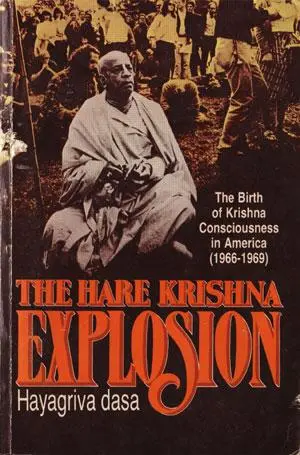
Adapted by Nandimukhi Devi Dasi from Remembering Srila Prabhupada (copyright 1998 Daniel Clark)
His Divine Grace A.C. Bhaktivedanta Swami Prabhupada, my spiritual master, enacted his life’s activities from his birth in 1896 to his passing in 1977. I knew him for the last eleven years of his exemplary pastimes. But to say I knew him is going too far. I watched him. I listened to him. I talked with him and corresponded with him. I followed him and obeyed him—and disobeyed him. I learned from him. I bowed down before him and prayed to him. I loved him, and still do. Through those eleven years, that person I first knew as the Swami, then as Swamiji, and then as Srila Prabhupada guided my life.
More
11 Dec 2011
by The Hare Krishna Movement
in Back to Godhead, Brahmananda das, Spiritual Life, Spiritual World, Vrindavan
Tags: Back to Godhead Magazine, Brahmananda dasa, devotional service, Krishna, Land of No Return, Srila Prabhupada, Vrindavan forest, Vrndavan

Vrndavana—Land of No Return
By His Holiness Brahmananda Swami
Originally Published in Back to Godhead 1975 Vol. 10, No. 11
Part 2
I once visited Vrndavana, India with His Divine Grace Srila Prabhupada. As I accompanied him on his daily walk one morning we suddenly came upon a particularly beautiful spot. The cool sands were thick with foliage; the tall trees full of singing birds. As the sun brightened the clear morning sky, peacocks filled the air with their peculiar call.
Srila Prabhupada looked over his shoulder and said to me, “So, Brahmananda, this is Vrndavana. How do you like it?”
“It’s wonderful, Srila Prabhupada,” was all I could reply. I felt that he was actually revealing the glories of Vrndavana to me even though I had no particular spiritual qualification.
Vrndavana is the place where the Supreme Lord Sri Krsna appeared five thousand years ago. Lord Krsna descended there from His own spiritual planet, Goloka Vrndavana to attract us by displaying His supernatural pastimes. Srila Prabhupada has explained that when Krsna descends to the material world, this same Vrndavana descends with Him just as an entourage accompanies an important personage. Because when Krsna comes His land also comes, Vrndavana is not considered to exist in the material world. Therefore devotees take shelter of the Vrndavana in India, for it is considered to be a replica of the original Goloka Vrndavana.
More
07 Dec 2011
by The Hare Krishna Movement
in Back to Godhead, Krishna Consciousness, Satsvarupa das Goswami, Spiritual Life, Spiritual World
Tags: back to Godhead, His Divine Grace A.C. Bhaktivedanta Swami Prabhupada, Krishna, Krsna Book, Lord Krsna, Satsvarupa dasa, Sudama
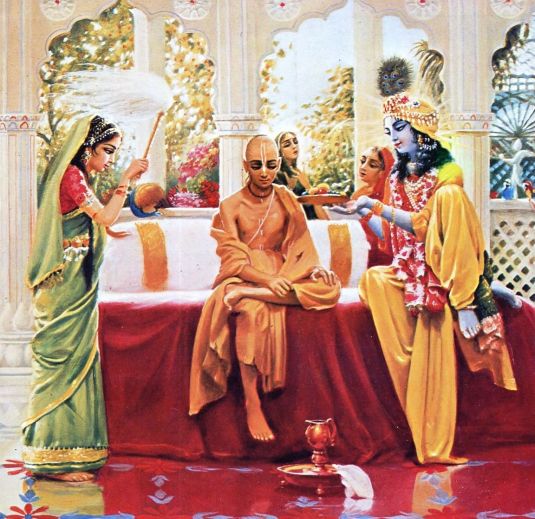
…It is related that by his constant association with the Lord, Sudama had wiped away from his heart whatever contamination was remaining, and he was very shortly transferred to the eternal spiritual kingdom, which is the goal of all saintly persons in the perfectional stage of life. It is stated in the Krsna Book that whoever hears this history will become qualified like Sudama and will be transferred to the spiritual kingdom of Lord Krsna.
Lord Krsna’s Friend Sudama
Published in Back to Godhead Magizine 1971 Vol. 1, Number 49
By Satsvarupa dasa adhikari
The wonderful history of Krsna and His friend Sudama is told in its entirety in the Krsna Book, Volume II, by His Divine Grace A.C. Bhaktivedanta Swami Prabhupada. Srila Prabhupada is kindly presenting to the western world the pastimes of Lord Krsna, which can act as a merciful shower upon the hearts of all of us. It is true that we have forgotten our eternal, blissful and loving relationships as servants of Krsna or God. The remedy to forgetfulness or ignorance of God is to hear about Him from the lips of His pure devotee. This is the view of authorized scriptures.
When Krsna descends from His eternal abode in the spiritual world and appears to this mundane world, as He did 5,000 years ago, He engages with others just as if He were an ordinary human being. Although He is unborn, He appears to have a mother and father. In the village of Vrndavana Krsna plays as a cowherd boy. He enacts these pastimes for His own transcendental pleasure and to attract all the suffering living entities back home, back to Godhead. Sudama was among those devotees who were childhood friends with Krsna, and Sudama was also His intimate school friend.
More
06 Dec 2011
by The Hare Krishna Movement
in Bhagavad-gita, High Thinking, Krishna Consciousness
Tags: Arjuna, Bg. 18.65, bhagavad-gita, Brahma-samhita, His Divine Grace A.C. Bhaktivedanta Swami Prabhupada, Krishna, Krsna meditation, Macmillan 1972 Edition

“…one should concentrate his mind upon Kṛṣṇa-the very form with two hands carrying a flute, the bluish boy with a beautiful face and peacock feathers in His hair. There are descriptions of Kṛṣṇa found in the Brahma-saṁhitā and other literatures. One should fix his mind on this original form of Godhead, Kṛṣṇa. He should not even divert his attention to other forms of the Lord. The Lord has multi-forms, as Viṣṇu, Nārāyaṇa, Rāma, Varāha, etc., but a devotee should concentrate his mind on the form that was present before Arjuna. Concentration of the mind on the form of Kṛṣṇa constitutes the most confidential part of knowledge, and this is disclosed to Arjuna because Arjuna is the most dear friend of Kṛṣṇa’s.”
Bhagavad-gita As It Is – Macmillan 1972 Edition
By His Divine Grace A.C. Bhaktivedanta Swami Prabhupada
Chapter 18, Text 65
man-manā bhava mad-bhakto
mad-yājī māṁ namaskuru
mām evaiṣyasi satyaṁ te
pratijāne priyo ‘si me
man-manāḥ—thinking of Me; bhava—just become; mat-bhaktaḥ—My devotee; mat-yājī—My worshiper; mām—unto Me; namaskuru—offer your obeisances; mām—unto Me; eva—certainly; eṣyasi—come; satyam—truly; te—to you; pratijāne—I promise; prijaḥ—dear; asi—you are; me—My.
Always think of Me and become My devotee. Worship Me and offer your homage unto Me. Thus you will come to Me without fail. I promise you this because you are My very dear friend.
More
04 Dec 2011
by The Hare Krishna Movement
in Bhagavad-gita, Book Changes, Book Distribution
Tags: Arjuna, as it is, Battlefield of Kuruksetra, bhagavad-gita, devotee of Sri Krishna, dharma-ksetra, gita-mahatmya, Glorification of the Gita, His Divine Grace A.C. Bhaktivedanta Swami Prabhupada, Krishna, Kuruksetra, place of pilgrimage

The Advent of Bhagavad-gita
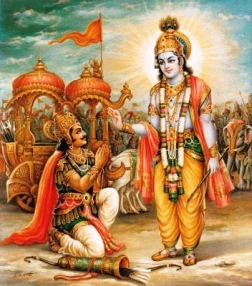
Today is the anniversary commemorating the day when Sri Krishna spoke Bhagavad-gita to Arjuna, at the place known as Kurukṣetra.
Traditionally devotees go to Kurukṣetra (dharma-kṣetra, a place where religious rituals are performed) ) and recite Bhagavad Gita from early morning until the next morning, perform arati to Bhagavad Gita and to Krishna and Arjuna upon the chariot, offer lamps, and discuss the significance of the Bhagavad-gita.
Devotees who cannot get to Kurukṣetra, can honor the blessed event by reading or reciting the Bhagavad-gita, and discussing the subject matter of Bhagavad Gita in the association of devotees.
Distribution of Bhagavad-gita’s on this day is also a very auspicious activity to perform.
Bhagavad-gita As It Is – Macmillan 1972 Edition
By His Divine Grace A.C. Bhaktivedanta Swami Prabhupada
dhṛtarāṣṭra uvāca
dharma-kṣetre kuru-kṣetre
samavetā yuyutsavaḥ
māmakāḥ pāṇḍavāś caiva
kim akurvata sañjaya
dhṛtarāṣṭraḥ—King Dhṛtarāṣṭra; uvāca—said; dharma-kṣetre—in the place of pilgrimage; kuru-kṣetre—in the place named Kurukṣetra; samavetāḥ—assembled; yuyatsavaḥ—desiring to fight; māmakāḥ—my party (sons); pāṇḍavāḥ—the sons of Pāṇḍu; ca—and; eva-certainly; kim—what; akurvata—did they do; sañjaya—O Sañjaya.
Translation
Dhṛtarāṣṭra said: O Sañjaya, after assembling in the place of pilgrimage at Kurukṣetra, what did my sons and the sons of Pāṇḍu do, being desirous to fight?
Purport
Bhagavad-gītā is the widely read theistic science summarized in the Gītā-māhātmya (Glorification of the Gītā). There it says that one should read Bhagavad-gītā very scrutinizingly with the help of a person who is a devotee of Śrī Kṛṣṇa and try to understand it without personally motivated interpretations. The example of clear understanding is there in the Bhagavad-gītā itself, in the way the teaching is understood by Arjuna, who heard the Gītā directly from the Lord. If someone is fortunate enough to understand Bhagavad-gītā in that line of disciplic succession, without motivated interpretation, then he surpasses all studies of Vedic wisdom, and all scriptures of the world. One will find in the Bhagavad-gītā all that is contained in other scriptures, but the reader will also find things which are not to be found elsewhere. That is the specific standard of the Gītā. It is the perfect theistic science because it is directly spoken by the Supreme Personality of Godhead, Lord Śrī Kṛṣṇa.
More
04 Dec 2011
by The Hare Krishna Movement
in Bhagavad-gita, Srila Prabhupada
Tags: Advent of Bhagavad-gita, Arjuna, battle of Kurksetra, bhagavad-gita, essays and articles, His Divine Grace A.C. Bhaktivedanta Awami Prabhupada, Krishna, origin of Bhagavad-gita
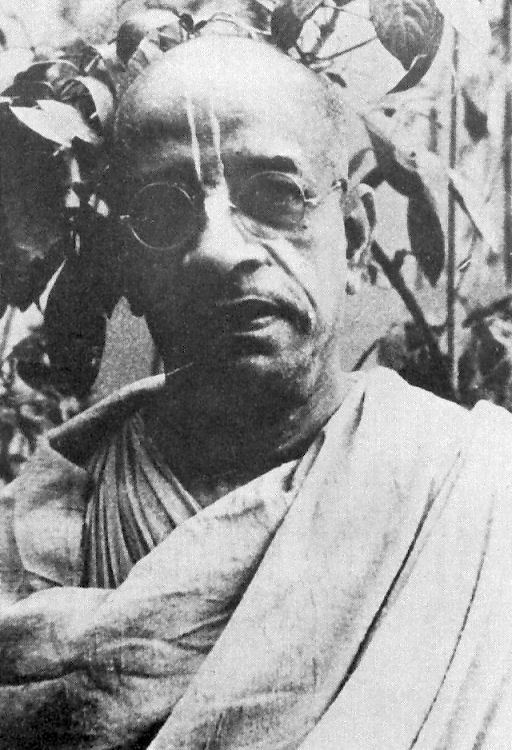
In honor of the Advent of Srimad Bhagavad-gita we are reprinting an Essay on the Bhagavad-gita written by Srila Prabhupada and published on the advent of Bhagavad-gita in 1948
Interpretations of Bhagavad-gita
Originally published c. 1948, on the auspicious observance of the advent of Srimad Bhagavad-gita.]
By His Divine Grace A.C. Bhaktivedanta Swami
It has become a luxurious fashion of the day, along with the progress of material civilization, that everyone can make his interpretation of the great Indian philosophy called the Bhagavad-gītā. This concise form of Vedic knowledge, known as the Gītopaniṣad, is acknowledged by all sections of transcendental scholars, in India especially, as the cream of all Upaniṣads and that of Vedānta-sūtras also. Scholars and ācāryas like Śrīpāda Śaṅkarācārya and some of his followers also could not leave out this very important book of knowledge, although such scholars of the Māyāvāda school did not acknowledge the bona fides of the Purāṇas. But the interpretation of Śrī Śaṅkarācārya differs from the interpretations of the Vaiṣṇava ācāryas headed by Śrī Ramanujācārya and Madhvācārya. There are innumerable interpretations of the Bhagavad-gītā in the market, and it is certainly a puzzling business to select which of the various interpretations shall be accepted as bona fide and which of them shall be rejected as mala fide.
In order to make a distinction between these two classes of bona fide and mala fide interpretations, we have to make an impartial study of the book, and such unbiased study only will make us able to discern the bona fide from the mala fide.
In this connection, we may first of all try to find out the origin of the Bhagavad-gītā. It is wrong to understand that The Bhagavad-gītā was first spoken in the battlefield of Kurukṣetra as it is a part of the great history of India, namely, the Mahābhārata. We can understand from the talks of Śrī Kṛṣṇa and Arjuna, as it is stated in the Bhagavad-gītā, that long, long before the battle of Kurukṣetra, this philosophy was once spoken by Śrī Kṛṣṇa to Vivasvān (the Sun), and from Vivasvān the knowledge was transferred to Manu, and from Manu it was transferred to King Ikṣvāku. And, in that way of disciplic succession, the knowledge has come down to generations after generations, but in course of time, such disciplic succession broke, and therefore, Śrī Kṛṣṇa again repeated the same yoga or transcendental knowledge to Arjuna. In the beginning of the 4th Chapter of Bhagavad-gītā, this fact is stated as follows:
More
01 Dec 2011
by The Hare Krishna Movement
in Back to Godhead, Brahmananda das, Spiritual World, Vrindavan
Tags: back to Godhead, Brahmananda dasa, Krishna, Land of No Return, material world, Shangri-la, Spiritual world, Srila Prabhupada, Vrindavan
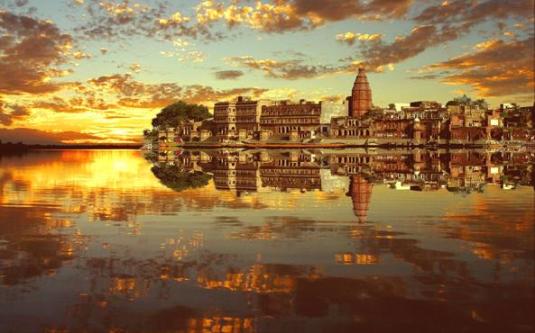
Because Vrndavana is the eternal and entirely spiritual abode of the Lord, it is nondifferent from Him. At Vrndavana, one will find unlimited wealth, strength, fame, wisdom, beauty and renunciation—all the six opulences possessed by the Supreme Personality of Godhead, Bhagavan Sri Krsna. Indeed Vrndavana is Krsna, and, to go there is to perceive God Himself.
Vrndavana—Land of No Return (Part 1)
By His Holiness Brahmananda Swami
Back to Godhead Magazine 1975 Volume 10 Number 9
From the beginning of time, man has yearned for the perfect home—a paradise, a Shangri-la, a Walden—where he could live eternally in peace and happiness. Such a place cannot be found anywhere in the material world, however, for the material world is by its very nature temporary and frustrating. To end our weary searching, we must go beyond this world of duality, beyond the boundaries of space and time, into the spiritual realm.
Vrndavana, India, is that sought-after eternal resting place because it is at Vrndavana that Lord Sri Krsna, the Supreme Personality of Godhead, descended to this planet five thousand years ago. The Lord’s appearance and activities are not mundane; they are completely transcendental. Just as a king may travel with all his retinue, set up camp, and conduct his affairs of state in the same style as if he were in his palace, Lord Krsna brought with Him all His transcendental associates and paraphernalia and created on earth an exact replica of the spiritual world, known as Goloka Vrndavana.
More
01 Dec 2011
by The Hare Krishna Movement
in Bhagavad-gita, Maya
Tags: 29, Bg 5, bhagavad-gita, external energy of Krsna, His Divine Grace A.C. Bhaktivedanta Swami Prabhupada, illusion, Krishna, maya, perfection of life, perfeection of yoga

The sense of a separated existence from Kṛṣṇa is called māyā (mā-not, yā-this).
People in general, especially in this age of Kali, are enamored by the external energy of Kṛṣṇa, and they wrongly think that by advancement of material comforts every man will be happy. They have no knowledge that the material or external nature is very strong, for everyone is strongly bound by the stringent laws of material nature. A living entity is happily the part and parcel of the Lord, and thus his natural function is to render immediate service to the Lord. By the spell of illusion one tries to be happy by serving his personal sense gratification in different forms which will never make him happy. Instead of satisfying his own personal material senses, he has to satisfy the senses of the Lord. That is the highest perfection of life. The Lord wants this, and He demands it. One has to understand this central point of Bhagavad-gītā. Our Kṛṣṇa consciousness movement is teaching the whole world this central point, and because we are not polluting the theme of Bhagavad-gītā As It Is, anyone seriously interested in deriving benefit by studying the Bhagavad-gītā must take help from the Kṛṣṇa consciousness movement for practical understanding of Bhagavad-gītā under the direct guidance of the Lord. We hope, therefore, that people will derive the greatest benefit by studying Bhagavad-gītā As It Is as we have presented it here, and if even one man becomes a pure devotee of the Lord we shall consider our attempt a success.
The Kṛṣṇa consciousness movement is essential in human society, for it offers the highest perfection of life. How this is so is explained fully in the Bhagavad-gītā. Unfortunately, mundane wranglers have taken advantage of Bhagavad-gītā to push forward their demonic propensities and mislead people regarding right understanding of the simple principles of life. Everyone should know how God or Kṛṣṇa is great, and everyone should know the factual position of the living entities. Everyone should know that a living entity is eternally a servant and that unless one serves Kṛṣṇa one has to serve illusion in different varieties of the three modes of material nature, and thus perpetually one has to wander within the cycle of birth and death; even the so-called liberated Māyāvādī speculator has to undergo this process. This knowledge constitutes a great science, and each and every living being has to hear it for his own interest. (From the preface to the Bhagavad-gita As It Is)
More
24 Nov 2011
by The Hare Krishna Movement
in Songs of the Vaisnava Acaryas, Sri Caitanya-Caritamrta, Vegetarian Cooking
Tags: Advaita Acarya, Caitanya Caritamrta, ecstasy of Sri Caitanya Mahaprabhu, grhastha-asrama, Krishna, Lord Chaianya Mahaprabhu, Lord Nityananda, Prasadam, sak, Srila Prabhupada, vegetarian Thanksgiving

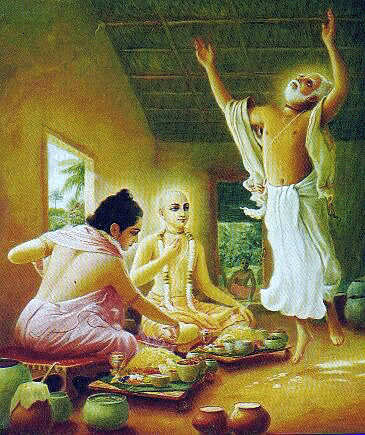
Today being Thanksgiving, we decided to post a story of one of the “Most Famous Feasts” in recent Vaisnava history, cooked by the wife of Advaita Acarya, Sita. Followed by the song composed by Srila Bhaktivinoda Thakura, “Prasada-sevya part 2” honoring this event.
Sri Caitanya-caritamrta – 1975 Edition
By His Divine Grace A.C. Bhaktivedanta Swami Prabhupada
Lord Sri Caitanya Mahaprabhu’s Stay at the House of Advaita Acarya
Madhya 3, Text 38-136
Advaita Ācārya said, “You have been fasting continuously for three days in Your ecstasy of love for Kṛṣṇa. I therefore invite You to My home, where You may kindly take Your alms. Come with Me to My residence.”
Advaita Prabhu continued, “At My home I have just cooked one palmful of rice. The vegetables are always very simple. There is no luxurious cooking-simply a little liquid vegetable and spinach.”
Saying this, Śrī Advaita Ācārya took the Lord into the boat and brought the Lord to His residence. There Advaita Ācārya washed the feet of the Lord and was consequently very happy within.
All the eatables were first cooked by the wife of Advaita Ācārya. Then Śrīla Advaita Ācārya personally offered everything to Lord Viṣṇu.
More
22 Nov 2011
by The Hare Krishna Movement
in Bhagavad-gita, Krsna is the Source of All Incarnations
Tags: Bg 4.7, bhagavad-gita, buddha, Kalki, Krishna, Kurma, Matsya, Nrismhadeva, Parasurama, Plate 16, prabhupada, Rama, Varaha
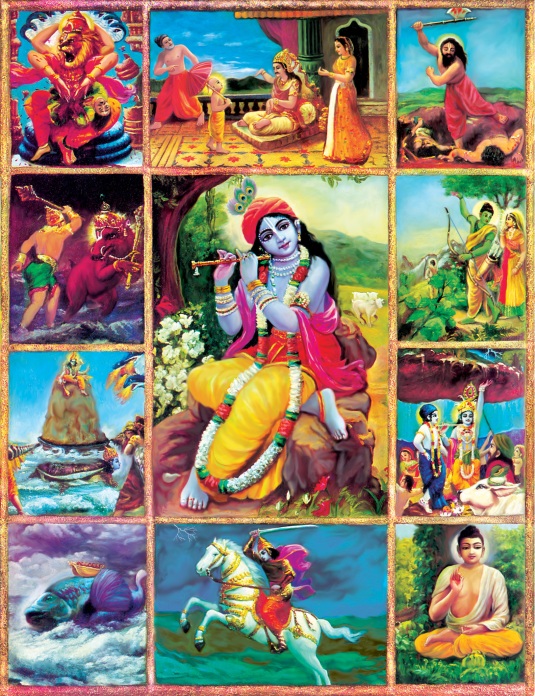
The principles of the Bhagavad-gītā were spoken to Arjuna, and, for that matter, to other highly elevated persons, because he was highly advanced compared to ordinary persons in other parts of the world. Two plus two equals four is a mathematical principle that is true both in the beginner’s arithmetic class and in the advanced class as well. Still, there are higher and lower mathematics. In all incarnations of the Lord, therefore, the same principles are taught, but they appear to be higher and lower in varied circumstances.
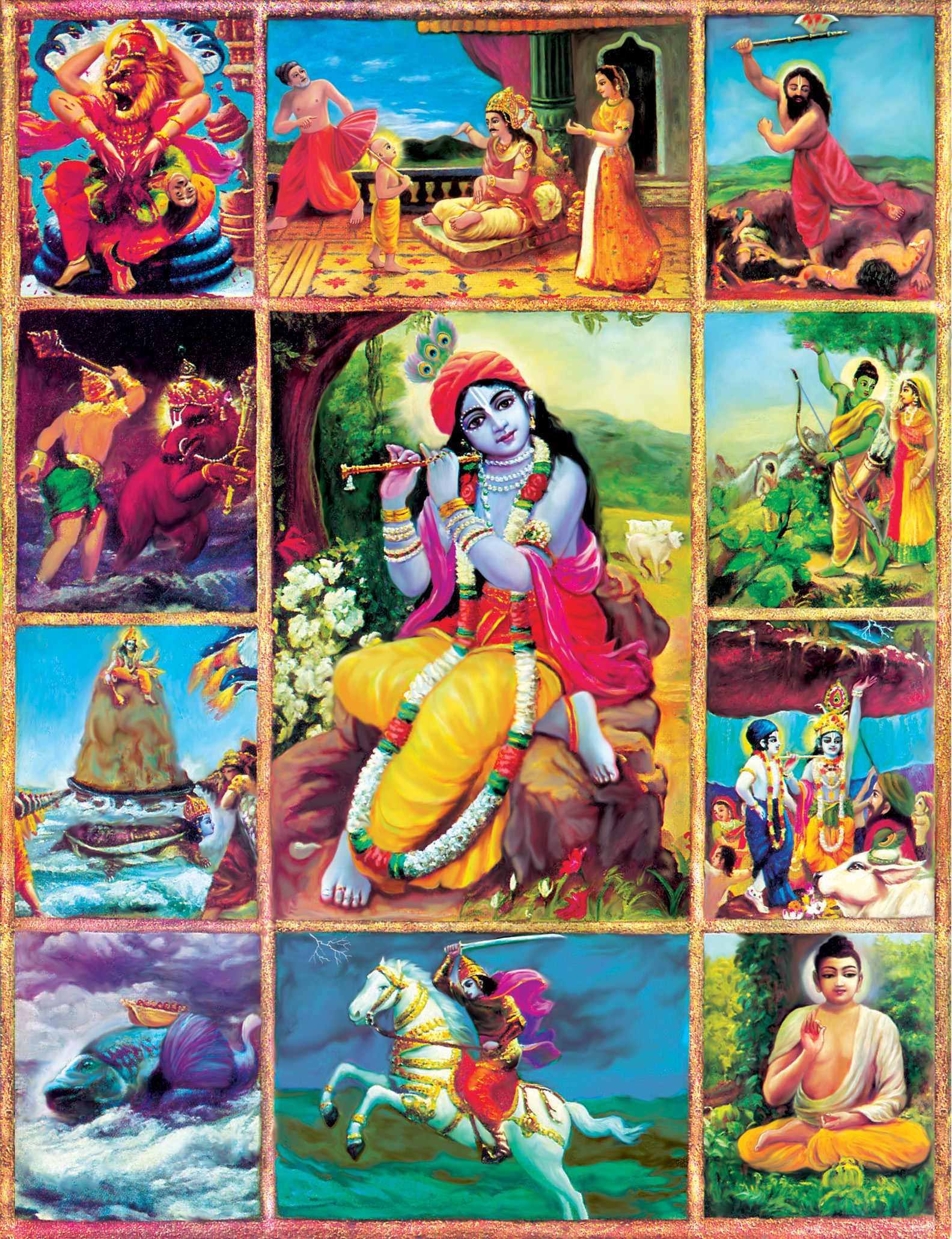
In the center Square, Krishna is shown in His original two-handed form, holding a flute. Surrounding Him are ten of His eternal incarnations, pictured in the order in which they appeared in the material world, beginning clockwise from the lower left-hand corner.
a) Matsya, the fish incarnation, is saving the Vedas.
b) Kurma, the tortoise incarnation, is holding the hill on His back.
c) Varaha, the boar incarnation, is fighting with the demon Hiranyaksa.
d) Nrismhadeva, the lion incarnation, is killing the demon Hiranyakasipu.
e) Vamanadeva, the dwarf incarnation, is begging some land from King Bali.
f) Parasurama, is killing the demoniac ksatriyas.
g) Lord Ramacandra, is going off into exile with His Wife Sita, and brother, Laksmana.
h) Krishna, is lifting Govardhana Hill and beside His is His brother, Balarama.
i) Lord Buddha.
j) Lord Kalki is riding on His horse, killing all the demons and thus liberating them.
Bhagavad-gita As It Is – Macmillan 1972 Edition
By His Divine Grace A.C. Bhaktivedanta Swami Prabhupada
Chapter 4, Text 7
yadā yadā hi dharmasya
glānir bhavati bhārata
abhyutthānam adharmasya
tadātmānaṁ sṛjāmy aham
yadā—whenever; yadā—wherever; hi—certainly; dharmasya—of religion; glāniḥ—discrepancies; bhavati—manifested, becomes; bhārata—O descendant of Bharata; abhyutthānam—predominance; adharmasya—of irreligion; tadā—at that time; ātmānam—self; sṛjāmi—manifest; aham—I.
TRANSLATION
Whenever and wherever there is a decline in religious practice, O descendant of Bharata, and a predominant rise of irreligion-at that time I descend Myself.
More
21 Nov 2011
by The Hare Krishna Movement
in A.C. Bhaktivedanta Swami Prabhupada, Back to Godhead, Ganges
Tags: His Divine Grace A.C. Bhaktivedanta Swami Prabhupada, Krishna, Krsna, kuntidevi, Lord Madhu, Queen Kunti, River Ganges

The Flow of Attraction to Krsna
Back to Godhead Magazine
Volume 01, Number 60, 1973
tvayi me ‘nanya-visaya matir madhu-pate ‘sakrt
ratim udvahatad addha gangevaugham udanvati
“O Lord of Madhu, as the Ganges forever flows to the sea without hindrance, let my attraction be constantly drawn unto You without being diverted to anyone else.” (Srimad-Bhagavatam, 1.8.42 -Prayer by Queen Kunti)
By His Divine Grace A.C. Bhaktivedanta Swami Prabhupada
In the previous verses of Srimad-Bhagavatam Queen Kunti prayed that the Lord kindly cut off her attraction for her kinsmen, the Pandava and Vrsni families. However, giving up one’s attraction for material things is not sufficient. The Mayavadi philosophers say, brahma satyam jagan-mithya: “This world is false, and Brahman [spirit] is truth.” We admit this, but qualify it. As living entities, we want enjoyment. Enjoyment means variety. It is not possible to enjoy anything without variety. Why has God created so many colors and so many forms? In order to create enjoyment out of variety. Indeed, variety is the mother of enjoyment. Mayavadi philosophers wish to negate this variety, and therefore they are called impersonalists.
The human form of life is meant for reestablishing our relationship with God. This material world means forgetfulness of our relationship with God. There is no Krsna consciousness in this material world, for as soon as there is Krsna consciousness, as soon as there is action on the basis of Krsna, there is nothing material. Everything is spiritual.
More
27 Oct 2011
by The Hare Krishna Movement
in Books by Srila Prabhupada, Festivals, Krishna, Krishna Consciousness
Tags: Balarama, Govardhan Hill, His Divine Grace, Indra, Krishna, Krsna The Supreme Personality of Godhead, lifting Govardhana Hill, Mother Yasoda, Nanda Maharaja, Rohini
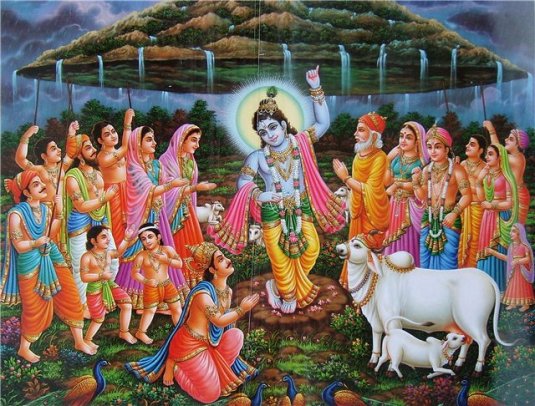
Lifting Govardhana Hill
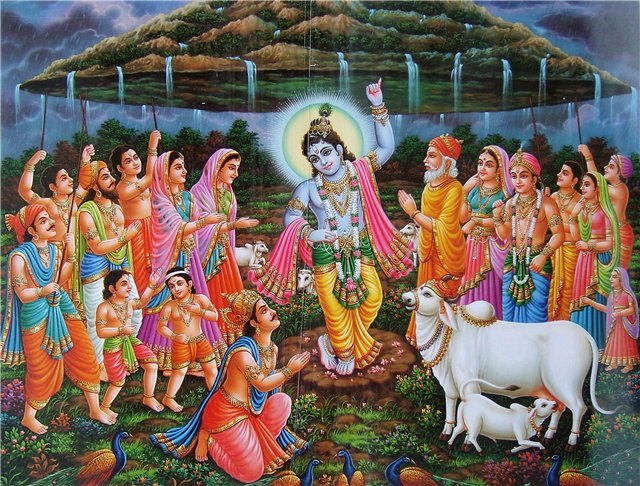
Today is the celebration of Govardhana-puja, so let us remember the Wonderful activies of Krishna which surpass the activies of all men.
Without understanding the intricacies of Kṛṣṇa, the Supreme Personality of Godhead, and without knowing His uncommon spiritual opulences, the innocent cowherd boys and men of Vṛndāvana began to discuss the wonderful activities of Kṛṣṇa which surpass the activities of all men.
One of them said, “My dear friends, considering His wonderful activities, how is it possible that such an uncommon boy would come and live with us in Vṛndāvana? It is really not possible. Just imagine! He is now only seven years old! How was it possible for Him to lift Govardhana Hill in one hand and hold it up just like the king of elephants holds a lotus flower? To lift a lotus flower is a most insignificant thing for an elephant, and similarly Kṛṣṇa lifted Govardhana Hill without exertion.
KRSNA, The Supreme Personality of Godhead – 1970 Edition
By His Divine Grace A.C. Bhaktivedanta Swami Prabhupada
Vol. 1, Chapter 26
Devastating Rainfall in Vṛndāvana
When Indra understood that the sacrifice offered by the cowherd men in Vṛndāvana was stopped by Kṛṣṇa, he became angry, and he vented his anger upon the inhabitants of Vṛndāvana, who were headed by Nanda Mahārāja, although Indra knew perfectly well that Kṛṣṇa was personally protecting them. As the director of different kinds of clouds, Indra called for the sāṁvartaka. This cloud is invited when there is a need to devastate the whole cosmic manifestation. The sāṁvartaka was ordered by Indra to go over Vṛndāvana and inundate the whole area with an extensive flood. Demonically, Indra thought himself to be the all-powerful supreme personality. When demons become very powerful, they defy the supreme controller, Personality of Godhead. Indra, though not a demon, was puffed up by his material position, and he wanted to challenge the supreme controller. He thought himself, at least for the time being, as powerful as Kṛṣṇa. Indra said, “Just see the impudence of the inhabitants of Vṛndāvana! They are simply inhabitants of the forest, but being infatuated with their friend Kṛṣṇa, who is nothing but an ordinary human being, they have dared to defy the demigods.”
More
06 Oct 2011
by The Hare Krishna Movement
in Lectures, Spiritual Life, Srimad Bhagavatam
Tags: Krishna, Krishna consciousness, Parikshit Maharaja, Srila Prabhupada, Srimad Bhagavatam, Sukadeva Goswami, Vedic literatures, what is my duty

Chanakya Pandit says that “If you want to make spiritual advancement, then you should always think that “Death is next moment. Death is next moment.”
Excerpt from lecture on Srimad-Bhagavatam
Canto 1, Chapter 4, Text 25, Montreal, June 20, 1968
By His Divine Grace A. C. Bhaktivedanta Swami Prabhupada
Parikshit Maharaja, he was a powerful king. He was equipped with all, everything, but he did not counteract the curse [1]. He could counteract that curse. He was so powerful, but he accepted: “All right. I am cursed. I shall give up my life within seven days.” That means he took it as an opportunity that “I am going to death within seven days. That is certain. And I must prepare myself fully so that my next life I can approach Krishna.” So this is a good opportunity, that “I have got seven days’ time.” We haven’t got seven seconds’ time. We do not know. Nobody has served me notice. We find by practical experience that we are walking on the street—all of a sudden there is some accident, and we die. There is possibility. So the important point is that Maharaja Parikshit was fortunate enough to get seven days’ time before his death. But we do not know how much time is there for our death. So how much serious we shall be. Chanakya Pandit says that “If you want to make spiritual advancement, then you should always think that “Death is next moment. Death is next moment.” Because there is no guarantee when death is coming. If I think that death is next moment, that is not any utopian. The next moment may be my death. And Chanakya Pandit says, “But if you want to be materially happy, you should always think that ‘I shall never die,’ ” although it is false idea. Everyone will die.
More
22 Sep 2011
by The Hare Krishna Movement
in A.C. Bhaktivedanta Swami Prabhupada, Back to Godhead, Devotional Service, Krishna Consciousness
Tags: Back to Godhead Magazine, devotional service, His Divine Grace A.C. Bhaktivedanta Swami Prabhupada, Krishna, krsna consciousness, materialism, spiritual endeavors, Supreme Personality of Godhead
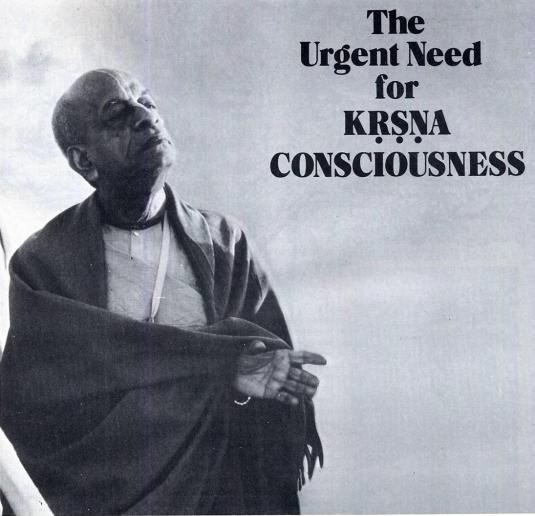
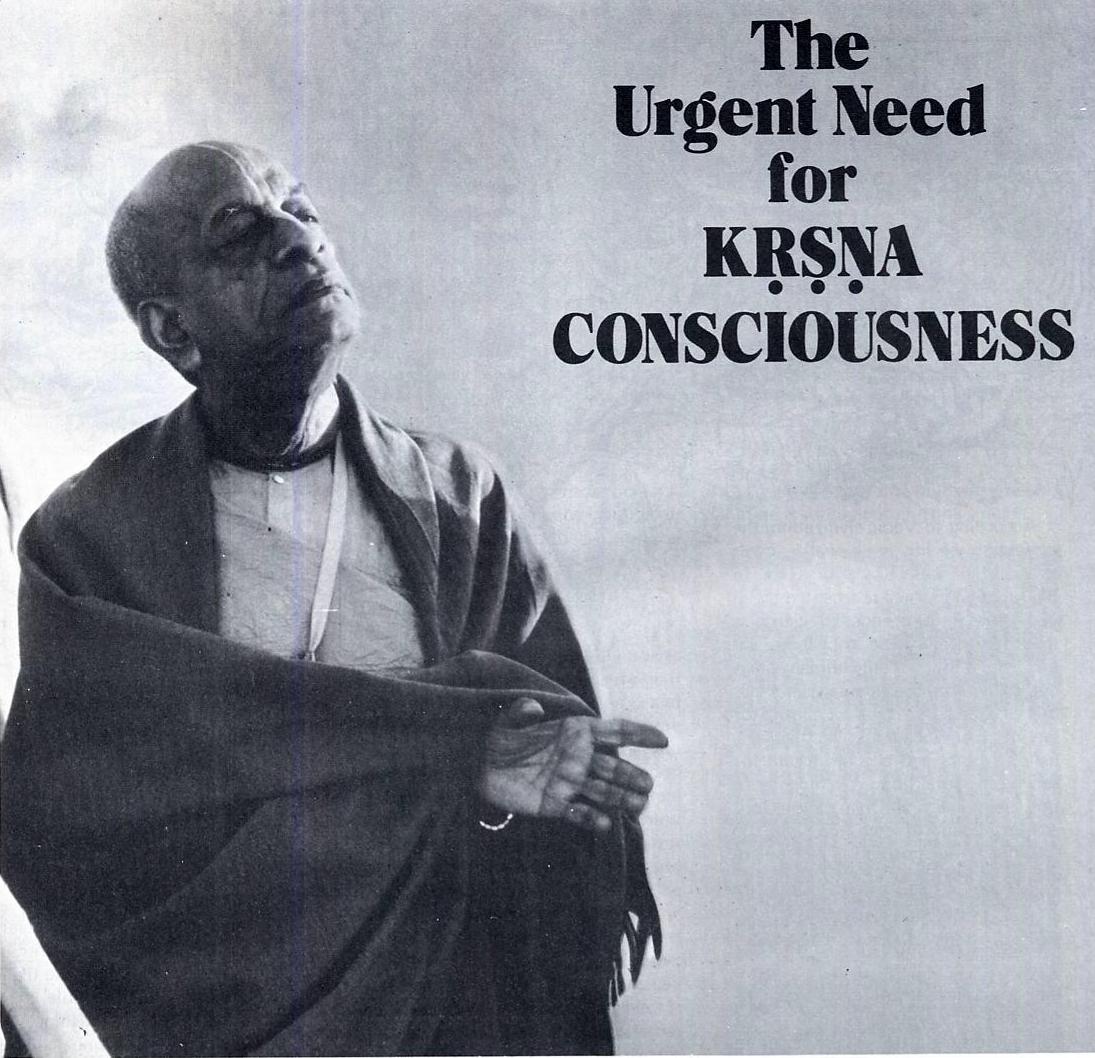
The Urgent Need for Krishna Consciousness
By His Divine Grace A.C. Bhaktivedanta Swami Prabhupada
This very important Krsna consciousness movement is meant to save human society from spiritual death. At present human society is being misled by leaders who are blind, for they do not know the aim and objective of human life, which is self-realization and the reestablishment of our lost relationship with the Supreme Personality of Godhead. That is the missing point. This Krsna consciousness movement is trying to enlighten human society in this important matter.
According to Vedic civilization, the perfection of life is to realize one’s relationship with Krsna or God. In Bhagavad-gita, which is accepted by all authorities in transcendental science as the basis of all Vedic knowledge, we understand that not only human beings but all living entities are parts and parcels of God. The parts are meant for serving the whole, just as the legs, hands, fingers and ears are meant for serving the total body. We living entities, being parts and parcels of God, are duty bound to serve Him.
Actually our position is that we are always rendering service to someone, either to our family, country or society. If we have no one to serve, sometimes we keep a pet cat or dog and render service to it. All these factors prove that we are constitutionally meant to render service, yet in spite of serving to our best capacity, we are no more satisfied. Nor is the person to whom we are rendering that service satisfied. On the material platform, everyone is frustrated. The reason for this is that the service which is being rendered is not properly directed. For example, if we want to render service to a tree, we must water the root. If we pour water on the leaves, branches and twigs, there is little benefit. If the Supreme Personality of Godhead is served, all other parts and parcels will be automatically satisfied. Consequently all welfare activities as well as service to society, family and nation are realized by serving the Supreme Personality of Godhead.
More
20 Sep 2011
by The Hare Krishna Movement
in A.C. Bhaktivedanta Swami Prabhupada, Back to Godhead, Lectures
Tags: back to Godhead, Balarama, Gauda, Krishna, Lecture by A.C. Bhaktivedanta Swami Prabhupada, Lord Nityananda, Sri Caitanya-caritamrta, Sri Krsna Caitanya, sun and moon
 The Rising Sun and Moon
Lecture by His Divine Grace A.C. Bhaktivedanta Swami Prabhupada
Mayapur, India—March 26, 1975
Back to Godhead 2004, Vol.38, No. 4
vande sri-krsna-caitanya-
nityanandau sahoditau
gaudodaye puspavantau
citrau sandau tamo-nudau
“I offer my respectful obeisances unto Sri Krsna Caitanya and Lord Nityananda, who are like the sun and moon. They have arisen simultaneously on the horizon of Gauda [West Bengal] to dissipate the darkness of ignorance and thus wonderfully bestow benediction upon all.”—Sri Caitanya-caritamrta, Adi 1.2
SriKrsna Caitanya has many expansions, and the first is Lord Nityananda, who is Krsna’s brother, Balarama. We have to understand these things from the mahajanas, the great sages who are learned in the science of Krsna consciousness. Narottama Dasa Thakura, a mahajana, says, vrajendra-nandana yei, saci-suta hoilo sei, balarama hoilo nitai: “Sri Caitanya Mahaprabhu is Lord Krsna, the son of Nanda Maharaja, and Sri Nityananda Prabhu is Balarama.”
Sometimes foolish people say that Nityananda is an expansion of Radharani. That is not a fact. Nityananda is Balarama. We have to know from the mahajanas; we cannot manufacture our own ideas. That is blasphemy.
More
04 Sep 2011
by The Hare Krishna Movement
in Devotional Service, Science of Self Realization, Srimati Radharani
Tags: Devotees in Vrndavana, His Divine Grace A.C. Bhaktivedanta Swami Prabhupada, Krishna, Madana-mohana-mohani, Nectar of Devotion, Radharani, Srimati Radharani

From; The Nectar of Devotion – 1970 Edition
By His Divine Grace A.C. Bhaktivedanta Swami Prabhupada
Attracting Krsna
Śrīla Rūpa Gosvāmī has stated that devotional service attracts even Kṛṣṇa. Kṛṣṇa attracts everyone, but devotional service attracts Kṛṣṇa. The symbol of devotional service in the highest degree is Rādhārāṇī. Kṛṣṇa is called Madana-mohana, which means that He is so attractive that He can defeat the attraction of thousands of Cupids. But Rādhārāṇī is still more attractive, for She can even attract Kṛṣṇa. Therefore devotees call Her Madana-mohana-mohanī-the attractor of the attractor of Cupid.
To perform devotional service means to follow in the footsteps of Rādhārāṇī, and devotees in Vṛndāvana put themselves under the care of Rādhārāṇī in order to achieve perfection in their devotional service. In other words, devotional service is not an activity of the material world; it is directly under the control of Rādhārāṇī. In Bhagavad-gītā it is confirmed that the mahātmās, or great souls, are under the protection of daivī prakṛti, the internal energy-Rādhārāṇī. So, being directly under the control of the internal potency of Kṛṣṇa, devotional service attracts even Kṛṣṇa Himself.
This fact is corroborated by Kṛṣṇa in the Eleventh Canto of Śrīmad-Bhāgavatam, 12th Chapter, 1st verse, where He says, “My dear Uddhava, you may know it from Me that the attraction I feel for devotional service rendered by My devotees is not to be attained even by the performance of mystic yoga, philosophical speculation, ritualistic sacrifices, the study of Vedānta, the practice of severe austerities or the giving of everything in charity. These are, of course, very nice activities, but they are not as attractive to Me as the transcendental loving service rendered by My devotees.”(from Nectar of Devotion: Chapter One, Characteristics of Pure Devotional Service, Attracting Krsna)
03 Sep 2011
by The Hare Krishna Movement
in Festivals, Lectures, Srimati Radharani
Tags: Krishna, Radha, Radharani, Radhastami, Srila Prabhupada, Srimati Radharani, Srimati Radharani's Apperance Day
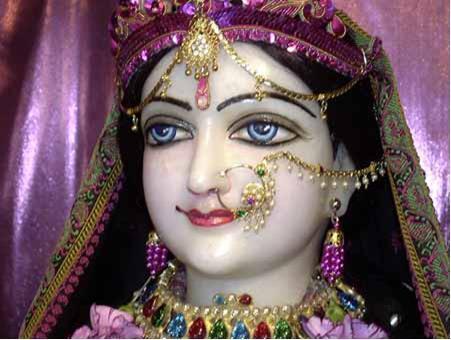
Rādhārāṇī is hari-priyā, very dear to Kṛṣṇa. So if we approach Kṛṣṇa through Rādhārāṇī, through the mercy of Rādhārāṇī, then it becomes very easy. If Rādhārāṇī recommends that “This devotee is very nice,” then Kṛṣṇa immediately accepts, however fool I may be. Because it is recommended by Rādhārāṇī, Kṛṣṇa accepts. Therefore in Vṛndāvana you’ll find all the devotees, they’re chanting more Rādhārāṇī’s name than Kṛṣṇa’s. Wherever you’ll go, you’ll find the devotees are addressing, “Jaya Rādhe.” You’ll find still in Vṛndāvana. They are glorifying Rādhārāṇī. They’re more interested, worshiping Rādhārāṇī. Because however fallen I may be, if some way or other I can please Rādhārāṇī, then it is very easy for me to understand Kṛṣṇa.
The devotees of the Lord in Vaikuntha want to see the Lord as most beautiful, but the devotees in Vrindavana want to see Radharani as even more beautiful than Krishna
Rādhāṣṭamī:
Śrīmatī Rādhārāṇī’s Appearance Day
Lecture given by His Divine Grace A. C. Bhaktivedanta Swami Prabhupada
London, August 29, 1971
Prabhupāda: (chants maṅgalācaraṇa prayers) Today is birth, appearance day of Śrīmatī Rādhārāṇī, Rādhāṣṭamī. Fifteen days after Kṛṣṇa’s birth, Rādhārāṇī appeared. (pause) Rādhārāṇī is Kṛṣṇa’s pleasure potency. Rādhā-kṛṣṇa-praṇaya-vikṛtir hlādinī-śaktiḥ. More
01 Sep 2011
by The Hare Krishna Movement
in Books by Srila Prabhupada, Krishna, Krishna Consciousness, Spiritual World
Tags: gopis, Krishna, Krsna The Supreme Personality of Godhead, prabhupada, Radharani

KRSNA, The Supreme Personality of Godhead – 1970 Edition
By His Divine Grace A. C. Bhaktivedanta Swami Prabhupada
The Gopīs Attracted by the Flute
Kṛṣṇa was very pleased with the atmosphere of the forest where flowers bloomed and bees and drones hummed very jubilantly. While the birds, trees and branches were all looking very happy, Kṛṣṇa, tending the cows, accompanied by Śrī Balarāma and the cowherd boys, began to vibrate His transcendental flute. After hearing the vibration of the flute of Kṛṣṇa, the gopīs in Vṛndāvana remembered Him and began to talk amongst themselves about how nicely Kṛṣṇa was playing His flute. When the gopīs were describing the sweet vibration of Kṛṣṇa’s flute, they also remembered their pastimes with Him; thus their minds became disturbed, and they were unable to describe completely the beautiful vibrations. While discussing the transcendental vibration, they remembered also how Kṛṣṇa dressed, decorated with a peacock feather on His head, just like a dancing actor, and with blue flowers pushed over His ear. His garment glowed yellow-gold, and He was garlanded with a vaijayantī necklace. Dressed in such an attractive way, Kṛṣṇa filled up the holes of His flute with the nectar emanating from His lips. So they remembered Him, entering the forest of Vṛndāvana, which is always glorified by the footprints of Kṛṣṇa and His companions.
More
01 Sep 2011
by The Hare Krishna Movement
in Srimati Radharani
Tags: Krishna, Queen of Vrindavan, Radha, Sri Prarthana-paddhati, Srila Rupa Goswami, Srimati Radharani, Stavamala

“O Radharani, O Queen of Vrindavana, Your complexion is like molten gold, Your doe-like eyes are captivatingly restless, a million full and brilliant moons wane before Your lustrous countenance, and a blue sari, having stolen the hue of a fresh rain-laden cloud, has enwrapped Your exquisite form. O Radha, You are the crest-jewel of all the dallying damsels of Vrindavana, fragrant and pristine like a budding jasmine flower. Your sublime form is adorned with priceless jewelry, and you are the best of all the charming and intelligent gopis. You are decorated with all wonderful excellences and surrounded by eight dedicated and beloved cowherd girls known as the asta-sakhis.
“The ambrosia of Your beautiful lips, red as the bimba fruit, is life-giving syrup to Krishna. O Radha, I am rolling on the banks of the Yamuna, my poor heart filled with anticipation, praying to You with all humility. I am guilty of being an offender, a rascal, a useless wretch — yet I beg You to kindly engage me in even the smallest service to Your lotus feet. O most merciful Lady, it will not become You to ignore this most distressed soul, for Your heart is always overflowing with compassion and love.”
[Sri Prarthana-paddhati [Stavamala], Srila Rupa goswami]
Pasted from; http://www.harekrsna.de/radha-beauty.htm
Previous Older Entries Next Newer Entries











 The Hare Krishna Movement