His Divine Grace A.C. Bhaktivedanta Swami Prabhupada Founder-Acarya of the International Society for Krishna Consciousness
“He lives forever by his divine instruction, and the followers live with him”
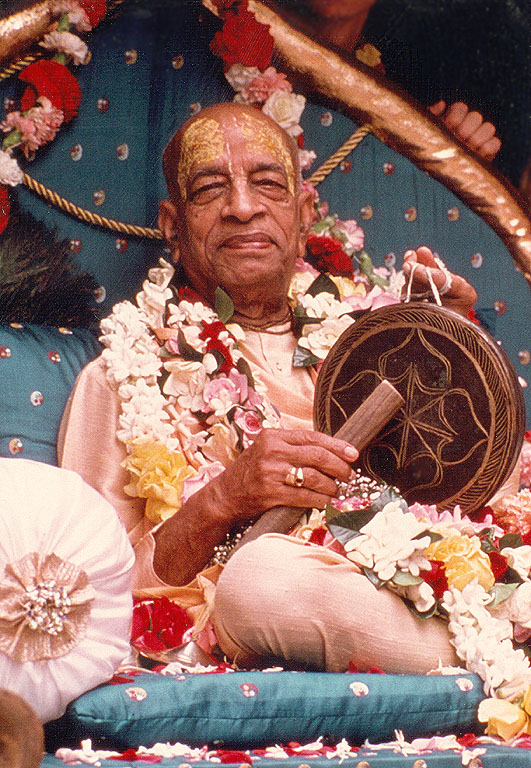
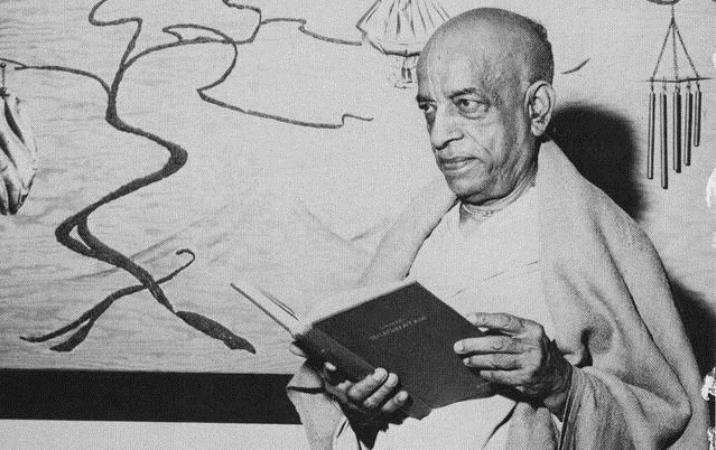
His Divine Grace A.C. Bhaktivedanta Swami Prabhupada (1896-1977), Founder-Acharya of the International Society for Krishna Consciousness, otherwise knon as The Hare Krishna Movement, and affectionately know as Srila Prabhupada by his followers, is the extraordinary person who dedicated his life to teaching the world about Krishna consciousness, ancient India’s most noble message of spiritual wisdom.
In 1965, at the age of 69, on the order of his spiritual master Srila Bhaktisiddhanta Saraswati Thakura, representing a line of teachers dating back to Lord Krishna Himself, Srila Prabhupada sailed from India to New York to share Lord Krishna’s message.
This English translation and commentary is the work of His Divine Grace A. C. Bhaktivedanta Swami Prabhupada, the world’s most distinguished scholar and teacher of Indian religious and philosophical thought. He himself is a disciplic descendant of Sri Caitanya, and his intimate familiarity with the precepts of Caitanya Mahaprabhu eminently qualifies him to present this important classic to the English-speaking world. The ease and clarity with which he expounds upon Sri Caitanya’s precepts lures even a reader totally unfamiliar with Indian religious tradition into a genuine understanding and appreciation of this profound and monumental work.
Srila Prabhupada himself considered his most important work to be the translation and publishing of his books. From the period of 1966 till 1977, Srila Prabhupada translated and wrote purports to nearly all of the 18,000 verses of Srimad-Bhagavatam, 700 verses of Bhagavad-gita, and 17 volumes of Sri Caitanya-caritamrita. He published a monthly magazine, Back to Godhead, which at one point was distributed in excess of one million copies per month. His published books number 160. Millions of copies have been distributed around the world in 28 major languages. Highly respected by academicians for their authoritativeness, depth and clarity, they are used as standard course material in numerous colleges and universities in India and the USA. In 1972, Srila Prabhupada founded The Bhaktivedanta Book Trust for publishing his works exclusively, and The Bhaktivedanta Book Trust went on to become the world’s largest publisher of books in the field of Indian religion and philosophy.
This morning as I was finishing the Tenth Chapter of the Second Canto, the following verse and purport jumped out at me from the pages. And I realized for the thousandth time, what great good fortune we have in that we can hear directly from the pure devotee of the Lord, about the eternal pastimes of the Lord, through the pages of the Srimad Bhagavatam.
Of the three types of Transcendentalist’s, namely the jñānī, the yogī and the bhakta, or the impersonalist, the meditator and the devotee. It is only the devotee who can factually know the Lord as He is and thus be trained in the bona fide service of the Lord and be allowed to enter into the direct association of the Lord in so many capacities. The highest glorious association with the Lord is made possible in the planet of Goloka Vṛndāvana, where Lord Kṛṣṇa enjoys Himself with the gopīs and His favorite animals, the surabhi cows.
… The impersonalist is satisfied simply by understanding the all-pervasive influence of the Lord. This is called Brahman realization. Greater than the impersonalist is the mystic who sees the Lord situated in his heart as Paramātmā, the partial representation of the Lord. But there are pure devotees who take part in the direct pleasure (ānanda) potency of the Lord by factual reciprocation of loving service. The Lord in His abode called the Vaikuṇṭha planets, which are eternal manifestations, always remains with His associates and enjoys transcendental loving services by His pure devotees in different transcendental humors.
So we are pleased to present the following Texts and Purports
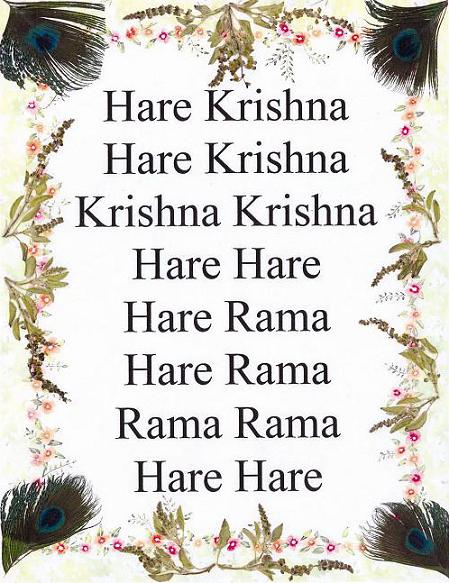
It has been interesting to see how this Hare Krishna Movement (ISKCON) has changed and developed since the early days. When this movement started it was like a family, a small family of dedicated devotees, with one scripture, one God (Krsna), one mantra (Hare Krishna, Hare Krishna, Krishna Krishna, Hare Hare, Hare Rama, Hare Rama, Rama Rama, Hare Hare), and one spiritual master (Srila Prabhupada). Then it became an International family with branches all around the world.
Now this society has become a huge movement, with new temples and congregations springing up all over the world, with different branches and camps, and so many new Spiritual Masters. It is inspiring to see the growth of this society, even though at times does not resemble the Original. What with the changes to our sacred books, and outside influences from all sides. It has created some division amongst our ranks. But there is one thing we can all agree on is, and I quote from the last paragraph from the introduction of the Bhagavad-gita:
“In this present day, man is very eager to have one scripture, one God, one religion, and one occupation. So let there be one common scripture for the whole world-Bhagavad-gītā. And let there be one God only for the whole world-Śrī Kṛṣṇa. And one mantra only-Hare Kṛṣṇa, Hare Kṛṣṇa, Kṛṣṇa Kṛṣṇa, Hare Hare/ Hare Rāma, Hare Rāma, Rāma Rāma, Hare Hare. And let there be one work only-the service of the Supreme Personality of Godhead.“
The Branches of the Caitanya Tree
Thus the branches of the Caitanya tree formed a cluster or society, with great branches covering all the universe. (Sri Caitanya-caritmrta Adi 9.18)
PURPORT
Our International Society for Krishna Consciousness is one of the branches of the Caitanya tree.
Śrī Caitanya Mahaprabhu was also the gardener, and as He poured the water of His mercy on the tree, all the branches and subbranches grew, day after day. (Adi 12.5)
The fruits of love of Godhead that grew on those branches of the Caitanya tree were so large that they flooded the entire world with love of Krsna. (Adi 12.6)
Sometimes when I am sitting and reading from Srila Prabhupada’s Srimad Bhagavatam, a verse or sentence from the purport just jumps out from the page almost like it is in 3D, and I catch a glimpse of what the Spiritual World must be like. It is beyond even my imagination, but sometimes I catch a glimmer of light, through a transcendental window, by the grace of my spiritual master His Divine Grace A. C. Bhaktivedanta Swami Prabhupada.
…The transcendental abode of the Lord where the trees are all desire trees and the buildings are made of touchstone. The Lord Govinda is engaged there in herding the surabhi cows as His natural occupation.
“I worship Govinda, the primeval Lord, the first progenitor who is tending the cows, yielding all desire, in abodes built with spiritual gems, surrounded by millions of purpose trees, always served with great reverence and affection by hundreds of thousands of lakṣmīs or gopīs.” (Bs 5.29)
…The Lord Govinda is engaged there in herding the surabhi cows as His natural occupation. And those who are artists, overtaken by the beautiful creation, should better see to the beautiful face of the Lord for complete satisfaction. The face of the Lord is the embodiment of beauty. What they call beautiful nature is but His smile, and what they call the sweet songs of the birds are but specimens of the whispering voice of the Lord.
Last night as I was falling asleep, this prayer just popped into my head:
SRI RUPA PRANAMA
sri-caitanya-mano-‘bhistam sthapitum yena bhtu-tale svayam rupah kada mahyam dadati sva-padantikam
sri-caitanya-of Lord Caitanya; manah– mind; abhistam-what is desired; sthapitam-established; yena-by whom; bhu-tale-on the surface of the globe; svayam-himself; rupah-Srila Rupa Gosvami; kada-when; mahyam-unto me; dadati-will give; sva-his own; pada-lotus feet; antikam-proximity to.
When will Srila Rupa Gosvami Prabhupada, who has established within this material world the mission to fulfill the desire of Lord Caitanya, give me shelter under his lotus feet?
And as I drifted off to sleep I was thinking about Srila Rupa Goswami, I don’t know why. But I woke still thinking about him. The following is an article from Back to Godhead Magizine.
Obstacles on the Path of Eternity An Excerpt from Srila Rupa Gosvami’s Upadesamrta from Back to Godhead Magazine Vol. 1, No.88, 1973
[SRILA RUPA GOSVAMI was one of six exalted devotees especially chosen through the Krsna conscious chain of spiritual masters to teach the devotional service of the Supreme Lord in a scientific manner. Although all of these six great devotees were erudite scholars and prolific writers, Srila Rupa Gosvami is the most prominent, for he most greatly appreciated the nectar of Krsna consciousness. His Upadesamrta (Nectarean Instructions), a short work of only eleven verses, teaches the basic principles for arousing one’s dormant love of Krsna, the Supreme Lord. Written in Sanskrit some 400 years ago, it has now been translated into English, with an illuminating explanation of each verse, by His Divine Grace A.C. Bhaktivedanta Swami Prabhupada.]
The following is one of the most quoted verses by Srila Prabhupada, from the Srimad Bhagavatam, and it is also one of the longest purports as well. Very important verse!
śrī-prahrādaḥ uvāca—Prahlāda Mahārāja said; śravaṇam—hearing; kīrtanam—chanting; viṣṇoḥ—of LordViṣṇu (not anyone else); smaraṇam—remembering; pāda-sevanam—serving the feet; arcanam—offering worship (with ṣoḍaśopacāra, the sixteen kinds of paraphernalia); vandanaṁ—offering prayers; dāsyam—becoming the servant; sakhyam—becoming the best friend; ātma-nivedanam—surrendering everything, whatever one has; iti—thus; puṁsā arpitā—offered by the devotee; viṣṇau—unto Lord Viṣṇu (not to anyone else); bhaktiḥ—devotional service; cet—if; nava-lakṣaṇā—possessing nine different processes; kriyeta—one should perform; bhagavati—unto the Supreme Personality of Godhead; addhā—directly or completely; tat—that; manye—I consider; adhītam—learning; uttamam—topmost.
Prahlāda Mahārāja said: Hearing and chanting about the transcendental holy name, form, qualities, paraphernalia and pastimes of Lord Viṣṇu, remembering them, serving the lotus feet of the Lord, offering the Lord respectful worship with sixteen types of paraphernalia, offering prayers to the Lord, becoming His servant, considering the Lord one’s best friend, and surrendering everything unto Him (in other words, serving Him with the body, mind and words)—these nine processes are accepted as pure devotional service. One who has dedicated his life to the service of Kṛṣṇa through these nine methods should be understood to be the most learned person, for he has acquired complete knowledge.
When Prahlāda Mahārāja was asked by his father to say something from whatever he had learned, he considered that what he had learned from his spiritual master was the best of all teachings…(from purport)
Happy New Year to all are readers. Wishing you all a prosperous new year filled with happiness and love. And may your Krishna Consciousness increase with each passing day.
When I think of New Years, I am reminded of what a short time a year is in the greater scheme of eternity. In the Bhagavad-gita there is a brief description of the duration of time in the material universe.
…The duration of the material universe is limited. It is manifested in cycles of kalpas. A kalpa is a day of Brahmā, and one day of Brahmā consists of a thousand cycles of four yugas or ages: Satya, Tretā, Dvāpara, and Kali. The cycle of Satya is characterized by virtue, wisdom and religion, there being practically no ignorance and vice, and the yuga lasts 1,728,000 years. In the Tretā-yuga vice is introduced, and this yuga lasts 1,296,000 years. In the Dvāpara-yuga there is an even greater decline in virtue and religion, vice increasing, and this yuga lasts 864,000 years. And finally in Kali-yuga (the yuga we have now been experiencing over the past 5,000 years) there is an abundance of strife, ignorance, irreligion and vice, true virtue being practically nonexistent, and this yuga lasts 432,000 years. (from purport Bg 8.17)
Even if I could grasp the extent of time in the material universe, that is just a fraction of the unlimited eternal time that continues after the termination of the yuga.
…Then the process is set rolling again. These four yugas, rotating a thousand times, comprise one day of Brahmā, the creator god, and the same number comprise one night. Brahmā lives one hundred of such “years” and then dies. These “hundred years” by earth calculations total to 311 trillion and 40 million earth years. By these calculations the life of Brahmā seems fantastic and interminable, but from the viewpoint of eternity it is as brief as a lightning flash. In the causal ocean there are innumerable Brahmās rising and disappearing like bubbles in the Atlantic. Brahmā and his creation are all part of the material universe, and therefore they are in constant flux. (from purport Bg 8.17)
The above calculations Srila Prabhupada uses and I quote;
…seems fantastic and interminable, but from the viewpoint of eternity it is as brief as a lightning flash.
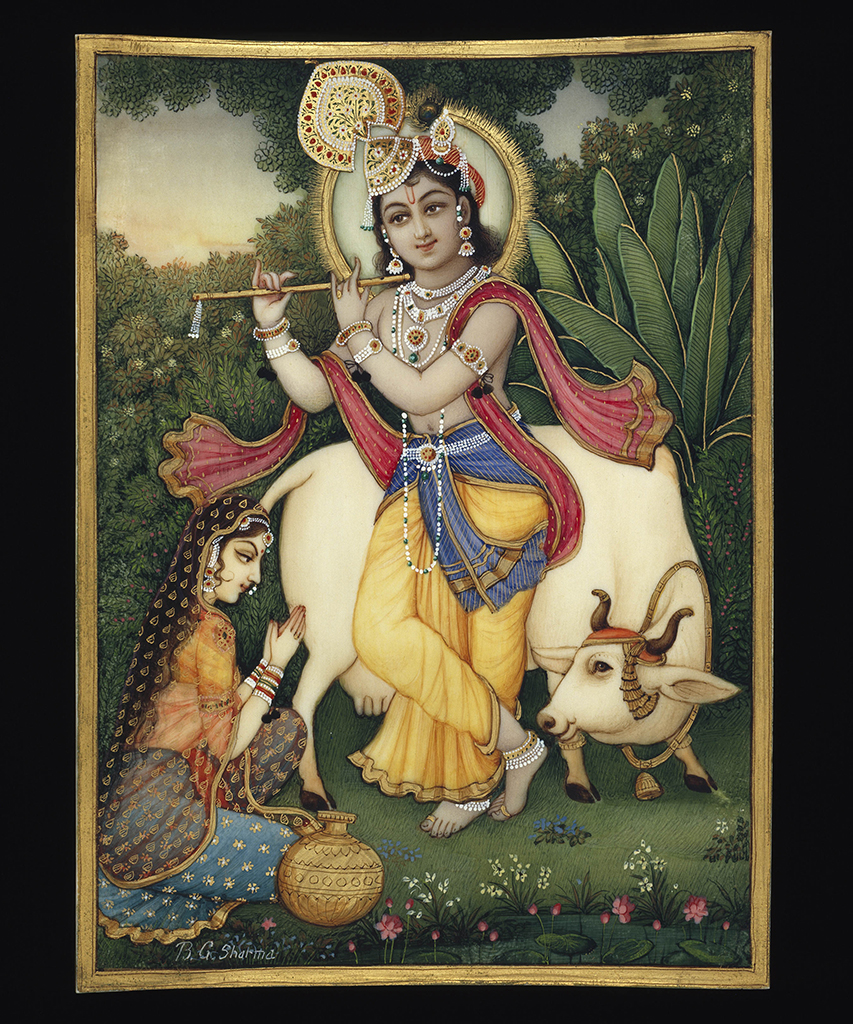
One of my favorite Krishna Painters is B. G. Sharma. Although he passed away in November 2007 at the age of 83, the B. G. Sharma Art Gallery in Udaipur, Rajasthan, remains open to the public and displays a vast collection of his original miniature and religious paintings.
Krishna and Cows
Krishna and cows have always been together. In His original form in the spiritual world, Krishna is a cowherd boy in the agricultural community of Goloka (“cow planet”) Vrindavan, where He keeps unlimited, transcendental surabhi cows.
When He descends to earth, Krishna brings a replica of Vrindavan with Him, and He spends His childhood tending cows and calves while playing in the pasturing grounds with His friends. His example shows the importance of cows to human society, the practical benefits of caring for them, and the advantages of an agrarian economy based on cooperation between man and cows.
Krishna established the original economic system, varnashrama-dharma, for the spiritual and material progress of all living beings. Protected cows are a major component of this system; bulls and oxen till the fields, and cows give milk. Cows are considered one of the mothers of humankind because cow’s milk—when properly prepared—is perfectly suited to maintaining human life. Milk can be made into a wide variety of preparations, such as yogurt and butter, which are also essential ingredients for use in the ceremonial worship of Krishna in His transcendental Deity form.
In His famous book of instructions for humankind, the Bhagavad-gita, Krishna mentions cow protection as one of the prime duties of any civilized society. The Bible also tells us that cow-killing is as punishable as killing a human being.
Kṛṣṇa had many thousands of cows, and they were divided into groups according to their colors. They were also differently named according to color. When He would prepare to return from the pasturing ground, He would gather all the cows. As Vaiṣṇavas count 108 beads, which represent the 108 individual gopīs, so Kṛṣṇa would also count on 108 beads to count the different groups of cows. (Krishna book CH 35)
The cows taken care of by Kṛṣṇa had different names, and Kṛṣṇa would call them with love. After hearing Kṛṣṇa calling, the cows would immediately respond by mooing, and the boys would enjoy this exchange to their hearts’ content. They would all imitate the sound vibrations made by the different kinds of birds, especially the cakoras, peacocks, cuckoos and bhāradvājas. (Krishna book, CH 15)
…So far Narada Muni is concerned, in His previous life He was a maidservant’s son, but by the mercy of the devotees He later on became siddha and next life He appeared as Narada with complete freedom to move anywhere by the grace of the Lord. So even though He was in his previous life a maidservant’s son there was no impediment in the achievement of His perfect spiritual life. Similarly any living entity who is conditioned can achieve the perfectional stage of life by the above mentioned processes and the vivid example is Narada Muni.
So I do not know why you have asked about my previous life. Whether I was subjected to the laws of material nature? So, even though accepting that I was subjected to the laws of material nature, does it hamper in my becoming Spiritual Master? What is your opinion? From the life of Narada Muni it is distinct that although He was a conditioned soul in His previous life, there was no impediment of His becoming the Spiritual Master. This law is applicable not only to the Spiritual Master, but to every living entity.
Letter to: Tamala Krsna Los Angeles 21 June, 1970
Paris My Dear Tamala,
Please accept my blessings. I beg to acknowledge receipt of your letter dated 18th June, 1970, sent by Special Delivery Air Mail.
Krsna philosophy is understood as it is stated in the Vedas:
Yasya deve para bhakti yatha deve tatha gurau tasya ete kathitha hi artha prakasante mahatmanah
“One who has got unflinching faith in the Supreme Lord and similar faith in his Spiritual Master to him only the imports of Vedic knowledge become revealed.”
A Spiritual Master is always liberated. In any condition of His life He should not be mistaken as ordinary human being. This position of a Spiritual Master is achieved by three processes. One is called sadhana siddha. That means one who is liberated by executing the regulative principle of devotional service. Another is krpa siddha, one who is liberated by the mercy of Krsna or His devotee. And another is nitya siddha who is never forgetful of Krsna throughout his whole life. These are the three features of the perfection of life.
Here is another word for your vaisnava vocabulary; Acaryopasanam.
In Bhagavad-gita, Thirteenth Chapter, it is clearly stated that one should execute devotional service and advance on the path of spiritual knowledge by accepting the acarya.Ācāryopāsanam: one should worship an acarya, a spiritual master who knows things as they are. The spiritual master must be in the disciplic succession from Krsna. (from purport SB 3.29.17)
We can understand from Srila Prabhupada, that there are huge gaps in the disciplic succession, but we need to follow the prominent Acarya.
“So these gaps do not hamper from understanding the parampara system. We have to pick up the Prominent Acarya, and follow from him.” (letter to Dayananda April12,1968)
The following are just a few of the many quotes from Srila Prabhupada which encourage us to approach Krishna through the mercy of Srimati Radharani, Krishna’s eternal consort. For those of us who feel that there is no hope of making spiritual progress in this lifetime, Srimati Radharani, Who is compassion personified, kindly comes to our rescue if we can humbly invoke Her divine blessings.
“I offer my respects to Radharani whose bodily complexion is like molten gold and who is the Queen of Vrndavana. You are the daughter of King Vrsabhanu, and You are very dear to Lord Krishna.” (Sri Radha Pranama)
“I emphatically say to you, O brothers, you will obtain your good fortune from the Supreme Lord Krishna only when Srimati Radharani becomes pleased with you.”(Prayer to the Lotus Feet of Krishna, September 13, 1965)
“Actually, because Krishna is the Supreme Personality of Godhead, it is very difficult to approach Him. But the devotees, taking advantage of His compassionate nature, which is represented by Radharani, always pray to Radharani for Krishna’s compassion.” (Nectar of Devotion, Chapter 22)
“There is no comparison to Radharani’s beauty and the luster of Her transcendental body. The so-called beauty of the moon has fallen on the ground in the presence of Radharani’s beauty.” (From Vrindavana by Srila Narottama das Thakura)
“The beauty of Srimati Radharani’s eyes forcibly devours the beauty of newly grown blue lotus flowers, and the beauty of Her face surpasses that of an entire forest of fully blossomed lotuses. Her bodily luster seems to place even gold into a painful situation. Thus the wonderful, unprecedented beauty of Srimati Radharani is awakening in Vrindavana.” (Caitanya-caritamrita Antya 1.169)
Although Srila Prabhupada wrote many books, he one day asked me, “So why did I write all these books?” I said, “So we can know the philosophy, learn the philosophy.” He said, “No, the purpose of all these books is to convince you to chant the holy name of Krishna.”
Chanting is exactly like the simple method of inhaling and exhaling. Although it seems like a very simple act, it is nevertheless the essence of the whole thing. Without that inhaling and exhaling, none of the other activities can take place. We also understand that no one simply inhales and exhales, but all the other activities are supportive of the inhaling and exhaling.
”One cleanses himself daily by taking a bath in water, but one who takes his bath only once in the sacred Ganges water of the Bhagavad-gita cleanses away all the dirt of material life. Because Bhagavad-gita is spoken by the Supreme Personality of Godhead, one need not read any other Vedic literature. One need only attentively and regularly hear and read Bhagavad-gita.
In the present age, mankind is so absorbed with mundane activities that it is not possible to read all of the Vedic literatures. But this is not necessary. This one book, Bhagavad-gita, will suffice because it is the essence of all Vedic literatures and because it is spoken by the Supreme Personality of Godhead.
It is said that one who drinks the water of the Ganges certainly gets salvation, but what to speak of one who drinks the waters of Bhagavad-gita? Gita is the very nectar of the Mahabharata spoken by Visnu Himself, for Lord Krsna is the original Visnu. It is nectar emanating from the mouth of the Supreme Personality of Godhead, and the Ganges is said to be emanating from the lotus feet of the Lord. Of course there is no difference between the mouth and the feet of the Supreme Lord, but in our position we can appreciate that the Bhagavad-gita is even more important than the Ganges.
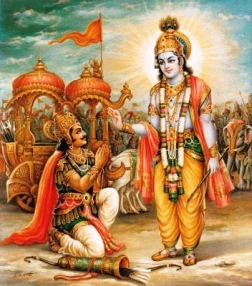
The Bhagavad-gita is just like a cow, and Lord Krsna, who is a cowherd boy, is milking this cow. The milk is the essence of the Vedas, and Arjuna is just like a calf. The wise men, the great sages and pure devotees, are to drink the nectarean milk of Bhagavad-gita.
In this present day, man is very eager to have one scripture, one God, one religion, and one occupation. So let there be one common scripture for the whole world–Bhagavad-gita. And let there be one God only for the whole world–Sri Krsna. And one mantra only–Hare Krsna, Hare Krsna, Krsna Krsna, Hare Hare/ Hare Rama, Hare Rama, Rama Rama, Hare Hare. And let there be one work only–the service of the Supreme Personality of Godhead.” (Bhagavad-gītā Introduction)
A Summary of Srila Prabhupada’s Miraculous Accomplishments from 1965 to 1977
In reading many of the profiles of Srila Prabhupada, I’m saddened that a number of his important projects, programs and achievements are never mentioned. In the following summary I’ve tried to compile a more comprehensive list of his credits. Although this list is also incomplete, I hope it presents a fuller picture of Srila Prabhupada’s greatness.
In 1965, at seventy years of age, he ventured outside India for the first time to fulfill the order of his spiritual master. During his voyage at sea, he suffered two severe heart attacks. He reached the shores of America with virtually no money to his name.
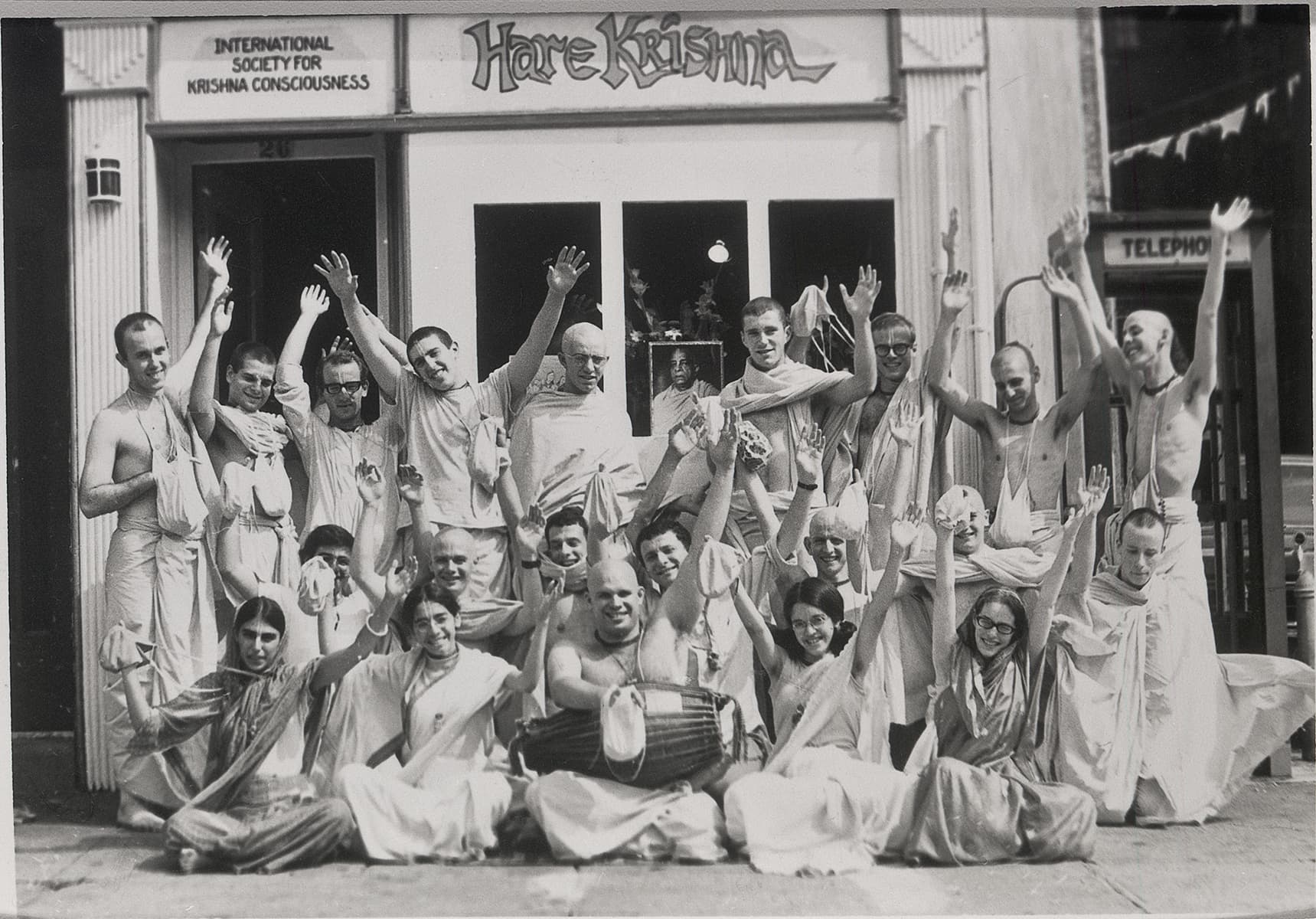
He founded the International Society for Krsna Consciousness with a small group of disciples, after a year of struggling alone in New York City. This marked the only time in history that a Krsna devotee successfully trained non-Indians in the strict disciplines of Vaisnavism. Amazingly, this was achieved during the blossoming of America’s hedonistic counterculture movement.
He sent his followers, chanting the names of God, into the streets of cities and towns everywhere and Hare Krsna became famous in every corner of the earth.
So today we honor the Disappearance Day of our Srila Prabhupada. We honor this day with a half day fast and remembrances.
He reasons ill who says that Vaiṣṇavas die, When thou art living still in sound! The Vaiṣṇavas die to live, and living try To spread the holy name around.
Srila Prabhupada is still present through his words and instructions. We would like to share with youthe following speech was delivered in 1936 Bombay by the pure devotee who three decades later will become the world-renowned spiritual master of The Hare Krishna Movement. Abhay Charan das who latter becomes His Divine Grace A.C. Bhaktivedanta Swami Prabhupada glorifies his own spiritual master Śrīla Bhaktisiddhānta Sarasvatī Goswami Maharaja with this Appearance day (Vyasa-puja) homage. Thus we learn the time-honored meaning of spiritual master, disciple and their relationship.
Today we celebrate Govardhana-puga, when Krishna exhibited His transcendental pastime of lifting Govardhana Hill to protect the inhabitants of Vrndavan.
…The sacrifice known as Govardhana Pūjā is observed in the Kṛṣṇa consciousness movement. Lord Caitanya has recommended that since Kṛṣṇa is worshipable, so His land, Vṛndāvana and Govardhana Hill, are also worshipable. To confirm this statement, Lord Kṛṣṇa said that Govardhana Pūjā is as good as worship of Him. From that day, the Govardhana Pūjā has been still going on and is known as Annakūṭa. In all the temples of Vṛndāvana or outside of Vṛndāvana, huge quantities of food are prepared in this ceremony and are very sumptuously distributed to the general population. Sometimes the food is thrown to the crowds, and they enjoy collecting it off the ground. From these instances, we can understand that prasādam offered to Kṛṣṇa never becomes polluted or contaminated, even if it is thrown on the ground. The people, therefore, collect it and eat with great satisfaction. (from Kṛṣṇa, The Supreme Personality of Godhead, chapter 24)
On this auspicious day, we like to read from KRSNA Book, and I have included the entire 25th chapter emtitled, “Devastating Rainfall in Vrndavana”.
This month of Kartika or the month of Damodara, has always been very dear. It is probably because Radha Damodara were the first worshipable Radha Krishna deities I had the good fortune to serve. When I joined the Hare Krishna movement, I was assigned to the Radha Damodara Traveling Sankirtan Party (RDTSP). I traveled with the bus party for the first year of my devotional career, and when the bus party broke up, I was re-assigned to the Gita Nagari farm, where I was engaged for some time as a carpenter building the new temple for the Radha Damodara deities who reside there. I guess we always remember our first love. -V
Worship of Sri Sri Radha-Damodara
Radharani is especially keen to hear Krishna’s pastimes, but She is particularly attracted to the Damodara pastime. Charmed by Damodara’s mood of surrender in agreeing to be bound by Mother Yasoda’s love, Sri Radha longs to have that same exchange with Krishna. She desires to express such intense love for Krishna that He will also agree to be bound by Her love. Appreciating this mood of Mother Yasoda to enhance Her own feelings for Krishna, She resolves to experience this same reciprocation of love.” (Srimad Bhagavatam 10.9.20 Purport) Radha-Damodara thus refers to Radharani’s mood of intense attraction for this pastime between Damodara and Mother Yasoda.
Neither Lord Brahma, nor Lord Siva, nor even the goddess of fortune, who is always the better half of the Supreme Lord, can obtain from the Supreme Personality of Godhead, the deliverer from this material world, such mercy as recieved by mother Yasoda. (Srimad Bhagavan 10.9.20)
Our dear departed friend Padmapani Prabhu, is gone but not forgotten, as he has left us with the beautiful web page The Prabhupada Connection, but he has also, as some of the earlier devotees might remember, left us with this fine publication The Vaisnava Journal. I feel it is an important part of our history, and I wanted to be sure it available to all our readers, so we share all 5 issuses as PDF that you can view or save, by clicking on the links. Hare Krishna!
The Vaisnava Journal
by Padmapani Das
Shortly after Srila Prabhupada physically departed from this world, I joined the Middle East program. Since there were no temples in that part of the world, we simply carried on as we had always done—chanting Hare Krishna and worshiping Srila Prabhupada as our guru and the founder-acarya of ISKCON. But while visiting temples in India and Europe for short breaks, I noticed things were becoming increasingly difficult for devotees and the movement. So when the Middle East program had finished its course after five years, I humbly tried to make a positive contribution towards keeping our movement and the devotees together with Srila Prabhupada in the center. The Vaisnava Journal was created and distributed to ISKCON leaders and devotees worldwide with that objective in mind.
At the time we had Back to Godhead magazine and the ISKCON World Review, but neither of these publications addressed the topical issues of the day which were affecting the stability of Srila Prabhupada’s movement. I saw a great need for open and respectful communication in our society, and by Krishna’s grace, devotees of all persuasions and positions responded favorably. We openly discussed vital issues of concern to our movement and many spirited exchanges resulted. Unfortunately after five issues I was no longer able to support the rising publication and mailing costs on my own, so I had to stop work on the journal. However we now have a record of those discussions and our readers can research the contents online. Please click on the links below to access each issue in PDF format.
The kindness of strangers played a pivotal role in ISKCON’s pre-history.
Last year I had the good fortune to meet Gopal and Sally Agarwal, an elderly couple who played a significant role in ISKCON’s origins. They are forever etched in the devotees’ collective memory as two of the Western world’s earliest recipients of Srila Prabhupada’s mercy. It was the Agarwals who hosted him in the fall of 1965, before ISKCON was even nominally born, giving him shelter, hospitality, friendship, and love. Indeed, for one month their home served as Prabhupada’s earliest refuge outside India.
As Prabhupada acquainted himself with the Agarwal home in Butler, in western Pennsylvania, he saw a typically quiet American town nestled in the hills, a town that has changed little since his brief visit those many years ago.
Yesterday we had the good fortune to visit Buttler PA, for the 60th aniversary of Srila Prabhupada’s arrival in the USA. First we visited the YMCA building where Srila Prabhupada stayed, then we had a Hari-nama in the streets of Buttler on the way to Sally and Gopal Agarwal’s apartment where Srila Prabhupada spent his first nights in America. It was a rather small apartment, and Srila Prabhupada slept on their couch, for the first few nights before moving to a room in the YMCA building. But he made his way back to their apartment each day to cook some lunch prasadam for the family. It was very exciting to pilgrimage to the site where Srila Prabhupada first bathed, cooked, slept, and gave his first Bhagavata discourses in America.
Butler Eagle Magazine, Pennsylvania, September 22 1965
The following first article written about A. C. Bhaktivedanta Swami Prabhupada’s arrival and mission in the West was obtained through work with the Butler Eagle News Paper in Butler, Pa., Prabhupada’s first residence after arriving from India in 1965. Prabhupada’s great desire to preach the mission of Love of God to all in the English speaking countries, started here.
In Fluent English Devotee of Hindu Cult Explains Commission to Visit the West
By Penny Ritts/Butler Eagle, September 22 1965
A slight brown man in faded orange drapes wearing white bathing shoes stepped out of a compact car yesterday and into the Butler YMCA to attend a meeting. He is A. C. Bhaktivedanta Swamiji, a messenger from India to the peoples of the West.
A Hindu by faith, the “learned teacher” has translated biblical literature such as Srimad Bhagavatam into English from ancient Sanskrit. He is now fulfilling a commission from his spiritual master to enlighten English-speaking people regarding their relationship with God.
“My mission is to revive a people’s God-consciousness.” says the Swamiji. “God is the Father of all living beings, in thousands of different forms.” he explains. “Human life is a stage of perfection in evolution: if we miss the message, back we go through the process again.” he believes.
The Swamiji has given himself a month to tell his message to all who will listen. He anticipates many informal meetings, such as a gathering of friends in the Gopal Agarwal home in Stirling Apartments Monday the night of his arrival, for an exchange of ideas regarding his philosophy of life. A simplified version of his theory is that life progresses from aquatic to plant, to reptile to bird, to beast to “beastly” human being and finally, to civilized man. “After this life there is a still better life on other planets,” predicts the visitor. He believes that the highest possible state will be to go to God, or eternal life.
The traveller who left India for the first time Aug. 30 will welcome guest appearances or impromptu discussions with anyone who calls the Agarwal family. He says that he is here to talk. Now 70 years old, the appointed “missionary” to the United States was educated in India where he received a Bachelor of Arts degree. He became a disciple in 1933 and received instructions until the death of his leader in 1936. He has severed all family ties, forsaking wife and children and a business in Calcutta to follow his beliefs.
His religion remains Hindu. He does not ask his listeners to change their religious affiliation, but merely to become “better Jews or Christians,” etc.
Bhaktivedanta lives as a monk, and permits no woman to touch his food. On a six-week ocean voyage and at the Agarwal apartment in Butler he prepares his meals in a brass pan with separate levels for steaming rice, vegetables and making “bread” at the same time. He is a strict vegetarian, and is permitted to drink only milk, the “miracle food for babies and old men,” he noted. Even onions, garlic, and eggs are forbidden in his cult.
The Swamiji is equally philosophical about physical discomforts or wars: “It’s man’s nature to fight” he shrugs. “We have to adjust to these things; currents come and go in life just as in an ocean.”
“Life and Milk of Cow” is all-important to the Swamiji’s way of life; all else is artificial, he claims. The government of India does not support the Hindu or Moslem religions, neither does it interfere with their practices, he says. His scholarly work is aided by benefactors when and where he finds them.
His special dress minimizes the importance of raiment; the white mark on his face is a symbol of devotion. The Swamiji renews his faith with daily prayer, chanting and meditation. If Americans would give more attention to their spiritual life, they would be much happier, he says.










 The Hare Krishna Movement