11 Jul 2014
by The Hare Krishna Movement
in A.C. Bhaktivedanta Swami Prabhupada, B. G. Sharma Art, Bhagavad-gita
Tags: A.C. Bhaktivedanta Swami Prabhupada, Arjuna, Bg2.10, Bg2.11, Bg2.12, bhagavad-gita, God, illusion, impersonal Brahman, individual soul, Krsna, maya, mayavadi theory, saintly persons, Sharaman, supreme authority, Supreme Lord, the blessed Lord said, The Krishna Art of B. G. Sharma

click on image to enlarge
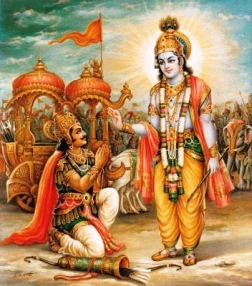
…at that time Kṛṣṇa, smiling, in the midst of both the armies, spoke the following words to the grief-stricken Arjuna.
The Blessed Lord said: While speaking learned words, you are mourning for what is not worthy of grief. Those who are wise lament neither for the living nor the dead.
Never was there a time when I did not exist, nor you, nor all these kings; nor in the future shall any of us cease to be. (Bg. 2.10-12)
Full text and purports More
03 Jul 2014
by The Hare Krishna Movement
in A.C. Bhaktivedanta Swami Prabhupada, Demigod, Durga, Laksmi, Sarasvati, Srimad Bhagavatam, Uma
Tags: 1972 Edititon, A.C. Bhaktivedanta Swami Prabhupada, as it is, bhagavad-gita, demigods, God, goddess durga, goddess of fortune, goddess of learning, intelligence to see God, Laksmi, Lord Shiva, mother of the universe, Siva, Srimad Bhagavatam, Supreme Personality of Godhead, the Mother of the Universe, Uma the wife of Lord Shiva

Sarasvatī, the Goddess of Learning
click on image to enlarge
The other day I was doing some service at the Hare Krishna Temple here in New Vrindavan, West Virginia, and I ran into some Indian guests. After we greeted each other one of them asked me “when did you become a Hindu?” “I never became a Hindu” I replied, “I am a Hare Krishna devotee, a disciple of His Divine Grace A. C. Bhaktivedanta Swami Prabhupada. I am not a Hindu. I worship the Supreme Personality of Godhead Lord Kṛṣṇa.”
So just to make things a little clearer…both to myself and others, I did some research from Srila Prabhupada’s books to find the proper understanding of Goddess Worship, or worship of the demigods.
…Worship of demigods is discouraged herein because even the greatest demigods like Brahmā and Śiva only represent part of the opulence of the Supreme Lord. (Bg 10.42)
…The goddess of fortune, Lakṣmī, and all-powerful demigods like Brahmā and Śiva are engaged in the worship of Viṣṇu or Lord Kṛṣṇa; therefore who can be more powerful than Mukunda (Lord Kṛṣṇa) to be factually called the Supreme Personality of Godhead? The goddess of fortune, Lakṣmījī, Lord Brahmā and Lord Śiva are not independently powerful; they are powerful as expansions of the Supreme Lord, and all of them are engaged in the transcendental loving service of the Lord, and so also are the living entities. (from purport SB 1.18.21)
…Both the living entity and the demigods are subordinate to the will of the Supreme Personality of Godhead…not a blade of grass moves without the will of the Supreme Personality of Godhead. Generally, persons who are distressed in the material world go to the demigods, as they are advised in the Vedic literature. A person wanting some particular thing may worship such and such a demigod. For example, a diseased person is recommended to worship the sun-god; a person wanting education may worship the goddess of learning, Sarasvatī; and a person wanting a beautiful wife may worship the goddess Umā, the wife of Lord Śiva. In this way there are recommendations in the śāstras (Vedic scriptures) for different modes of worship of different demigods. And because a particular living entity wants to enjoy a particular material facility, the Lord inspires him with a strong desire to achieve that benediction from that particular demigod, and so he successfully receives the benediction. The particular mode of the devotional attitude of the living entity toward a particular type of demigod is also arranged by the Supreme Lord. The demigods cannot infuse the living entities with such an affinity, but because He is the Supreme Lord or the Supersoul who is present in the heart of all living entities, Kṛṣṇa gives impetus to man to worship certain demigods. (from purport Bg 7.21)
…Everyone thinks that his intelligence is perfect. Sometimes one employs his intelligence in the worship of Umā, the wife of Lord Śiva, in order to obtain a beautiful wife. Sometimes, when one wants to become as learned as Lord Brahmā, he employs his intelligence in the worship of the goddess of learning, Sarasvatī. Sometimes, when one wishes to become as opulent as Lord Viṣṇu, he worships the goddess of fortune, Lakṣmī.
Intelligence should be employed in the service of the Supreme Personality of Godhead. As soon as one uses his intelligence in this way, the goddess of fortune automatically becomes favorable to him. The goddess of fortune, Lakṣmī, never remains without her husband, Lord Viṣṇu. Consequently, when one worships Lord Viṣṇu he automatically obtains the favor of the goddess of fortune. (from purport SB 4.25.28)
Full text and purports from above excerpts More
01 Jul 2014
by The Hare Krishna Movement
in A.C. Bhaktivedanta Swami Prabhupada, Bhagavad-gita, Bhagavad-gita, Krsna Consciousness, Lectures
Tags: A.C. Bhaktivedanta Swami Prabhupada, as it is, Bg 9.34, bhagavad-gita, economically, God, God's party, Just always think of Me, just worship Me, krsna consciousness, lectures on Bhagavad gita, man-mana bava mad-bhakto, materialists, political field, politically, socially or religiously, spiritualism, spiritualists
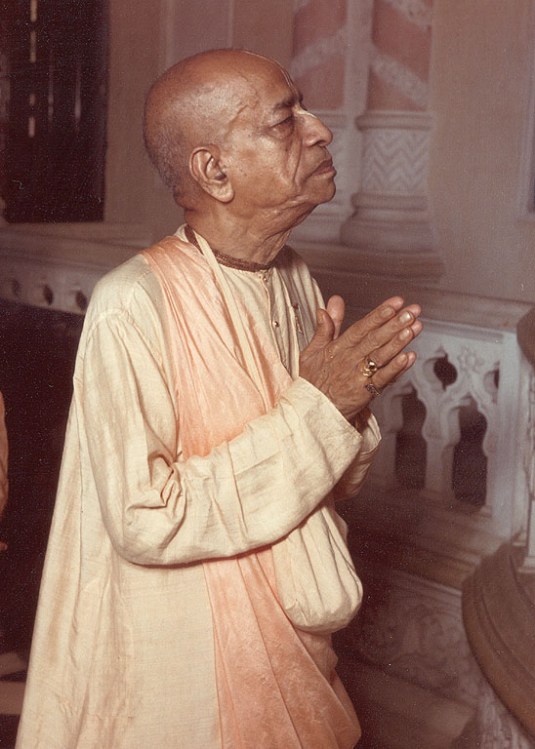
Engage your mind always in thinking of Me, offer obeisances and worship Me. Being completely absorbed in Me, surely you will come to Me. (Bg 9.34)
This is perhaps my favorite sloka from the Bhagavad-gita As It Is. “Always think of Me”, this for me is the essence of Krsna consciousness. Srila Prabhupada once said that “Krsna consciousness is so simple, you can miss it”. Thinking of Krsna, is Krsna consciousness. We have posted one of two lectures Srila Prabhupada gave on this very important verse.
Bhagavad-gītā Lecture 9.34
By His Divine Grace A. C. Bhaktivedanta Swami Prabhupada
New York, December 26, 1966
Prabhupāda:
man-manā bhava mad-bhakto
mad-yājī māṁ namaskuru
mām evaiṣyasi yuktvaivam
ātmānaṁ mat-parāyaṇaḥ
[Bg. 9.34]
This śloka, this verse we have already finished. The conclusion of the Ninth Chapter of Śrīmad Bhagavad-gītā, that, the Lord says that, man-manā bhava mad-bhaktaḥ. “Just always think of Me. Just become My devotee. And, if you want to worship, just worship Me.”
Full Lecture More
15 Jun 2014
by The Hare Krishna Movement
in A.C. Bhaktivedanta Swami Prabhupada, Bhagavad-gita, Father, Letters by Srila Prabhupada
Tags: A.C. Bhaktivedanta Swami Prabhupada, disciplic succession, eternal father, father, fathers, Fathers day, God, Krishna, Krsna, original father, spiritual master, supreme father
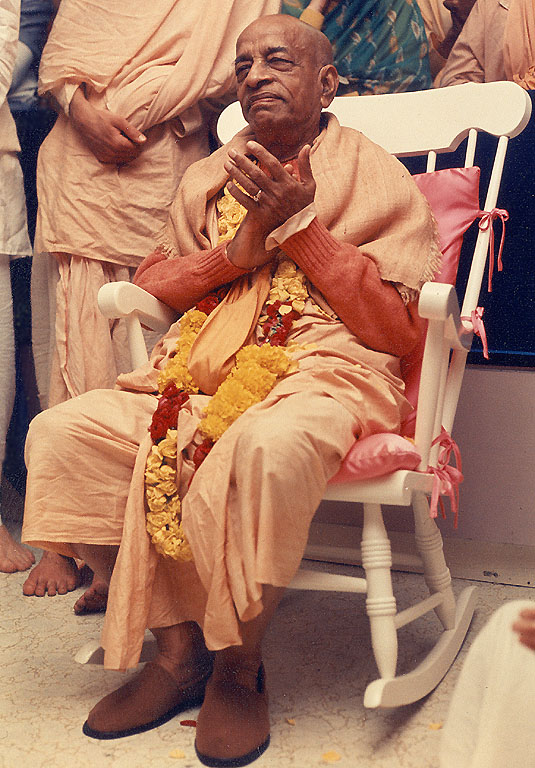
Here in the West people are celebrating Fathers day. So today we honor our our Father with some quotes on Father.
…To accept Kṛṣṇa as father means “My father is there. I have no anxiety.” (Morning Walk — April 26, 1976, Melbourne)
…I am your Spiritual Father, and Krishna is your Spiritual Husband. A girl can never forget either her father or her husband.
(Letter to Jadurani — Stinson Beach, Calif 8 July, 1967)
…The Lord is very kind to the living entities because they are His sons. Lord Kṛṣṇa declares in Bhagavad-gītā, “sarva-yoniṣu…ahaṁ bīja-pradaḥ pitā.” “I am the father of all.”
You are the father of this complete cosmic manifestation, the worshipable chief, the spiritual master. No one is equal to You, nor can anyone be one with You. Within the three worlds, You are immeasurable.
You are the Supreme Lord, to be worshiped by every living being. Thus I fall down to offer You my respects and ask Your mercy. Please tolerate the wrongs that I may have done to You and bear with me as a father with his son, or a friend with his friend, or a lover with his beloved. (Bg 11. 43-44)
More
13 Nov 2013
by The Hare Krishna Movement
in A.C. Bhaktivedanta Swami Prabhupada, A.C. Bhaktivedanta Swami Prabhupada, Back to Godhead, BTG magizine, God, Jon Nordheimer
Tags: A.C. Bhaktivedanta Swami Prabhupada, God, interview with Srila Prabhupada, Jon Nordheimer, Krsna God, New York Times, prabhupada, spiritual sparks

click on image to enlarge
This is a nice article from Back to Godhead Magazine published in 1975. It is an interview with New York Times reporter Jon Nordheimer, and His Divine Grace A.C. Bhaktivedanta Swami Prabhupada, on the subject of God.
The Choice is Yours
Excerpted from Back to Godhead Magazine 1975, Vol. 10, No. 4
Interview with His Divine Grace A. C. Bhaktivedanta Swami Prabhupada
PRABHUPADA: When we speak of Krsna, we mean God. Everyone has some vague idea of God, but no clear idea. Therefore God descends to show what He is. If we speculate on God, someone will think one thing, and another person will think another. This is the result of speculation. But if God Himself comes and shows Himself as He is and speaks about Himself, that is perfect knowledge. This Krsna consciousness movement is spreading that message: God Himself is speaking about Himself: “I am this; I am like this; My form is like this; My activities are like this; My address is this and that—if you like, you can come back to Me. This is the situation. Everyone can come to Me.” All this information is in Bhagavad-gita As It Is. In Bhagavad-gita God speaks about Himself and presents Himself as He is. We simply have to take that information; then we can understand God. As soon as we understand God, we can go home immediately. It is very simple.
More
21 Sep 2013
by The Hare Krishna Movement
in A.C. Bhaktivedanta Swami Prabhupada, Buddha, Srimad Bhagavatam, Vegetarianism
Tags: A.C. Bhaktivedanta Swami, animal sacrifices, Anjana, buddha, Gaya, God, incarnation of the Personality of Godhead, Lord Buddha, moral discipline, nonviolence, prabhupada, Vedas

click on image to enlarge
For some reason, I have always been attracted to Buddha since my early childhood. Later in my life as I turned 18, I also became interested in vegetarianism, which peaked my interest in spiritual life as well. So it was, I began the practice of yoga and meditation. It is interesting to note that later (age 21) when I became a Hare Krishna devotee, was when my actual education in Lord Buddha began. We share with you two select verses from the Srimad Bhagavatam describing the mission of Lord Buddha.
The mission of Lord Buddha was to save people from the abominable activity of animal killing and to save the poor animals from being unnecessarily killed.
Lord Buddha, a powerful incarnation of the Personality of Godhead, appeared in the province of Gayā (Bihar) as the son of Añjana, and he preached his own conception of nonviolence and deprecated even the animal sacrifices sanctioned in the Vedas. At the time when Lord Buddha appeared, the people in general were atheistic and preferred animal flesh to anything else. On the plea of Vedic sacrifice, every place was practically turned into a slaughterhouse, and animal killing was indulged in unrestrictedly. Lord Buddha preached nonviolence, taking pity on the poor animals. He preached that he did not believe in the tenets of the Vedas and stressed the adverse psychological effects incurred by animal killing. Less intelligent men of the age of Kali, who had no faith in God, followed his principle, and for the time being they were trained in moral discipline and nonviolence, the preliminary steps for proceeding further on the path of God realization. He deluded the atheists because such atheists who followed his principles did not believe in God, but they kept their absolute faith in Lord Buddha, who himself was the incarnation of God. Thus the faithless people were made to believe in God in the form of Lord Buddha. That was the mercy of Lord Buddha: he made the faithless faithful to him.
Select verses: More
09 Jul 2013
by The Hare Krishna Movement
in A.C. Bhaktivedanta Swami Prabhupada, Srimad Bhagavatam
Tags: A.C. Bhaktivedanta Swami Prabhupada, codes of religion, dharma, God, jnana, Kali-yuga, knowledge, krsne sva-dhamopagate, Lord Sri Krishna, purana, religion
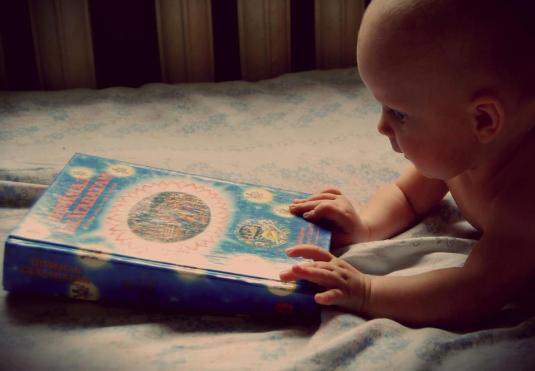
Srimad Bhagavatam
By His Divine Grace A.C. Bhaktivedanta Swami Prabhupada
Canto One, Chapter 3, Text 43
kṛṣṇe sva-dhāmopagate
dharma-jñānādibhiḥ saha
kalau naṣṭa-dṛśām eṣa
purāṇārko ’dhunoditaḥ
kṛṣṇe—in Kṛṣṇa’s; sva-dhāma—own abode; upagate—having returned; dharma—religion; jñāna—knowledge; ādibhiḥ—combined together; saha—along with; kalau—in the Kali-yuga; naṣṭa-dṛśām—of persons who have lost their sight; eṣaḥ—all these; purāṇa-arkaḥ—the Purāṇa which is brilliant like the sun; adhunā—just now; uditaḥ—has arisen.
TRANSLATION
This Bhāgavata Purāṇa is as brilliant as the sun, and it has arisen just after the departure of Lord Kṛṣṇa to His own abode, accompanied by religion, knowledge, etc. Persons who have lost their vision due to the dense darkness of ignorance in the age of Kali shall get light from this Purāṇa.
PURPORT
Lord Śrī Kṛṣṇa has His eternal dhāma, or abode, where He eternally enjoys Himself with His eternal associates and paraphernalia. And His eternal abode is a manifestation of His internal energy, whereas the material world is a manifestation of His external energy. When He descends on the material world, He displays Himself with all paraphernalia in His internal potency, which is called ātma-māyā. In the Bhagavad-gītā the Lord says that He descends by His own potency (ātma-māyā). His form, name, fame, paraphernalia, abode, etc., are not, therefore, creations of matter. He descends to reclaim the fallen souls and to reestablish codes of religion which are directly enacted by Him. Except for God, no one can establish the principles of religion. Either He or a suitable person empowered by Him can dictate the codes of religion. Real religion means to know God, our relation with Him and our duties in relation with Him and to know ultimately our destination after leaving this material body. The conditioned souls, who are entrapped by the material energy, hardly know all these principles of life. Most of them are like animals engaged in eating, sleeping, fearing and mating. They are mostly engaged in sense enjoyment under the pretension of religiosity, knowledge or salvation. They are still more blind in the present age of quarrel, or Kali-yuga. In the Kali-yuga the population is just a royal edition of the animals. They have nothing to do with spiritual knowledge or godly religious life. They are so blind that they cannot see anything beyond the jurisdiction of the subtle mind, intelligence or ego, but they are very much proud of their advancement in knowledge, science and material prosperity. They can risk their lives to become a dog or hog just after leaving the present body, for they have completely lost sight of the ultimate aim of life. The Personality of Godhead Śrī Kṛṣṇa appeared before us just a little prior to the beginning of Kali-yuga, and He returned to His eternal home practically at the commencement of Kali-yuga. While He was present, He exhibited everything by His different activities. He spoke the Bhagavad-gītā specifically and eradicated all pretentious principles of religiosity. And prior to His departure from this material world, He empowered Śrī Vyāsadeva through Nārada to compile the messages of the Śrīmad-Bhāgavatam, and thus both the Bhagavad-gītā and the Śrīmad-Bhāgavatam are like torchbearers for the blind people of this age. In other words, if men in this age of Kali want to see the real light of life, they must take to these two books only, and their aim of life will be fulfilled. Bhagavad-gītā is the preliminary study of the Bhāgavatam. And Śrīmad-Bhāgavatam is the summum bonum of life, Lord Śrī Kṛṣṇa personified. We must therefore accept Śrīmad-Bhāgavatam as the direct representation of Lord Kṛṣṇa. One who can see Śrīmad-Bhāgavatam can see also Lord Śrī Kṛṣṇa in person. They are identical.
28 Apr 2013
by The Hare Krishna Movement
in A.C. Bhaktivedanta Swami Prabhupada, Journey of Self-Discovery, Krsna Consciousness
Tags: A.C. Bhaktivedanta Swami Prabhupada, everyone can see God, God, God consciousness, Gopal, Govinda, Krishna, self discovery, self realization, The Journey of Self-Discovery, Vedic literature, yoga

…The first thing Kṛṣṇa is looking for is how eager you are to see Him. Kṛṣṇa will respond. If you are actually eager to see Kṛṣṇa, then it is sure your efforts will be successful.
But you must desire Kṛṣṇa only. In this connection, Rūpa Gosvāmī has written a verse:
“My dear friend, there is one boy—His name is Govinda. He is standing on the bank of the Yamunā near the Keśi-ghāṭa, and He is playing on His flute. He is so beautiful, especially during this full-moon night. If you have any intentions to enjoy in this material world with your children, husband, or other family members, then please do not go there.”
The idea is that if you once see Kṛṣṇa, then you’ll forget all this nonsensical materialistic enjoyment. That is seeing Kṛṣṇa.
The gopīs are another example of great eagerness to see Kṛṣṇa. The gopīs came to Kṛṣṇa, being captivated by His beautiful features. They were young girls, and Kṛṣṇa was so beautiful. Actually they were lusty when they came to Kṛṣṇa, but Kṛṣṇa is so pure that they became first-class devotees. There is no comparison to the gopīs’ devotion, because they loved Kṛṣṇa with heart and soul. That is the qualification. They loved Kṛṣṇa so much that they didn’t care for family or reputation when they went out in the dead of night. Kṛṣṇa’s flute was sounding, and they were all fleeing their homes. Their fathers, their brothers, their husbands all said, “Where are you going? Where are you going in this dead of night?” But the gopīs didn’t care. They neglected their children, their family, everything. Their only thought was, “We must go to Kṛṣṇa.”
This eagerness is required. We must be very, very eager to see Kṛṣṇa.
More
19 Apr 2013
by The Hare Krishna Movement
in A.C. Bhaktivedanta Swami Prabhupada, Lectures, Rama
Tags: God, God disposes, God's desire, Lecture by Srila Prabhupada, Lord Ramachndra's Appearance Day, Rama, Srimad Bhagavatam

In honor of the Appearance Day of Lord Ramachandra, we are posting a Lecture given by His Divine Grace A.C. Bhaktivedanta Swami Prabhupada from way back in 1966, when many of us here in the Western world were just hearing about Rama, and His amazing pastimes, for the very first time.
…When God comes in incarnation or He sends His representative to reclaim, they perform wonderful acts. They are not ordinary, common men. Either God or God’s representative, they act in such a way that it is not possible for any common man. That is the particular symptom of God and God’s representative. (Ramachandra’s Appearance Day Lecture, December 27, 1966 New York)
Full Lecture More
04 Apr 2013
by The Hare Krishna Movement
in A.C. Bhaktivedanta Swami Prabhupada, Conversation with Srila Prabhupada, Jon Nordheimer
Tags: A.C. Bhaktivedanta Swami Prabhupada, ability to choose, bhagavad-gita, darkness, God, God is Available, illusion, Jon Nordheimer, light, maya, New Vrindavan 1972, New York Times, Srila Prabhupada

…God is available. and we can associate with Him according to our choice. The ability to choose, or our conscience, is given to us in the human form so we can utilize it. All the ingredients are there for us to cross the ocean of birth and death. This human body is a very nice boat, and we have a very good navigator, the spiritual master. We also have a very favorable wind the instructions of God. So we should take our chance and cross the ocean of birth and death. We can say, “Now here is an opportunity. Take it and be saved from birth, old age, disease, and death.” but if you don’t take advantage, what can we do?
Mr. Nordheimer: Why does all this exist? Why the challenge in the first place? Why maya?
Srila Prabhupada: Maya means illusion, darkness. If I tell you to come from the darkness into the light and if you don’t come, that is your misfortune. Maya is there, and God is there. If you want to remain in maya, then how can you be saved? I can help you by saying, “Don’t remain in darkness. Please come out into the light.” But if you say, “No, I shall remain here,” then how can I save you? You have your choice. God is there, and maya is there. If you take to maya, you remain in darkness. What can I do, and what can God do? That is your choice.
A Choice of Destinies
His Divine Grace A.C. Bhaktivedanta Swami Prabhupada speaks with Jon Nordheimer of the New York Times in a conversation recorded in September 1972 at New Vrindaban.
Full conversation More
15 Feb 2013
by The Hare Krishna Movement
in A.C. Bhaktivedanta Swami Prabhupada, Book Changes, Mahesh Raja das
Tags: A.C. Bhaktivedanta Swami Prabhupada, book changes, conditioned souls, God, great scholar, Krishna, Krsna, Liberated souls, prakrta shajiyas, sahajiyas, srila prabhupada conversations, Srila Prabhupada lectures, Srila Prabhupada's writting, transcendental literature

click on image to slightly enlarge
Under the Direction of God (Krishna)
His Divine Grace Srila Prabhupada speaks as Krsna speaks
“It is not possible for a common man to write books on bhakti, for his writings will not be effective. He may be a very great scholar and expert in presenting literature in flowery language, but this is not at all helpful in understanding transcendental literature. Even if transcendental literature is written in faulty language, it is acceptable if it is written by a devotee, whereas so-called transcendental literature written by a mundane scholar, even if it is a very highly polished literary presentation, cannot be accepted. The secret in a devotee’s writing is that when he writes about the pastimes of the lord, the lord helps him; he does not write himself.
We Don’t Allow Any Literature Not Given by Liberated Soul
compiled by Sriman Mahesh Prabhu
The difference between Srila Prabhupada’s books and other so-called gurus’ (conditioned souls) writing is Srila Prabhupada’s instruction was coming directly from Krsna. This is the transcendental platform.
Srila Prabhupada encouraged his disciples, however, to write their realizations. Other conditioned souls may present their nonsense commentaries on Bhagavad-Gita etc., but they will never be quoted for references. Srila Prabhupada is on the trancendental platform and Krishna speaks through him, consequently only he will be quoted for reference.
More
20 Dec 2012
by The Hare Krishna Movement
in Astrology, Krishna Consciousness
Tags: 12-21-2012, Dec. 21 2012, God, Krishna, Mayan Age, mayan age ends, new age of spiritual enlightment

Well today is 12-21-2012, or as one web site declared “Mayan Age Ends 12-21-2012 but heralds in a New Age of spiritual enlightenment” Good! Glad to hear it. Hare Krishna! This is our last post for a while as we thought 12-21-2012 was a good day to start an adventure, travel, take a short journey, and just go for some walks, read and chant more, etc. Or as one great thinker put it, “Today is the begining of the rest of my life” So we will be back to post some more Krishna Nectar soon.
We will leave you with this small bit of Krishna Nectar:
…Since it was almost night, and all the inhabitants of Vṛndāvana, including the cows and calves, were very tired, they decided to take their rest on the river bank. In the middle of the night, while they were taking rest, there was suddenly a great forest fire, and it quickly appeared that the fire would soon devour all the inhabitants of Vṛndāvana. As soon as they felt the warmth of the fire, they immediately took shelter of Kṛṣṇa, the Supreme Personality of Godhead, although He was playing just like their child. They began to say, “Our dear Kṛṣṇa! O Supreme Personality of Godhead! Our dear Balarāma, the reservoir of all strength! Please try to save us from this all devouring and devastating fire. We have no other shelter than You. This devastating fire will swallow us all!” Thus they prayed to Kṛṣṇa, saying that they could not take any shelter other than His lotus feet. Lord Kṛṣṇa, being compassionate upon His own townspeople, immediately swallowed up the whole forest fire and saved them. This was not impossible for Kṛṣṇa because He is unlimited. He has unlimited power to do anything He desires.
“Please try to save us from this all devouring and devastating fire. We have no other shelter than You.”
Yes this is Krishna Consciousness…in whatever situation we are thrown if we simply remember Krishna (God) we can consider ourselves fortunate.
10 Dec 2012
by The Hare Krishna Movement
in A.C. Bhaktivedanta Swami Prabhupada, Bob Cohen, Perfect Answers Perfect Questions, Practicing Krishna Consciousness at Home, Srila Prabhupada, Srila Prabhupada Conversations
Tags: A.C. Bhaktivedanta Swami Prabhupada, Bob Cohen, God, Krisha, Perfect Ouestions Perfect Answers, science of God, search for meaning, self improvement, self realization

Continuing with our series of a True account entitled Perfect Questions, Perfect Answers… A search for meaning carries Bob Cohen, a young American Peace Corps worker halfway around the world, to an ancient village in the midst of West Bengal. There, in a small bamboo hut, he finds a teacher who is able to tell him everything he ever wanted to know.
Perfect Questions, Perfect Answers
By His Divine Grace A. C. Bhaktivedanta Swami Prabhupada
Chapter 5
Becoming Pure
February 29, 1972
Bob: Thank you so much for allowing me to ask my questions.
Śrīla Prabhupāda: That is my mission. People should understand the science of God. Unless we cooperate with the Supreme Lord, our life is baffled. I have given the example many times that a screw which has fallen from a machine has no value. But when the same screw is again attached to the machine, it has value. Similarly, we are part and parcel of God. So without God, what is our value? No value! We should again come back to our position of attachment to God. Then we have value.
Bob: I met a fellow today who came in the afternoon. His reason for coming—you may find it humorous—was that he heard the hippies were in Māyāpur.
More
28 Sep 2012
by The Hare Krishna Movement
in Chanting Hare Krishna, Japa, Practicing Krishna Consciousness at Home
Tags: chanting, chanting Hare Krishna, God, Hare, Hare Krishna, Holy Names of the Lord, japa, kirtana, Krishna, Maha Mantra, practicing krishna consciousness at home, Rama
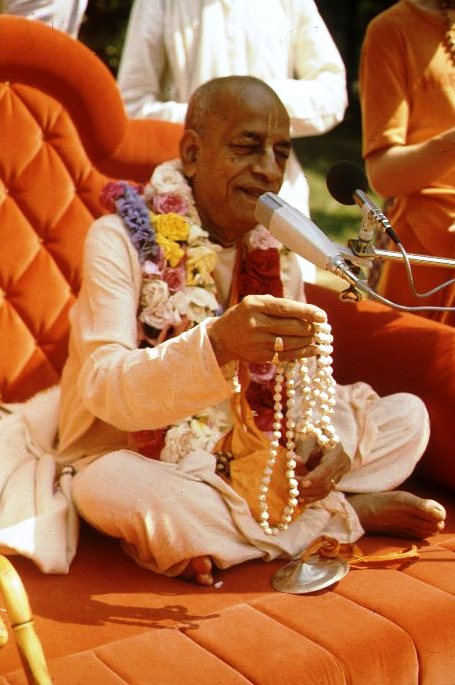
It has been requested that we do a post on Japa Meditation, so on this auspicious day of the appearance of Haridasa Thakura, we share with you some instructions on the chanting of Japa.
…Since God is all-powerful and all-merciful, He has kindly made it very easy for us to chant His names, and He has also invested all His powers in them. Therefore the names of God and God Himself are identical. This means that when we chant the holy names of Krishna and Rama we are directly associating with God and being purified. Therefore we should always try to chant with devotion and reverence. The Vedic literature states that Lord Krishna is personally dancing on your tongue when you chant His holy name.
More
12 Sep 2012
by The Hare Krishna Movement
in Uncategorized
Tags: A.C. Bhaktivedanta Swami Prabhupada, astanga-yoga, Bhagavad Gita, Bhagavad-gita Chapter 5, bhakti yoga, God, human suffering, illusion, jnana-yoga, karma yoga, Krishna consciousness, Krsna, material world, maya

click on image to enlarge
…This Fifth Chapter is a practical explanation of Kṛṣṇa consciousness, generally known as karma-yoga. The question of mental speculation as to how karma-yoga can give liberation is answered herewith. To work in Kṛṣṇa consciousness is to work with the complete knowledge of the Lord as the predominator. Such work is not different from transcendental knowledge. Direct Kṛṣṇa consciousness is bhakti-yoga, and jñāna-yoga is a path leading to bhakti-yoga. Kṛṣṇa consciousness means to work in full knowledge of one’s relationship with the Supreme Absolute, and the perfection of this consciousness is full knowledge of Kṛṣṇa, or the Supreme Personality of Godhead. A pure soul is the eternal servant of God as His fragmental part and parcel. He comes into contact with māyā (illusion) due to the desire to lord it over māyā, and that is the cause of his many sufferings. As long as he is in contact with matter, he has to execute work in terms of material necessities. Kṛṣṇa consciousness, however, brings one into spiritual life even while one is within the jurisdiction of matter, for it is an arousing of spiritual existence by practice in the material world. The more one is advanced, the more he is freed from the clutches of matter. The Lord is not partial toward anyone. Everything depends on one’s practical performance of duties in an effort to control the senses and conquer the influence of desire and anger. And, attaining Kṛṣṇa consciousness by controlling the above-mentioned passions, one remains factually in the transcendental stage, or brahman-nirvāṇa. The eightfold yoga mysticism is automatically practiced in Kṛṣṇa consciousness because the ultimate purpose is served. There is gradual process of elevation in the practice of yama, niyama, āsana, pratyāhāra, dhyāna, dhāraṇā, prāṇāyāma, and samādhi. But these only preface perfection by devotional service, which alone can award peace to the human being. It is the highest perfection of life.
For entire 5th Chapter More
27 Aug 2012
by The Hare Krishna Movement
in Bob Cohen, Free Downloads, Free eBooks, Perfect Answers Perfect Questions
Tags: A.C. Bhaktivedanta Swami Prabhupada, Bob Cohen, creator, Eastern Wisdom, God, krsna conscious devotees, oriental philosophy, religion, Spiritual Life, SrilaPrabhupada

This begins a new series of a True account. A search for meaning carries Bob Cohen, a young American Peace Corps worker halfway around the world, to an ancient village in the midst of West Bengal. There, in a small bamboo hut, he finds a teacher who is able to tell him everything he ever wanted to know. To download the entire book you may click the link at bottom for entire book on pdf, or you can visit Krishna Path .org to download in epub format.
Perfect Questions, Perfect Answers
Conversations between His Divine Grace A.C. Bhaktivedanta Swami Prabhupada
and Bob Cohen a Peace Corp worker in India
Introduction
God, spiritual life—those were such vague terms to me before I met Śrīla Prabhupāda. I have always been interested in religion, but before I met the Kṛṣṇa conscious devotees, somehow I did not have the proper perspective needed to inquire fruitfully about spiritual life. The existence of a Creator is only common sense—but who is God? Who am I? I had been to Hebrew School and had studied Oriental philosophy, but I could never get satisfying answers to my questions.
I first heard the Hare Kṛṣṇa mantra in Greenwich Village, New York, in late 1968.
hare kṛṣṇa hare kṛṣṇa
kṛṣṇa kṛṣṇa hare hare
hare rāma hare rāma
rāma rāma hare hare
The chanting was captivating, and it made me feel very comfortable. The mantra stuck in my mind, and I soon regretted that I had not taken a magazine from the devotees. As explained to me later, a transcendental seed had been planted that could eventually ripen into love of Godhead.
More
07 Aug 2012
by The Hare Krishna Movement
in Krishna Consciousness, The Matchless Gift
Tags: A.C. Bhaktivedanta Swami Prabhupada, affection, eternal, God, krsna consciousness, Learning to Love, learning to love God, love, loving relationship with Krishna, spirit soul, The Matchless Gift

click on image to slightly enlarge
…Since we as living entities are eternal, temporary activities are not our main concern. Our engagements should be eternal because we are eternal, and that eternal engagement is the rendering of service to Kṛṣṇa in love.
Love begins with this give and take. We give something to our lover, he gives something to us, and in this way love develops. When we create any loving transaction with any boy or girl, man or woman, we give and take. Thus Kṛṣṇa is teaching us how to give and take. Kṛṣṇa is begging us:
“Try to love Me. Learn how to love Me. Offer something to Me.”
“Sir,” we may say, “I have nothing to give You.”
“Oh, you cannot collect a piece of fruit, a flower, a leaf or a little water?”
“Oh yes, why not? Anyone can collect this.”
This then is the method of Kṛṣṇa consciousness which allows one to make friends with Kṛṣṇa. We can enter into any number of relationships with Kṛṣṇa. We can become a direct servant of Kṛṣṇa, or in the highest stages we can become Kṛṣṇa’s father, mother or lover. Kṛṣṇa is prepared to establish a loving relationship with all living entities. In actuality this relationship is already there because He is the supreme father and we are His parts and parcels. Because the son is part of the body of the father, the relationship between them cannot be broken; it may be forgotten for some time, but as soon as one recognizes his father or son, immediately affection develops. Similarly, we are eternally related to Kṛṣṇa, but at the present moment this relationship is simply forgotten or suppressed. Consequently we think that we have no relationship with Kṛṣṇa, but this is not a fact. Because we are integral with Him, because we are part and parcel of Him, our relationship with Him is eternal. That relationship simply has to be revived, and that revival is this process of Kṛṣṇa consciousness.
Krsna Consciousness, The Matchless Gift
By His Divine Grace A.C. Bhaktivedanta Swami Prabhupada
Chapter 3
Learning to Love
More
26 Jul 2012
by The Hare Krishna Movement
in Guru & Disciple, Spiritual Master
Tags: A.C. Bhaktivedanta Swami Prabhupada, bona fide guru, disciple, disciplic succession, God, guru, guru disciple relationship, material world, prabhupada, spiritual master, Srila Prabhupada

The bona fide guru will simply present what the supreme guru, God, says in bona fide scripture. A guru cannot change the message of the disciplic succession.
The guru’s business is to bring his disciples from darkness to light.
The guru’s business is to see that no human being suffers in this material world. No one can claim that he is not suffering. That is not possible. In this material world, there are three kinds of suffering; adhyatmika, adhibhautika, and adhidaivika. These are miseries arising from the material body and mind, from other living entities and from the forces of nature. We may suffer mental anguish, or we may suffer from other living entities-from ants or mosquitoes or flies-or we may suffer due to some superior power. There may be no rain, or there may be flood. There may be excessive heat or excessive cold. So many types of suffering are imposed by nature. Thus there are three types of miseries within the material world, and everyone is suffering from one, two, or three of them. No one can say that he is completely free from suffering.
Guru-Disciple Relationship
The Guru – Guide to the Spiritual World
from the Bhakta Handbook
On hearing the word guru, we tend to envision a caricature like image: a bizarre-looking old fellow with a long, stringy beard and flowing robes, meditating on distant, esoteric truths. Or we think of a cosmic con man cashing in on young seekers’ spiritual gullibility. But what really is a guru? What does he know that we don’t? How does he enlighten us?
In a talk given in England in 1973, Srila Prabhupada provides some enlightening answers.
More
04 Jun 2012
by The Hare Krishna Movement
in Krishna Consciousness, Teachings of Lord Kapila, The Hare Krishna Movement
Tags: A.C. Bhaktivedanta Swami Prabhupada, Bhagavan, God, Krishna consciousness movement, krsna consciousness, krsnas tu bhagavan svayam, Lord Kapila, Son of Devahuti, Sri Krsna, Teachings of Lord Kapila
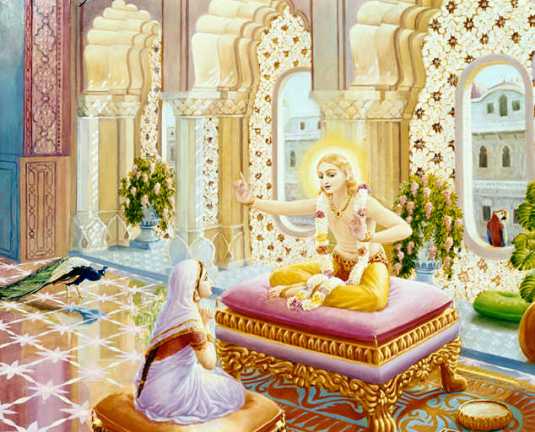
…The purpose of this Kṛṣṇa consciousness movement is to inform everyone that no one is superior to Kṛṣṇa, God. Because many young Americans and Europeans are fortunate and know nothing of any hodgepodge god, they have taken this bona fide Kṛṣṇa consciousness movement seriously. Kṛṣṇas tu bhagavān svayam: Bhagavān, God, means Śrī Kṛṣṇa. We have simply presented this information, saying, “Here is God. Śrī Kṛṣṇa.” Because they have taken this seriously, many young Americans and Europeans are advancing in Kṛṣṇa consciousness. Consequently many people are surprised to see how Americans and Europeans have become such great devotees and are dancing in ecstasy. How is it they are so advanced? They have taken the information seriously: kṛṣṇas tu bhagavān svayam. Whether one touches fire blindly or knowingly, fire will burn. It is not that because the fire is touched by a child, fire will not burn. These young Westerners have touched fire, and consequently it is acting as fire.
…If we hear about Kṛṣṇa, we become purified. Hearing about Kṛṣṇa means associating with Kṛṣṇa. In this way we may perfect our lives.
Teachings of Lord Kapila, the Son of Devahūti
By His Divine Grace A. C. Bhaktivedanta Swami Prabhupāda
Chapter One
The Purpose of Lord Kapila’s Advent
TEXT 1
śaunaka uvāca
kapilas tattva-saṅkhyātā
bhagavān ātma-māyayā
jātaḥ svayam ajaḥ sākṣād
ātma-prajñaptaye nṛṇām
TRANSLATION
Śrī Śaunaka said: Although He is unborn, the Supreme Personality of Godhead took birth as Kapila Muni by His internal potency. He descended to disseminate transcendental knowledge for the benefit of the whole human race.
PURPORT
The word ātma-prajñaptaye indicates that the Lord descends for the benefit of the human race to give transcendental knowledge. Material necessities are quite sufficiently provided for in the knowledge given in the Vedic literatures, which offer a program for good living and gradual elevation to the platform of sattva-guṇa, the mode of goodness. Once one is situated in sattva-guṇa, one’s knowledge expands. On the platform of passion there is no knowledge, for passion is an impetus to enjoy material benefits. On the platform of ignorance there is neither knowledge nor enjoyment but simply animalistic living.
More
06 Mar 2012
by The Hare Krishna Movement
in Guru & Disciple, Science of Self Realization, Srila Prabhupada Conversations
Tags: A.C. Bhaktivedanta Swami Prabhupada, Christian, economic development, God, guru, Hindu, Krishna consciousness, London Times, materialistic life, Muhammadan, Prabhupada conversations, Saints and Swindlers, Spiritual Life, spiritual master, Srila Prabhupada Speaks out, The Science of Self Realization

The Science of Self Realization
By His Divine Grace A.C. Bhaktivedanta Swami Prabhupada
From Chapter II, Choosing a Spiritual Master
Separating the Saints From the Swindlers
Srila Prabhupada speaks out in an interview with the London Times: “If you want to be cheated, you will find many cheating gurus. But if you are sincere, you will find a sincere guru… The genuine guru is God’s representative, and he speaks about God and nothing else… A genuine guru is not a businessman. He is a representative of God. What ever God says, the guru repeats. He does not speak otherwise.”
Reporter: Your Grace, it seems to me that more people then ever are seeking some kind of spiritual life. I wonder if you could tell me why this is so.
Srila Prabhupada: The desire for spiritual life is an absolutely natural hankering. Because we are spirit souls, we can not be happy in the material atmosphere. If you take a fish out of the water, it cannot be happy on land. Similarly, if we are without spiritual consciousness, we can never be happy. Today, so many people are after scientific advancement and economic development, but they are not happy because these are not the actual goals of life. Many young people are realizing this, and they are rejecting materialistic life and are trying to search for spiritual life. Actually this is the proper search. Krishna consciousness is the proper goal of life. Unless you take to Krishna consciousness you cannot be happy. That is a fact. Therefore, we invite everyone to study and understand this great movement.
More
Previous Older Entries Next Newer Entries