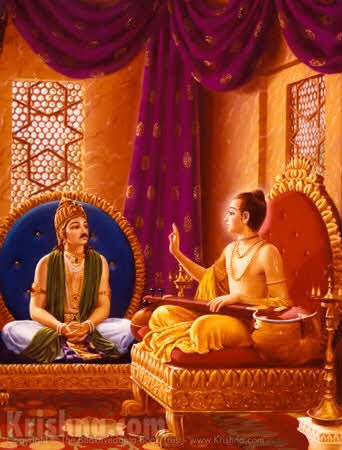
King Puranjana is the central figure in a famous philosophical allegory narrated by the sage Nārada Muni to King Prācīnabarhiṣat in the Fourth Canto of the Bhāgavata Purāṇa (Śrīmad-Bhāgavatam). The story illustrates the journey of the individual soul (jīva) through material existence, entanglement in bodily desires, death, and rebirth.
The word purañjana means “one who enjoys in a body.”
Nārada Muni asked King Prācīnabarhiṣat*: My dear King, what do you desire to achieve by performing these fruitive activities? The chief aim of life is to get rid of all miseries and enjoy happiness, but these two things cannot be realized by fruitive activity. (SB 4.25.4)
* see note at bottom
In this material world there is a great illusion which covers real intelligence. A man in the mode of passion wants to work very hard to derive some benefit, but he does not know that time will never allow him to enjoy anything permanently. Compared with the work one expends, the gain is not so profitable. Even if it is profitable, it is not without its distresses. If a man is not born rich and he wants to purchase a house, cars and other material things, he has to work hard day and night for many years in order to possess them. Thus happiness is not attained without undergoing some distress.
Therefore Nārada Muni asked King Puranjana*, what he desired to attain by performing so many costly sacrifices.
…For the common man, there is no such hope because even if they are promoted to the higher planetary systems, they are not guaranteed freedom from the miseries of birth, old age, disease and death. Even Lord Brahmā, who is situated in the highest planetary system (Brahmaloka), has to die. Lord Brahmā’s birth and death may be different from an ordinary man’s, but within this material world he cannot avoid the distresses of birth, old age, disease and death. If one is at all serious about attaining liberation from these miseries, he must take to devotional service. This is confirmed by the Lord Himself in Bhagavad-gītā (Bg.4.9):
janma karma ca me divyam
evaṁ yo vetti tattvataḥ
tyaktvā dehaṁ punar janma
naiti mām eti so ‘rjuna
“One who knows the transcendental nature of My appearance and activities does not, upon leaving the body, take his birth again in this material world, but attains My eternal abode, O Arjuna.”
Thus after attaining full Kṛṣṇa consciousness, the devotee does not return to this material world after death. He goes back home, back to Godhead. That is the perfect stage of happiness, unblemished by any trace of distress. (from Purport SB 4.25.4)
Full text and purport
More