The world seems to be in a state of chaos, what with cities being bombed, thousands of people being displaced, and left without home, power, heat, food or water. There is death and destruction in so many places around the globe. It is ‘man’s inhumanity to man”, and I often wonder how is it possible that man can act in such deplorable and sinful way
Those who are demoniac do not know what is to be done and what is not to be done. Neither cleanliness nor proper behavior nor truth is found in them. (Bg. 16.7)
Following such conclusions, the demoniac, who are lost to themselves and who have no intelligence, engage in unbeneficial, horrible works meant to destroy the world. (Bg. 16.9)
PURPORT
The demoniac are engaged in activities that will lead the world to destruction. The Lord states here that they are less intelligent. The materialists, who have no concept of God, think that they are advancing. But, according to Bhagavad-gītā, they are unintelligent and devoid of all sense. They try to enjoy this material world to the utmost limit and therefore always engage in inventing something for sense gratification. Such materialistic inventions are considered to be advancement of human civilization, but the result is that people grow more and more violent and more and more cruel, cruel to animals and cruel to other human beings. They have no idea how to behave toward one another. Animal killing is very prominent amongst demoniac people. Such people are considered the enemies of the world because ultimately they will invent or create something which will bring destruction to all. Indirectly, this verse anticipates the invention of nuclear weapons, of which the whole world is today very proud. At any moment war may take place, and these atomic weapons may create havoc. Such things are created solely for the destruction of the world, and this is indicated here. Due to godlessness, such weapons are invented in human society; they are not meant for the peace and prosperity of the world.
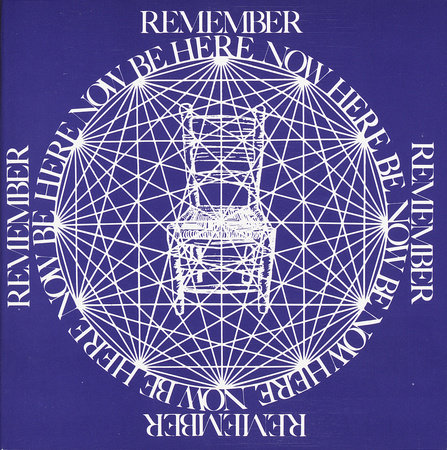
Today most people have heard of yoga and meditation, but I remember when I first took up yoga back in 1972, it was not so widely known. I was first introduced to it from the book “Be Here Now”. It was a very simplistic book, but it was full of ideas, quotes and images, that opened my mind to a world of spiritual thought. It introduced me to yoga, meditation, the concept of vegetarianism, spirituality, and the need of a Guru or Spiritual Master. I began to take seriously ideas that were introduced, such as self realization, living a more pure life, developing our relationship with God, finding out who is God, and finding my spiritual master (guru). So for me, the book was the beginning of my journey, as it was for many, so indeed it was a huge success, it that regard.
Maybe I was sincere, or maybe just lucky, but I soon found my eternal Spiritual Master, His Divine Grace A.C. Bhaktivedanta Swami Prabhupada, and he answered all my questions. He told me who is God (Krsna), what my relationship with him is (sanatan-dharma), the process for self realization (bhakti-yoga), and how to get out of this temporary material world and return home back to Godhead.
When I first began my practice of Yoga, it was purely as a spiritual Practice. Nowadays, people will take it up for many different reasons, such as weight loss, fitness, relaxation, or social acceptance and community. But I still see it as a spiritual practice. The daily asanas, which are good for my ageing body, are an offering, and the breathing is a mindful prayer.
The word Yoga means “Union”. To link our consciousness with a Higher Consciousness.
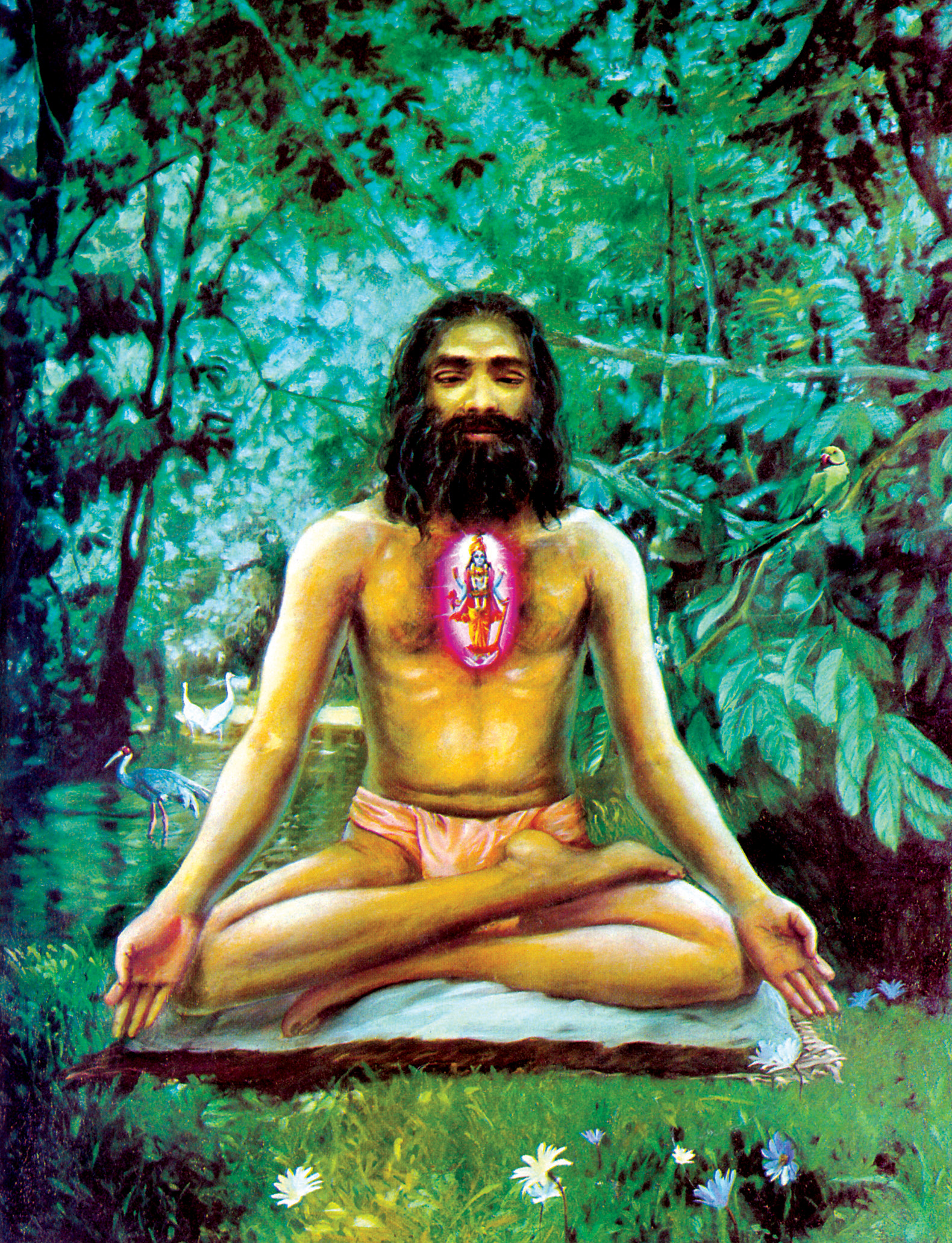
Yoga means “linking” with the Supreme. The Bhagavad-gītā describes several systems—karma-yoga (work), jñāna-yoga (knowledge), dhyāna-yoga (meditation), and aṣṭāṅga-yoga (eightfold path)—but ultimately declares bhakti-yoga, devotional service, to be the highest.
“Of all yogīs, he who always abides in Me with great faith, worshiping Me in transcendental loving service, is most intimately united with Me in yoga, and is the highest of all.” (Bg. 6.47) So one who thinks of the Supreme Lord always is the greatest yogi, the supermost jnani, and the greatest devotee at the same time.
This morning as I was finishing the Tenth Chapter of the Second Canto, the following verse and purport jumped out at me from the pages. And I realized for the thousandth time, what great good fortune we have in that we can hear directly from the pure devotee of the Lord, about the eternal pastimes of the Lord, through the pages of the Srimad Bhagavatam.
Of the three types of Transcendentalist’s, namely the jñānī, the yogī and the bhakta, or the impersonalist, the meditator and the devotee. It is only the devotee who can factually know the Lord as He is and thus be trained in the bona fide service of the Lord and be allowed to enter into the direct association of the Lord in so many capacities. The highest glorious association with the Lord is made possible in the planet of Goloka Vṛndāvana, where Lord Kṛṣṇa enjoys Himself with the gopīs and His favorite animals, the surabhi cows.
… The impersonalist is satisfied simply by understanding the all-pervasive influence of the Lord. This is called Brahman realization. Greater than the impersonalist is the mystic who sees the Lord situated in his heart as Paramātmā, the partial representation of the Lord. But there are pure devotees who take part in the direct pleasure (ānanda) potency of the Lord by factual reciprocation of loving service. The Lord in His abode called the Vaikuṇṭha planets, which are eternal manifestations, always remains with His associates and enjoys transcendental loving services by His pure devotees in different transcendental humors.
So we are pleased to present the following Texts and Purports
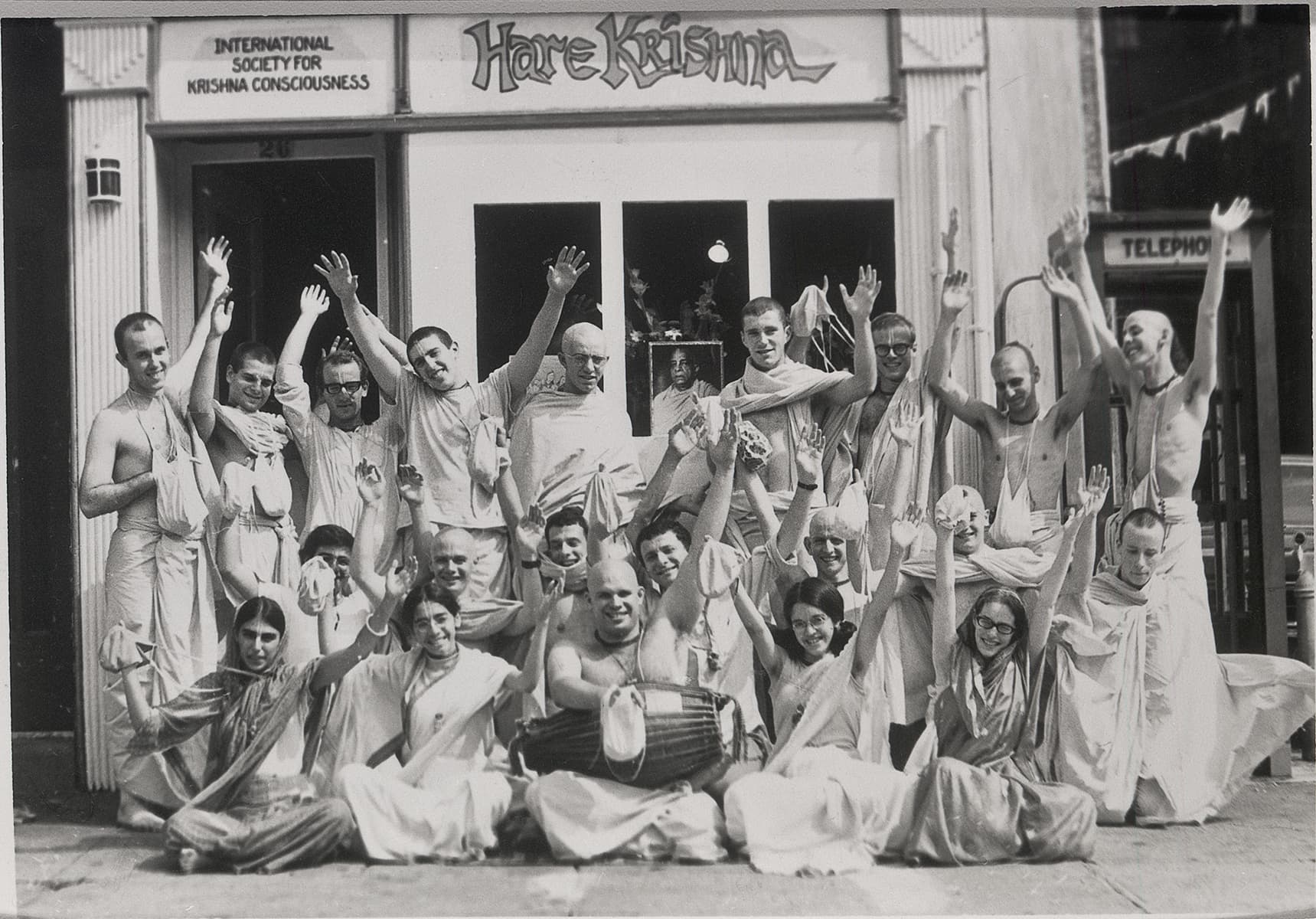
It has been interesting to see how this Hare Krishna Movement (ISKCON) has changed and developed since the early days. When this movement started it was like a family, a small family of dedicated devotees, with one scripture, one God (Krsna), one mantra (Hare Krishna, Hare Krishna, Krishna Krishna, Hare Hare, Hare Rama, Hare Rama, Rama Rama, Hare Hare), and one spiritual master (Srila Prabhupada). Then it became an International family with branches all around the world.
Now this society has become a huge movement, with new temples and congregations springing up all over the world, with different branches and camps, and so many new Spiritual Masters. It is inspiring to see the growth of this society, even though at times does not resemble the Original. What with the changes to our sacred books, and outside influences from all sides. It has created some division amongst our ranks. But there is one thing we can all agree on is, and I quote from the last paragraph from the introduction of the Bhagavad-gita:
“In this present day, man is very eager to have one scripture, one God, one religion, and one occupation. So let there be one common scripture for the whole world-Bhagavad-gītā. And let there be one God only for the whole world-Śrī Kṛṣṇa. And one mantra only-Hare Kṛṣṇa, Hare Kṛṣṇa, Kṛṣṇa Kṛṣṇa, Hare Hare/ Hare Rāma, Hare Rāma, Rāma Rāma, Hare Hare. And let there be one work only-the service of the Supreme Personality of Godhead.“
The Branches of the Caitanya Tree
Thus the branches of the Caitanya tree formed a cluster or society, with great branches covering all the universe. (Sri Caitanya-caritmrta Adi 9.18)
PURPORT
Our International Society for Krishna Consciousness is one of the branches of the Caitanya tree.
Śrī Caitanya Mahaprabhu was also the gardener, and as He poured the water of His mercy on the tree, all the branches and subbranches grew, day after day. (Adi 12.5)
The fruits of love of Godhead that grew on those branches of the Caitanya tree were so large that they flooded the entire world with love of Krsna. (Adi 12.6)
This morning as I was waking up, I was reminded that just yesterday, America and Israel declared war on Iran.
As much as I would like not to meditate on politics, it almost seems unavoidable, because it affects us all.
People are suffering, and starving and dying everyday in places like Ukraine, Gaza, Venezuela, Iran, and not to mention thousands of other places in the world.
It is too easy to just look away, and write it off as Karma.
As a devotee, I try to see this world through the lens of the Vedas, particularly the Bhagavad-gita and the Srimad Bhagavatam.
And I was thinking how different we all are, but connected as well; brothers and sisters, parents and children, friends and neighbors. All connected like drops of water in the ocean, or sparks from the same fire.
I went to the seventh chapter of the Bhagavad-gita, entitled “Knowledge of the Absolute”, in hopes of a better understanding of world events.
na māṁ duṣkṛtino mūḍhāḥ prapadyante narādhamāḥ māyayāpahṛta-jñānā āsuraṁ bhāvam āśritāḥ
na—not; mām—unto Me; duṣkṛtinaḥ—miscreants; mūḍhāḥ—foolish; prapadyante—surrender; narādhamāḥ—lowest among mankind; māyayā—by the illusory energy; apahṛta—stolen by illusion; jñānāḥ—knowledge; asuram—demonic; bhāvam—nature; āśritāḥ—accepting.
TRANSLATION
Those miscreants who are grossly foolish, lowest among mankind, whose knowledge is stolen by illusion, and who partake of the atheistic nature of demons, do not surrender unto Me. (Bg. 7.15)
When we speak of yoga we refer to linking up our consciousness with the Supreme Absolute Truth. Such a process is named differently by various practitioners in terms of the particular method adopted. When the linking up process is predominantly in fruitive activities, it is called karma-yoga, when it is predominantly empirical, it is called jñāna-yoga, and when it is predominantly in a devotional relationship with the Supreme Lord, it is called bhakti-yoga. Bhakti-yoga or Kṛṣṇa consciousness is the ultimate perfection of all yogas, as will be explained in the following verse.
And of all yogīs, he who always abides in Me with great faith, worshiping Me in transcendental loving service, is most intimately united with Me in yoga and is the highest of all. (Bhagavad-gita 6.47)
The culmination of all kinds of yoga practices lies in bhakti-yoga. All other yogas are but means to come to the point of bhakti in bhakti-yoga. Yoga actually means bhakti-yoga; all other yogas are progressions toward the destination of bhakti-yoga. From the beginning of karma-yoga to the end of bhakti-yoga is a long way to self-realization. Karma-yoga, without fruitive results, is the beginning of this path. When karma-yoga increases in knowledge and renunciation, the stage is called jñāna-yoga. When jñāna-yoga increases in meditation on the Supersoul by different physical processes, and the mind is on Him, it is called aṣṭāṅga-yoga. And, when one surpasses the aṣṭāṅga-yoga and comes to the point of the Supreme Personality of Godhead Kṛṣṇa, it is called bhakti-yoga, the culmination. Factually, bhakti-yoga is the ultimate goal, but to analyze bhakti-yoga minutely one has to understand these other yogas. The yogī who is progressive is therefore on the true path of eternal good fortune. One who sticks to a particular point and does not make further progress is called by that particular name: karma-yogī, jñāna-yogī or dhyāna-yogī, rāja-yogī, haṭha-yogī, etc. If one is fortunate enough to come to the point of bhakti-yoga, it is to be understood that he has surpassed all the other yogas. Therefore, to become Kṛṣṇa conscious is the highest stage of yoga, just as, when we speak of Himalayan, we refer to the world’s highest mountains, of which the highest peak, Mount Everest, is considered to be the culmination.
I have read and re-read this chapter many times this election year, and this is a perfect description on the demoniac man.
dambho darpo ’bhimānaś ca krodhaḥ pāruṣyam eva ca ajñānaṁ cābhijātasya pārtha sampadam āsurīm
dambhaḥ—pride; darpaḥ—arrogance; abhimānaḥ—conceit; ca—and; krodaḥ—anger; pāruṣyam—harshness; eva—certainly; ca—and; ajñānam—ignorance; ca—and; abhijātasya—one who is born; pārtha—O son of Pṛthā; sampadam—nature; āsurīm—demoniac.
Arrogance, pride, anger, conceit, harshness and ignorance—these qualities belong to those of demonic nature, O son of Pṛthā. (Bg 16.4)
In this verse, the royal road to hell is described. The demoniac want to make a show of religion and advancement in spiritual science, although they do not follow the principles. They are always arrogant or proud in possessing some type of education or so much wealth. They desire to be worshiped by others, and demand respectability, although they do not command respect. Over trifles they become very angry and speak harshly, not gently. They do not know what should be done and what should not be done. They do everything whimsically, according to their own desire, and they do not recognize any authority. These demoniac qualities are taken on by them from the beginning of their bodies in the wombs of their mothers, and as they grow they manifest all these inauspicious qualities. (From purport to Bg. 16.4)
The demoniac man knows no limit to his desire to acquire money. That is unlimited. He only thinks how much assessment he has just now and schemes to engage that stock of wealth farther and farther. For that reason, he does not hesitate to act in any sinful way and so deals in the black market for illegal gratification. He is enamoured by the possessions he has already, such as land, family, house and bank balance, and he is always planning to improve them…
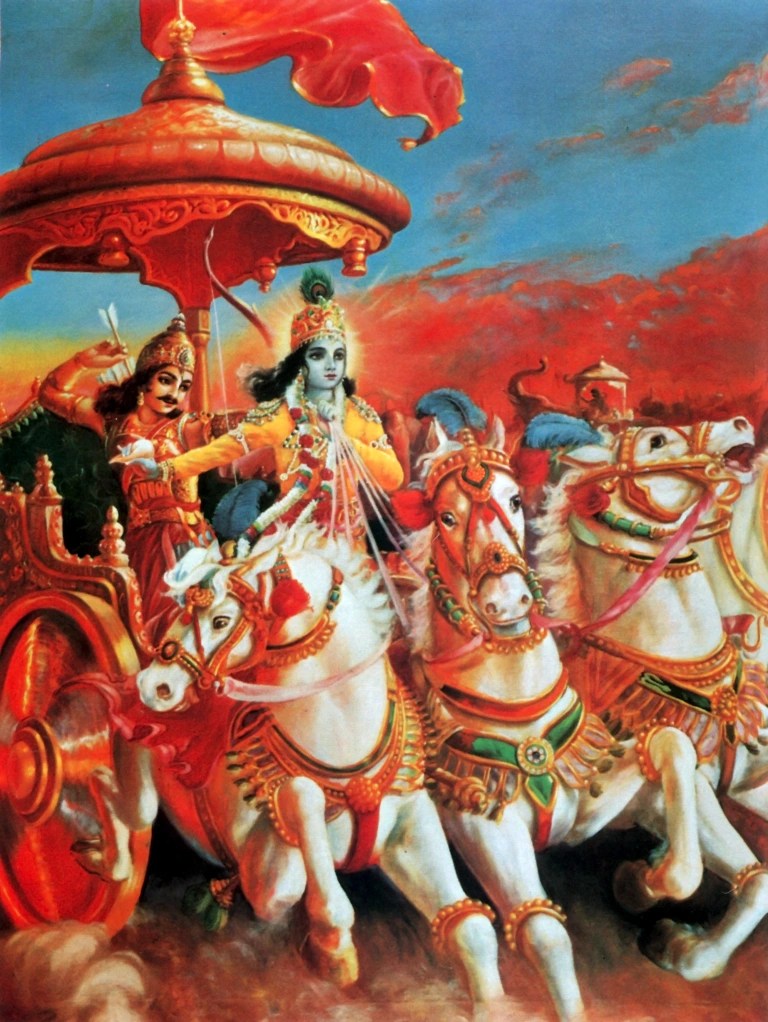
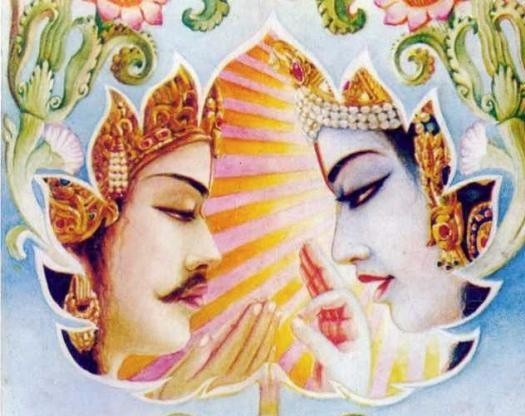
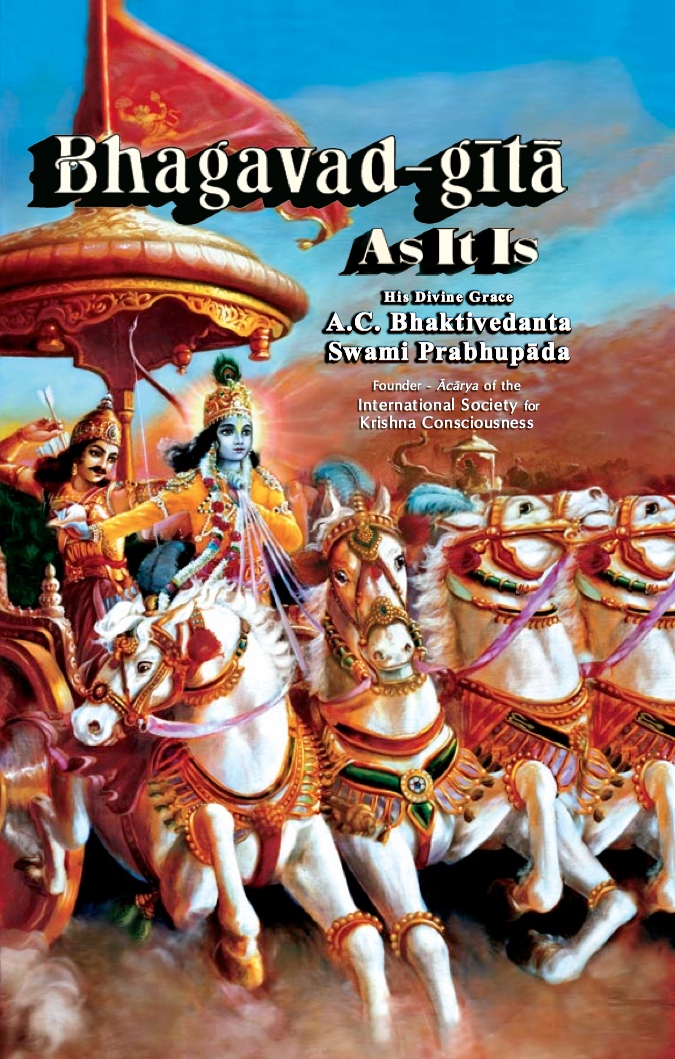
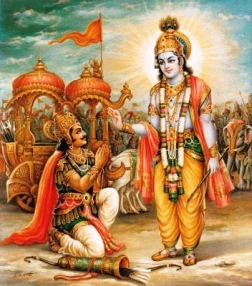
Whenever I think about the Bhagavad-gita, this image comes to mind. It is the “Song of God”, the words spoken by the Supreme Personality of Godhead to His dear friend and disciple Arjuna.
Bhagavad-gītā As It Is 1972 Edition By His Divine Grace A. C. Bhaktivedanta Swami Prabhupāda Chapter Ten, Text 12-13
Arjuna said: You are the Supreme Brahman, the ultimate, the supreme abode and purifier, the Absolute Truth and the eternal divine person. You are the primal God, transcendental and original, and You are the unborn and all-pervading beauty. All the great sages such as Nārada, Asita, Devala, and Vyāsa proclaim this of You, and now You Yourself are declaring it to me.
PURPORT
In these two verses the Supreme Lord gives a chance to the modern philosopher, for here it is clear that the Supreme is different from the individual soul. Arjuna, after hearing the essential four verses of Bhagavad-gītā in this chapter, became completely free from all doubts and accepted Kṛṣṇa as the Supreme Personality of Godhead. He at once boldly declares, “You are Parambrahma, the Supreme Personality of Godhead.” And previously Kṛṣṇa states that He is the originator of everything and everyone. Every demigod and every human being is dependant on Him. Men and demigods, out of ignorance, think that they are absolute and independant of the Supreme Lord Kṛṣṇa. That ignorance is removed perfectly by the discharge of devotional service. This is already explained in the previous verse by the Lord. Now by His grace, Arjuna is accepting Him as the Supreme Truth, in concordance with the Vedic injunction. It is not because Kṛṣṇa is an intimate friend of Arjuna that he is flattering Him by calling Him the Supreme Personality of Godhead, the Absolute Truth. Whatever Arjuna says in these two verses is confirmed by Vedic truth. Vedic injunctions affirm that only one who takes to devotional service to the Supreme Lord can understand Him, whereas others cannot. Each and every word of this verse spoken by Arjuna is confirmed by Vedic injunction.
People often think that The Hare Krishna Movement (ISKCON) is a Hindu Religion, but it is not. Sometime back in 1968, one reporter asked Srila Prabhupada, “What is this Hare Krishna Movement?”. Srila Prabhupada replied: “We are not a buissness , we are not a Religion”.
…I am not very interested to establish a Hindu temple. Perhaps you know from the very beginning I never described my movement as Hindu religion. Religion means the bona fide process by which we understand God and the first class religion is that which teaches people to develop love for God. To know or accept the authority of God is one thing, but to love God is another. Generally, people are interested in material comforts and they make God as the supplying agent. This kind of devotion is not purified. It is contaminated by material desires, but when one is elevated to the position of giving everything to God out of love and affection, that is the first class position. We are teaching this philosophy in the name of Krishna Consciousness, and it is applicable to all sober persons. The Bhagavat principle is that because we can be happy simply by developing our dormant love of God, this is our first business. (Letter to: Mukunda June 3, 1969)
In the eighteenth Chapter of Bhagavad-gita, Lord Krishna in conclusion states:
Abandon all varieties of religion and just surrender unto Me. I shall deliver you from all sinful reaction. Do not fear. (Bg 18.66)
PURPORT
The Lord has described various kinds of knowledge, processes of religion, knowledge of the Supreme Brahman, knowledge of the Supersoul, knowledge of the different types of orders and statuses of social life, knowledge of the renounced order of life, knowledge of nonattachment, sense and mind control, meditation, etc. He has described in so many ways different types of religion. Now, in summarizing Bhagavad-gītā, the Lord says that Arjuna should give up all the processes that have been explained to him; he should simply surrender to Kṛṣṇa. That surrender will save him from all kinds of sinful reactions, for the Lord personally promises to protect him.
…Sometimes an ever-liberated personal associate of the Supreme Personality of Godhead descends into this universe just as the Lord descends. Although working for the liberation of conditioned souls, the messenger of the Supreme Lord remains untouched by the material energy. Generally ever-liberated personalities live in the spiritual world as associates of Lord Kṛṣṇa, and they are known as kṛṣṇa-pāriṣada, associates of the Lord. Their only business is enjoying Lord Kṛṣṇa’s company, and even though such eternally liberated persons come within this material world to serve the Lord’s purpose, they enjoy Lord Kṛṣṇa’s company without stoppage. The ever-liberated person who works on Kṛṣṇa’s behalf enjoys Lord Kṛṣṇa’s company through his engagement.
… The conditioned soul subjected to the threefold material miseries is ceaselessly kicked by māyā, and this is his disease. If by chance he meets a saintly person who works on Kṛṣṇa’s behalf to deliver conditioned souls, and if he agrees to abide by his order, he can gradually approach the Supreme Personality of Godhead, Kṛṣṇa.(from purport to Madhya-lila 22.14-15)
O son of Kuntī [Arjuna], I am the taste of water, the light of the sun and the moon, the syllable om in the Vedic mantras; I am the sound in ether and ability in man.(Bg 7.8)
“Water is our life. So when you take water, quench your thirst, you can immediately thank God because that taste is God. So immediately you can remember, “O my dear Lord, You have created so nice thing, water. Oh, I am so thirsty. It is quenching my thirst. Thank You.” Is it very difficult? But the nonsense, they will not do even this. They’ll say, “Oh, God is dead.” Therefore we are suffering. We are so ungrateful that we even do not give thanks. In the ordinary way, if somebody gives me a glass of water when I am thirsty—it is etiquette—I say, “Thank you.” And God has given us so vast mass of water in the ocean, in the sea, in the sky. Without water we cannot live. There is no thanksgiving. There is no thanksgiving.” (Śrīla Prabhupāda, 68/08/20 – Lecture SB 07.09.12-13 – Montreal)
Thank you to whoever posted this on Facebook. I didn’t catch the name of person posting this, but this is real good!
THE BHAGAVAD GITA IN TEN POINTS On July 13, 1947 Srila Prabhupada wrote a letter to Raja Mohendra Pratap and explained the Bhagavad-gita to him in ten points. The following is Srila Prabhupada’s summary of ten conclusions in the Bhagavad-gita.
1) God is one and everything is in Him and He is in everything.
2) To render transcendental service unto God is to serve everything that be, just like to water the root of the tree is to water the different branches and numerous leaves of the tree or to supply food to the stomach is to vitalize all the senses and the sense organs of the body.
3) The parts are automatically served when the Whole is served but when the parts are served the whole may not be served or not served at all.
4) The parts and the Whole being eternally related, it is the eternal duty of the parts to render service unto the Whole.
5) A recipient of the services of the parts, God’s sat-cit-ananda vigraha, i.e., the all-attractive Cognizant and all-blissful Personality eternal. He can reveal Himself by His own potency without any help of the external potency called maya in order to be cognizable by the limited potency of the parts and as such He is not only the greatest of all but he is the smallest of all. That is His prerogative.
6) He is better realized when He by His causeless mercy agrees to descend in this mortal world but He is never realized by the partial speculations of the empiric philosophers, however systematic and long-termed it may be.
7) Sri Krishna is the Personality of Godhead and is the Summum Bonum Cause of all Causes proved by fact and figures in the statement of Bhagavad-gita, but He reserves the right of not being exposed to the sensual speculations of the empiric philosophers.
One should therefore surrender unto Him if one wants to know Him as He is and that is the real process to approach the Infinite by the infinitesimals.
9) Sri Krishna is easily available by the religion of love, i.e., by love and service as conceived by the damsels of Vraja who had practically no education whatsoever and much less any claim for high class birthright.
10) The highest service that can be rendered to the mankind is, therefore, to preach the philosophy and religion of Bhagavad-gita for all the times, all the places and all the people.
Happy New Year to all are readers. Wishing you all a prosperous new year filled with happiness and love. And may your Krishna Consciousness increase with each passing day.
When I think of New Years, I am reminded of what a short time a year is in the greater scheme of eternity. In the Bhagavad-gita there is a brief description of the duration of time in the material universe.
…The duration of the material universe is limited. It is manifested in cycles of kalpas. A kalpa is a day of Brahmā, and one day of Brahmā consists of a thousand cycles of four yugas or ages: Satya, Tretā, Dvāpara, and Kali. The cycle of Satya is characterized by virtue, wisdom and religion, there being practically no ignorance and vice, and the yuga lasts 1,728,000 years. In the Tretā-yuga vice is introduced, and this yuga lasts 1,296,000 years. In the Dvāpara-yuga there is an even greater decline in virtue and religion, vice increasing, and this yuga lasts 864,000 years. And finally in Kali-yuga (the yuga we have now been experiencing over the past 5,000 years) there is an abundance of strife, ignorance, irreligion and vice, true virtue being practically nonexistent, and this yuga lasts 432,000 years. (from purport Bg 8.17)
Even if I could grasp the extent of time in the material universe, that is just a fraction of the unlimited eternal time that continues after the termination of the yuga.
…Then the process is set rolling again. These four yugas, rotating a thousand times, comprise one day of Brahmā, the creator god, and the same number comprise one night. Brahmā lives one hundred of such “years” and then dies. These “hundred years” by earth calculations total to 311 trillion and 40 million earth years. By these calculations the life of Brahmā seems fantastic and interminable, but from the viewpoint of eternity it is as brief as a lightning flash. In the causal ocean there are innumerable Brahmās rising and disappearing like bubbles in the Atlantic. Brahmā and his creation are all part of the material universe, and therefore they are in constant flux. (from purport Bg 8.17)
The above calculations Srila Prabhupada uses and I quote;
…seems fantastic and interminable, but from the viewpoint of eternity it is as brief as a lightning flash.
Earliest Recording of Srila Prabhupada in the Bhaktivedanta Archives
Its interesting to note that this lecture also became the Introduction to Bhagavad-gita As It Is
Prabhupāda:
om ajnana-timirandhasya jnananjana-salakaya caksur unmilitam yena tasmai sri-gurave namah
sri-caitanya-mano-‘bhistam sthapitum yena bhtu-tale svayam rupah kada mahyam dadati sva-padantikam
vande ‘ham sri-guroh sri-yuta-pada-kamalam sri-gurun vaisnavams’ ca sri-rupam sagrajatam saha-gana-raghunathanvitam tam sa jivam sadvaitam savadhutam parijana-sahitam krsna-caitanya-devam sri-radha-krsna-padan saha-gana-lalita-sri-visakhanvitams’ ca
he krsna karuna-sindho dina-bandho jagat-pate gopesa gopika kanta radha-kanta namo ‘stu te
Hare Krishna, Hare Krishna Krishna Krishna, Hare Hare Hare Rama, Hare Rama Rama Rama, Hare Hare
Bhagavad-gītā is known also Gītopaniṣad, the essence of Vedic knowledge, and one of the most important of the various Upaniṣads in Vedic literature. This Bhagavad-gītā, there are many commentations in English, and what is the necessity of another English commentation of the Bhagavad-gītā can be explained in the following way. One . . .
(break) One American lady, Mrs. Charlotte Leblanc, asked me to recommend an English edition of Bhagavad-gītā which she can read.
Of course, in America there are so many editions of English Bhagavad-gītā, but so far I have seen them, not only in America but also India, none of them can be said strictly as authoritative, because almost every one of them have expressed their own opinion through the commentation of the Bhagavad-gītā without touching the spirit of Bhagavad-gītā As It Is.
The spirit of Bhagavad-gītā is mentioned in the Bhagavad-gītā itself. It is just like this—if we want to take a particular medicine, then we have to follow the particular direction mentioned on the label of the medicine. We cannot take the particular medicine according to our own direction or by the direction of a friend, but we have to take the medicine under the direction given on the label of the bottle and as directed by the physician. Similarly, the Bhagavad-gītā also should be taken or accepted as it is directed by the speaker Himself.
In the following conversation, taped at George’s home in England on September 4, 1982, George reveals some memorable experiences he has had chanting Hare Krishna and describes in detail his deep personal realizations about the chanting. He reveals what factors led him to produce “The Hare Krishna Mantra” record, “My Sweet Lord,” and the LPs All Things Must Pass and Living in the Material World, which were all influenced to a great extent by the Hare Krishna chanting and philosophy. He speaks lovingly and openly about his association with His Divine Grace A. C. Bhaktivedanta Swami Prabhupada, Founder-Acarya (spiritual master) of the Hare Krishna movement. In the following interview George speaks frankly about his personal philosophy regarding the Hare Krishna movement, music, yoga, reincarnation, karma, the soul, God, and Christianity. The conversation concludes with his fond remembrances of a visit to the birthplace of Lord Krishna in Vrndavana, India, home of the Hare Krishna mantra, and with George discussing some of his celebrity friends’ involvement with the mantra now heard and chanted around the world.
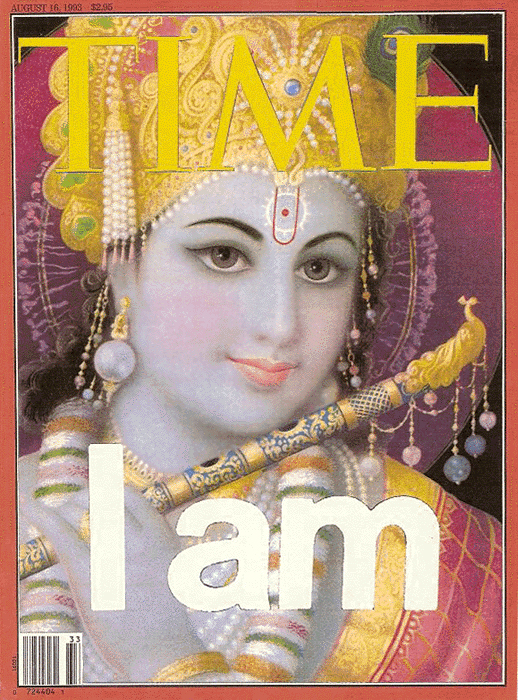
I remember back many years ago, when I was a new devotee traveling with the RDTSP, we attended a Rainbow Festival in Oregon. There were many hippy type personalities, and aspiring spiritualists, and I meet this one man, who looked like Jesus, with long hair and sandals, with a sign around his neck that said, “I Am God”.
So I said to him, “If you are God, then show me your Universal Form”. It was stunned silence. He could not reply. I guess maybe he wasn’t God after all. Or I didn’t have the divine vision to see. But either way, he wasn’t still wearing the sign at the end of the day.
O greatest of all personalities, O supreme form, though I see here before me Your actual position, I yet wish to see how You have entered into this cosmic manifestation. I want to see that form of Yours. (Bg. 11. 3)
If You think that I am able to behold Your cosmic form, O my Lord, O master of all mystic power, then kindly show me that universal self. (Bg 11 .4)
The Blessed Lord said: My dear Arjuna, O son of Pṛthā, behold now My opulences, hundreds of thousands of varied divine forms, multicolored like the sea. (Bg 11. 5)
But you cannot see Me with your present eyes. Therefore I give to you divine eyes by which you can behold My mystic opulence. (Bg. 11. 8)
Arjuna saw in that universal form unlimited mouths and unlimited eyes. It was all wondrous. The form was decorated with divine, dazzling ornaments and arrayed in many garbs. He was garlanded gloriously, and there were many scents smeared over His body. All was magnificent, all-expanding, unlimited. This was seen by Arjuna. (Bg 11. 10-11
Here is another word for your vaisnava vocabulary; Acaryopasanam.
In Bhagavad-gita, Thirteenth Chapter, it is clearly stated that one should execute devotional service and advance on the path of spiritual knowledge by accepting the acarya.Ācāryopāsanam: one should worship an acarya, a spiritual master who knows things as they are. The spiritual master must be in the disciplic succession from Krsna. (from purport SB 3.29.17)
We can understand from Srila Prabhupada, that there are huge gaps in the disciplic succession, but we need to follow the prominent Acarya.
“So these gaps do not hamper from understanding the parampara system. We have to pick up the Prominent Acarya, and follow from him.” (letter to Dayananda April12,1968)
”One cleanses himself daily by taking a bath in water, but one who takes his bath only once in the sacred Ganges water of the Bhagavad-gita cleanses away all the dirt of material life. Because Bhagavad-gita is spoken by the Supreme Personality of Godhead, one need not read any other Vedic literature. One need only attentively and regularly hear and read Bhagavad-gita.
In the present age, mankind is so absorbed with mundane activities that it is not possible to read all of the Vedic literatures. But this is not necessary. This one book, Bhagavad-gita, will suffice because it is the essence of all Vedic literatures and because it is spoken by the Supreme Personality of Godhead.
It is said that one who drinks the water of the Ganges certainly gets salvation, but what to speak of one who drinks the waters of Bhagavad-gita? Gita is the very nectar of the Mahabharata spoken by Visnu Himself, for Lord Krsna is the original Visnu. It is nectar emanating from the mouth of the Supreme Personality of Godhead, and the Ganges is said to be emanating from the lotus feet of the Lord. Of course there is no difference between the mouth and the feet of the Supreme Lord, but in our position we can appreciate that the Bhagavad-gita is even more important than the Ganges.
The Bhagavad-gita is just like a cow, and Lord Krsna, who is a cowherd boy, is milking this cow. The milk is the essence of the Vedas, and Arjuna is just like a calf. The wise men, the great sages and pure devotees, are to drink the nectarean milk of Bhagavad-gita.
In this present day, man is very eager to have one scripture, one God, one religion, and one occupation. So let there be one common scripture for the whole world–Bhagavad-gita. And let there be one God only for the whole world–Sri Krsna. And one mantra only–Hare Krsna, Hare Krsna, Krsna Krsna, Hare Hare/ Hare Rama, Hare Rama, Rama Rama, Hare Hare. And let there be one work only–the service of the Supreme Personality of Godhead.” (Bhagavad-gītā Introduction)
Some years ago I put the complete Original 1972 Bhagavad-gita “As It Is” by His Divine Grace A. C. Bhaktivedanta Swami online. You can click on link prabhupada.gita to visit. I find it is a quick and easy site for reference to all your favorite chapters and slokas.
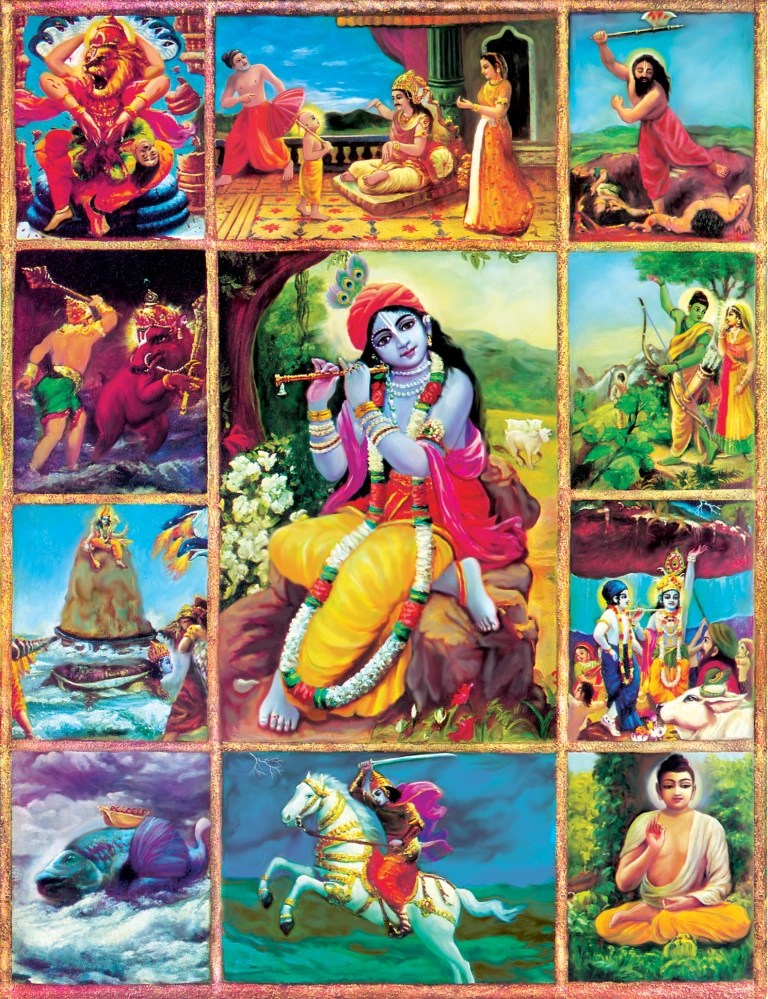
From upper left-hand corner: Lord Nrsimhadeva, the man-lion incarnation; Lord Vamana, the dwarf-brahmana incarnation; Lord Parasurama, the warrior incarnation; Lord Ramacandra; Lord Krishna and Lord Balarama; Lord Buddha; Lord Kalki, who destroys all demons at the end of the millennium; Lord Matsya, the fish incarnation; Lord Kurma, the tortoise incarnation; and Lord Varaha, the boar incarnation.
This morning my attention was drawn to the forth chapter of the Bhagavad-gita “As It Is” entitled Transcendental Knowledge. I just opened the book at random and this was the verse I saw…
Whenever and wherever there is a decline in religious practice, O descendant of Bharata, and a predominant rise of irreligion—at that time I descend Myself. (Bg. 4.7)
In order to deliver the pious and to annihilate the miscreants, as well as to reestablish the principles of religion, I advent Myself millennium after millennium. (Bg. 4.8)
Lord Krsna appears in every millennium, in various incarnations, to annihilate the demons, protect the devotees and reestablish the principles of religion.










 The Hare Krishna Movement