01 Apr 2013
by The Hare Krishna Movement
in A.C. Bhaktivedanta Swami Prabhupada, Bob Cohen, KrishnaPath.org, Letters by Srila Prabhupada, Perfect Answers Perfect Questions
Tags: A.C. Bhaktivedanta Swami Prabhupada, Atreya Rsi das, Bob Cohen, krsna consciousness, perfect questions perfect answers, Srila Prabhupada

Continuing with our series of a True account entitled Perfect Questions, Perfect Answers… A search for meaning carries Bob Cohen, a young American Peace Corps worker halfway around the world, to an ancient village in the midst of West Bengal. There, in a small bamboo hut, he finds a teacher who is able to tell him everything he ever wanted to know.
Perfect Questions, Perfect Answers
By His Divine Grace A. C. Bhaktivedanta Swami Prabhupāda
Chapter Eight
Advancing in Kṛṣṇa Consciousness
(an exchange of letters)
More
31 Mar 2013
by The Hare Krishna Movement
in A.C. Bhaktivedanta Swami Prabhupada, Jesus Christ
Tags: A.C. Bhaktivedanta Swami Prabhupada, Christian, compassion, crucified, Easter Sunday, Father forgive them, God consciousness, guru, Jesus, Jesus Christ, Lord Jisus Christ, spiritual master, tolerance

Today as most of the Western World celebrates Easter Sunday, we thought we word honor the life of Lord Jesus Christ with some select writings by our spiritual master A.C. Bhaktivedanta Swami Prabhupada.
The Śrīmad-Bhāgavatam states that any bona fide preacher of God consciousness must have the qualities of titikṣā (tolerance) and karuṇā (compassion). In the character of Lord Jesus Christ we find both these qualities. He was so tolerant that even while he was being crucified, he didn’t condemn anyone. And he was so compassionate that he prayed to God to forgive the very persons who were trying to kill him. (Of course, they could not actually kill him. But they were thinking that he could be killed, so they were committing a great offense.) As Christ was being crucified he prayed, “Father, forgive them. They know not what they are doing.”
…Of course, the message that Christ preached was just according to his particular time, place, and country, and just suited for a particular group of people. But certainly he is the representative of God. Therefore we adore Lord Jesus Christ and offer our obeisances to him.
Once, in Melbourne, a group of Christian ministers came to visit me. They asked, “What is your idea of Jesus Christ?” I told them, “He is our guru. He is preaching God consciousness, so he is our spiritual master.” The ministers very much appreciated that.
Actually, anyone who is preaching God’s glories must be accepted as a guru. Jesus Christ is one such great personality. We should not think of him as an ordinary human being. The scriptures say that anyone who considers the spiritual master to be an ordinary man has a hellish mentality. If Jesus Christ were an ordinary man, then he could not have delivered God consciousness. (Science of Self Realization, Chapter 4, “Understanding Krsna and Christ)
Full Chapter More
30 Mar 2013
by The Hare Krishna Movement
in A.C. Bhaktivedanta Swami Prabhupada, Gopis, Krsna Consciousness, KRSNA The Supreme Personality of Godhead, Spiritual World
Tags: A.C. Bhaktivedanta Swami Prabhupada, bank of the Yamuna, disciplic succession, Durga, goddess durga, goddess katyayani, gopi girls, gopis, Katyayani, Krsna, Lord Caitanya, Stealing the Garments of the Unmarried Gopi Girls, The Supreme Personality of Godhead, unmarried girsl, Vrndavana, Yamuna

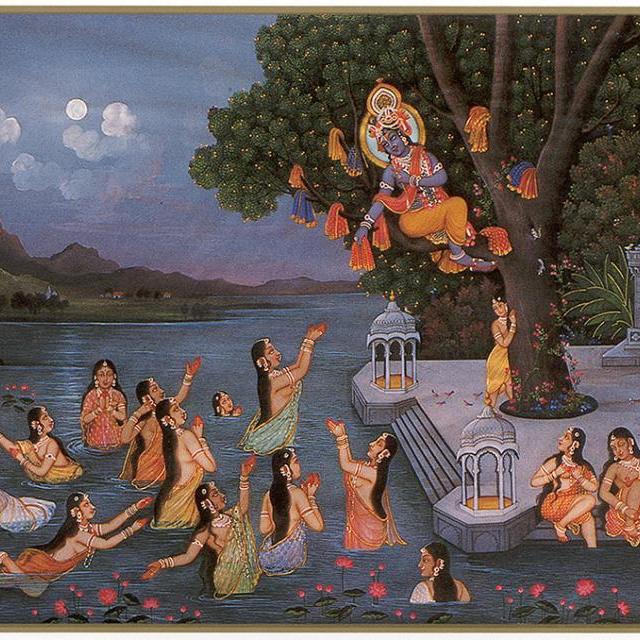
…The unmarried gopīs used to prepare the deity of goddess Durgā and worship it with candana pulp, garlands, incense lamps and all kinds of presentations-fruits, grains and twigs of plants. After worshiping, it is the custom to pray for some benediction. The unmarried girls used to pray with great devotion to goddess Kātyāyanī, addressing her as follows: “O supreme eternal energy of the Personality of Godhead, O supreme mystic power, O supreme controller of this material world, O goddess, please be kind to us and arrange for our marriage with the son of Nanda Mahārāja, Kṛṣṇa.”
…Early in the morning, the gopīs used to go to the bank of the Yamunā to take bath. They would assemble together, capturing each other’s hands, and loudly sing of the wonderful pastimes of Kṛṣṇa. It is an old system among Indian girls and women that when they take bath in the river they place their garments on the bank and dip into the water completely naked. The portion of the river where the girls and women take bath was strictly prohibited to any male member, and this is still the system. The Supreme Personality of Godhead, knowing the minds of the unmarried young gopīs, benedicted them with their desired objective. They had prayed for Kṛṣṇa to become their husband, and Kṛṣṇa wanted to fulfill their desires.
More
28 Mar 2013
by The Hare Krishna Movement
in A.C. Bhaktivedanta Swami Prabhupada, Cow Protection, Quotes by Srila Prabhupada, Vegetarianism
Tags: A.C. Bhaktivedanta Swami Prabhupada, bhagavad-gita, cow protection, cow slaughter, cows milk, Kali-yuga, Krishna, meat-eating, miracle food milk, namo brahmanya-devaya, vegetarianism

click on image to enlarge
We compiled a few select quotes from Srila Prabhupada stressing the importance of the miracle food milk, and cow protection which is real advancement of civilization, and will help save humanity from the greatest danger.
…cow protection is essential. There is a miracle in milk, for it contains all the necessary vitamins to sustain human physiological conditions for higher achievements. (Srimad Bhagavatam 1.16.4 Purport)
…The cow is the most important animal for developing the human body to perfection. The body can be maintained by any kind of foodstuff, but cow’s milk is particularly essential for developing the finer tissues of the human brain so that one can understand the intricacies of transcendental knowledge. A civilized man is expected to live on foodstuffs comprising fruits, vegetables, grains, sugar and milk. The bull helps in the agricultural process of producing grain, etc., and thus in one sense the bull is the father of humankind, whereas the cow is the mother, for she supplies milk to human society. A civilized man is therefore expected to give all protection to the bulls and cows. (Srimad Bhagavatam 3.5.7 Purport)
…Milk is compared to nectar, which one can drink to become immortal. Of course, simply drinking milk will not make one immortal, but it can increase the duration of one’s life. In modern civilization, men do not think milk to be important, and therefore they do not live very long. Although in this age men can live up to one hundred years, their duration of life is reduced because they do not drink large quantities of milk. This is a sign of Kali-yuga. In Kali-yuga, instead of drinking milk, people prefer to slaughter an animal and eat its flesh. The Supreme Personality of Godhead, in His instructions of Bhagavad-gītā, advises go-rakṣya, which means cow protection. The cow should be protected, milk should be drawn from the cows, and this milk should be prepared in various ways. One should take ample milk, and thus one can prolong one’s life, develop his brain, execute devotional service, and ultimately attain the favor of the Supreme Personality of Godhead. (Srimad Bhagavatam 8.6.12 Purport)
More
28 Mar 2013
by The Hare Krishna Movement
in A.C. Bhaktivedanta Swami Prabhupada, Devotional Service, Teachings of Lord Chaitanya
Tags: A.C. Bhaktivedanta Swami Prabhupada, bhakti, Caitanya Mahaprabhu, devotee, devotional service, fruitive activities, meditation, meditational yoga, perfect stage of devotion, philosophical speculation, speculative knowledge, Teachings of Lord Chaitanya, Vedic literature

Teachings of Lord Caitanya
By His Divine Grace A. C. Bhaktivedanta Swami Prabhupāda
Chapter Five
How to Approach God
Actually all Vedic literature directs the human being toward the perfect stage of devotion. The paths of fruitive activities, speculative knowledge and meditation do not lead one to the perfectional stage, but by the process of devotional service the Lord actually becomes approachable. Therefore all Vedic literature recommends that one accept this process. In this regard, Caitanya Mahāprabhu quoted from the Lord’s instructions to Uddhava in Śrīmad-Bhāgavatam:
na sādhayati māṁ yogo
na sāṅkhyaṁ dharma uddhava
na svādhyāyas tapas tyāgo
yathā bhaktir mamorjitā
“My dear Uddhava, neither philosophical speculation, nor meditational yoga, nor penances can give Me such pleasure as devotional service practiced by the living entities.” (Bhāg. 11.14.20)
More
27 Mar 2013
by The Hare Krishna Movement
in A.C. Bhaktivedanta Swami Prabhupada, Caitanya Mahaprabhu, Festivals, Gaura Purnima, Lectures
Tags: A.C. Bhaktivedanta Swami Prabhupada, appearance day of Sri Caitanya, devotee, Gaura Purnima, His Divine Grace Srila Prabhupada, Kali-yuga, Krishna, Krsna, Lord Caitianya, Mayapur, Sri Caitanya Mahaprabhu, Sri Gaura Purnima, sri-krsna-caitanya radha-krsna nahe anya, tri-yuga

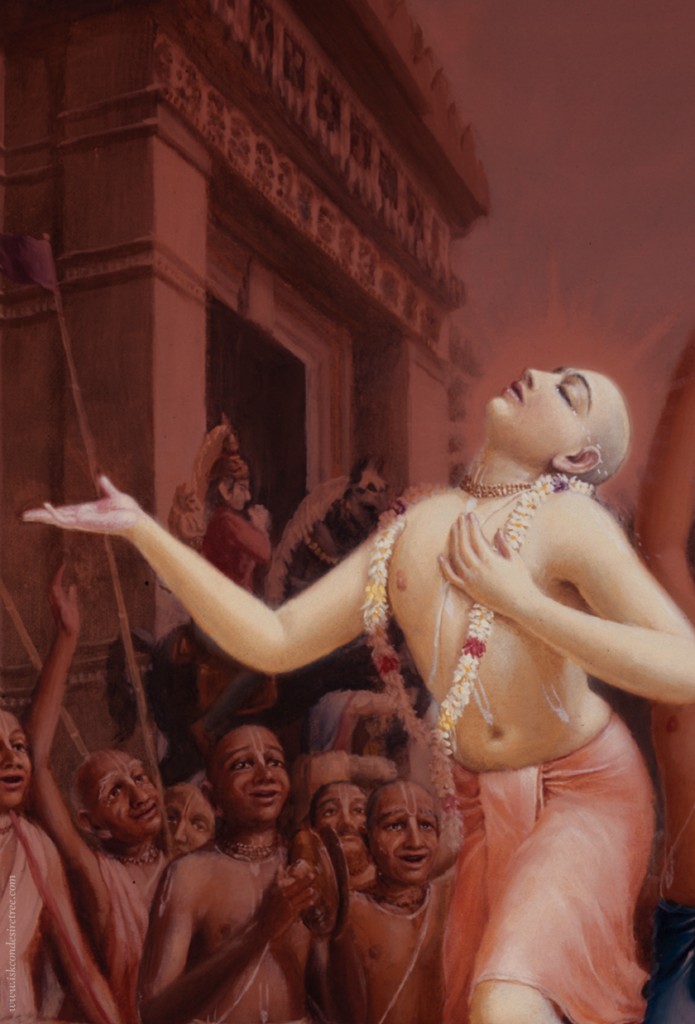
Today as most of the world celebrates Gaura Purnima, (Appearance day of Śrī Caitanya Mahāprabhu), I was reminded of a lecture given by His Divine Grace Srila Prabhupada on Gaura Purnima in Mayapur, India, March 16th, 1976. So with pleasure we are posting this famous Gaura Purnima lecture in its entirety.
Prabhupāda:…Śrī Caitanya Mahāprabhu is the Supreme Personality of Godhead, Kṛṣṇa. Śrī-kṛṣṇa-caitanya rādhā-kṛṣṇa nahe anya. You are worshiping Rādhā-Kṛṣṇa, and there is Caitanya Mahāprabhu’s Deity also. There are some parties, they protest, “Why Caitanya Mahāprabhu’s Deity should be placed along with Kṛṣṇa?” But they do not know śrī-kṛṣṇa-caitanya rādhā-kṛṣṇa nahe anya. It is not different. So Śrī Kṛṣṇa Caitanya is Kṛṣṇa. It is confirmed by the śāstras. Here it is said, channaḥ kalau yad abhava. In the Kali-yuga, directly He does not appear as the incarnation like Nṛsiṁhadeva or Vāmanadeva or Lord Rāmacandra, yes, but as devotee. So He’s the same incarnation, Lord Caitanya Mahāprabhu. Abhavat. “Therefore sometimes You are called as tri-yuga.” There are four yugas, but He is known… Because in three yugas He appears distinctly, and in the fourth yuga, the Kali-yuga, as devotee, therefore He’s called tri-yuga. So today is the birthday or appearance day of Śrī Caitanya Mahāprabhu, and this is the birthplace, this Māyāpura, and you are all present here. It is a good fortune. Always remember Śrī Caitanya Mahāprabhu and chant śrī-kṛṣṇa-caitanya prabhu-nityānanda…
Devotees: …śrī-advaita gadādhara śrīvāsādi-gaura-bhakta-vṛnda.
Prabhupāda: This will make your life perfect.
Full Lecture More
26 Mar 2013
by The Hare Krishna Movement
in A.C. Bhaktivedanta Swami Prabhupada, Caitanya Mahaprabhu, Narottama das Thakur, Sri Krsna Caitanya Prabhu
Tags: A.C. Bhaktivedanta Swami Prabhupada, disciplic succession, Krishna, krsna consciousness, Lord Caitanya, Narottama Dasa, Narottama Dasa Thakura, six gosvamis, Sri Krsna Caitanya Prabhu, Srinivasa Acarya
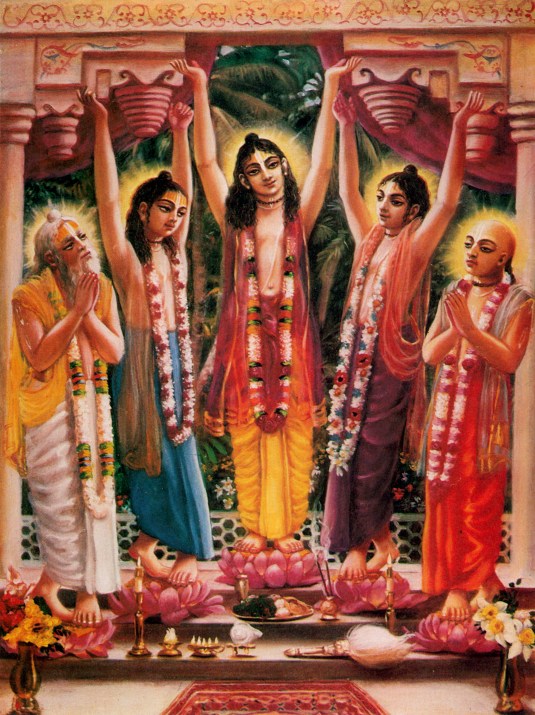
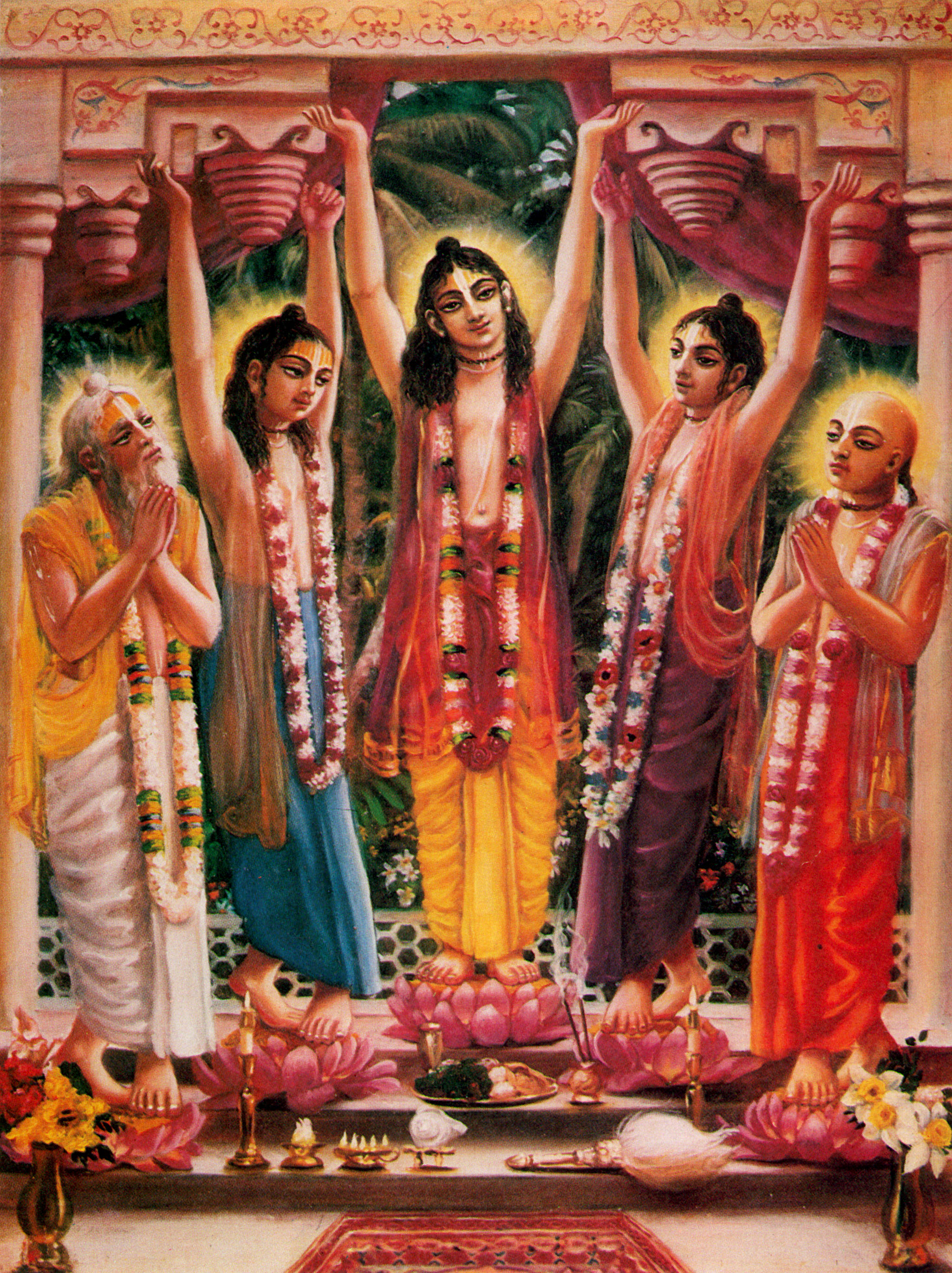
For Gaura Purnima, or the Appearance Celebration of Sri Caitanya Mahaprabhu, we are pleased to post one of our favorite songs from the “Songs of the Vaisnava Acaryas”, along with a purport by Srila Prabhupada, to honor this auspicious event.
…”My dear Lord, please be merciful to me, because who can be more merciful than Your Lordship within these three worlds?” Actually, this is a fact. Not only Narottama Dasa Thakura but Rupa Gosvami also prayed to Lord Caitanya in this way. At the time of the first meeting of Lord Caitanya and Rupa Gosvami at Prayaga (Allahabad), Srila Rupa Gosvami said, “My dear Lord, You are the most munificent of all incarnations, because You are distributing love of Krsna, Krsna consciousness.” When Krsna was personally present He simply asked us to surrender, but He did not distribute Himself so easily. He made conditions–“First of all you surrender.” But this incarnation, Lord Caitanya, although Krsna Himself, makes no such condition. He simply distributes: “Take love of Krsna.” Therefore Lord Caitanya is approved as the most munificent incarnation…(From Purport to song)
Full Song with Translation and Purport More
23 Mar 2013
by The Hare Krishna Movement
in A.C. Bhaktivedanta Swami Prabhupada, Bhagavad-gita, Book Changes, Books by Srila Prabhupada, Rupanuga das, The Hare Krishna Movement
Tags: A.C. Bhaktivedanta Swami Prabhupada, Bali Mardan, BBT, BBT Trustee, bhagavad-gita, Bhagavan das, hansadutta das, Harikesa das, Lord Caitanya, MacMillan Bhagavad-gita, Ramesvara das, Rascal editors, Rupanuga das, Sampradaya sun, Srila Prabhupada

This is a very nice article written by Sriman Rupanuga Prabhu, that I found on the Sampradaya Sun this morning. It gives us some more information of the history of the Srila Prabhupada’s Bhagavad-gita As It Is, 1972 Macmillan Edition, and the changes that have transpired since. Very informative!
…That new Gita was to prove big and heavy and only so many could be crammed into a bookbag, but people were to become immediately attracted to the gorgeous, colorful paintings; besides, where could they find such a book with so many color illustrations, and for how much? It was Srila Prabhupada’s transcendent genius to conceive of such a way to reveal to people the deepest philosophy and the highest truths comprehensible to human beings. No other volume of supposed philosophical content could compare to that Gita, decorated as it was with paintings allowing a view of the Spiritual Sky. Along with Prasadam, those paintings were Srila Prabhupada’s secret weapons.
…To reiterate, after examining and rejecting new paintings for the Krsna Book, Srila Prabhupada formulated the following instructions for paintings in his books:
“If a painting is to be replaced it must be the exact same pastime, same scene, but better technically; to take out an approved painting and replace it with a different one was not allowed; and a painting may be added but there is no question of removing anything.”
In other words, Srila Prabhupada was explaining that if he were to replace a painting as they were proposing, it would be only with a better painting technically, with the same scene. But once approved by him, a painting could not be replaced; but more, bona fide paintings could be added. The conclusion is that paintings personally approved by Srila Prabhupada were not to be changed or replaced then, or in the future. It’s noteworthy that he strongly resisted replacing illustrations or paintings he had previously approved, and often took the time to demonstrate how proposed replacement or additions were misconceived.
More
21 Mar 2013
by The Hare Krishna Movement
in A.C. Bhaktivedanta Swami Prabhupada, Caitanya Mahaprabhu, Krsna's Transcendental Scent, Spring, Sri Caitanya-Caritamrta
Tags: 1975 edition, A.C. Bhaktivedanta Swami Prabhupada, camphor and lotus, fragrance of Krishna, krsna's body fragrance, sandalwood pulp, scent of Krsna's body, Sri Caitanya-caritamrta

click on image to enlarge
…Śrīmatī Rādhārāṇī expressed to Her gopī friends how She hankers for the transcendental scent of Kṛṣṇa’s body. Śrī Caitanya Mahāprabhu recited that same verse and made its meaning clear.
” ‘The scent of Kṛṣṇa’s transcendental body surpasses the aroma of musk and attracts the minds of all women. The eight lotuslike parts of His body distribute the fragrance of lotuses mixed with that of camphor. His body is anointed with aromatic substances like musk, camphor, sandalwood and aguru. O My dear friend, that Personality of Godhead, also known as the enchanter of Cupid, always increases the desire of My nostrils.’
“The scent of Kṛṣṇa’s body surpasses the fragrances of musk and the bluish lotus flower. Spreading throughout the fourteen worlds, it attracts everyone and makes the eyes of all women blind.
“My dear friend, the scent of Kṛṣṇa’s body enchants the entire world. It especially enters the nostrils of women and remains seated there. Thus it captures them and forcibly brings them to Kṛṣṇa.
“Kṛṣṇa’s eyes, navel and face, hands and feet are like eight lotus flowers on His body. From those eight lotuses emanates a fragrance like a mixture of camphor and lotus. That is the scent associated with His body.
“When sandalwood pulp with aguru, kuṅkuma and musk is mixed with camphor and spread on Kṛṣṇa’s body, it combines with Kṛṣṇa’s own original bodily perfume and seems to cover it.
More
19 Mar 2013
by The Hare Krishna Movement
in A.C. Bhaktivedanta Swami Prabhupada, Caitanya Mahaprabhu, Sri Caitanya-Caritamrta, Srimati Radharani
Tags: A.C. Bhaktivedanta Swami Prabhupada, bumblebee, Krishna, Krsna, kumkuma, Mathura, Radha, Radharani, Spring, Srimati Radharani, The Song to the Bumblebee, Uddhava

“My dear bumblebee, you are a very cunning friend of Uddhava and Kṛṣṇa. You are very expert in touching people’s feet, but I am not going to be misled by this. You appear to have sat on the breasts of one of Kṛṣṇa’s friends, for I see that you have kuṅkuma dust on your mustache. Kṛṣṇa is now engaged in flattering all His young girl friends in Mathurā. Therefore, now that He can be called a friend of the residents of Mathurā, He does not need the help of the residents of Vṛndāvana. He has no reason to satisfy us gopīs. Since you are the messenger of such a person as He, what is the use of your presence here? Certainly Kṛṣṇa would be ashamed of your presence in this assembly.”
Full Text and Purport More
19 Mar 2013
by The Hare Krishna Movement
in A.C. Bhaktivedanta Swami Prabhupada, Bhagavad-gita
Tags: A.C. Bhaktivedanta Swami Prabhupada, Bg. 10.35, bhagavad-gita, flowers and trees blossom and flourish, I am the flower bearing spring, Krishna, of seasons, Spring, spring is the representative of the Supreme Lord Krishna

click on image to enlarge
Well it seems that Spring is almost here, saw the first Robin of the year, have witnessed the blooming of the crocus and daffodils, and as the days get longer and the nights stay warmer, I am reminded of the verse from the Bhagavad-gita where Krishna says:
…and of seasons I am flower-bearing spring (Bhagavad-gita 10.35)
…Of course spring is a season universally liked because it is neither too hot nor too cold, and the flowers and trees blossom and flourish. In spring there are also many ceremonies commemorating Kṛṣṇa’s pastimes; therefore this is considered to be the most joyful of all seasons, and it is the representative of the Supreme Lord Kṛṣṇa. (from purport to verse)
Full Text and Purport More
18 Mar 2013
by The Hare Krishna Movement
in A.C. Bhaktivedanta Swami Prabhupada, Disciplic succession, Guru & Disciple, Quotes by Srila Prabhupada
Tags: A.C. Bhaktivedanta Swami Prabhupada, Accepting the Line of Disciplic Succession, disciplic succession, quotes by Srila Prabhupada, Srila Prabhupada, Srila Prabhupada's books, vani, vibration of transcendental sound

This is a nice post put together by Krishna Path entitled “Accepting the Line of Disciplic Succession”, with some slight editing (highlighting) done by us. What is particularly nice about it, are the Quotes at bottom stressing the importance of reading Srila Prabhupada’s books.
So there is nothing to be said new. Whatever I have to speak, I have spoken in my books. Now you try to understand it and continue your endeavor. Whether I am present or not present, it doesn’t matter. (Arrival Speech – May 17, 1977, Vrndavana)
So although a physical body is not present, the vibration should be accepted as the presence of the spiritual master, vibration. What we have heard from the spiritual master, that is living. (Lecture Excerpt – Los Angeles, January 13, 1969)
So utilize whatever time you find to make a thorough study of my books. Then all your questions will be answered. (Letter to: Upendra – Nellore 7 January, 1976)
More
16 Mar 2013
by The Hare Krishna Movement
in A.C. Bhaktivedanta Swami Prabhupada, Gopis, KRSNA The Supreme Personality of Godhead
Tags: A.C. Bhaktivedanta Swami Prabhupada, gopis, Krishna, Krsna Book, meditation of seeing Krishna, samadhi, The Gopīs Attracted by the Flute, topmost yogi. Krsna, transcendental mediation, yoga, yogis

click on image to enlarge
…Kṛṣṇa was very expert in playing the flute, and the gopīs were captivated by the sound vibration, which was not only attractive to them, but to all living creatures who heard it. One of the gopīs told her friends, “The highest perfection of the eyes is to see Kṛṣṇa and Balarāma entering the forest and playing Their flutes and tending the cows with Their friends.”
Persons who are constantly engaged in the transcendental meditation of seeing Kṛṣṇa, internally and externally, by thinking of Him playing the flute and entering the Vṛndāvana forest, have really attained the perfection of samādhi. Samādhi (trance) means absorption of all the activities of the senses on a particular object, and the gopīs indicate that the pastimes of Kṛṣṇa are the perfection of all meditation and samādhi. It is also confirmed in the Bhagavad-gītā that anyone who is always absorbed in the thought of Kṛṣṇa is the topmost of all yogīs.
Kṛṣṇa, The Supreme Personality of Godhead 1970 Edition
By His Divine Grace A. C. Bhaktivedanta Swami Prabhupada
Vol. 1, Chapter 21
The Gopīs Attracted by the Flute
Kṛṣṇa was very pleased with the atmosphere of the forest where flowers bloomed and bees and drones hummed very jubilantly. While the birds, trees and branches were all looking very happy, Kṛṣṇa, tending the cows, accompanied by Śrī Balarāma and the cowherd boys, began to vibrate His transcendental flute. After hearing the vibration of the flute of Kṛṣṇa, the gopīs in Vṛndāvana remembered Him and began to talk amongst themselves about how nicely Kṛṣṇa was playing His flute. When the gopīs were describing the sweet vibration of Kṛṣṇa’s flute, they also remembered their pastimes with Him; thus their minds became disturbed, and they were unable to describe completely the beautiful vibrations. While discussing the transcendental vibration, they remembered also how Kṛṣṇa dressed, decorated with a peacock feather on His head, just like a dancing actor, and with blue flowers pushed over His ear. His garment glowed yellow-gold, and He was garlanded with a vaijayantī necklace. Dressed in such an attractive way, Kṛṣṇa filled up the holes of His flute with the nectar emanating from His lips. So they remembered Him, entering the forest of Vṛndāvana, which is always glorified by the footprints of Kṛṣṇa and His companions.
More
14 Mar 2013
by The Hare Krishna Movement
in A.C. Bhaktivedanta Swami Prabhupada, Lectures, Sri Nrsimha Pranama, Sri Nrsimha Pranama
Tags: A.C. Bhaktivedanta Swami Prabhupada, Lord Nrsimha-deva, namas te nara-simhaya, Nrsimha, Sri-Nrsimha-Pranama, tava kara-kamala-vare

click on image to enlarge
Śrī Nṛsiṁha Praṇāma
Translation from the Songs of the Vaisnava Acaryas 1972 Edition
namas te narasiḿhāya prahlādāhlāda-dāyine
hiraṇyakaśipor vakṣaḥ-śilā-ṭańka-nakhālaye
ito nṛsiḿhaḥ parato nṛsiḿho yato yato yāmi tato nṛsiḿhaḥ
bahir nṛsiḿho hṛdaye nṛsiḿho nṛsiḿham ādiḿ śaraṇaḿ prapadye
“I offer my obeisances to Lord Nṛsiṁha -deva, who is always giving bliss to His devotees like Prahlada Maharaja and chiseling at the hearts of demons like Hiraṇyakaśipu. The devotee always sees Lord Nṛsiṁha everywhere. Lord Nṛsiṁha is within and without. Therefore let us take shelter of Lord Nrsimha.”
tava kara-kamala-vare nakham adbhuta-śṛṅgaṁ
dalita-hiraṇyakaśipu-tanu-bhṛṅgam
keśava dhṛta-narahari-rūpa jaya jagadīśa hare
“O my lord Nṛsiṁha-deva, Your hands are very beautiful, like the lotus flower, but with Your longs nails You have ripped apart the wasp Hiraṇyakaśipu. Unto You, Lord of the Universe, I offer my humble obeisances.” (Prayers to Lord Nṛsiṁha from Dasavatara by Jayadeva Gosvami)
Purport More
12 Mar 2013
by The Hare Krishna Movement
in A.C. Bhaktivedanta Swami Prabhupada, Chanting Hare Krishna, Krishna Consciousness, Mantra Meditation, Sankirtan, Srimad Bhagavatam
Tags: A.C. Bhaktivedanta Swami Prabhupada, age of kali, chant Hare Krishna, full of faults, Hare Krishna Mantra, Kali-yuga, kirtanad eva krsnasya, Krsna, krsna consciousness, Lord Caitanya Mahaprabhu, sankirtana movement, Srila Prabhupada, The Hare Krishna Movement
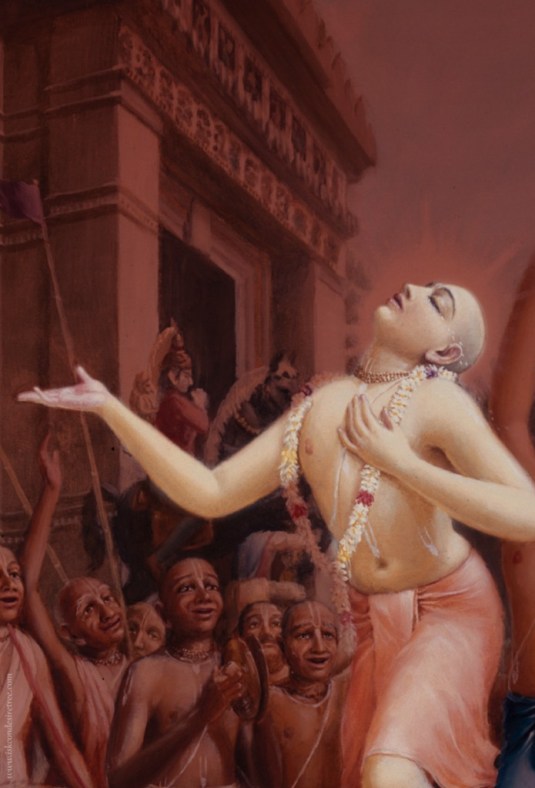
“In the sastra it is said this Kali-yuga is full of faults, so many faults. It is the ocean of faults. But there is a very nice thing, asti hy eko mahan gunah, a very great quality. What is that? Kirtanad eva krsnasya mukta-sangah param vrajet [SB 12.3.51]. If you simply chant Hare Krishna mantra, then you become perfect. Is it very difficult? Chant Hare Krishna and you become perfect. But we are so unfortunate, we are not even prepared to chant. This is our position. So you have to make little determination that ‘I shall chant henceforward Hare Krishna mantra.’ Then everything is all right.” (Srila Prabhupada from Lecture)
and this from Srimad Bhagavatam 8.5.23
When Kṛṣṇa appeared, He gave His orders, and when Kṛṣṇa Himself appeared as a devotee, as Śrī Caitanya Mahāprabhu, He showed us the path by which to cross the ocean of Kali-yuga. That is the path of The Hare Kṛṣṇa Movement. When Śrī Caitanya Mahāprabhu appeared, He ushered in the era for the saṅkīrtana movement. It is also said that for ten thousand years this era will continue. This means that simply by accepting the saṅkīrtana movement and chanting the Hare Kṛṣṇa mahā-mantra, the fallen souls of this Kali-yuga will be delivered. After the Battle of Kurukṣetra, at which Bhagavad-gītā was spoken, Kali-yuga continues for 432,000 years, of which only 5,000 years have passed. Thus there is still a balance of 427,000 years to come. Of these 427,000 years, the 10,000 years of the saṅkīrtana movement inaugurated by Śrī Caitanya Mahāprabhu 500 years ago provide the opportunity for the fallen souls of Kali-yuga to take to the Kṛṣṇa consciousness movement, chant the Hare Kṛṣṇa mahā-mantra and thus be delivered from the clutches of material existence and return home, back to Godhead.
Full Text and Purport More
11 Mar 2013
by The Hare Krishna Movement
in A.C. Bhaktivedanta Swami Prabhupada, Brahma, Krishna, KRSNA The Supreme Personality of Godhead
Tags: A.C. Bhaktivedanta Swami Prabhupada, Brahma, great swan carrier, humble obeisances, Krsna, Lord Brahma, prayers, Prayers Offered by Lord Brahma to Lord Krsna, Spiritual world, Srila Prabhupada, The Supreme Personality of Godhead, windows to the spiritual sky

Maybe it is just my mood, but I find all these stories from “Krsna, The Supreme Personality of Godhead” by Srila Prabhupada, to be transcendentally enlivening. They are like windows to the Spiritual World, and my mind just wants to hang on each and every word. So the following post is from my reading this weekend. Enjoy.
…Brahmā thus found Śrī Kṛṣṇa, the Supreme Personality of Godhead, playing the part of a small cowherd boy; he saw that little child with a lump of food in His left hand, searching out His friends, cows and calves, just as He was actually doing one year before, after their disappearance.
Immediately Brahmā descended from his great swan carrier and fell down before the Lord just like a golden stick. All the four helmets on the heads of Brahmā touched the lotus feet of Kṛṣṇa. Brahmā, being very joyful, began to shed tears, and he washed the lotus feet of Kṛṣṇa with his tears. Repeatedly he fell and rose as he recalled the wonderful activities of the Lord. After repeating obeisances for a long time, Brahmā stood up and smeared his hands over his eyes. Seeing the Lord before him, he, trembling, began to offer prayers with great respect, humility and attention. (from the end of Chapter 13, Kṛṣṇa, the Supreme Personality of Godhead)
…Brahmā said, ”My dear Lord, You are the only worshipful Supreme Lord, Personality of Godhead; therefore I am offering my humble obeisances and prayers just to please You. Your bodily features are of the color of clouds filled with water. You are glittering with a silver electric aura emanating from Your yellow garments.
“Let me offer my respectful repeated obeisances unto the son of Mahārāja Nanda who is standing before me with conchshell, earrings and peacock feather on His head. His face is beautiful; He is wearing a helmet, garlanded by forest flowers, and He stands with a morsel of food in His hand. He is decorated with cane and bugle, and He carries a buffalo horn and flute. He stands before me with small lotus feet. (beginning the 14 Chapter of Kṛṣṇa, the Supreme Personality of Godhead)
Full Chapter More
08 Mar 2013
by The Hare Krishna Movement
in A.C. Bhaktivedanta Swami Prabhupada, Bhagavad-gita, Om
Tags: A.C. Bhaktivedanta Swami Prabhupada, bhakti yoga, chanting Hare Krishna, mama om visnu-padaya, meditation, Om, om ajnana-timirandhasya, om namo bhagavate vasudevaya, om tat sat, omkara, syllable om, The Syllable Om, yoga

The Syllable Om
Many years ago as a young aspiring yogi, and with my very first attempts at meditation, I began my practice with the sacred syllable Om. Many years later and although I may have advanced somewhat spiritually, and practice bhakti-yoga, devotional service and the chanting of the Maha-mantra Hare Krishna, Hare Krishna, Krishna Krishna, Hare Hare, still all my morning prayers still begin with the syllable Om. Such as “om namo bhagavate vasudevaya” before my reading of the Srimad Bhagavatam. And my morning offering of respectful obeisances to my spiritual master Srila Prabhupada with the prayer “om ajñāna-timirāndhasya jñānāñjana-śalākayā, cakṣur unmīlitaṁ yena tasmai śrī-gurave namaḥ” and “nama oṁ viṣṇu-pādāya kṛṣṇa-preṣṭhāya bhū-tale,śrīmate bhaktivedānta-svāmin iti nāmine”. Today we are looking at a few slokas from the Bhagavad-gita where the syllable Om is used.
More
06 Mar 2013
by The Hare Krishna Movement
in A.C. Bhaktivedanta Swami Prabhupada, Spiritual Life, Spiritual Master, Srimad Bhagavatam, Sukadeva Goswami
Tags: A.C. Bhaktivedanta Swami Prabhupada, at the time of death, dying man, great master, guru, Maharaja Pariksit, spiritual master, Srimad Bhagavatam, Sukadeva Gosvami, thesis of Srimad Bhagavatam

You are the spiritual master of great saints and devotees. I am therefore begging you to show the way of perfection for all persons, and especially for one who is about to die.
Please let me know what a man should hear, chant, remember and worship, and also what he should not do. Please explain all this to me.
Unless one is perfectly anxious to inquire about the way of perfection, there is no necessity of approaching a spiritual master. A spiritual master is not a kind of decoration for a householder. Generally a fashionable materialist engages a so-called spiritual master without any profit. The pseudo- spiritual master flatters the so-called disciple, and thereby both the master and his ward go to hell without a doubt. Mahārāja Parīkṣit is the right type of disciple because he puts forward questions vital to the interest of all men, particularly for the dying men. The question put forward by Mahārāja Parīkṣit is the basic principle of the complete thesis of Śrīmad-Bhāgavatam. Now let us see how intelligently the great master replies. (from purport to SB 1.19.37)
Srimad Bhagavatam
By His Divine Grace A.C. Bhaktivedanta Swami
Canto 1, Chapter 19, Text 29-40
More
04 Mar 2013
by The Hare Krishna Movement
in A.C. Bhaktivedanta Swami Prabhupada, Lectures, Nectar of Devotion
Tags: A.C. Bhaktivedanta Swami Prabhupada, Acyutananda das, ceto-darpana-marjanam, chanting Hare Krishna, cleansing the heart, Europeans and Americans, Nectar of Devotion, prabhupada, sankirtan, sri krishna sankirtan, Sri-krsna-sankirtan, Srila Prabhupada

click on image to enlarge
…Kṛṣṇa consciousness is a fact in everyone’s heart. It is already there. Otherwise how these Europeans and Americans, they’re taking to Kṛṣṇa consciousness very seriously? So it is to be understood that Kṛṣṇa consciousness was there already. By the process of hearing… As Caitanya Mahāprabhu has recommended: ceto-darpaṇa-mārjanaṁ paraṁ vijayate śrī-kṛṣṇa-saṅkīrtanam [Cc. Antya 20.12]. Śrī-kṛṣṇa-saṅkīrtanam is so auspicious that the chanting of this mantra awakens the dormant Kṛṣṇa consciousness. Ceto-darpaṇa-mārjanam. The more you hear Hare Kṛṣṇa mantra, the more your heart becomes cleansed. These are the statements given by Caitanya Mahāprabhu. There cannot be any defect. My statement may be defective, but Caitanya Mahāprabhu’s statement cannot be defective, because He is in the transcendental platform. He is transcendence Himself. Kṛṣṇa-caitanya-nāmne. Kṛṣṇāya kṛṣṇa-caitanya-nāmine. He’s Kṛṣṇa Himself, but He has appeared in the form of Kṛṣṇa Caitanya. Therefore, whatever He says, that is fact. Ceto-darpaṇa-mārjanam. The more we hear the vibration, the transcendental vibration, Hare Kṛṣṇa, Hare Kṛṣṇa, Kṛṣṇa Kṛṣṇa, Hare Hare/ Hare Rāma, Hare Rāma, Rāma Rāma, Hare Hare, without any offense… Even with, mixed with offense… There are three stages of chanting this vibration: offensive chanting, and almost offenseless chanting, and offenseless chanting. Offensive chanting may give you material pains and pleasures, and almost offenseless will give you liberation, will place you in the transcendental platform. And when it is offenseless, then immediately you’ll invoke love of God, Kṛṣṇa-prema. So even in offensive stage, if you go on chanting and try to be, try to become safe from offensive condition… Daśa-vidhā-nāma, ten kinds of offenses, if we avoid, that is the process of auspicity. But even we are not in the platform of offenseless chanting, still, we must go on chanting. It will gradually make our heart cleansed and we’ll be offenseless. Ceto-darpaṇa-mārjanaṁ bhava-mahā-dāvāgni-nirvāpaṇam [Cc. Antya 20.12]. So the Kṛṣṇa consciousness, awakening of Kṛṣṇa consciousness, is required. That is called ceto-darpaṇa-mārjanam.
So here, Rūpa Gosvāmī says auspicity means that which spreads for everyone, in all parts of the world. That is auspicity. Not partial. In politics or sociology or humanitarian activities, there is partiality for a certain section of human being, or certain section of living beings. But this chanting of Hare Kṛṣṇa mantra, awakening Kṛṣṇa consc…, dormant Kṛṣṇa consciousness, is meant for all living entities. Even birds, beasts, insects, they can also awaken. This is the recommendation of Haridāsa Ṭhākura, that if we chant loudly, the trees will hear, the birds will hear, the insect will hear, and they will be liberated. That is the statement of Nāmācārya Haridāsa Ṭhākura. Therefore chanting of Hare Kṛṣṇa mantra and awakening of dormant Kṛṣṇa consciousness is the auspicious activities, welfare activities, for every living entity all over the world.
Full Lecture More
03 Mar 2013
by The Hare Krishna Movement
in A.C. Bhaktivedanta Swami Prabhupada, Lokadrsti devi, Spiritual Master, Srila Prabhupada, Srila Prabhupada Pranati
Tags: A.C. Bhaktivedanta Swami Prabhupada, His Divine Grace, Lokadrsti devi dasi, nama om visnu padaya, namas to sarasvate, Prabhupada's Vyasasana, Pranati, Srila Prabhupada, Srila Prabhupada Pranati, Vyasasana

click on image to enlarge
Śrīla Prabhupāda Praṇati
nama oṁ viṣṇu-pādāya kṛṣṇa-preṣṭhāya bhū-tale
śrīmate bhaktivedānta-svāmin iti nāmine
namah–obeisances; om–address;visnu-padaya–unto him who is at the feet of Lord Visnu;krsna-presthaya–who is very dear to Lord Krsna;bhu-tale–on the earth;srimate–all beautiful;bhaktivedanta-svamin–A.C. Bhaktivedanta Swami;iti–thus;namine–who is named
I offer my respectful obeisances unto His Divine Grace A. C. Bhaktivedanta Swami Prabhupāda, who is very dear to Lord Kṛṣṇa, having taken shelter at His lotus feet.
namas te sārasvate deve gaura-vāṇī-pracāriṇe
nirviśeṣa-śūnyavādi-pāścātya-deśa-tāriṇe
namah–obeisances;te–unto you;sarasvate deve-servant of Bhaktisiddhanta Sarasvati Gosvami;gaura-vani–the message of Lord Caitanya;pracarine–who are preaching;nirvisesa–impersonalism;sunyavadi–voidism;pascatya–Western;desa–countries;
tarine–who are delivering
Our respectful obeisances are unto you, O spiritual master, servant of Sarasvatī Gosvāmī. You are kindly preaching the message of Lord Caitanyadeva and delivering the Western countries, which are filled with impersonalism and voidism.
Vyasasana decorations by Lokadrsti devi dasi
Previous Older Entries Next Newer Entries











 The Hare Krishna Movement