14 Jun 2012
by The Hare Krishna Movement
in Krishna Consciousness, Practicing Krishna Consciousness at Home, Varnasrama Dharma
Tags: brahmanas, krsna consciousness, Krsna Consciousness is for Everyone, Padmapani dasa, Prabhupada connect, Prasadam, spiritual food, spiritual solutions, Srila Prabhupada's teachings, varnasrama-dharma
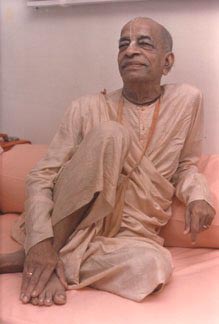
…In order for his movement to be successful, Srila Prabhupada emphasized that there is no room for politics in Krsna consciousness: “Politics means planning for one’s own happiness. That is politics. So in our society there should be no diplomacy, no politics. Everyone should be eager how to do good for others. That is Vaisnava.”
Krishna Consciousness is for Everyone
By Sriman Padmapani Prabhu
Oftentimes those who are practicing Krsna consciousness are challenged that merely tending to spiritual life can’t possibly solve one’s problems in the real world. How can chanting Hare Krsna help someone who is constantly worried about putting food on their dinner table? So-called spiritual solutions seem vague and impractical. However, if we make the effort to study Srila Prabhupada’s teachings in full, we soon discover that he was always down-to-earth along with being committed to living and preaching a godly life.
In early 1974, Srila Prabhupada instructed his leading disciples to start organizing his movement according to the principles of varnasrama-dharma: “Everywhere, wherever we have got our centers, a varnasrama college should be established to train all divisions: one class brahmana, one class ksatriya, one class vaisya, and one class sudra” (Srila Prabhupada, Vrindavan, March, 1974). These four divisions of society are described in the 18th chapter of the Bhagavad-gita where Lord Krsna states that such divisions are naturally “in accordance with the modes of nature” (B.G. 18.41). In the varnasrama system, the brahmanas are the priests, the ksatriyas are the administrators, the vaisyas are the producers of food and the sudras are the workers. By co-operating together, these four parts of the social body are able to maintain a healthy and well functioning society. On the basis of Vedic scripture, Srila Prabhupada guaranteed that there would be no scarcity if the principles of varnasrama were properly established in human society. “Come and join us,” he said. “We shall give you food, shelter, everything. This is Krsna consciousness.”
More
14 Jun 2012
by The Hare Krishna Movement
in Chanting Hare Krishna, Letters by Srila Prabhupada
Tags: A.C. Bhaktivedanta Swami Prabhupada, chanting Hare Krishna, God's holy name, Hare Hare, holy name, Janardana, kingdom of God, Krishna consciousness movement, Krishna Krishna, Letters by Srila Prabhupada, Lord Caitanya, Lord Jesus Christ, millions of holy names

…The Lord Has millions of holy names and you can chant any one of them, and each and every Name of the Lord is of full potential. We chant the above mentioned holy Name of the Lord because the name was Chanted by Lord Caitanya, the father of this movement of Krishna Consciousness. We follow Lord Caitanya’s footprints to achieve very quick result…
Letter to: Mr. Dambergs (senior)
New York,12 April, 1967
Dear Mr. Senior Dambergs,
Kindly accept my greetings. I am unknown to you but I have heard about you from your very good grandson Sriman Janardana (Janis). I have heard that you have been ailing since a long time but I have heard also that you are a great devotee of Lord Jesus Christ. It is very good. I am also an insignificant servant of Lord Jesus Christ because I am preaching the same message as Lord Jesus did. I’m preaching God consciousness or Krishna consciousness. Fools thought that Lord Jesus Christ was dead by crucifixion but He resurrected. All living entities are parts and parcel of the Supreme Lord and therefore they are also eternal. All our ailments are due to the external body. Although we have to suffer some time from bodily inconveniences specially in the old age, still if we are God conscious, we shall not feel the pangs. The best thing is therefore to Chant the holy Name of the Lord Constantly. I would you request you to chant always God’s holy Name. We are chanting God’s holy name always and instructing our students to do so. If you have any holy name for God do chant Him always and it will do you the greatest benefit. And by chanting so when you will be remembering Him always then you transfer to the Kingdom of God is guaranteed. When you return to the Kingdom of God there is no necessity to come back again to the rotten world full of miseries. We are chanting God’s Name as
Hare Krishna Hare Krishna Krishna Krishna Hare Hare
Hare Rama Hare Rama Rama Rama Hare Hare.
More
11 Jun 2012
by The Hare Krishna Movement
in Chanting Hare Krishna, Diksha, Guru & Disciple, Hare Krishna Maha Mantra
Tags: chanting Hare Krishna, guru disciple, initiation ceromony, Krsna, krsna consciousness, lecture on initiation, Madhudvisa, Revatinandana, spiritual master, Srila Prabhupada, Srimati dasi, ten offences to be advoided while chanting the maha-mantra, ten offenses, Vilasa-vigraha, yoga process
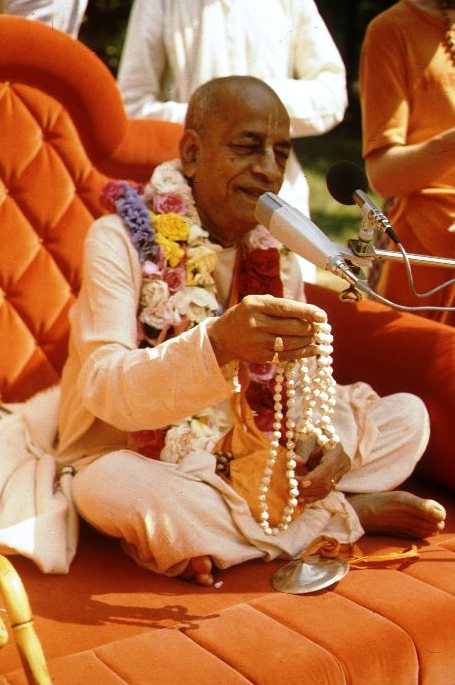
…Madhudviṣa: Śrīla Prabhupāda? Should I read the ten offenses?
Prabhupāda: Yes.
Madhudviṣa: We have them here.
Prabhupāda: Just see. Go on reading. Yes, you read.
Madhudviṣa: “The ten offenses to avoid while chanting the mahā-mantra. Number one: Blaspheming the Lord’s devotee.”
Prabhupāda: Now just try to understand. Any devotee of Lord should not be blasphemed. It doesn’t matter in any country. Just like Lord Jesus Christ, he is a great devotee. And even Muhammad, he’s also a devotee. It is not that because we are devotee and they are not devotee. Don’t think like that. Anyone who is preaching the glories of God, he is a devotee. He should not be blasphemed. You should be careful. Then?
Madhudviṣa: “Number two: Considering the Lord and other demigods on the same level or assuming there are many Gods.”…
Lecture on Initiation and the Ten Offences to be Advoided While Chanting the Maha-mantra
By His Divine Grace A. C. Bhaktivedanta Swami Prabhupāda
Seattle, October 20, 1968
More
09 Jun 2012
by The Hare Krishna Movement
in Krishna, Srimad Bhagavatam
Tags: A.C, austerity, Bhaktivedanta Swami Prabhupada, goal of life, knowledge, Krishna, Personality of Godgead, revealed scriptures, sacrifices, SB 1.2.28-29, Sri Krsna, Srila Prabhupada, Srimad Bhagavatam, ultimate goal of life, Vasudeva, vasudeva-para veda, yoga
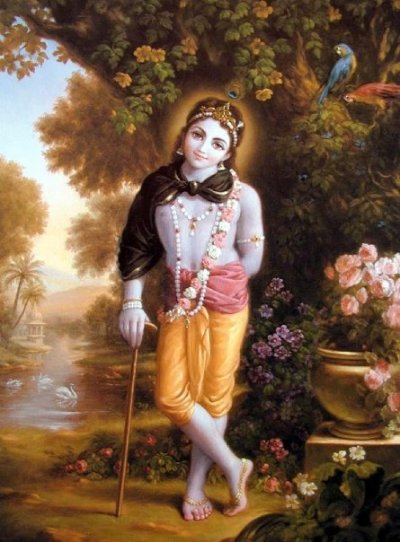
That Śrī Kṛṣṇa, the Personality of Godhead, is the only object of worship is confirmed in these two ślokas.
Srimad-Bhagavatam
By His Divine Grace A.C. Bhaktivedanta Swami Prabhupada
Canto 1, Chapter Two, Text 28-29
TEXTS 28-29
vāsudeva-parā vedā
vāsudeva-parā makhāḥ
vāsudeva-parā yogā
vāsudeva-parāḥ kriyāḥ
vāsudeva-paraṁ jñānaṁ
vāsudeva-paraṁ tapaḥ
vāsudeva-paro dharmo
vāsudeva-parā gatiḥ
vāsudeva—the Personality of Godhead; parāḥ—the ultimate goal; vedāḥ—revealed scriptures; vāsudeva—the Personality of Godhead; parāḥ—for worshiping; makhāḥ—sacrifices; vāsudeva—the Personality of Godhead; parāḥ—the means of attaining; yogāḥ—mystic paraphernalia; vāsudeva—the Personality of Godhead; parāḥ—under His control; kriyāḥ—fruitive activities; vāsudeva—the Personality of Godhead; param—the supreme; jñānam—knowledge; vāsudeva—the Personality of Godhead; param—best; tapaḥ—austerity; vāsudeva—the Personality of Godhead; paraḥ—superior quality; dharmaḥ—religion; vāsudeva—the Personality of Godhead; parāḥ—ultimate; gatiḥ—goal of life.
In the revealed scriptures, the ultimate object of knowledge is Śrī Kṛṣṇa, the Personality of Godhead. The purpose of performing sacrifice is to please Him. Yoga is for realizing Him. All fruitive activities are ultimately rewarded by Him only. He is supreme knowledge, and all severe austerities are performed to know Him. Religion [dharma] is rendering loving service unto Him. He is the supreme goal of life.
Purport
That Śrī Kṛṣṇa, the Personality of Godhead, is the only object of worship is confirmed in these two ślokas. In the Vedic literature there is the same objective: establishing one’s relationship and ultimately reviving our lost loving service unto Him. That is the sum and substance of the Vedas. In the Bhagavad-gītā the same theory is confirmed by the Lord in His own words: the ultimate purpose of the Vedas is to know Him only. All the revealed scriptures are prepared by the Lord through His incarnation in the body of Śrīla Vyāsadeva just to remind the fallen souls, conditioned by material nature, of Śrī Kṛṣṇa, the Personality of Godhead. No demigod can award freedom from material bondage. That is the verdict of all the Vedic literatures. Impersonalists who have no information of the Personality of Godhead minimize the omnipotency of the Supreme Lord and put Him on equal footing with all other living beings, and for this act such impersonalists get freedom from material bondage only with great difficulty. They can surrender unto Him only after many, many births in the culture of transcendental knowledge.
More
09 Jun 2012
by The Hare Krishna Movement
in Guru & Disciple, Letters by Srila Prabhupada
Tags: A.C. Bhaktivedanta Swami Prabhupada, devotional sentiments, disciple, guru, Guru Maharaja, I am always with you, Krsna's Mercy, Letters by Srila Prabhupada, mercy of Krsna, our ever well-wisher, spiritual master, Srila Prabhupada

“The Spiritual Master is present wherever his sincere disciple is trying to serve his instructions. This is possible by the Mercy of Krsna. In your attempts to serve me and in all your sincere devotional sentiments I am with you as my Guru Maharaja is with me. Remember this always.”
.
(Srila Prabhupada letter, 12/01/73)
Full Letter More
07 Jun 2012
by The Hare Krishna Movement
in A.C. Bhaktivedanta Swami Prabhupada, Devotee's, Krishna Consciousness, Lectures
Tags: A.C. Bhaktivedanta Swami Prabhupada, benefactor of the truthful devotee, bhagavad-gita, chanting Hare Krishna, Hear About Krishna, heard and chanted, Krishna, lecture by Prabhupada, material enjoyment, Paramata, Sri Krishna, supersoul, The Supreme Personality of Godhead

…I have not bribed these American and European boys to become Krishna conscious. I have no money. When I went to America, I had only seven dollars. One hour’s expenditure in New York. There is no question of bribing them. But they heard about Krishna. I was reading Bhagavad-gita on the street, in the park, and chanting. They heard, and they came to me. They became attracted. Why?
Just Give Them Chance to Hear About Krishna
Srimad-Bhagavatam Lecture 1.2.17 Vrndavana, October 28, 1972
By His Divine Grace A.C. Bhaktivedanta Swami Prabhupada
srnvatam sva-kathah krsnah
punya-sravana-kirtanah
hrdy antah-stho hy abhadrani
vidhunoti suhrt satam
Translation: “Sri Krishna, the Personality of Godhead, who is the Paramatma, Supersoul, in everyone’s heart and the benefactor of the truthful devotee, cleanses desire for material enjoyment from the heart of the devotee who relishes His messages, which are in themselves virtuous when properly heard and chanted.”
There is a English proverb that “God helps him who tries to help himself”. That is a English proverb. So to become Krsna conscious is not very difficult thing. People have no taste. They do not understand the importance of this Krsna consciousness movement. But this is the only way by which one can become perfect and happy.
It is confirmed in the Bhagavad-gita that just to become happy and peaceful one has to learn three things.
bhoktaram yajna-tapasam
sarva-loka-mahesvaram
suhrdam sarva-bhutanam
jnatva mam santim rcchati
If you want… Because the problem is that we want to be happy and peaceful. Everyone says, “I want peace. There is no peace in my mind.” That is a general understanding. Nobody can say that “I am completely happy and peaceful.” No, that is not possible. The material world is made in such a way that you cannot feel happy. That is not possible. First of all, we have come to this material world to enjoy sense gratification, but that is not our proper business. Our proper business is to satisfy the senses of Krsna, not our senses. So because we have deviated from our original position, therefore it is always a perplexity of our life. But due to illusion we cannot understand it.
More
07 Jun 2012
by The Hare Krishna Movement
in Uncategorized
Tags: 1972 Macmillan edition, A.C. Bhaktivedanta Swami Prabhupada, Arjuna, as it is, bhagavad-gita, Bhagavad-gita text and purports, happiness of distress, heavenly planets, Krishna, Krishna consciousness, loss or gain, material activities, Mukunda, sense gratification, son of Kunti, victory or defeat

This is the second half of Chapter Two “Contents of the Gita Sumarized”
Bhagavad-gita As It Is 1972 Macmillan Edition
By His Divine Grace A.C. Bhaktivedanta Swami Prabhupada
Chapter 2, Text & Purports 37-72
TEXT 37
hato vā prāpsyasi svargaṁ
jitvā vā bhokṣyase mahīm
tasmād uttiṣṭha kaunteya
yuddhāya kṛta-niścayaḥ
hataḥ—being killed; vā—either; prāpsyasi—you gain; svargam—the heavenly kingdom; jitvā—by conquering; vā—or; bhokṣyase—you enjoy; mahīm—the world; tasmāt—therefore; uttiṣṭha—get up; kaunteya—O son of Kuntī; yuddhāya—to fight; kṛta—determination; niścayaḥ—uncertainty.
TRANSLATION
O son of Kuntī, either you will be killed on the battlefield and attain the heavenly planets, or you will conquer and enjoy the earthly kingdom. Therefore get up and fight with determination.
PURPORT
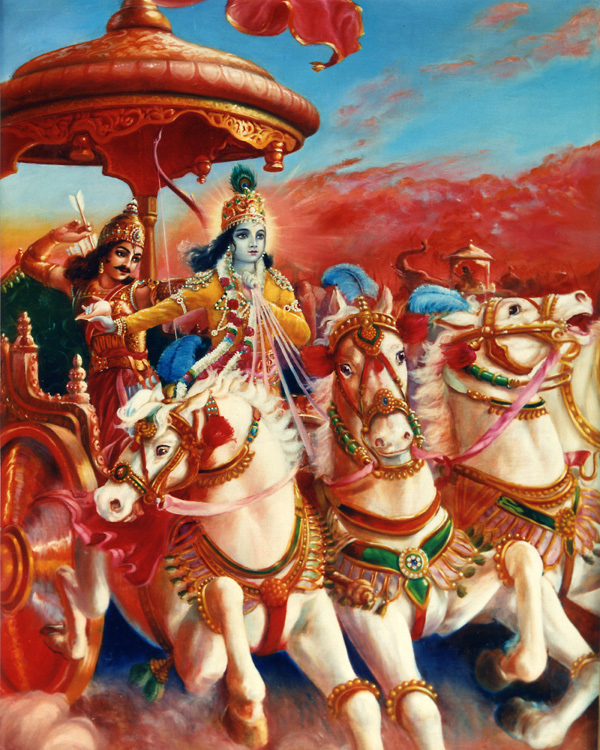
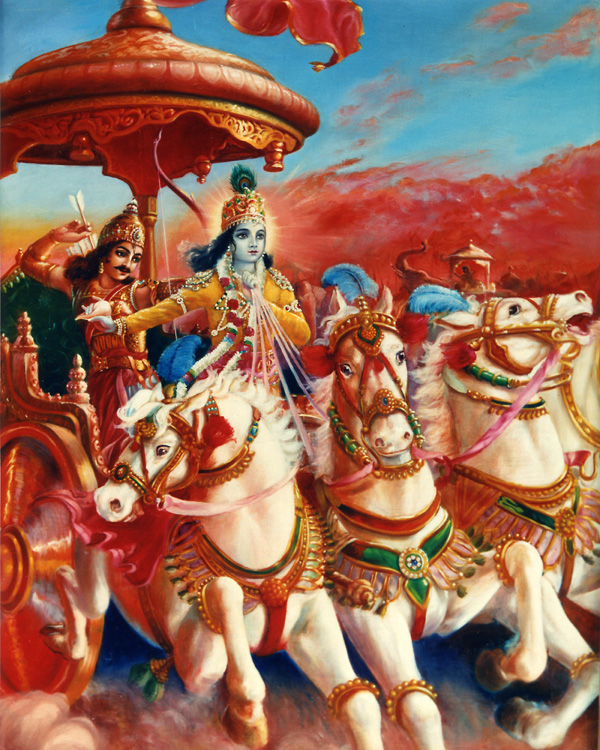
Even though there was no certainty of victory for Arjuna’s side, he still had to fight; for, even being killed there, he could be elevated into the heavenly planets.
TEXT 38
sukha-duḥkhe same kṛtvā
lābhālābhau jayājayau
tato yuddhāya yujyasva
naivaṁ pāpam avāpsyasi
sukha—happiness; duḥkhe—in distress; same—in equanimity; kṛtvā—doing so; lābhālābhau—both in loss and profit; jayājayau—both in defeat and victory; tataḥ—thereafter; yuddhāya—for the sake of fighting; yujyasva—do fight; na—never; evam—in this way; pāpam—sinful reaction; avāpsyasi—you will gain.
TRANSLATION
Do thou fight for the sake of fighting, without considering happiness or distress, loss or gain, victory or defeat-and, by so doing, you shall never incur sin.
PURPORT
Lord Kṛṣṇa now directly says that Arjuna should fight for the sake of fighting because He desires the battle. There is no consideration of happiness or distress, profit or gain, victory or defeat in the activities of Kṛṣṇa consciousness. That everything should be performed for the sake of Kṛṣṇa is transcendental consciousness; so there is no reaction to material activities. He who acts for his own sense gratification, either in goodness or in passion, is subject to the reaction, good or bad. But he who has completely surrendered himself in the activities of Kṛṣṇa consciousness is no longer obliged to anyone, nor is he a debtor to anyone, as one is in the ordinary course of activities. It is said:
devarṣi-bhutāpta-nṛṇāṁ pitṝṇāṁ
na kiṅkaro nāyamṛṇī ca rājan
sarvātmanā yaḥ śaraṇaṁ śaraṇyaṁ
gato mukundaṁ parihṛtya kartam
(Bhag. 11.5.41)
“Anyone who has completely surrendered unto Kṛṣṇa, Mukunda, giving up all other duties, is no longer a debtor, nor is he obliged to anyone-not the demigods, nor the sages, nor the people in general, nor kinsmen, nor humanity, nor forefathers.” That is the indirect hint given by Kṛṣṇa to Arjuna in this verse, and the matter will be more clearly explained in the following verses.
More
07 Jun 2012
by The Hare Krishna Movement
in A.C. Bhaktivedanta Swami Prabhupada, Back to Godhead, Lectures
Tags: A.C. Bhaktivedanta Swami Prabhupada, Conway Hall London, eternal servitors of Krishna, Gurudas, Krishna, lecture by Prabhupada, meditation, relationship with God, sankirtana movement, self realization, Srila Prabhupada, Supreme Lord, true identity

…As soon as one understands his identity, his relationship with God, then immediately he becomes happy. We are so full of miseries because we have identified ourselves with the material world. Therefore we are unhappy. Anxieties and fearfulness are due to our misidentifying with the material world.
A Lecture Given At Conway Hall, London,
By His Divine Grace A.C. Bhaktivedanta Swami Prabhupada
We Are All Eternal Servitors of Krsna
Today’s subject matter is our relationship with God. That is self-realization. The sankirtana movement is the easiest process for self-realization because it cleanses the heart. Our misunderstanding of our identity is due to the dust covering the mirror of the mind. In a mirror which is covered with dust one cannot see himself. But if it is very clear, then one can see himself. So meditation is a process for cleansing the heart. Meditation means to try to understand one’s relationship with the Supreme.
More
06 Jun 2012
by The Hare Krishna Movement
in Uncategorized
Tags: 1972 Macmillan edition, A.C. Bhaktivedanta Swami Prabhupada, Arjuna, as it is, bhagavad-gita, Contents of the Gita Sumarized, Krishna, Krishna consciousness, Krsna, Madhusudana, material compassion, real self, Sanjaya, self realization
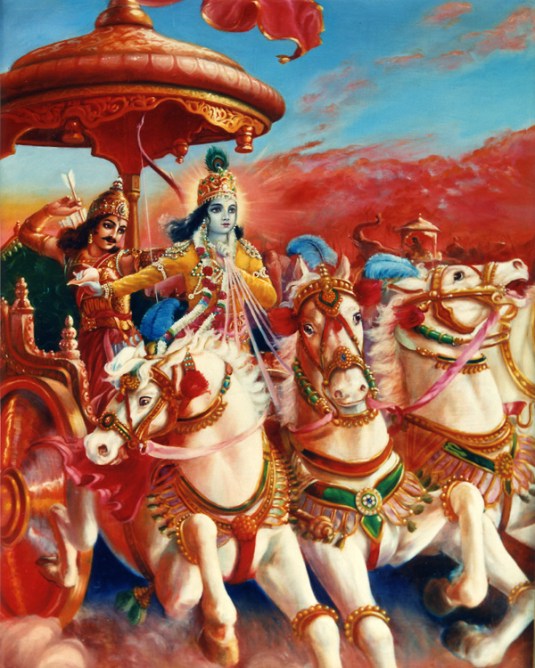
As this is a very long chapter we are posting it in two parts. Today we are posting text 1-35, and tomorrow we will conclude the chapter entitled “Contents of the Gita Summarized”
Bhagavad-gita As It Is 1972 Macmillan Edition
By His Divine Grace A.C. Bhaktivedanta Swami Prabhupada
Chapter Two, Text and Purports 1-35
Contents of the Gita Summarized
TEXT 1
sañjaya uvāca
taṁ tathā kṛpayāviṣṭam
aśru-pūrṇākulekṣaṇam
viṣīdantam idaṁ vākyam
uvāca madhusūdanaḥ
sañjayaḥ uvāca—Sañjaya said; tam—unto Arjuna; tathā—thus; kṛpayā—by compassion; āviṣṭam—overwhelmed; aśru-pūrṇa—full of tears; ākula—depressed; īkṣaṇam—eyes; viṣīdantam—lamenting; idam—this; vākyam—words; uvāca—said; madhusūdanaḥ—the killer of Madhu.
TRANSLATION
Sañjaya said: Seeing Arjuna full of compassion and very sorrowful, his eyes brimming with tears, Madhusūdana, Kṛṣṇa, spoke the following words.
PURPORT
Material compassion, lamentation and tears are all signs of ignorance of the real self. Compassion for the eternal soul is self-realization. The word “Madhusūdana” is significant in this verse. Lord Kṛṣṇa killed the demon Madhu, and now Arjuna wanted Kṛṣṇa to kill the demon of misunderstanding that had overtaken him in the discharge of his duty. No one knows where compassion should be applied. Compassion for the dress of a drowning man is senseless. A man fallen in the ocean of nescience cannot be saved simply by rescuing his outward dress-the gross material body. One who does not know this and laments for the outward dress is called a śūdra, or one who laments unnecessarily. Arjuna was a kṣatriya, and this conduct was not expected from him. Lord Kṛṣṇa, however, can dissipate the lamentation of the ignorant man, and for this purpose the Bhagavad-gītā was sung by Him. This chapter instructs us in self-realization by an analytical study of the material body and the spirit soul, as explained by the supreme authority, Lord Śrī Kṛṣṇa. This realization is made possible by working with the fruitive being situated in the fixed conception of the real self.
More
04 Jun 2012
by The Hare Krishna Movement
in Krishna Consciousness, Teachings of Lord Kapila, The Hare Krishna Movement
Tags: A.C. Bhaktivedanta Swami Prabhupada, Bhagavan, God, Krishna consciousness movement, krsna consciousness, krsnas tu bhagavan svayam, Lord Kapila, Son of Devahuti, Sri Krsna, Teachings of Lord Kapila
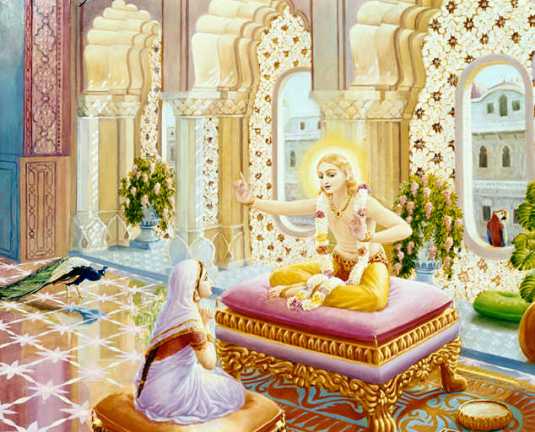
…The purpose of this Kṛṣṇa consciousness movement is to inform everyone that no one is superior to Kṛṣṇa, God. Because many young Americans and Europeans are fortunate and know nothing of any hodgepodge god, they have taken this bona fide Kṛṣṇa consciousness movement seriously. Kṛṣṇas tu bhagavān svayam: Bhagavān, God, means Śrī Kṛṣṇa. We have simply presented this information, saying, “Here is God. Śrī Kṛṣṇa.” Because they have taken this seriously, many young Americans and Europeans are advancing in Kṛṣṇa consciousness. Consequently many people are surprised to see how Americans and Europeans have become such great devotees and are dancing in ecstasy. How is it they are so advanced? They have taken the information seriously: kṛṣṇas tu bhagavān svayam. Whether one touches fire blindly or knowingly, fire will burn. It is not that because the fire is touched by a child, fire will not burn. These young Westerners have touched fire, and consequently it is acting as fire.
…If we hear about Kṛṣṇa, we become purified. Hearing about Kṛṣṇa means associating with Kṛṣṇa. In this way we may perfect our lives.
Teachings of Lord Kapila, the Son of Devahūti
By His Divine Grace A. C. Bhaktivedanta Swami Prabhupāda
Chapter One
The Purpose of Lord Kapila’s Advent
TEXT 1
śaunaka uvāca
kapilas tattva-saṅkhyātā
bhagavān ātma-māyayā
jātaḥ svayam ajaḥ sākṣād
ātma-prajñaptaye nṛṇām
TRANSLATION
Śrī Śaunaka said: Although He is unborn, the Supreme Personality of Godhead took birth as Kapila Muni by His internal potency. He descended to disseminate transcendental knowledge for the benefit of the whole human race.
PURPORT
The word ātma-prajñaptaye indicates that the Lord descends for the benefit of the human race to give transcendental knowledge. Material necessities are quite sufficiently provided for in the knowledge given in the Vedic literatures, which offer a program for good living and gradual elevation to the platform of sattva-guṇa, the mode of goodness. Once one is situated in sattva-guṇa, one’s knowledge expands. On the platform of passion there is no knowledge, for passion is an impetus to enjoy material benefits. On the platform of ignorance there is neither knowledge nor enjoyment but simply animalistic living.
More
31 May 2012
by The Hare Krishna Movement
in Panca-Tattva, Sri Caitanya-Caritamrta
Tags: A.C. Bhaktivedanta Swami Prabhupada, Adi-lila 7.6, bhakta-saktikam, bhakta-svarupa, five tattvas, five truths, panca-tattvatmakam krsna, Pancha Tattva, Sri Advaita Prabhu, Sri Caitanya Mahaprabhu, Sri Caitanya-caritamrta, Sri Gadadhara Prabhu, Sri Nityananda Prabhu, Srivasa Prabhu, visnu-tattva

Sri Caitanya-caritamrta 1975 Edition
By His Divine Grace A.C. Bhaktivedanta Swami Prabhupada
Adi-lila 7.6
pañca-tattvātmakaṁ kṛṣṇaṁ
bhakta-rūpa-svarūpakam
bhaktāvatāraṁ bhaktākhyaṁ
namāmi bhakta-śaktikam
pañca-tattva-ātmakam—comprehending the five transcendental subject matters; kṛṣṇam—unto Lord Kṛṣṇa; bhakta-rūpa—in the form of a devotee; svarūpakam—in the expansion of a devotee; bhakta-avatāram—in the incarnation of a devotee; bhakta-ākhyam—known as a devotee; namāmi—I offer my obeisances; bhakta-śaktikam—the energy of the Supreme Personality of Godhead.
Let me offer my obeisances unto Lord Śrī Kṛṣṇa, who has manifested Himself in five as a devotee, expansion of a devotee, incarnation of a devotee, pure devotee and devotional energy.
PURPORT
Śrī Nityānanda Prabhu is the immediate expansion of Śrī Caitanya Mahāprabhu as His brother. He is the personified spiritual bliss of sac-cid-ānanda-vigraha. His body is transcendental and full of ecstasy in devotional service. Śrī Caitanya Mahāprabhu is therefore called bhakta-rūpa (the form of a devotee), and Śrī Nityānanda Prabhu is called bhakta-svarūpa (the expansion of a devotee). Śrī Advaita Prabhu, the incarnation of a devotee, is viṣṇu-tattva and belongs to the same category. There are also different types of bhaktas, or devotees, on the platforms of neutrality, servitude, friendship, parenthood and conjugal love. Devotees like Śrī Dāmodara, Śrī Gadādhara and Śrī Rāmānanda are different energies. This confirms the Vedic sūtra parāsya śaktir vividhaiva śrūyate. All these bhakta subjects taken together constitute Śrī Caitanya Mahāprabhu, who is Kṛṣṇa Himself.
The Pancha Tattva further described More
30 May 2012
by The Hare Krishna Movement
in A.C. Bhaktivedanta Swami Prabhupada, Back to Godhead, Lectures
Tags: A.C. Bhaktivedanta Swami Prabhupada, Back to Godhead Magazine, Bible, gospel according to Saint John, Hare Krishna, In The Begining Was the Word, mantra, Prabhupada Lecture, sound, sound is the origin of all creation, the Word, vibration of transcendental sound, Word was with God
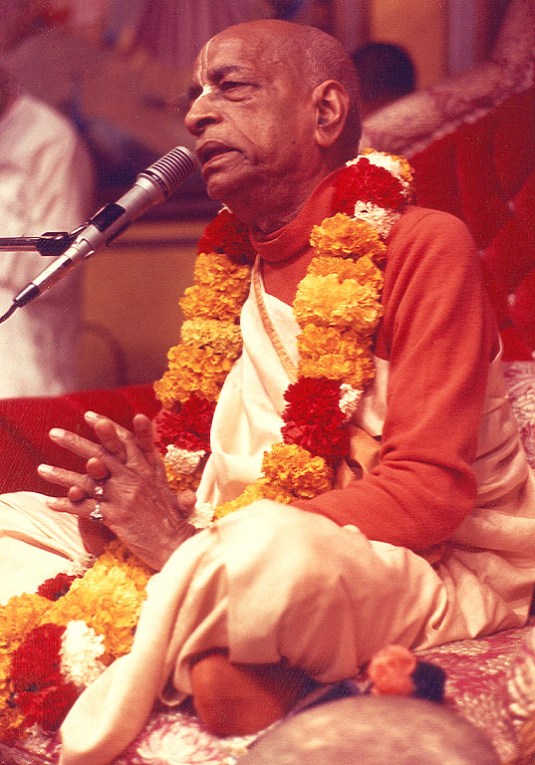
…”In the beginning was the Word.” This indicates that before creation, transcendental sound existed. That word or transcendental sound is not like material sound, for if we associate with the transcendental sound Hare Krsna, we become purified and thus become transcendental. To give a crude example, if we put an iron rod into a fire, it will gradually become warmer and warmer until it becomes red hot. When it is red hot, it will no longer be iron; it will be fire. How has it become fire? By association with the fire. Therefore if you simply keep yourself in touch with God through the transcendental sound, gradually you will become godly, and as soon as you become godly, you will become the same in quality as God full in riches, full in power, full in knowledge and everything else. Therefore the Vedic instruction is, “Don’t keep yourself in darkness. Come to the light.”
In the Beginning Was the Word
By His Divine Grace A.C. Bhaktivedanta Swami Prabhupada
From Back to Godhead Magazine 1975 Vol. 10, No. 1
Ladies and gentlemen, I thank you very much for kindly participating in this sankirtana movement, which is a movement for the vibration of transcendental sound. Sound is the origin of all creation. That is admitted in the Bible also. We are reading a passage from the Bible:
[A disciple reads] The Gospel According to Saint John. Chapter 1. “In the beginning was the Word, and the Word was with God, and the Word was God. The same was in the beginning with God. All things were made by him; and without him was not anything made that was made. In him was life; and the life was the light of men. And the light shineth in darkness; and the darkness comprehended it not.”
More
29 May 2012
by The Hare Krishna Movement
in Essays & Articles
Tags: peace formula, Srila Prabhupada's type writer, Supreme Lord, Swami A.C. Bhaktivedanta, Who Is Crazy

…The peace for which you are hankering in life after life, moment after moment—that you’ll get at that time, when your desires are purified, and dovetailed with the Lord. One who desires sense gratification, the enjoyment of material satisfaction, will never be happy. That is not possible. If you want peace, if you want happiness, if you want perfection in your life, then just begin to dovetail your desires, activities, and potentials with the Supreme Personality of Godhead. Then you will see what real happiness is, and can tell who is really crazy.
Who Is Crazy? (Original)
by Swami A.C. Bhaktivedanta
Lord Sri Krishna says, “My dear Arjuna, there are different classes of men. One class of men, they are sleeping. And another class of men, they are awake. They are not sleeping.” And how is this so? This chanting, which we have performed just now, is the wakening process for the sleeping soul. The soul is sleeping, covered by this material body. These bodily activities are in the sleeping stage. Just as we see dreams in the sleeping stage, similarly, all these bodily activities are dreams. Just think for yourself: how many incidents have there been in your past life? If you think of them, they will appear just like dreams. At least for myself this is the case. I was born in India, educated, then married, then I had very good days with my wife, got some children, some of whom died, some of whom are living, some of whom are married; now they have begotten children. All this occurred in my past life. Now it is all a dream. I have no connection with it. Similarly, in dreams I sometimes find that I have become a king. Oh, there are so many riches and so much opulence. Then, as soon as the dream is over, I come home and all is gone.
More
29 May 2012
by The Hare Krishna Movement
in Bhagavad-gita, Srimad Bhagavatam, Varnasrama Dharma
Tags: A.C. Bhaktivedanta Swami Prabhupada, Bg. 4.13, caste divisions, four orders of life, occupation according to caste, Personality of Godhead, prescribed duties, Sb 1.2.13, varnasrama institution, varnasrama-dharma
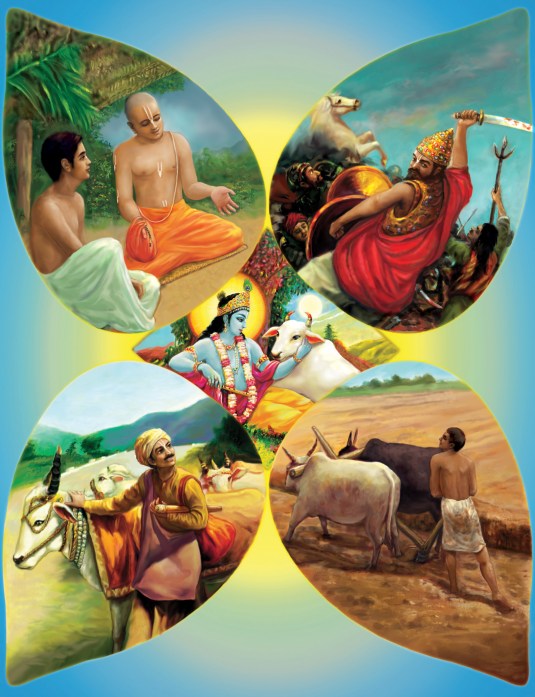
Here are two verses (one from the Srimad Bhagavatam; 1.2.13, and one from the Bhagavad-gita; 4.13) describing the importance of the varṇāśrama institution.
…the highest aim of life or the highest perfection of the institution of the varṇāśrama-dharma is to cooperate jointly for the satisfaction of the Supreme Lord.
Srimad Bhagavatam
By is Divine Grace A.C. Bhaktivedanta Swami PRabhupada
Canto One, Chapter 2, Text 13
ataḥ pumbhir dvija-śreṣṭhā
varṇāśrama-vibhāgaśaḥ
svanuṣṭhitasya dharmasya
saṁsiddhir hari-toṣaṇam
O best among the twice-born, it is therefore concluded that the highest perfection one can achieve by discharging the duties prescribed for one’s own occupation according to caste divisions and orders of life is to please the Personality of Godhead.
Human society all over the world is divided into four castes and four orders of life. The four castes are the intelligent caste, the martial caste, the productive caste and the laborer caste. These castes are classified in terms of one’s work and qualification and not by birth. Then again there are four orders of life, namely the student life, the householder’s life, the retired and the devotional life. In the best interest of human society there must be such divisions of life, otherwise no social institution can grow in a healthy state. And in each and every one of the abovementioned divisions of life, the aim must be to please the supreme authority of the Personality of Godhead. This institutional function of human society is known as the system of varṇāśrama-dharma, which is quite natural for the civilized life. The varṇāśrama institution is constructed to enable one to realize the Absolute Truth. It is not for artificial domination of one division over another. When the aim of life, i.e., realization of the Absolute Truth, is missed by too much attachment for indriya-prīti, or sense gratification, as already discussed hereinbefore, the institution of the varṇāśrama is utilized by selfish men to pose an artificial predominance over the weaker section. In the Kali-yuga, or in the age of quarrel, this artificial predominance is already current, but the saner section of the people know it well that the divisions of castes and orders of life are meant for smooth social intercourse and high-thinking self-realization and not for any other purpose.
More
28 May 2012
by The Hare Krishna Movement
in Bhaktivinoda Thakura, Kabe Ha'be Bolo, Songs of the Vaisnava Acaryas
Tags: holy name, invocation of the Holy Name, kabe ha'be bolo, Krishna, Lord Caitanya, name's nectar sublime, Srila Bhaktivinoda Thakura, when will that day be mine
When, oh when, will that day be mine?
When my offenses ceasing,
taste for the name increasing,
when in my heart will your mercy shine?
When, oh when will that day be mine?
Lower than a blade of grass, more tolerant than a tree.
When will my mind attain this quality?
Respectful to all, not expecting their honour, then shall I taste the name’s nectar sublime.
When oh when will that day be mine?
Kabe Ha’be Bolo (Invocation of the Holy Name)
by Srila Bhaktivinoda Thakura
For complete lyrics and translation More
27 May 2012
by The Hare Krishna Movement
in Krishna Consciousness, KRSNA The Supreme Personality of Godhead
Tags: 1970 Edition, A.C. Bhaktivedanta Swami Prabhupada, ahaituka, apratihata, gopis, Krishna, Krsna Book, Krsna The Supreme Personality of Godhead, Lord Caitanya, Lord Sri Krishna, Radharani

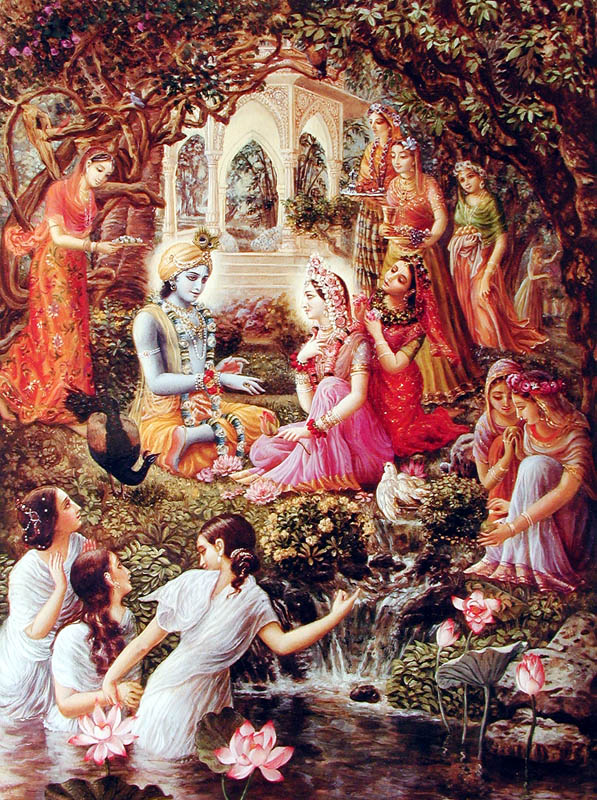
…The exemplary character of devotional service manifested by the devotees of Vṛndāvana is the purest type of devotion. It is enjoined in authoritative śāstra that devotional service must be ahaituka and apratihata. This means that devotional service to Kṛṣṇa cannot be checked by political or religious convention. The stage of devotional service is always transcendental. The gopīs particularly showed pure devotional service towards Kṛṣṇa, so much so that Kṛṣṇa Himself remained indebted to them. Lord Caitanya thus said that the devotional service manifested by the gopīs in Vṛndāvana excelled all other methods of approaching the Supreme Personality of Godhead.
Kṛṣṇa The Supreme Personality of Godhead 1970 Edition
By His Divine Grace A.C. Bhaktivedanta Swami Prabhupada
Vol.1, Chapter 31
Songs by the Gopīs
One gopī said, “My dear Kṛṣṇa, ever since You took Your birth in this land of Vrajabhūmi, everything appears to be glorious. The land of Vṛndāvana has become glorious, and it is as if the goddess of fortune is personally always existing here. But it is only we who are very unhappy, because we are searching for You, but cannot see You with our greatest effort. Our life is completely dependent upon You; therefore we request that You again come to us.”
More
25 May 2012
by The Hare Krishna Movement
in Krishna Consciousness, Lectures, Practicing Krishna Consciousness at Home
Tags: A.C. Bhaktivedanta Swami Prabhupada, Bg 7.8, bhagavad-gita, everywhere is Krishna, I am the light of Sun and Moon, I am the taste of water, Krishna consciousness, raso ham apsu kunteya, remembering Krishna, simple meditation, Srila Prabhupada, Srimad Bhagavatam

…Thus when a devotee drinks water or any other liquid, he immediately remembers Kṛṣṇa. For a devotee there is no difficulty in awakening Kṛṣṇa consciousness twenty-four hours a day. If you simply drink water, and practice the simple meditation of remembering that Krishna says in the Bhagavad-gita 7.8 “raso ‘ham apsu kaunteya prabhāsmi śaśi-sūryayoḥ”, “I am the taste of water, the light of the sun and the moon”. It is easy to remember Krishna (God)
Is there any land within this universe where there is no sunshine, moonshine? Everywhere. So where is the difficulty to become Kṛṣṇa conscious? You are practicing meditation. Why not this simple meditation?
“How I can think of Kṛṣṇa constantly? Kṛṣṇa says that you think of Kṛṣṇa while drinking water, you think of Kṛṣṇa when you see the sunshine, think of Kṛṣṇa when you see the moonshine, day and night. So at daytime there is sunshine, at night there is moonshine. So day and night you can think of Kṛṣṇa. So, so many ways…
Because our only business is to remember Kṛṣṇa. That we can do any stage of life. It does not require that you have to become a brāhmaṇa, an Indian, and so on, so on, great learned scholar in Vedic scripture. No. You may be in the far away country, in Europe, America, or you may not be in brāhmaṇa family. It doesn’t matter. But you can remember Kṛṣṇa. We are teaching this art through Kṛṣṇa consciousness, that you may remain in whichever position Kṛṣṇa has put you. It doesn’t matter. But try to understand Kṛṣṇa. “How can I understand?” Well, you are drinking water. You can understand Kṛṣṇa. Where is the difficulty? Raso ‘ham apsu kaunteya [Bg. 7.8]. Kṛṣṇa says that “I am the taste of water.” Then where there is a person who does not drink water? Is there any land where people do not drink water? Is there any land?
So many ways we can remember Kṛṣṇa always.
A devotee who has purified his existence through devotional service sees only Kṛṣṇa in every step of life. (Paraphrased from Lecture by His Divine Grace A.C. Bhaktivedanta Swami Prabhupada given in Vrndavan India August 17, 1974)
Full Bhagavad-gita verse 7.8 and Lecture follow More
24 May 2012
by The Hare Krishna Movement
in Srimad Bhagavatam, Sukadeva Goswami
Tags: A.C. Bhaktivedanta Swami Prabhupada, householder, material contamination, material distinctions, spiritual vision, Srila Prabhupada, Srila Sukadeva Gosvami, Srila Vyasadeva, Srimad Bhagavatam, Sukadeva Goswami, Vyasadeva

When Vyasadeva was following his son, Srila Sukadeva Gosvami, they came upon some damsels bathing in a pond, Sukadeva was also naked, yet the maidens did not cover themselves when he passed by. However, they did cover themselves when the fully-clad Vyasadeva approached. Astonished at the apparently inconsistent behavior of the young girls, Vyasadeva asked them to explain. “Your son is purified of all material contamination,” they said, “so when he looks at us he makes no distinction between male and female. But as a householder, you do make such distinctions. Therefore, while we feel no shame before your son, we must cover ourselves before you.
More
Previous Older Entries Next Newer Entries











 The Hare Krishna Movement