25 Jun 2013
by The Hare Krishna Movement
in Back to Godhead, Bhaktisiddhanta Sarasvati Thakura, Bhaktivinoda Thakura, Brahmananda das, Caitanya Mahaprabhu, Gaudiya Vaisnavism
Tags: A.C. Bhaktivedanta Swami Prabhupada, Back to Godhead Magazine, Bhaktisiddhanta Sarasvati, Brahmananda dasa, Brahmananda Swami, brahmanas, devotional service, lion guru, Lord Caitanya, netyananda-vamsa, Srila Bhaktisiddhanta, Srila Bhaktivinoda Thakur

This is Part 2 of the very informative article by Sriman Brahmananda Prabhu as it appeared in Back to Godhead Magazine in 1974, which gives not only some of the History of Lord Caitanya’s Mission, but on the preaching of Srila Bhaktivinoda Thakur, Srila Bhaktisiddhanta, Gaudiya Vaisnavism, and the Hare Krishna Movement here in the West.
How the Teachings of Lord Caitanya Came to the Western World
Excerpted from Back to Godhead Magazine
Vol.1, No. 68, 1974
Part 2
by His Holiness Brahmananda Svami
[Lord Caitanya Mahaprabhu, who is Krsna Himself in the form of His own pure devotee, appeared 500 years ago in Bengal, India, to teach—by His own example—how one can become fully Krsna conscious. The teachings of Lord Caitanya were recorded and transmitted by many faithful disciples, but they were virtually unknown in the West until 1896, when Srila Bhaktivinoda Thakura, a great spiritual master in the disciplic line from Lord Caitanya, published a short book entitled Sri Caitanya Mahaprabhu—His Life and Precepts and sent copies to the Western world. The following is the second of three articles depicting the pioneering efforts of Srila Bhaktivinoda Thakura, and those who have followed him, in spreading the great benediction of Krsna consciousness to the West.]
More
24 Jun 2013
by The Hare Krishna Movement
in A.C. Bhaktivedanta Swami Prabhupada, Ganges, Srimad Bhagavatam
Tags: A.C. Bhaktivedanta Swami Prabhupada, amartya, baby Krsna, Ganges, Ganges River, Gokula, Krsna's lotus feet, sacred rivers, sanctified, SB 1.19.6, Srimad Bhagavatam, transcendental, Tulasi, tulasi leaves, Yamuna, Yamuna river
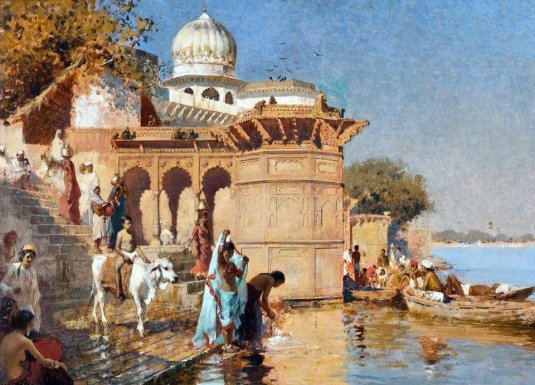
click on image to enlarge
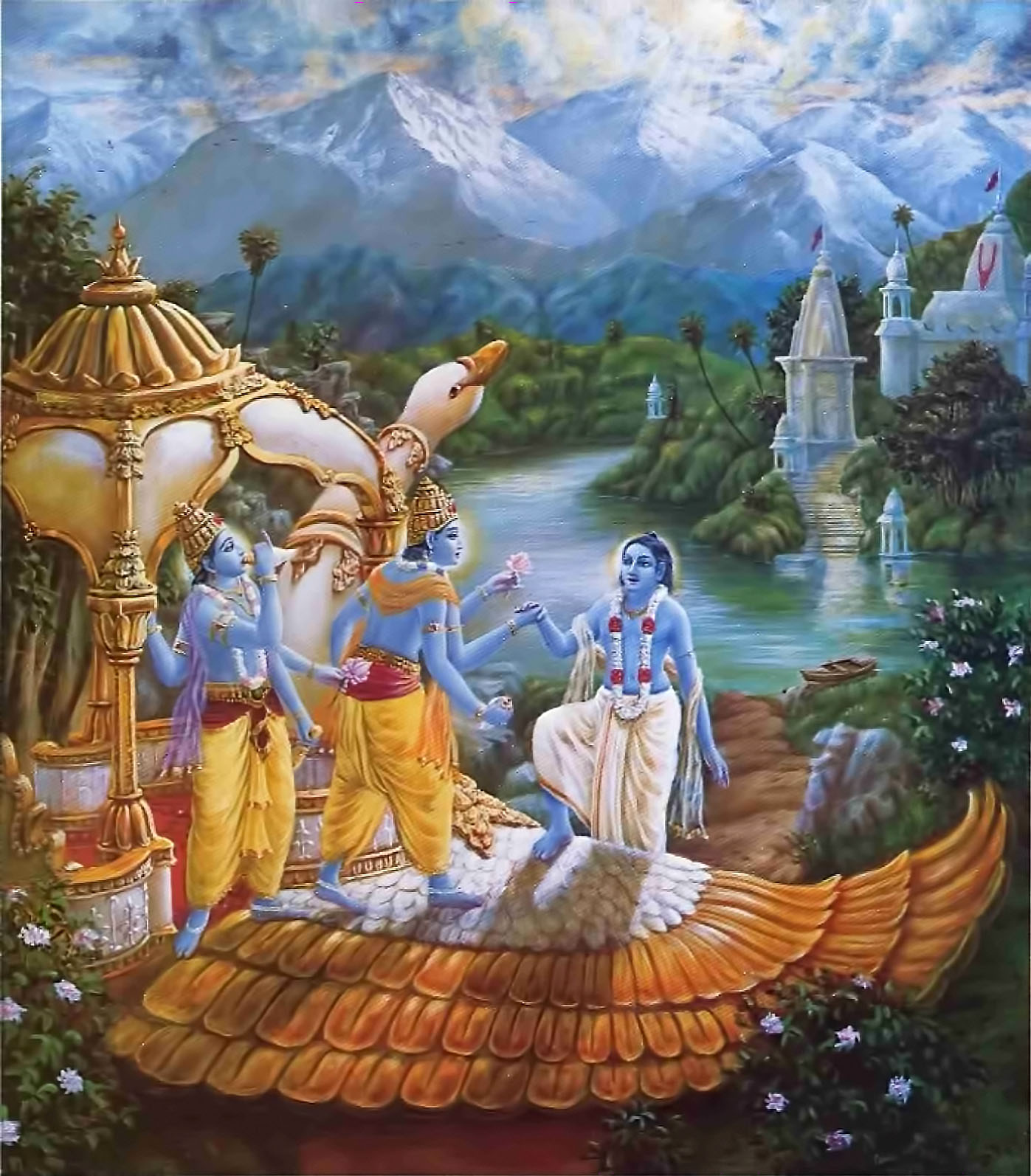
…Both the Ganges and the Yamunā are amartyā (transcendental) rivers, but the Yamunā is still more sanctified for the following reasons.
…And as far as sanctity is concerned, the River Yamunā is more directly connected with Lord Kṛṣṇa than the Ganges. The Lord sanctified the River Yamunā from the beginning of His transcendental pastimes in the world. While His father Vasudeva was crossing the Yamunā with the baby Lord Kṛṣṇa for a safe place at Gokula on the other bank of the river from Mathurā, the Lord fell down in the river, and by the dust of His lotus feet the river at once became sanctified. It is especially mentioned herein that Mahārāja Parīkṣit took shelter of that particular river which is beautifully flowing, carrying the dust of the lotus feet of Lord Kṛṣṇa, mixed with tulasī leaves. Lord Kṛṣṇa’s lotus feet are always besmeared with the tulasī leaves, and thus as soon as His lotus feet contact the water of the Ganges and the Yamunā, the rivers become at once sanctified. The Lord, however, contacted the River Yamunā more than the Ganges. (from purport to SB 1.19.6)
Full verse and purport More
22 Jun 2013
by The Hare Krishna Movement
in Back to Godhead, Bhaktivinoda Thakura, Brahmananda das, Gaudiya Vaisnavism
Tags: A.C. Bhaktivedanta Swami, Acaryas, age of quarrel, Back to Godhead Magazine, Bengali, Brahmananda dasa, Kali-yuga, Krsna, Lord Caitanya, sastras, scriptures, Srila Bhaktivinoda Thakur, Vedas
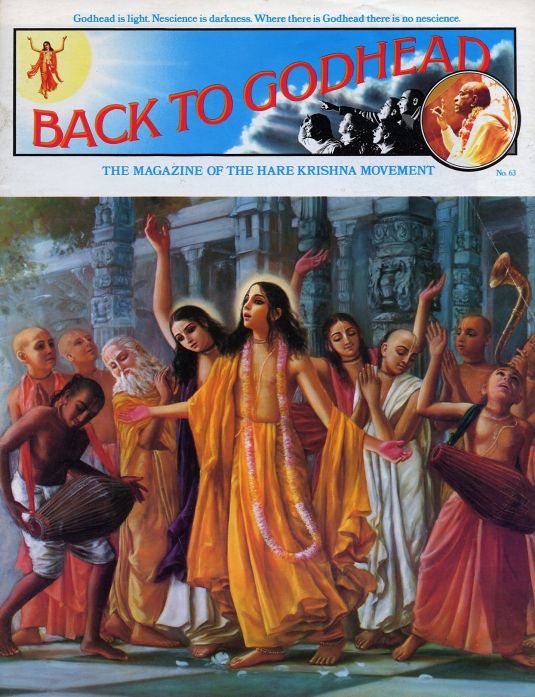
This is a very informative article which gives not only some of the History of Lord Caitanya’s Mission, but on the preaching of Srila Bhaktivinoda Thakur, Gaudiya Vaisnavism, and the Hare Krishna Movement here in the West.
How the Teachings of Lord Caitanya Came to the Western World
Excerpted from Back to Godhead Magazine
Vol.1, No. 66, 1974
Part 1
by His Holiness Brahmananda Swami
“He reasons ill who tells that Vaisnavas die When thou art living still in Sound! The Vaisnavas die to live and living try To spread a holy life around!”—verse by Srila Bhaktivinoda Thakura on the tomb of the great saint Thakura Haridasa at Puri, India
In Calcutta in 1896, the teachings of Lord Caitanya began their journey to the West. In Bengali-speaking Calcutta on August 20th of that year, Srila Bhaktivinoda Thakura published a small English treatise entitled Lord Caitanya—His Life and Precepts. Seventyone years later, in 1967, in Montreal, Canada, a graduate student came across a copy of this book while browsing through the rare-book collection of the McGill University library. The book was a wonderful find for him because he was a dedicated follower of Lord Caitanya’s, having been convinced of Lord Caitanya’s teachings by His Divine Grace A.C. Bhaktivedanta Swami Prabhupada, whom he had accepted as his spiritual master. Srila Prabhupada was born in Calcutta on September 1, 1896, only a few days after Lord Caitanya-His Life and Precepts was published. Thus by a transcendental arrangement this significant book and he who would fulfill the purpose of the book appeared together.
More
21 Jun 2013
by The Hare Krishna Movement
in A.C. Bhaktivedanta Swami Prabhupada, Govinda
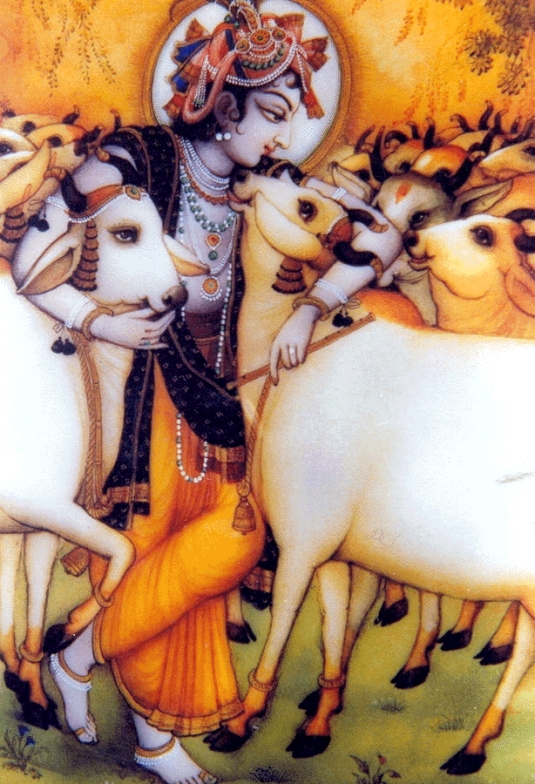
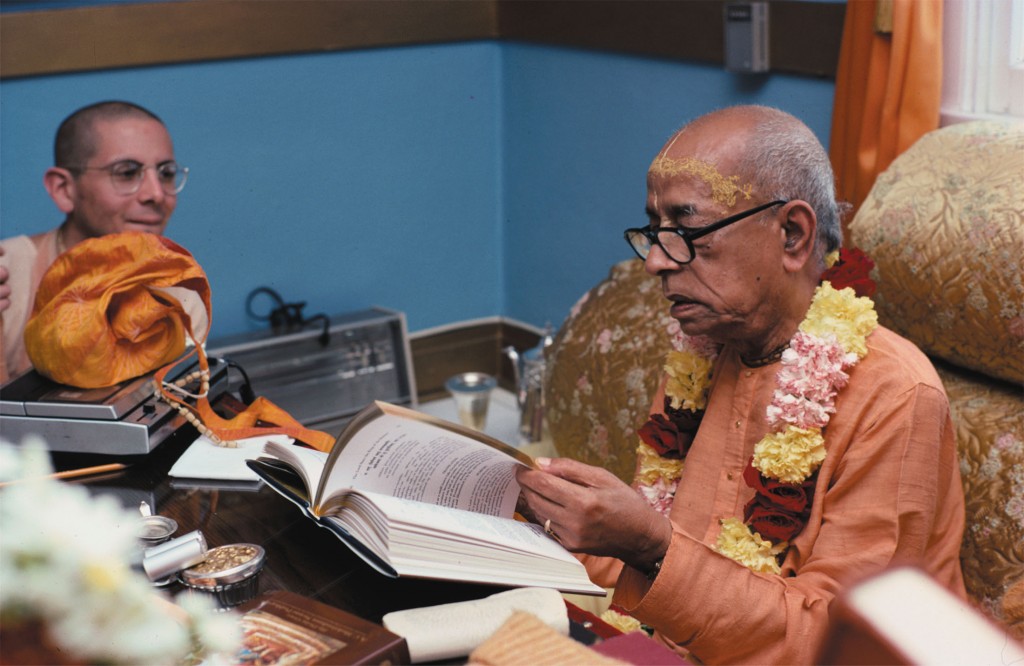
Sometimes when I am sitting and reading from Srila Prabhupada’s Srimad Bhagavatam, a verse or sentence from the purport just jumps out from the page almost like it is in 3D, and I catch a glimpse of what the Spiritual World must be like. It is beyond even my imagination, but sometimes I catch a glimmer of light, through a transcendental window, by the grace of my spiritual master His Divine Grace A. C. Bhaktivedanta Swami Prabhupada.
…The transcendental abode of the Lord where the trees are all desire trees and the buildings are made of touchstone. The Lord Govinda is engaged there in herding the surabhi cows as His natural occupation.
“I worship Govinda, the primeval Lord, the first progenitor who is tending the cows, yielding all desire, in abodes built with spiritual gems, surrounded by millions of purpose trees, always served with great reverence and affection by hundreds of thousands of lakṣmīs or gopīs.” (Bs 5.29)
…The Lord Govinda is engaged there in herding the surabhi cows as His natural occupation. And those who are artists, overtaken by the beautiful creation, should better see to the beautiful face of the Lord for complete satisfaction. The face of the Lord is the embodiment of beauty. What they call beautiful nature is but His smile, and what they call the sweet songs of the birds are but specimens of the whispering voice of the Lord.
More
19 Jun 2013
by The Hare Krishna Movement
in A.C. Bhaktivedanta Swami Prabhupada, Book Changes, Book Distribution, ISKCON, ISKCON History, Ramesvara das
Tags: A.C. Bhaktivedanta Swami Prabhupada, Baladeva Vidyabhusana das, BBT, Bhaktivedanta Book Trust, bood distribution, book changes, Iskcon, ISKCON history, Ramesvara das, Srila Prabhupada, Srila Prabhupada's books, The Hare Krishna Movement
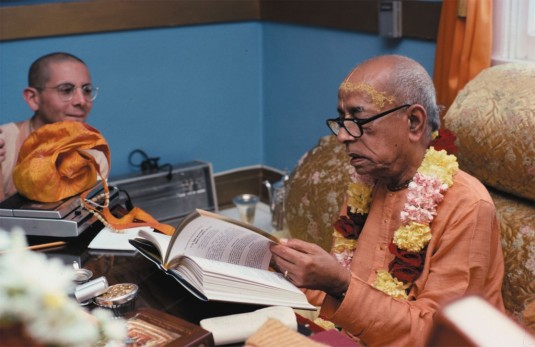
click on image to enlarge
In case anyone missed this important 1979 interview with Ramesvara Prabhu, on the History of ISKCON, Book Changes, Book Publication, etc., etc. We are re-posting again.
Testimonial by Ramesvara dasa
Ramesvara-interview-1979
A very, very important document has just become public. It is a 300+ page transcript of a 1979 interview betweem Baladeva Vidyabhusana Prabhu and Ramesvara Prabhu, the manager of the Bhaktivedanta Book Trust, the person who was directly in charge of printing Srila Prabhupada’s books durning that time. Ramesvara had many direct instructions from Srila Prabhupada in regard to printing his books, and he also gives an eye-witness account of many events that took place while Srila Prabhupada was physically present. Very interesting read!!!
You can download the PDF file of the interview by clicking on: Ramesvara-interview-1979
Or you can read the entire interview here… More
17 Jun 2013
by The Hare Krishna Movement
in A.C. Bhaktivedanta Swami Prabhupada, Hearing and Memorizing, Meditation, Nectar of Devotion
Tags: A.C. Bhaktivedanta Swami Prabhupada, causeless mercy, core of his heart, liberated, meditation, offering respectful obeisances, resultant actions of his past misdeeds, rightful claim, SB 10.14.8, SB 5.10.14, tat te nukampam

click on image to enlarge
This morning as I was reading from the Srimad Bhagavatam, I was feeling the aches and pains of age, and I was reminded of one of my most favorite verses:
tat te ‘nukampāṁ susamīkṣamāṇo
bhuñjāna evātma-kṛtaṁ vipākam
hṛd-vāg-vapurbhir vidadhan namas te
jīveta yo mukti-pade sa dāya-bhāk
“My dear Lord, any person who is constantly awaiting Your causeless mercy to be bestowed upon him, and who goes on suffering the resultant actions of his past misdeeds, offering You respectful obeisances from the core of his heart, is surely eligible to become liberated, for it has become his rightful claim.” (SB 10.14.8)
…A devotee of the Lord never thinks that he is a paramahaṁsa or a liberated person. He always remains a humble servant of the Lord. In all reverse conditions, he agrees to suffer the results of his past life. He never accuses the Lord of putting him into a distressed condition. These are the signs of an exalted devotee. Tat te ‘nukampāṁ susamīkṣyamāṇaḥ. When suffering reversed conditions, the devotee always considers that the reverse conditions are the Lord’s concessions. He is never angry with his master; he is always satisfied with the position his master offers. In any case, he continues performing his duty in devotional service. Such a person is guaranteed promotion back home, back to Godhead. (from purport)
When I did a computer search on the phrase “rightful claim”, this of course brought me to the different references from the Srimad Bhagavatam (ie., SB 5.10.14, and SB 8.14.13) but also to the “Nectar of Devotion”, chapter ten. Reading from it was so nice, that I decided to post the entire chapter. More
16 Jun 2013
by The Hare Krishna Movement
in A.C. Bhaktivedanta Swami Prabhupada, Books by Srila Prabhupada, Raja-Vidya
Tags: A.C. Bhaktivedanta Swami Prabhupada, beyond samsara, faith in guru and Krsna, great souls, knowledge through disciplic succession, Krsna's energies, mahatma, Raja-Vidya, the king of knowledge

This is the index to the Contents of “Raja-Vidya The King of Knowledge” by His Divine Grace A.C. Bhaktivedanta Swami Prabhupada. We have posted it here in its entirety. This index will give you immediate access to the chapters by clicking on the following underlined links. And for a free PDF download click on link at bottom of post.
Chapter One Raja – Vidya: The King of Knowledge
Chapter Two Knowledge Beyond Saṁsāra
Chapter Three Knowledge of Kṛṣṇa’s Energies
Chapter Four Knowledge by Way of the Mahātmās, Great Souls
Chapter Five Parampara: Knowledge Through Disciplic Succession
Chapter Six Knowledge of Kṛṣṇa’s Appearances and Activities
Chapter Seven Knowledge as Faith in Guru and surrender to Kṛṣṇa
Chapter Eight Action in Knowledge of Kṛṣṇa
For a free pdf download of Raja-Vidya The King of Knowledge; Raja-Vidya-The-King-of-Knowledge
14 Jun 2013
by The Hare Krishna Movement
in A.C. Bhaktivedanta Swami Prabhupada, Dedication Slokas, Srimad Bhagavatam
Tags: A.C. Bhaktivedanta Swami, collection of slokas, dedication slokas, krsne sva-dhamopagate, original books by srila prtabhupada, slokas, srila prabhupada slokas, Srimad Bhagavatam
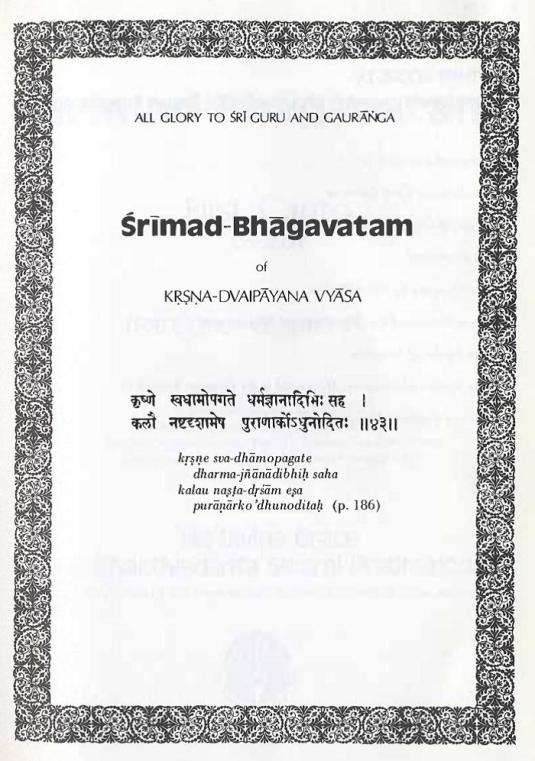
For anyone who has had the good fortune to read and study Srila Prabhupada’s epic Srimad Bhagavatam, will know that on the title page of each and every volume is a dedication sloka. I thought it would be interesting to compile a list of the dedication slokas from all of the original books. I stopped this collection of slokas with the Tenth Canto, Part Three, as this is where Srila Prabhupada left off, and where my collection of Srimad Bhagavatam’s stops. -Vyasasan das
More
14 Jun 2013
by The Hare Krishna Movement
in A.C. Bhaktivedanta Swami Prabhupada, Bhaktivinoda Thakura, Narada Muni, Narada Muni Bajay Vina
Tags: 24 hour kirtan, A.C. Bhaktiverdanta Swami Prabhupada, Haribol, Indra, Krishna's names, Narada Muni, narada muni bajay vina, New Vrindavan, Radhika-ramana, Srila Bhaktivinoda Thakur, vina

Narada Muni Bajay Vina
This is one of my favorite Vaisnava Songs, written by Srila Bhaktivinoda Thakura, with a puroprt by His Divine Grace A.C. Bhaktivedanta Swami Prabhupada. We post it today in honnor of the 24 Hour Kirtan that will start this evening at the New Vrindavan Community.
…This is a song sung by Bhaktivinoda Thakura. The purport of this song is that the great soul Narada Muni is playing on his stringed instrument, called the vina, and vibrating Radhika-ramana, one of Krsna’s names. So, as soon as he plucks the strings and chants, all the devotees immediately respond to him, and it becomes a very beautiful vibration. Amiya-dhara, barise ghana. As the singing goes on with the stringed instrument, it appears that there is a shower of nectar, and all the devotees then dance in ecstasy to the fullest extent of their satisfaction. Then, as they dance, it appears that they become intoxicated by drinking the beverage called madhuri pura. And as one becomes almost mad by drinking, similarly, all the devotees became mad in ecstasy. And some of them are crying, and some of them are dancing, and some of them, although they cannot dance publicly, are dancing within their hearts. Then Lord Siva embraces Narada Muni and begins to dance and cry out in ecstasy, and when Lord Brahma sees Lord Siva dancing with Narada Muni, he joins in and says, “All of you kindly chant ‘Haribol! Haribol!'” Then gradually the king of heaven, Indra, also joins in with great satisfaction and begins to dance and to chant “Hari hari bol!”
In this way, by the influence of the transcendental vibration of the holy name of God, the whole universe becomes ecstatic, and Bhaktivinoda Thakura says, “When the whole universe becomes ecstatic in this way, my desires are satisfied, and I therefore pray unto the lotus feet of Rupa Gosvami that the chanting of harinama may go on nicely like this.” (from purport)
Narada Muni Bajay Vina
by Srila Bhaktivinoda Thakura
Full song with Bengali lyrics, translation and purport. More
12 Jun 2013
by The Hare Krishna Movement
in A.C. Bhaktivedanta Swami Prabhupada, Ramesvara das, Remembering Srila Prabhupada, Srila Prabhupada
Tags: A.C. Bhaktivedanta Swami Prabhupada, Interview with Ramesvara Prabhu on Book Changes, Krsna Book, rose garden, Srila Prabhupada

Reading Krsna Book With Prabhupada
from; Interview with Ramesvara Prabhu on Book Changes 1979
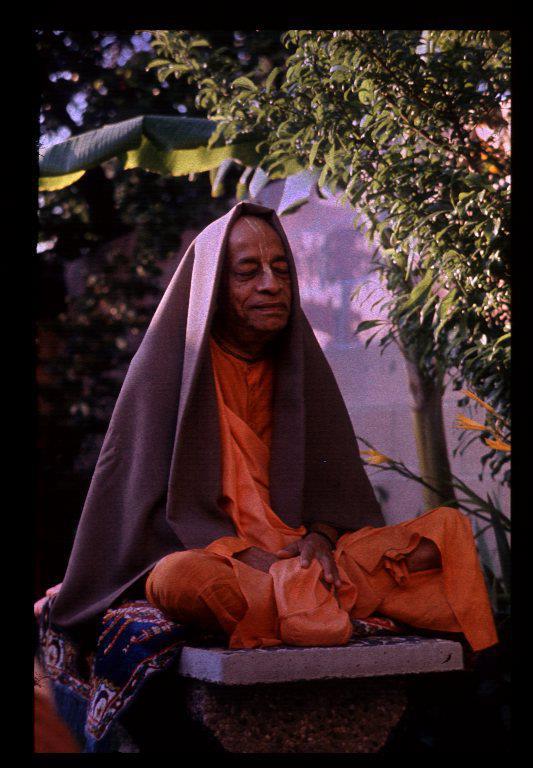
There’s a few more early incidents that I can remember. In Los Angeles on one of those early visits, probably ’73, we used to read the Krsna Book to Prabhupada every evening, he would sit in his garden. And it was just the most wonderful, intimate association with Prabhupada. And I used to marvel at the way Prabhupada would sit and listen to the Krsna Book. His head was looking up very erect, the way he was holding his body, and very grave, serious, sober look on his face. Very intense. Although it was so personal and ecstatic and informal, to just be with a handful of devotees reading the Krsna Book to Prabhupada, Prabhupada was showing us how to actually become absorbed in hearing of God. It wasn’t that…he was not in a light mood. He was in a heavy mood, like a great transcendental aristocrat. I’ll never forget how serious, how he was looking, so formal. Even though the mood was so informal. In that way he was showing us how to hear the Krsna Book.
for full interview; Interview with Ramesvara Prabhu on Book Changes
11 Jun 2013
by The Hare Krishna Movement
in A.C. Bhaktivedanta Swami Prabhupada, Dharma, Srimad Bhagavatam, Vaisnava Vocabulary
Tags: A.C. Bhaktivedanta Swami Prabhupada, adhoksaje, apratihata, His Divine Grace, Lecture by Srila Prabhupada, nivrtti-marga, path of renunciation, path of sense enjoyment, pravrtti-marga, sa vai pumsam paro dharmo, Srila Prabhupada

For some reason I woke up this morning thinking about this very important verse from the Srimad Bhagavatam;
sa vai puṁsāṁ paro dharmo
yato bhaktir adhokṣaje
ahaituky apratihatā
yayātmā suprasīdati
The supreme occupation [dharma] for all humanity is that by which men can attain to loving devotional service unto the transcendent Lord. Such devotional service must be unmotivated and uninterrupted to completely satisfy the self.
I was trying to recall the two occupational paths; the path of sense enjoyment, and the path of renunciation, and the sanskrit words for them. I remembered that the verse and purport was in the first canto, chapter two, so I looked it up and there was the two words my mind was searching for;
“The Vedas prescribe two different types of occupation for the human being. One is called the pravṛtti-mārga, or the path of sense enjoyment, and the other is called the nivṛtti-mārga, or the path of renunciation.”
Both good words for your vaisnava vocabulary. But anyway, as I was searching this verse, I realized just how important this particular verse was. Srila Prabhupada lectured on this verse 13 times. And in one Lecture given by His Divine Grace in Montreal, August 3rd, 1968, Srila Prabhupada begins by saying…
“The real aim of life is how to get satisfaction, full, complete satisfaction. And that satisfaction, complete satisfaction, can be achieved only by prosecution of devotional service. There is no other method. If you want to be happy, free from all cares and anxieties, then you have to engage yourself in devotional servece of the Lord. That will make you free from all material miseries. We are all seeking after that position, how to become completely happy. Our whole struggle for existence…Anyone, in any place, any country, they are all struggling how to become happy. This happiness of the mind, atma, is only possible when we are engaged in Krsna consciousness. That is the only remedy. There is no other alternative.” (Srimad Bhagavatam Lecture Aug. 3, 1968)
I guess this was what I needed to hear this morning before leaving for work.
Full text and purport More
09 Jun 2013
by The Hare Krishna Movement
in A.C. Bhaktivedanta Swami Prabhupada
Tags: 1972 Edition, A.C. Bhaktivedanta Swami Prabhupada, Arjuna, as it is, Bg. 11, bhagavad-gita, Chapter Eleven, Krishna, Krsna, prabhupada gita, spiritual master, Supreme Lord, Supreme Personality of Godhead, Universal Form
06 Jun 2013
by The Hare Krishna Movement
in Pranams, Songs of the Vaisnava Acaryas
Tags: A.C. Bhaktivedanta Swami Prabhupada, Jagannatha dasa babaji, Lord Caitanya, mangalacarana, om ajana-timirandhasya, pranams, sri guru pranama, sri-caitanya-mano-bistam, sri-varsabhanavi-devi, Srila Bhaktisiddhanta Sarasvati, Srila Bhaktivinoda, Srila Gaurakisora, Srila Rupa Goswami, vande ham

click on image to enlarge
One of the most used books in our temple room is the songbook. Everyday it seems, I am flipping through the “Songs of the Vaisnava Acaryas”, singing one of the many songs or reciting some of the numerous pranams (prayers) as part of my daily sadhana. The following post is the first 13 pages of songbook, which in my mind is a nice way to start the day and is a good prelude to other devotional service.
Pranams
from the Songs of the Vaisnava Acaryas More
05 Jun 2013
by The Hare Krishna Movement
in A.C. Bhaktivedanta Swami Prabhupada, Back to Godhead, Kali Yuga
Tags: A.C. Bhaktivedanta Swami Prabhupada, bhagavatam, chanting Hare Krishna, future, Hare Krishna, hypocrisy, kalau dasa-nidhe rajan, Kali-yuga, past, prediction, present, Srimad Bhagavatam

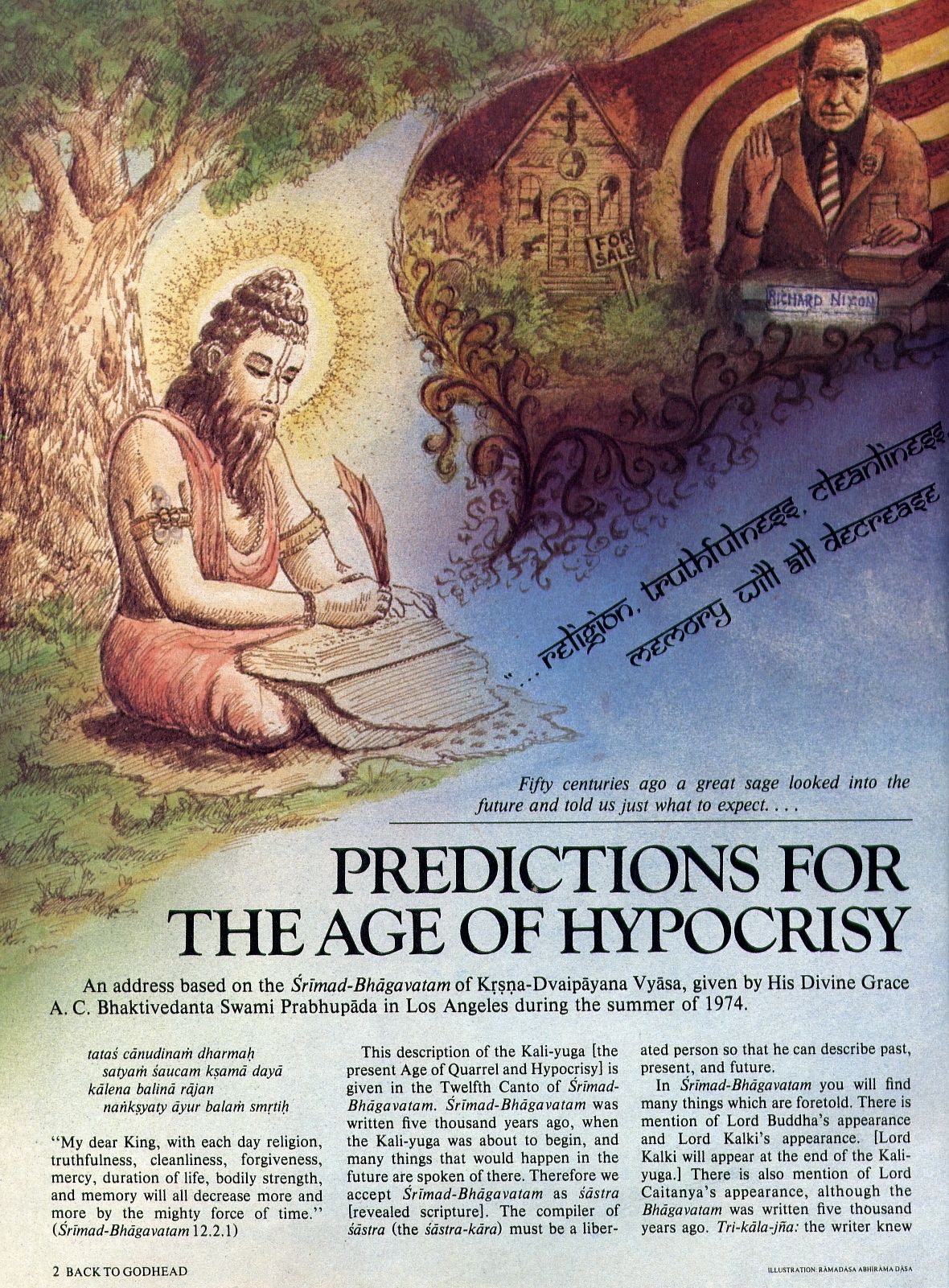
Predictions for the Age of Hypocrisy
Fifty centuries ago a great sage looked into the future and told us just what to expect. . .
An address based on the Srimad-Bhagavatam of Krsna-Dvaipayana Vyasa, given by His Divine Grace A.C. Bhaktivedanta Swami Prabhupada in Los Angeles during the summer of 1974.
Excerpted from Back to Godhead Magazine
tatas canu-dinam dharmah
satyam saucam ksama daya
kalena balina rajan
nanksyaty ayur balam smrtih
“My dear King, with each day religion, truthfulness, cleanliness, forgiveness, mercy, duration of life, bodily strength, and memory will all decrease more and more by the mighty force of time.” (Srimad-Bhagavatam 12.2.1)
This description of the Kali-yuga [the present Age of Quarrel and Hypocrisy] is given in the Twelfth Canto of Srimad-Bhagavatam. Srimad-Bhagavatam was written five thousand years ago, when the Kali-yuga was about to begin, and many things that would happen in the future are spoken of there. Therefore we accept Srimad-Bhagavatam as sastra [revealed scripture]. The compiler of sastra (the sastra-kara) must be a liberated person so that he can describe past, present, and future.
In Srimad-Bhagavatam you will find many things which are foretold. There is mention of Lord Buddha’s appearance and Lord Kalki’s appearance. [Lord Kalki will appear at the end of the Kali-yuga.] There is also mention of Lord Caitanya’s appearance, although the Bhagavatam was written five thousand years ago. Tri-kala-jna: the writer knew past, present, and future.
So here Sukadeva Gosvami is describing the chief symptoms of this age. He says, tatas canudinam: with the progress of this age (Kali-yuga), dharma, religious principles; satyam, truthfulness; saucam, cleanliness; ksama, forgiveness; daya, mercifulness; ayur, duration of life; balam, bodily strength; smrti, memory—these eight things will gradually decrease to nil or almost nil.
More
04 Jun 2013
by The Hare Krishna Movement
in A.C. Bhaktivedanta Swami Prabhupada, Chanting Hare Krishna, Sri Caitanya-Caritamrta
Tags: A.C. Bhaktivedanta Swami Prabhupada, Antya-lila 4.71, chanting Hare Krishna, Hare Krishna, holy name of the lord, Sri Caitanya-caritamrta, Srila Prabhupada, ten offenses
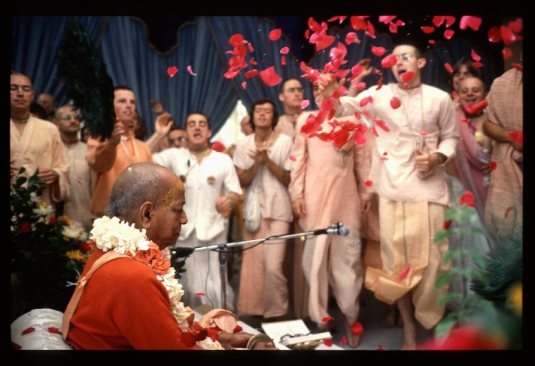
The Following is a very nice verse from the Sri Caitanya-caritamrta about the importance of Chanting the Holy Name of the Lord. Following that is the verse which describes the importance of chanting the names śrī-kṛṣṇa-caitanya prabhu-nityānanda before chanting the Hare Kṛṣṇa mahā-mantra, and the ten kinds of offenses which should be avoided.
…”Of the nine processes of devotional service, the most important is to always chant the holy name of the Lord. If one does so, avoiding the ten kinds of offenses, one very easily obtains the most valuable love of Godhead.” (Antya-lila 4.71)
Similarly, Śrīla Sanātana Gosvāmī has praised the chanting of the holy name as follows in his Bṛhad-bhāgavatāmṛta (Chapter One, verse 9)
“All glories, all glories to the all-blissful holy name of Śrī Kṛṣṇa, which causes the devotee to give up all conventional religious duties, meditation and worship. When somehow or other uttered even once by a living entity, the holy name awards him liberation. The holy name of Kṛṣṇa is the highest nectar. It is my very life and my only treasure.”
More
01 Jun 2013
by The Hare Krishna Movement
in A.C. Bhaktivedanta Swami Prabhupada, Bob Dylan, Srimad Bhagavatam
Tags: A.C. Bhaktivedanta Swami Prtabhupada, Bob Dylan, illusioned by material energy, liberated soul, Lord Krishna, Maharaja Yudhisthira, materially engrossed, one who is served, SB 1.12.6, sense gratification, servitor, song lyrics by Bob Dylan, You Gotta Serve Somebody
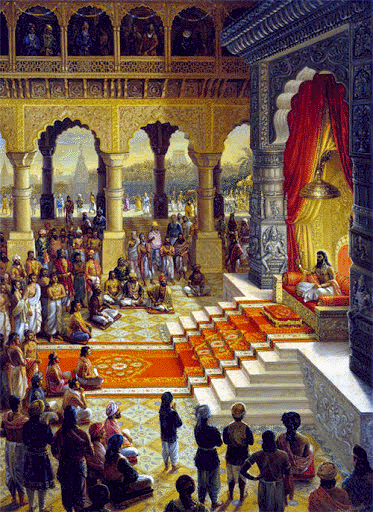
This morning as I was reading from the Srimad Bhagavatam 1.12.6 about Mahārāja Yudhiṣṭhira, who was the King and a liberated soul durning the time of Lord Krishna. How he did not take any pleasure in a his vast kingdom, good wife, obedient brothers, happy subjects and prosperous world. He was satisfied only by rendering loving service for the satisfaction of the Lord. As is stated in following verse:
O brāhmaṇas, the opulence of the King was so enchanting that the denizens of heaven aspired for it. But because he was absorbed in the service of the Lord, nothing could satisfy him except the Lord’s service.
As I was reading from the purport to this verse a song by Bob Dylan kept going through my head…
But you’re gonna have to serve somebody, yes indeed
You’re gonna have to serve somebody
Well, it may be the devil or it may be the Lord
But you’re gonna have to serve somebody
…which was kinda cool because it coincided with the reading. So I share with you, the complete verse and purport by Srila Prabhupada, as well as the song lyrics by Bob Dylan.
More
30 May 2013
by The Hare Krishna Movement
in A.C. Bhaktivedanta Swami Prabhupada, Letters by Srila Prabhupada, Practicing Krishna Consciousness at Home, Vegetarian Cooking, Vegetarianism
Tags: A.C. Bhaktivedanta Swami Prabhupada, nama om vishnu-padaya, namo maha-vadanyaya, namo rahmanya-devaya, offering food, offering food to the Lord, offering prasadam, Prasadam, prayer to Srila Prabhupada, spiritual master
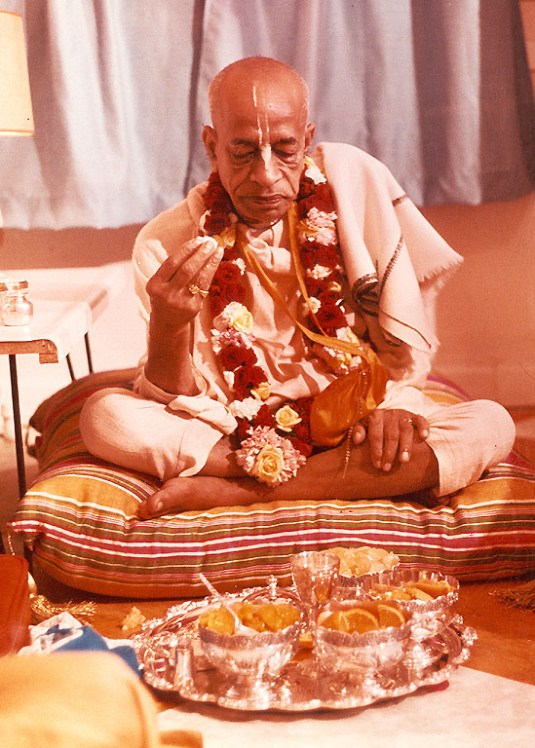
…For offering prasadam simply prayers to the Spiritual Master is sufficient. The process is that everything is offered to the Spiritual Master, and the Spiritual Master is supposed to offer the same foodstuff to the Lord. When a thing is offered to the Spiritual Master, he immediately offers to the Lord. That is the system, and as we come by parampara system, it is our duty to go through the right channel—namely, first the Spiritual Master, then Lord Caitanya, and then Krishna. So when we chant prayers, we do this, Vande ham Sri Guru . . . and gradually to the Goswamis, then to Lord Caitanya, and then to Radha Krishna. That is the praying system. But offering the prasadam to present everything before the Spiritual Master whose picture is also in the altar, means that the Spiritual Master will take care of offering the foodstuff to the Lord. Therefore simply by chanting the prayer to the Spiritual Master, everything will be complete. (Letter to Harer Nama May 28, 1968)
More
29 May 2013
by The Hare Krishna Movement
in A.C. Bhaktivedanta Swami Prabhupada, Bhagavad-gita, Prajah, Vaisnava Vocabulary
Tags: 84000000, A.C. Bhaktivedanta Swami Prabhupada, Bg 14/.4, bhagavad-gita, birth and death, kunteya, living being, material desires, material nature, material world, praja, sarva-yonisu, species of life

Here is a word for your vaisnava vocabulary; Prajah.
Prajā means the living being who has taken his birth in the material world. Actually the living being has no birth and no death, but because of his separation from the service of the Lord and due to his desire to lord it over material nature, he is offered a suitable body to satisfy his material desires. In doing so, one becomes conditioned by the laws of material nature, and the material body is changed in terms of his own work. The living entity thus transmigrates from one body to another in 8,400,000 species of life.
As Krishna points out in the Bhagavad-gita:
It should be understood that all species of life, O son of Kuntī, are made possible by birth in this material nature, and that I am the seed-giving father. (Bg 14-4)
Full verse and purport More
27 May 2013
by The Hare Krishna Movement
in A.C. Bhaktivedanta Swami Prabhupada, Book Distribution, Krsna Consciousness, Krsna Consciousness the Matchless Gift, Srimad Bhagavatam, The Hare Krishna Movement
Tags: A.C. Bhaktivedanta Swami Prabhupada, Book Distribution, devotees, heaven or hell, jnanis, karmis, krsna consciousness, Lord Nrsimhadeva, material adjustment, materialistic activity, meditate, prahlada, Prahlada Maharaja, sankirtan, SB 7.9.44, secluded place, Transcendental meditation

click on image to enlarge
…The Kṛṣṇa conscious person can go even to hell and still be happy. The pure devotee is never unhappy in any condition of life.
For a devotee, being situated in the heavenly planets and being in the hellish planets are equal, for a devotee lives neither in heaven nor in hell but with Kṛṣṇa in the spiritual world. The secret of success for the devotee is not understood by the karmīs and jñānīs. Karmīs therefore try to be happy by material adjustment, and jñānīs want to be happy by becoming one with the Supreme. The devotee has no such interest. He is not interested in so-called meditation in the Himalayas or the forest. Rather, his interest is in the busiest part of the world, where he teaches people Kṛṣṇa consciousness. The Kṛṣṇa consciousness movement was started for this purpose. We do not teach one to meditate in a secluded place just so that one may show that he has become very much advanced and may be proud of his so-called transcendental meditation, although he engages in all sorts of foolish materialistic activity.
A Vaiṣṇava is not interested in such a bluff of spiritual advancement. Rather, he is interested in enlightening people in Kṛṣṇa consciousness because that is the only way for them to become happy. One wanders within the universe, life after life, but by the grace of a devotee, a servant of Śrī Caitanya Mahāprabhu, one can get the clue to Kṛṣṇa consciousness and then not only become happy in this world but also return home, back to Godhead. That is the real target in life… The members of the Kṛṣṇa consciousness movement must be fully convinced that without Kṛṣṇa one cannot be happy. Thus the Kṛṣṇa conscious person avoids all kinds of pseudo spiritualists, transcendentalists, meditators, monists, philosophers and philanthropists. (from Purport to SB 7.9.44)
Full Verse and Purport More
26 May 2013
by The Hare Krishna Movement
in A.C. Bhaktivedanta Swami Prabhupada, Krishna, Krishna Consciousness, Nectar of Devotion
Tags: A.C. Bhaktivedanta Swami Prabhupada, devotees, linking up with the Lord, Nectar of Devotion, perfection, perfectional stage of meeting krsna, Radha-Krsna, Radharani, Rupa Goswami, satisfaction, Srimati Radharani, steadiness, Yamuna, yoga

click on image to enlarge
…When Kṛṣṇa and His devotees meet, the meeting is technically called yoga, or linking up with the Lord. Such meetings between Kṛṣṇa and His devotees can be divided into three classes-namely, perfection, satisfaction, and steadiness. When the devotee meets with Kṛṣṇa in great eagerness, that state of meeting is called perfection.
An example of this perfectional stage of meeting Krishna can be found in the words of Srimati Radharani in this very nice verse;
Rādhārāṇī told Her companion, “My dear friend, I was just going to the bank of the Yamunā, and all of a sudden a very nice boy whose complexion is like a dark blue cloud became visible in front of My eyes. He glanced over Me in a way that I cannot describe. But since this has occurred, I am sorry that I can no longer engage My mind in the duties of My household affairs.”
The following is Chapter 39 from the Nectar of Devotion More
Previous Older Entries Next Newer Entries











 The Hare Krishna Movement