14 May 2011
by The Hare Krishna Movement
in Lectures, Sri Caitanya-Caritamrta
Tags: Caitanya Caritamrta, Goswami, immortal, International Society for Krishna Consciousness, Krsnadas Kaviraja, living force, living force in immortality, material condition, Srila Prabhupada

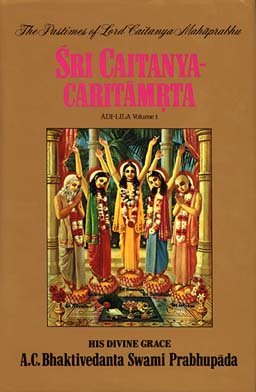
Sri Caitanya-caritāmṛta
By HIs Divine Grace A.C. Bhaktivedanta Swami Prabhupada
(Originally delivered as five morning lectures on the Caitanya-caritāmṛta-the authoritative biography of Lord Caitanya Mahāprabhu by Kṛṣṇadāsa Kavirāja Gosvāmī-before the International Society for Krishna Consciousness, New York City, April 10-14, 1967.)
Introduction
The word caitanya means “living force.” As living entities, we can move, but a table cannot because it does not possess living force. Movement and activity may be considered signs or symptoms of the living force. Indeed, it may be said that there can be no activity without the living force. Although the living force is present in the material condition, it is not amṛta, immortal. The words caitanya-caritāmṛta, then, may be translated as “the character of the living force in immortality.”
But how is this living force displayed immortally? It is not displayed by man or any other creature in this material universe, for none of us are immortal in these bodies. We possess the living force, we perform activities, and we are immortal by our nature and constitution, but the material condition into which we have been put does not allow our immortality to be displayed. It is stated in the Kaṭha Upaniṣad that eternality and the living force belong both to ourselves and God. Although this is true in that both God and ourselves are immortal, there is a difference. As living entities, we perform many activities, but we have a tendency to fall down into material nature. God has no such tendency. Being all-powerful, He never comes under the control of material nature. Indeed, material nature is but one display of His inconceivable energies.
From the ground we may see only clouds in the sky, but if we fly above the clouds we can see the sun shining. From the sky, skyscrapers and cities seem very tiny; similarly, from God’s position this entire material creation is insignificant. The tendency of the conditioned living entity is to come down from the heights, where everything can be seen in perspective. God, however, does not have this tendency. The Supreme Lord is not subject to fall down into illusion (māyā), any more than the sun is subject to fall beneath the clouds. Because the Supreme Lord is not subject to illusion, He is unconditioned; because we, as finite living entities, are prone to fall into illusion, we are called conditioned. Impersonalist philosophers (Māyāvādīs) maintain that both the living entity and God Himself are under the control of māyā when they come into this material world. This may be true of the living entity, but it is not true of God, for in all instances the material energy is working under His direction. Those who think the Supreme Lord is subject to material conditioning are called fools by Kṛṣṇa Himself in the Bhagavad-gītā (9.11):
More
13 May 2011
by The Hare Krishna Movement
in Bhagavad-gita, Devotee's, Free Downloads, Krishna Kirtan das
Tags: as it is, Bhagavad-gita in Portuguese, Krishna Kirtan das, original 1972, prabhupadanugas, Srila Prabhupada
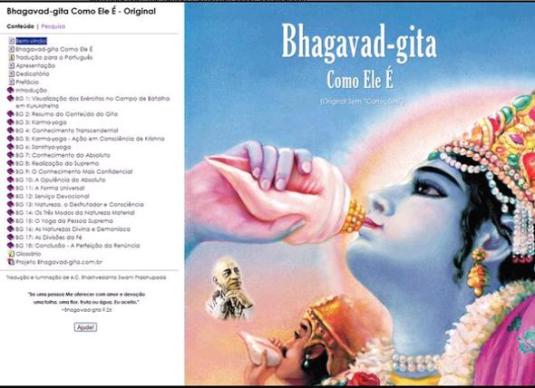
Bhagavad-gita As It Is (Original) in Portuguese!
By: Krishna Kirtan das
www.bhagavad-gita.com.br
The Bhagavad-gita.com.br project is born with the purpose of disclosing the famous and unique “Bhagavad-gita As It Is” (“Bhagavad-gita Como Ele É “) of A.C. Bhaktivedanta Swami Prabhupada to the population of the Portuguese language.
There is not enough words of gratitude to thank Sriman Visvavandya Prabhu for this magnificent, accurate, and genuine translation of the original Bhagavad-gita As It Is from 1972. Only due to his dedication and sincerity we can now read and admire the Bhagavad-gita as it really is, and as never before available in Portuguese. This is a translation of the original version of Bhagavad-gita As It Is (1972) from the original English version, without any change, addition, or extrapolation.
This Portuguese version of the Bhagavad-gita As It Is (1972) of A.C. Bhaktivedanta Swami Prabhupada is an unprecedented and unique event, and deserves your complete attention and observation. When you start reading this translated Portuguese version of the Bhagavad-gita As It Is you will immediately realize and start to experience the incredible clarity, purity, and accuracy of the words chosen by Srila Prabhupada, and will start seeing the full clarity and precision of his commentaries and of his translation from original Sanskrit verses, in their full form and unadulterated beauty.
The original Bhagavad-gita As It Is (1972) is now recognized and highly desired for the sincere study of the Bhagavad-gita. Srila Prabhupada himself lectured by reading directly from this version of the Gita, and he was also pleased with his own work. A large segment of the Vaishnava community in the world today is beginning more and more to recognize the immense value to humanity that is the original version of Bhagavad-gita As It Is from 1972.
Bhagavad-gita Como Ele É – Online
www.bhagavad-gita.com.br
With your help, this project can be expanded and improved.
Ideas such as integration with Facebook, interactive commentary, audio/video of the verses, lectures, online courses, and visual mapping technology for the study of topics, are just some of the ideas and concepts that the project has for the future.
(Find us on Facebook also at www.facebook.com/gita.1972)
If you like the project and the idea and want to contribute, please feel free. Your help is very welcome.
Only with the grace of Guru and Krishna, and with the blessings of the Vaishnavas, that everything is possible!
Om Tat Sat.
A servant and friend,
Krishna Kirtan
Pasted from
12 May 2011
by The Hare Krishna Movement
in Letters by Srila Prabhupada, Sriman George Harrison, Syamasundara das
Tags: bhagavad-gita, Krishna Cconsciousness, My Sweet Lord, Srila Prabhupada, Sriman George Harrison, Syamasundara dasa, The Beatles
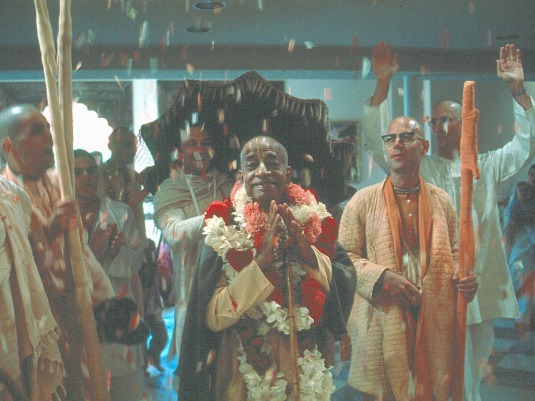
Los Angeles
14 May, 1970
70-05-14
c/o George Harrison
Oxfordshire, England
My Dear Syamasundara
Please accept my blessings. I beg to acknowledge receipt of your letter dated 7th May, 1970, written on Hare Krishna stationery of George Harrison. My hearty thanks are to George Harrison because now he is chanting Hare Krishna so enthusiastically. May Krishna bless him more and more, and he may advance in Krishna consciousness.
So as suggested by you I am deleting the words “of the famous Beatles”, and simply putting his name and his present transcendental change by chanting Hare Krishna. In the Preface the one paragraph is being replaced by the following words, suggested by him.
“If there is a God, I want to see Him. It’s pointless to believe in something without proof, and Krishna Consciousness and meditation are methods where one can actually obtain ‘God perception.’ You can actually see God, and hear Him, play with Him. And He is actually there, actually with you.”
More
12 May 2011
by The Hare Krishna Movement
in Krishna Consciousness, Madhudvisa das, The Hare Krishna Movement, What Happened to the Hare Krishna's?
Tags: Book Distribution, Krishna consciousness, Lord Caitanya, Madhudvisa dasa, sankirtan, Srila Prabhupada, The Hare Krishna's Go West, Visnujhana Swami, What Happened to the Hare Krishna's

What Happened to the Hare Krishna’s
By Sriman Madhudvisa Prabhu
Lord Caitanya Mahaprabhu desired this chanting of Hare Krishna and dancing in ecstasy be spread all over the world, in fact he predicted that one day the whole world will dance in ecstasy to this chanting of Hare Krishna. Until His Divine Grace A.C. Bhaktivedanta Swami Prabhupada left India for the United States in 1965 no one in India could imagine how the prediction of Lord Caitanya could come true.
The following is a continuation of the fine booklet compiled by Sriman Madhudhvisa Prabhu which he has kindly allowed us to publish from this site.
The Hare Krishna’s Go West
At the age of sixty nine, Srila Prabhupada travelled to the United States with nothing but a few dollars and a stock of Srimad Bhagavatam volumes he had translated and printed in India, along with his most valuable asset, unflinching faith in Krishna and the order of his spiritual master.
In the United States Srila Prabhupada established the International Society for Krishna Consciousness(ISKCON) in accordance with instructions of His Divine Grace Srila Bhaktisiddhanta Sarasvati Thakur, his spiritual master. Srila Bhaktisiddhanta instructed Srila Prabhupada to present the philosophy of Krishna consciousness in English and to preach in the Western countries.
Although Srila Bhaktsiddhanta Sarasvati Thakura, my beloved eternal spiritual master, guide and friend, according to material vision passed away from this material world on the last day of December, 1936, I still consider His Divine Grace to be present with me by his vani, his words. there are two ways of association – by vani and vapu. Vani means words and vapu means physical presence. Physical presence is sometimes appreciable and sometimes not, but vani continues to exist eternally. Therefore we must take advantage of the vani, not the physical presence. Bhagavad-gita, for example, is the vani of Lord Krishna. Although Krishna was personally present five thousand years ago and is no longer physically present from the materialistic point of view, Bhagavad-gita continues. (CC Ant p319)
Srila Prabhupada, after studying the Americans and their way of life, moved to the Bowery, and later to the Lower East Side in New York. At this time the ‘Hippy’ movement was emerging and many dissatisfied young people had started moving to the area. These young Americans were unimpressed with the materialistic lifestyles of their parents, they were concerned about America’s involvement in the Vietnam war and the proliferation of nuclear weapons. They were looking for an answer. They wanted peace, love and happiness and with this vague notion they converged on the Lower East Side of New York in search of utopia. For many of these ‘flower children’ Srila Prabhupada provided just what they were looking for. A spiritual lifestyle, peace, happiness and a real purpose in life. Srila Prabhupada’s method was simple. He sat underneath a tree in the park and chanted the Hare Krishna mantra, spoke on Bhagavad-gita As It Is and distributed prasadam (food spiritualized by offering to Krishna). He saw no distinction between people, young or old, black or white, man or woman; to Prabhupada they were all spirit souls who were lost in the bewildering network of this material world. His only desire was to help these lost souls find their way back to Krishna, their eternal father. He knew that they were suffering because of forgetfulness of their eternal relationship with Krishna, and as a humble servant of Krishna he was just trying to give them the right direction so they could reestablish that lost relationship with Krishna. This simple program gradually attracted many sincere young boys and girls to Krishna consciousness.
More
12 May 2011
by The Hare Krishna Movement
in Six Goswamis
Tags: Sampradaya Acharyas, six goswami's, Sri Jiva Goswami, Sri Raghunatha Batta Goswami, Sri Raghunatha Bhatta Goswami, Sri Raghunatha dasa Goswami, Sri Rupa Goswami, Sri Sanatana Goswami
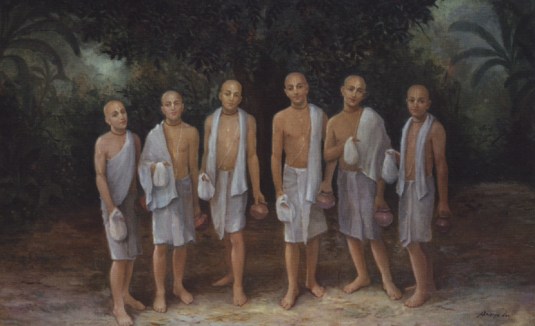
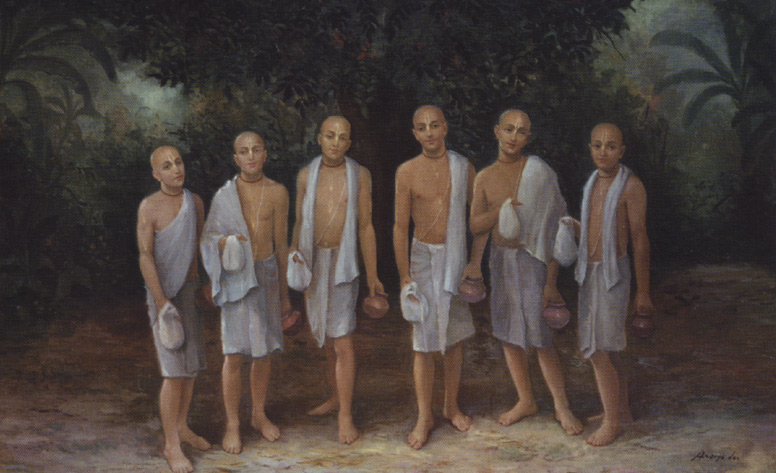
“I offer my respectful obeisances unto the six Gosvamis–Sri Rupa Gosvami, Sri Sanatana Gosvami, Sri Raghunatha Bhatta Gosvami, Sri Raghunatha dasa Gosvami, Sri Jiva Gosvami, and Sri Gopala Bhatta Gosvami–who cast off all aristocratic association as insignificant. To deliver poor, conditioned souls, they accepted loincloths and became mendicants, but they were always merged in the ecstatic ocean of the gopis’ love for Krsna, and they were always bathing repeatedly in the waves of that ocean.”
“The six Gosvamis, namely, Sri Sanatana Gosvami, Sri Rupa Gosvami, Sri Raghunatha Bhatta Gosvami, Sri Raghunatha dasa Gosvami, Sri Jiva Gosvami, and Sri Gopala Bhatta Gosvami, are very expert in scrutinizingly studying the revealed scriptures with the aim of establishing eternal religious principles for the benefit of all human beings. They are always absorbed in the mood of the gopis and are engaged in the transcendental loving service of Radha and Krsna.” (Sad-gosvamy-astaka 2)
More
12 May 2011
by The Hare Krishna Movement
in Devotional Service, Srimad Bhagavatam
Tags: devotional service, fearfulness, illusion, loving Krsna, Srila Prabhupada, Srimad Bhagavatam, submissive hearing, Supreme Personality of Godhead, transcending worldly miseries, Vedic literature
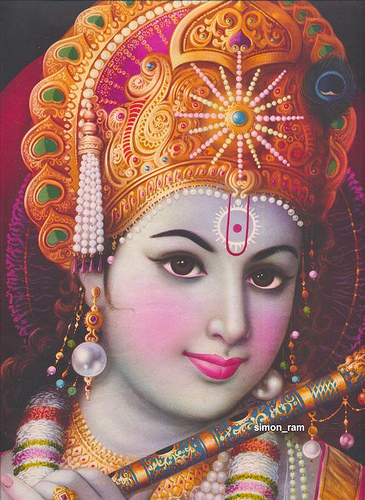
Srimad Bhagavatam
By His Divine Grace A.C. Bhaktivedanta Swami Prabhupada
Canto 1, Chapter 7, Text 7
The conclusion is that simply by hearing the Vedic literature Śrīmad-Bhāgavatam, one can have direct connection with the Supreme Personality of Godhead Śrī Kṛṣṇa, and thereby one can attain the highest perfection of life by transcending worldly miseries, illusion and fearfulness. These are practical tests for one who has actually given a submissive hearing to the readings of the Śrīmad-Bhāgavatam.
TEXT 7
yasyāṁ vai śrūyamāṇāyāṁ
kṛṣṇe parama-pūruṣe
bhaktir utpadyate puṁsaḥ
śoka-moha-bhayāpahā
SYNONYMS
yasyām—this Vedic literature; vai—certainly; śrūyamāṇāyām—simply by giving aural reception; kṛṣṇe—unto Lord Kṛṣṇa; parama—supreme; pūruṣe—unto the Personality of Godhead; bhaktiḥ—feelings of devotional service; utpadyate—sprout up; puṁsaḥ—of the living being; śoka—lamentation; moha—illusion; bhaya—fearfulness; apahā—that which extinguishes.
TRANSLATION
Simply by giving aural reception to this Vedic literature, the feeling for loving devotional service to Lord Kṛṣṇa, the Supreme Personality of Godhead, sprouts up at once to extinguish the fire of lamentation, illusion and fearfulness.
PURPORT
There are various senses, of which the ear is the most effective. This sense works even when a man is deep asleep. One can protect himself from the hands of an enemy while awake, but while asleep one is protected by the ear only. The importance of hearing is mentioned here in connection with attaining the highest perfection of life, namely, getting free from three material pangs. Everyone is full of lamentation at every moment, he is after the mirage of illusory things, and he is always afraid of his supposed enemy. These are the primary symptoms of material disease. And it is definitely suggested herein that simply by hearing the message of Śrīmad-Bhāgavatam one gets attachment for the Supreme Personality of Godhead Śrī Kṛṣṇa, and as soon as this is effected the symptoms of the material diseases disappear. Śrīla Vyāsadeva saw the all-perfect Personality of Godhead, and in this statement the all-perfect Personality of Godhead Śrī Kṛṣṇa is clearly confirmed.
More
11 May 2011
by The Hare Krishna Movement
in Diksha, Iskcon Bangalore, Siksa, The Struggle for Truth
Tags: Bangalore court case, direct written order of the Founder Acharya, Founder Acarya, GBC elected representatives, ISKCON Bangalore, ISKCON News, Nara Narayana Visvakarma, Srila Prabhupada, Sun

Sometime back there was a News article posted on ISKCON News entiltled “Bangalore Splinter Group Wins Court Case”. And a rebutal letter written by Sriman Nara Narayana Visvakarma Prabhu, which we think is still relavant today, as the battle continues…”
Although Bangalore represents a minority of ISKCON it is actually uniquely faithful to the direct written order of the Founder Acharya of ISKCON that the GBC be elected representatives of the temples, not unaccountable dictators with despotic powers.
Comments on ISKCON News Article
By: Nara Narayana Visvakarma
Apr 21, LOS ANGELES, CALIFORNIA (SUN) — On April 20, 2009, ‘ISKCON News Weekly’ published an article entitled, “Bangalore Splinter Group Wins Court Case. “Bangalore, INDIA – In the latest development in the longstanding feud between the International Society for Krishna Consciousness (ISKCON)”
Both parties are ISKCON, the Bombay faction deviated from the teachings of the Founder Acharya by creating a group of self-appointing managers who even claim ecclesiastical power and who wield illegal dictatorial powers over the innocent membership of ISKCON.
The actual GBC is meant to be an elected body representing the heads of the independent temples who the GBC are meant to represent. The Bombay ISKCON GBC as well as the Bangalore GBC were created by the Founder Acharya of ISKCON in 1970. Since that time, few temples besides Bangalore and their 28 affiliate temples have recognized the elected status of the GBC, and have actually held GBC elections. The GBC suing Bangalore, has not legal status to exist, and has clearly deviated from the charter under which they were created in 1970.
Bangalore is being sued for obeying the order of the Founder Acharya of ISKCON. Nothing more and nothing less.
“…and a breakaway group of devotees who took over the prominent ISKCON temple here, a City Civil Court issued a ruling in favor of the splinter group on Friday, April 17. The decision seems to be a blow to ISKCON and its leadership in India, although sources close to ISKCON leadership in India indicate that the organization plans to appeal the decision.”
Although Bangalore represents a minority of ISKCON it is actually uniquely faithful to the direct written order of the Founder Acharya of ISKCON that the GBC be elected representatives of the temples, not unaccountable dictators with despotic powers.
More
10 May 2011
by The Hare Krishna Movement
in Books by Srila Prabhupada, Srimad Bhagavatam
Tags: His Divine Grace A.C. Bhaktivedanta Swami Prabhupada, original pre-1978, Set, Srila Prabhupada wholesale, Srimad Bhagavatam
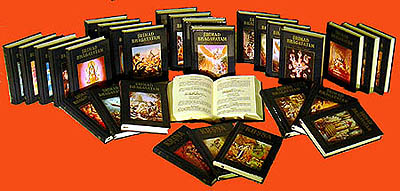 Srimad Bhagavatam Compact 30 Vol 1977 Edition
Cantos 1-9, plus the Original Krsna Book in 3 Volumes comprising the 10th Canto
Srimad Bhagavatam , an “Epic Philosophical and Literary Classic”, holds a prominent position in India’s voluminous written wisdom. The timeless wisdom of India is expressed in the Vedas, ancient Sanskrit texts that touch upon all fields of human knowledge. Originally preserved through oral tradition, the Vedas were first put into writing by Srila Vyasadeva, the “literary incarnation of God.” After compiling the Vedas, Srila Vyasadeva was inspired by his spiritual master to present their profound essence in the form of Srimad-Bhagavatam. Known as “the ripened fruit of the tree of Vedic Literature, Srimad-Bhagavatam is the most complete and authoritative exposition of Vedic Knowledge.
This 12,000 page, 30 vol. set, comes in High Quality Hard Bound 5×7 size. with over 600 beautiful full color plates.
For a limited time selling at the reduced Wholesale rate of $149.95
No home library is complete without a set.
Get one today!
Go to http://www.theharekrishnamovement.com To buy a set online!
09 May 2011
by The Hare Krishna Movement
in Arsha Prayoga, Book Changes, Locanananda das
Tags: Acharya, Arsha Prayoga, BBT, book changes, books by His Divine Grace A.C. Bhaktivedanta Swami Prabhupada, Krishna, Locanananda das, revolution in consciousness, spiritual master, spiritual potency, Srila Prabhupada, The Hare Krishna Movement
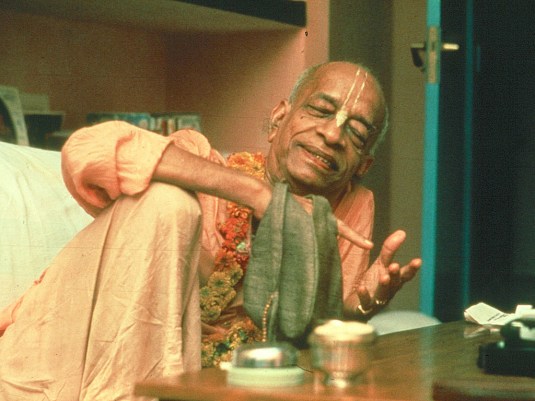
Arsha Prayoga – Part IV
By Sriman Locanananda Prabhu
For those who saw the Hare Krishna movement spread from city to city and from country to country, it was clear that the original version of Srila Prabhupada’s books was full of spiritual potency and did not require to be changed in any way for his words to act upon the hearts of the conditioned souls.
The question as to whether the writings of the Acharya may or may not be revised by his disciples after his disappearance is answered by the rule of arsha-prayoga.
This principle states that one should not see mistakes in what the spiritual master has written or think that his writings may be changed to make them more effective or politically correct. To preserve his teachings in their originally published form is the way by which the Acharya is honored, and to do otherwise is to dishonor him. That is the rule of arsha-prayoga, a principle that devoted followers of a bona fide spiritual master must adhere to without deviation.
The rationale for changing Srila Prabhupada’s books was based on a series of false arguments, many of which were defeated by Srila Prabhupada himself as this article will show. To justify their actions, the BBT editors created the illusion that Srila Prabhupada’s books were defective and in need of extensive editing even though they knew His Divine Grace had never authorized anyone to revise his books after his disappearance. Subsequent to his departure, they conveniently overlooked the principle of arsha-prayoga and proceeded to do exactly what Vaishnava tradition strictly prohibits.
More
07 May 2011
by The Hare Krishna Movement
in Devotee's, Jayananda Thakur
Tags: GBC, Iskcon, Jayananda, Krishna-Mangala das, Mayapur, memorial for Jayananda Prabhu, Srila Prabhupada, Vishoka das
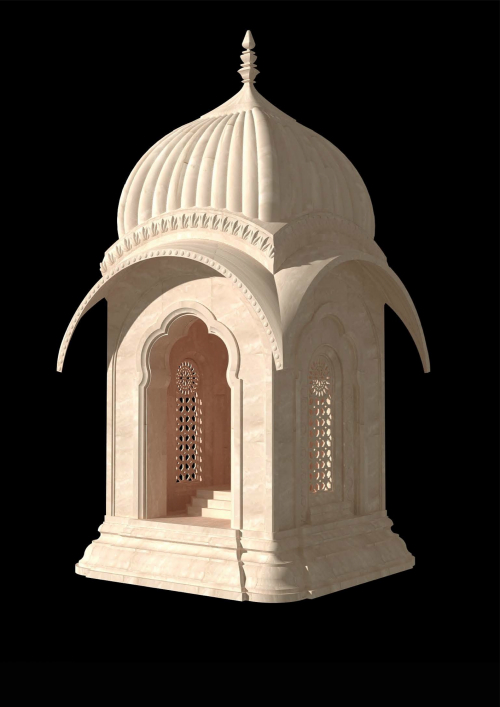
Memorial to be Built for Jayananda Prabhu in Mayapur
By Madhava Smullen for ISKCON News on 9 Apr 2011
ISKCON’s Governing Body Commission has accepted a proposal from Vishoka Dasa of New Vrindaban, West Virginia, and Krishna-Mangala Dasa of Russia that they establish a memorial for Jayananda Prabhu—considered a modern-day saint by members of ISKCON—although he passed away as far back as 1977.
“The GBC Body hereby thanks Vishoka Das and Krishna Mangala Das for their kind endeavors in this regard and offers its blessing for the successful completion of the project,” stated Resolution 303 in the official GBC minutes of this year’s meetings in Mayapur, India.
Jayananda’s Memorial, or Samadhi, will be located at the ISKCON Jagannath temple in Rajapur, near Mayapur. “As Jayananda prabhu’s service to Lord Jagannatha is universally recognized, the GBC felt that it would both be an extra honor and most appropriate for his Samadhi memorial to be located at the Jagannatha Mandir,” read the GBC report.
Jayananda’s Samadhi will be around seven feet tall, and constructed from marble. Early renderings of the design, by a professional devotee designer, show it to be a smaller version of the samadhis of Vaishnava Acharyas such as Rupa and Sanatan Goswamis, with a curved roof and latticed windows.
The Mayapur Samadhi Committee will work with Vishoka and Krishna-Mangala on the project, which funds are still being raised for.
“Jayananda is a great inspiration to ISKCON—devotees still read books about him and log onto websites about him, to get an example of how to be better devotees and servants of Srila Prabhupada,” says Vishoka Dasa, whose book, The Beautiful Life of Jayananda Thakur: Remembering an American Saint was published in 2001.
More
06 May 2011
by The Hare Krishna Movement
in Buddha, Krsna is the Source of All Incarnations
Tags: ahimsa, animal sacrifice, buddha, Gaya, Kali-yuga, Lord Buddha, nonviolence, Srila Prabhupada, Srimad Bhagavatam, Vedas, vedic sacrifice
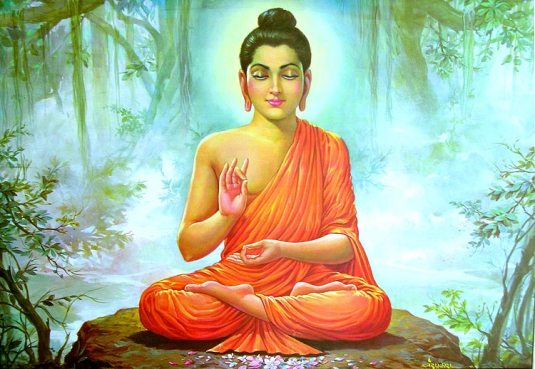
Krsna Is the Source of All Incarnations
Srimad Bhagavatam; Canto 1, Chapter 3, Text 24
By His Divine Grace A.C. Bhaktivedanta Swami Prabhupada
Lord Buddha
TEXT 24
tataḥ kalau sampravṛtte
sammohāya sura-dviṣām
buddho nāmnāñjana-sutaḥ
kīkaṭeṣu bhaviṣyati
SYNONYMS
tataḥ—thereafter; kalau—the age of Kali; sampravṛtte—having ensued; sammohāya—for the purpose of deluding; sura—the theists; dviṣām—those who are envious; buddhaḥ—Lord Buddha; nāmnā—of the name; añjana-sutaḥ—the son of Añjana; kīkaṭeṣu—in the province of Gayā (Bihar);bhaviṣyati—will take place.
TRANSLATION
Then, in the beginning of Kali-yuga, the Lord will appear as Lord Buddha, the son of Añjana, in the province of Gayā, just for the purpose of deluding those who are envious of the faithful theist.
PURPORT
Lord Buddha, a powerful incarnation of the Personality of Godhead, appeared in the province of Gayā (Bihar) as the son of Añjana, and he preached his own conception of nonviolence and deprecated even the animal sacrifices sanctioned in the Vedas. At the time when Lord Buddha appeared, the people in general were atheistic and preferred animal flesh to anything else. On the plea of Vedic sacrifice, every place was practically turned into a slaughterhouse, and animal killing was indulged in unrestrictedly.
Lord Buddha preached nonviolence, taking pity on the poor animals. He preached that he did not believe in the tenets of the Vedas and stressed the adverse psychological effects incurred by animal killing. Less intelligent men of the age of Kali, who had no faith in God, followed his principle, and for the time being they were trained in moral discipline and nonviolence, the preliminary steps for proceeding further on the path of God realization. He deluded the atheists because such atheists who followed his principles did not believe in God, but they kept their absolute faith in Lord Buddha, who himself was the incarnation of God. Thus the faithless people were made to believe in God in the form of Lord Buddha. That was the mercy of Lord Buddha: he made the faithless faithful to him.
More
05 May 2011
by The Hare Krishna Movement
in Sri Caitanya-Caritamrta
Tags: Adi-lila 3.52, bhagavatam, Caitanya Mahaprabhu, chanting Hare Krishna, golden complexion, Lord Caitanya, sankirtan, Sri Caitanya-caritamrta, Srila Prabhupada
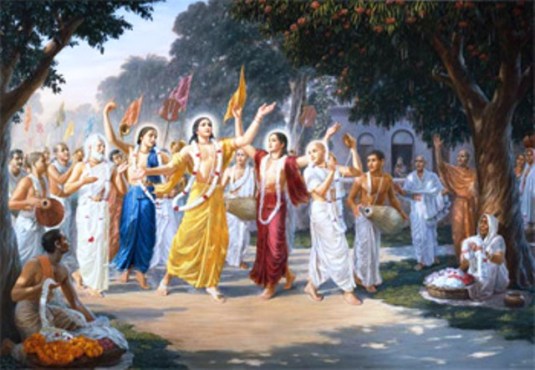
Sri Caitanya-caritamrta – 1975 Edition
By His Divine Grace A.C.Bhaktivedanta Swami Prabhupada
Adi 3.52
TRANSLATION
“In the Age of Kali, intelligent persons perform congregational chanting to worship the incarnation of Godhead who constantly sings the name of Kṛṣṇa. Although His complexion is not blackish, He is Kṛṣṇa Himself. He is accompanied by His associates, servants, weapons and confidential companions.”
PURPORT
This text is from Śrīmad-Bhāgavatam (11.5.32). Śrīla Jīva Gosvāmī has explained this verse in his commentary on the Bhāgavatam, known as the Krama-sandarbha, wherein he says that Lord Kṛṣṇa also appears with a golden complexion. That golden Lord Kṛṣṇa is Lord Caitanya, who is worshiped by intelligent men in this age. That is confirmed in Śrīmad-Bhāgavatam by Garga Muni, who said that although the child Kṛṣṇa was blackish, He also appears in three other colors-red, white and yellow. He exhibited His white and red complexions in the Satya and Tretā ages respectively. He did not exhibit the remaining color, yellow-gold, until He appeared as Lord Caitanya, who is known as Gaura Hari.
Śrīla Jīva Gosvāmī explains that kṛṣṇa-varṇam means Śrī Kṛṣṇa Caitanya. Kṛṣṇa-varṇa and Kṛṣṇa Caitanya are equivalent. The name Kṛṣṇa appears with both Lord Kṛṣṇa and Lord Caitanya Kṛṣṇa. Lord Śrī Caitanya Mahāprabhu is the Supreme Personality of Godhead, but He always engages in describing Kṛṣṇa and thus enjoys transcendental bliss by chanting and remembering His name and form. Lord Kṛṣṇa Himself appears as Lord Caitanya to preach the highest gospel.
Lord Caitanya always chants the holy name of Kṛṣṇa and describes it also, and because He is Kṛṣṇa Himself, whoever meets Him will automatically chant the holy name of Kṛṣṇa and later describe it to others. He injects one with transcendental Kṛṣṇa consciousness, which merges the chanter in transcendental bliss. In all respects, therefore, He appears before everyone as Kṛṣṇa, either by personality or by sound. Simply by seeing Lord Caitanya one at once remembers Lord Kṛṣṇa. One may therefore accept Him as viṣṇu-tattva. In other words, Lord Caitanya is Lord Kṛṣṇa Himself.
Sāṅgopāṅgāstra-pārṣadam further indicates that Lord Caitanya is Lord Kṛṣṇa. His body is always decorated with ornaments of sandalwood and with sandalwood paste. By His superexcellent beauty He subdues all the people of the age. In other descents the Lord sometimes used weapons to defeat the demoniac, but in this age the Lord subdues them with His all-attractive figure as Caitanya Mahāprabhu. Śrīla Jīva Gosvāmī explains that His beauty is His astra, or weapon, to subdue the demons. Because He is all-attractive, it is to be understood that all the demigods lived with Him as His companions. His acts were uncommon and His associates wonderful. When He propagated the saṅkīrtana movement, He attracted many great scholars and ācāryas, especially in Bengal and Orissa. Lord Caitanya is always accompanied by His best associates like Lord Nityānanda, Advaita, Gadādhara and Śrīvāsa.
Śrīla Jīva Gosvāmī cites a verse from the Vedic literature which says that there is no necessity of performing sacrificial demonstrations or ceremonial functions. He comments that instead of engaging in such external, pompous exhibitions, all people, regardless of caste, color or creed, can assemble together and chant Hare Kṛṣṇa to worship Lord Caitanya. Kṛṣṇa-varṇaṁ tviṣākṛṣṇam indicates that prominence should be given to the name of Kṛṣṇa. Lord Caitanya taught Kṛṣṇa consciousness and chanted the name of Kṛṣṇa.
Therefore, to worship Lord Caitanya, everyone should together chant the mahā-mantra-Hare Kṛṣṇa, Hare Kṛṣṇa, Kṛṣṇa Kṛṣṇa, Hare Hare Hare Rāma, Hare Rāma, Rāma Rāma, Hare Hare. To propagate worship in churches, temples or mosques is not possible, because people have lost interest in that. But anywhere and everywhere, people can chant Hare Kṛṣṇa. Thus worshiping Lord Caitanya, they can perform the highest activity and fulfill the highest religious purpose of satisfying the Supreme Lord.
Śrīla Sārvabhauma Bhaṭṭācārya, a famous disciple of Lord Caitanya, said, “The principle of transcendental devotional service having been lost, Śrī Kṛṣṇa Caitanya has appeared to deliver again the process of devotion. He is so kind that He is distributing love of Kṛṣṇa. Everyone should be attracted more and more to His lotus feet, as humming bees are attracted to a lotus flower.”
02 May 2011
by The Hare Krishna Movement
in Devotee's, Letters by Srila Prabhupada, Sriman George Harrison, Syamasundara das
Tags: Apple Records, Apple Studio, John Lennon, Letters by Srila Prabhupada, Srila Prabhupada, Sriman George Harrison, Syamasundara das, The Beatles
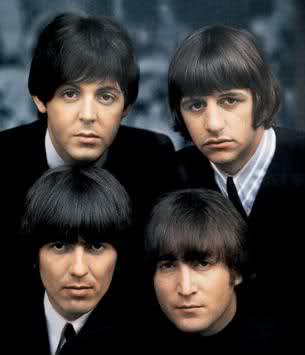
Letter by Srila Prabhupada to Sriman Syamasundara Prabhu
June 29, 1969, Los Angeles, Calif.,
My dear Syamasundara, please accept my blessings.
I am in due receipt of your letter of June 19, 1969, and I have noted the contents carefully.
Here in Los Angeles I have arrived on the 23rd of June from New Vrindaban. I received your telegram for a loan of $1025, and immediately I arranged to have it sent from New York. I understand from Mukunda’s letter dated June 25th that the lease agreement has duly been completed.
Now I think you are all happy to have a nice place for our London temple, so just organize it to your best capacity. It doesn’t matter when I go there. In the meantime, you give your full attention to decorating the temple, and I am very glad to learn you are making the throne and altar according the the design I sent to you.
I learned that Mataji has arranged for the Radha-Krishna Deities for our temple. Is this a fact? If not, let me know, I have already one pair of 24″ Deities from Vrindaban that will be dispatched, and as suggested by you, by Janmastami the Deities may be installed.
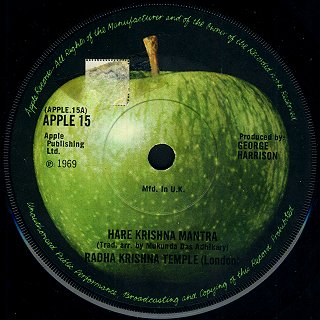
I am very glad to know that George is interested in recording some Krishna Consciousness album, and it is very happy news. I request you and, through you, your friends, George and John, to make a nice Hare Krishna record sung by the most popular Beatles and assisted by our devotees. That will be very nice.
 “
“
I have all encouragement for you for this purpose. Try to make this Hare Krishna Movement popular through any source that is possible. That is our business.
I thank you very much for your gorgeous, hopeful words that when I go to London, the London center will be pivot for our Krishna Consciousness Movement. I still maintain the idea of a world Sankirtana Party, so we have got men now in Los Angeles, in Montreal, in Boston, in New York, in New Vrindaban, and in London, who can form a nice group of Sankirtana, at least with 25 heads.
If we travel, beginning from London, around the world and again come back to London, surely your foretelling will be a factual event. So try your best, and Krishna will help us as He is helping us. Krishna can help us immediately with all of His resources, but first of all He wants to see how much we can work seriously. So the more we become steady and serious, the more help we will have from Him, rest assured.
I shall be glad to know of your further progress in the temple attempts and the recording affairs. Please convey my blessings to the others.
I hope this will meet you in good health.
Your ever well-wisher,
A. C. Bhaktivedanta Swami
Pasted from http://www.prabhupadanugas.eu/?p=4530
01 May 2011
by The Hare Krishna Movement
in Book Changes, Devotee's, Govinda dasi
Tags: BBT, book changes, Govinda dasi, Hayagriva, Jayadvaita Swami, original books, prabhupada
A Letter on Book Changes
by Govinda Dasi (ACBSP)
Srila Prabhupada often said “Krishna has written these books.” So tell me, how can a conditioned soul improve on what Krishna has said or written??
Dear Yashoda Dulal Prabhu,
Pamho. Yes, the BBT always gives that one worn-out example of cattle, and of course the other one, planet of the trees. Yes, those are typos, mistakes. They fail to mention the other four thousand and nine hundred and ninety eight changes they made!
And had these two errors been corrected, along with any misspelled words, etc. there would have been no cause for alarm–or for a million dollar lawsuit with bbt defending the edited version–one which they lost in the courts. That court case is the only reason that now the world has an option to read Prabhupada’s original words. But the 5000 changes that were made, and changing the “writer’s voice” was unwarranted and factually criminal.
In a meeting at Honolulu temple some years back, Jayadvaita M. actually stated, “Oh, those (original) books were horrible!” Those “horrible” original books, filled with Srila Prabhupada’s divine mercy, made thousands of devotees in the ’70s. More books were distributed then than now.
It seems you believe the propaganda that Hayagriva was never around Prabhupada much, and there were many editors etc. What can I say? This is simply not true. I knew Hayagriva from the time I joined Prabhupada in San Francisco, January of 1967. Hayagriva was there, and was already editing the Gita, and spending hours every day with Srila Prabhupada going over every verse!
And later, just before the first Gita was printed, in late 1968, Hayagriva LIVED with us in Los Angeles. (I was Prabhupada’s secretary for the whole year of 1968 and part of 1969) Daily they would spend hours in Prabhupada’s room, going over every inch of the final edits. I am an eye witness to this.
At this time, I even did the cover drawing for the first MacMillan Gita (the purple one) with Prabhupada guiding me, literally over my shoulder, watching the drawing develop. The purple Gita cut out a lot of that meticulous work done by Srila Prabhupada and Hayagriva; Macmillan wanted to save money, to make it smaller. So they greatly edited Prabhupada’s manuscript, and he was unhappy with it, but accepted it as “a blind uncle.”
But at his first opportunity, he printed his manuscript in total, the Original Gita, the one with Jadurany’s reddish battlefield painting on the cover. Srila Prabhupada was extremely happy with that Gita–he finally got his carefully nurtured manuscript into print! He was overjoyed!
The “Edited Edition”, with the blue battlefield cover, done by Parikshit das, with Krishna carrying a whip rather than his Panchajanya (conch) as directed by Srila Prabhupada, was done AFTER Srila Prabhupada’s departure from this world. Both the editing and the cover were done after his departure, yet they inserted his preface and signature of 1971–as if, with 5000 changes, it was the same book! How unethical!
Most of Prabhupada’s disciples did not even know this editing mischief was going on; they were grieving the loss of Srila Prabhupada from this world. Only later, when the dust had settled, did many of us learn of this travesty.
So I really do know what happened in those days. I even met with MacMillan in New York prior to the printing.
Jayadvaita M. had not even become a devotee in early 1967, so how would he know?? He says many things that are not in keeping with what really happened, since he was not there; perhaps he is relying on hearsay, I don’t know. Neither was Jayadvaita M. in Los Angeles in late 1968 when Hayagriva lived with us for weeks on end, completing the editing work.
Most of what the bbt says in this regard is based on fairy tales, hearsay, and perhaps some personal ambition as well. I do not know how they can skew things in this way and still sleep at night.
But what I do know is that Srila Prabhupada wanted NO FURTHER CHANGES TO HIS BOOKS. HE EXPRESSED THIS ON MANY OCCASIONS. A little research can easily prove this point.
More
01 May 2011
by The Hare Krishna Movement
in Hayagriva das, The Hare Krishna Explosion
Tags: Ayurvedic doctors, bhagavad-gita, Brahmananda, Haridas, hayagriva das, Kirtananda, Passage to India, San Franscisco, Swamiji
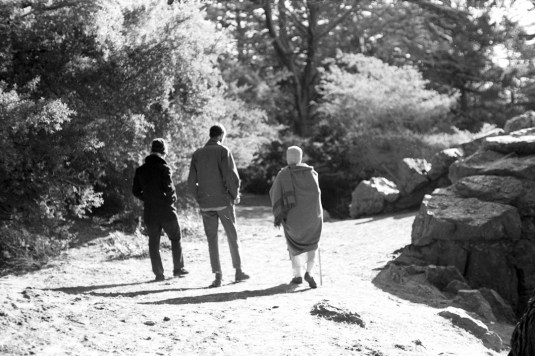
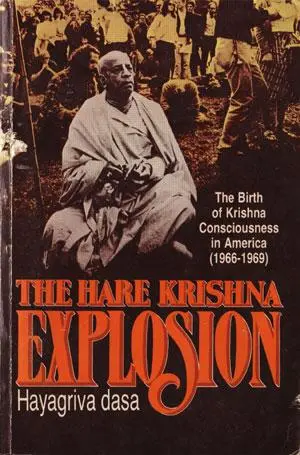
The Hare Krishna Explosion
by Hayagriva das
Part II: San Francisco, 1967
Chapter 12
Passage to India
Paradisio isn’t quite paradise. The birdstool on the Buddha was no doubt portentous. There is very little sunshine. Behind the beach house, to the east, a mountain range blocks out the morning sun, and by midday, clouds and fog roll in. The temperature is also rather cool for July.
To fully recover, Swamiji needs lots of sun. He especially misses the morning sun. He feels that if he can just get enough light and heat, his condition will improve. Because of this, he begins talking of returning to India, and this upsets us. We’ve supplied the nicest place possible near San Francisco, but we can’t supply the sun.
Moreover, Swamiji regrets having no close temple contact. He wants to visit a temple at least twice a week, but the winding road into San Francisco is too arduous.
He speaks more frequently of India. He wants to consult Ayurvedic doctors, who generally prescribe natural herbs recommended in certain Vedic writings. And then there’s Indian massage, another art unknown to us. Swamiji complains that Western doctors know only how to cut with knives and stick with needles. We don’t know what to suggest. We feel inadequate, helpless.
After the Rathayatra festival, Swamiji tells me that I should live at Paradisio and work full time on the final manuscript of Bhagavad-gita. In New York, Brahmananda continues to negotiate with publishers. The books must be printed at all costs. My job: prepare the manuscript nicely.
“It must be well stated in the English language,” Swamiji insists. “If there are any questions about the translations, you may ask me. Remember, edit for force and clarity.”
Daily, I try to clarify and strengthen the sentences without changing the style or meddling with the meaning, and, needless to say, this is very difficult. I soon find myself consulting Swamiji on every other verse, and occasionally he dictates an entirely different translation. The verse translations themselves are most problematical because they often differ from the word by word Sanskrit-English meanings accompanying them. What to do?
“Quit bothering him,” Kirtanananda tells me. “Whenever anyone’s in his room, he talks to the point of exhaustion.”
True. He talks sitting up. Then he leans back and talks. Then rests on one elbow. Then lies on his side, still talking, still clarifying, still praising Krishna.
At this time, he tells Haridas: “I no longer have a physical body. It is all spiritual.”
Haridas leaves his room almost in tears. “Swamiji’s more beautiful than ever,” he tells me. “Is it possible for your spiritual master to make spiritual progress?”
“I don’t know,” I say. “He says that spiritual life is always dynamic.”
“He seems to be vibrating on a much higher platform now,” Haridas insists.
“Others are saying the same,” I say. “But it could be just our perception.“
“He’s chanting more now,” Haridas insists. “Even more than at Mishra’s, more than I’ve ever heard him chant before.”
“I wouldn’t want to speculate about it,” I say.
More
30 Apr 2011
by The Hare Krishna Movement
in Devotee's, Diksha, Maha Mantra das, Siksa
Tags: Founder Acarya, Hare Krishna Philosophy, International Society for Krishna Consciousness, Lord Krishna, Maha Mantra das, prabhupada, Sun
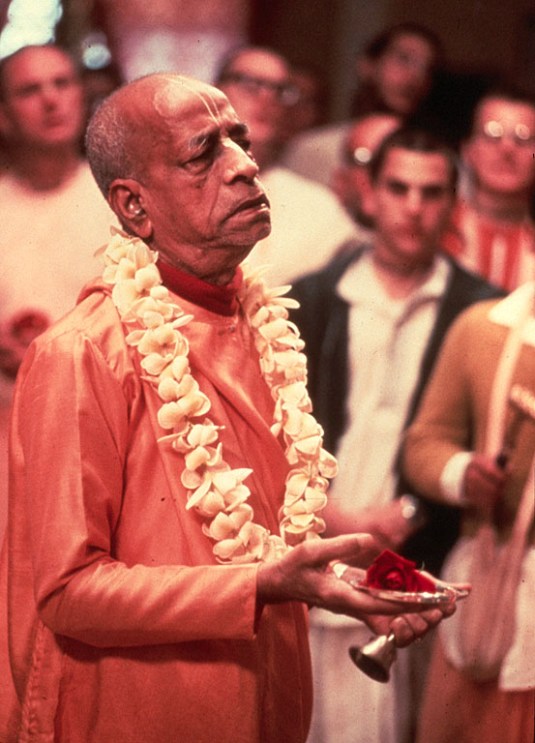
Direct Shelter
By Maha Mantra das
When I visited my first ISKCON centre many years ago and began to show an interest in the Hare Krishna philosophy and lifestyle, I was welcomed in with open arms and congratulated on my willingness to break away. I was told how, contrary to popular belief, it was actually society at large who were doing the brainwashing. It was further explained that the Krishna’s were not some dogmatic religion, and that the Movement was ‘calling-out’ modern society for keeping the masses in darkness and oppressing people’s rights to free-thought, free-speech. I was impressed with the courage and questioning/challenging spirit of the devotees. So it’s nice to see that spirit alive and well in Dhira Prabhu’s latest thoughtful article, and I’m sure my mum will be very pleased to know that I have not, in fact, joined some dangerous cult that muzzles it’s members if they dare speak up…. right?
As a newcomer to the temple, I was quickly introduced to His Divine Grace Srila Prabhupada, Founder-Acarya of the International Society for Krishna Consciousness, even though he had physically left the world some 10 years prior. I was taught his pranams that I recited daily, shown how to offer my food to his picture, and encouraged to repose whatever love or devotion I had in His Divine Grace as my link to Lord Krishna.
More
30 Apr 2011
by The Hare Krishna Movement
in Chanting Hare Krishna
Tags: chanting Hare Krishna, Hansadutta, Hare Krishna Hare Krishna Krishna Krishna Hare Hare Hare Rama Hare Rama Rama Rama Hare Hare, sound incarnation, sound vibration, transcendental touchstone

Why Chant Hare Krishna?
By Sriman Hansadutta Prabhu
God is absolute, and therefore anything directly connected with Him, such as His holy name, form, pastimes, paraphernalia and entourage, is identical with Him. In the material world of duality, objects are different from their names. A thirsty man’s cry–“Water! Water! Water!”–will never satisfy his thirst, because the name water and the substance water are completely different. In the absolute world, however, there are no such differences. There an object and its name, or a person and his name, are one. Therefore, simply by vibrating the holy name of God, one associates with God directly.
nama chintaminih krishnash
chaitanya-rasa-vigrahah
pumah shuddho nitya-mukto
‘bhinnatvan nama-naminoh
The holy name of Krishna is like a transcendental touchstone, for it is Krishna Himself, the reservoir of all pleasure. Krishna’s name is complete, and it is the form of transcendental mellows. It is always pure and liberated from all material contamination. This is because the name of Krishna and Krishna Himself are identical.–Padma Purana
Lord Chaitanya Mahaprabhu, an incarnation of Krishna, recommended that one chant the maha-mantra twenty-four hours a day and thus make one’s life perfect. He said:
One can chant the holy name of God in a humble state of mind, thinking himself lower than the straw in the street. One should be more tolerant than a tree, devoid of all sense of false prestige, and always ready to offer all respects to others. In such a humble state of mind one can chant the holy name of the Lord constantly.–Shikshastaka, Verse 3
Chanting Hare Krishna gradually frees one from material concepts and elevates one to samadhi, a trance-like state in which one realizes the Supersoul (Paramatma, or Krishna residing in the heart) through his transcendental mind and intelligence. God realization is the goal of yoga. The living entity is called jivatma (the atomic self), and Krishna is called Paramatma (the Supreme Self). In perfect Krishna consciousness, one realizes the eternal relationship between the atomic soul and the Supreme Soul, Krishna, without misidentifying himself with the Supreme.
In this age, the best method of practicing yoga is to chant and hear the holy names of God, as found in the maha-mantra: Hare Krishna, Hare Krishna, Krishna Krishna, Hare Hare/ Hare Rama, Hare Rama, Rama Rama, Hare Hare. This is the beginning of bhakti-yoga, or Krishna consciousness. There are no hard and fast rules for chanting. One can chant at any time or in any place. One need not give up his job or family, because the chanting automatically purifies one’s life, adjusting unwanted and unnecessary difficulties. The authorized scriptures of the world’s civilized nations give various names for God, but the Vedic scriptures especially recommend the chanting of Hare Krishna, Hare Krishna, Krishna Krishna, Hare Hare/ Hare Rama, Hare Rama, Rama Rama, Hare Hare. We therefore humbly request you to chant this maha-mantra and be happy.
30 Apr 2011
by The Hare Krishna Movement
in Diksha, Mahesh Raja das, Siksa, The Hare Krishna Movement
Tags: Acarya, accepting initiation, actual initiator, guru, Iskcon, Krsna, Mahesh Raja, scriptures, spiritual initiation, spiritual master, Srila Prabhupada, svarupa
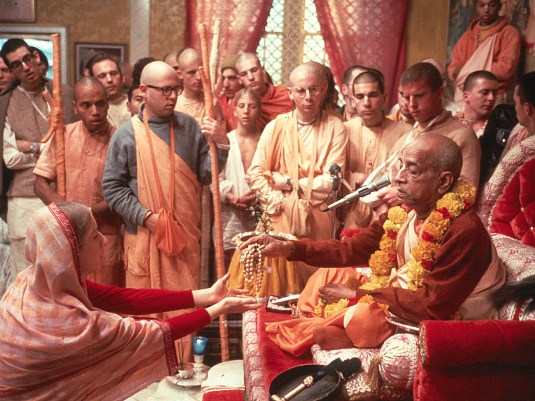
Srila Prabhupada is the Guru, Acarya and Actual Initiator in ISKCON
By Mahesh Raja
Regarding parampara system: there is nothing to wonder for big gaps. Just like we belong to the Brahma Sampradaya, so we accept it from Krishna to Brahma, Brahma to Narada, Narada to Vyasadeva, Vyasadeva to Madhva, and between Vyasadeva and Madhva there is a big gap. But it is sometimes said that Vyasadeva is still living, and Madhva was fortunate enough to meet him directly. In a similar way, we find in the Bhagavad-gita that the Gita was taught to the sungod, some millions of years ago, but Krishna has mentioned only three names in this parampara system–namely, Vivasvan, Manu, and Iksvaku; and so these gaps do not hamper from understanding the parampara system. We have to** pick up the prominent acaryas, and follow from him.** There are many branches also from the parampara system, and it is not possible to record all the branches and sub-branches in the disciplic succession. We have to pick up from the authority of the acharya in whatever sampradaya we belong to. (68-04-12.Day Letter: Dayananda)
The **only** injunction from scriptures is to worship the acarya. Its only the acarya that is able to give diksa ( spiritual initiation) to the Madhyama-adhikari (see antya CC 4.192-4.194) where he relishes loving mellows(in his svarupa) with krsna. Acarya is not voted by the GBC 2/3 majority votes. The acarya has direct communication with Krsna- Krsna speaks through him. It is therefore only the acarya that can actually be expected to be worshiped as good as Krsna. So the photo worship is not sanctioned of one who is not an acarya. (conditioned soul worship — idol worship where is the difference?).
Adi 1.45 “According to the deliberate opinion of all revealed scriptures, the spiritual master is nondifferent from Krsna. Lord Krsna in the form of the spiritual master delivers His devotees.”
Adi 1.46 **acaryam** mam vijaniyan navamanyeta karhicit na martya-buddhyasuyeta sarva-deva-mayo guruh “One should know the acarya as Myself and never disrespect him in any way. One should not envy him, thinking him an ordinary man, for he is the representative of all the demigods.” Purport:This is a verse from Srimad-Bhagavatam (11.17.27)
Note: It is significant the same text has been quoted In NoD Ch7 but in reference to **accepting initiation**. So this shows Initiation is from Acarya not from 2/3 majority voted spiritual masters.
Ch7 Nectar of Devotion; Serving the Spiritual Master with Faith and Confidence Regarding ACCEPTING INITIATION from the spiritual master, in the Eleventh Canto of Srimad-Bhagavatam, Seventeenth Chapter, verse 27, it is stated by Lord Krsna, “My dear Uddhava, the spiritual master must be accepted not only as My representative, but as My very self. He must never be considered on the same level with an ordinary human being. One should never be envious of the spiritual master, as one may be envious of an ordinary man. The spiritual master should always be seen as the representative of the Supreme Personality of Godhead, and by serving the spiritual master one is able to serve all the demigods.”
Adi 1.35 A devotee must have only one initiating spiritual master because in the scriptures acceptance of more than one is always forbidden.
Note:We know it is only the uttama adhikari acarya Prabhupada that is able to transmit diksa (spiritual Initiation) into the madhyam adhikaris heart whereby he is enabled to see Krsna and relish loving mellows in his svarupa. (television in the heart).
Here it is understood that the spiritual master disciplic succession is of acaryas. And Srila Prabhupada is the current acarya. SB 3.29.17 In Bhagavad-gita, Thirteenth Chapter, it is clearly stated that one should execute devotional service and advance on the path of spiritual knowledge by accepting the acarya. Acaryopasanam: one should worship an acarya, a spiritual master who knows things as they are. The spiritual master must be in the disciplic succession from Krsna. The predecessors of the spiritual master are his spiritual master, his grand spiritual master, his great-grand spiritual master and so on, who form the disciplic succession of acaryas.
Srila Prabhupada is the prominent acarya.
More
29 Apr 2011
by The Hare Krishna Movement
in Bhaktivinoda Thakura
Tags: Aghasura, Bakasura, Dhenukasura, false pride, Kaliya, Kesi, Nalakuvara and Manigriva, pseudo guru, Putana, Sakatasura, Srila Bhaktivinoda Thakura, Trinavarta, Vatsaura

Killing the Demons within the Heart
Srila Bhaktivinoda Thakura in his Sri Caitanya Siksamrita describes the demons Krishna killed in His Vrndavana pastimes and the anarthas (unwanted things) with which they may be associated.
Putana (the witch) – the pseudo guru.
Sakatasura (the cart demon) – carrying the burden of a cart-load of old and new bad habits, lethargy and vanity.
Trinavarta (the whirlwind demon) – false pride which comes from material scholarship, which leads to bogus philosophies.
Deliverance of Nalakuvara and Manigriva (breaking the twin arjuna trees) – Arrogant pride which comes from puffed-up prestige, which is rooted in a madness for wealth.
Vatsasura (the calf demon) – a childish type of mentality which gives rise to a type of greediness which results in a wicked type of mischievousness.
Bakasura (stork demon) – Cunning duplicity, deceptiveness and false types of behavior.
Aghasura (the snake demon) – Cruelty and violence.
Brahma-vimohana Pastime (Lord Brahma steals the cowherd boys and calves) – mundane activities and speculative scholasticism.
Dhenukasura (the ass demon) – gross materialistic intelligence, ignorance of spiritual knowledge.
Kaliya (chastising the Kaliya serpent) – brutality and treachery.
Extinguishing the Forest Fire – inter-communal discord among Vaishnavas.
Pralambasura (killing the Pralamba demon) – lusty inclinations; desire for personal gain and honor.
Second Forest Fire – disturbance of religious principles and interference with religious people by those who are atheist.
Brahmanas Performing Sacrifice – indifference toward Krishna caused by pride because of one’s status (position) in varnasrama.
Overcoming the Pride of Indra – demigod worship, and the tendency to think “I am Supreme.”
Nanda Maharaja Captured by Varuna – thinking that spiritual life can be enhanced by intoxication.
Nanda Maharaja Swallowed by Vidyadhara (the snake) – rescuing the truth of Krishna consciousness from being swallowed by the impersonalists.
Sankhacuda (killing the conch-shell demon and getting the jewel that was stolen by him) – proneness toward acquiring name and fame, and desire for sensuous enjoyment, under the plea of devotion.
Aristasura (the bull demon) – pride arising from indulging in false religions invented by cheaters which causes neglect of devotional service (bhakti).
Kesi (the horse demon) – The feeling that “I am a great devotee and spiritual master.”
Vyomasura (the demon in the sky) – associating with thieves and other rascals, and with people who put themselves forward as avataras.
Bhaktivinoda Thakura says: “The devotee who worships the holy name should first petition the Lord for the strength to cast out all these unfavorable tendencies and should pray thus before Lord Hari on a daily basis. By doing this regularly, the devotee’s heart will eventually become purified. Sri Krishna has killed a number of demons which may arise in the kingdom of the heart, so in order to destroy these problems, a devotee must cry very humbly before the Lord and admit defeat then the Lord will nullify all contaminations.”
Pasted from: http://www.harekrsna.de/divine-message.htm
29 Apr 2011
by The Hare Krishna Movement
in Dhira Govinda das, Diksha, Dusyanta das, Rama das, Siksa, Spiritual Master, Srila Prabhupada, The Prominent Link
Tags: current link, devotees, Dhira Govinda das, disciples, Dusyanta das, GBC, Hare Krishna Movement, Iskcon, link, prominent link, Rama das, SAC, Sampradaya Acarya, spiritual master and disciple, Srila Prabhupada, Srimad Bhagavatam
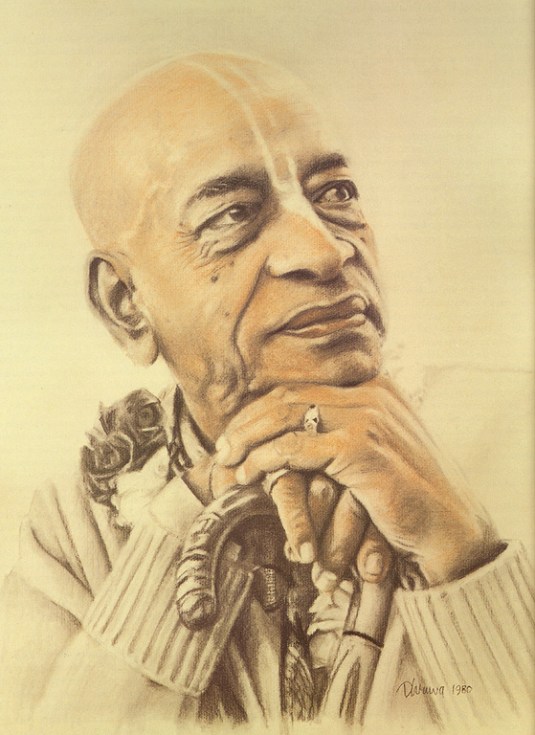
Recently there was a nice article on the Sampradaya Sun posted by Sriman Dhira Govinda Prabhu on the Current and Direct Link, for continuance of the disciplic succession in ISKCON, and two nice spin off articles. Enclosed are two of the recent articles submitted by readers.
Current Link
BY: DUSYANTA DAS
Apr 27, 2011 — UK (SUN) — In Srimad Bhagavatam 2.9.7 is where the quote is found concerning the word “link”. In the purport, Srila Prabhupada identifies this phenomena thus: “…in order to receive the real message of Srimad Bhagavatam one should approach the current link, or Spiritual master, in the chain of disciplic succession.”
The definition of “current” is explained clearly from the Collins English dictionary thus:
“most recent, commonly known, practiced or accepted, widespread, circulating and valid at present”. Which all seems to fit very easily into the idea that Srila Prabhupada is the Spiritual Master, the current link that is illustrated here in the purport of SB 2.9.7.
The application of this phenomena, the “current link” is hinging on the word in the sentence “approach”. Which is either a verb or noun. The verb “approach” is defined as “to come near, to go to someone with a request or offer, to set about doing something.” The noun “approach” is defined as “a way or road to a place, a method of doing something.”
If we follow the premise that Srila Prabhupada uses the term “immediate acarya” as synonymous with the term “current link”, then we come up with the definitions lending the validity to a direct relationship with Him without intermediaries and regardless of physical presence. Immediate definition as “without intervening medium, closest or most direct in effect of relationship.”
The point in approaching a spiritual master or current link in disciplic succession is to take initiation from him.
More
Previous Older Entries Next Newer Entries











 The Hare Krishna Movement