28 Oct 2012
by The Hare Krishna Movement
in A.C. Bhaktivedanta Swami Prabhupada, Prahlada Maharaja, Srimad Bhagavatam, Teachings of Pralada Maharaja
Tags: 9 types of devotional service, A.C. Bhaktivedanta Swami Prabhupada, arcanam, atma-nivedanam, dasyam, devotional service, kirtanam, Narada Muni, nine processes of devotional service, pada-sevanam, Prahlada Maharaja, sakyam, sarvanam, smaranam, Srila Prabhupada, Teachings of Prahlada Maharaja, the science of God, vandanam, visnoh
click on image to enlarge
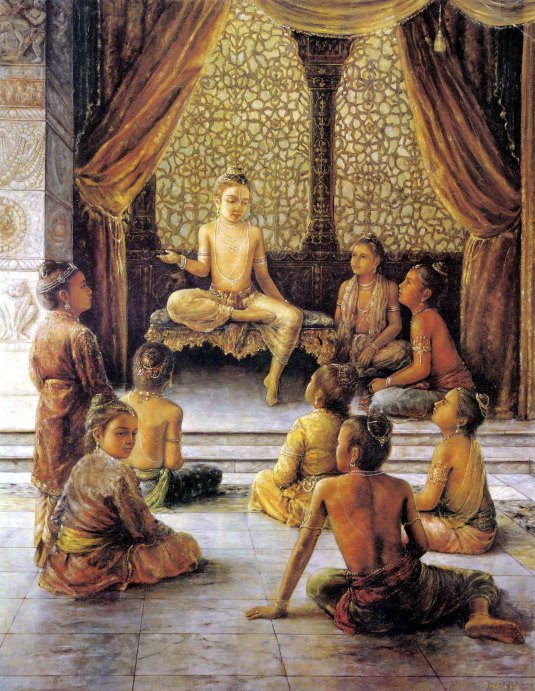
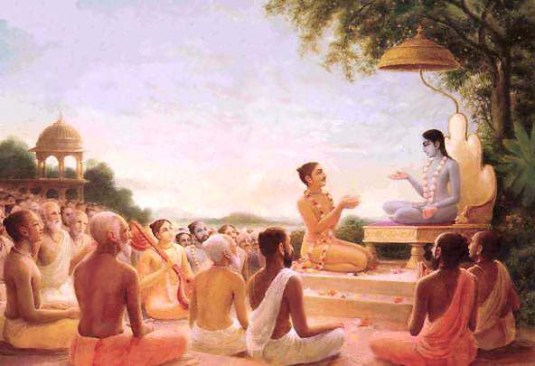
Prahlāda Mahārāja said: Hearing and chanting about the transcendental holy name, form, qualities, paraphernalia and pastimes of Lord Viṣṇu, remembering them, serving the lotus feet of the Lord, offering the Lord respectful worship with sixteen types of paraphernalia, offering prayers to the Lord, becoming His servant, considering the Lord one’s best friend, and surrendering everything unto Him (in other words, serving Him with the body, mind and words)—these nine processes are accepted as pure devotional service. One who has dedicated his life to the service of Kṛṣṇa through these nine methods should be understood to be the most learned person, for he has acquired complete knowledge.
Full text and purport More
25 Oct 2012
by The Hare Krishna Movement
in A.C. Bhaktivedanta Swami Prabhupada, Maharaja Pariksit, Srimad Bhagavatam
Tags: A.C. Bhaktivedanta Swami Prabhupada, enjoy life to the fullest, fast till death, Ganges, great emperor, kingdom, Maharaja Pariksit, pious king, power and opulence, retiring from life, SB 1.4.9-12, Srimad Bhagavatam
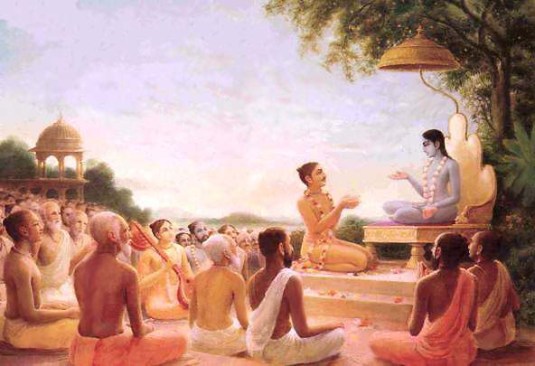
This morning I was reading about Maharaja Pariksit and of his qualities and position in life. He was in a position to enjoy life to the fullest extent,then why should he give up all these favorable circumstances and sit down on the bank of the Ganges, fasting till death? This is astonishing, and therefore all were eager to know the cause. He gave up everything to hear Sriman Bhagavatam from the lips of the pure devotee.
He was a great emperor and possessed all the opulences of his acquired kingdom. He was so exalted that he was increasing the prestige of the Pāṇḍu dynasty. Why did he give up everything to sit down on the bank of the Ganges and fast until death?
…There was nothing undesirable in his life. He was quite a young man and could enjoy life with power and opulence. So there was no question of retiring from active life. There was no difficulty in collecting the state taxes because he was so powerful and chivalrous that even his enemies would come to him and bow down at his feet and surrender all wealth for their own benefit. Mahārāja Parīkṣit was a pious king. He conquered his enemies, and therefore the kingdom was full of prosperity. There was enough milk, grains and metals, and all the rivers and mountains were full of potency. So materially everything was satisfactory. Therefore, there was no question of untimely giving up his kingdom and life. The sages were eager to hear about all this.
More
08 Oct 2012
by The Hare Krishna Movement
in A.C. Bhaktivedanta Swami Prabhupada, Back to Godhead, Prahlada Maharaja, Srimad Bhagavatam
Tags: A.C. Bhaktivedanta Swami Prabhupada, Absolute Truth, Back to Godhead Magazine, Brahma, demigods, demon, devotee of God, great devotion, hiranyakasipu, king indra, Lord Nrsimhadeva, Narada, Pralada, pralhada maharaja, Queen Kayadhu
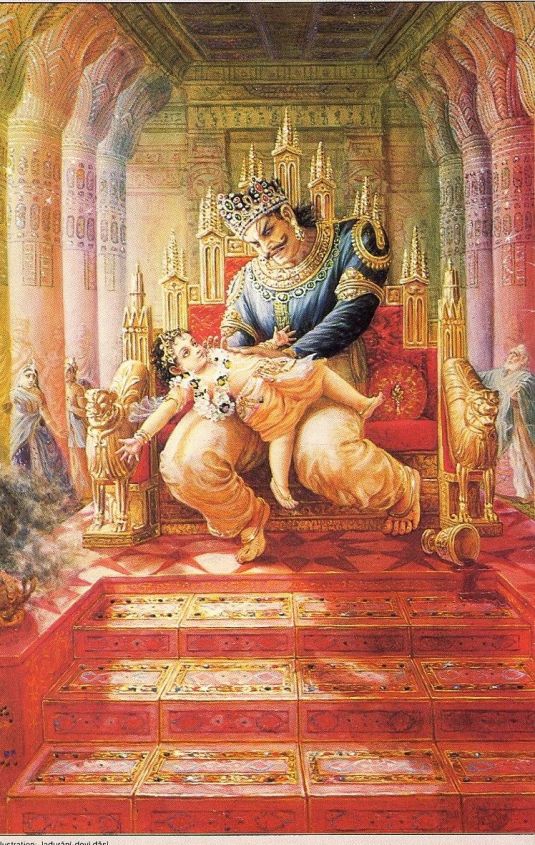
Sinister Father Saintly Son
“Like father like son,” the saying goes. So how was it that the most sinister personality ever to darken the universe fathered a great saint?
Adapted from Srimad-Bhagavatam, translation and commentary
By His Divine Grace A.C. Bhaktivedanta Swami Prabhupada.
A vicious storm raged through the darkness. Pierce winds hissed again and again and uprooted gigantic trees. Thick clouds covered the sky, and lightning flashed as though laughing. The ocean with its high waves wailed as if stricken with sorrow. Jackals and dogs howled ominously, and birds flew shrieking from their nests. The twin demons Hiranyakasipu and Hiranyaksa were being born.
Day by day, year after year, they grew more powerful, more evil, and more dominant over all the other demons, who made alliances with them. Then, under the direction of Hiranyaksa and Hiranyakasipu, the demons set out to conquer the demigods, their archenemies and the administrators of the universe. In their war for universal power, the demons enjoyed many victories, but at last Lord Visnu [Krsna] Himself killed Hiranyaksa. His brother’s death overwhelmed Hiranyakasipu with grief and rage. He bit his lips and gazed upward with eyes whose blazing anger filled the sky with smoke. He took up his trident, glanced around fiercely, bared his terrible teeth, and began to speak to his demon friends.
More
03 Oct 2012
by The Hare Krishna Movement
in A.C. Bhaktivedanta Swami Prabhupada, Mohine-Murti, Srimad Bhagavatam
Tags: A.C. Bhaktivedanta Swami Prabhupada, ankle bells, blackis lotus, bumblebees, demigods, demons, incarnation as a woman, lusty desires, mallika flowers, Mohini-murti, Srila Prabhupada, The Supreme Personality of Godhead, Visnu

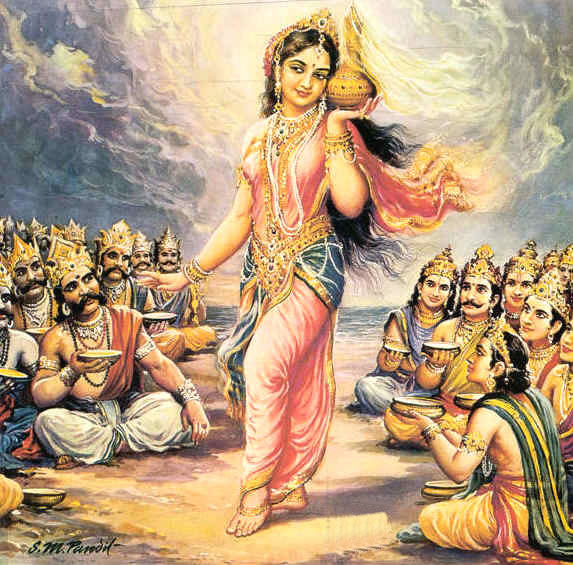
The following is from the Srimad Bhagavatam, Eight Canto, Chapter Nine, entitled “The Lord Incarnates as Mohinī-Mūrti”. The full chapter follows this beautiful verse from preceding chapter.
The Supreme Personality of Godhead, Viṣṇu, who can counteract any unfavorable situation, then assumed the form of an extremely beautiful woman. This incarnation as a woman, Mohinī-mūrti, was most pleasing to the mind. Her complexion resembled in color a newly grown blackish lotus, and every part of Her body was beautifully situated. Her ears were equally decorated with earrings, Her cheeks were very beautiful, Her nose was raised and Her face full of youthful luster. Her large breasts made Her waist seem very thin. Attracted by the aroma of Her face and body, bumblebees hummed around Her, and thus Her eyes were restless. Her hair, which was extremely beautiful, was garlanded with mallikā flowers. Her attractively constructed neck was decorated with a necklace and other ornaments, Her arms were decorated with bangles, Her body was covered with a clean sari, and Her breasts seemed like islands in an ocean of beauty. Her legs were decorated with ankle bells. Because of the movements of Her eyebrows as She smiled with shyness and glanced over the demons, all the demons were saturated with lusty desires, and every one of them desired to possess Her. (SB 8.8.41-48)
Because of the Supreme Lord’s assuming the form of a beautiful woman to arouse the lusty desires of the demons, a description of Her complete beauty is given here.
More
26 Sep 2012
by The Hare Krishna Movement
in A.C. Bhaktivedanta Swami Prabhupada, Srimad Bhagavatam
Tags: A.C. Bhaktivedanta Swami Prabhupada, chanting the holy name of the lord, devotee, devotee is called punya-sloka, instructions on the execution of devotional service, Jai Prabhupada, punya-sloka, pure devotee, SB 3.28.18

This is a very nice verse from Srila Prabhupada’s Srimad Bhagavatam. A good friend of mine is always quoting this verse and requested we include it in our daily postings. So without further ado, this one’s for you.
“…Another significant word in this verse is puṇya-śloka-yaśaskaram. The devotee is called puṇya-śloka. As one becomes purified by chanting the holy name of the Lord, so one can become purified simply by chanting the name of a holy devotee. The pure devotee of the Lord and the Lord Himself are nondifferent. It is sometimes feasible to chant the name of a holy devotee. This is a very sanctified process…” Jai Prabhupada!
Srimad-Bhagavatam
By His Divine Grace A.C. Bhaktivedanta Swami Prabhupada
Canto 3, Chapter 28, Text 18
Kapila’s Instructions on the Execution of Devotional Service
kīrtanya-tīrtha-yaśasaṁ
puṇya-śloka-yaśaskaram
dhyāyed devaṁ samagrāṅgaṁ
yāvan na cyavate manaḥ
kīrtanya—worth singing; tīrtha-yaśasam—the glories of the Lord; puṇya-śloka—of the devotees; yaśaḥ-karam—enhancing the glory; dhyāyet—one should meditate; devam—upon the Lord; samagra-aṅgam—all the limbs; yāvat—as much as; na—not; cyavate—deviates; manaḥ—the mind.
The glory of the Lord is always worth singing, for His glories enhance the glories of His devotees. One should therefore meditate upon the Supreme Personality of Godhead and upon His devotees. One should meditate on the eternal form of the Lord until the mind becomes fixed.
One has to fix his mind on the Supreme Personality of Godhead constantly. When one is accustomed to thinking of one of the innumerable forms of the Lord—Kṛṣṇa, Viṣṇu, Rāma, Nārāyaṇa, etc.—he has reached the perfection of yoga. This is confirmed in the Brahma-saṁhitā: a person who has developed pure love for the Lord, and whose eyes are smeared with the ointment of transcendental loving exchange, always sees within his heart the Supreme Personality of Godhead. The devotees especially see the Lord in the beautiful blackish form of Śyāmasundara. That is the perfection of yoga. This yoga system should be continued until the mind does not vacillate for a moment. Oṁ tad viṣṇoḥ paramaṁ padaṁ sadā paśyanti sūrayaḥ: the form of Viṣṇu is the highest individuality and is always visible to sages and saintly persons.
More
26 Sep 2012
by The Hare Krishna Movement
in A.C. Bhaktivedanta Swami Prabhupada, Srimad Bhagavatam, Vamanadeva
Tags: Aditi, Adityas, Bali Maharaja, bhagavatam, Lord Vamana, SB 2.7.17, Scheduled Incarnations with Specific Functions, Srila Prabhupada, Vamana, Vamanadeva

In honor of the appearance day of Lord Vāmana, we are posting a verse from Srila Prabhupada’s Bhagavatam, which describes the history of Bali Mahārāja and his charity to Vāmanadeva. This verse describes; that by giving everything to the cause of the Lord, one does not lose anything, but he gains everything that he could never otherwise expect.
Srimad-Bhagavatam
By His Divine Grace A.C. Bhaktivedanta Swami Prabhupada
Canto 2, Chapter 7, Text 17
Scheduled Incarnations with Specific Functions
Full text and purport More
23 Aug 2012
by The Hare Krishna Movement
in Gajendra, Spiritual World, Srimad Bhagavatam
Tags: A.C. Bhaktivedanta Swami Prabhupada, Brahma, demigods, Gajendra, gandharvas, king of the elephants, sages, Siva, Spiritual world, Srimad Bhagavatam, Sukadeva Gosvami

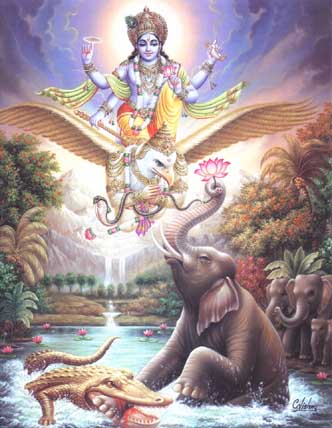
The Fourth Chapter of the Eight Canto of Srimad Bhagavatam describes the previous birth of Gajendra and the crocodile. It tells how the crocodile became a Gandharva and how Gajendra became an associate of the Supreme Personality of Godhead.
…in his birth as an elephant, when he was dangerously attacked by the crocodile, he remembered his past life in devotional service and remembered a prayer he had learned in that life. Because of this prayer, he again received the mercy of the Lord.
Śukadeva Gosvāmī ends this chapter by describing the good fortune of the elephant. Śukadeva Gosvāmī says that by hearing the narration of Gajendra’s deliverance, one can also get the opportunity to be delivered.
“One who seeks Your compassion and thus tolerates all kinds of adverse conditions due to the karma of his past deeds, who engages always in Your devotional service with his mind, words and body, and who always offers obeisances unto You, is certainly a bona fide candidate for liberation.”
A devotee who tolerates everything in this material world and patiently executes his devotional service can become mukti-pade sa dāya-bhāk, a bona fide candidate for liberation. The word dāya-bhāk refers to a hereditary right to the Lord’s mercy. A devotee must simply engage in devotional service, not caring about material situations. Then he automatically becomes a rightful candidate for promotion to Vaikuṇṭhaloka. The devotee who renders unalloyed service to the Lord gets the right to be promoted to Vaikuṇṭhaloka, just as a son inherits the property of his father.
Full Text & Purports More
23 Aug 2012
by The Hare Krishna Movement
in Quotes by Srila Prabhupada, Remembering Srila Prabhupada, Srila Prabhupada, Srimad Bhagavatam
Tags: disciples, Krishna consciousness, pure devotees, Remembering Srila Prabhupada, SB 3.22.21, smile of Krishna conscious person, Spiritual world, Srila Prabhupada, Srimad Bhagavatam, thoughts of Krsna

“That is the way of Krishna consciousness. Pure devotees are so absorbed in thought of Krishna that they have no other engagement; although they may seem to think or act otherwise, they are always thinking of Krishna. The smile of such a Krishna conscious person is so attractive that simply by smiling he wins so many admirers, disciples and followers.” (from purport to Srimad Bhagavatam, 3.22.21)
Full text and purport More
20 Aug 2012
by The Hare Krishna Movement
in Kali Yuga, Srimad Bhagavatam, Time
Tags: A.C. Bhaktivedanta Swami Prabhupada, age of kali, bhagavad-gita, dvapara-yuga, enlightenment, great sacrifice, Kali-yuga, meditation, Naimisaranya, satya-yuga, self realization, Sri Krishna, Srimad Bhagavatam, Treta-yuga, worship of the Lord, yoga

By human calculation, a thousand ages taken together is the duration of Brahmā’s one day. And such also is the duration of his night.
…This age of Kali is not at all suitable for self-realization as was Satya-yuga, the golden age, or Tretā- or Dvāpara-yugas, the silver and copper ages. For self-realization, the people in Satya-yuga, living a lifetime of a hundred thousand years, were able to perform prolonged meditation. And in Tretā-yuga, when the duration of life was ten thousand years, self-realization was attained by performance of great sacrifice. And in the Dvāpara-yuga, when the duration of life was one thousand years, self-realization was attained by worship of the Lord. But in the Kali-yuga, the maximum duration of life being one hundred years only and that combined with various difficulties, the recommended process of self-realization is that of hearing and chanting of the holy name, fame, and pastimes of the Lord.
The sages of Naimiṣāraṇya began this process in a place meant specifically for the devotees of the Lord. They prepared themselves to hear the pastimes of the Lord over a period of one thousand years. By the example of these sages one should learn that regular hearing and recitation of the Bhāgavatam is the only way for self-realization. Other attempts are simply a waste of time, for they do not give any tangible results. Lord Śrī Caitanya Mahāprabhu preached this system of Bhāgavata-dharma, and He recommended that all those who were born in India should take the responsibility of broadcasting the messages of Lord Śrī Kṛṣṇa, primarily the message of Bhagavad-gītā. And when one is well established in the teachings of Bhagavad-gītā, he can take up the study of Śrīmad-Bhāgavatam for further enlightenment in self-realization.
Further information on the Age of Kali More
18 Aug 2012
by The Hare Krishna Movement
in Krsna Consciousness, Srimad Bhagavatam
Tags: A.C. Bhaktivedanta Swami Prabhupada, adventures and pastimes of the Lord, age of quarrel, Kali-yuga, Krishna and Balarama, Krishna's transcendental pastimes, Mahabarata, multi-incarnations, mundane news, Puranas, Ramayana, Srimad Bhagavatam, Supreme Godhead, transcendental news, virtuous glories of the Lord
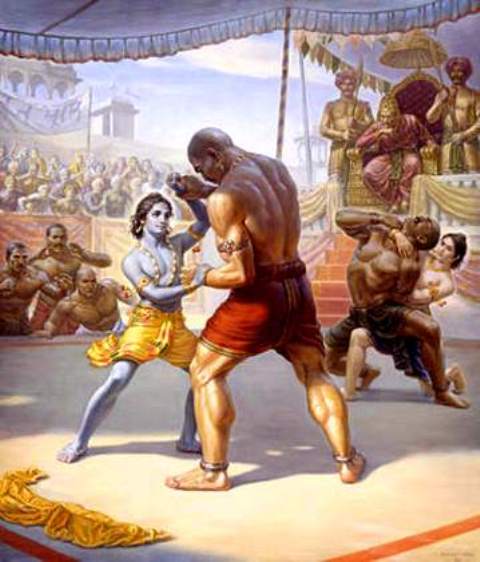
Who is there, desiring deliverance from the vices of the age of quarrel, who is not willing to hear the virtuous glories of the Lord?
His transcendental acts are magnificent and gracious, and great learned sages like Nārada sing of them. Please, therefore, speak to us, who are eager to hear about the adventures He performs in His various incarnations.
O wise Sūta, please narrate to us the transcendental pastimes of the Supreme Godhead’s multi-incarnations. Such auspicious adventures and pastimes of the Lord, the supreme controller, are performed by His internal powers.
We never tire of hearing the transcendental pastimes of the Personality of Godhead, who is glorified by hymns and prayers. Those who have developed a taste for transcendental relationships with Him relish hearing of His pastimes at every moment.
..There is a great difference between mundane stories, fiction, or history and the transcendental pastimes of the Lord. The histories of the whole universe contain references to the pastimes of the incarnations of the Lord. The Rāmāyaṇa, the Mahābhārata, and the Purāṇas are histories of bygone ages recorded in connection with the pastimes of the incarnations of the Lord and therefore remain fresh even after repeated readings. For example, anyone may read Bhagavad-gītā or the Śrīmad-Bhāgavatam repeatedly throughout his whole life and yet find in them new light of information. Mundane news is static whereas transcendental news is dynamic, inasmuch as the spirit is dynamic and matter is static. Those who have developed a taste for understanding the transcendental subject matter are never tired of hearing such narrations. (From Purport to SB 1.1.19)
Srimad Bhagavatam
By His Divine Grace A.C. Bhaktivedanta Swami Prabhupada
Canto 1, Chapter 1, Text 16-19
Full Text and Purport More
05 Aug 2012
by The Hare Krishna Movement
in Lectures, Srimad Bhagavatam
Tags: A.C. Bhaktivedanta Swami Prabhupada, Brahma-nistham, disciple, guru, guru disciple, lectures by His Divine Grace, lectures on Srimad Bhagavatam, parampara system, prabhupada, proper guru, spiritual master, submissively hear
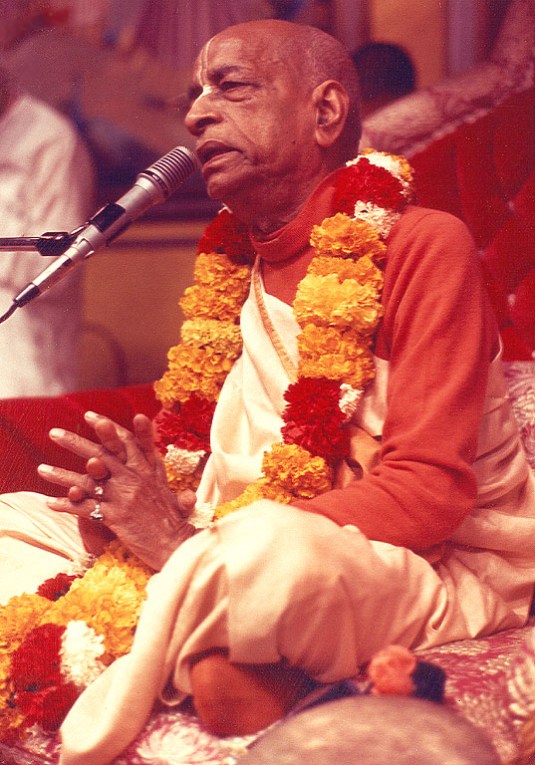
… Guru means heavy, heavy with knowledge…”who has heard from the paramparā system.” and “He is firmly fixed up in the service of the Supreme Personality of Godhead.” Brahma-niṣṭham. He has no other business. This is two qualifications. He must have heard the Vedic knowledge through the disciplic succession. It does not require that he is very learned scholar. No. Simply he must hear from the authority.
Lecture on Śrīmad-Bhāgavatam 3.25.4
By His Divine Grace A.C. Bhaktivedanta Swami Prabhupada
Bombay, November 4, 1974
Nitāi: “Śrī Sūta Gosvāmī said: The most powerful sage Maitreya was a friend of Vyāsadeva. Thus being encouraged, Maitreya, pleased by Vidura’s inquiry about transcendental knowledge, spoke as follows.”
Prabhupada:
dvaipāyana-sakhas tv evaṁ
maitreyo bhagavāṁs tathā
prāhedaṁ viduraṁ prīta
ānvīkṣikyāṁ pracoditaḥ
[SB 3.25.4]
So this is the process of getting knowledge, to approach the proper person, guru, and submissively hear from him about transcendental knowledge. Tad viddhi praṇipātena paripraśnena sevayā [Bg. 4.34]. Don’t try to receive spiritual knowledge or transcendental knowledge very cheaply. Although it is very easy, there is no difficulty, but the process must be known. Just like any machine—we have got experience—just like sometimes our typewriter machine or this dictaphone does not work. So if we go to the proper person, who knows the work, he immediately tightens one screw or changes something; it works. The process we must know. So if I go to a pān-wala for repairing my machine, that will be not good. He does not know the process. He may know to…, how to make pān, biḍi; but doesn’t matter, he does not know how to repair a machine.
More
29 Jul 2012
by The Hare Krishna Movement
in People, Srimad Bhagavatam
Tags: A.C. Bhaktivedanta Swami Prabhupada, artists, Brahma, Candra, demigods, engineres, Indra, inventors, kings, leaders, learned scholars, politicians, powerful deities, scientists, Siva, Srimad Bhagavatam

…There are many powerful kings, leaders, learned scholars, scientists, artists, engineers, inventors, excavators, archaeologists, industrialists, politicians, economists, business magnates, and many more powerful deities or demigods like Brahmā, Śiva, Indra, Candra, Sūrya, Varuṇa and Marut, who are all protecting the interest of the universal affairs of maintenance, in different positions, and all of them are different powerful parts and parcels of the Supreme Lord.
The Supreme Lord Śrī Kṛṣṇa is the father of all living entities, who are placed in different high and low positions according to their desires or aspirations. Some of them, as particularly mentioned above, are specifically endowed with powers by the will of the Lord. A sane person must know for certain that a living being, however powerful he may be, is neither absolute nor independent. All living beings must accept the origin of their specific power as mentioned in this verse. And if they act accordingly, then simply by discharging their respective occupational duties they can achieve the highest perfection of life, namely eternal life, complete knowledge and inexhaustible blessings.
As long as the powerful men of the world do not accept the origin of their respective powers, namely the Personality of Godhead, the actions of māyā (illusion) will continue to act. The actions of māyā are such that a powerful person, misled by the illusory, material energy, wrongly accepts himself as all in all and does not develop God consciousness. As such, the false sense of egoism (namely myself and mine) has become overly prominent in the world, and there is a hard struggle for existence in human society. The intelligent class of men, therefore, must admit the Lord as the ultimate source of all energies and thus pay tribute to the Lord for His good blessings. Simply by accepting the Lord as the supreme proprietor of everything, since He is actually so, one can achieve the highest perfection of life.
More
28 Jul 2012
by The Hare Krishna Movement
in Shiva, Srimad Bhagavatam
Tags: A.C. Bhaktivedanta Swami Prabhupada, autumn season, blossoming petals of the lotus flower, darkness in the heart, effulgence, Krishna's lotus feet, Lord Siva, lotus feet, pada, padma, SB 4.25.52, Shiva, Srimad Bhagavatam, yasya deve para bhaktir
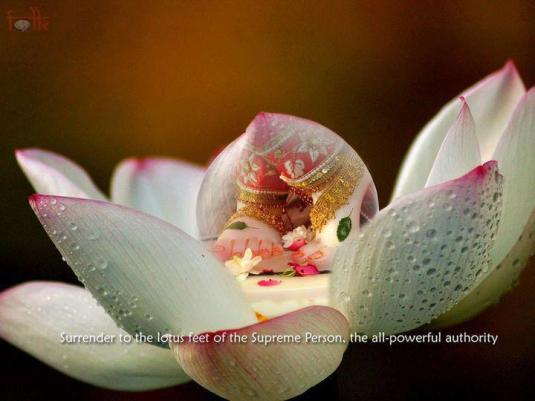
click on image to slightly enlarge
My dear Lord, Your two lotus feet are so beautiful that they appear like two blossoming petals of the lotus flower which grows during the autumn season. Indeed, the nails of Your lotus feet emanate such a great effulgence that they immediately dissipate all the darkness in the heart of a conditioned soul. My dear Lord, kindly show me that form of Yours which always dissipates all kinds of darkness in the heart of a devotee. My dear Lord, You are the supreme spiritual master of everyone; therefore all conditioned souls covered with the darkness of ignorance can be enlightened by You as the spiritual master.
Srimad Bhagavatam
By His Divine Grace A.C. Bhaktivedanta Swami Prabhupada
Canto Four, Chapter 25, Verse 52
Chanting the Song Sung by Lord Siva
More
16 Jul 2012
by The Hare Krishna Movement
in A.C. Bhaktivedanta Swami Prabhupada, Meditation, Srimad Bhagavatam, Visnu, Yoga
Tags: A.C. Bhaktivedanta Swami Prabhupada, Absolute Truth, impersonal conception of the Absolute Truth, Lord Visnu, material energy, pantheism, Personality of Godhead, Srimad Bhagavatam, Visnu
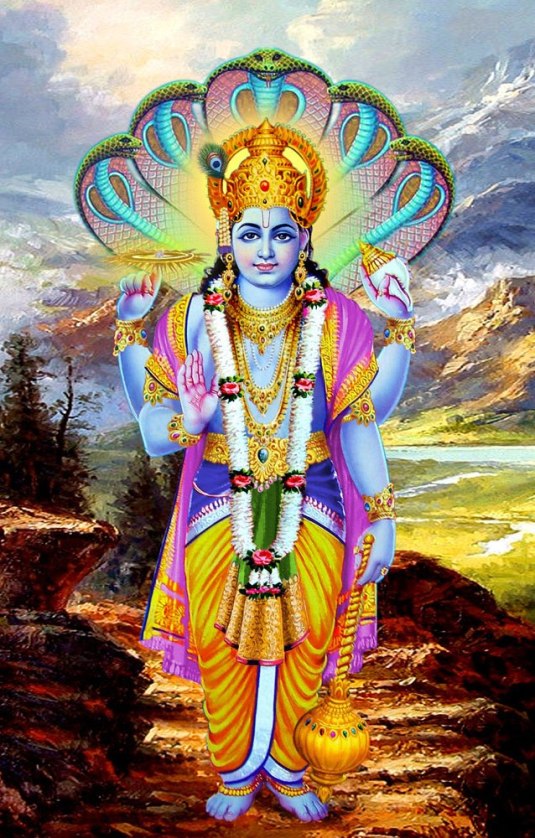
In our previous post Fix your mind upon the Supreme Personality of Godhead it was recommended that we should fix one’s mind in the service of the Personality of Godhead. Now the next step is to meditate upon the form of the Lord. To move from the impersonal to the more personal aspects of the Absolute Truth.
Thereafter, you should meditate upon the limbs of Viṣṇu, one after another, without being deviated from the conception of the complete body. Thus the mind becomes free from all sense objects. There should be no other thing to be thought upon. Because the Supreme Personality of Godhead, Viṣṇu, is the Ultimate Truth, the mind becomes completely reconciled in Him only.
…Therefore, thinking of Viṣṇu or meditating upon the transcendental form of Viṣṇu, specifically upon Lord Kṛṣṇa, is the last word on the subject of meditation.
…it is definitely assured that the Supreme Lord is not impersonal. He is a person, but His body is different from those of conditioned persons like us. Otherwise, meditation beginning from the praṇava (oṁkāra) up to the limbs of the personal body of Viṣṇu would not have been recommended by Śukadeva Gosvāmī for the attainment of complete spiritual perfection. The Viṣṇu forms of worship in great temples of India are not, therefore, arrangements of idol worship, as they are wrongly interpreted to be by a class of men with a poor fund of knowledge; rather, they are different spiritual centers of meditation on the transcendental limbs of the body of Viṣṇu. The worshipable Deity in the temple of Viṣṇu is identical with Lord Viṣṇu by the inconceivable potency of the Lord.
More
16 Jul 2012
by The Hare Krishna Movement
in A.C. Bhaktivedanta Swami Prabhupada, Meditation, Srimad Bhagavatam, Yoga
Tags: A.C. Bhaktivedanta Swami Prabhupada, God realization, meditation, Om, omkara, Personality of Godhead, pranava, SB 2.1.18, self realization, Srimad Bhagavatam, yoga

In our previous post Om, Oṁkāra, or the Praṇava, is the Seed of Transcendental Realization Oṁkāra, or the praṇava, which is the seed of transcendental realization, and it is composed of the three transcendental letters a-u-m, was discussed. By its chanting by the mind, in conjunction with the breathing process, was a means of changing the habit of the mind, to bring the mind under control. But in this next verse, Śukadeva Gosvāmī recommends the next step in God Realization, namely to fix one’s mind in the service of the Personality of Godhead.
Gradually, as the mind becomes progressively spiritualized, withdraw it from sense activities, and by intelligence the senses will be controlled. The mind too absorbed in material activities can be engaged in the service of the Personality of Godhead and become fixed in full transcendental consciousness.
More
15 Jul 2012
by The Hare Krishna Movement
in Lectures, Srimad Bhagavatam
Tags: A.C. Bhaktivedanta Swami Prabhupada, bhagavata, Book Bhagavata, Devotee Bhagavata, Krishna, Lord Siva, maya, Parvati, prabhupada, Pradyumna, SB 1.2.18, Siva Purana
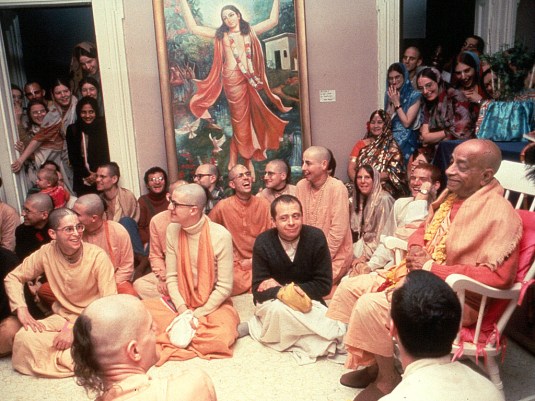
click on image to enlarge
…So Krsna and maya are side by side. As soon as you forget Krsna, or as soon as you want to utilize Krsna for your sense gratification, it is immediately maya, darkness. And as soon as you want to serve Krsna, immediately it is light. So if we keep ourself on this side, light side, always serving Krsna, then there is no possibility of our being in contact with maya.
“The Choice; Krishna Or Maya”
Srimad-Bhagavatam 1.2.18
August 21, 1972, Los Angeles
Pradyumna: (leads chanting, etc.)
nasta-prayesv abhadresu
nityam bhagavata-sevaya
bhagavaty uttama-sloke
bhaktir bhavati naisthiki
[SB 1.2.18]
Translation: “By regularly hearing the Bhagavatam and rendering service unto the pure devotee, all that is troublesome to the heart is practically destroyed, and loving service unto the glorious Lord, who is praised with transcendental songs, is established as an irrevocable fact.”
Prabhupada: So here it is said bhagavata-sevaya, not bhagavan-sevaya. Bhagavan is Krsna, the Supreme Personality of Godhead, and bhagavata means in relation with Bhagavan, who has got relationship with Bhagavan. So here it is recommended bhagavata-sevaya, not bhagavan-sevaya. The idea is that you cannot approach Bhagavan, God, directly. That is not possible. First of all, you have to serve bhagavata, the devotee bhagavata.
There are two kinds of bhagavata: book bhagavata and devotee bhagavata. So in the Siva Purana, there was a question by Parvati to Lord Siva. Lord Siva and Parvati, husband and wife. Parvati means the material nature. Srsti-sthiti-pralaya-sadhana-saktir eka chayeva yasya bhuvanani bibharti durga [Bs. 5.44]. Durga-devi. Durga-devi is in charge of this material world. It is called durga, durga, just like fort. And the superintendent of this fort is Durga. You cannot go out of this fort; you are imprisoned. So such Durga-devi, who is so powerful energy — she can create, annihilate, maintain, srsti-sthiti-pralaya-sadhana — she is always sitting by the side of her husband, Lord Siva, and questioning about spiritual enquiries. Just see. Such powerful deity is also ignorant about spiritual life. So the husband, Lord Siva, is Vaisnava, and she’s always asking, and sitting down underneath a bael tree. She can create so many universes, but for her, no building; only underneath a tree.
More
09 Jul 2012
by The Hare Krishna Movement
in Chanting Hare Krishna, Hare Krishna Maha Mantra, Krishna Consciousness, Srimad Bhagavatam
Tags: A.C. Bhaktivedanta Swami Prabhupada, chanting Hare Krishna, devotional service, offenseless chanting and hearing, parikshit, Prabhupada books, Sri Sukadeva Goswami, Srimad Bhagavatam, The Hare Krishna Movement, transcendental chanting of the holy name
click on image to visit online store
…In this verse, Śrī Śukadeva Gosvāmī recommends the transcendental chanting of the holy name of the Lord. By offenseless chanting and hearing of the holy name of the Lord, one becomes acquainted with the transcendental form of the Lord, and then with the attributes of the Lord, and then with the transcendental nature of His pastimes, etc. Here it is mentioned that one should constantly chant the holy name of the Lord after hearing it from authorities. This means that hearing from the authorities is the first essential.
Anyone who hears Śrīmad-Bhāgavatam attentively from its bona fide reciter is sure to become a sincere devotee of the Lord, who is able to award liberation. There was none so attentive as Mahārāja Parīkṣit in the matter of hearing Śrīmad-Bhāgavatam, and there was none so qualified as Śukadeva Gosvāmī to recite the text of Śrīmad-Bhāgavatam. Therefore, anyone who follows in the footsteps of either the ideal reciter or the ideal hearer, Śukadeva Gosvāmī and Mahārāja Parīkṣit respectively, will undoubtedly attain salvation like them.
O King, constant chanting of the holy name of the Lord after the ways of the great authorities is the doubtless and fearless way of success for all, including those who are free from all material desires, those who are desirous of all material enjoyment, and also those who are self-satisfied by dint of transcendental knowledge.
Srimad Bhagavatam
By His Divine Grace A.C. Bhaktivedanta Swami Prabhupada
Second Canto, Chapter One, Text 10-11
The First Step in God Realization
More
25 Jun 2012
by The Hare Krishna Movement
in Bhagavad-gita, Salvation, Srimad Bhagavatam
Tags: A.C. Bhaktivedanta Swami Prabhupada, Arjuna, Battlefield of Kuruksetra, bhagavad-gita, Bhisma, liberation from material bondage, merciful glance, salvation, SB 1.9.35, Srimad Bhagavatam, The Passing Away of Bhismadeva in the Presence of Lord Krsna

…The Lord diminished the duration of life of the opposite party by His merciful glance. It is said that all the fighters who assembled on the Battlefield of Kurukṣetra attained salvation by personally seeing the Lord at the time of death. Therefore, His diminishing the duration of life of Arjuna’s enemy does not mean that He was partial to the cause of Arjuna. Factually He was merciful to the opposite party because they would not have attained salvation by dying at home in the ordinary course of life. Here was a chance to see the Lord at the time of death and thus attain salvation from material life. Therefore, the Lord is all good, and whatever He does is for everyone’s good.
Srimad Bhagavatam
By His Divine Grace A.C. Bhaktivedanta Swami Prabhupada
Canto 1, Chapter 9, Text 35
The Passing Away of Bhismadeva in the Presence of Lord Krsna
sapadi sakhi-vaco niśamya madhye
nija-parayor balayo rathaṁ niveśya
sthitavati para-sainikāyur akṣṇā
hṛtavati pārtha-sakhe ratir mamāstu
sapadi—on the battlefield; sakhi-vacaḥ—command of the friend; niśamya—after hearing; madhye—in the midst; nija—His own; parayoḥ—and the opposite party; balayoḥ—strength; ratham—chariot; niveśya—having entered; sthitavati—while staying there; para-sainika—of the soldiers on the opposite side; āyuḥ—duration of life; akṣṇā—by looking over; hṛtavati—act of diminishing; pārtha—of Arjuna, son of Pṛthā (Kuntī); sakhe—unto the friend; ratiḥ—intimate relation; mama—my; astu—let there be.
In obedience to the command of His friend, Lord Śrī Kṛṣṇa entered the arena of the Battlefield of Kurukṣetra between the soldiers of Arjuna and Duryodhana, and while there He shortened the life spans of the opposite party by His merciful glance. This was done simply by His looking at the enemy. Let my mind be fixed upon that Kṛṣṇa.
Purport
In the Bhagavad-gītā (1.21-25) Arjuna ordered the infallible Lord Śrī Kṛṣṇa to place his chariot between the phalanxes of the soldiers. He asked Him to stay there until he had finished observing the enemies he had to face in the battle. When the Lord was so asked, He at once did so, just like an order carrier. And the Lord pointed out all the important men on the opposite side, saying, “Here is Bhīṣma, here is Droṇa,” and so on. The Lord, being the supreme living being, is never the order supplier or order carrier of anyone, whoever he may be. But out of His causeless mercy and affection for His pure devotees, sometimes He carries out the order of the devotee like an awaiting servant. By executing the order of a devotee, the Lord becomes pleased, as a father is pleased to carry out the order of his small child. This is possible only out of pure transcendental love between the Lord and His devotees, and Bhīṣmadeva was quite aware of this fact. He therefore addressed the Lord as the friend of Arjuna.
More
17 Jun 2012
by The Hare Krishna Movement
in A.C. Bhaktivedanta Swami Prabhupada, Srimad Bhagavatam
Tags: A.C. Bhaktivedanta Swami Prabhupada, birds of the same feather, crows, goodness, passion, SB 1.5.10-11, Srimad Bhagavatam, swans, swans and crows

…Crows and swans are not birds of the same feather because of their different mental attitudes. The fruitive workers or passionate men are compared to the crows, whereas the all-perfect saintly persons are compared to the swans. The swans do not take pleasure in the places where crows are assembled for conferences and meetings. They are instead seen in the atmosphere of natural scenic beauty where there are transparent reservoirs of water nicely decorated with stems of lotus flowers in variegated colors of natural beauty. That is the difference between the two classes of birds.
Those words which do not describe the glories of the Lord, who alone can sanctify the atmosphere of the whole universe, are considered by saintly persons to be like unto a place of pilgrimage for crows. Since the all-perfect persons are inhabitants of the transcendental abode, they do not derive any pleasure there.
On the other hand, that literature which is full of descriptions of the transcendental glories of the name, fame, forms, pastimes, etc., of the unlimited Supreme Lord is a different creation, full of transcendental words directed toward bringing about a revolution in the impious lives of this world’s misdirected civilization. Such transcendental literatures, even though imperfectly composed, are heard, sung and accepted by purified men who are thoroughly honest.
… literatures which describe the glories of the Lord are enjoyed by the paramahaṁsas who have grasped the essence of human activities.
Srimad Bhagavatam
By His Divine Grace A.C. Bhaktivedanta Swami Prabhupada
Canto 1, Chapter 5, Texts 10-11
More
09 Jun 2012
by The Hare Krishna Movement
in Krishna, Srimad Bhagavatam
Tags: A.C, austerity, Bhaktivedanta Swami Prabhupada, goal of life, knowledge, Krishna, Personality of Godgead, revealed scriptures, sacrifices, SB 1.2.28-29, Sri Krsna, Srila Prabhupada, Srimad Bhagavatam, ultimate goal of life, Vasudeva, vasudeva-para veda, yoga
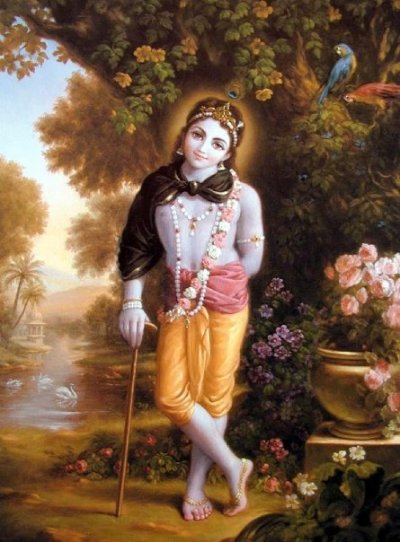
That Śrī Kṛṣṇa, the Personality of Godhead, is the only object of worship is confirmed in these two ślokas.
Srimad-Bhagavatam
By His Divine Grace A.C. Bhaktivedanta Swami Prabhupada
Canto 1, Chapter Two, Text 28-29
TEXTS 28-29
vāsudeva-parā vedā
vāsudeva-parā makhāḥ
vāsudeva-parā yogā
vāsudeva-parāḥ kriyāḥ
vāsudeva-paraṁ jñānaṁ
vāsudeva-paraṁ tapaḥ
vāsudeva-paro dharmo
vāsudeva-parā gatiḥ
vāsudeva—the Personality of Godhead; parāḥ—the ultimate goal; vedāḥ—revealed scriptures; vāsudeva—the Personality of Godhead; parāḥ—for worshiping; makhāḥ—sacrifices; vāsudeva—the Personality of Godhead; parāḥ—the means of attaining; yogāḥ—mystic paraphernalia; vāsudeva—the Personality of Godhead; parāḥ—under His control; kriyāḥ—fruitive activities; vāsudeva—the Personality of Godhead; param—the supreme; jñānam—knowledge; vāsudeva—the Personality of Godhead; param—best; tapaḥ—austerity; vāsudeva—the Personality of Godhead; paraḥ—superior quality; dharmaḥ—religion; vāsudeva—the Personality of Godhead; parāḥ—ultimate; gatiḥ—goal of life.
In the revealed scriptures, the ultimate object of knowledge is Śrī Kṛṣṇa, the Personality of Godhead. The purpose of performing sacrifice is to please Him. Yoga is for realizing Him. All fruitive activities are ultimately rewarded by Him only. He is supreme knowledge, and all severe austerities are performed to know Him. Religion [dharma] is rendering loving service unto Him. He is the supreme goal of life.
Purport
That Śrī Kṛṣṇa, the Personality of Godhead, is the only object of worship is confirmed in these two ślokas. In the Vedic literature there is the same objective: establishing one’s relationship and ultimately reviving our lost loving service unto Him. That is the sum and substance of the Vedas. In the Bhagavad-gītā the same theory is confirmed by the Lord in His own words: the ultimate purpose of the Vedas is to know Him only. All the revealed scriptures are prepared by the Lord through His incarnation in the body of Śrīla Vyāsadeva just to remind the fallen souls, conditioned by material nature, of Śrī Kṛṣṇa, the Personality of Godhead. No demigod can award freedom from material bondage. That is the verdict of all the Vedic literatures. Impersonalists who have no information of the Personality of Godhead minimize the omnipotency of the Supreme Lord and put Him on equal footing with all other living beings, and for this act such impersonalists get freedom from material bondage only with great difficulty. They can surrender unto Him only after many, many births in the culture of transcendental knowledge.
More
Previous Older Entries Next Newer Entries










 The Hare Krishna Movement