05 May 2013
by The Hare Krishna Movement
in A.C. Bhaktivedanta Swami Prabhupada, Krsna Consciousness, Lectures
Tags: A.C. Bhaktivedanta Swami Prabhupada, barhavatamsam asitambuda, He played on His flute, Here is God, His color is blackish, Krishna consciousness, photo by Gurudas, SB 1.1.1, Srila Prabhupada, Vedas, Vedic statement, venum kvanantam
Śrīmad Bhāgavatam Lecture
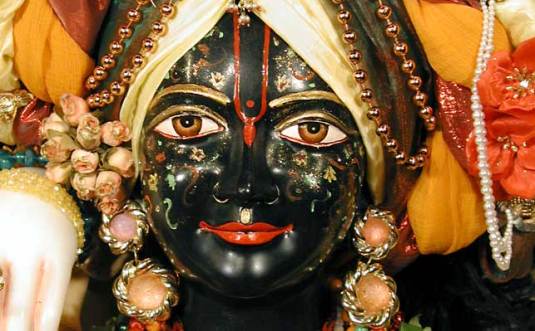
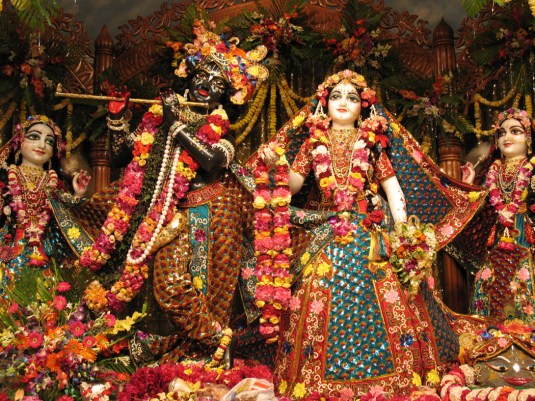
…So our Kṛṣṇa consciousness movement is so nice.. We present, “Here is God.” Here is God. Take His name. Take His address also. It is so perfect. They are searching after God. We are giving the name, address, activity, everything, quality, all. Nāma-rūpa-līlā-parikara-vaiśiṣṭhyam, everything. Nāma means name. Here is Kṛṣṇa, “He is engaged in enjoyment with Rādhārāṇī and playing on His flute.” Veṇuṁ kvaṇantam aravinda-dalāyatākṣaṁ bar… [Bs. 5.30]. We are not imagining. Not that this artist imagines, the poet imagines. No. We don’t do that rascaldom. We don’t do that. We take information from the Vedas. Kṛṣṇa, when He was present personally, He played on His flute. The gopīs saw and the cowherds boys saw five thousand years ago. And the ācāryas took information. Even if you don’t believe in the history, then come to śāstra. The śāstra says veṇuṁ kvaṇantam aravinda-dalāyatākṣam: [Bs. 5.30] “Kṛṣṇa, the Supreme Personality of Godhead, is always engaged in playing on His flute.” This is Vedic statement. Veṇuṁ kvaṇantam aravinda-dalāyatākṣam: [Bs. 5.30] “His eyes are just like lotus petals.” Veṇuṁ kvaṇantam aravinda-dalāyatākṣaṁ barhāvataṁsam asitāmbuda-sundarāṅgam: [Bs. 5.30] “He has got a peacock feather on His head.” These are the description in the Vedas. “He has got a peacock feather on His head.” Barhāvataṁsam asitāmbuda: “His color is blackish.” What kind of blackish? Asitāmbuda: “Just like new cloud.” Asitāmbuda-sundarāṅgam: “But don’t think because He is blackish, He is not beautiful. He is most beautiful.” How much beautiful? Kandarpa-koṭi-kamanīya-viśeṣa-śobham: [Bs. 5.30] “He is so beautiful that if you gather millions of Cupids, still He is more beautiful.” These descriptions are there.
So Kṛṣṇa consciousness movement is very nice. You will be able to understand what is God, and you will be able to understand what is your relationship with God. And you will be able to understand how you can go back to home, back to Godhead.
Thank you very much. (end)
Full Lecture More
19 Apr 2013
by The Hare Krishna Movement
in A.C. Bhaktivedanta Swami Prabhupada, Lectures, Rama
Tags: God, God disposes, God's desire, Lecture by Srila Prabhupada, Lord Ramachndra's Appearance Day, Rama, Srimad Bhagavatam

In honor of the Appearance Day of Lord Ramachandra, we are posting a Lecture given by His Divine Grace A.C. Bhaktivedanta Swami Prabhupada from way back in 1966, when many of us here in the Western world were just hearing about Rama, and His amazing pastimes, for the very first time.
…When God comes in incarnation or He sends His representative to reclaim, they perform wonderful acts. They are not ordinary, common men. Either God or God’s representative, they act in such a way that it is not possible for any common man. That is the particular symptom of God and God’s representative. (Ramachandra’s Appearance Day Lecture, December 27, 1966 New York)
Full Lecture More
13 Apr 2013
by The Hare Krishna Movement
in A.C. Bhaktivedanta Swami Prabhupada, Lectures, Srimad Bhagavatam
Tags: A.C. Bhaktivedanta Swami Prabhupada, bhagavata, Christian, Hindu, Jesus Christ, love God, Prahlada Maharaja, religion, SB 7.9.12, Srila Prabhupada lecture, Srimad Bhagavatam lecture

…Everyone will say that “My system of religion is better than yours.” That is quite natural. A Hindu will say, “Oh, I am better than the Christian.” Christian will say, “I am better than the Hindu.” But Bhagavata says that that is not the test of religion. Bhagavat says, sa vai pumsam paro dharmo yato bhaktir adhoksaje [SB 1.2.6]. That type of religion is the best by which one develops love of Godhead. That’s all. The test is how much you have developed love of Godhead. Bhava-grahi janardana. In Vedic literature it is said that God, Krsna, simply accepts your bhava or your situation, how much you have developed your attraction for God, or Krsna. That is taken into account. He does not take account that “Oh, you are very rich. You are very beautiful. You are very opulent,” or “You are very poor. You are not beautiful.” These considerations are not there. The only consideration is how much you love God. Then your life is successful. (Srimad Bhagavatam Lecture 7.9.12, Montreal)
Full Lecture More
08 Apr 2013
by The Hare Krishna Movement
in A.C. Bhaktivedanta Swami Prabhupada, Ajamila, Lectures, Srimad Bhagavatam
Tags: A.C. Bhaktivedanta Swami Prabhupada, Ajamila, ass, back to Godhead, happiness, Lecture by His Divine Grace, Lecture by Srila Prabhupada, material life, mudha, sa evam vartamano, SB 6.1.26-27
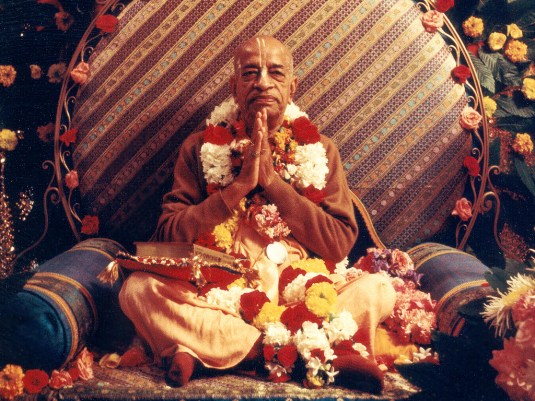
This is a very nice lecture by His Divine Grace from the sixth Canto of the Srimad Bhagavatam, recorded July 12th, 1975, in Philadelphia, PA.
…We are thinking, “I shall be happy in this way. I shall be happy in this…” Nothing. You shall never be happy—this is perfect instruction—unless you go back to home, back to Godhead. Just like a mad boy, he has forsaken his father. His father is rich man, everything is there, but he has become hippie. So similarly, we are also like that. Our father is Kṛṣṇa. We can live there very comfortably without any botheration, without endeavor for earning money, but we have decided that we shall live here in this material world. This is called ass. … Therefore mūḍha. We do not know what is our self-interest. And we are hoping against hope, “I shall be happy in this way. I shall be happy in this way.” Therefore this word is used, mūḍha. They do not know what is actually his happiness, and he is trying one chapter, another, one chapter, another, “Now I will be happy.” The ass. The ass. Sometimes the washerman sits on his back and takes a bunch of grass and puts in front of the ass, and the ass wants to take the grass. But as he moving forward, the grass is also moving forward. (laughter) And he thinks, “Just one step forward, I shall get the grass.” But because he is ass, he does not know that “The grass is situated in such a way that I may go on for millions of years; still, I will not get the happiness…” This is ass. He does not come to his senses that “For millions and trillions of years I may try to be happy in this material world. I will never be happy.”
More
27 Mar 2013
by The Hare Krishna Movement
in A.C. Bhaktivedanta Swami Prabhupada, Caitanya Mahaprabhu, Festivals, Gaura Purnima, Lectures
Tags: A.C. Bhaktivedanta Swami Prabhupada, appearance day of Sri Caitanya, devotee, Gaura Purnima, His Divine Grace Srila Prabhupada, Kali-yuga, Krishna, Krsna, Lord Caitianya, Mayapur, Sri Caitanya Mahaprabhu, Sri Gaura Purnima, sri-krsna-caitanya radha-krsna nahe anya, tri-yuga

Today as most of the world celebrates Gaura Purnima, (Appearance day of Śrī Caitanya Mahāprabhu), I was reminded of a lecture given by His Divine Grace Srila Prabhupada on Gaura Purnima in Mayapur, India, March 16th, 1976. So with pleasure we are posting this famous Gaura Purnima lecture in its entirety.
Prabhupāda:…Śrī Caitanya Mahāprabhu is the Supreme Personality of Godhead, Kṛṣṇa. Śrī-kṛṣṇa-caitanya rādhā-kṛṣṇa nahe anya. You are worshiping Rādhā-Kṛṣṇa, and there is Caitanya Mahāprabhu’s Deity also. There are some parties, they protest, “Why Caitanya Mahāprabhu’s Deity should be placed along with Kṛṣṇa?” But they do not know śrī-kṛṣṇa-caitanya rādhā-kṛṣṇa nahe anya. It is not different. So Śrī Kṛṣṇa Caitanya is Kṛṣṇa. It is confirmed by the śāstras. Here it is said, channaḥ kalau yad abhava. In the Kali-yuga, directly He does not appear as the incarnation like Nṛsiṁhadeva or Vāmanadeva or Lord Rāmacandra, yes, but as devotee. So He’s the same incarnation, Lord Caitanya Mahāprabhu. Abhavat. “Therefore sometimes You are called as tri-yuga.” There are four yugas, but He is known… Because in three yugas He appears distinctly, and in the fourth yuga, the Kali-yuga, as devotee, therefore He’s called tri-yuga. So today is the birthday or appearance day of Śrī Caitanya Mahāprabhu, and this is the birthplace, this Māyāpura, and you are all present here. It is a good fortune. Always remember Śrī Caitanya Mahāprabhu and chant śrī-kṛṣṇa-caitanya prabhu-nityānanda…
Devotees: …śrī-advaita gadādhara śrīvāsādi-gaura-bhakta-vṛnda.
Prabhupāda: This will make your life perfect.
Full Lecture More
14 Mar 2013
by The Hare Krishna Movement
in A.C. Bhaktivedanta Swami Prabhupada, Lectures, Sri Nrsimha Pranama, Sri Nrsimha Pranama
Tags: A.C. Bhaktivedanta Swami Prabhupada, Lord Nrsimha-deva, namas te nara-simhaya, Nrsimha, Sri-Nrsimha-Pranama, tava kara-kamala-vare

click on image to enlarge
Śrī Nṛsiṁha Praṇāma
Translation from the Songs of the Vaisnava Acaryas 1972 Edition
namas te narasiḿhāya prahlādāhlāda-dāyine
hiraṇyakaśipor vakṣaḥ-śilā-ṭańka-nakhālaye
ito nṛsiḿhaḥ parato nṛsiḿho yato yato yāmi tato nṛsiḿhaḥ
bahir nṛsiḿho hṛdaye nṛsiḿho nṛsiḿham ādiḿ śaraṇaḿ prapadye
“I offer my obeisances to Lord Nṛsiṁha -deva, who is always giving bliss to His devotees like Prahlada Maharaja and chiseling at the hearts of demons like Hiraṇyakaśipu. The devotee always sees Lord Nṛsiṁha everywhere. Lord Nṛsiṁha is within and without. Therefore let us take shelter of Lord Nrsimha.”
tava kara-kamala-vare nakham adbhuta-śṛṅgaṁ
dalita-hiraṇyakaśipu-tanu-bhṛṅgam
keśava dhṛta-narahari-rūpa jaya jagadīśa hare
“O my lord Nṛsiṁha-deva, Your hands are very beautiful, like the lotus flower, but with Your longs nails You have ripped apart the wasp Hiraṇyakaśipu. Unto You, Lord of the Universe, I offer my humble obeisances.” (Prayers to Lord Nṛsiṁha from Dasavatara by Jayadeva Gosvami)
Purport More
04 Mar 2013
by The Hare Krishna Movement
in A.C. Bhaktivedanta Swami Prabhupada, Lectures, Nectar of Devotion
Tags: A.C. Bhaktivedanta Swami Prabhupada, Acyutananda das, ceto-darpana-marjanam, chanting Hare Krishna, cleansing the heart, Europeans and Americans, Nectar of Devotion, prabhupada, sankirtan, sri krishna sankirtan, Sri-krsna-sankirtan, Srila Prabhupada

click on image to enlarge
…Kṛṣṇa consciousness is a fact in everyone’s heart. It is already there. Otherwise how these Europeans and Americans, they’re taking to Kṛṣṇa consciousness very seriously? So it is to be understood that Kṛṣṇa consciousness was there already. By the process of hearing… As Caitanya Mahāprabhu has recommended: ceto-darpaṇa-mārjanaṁ paraṁ vijayate śrī-kṛṣṇa-saṅkīrtanam [Cc. Antya 20.12]. Śrī-kṛṣṇa-saṅkīrtanam is so auspicious that the chanting of this mantra awakens the dormant Kṛṣṇa consciousness. Ceto-darpaṇa-mārjanam. The more you hear Hare Kṛṣṇa mantra, the more your heart becomes cleansed. These are the statements given by Caitanya Mahāprabhu. There cannot be any defect. My statement may be defective, but Caitanya Mahāprabhu’s statement cannot be defective, because He is in the transcendental platform. He is transcendence Himself. Kṛṣṇa-caitanya-nāmne. Kṛṣṇāya kṛṣṇa-caitanya-nāmine. He’s Kṛṣṇa Himself, but He has appeared in the form of Kṛṣṇa Caitanya. Therefore, whatever He says, that is fact. Ceto-darpaṇa-mārjanam. The more we hear the vibration, the transcendental vibration, Hare Kṛṣṇa, Hare Kṛṣṇa, Kṛṣṇa Kṛṣṇa, Hare Hare/ Hare Rāma, Hare Rāma, Rāma Rāma, Hare Hare, without any offense… Even with, mixed with offense… There are three stages of chanting this vibration: offensive chanting, and almost offenseless chanting, and offenseless chanting. Offensive chanting may give you material pains and pleasures, and almost offenseless will give you liberation, will place you in the transcendental platform. And when it is offenseless, then immediately you’ll invoke love of God, Kṛṣṇa-prema. So even in offensive stage, if you go on chanting and try to be, try to become safe from offensive condition… Daśa-vidhā-nāma, ten kinds of offenses, if we avoid, that is the process of auspicity. But even we are not in the platform of offenseless chanting, still, we must go on chanting. It will gradually make our heart cleansed and we’ll be offenseless. Ceto-darpaṇa-mārjanaṁ bhava-mahā-dāvāgni-nirvāpaṇam [Cc. Antya 20.12]. So the Kṛṣṇa consciousness, awakening of Kṛṣṇa consciousness, is required. That is called ceto-darpaṇa-mārjanam.
So here, Rūpa Gosvāmī says auspicity means that which spreads for everyone, in all parts of the world. That is auspicity. Not partial. In politics or sociology or humanitarian activities, there is partiality for a certain section of human being, or certain section of living beings. But this chanting of Hare Kṛṣṇa mantra, awakening Kṛṣṇa consc…, dormant Kṛṣṇa consciousness, is meant for all living entities. Even birds, beasts, insects, they can also awaken. This is the recommendation of Haridāsa Ṭhākura, that if we chant loudly, the trees will hear, the birds will hear, the insect will hear, and they will be liberated. That is the statement of Nāmācārya Haridāsa Ṭhākura. Therefore chanting of Hare Kṛṣṇa mantra and awakening of dormant Kṛṣṇa consciousness is the auspicious activities, welfare activities, for every living entity all over the world.
Full Lecture More
02 Mar 2013
by The Hare Krishna Movement
in A.C. Bhaktivedanta Swami Prabhupada, Bhaktisiddhanta Sarasvati Thakura, Festivals, Lectures
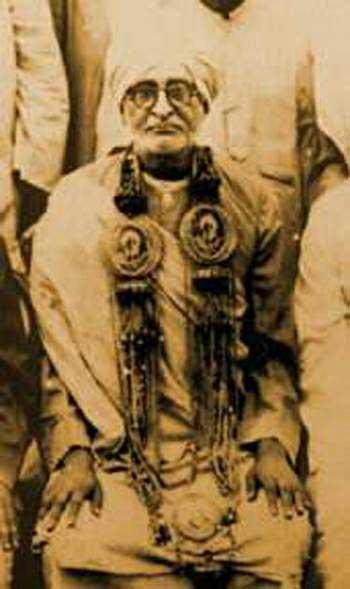
Today is the Appearance Day of His Divine Grace Srila Bhaktisiddhanta Sarasvati Gosvami, the spiritual master of our Srila Prabhupada. So we honor this event with a lecture given by A.C. Bhaktivedanta Swami Prabhupada on Srila Bhaktisiddhanta’s appearance day festival given in Mayapur, February 8, 1977.
…We should become intelligent. And to make us intelligent, Kṛṣṇa comes, Kṛṣṇa’s devotees come, some messenger comes. And Śrīla Bhaktisiddhānta Sarasvatī Ṭhākura is one of the messengers of Kṛṣṇa Caitanya Mahāprabhu to preach Kṛṣṇa consciousness. And not only he preached, but he trained up many disciples to preach this Kṛṣṇa consciousness all over the world. So by his grace we are also endeavoring to do something. This is called paramparā system.
So we should take advantage of this Vaiṣṇava mission. Our Guru Mahārāja Bhaktisiddhānta Sarasvatī Ṭhākura, he is Vaiṣṇava, cent percent Vaiṣṇava.
…Vaiṣṇava means he doesn’t want any material profit or material opulence or material reputation.
But in the material world everyone is busy for three things—material profit, material reputation, and material adoration.
This is not Vaiṣṇava’s business. Vaiṣṇava never cares for all these things. Vaiṣṇava is always thinking how to do good to the suffering humanity.
Full Lecture More
14 Feb 2013
by The Hare Krishna Movement
in A.C. Bhaktivedanta Swami Prabhupada, Lectures, Radha Madhava, Radha-Madhava, Songs of the Vaisnava Acaryas
Tags: A.C. Bhaktivedanta Swami Prabhupada, braja-jana-ranjana, giri-vara-dhari, gopi-jana-vallabha, Jaya Radha Madhava, kunja-bihari, Lectures by Srila Prabhupada, purport to Jaya Radha Madhava, yamuna-tira-vana-cari, yasoda-nandana
click on image to enlarge
Jaya Rādhā-Mādhava
by Srila Bhaktivinoda Thakura
jaya rādhā-mādhava kuñja-bihārī
gopī-jana-vallabha giri-vara-dhārī
jaya–all glories to: rādhā-mādhava–Rādhā and the Lord of sweetness; kuñja-bihārī–He who enjoys loving pastimes in the groves of Vṛndāvana; gopī-jana-vallabha–the lover of the cowherd maidens of Vraja; giri-vara-dhārī–the holder of the great hill named Govardhana;
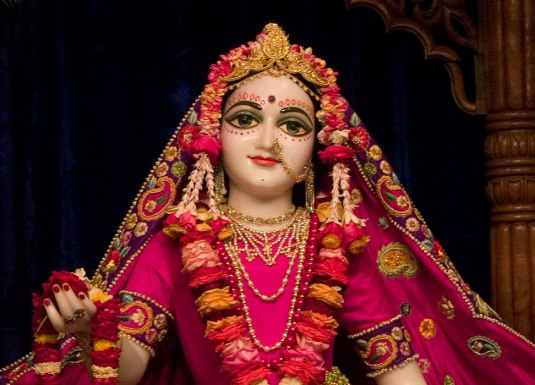
Krsna is the lover of Radha. He displays many amorous pastimes in the groves of Vrndavana, He is the lover of the cowherd maidens of Vraja, and the holder of the great hill named Govardhana.
yaśodā-nandana braja-jana-rañjana
yāmuna-tīra-vana-cārī
yaśodā-nandana–the beloved son of mother Yaśodā; vraja-jana-rañjana–the delighter of the inhabitants of Vraja; yāmuna-tīra-vana-cārī–who wanders in the forests along the banks of the river Yamunā
He is the beloved son of mother Yasoda, the delighter of the inhabitants of Vraja, and He wanders in the forests along the banks of the River Yamuna!
Purport to Jaya Rādhā-Mādhava
New York, July 20, 1971
Prabhupāda: So you know this song Jaya Rādhā-Mādhava?
Devotees: Jaya!
Prabhupāda: So you can follow me?
Devotees: Jaya! Haribol! (Śrīla Prabhupāda leads singing of Jaya Rādhā-Mādhava)
More
16 Jan 2013
by The Hare Krishna Movement
in A.C. Bhaktivedanta Swami Prabhupada, Bhaktivinoda Thakura, Lectures, Radha Madhava, Songs of the Vaisnava Acaryas, Spiritual Life, Spiritual World
Tags: Bhaktivinoda Thakura
click on image to enlarge
…Ladies and gentlemen, I thank you very much for your coming here to participate in this Kṛṣṇa consciousness movement. We are calling everyone to go back to home, back to Godhead. This is our movement, Kṛṣṇa consciousness movement. Just now we described the place where we intend to go. That is Goloka Vṛndāvana. There the Supreme Personality of Godhead is residing with His consort Rādhārāṇī. Rādhā-Mādhava. (from lecture by Srila Prabhupada, Laguna Beach 9-30-1972)
So this is the original nature of Krsna. He is Radha-Madhava. He is the lover of Srimati Radharani.
Full Lecture plus song More
13 Sep 2012
by The Hare Krishna Movement
in Krsna Consciousness, Lectures
Tags: A.C. Bhaktivedanta Swami Prabhupada, anyabilasita-sunyam, Bhagavad-gita lecture, Brahma-samhita, Krishna, krsna-prema, Lecture by Srila Prabhupada, love of God, namo maha-vadanyaya, no material desire, pure devotee
Click on image to enlarge
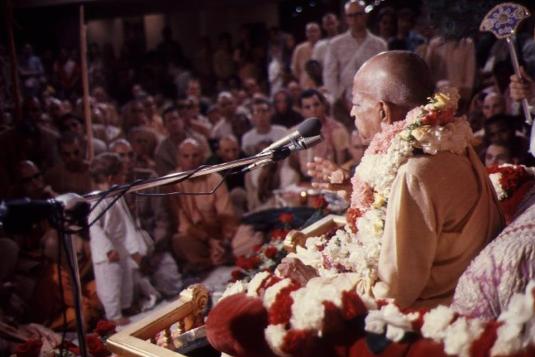
Pure devotee means he has no other desire, no material desire. Anyābhilāṣitā-śūnyam, zero.
…And if it is mixed up, anyābhi…, with material desire or spiritual emancipation or fruitive activities, then it is not pure devotee.
So if you can approach such pure devotee… As it is stated in the Brahma-saṁhitā, adurlabham ātma-bhaktau. This is ātma-bhaktau, a pure devotee. He can deliver you Kṛṣṇa. “Take Kṛṣṇa. Here is Kṛṣṇa.” Kṛṣṇa-prema… That is…
The symbolic representation is Śrī Caitanya Mahāprabhu. He’s described by Rūpa Gosvāmī:
namo mahā-vadānyāya kṛṣṇa-prema-pradāya te kṛṣṇāya kṛṣṇa-caitanya-nāmne gaura-tviṣe namaḥ [Madhya 19.53]
When Rūpa Gosvāmī… He was minister in the government of Nawab Hussain Shah. At that time, very exalted personality. He could understand Caitanya Mahāprabhu’s mission. Therefore when he first met Him at Allahabad, Prayāga, he offered his respect with these words: namo mahā-vadānyāya, the most munificent incarnation. Why? Kṛṣṇa-prema-pradāya te. “You are distributing kṛṣṇa-prema. It is very difficult to understand Kṛṣṇa, but You are so kind that You are immediately delivering love of Kṛṣṇa.”
You can know one person. But to develop love for him, that is another transaction. So people cannot understand even Kṛṣṇa, and what is the saying of Kṛṣṇa’s love? But Caitanya Mahāprabhu is so kind that He’s immediately giving kṛṣṇa-prema, love of Kṛṣṇa. Therefore He is described as the most munificent incarnation. Kṛṣṇa Himself could not deliver Himself. He wanted. “First of all you surrender.” Sarva-dharmān parityajya mām ekaṁ śaraṇaṁ vraja [Bg. 18.66] But Caitanya Mahāprabhu is so kind. Simply through this chanting and dancing, He is distributing love of Kṛṣṇa.
You can see practically. These boys from European and American countries, means all over the world, why they are chanting and dancing in this way? Do you think they have become mad? And one says, “Yes, they have become mad.” Why? For love of Kṛṣṇa. Now they have began they have become lover of Kṛṣṇa. So kṛṣṇa-prema is like that. That is through the mercy of Śrī Caitanya Mahāprabhu.
Therefore Śrī Caitanya Mahāprabhu is the symbolic representation of devotee. Bhaktāvatāraṁ bhaktākhyaṁ namāmi bhakta-śaktikam. Namāmi bhakta-śaktikam. He can give the strength to the devotee so that he can develop his dormant love of Kṛṣṇa. Therefore in the Brahma-saṁhitā it is stated that adurlabham ātma-bhaktau. If one is pure devotee, for him, Kṛṣṇa is available very easy. He says in the Bhagavad-gītā. Bhaktyā mām abhijānāti yāvān yaś cāsmi tattvataḥ [Bg. 18.55] “One can understand Me in truth…” Yāvān yaś cāsmi tattvataḥ. “Which is very, very difficult.”
manuṣyāṇāṁ sahasreṣu kaścid yatati siddhaye yatatām api siddhānāṁ kaścin māṁ vetti tattvataḥ [Bg. 7.3]
To understand Kṛṣṇa as He is, it is difficult. But if you take to this process of devotional service…
śravaṇaṁ kīrtanaṁ viṣṇoḥ smaraṇaṁ pāda-sevanam arcanaṁ vandanaṁ dāsyaṁ sakhyam ātma-nivedanam [SB 7.5.23]
Either of these process. All the process or either of these. You become successful to develop your dormant Kṛṣṇa consciousness, and then your life becomes successful. Thank you very much. (end)
Full lecture More
09 Aug 2012
by The Hare Krishna Movement
in Festivals, Janmastami, Krishna, Lectures
Tags: A.C. Bhaktivedanta Swami Prabhupada, Hare Krishna, International Society for Krishna Consciousness, Janmastami, Krishna, Krsna Kesava pahi mam, Lord Sri Krishna, Lord Sri Krsna's Appearance Day Lecture, Rama Raghava raksa mam, Srila Prabhupada lecture

Kṛṣṇa! Kṛṣṇa! Kṛṣṇa! Kṛṣṇa! Kṛṣṇa! Kṛṣṇa! Kṛṣṇa! he
Kṛṣṇa! Kṛṣṇa! Kṛṣṇa! Kṛṣṇa! Kṛṣṇa! Kṛṣṇa! Kṛṣṇa! he
Kṛṣṇa! Kṛṣṇa! Kṛṣṇa! Kṛṣṇa! Kṛṣṇa! Kṛṣṇa! rakṣa mām
Kṛṣṇa! Kṛṣṇa! Kṛṣṇa! Kṛṣṇa! Kṛṣṇa! Kṛṣṇa! pāhi mām
Rāma! Rāghava! Rāma! Rāghava! Rāma! Rāghava! rakṣa mām
Kṛṣṇa! Keśava! Kṛṣṇa! Keśava! Kṛṣṇa! Keśava! pāhi mām
Caitanya-caritāmṛta (Madhya 7.96)
Today, here in the Western half of the World, we are celebrating Janmastami: the appearance day of Lord Sri Krishna. So let us take advantage of this auspicious day and hear, chant, and remember the pastimes of the Lord. Hare Krishna!
Janmāṣṭamī
Lord Śrī Kṛṣṇa’s Appearance Day Lecture
By His Divine Grace A.C. Bhaktivedanta Swami Prabhupada
Montreal, August 16, 1968
More
05 Aug 2012
by The Hare Krishna Movement
in Lectures, Srimad Bhagavatam
Tags: A.C. Bhaktivedanta Swami Prabhupada, Brahma-nistham, disciple, guru, guru disciple, lectures by His Divine Grace, lectures on Srimad Bhagavatam, parampara system, prabhupada, proper guru, spiritual master, submissively hear
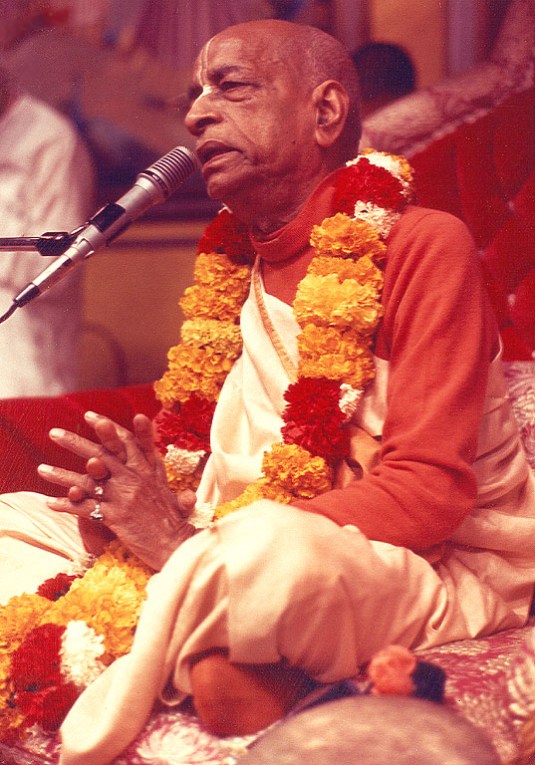
… Guru means heavy, heavy with knowledge…”who has heard from the paramparā system.” and “He is firmly fixed up in the service of the Supreme Personality of Godhead.” Brahma-niṣṭham. He has no other business. This is two qualifications. He must have heard the Vedic knowledge through the disciplic succession. It does not require that he is very learned scholar. No. Simply he must hear from the authority.
Lecture on Śrīmad-Bhāgavatam 3.25.4
By His Divine Grace A.C. Bhaktivedanta Swami Prabhupada
Bombay, November 4, 1974
Nitāi: “Śrī Sūta Gosvāmī said: The most powerful sage Maitreya was a friend of Vyāsadeva. Thus being encouraged, Maitreya, pleased by Vidura’s inquiry about transcendental knowledge, spoke as follows.”
Prabhupada:
dvaipāyana-sakhas tv evaṁ
maitreyo bhagavāṁs tathā
prāhedaṁ viduraṁ prīta
ānvīkṣikyāṁ pracoditaḥ
[SB 3.25.4]
So this is the process of getting knowledge, to approach the proper person, guru, and submissively hear from him about transcendental knowledge. Tad viddhi praṇipātena paripraśnena sevayā [Bg. 4.34]. Don’t try to receive spiritual knowledge or transcendental knowledge very cheaply. Although it is very easy, there is no difficulty, but the process must be known. Just like any machine—we have got experience—just like sometimes our typewriter machine or this dictaphone does not work. So if we go to the proper person, who knows the work, he immediately tightens one screw or changes something; it works. The process we must know. So if I go to a pān-wala for repairing my machine, that will be not good. He does not know the process. He may know to…, how to make pān, biḍi; but doesn’t matter, he does not know how to repair a machine.
More
22 Jul 2012
by The Hare Krishna Movement
in Lectures, Vedas
Tags: A.C. Bhaktivedanta Swami Prabhupada, bhagavad-gita, brahmana, Conway Hall, Hindu, ksatriya, Lecture by Srila Prabhupada, Sanskrit, sudra, Teachings of the Vedas, vaisya, varnasrama, Veda, Vedas, Vedic knowledge

…The Vedas are not compilations of human knowledge. Vedic knowledge comes from the spiritual world, from Lord Krsna.
“Teachings of the Vedas”
[Delivered as a lecture by His Divine Grace A. C. Bhaktivedanta Swami Prabhupada on October 6, 1969, at Conway Hall, London, England.]
Ladies and gentlemen, today’s subject matter is the teachings of the Vedas. What are the Vedas? The Sanskrit verbal root of veda can be interpreted variously, but the purpose is finally one. Veda means knowledge. Any knowledge you accept is veda, for the teachings of the Vedas are the original knowledge. In the conditioned state, our knowledge is subjected to many deficiencies. The difference between a conditioned soul and a liberated soul is that the conditioned soul has four kinds of defects. The first defect is that he must commit mistakes. For example, in our country, Mahatma Gandhi was considered to be a very great personality, but he committed many mistakes. Even at the last stage of his life, his assistant warned, “Mahatma Gandhi, don’t go to the New Delhi meeting. I have some friends, and I have heard there is danger.” But he did not hear. He persisted on going and was killed. Even great personalities like Mahatma Gandhi, President Kennedy — there are so many of them — make mistakes. To err is human. This is one defect of the conditioned soul.
Another defect: to be illusioned. Illusion means to accept something which is not: maya. Maya means what is not. Everyone is accepting the body as the self. If I ask you what you are, you will say, “I am Mr. John; I am a rich man; I am this, I am that.” All these are bodily identifications. But you are not this body. This is illusion.
The third defect is the cheating propensity. Everyone has the propensity to cheat others. Although a person is fool number one, he poses himself as very intelligent. Although it is already pointed out that he is in illusion and makes mistakes, he will theorize: “I think this is this, this is this.” But he does not even know his own position. He writes books of philosophy, although he is defective. That is his disease. That is cheating.
Lastly, our senses are imperfect. We are very proud of our eyes. Often, someone will challenge, “can you show me God?” But do you have the eyes to see God? You will never see if you haven’t the eyes. If immediately the room becomes dark, you cannot even see your hands. So what power do you have to see? We cannot, therefore, expect knowledge (veda) with these imperfect senses. With all these deficiencies, in conditioned life, we cannot give perfect knowledge to anyone. Nor are we ourselves perfect. Therefore we accept the Vedas as they are.
More
18 Jul 2012
by The Hare Krishna Movement
in Caitanya Mahaprabhu, Lectures, Sri Caitanya-Caritamrta
Tags: A.C. Bhaktivedanta Swami Prabhupada, Caitanya Caritamrta, Krsna, krsnera svarupa ananta, Lord Caitanya, Mad. 20.146-151, photo by Gurudas, prabhupada, Prabhupada lectures, transcendental forms of Krsna, Vedas, Vedic knowledge points to Krishna

“Vedic Knowledge Points To Krsna”
Lecture on Caitanya-caritamrta Madhya 20.146-151
New York, December 3, 1966
By His Divine Grace A.C. Bhaktivedanta Swami Prabhupada
Prabhupada:
mukhya-gauna-vrtti, kimva anvaya-vyatireke
vedera pratijna kevala kahaye krsnake
So Lord Caitanya says, “You study Vedas in any way, directly, indirectly. In whatever way you like you study Vedas, but the ultimate objective is Krsna.”
Now, Caitanya, Lord Caitanya, is describing about the various forms of Krsna. This is very important subject. How Krsna is all-pervading, He is describing.
krsnera svarupa-ananta, vaibhava-apara
cic-chakti, maya-sakti, jiva-sakti ara
Krsnera svarupa ananta. The transcendental forms of Krsna, innumerable, vaibhava, and His opulence, that is also innumerable. Nobody can estimate. How many forms are there of Krsna or how much opulent He is, nobody can estimate; nobody can measure. This is inconceivable. The first proposition. Cic-chakti maya-sakti jiva-sakti ara. And His potencies are also unlimited, out of which, three potencies are generally accepted: cit-sakti, spiritual potency; material potency; and marginal potency. These three potencies I have described many times. Cit-sakti, the spiritual potency, is a manifestation of the spiritual world, and material potency is a manifestation of this material world, and the marginal potency, we are, we living entities. We are marginal potency. Why it is marginal? Because although we belong to the spiritual potency, but we have got tendency to come into contact of this material potency. Therefore it is called marginal, “this way or that way.” That a slight independence which is there in every living entity, he can use that, and he may select either to live in the spiritual potency or in the material potency. Therefore the living entities are called marginal potency. So parasya saktir vividhaiva sruyate [Cc. Madhya 13.65, purport]. Although the energies of the Supreme Lord are innumerable — nobody can count or measure — but they are divided into three.
More
15 Jul 2012
by The Hare Krishna Movement
in Lectures, Srimad Bhagavatam
Tags: A.C. Bhaktivedanta Swami Prabhupada, bhagavata, Book Bhagavata, Devotee Bhagavata, Krishna, Lord Siva, maya, Parvati, prabhupada, Pradyumna, SB 1.2.18, Siva Purana
click on image to enlarge
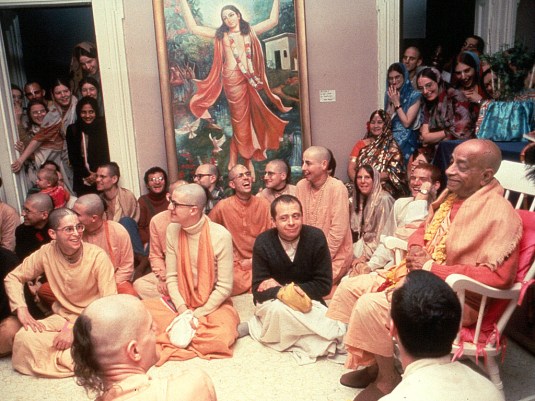
…So Krsna and maya are side by side. As soon as you forget Krsna, or as soon as you want to utilize Krsna for your sense gratification, it is immediately maya, darkness. And as soon as you want to serve Krsna, immediately it is light. So if we keep ourself on this side, light side, always serving Krsna, then there is no possibility of our being in contact with maya.
“The Choice; Krishna Or Maya”
Srimad-Bhagavatam 1.2.18
August 21, 1972, Los Angeles
Pradyumna: (leads chanting, etc.)
nasta-prayesv abhadresu
nityam bhagavata-sevaya
bhagavaty uttama-sloke
bhaktir bhavati naisthiki
[SB 1.2.18]
Translation: “By regularly hearing the Bhagavatam and rendering service unto the pure devotee, all that is troublesome to the heart is practically destroyed, and loving service unto the glorious Lord, who is praised with transcendental songs, is established as an irrevocable fact.”
Prabhupada: So here it is said bhagavata-sevaya, not bhagavan-sevaya. Bhagavan is Krsna, the Supreme Personality of Godhead, and bhagavata means in relation with Bhagavan, who has got relationship with Bhagavan. So here it is recommended bhagavata-sevaya, not bhagavan-sevaya. The idea is that you cannot approach Bhagavan, God, directly. That is not possible. First of all, you have to serve bhagavata, the devotee bhagavata.
There are two kinds of bhagavata: book bhagavata and devotee bhagavata. So in the Siva Purana, there was a question by Parvati to Lord Siva. Lord Siva and Parvati, husband and wife. Parvati means the material nature. Srsti-sthiti-pralaya-sadhana-saktir eka chayeva yasya bhuvanani bibharti durga [Bs. 5.44]. Durga-devi. Durga-devi is in charge of this material world. It is called durga, durga, just like fort. And the superintendent of this fort is Durga. You cannot go out of this fort; you are imprisoned. So such Durga-devi, who is so powerful energy — she can create, annihilate, maintain, srsti-sthiti-pralaya-sadhana — she is always sitting by the side of her husband, Lord Siva, and questioning about spiritual enquiries. Just see. Such powerful deity is also ignorant about spiritual life. So the husband, Lord Siva, is Vaisnava, and she’s always asking, and sitting down underneath a bael tree. She can create so many universes, but for her, no building; only underneath a tree.
More
11 Jul 2012
by The Hare Krishna Movement
in A.C. Bhaktivedanta Swami Prabhupada, Back to Godhead, Lectures, Spiritual Life
Tags: A.C. Bhaktivedanta Swami Prabhupada, BTG Magazine, Gurudas, krsna consciousness, Lecture by Srila Prabhupada, photo by Gurudas, religious system, Spiritual Life, spiritual understanding

…So if we are serious, if we actually want to be happy, we must take to the cultivation of spiritual understanding, an understanding of Krsna consciousness. Of course, in every country of the world there is some religious system, some system for understanding spiritual life. But unfortunately, almost nobody is interested in spiritual life because people have been induced to become addicted to material, or sensual, activities. They are going further and further away from spiritual life and becoming more and more confused. Disappointment is rising all over the world.
So to mitigate this disappointment and confusion, one has to take to Krsna consciousness. Try to understand the philosophy of Krsna consciousness, and act accordingly. Then you will be happy.
A Call to Spiritual Life
By His Divine Grace A.C. Bhaktivedanta Swami Prabhupada
An address given in September 1973 (upon arriving for his first visit in Stockholm).
Thank you very much for kindly receiving me on this first visit of mine to your country.
The Krsna consciousness movement is gradually spreading all over the world, but it is a little difficult to understand the purport of this movement because it is completely on the spiritual platform. Generally, people do not understand what the spiritual platform is. But it is quite simple. Every one of us every living being is a combination of two things: matter and spirit. Matter we can understand, but on account of our long association with matter we cannot understand what spirit is.
More
28 Jun 2012
by The Hare Krishna Movement
in Lectures, Sri Caitanya-Caritamrta
Tags: A.C. Bhaktivedanta Swami Prabhupada, books, bookworm, goal of life, learned scholar, libary of Trinity College, Lord Caitanya Mahaprabhu

click on image to enlarge
“If one becomes a bookworm, reading many books and scriptures and hearing many commentaries and the instructions of many men, this will produce doubt within his heart. One cannot in this way ascertain the real goal of life.” (Adi-lila 16. 11)
…Man has a general tendency toward fruitive activities, religious ritualistic ceremonies and philosophical speculation. A living entity thus bewildered since time immemorial does not understand the real goal of life, and thus his activities in life are wasted. Innocent persons misled in this way are deprived of unalloyed kṛṣṇa-bhakti, devotional service to the Lord. Tapana Miśra is a vivid example of such a person. He was a learned scholar, but he could not ascertain what the goal of life is. Therefore he was given a chance to hear Lord Caitanya Mahāprabhu instructing Sanātana Gosvāmī. Lord Caitanya’s instruction to Tapana Miśra is especially significant for persons who loiter here and there collecting books and reading none of them, thus becoming bewildered regarding the aim of life.
.. Simply by studying, becoming bookworm, you cannot advance. The real secret is… Yasya deve para bhaktir yatha deve tatha gurau [ŚU 6.23] That is stated in the Vedas. Unflinching faith in God and spiritual master. Then things will be revealed from within.
Sri Caitanya-caritamrta – 1975 Edition
By His Divine Grace A.C. Bhaktivedanta Swami Prabhupada
Adi-lila Chapter 16, Text 11
The Pastimes of the Lord in His Childhood and Youth
bahu-śāstre bahu-vākye citte bhrama haya
sādhya-sādhana śreṣṭha nā haya niścaya
bahu-śāstre—by many books or scriptures; bahu-vākye—by many versions of many persons; citte—within the heart; bhrama—doubt; haya—there is; sādhya-sādhana—objective and means; śreṣṭha—about the best; nā—not; haya—there is; niścaya—certainty.
If one becomes a bookworm, reading many books and scriptures and hearing many commentaries and the instructions of many men, this will produce doubt within his heart. One cannot in this way ascertain the real goal of life.
PURPORT
In Śrīmad-Bhāgavatam (7.13.8) it is said, granthān naivābhyased bahūn na vyākhyām upayuñjīta: “One should not read many books, nor should one try to make a profession of reciting many books, especially if one is a devotee.” One must give up the ambition to be a learned scholar and in this way earn a worldly reputation and financial facilities. If one diverts his attention to studying many books, he cannot fix his mind in devotional service, nor can he understand many scriptures, for they are full of grave statements and meanings. In this connection Śrīla Bhaktisiddhānta Sarasvatī Ṭhākura gives his opinion that those who are attracted to studying many kinds of literature concerning various subject matters, especially fruitive activities and philosophical speculation, are deprived of unalloyed devotional service because of their splayed attention.
More
27 Jun 2012
by The Hare Krishna Movement
in A.C. Bhaktivedanta Swami Prabhupada, Back to Godhead, Lectures, Vaisnava Compassion
Tags: A.C. Bhaktivedanta Swami Prabhupada, Back to Godhead Magazine, hellish conditions, hellish life, krsna consciousness, Krsnaloka, Maharaja Pariksit, spiritual body, Sukadeva Goswami, Vaisnava heart
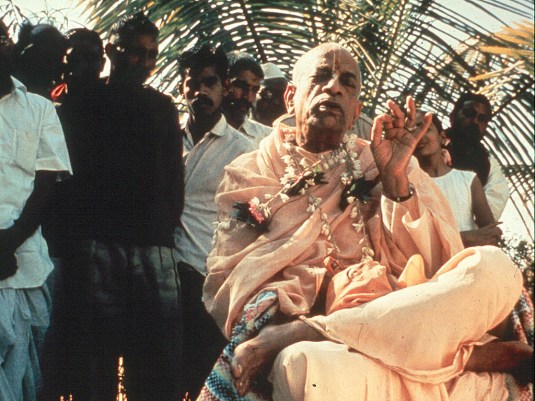
…With similar Vaisnava compassion, Pariksit Maharaja says to Sukadeva Gosvami, “You have described the different types of hellish conditions of life. Now, tell me how those who are suffering can be delivered. Kindly explain this to me.” “How can they be delivered from their fierce miseries and horrible pains?” That is a Vaisnava heart. Maharaja Pariksit says, “Somehow or other they have fallen down to this hellish life. But that does not mean that they should remain in that condition. There must be some means by which they can be delivered, so kindly explain that.”
“Yes, I’ve already described the different types of hellish conditions and very severe painful life, but one has to counteract it.”
If you are to go to Krsna, then you have to prepare your spiritual body. That is Krsna consciousness, If you keep yourself in Krsna consciousness, then gradually you prepare your next body, a spiritual body, which will carry you immediately to Krsnaloka, and you will become happy. You will live there perpetually and blissfully.
A Devotee is an Ocean of Mercy
Lecture given by His Divine Grace A.C. Bhaktivedanta Swami Srila Prabhupada
From Back to Godhead Magazine 1972 Vol. 1, No 45
Today I shall speak to you about the glorification of the holy name of God. This was discussed between Maharaja Pariksit and Sukadeva Gosvami in connection with a brahmana who was very fallen and addicted to all kinds of sinful activities but was saved simply by chanting the holy name. This is found in the Sixth Canto of Srimad-Bhagavatam.
More
18 Jun 2012
by The Hare Krishna Movement
in Guru & Disciple, Lectures
Tags: A.C. Bhaktivedanta Swami Prabhupada, bona fide guru, bona fide spiritual master, Caitanya Mahaprabhu, guru, guru-krsna-krpaya, Gurudas photo, India, lecture on Nectar of Devotion, spiritual master, The Nectar of Devotion, Vrindavan
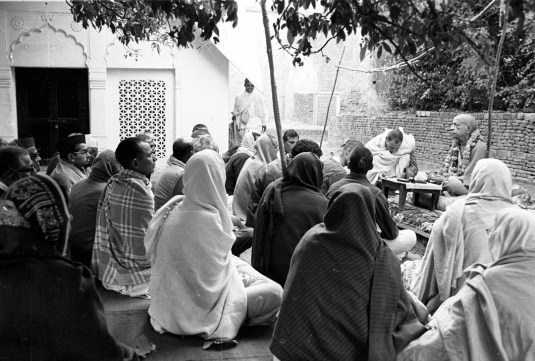
click on picture to enlarge
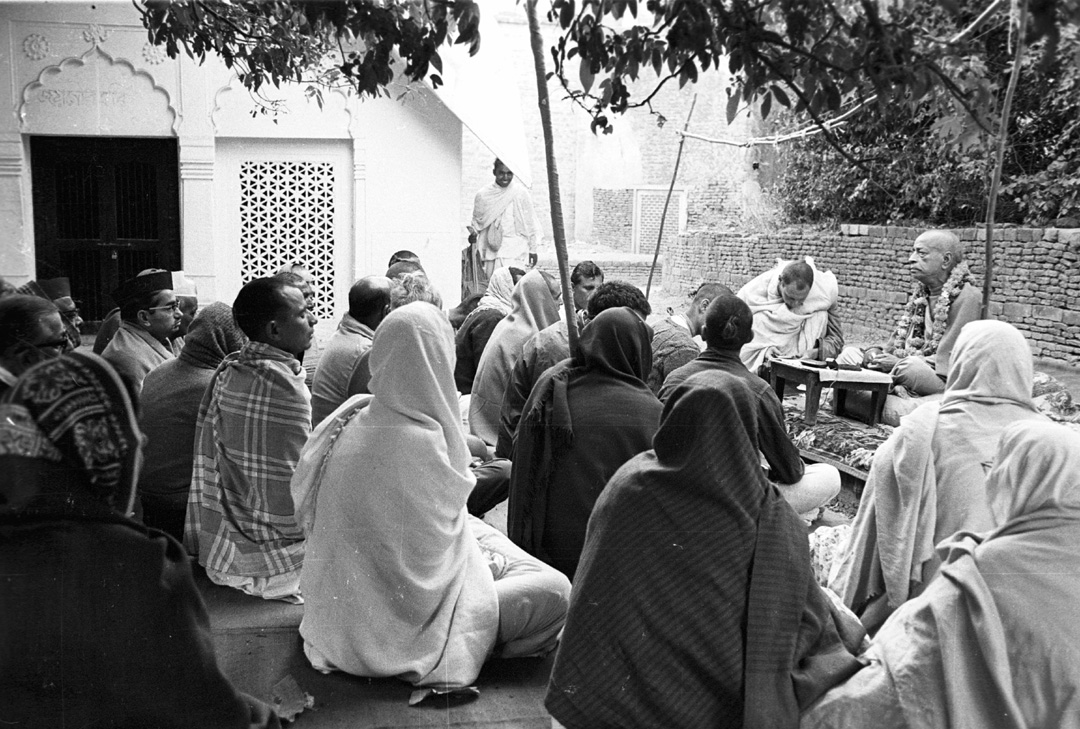
…So to find out a bona fide guru is not difficult, provided one is bona fide to search out a guru. Therefore Caitanya Mahāprabhu said, guru-kṛṣṇa-kṛpāya pāya bhakti-latā-bīja [Cc. Madhya 19.151]. By the mercy of guru and Kṛṣṇa… Because by the mercy of Kṛṣṇa one gets a bona fide guru, and by the mercy of bona fide guru, one gets Kṛṣṇa. This is the process. When I am actually serious to have connection with Kṛṣṇa, Kṛṣṇa is sitting in everyone’s heart. Īśvaraḥ sarva-bhūtānāṁ hṛd-deśe ’rjuna tiṣṭhati [Bg. 18.61]. So Kṛṣṇa can understand. We cannot hide anything from Kṛṣṇa. That is not possible.
Bona Fide Spiritual Master
Lecture from The Nectar of Devotion
By His Divine Grace A. C. Bhaktivedanta Swami Prabhupāda
Vṛndāvana, October 31, 1972
Pradyumna: (reading) Page xxi. “In the Caitanya-caritāmṛta, by Kṛṣṇadāsa Kavirāja Gosvāmī, Lord Caitanya states that it is a fortunate person who comes in contact with a bona fide spiritual master by the grace of Kṛṣṇa. One who is serious about spiritual life is given by Kṛṣṇa the intelligence to come in contact with a bona fide spiritual master.”
Prabhupāda: Yes. Here it is stated, “It is…, it is a fortunate person.” Not the unfortunate. “It is the fortunate person who comes in contact with a bona fide spiritual master.” This question, we were just discussing before coming to the class, how to select a bona fide spiritual master. So that is not very difficult. Just like in our ordinary business life, we accept somebody as representative of the firm who is actually come, canvassing for the benefit of the firm. He’s representative. Suppose he’s representing some book seller, publisher, so he should canvass for selling the books published by his firm, not for anything else. Suppose he has taken the advantage of becoming representative of a business firm, but he’s doing his own business. He’s not bona fide. He’s not bona fide. So real guru is Kṛṣṇa. Kṛṣṇa… Aham eva āsam agre. Kṛṣṇa existed before the creation. Then He made His representative, Brahma. Tene brahma hṛdā ādi-kavaye. He instructed the original guru, Brahma. Because there was no other living creature, except Brahma, in the beginning of creation, and He instructed Brahma. Tene brahma hṛdā ādi-kavaye. There are other versions in the Vedas, that He instructed Brahma. So therefore, the original guru is Kṛṣṇa. The same guru, Kṛṣṇa, is instructing Arjuna also. Kṛṣṇa became guru of Arjuna. Arjuna accepted Him guru: śiṣyas te ’ham. Arjuna said, “Now I am not talking with You as friend, but I accept You as my guru.” Therefore, by sastric conclusion, Kṛṣṇa is the original guru. Who can deny it? Kṛṣṇa is jagat-guru. He’s guru of everyone, because everyone (is) accepting this authority of Kṛṣṇa. Anyone is accepting the authority of Bhagavad-gītā, he’s accepting, imperceptibly, Kṛṣṇa as guru. Therefore, bona fide spiritual master means who is representing Kṛṣṇa. Who can deny it?
So to find out a bona fide spiritual master is not a very difficult job, because if one is representing guru, Kṛṣṇa, then he must speak of Kṛṣṇa, canvass for Kṛṣṇa. What do you think, Visanji?
Indian man: Jaya, Mahārāja.
More
Previous Older Entries Next Newer Entries










 The Hare Krishna Movement