08 Feb 2014
by The Hare Krishna Movement
in A.C. Bhaktivedanta Swami Prabhupada, Chanting Hare Krishna, Krsna Consciousness, Mantra Meditation, Meditation, The Path of Perfection, Yoga
Tags: A.C. Bhaktivedanta Swami Prtabhupada, Action as Yoga, Bhagavad Gita, chanting and dancing, chanting Hare Krishna, dancing and chanting, Hare Krishna, kirtan, Krsna, mantra meditation, meditation, sankirtan, The Hare Krishna Movement, The Path of Perfection, yoga, yoga system
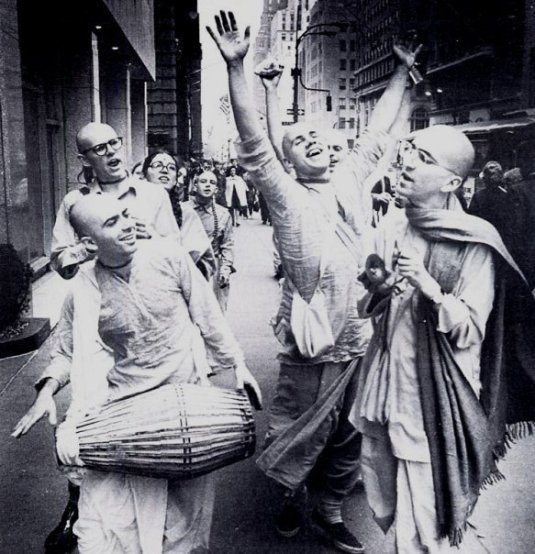
…In the Sixth and Eighth Chapters of Bhagavad-gītā, Lord Śrī Kṛṣṇa, the Supreme Personality of Godhead, explains that the eightfold yoga system is a means to control the mind and senses. This method, however, is very difficult for people to perform, especially in this age of Kali, an age characterized by ignorance and chaos.
Although this eightfold yoga system is particularly recommended in the Sixth Chapter of Bhagavad-gītā, the Lord emphasizes that the process of karma-yoga, action in Kṛṣṇa consciousness, is superior.
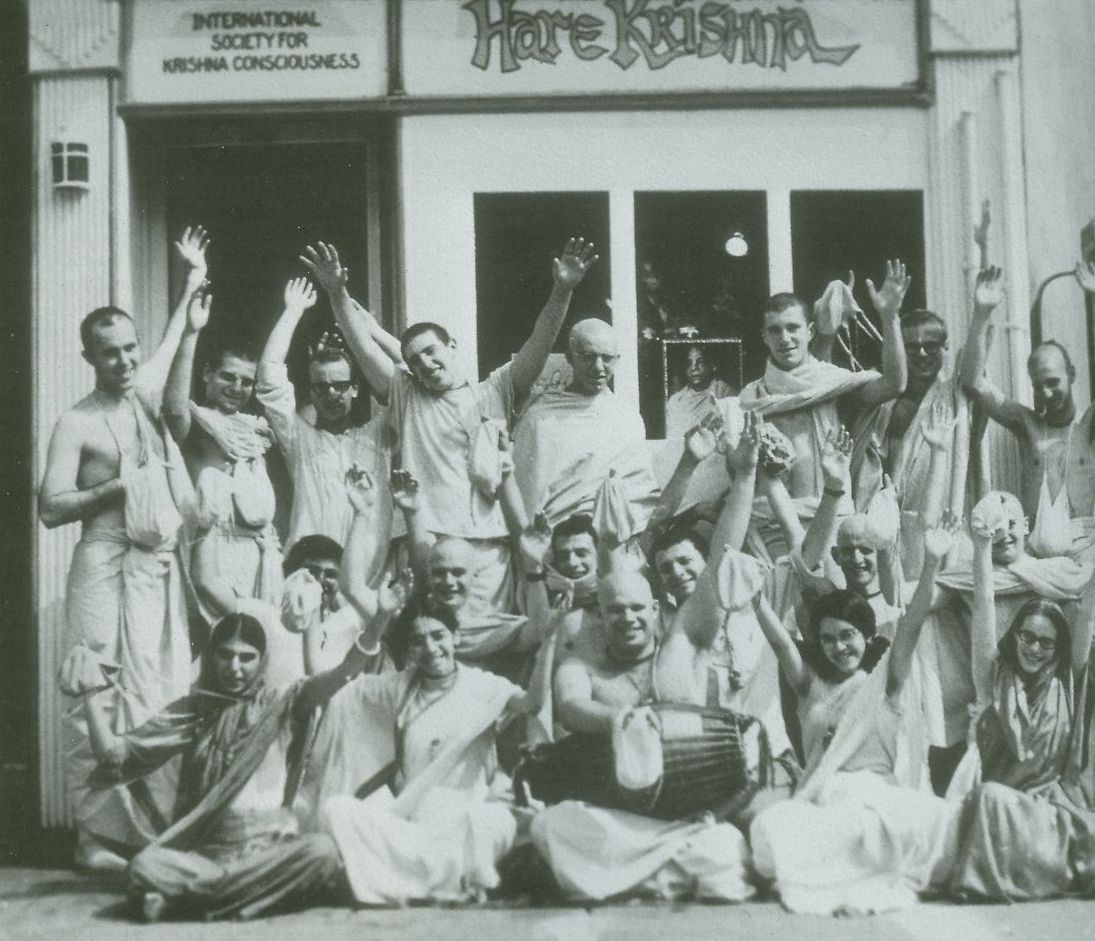
…No one really wants to sit down and meditate. Why should we? We’re meant for positive activity, for recreation, for pleasure. In Kṛṣṇa consciousness, our recreation is dancing and chanting, and when we get tired, we take prasāda. Is dancing difficult? Is chanting difficult? We don’t charge anything to dance in the temple. If you go to a ballroom, you have to pay to enter, but we do not charge. It is natural to enjoy music and dancing and palatable foods. These are our recreations, and this is our method of meditation. So this yoga system is not at all laborious. It is simply recreation, susukham. It is stated in the Ninth Chapter of Bhagavad-gītā (9.2) that this yoga is susukham—very happy. “It is everlasting, and it is joyfully performed.” It is natural, automatic, and spontaneous. It is our real life in the spiritual world. (The Path of Perfection)
Full Chapter More
13 Jan 2014
by The Hare Krishna Movement
in A.C. Bhaktivedanta Swami Prabhupada, Krsna Consciousness, The Hare Krishna Movement, Twenty-Six Qualities of a Devotee, Vaisnava, Vaisnava Compassion
Tags: A.C. Bhaktivedanta Swami Prabhupada, desire tree, envious, Krsna, Krsna consciousness movement, non envious, SB 5.18.9, vaisnava, welfare of others, welfare of the entire universe

click on image to enlarge
May there be good fortune throughout the universe, and may all envious persons be pacified. May all living entities become calm by practicing bhakti-yoga, for by accepting devotional service they will think of each other’s welfare. Therefore let us all engage in the service of the supreme transcendence, Lord Śrī Kṛṣṇa, and always remain absorbed in thought of Him. Srimad-Bhagavatam 5.18.9)
…Just like a desire tree, a Vaiṣṇava can fulfill all the desires of anyone who takes shelter of his lotus feet… he prays not for himself, but for all living entities—the gentle, the envious and the mischievous…This is the attitude of a Vaiṣṇava, who always thinks of the welfare of the entire universe.
…If the Kṛṣṇa consciousness movement spreads all over the world, and if by the grace of Kṛṣṇa everyone accepts it, the thinking of envious people will change. Everyone will think of the welfare of others. (from purport)
full verse and purport More
30 Oct 2013
by The Hare Krishna Movement
in A.C. Bhaktivedanta Swami Prabhupada, Childhood Pastimes of Krsna, Krsna Consciousness, Spiritual World, Srimad Bhagavatam, Vrndavana
Tags: A.C. Bhaktivedanta Swami Prabhupada, asura, Bakasura, BBT, Bhaktivedanta purports, cowheard boys, fruit vendor, go carana, Gokula, Krishna and Balarama, Krsna, Mother Yasoda, Nanda, Nanda Maharaja, pastimes of krsna, SB 10.11, Srimad Bhagavatam, Vatsasura, yamala arjunas, Yasoda

Today is Rama Ekadasi (fast from grains and beans), so on this auspicious day, in the auspicious month of Damodara, we wanted to do a special post. The following is the entire 11th chapter of the Tenth Canto of Srimad Bhagavatam entitled “The Childhood Pastimes of Kṛṣṇa”.
The following two verses are just an example of the nectar one will find in the following chapter…
…The gopīs would say, “If You dance, my dear Kṛṣṇa, then I shall give You half a sweetmeat.” By saying these words or by clapping their hands, all the gopīs encouraged Kṛṣṇa in different ways. At such times, although He was the supremely powerful Personality of Godhead, He would smile and dance according to their desire, as if He were a wooden doll in their hands. Sometimes He would sing very loudly, at their bidding. In this way, Kṛṣṇa came completely under the control of the gopīs.(Text 7)
…To pure devotees throughout the world who could understand His activities, the Supreme Personality of Godhead, Kṛṣṇa, exhibited how much He can be subdued by His devotees, His servants. In this way He increased the pleasure of the Vrajavāsīs by His childhood activities. (Text 9)
Srimad Bhagavatam
By His Divine Grace A. C. Bhaktivedanta Swami Prabhupada
Canto 10, Chapter 11
More
28 Oct 2013
by The Hare Krishna Movement
in A.C. Bhaktivedanta Swami Prabhupada, Bhagavad-gita, Krishna Consciousness, Krsna Consciousness
Tags: 1972 Edition, A.C. Bhaktivedanta Swami Prabhupada, Arjuna, Bhagavad-gita As It Is, bhava, devotee, essintial part of knowledge, friend of krsna, Krishna, krsna consciousness, man manah, official meditator, the most confidential part of knowledge
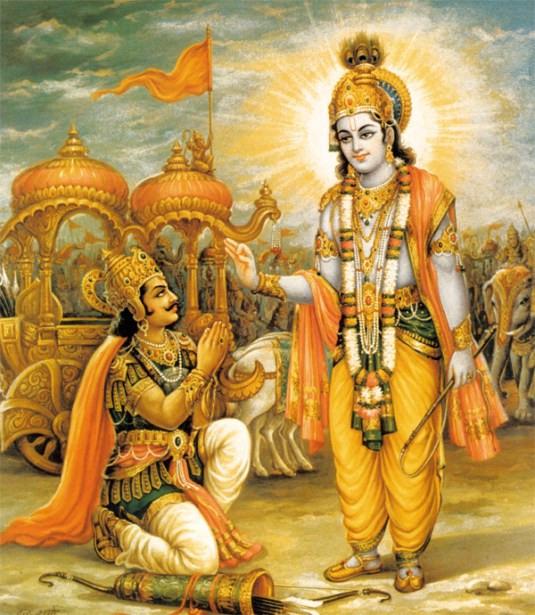
Because you are My very dear friend, I am speaking to you the most confidential part of knowledge. Hear this from Me, for it is for your benefit.
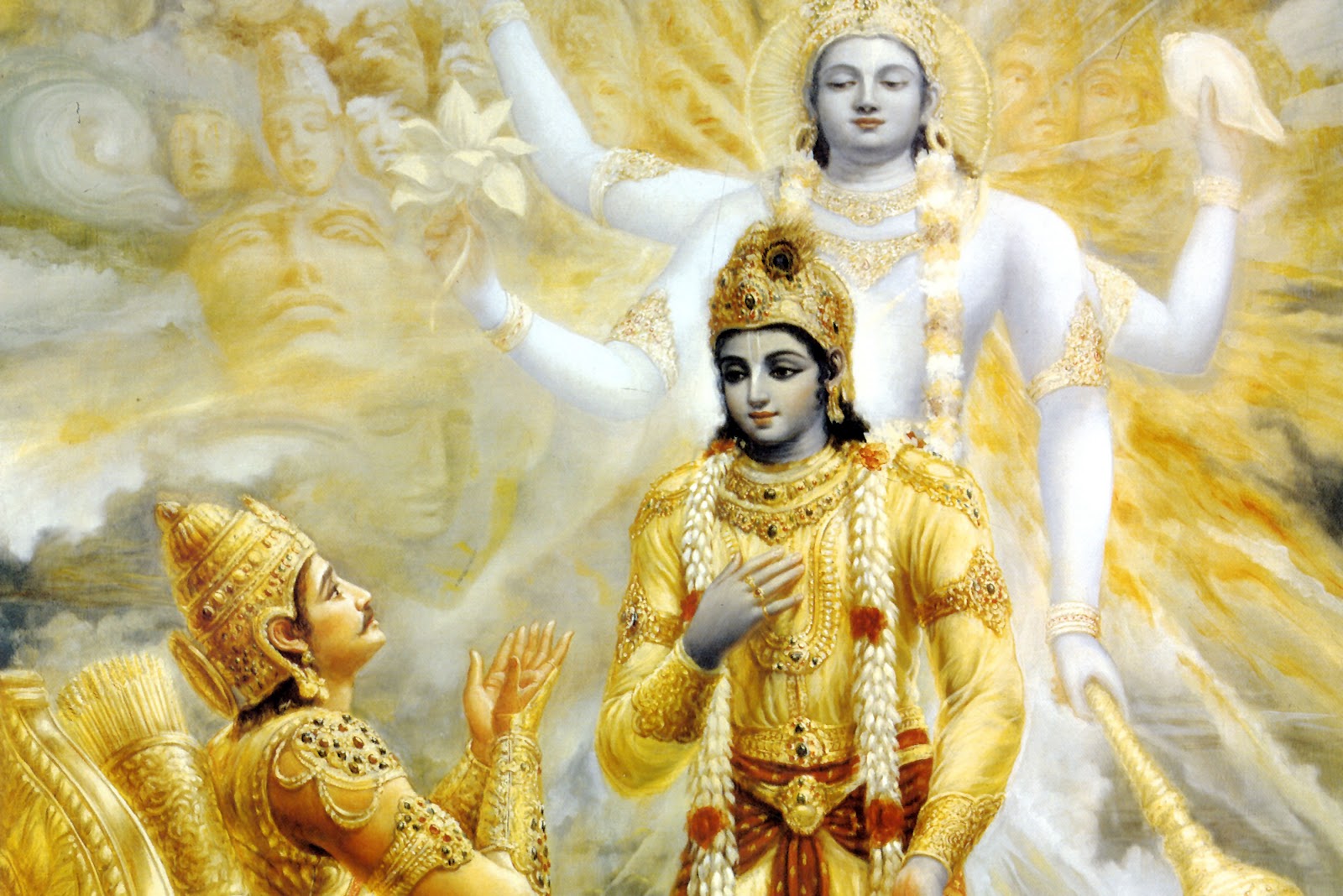
Always think of Me and become My devotee. Worship Me and offer your homage unto Me. Thus you will come to Me without fail. I promise you this because you are My very dear friend.
…”Just always think of Me.”…This is the most important instruction in all Vedic literature. What Kṛṣṇa is saying in this connection is the most essential part of knowledge, and it should be carried out not only by Arjuna but by all living entities.
…The most confidential part of knowledge is that one should become a pure devotee of Kṛṣṇa and always think of Him and act for Him. One should not become an official meditator. Life should be so molded that one will always have the chance to think of Kṛṣṇa. One should always act in such a way that all his daily activities are in connection with Kṛṣṇa. He should arrange his life in such a way that throughout the twenty-four hours he cannot but think of Kṛṣṇa. And the Lord’s promise is that anyone who is in such pure Kṛṣṇa consciousness will certainly return to the abode of Kṛṣṇa, where he will be engaged in the association of Kṛṣṇa face to face. This most confidential part of knowledge is spoken to Arjuna because he is the dear friend of Kṛṣṇa. Everyone who follows the path of Arjuna can become a dear friend to Kṛṣṇa and obtain the same perfection as Arjuna.
More
17 Oct 2013
by The Hare Krishna Movement
in A.C. Bhaktivedanta Swami Prabhupada, Akrura, Gallery, Krishna Consciousness, Krsna Consciousness, KRSNA The Supreme Personality of Godhead
Tags: A.C. Bhaktivedanta Swami Prabhupada, Akrura, Krishna Balarama, Krsna, Krsna and Balarama, Krsna enters Mathura, Krsna The Supreme Personality of Godhead, Mathura, Vrndavana

Please click on image to enlarge
This mornings post is actually about the picture. I love this image and just wanted to put it on our page. And the words from Srila Prabhupada’s Kṛṣṇa Book, are like the music to the song.
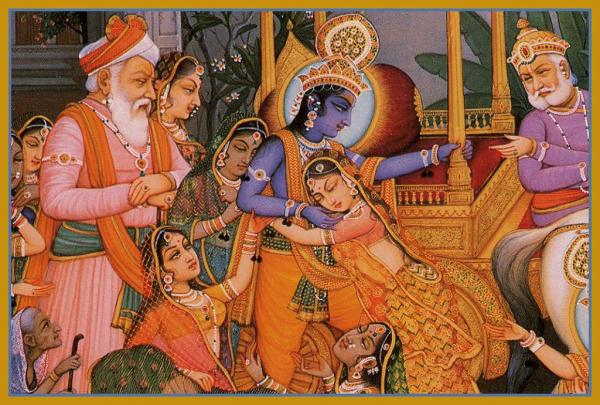
…Akrūra said, ”My dear Lord, all wonderful things that are happening within this world, either in the sky or in the water or on the land, are factually appearing in Your universal form. So when I have seen You, what wonderful things have I not seen?“ This statement confirms the Vedic version that one who knows Kṛṣṇa knows everything, and one who has seen Kṛṣṇa has seen everything, regardless of how wonderful a thing may be. ”My dear Lord,“ Akrūra continued, ”there cannot be anything more wonderful than Your transcendental form. When I have seen Your transcendental form, what is there left to see?“
When passing from Vṛndāvana to Mathurā, all passersby along the way who saw Kṛṣṇa and Balarāma could not help but look at Them again and again. In the meantime, the other inhabitants of Vṛndāvana, headed by Nanda and Upananda, had already reached Mathurā by going through forests and rivers, and they were awaiting the arrival of Kṛṣṇa and Balarāma.
More
04 Oct 2013
by The Hare Krishna Movement
in A.C. Bhaktivedanta Swami Prabhupada, Krsna Consciousness, Sri Caitanya-Caritamrta, The Reservoir of Pleasure
Tags: A.C. Bhaktivedanta Swami Prabhupada, Adi-lila 4.19, devotee, devotional service, natural affection, personal friend, pet son, Sri Caitanya-caritamrta, worship the lord with affection

“In whatever transcendental mellow My devotee worships Me, I reciprocate with him. That is My natural behavior. (Sri Caitanya-caritamrta Adi-lila 4.19)
…The Lord, by His inherent nature, reveals Himself before His devotees according to their inherent devotional service. The Vṛndāvana pastimes demonstrated that although generally people worship God with reverence, the Lord is more pleased when a devotee thinks of Him as his pet son, personal friend or most dear fiance and renders service unto Him with such natural affection. The Lord becomes a subordinate object of love in such transcendental relationships. (from purport)
Full verse and purport More
30 Sep 2013
by The Hare Krishna Movement
in A.C. Bhaktivedanta Swami Prabhupada, Krishna Consciousness, Krsna Consciousness, KRSNA The Supreme Personality of Godhead
Tags: A.C. Bhaktivedanta Swami Prabhupada, Dwarka, Jarasandha, Kamsa, king jarasandha, kingdom of Mathura, Krishna, Krsna, Krsna erects the Dvaraka fort, Krsna The Supreme Personality of Godhead, military strength capital of the Yadu kings, Sri Krishna, Vedic civilization

click on image to enlarge
I often lament that as a child growing up my hero’s were fictional characters, like Flash Gordan and Superman, without any Krsna Consciousness. And I often think how fortunate are the children who grew up instead with stories from the Krsna Book, or the Mahabharata. With great battle scenes, real drama, and romance. Not just fictional stories but eternal pastimes of the Lord and His devotees. Here is one such example:
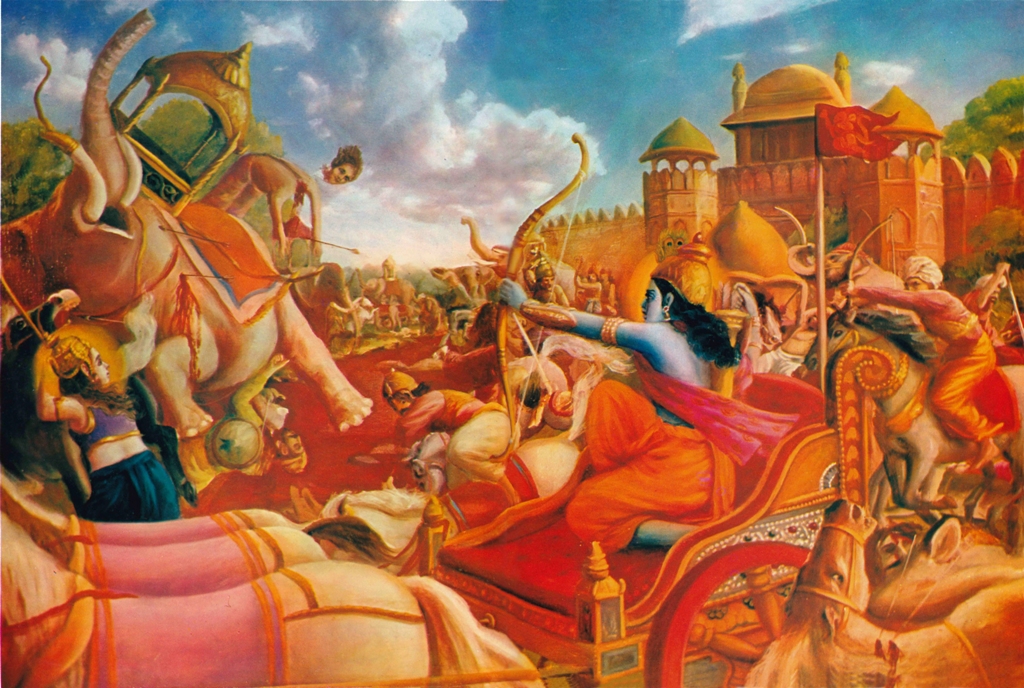
…In order to fight with Kṛṣṇa, Jarāsandha surrounded Him from all sides with great military strength, and the sun appeared covered by the cloudy air and dust. Similarly, Kṛṣṇa, the supreme sun, was covered by the military strength of Jarāsandha. Kṛṣṇa’s and Balarāma’s chariots were marked with pictures of Garuḍa and palm trees. The women of Mathurā were all standing on the tops of the houses and palaces and gates to see the wonderful fight, but when Kṛṣṇa’s chariot was surrounded by Jarāsandha’s military force, they became so frightened that some of them fainted. Kṛṣṇa saw Himself overwhelmed by the military strength of Jarāsandha. His small number of soldiers was being harassed by them, so He immediately took up His bow, named Śārṅga.
He began to take His arrows from their case, and one after another He set them on the bowstring and shot them toward the enemy. They were so accurate that the elephants, horses and infantry soldiers of Jarāsandha were quickly killed. The incessant arrows thrown by Kṛṣṇa appeared as a whirlwind of blazing fire killing all the military strength of Jarāsandha.
Wow!
Kṛṣṇa, the Supreme Personality of Godhead 1970 Edition
By His Divine Grace A. C. Bhaktivedanta Swami Prabhupāda
Chapter Fifty
Full Chapter More
25 Sep 2013
by The Hare Krishna Movement
in A.C. Bhaktivedanta Swami Prabhupada, Bhagavad-gita, Krsna Consciousness, Spiritual Life, Yoga
Tags: A.C. Bhaktivedanta Swami Prabhupada, Arjuna, as it is, Bg. 6.29, Bg. 6.30, bhagavad-gita, bhakti yoga, Krishna, Krishna consciousness, krsna conscious yogi, love of God, self realization, true yogi, yoga, yogi
Please click on image to enlarge
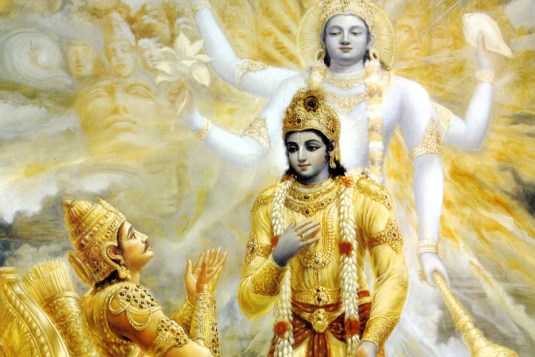
A true yogī observes Me in all beings, and also sees every being in Me. Indeed, the self-realized man sees Me everywhere. (Bg. 6.29)
For one who sees Me everywhere and sees everything in Me, I am never lost, nor is he ever lost to Me. (Bg. 6.30)
…A person in Kṛṣṇa consciousness certainly sees Lord Kṛṣṇa everywhere, and he sees everything in Kṛṣṇa…Nothing can exist without Kṛṣṇa, and Kṛṣṇa is the Lord of everything—this is the basic principle of Kṛṣṇa consciousness.
…Kṛṣṇa consciousness is the development of love of Kṛṣṇa—a position transcendental even to material liberation. (from purport to Bg.6.30)
Bhagavad-gita As It Is 1972 Edition
By His Divine Grace A.;C. Bhaktivedanta Swami Prabhupada
Chapter 6, Text 29-30
Full Text and Purports More
18 Sep 2013
by The Hare Krishna Movement
in A.C. Bhaktivedanta Swami Prabhupada, Bhagavad-gita, Haridasa Thakura, Krsna Consciousness
Tags: 300 thousand names, A.C. Bhaktivedanta Swami Prabhupada, disciples, dog-eaters, Haridasa Thakur, Lord Caitanya, Moslem family, namacarya, namachara, Spiritual Life, Thakur Haridasa

After the passing away of Haridāsa Ṭhākura, the Lord Himself took his body on His lap, and He danced with it in great ecstasy. (Sri Caitanya-caritamrta Adi-lila 10.46)
Today being the Disappearance of Haridāsa Ṭhākura, we honor him with this short post. We have selected a verse from the Bhagavad-gita 6.44 wherein Srila Prabhupada mentions in the purport;
…Lord Caitanya, accepted Ṭhākur Haridāsa as one of His most important disciples. …he was elevated to the post of nāmācārya by Lord Caitanya due to his rigidly attended principle of chanting three hundred thousand holy names of the Lord daily: Hare Kṛṣṇa, Hare Kṛṣṇa, Kṛṣṇa Kṛṣṇa, Hare Hare/ Hare Rāma, Hare Rāma, Rāma Rāma, Hare Hare.
Full Text and Purport More
04 Sep 2013
by The Hare Krishna Movement
in A.C. Bhaktivedanta Swami Prabhupada, Back to Godhead, Krsna Consciousness, Visakha devi dasi
Tags: A.C. Bhaktivedanta Swami Prabhupada, Back to Godhead Magazine, Book Distribution, BTG, His Divine Grace, hot off the press, preaching Krishna consciousness, Srila Prabhupada, transcontinental jet, traveling emissary, Visakha devi dasi
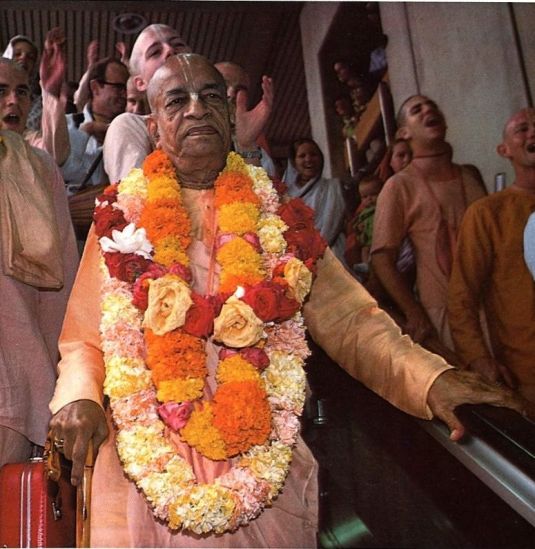
As a young devotee/book distributor, we were always anxious to see the new Back to Godhead Magazines “Hot off the Press”, and distribute them to the public. This was one article written by Visakha devi dasi that I fondly remember. Whenever I got tired out on book distribution, I would think of Srila Prabhupada’s rigorous schedule, and it would inspire me to continue on. Srila Prabhupada was tireless in his preaching and generous in giving others his divine association.
Summer Sessions With Srila Prabhupada
Excerpted from Back to Godhead Magazine 1975, Vol. 10, No 10
Article by Visakha devi dasi
In five cities and on a transcontinental jet, His Divine Grace spends a typical month at his favorite pastime—teaching Krsna Consciousness.
He’s probably logged as much flight time in the past ten years as any other traveling emissary. His Divine Grace A.C. Bhaktivedanta Swami Prabhupada has gone around the world twelve times visiting his ISKCON centers, lecturing and insuring a high standard of spiritual life among his disciples. The author traveled with him this past summer as he shuttled from West to East coast and back again, holding informal meetings and having dialogues with those who came to ask questions no one else could answer.
More
24 Aug 2013
by The Hare Krishna Movement
in A.C. Bhaktivedanta Swami Prabhupada, Krsna Consciousness, KRSNA The Supreme Personality of Godhead, Krsna-katha, Spiritual Life, Spiritual World
Tags: A.C. Bhaktivedanta Swami Prabhupada, bees and drones, gopis, gopis in Vrndavana, Krishna and Balarama, krsna tending the cows, Krsna The Supreme Personality of Godhead, Krsna's flute, The Gopīs Attracted by the Flute
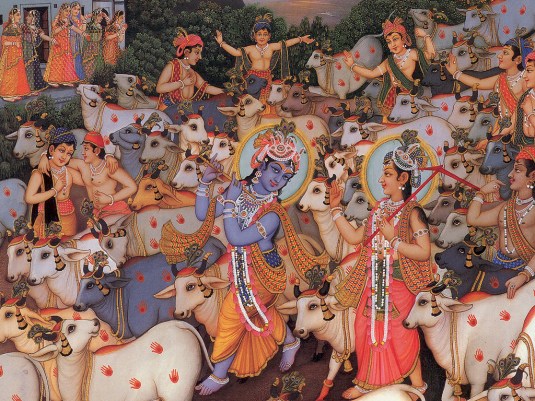
please click on image to enlarge
Kṛṣṇa was very pleased with the atmosphere of the forest where flowers bloomed and bees and drones hummed very jubilantly. While the birds, trees and branches were all looking very happy, Kṛṣṇa, tending the cows, accompanied by Śrī Balarāma and the cowherd boys, began to vibrate His transcendental flute. After hearing the vibration of the flute of Kṛṣṇa, the gopīs in Vṛndāvana remembered Him and began to talk amongst themselves about how nicely Kṛṣṇa was playing His flute. When the gopīs were describing the sweet vibration of Kṛṣṇa’s flute, they also remembered their pastimes with Him; thus their minds became disturbed, and they were unable to describe completely the beautiful vibrations. While discussing the transcendental vibration, they remembered also how Kṛṣṇa dressed, decorated with a peacock feather on His head, just like a dancing actor, and with blue flowers pushed over His ear. His garment glowed yellow-gold, and He was garlanded with a vaijayantī necklace. Dressed in such an attractive way, Kṛṣṇa filled up the holes of His flute with the nectar emanating from His lips. So they remembered Him, entering the forest of Vṛndāvana, which is always glorified by the footprints of Kṛṣṇa and His companions.
Kṛṣṇa was very expert in playing the flute, and the gopīs were captivated by the sound vibration, which was not only attractive to them, but to all living creatures who heard it. One of the gopīs told her friends, “The highest perfection of the eyes is to see Kṛṣṇa and Balarāma entering the forest and playing Their flutes and tending the cows with Their friends.”
Persons who are constantly engaged in the transcendental meditation of seeing Kṛṣṇa, internally and externally, by thinking of Him playing the flute and entering the Vṛndāvana forest, have really attained the perfection of samādhi. Samādhi (trance) means absorption of all the activities of the senses on a particular object, and the gopīs indicate that the pastimes of Kṛṣṇa are the perfection of all meditation and samādhi. It is also confirmed in the Bhagavad-gītā that anyone who is always absorbed in the thought of Kṛṣṇa is the topmost of all yogīs. (KRSNA The Supreme Personality of Godhead, Vol 1, Chapter 21)
Full Chapter More
22 Jul 2013
by The Hare Krishna Movement
in A.C. Bhaktivedanta Swami Prabhupada, Krsna Consciousness, Lectures
Tags: A.C. Bhaktivedanta Swami Prabhupada, Christian, govinda adi-purusam, Hindu, Krishna, krsna consciousness, Lecture by Srila Prabhupada, London August 11 1971, love of God, Love of Godhead, lover of God, loving propensity, Muslim, Radha, Radharani, religion, Srimati Radharani

click on image to enlarge
…If you want happiness, then you must learn how to love God. You are trying to love somebody, but you are being frustrated, foiled. Because except God, nobody is loving object. And if you love God, then naturally you love everything because God is everything. The example is that if you pour water on the root of the tree, it goes everywhere—to the twigs, to the leaves, to the flowers, everywhere.
That technique is love of Godhead. If you learn, it doesn’t matter what religion you profess. It is no concern. We do not say that “You become Hindu,” “You become Muslim,” or “Christian.” No. We say that “You become lover of God.” You learn how to love God. Your loving propensity is there, but it is being misplaced. It is placed on dog instead of God; therefore you are unhappy. When your loving propensity will be placed in the proper place, you will be happy. This is Kṛṣṇa consciousness, love of Godhead. (from Lecture)
Lecture by Srila Prabhupada
London, August 11, 1971
Prabhupāda: I have to speak something? So we are worshiping Rādhā-Mādhava, the lover or enjoyer of Rādhārāṇī. [break] Govindam ādi-puruṣaṁ tam ahaṁ bhajāmi **
More
17 Jul 2013
by The Hare Krishna Movement
in A.C. Bhaktivedanta Swami Prabhupada, Ecstasy, Krsna Consciousness, Nectar of Devotion, Srimati Radharani, Teachings of Lord Chaitanya, Vaisnava Vocabulary
Tags: A.C. Bhaktivedanta Swami Prabhupada, amorous pastimes, ecstasy, ecstasy of transcendental love, Krishna, Radha Madana-mohana, Spiritual Life, Srila Prabhupada, Srimati Radharani, supreme ecstasy of srimati radharani

No common man can understand the ecstasy of transcendental love between Radharani and Krsna (from Teachings of Lord Caitanya)
That supreme ecstasy of Srimati Radharani is the essence of spiritual life. Her only business is to fulfill all the desires of Krsna (CC Madhya 8.164, Translation)
This morning as I was doing my morning meditations (japa) I happened to be looking at this beautiful picture of Radha and Krishna. I was very much moved by the picture and was reminded of the following verse…
“Glory to the all-merciful Sri Radha and Madana-Mohana, who are always engaged in amorous pastimes. They are the only shelter of my depraved and crippled self. Their lotus feet are the be-all and end-all of my life” (Songs of the Vaisnava Acaryas)
…and the word that kept coming up in my mind was “Ecstasy”. I could not even begin to understand what Srimati Radharani must be feeling when She looks at Krishna, or what Sri Krishna must be experiencing when He looks into the eyes of Srimati Radharani. It must be Ecstaic Love!
I went to Srila Prabhupada’s “Nectar of Devotion”, to the “Teachings of Lord Caitanya”, and to try to get a better understanding also did a search on the word ‘ecstasy’ in vainquotes. The results of my readings are as follows:
More
27 May 2013
by The Hare Krishna Movement
in A.C. Bhaktivedanta Swami Prabhupada, Book Distribution, Krsna Consciousness, Krsna Consciousness the Matchless Gift, Srimad Bhagavatam, The Hare Krishna Movement
Tags: A.C. Bhaktivedanta Swami Prabhupada, Book Distribution, devotees, heaven or hell, jnanis, karmis, krsna consciousness, Lord Nrsimhadeva, material adjustment, materialistic activity, meditate, prahlada, Prahlada Maharaja, sankirtan, SB 7.9.44, secluded place, Transcendental meditation

click on image to enlarge
…The Kṛṣṇa conscious person can go even to hell and still be happy. The pure devotee is never unhappy in any condition of life.
For a devotee, being situated in the heavenly planets and being in the hellish planets are equal, for a devotee lives neither in heaven nor in hell but with Kṛṣṇa in the spiritual world. The secret of success for the devotee is not understood by the karmīs and jñānīs. Karmīs therefore try to be happy by material adjustment, and jñānīs want to be happy by becoming one with the Supreme. The devotee has no such interest. He is not interested in so-called meditation in the Himalayas or the forest. Rather, his interest is in the busiest part of the world, where he teaches people Kṛṣṇa consciousness. The Kṛṣṇa consciousness movement was started for this purpose. We do not teach one to meditate in a secluded place just so that one may show that he has become very much advanced and may be proud of his so-called transcendental meditation, although he engages in all sorts of foolish materialistic activity.
A Vaiṣṇava is not interested in such a bluff of spiritual advancement. Rather, he is interested in enlightening people in Kṛṣṇa consciousness because that is the only way for them to become happy. One wanders within the universe, life after life, but by the grace of a devotee, a servant of Śrī Caitanya Mahāprabhu, one can get the clue to Kṛṣṇa consciousness and then not only become happy in this world but also return home, back to Godhead. That is the real target in life… The members of the Kṛṣṇa consciousness movement must be fully convinced that without Kṛṣṇa one cannot be happy. Thus the Kṛṣṇa conscious person avoids all kinds of pseudo spiritualists, transcendentalists, meditators, monists, philosophers and philanthropists. (from Purport to SB 7.9.44)
Full Verse and Purport More
05 May 2013
by The Hare Krishna Movement
in A.C. Bhaktivedanta Swami Prabhupada, Krsna Consciousness, Lectures
Tags: A.C. Bhaktivedanta Swami Prabhupada, barhavatamsam asitambuda, He played on His flute, Here is God, His color is blackish, Krishna consciousness, photo by Gurudas, SB 1.1.1, Srila Prabhupada, Vedas, Vedic statement, venum kvanantam
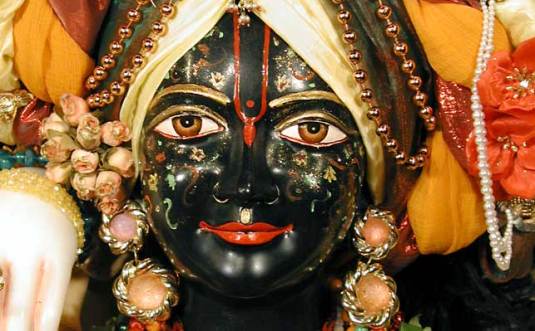
Śrīmad Bhāgavatam Lecture
…So our Kṛṣṇa consciousness movement is so nice.. We present, “Here is God.” Here is God. Take His name. Take His address also. It is so perfect. They are searching after God. We are giving the name, address, activity, everything, quality, all. Nāma-rūpa-līlā-parikara-vaiśiṣṭhyam, everything. Nāma means name. Here is Kṛṣṇa, “He is engaged in enjoyment with Rādhārāṇī and playing on His flute.” Veṇuṁ kvaṇantam aravinda-dalāyatākṣaṁ bar… [Bs. 5.30]. We are not imagining. Not that this artist imagines, the poet imagines. No. We don’t do that rascaldom. We don’t do that. We take information from the Vedas. Kṛṣṇa, when He was present personally, He played on His flute. The gopīs saw and the cowherds boys saw five thousand years ago. And the ācāryas took information. Even if you don’t believe in the history, then come to śāstra. The śāstra says veṇuṁ kvaṇantam aravinda-dalāyatākṣam: [Bs. 5.30] “Kṛṣṇa, the Supreme Personality of Godhead, is always engaged in playing on His flute.” This is Vedic statement. Veṇuṁ kvaṇantam aravinda-dalāyatākṣam: [Bs. 5.30] “His eyes are just like lotus petals.” Veṇuṁ kvaṇantam aravinda-dalāyatākṣaṁ barhāvataṁsam asitāmbuda-sundarāṅgam: [Bs. 5.30] “He has got a peacock feather on His head.” These are the description in the Vedas. “He has got a peacock feather on His head.” Barhāvataṁsam asitāmbuda: “His color is blackish.” What kind of blackish? Asitāmbuda: “Just like new cloud.” Asitāmbuda-sundarāṅgam: “But don’t think because He is blackish, He is not beautiful. He is most beautiful.” How much beautiful? Kandarpa-koṭi-kamanīya-viśeṣa-śobham: [Bs. 5.30] “He is so beautiful that if you gather millions of Cupids, still He is more beautiful.” These descriptions are there.
So Kṛṣṇa consciousness movement is very nice. You will be able to understand what is God, and you will be able to understand what is your relationship with God. And you will be able to understand how you can go back to home, back to Godhead.
Thank you very much. (end)
Full Lecture More
28 Apr 2013
by The Hare Krishna Movement
in A.C. Bhaktivedanta Swami Prabhupada, Journey of Self-Discovery, Krsna Consciousness
Tags: A.C. Bhaktivedanta Swami Prabhupada, everyone can see God, God, God consciousness, Gopal, Govinda, Krishna, self discovery, self realization, The Journey of Self-Discovery, Vedic literature, yoga

…The first thing Kṛṣṇa is looking for is how eager you are to see Him. Kṛṣṇa will respond. If you are actually eager to see Kṛṣṇa, then it is sure your efforts will be successful.
But you must desire Kṛṣṇa only. In this connection, Rūpa Gosvāmī has written a verse:
“My dear friend, there is one boy—His name is Govinda. He is standing on the bank of the Yamunā near the Keśi-ghāṭa, and He is playing on His flute. He is so beautiful, especially during this full-moon night. If you have any intentions to enjoy in this material world with your children, husband, or other family members, then please do not go there.”
The idea is that if you once see Kṛṣṇa, then you’ll forget all this nonsensical materialistic enjoyment. That is seeing Kṛṣṇa.
The gopīs are another example of great eagerness to see Kṛṣṇa. The gopīs came to Kṛṣṇa, being captivated by His beautiful features. They were young girls, and Kṛṣṇa was so beautiful. Actually they were lusty when they came to Kṛṣṇa, but Kṛṣṇa is so pure that they became first-class devotees. There is no comparison to the gopīs’ devotion, because they loved Kṛṣṇa with heart and soul. That is the qualification. They loved Kṛṣṇa so much that they didn’t care for family or reputation when they went out in the dead of night. Kṛṣṇa’s flute was sounding, and they were all fleeing their homes. Their fathers, their brothers, their husbands all said, “Where are you going? Where are you going in this dead of night?” But the gopīs didn’t care. They neglected their children, their family, everything. Their only thought was, “We must go to Kṛṣṇa.”
This eagerness is required. We must be very, very eager to see Kṛṣṇa.
More
24 Apr 2013
by The Hare Krishna Movement
in A.C. Bhaktivedanta Swami Prabhupada, Beyond Birth & Death, Krsna Consciousness
Tags: A.C. Bhaktivedanta Swami Prabhupada, bhakti yogis, death, dhyana yogis, dying, Elevation at Death, eternal life, hatha yogis, life after death, to link up, yoga, yogis

*click on image to enlarge
This is a continuation (chapter 2) from the small book, “Beyond Birth and Death”, by Srila Prabhupada. Personally, I like these small books, as so much of the philosophy of Krishna Consciousness is contained in them, in a very readable format. For a Free pdf download of entire book; follow link at bottom of post. Hare Krishna!
Beyond Birth and Death
By His Divine Grace A. C. Bhaktivedanta Swami Prabhupāda
Chapter Two
Elevation at Death
There are different kinds of transcendentalists who are called yogīs—haṭha-yogīs, jñāna-yogīs, dhyāna-yogīs, and bhakti-yogīs—and all of them are eligible to be transferred to the spiritual world. The word yoga means “to link up,” and the yoga systems are meant to enable us to link with the transcendental world. As mentioned in the previous chapter, originally we are all connected to the Supreme Lord, but now we have been affected by material contamination. The process is that we have to return to the spiritual world, and that process of linking up is called yoga. Another meaning of the word yoga is “plus.” At the present moment we are minus God, or minus the Supreme. When we add Kṛṣṇa—or God—to our lives, this human form of life becomes perfect.
At the time of death we have to finish that process of perfection. During our lifetime we have to practice the method of approaching that perfection so that at the time of death, when we have to give up this material body, that perfection can be realized.
More
20 Apr 2013
by The Hare Krishna Movement
in A.C. Bhaktivedanta Swami Prabhupada, Free Downloads, Free eBooks, Krsna Consciousness, Practicing Krishna Consciousness at Home, Spiritual Life, The Hare Krishna Movement
Tags: A.C. Bhaktivedanta Swami Prabhupada, bhakti handbook, ebooks, free pdf download, Iskcon, krishna consciousness handbook, pdf download, practicing Krishna consciousness, Spiritual Life
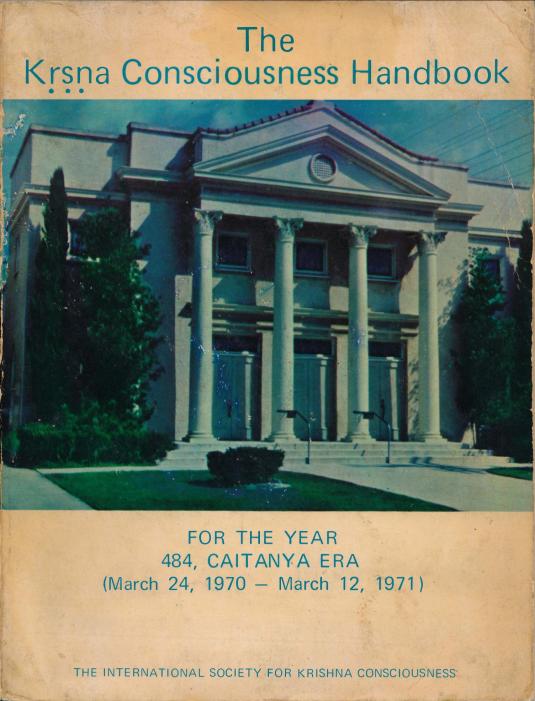
I always liked this small booklet, as it contained the basic instructions for practicing Krishna Consciousness. Krishna Consciousness is not so difficult, it only requires a little sincerity and faith, and in a short time one can realize its positive results.
To read this booklet and/or to save it to your computer, simply click on following link:
The Krishna Consciousness Handbook
30 Mar 2013
by The Hare Krishna Movement
in A.C. Bhaktivedanta Swami Prabhupada, Gopis, Krsna Consciousness, KRSNA The Supreme Personality of Godhead, Spiritual World
Tags: A.C. Bhaktivedanta Swami Prabhupada, bank of the Yamuna, disciplic succession, Durga, goddess durga, goddess katyayani, gopi girls, gopis, Katyayani, Krsna, Lord Caitanya, Stealing the Garments of the Unmarried Gopi Girls, The Supreme Personality of Godhead, unmarried girsl, Vrndavana, Yamuna

…The unmarried gopīs used to prepare the deity of goddess Durgā and worship it with candana pulp, garlands, incense lamps and all kinds of presentations-fruits, grains and twigs of plants. After worshiping, it is the custom to pray for some benediction. The unmarried girls used to pray with great devotion to goddess Kātyāyanī, addressing her as follows: “O supreme eternal energy of the Personality of Godhead, O supreme mystic power, O supreme controller of this material world, O goddess, please be kind to us and arrange for our marriage with the son of Nanda Mahārāja, Kṛṣṇa.”
…Early in the morning, the gopīs used to go to the bank of the Yamunā to take bath. They would assemble together, capturing each other’s hands, and loudly sing of the wonderful pastimes of Kṛṣṇa. It is an old system among Indian girls and women that when they take bath in the river they place their garments on the bank and dip into the water completely naked. The portion of the river where the girls and women take bath was strictly prohibited to any male member, and this is still the system. The Supreme Personality of Godhead, knowing the minds of the unmarried young gopīs, benedicted them with their desired objective. They had prayed for Kṛṣṇa to become their husband, and Kṛṣṇa wanted to fulfill their desires.
More
10 Feb 2013
by The Hare Krishna Movement
in A.C. Bhaktivedanta Swami Prabhupada, Caitanya Mahaprabhu, Chanting Hare Krishna, Krsna Consciousness, Sankirtan, Sri Caitanya-Caritamrta
Tags: A.C. Bhaktivedanta Swami Prabhupada, actions which will be benificial for all living entities, adi-lila 9.27-52, devotional service, Krsna consciousness movement, sankirtan movement, Sri Caitanya Mahaprabhu, Sri Caitanya-caritamrta, tree of devotional service, welfare activities for the benifit of others
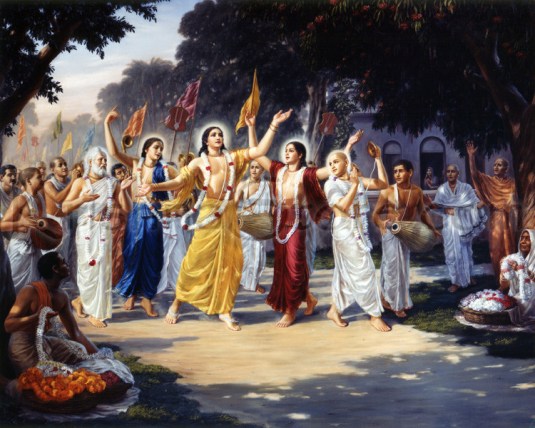
click on image to enlarge
Lord Caitanya’s Sankirtana Movement
“It is the duty of every living being to perform welfare activities for the benefit of others with his life, wealth, intelligence and words.”
“By his work, thoughts and words, an intelligent man must perform actions which will be beneficial for all living entities in this life and in the next.”
The Kṛṣṇa consciousness movement introduced by Lord Caitanya is extremely important because one who takes to it becomes eternal, being freed from birth, death and old age. People do not recognize that the real distresses in life are the four principles of birth, death, old age and disease. They are so foolish that they resign themselves to these four miseries, not knowing the transcendental remedy of the Hare Kṛṣṇa mahā-mantra. Simply by chanting the Hare Kṛṣṇa mahā-mantra, one can become free from all misery, but because they are enchanted by the illusory energy, people do not take this movement seriously. Therefore those who are actually servants of Śrī Caitanya Mahāprabhu must seriously distribute this movement all over the world to render the greatest benefit to human society.
There is a very nice section in the Śrī Caitanya-caritāmṛta wherein the author uses the figurative example of the gardener, to explain the mission of Lord Caitanya Mahāprabhu. With pleasure we are posting the entire section below… More
Previous Older Entries Next Newer Entries















 The Hare Krishna Movement