12 May 2013
by The Hare Krishna Movement
in A.C. Bhaktivedanta Swami Prabhupada, Acyutanananda das, Songs of the Vaisnava Acaryas
Tags: 26 second Avenue, Acyutananda, Acyutananda Swami, Brahmananda Swami, Bruce, Chuck Barnett, disciples, India, initiated disciples of Srila Prabhupada, sannyasa, Songs of the Vaisnava Acaryas, Sriman Acyutananda, Tompkins Square Park, Vaisnava songs
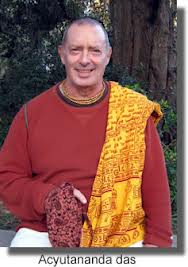
It was my good fortune to finally meet one of my singing mentors, and God-brother, the legendary Acyutananda das, at the Festival of Inspiration held annually at the New Vrindavan farm community in West Virginia. He was a very likable character and willingly signed my 1974 copy of the Songs of the Vaisnava Acaryas. He opened the Festival of Inspiration with a Question and Answer session, answering all kinds of questions on the “Early Days”, “India”, “Life with Srila Prabhupada”, “Spiritual Life” etc., etc. with his own blend of sarcastic humor, wit, and intellectual powers. It was quite enjoyable and enlightening. He is a very ‘real’, unpretentious fellow, and as I said very likable.
In honor of our visit with him we are posting the Foreword from the Songs of the Vaisnava Acarays, wherein Srila Prabhupada is giving his thanks and blessings:
…I confer all my blessings upon Acyutananda Swami for his genuine attempt to advance in Krishna consciousness. I hope he will attempt to advance more and more and never be hampered my maya. We should always remember the danger of maya’s influence and endeavor to save ourselves from her great power. We must therefore always merge in the transcendental mellow of kirtana-rasa, for kirtana-rasa is the safest situation within this material world. Hare Krishna.
A.C. Bhaktivedanta Swami
Foweard More
10 May 2013
by The Hare Krishna Movement
in A.C. Bhaktivedanta Swami Prabhupada, Srimad Bhagavatam, Teachings of Queen Kunti, Vegetarianism
Tags: A.C. Bhaktivedanta Swami Prabhupada, fruits, godless civilization, herbs and grains, human prosperity, industrial enterprise, natural gifts of nature, nature, organic food, SB 1.8.40, Theachings of Wueen Kunti, vegetables, vegetarian, vegetarianism
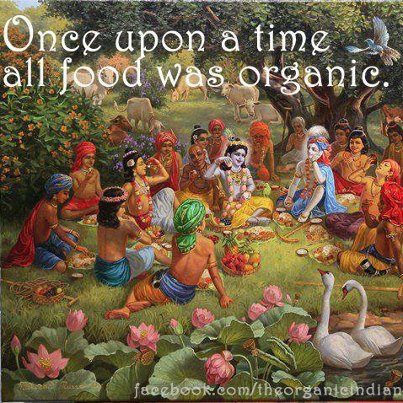
The following is a very nice verse from the Srimad Bhagavatam describing the Gifts of Nature, and how everything is coming from God. We have also included the chapter from the Teachings of Queen Kunti, Where Srila Prabhupada further explaines this wonderful text.
…Human prosperity flourishes by natural gifts and not by gigantic industrial enterprises.
Srimad Bhagavatam
By His Divine Grace A.C. Bhaktivedanta Swami Prabhupada
Canto One, Chapter 8, Text 40
ime jana-padāḥ svṛddhāḥ
supakvauṣadhi-vīrudhaḥ
vanādri-nady-udanvanto
hy edhante tava vīkṣitaiḥ
ime—all these; jana-padāḥ—cities and towns; svṛddhāḥ—flourished; supakva—nature; auṣadhi—herbs; vīrudhaḥ—vegetables; vana—forests; adri—hills; nadī—rivers; udanvantaḥ—seas; hi—certainly; edhante—increasing; tava—by You; vīkṣitaiḥ—seen.
All these cities and villages are flourishing in all respects because the herbs and grains are in abundance, the trees are full of fruits, the rivers are flowing, the hills are full of minerals and the oceans full of wealth. And this is all due to Your glancing over them.
Human prosperity flourishes by natural gifts and not by gigantic industrial enterprises. The gigantic industrial enterprises are products of a godless civilization, and they cause the destruction of the noble aims of human life. The more we go on increasing such troublesome industries to squeeze out the vital energy of the human being, the more there will be unrest and dissatisfaction of the people in general, although a few only can live lavishly by exploitation. The natural gifts such as grains and vegetables, fruits, rivers, the hills of jewels and minerals, and the seas full of pearls are supplied by the order of the Supreme, and as He desires, material nature produces them in abundance or restricts them at times. The natural law is that the human being may take advantage of these godly gifts by nature and satisfactorily flourish on them without being captivated by the exploitative motive of lording it over material nature. The more we attempt to exploit material nature according to our whims of enjoyment, the more we shall become entrapped by the reaction of such exploitative attempts. If we have sufficient grains, fruits, vegetables and herbs, then what is the necessity of running a slaughterhouse and killing poor animals? A man need not kill an animal if he has sufficient grains and vegetables to eat. The flow of river waters fertilizes the fields, and there is more than what we need. Minerals are produced in the hills, and the jewels in the ocean. If the human civilization has sufficient grains, minerals, jewels, water, milk, etc., then why should it hanker after terrible industrial enterprises at the cost of the labor of some unfortunate men? But all these natural gifts are dependent on the mercy of the Lord. What we need, therefore, is to be obedient to the laws of the Lord and achieve the perfection of human life by devotional service. The indications by Kuntīdevī are just to the point. She desires that God’s mercy be bestowed upon them so that natural prosperity be maintained by His grace.
Also From the Teachings of Queen Kunti, Chapter 23 More
07 May 2013
by The Hare Krishna Movement
in A.C. Bhaktivedanta Swami Prabhupada, Diksha, Disciplic succession, Guru & Disciple, Prabhupadanugas, Remembering Srila Prabhupada, Satsvarupa das Goswami, Spiritual Master, The Hare Krishna Movement
Tags: A.C. Bhaktivedanta Swami Prabhupada, Bhakti Caru Swami, buddha, Buddhists, Christ, Christians, devotees, Founder Acarya, Iskcon, prabhupadanuga, prabhupadanugas, Satsvarupa Dasa Goswami, spiritual master, Srila Prabhupada, Srila Prabhupada Lilamrta, The Final Lesson
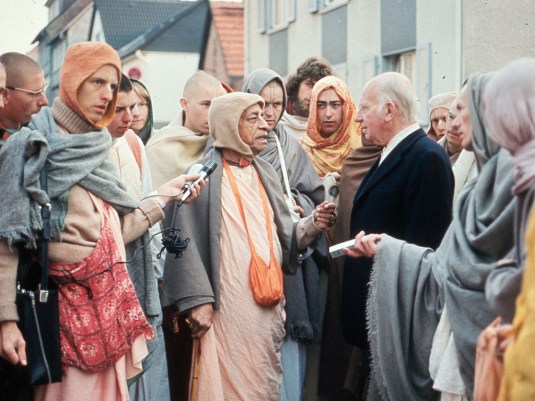
click on image to enlarge
Perhaps it was Krsna who directed me to the last chapter of Śrīla Prabhupāda-līlāmṛta, by Satsvarūpa dāsa Goswāmī. The famous book chronicling The life of our Founder-Acarya His Divine Grace A. C. Bhaktivedanta Swami Prabhupada. In this last chapter entitled, “The Final Lesson”, last sentence of this voluminious book, Satsvarūpa dāsa Goswāmī concludes with this statement:
“Our hope is that by hearing about Śrīla Prabhupāda the reader will become himself a Prabhupādānuga, a follower of Śrīla Prabhupāda. We can wish no better fortune upon anyone.”
Update:
this came as a comment…
This is probably the best thing Satsvarupa Maharaja ever wrote.
When a devotee decides to join the Hare Krishna movement as a full-time member, they are announcing to the world their acceptance of Srila Prabhupada as the empowered representative of the Supreme Personality of Godhead. By mature realization they will come to recognize Srila Prabhupada as their eternal spiritual master. These lifetime servants of the spiritual master are called Prabhupadanugas.
Those who mould their lives in such a way that they can always think of the lotus feet of the spiritual master will live with him eternally. Because of Srila Prabhupada’s transcendental position, there is no separation in time or space between us. He is present in our lives and is guiding us back to Godhead through his written and spoken word. By his unlimited blessings we continue to move forward in Krishna consciousness and surely we will one day reach the ultimate goal of love of Godhead. The more we advance toward that goal, the more we will understand the greatness of Srila Prabhupada’s compassion upon us and his concern for the conditioned souls of this world who are all part and parcel of the Supreme Lord, Sri Krishna. (Locanananda das)
Sometimes the ISKCON devotees refer to Prabhupadanugas as some splinter group, not belonging to the mainstream devotees. But in fact we can plainly see from some of the writing of the senior members of our society that becoming a follower of Śrīla Prabhupāda is exactly what is needed. For instance in Bhakti Curu Swami’s, Disappearance Day offering to Srila Prabhupada, given June 16, 2010, he states:
…everyday, in all the temples of ISKCON, Srila Prabhupada is worshipped by everyone. Then why do we hesitate to tell a new comer who is searching for a guru that Srila Prabhupada, the best guru the world has ever seen, is still here, and one can surrender unto him and go back to Godhead very easily? When we have such a great good fortune, why do we not take full advantage of it? It is only when we do so that the glorious days of ISKCON will come back again and we will witness Sri Caitanya Mahaprabhu’s sankirtan movement starting to spread in leaps and bounds all over the world.
If we really love ISKCON and if we sincerely want the Krsna Consciousness movement to spread all over the world in every town and village, then let us broadcast all over the world that Srila Prabhupada is still with us and that anyone who wants to receive his mercy can approach him and establish his eternal relationship with him.
Full Chapter of the “The Final Lesson” More
06 May 2013
by The Hare Krishna Movement
in A.C. Bhaktivedanta Swami Prabhupada, Diksha, Nectar of Instruction, Reference Material, Rupa Goswami, Siksa, Upadesamrta
Tags: A.C. Bhaktivedanta Swami Prabhupada, Always thinking of Krsna, association with vaisnavas, devotee, diska, kanistha-adhikari, madhyama-adhikari, Nectar of Instruction, serving Krsna, spiritual master, Srila Prabhupada, Srila Rupa Goswami, uttama-adhikari, vaisnava
…In this verse Śrīla Rūpa Gosvāmī advises the devotee to be intelligent enough to distinguish between the kaniṣṭha-adhikārī, madhyama-adhikārī and uttama-adhikārī. The devotee should also know his own position and should not try to imitate a devotee situated on a higher platform. Śrīla Bhaktivinoda Ṭhākura has given some practical hints to the effect that an uttama-adhikārī Vaiṣṇava can be recognized by his ability to convert many fallen souls to Vaiṣṇavism. One should not become a spiritual master unless he has attained the platform of uttama-adhikārī. A neophyte Vaiṣṇava or a Vaiṣṇava situated on the intermediate platform can also accept disciples, but such disciples must be on the same platform, and it should be understood that they cannot advance very well toward the ultimate goal of life under his insufficient guidance. Therefore a disciple should be careful to accept an uttama-adhikārī as a spiritual master.
For a Free pdf download of entire book follow link at bottom of post More
05 May 2013
by The Hare Krishna Movement
in A.C. Bhaktivedanta Swami Prabhupada, Krsna Consciousness, Lectures
Tags: A.C. Bhaktivedanta Swami Prabhupada, barhavatamsam asitambuda, He played on His flute, Here is God, His color is blackish, Krishna consciousness, photo by Gurudas, SB 1.1.1, Srila Prabhupada, Vedas, Vedic statement, venum kvanantam
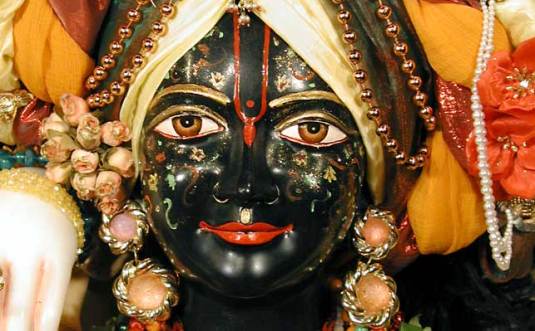
Śrīmad Bhāgavatam Lecture
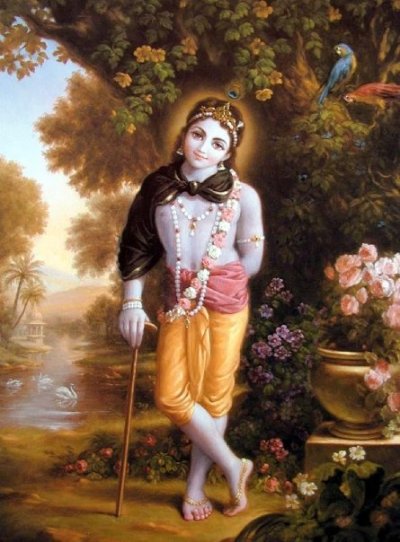
…So our Kṛṣṇa consciousness movement is so nice.. We present, “Here is God.” Here is God. Take His name. Take His address also. It is so perfect. They are searching after God. We are giving the name, address, activity, everything, quality, all. Nāma-rūpa-līlā-parikara-vaiśiṣṭhyam, everything. Nāma means name. Here is Kṛṣṇa, “He is engaged in enjoyment with Rādhārāṇī and playing on His flute.” Veṇuṁ kvaṇantam aravinda-dalāyatākṣaṁ bar… [Bs. 5.30]. We are not imagining. Not that this artist imagines, the poet imagines. No. We don’t do that rascaldom. We don’t do that. We take information from the Vedas. Kṛṣṇa, when He was present personally, He played on His flute. The gopīs saw and the cowherds boys saw five thousand years ago. And the ācāryas took information. Even if you don’t believe in the history, then come to śāstra. The śāstra says veṇuṁ kvaṇantam aravinda-dalāyatākṣam: [Bs. 5.30] “Kṛṣṇa, the Supreme Personality of Godhead, is always engaged in playing on His flute.” This is Vedic statement. Veṇuṁ kvaṇantam aravinda-dalāyatākṣam: [Bs. 5.30] “His eyes are just like lotus petals.” Veṇuṁ kvaṇantam aravinda-dalāyatākṣaṁ barhāvataṁsam asitāmbuda-sundarāṅgam: [Bs. 5.30] “He has got a peacock feather on His head.” These are the description in the Vedas. “He has got a peacock feather on His head.” Barhāvataṁsam asitāmbuda: “His color is blackish.” What kind of blackish? Asitāmbuda: “Just like new cloud.” Asitāmbuda-sundarāṅgam: “But don’t think because He is blackish, He is not beautiful. He is most beautiful.” How much beautiful? Kandarpa-koṭi-kamanīya-viśeṣa-śobham: [Bs. 5.30] “He is so beautiful that if you gather millions of Cupids, still He is more beautiful.” These descriptions are there.
So Kṛṣṇa consciousness movement is very nice. You will be able to understand what is God, and you will be able to understand what is your relationship with God. And you will be able to understand how you can go back to home, back to Godhead.
Thank you very much. (end)
Full Lecture More
30 Apr 2013
by The Hare Krishna Movement
in A.C. Bhaktivedanta Swami Prabhupada, Peace Formula
Tags: A.C. Bhaktivedanta Swami Prabhupada, Bg. 5.29, bhagavad-gita, demigods, formula for peace, illusory energy, krsna consciousness, living entities, Lord Krsna, material world, maya, peace formula, SB 1.11.33, Srila Prabhupada, Srimad Bhagavatam, supreme predominator

This is a combined post from my reading this morning, from the Srimad Bhagavatam 1.11.33 and Bhagavad-gita 5.29, wherein Srila Prabhupada is describing the factual formula for peace in this material world. Very interesting.
…In the material world no one is permanently fortunate, however clever one may be. There have been so many big empires in different parts of the world, there have been so many powerful kings all over the world, and there have been so many fortunate men, but all of them have been liquidated gradually. This is the law of material nature. But spiritually it is different. The spiritual relation with the Lord is so enlivening and resourceful that no one can leave the company of the Lord, once having taken shelter of Him. (SB 1.11.33 purport)
…The conditioned souls within the clutches of illusory energy are all anxious to attain peace in the material world. But they do not know the formula for peace, which is explained in the Bhagavad-gītā. The greatest peace formula is simply this: Lord Kṛṣṇa is the beneficiary in all human activities. Men should offer everything to the transcendental service of the Lord because He is the proprietor of all planets and the demigods thereon. No one is greater than He…Under the spell of illusion, living entities are trying to be lords of all they survey, but actually they are dominated by the material energy of the Lord. The Lord is the master of material nature, and the conditioned souls are under the stringent rules of material nature. Unless one understands these bare facts, it is not possible to achieve peace in the world either individually or collectively. This is the sense of Kṛṣṇa consciousness: Lord Kṛṣṇa is the supreme predominator, and all living entities, including the great demigods, are His subordinates. One can attain perfect peace only in complete Kṛṣṇa consciousness. (Bg 5.29 purport)
Full texts and purports More
28 Apr 2013
by The Hare Krishna Movement
in A.C. Bhaktivedanta Swami Prabhupada, Journey of Self-Discovery, Krsna Consciousness
Tags: A.C. Bhaktivedanta Swami Prabhupada, everyone can see God, God, God consciousness, Gopal, Govinda, Krishna, self discovery, self realization, The Journey of Self-Discovery, Vedic literature, yoga

…The first thing Kṛṣṇa is looking for is how eager you are to see Him. Kṛṣṇa will respond. If you are actually eager to see Kṛṣṇa, then it is sure your efforts will be successful.
But you must desire Kṛṣṇa only. In this connection, Rūpa Gosvāmī has written a verse:
“My dear friend, there is one boy—His name is Govinda. He is standing on the bank of the Yamunā near the Keśi-ghāṭa, and He is playing on His flute. He is so beautiful, especially during this full-moon night. If you have any intentions to enjoy in this material world with your children, husband, or other family members, then please do not go there.”
The idea is that if you once see Kṛṣṇa, then you’ll forget all this nonsensical materialistic enjoyment. That is seeing Kṛṣṇa.
The gopīs are another example of great eagerness to see Kṛṣṇa. The gopīs came to Kṛṣṇa, being captivated by His beautiful features. They were young girls, and Kṛṣṇa was so beautiful. Actually they were lusty when they came to Kṛṣṇa, but Kṛṣṇa is so pure that they became first-class devotees. There is no comparison to the gopīs’ devotion, because they loved Kṛṣṇa with heart and soul. That is the qualification. They loved Kṛṣṇa so much that they didn’t care for family or reputation when they went out in the dead of night. Kṛṣṇa’s flute was sounding, and they were all fleeing their homes. Their fathers, their brothers, their husbands all said, “Where are you going? Where are you going in this dead of night?” But the gopīs didn’t care. They neglected their children, their family, everything. Their only thought was, “We must go to Kṛṣṇa.”
This eagerness is required. We must be very, very eager to see Kṛṣṇa.
More
27 Apr 2013
by The Hare Krishna Movement
in A.C. Bhaktivedanta Swami Prabhupada, Bhagavad-gita, Book Distribution, Books by Srila Prabhupada
Tags: 1972 Edition, A.C. Bhaktivedanta Swami Ptabhupada, as it is, bhagavad-gita, Book Distribution, book distributors, books by the case, online store, Srila Prtabhupada, The Hare Krishna Movement, wholesale books

By them by the case!!!
Book Distributors can buy a Case of the original 1972 Classic Edition of the Bhagavad-gita As It Is at a special reduced rate! Only $82.00 per case plus shipping, for a limited time offer.
click on link to visit online store The Hare Krishna Movement
More
27 Apr 2013
by The Hare Krishna Movement
in A.C. Bhaktivedanta Swami Prabhupada, Bhaktisiddhanta Sarasvati Thakura, Books by Srila Prabhupada, Caaitanya-caritamrta, Sri Caitanya-Caritamrta
Tags: A.C. Bhaktivedanta Swami Prabhupada, Bhaktisiddanta Sarasvati, Caitanya Caritamrta, Jayadvaita das, Nitai das, Pradyumna das, Sri Caitanya Mahaprabhu, Sri Caitanya-caritamrta

For some reason I love reading the Concluding Words of the Śrī Caitanya-caritāmṛta, and find myself reading it again and again. The printing of this English translation is historically, a miraculous achievement, and yet reading Srila Prbhupada’s words and hearing the depth of his humility, is awe inspiring. He gives thanks to his American disciples, and to His Spiritual Master His Divine Grace Bhaktisiddhānta Sarasvatī Ṭhākura with the following words:
…I think that His Divine Grace Bhaktisiddhānta Sarasvatī Ṭhākura is always seeing my activities and guiding me within my heart by his words. As it is said in Śrīmad Bhāgavatam, tene brahma hṛdā ya ādi-kavaye. Spiritual inspiration comes from within the heart, wherein the Supreme Personality of Godhead, in His Paramātmā feature, is always sitting with all His devotees and associates. It is to be admitted that whatever translation work I have done is through the inspiration of my spiritual master because personally I am most insignificant and incompetent to do this materially impossible work. I do not think myself a very learned scholar, but I have full faith in the service of my spiritual master, His Divine Grace Śrīla Bhaktisiddhānta Sarasvatī Ṭhakura. If there is any credit to my activities of translating, it is all due to His Divine Grace. Certainly if His Divine Grace were personally present at this time, it would have been a great occasion for jubiliation, but even though he is not physically present, I am confident that he is very pleased by this work of translation. He was very fond of seeing many books published to spread the Kṛṣṇa consciousness movement. Therefore our society, the International Society for Kṛṣṇa Consciousness, has formed to execute the order of Śrī Caitanya Mahāprabhu and His Divine Grace Śrīla Bhaktisiddhānta Sarasvatī Ṭhakura.
Although Srila Prabhupada gives all credit to his spiritual master, we give all credit to him. All Glories to Srila Prabhupada!
Full text More
26 Apr 2013
by The Hare Krishna Movement
in A.C. Bhaktivedanta Swami Prabhupada, Krishna Consciousness, Radha Krishna, Sri Caitanya-Caritamrta
Tags: A.C. Bhaktivedanta Swami Prabhupada, Krishna consciousness, krsna consciousness, Narotamma dasa thakura, pastimes of Lord Krsna, radha-krsna nahe anya, servant of the servant, six goswami's, Sri Caitanya Mahaprabhu, Sri Caitanya-caritamrta, Sri Krsna Caitanya
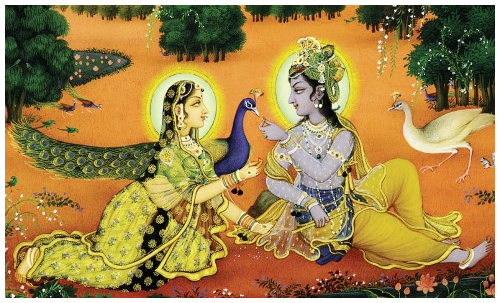
…The essence of spiritual knowledge is found in the pastimes of Śrī Caitanya Mahāprabhu, which are identical with the pastimes of Lord Kṛṣṇa. This is the essence of knowledge. If knowledge does not include the understanding of Śrī Caitanya Mahāprabhu and Kṛṣṇa, it is simply superfluous. By Śrī Caitanya Mahāprabhu’s grace, the nectar of Lord Śrī Kṛṣṇa’s pastimes is flowing in different directions in hundreds and thousands of rivers. One should not think that the pastimes of Śrī Caitanya Mahāprabhu are different from Kṛṣṇa’s pastimes. It is said: śrī-kṛṣṇa-caitanya, rādhā-kṛṣṇa nahe anya. Lord Caitanya Mahāprabhu is a combination of Rādhā-Kṛṣṇa, and without understanding His pastimes, one cannot understand Rādhā and Kṛṣṇa. Śrīla Narottama dāsa Ṭhākura therefore sings: rūpa-raghunātha-pade haibe ākuti kabe hāma bujhaba se yugala pirīti. “When shall I become very eager to study the books left by the six Gosvāmīs? Then I shall be able to understand the conjugal pastimes of Rādhā and Kṛṣṇa.” (Purport Madha-lila 25.271)
Full text and purport More
25 Apr 2013
by The Hare Krishna Movement
in A.C. Bhaktivedanta Swami Prabhupada, Balarama, Festivals, KRSNA The Supreme Personality of Godhead
Tags: A.C. Bhaktivedanta Swami Prabhupada, Balarama, full moon, gopis of vrndavan, krishna's springtime rasa-lila, Krsna Book, Lord Balarama, Lord Balarama Rasayatra, Lord Balarama Visits Vrndavana, Sri Krishna Vasanta Rasa, Vaisakha
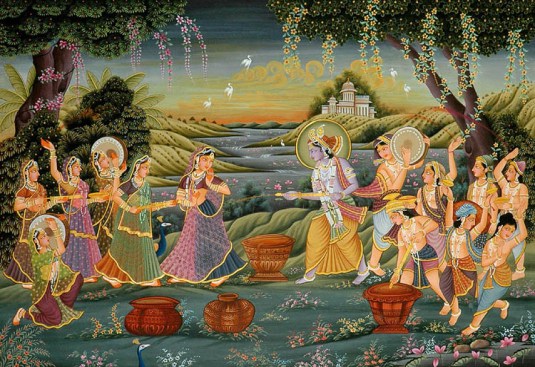
click on image to enlarge
Today the Vaisnava Calender marks two auspicious occasions; Sri Krishna Vasanta Rasa (Lord Krishna’s Springtime Rasa-lila), and also Lord Balarama Rasayatra (Balarama’s rasa dance with the gopis of Vrndavan). In honor we post a very nice chapter from Krsna Book entitled “Lord Balarāma Visits Vṛndāvana”.
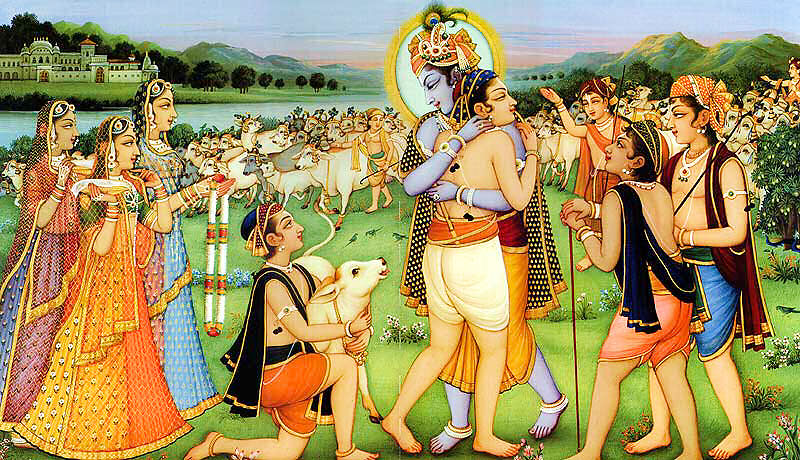
…Lord Balarāma could, of course, understand the ecstatic feelings of the gopīs, and therefore He wanted to pacify them. He was expert in presenting an appeal, and thus, treating the gopīs very respectfully, He began to narrate the stories of Kṛṣṇa so tactfully that the gopīs became satisfied. In order to keep the gopīs in Vṛndāvana satisfied, Lord Balarāma stayed there continually for two months, namely the months of Caitra (March-April) and Vaiśākha (April-May). For those two months He kept Himself among the gopīs, and He passed every night with them in the forest of Vṛndāvana in order to satisfy their desire for conjugal love. Thus Balarāma also enjoyed the rāsa dance with the gopīs during those two months. Since the season was springtime, the breeze on the bank of the Yamunā was blowing very mildly, carrying the aroma of different flowers, especially of the flower known as kaumudī. Moonlight filled the sky and spread everywhere, and thus the banks of the Yamunā appeared to be very bright and pleasing, and Lord Balarāma enjoyed the company of the gopīs there.
Full Chapter More
24 Apr 2013
by The Hare Krishna Movement
in A.C. Bhaktivedanta Swami Prabhupada, Beyond Birth & Death, Krsna Consciousness
Tags: A.C. Bhaktivedanta Swami Prabhupada, bhakti yogis, death, dhyana yogis, dying, Elevation at Death, eternal life, hatha yogis, life after death, to link up, yoga, yogis

*click on image to enlarge
This is a continuation (chapter 2) from the small book, “Beyond Birth and Death”, by Srila Prabhupada. Personally, I like these small books, as so much of the philosophy of Krishna Consciousness is contained in them, in a very readable format. For a Free pdf download of entire book; follow link at bottom of post. Hare Krishna!
Beyond Birth and Death
By His Divine Grace A. C. Bhaktivedanta Swami Prabhupāda
Chapter Two
Elevation at Death
There are different kinds of transcendentalists who are called yogīs—haṭha-yogīs, jñāna-yogīs, dhyāna-yogīs, and bhakti-yogīs—and all of them are eligible to be transferred to the spiritual world. The word yoga means “to link up,” and the yoga systems are meant to enable us to link with the transcendental world. As mentioned in the previous chapter, originally we are all connected to the Supreme Lord, but now we have been affected by material contamination. The process is that we have to return to the spiritual world, and that process of linking up is called yoga. Another meaning of the word yoga is “plus.” At the present moment we are minus God, or minus the Supreme. When we add Kṛṣṇa—or God—to our lives, this human form of life becomes perfect.
At the time of death we have to finish that process of perfection. During our lifetime we have to practice the method of approaching that perfection so that at the time of death, when we have to give up this material body, that perfection can be realized.
More
22 Apr 2013
by The Hare Krishna Movement
in A.C. Bhaktivedanta Swami Prabhupada, Devotional Service, Dvaraka, Spiritual Life, Srimad Bhagavatam
Tags: A.C. Bhaktivedanta Swami Prabhupada, devotees, impersonal, just as it behooves, Krishna, reciprocates, SB 1.11.20-22, Supreme Personality of Godhead, yatha-vidhi
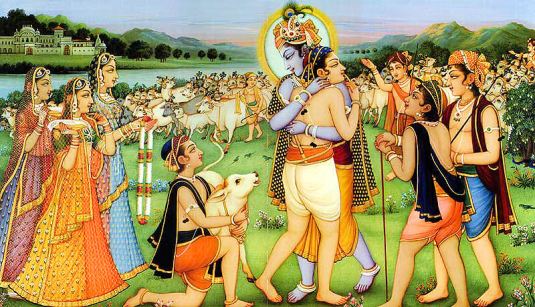
Everyone is Eligible for the Supreme Destination Part II
This is a continuation from yesterdays post because as I continued my reading from Chapter Eleven entitled “Lord Kṛṣṇa’s Entrance into Dvārakā”, it became apparent that:
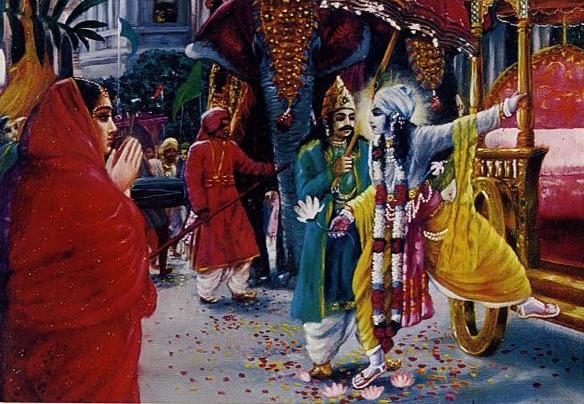
The Supreme Lord Personality of Godhead is neither impersonal nor an inert object unable to reciprocate the feelings of His devotees. Here the word yathā-vidhi, or “just as it behooves” is significant. He reciprocates “just as it behooves” with His different types of admirers and devotees. Of course, the pure devotees are of one type only because they have no other object for service but the Lord, and therefore the Lord also reciprocates with such pure devotees just as it behooves, namely, He is always attentive to all the matters of His pure devotees. There are others who designate Him as impersonal, and so the Lord also does not take any personal interest. He satisfies everyone in terms of one’s development of spiritual consciousness, and a sample of such reciprocation is exhibited here with His different welcomers.
Yes, this is a beautiful chapter of the Srimad Bhagavatam, and Srila Prabhupada’s Purports are dripping with transcendental Knowledge.
More
21 Apr 2013
by The Hare Krishna Movement
in A.C. Bhaktivedanta Swami Prabhupada, Bhagavad-gita, Krishna Consciousness, Prostitutes
Tags: A.C. Bhaktivedanta Swami Prabhupada, Allen Ginsberg, Bilvamangala Thakura, brahman family, candalas, cintamani, cintmani, devotee of the Lord, devotional service, prostitute, prostitute-hunter, Sri Bilvamangala Thakura, Srila Prabhupada, sucinam srimatam gehe
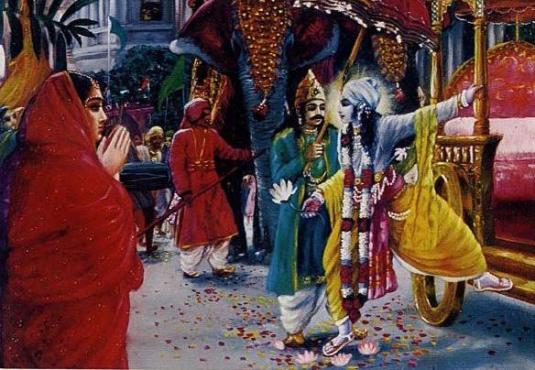
This I found this extremely interesting from my reading this morning, how even the prostitutes some 5,000 years ago in the time of Lord Krsna were accepted as necessary citizens for the proper upkeep of society. They were not condemned by the Lord, but rather He greeted them with the proper etiquette. Krishna says in the Bhagavad-gita… “even the low-born caṇḍālas and those who are born in a family of unbelievers, and even the prostitutes, shall attain perfection of life if they take shelter of unalloyed devotional service to Me, because in the path of devotional service there are no impediments due to degraded birth and occupation. The path is open for everyone who agrees to follow it.”
At the same time, many hundreds of well-known prostitutes began to proceed on various vehicles. They were all very eager to meet the Lord, and their beautiful faces were decorated with dazzling earrings, which enhanced the beauty of their foreheads.(SB 1.11.19)
…We may not hate even the prostitutes if they are devotees of the Lord. Even to date there are many prostitutes in great cities of India who are sincere devotees of the Lord. By tricks of chance one may be obliged to adopt a profession which is not very adorable in society, but that does not hamper one in executing devotional service to the Lord. Devotional service to the Lord is uncheckable in all circumstances.
Śrī Bilvamaṅgala Ṭhākura, a great ācārya of the Viṣṇusvāmī Vaiṣṇava sect, in his householder life was overly attached to a prostitute who happened to be a devotee of the Lord. One night when the Ṭhākura came to Cintāmaṇi’s house in torrents of rain and thunder, Cintāmaṇi was astonished to see how the Ṭhākura could come on such a dreadful night after crossing a foaming river which was full of waves. She said to Ṭhākura Bilvamaṅgala that his attraction for the flesh and bone of an insignificant woman like her would be properly utilized if it could be diverted to the devotional service of the Lord to achieve attraction for the transcendental beauty of the Lord. It was a momentous hour for the Ṭhākura, and he took a turn towards spiritual realization by the words of a prostitute. Later on the Ṭhākura accepted the prostitute as his spiritual master, and in several places of his literary works he has glorified the name of Cintāmaṇi, who showed him the right path. (SB 1.11.19 Purport)
It is clearly declared by the Supreme Lord, that in devotional service, there is no distinction between the lower or higher classes of people. In the material conception of life, there are such divisions, but for a person engaged in transcendental devotional service to the Lord, there are not. Everyone is eligible for the supreme destination. (Bg 9.32 Purport)
In the second part of the post there is a conversation with Allen Ginsberg on the life of Bilvamaṅgala Ṭhākura
More
20 Apr 2013
by The Hare Krishna Movement
in A.C. Bhaktivedanta Swami Prabhupada, Free Downloads, Free eBooks, Krsna Consciousness, Practicing Krishna Consciousness at Home, Spiritual Life, The Hare Krishna Movement
Tags: A.C. Bhaktivedanta Swami Prabhupada, bhakti handbook, ebooks, free pdf download, Iskcon, krishna consciousness handbook, pdf download, practicing Krishna consciousness, Spiritual Life
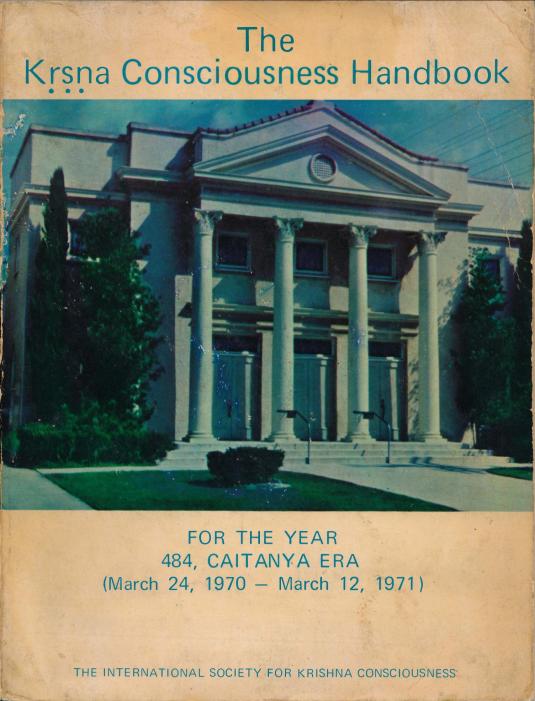
I always liked this small booklet, as it contained the basic instructions for practicing Krishna Consciousness. Krishna Consciousness is not so difficult, it only requires a little sincerity and faith, and in a short time one can realize its positive results.
To read this booklet and/or to save it to your computer, simply click on following link:
The Krishna Consciousness Handbook
20 Apr 2013
by The Hare Krishna Movement
in A.C. Bhaktivedanta Swami Prabhupada, Bob Cohen, Brahmatirtha das, Perfect Answers Perfect Questions
Tags: A.C. Bhaktivedanta Swami Prabhupada, Bhakti-devi dasi, Bob Cohen, Brahmatirtha dasa, human life is ment for urification, krishna consciousnessm yoga, perfect questions perfect answers, purification

Continuing with our series of a True account entitled Perfect Questions, Perfect Answers… A search for meaning carries Bob Cohen, a young American Peace Corps worker halfway around the world, to an ancient village in the midst of West Bengal. There, in a small bamboo hut, he finds a teacher who is able to tell him everything he ever wanted to know.
This is the finial installment, the last chapter in the book, and the concluding words are written by Bob, who later became initiated by Srila Prabhupada and was given the name Brahmatīrtha dāsa.
Perfect Questions, Perfect Answers
by His Divine Grace A. C. Bhaktivedanta Swami Prabhupāda
Concluding words
On July 19, 1976, His Divine Grace Śrīla Prabhupāda accepted my wife and me as his disciples and initiated us with the names Bhakti-devī dāsī and Brahmatīrtha dāsa. As I reflect back on that day, I can see how fortunate I was to have met His Divine Grace and my Godbrothers in the Hare Kṛṣṇa movement.
When I was handed my beads at initiation, I promised to follow the regulative principles and to chant God’s names daily. Four years previously, Śrīla Prabhupāda had advised me to follow these principles, and within six months, he said, I could be like the other devotees; all unnecessary things (anarthas), such as mundane movies and restaurants, would cease to attract me. “The whole human life is meant for purification,” he said. I was interested in being purified, even though I did not really know what purification meant. I had gone to India with the Peace Corps hoping to find a higher level of consciousness. I could not believe that satisfying the senses was the all in all, yet I myself was bound by the senses. Later I could understand that yoga means becoming free from the dictation of the senses.
More
19 Apr 2013
by The Hare Krishna Movement
in A.C. Bhaktivedanta Swami Prabhupada, Lectures, Rama
Tags: God, God disposes, God's desire, Lecture by Srila Prabhupada, Lord Ramachndra's Appearance Day, Rama, Srimad Bhagavatam

In honor of the Appearance Day of Lord Ramachandra, we are posting a Lecture given by His Divine Grace A.C. Bhaktivedanta Swami Prabhupada from way back in 1966, when many of us here in the Western world were just hearing about Rama, and His amazing pastimes, for the very first time.
…When God comes in incarnation or He sends His representative to reclaim, they perform wonderful acts. They are not ordinary, common men. Either God or God’s representative, they act in such a way that it is not possible for any common man. That is the particular symptom of God and God’s representative. (Ramachandra’s Appearance Day Lecture, December 27, 1966 New York)
Full Lecture More
18 Apr 2013
by The Hare Krishna Movement
in A.C. Bhaktivedanta Swami Prabhupada, Chanting Hare Krishna, Letters by Srila Prabhupada, Sankirtan, Susan Beckman, The Hare Krishna Movement
Tags: A.C. Bhaktivedanta Swami Prabhupada, chanting Hare Krishna, humble state of mind, Jayananda das, Letters by Srila Prabhupada, Lord Caitanya, lower than the straw in the street, sankirtan, sankirtan movement, Susan Beckman, The Hare Krishna Movement
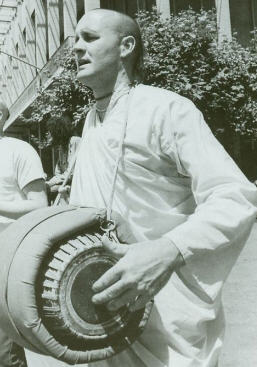
…Lord Sri Chaitanya Mahaprabhu, the incarnation of Godhead in this age has delivered the medicine for all problems of the world by his introducing the Sankirtan movement. The chanting is a process of purification. Just like we use soap to cleanse the body, this is material, but the chanting is spiritual cleansing.
…one should learn the art of chanting the Holy name of Krishna 24 hours a day and that alone is the remedy for all problems of material existence. How is it possible to chant 24 hours a day? Lord Chaitanya gave the hint, “One can chant the holy name of God in a humble state of mind, thinking himself lower than the straw in the street, more tolerant than a tree, devoid of all kinds of sense of false prestige, and always ready to offer all respects to others. In such a humble state of mind one can chant the Holy name of God constantly.” So I cannot give you any better advice for your problem, simply chant Hare Krishna and everything will be all right. (Letter to Susan Bekman from Srila Prabhupada)
Full Letter More
17 Apr 2013
by The Hare Krishna Movement
in A.C. Bhaktivedanta Swami Prabhupada
Tags: A.C. Bhaktivedanta Swami Prabhupada, Arjuna, beauty, Bg 10, bhagavad-gita, fame wealth, Krishna, paramam, renunciation, six opulences, Sri Bhagavan uvaca, strength, Supreme Persolity of Godhead, The Opulence of the Absolute, the Suprme Lord
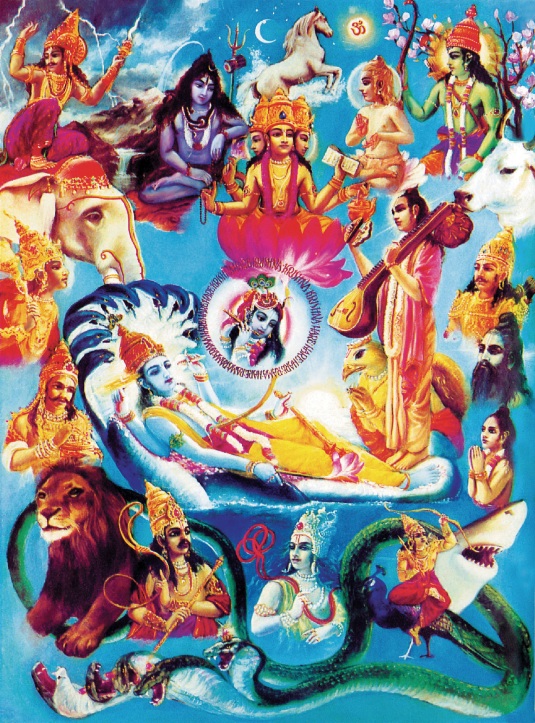
Bhagavad-gītā As It Is 1972 Edition
By His Divine Grace A. C. Bhaktivedanta Swami Prabhupāda
Chapter Ten
More
15 Apr 2013
by The Hare Krishna Movement
in A.C. Bhaktivedanta Swami Prabhupada, Disciplic succession, Guru & Disciple, Letters by Srila Prabhupada, Parampara System
Tags: 68-04-12, Brahma sampradaya, Dayanda das, disciplic succession, guru and disciple, Madhava, Parampara, parampara system, Sampradaya Acarya, spiritual master, Vyasadeva

..Regarding parampara system: there is nothing to wonder for big gaps. Just like we belong to the Brahma Sampradaya, so we accept it from Krishna to Brahma, Brahma to Narada, Narada to Vyasadeva, Vyasadeva to Madhva, and between Vyasadeva and Madhva there is a big gap. But it is sometimes said that Vyasadeva is still living, and Madhva was fortunate enough to meet him directly. In a similar way, we find in the Bhagavad-gita that the Gita was taught to the sungod, some millions of years ago, but Krishna has mentioned only three names in this parampara system—namely, Vivasvan, Manu, and Iksvaku; and so these gaps do not hamper from understanding the parampara system. We have to pick up the prominent acaryas, and follow from him. There are many branches also from the parampara system, and it is not possible to record all the branches and sub-branches in the disciplic succession. We have to pick up from the authority of the acharya in whatever sampradaya we belong to. (from letter to Dayananda: April 12, 1968)
Full letter More
Previous Older Entries Next Newer Entries










 The Hare Krishna Movement