19 Nov 2014
by The Hare Krishna Movement
in A.C. Bhaktivedanta Swami Prabhupada, Maitreya, Srimad Bhagavatam, Vidura
Tags: A.C. Bhaktivedanta Swami Ppabhupada, all-inclusive welfare service, essence of all topics, human society, jnais, karmis, King of all kings, Krsna, Krsna-katha, Maitreya Muni, miseries of material existence, O great sage, O my Lord, saints, sri suka uvaca, Sukadeva Gosvami, Supreme King of all kings, Supreme Lord, topics of the Lord, transcendental loving service, Vidura, welfare for all people, yogis

I have been reading, with rapt attention, from Volume One, of the Third Canto, of Srimad Bhagavatam, by His Divine Grace A. C. Bhaktivedanta Swami Prabhupada, each morning. As I was reading this morning the words “…all-inclusive welfare service for the entire human society”, just kinda jumped out at me, as did the words “…greatest welfare service for the world”. I am reminded of the importance of hearing Srimad Bhagavatam every day, and of our good fortune to be able to partake in this transcendental conversation (kṛṣṇa-kathā). There are many topics for different persons in different modes of material nature, but the essential topics are those in relationship with the Supreme Lord.
Śukadeva Gosvāmī said: Vidura, the best amongst the Kuru dynasty, who was perfect in devotional service to the Lord, thus reached the source of the celestial Ganges River [Hardwar], where Maitreya, the great, fathomless learned sage of the world, was seated. Vidura, who was perfect in gentleness and satisfied in transcendence, inquired from him. (SB 3.5.1)
The great sage Maitreya Muni is described here as bhagavān because he surpassed all ordinary human beings in learning and experience. Thus his selection of the greatest welfare service for the world is considered authoritative. The all-inclusive welfare service for the entire human society is devotional service to the Lord, and, as requested by Vidura, the sage described the same very appropriately. (purport 3.5.17)
Śrīmad-Bhāgavatam: Canto 3: “The Status Quo”
By His Divine Grace A. C. Bhaktivedanta Swami Prabhupāda
Canto Three, Chapter Five, Text 1-17
Vidura’s Talks with Maitreya
More
18 Nov 2014
by The Hare Krishna Movement
in A.C. Bhaktivedanta Swami Prabhupada, Bhagavata Dharma Discourses
Tags: 1.2.6, artha, Bhagavata Dharma Discourses, bhakti, external world, New Vrindavan, pure devotional service, sa vai pumsam paro dharmaḥ, Supreme Personality of Godhead, topmost religious system

Continuning with our “Bhagavata Dharma Discourses” series given at New Vrindavan, 1972.
Śrīmad-Bhāgavatam Lecture
by His Divine Grace A. C. Bhaktivedanta Swami Prabhupada
Canto One, Chapter 2, Text 6
New Vrindaban, September 5, 1972
Pradyumna: Translation: “The supreme occupation or dharma for all humanity is that by which men can attain to loving devotional service unto the transcendent Lord. Such devotional service must be unmotivated and uninterrupted in order to completely satisfy the self.”
Prabhupāda: So
sa vai puṁsāṁ paro dharmo
yato bhaktir adhokṣaje
ahaituky apratihatā
yayātmā suprasīdati
[SB 1.2.6]
Everyone is seeking satisfaction, atyantikṣu. Everyone is struggling for existence for the ultimate happiness. But in this material world, although they are thinking by possessing material wealth they will be satisfied, but that is not the fact.
More
16 Nov 2014
by The Hare Krishna Movement
in A.C. Bhaktivedanta Swami Prabhupada, Caaitanya-caritamrta, Sri Caitanya-Caritamrta, Temples
Tags: A.C. Bhaktivedanta Swami Prabhupada, Adi lila, damsels of Vraja, Gopijana-vallabha, Govinda, grace of Krsna, Madana-mohana, neophyte devotees, reservoir of all pleasure, Sri Radha Madana Mohana, Supreme Lord, the pleasure deity

Sri Sri Radha-Madana-mohana Mandir
click on image to enlarge
As we mentioned in a previous post With the Radiance of Molten Gold “The First Chapter of Śrī Caitanya-caritāmṛta begins with fourteen Sanskrit verses that describe the Absolute Truth. Then the next three Sanskrit verses describe the principal Deities of Vṛndāvana, namely, Śrī Rādhā-Madana-mohana, Śrī Rādhā-Govindadeva and Śrī Rādhā-Gopīnāthajī.” Today we are posting the next three verses describing the principal deities, with images of the three temples. In addition we are posting verses 18 & 19. The purport to text 19, is the main content of today’s post.
…The three Deities-Madana-mohana, Govinda and Gopījana-vallabha-have very specific qualities. Worship of Madana-mohana is on the platform of reestablishing our forgotten relationship with the Personality of Godhead. In the material world we are presently in utter ignorance of our eternal relationship with the Supreme Lord… It is best for such persons not to aspire for success in fruitive activities or mental speculation, but instead simply to surrender to the Supreme Personality of Godhead. The perfection of life is simply to surrender to the Supreme. In the beginning of our spiritual life we must therefore worship Madana-mohana so that He may attract us and nullify our attachment for material sense gratification. This relationship with Madana-mohana is necessary for neophyte devotees. When one wishes to render service to the Lord with strong attachment, one then worships Govinda on the platform of transcendental service. Govinda is the reservoir of all pleasures. When by the grace of Kṛṣṇa and the devotees one reaches perfection in devotional service, he can appreciate Kṛṣṇa as Gopījana-vallabha, the pleasure Deity of the damsels of Vraja. (from purport to Adi 1.19)
More
15 Nov 2014
by The Hare Krishna Movement
in A.C. Bhaktivedanta Swami Prabhupada, Indira devi, Letters by Srila Prabhupada, Practicing Krishna Consciousness at Home, Women, Women in ISKCON, Yogi
Tags: Bhaktivindode Thakura, ch, children of devotees, devotional service, family life, family life in Krsna consciousness, Indira devi dasi, Krishna conscious children, perfect yogi, sannyasa, Vamanadeva das, Vikuntha
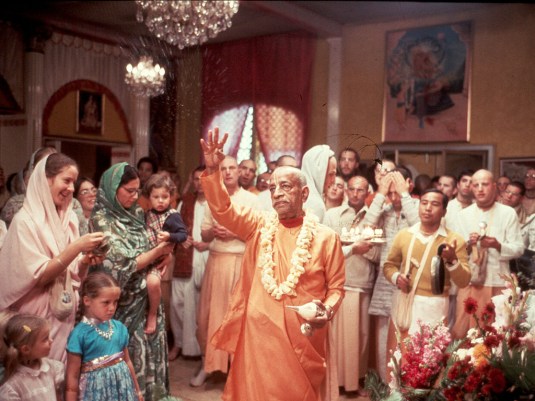
My wife read me following letter this morning, that she saw on FaceBook. It is a letter written by Srila Prabhupada in 1971 to his female disciple Indira devi dasi, and is explaining how to practice household life (gṛhastha ashram) in Krishna consciousness.
My Dear Indira,
Please accept my blessings. I beg to acknowledge receipt of your letter. So far your son leaving you, his parents, at 5 years, that is not necessary. Especially our Krishna Conscious children; they are already living in a asrama. The children of our devotees may live with their parents perpetually because you are all living in the temple and already engaged in devotional service. Other instructions are for those not engaged in Krishna Consciousness. Any family engaged in Krishna’s service is living not in this material world. Such a home is considered as Vaikuntha. That is the verdict of Bhaktivinode Thakura.
Full Letter More
13 Nov 2014
by The Hare Krishna Movement
in A.C. Bhaktivedanta Swami Prabhupada, Caaitanya-caritamrta, Caitanya Mahaprabhu
Tags: A. C. Bhaktivedanta Swami Pabhupada, Adi1.4, age of kali, and the primeval Lord Himself, causeless mercy, His energies, His plenary portions, I offer my respectful obeisances unto the spiritual masters, incarnation of God, molten gold, spiritual knowledge, Sri Krsna Caitanya, srimati sacidevi, the devotees of the Lord, the Lord’s incarnations, with the radiance of molten gold

The First Chapter of Śrī Caitanya-caritāmṛta begins with fourteen Sanskrit verses that describe the Absolute Truth. Latly, I have been reading these first fourteen verses every morning, as part of my morning practice; just trying to put myself in the mood of devotional service. The following is my favorite of the fourteen and we share it with you this morning. All fourteen are posted below. Hare Krishna!
May that Lord who is known as the son of Śrīmatī Śacīdevī be transcendentally situated in the innermost chambers of your heart. Resplendent with the radiance of molten gold, He has appeared in the Age of Kali by His causeless mercy to bestow what no incarnation ever offered before: the most sublime and radiant spiritual knowledge of the mellow taste of His service.
More
11 Nov 2014
by The Hare Krishna Movement
in A.C. Bhaktivedanta Swami Prabhupada, Back to Godhead, Rupa Goswami, The Hare Krishna Movement, Upadesamrta
Tags: A. C. Bhakthvedanta Swami Prabhupada, Back to Godhead Magazine, devotional service, Obstacles on the Path of Eternity, problems of economic or political maladjustment and instability, spiritual community, Srila Rupa Gosvami, Srila Rupa Gosvami's Upadesamrta, the krsna consciousness movement, Upadesamrta

This morning while I was looking through some of the old issues of Back to Godhead Magazine, I stumbled upon the following article.
Obstacles on the Path of Eternity
An Excerpt from Srila Rupa Gosvami’s Upadesamrta
from Back to Godhead Magazine Vol. 1, No.88, 1973
[SRILA RUPA GOSVAMI was one of six exalted devotees especially chosen through the Krsna conscious chain of spiritual masters to teach the devotional service of the Supreme Lord in a scientific manner. Although all of these six great devotees were erudite scholars and prolific writers, Srila Rupa Gosvami is the most prominent, for he most greatly appreciated the nectar of Krsna consciousness. His Upadesamrta (Nectarean Instructions), a short work of only eleven verses, teaches the basic principles for arousing one’s dormant love of Krsna, the Supreme Lord. Written in Sanskrit some 400 years ago, it has now been translated into English, with an illuminating explanation of each verse, by His Divine Grace A.C. Bhaktivedanta Swami Prabhupada.]
More
07 Nov 2014
by The Hare Krishna Movement
in A.C. Bhaktivedanta Swami Prabhupada, Bhagavata Dharma Discourses, Srimad Bhagavatam
Tags: A.C. Bhaktivedanta Swami Prabhupada, Bhagavata Dharma Discourses, Lord Krsna, New Vrindavan, New Vrindavan 1972, Pradyuma, SB 1.2.5, Srila Prabhupada lecture, Srimad Bhagavatam lecture, srimad bhagavatam lectures

Continuning with our “Bhagavata Dharma Discourses” series given at New Vrindavan, 1972.
Śrīmad-Bhāgavatam Lecture
New Vrindaban, September 4, 1972
By His Divine Grace A. C. Bhaktivedanta Swami Prabhupada
Canto 1, Chapter Two, Text 5
Pradyumna: “O sages, I have been justly questioned by you. Your questions are worthy because they relate to Lord Kṛṣṇa and so are of relevance to the world’s welfare. Only questions of this sort are capable of completely satisfying the self.” [SB 1.2.5]
Prabhupāda: So there was a great meeting. Just like we are holding here meeting for a few days, a similar meeting was held thousands of years ago, at least four thousand years ago, in a place which is called Naimiṣāraṇya. The Naimiṣāraṇya is in India. It is near Lucknow. Here is Professor Shivasrava(?). He knows. The station is called now Nimsar. I think it is in Hardoi district? So still the place is there, and if you sometimes go to India you can visit this place. It is a very nice place for spiritual atmosphere. So formerly all the great sages used to assemble in that Naimiṣāraṇya. It is said that all the demigods used to visit that place. So in that great meeting, Bhāgavata was discussed.
More
06 Nov 2014
by The Hare Krishna Movement
in A.C. Bhaktivedanta Swami Prabhupada, Krishna Consciousness, Krishna's flute, KRSNA The Supreme Personality of Godhead, Rasa Dance, Tulasi-saligram Vivaha
Tags: A.C. Bhaktivedanta Swami Prabhupada, autumn season, Caturmasya, full moon in autum, full moonlight, gopis, Kartika, Kṛṣṇa, Krsna, krsna consciousness, Purnima, rasa dance, rasa-lila, Sri Krsna Rasa-yatra, Srimati Tulsi Devi, The Rasa Dance, The Supreme Personality of Godhead, Tulasi-Saligrama Vivaha

Today being Purnima (the Full Moon), is also the End of Kartika, Sri Krsna Rasa-yatra (the purnima or full moon of Damodara month is the second full moon of the autumn season, and rasa lila is again celebrated), Tulasi-Saligrama Vivaha (this is the celebration of the marriage ceremony of Srimati Tulsi Devi and Lord Sri Krishna), and the Last Day of Caturmasya.
In honor of this auspicious day, we are posting the Introduction to the Rasa Dance, Chapter 29 of the Krsna Book.
…The appearance of the moon increased Kṛṣṇa’s desire to dance with the gopīs. The forests were filled with fragrant flowers. The atmosphere was cooling and festive. When Lord Kṛṣṇa began to blow His flute, the gopīs all over Vṛndāvana became enchanted. Their attraction to the vibration of the flute increased a thousand times due to the rising full moon, the red horizon, the calm and cool atmosphere, and the blossoming flowers. All these gopīs were by nature very much attracted to Kṛṣṇa’s beauty, and when they heard the vibration of His flute, they became apparently lustful to satisfy the senses of Kṛṣṇa.
Immediately upon hearing the vibration of the flute, they all left their respective engagements and proceeded to the spot where Kṛṣṇa was standing. While they ran very swiftly, all their earrings swung back and forth. They all rushed toward the place known as Vaṁśīvaṭa. Some of them were engaged in milking cows, but they left their milking business half finished and immediately went to Kṛṣṇa. One of them had just collected milk and put it in a milk pan on the oven to boil, but she did not care whether the milk overboiled and spilled–she immediately left to go see Kṛṣṇa. Some of them were breast feeding their small babies, and some were engaged in distributing food to the members of their families, but they left all such engagements and immediately rushed towards the spot where Kṛṣṇa was playing His flute. Some were engaged in serving their husbands, and some were themselves engaged in eating, but neither caring to serve their husbands nor eat, they immediately left. Some of them wanted to decorate their faces with cosmetic ointments and to dress themselves very nicely before going to Kṛṣṇa, but unfortunately they could not finish their cosmetic decorations nor put on their dresses in the right way because of their anxiety to meet Kṛṣṇa immediately. Their faces were decorated hurriedly and were haphazardly finished; some even put the lower part of their dresses on the upper part of their bodies and the upper part on the lower part.
While all the gopīs were hurriedly leaving their respective places, their husbands, brothers and fathers were all struck with wonder to know where they were going. Being young girls, they were protected either by husbands, elderly brothers or fathers. All their guardians forbade them to go to Kṛṣṇa, but they disregarded them. When a person becomes attracted by Kṛṣṇa and is in full Kṛṣṇa consciousness, he does not care for any worldly duties, even though very urgent. Kṛṣṇa consciousness is so powerful that it gives everyone relief from all material activities. Śrīla Rūpa Gosvāmī has written a very nice verse wherein one gopī advises another, “My dear friend, if you desire to enjoy the company of material society, friendship and love, then please do not go to see this smiling boy Govinda, who is standing on the bank of the Yamunā and playing His flute, His lips brightened by the beams of the full moonlight.” Śrīla Rūpa Gosvāmī indirectly instructs that one who has been captivated by the beautiful smiling face of Kṛṣṇa has lost all attraction for material enjoyments. This is the test of advancement in Kṛṣṇa consciousness: a person advancing in Kṛṣṇa consciousness must lose interest in material activities and personal sense gratification.
Full Chapter More
06 Nov 2014
by The Hare Krishna Movement
in A.C. Bhaktivedanta Swami Prabhupada, Caaitanya-caritamrta, Caitanya Mahaprabhu
Tags: A. C. Bhakthvedanta Swami Prabhupada, Adi4.1, age of kali, Caitanya, Caitanya Mahaprabhu, causeless mercy, devotional service, incarnation, Lord Krsna, Lord Sri Krsna, mellow of conjugal love, principles of religion, revealed scriptures, Sanskrit sloka, son of Srimati Cacidevi, Sri Caitanya Caritamrta

By the mercy of Lord Caitanya Mahāprabhu, even a foolish child can fully describe the real nature of Lord Kṛṣṇa, the enjoyer of the pastimes of Vraja, according to the vision of the revealed scriptures. (Ādi-līlā Chapter 4, Text 1)
This month as we explore the childhood pastimes of Lord Krsna in Vrndavan, it is important to keep in mind that, it is due to the mercy of the spiritual master and Lord Caitanya Mahaprabhu, that we are able to enter into the sublime understandings of the Lord. As is mentioned in the purport to the above sloka;
One can ascertain the meaning of this Sanskrit śloka only when one is endowed with the causeless mercy of Lord Caitanya. Lord Śrī Kṛṣṇa, being the absolute Personality of Godhead, cannot be exposed to the mundane instruments of vision. He reserves the right not to be exposed by the intellectual feats of nondevotees. Notwithstanding this truth, even a small child can easily understand Lord Śrī Kṛṣṇa and His transcendental pastimes in the land of Vṛndāvana by the grace of Lord Caitanya Mahāprabhu. (purport to Adi. 4.1)
but the real reason for this post is to remind out readers about the causeless mercy of Lord Caitanya
“May that Lord who is known as the son of Śrīmatī Śacīdevī be transcendentally situated in the innermost core of your heart. Resplendent with the radiance of molten gold, He has descended in the Age of Kali by His causeless mercy to bestow what no incarnation has ever offered before: the most elevated mellow of devotional service, the mellow of conjugal love.” (Ādi-līlā Chapter 3, Text 4)
PURPORT
This is a quotation from the Vidagdha-mādhava, a drama compiled and edited by Śrīla Rūpa Gosvāmī.
More
05 Nov 2014
by The Hare Krishna Movement
in A.C. Bhaktivedanta Swami Prabhupada, Damodara, Kartika, KRSNA The Supreme Personality of Godhead
Tags: A.C. Bhaktivedanta Swami, A.C. Bhaktivedanta Swami Prabhupada, brahmanas, gopis, handcart, hither and thither, Krishna, Krishna's childhood pastimes, Krsna, Nanda Maharaja, Supreme Personality of Godhead, Vedic hymns, Yasoda, YMother Yasoda

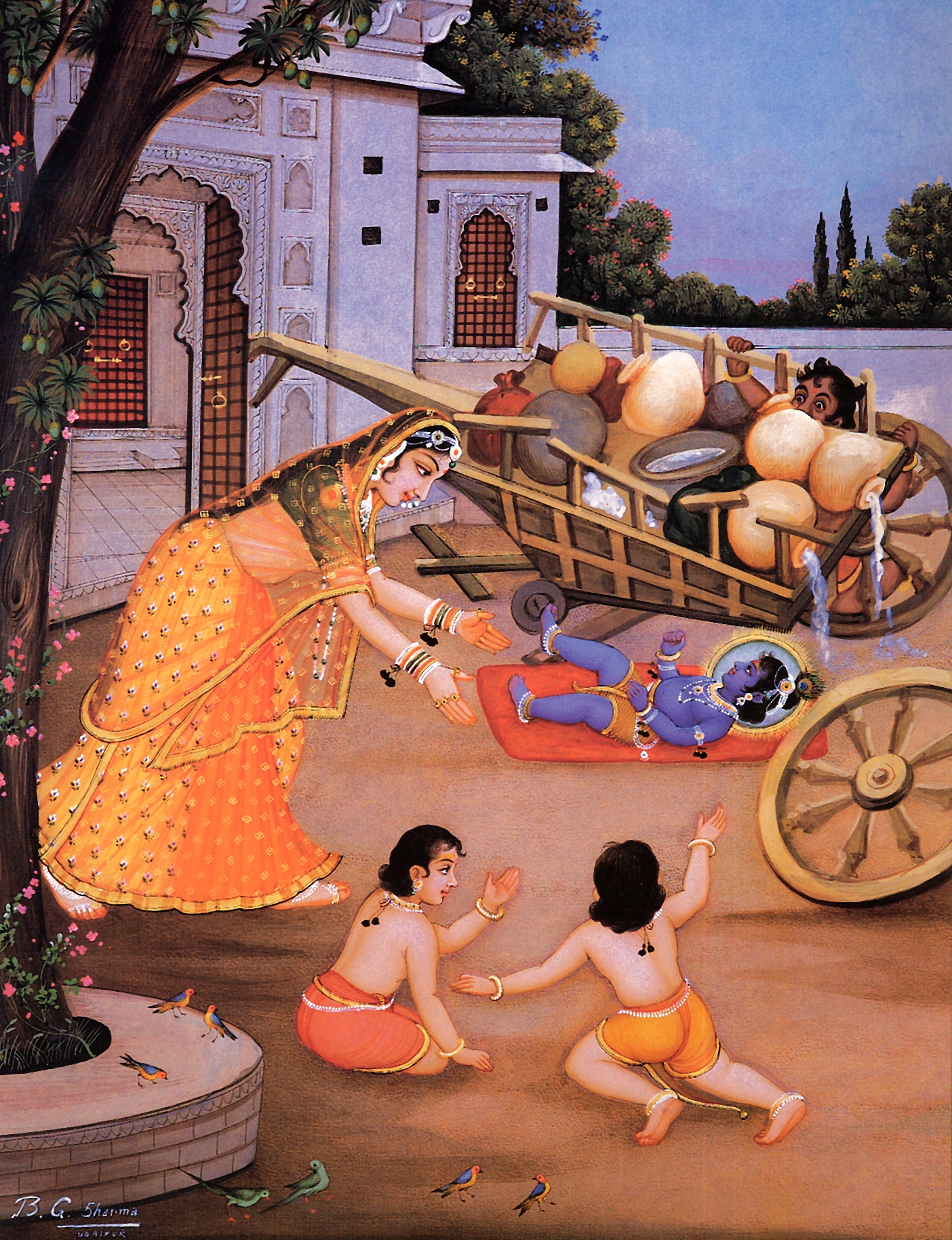
Continuining our month long attempt to stay focused on the childhood pastimes of Krsna, during this month of Damodara (Kartika), we bring you another exciting chapter from; Kṛṣṇa, the Supreme Personality of Godhead. Today we are posting the chapter entitled “The Salvation of Tṛṇāvarta”.
…Baby Kṛṣṇa had been placed underneath a hand-driven cart, and while He was kicking His legs, He accidentally touched the wheel of the cart, and it collapsed. Various kinds of utensils and brass and metal dishes had been piled up in the handcart, and they all fell down with a great noise. The wheel of the cart separated from the axle, and the spokes of the wheel were all broken and scattered hither and thither. Mother Yaśodā and all the gopīs, as well as Mahārāja Nanda and the cowherd men, were astonished as to how the cart could have collapsed by itself.
…If someone takes advantage of hearing the pastimes of the Lord, the material contamination of dust, accumulated in the heart due to long association with material nature, can be immediately cleansed. Lord Caitanya also instructed that simply by hearing the transcendental name of Lord Kṛṣṇa, one can cleanse the heart of all material contamination. There are different processes for self-realization, but this process of devotional service–of which hearing is the most important function–when adopted by any conditioned soul, will automatically cleanse him of the material contamination and enable him to realize his real constitutional position. (Kṛṣṇa, the Supreme Personality of Godhead)
Full Chapter More
02 Nov 2014
by The Hare Krishna Movement
in A.C. Bhaktivedanta Swami Prabhupada, Bhagavata Dharma Discourses, New Vrindavan, Srimad Bhagavatam, Srimad Bhagavatam
Tags: A.C. Bhaktivedanta Swami Prabhupada New Vrindaban, bhagavad-gita, Bhagavata Dharma Discourses, God is our father, God Krishna, guru, lecture on Srimad Bhagavatam, material nature is our mother, nature, sac-cid-ananda-vigrahah, Sanskrit language, SB 1.2.1, sound vibration, spiritual realization
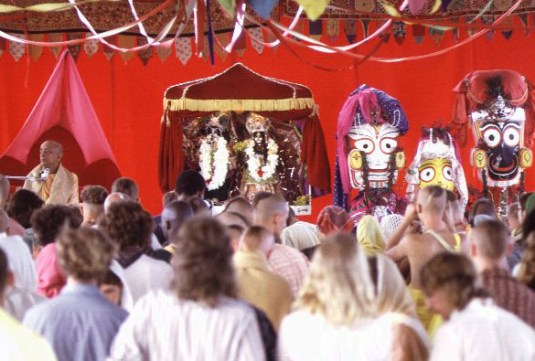
This is the first in the series of Lectures given at New Vrindavan Farm Community in September of 1972. These lectures are commonly known as the the “Bhāgavata Dharma Discourses”
…Devotee (1): Does anyone have any questions? Please ask. Raise your hand please. Especially a guest. If you have any questions please inquire. Yes?
Guest: Who is our mother?
Devotee (1): The question was, who is our mother?
Prabhupāda: Material nature is our mother. God is our father, and material nature is our mother. That is stated in the Bhagavad-gītā. Just like the father gives the seed of the child within the womb of the mother. Similarly God impregnates this material nature with the living entities, and after that they come out in different forms. So material nature is our mother, and God is our father.
Guest: What happens to us immediately after our material body dies, in other words…
Prabhupāda: You do not die, your body changes. So you accept another body…
Full lecture More
27 Oct 2014
by The Hare Krishna Movement
in A.C. Bhaktivedanta Swami Prabhupada, Lokadrsti devi, Vyas-puja, Vyasasan das, Vyasasana
Tags: A.C. Bhaktivedanta Swami Prabhupada, bhagavad-gita, disappearance day of Srila Prabhupada, Hari Nama devi, Krishna, lokadrsti devi, Maha Laxmi devi, Pushpanjali, Srila Prabhupada, Vyasasan das, Vyasasana
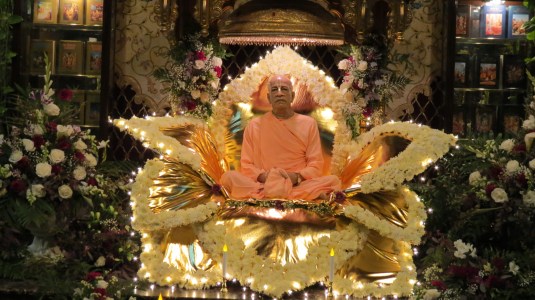
click on images to enlarge
Picture taken before Guru-puja
Today we honored His Divine Grace A. C. Bhaktivedanta Swami Prabhupada’s disappearance day here at New Vrindavan Farm Community, with beautiful offerings, a Pushpanjali (an offering of flowers) followed by an amazing feast The beautiful Vyasasana decoration was done by Her Grace Lokadrsti devi dasi, with assistance from Hari Nama, Maha Laxmi, and Christine prabhus. More
26 Oct 2014
by The Hare Krishna Movement
in A.C. Bhaktivedanta Swami Prabhupada, Bhagavata Dharma Discourses, Conversation with Srila Prabhupada, Jon Nordheimer, New Vrindavan
Tags: A. C. Bhakthvedanta Swami Prabhupada, Bhagavata Dharma Discourses at New Vrindavan, chant the name of Lord Krsna, His Divine Grace A. C. Bhaktivedanta, janmastami celebration at new vrindavan, Jon Nordheimer, New Vrindavan farm community, New York Times reporter, open pavilion

This is the beginning of a new series of Lectures entitled “The Bhagavata Dharma Discourses” which were held at New Vrindavan Farm Community in 1972. It was the third annual Janmastami Celebration held at New Vrindavan, and devotees poured in from everywhere, and even a New York Times Reporter appeared. “On the crown of a lovely green hill in the West Virginia contryside,” his article read, “under the aluminum roof of an open pavilion, the faithful gathered to chant the name of Lord Krsna and kneel at the feet of their spiritual master…A.C. Bhaktivedanta Swami Prabhupada.”
An interview held during the Bhāgavata Dharma Discourses at New Vrindaban, September 2, 1972. Śrīla Prabhupāda is interviewed by John Nordheimer of the New York Times.
More
25 Oct 2014
by The Hare Krishna Movement
in A.C. Bhaktivedanta Swami Prabhupada, Damodara, Gopis, Srimad Bhagavatam
Tags: A.C. Bhaktivedanta Swami Prabhupada, affection of the gopis, damsels of Vraja, ecstasy, gopis, Krsna, Lord Krsna, remembrance of Lord Krsna, SB3.2.14, Srimad Bhagavatam, transcendental love, Vrndavana

click on image to enlarge
In our attempt to stay focused on the childhood pastimes of Lord Krsna throughout this month of Damodara, we were reading from the Third Canto of the Srimad-Bhagavatam, chapter 2, entitled; “Remembrance of Lord Kṛṣṇa”. The great devotee Uddhava, was asked by Vidura, to speak on the messages of Lord Krsna. The following is but one of the verses and purports from this famous chapter.
…In His boyhood at Vṛndāvana, Lord Kṛṣṇa was notorious as a teasing friend in transcendental love to all the girls His age. His love for them was so intense that there is no comparison to that ecstasy, and the damsels of Vraja were so much attached to Him that their affection excelled that of the great demigods like Brahmā and Śiva. Lord Kṛṣṇa finally admitted His defeat before the transcendental affection of the gopīs and declared that He was unable to repay them for their unalloyed affection. (from purport to SB 3.2.14)
Full text and purport More
24 Oct 2014
by The Hare Krishna Movement
in A.C. Bhaktivedanta Swami Prabhupada, Festivals, Govardhana-puja
Tags: A.C. Bhaktivedanta Swami Prabhupada, Bhaktivedanta purports, Govardhana Hill, Govardhana-puja, Krsna Book, Krsna consciousness movement, Lord Krishna, Worshiping Govardhana Hill

Today in honor of Govardhana-puja, we are posting the entire chapter from Krsna Book, entitled “Worshiping Govardhana Hill”
…The sacrifice known as Govardhana-pūjā is observed in the Kṛṣṇa consciousness movement. Lord Caitanya has recommended that since Kṛṣṇa is worshipable, so His land, Vṛndāvana and Govardhana Hill, are also worshipable. To confirm this statement, Lord Kṛṣṇa said that Govardhana Pūjā is as good as worship of Him. From that day, the Govardhana Pūjā has been still going on and is known as Annakūṭa. In all the temples of Vṛndāvana or outside of Vṛndāvana, huge quantities of food are prepared in this ceremony and are very sumptuously distributed to the general population. Sometimes the food is thrown to the crowds, and they enjoy collecting it off the ground. From these instances, we can understand that prasādam offered to Kṛṣṇa never becomes polluted or contaminated, even if it is thrown on the ground. The people, therefore, collect it and eat with great satisfaction.
More
22 Oct 2014
by The Hare Krishna Movement
in A.C. Bhaktivedanta Swami Prabhupada, Childhood Pastimes of Krsna, Damodara, Kaliya Serpent, Krishna Consciousness, KRSNA The Supreme Personality of Godhead
Tags: A.C. Bhaktivedanta Swami Ppabhupada, black serpent kaliya, books of Srila Prabhupada, childhood pastimes of Krishna, Damodara, Kaliya, Kartika, Krsna Book, Lord Krsna, month of Damodara, pastimes of krsna, Yamuna river

“O Lord, although You are able to give all kinds of benedictions, I do not pray to You for liberation, nor eternal life in Vaikuntha, nor any other boon. My only prayer is that Your childhood pastimes may constantly appear in my mind. O Lord, I do not even want to know Your feature of Paramatma. I simply wish that Your childhood pastimes may ever be enacted in my heart.” (Damodarasatka prayers)
Continuining our month long attempt to stay focused on the childhood pastimes of Krsna, during this month of Damodara (Kartika), we bring you another exciting chapter from; Kṛṣṇa, the Supreme Personality of Godhead. Today we are posting the chapter entitled “Subduing Kāliya”
Kṛṣṇa, the Supreme Personality of Godhead
By His Divine Grace A. C. Bhaktivedanta Swami Prabhupāda
Chapter Sixteen
Subduing Kāliya
When He understood that the water of the Yamunā was being polluted by the black serpent Kāliya, Lord Kṛṣṇa took action against him and made him leave the Yamunā and go elsewhere, and thus the water became purified.
More
21 Oct 2014
by The Hare Krishna Movement
in A.C. Bhaktivedanta Swami Prabhupada, Lord Rsabhadeva, Srimad Bhagavatam, Threefold Miseries, Transcendental Knowledge, Varnasrama Dharma
Tags: A.C. Bhaktiveanta Swami Prabhupada, amhita, devotional service, eternal blissful life, living entities, Lord Rsabhadeva, material bodies, rsabha uvaca, Srimad Bhagavatam, transcendental knowledge
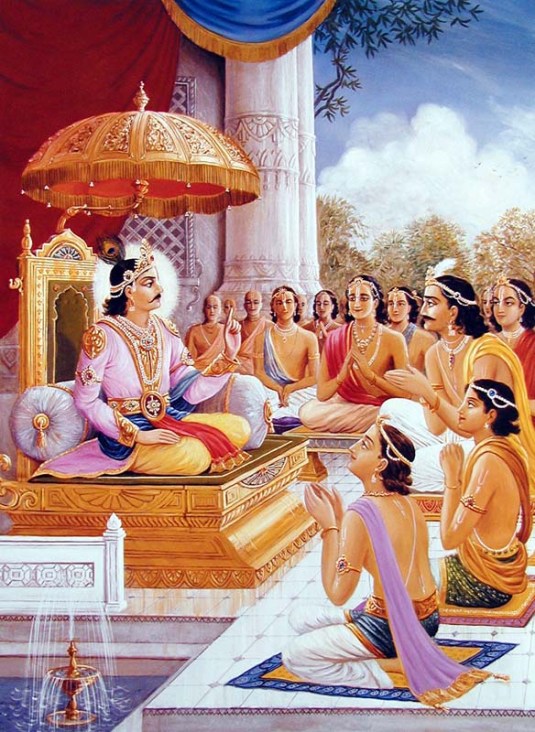
This morning by chance, I happened upon the teachings of Lord Rsabhadeva to His sons. It was in an old notebook that I opened just to see what was inside. Inside were prayers from the Vaisnava Songbook, the Brahma-samhita, Teachings of Pralada Maharaja, and these teachings of Lord Rsabhadeva. It was Sri Gandhari’s old gurukula study notebook, and what she was studying 30 years ago was very useful and timely today. It was just what I needed to read this morning and I share it with you today. It is verses 1-27, from the Fifth Canto of the Srimad Bhagavatam, chapter five.
Lord Ṛṣabhadeva told His sons: My dear boys, of all the living entities who have accepted material bodies in this world, one who has been awarded this human form should not work hard day and night simply for sense gratification, which is available even for dogs and hogs that eat stool. One should engage in penance and austerity to attain the divine position of devotional service. By such activity, one’s heart is purified, and when one attains this position, he attains eternal, blissful life, which is transcendental to material happiness and which continues forever.
More
20 Oct 2014
by The Hare Krishna Movement
in A.C. Bhaktivedanta Swami Prabhupada, B. G. Sharma Art, Childhood Pastimes of Krsna, Kartika, Krishna Consciousness, KRSNA The Supreme Personality of Godhead, Nalakuvara and Manigriva
Tags: A.C. Bhaktivedanta Swami Prabhupada, art of B.B. Sharma, B.G. Sharma, demigods, ecstatic love, Gokula, Krishna's childhood pastimes, Krsna, Krsna The Supreme Personality of Godhead, liberated, Lord Krsna, lotus feet of the Lord, Mother Yasoda, Nalakurvara and Manigriva, Narada Muni, ropes of Yasoda, wooden grinding mortar
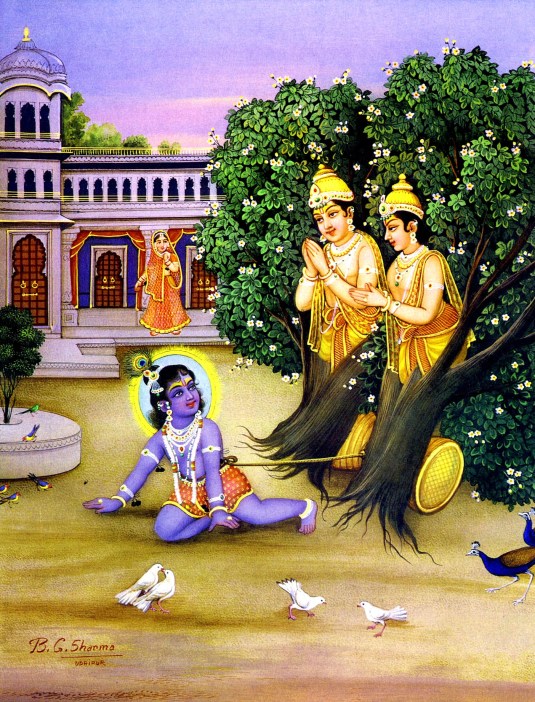
click on image to enlarge
“O Lord Damodara, in Your form as a baby, Mother Yasoda bound You to a grinding stone with a rope for tying cows, You then freed the sons of Kuvera, Manigriva, and Nalakuvera, who were cursed to stand as trees, and You gave them the chance to become Your devotees. Please bless me in this same way, I have no desire for liberation into Your effulgence.” (Damodarastka Prayers)
So…continuining our month long attempt to stay focused on the childhood pastimes of Krsna, during this month of Damodara (Kartika), we bring you another exciting chapter from; Kṛṣṇa, the Supreme Personality of Godhead. Today we are posting the chapter entitled “The Deliverance of Nalakūvara and Maṇigrīva”.
Kṛṣṇa, the Supreme Personality of Godhead
By His Divine Grace A. C. Bhaktivedanta Swami Prabhupāda
Chapter Ten
The Deliverance of Nalakūvara and Maṇigrīva
The story of the cursing of Nalakūvara and Maṇigrīva and their deliverance by Kṛṣṇa, under the all-blissful desire of the great sage Nārada, is here described.
More
18 Oct 2014
by The Hare Krishna Movement
in A.C. Bhaktivedanta Swami Prabhupada, Dharma, Dream
Tags: A. C. Bhaktivedanta Swami Pabhupada, dharma, happiness, living being's eternal occupation, occupation, root meaning of the word dharma, Srimad Bhagavatam, Supreme Lord, that which sustains

This morning I awoke early, and before rising, I was just going over the dreams in my head. I was dreaming about the following verse from the Srimad Bhagavatam.
“The supreme occupation [dharma] for all humanity is that by which men can attain to loving devotional service unto the transcendent Lord. Such devotional service must be unmotivated and uninterrupted to completely satisfy the self.” (SB 1.2.6)
I have been very much absorbed in my worldly occupation of late, writing up contracts, submitting bills, paying employees etc. and have mostly been waking up with thoughts of work. But this morning I was dreaming about a specific verse from the Srimad Bhagavatam. Interesting! So I went to the Bhagavatam, and read the purport to this verse.
…We have purposely denoted dharma as occupation because the root meaning of the word dharma is “that which sustains one’s existence.” A living being’s sustenance of existence is to coordinate his activities with his eternal relation with the Supreme Lord Kṛṣṇa. Kṛṣṇa is the central pivot of living beings, and He is the all-attractive living entity or eternal form amongst all other living beings or eternal forms. Each and every living being has his eternal form in the spiritual existence, and Kṛṣṇa is the eternal attraction for all of them. Kṛṣṇa is the complete whole, and everything else is His part and parcel. The relation is one of the servant and the served. It is transcendental and is completely distinct from our experience in material existence. This relation of servant and the served is the most congenial form of intimacy. One can realize it as devotional service progresses. Everyone should engage himself in that transcendental loving service of the Lord, even in the present conditional state of material existence. That will gradually give one the clue to actual life and please him to complete satisfaction.
Somehow I feel more satisfied, more complete, after my reading.
Full Verse and Purport More
17 Oct 2014
by The Hare Krishna Movement
in A.C. Bhaktivedanta Swami Prabhupada, Srila Prabhupada's Books, Srimad Bhagavatam
Tags: A.C. Bhaktivedanta Swami Prabhupada, Bhaktivedanta purports, brahmajyoti effulgence, Brhaspati, conditioned soul, intelligent man, Lord Brahma, Lord Siva, Maharaja Pariksit, material world, pure devotional service, SB 2.3, Sri Sukadeva Gosvami, Srimad Bhagavatam, threshold of death, Vedas
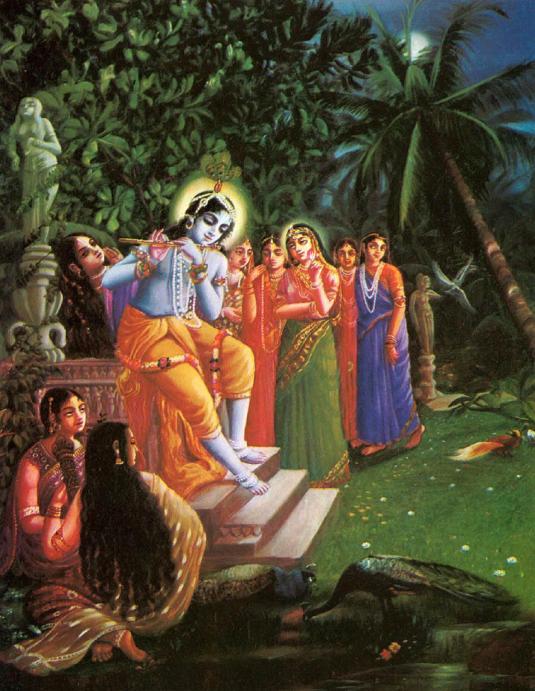
click on image to enlarge
As we continue to update our (one of our other sites) Śrīmad-Bhāgavatam by posting a chapter at a time, of that great literary work by His Divine Grace Srila Prabhupada, we will continue to share the progress with our readers here at The Hare Krishna Movement.
Śrīmad-Bhāgavatam
by His Divine Grace A. C. Bhaktivedanta Swami Prabhupāda
Canto 2, Chapter Three
Pure Devotional Service: The Change in Heart
More
Previous Older Entries Next Newer Entries













 The Hare Krishna Movement