Sometimes when I am sitting and reading from Srila Prabhupada’s Srimad Bhagavatam, a verse or sentence from the purport just jumps out from the page almost like it is in 3D, and I catch a glimpse of what the Spiritual World must be like. It is beyond even my imagination, but sometimes I catch a glimmer of light, through a transcendental window, by the grace of my spiritual master His Divine Grace A. C. Bhaktivedanta Swami Prabhupada.
…The transcendental abode of the Lord where the trees are all desire trees and the buildings are made of touchstone. The Lord Govinda is engaged there in herding the surabhi cows as His natural occupation.
“I worship Govinda, the primeval Lord, the first progenitor who is tending the cows, yielding all desire, in abodes built with spiritual gems, surrounded by millions of purpose trees, always served with great reverence and affection by hundreds of thousands of lakṣmīs or gopīs.” (Bs 5.29)
…The Lord Govinda is engaged there in herding the surabhi cows as His natural occupation. And those who are artists, overtaken by the beautiful creation, should better see to the beautiful face of the Lord for complete satisfaction. The face of the Lord is the embodiment of beauty. What they call beautiful nature is but His smile, and what they call the sweet songs of the birds are but specimens of the whispering voice of the Lord.
The following article I found very interesting. It is very informative, and is worth reprinting here.
The Samurai: Protectors of the Cow by Jahnava Nitai das
If I were to tell you, that once, no other country, save India, revered the cow as much as Japan, I could understand your disbelief. Today, we think of Japan as a meat-eating culture. However, this image is a product of the last 150 years of American influence. The traditional Japanese culture held the cow as the most sacred animal. What follows next is the true story of among the greatest protectors of the cow – the Samurai.
In The Footsteps Of The Buddha
When Buddhism left India for the Far East it had a profound influence on all of the countries it encountered including China, Korea and Japan. Buddhism entered Japan around the year 552 A.D. In April 675 A.D. the Japanese Emperor Tenmu banned the consumption of all meat from four legged animals including cows, horses, dogs, and monkeys, as well as domestic birds such as chickens and roosters. Each succeeding emperor would periodically reinforce this ban until by the 10th Century all meat eating had been eliminated.
In mainland China and Korea the Buddhist monks adhered to the principle of ‘ahimsa’ or non-violence in their eating habits but theses strictures were not placed on the population as a whole. In Japan, however, the Emperor was very strict in guiding his subjects towards the Buddha’s teachings of non-violence. The killing of mammals was considered extremely sinful, birds moderately sinful, and fish somewhat sinful. The Japanese did eat whale, which today we know are mammals, but at the time were considered very large fish.
The Japanese also made a distinction between animals reared in the household and wild animals. To kill a wild animal such as a bird was sinful. However, to kill an animal raised from birth was considered abominable – tantamount to killing a member of the family. As such, the diet of the Japanese was mostly rice, noodles, fish, and on occasion wild fowl.
The following are just a few of the many quotes from Srila Prabhupada which encourage us to approach Krishna through the mercy of Srimati Radharani, Krishna’s eternal consort. For those of us who feel that there is no hope of making spiritual progress in this lifetime, Srimati Radharani, Who is compassion personified, kindly comes to our rescue if we can humbly invoke Her divine blessings.
“I offer my respects to Radharani whose bodily complexion is like molten gold and who is the Queen of Vrndavana. You are the daughter of King Vrsabhanu, and You are very dear to Lord Krishna.” (Sri Radha Pranama)
“I emphatically say to you, O brothers, you will obtain your good fortune from the Supreme Lord Krishna only when Srimati Radharani becomes pleased with you.”(Prayer to the Lotus Feet of Krishna, September 13, 1965)
“Actually, because Krishna is the Supreme Personality of Godhead, it is very difficult to approach Him. But the devotees, taking advantage of His compassionate nature, which is represented by Radharani, always pray to Radharani for Krishna’s compassion.” (Nectar of Devotion, Chapter 22)
“There is no comparison to Radharani’s beauty and the luster of Her transcendental body. The so-called beauty of the moon has fallen on the ground in the presence of Radharani’s beauty.” (From Vrindavana by Srila Narottama das Thakura)
“The beauty of Srimati Radharani’s eyes forcibly devours the beauty of newly grown blue lotus flowers, and the beauty of Her face surpasses that of an entire forest of fully blossomed lotuses. Her bodily luster seems to place even gold into a painful situation. Thus the wonderful, unprecedented beauty of Srimati Radharani is awakening in Vrindavana.” (Caitanya-caritamrita Antya 1.169)
I didn’t expect so many people. But literally there were five to six hundred people in the temple room and more were standing outside, and they were all very, very much anxious to see Srila Prabhupada. So Srila Prabhupada gave a wonderful lecture. I wish I could remember some of the things that he said, but one of the things they asked was, “Why do you wear these marks on your forehead?” And he said, “So this is simply to make people chant Hare Krsna, that when they see these marks on our foreheads they will remember, ‘Oh, that is a Hare Krsna devotee.’ And therefore they are beginning to chant, and by chanting they can become happy. The only way to become happy is to chant. So our business is to make everyone chant by one way or another.” So everyone was very pleased with his answers.
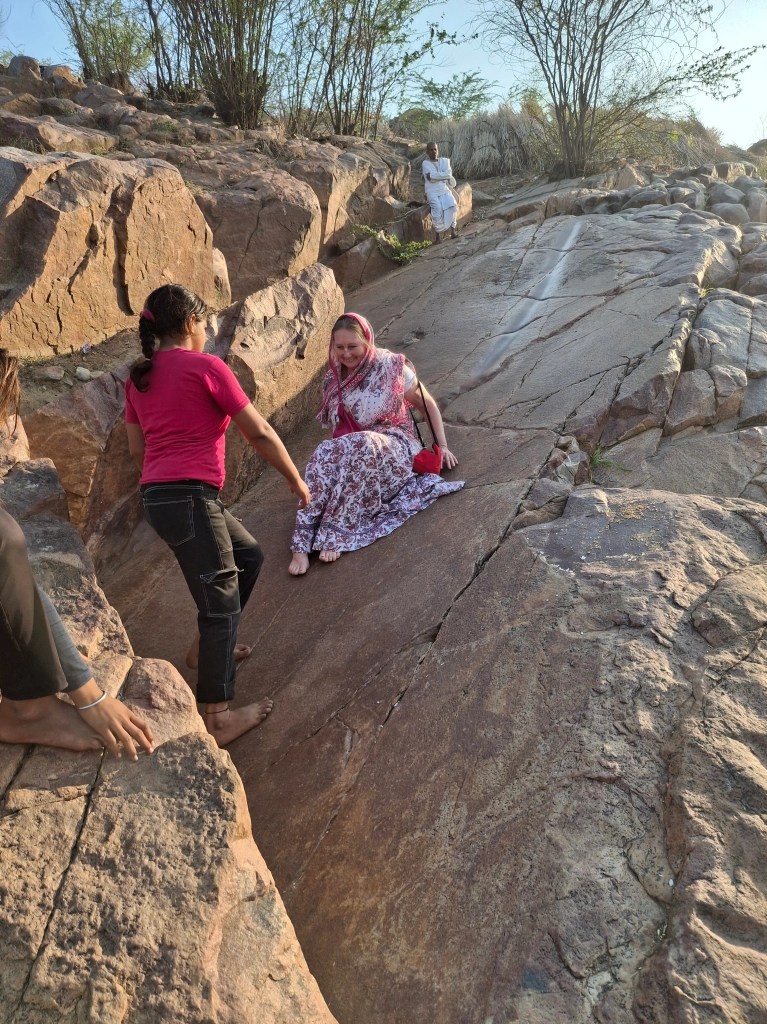
I have many happy memories of our last trip to India, but this day, our visit to Phishalina-shila (Krishna’s slide) was one of the most enjoyable. Hard to imagine that 5,000 years ago, Krishna and his friends slid down this very same rock, and that countless sages and saints, pilgrims and devotees, have slid down it since. Truly a remarkable site, and sacred place of pilgrimage. -V
Phishalni-shila
This is the stone slide known as Phishalni-shila where the sakhis used to enjoy sliding pastimes in their childhood. The word ‘phisalni-shila means ‘rock-slide’ One can also see the marks of alta or red lac, left behind from the footsteps of the sakhis, as they engaged in their various pastimes. Some locals call this place as Phishalini, as well as Shikalini, which are corrupted forms of Phishalni.
Kamyavan – Pichalini-shila (kalavati)
“The Bhakti-ratnakara says. “On Chandrasena-parvata is Pichalni-shila. At this place Krishna plays along with His friends. Sitting in a bending form they slid down the rock again and again.” Situated on the side of a hill is this natural rock slide that is used even today by the local children. Krishna and His friends used to come here for herding the cows and would enjoy many long hours playing on this slide. The word ‘pichalni’ means ‘sliding stone’ and ‘shila’ means a ‘stone’ or ‘rock’. The hill on which the Pichalni-shila is found is known as Chandrasena Parvata, but is known locally as Pichal Pihari. The word ‘pihari’ means a ‘hill’. Locals also refer to this rock slide as Khisasini-shila or Pishalini-shila, which are both corruptions of the word Pichalni-shila.
The village of Kalavati is the place where the Pichalni-shila is located. The word ‘kalavati’ means the ‘place of the dance’ and it was here where the gopis assembled and engaged in singing songs glorifying Krishna and dancing in circles with one-another. When Krishna heard the rhythmic jingling of the gopi’s ankle bells and the sweet sound of their singing, He came here to witness the wonderful dance performance of the cowherd girls.”
This month of Kartika or the month of Damodara, has always been very dear. It is probably because Radha Damodara were the first worshipable Radha Krishna deities I had the good fortune to serve. When I joined the Hare Krishna movement, I was assigned to the Radha Damodara Traveling Sankirtan Party (RDTSP). I traveled with the bus party for the first year of my devotional career, and when the bus party broke up, I was re-assigned to the Gita Nagari farm, where I was engaged for some time as a carpenter building the new temple for the Radha Damodara deities who reside there. I guess we always remember our first love. -V
Worship of Sri Sri Radha-Damodara
Radharani is especially keen to hear Krishna’s pastimes, but She is particularly attracted to the Damodara pastime. Charmed by Damodara’s mood of surrender in agreeing to be bound by Mother Yasoda’s love, Sri Radha longs to have that same exchange with Krishna. She desires to express such intense love for Krishna that He will also agree to be bound by Her love. Appreciating this mood of Mother Yasoda to enhance Her own feelings for Krishna, She resolves to experience this same reciprocation of love.” (Srimad Bhagavatam 10.9.20 Purport) Radha-Damodara thus refers to Radharani’s mood of intense attraction for this pastime between Damodara and Mother Yasoda.
Neither Lord Brahma, nor Lord Siva, nor even the goddess of fortune, who is always the better half of the Supreme Lord, can obtain from the Supreme Personality of Godhead, the deliverer from this material world, such mercy as recieved by mother Yasoda. (Srimad Bhagavan 10.9.20)
The kindness of strangers played a pivotal role in ISKCON’s pre-history.
Last year I had the good fortune to meet Gopal and Sally Agarwal, an elderly couple who played a significant role in ISKCON’s origins. They are forever etched in the devotees’ collective memory as two of the Western world’s earliest recipients of Srila Prabhupada’s mercy. It was the Agarwals who hosted him in the fall of 1965, before ISKCON was even nominally born, giving him shelter, hospitality, friendship, and love. Indeed, for one month their home served as Prabhupada’s earliest refuge outside India.
As Prabhupada acquainted himself with the Agarwal home in Butler, in western Pennsylvania, he saw a typically quiet American town nestled in the hills, a town that has changed little since his brief visit those many years ago.
Yesterday we had the good fortune to visit Buttler PA, for the 60th aniversary of Srila Prabhupada’s arrival in the USA. First we visited the YMCA building where Srila Prabhupada stayed, then we had a Hari-nama in the streets of Buttler on the way to Sally and Gopal Agarwal’s apartment where Srila Prabhupada spent his first nights in America. It was a rather small apartment, and Srila Prabhupada slept on their couch, for the first few nights before moving to a room in the YMCA building. But he made his way back to their apartment each day to cook some lunch prasadam for the family. It was very exciting to pilgrimage to the site where Srila Prabhupada first bathed, cooked, slept, and gave his first Bhagavata discourses in America.
Butler Eagle Magazine, Pennsylvania, September 22 1965
The following first article written about A. C. Bhaktivedanta Swami Prabhupada’s arrival and mission in the West was obtained through work with the Butler Eagle News Paper in Butler, Pa., Prabhupada’s first residence after arriving from India in 1965. Prabhupada’s great desire to preach the mission of Love of God to all in the English speaking countries, started here.
In Fluent English Devotee of Hindu Cult Explains Commission to Visit the West
By Penny Ritts/Butler Eagle, September 22 1965
A slight brown man in faded orange drapes wearing white bathing shoes stepped out of a compact car yesterday and into the Butler YMCA to attend a meeting. He is A. C. Bhaktivedanta Swamiji, a messenger from India to the peoples of the West.
A Hindu by faith, the “learned teacher” has translated biblical literature such as Srimad Bhagavatam into English from ancient Sanskrit. He is now fulfilling a commission from his spiritual master to enlighten English-speaking people regarding their relationship with God.
“My mission is to revive a people’s God-consciousness.” says the Swamiji. “God is the Father of all living beings, in thousands of different forms.” he explains. “Human life is a stage of perfection in evolution: if we miss the message, back we go through the process again.” he believes.
The Swamiji has given himself a month to tell his message to all who will listen. He anticipates many informal meetings, such as a gathering of friends in the Gopal Agarwal home in Stirling Apartments Monday the night of his arrival, for an exchange of ideas regarding his philosophy of life. A simplified version of his theory is that life progresses from aquatic to plant, to reptile to bird, to beast to “beastly” human being and finally, to civilized man. “After this life there is a still better life on other planets,” predicts the visitor. He believes that the highest possible state will be to go to God, or eternal life.
The traveller who left India for the first time Aug. 30 will welcome guest appearances or impromptu discussions with anyone who calls the Agarwal family. He says that he is here to talk. Now 70 years old, the appointed “missionary” to the United States was educated in India where he received a Bachelor of Arts degree. He became a disciple in 1933 and received instructions until the death of his leader in 1936. He has severed all family ties, forsaking wife and children and a business in Calcutta to follow his beliefs.
His religion remains Hindu. He does not ask his listeners to change their religious affiliation, but merely to become “better Jews or Christians,” etc.
Bhaktivedanta lives as a monk, and permits no woman to touch his food. On a six-week ocean voyage and at the Agarwal apartment in Butler he prepares his meals in a brass pan with separate levels for steaming rice, vegetables and making “bread” at the same time. He is a strict vegetarian, and is permitted to drink only milk, the “miracle food for babies and old men,” he noted. Even onions, garlic, and eggs are forbidden in his cult.
The Swamiji is equally philosophical about physical discomforts or wars: “It’s man’s nature to fight” he shrugs. “We have to adjust to these things; currents come and go in life just as in an ocean.”
“Life and Milk of Cow” is all-important to the Swamiji’s way of life; all else is artificial, he claims. The government of India does not support the Hindu or Moslem religions, neither does it interfere with their practices, he says. His scholarly work is aided by benefactors when and where he finds them.
His special dress minimizes the importance of raiment; the white mark on his face is a symbol of devotion. The Swamiji renews his faith with daily prayer, chanting and meditation. If Americans would give more attention to their spiritual life, they would be much happier, he says.
Without a doubt, this is my favorite book ever. I never get tired of reading from the Krsna Book. It seems to get sweeter every time.
Krsna was very pleased with the atmosphere of the forest, where flowers bloomed and bees and drones hummed very jubilantly. While the birds, trees and branches were all looking very happy, Krsna, tending the cows and accompanied by Sri Balarama and the cowherd boys, began to vibrate His transcendental flute. After hearing the vibration, the gopis in Vrndavana remembered Him and began to talk amongst themselves about how nicely Krsna was playing His flute. When the gopis were describing the sweet vibration of Krsna’s flute’; they also remembered their pastimes with Him; thus their minds became disturbed, and they were unable to fully describe the beautiful vibrations. While discussing the transcendental vibration, they also remembered how Krsna dressed, decorated with a peacock feather on His head, just like a dancing actor, and with blue flowers pushed over His ear. His garment glowed yellow-gold, and He was garlanded with a vaijayanti necklace. Dressed in such an attractive way, Krsna filled up the holes of His flute with the nectar emanating from His lips. So they remembered Him, entering Vrndavana forest, which is always glorified by the footprints of Krsna and His friends.
This is a nice description of Lord Kṛṣṇa’s transcendental counchshell, and of how He was received by the citizens of Dvārakā. Beautiful!
Sūta Gosvāmī said: Upon reaching the border of His most prosperous metropolis, known as the country of the Ānartas [Dvārakā], the Lord sounded His auspicious conchshell, heralding His arrival and apparently pacifying the dejection of the inhabitants.
The white and fat-boweled conchshell, being gripped by the hand of Lord Kṛṣṇa and sounded by Him, appeared to be reddened by the touch of His transcendental lips. It seemed that a white swan was playing in the stems of red lotus flowers.
The citizens of Dvārakā, having heard that sound which threatens fear personified in the material world, began to run towards Him fast, just to have a long desired audience with the Lord, who is the protector of all devotees.
…The sound heralded by Lord Kṛṣṇa was something like the heralding of the sunrise in the morning. This sound of the Lord is identical with the Lord. We are always fearful due to our ignorance of the next problem. The whole material existence is full of problems, and thus the fear problem is always prominent. This is due to our association with the illusory energy of the Lord, known as māyā or external energy, yet all fear is vanished as soon as there is the sound of the Lord, represented by His holy name, as it was sounded by Lord Śrī Caitanya Mahāprabhu in the following sixteen words:
Hare Kṛṣṇa, Hare Kṛṣṇa, Kṛṣṇa Kṛṣṇa, Hare Hare Hare Rāma, Hare Rāma, Rāma Rāma, Hare Hare
We can take advantage of these sounds and be free from all threatening problems of material existence.
So we are finishing our series on the five types of relationships (rasa’s) with the Lord. Today we are exploring Devotional Service in Conjugal Love (Madhurya-rasa) as explained in chapter 44 of “The Nectar of Devotion”.
Because of the sensitive nature of this topic, we have posted the entire chapter from the the original 1970 edition of “The Nectar of Devotion”, by His Divine Grace A C Bhaktivedanta Swami Prabhupada.
A pure devotee’s attraction to Krsna in conjugal love is called devotional service in conjugal love. Although such conjugal feelings are not at all material, there is some similarity between this spiritual love and material activities. Therefore, persons who are interested only in material activities are unable to understand this spiritual conjugal love, and these devotional reciprocations appear very mysterious to them. Rupa Gosvāmī therefore describes conjugal love very briefly.
The impetuses of conjugal love are Krsna and His very dear consorts, such as Rādhārāṇī and Her immediate associates. Lord Krsnahas no rival: no one is equal to Him, and no one is greater than Him. His beauty is also without any rival, and because He excels all others in the pastimes of conjugal love, He is the original object of all conjugal love.
…”Everyone and everything is attracted to Kṛṣṇa–that is the perfect description of Kṛṣṇa’s attraction. The example of the gopīs is very instructive to persons who are trying to be absorbed in Kṛṣṇa consciousness. One can very easily associate with Kṛṣṇa simply by remembering His transcendental pastimes. Everyone has a tendency to love someone. That Kṛṣṇa should be the object of love is the central point of Kṛṣṇa consciousness. By constantly chanting the Hare Kṛṣṇa mantra and remembering the transcendental pastimes of Kṛṣṇa, one can be fully in Kṛṣṇa consciousness and thus make his life sublime and fruitful.”
Kṛṣṇa, The Supreme Personality of Godhead By His Divine Grace A. C. Bhaktivedanta Swami Prabhupada Vol. 1, Chapter 34
The Gopīs’ Feelings of Separation
The gopīs of Vṛndāvana were so attached to Kṛṣṇa that they were not satisfied simply with the rāsa dance at night. They wanted to associate with Him and enjoy His company during the daytime also. When Kṛṣṇa went to the forest with His cowherd boy friends and cows, the gopīs did not physically take part, but their hearts went with Him. And because their hearts went, they were able to enjoy His company through strong feelings of separation. To acquire this strong feeling of separation is the teaching of Lord Caitanya and His direct disciplic succession of Gosvāmīs. When we are not in physical contact with Kṛṣṇa, we can associate with Him like the gopīs, through feelings of separation. Kṛṣṇa’s transcendental form, qualities, pastimes, and entourage are all identical with Him. There are nine different kinds of devotional service. Devotional service to Kṛṣṇa in feelings of separation elevates the devotee to the highest perfectional level, to the level of the gopīs.
Well the Golden Jubilee at Krishna Balarama Mandir is over, and its time for many of us to return to their respective homes. The above photo are the Prabhupada disciples, sannayasi’s, and other participants, taken on the last day of festival. Many thanks to the management and festival organizers, as well as all the Vrindavan residents who helped make this a memorable occasion.
The Sri Sri Krishna Balaram Mandir, situated in the Raman Reti area of Vrindavan, holds a special significance for the devotees of the International Society for Krishna Consciousness. This grand temple represents the fulfilled dream of Srila Prabhupada, Founder Acharya of ISKCON, who wished to construct a temple of unparalleled beauty for the worship of the transcendental brothers Krishna and Balaram in the same village where They played more than five thousand years ago. Srila Prabhupada directly oversaw all the aspects of design and construction and personally called the Lord to come and accept the worship of His devotees from around the world. He said, “Lord Balaram is the source of spiritual strength, and I have built this temple just to give strength to the devotees”.
Today, the Sri Sri Krishna Balaram Mandir is a booming spiritual center. Every day of the week pilgrims flood in the gate in great numbers from all over the world. In fact, the large green government signs posted over the highway turn off to Vrindavan only give directions to two temples: Banke Bihari and ISKCON.
We are currently in Vrindavan, India, doing the twelve day Parikrama of the forests of Vrindavan. We have visited many Holy sites, and have had Darshana with so beautiful deities, and gotten water sprinkled on us, from many sacred Kunds (ponds, bathing sites). It has been a wonderful trip thus far, although the traffic, and dust, has been rather exhausting. Hare Krishna! -V
The 12 principal forests of Vraja
The 12 principal forests of Vraja, where Krishna and Radha are said to have performed their divine pastimes, are Madhuvana, Talavana, Kumudavana, Bhulavana, Kamyavana, Khadiravana, Vrindavana, Bhadravana, Bhandiravana, Baelvana, Lohavana, and Madhavana.
Seven forests on the west side of the Yamuna River:
Madhuvana, Talavana, Kumudavana, Bahulavana, Kamyavana, Khadiravana, and Vrindavana.
Five forests on the east side of the Yamuna River:
Bhadravana, Bhandiravana, Baelvana, Lohavana, and Mahavana.
Significance:
These forests are considered sacred and are revered places of pilgrimage for devotees.
Remembering Jayananda by Vyasasan das __________________
There are some things about becoming a devotee I will never forget, for instance; receiving my first book, relishing my first plate of prasadam, seeing the deities in the temple for the first time, meeting Srila Prabhupada, Visnujhana Swami and Jayananda das bramachari.
The first time I meet Jayananda, was in 1975 in San Diego. I had been traveling with the RDTSKP for the last few months, since I joined. I was very much enjoying being a devotee, and traveling and putting on festivals, distributing prasadam, books and the Holy Name. By this time I had meet a number of Sannyasis; including Tamal Krsna Goswami, Gurudas Swami, Tripuari Swami, Vishnujana Swami, etc. and was very impressed by their character, and position.
One morning after Bhagavatam class we were all sitting down on the floor taking our breakfast. I was looking over at all the assembled sannyasis; there must have been seven of them eating together. They all had on nice orange clothing, and were eating off beautiful silver plates, and I was thinking, “Ya, that’s what I want. I want to be a Hare Krishna Sannyasa. Devotees will offer me respectful obeisances when they see me, and I will always get the best accommodations and best prasadam”. So I was thinking like this… when in walks in this guy in a greasy hooded sweatshirt, ripped doti, hands and face covered with dirt and grease, (it turns out he just changed the oil in 6 sankirtan vans), and he walks over to the prasadam table and starts filling a plate.
So I ask the devotee sitting next to me, “Who is that guy, is he supposed to be here?” I thought it was some bum wearing a dhoti. But the devotee replied; “Oh, that’s Jayananda Prabhu, he’s a really advanced devotee”. Well I was looking at Jayananda who was eagerly feasting on the morning prasadam, and I was looking over at the sannyasis who were carefully moving the prasadam around the silver plates, and I just wasn’t that sure?
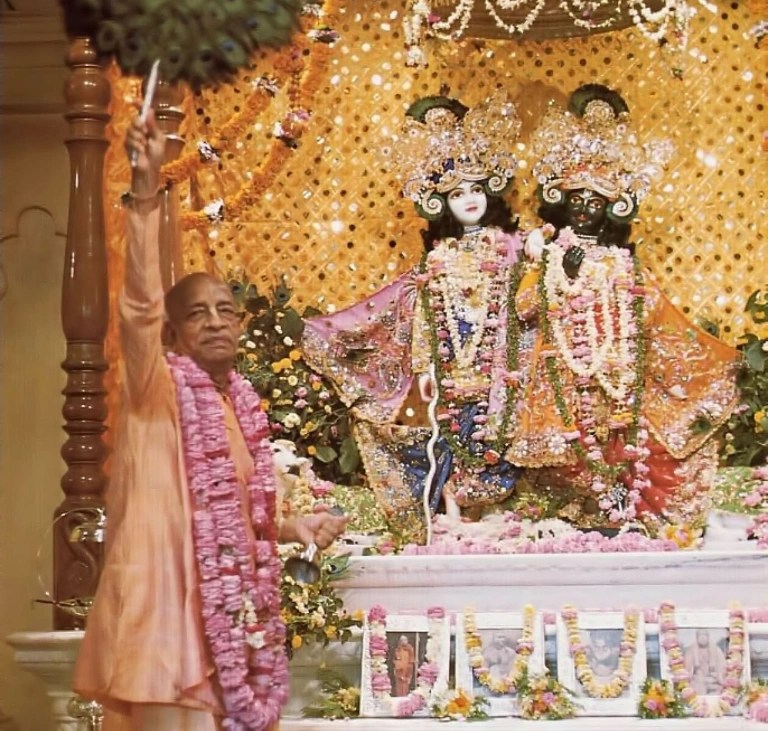
Probably because we leave for India today, and probably because we are going for the 50th Aniversity of the opening of the Sri Sri Krishna Balarama Temple in Vrindavan, but every morning I think about this Iconic picture of Srila Prabhupada offering the first Arotika to Krishna and Balarama.
We share with you some of thepastimes of the two transcendental brothers.
While Kṛṣṇa was engaged in tending the cows in the forest of Vṛndāvana or on Govardhana Hill, the gopīs in the village were always absorbed in thinking of Him and discussing His different pastimes. This is the perfect example of Kṛṣṇa consciousness: to somehow or other remain always engrossed in thoughts of Kṛṣṇa. The vivid example is always present in the behavior of the gopīs; therefore Lord Caitanya declared that no one can worship the Supreme Lord by any method which is better than the method of the gopīs. The gopīs were not born in very high brāhmaṇa or kṣatriya families; they were born in the families of vaiśyas, and not in big mercantile communities but in the families of cowherd men. They were not very well educated, although they heard all sorts of knowledge from the brāhmaṇas, the authorities of Vedic knowledge. The gopīs’ only purpose was to remain always absorbed in thoughts of Kṛṣṇa. (“The Gopīs Attracted by the Flute.”)
Sometimes I think if only I could take a picture with my mind, and recall it at any time, this would be one of the images I would like to hold on to. And of course one of Srila Prabhupada as well.
We share with you a song by Narottama Das Thakur entitled “Gaurangera Duti Pada”, with a purport by His Divine Grace A. C. Bhaktivedanta Swami.
Gaurangera Duti Pada by Narottama Dasa Thakura
” Anyone who has accepted the two lotus feet of Lord Caitanya can understand the true essence of devotional service. If one is captivated by the pleasing pastimes of Lord Caitanya, the dirty things in his heart will all become cleansed.“
…Gauranga refers to Lord Caitanya, who has a fair complexion. One who has a fair complexion is called gaura, and since Lord Caitanya was very fair, just like molten gold, He was also named Gaurasundara. Narottama dasa Thakura says, gaurangera duti pada, jar dhana-sampada, se jane bhakati-rasa-sar. Anyone who has accepted the two lotus feet of Lord Caitanya can understand the true essence of devotional service. Devotional service is very difficult. It cannot be understood by any ordinary man. As it is stated in the Bhagavad-gita, out of many thousands of persons who are trying to achieve the perfection of human life, only some actually become perfect and realize the self. And out of many thousands of such self-realized persons, only one can understand Krsna. Without understanding Krsna, how can one engage himself in the service of Krsna? Therefore, the devotional service of Krsna is not an ordinary thing. But fortunately, if one follows in the footsteps of Lord Caitanya (gaurangera duti pada) by following the path shown by Lord Caitanya-the process of simply chanting Hare Krsna-he can very easily understand what devotional service is. (from purport to the song “Gaurangera Duti Pada”)
Full song with Bengali Lyrics, English translation, and purport by His Divine Grace A. C. Bhaktivedanta Swami Prabhupada
Of late, there are some devotees I know, who are having difficulties in life; health issues, impoverishment, depression, etc. Sometimes I am asked for advice or support. I generally don’t like to give advice, as I consider myself fallen by nature. But thinking along these lines of ‘advice and support’ I did a search in Srila Prabhupada’s books to see how a devotee of the Lord deals with suffering. I have posted a couple of nice verses that deal with the Lords Mercy.
The mountains, although being struck by torrents of rain during the rainy season, are not shaken, just as those whose hearts are dedicated to the transcendental Personality of Godhead are never disturbed, even when harassed by great misfortune. (Light of the Bhagavata 12)
Because a person who is spiritually advanced accepts any adverse condition of life as the mercy of the Lord, he is completely eligible to enter into the spiritual kingdom. Even though a person takes to the devotional service of the Supreme Lord, he may sometimes become diseased, impoverished, or disappointed by life’s events. A true devotee of the Lord always considers these sufferings to be due to past sinful activities, and thus without becoming disturbed he patiently awaits the mercy of the Supreme Lord. Such devotees are compared to high mountains, which are never agitated in any way, even when struck by powerful torrents of rain in the rainy season. Rather, such devotees remain humble in spiritual enlightenment. Free from pride and envy, they easily gain the mercy of the Lord and go back home, back to Godhead.
Who is that smiling women in the middle? Why its Lady Subhadra!
Subhadra : Daughter of Vasudeva and sister of Lord Śrī Krsna. She was not only a very dear daughter of Vasudeva, but also a very dear sister to both Krsna and Baladeva. The two brothers and sister are represented in the famous Jagannatha temple of Puri, and the temple is still visited by thousands of pilgrims daily. This temple is in remembrance of the Lord’s visit at Kuruksetra during an occasion of solar eclipse and His subsequent meeting with the residents of Vrndavana. The meeting of Radha and Krsna during this occasion is a very pathetic story, and Lord Śrī Caitanya, in the ecstasy of Rādhārāṇī, always pined for Lord Śrī Krsna at Jagannatha Puri. While Arjuna was at Dvaraka, he wanted to have Subhadra as his queen, and he expressed his desire to Lord Krsna. Śrī Krsna knew that His elder brother, Lord Baladeva, was arranging her marriage elsewhere, and since He did not dare to go against the arrangement of Baladeva, He advised Arjuna to kidnap Subhadra. So when all of them were on a pleasure trip on the Raivata Hill, Arjuna managed to kidnap Subhadra according to the plan of Śrī Krsna. Śrī Baladeva was very angry at Arjuna, and He wanted to kill him, but Lord Krsna implored His brother to excuse Arjuna. Then Subhadra was duly married with Arjuna, and Abhimanyu was born of Subhadra. At the premature death of Abhumanyu, Subhadra was very mortified, but on the birth of Pariksit she was happy and solaced. (from purport to SB 1.13.3-4)
This morning I was looking through my bookshelf and I saw a book I didn’t recognize. But when I opened it, I saw my name was written on the first page. I must have purchased it on one of our trips. I had completely forgotten about it, and it was still brand new. I love a new book, so I was overjoyed to discover what was inside. Thousands of quotes from Srila Prabhupada’s many books on the Nectar of the Holy Name. So today I am posting just a few of them that jumped out at me, but I am also including the entire book as a free PDF at bottom of post.
Sri Caitanya Mahaprabhu asked, “What should all living entities constantly remember?” Ramananda Raya replied, “The chief object of remembrance is always the holy name of the Lord, His qualities and pastimes.” (Sri Caitanya−caritamrta Madhya−lila 8.252)
krte yad dhyayato visnum tretayam yajato makhaih dvapare paricaryayam kalau tad dhari−kirtanat [Sukadeva Gosvami to Maharaja Pariksit]:
“Whatever result was obtained in Satya−yuga by meditating on Visnu, in Treta−yuga by performing sacrifices and in Dvapara−yuga by serving the Lord’s lotus feet can also be obtained in Kali−yuga simply by chanting the Hare Krsna maha−mantra.” (Srimad−Bhagavatam 12.3.52)
The Holy Name Is the Universal and Supreme Religion for this Age
harer nama harer nama harer namaiva kevalam kalau nasty eva nasty eva nasty eva gatir anyatha (Sri Caitanya−caritamrta Adi 17.21)
“In this age of Kali there is no alternative, there is no alternative, there is no alternative for spiritual progress than the holy name, the holy name, the holy name of the Lord.”
krsna−varnam tvisakrsnam sangopangastra−parsadam yajnaih sankirtana−prayair yajanti hi su−medhasah
“The pious results derived from chanting the thousand holy names of Visnu three times can be attained by only one repetition of the holy name of Krsna.” ( Sri Caitanya−caritamrta Madhya−lila 9.33)
trnad api sunicena taror api sahisnuna amanina manadena kirtaniyah sada harih
“One should chant the holy name of the Lord in a humble state of mind, thinking oneself lower than the straw in the street. One should be more tolerant than a tree, devoid of all sense of false prestige and ready to offer all respects to others. In such a state of mind one can chant the holy name of the Lord constantly.”












 The Hare Krishna Movement