04 Jan 2014
by The Hare Krishna Movement
in A.C. Bhaktivedanta Swami Prabhupada, Deitie, Radha Raman
Tags: A.C. Bhaktivedanta Swami Prabhupada, impersonal or void, meditation, meditation on the form of the lord, process of meditation, Radha Raman, sac-cid-ananda-vigraha, Srimad Bhagavatam, Universal Form, virat-rupa, yoga

The process of meditation should begin from the lotus feet of the Lord and progress to His smiling face. The meditation should be concentrated upon the lotus feet, then the calves, then the thighs, and in this way higher and higher. The more the mind becomes fixed upon the different parts of the limbs, one after another, the more the intelligence becomes purified. (SB 2.2.13)
…The process of meditation recommended in the Śrīmad-Bhāgavatam is not to fix one’s attention on something impersonal or void. The meditation should concentrate on the person of the Supreme Godhead, either in His virāṭ-rūpa, the gigantic universal form, or in His sac-cid-ānanda-vigraha [Bs. 5.1], as described in the scriptures. There are authorized descriptions of Viṣṇu forms, and there are authorized representations of Deities in the temples. Thus one can practice meditating upon the Deity, concentrating his mind on the lotus feet of the Lord and gradually rising higher and higher, up to His smiling face.
Full text and purport More
02 Jan 2014
by The Hare Krishna Movement
in A.C. Bhaktivedanta Swami Prabhupada, Books by Srila Prabhupada, Srimad Bhagavatam
Tags: A.C. Bhaktivedanta Swami Prabhupada, glorification of Your lotus feet, hearing from the pure devotee, Krsna, lotus feet, prabhupada vani, pure devotees, rememberance of the Lord, saffron particles, SB 4.20.25, Srimad Bhagavatam

click on image to enlarge
This following verse reminds me of the importance of reading Srila Prabhupada’s books every day. Hearing from the pure devotee of the Lord, is so powerful that it can revive the living entity’s memory of his eternal relationship with the Supreme Personality of Godhead.
My dear Lord, You are glorified by the selected verses uttered by great personalities. Such glorification of Your lotus feet is just like saffron particles. When the transcendental vibration from the mouths of great devotees carries the aroma of the saffron dust of Your lotus feet, the forgetful living entity gradually remembers his eternal relationship with You. Devotees thus gradually come to the right conclusion about the value of life. My dear Lord, I therefore do not need any other benediction but the opportunity to hear from the mouth of Your pure devotee.
Reading the books of His Divine Grace A.C. Bhaktivedanta Swami Prabhupada is hearing from the mouth of the pure devotee.
More
16 Dec 2013
by The Hare Krishna Movement
in A.C. Bhaktivedanta Swami Prabhupada, Chanting Hare Krishna, Narada Muni, Srila Prabhupada, Srimad Bhagavatam
Tags: A.C. Bhaktivedanta Swami Prtabhupada, bona fide representative, chanting Hare Krishna, chanting the glories of the Lord, devotee, Narada Muni, sincere devotee of the lord, Srila Prabhupada, Srimad Bhagavatam, traveling all over the world

click on image to enlarge
The following is a nice verse from the Srimad Bhagavatam spoken by Narada Muni. As I was looking for an image for this post, I thought I should put up a picture of Him. But then it hit me, this verse could have just as easily been spoken by Srila Prabhupada! In fact it was.
Thus I began chanting the holy name and fame of the Lord by repeated recitation, ignoring all the formalities of the material world. Such chanting and remembering of the transcendental pastimes of the Lord are benedictory. So doing, I traveled all over the earth, fully satisfied, humble and unenvious.
The life of a sincere devotee of the Lord is thus explained in a nutshell by Nārada Muni by his personal example. Such a devotee, after his initiation by the Lord or His bona fide representative, takes very seriously chanting of the glories of the Lord and traveling all over the world so that others may also hear the glories of the Lord. Such devotees have no desire for material gain. They are conducted by one single desire: to go back to Godhead. This awaits them in due course on quitting the material body. Because they have the highest aim of life, going back to Godhead, they are never envious of anyone, nor are they proud of being eligible to go back to Godhead. Their only business is to chant and remember the holy name, fame and pastimes of the Lord and, according to personal capacity, to distribute the message for others’ welfare without motive of material gain.
full text More
13 Dec 2013
by The Hare Krishna Movement
in A.C. Bhaktivedanta Swami Prabhupada, Bhagavad-gita
Tags: A.C. Bhaktivedanta Swami Prabhupada, actions and reactions, bhagavad-gita, chess, karma, law of karma, player and his playthings, Srimad Bhagavatam, the player

As a player sets up and disperses his playthings according to his own sweet will, so the supreme will of the Lord brings men together and separates them. (Srimad Bhagavatam 1.13.43)
…Generally the law of karma is that one is awarded the result of one’s own actions…A rich man gets his son born with a silver spoon in his mouth, but the child who came as the rich man’s son deserved such a place, and therefore he is placed there by the will of the Lord… but in special cases, by the will of the Lord, such resultant actions are changed also. But this change can be affected by the will of the Lord only, and no other. Therefore, the example of the player cited in this verse is quite appropriate, for the Supreme Will is absolutely free to do whatever He likes, and because He is all-perfect, there is no mistake in any of His actions or reactions. These changes of resultant actions are especially rendered by the Lord when a pure devotee is involved. (from purport)
Full Text and purport + reference verses More
01 Dec 2013
by The Hare Krishna Movement
in A.C. Bhaktivedanta Swami Prabhupada, Kali Yuga, Srimad Bhagavatam, Vedas
Tags: A.C. Bhaktivedanta Swami Prabhupada, anomalies, enlightened in spiritual knowledge, future anomalies, Kaili age, Kali, Kali-yuga, millennium, spiritual knowldege, spiritual master, Srila Vyasadeva, Srimad Bhagavatam, Vyasadeva

The great sage Vyāsadeva saw anomalies in the duties of the millennium. This happens on the earth in different ages, due to unseen forces in the course of time.
The great sages like Vyāsadeva are liberated souls, and therefore they can see clearly past and future. Thus he could see the future anomalies in the Kali age, and accordingly he made arrangement for the people in general so that they can execute a progressive life in this age, which is full of darkness. The people in general in this age of Kali are too much interested in matter, which is temporary. Because of ignorance they are unable to evaluate the assets of life and be enlightened in spiritual knowledge.
…The unmanifested forces of time are so powerful that they reduce all matter to oblivion in due course. In Kali-yuga, the last millennium of a round of four millenniums, the power of all material objects deteriorates by the influence of time. In this age the duration of the material body of the people in general is much reduced, and so is the memory. The action of matter has also not so much incentive. The land does not produce food grains in the same proportions as it did in other ages. The cow does not give as much milk as it used to give formerly. The production of vegetables and fruits is less than before. As such, all living beings, both men and animals, do not have sumptuous, nourishing food. Due to want of so many necessities of life, naturally the duration of life is reduced, the memory is short, intelligence is meager, mutual dealings are full of hypocrisy and so on.
Srimad Bhagavatam
By His Divine Grace A. C. Bhaktivedanta Swami Prabhupada
Canto One, Chapter 4, Texts 16, 17-18
full text and purport More
18 Nov 2013
by The Hare Krishna Movement
in A.C. Bhaktivedanta Swami Prabhupada, Free Downloads, Free eBooks, Srimad Bhagavatam
Tags: A.C. Bhaktivedanta Swami Prabhupada, Bhaktivedanta purports, final srimad bhagavatam volume, Founder Acarya, International Society for Krishna Consciousness, Krsna Balarama Mandira, prabhupada, SB 10.3, Srimad Bhagavatam, translated by His Divine Grace

This is the final Śrīmad-Bhāgavatam volume translated by His Divine Grace A. C. Bhaktivedanta Swami Prabhupada, Founder-Acarya of the International Society for Krishna Consciousness, before his untimely departure. We share it with you as a free PDF download. You can click on following link to view the complete volume or save it to your computer.
click on following link; Srimad Bhagavatam Tenth Canto Part 3
More
30 Oct 2013
by The Hare Krishna Movement
in A.C. Bhaktivedanta Swami Prabhupada, Childhood Pastimes of Krsna, Krsna Consciousness, Spiritual World, Srimad Bhagavatam, Vrndavana
Tags: A.C. Bhaktivedanta Swami Prabhupada, asura, Bakasura, BBT, Bhaktivedanta purports, cowheard boys, fruit vendor, go carana, Gokula, Krishna and Balarama, Krsna, Mother Yasoda, Nanda, Nanda Maharaja, pastimes of krsna, SB 10.11, Srimad Bhagavatam, Vatsasura, yamala arjunas, Yasoda

Today is Rama Ekadasi (fast from grains and beans), so on this auspicious day, in the auspicious month of Damodara, we wanted to do a special post. The following is the entire 11th chapter of the Tenth Canto of Srimad Bhagavatam entitled “The Childhood Pastimes of Kṛṣṇa”.
The following two verses are just an example of the nectar one will find in the following chapter…
…The gopīs would say, “If You dance, my dear Kṛṣṇa, then I shall give You half a sweetmeat.” By saying these words or by clapping their hands, all the gopīs encouraged Kṛṣṇa in different ways. At such times, although He was the supremely powerful Personality of Godhead, He would smile and dance according to their desire, as if He were a wooden doll in their hands. Sometimes He would sing very loudly, at their bidding. In this way, Kṛṣṇa came completely under the control of the gopīs.(Text 7)
…To pure devotees throughout the world who could understand His activities, the Supreme Personality of Godhead, Kṛṣṇa, exhibited how much He can be subdued by His devotees, His servants. In this way He increased the pleasure of the Vrajavāsīs by His childhood activities. (Text 9)
Srimad Bhagavatam
By His Divine Grace A. C. Bhaktivedanta Swami Prabhupada
Canto 10, Chapter 11
More
22 Oct 2013
by The Hare Krishna Movement
in A.C. Bhaktivedanta Swami Prabhupada, Damodara, Kartika, Srila Prabhupada's Books, Srimad Bhagavatam
Tags: A.C. Bhaktivedanta Swami Prabhupada, austerities, bagavata, bhakta, black ointment around His eyes, Damodara, Krsna, Mother Yasoda, Mother Yasoda Binds Lord Krsna, mystics, Paramatma, penances, SB 10.9, Srila Prabhupada, Srimad Bhagavatam, yogis
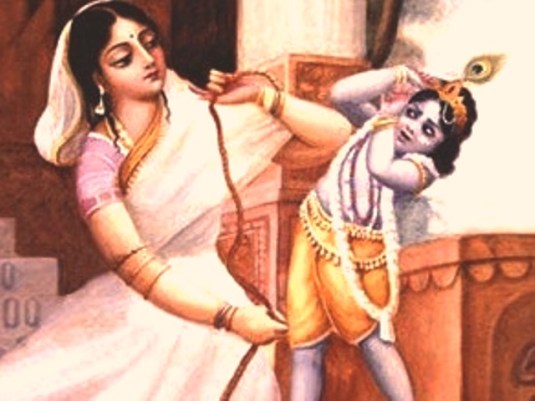
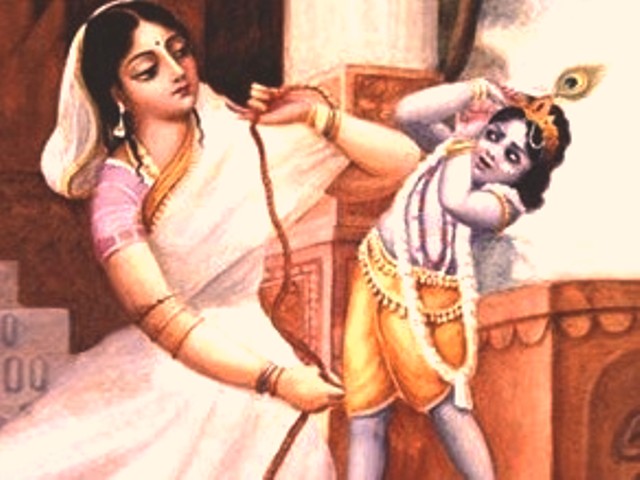
In celebration of the month of Damodara (Kartika) we are focusing our attention on the pastimes of Krishna in Vrndavan. Especially Krishna’s childhood pastimes. So with this in mind we are posting the entire 9th chapter from the Tenth Canto of Srila Prabhupada’s Srimad Bhagavatam entitled Mother Yaśodā Binds Lord Kṛṣṇa.
When caught by mother Yaśodā, Kṛṣṇa became more and more afraid and admitted to being an offender. As she looked upon Him, she saw that He was crying, His tears mixing with the black ointment around His eyes, and as He rubbed His eyes with His hands, He smeared the ointment all over His face. Mother Yaśodā, catching her beautiful son by the hand, mildly began to chastise Him. (SB 10.9.11)
Yogīs, mystics, want to catch Kṛṣṇa as Paramātmā, and with great austerities and penances they try to approach Him, yet they cannot. Here we see, however, that Kṛṣṇa is going to be caught by Yaśodā and is running away in fear. This illustrates the difference between the bhakta and the yogī. Yogīs cannot reach Kṛṣṇa, but for pure devotees like mother Yaśodā, Kṛṣṇa is already caught. (from purport to SB 10.9.9)
Srimad-Bhagavatam
By His Divine Grace A.C. Bhaktivedanta Swami Prabhupada
Tenth Canto, Chapter 9
More
08 Oct 2013
by The Hare Krishna Movement
in A.C. Bhaktivedanta Swami Prabhupada, Back to Godhead, Bhagavad-gita
Tags: A.C. Bhaktivedanta Swami Prabhupada, Arjuna, as it is, bhagavad-gita, Bhaktivedanta purports, Krishna, Lord Krsna, mental agonies, Puranas, Srila Prabhupada, Srimad Bhagavatam, Upanisads, Vedanta-sutras, Vedic literatures, Vedic wisdom

1973 Back to Godhead cover
This morning I was reading from the Srimad Bhagavatam Canto 1, Chapter 15, Text 27, wherein Srila Prabhupada was describing the glories and importance of the the Bhagavad-gita As It Is. The following is some excerpts from this amazing purport, followed by full text and purport. I found this one purport to be a very nice synopsis of the entire Bhagavad-gita As It Is.
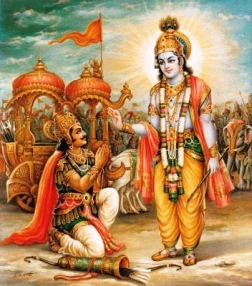
…The Lord left behind Him the instructions of the Bhagavad-gītā not for the benefit of Arjuna alone, but also for all time and in all lands. The Bhagavad-gītā, being spoken by the Supreme Personality of Godhead, is the essence of all Vedic wisdom. It is nicely presented by the Lord Himself for all who have very little time to go through the vast Vedic literatures like the Upaniṣads, Purāṇas and Vedānta-sūtras.
…the Bhagavad-gītā can be consulted in all critical times, not only for solace from all kinds of mental agonies, but also for the way out of great entanglements which may embarrass one in some critical hour.
…The merciful Lord left behind Him the great teachings of the Bhagavad-gītā so that one can take the instructions of the Lord even when He is not visible to material eyesight.
…There is no difference between the sound representation of the Lord and the Lord Himself. One can derive the same benefit from the Bhagavad-gītā as Arjuna did in the personal presence of the Lord.
…The Bhagavad-gītā begins with the problems of life by discriminating the soul from the elements of matter and proves by all reason and argument that the soul is indestructible in all circumstances and that the outer covering of matter, the body and the mind, change for another term of material existence which is full of miseries. The Bhagavad-gītā is therefore meant for terminating all different types of miseries, and Arjuna took shelter of this great knowledge, which had been imparted to him during the Kurukṣetra battle. (from Purport to SB 1.15.27)
Full verse and purport More
23 Sep 2013
by The Hare Krishna Movement
in A.C. Bhaktivedanta Swami Prabhupada, Ecstasy, Krishna Nectar, Spiritual Life, Vrndavana
Tags: A.C. Bhaktivedanta Swami Prabhupada, divine ecstasies, Krishna's friends, Krsna, Krsna-katha, lotus flower, lunch with krssn, Pariksit, SB 10, Srila Prabhupada's divine ecstasies, Srimad Bhagavatam, Sukadeva Goswami, whorl of a lotus flower

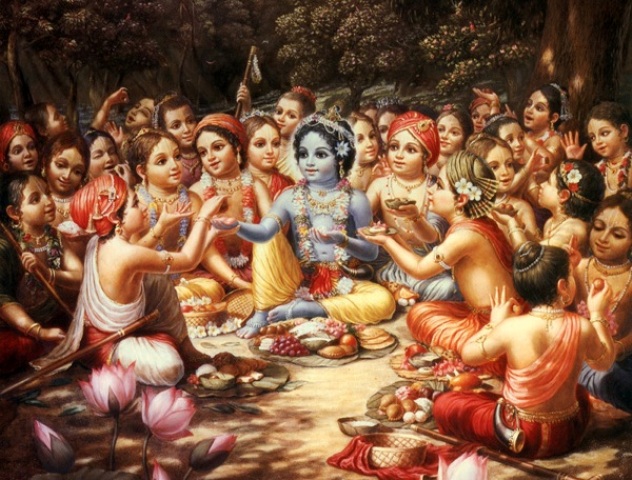
Today, being Monday, and the start of another workday week, I wanted to focus my mind, not on all the work ahead, but rather, on some Krishna Nectar from Srila Prabhupada’s Srimad Bhagavatam. We share with you a few of Srila Prabhupada’s divine ecstasies. As we mentioned is a previous post, there are two kṛṣṇa-kathās; narrations spoken by Kṛṣṇa, and narrations spoken about Kṛṣṇa. Please note text 5 & 6 which is spoken by Krsna.
…devotees who have accepted the essence of life, are attached to Kṛṣṇa in the core of their hearts, and He is the aim of their lives. It is their nature to talk only of Kṛṣṇa at every moment, as if such topics were newer and newer.
Like the whorl of a lotus flower surrounded by its petals and leaves, Kṛṣṇa sat in the center, encircled by lines of His friends, who all looked very beautiful. Every one of them was trying to look forward toward Kṛṣṇa, thinking that Kṛṣṇa might look toward him. In this way they all enjoyed their lunch in the forest.
Among the cowherd boys, some placed their lunch on flowers, some on leaves, fruits, or bunches of leaves, some actually in their baskets, some on the bark of trees and some on rocks. This is what the children imagined to be their plates as they ate their lunch.
Srimad Bhagavatam
By His Divine Grace A. C. Bhaktivedanta Swami Prabhupada
Canto 10, Chapter 13, Text 1-12
Translations and purports More
20 Sep 2013
by The Hare Krishna Movement
in A.C. Bhaktivedanta Swami Prabhupada, Srimad Bhagavatam
Tags: A.C. Bhaktivedanta Swami Prabhupada, age of kali, austerity, brahminical culture, cleanliness, innocent animals, Kali, Kali-yuga, ksatriya rulers, Maharaja Pariksit, mercy. truthfulness, Punishment and Reward of Kali, SB 17, spiritual initiation, Srimad Bhagavatam, sudra, surabji, Suta Goswami

Śrīmad-Bhāgavatam
By His Divine Grace A. C. Bhaktivedanta Swami Prabhupāda
Chapter Seventeen
More
16 Sep 2013
by The Hare Krishna Movement
in A.C. Bhaktivedanta Swami Prabhupada, Jiva Goswami, Srimad Bhagavatam, Vamanadeva
Tags: A.C. Bhaktivedanta Swami Prabhupada, Aditi, appearance of lord vamandeva, Bali Maharaja, club, conchshell, disc, dwarf-brahmana, Jiva Goswami, Krsna, lotus, Srila Prabhupada, Srimad Bhagavatam, Vamana, Vamanadeva, Vijaya

Today we honor the Appearance of Lord Vamandeva, who, as some of you know, appeared as the fifteenth incarnation of Krsna. Lord Vāmanadeva assumed the form of a dwarf-brāhmaṇa [Vāmana] and visited the arena of sacrifice arranged by Mahārāja Bali. The following is a brief summary from Srila Prabhupada’s Srimad Bhagavatam, 8th Canto, Chapter 18.
Today also marks the Appearance of Srila Jiva Goswami, and there is a brief instruction given by him on understanding God at bottom of post.
Lord Vāmanadeva appeared in this world from the womb of Aditi completely equipped with conchshell, disc, club and lotus. His bodily hue was blackish, and He was dressed in yellow garments. Lord Viṣṇu appeared at an auspicious moment on Śravaṇa-dvādaśī when the Abhijit star had arisen. At that time, in all the three worlds (including the higher planetary system, outer space and this earth), all the demigods, the cows, the brāhmaṇas and even the seasons were happy because of God’s appearance. Therefore this auspicious day is called Vijayā.
More
22 Jul 2013
by The Hare Krishna Movement
in A.C. Bhaktivedanta Swami Prabhupada, Honey
Tags: A.C. Bhaktiveanta Swami Prabhupada, bee-mind, devotees, honey from the lotus flower, Lord Krsna, lotus, lotus feet of the Lord, lotus flower, lotus honey, Palace of Gold, Prabhupada's Palace, pure devotees, Srimad Bhagavatam

This last week we harvested some of the honey from our bee hives, and as we extracted it I was in awe of its beautiful golden color. After we offered some of it to the Lord, we sampled its taste and it was amazing, not of this world. They must be devotee bees’s gathering the nectar from the lotus flowers and rose gardens at Srila Prabhupada’s Palace of Gold, here at New Vrindavan. The taste and texture was other-worldly, and remarkable. So I thought I would take a moment to to find some references on honey from Srila Prabhupada’s Books.
The pure devotees are always hankering after the lotus feet of the Lord. The lotus has a kind of honey which is transcendentally relished by the devotees. They are like the bees who are always after the honey. Śrīla Rūpa Gosvāmī, the great devotee ācārya of the Gauḍīya-Vaiṣṇava-sampradāya, has sung a song about this lotus honey, comparing himself to the bee:
“O my Lord Kṛṣṇa, I beg to offer my prayers unto You. My mind is like the bee, and it is after some honey. Kindly, therefore, give my bee-mind a place at Your lotus feet, which are the resources for all transcendental honey.” (SB 1.11.26)
When the Lord entered the forest of Vṛndāvana, all the inhabitants of the forest, both animate and inanimate, were eager to receive Him. He saw that the flowers of the forest, all fully blossoming, were weeping in ecstasy, honey flowing down their petals. The waterfalls on the hilly rocks were gladly flowing, and one could hear sweet sounds from the caves nearby. (Light of the Bhagavata text 24)
More
16 Jul 2013
by The Hare Krishna Movement
in A.C. Bhaktivedanta Swami Prabhupada, Books by Srila Prabhupada, Free Downloads, Free eBooks, Srila Prabhupada's Books, Srimad Bhagavatam
Tags: A.C. Bhaktivedanta Swami Prabhupada, Book Distribution, epic bhagavatam, free books, free pdf download, pdf download, Srimad Bhagavatam, Tenth Canto, The Hare Krishna Movement


One of our readers suggested that we also upload Part One and Part Two of the Tenth Canto as a Free PDF Download, to go with Part Three which we posted the other day. So with great pleasure we post the Free links to read or save the pdf files of Part One and Two of Srila Prabhupada’s Epic Srimad-Bhagavatam.

click on link for free pdf download; SB10.1

click on link for free pdf download; SB10.2
More
14 Jul 2013
by The Hare Krishna Movement
in A.C. Bhaktivedanta Swami Prabhupada, BBT, Book Changes, Books by Srila Prabhupada, Srimad Bhagavatam
Tags: A.C. Bhaktivedanta Swami Prabhupada, BBT, dictaphone, final volume, Founder Acarya, foward to tenth canto, International Society for Krishna Consciousness, Krsna Balarama Mandir, Sanskrit text, Srimad Bhagavatam, Tenth Canto, translation and commentary

Śrīmad-Bhāgavatam
By His Divine Grace A.C. Bhaktivedanta Swami Prabhupada
Tenth Canto, Part Three
Foward
This is the final Śrīmad-Bhāgavatam volume translated by His Divine Grace A. C. Bhaktivedanta Swami Prabhupada, founder-acarya of the International Society for Krishna Consciousness. It is smaller than the earlier volumes because it ends where the renowned author stopped translating just before his departure from this mortal world on November 14, 1977, at the Krsna-Balarama Mandira in Vrndavana, India.
The first part of this volume was produced in the usual fashion. Srila Prabhupada would sit and read silently from the Sanskrit text and then speak the translation and commentary into his dictaphone. Later, due to illness, it became necessary for his disciples to assist him personally.
In these last days Srila Prabhupada was gravely ill. Unable to eat for weeks, his health had deteriorated, making even the slightest movement excruciatingly painful.
As he lay still, a devotee would softly read the Sanskrit to him. Another disciple, sitting on his bed, held the microphone to him, nearly touching his mouth. And then Srila Prabhupada would speak, voice sometimes barely audible.
These recordings, made in his quarters at the temple, constitute the balance of this book.
In these final moments, the physician attending His Divine Grace confided that an ordinary man in such critical condition would have been crying out from the intense pain. Srila Prabhupada’s disciples were awestruck as they watched their spiritual master work quietly, undisturbed.
In the last part of the book we find Srila Prabhupada’s usual clarity of thought, constant scriptural references, scrupulous attention to detail, and rigorous philosophical exposition fully intact, just as they were in the preceding twenty-nine volumes of the Śrīmad-Bhāgavatam.
Srila Prabhpada’s last days and this translation will stands an inspiring reminder that even the severest material circumstances cannot impede the activities of a pure devotee of the Supreme Personality of Godhead.
-The Publishers

For a Free PDF download of this special volume click on following link; SB-10-03-1980
More
02 Jul 2013
by The Hare Krishna Movement
in A.C. Bhaktivedanta Swami Prabhupada, Maharaja Pariksit, Spiritual Master, Srila Prabhupada's Books, Srimad Bhagavatam, Sukadeva Goswami
Tags: A.C. Bhaktivedanta Swami, at time of death, hear chant and remember, Maharaja Pariksit, perfection of life, segue, self realization, Srimad Bhagavatam, Sukadeva Goswami

This morning I was marveling at how beautifully Srila Prabhupada segues [def: an uninterrupted transition from one song to another. 2. go on without a pause.] from the First Canto of the Srimad Bhagavatam into the Second Canto. This Srimad Bhagavatam, is truly one of the most amazing books in existence today!
You are the spiritual master of great saints and devotees. I am therefore begging you to show the way of perfection for all persons, and especially for one who is about to die. (SB 1.19.37)
Please let me know what a man should hear, chant, remember and worship, and also what he should not do. Please explain all this to me. (SB 1.19.38)
Śrī Sūta Gosvāmī said: The King thus spoke and questioned the sage, using sweet language. Then the great and powerful personality, the son of Vyāsadeva, who knew the principles of religion, began his reply… (SB 1.19.40) [End of First Canto]
[Start of Second Canto]…Śrī Śukadeva Gosvāmī said: My dear King, your question is glorious because it is very beneficial to all kinds of people. The answer to this question is the prime subject matter for hearing, and it is approved by all transcendentalists. (SB 2.1.1)
…That very Śrīmad-Bhāgavatam I shall recite before you because you are the most sincere devotee of Lord Kṛṣṇa. One who gives full attention and respect to hearing Śrīmad-Bhāgavatam achieves unflinching faith in the Supreme Lord, the giver of salvation. (SB 2.1.10)
Unless one is perfectly anxious to inquire about the way of perfection, there is no necessity of approaching a spiritual master. A spiritual master is not a kind of decoration for a householder. Generally a fashionable materialist engages a so-called spiritual master without any profit. The pseudo spiritual master flatters the so-called disciple, and thereby both the master and his ward go to hell without a doubt. Mahārāja Parīkṣit is the right type of disciple because he puts forward questions vital to the interest of all men, particularly for the dying men. The question put forward by Mahārāja Parīkṣit is the basic principle of the complete thesis of Śrīmad-Bhāgavatam. Now let us see how intelligently the great master replies. (from purport to SB 1.19.37)
Full translation and purports More
24 Jun 2013
by The Hare Krishna Movement
in A.C. Bhaktivedanta Swami Prabhupada, Ganges, Srimad Bhagavatam
Tags: A.C. Bhaktivedanta Swami Prabhupada, amartya, baby Krsna, Ganges, Ganges River, Gokula, Krsna's lotus feet, sacred rivers, sanctified, SB 1.19.6, Srimad Bhagavatam, transcendental, Tulasi, tulasi leaves, Yamuna, Yamuna river
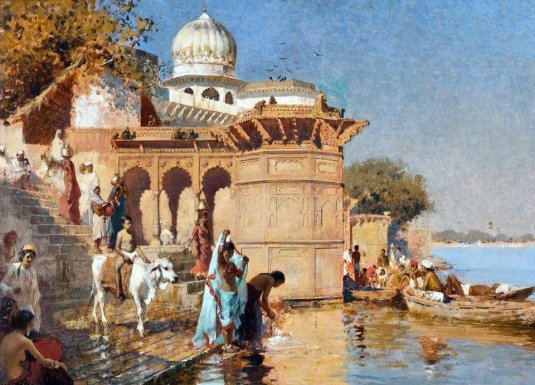
click on image to enlarge
…Both the Ganges and the Yamunā are amartyā (transcendental) rivers, but the Yamunā is still more sanctified for the following reasons.
…And as far as sanctity is concerned, the River Yamunā is more directly connected with Lord Kṛṣṇa than the Ganges. The Lord sanctified the River Yamunā from the beginning of His transcendental pastimes in the world. While His father Vasudeva was crossing the Yamunā with the baby Lord Kṛṣṇa for a safe place at Gokula on the other bank of the river from Mathurā, the Lord fell down in the river, and by the dust of His lotus feet the river at once became sanctified. It is especially mentioned herein that Mahārāja Parīkṣit took shelter of that particular river which is beautifully flowing, carrying the dust of the lotus feet of Lord Kṛṣṇa, mixed with tulasī leaves. Lord Kṛṣṇa’s lotus feet are always besmeared with the tulasī leaves, and thus as soon as His lotus feet contact the water of the Ganges and the Yamunā, the rivers become at once sanctified. The Lord, however, contacted the River Yamunā more than the Ganges. (from purport to SB 1.19.6)
Full verse and purport More
14 Jun 2013
by The Hare Krishna Movement
in A.C. Bhaktivedanta Swami Prabhupada, Dedication Slokas, Srimad Bhagavatam
Tags: A.C. Bhaktivedanta Swami, collection of slokas, dedication slokas, krsne sva-dhamopagate, original books by srila prtabhupada, slokas, srila prabhupada slokas, Srimad Bhagavatam
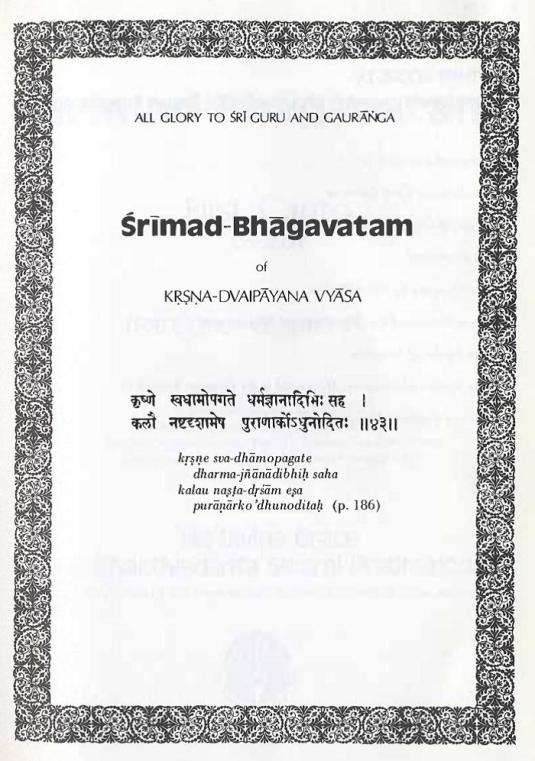
For anyone who has had the good fortune to read and study Srila Prabhupada’s epic Srimad Bhagavatam, will know that on the title page of each and every volume is a dedication sloka. I thought it would be interesting to compile a list of the dedication slokas from all of the original books. I stopped this collection of slokas with the Tenth Canto, Part Three, as this is where Srila Prabhupada left off, and where my collection of Srimad Bhagavatam’s stops. -Vyasasan das
More
05 Jun 2013
by The Hare Krishna Movement
in A.C. Bhaktivedanta Swami Prabhupada, Back to Godhead, Kali Yuga
Tags: A.C. Bhaktivedanta Swami Prabhupada, bhagavatam, chanting Hare Krishna, future, Hare Krishna, hypocrisy, kalau dasa-nidhe rajan, Kali-yuga, past, prediction, present, Srimad Bhagavatam

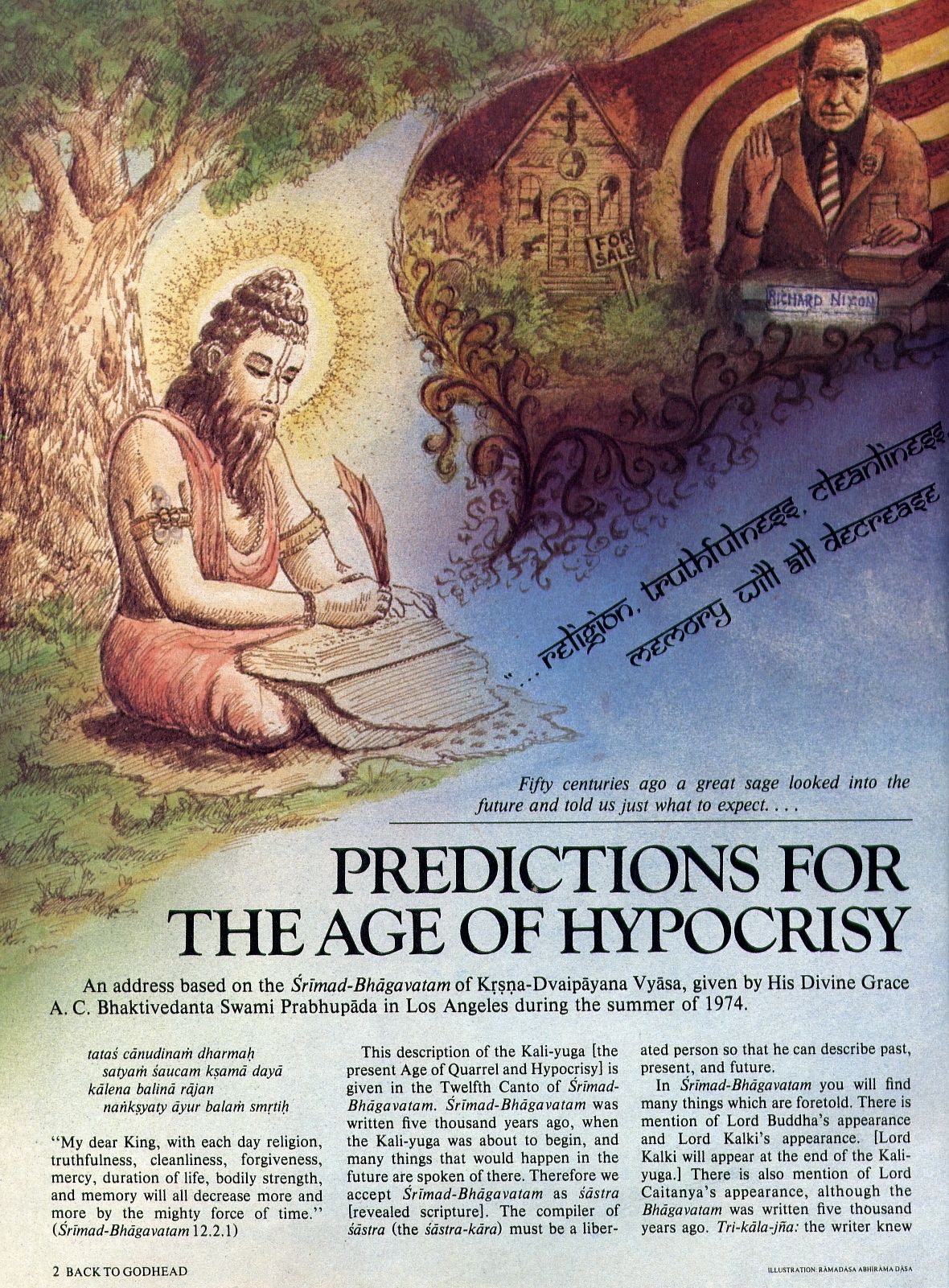
Predictions for the Age of Hypocrisy
Fifty centuries ago a great sage looked into the future and told us just what to expect. . .
An address based on the Srimad-Bhagavatam of Krsna-Dvaipayana Vyasa, given by His Divine Grace A.C. Bhaktivedanta Swami Prabhupada in Los Angeles during the summer of 1974.
Excerpted from Back to Godhead Magazine
tatas canu-dinam dharmah
satyam saucam ksama daya
kalena balina rajan
nanksyaty ayur balam smrtih
“My dear King, with each day religion, truthfulness, cleanliness, forgiveness, mercy, duration of life, bodily strength, and memory will all decrease more and more by the mighty force of time.” (Srimad-Bhagavatam 12.2.1)
This description of the Kali-yuga [the present Age of Quarrel and Hypocrisy] is given in the Twelfth Canto of Srimad-Bhagavatam. Srimad-Bhagavatam was written five thousand years ago, when the Kali-yuga was about to begin, and many things that would happen in the future are spoken of there. Therefore we accept Srimad-Bhagavatam as sastra [revealed scripture]. The compiler of sastra (the sastra-kara) must be a liberated person so that he can describe past, present, and future.
In Srimad-Bhagavatam you will find many things which are foretold. There is mention of Lord Buddha’s appearance and Lord Kalki’s appearance. [Lord Kalki will appear at the end of the Kali-yuga.] There is also mention of Lord Caitanya’s appearance, although the Bhagavatam was written five thousand years ago. Tri-kala-jna: the writer knew past, present, and future.
So here Sukadeva Gosvami is describing the chief symptoms of this age. He says, tatas canudinam: with the progress of this age (Kali-yuga), dharma, religious principles; satyam, truthfulness; saucam, cleanliness; ksama, forgiveness; daya, mercifulness; ayur, duration of life; balam, bodily strength; smrti, memory—these eight things will gradually decrease to nil or almost nil.
More
Previous Older Entries Next Newer Entries













 The Hare Krishna Movement
Foward to Final Volume of the Srimad Bhagavatam
14 Jul 2013 1 Comment
by The Hare Krishna Movement in A.C. Bhaktivedanta Swami Prabhupada, BBT, Book Changes, Books by Srila Prabhupada, Srimad Bhagavatam Tags: A.C. Bhaktivedanta Swami Prabhupada, BBT, dictaphone, final volume, Founder Acarya, foward to tenth canto, International Society for Krishna Consciousness, Krsna Balarama Mandir, Sanskrit text, Srimad Bhagavatam, Tenth Canto, translation and commentary
Śrīmad-Bhāgavatam
By His Divine Grace A.C. Bhaktivedanta Swami Prabhupada
Tenth Canto, Part Three
Foward
This is the final Śrīmad-Bhāgavatam volume translated by His Divine Grace A. C. Bhaktivedanta Swami Prabhupada, founder-acarya of the International Society for Krishna Consciousness. It is smaller than the earlier volumes because it ends where the renowned author stopped translating just before his departure from this mortal world on November 14, 1977, at the Krsna-Balarama Mandira in Vrndavana, India.
The first part of this volume was produced in the usual fashion. Srila Prabhupada would sit and read silently from the Sanskrit text and then speak the translation and commentary into his dictaphone. Later, due to illness, it became necessary for his disciples to assist him personally.
In these last days Srila Prabhupada was gravely ill. Unable to eat for weeks, his health had deteriorated, making even the slightest movement excruciatingly painful.
As he lay still, a devotee would softly read the Sanskrit to him. Another disciple, sitting on his bed, held the microphone to him, nearly touching his mouth. And then Srila Prabhupada would speak, voice sometimes barely audible.
These recordings, made in his quarters at the temple, constitute the balance of this book.
In these final moments, the physician attending His Divine Grace confided that an ordinary man in such critical condition would have been crying out from the intense pain. Srila Prabhupada’s disciples were awestruck as they watched their spiritual master work quietly, undisturbed.
In the last part of the book we find Srila Prabhupada’s usual clarity of thought, constant scriptural references, scrupulous attention to detail, and rigorous philosophical exposition fully intact, just as they were in the preceding twenty-nine volumes of the Śrīmad-Bhāgavatam.
Srila Prabhpada’s last days and this translation will stands an inspiring reminder that even the severest material circumstances cannot impede the activities of a pure devotee of the Supreme Personality of Godhead.
-The Publishers
For a Free PDF download of this special volume click on following link; SB-10-03-1980
More