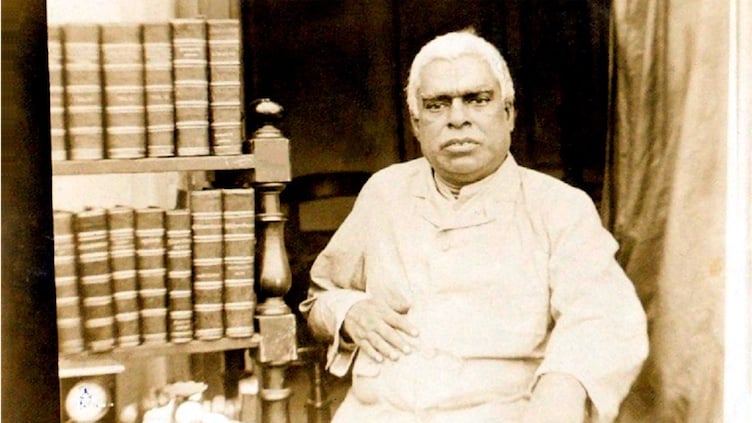
Today we honor the appearance day of Srila Bhaktivinoda Thakura. There is one book I have always been meaning to read: “The Seventh Goswami” by Rupa-vilasa dasa. But I did happen to find this book online in a PDF format on the Iskcon Desire Tree webpage. So we are including the Link in our post today.
“The glories of this great personality are limitless, and his achievements are countless. Mere words cannot do justice to his glories. Although Bhaktivinoda Thakura is especially recognised for re-discovering the birth place of Lord Caitanya, he in fact re-discovered and re-established Lord Caitanya’s movement, which was practically lost due to the cultural and religious fanaticism of the British rulers, and the concocted philosophies of deviant sects, who aimed to discredit and contradict the original teachings of the Supreme Lord.“
“Oh, for that day when the fortunate English, French, Russian, German and American people will take up banners, mrdangas and karatalas and raise kirtana through their streets and towns. When will that day come? Oh, for the day when the fair-skinned men from their side will raise up the chanting of ‘jaya sacinandana, jaya sacinandana ki jaya’ and join with the Bengali devotees. When will that day be? On such a day they will say, ‘Our dear Brothers, we have taken shelter of the ocean of Lord Caitanya’s Love; kindly embrace us.’ When will that day come? That day will witness the holy transcendental ecstasy of the Vaisnava-dharma to be the only dharma, and all the sects and religions will flow like rivers into the ocean of Vaisnava -dharma. When will that day come?” – Bhaktivinoda Thakura
And then he penned another amazing prediction, which can be applied to Srila Bhaktisiddhanta Sarasvati Thakura, but also, most certainly, to Srila Prabhupada: “A personality will soon appear to preach the teachings of Lord Caitanya and move unrestrictedly over the whole world with His message.”
On Janmastami (Lord Krsna’s Appearance Day) my wife and I, towards evening sat down, and watched the beautiful DVD “Darsana Krsna Meditiation”. After a long day of fasting, I was ready to go to sleep, but my wife suggested we watch the Darsana DVD instead. To my surprise it woke me up and I felt very enlivened, and we kept it playing until midnight, when Krsna makes His appearance. Then the next day I pulled out the book and just relished reading the text and reveling in the beautiful photography of the deities. Highly recommended!
The Darshan story
(by Nitya-tripta devi dasi)
I started my devotional service in 1975 at the BBT photo department, also affectionately known by the name of “Photo-Loka” to residents of the New Dvaraka community in Los Angeles. One of my assigned duties was to photograph the Deities with a 4×5 View-Camera. It is not a particularly easy camera to use. It is big and bulky; focusing the image is done on a ground glass at the back of the camera with a magnifying lens, which displays the image upside down and backwards. Exposures have to be taken with a hand held light-meter at the subject, and the light reading is calculated accordingly. And oh yes, there is usually the need of lights with their stands and a substantial tripod to support the camera. We also used this class of camera to photograph all the art-work for the BBT publications due to its fine rendition of detail. Only the best for Krishna!
The pictures I took in those early years in New Dvaraka and other temples were used in books and posters, sent to Srila Prabhupada directly, and used by the pujari island seamstresses to improve the quality of dress standards offered to the Lord. Many devotees, including myself, would talk of a book with magnificent Deity pictures, and we made our own private photo collections. Later on through the years I took pictures on various altars for the Krishna Vision Deity slide shows. Each Deity is different in his own special mood reciprocating with His devotees according to their needs and desires.
Sometimes when people take to Krsna Consciousness, they think that automatically, all their problems and difficulties will be solved, but unfortunately this is not the immediate case, as the letters from Srila Prabhupada to his disciples so vividly indicate. I was listening to one lecture where Srila Prabhupada was saying “…in this material world there will always be difficulties. This material world was designed in such a way that there will always be difficulties.” I went through some of the letters and highlighted where Srila Prabhupada used the word difficulties. It was interesting to read how he explained about these difficulties.
“Please accept my blessings. I beg to acknowledge receipt of your letter dated December 27, 1973. I can understand that you are sometimes experiencing difficulties but that you are very sincerely trying to become Krsna Conscious and that you have a number of persons there who are interested in your presentation of Krsna Consciousness. Actually this material world is full of suffering conditions and the only way to become free from these sufferings which are due to past sinful activities is to chant Hare Krsna. In this age no other method of rectification is possible. Along with the chanting of Hare Krsna we have to rigidly observe the prohibition of four sinful activities. If only these things we can do our lives can become perfect. I think you have my books so please study them carefully.” (Letter to: Bhumata — Los Angeles 2 January, 1974)
And in this one famous letter he wrote to Gurudas Prabhu, Srila Prabhupada descrbes his own difficulties in starting this Hare Krishna Movement.
My dear Gurudasa,
Please accept my blessings. I am in due receipt of your letter dated August 23, 1972, and I have noted the contents carefully. Do not be depressed. All along my God brothers gave me only depression, repression, compression—but I continued strong in my duty. So never mind there is some discouragement, continue with your work in full enthusiastic Krishna Consciousness attitude of service…
Hoping this meets you in good health.
Your ever well-wisher, A.C. Bhaktivedanta Swami
The following are the letters that Srila Prabhupada wrote to his disciples wherein he uses the word difficulties.
Man’s artificial civilization has created so many artificial laws that we, although God’s men, have difficulties to travel in God’s countries on God’s business. The foolish law makers should have at least given us some facilities to make people Krishna conscious so that they might be happy in this life and in the next. The Kingdom of Maya is like that and still we have to execute our business in Krishna Consciousness. (Letter to: Brahmananda — ISKCON New York 14 March, 1967)
P.S. Also inform Jayananda I have received his letter and the difficulties of life may come as seasonal changes but we should not be disturbed by all those difficulties. Our process is to chant and that process will gradually clear everything in due course. There is nothing to be disrupted—you should go on with your work with enthusiasm and everything will be solved. We are on the sound footing of Krishna Consciousness. ( Letter to: Mukunda — New York 6 June, 1967)
The other day I was talking with a devotee about AI (Artificial Intelligence), something I know nothing about. But when that person said that AI read all of Srila Prabhupada’s books, I became curious. So I did a Google search, just typed in “AI” and at the top of the list was this link https://openai.com/. So I asked a question, “Who is Srila Prabhupada?”. I was surprised when it came back with a detailed description:
Srila Prabhupada refers to A.C. Bhaktivedanta Swami Prabhupada (1896–1977), a renowned spiritual teacher and founder of the International Society for Krishna Consciousness (ISKCON), commonly known as the Hare Krishna movement.
He was born Abhay Charan De in Calcutta, India, and was a disciple of Srila Bhaktisiddhanta Sarasvati Thakura, a prominent leader in the Gaudiya Vaishnava tradition (a devotional branch of Hinduism focused on the worship of Krishna).
Some key points about him:
Mission: Srila Prabhupada’s main mission was to spread the teachings of Bhagavad-gītā and Śrīmad-Bhāgavatam around the world, emphasizing bhakti-yoga (devotional service to Krishna).
Global Impact: In 1965, at the age of 69, he traveled from India to the United States with little money and no institutional backing. Within 12 years, he established over 100 temples worldwide.
Books: He translated and wrote extensive commentaries on many sacred texts, including the Bhagavad-gītā As It Is, Śrīmad-Bhāgavatam, and Caitanya-caritāmṛta.
Philosophy: His teachings focused on chanting the Hare Krishna mantra as a means to achieve spiritual realization.
Legacy: Millions of people still follow his teachings today, and ISKCON continues to grow worldwide.
If you’d like, I can give you a short, inspiring biography of his life’s journey that reads more like a story than a fact sheet. Would you like that?
So I replied ‘Yes’.
Alright, here’s Srila Prabhupada’s story in a more flowing, inspiring way:
Without a doubt, this is my favorite book ever. I never get tired of reading from the Krsna Book. It seems to get sweeter every time.
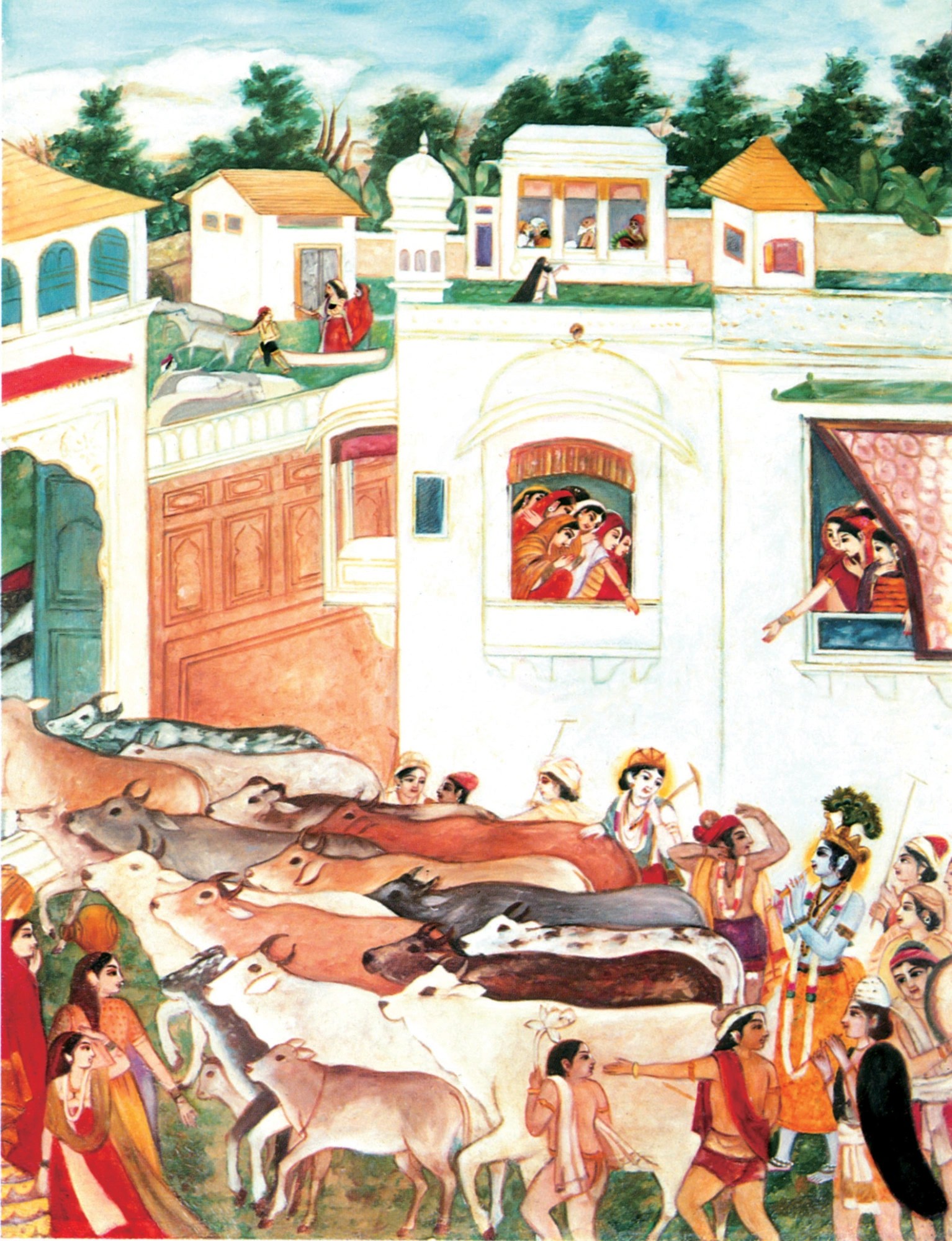
Krsna was very pleased with the atmosphere of the forest, where flowers bloomed and bees and drones hummed very jubilantly. While the birds, trees and branches were all looking very happy, Krsna, tending the cows and accompanied by Sri Balarama and the cowherd boys, began to vibrate His transcendental flute. After hearing the vibration, the gopis in Vrndavana remembered Him and began to talk amongst themselves about how nicely Krsna was playing His flute. When the gopis were describing the sweet vibration of Krsna’s flute’; they also remembered their pastimes with Him; thus their minds became disturbed, and they were unable to fully describe the beautiful vibrations. While discussing the transcendental vibration, they also remembered how Krsna dressed, decorated with a peacock feather on His head, just like a dancing actor, and with blue flowers pushed over His ear. His garment glowed yellow-gold, and He was garlanded with a vaijayanti necklace. Dressed in such an attractive way, Krsna filled up the holes of His flute with the nectar emanating from His lips. So they remembered Him, entering Vrndavana forest, which is always glorified by the footprints of Krsna and His friends.
Here is another word for your vaisnava vocabulary, acintya-bhedabheda-tattva. I was always facinated by this word because its meaning is inconceivable; simultaneous oneness and difference. Srila Prabhupada uses the example of the sun and the sunshine. The sunshine is not different from the sun as it is the engery of the sun, but when the sunshine is shinning in your room you cannot say the sun is in you room. Hence, one and different simultaneously. So similarly, God and His creation are one and different simultaneously One and Different.
Another example Srila Prabhupada uses is a drop of water from the ocean, has the same qualities as the ocean, in quality but not in quanitity. As living entities or as parts of God’s energy, we’re also equal in quality with God, but there’s a vast difference in quantity.
Achintya-bhedabheda-tattva refers to the inconceivable and simultaneous oneness and difference of the Supreme Person and His energies. This is one of the key points of theistic philosophy taught by Chaitanya Mahaprabhu. As parts of God’s energy, we’re also equal in quality with God, but there’s a vast difference in quantity. We’re each infinitesimal sparks of spiritual energy, and the Supreme Person, Krishna, is the infinite, supreme source of all energies.
Achintya-bhedabheda-tattva describes the relationship between the Supreme Lord and His energies, including individual souls, as both one with and different from Him simultaneously. This principle is beyond human comprehension, hence the “inconceivable” aspect.
From a lecture at a Christian Monastery – Melbourne April 06, 1972
“One may artificially repress the desires of the senses, although the taste for sensual enjoyment remains; but by ceasing such enjoyments, experiencing a higher taste, one is fixed in consciousness.” (Bhagavad-gita 2.59)
Visnujana Swami: “When one experiences ruci, which, means a taste for Spiritual life, he can rise above the attraction of the illusory energy by the mercy of the Lord. Then he is able to feel vairagya. Vairagya is the strength that protects us, even when we are neophytes in Krishna consciousness, from breaking the Krishna conscious regulative principles and being attracted to the flickering sensual enjoyments of the mundane world. Ruci, and vairagya-the taste for spiritual life and the strength to maintain it-are rarely achieved.
If you had a huge diamond and were carrying it around with you on the street, people might flock to see such a diamond. Ruci and vairagya, however, are much more valuable diamonds. But although you are all walking through the streets with these valuable gifts, unfortunately no one is interested, in following you to take advantage of them. Ruci and vairagya are such wonderful gems, however, that if you give them away to others, these gems will still stay with you.
I was thinking how Srila Prabhupada always referred to the the process of Krishna Consciousness as Joyful. He mentioned this joyful process in his letters, we share some of them with you.
Tridandi Goswami A.C. Bhaktivedanta Swami Founder-Acharya: International Society for Krishna Consciousness CENTER: 1975 So. La Cienega Blvd. Los Angeles, California 90034
DATE: July 15, 1969
My Dear Jadurany,
Please accept my blessings. I am in due receipt of your recent letter, and I have noted the contents. Regarding Festivals in Boston, you may hold as many as possible. If you can hold such festivals daily, that is also nice. Our movement is for ananda, simply bliss, and the method of pushing this movement is chanting, dancing, feasting and philosophizing. So in our almanac there are many festivals in every month. I am enclosing some festivals which were already held in Los Angeles, and if you perform them, I will give you a long list of others. But don’t embarrass yourself at present with greater plans than you can handle. The more you get devotees the more you will be able to perform nice festivals.
I am glad that Boston is improving in so many ways. So far as painting is concerned, you can begin now. I have already advised you this in a note enclosed with Tape #14 of Krishna. So read the Krishna tape transcriptions and draw pictures as many as possible. Each picture should be very much attractive, colorful and nice so that people will appreciate these paintings also. Our standard size will be like TLC, and you can make the pictures accordingly. According to my idea the pictures should be proportionate to 81/2 x 11. The style of the book will be like TLC so far as paper, print and binding are concerned.
Please convey my blessings to Satsvarupa and the others. I hope this will meet you all in good health.
This morning there was this nagging voice that kept saying “read Adi-lila chapter 4, of the Sri Caitanya-caritamrta” I haven’t read from the Caitanya-caritamrta for a while because I was re-reading the Bhagavad-gita and Krsna Book and because it is summer, I am busy with work… But I responded to the nagging voice…and pulled Vol. 1 from the shelf. As I read I became more and more enlivened and the words jumped out at me…. Śrīmatī Rādhārāṇī, who is the attraction for the all-attractive. What is attracting the All Attractive? Srimati Radharani!
And the other thing that jumped out at me was the word hlādinī. Here is another word for your vaishnava vocabulary. So today is a two part post from the Sri Caitanya-caritamrta, describing the hladini energy, and the attractiveness of Srimati Radharani.
Lord Kṛṣṇa enchants the world, but Śrī Rādhā enchants even Him. Therefore She is the supreme goddess of all. (Adi 4.95)
Śrī Rādhā is the full power, and Lord Kṛṣṇa is the possessor of full power. The two are not different, as evidenced by the revealed scriptures. (Adi 4.96)
Śrīmatī Rādhārāṇī is as fully spiritual as Kṛṣṇa. No one should consider Her to be material. She is definitely not like the conditioned souls, who have material bodies, gross and subtle, covered by material senses. She is all-spiritual, and both Her body and mind are of the same spiritual embodiment. Because Her body is spiritual, Her senses are also spiritual. Thus Her body, mind and senses fully shine in love of Kṛṣṇa. She is the personified hlādinī-śakti (the pleasure-giving energy of the Lord’s internal potency), and therefore She is the only source of enjoyment for Śrī Kṛṣṇa.
Śrī Kṛṣṇa cannot enjoy anything that is internally different from Him. Therefore Rādhā and Śrī Kṛṣṇa are identical. The sandhinī portion of Śrī Kṛṣṇa’s internal potency has manifested the all-attractive form of Śrī Kṛṣṇa, and the same internal potency, in the hlādinī feature, has presented Śrīmatī Rādhārāṇī, who is the attraction for the all-attractive. No one can match Śrīmatī Rādhārāṇī in the transcendental pastimes of Śrī Kṛṣṇa. (from purport Adi 4.71)
…All the desires of Lord Kṛṣṇa rest in Śrīmatī Rādhārāṇī. (from purport)
This is a nice description of Lord Kṛṣṇa’s transcendental counchshell, and of how He was received by the citizens of Dvārakā. Beautiful!
Sūta Gosvāmī said: Upon reaching the border of His most prosperous metropolis, known as the country of the Ānartas [Dvārakā], the Lord sounded His auspicious conchshell, heralding His arrival and apparently pacifying the dejection of the inhabitants.
The white and fat-boweled conchshell, being gripped by the hand of Lord Kṛṣṇa and sounded by Him, appeared to be reddened by the touch of His transcendental lips. It seemed that a white swan was playing in the stems of red lotus flowers.
The citizens of Dvārakā, having heard that sound which threatens fear personified in the material world, began to run towards Him fast, just to have a long desired audience with the Lord, who is the protector of all devotees.
…The sound heralded by Lord Kṛṣṇa was something like the heralding of the sunrise in the morning. This sound of the Lord is identical with the Lord. We are always fearful due to our ignorance of the next problem. The whole material existence is full of problems, and thus the fear problem is always prominent. This is due to our association with the illusory energy of the Lord, known as māyā or external energy, yet all fear is vanished as soon as there is the sound of the Lord, represented by His holy name, as it was sounded by Lord Śrī Caitanya Mahāprabhu in the following sixteen words:
Hare Kṛṣṇa, Hare Kṛṣṇa, Kṛṣṇa Kṛṣṇa, Hare Hare Hare Rāma, Hare Rāma, Rāma Rāma, Hare Hare
We can take advantage of these sounds and be free from all threatening problems of material existence.
This morning while I was chanting my japa (chanting silently the Hare Krishna mantra) I was thinking of how Google defined mantra meditation. So many people today have heard the words yoga and meditation, but what do they think it means? Some think yoga is just a good form of exercise, and meditation is just a way of shutting out the noise, and thinking of nothing. So I did a Google search:
Mantra meditation involves repeating a sacred sound, word, or phrase to focus the mind and promote relaxation. This technique helps to quiet the mind and allow for deeper states of meditation. The repeated mantra acts as a point of focus, helping to direct the mind and reduce mental chatter.
Mantra meditation is a technique that involves using mantras to relax the mind and help it focus.
Not bad definitions really, but for me, actually Yoga means “Union with God”, and Meditation means “Meditation on God”. So the ultimate goal of Yoga is bhakti-yoga, and the highest form of Mantra-meditation is to focus on God (Krishna).
Śrīmad-Bhāgavatam 7.5.22-34 Lecture By His Divine Grace A.C. Bhaktivedanta Swami Prabhupada Los Angeles, May 27, 1972
So today, appearance day of Lord Nṛsiṁhadeva. Lord Nṛsiṁhadeva appeared on this Nṛsiṁha Cāturdaśī on account of His devotee, Prahlāda. As it is stated in the Bhagavad-gītā, yadā yadā hi dharmasya glānir bhavati bhārata, abhyutthānam adharmasya [Bg. 4.7]. Paritrāṇāya sādhūnāṁ vināśāya ca duṣkṛtāṁ, sambhavāmi yuge yuge [Bg. 4.8]. The Lord appears with two purposes. Paritrāṇāya sādhūnām: just to give protection and rescue the devotees, and to kill the demons, vināśāya ca duṣkṛtām. So Prahlāda Mahārāja, five-years-old boy, his only fault was that he was Kṛṣṇa conscious. He was devotee of Kṛṣṇa. That was his only fault. And the father was so unkind to a child, even five years old. He could not excuse, “Oh, let this boy do whatever, chanting Hare Kṛṣṇa.” No. The demons are so much against God consciousness that even at his home he would not allow his own child to become God conscious. This is demoniac civili… So you’ll find many critics, many enemies, because you are making progress in Kṛṣṇa consciousness. So the demons are always against this Kṛṣṇa consciousness movement. That is the whole history. Just like Lord Jesus Christ, he was crucified. What was his fault? He was preaching God consciousness, that’s all. This society is so cruel. So Prahlāda Mahārāja was tortured in so many ways. The torturing methods, I think you will find as you will see in today’s picture, how Prahlāda Mahārāja was tortured.
So one day, Hiraṇyakaśipu… After all, he was his son. Affection was there. So one day, Hiraṇyakaśipu asked the boy,
So he asked his son, “My dear son, what you have learned? The best thing, what you have learned from your teachers, so you kindly let me know.” So Prahlāda Mahārāja informed that “I have learned like this.” What is that?
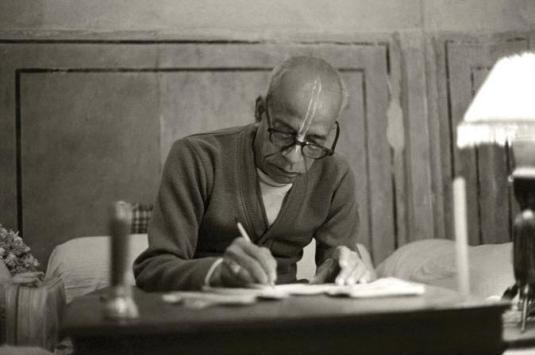
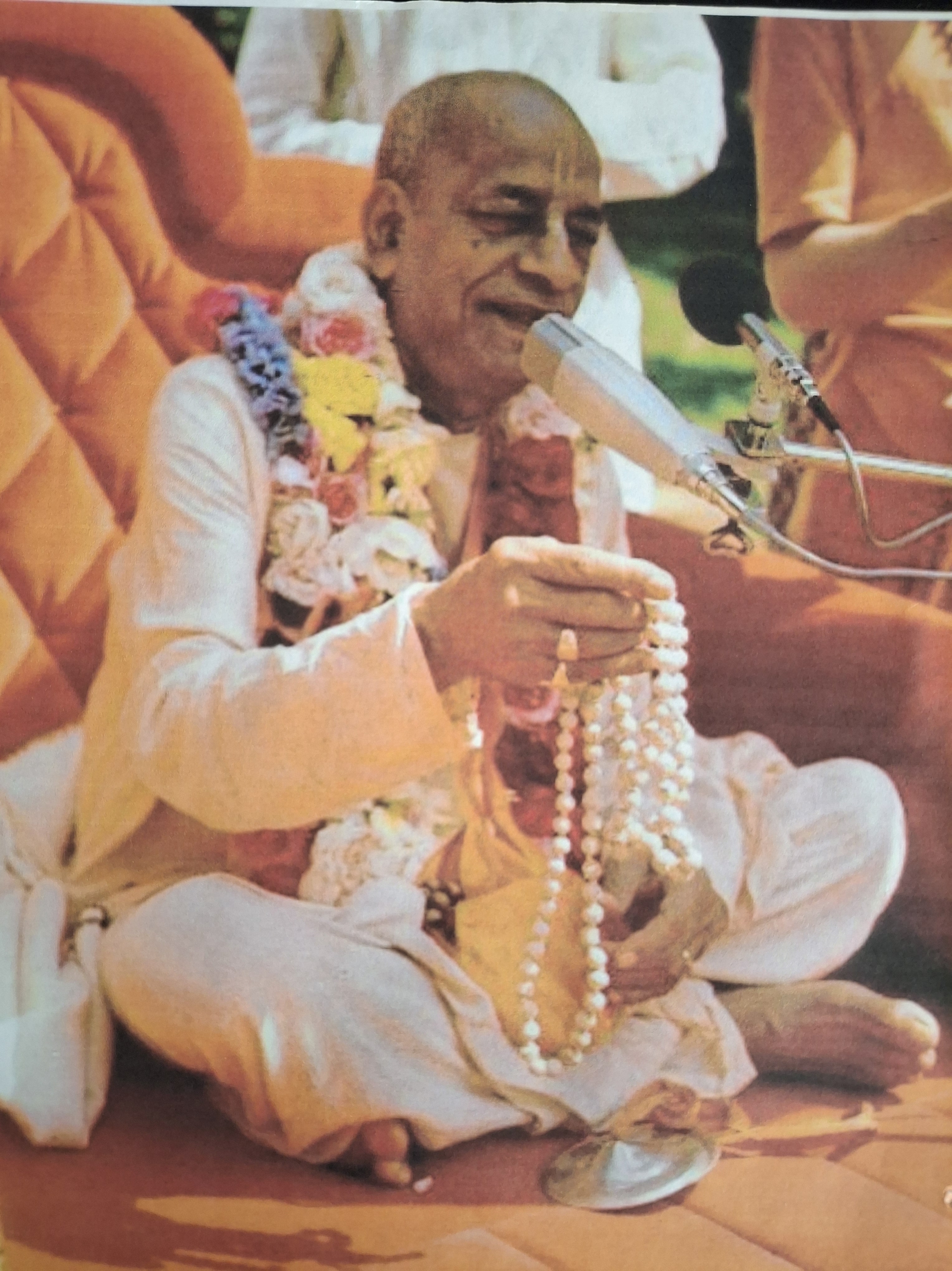
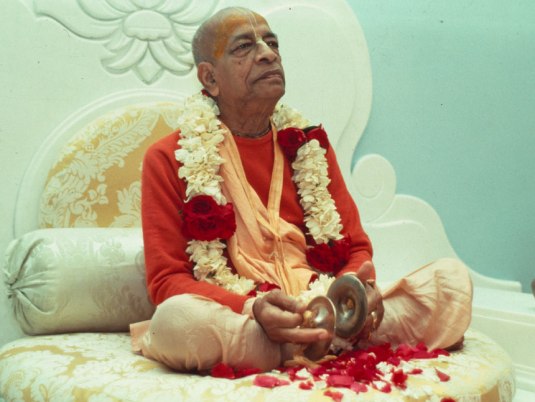
I’m sure everyone has a favorite picture of Srila Prabhupada, I particularly like this one in the morning when I am chanting Japa. It reminds me of the promise I made to chant every day.
When a mantra or hymn is chanted softly and slowly, that is called japa. The same mantra, when chanted loudly, is called kīrtana. For example, the mahā-mantra (Hare Kṛṣṇa, Hare Kṛṣṇa, Kṛṣṇa Kṛṣṇa, Hare Hare/ Hare Rāma, Hare Rāma, Rāma Rāma, Hare Hare) when uttered very softly only for one’s own hearing is called japa. The same mantra, when chanted loudly for being heard by all others, is called kīrtana. The mahā-mantra can be used for japa and kīrtana also. When japa is practiced it is for the personal benefit of the chanter, but when kīrtana is performed it is for the benefit of all others who may hear.
In the Padma Purāṇa there is a statement: “For any person who is chanting the holy name either softly or loudly, the paths to liberation and even heavenly happiness are at once open.” (Nectar of Devotion Chapter 9)
Of all the sacrifices, the chanting of Hare Kṛṣṇa, Hare Kṛṣṇa, Kṛṣṇa Kṛṣṇa, Hare Hare/ Hare Rāma, Hare Rāma, Rāma Rāma, Hare Hare is the purest representation of Kṛṣṇa. (from purport; Bhagavad-gita 10.25)
So we are continuing our series on the five types of relationships (rasa’s) with the Lord. Today we are exploring the Fraternal Devotional stage of Love of God (Sakhya-rasa) as explained in chapter 41 of “The Nectar of Devotion”. Also included in todays post are some select verses from the Bhagavad-gita describing Arjuna’s friendship with Krishna.
When a devotee is permanently situated in devotional service, and by different symptoms of ecstasy he has developed and matured a fraternal mellow or flavor in relationship with the Personality of Godhead, his feeling is called fraternal love of Godhead.
The impetus for such fraternal love of God is God Himself. When one is liberated and discovers his eternal relationship with the Supreme Lord, the Lord Himself becomes the impetus for increasing fraternal love. The eternal associates of the Lord in Vrindavan have described this as follows: “The Lord, Hari, whose bodily hue is like the indranīla jewel, whose smiling is as beautiful as the kunda flower, whose silk dress is as yellow as golden autumn foliage, whose chest is beautified with garlands of flowers and who is always playing upon His flute-this enemy of the Agha demon is always attracting our hearts by wandering about Vrindavan.”
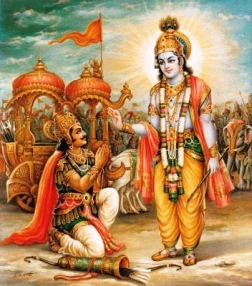
There are similar statements of fraternal love expressed outside the jurisdiction of Vrindavan. When the sons of Pandu, headed by Mahārāj Yudhisthira, saw Krishna in His four handed form on the battlefield of Kuruksetra, holding His conchshell, disc, club and lotus flower, they completely forgot themselves and became merged in the ocean of nectarean happiness. This shows how the sons of Pandu-King Yudhisthira, Bhima, Arjuna, Nakula and Sahadeva-were all caught up in fraternal love for Krishna.
From the Bhagavad-gita we are reminded of Arjuna’s friendship with Krishna.
So today we are exploring the Servitude stage of Love of God (Dasya-rasa) as explained in chapter 36 of “The Nectar of Devotion”.
Each soul, according to its constitutional nature, possesses a unique loving relationship with Krishna in one of five principal categories. When devotees return to the spiritual world, they engage in direct loving devotional service to Krishna in their particular rasa.
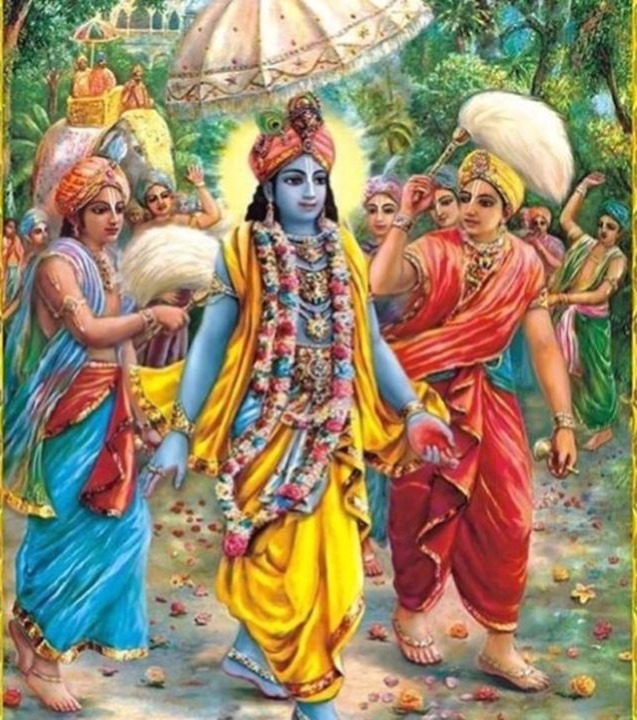
Devotees engaged in servitude are attached to Krishna in the affection of reverence. Some of the inhabitants of Gokula (Vrindavan) as exhibited on earth) are attached to Krishna on this platform of affection in reverence. The inhabitants of Vrindavan used to say, “Kṛṣṇa is always manifest before us with a complexion like a blackish cloud. He holds His wonderful flute in His lotus hands. He is dressed in yellow silks and bedecked with a peacock feather on His head. When Krishna walks near Govardhan Hill with these personal features, all the inhabitants of the heavenly planets, as well as the inhabitants of this earth, feel transcendental bliss and consider themselves the eternal servants of the Lord.”
Today we are exploring the Neutral stage of Love of God, (santa-rasa), as explained in chapter 35 of “The Nectar of Devotion”.
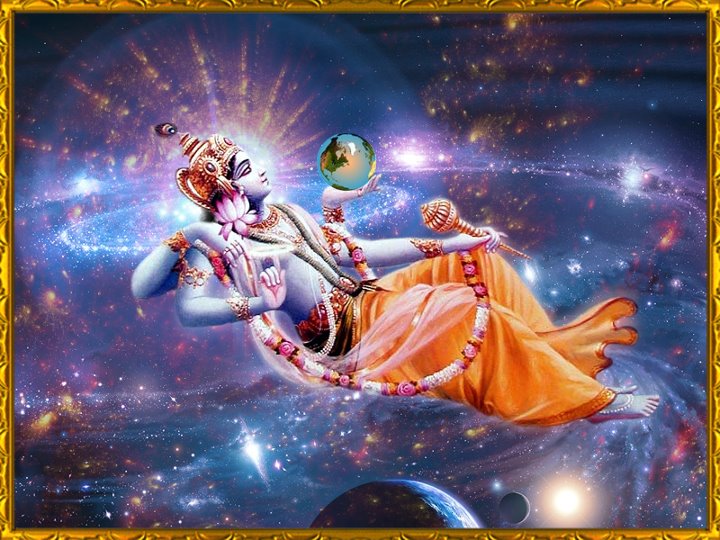
“When the yogi sees the eternal form of Visnu and appreciates the Lord’s beauty in awe and veneration, he is situated in the neutral stage of love of God.”
…Some great sages have attained this neutral position by practicing austerity, penance and meditation to control the senses. Such sages are generally called mystic yogīs, and in most cases they are inclined to appreciate the spiritual pleasure of the impersonal feature of the absolute truth. They are practically unaware of the transcendental pleasure derived from personal contact with the Supreme Godhead.
When some great saintly persons who had undergone penances and austerities saw the four-handed transcendental form of Visnu, they began to remark as follows: “This four-handed form of the Lord, manifested in a bluish color, is the reservoir of all pleasure and the center of our living force. Actually, when we see this eternal form of Visnu, we, along with many other paramahaṁsas, become immediately captivated by the beauty of the Lord.” This appreciation of Lord Visnu by saintly persons is an instance of situation in santa-rasa, or the neutral stage of devotional service. In the beginning, those who are aspiring for salvation try to get out of the material entanglement by performing painful austerities and penances, and ultimately they come to the impersonal status of spiritual realization. At this brahma-bhuta [SB 4.30.20] stage of liberation from the material entanglement, the symptoms, as explained in the Bhagavad-gita, are that one becomes joyous beyond any hankering or lamentation and gains a universal vision. When the devotee is situated in the santa-rasa, or neutral stage of devotional service, he appreciates the Visnu form of the Lord.
This morning I was thinking about the different relationships one can have with the Lord. In “The Nectar of Devotion”, Srila Prabhupada describes the five primary kinds of devotional service-namely, neutrality, servitude, fraternity, parenthood and conjugal love.Over the course of the next five posts, I want to explore these five primary relationships.
But for today, I want to start with this nice verse from the Bhagavad-gita, where these five types of relationships are mentioned in purport.
For one who remembers Me without deviation, I am easy to obtain, O son of Pṛthā, because of his constant engagement in devotional service. (Bg 8.14)
…Bhakti-yoga is very simple and pure and easy to perform. One can begin by simply chanting Hare Kṛṣṇa. Kṛṣṇa is very merciful to those who engage in His service, and He helps in various ways that devotee who is fully surrendered to Him so he can understand Him as He is. The Lord gives such a devotee sufficient intelligence so that ultimately the devotee can attain Him in His spiritual kingdom.
…Generally, the bhakti-yogīs are engaged in five different ways: 1) śānta-bhakta, engaged in devotional service in neutrality; 2) dāsya-bhakta, engaged in devotional service as servant; 3) sākhya-bhakta, engaged as friend; 4) vātsalya-bhakta, engaged as parent; and 5) mādhurya-bhakta, engaged as conjugal lover of the Supreme Lord. (from purport)
Ever since I was a small child, I have been attracted to the statue of Buddha. Don’t know why, but I had a statue of Buddha in my bedroom, and it was a Christian home. I didn’t really know about Krishna then or who the Buddha was…but I was so attracted to everything Eastern. As I learned latter in life Buddha was actually an incarnation of Krsna. “From the Bhāgavatam we understand that Lord Buddha is the incarnation of Kṛṣṇa who appeared when materialism was rampant and materialists were using the pretext of the authority of the Vedas.” (from purport Bg 4.7)
The Four Noble Truths & The Eightfold Path
The Four Noble Truths
The Buddha’s first sermon after his Enlightenment centered on the Four Noble Truths, which are the foundation of Buddhism. The truths are:
The truth of suffering (dukkha) The truth of the cause of suffering (samudaya) The truth of the end of suffering (nirhodha) The truth of the path that frees us from suffering (magga)
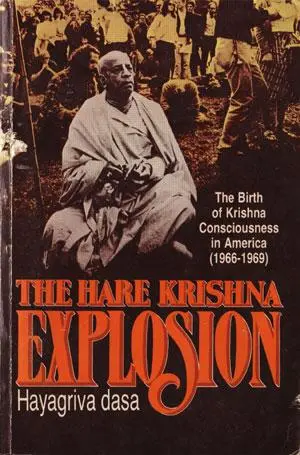
At various times people have called him a scholar, a philosopher, a cultural ambassador, a prolific author, a religious leader, a spiritual teacher, a social critic, and a holy man. In truth, he was all these things and more.
Over five hundred years ago, Lord Sri Krishna appeared as Sri Chaitanya Mahaprabhu in Navadvipa, a village in West Bengal. The purpose of His appearance was to inaugurate the Sankirtana Movement, the Yuga Dharma for this age of Kali. He declared that the chanting of His holy names would spread beyond the shores of India to every town and village in the world. He predicted that His commander-in-chief would appear to accomplish this mission.
Yes… Srila Prabhupada appeared to fulfill this prophecy.












 The Hare Krishna Movement
