So we are finishing our series on the five types of relationships (rasa’s) with the Lord. Today we are exploring Devotional Service in Conjugal Love (Madhurya-rasa) as explained in chapter 44 of “The Nectar of Devotion”.
Because of the sensitive nature of this topic, we have posted the entire chapter from the the original 1970 edition of “The Nectar of Devotion”, by His Divine Grace A C Bhaktivedanta Swami Prabhupada.
A pure devotee’s attraction to Krsna in conjugal love is called devotional service in conjugal love. Although such conjugal feelings are not at all material, there is some similarity between this spiritual love and material activities. Therefore, persons who are interested only in material activities are unable to understand this spiritual conjugal love, and these devotional reciprocations appear very mysterious to them. Rupa Gosvāmī therefore describes conjugal love very briefly.
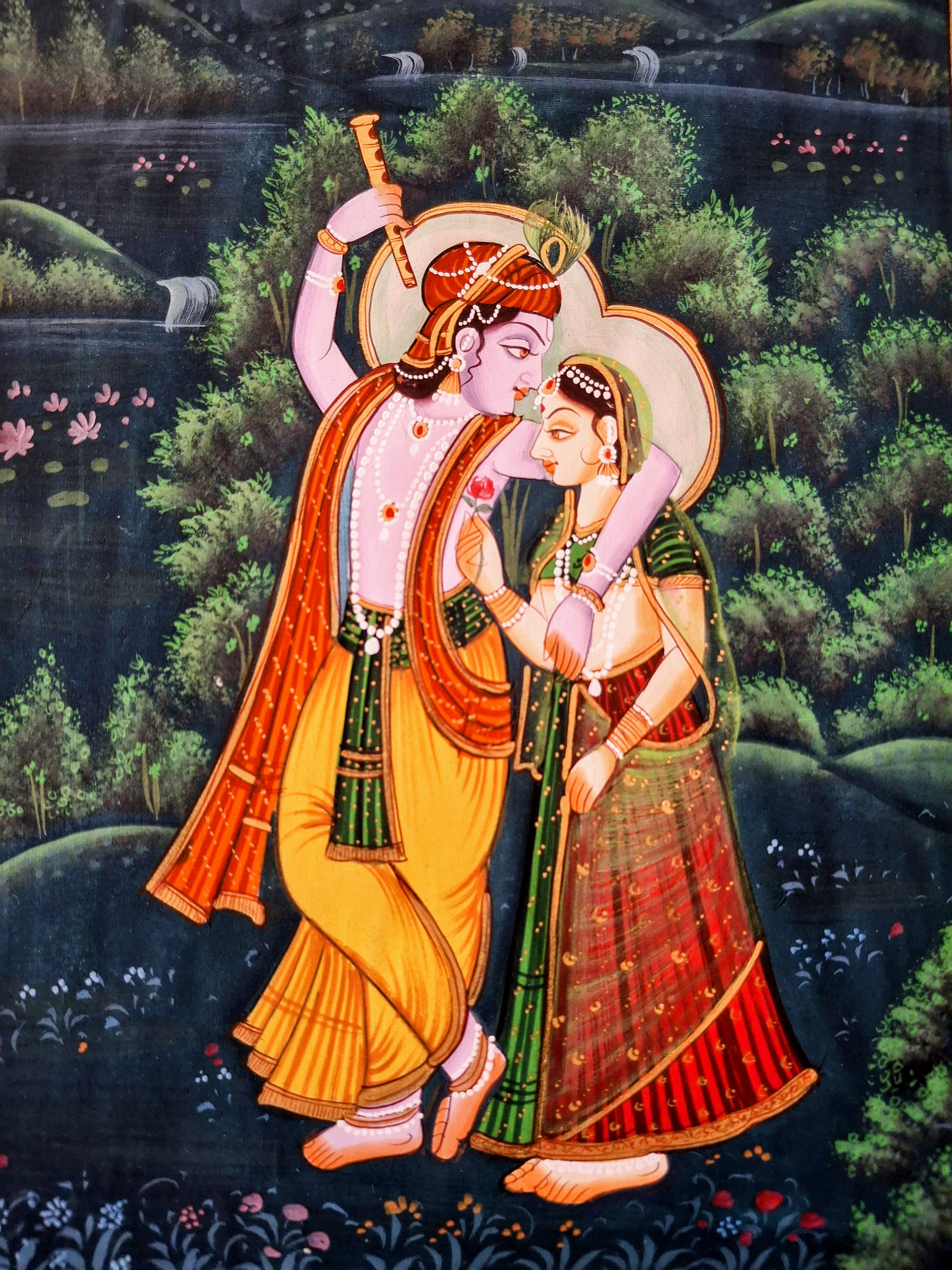
The impetuses of conjugal love are Krsna and His very dear consorts, such as Rādhārāṇī and Her immediate associates. Lord Krsnahas no rival: no one is equal to Him, and no one is greater than Him. His beauty is also without any rival, and because He excels all others in the pastimes of conjugal love, He is the original object of all conjugal love.
I posted this some years ago, but this morning I happened upon it again, and so enjoyed it, we thought we would post it again. In this treatise Ajitananda Prabhu describes how Srila Prabhupada perfectly displayed the twenty-six qualities of a pure devotee of Lord Krishna.
In Praise of Srila Prabhupada . by Ajitananda dasa ________________
His Divine Grace A.C. Bhaktivedanta Swami Prabhupada, who successfully distributed the message of Lord Krsna throughout the world, was not an ordinary conditioned soul, governed by the harsh laws of material nature. Although to the unenlightened he may have appeared to exhibit commonplace characteristics, it is evident through the careful study of his life and activities, that Srila Prabhupada perfectly displayed the twenty-six qualities of a pure devotee of Lord Krsna. We learn from Vedic literature that one who possesses these qualities is necessarily free from material bondage, and enjoys an eternal position in the intimate association of the Supreme Lord. Such a great soul is very rarely found within this material realm, and owing to his unparalleled purity and exalted status, he is worshipable by the entire world. Individually, and as a collective society of aspiring devotees, we must always strive to appreciate Srila Prabhupada’s divine qualities, teach this application to others, and perform all of our devotional activities for his satisfaction. This treatise is an imperfect but hopeful attempt to please Srila Prabhupada by illustrating, in a practical way, how he perfectly displayed the twenty-six qualities of a pure devotee of Lord Krsna.
Prabhupada: Tulasi Devi is a pure devotee of Krishna and she should be treated with the same respect given to all Krishna’s pure devotees. Simply by worshiping her faithfully, a devotee can get himself free of from all material miseries. In the Nectar of Devotion I have given two verses from the Skanda Purana, one of which is: “Tulasi is auspicious in all respects. Simply by seeing, simply by touching, simply by remembering, simply by praying to, simply by bowing before, simply by hearing about, or simply by sowing the tree, there is always auspiciousness. Anyone who comes in touch with the Tulasi tree in the above mentioned ways lives eternally in the Vaikuntha world.” So from this verse we can understand how pure is the service which Tulasi offers to Sri Krishna. So we should always endeavor after becoming servant of Tulasi Devi. I do not know who has taught you that part of a Tulasi plant may be cut off and then replanted? From the Tulasi plant you can cut off only leaves for offering them to Krishna, never for cutting and planting. That is an offense. The manjaris (seeds) can be offered in water and it makes the water fragrant and tasteful. And the manjaris can be planted for growing new Tulasi plants. Yes, the prayer you have enclosed is bona fide. Tulasi Devi never goes back to Godhead, she is always with Godhead. She is a pure devotee and thus she has appeared on this planet to render service to Krishna by being offered in all temples throughout the world by being offered up to the lotus feet of Krishna. ( Letter to: Radhavallabha — Bombay 6 January, 1972)
“Although my Guru Maharaja ordered me to accomplish this mission, I am not worthy or fit to do it. I am very fallen and insignificant. Therefore, O Lord, now I am begging for Your mercy so that I may become worthy, for You are the wisest and most experienced of all.” (Prayer to the Lotus Feet of Krishna, on board the ship Jaladuta, September 13, 1965)
“It is all Krishna’s Grace that He has sent such a nice assistants to me, for executing the mission of my Spiritual Master. Personally, I am nonentity; I have come here on the order of my Spiritual Master, and He has kindly sent you all boys to assist me. So whatever is being done, there is no credit for me, but all the credit goes to my Spiritual Master, because He has arranged everything, and I am simply to abide by His order.” (Srila Prabhupada Letter, October 16, 1968)
“I am just trying to disseminate this message of my Spiritual Master and if there’s any credit for this service, everything goes to Him.” (Srila Prabhupada Letter, March 14, 1969)
For anyone following the election this year, I think we can all agree, it has been interesting to say the least. For a post today I went to the Srimad Bhagavatam, Seventh Canto, where Prahada began to speak to his friends and teachers about the glories of devotional service to the Supreme Lord…
Politics involves accepting one group of men as enemies and another group as friends. Everything in politics is based on this philosophy, and the entire world, especially at the present, is engrossed in it. The public is concerned with friendly countries and friendly groups or enemy countries and enemy groups, but as stated in Bhagavad-gītā, a learned person does not make distinctions between enemies and friends. Devotees, especially, do not create friends and enemies. A devotee sees that every living being is part and parcel of Kṛṣṇa (mamaivāṁśo jīva-bhūtaḥ [15.7]). Therefore a devotee treats friends and enemies equally by trying to educate them both in Kṛṣṇa consciousness. Of course, atheistic men do not follow the instructions of pure devotees, but instead consider a devotee their enemy. A devotee, however, never creates a situation of friendship and enmity. (from purport SB 7.5.3)
Although the teachers tried to educate the boy Prahlāda in politics, economics and other material activities, he did not care for their instructions. Instead, he continued to be a pure devotee. Prahlāda Mahārāja never liked the idea of discriminating between one’s friends and enemies. Because he was spiritually inclined, he was equal toward everyone. (from chapter summmary)
The following is a very nice post written by Madhudvisa Prabhu, it is heavy, but is backed up by scripture and quotes by Srila Prabhupada himself. It was worth my time reading, and thus I share it with all of you. Hare Krishna!
The Guru Is A Pure Devotee!
by Madhudvisa dasa
During Srila Prabhupada’s physical presence there was no confusion in ISKCON over the qualifications and qualities of a bona fide guru. Srila Prabhupada was personally present and he exhibited all the qualities perfectly and all the devotees understood the spiritual master was a pure devotee. That’s what Srila Prabhupada demonstrated by his personal actions, that’s what he wrote in his books, that’s what he preached in his classes and that’s what the devotees understood and accepted. The spiritual master is a transparent via-medium to Krishna. His words are non-different from Krishna’s, hearing him is just as good as hearing Krishna personally. And his words are absolute and perfect because he is not presenting his own ideas, he is simply repeating what Krishna and the previous acaryas have said in a way suitable for the understanding of the audience. He’s not changing the message, adulterating it or adding in any ideas of his own, he’s presenting Krishna’s words and Krishna’s philosophy AS IT IS.
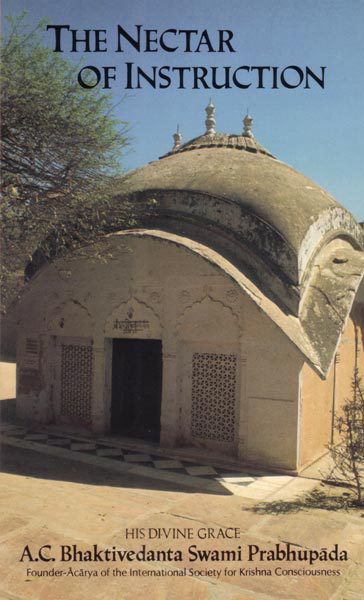
The Nectar of Instruction
By His Divine Grace A. C. Bhaktivedanta Swami Prabhupada
This morning I was reading through the “Bhakti-sastri Study Guide”, compiled by Atmatattva Dasa, and in the pages dedicated to the study of the ‘Nectar of Instruction’ there was the following summary which I use as an index to the Preface and the 11 Texts:
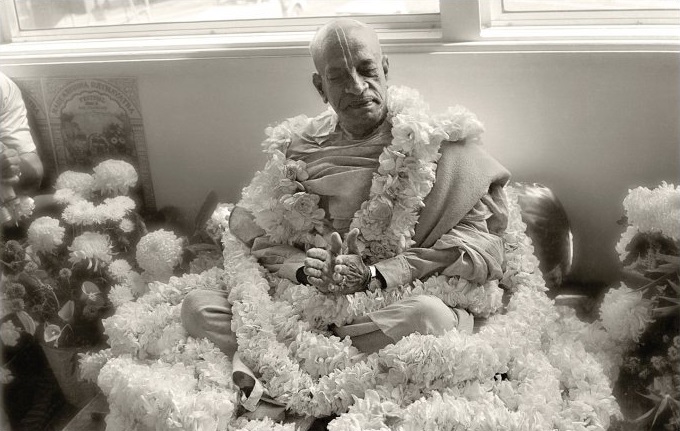
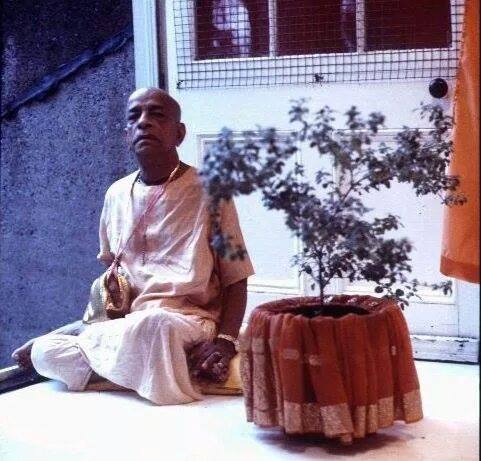
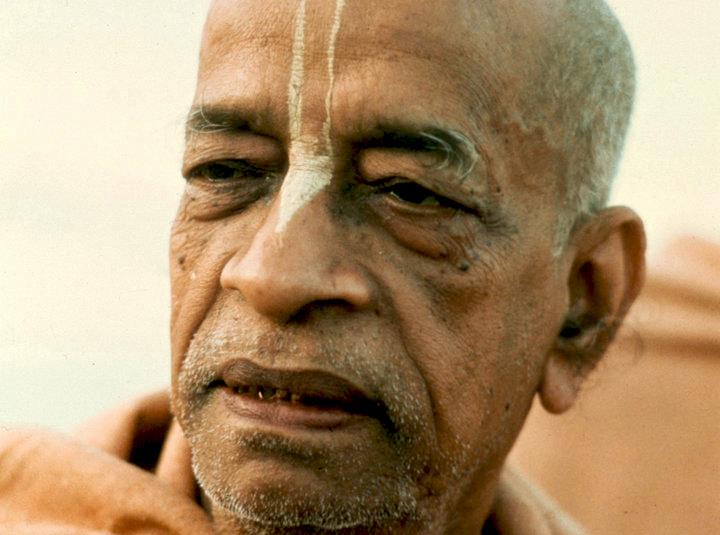
I was looking through some pictures this morning of Srila Prabhupada and my attention was drawn to this above image. He looked so peaceful, and I remembered that peacefulness is one of the transcendental qualities of the pure devotee. You can click on link at bottom of post to see the other Beautiful Transcendental Qualities of Srila Prabhupada.
Peaceful
Srila Prabhupada once described the mind of a pure devotee as being very peaceful, like a country pond filled with crystal-clear water, beautiful lotus flowers and swans gliding happily across it. This much desired state of mind is a natural quality of one who is situated in transcendence, at the lotus feet of Lord Krishna, far beyond the turbulent material world and senses. Srila Prabhupada was very peaceful due to his own pure Krishna consciousness. Shouldering the immense pressure and responsibility of a worldwide spiritual family, with its concomitant problems, Srila Prabhupada gracefully meted out love, guidance and practical instructions with full composure, never once losing touch with his peaceful Lord Krishna. (from “Srila Prabhupada’s Beautiful Transcendental Qualities” by Ajitananda das)
I like this picture very much and it became my meditation this morning. I began to think what it was, that first attracted me to Srila Prabhupada and the Hare Krishna Movement, or Krsna Consciousness. And it was the idea of becoming a better person, that first attracted me.
…Any man who has genuine devotion to the Lord has all the good qualities which are found in godly persons or in the demigods, whereas the nondevotee, however advanced he may be in material qualifications by education and culture, lacks in godly qualities (from purport Bg. 1.28)
Śrī Kṛṣṇadāsa Kavirāja, the author of Caitanya-caritāmṛta, says that all good qualities become manifest in the body of a Vaiṣṇava and that only by the presence of these good qualities can one distinguish a Vaiṣṇava from a non-Vaiṣṇava. Kṛṣṇadāsa Kavirāja lists the following twenty-six good qualities of a Vaiṣṇava: (1) He is very kind to everyone. (2) He does not make anyone his enemy. (3) He is truthful. (4) He is equal to everyone. (5) No one can find any fault in him. (6) He is magnanimous. (7) He is mild. (8) He is always clean. (9) He is without possessions. (10) He works for everyone’s benefit. (11) He is very peaceful. (12) He is always surrendered to Kṛṣṇa. (13) He has no material desires. (14) He is very meek. (15) He is steady. (16) He controls his senses. (17) He does not eat more than required. (18) He is not influenced by the Lord’s illusory energy. (19) He offers respect to everyone. (20) He does not desire any respect for himself. (21) He is very grave. (22) He is merciful. (23) He is friendly. (24) He is poetic. (25) He is expert. (26) He is silent.(from purport to SB 5.18.12)
Continuing with our series on the Nectar of Iststuction (Upadeśāmṛta), we are posting Text 6, the very important instructions given by Śrīla Rūpa Gosvāmī on the position of a person situated in Krsna consciousness. Srila Prabhupada explains in the purport that a person engaged in devotional service must be free from material motives. In this Kṛṣṇa consciousness movement, one’s consciousness is what needs to be changed. How we should view the pure devotee, and also the warning is there how to avoid offenses at the feet of the Vaiṣṇavas. Very important instructions.
The Nectar of Instruction
By His Divine Grace A. C. Bhaktivedanta Swami Prabhupāda
[*Note; Les Misérables (“The Miserable Ones”); translated variously from the French as The Miserable Ones, The Wretched, The Poor Ones, The Wretched Poor, or The Victims]
Often while reading Srila Prabhupada’s books, he talks about getting free from the miseries of life, or the threefold miseries. For instance in this purport it is described:
…One who is Kṛṣṇa conscious is a perfect yogī; he is aware of everyone’s happiness and distress by dint of his own personal experience. The cause of the distress of a living entity is forgetfulness of his relationship with God. And the cause of happiness is knowing Kṛṣṇa to be the supreme enjoyer of all the activities of the human being. Kṛṣṇa is the proprietor of all lands and planets. The perfect yogī is the sincerest friend of all living entities. He knows that the living being who is conditioned by the modes of material nature is subjected to the threefold material miseries due to forgetfulness of his relationship with Kṛṣṇa. Because one in Kṛṣṇa consciousness is happy, he tries to distribute the knowledge of Kṛṣṇa everywhere. Since the perfect yogī tries to broadcast the importance of becoming Kṛṣṇa conscious, he is the best philanthropist in the world, and he is the dearest servitor of the Lord.
I thought we could do a short post on just what are the threefold miseries, and how can one become free from them.
The threefold miseries are:
(1) Those miseries which arise from the mind and body
(2) Those miseries inflicted by other living beings
(3) Those miseries arising from natural catastrophes over which one has no control.
…In the Brahma-saṁhitā it is said that the Lord is never to be found by becoming a great scholar of the Vedic literatures, but He is very easily approachable through His pure devotee. In Vṛndāvana all the pure devotees pray for the mercy of Śrīmatī Rādhārāṇī, the pleasure potency of Lord Kṛṣṇa. Śrīmatī Rādhārāṇī is a tenderhearted feminine counterpart of the supreme whole, resembling the perfectional stage of the worldly feminine nature. Therefore, the mercy of Rādhārāṇī is available very readily to the sincere devotees, and once She recommends such a devotee to Lord Kṛṣṇa, the Lord at once accepts the devotee’s admittance into His association. The conclusion is, therefore, that one should be more serious about seeking the mercy of the devotee than that of the Lord directly, and by one’s doing so (by the good will of the devotee) the natural attraction for the service of the Lord will be revived. (Purport Srimad Bhagavatam 2.3.23)
As I was reading from the Srimad Bhagavatam this morning about the passing of Bhīṣmadeva it was being described how “The perfect yogīs or mystics can leave the material body at their own sweet will at a suitable time and go to a suitable planet desired by them.” And how it is possiable to go beyond Saṁsāra, and go back to Godhead without any doubt.
…In the momentous hour of leaving his material body, Bhīṣmadeva set the glorious example concerning the important function of the human form of life. The subject matter which attracts the dying man becomes the beginning of his next life. Therefore, if one is absorbed in thoughts of the Supreme Lord Śrī Kṛṣṇa, he is sure to go back to Godhead without any doubt.
And what is Samsara?
Saṁsāra means material existence. That is called saṁsāra. Bhūtvā bhūtvā pralīyate (BG 8.19). You take your birth once in some form of body. You live for some time. Then you have to give up this body. Then you have to accept another body. Then again live for some time. Then give up that body. Again accept another body. In this way, it is going on. That is called saṁsāra, rotating within this material world. (Lecture on Gurvastakam at Upsala University by His Divine Grace -Stockholm, September 9, 1973)
The saṁsāra means repetition of different bodies. That is called saṁsāra. (Lecture on SB 1.2.4 -Rome, May 28, 1974)
Saṁsāra means this material entanglement. This is called saṁsāra.
(Lecture on CC Madhya-lila 25.40-50 – San Francisco, January 24, 1967)
Continuing with our series of a True account entitled Perfect Questions, Perfect Answers… A search for meaning carries Bob Cohen, a young American Peace Corps worker halfway around the world, to an ancient village in the midst of West Bengal. There, in a small bamboo hut, he finds a teacher who is able to tell him everything he ever wanted to know.
…Bob: A perfected soul, a devotee, a pure devotee…
Śrīla Prabhupāda: A perfected soul is one who engages twenty-four hours a day in Kṛṣṇa consciousness. That is perfection. That is a transcendental position. Perfection means to engage in one’s original consciousness. That is perfection.
Perfect Questions, Perfect Answers
By His Divine Grace A.C. Baktivedanta Swami Prabhupada
Chapter 6, February 29, 1972, (evening)
This is a very nice verse from Srila Prabhupada’s Srimad Bhagavatam. A good friend of mine is always quoting this verse and requested we include it in our daily postings. So without further ado, this one’s for you.
“…Another significant word in this verse is puṇya-śloka-yaśaskaram. The devotee is called puṇya-śloka. As one becomes purified by chanting the holy name of the Lord, so one can become purified simply by chanting the name of a holy devotee. The pure devotee of the Lord and the Lord Himself are nondifferent. It is sometimes feasible to chant the name of a holy devotee. This is a very sanctified process…” Jai Prabhupada!
Srimad-Bhagavatam
By His Divine Grace A.C. Bhaktivedanta Swami Prabhupada
Canto 3, Chapter 28, Text 18
Kapila’s Instructions on the Execution of Devotional Service
kīrtanya-tīrtha-yaśasaṁ
puṇya-śloka-yaśaskaram
dhyāyed devaṁ samagrāṅgaṁ
yāvan na cyavate manaḥ
kīrtanya—worth singing; tīrtha-yaśasam—the glories of the Lord; puṇya-śloka—of the devotees; yaśaḥ-karam—enhancing the glory; dhyāyet—one should meditate; devam—upon the Lord; samagra-aṅgam—all the limbs; yāvat—as much as; na—not; cyavate—deviates; manaḥ—the mind.
The glory of the Lord is always worth singing, for His glories enhance the glories of His devotees. One should therefore meditate upon the Supreme Personality of Godhead and upon His devotees. One should meditate on the eternal form of the Lord until the mind becomes fixed.
One has to fix his mind on the Supreme Personality of Godhead constantly. When one is accustomed to thinking of one of the innumerable forms of the Lord—Kṛṣṇa, Viṣṇu, Rāma, Nārāyaṇa, etc.—he has reached the perfection of yoga. This is confirmed in the Brahma-saṁhitā: a person who has developed pure love for the Lord, and whose eyes are smeared with the ointment of transcendental loving exchange, always sees within his heart the Supreme Personality of Godhead. The devotees especially see the Lord in the beautiful blackish form of Śyāmasundara. That is the perfection of yoga. This yoga system should be continued until the mind does not vacillate for a moment. Oṁ tad viṣṇoḥ paramaṁ padaṁ sadā paśyanti sūrayaḥ: the form of Viṣṇu is the highest individuality and is always visible to sages and saintly persons.
Pure devotee means he has no other desire, no material desire. Anyābhilāṣitā-śūnyam, zero.
…And if it is mixed up, anyābhi…, with material desire or spiritual emancipation or fruitive activities, then it is not pure devotee.
So if you can approach such pure devotee… As it is stated in the Brahma-saṁhitā, adurlabham ātma-bhaktau. This is ātma-bhaktau, a pure devotee. He can deliver you Kṛṣṇa. “Take Kṛṣṇa. Here is Kṛṣṇa.” Kṛṣṇa-prema… That is…
The symbolic representation is Śrī Caitanya Mahāprabhu. He’s described by Rūpa Gosvāmī:
namo mahā-vadānyāya kṛṣṇa-prema-pradāya te kṛṣṇāya kṛṣṇa-caitanya-nāmne gaura-tviṣe namaḥ [Madhya 19.53]
When Rūpa Gosvāmī… He was minister in the government of Nawab Hussain Shah. At that time, very exalted personality. He could understand Caitanya Mahāprabhu’s mission. Therefore when he first met Him at Allahabad, Prayāga, he offered his respect with these words: namo mahā-vadānyāya, the most munificent incarnation. Why? Kṛṣṇa-prema-pradāya te. “You are distributing kṛṣṇa-prema. It is very difficult to understand Kṛṣṇa, but You are so kind that You are immediately delivering love of Kṛṣṇa.”
You can know one person. But to develop love for him, that is another transaction. So people cannot understand even Kṛṣṇa, and what is the saying of Kṛṣṇa’s love? But Caitanya Mahāprabhu is so kind that He’s immediately giving kṛṣṇa-prema, love of Kṛṣṇa. Therefore He is described as the most munificent incarnation. Kṛṣṇa Himself could not deliver Himself. He wanted. “First of all you surrender.” Sarva-dharmān parityajya mām ekaṁ śaraṇaṁ vraja [Bg. 18.66] But Caitanya Mahāprabhu is so kind. Simply through this chanting and dancing, He is distributing love of Kṛṣṇa.
You can see practically. These boys from European and American countries, means all over the world, why they are chanting and dancing in this way? Do you think they have become mad? And one says, “Yes, they have become mad.” Why? For love of Kṛṣṇa. Now they have began they have become lover of Kṛṣṇa. So kṛṣṇa-prema is like that. That is through the mercy of Śrī Caitanya Mahāprabhu.
Therefore Śrī Caitanya Mahāprabhu is the symbolic representation of devotee. Bhaktāvatāraṁ bhaktākhyaṁ namāmi bhakta-śaktikam. Namāmi bhakta-śaktikam. He can give the strength to the devotee so that he can develop his dormant love of Kṛṣṇa. Therefore in the Brahma-saṁhitā it is stated that adurlabham ātma-bhaktau. If one is pure devotee, for him, Kṛṣṇa is available very easy. He says in the Bhagavad-gītā. Bhaktyā mām abhijānāti yāvān yaś cāsmi tattvataḥ [Bg. 18.55] “One can understand Me in truth…” Yāvān yaś cāsmi tattvataḥ. “Which is very, very difficult.”
Either of these process. All the process or either of these. You become successful to develop your dormant Kṛṣṇa consciousness, and then your life becomes successful. Thank you very much. (end)
Click on link at bottom of post to download the entire “Nectar of Instruction” on pdf file.
The Nectar of Instruction
By His Divine Grace A.C. Bhaktivedanta Swami Prabhupada
Preface
The Krishna consciousness movement is conducted under the supervision of Srila Rupa Gosvami. The Gaudiya Vaisnavas, or Bengali Vaisnavas, are mostly
followers of Sri Caitanya Mahaprabhu, of whom the six Gosvamis of Vrndavana are direct disciples. Therefore Srila Narottama dasa Thakura has sung:
rupa-raghunatha-pade ha-ibe akuti
kabe hama bujhaba se yugala-piriti
“When I am eager to understand the literature given by the Gosvamis, then I shall be able to understand the transcendental loving affairs of Radha and Krishna.”
Sri Caitanya Mahaprabhu appeared in order to bestow upon human society the benediction of the science of Krishna. The most exalted of all the activities of Lord Krishna are His pastimes of conjugal love with the gopis. Sri Caitanya Mahaprabhu appeared in the mood of Srimati Radharani, the best of the gopis. Therefore, to understand the mission of Lord Sri Caitanya Mahaprabhu and follow in His footsteps, one must very seriously follow in the footsteps of the six Gosvamis–Sri Rupa, Sanatana, Bhatta Raghunatha, Sri Jiva, Gopala Bhatta and Dasa Raghunatha.
Sri Rupa Gosvami was the leader of all the Gosvamis, and to guide our activities he gave us this Upadesamrta (The Nectar of Instruction) to follow. As Sri Caitanya Mahaprabhu left behind Him the eight verses known as Siksastaka, Rupa Gosvami gave us Upadesamrta so that we may become pure Vaisnavas.
…A devotee who has attained perfect success in devotional service returns to Godhead without a doubt. For him there is no question of repeated birth and death. But if a devotee does not attain complete perfection, he is guaranteed birth in a learned and well-to-do family, and even if he is not given birth in a good family, he is blessed by being able to remember the lotus feet of the Lord. Such a benediction is greater than any number of material assets. Constant remembrance of the Lord’s name, fame and qualities automatically counteracts the reactions of all vices and extends the blessings of goodness. Constantly remembering the lotus feet of the Lord is the same as rendering active service to the Lord.
Therefore a pure devotee does not ask the Lord for material wealth, manpower, followers or beautiful women. Rather, he simply prays for unalloyed faith in the Lord’s service. This should be the prayer and life motto of all prospective students in devotional service.
The Desire of A Pure Devotee
An excerpt from “Prayers of King Kulasekhara”
An unpublished manuscript by
His Divine Grace A.C. Bhaktivedanta Swami Prabhupada
mukunda murdhna pranipatya yace bhavantam ekantam iyantam artham
avismrtis tvac-caranaravinde bhave bhave me ‘stu bhavat-prasadat
Mukunda-mala-stotra (Verse 4) King Kulasekhara
O my Lord Mukunda! I bow my head down before Your Lordship’s lotus feet and respect fully ask for the fulfillment of my only desire. Throughout my repeated births may I never forget but always remember You by Your Lordship’s mercy.
“By the mercy of the spiritual master one receives the benediction of Kṛṣṇa. Without the grace of the spiritual master, one cannot make any advancement. Therefore, I should always remember and praise the spiritual master. At least three times a day I should offer my respectful obeisances unto the lotus feet of my spiritual master.”
Dedication to
His Divine Grace A. C. Bhaktivedanta Swami Prabhupāda
Founder-Ācārya of the International Society for Krishna Consciousness
“We think that we have met Your Goodness by the will of providence, just so that we may accept you as captain of the ship for those who desire to cross the difficult ocean of Kali, which deteriorates all the good qualities of a human being.” (Śrīmad-Bhāgavatam 1.1.22)
On the order of his spiritual master, His Divine Grace A. C. Bhaktivedanta Swami Prabhupāda began translating and writing Vedic literature in the English language to bring the message of Lord Kṛṣṇa to the Western countries. After decades of struggle in India, he came to the West and started the International Society for Krishna Consciousness. Later on he created the Bhaktivedanta Book Trust, to publish his writings and recordings of his lectures, conversations, etc. The VedaBase has been created so that this great treasurehouse of knowledge may be preserved and propagated and so that all may take advantage of the wisdom and association of the pure devotee of Lord Krishna.
His Divine Grace A.C. Bhaktivedanta Swami Prabhupada
Letter to his London disciples, July, 1969:
“Therefore having a bona fide spiritual master and serving him and pleasing him and getting his mercy is essential. Otherwise there can be no advancement in Krishna consciousness. And unless the spiritual master is a pure devotee of Krishna then he has no potency to give you Krishna. He is simply a cheating rascal.
So in fact above all the rules and regulations and offenses I have mentioned the most important thing, the essential thing, which is required if you want to come to the stage of purely chanting the Hare Krishna mantra is you must have a bona fide spiritual master who is a pure devotee of Krishna. Without having a bona fide spiritual master you can chant Hare Krishna forever but you will not be able to advance because Krishna does not reveal Himself in this way. He only reveals Himself to those devotees who surrender to and serve and please His pure devotees.”











 The Hare Krishna Movement