Sometime ago, I ran across this wonderful web site Prabhupada.io. It has it all, images, text, conversations, lectures, letters, etc. It is truly an Archive of Srila Prabhupada’s Original unedited words. Highly Recommended!
Building a Sacred Digital Archive for the Next 10,000 Years
The path to creating Prabhupada.io began with a simple recognition: Srila Prabhupada’s teachings are not merely books—they are eternal law books that deserve preservation and accessibility for millennia to come.
The Vision: A True Digital Archive
What distinguishes a true digital archive from a mere collection of files? It requires, among other things:
Comprehensive indexing that reveals the interconnected web of spiritual knowledge
Clean, searchable source texts extracted with care from the original works
Intuitive navigation that serves both newcomers and scholars
Open accessibility that removes barriers between seekers and sacred wisdom
Future-proof architecture built to endure for generations
A Summary of Srila Prabhupada’s Miraculous Accomplishments from 1965 to 1977
In reading many of the profiles of Srila Prabhupada, I’m saddened that a number of his important projects, programs and achievements are never mentioned. In the following summary I’ve tried to compile a more comprehensive list of his credits. Although this list is also incomplete, I hope it presents a fuller picture of Srila Prabhupada’s greatness.
In 1965, at seventy years of age, he ventured outside India for the first time to fulfill the order of his spiritual master. During his voyage at sea, he suffered two severe heart attacks. He reached the shores of America with virtually no money to his name.
He founded the International Society for Krsna Consciousness with a small group of disciples, after a year of struggling alone in New York City. This marked the only time in history that a Krsna devotee successfully trained non-Indians in the strict disciplines of Vaisnavism. Amazingly, this was achieved during the blossoming of America’s hedonistic counterculture movement.
He sent his followers, chanting the names of God, into the streets of cities and towns everywhere and Hare Krsna became famous in every corner of the earth.
This morning I was thinking about the different relationships one can have with the Lord. In “The Nectar of Devotion”, Srila Prabhupada describes the five primary kinds of devotional service-namely, neutrality, servitude, fraternity, parenthood and conjugal love.Over the course of the next five posts, I want to explore these five primary relationships.
But for today, I want to start with this nice verse from the Bhagavad-gita, where these five types of relationships are mentioned in purport.
For one who remembers Me without deviation, I am easy to obtain, O son of Pṛthā, because of his constant engagement in devotional service. (Bg 8.14)
…Bhakti-yoga is very simple and pure and easy to perform. One can begin by simply chanting Hare Kṛṣṇa. Kṛṣṇa is very merciful to those who engage in His service, and He helps in various ways that devotee who is fully surrendered to Him so he can understand Him as He is. The Lord gives such a devotee sufficient intelligence so that ultimately the devotee can attain Him in His spiritual kingdom.
…Generally, the bhakti-yogīs are engaged in five different ways: 1) śānta-bhakta, engaged in devotional service in neutrality; 2) dāsya-bhakta, engaged in devotional service as servant; 3) sākhya-bhakta, engaged as friend; 4) vātsalya-bhakta, engaged as parent; and 5) mādhurya-bhakta, engaged as conjugal lover of the Supreme Lord. (from purport)
Bhagavad-gītā As It Is by His Divine Grace A. C. Bhaktivedanta Swami Prabhupada
PICTURE INDEX
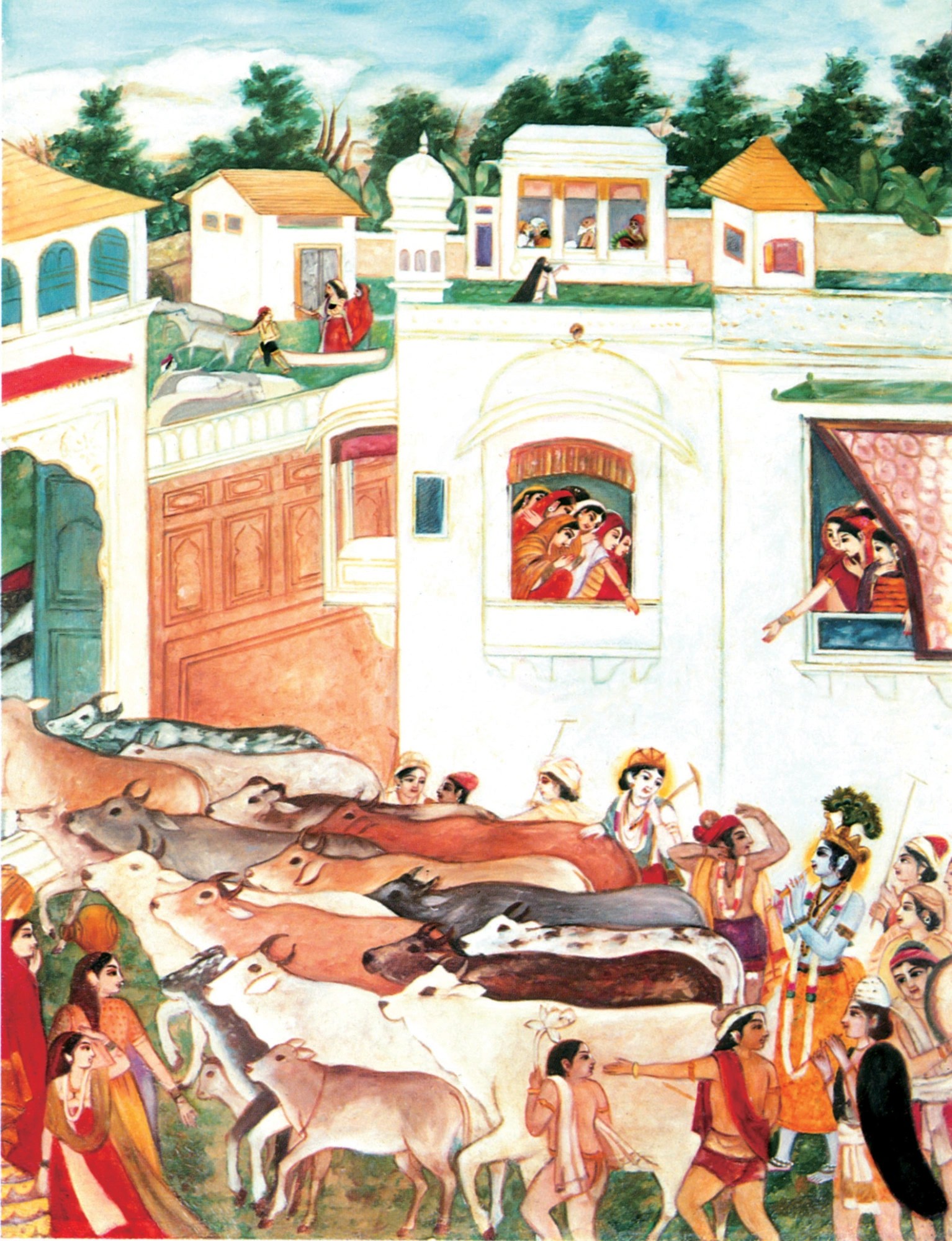
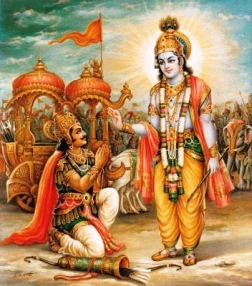
The illustrations of Bhagavad-gītā As It Is were painted by members of the International Society for Krishna Consciousness working under the personal direction of the author, their spiritual master, In the following descriptive index, the numbers in boldface type which follow each plate number refer to the chapter and verse of the Gītā that the picture illustrates.
(Srila Prabhupada and George Harrison, London, 1973)
“I liked Prabhupada’s humbleness. I always liked his humility and his simplicity The servant of the servant of the servant is really what it is, you know. None of us are God—just His servants. He just made me feel so comfortable. I always felt very relaxed with him, and I felt more like a friend. I felt that he was a good friend. Even though he was at the time seventy-nine years old, working practically all through the night, day after day, with very little sleep, he still didn’t come through to me as though he was a very highly educated intellectual being, because he had a sort of childlike simplicity. Which is great, fantastic. Even though he was the greatest Sanskrit scholar and a saint, I appreciated the fact that he never made me feel uncomfortable. In fact, he always went out of his way to make me feel comfortable. I always thought of him as sort of a lovely friend, really, and now he’s still a lovely friend.”
“That was the thing about Prabhupada, you see. He didn’t just talk about loving Krishna and getting out of this place, but he was the perfect example. He talked about always chanting, and he was always chanting. I think that that in itself was perhaps the most encouraging thing for me. It was enough to make me try harder, to be just a little bit better. He was a perfect example of everything he preached.”
Seeing The Real Vrndavana
by Hayagriva Dasa
excerpted from Back To Godhead Magazine
Oct 1, 2006 Volume-03 Number-31 (Indian)
Learning from Srila Prabhupada how to see beyond the material coverings to perceive the real dhama
I bend down to get through the door and enter a small, sparsely furnished room. Suddenly, I’m face to face with Srila Prabhupada. He’s sitting on the floor behind a low desk piled with books and papers.
“Jai!” he says. “Our Hayagriva has arrived.”
I pay dandabat obeisances by prostrating myself and touching his feet with my right hand. Then I place my hand to my forehead. To remember the spiritual master’s lotus feet is to remember Krsna. The effect is as cooling as sandalwood.
“nama om visnu-padaya krsna presthilya bhu-tale srimate bhaktivedanta- svamin iti namine,” I say, offering respects. Then I sit before him, and he smiles.
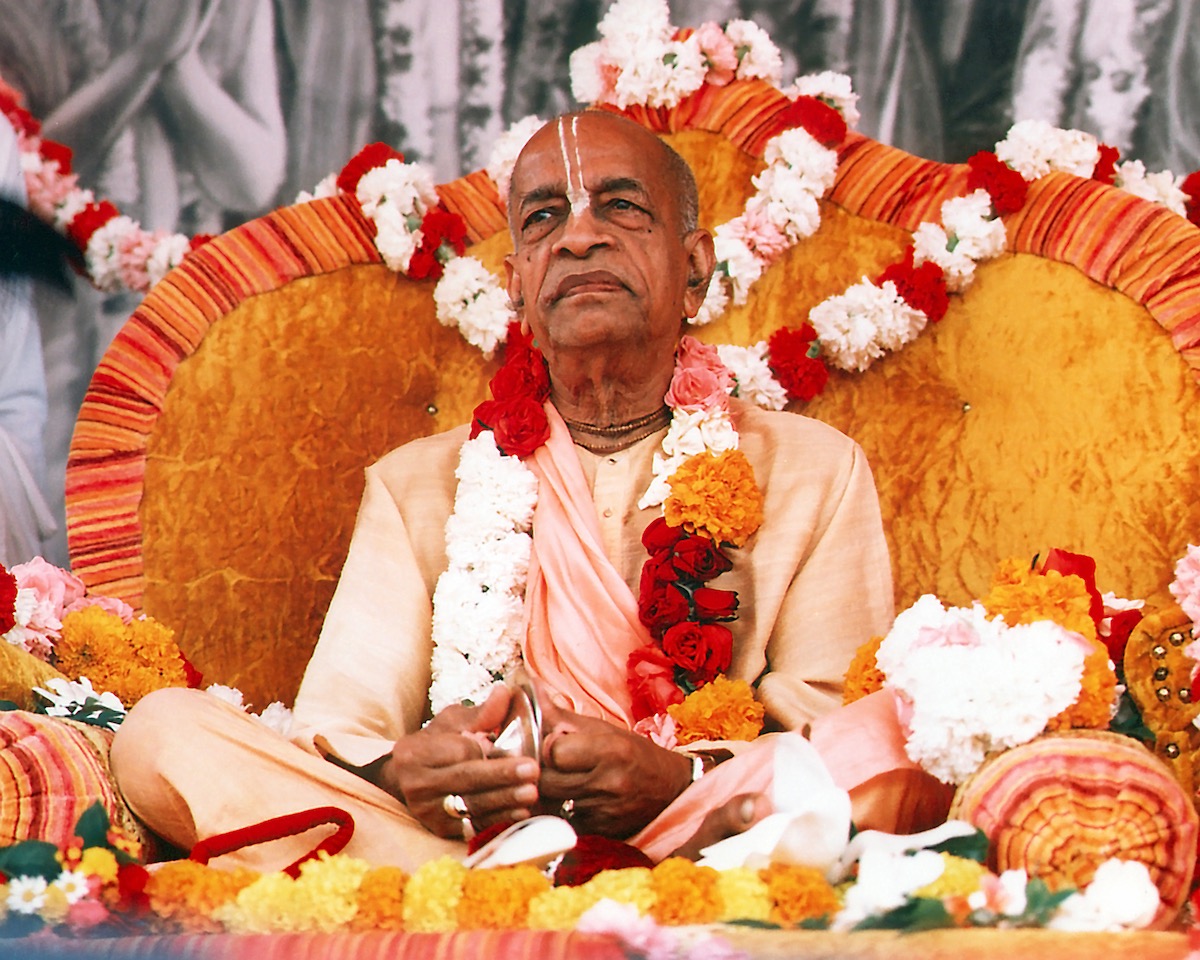
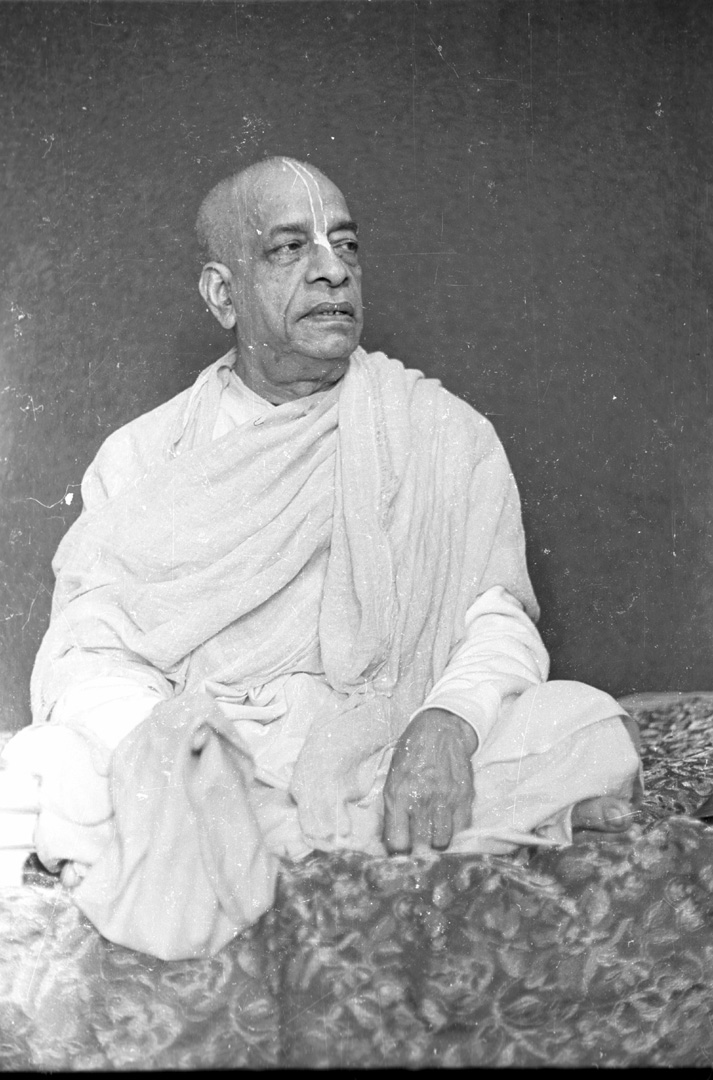
Although seventy-six, Prabhupada seems as ageless as ever. His head is freshly shaved, and the aroma of mustard- seed oil tells me that he has just received a massage. His complexion is radiant, his eyes clear, his face full and healthy. This is the face that attracted me that day when I was walking down New York’s Houston Street and first met him, the face that brought so many young seekers to that little storefront temple on Monday, Wednesday, and Friday nights. For us, his face embodies all the attractive qualities of devotion, for it’s a pure, truthful, and compassionate face. It is both happy and grave. It is magnanimous, gentle, and forgiving. It is also determined and self-controlled, and, above all, most learned and intelligent. It’s a face not afraid to love and give all in love for Krsna.
Indeed, Prabhupada’s face conjures all those virtues that lead to love of Krsna. It’s not an ordinary man’s face. It transports an entire spiritual fact, the Vedic culture, an atmosphere of bhakti . I first began realizing his potency just by Jlooking at his face. Whenever I’m Kr,na conscious, it makes me joyful. Whenever I’m not, I’m afraid to look at it; it accuses me, makes me ashamed without uttering a word. What power there is in the spiritual master’s face! What magne tism! What volumes of wisdom! ‘
“I’m glad you invited me here, Srila Prabhupada,” I say.
Prabhupada: Oh. [break] Krsna dasa, some scientists say that there is no life in the other planets, and some scientists said there may be. So who is correct?
Paramahamsa: Well, didn’t the Yamadutas… You stated in your lecture yesterday that the Yamadutas said that what is truth is what is in the Vedas. So I assume from the Vedic knowledge that there is life on other planets. Logically speaking also.
Prabhupada: Yes. How can you say there is no life?
I have read and re-read the Foreward to The Science of Self Realization by Mukunda dasa Goswami many times now, and every time I am moved by this written account.
…From the very start, I knew that His Divine Grace A. C. Bhaktivedanta Swami Prabhupāda was the most extraordinary person I had ever met. The first meeting occurred in the summer of 1966, in New York City. A friend had invited me to hear a lecture by “an old Indian svāmī” on lower Manhattan’s Bowery. Overwhelmed with curiosity about a svāmī lecturing on skid row, I went there and felt my way up a pitch-black staircase. A bell-like, rhythmic sound got louder and clearer as I climbed higher. Finally I reached the fourth floor and opened the door, and there he was. (Mukunda dasa Goswami from Foreward to The Science of Self Realiztion)
…The idea is that one gopī is advising another gopī, “My dear friend, there is one boy. His name is Govinda. He is standing on the bank of Yamunā near the Keśi-ghāṭa, and He’s playing on His flute. And He’s so beautiful that especially during full moon night, please do not go there.” [laughter] Why? “Now, because if you have got intention to enjoy in this material world with your family members, wife, children, husband, please do not go there.” Smerān bhaṅgī-traya-paricitāṁ sāci-vistīrṇa-dṛṣṭim. Bhaṅgī-traya. “Kṛṣṇa always stands in three-curved way with His flute. That is Kṛṣṇa’s tri-bhaṅga-murāri.” Tri-bhaṅga. Three places, He is bent. (Lecture 1.2.12)
Lecture on the Śrīmad-Bhāgavatam
By His Divine Grace A. C. Bhaktivedanta Swami Prabhupada
First Canto, Chapter 2, Text 12
The Nectar of Devotion Lecture
given by His Divine Grace A. C. Bhaktivedanta Swami Prabhupada
Vṛndāvana, October 19, 1972
Pradyumna: (reading) “…happiness immediately terminates with his body as long as his life, as soon as his life is over. Death is therefore taken as the representative of God for the atheistic class of men. The devotee realizes the presence of God by devotional service, whereas the atheist realizes the presence of God in the shape of death.”
Prabhupāda: Yes. This point we have discussed last night that everyone can see God. To see God is not very difficult job. There are so many points described in the Bhagavad-gītā. For the devotees, those who are serious about seeing God, they can see God. God is present everywhere. And God Himself, Kṛṣṇa, is describing, raso ‘ham apsu kaunteya prabhāsmi śaśi-sūryayoḥ [Bg. 7.8]. So everyone drinks water. Now Kṛṣṇa says, “The taste of the water, I am.” So who has not tasted the water? Everyone drinks water at least four times, five times. So as soon as you drink water, the taste of the water is Kṛṣṇa. Kṛṣṇa says, “I am this.” Kṛṣṇa has described Himself in so many ways. “Amongst the trees, I am this. Amongst the aquatics, I am this. Amongst the nonmovable, I am this.” So why not see God in that way? The atheist class of men, they say, “Can you show me God?” So why don’t you see God? Why you close your eyes? If you have got eyes to see, you can see God everywhere.
The following is a very nice post written by Madhudvisa Prabhu, it is heavy, but is backed up by scripture and quotes by Srila Prabhupada himself. It was worth my time reading, and thus I share it with all of you. Hare Krishna!
The Guru Is A Pure Devotee!
by Madhudvisa dasa
During Srila Prabhupada’s physical presence there was no confusion in ISKCON over the qualifications and qualities of a bona fide guru. Srila Prabhupada was personally present and he exhibited all the qualities perfectly and all the devotees understood the spiritual master was a pure devotee. That’s what Srila Prabhupada demonstrated by his personal actions, that’s what he wrote in his books, that’s what he preached in his classes and that’s what the devotees understood and accepted. The spiritual master is a transparent via-medium to Krishna. His words are non-different from Krishna’s, hearing him is just as good as hearing Krishna personally. And his words are absolute and perfect because he is not presenting his own ideas, he is simply repeating what Krishna and the previous acaryas have said in a way suitable for the understanding of the audience. He’s not changing the message, adulterating it or adding in any ideas of his own, he’s presenting Krishna’s words and Krishna’s philosophy AS IT IS.
My dear friend from the Prabhupada Connection, Padmpani Prabhu, sent me the following post in my mail box the other day and gave me his permission to post it. So with great pleasure we are posting it here.. Please, if you havn’t already, check out his famous site The Prabhupada Connection
Whatever Happened to the Revolution?
For many of us who came of age in the Sixties and Seventies, the counterculture and its promise of an alternative society based on love and peace was an important part of our lives. Art, music, poetry, philosophy, ecology and human rights were just a few of the buzzwords floating through the collective psyche of the Sixties generation. Revolution was in the air. “The establishment” was doomed and soon to be replaced with a kinder, gentler society. Peace would reign supreme and all peoples of the world would unite and be free from the chains of oppression. Or so we thought.
At the time, it appeared that massive cultural changes were about to sweep away the capitalist system (or the “military industrial complex,” as we used to call it). Every day there was a new victory for change. Underground newspapers proliferated, broadcasting the latest progress reports: the sit-ins, the love-ins, the be-ins, the antiwar and civil rights demonstrations, the Democratic National Convention of 1968, the Chicago Seven Trial, Woodstock, etc. Something was happening here, and it was big.
The following PDF file entitled “Prabhupada” is a very nice little pamphlet describing Srila Prabhupada’s Journey to the West, the society he formed, his teachings, ect. It is very nice and you can click on the following link to view it or save it to your comuputer.
click of the following link to veiw or save pdf file Prabhupada
The Nectar of Devotion Lectures
Given by His Divine Grace A. C. Bhaktivedanta Swami Prabhupada
Vṛndāvana, October 19, 1972
Pradyumna: (reading) “…happiness immediately terminates with his body as long as his life, as soon as his life is over. Death is therefore taken as the representative of God for the atheistic class of men. The devotee realizes the presence of God by devotional service, whereas the atheist realizes the presence of God in the shape of death.”
Prabhupāda: Yes. This point we have discussed last night that everyone can see God. To see God is not very difficult job. There are so many points described in the Bhagavad-gītā. For the devotees, those who are serious about seeing God, they can see God. God is present everywhere. And God Himself, Kṛṣṇa, is describing, raso ‘ham apsu kaunteya prabhāsmi śaśi-sūryayoḥ [Bg. 7.8]. So everyone drinks water. Now Kṛṣṇa says, “The taste of the water, I am.” So who has not tasted the water? Everyone drinks water at least four times, five times. So as soon as you drink water, the taste of the water is Kṛṣṇa. Kṛṣṇa says, “I am this.” Kṛṣṇa has described Himself in so many ways. “Amongst the trees, I am this. Amongst the aquatics, I am this. Amongst the nonmovable, I am this.” So why not see God in that way? The atheist class of men, they say, “Can you show me God?” So why don’t you see God? Why you close your eyes? If you have got eyes to see, you can see God everywhere.
The Nectar of Devotion Lecture
By His Divine Grace A. C. Bhaktivedanta Swami Prabhupada
Vṛndāvana, October 19, 1972
Pradyumna: (reading) “…happiness immediately terminates with his body as long as his life, as soon as his life is over. Death is therefore taken as the representative of God for the atheistic class of men. The devotee realizes the presence of God by devotional service, whereas the atheist realizes the presence of God in the shape of death.”
Prabhupāda: Yes. This point we have discussed last night that everyone can see God. To see God is not very difficult job. There are so many points described in the Bhagavad-gītā. For the devotees, those who are serious about seeing God, they can see God. God is present everywhere. And God Himself, Kṛṣṇa, is describing, raso ‘ham apsu kaunteya prabhāsmi śaśi-sūryayoḥ [Bg. 7.8]. So everyone drinks water. Now Kṛṣṇa says, “The taste of the water, I am.” So who has not tasted the water? Everyone drinks water at least four times, five times. So as soon as you drink water, the taste of the water is Kṛṣṇa. Kṛṣṇa says, “I am this.” Kṛṣṇa has described Himself in so many ways. “Amongst the trees, I am this. Amongst the aquatics, I am this. Amongst the nonmovable, I am this.” So why not see God in that way? The atheist class of men, they say, “Can you show me God?” So why don’t you see God? Why you close your eyes? If you have got eyes to see, you can see God everywhere.
What is the Position of Lord Shiva?
By His Divine Grace A. C. Bhaktivedanta Swami Prabhupada
(excerpted from Bhagavad-gita class, Dec. 11, 1967)
Madhudvisa: Prabhupāda? What is the position of Lord Shiva?
Prabhupāda: Lord Shiva is a demigod, but he is higher than all other demigods. He’s higher than Lord Brahmā also. But he’s not the Supreme Lord. Just like there are different gradations. That is not difficult to understand. In society also, there are different gradations. Similarly, the living entities, there are different gradations. Some of the living entities are situated in higher planets, some of them are situated in lower planets and some of them are situated in high-grade life and some in low-grade life. So the demigods are also living entities, but they are enjoying better standard of life due to their acts of piety. But Lord Shiva is not amongst the living entities. He’s above the living entities but he is counted as one of the demigods. But his position is better than Lord Brahmā even. Brahmā is said to be the highest living entity within the universe, and Lord Shiva’s position is higher than that of Lord Brahmā.
…Yes. Those who are spiritually advanced, their photograph and ordinary photograph is different. Just like here is statue of Kṛṣṇa. He’s not different from Kṛṣṇa. The original person Kṛṣṇa and this statue of Kṛṣṇa is the same. Similarly, a spiritually perfect person and his photograph is the same. Because it is in the absolute stage. In the absolute stage there is no difference. In the material stage there is difference. Is that clear?… (Srila Prabhupada Bhagavad-gita Lecture Sept. 16, 1966)
Recently I was staying at a friends house, and in the room where I was spending the night there was one book by Giriraj Swami entitled “Watering the Seed”. I happened to open it and began reading from the Preface:
…from that first meeting with Srila Prabhupada, my whole life’s purpose became to bring people to meet Srila Prabhupada. And I was able to do that for many years. But when he passed away, I wondered ‘what will be my service now?’. My whole service had been to bring people to Srila Prabhupada.
Now I understand that Srila Prabhupada is always present, and that by speaking of him, hearing about him, remembering him, and, most significantly, by studying his books and following his instructions, we can experience his presence. So I can continue doing what I was doing when he was personally present-introducing soul’s to Srila Prabhupada-and that is what I feel most natural doing. Because I know that somehow or other, if someone comes in touch with Srila Prabhupada, his life will become successful. (Watering the Seed, Preface)
Now, I am always encouraged when I hear my Godbrothers speaking in this way, because this is how I have always felt, and continue to feel. That my main purpose, as a disciple, is to bring people to Srila Prabhupada, and there-by bringing them to Krishna.










 The Hare Krishna Movement
