08 Aug 2013
by The Hare Krishna Movement
in Krishna, Krishna Consciousness, Krsna-katha
Tags: Govinda, He is playing on His flute, Kesi-ghat, Krishna, Krsna

“My dear friend, there is one boy—His name is Govinda. He is standing on the bank of the Yamuna near the Kesi-ghat, and He is playing on His flute. He is so beautiful, especially during this full-moon night. If you have any intentions to enjoy in this material world with your children, husband, or other family members, then please do not go there.”
More
05 Aug 2013
by The Hare Krishna Movement
in A.C. Bhaktivedanta Swami Prabhupada, Bhagavad-gita, Spiritual Life
Tags: A.C. Bhaktivedanta Swami Prabhupada, as it is, Bg 4.9, bhagavad-gita, cintamani-prakara-sadmasu, dancing and playing with Krsna, Krsna, material world, our real position, Prabhupada Lecture, prabhupada vani, that is Vrindavan, Vrindavan picture
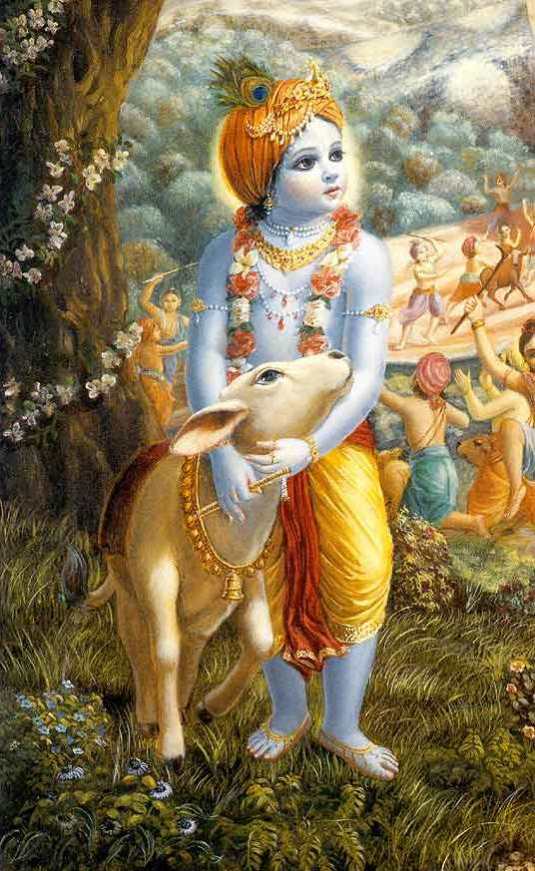
Recently I celebrated another Birthday, and on one card there was this nice inscription; “we are meant for dancing and playing and walking and living with Krsna. That is our real position. That is Vrndavana.” So beautiful was this statement from one of Srila Prabhupada’s lectures, that I looked it up in Prabhupada Vani to read the entire lecture (you can click on underlined link).
…we are meant for dancing and playing and walking and living with Krsna. That is our real position. That is the Vrndavana. Everyone… Everyone is connected with Krsna. … the trees, the flowers, water, the cows, the calves, the cowherd boys, the elderly cowherd men, Nanda Maharaja, Yasodamayi, the gopis. Krsna comes with full Vrndavana picture, and He demonstrates His Vrndavana life, cintamani-prakara-sadmasu, just to attract us, that “You are trying to enjoy in this material world, but here you cannot enjoy because you are eternal. You cannot get eternal life here. So you come to Me. You come to Me.” Tyaktva deham punar janma naiti mam eti kaunteya [Bg. 4.9]. (Lecture given by His Divine Grace A. C. Bhaktivedanta Swami Prabhupada, 21 Feb 76, Mayapura)
Full text and purport to Bg. 4.9 More
05 Jul 2013
by The Hare Krishna Movement
in A.C. Bhaktivedanta Swami Prabhupada, Spiritual World, Teachings of Lord Chaitanya
Tags: A.C. Bhaktivedanta Swami Prabhupada, Aniruddha, Damodara, devotees, four-handed, Hrsikesa, Krsna, Madhava, Madhusudana, Narayana, Padmanabha, prabhava form, Pradyumna, Sankarsana, spiritual sky, Sridhara, Teachings of Lord Chaitanya, Trivikrama, universe, vaisnava calendar, Vamana, Vasudeva, vilasa-murti, Visnu

click on image
Sometime back I ran across this picture and saved it to my files thinking I could use it in a post someday. While posting this chapter from the Teachings of Lord Caintanya, entitled “Unlimited Forms of Godhead”, I was looking for an image to use. So I selected the above image and to my surprise when I clicked on it, it moved. I had forgotten how cheesy cool this image was, and why it captured my interest, back when I saved it. So we share it today with our readers, and thank the unknown artist who put this picture to life.
…The different forms of Kṛṣṇa are distributed throughout the universe to give pleasure to the devotees. It is not that devotees are born only in India. There are devotees in all parts of the world, but they have simply forgotten their identity. These forms incarnate not only to give pleasure to the devotee but to reestablish devotional service and perform other activities which vitally concern the Supreme Personality of Godhead.
Teachings of Lord Chaintanya
By His Divine Grace A.C. Bhaktivedanta Swami Prabhupada
Chapter Seven
More
03 Jul 2013
by The Hare Krishna Movement
in A.C. Bhaktivedanta Swami Prabhupada
Tags: A.C. Bhaktivedanta Swami Prabhupada, Arjuna, bhakta, devotion, devotional service, Gita, impersonal, impersonal Brahman, impersonalists, karmi, Krishna, Krsna, meditation, personalists, spiritual realization, spiritual sky, unmanifested, yogi

In this 12th chapter of the Bhagavad-gita As It Is entitled Devotional Service, the path of liberation is explained…
For one who worships Me, giving up all his activities unto Me and being devoted to Me without deviation, engaged in devotional service and always meditating upon Me, who has fixed his mind upon Me, O son of Pṛthā, for him I am the swift deliverer from the ocean of birth and death.
Also a nice description of the qualities of a devotee are given…
One who is not envious but who is a kind friend to all living entities, who does not think himself a proprietor, who is free from false ego and equal both in happiness and distress, who is always satisfied and engaged in devotional service with determination and whose mind and intelligence are in agreement with Me—he is very dear to Me.
Full Chapter More
22 Jun 2013
by The Hare Krishna Movement
in Back to Godhead, Bhaktivinoda Thakura, Brahmananda das, Gaudiya Vaisnavism
Tags: A.C. Bhaktivedanta Swami, Acaryas, age of quarrel, Back to Godhead Magazine, Bengali, Brahmananda dasa, Kali-yuga, Krsna, Lord Caitanya, sastras, scriptures, Srila Bhaktivinoda Thakur, Vedas
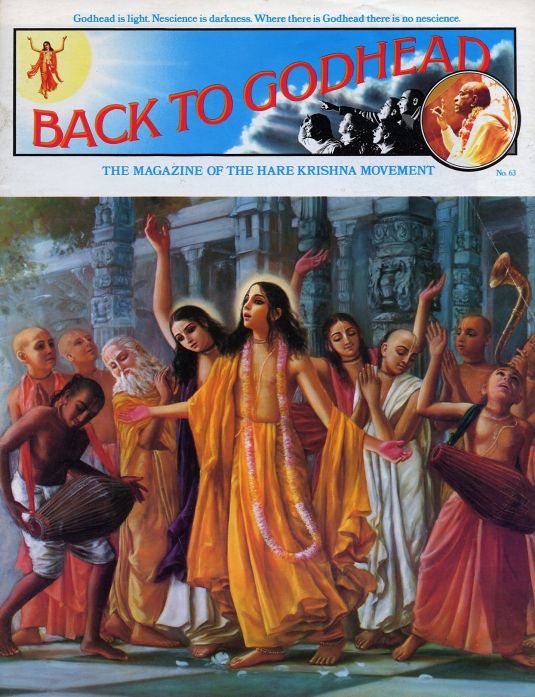
This is a very informative article which gives not only some of the History of Lord Caitanya’s Mission, but on the preaching of Srila Bhaktivinoda Thakur, Gaudiya Vaisnavism, and the Hare Krishna Movement here in the West.
How the Teachings of Lord Caitanya Came to the Western World
Excerpted from Back to Godhead Magazine
Vol.1, No. 66, 1974
Part 1
by His Holiness Brahmananda Swami
“He reasons ill who tells that Vaisnavas die When thou art living still in Sound! The Vaisnavas die to live and living try To spread a holy life around!”—verse by Srila Bhaktivinoda Thakura on the tomb of the great saint Thakura Haridasa at Puri, India
In Calcutta in 1896, the teachings of Lord Caitanya began their journey to the West. In Bengali-speaking Calcutta on August 20th of that year, Srila Bhaktivinoda Thakura published a small English treatise entitled Lord Caitanya—His Life and Precepts. Seventyone years later, in 1967, in Montreal, Canada, a graduate student came across a copy of this book while browsing through the rare-book collection of the McGill University library. The book was a wonderful find for him because he was a dedicated follower of Lord Caitanya’s, having been convinced of Lord Caitanya’s teachings by His Divine Grace A.C. Bhaktivedanta Swami Prabhupada, whom he had accepted as his spiritual master. Srila Prabhupada was born in Calcutta on September 1, 1896, only a few days after Lord Caitanya-His Life and Precepts was published. Thus by a transcendental arrangement this significant book and he who would fulfill the purpose of the book appeared together.
More
09 Jun 2013
by The Hare Krishna Movement
in A.C. Bhaktivedanta Swami Prabhupada
Tags: 1972 Edition, A.C. Bhaktivedanta Swami Prabhupada, Arjuna, as it is, Bg. 11, bhagavad-gita, Chapter Eleven, Krishna, Krsna, prabhupada gita, spiritual master, Supreme Lord, Supreme Personality of Godhead, Universal Form
18 May 2013
by The Hare Krishna Movement
in Back to Godhead, Jananivasa das, Mahamaya devi dasi, Radha Madhava
Tags: Back to Godhead Magazine, Jananivasa dasa, Krsna, Madhava, Mahamaya devi dasi, Mayapur Chandrodaya Mandir, Radha, Radha-Krsna, Radha-Madhava, Radhapada, Radharani, Sri Sri Radha-Madhava, Srila Prabhupada, the husband of the goddess of fortune
The Center of Attention: Radha-Madhava
by Jananivasa Dasa
Excerpted from Back to Godhead Magizine, 1999, Vol. 33, No. 6

At the heart of any Krsna conscious community are the Deities. On the main altar of the Mayapur Chandro-daya Mandir (ISKCON’s temple in Mayapur) stand Sri Sri Radha-Madhava (Radha-Krsna) along with Radha’s eight intimate gopi (cowherd girl) friends. Overseeing the worship is Jananivasa Dasa, who has been serving the Deities in Mayapur for forty-one years. The following history of Radha-Madhava was adapted from an interview with Jananivasa conducted by Mahamaya Devi Dasi.
…Once I was standing in the Deity room near Srila Prabhupada while he was viewing the Deities, and he said, “They’re dancing.”
Another time he said, “You see how Radharani is standing like this—” (imitating Her outstretched hand) “holding something out to Krsna? Sometimes Radharani is holding her hand up like this [in blessing pose]. When She’s like that, Krsna can leave Her. But when She’s offering something to Him, He can never leave.”
Once a devotee asked, “Srila Prabhupada, we’re sitting in these rice fields, and you’ve asked us to build a city. Where is all the money going to come from?”
Srila Prabhupada laughed. “You are always worried about where the money will come from. Here we have Radha-Madhava. ‘Madhava’ means the husband of the goddess of fortune. You just worship Radha-Madhava nicely, and everything will come by Their mercy. You don’t have to worry about money.”

click on image to enlarge
More
30 Mar 2013
by The Hare Krishna Movement
in A.C. Bhaktivedanta Swami Prabhupada, Gopis, Krsna Consciousness, KRSNA The Supreme Personality of Godhead, Spiritual World
Tags: A.C. Bhaktivedanta Swami Prabhupada, bank of the Yamuna, disciplic succession, Durga, goddess durga, goddess katyayani, gopi girls, gopis, Katyayani, Krsna, Lord Caitanya, Stealing the Garments of the Unmarried Gopi Girls, The Supreme Personality of Godhead, unmarried girsl, Vrndavana, Yamuna

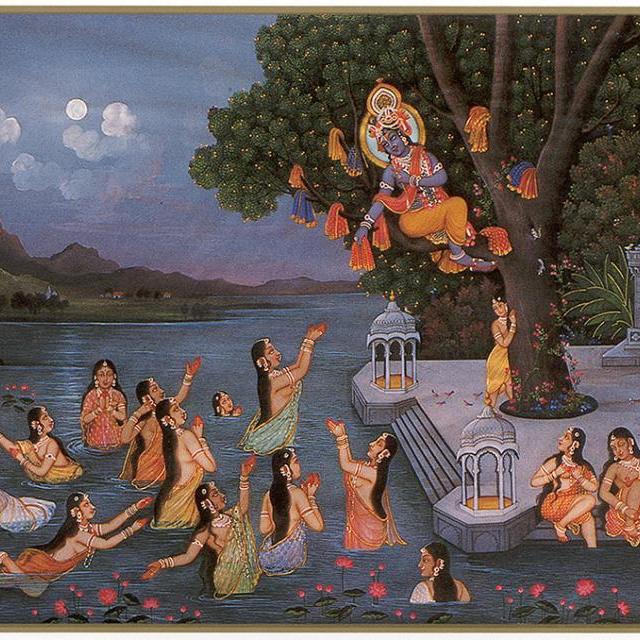
…The unmarried gopīs used to prepare the deity of goddess Durgā and worship it with candana pulp, garlands, incense lamps and all kinds of presentations-fruits, grains and twigs of plants. After worshiping, it is the custom to pray for some benediction. The unmarried girls used to pray with great devotion to goddess Kātyāyanī, addressing her as follows: “O supreme eternal energy of the Personality of Godhead, O supreme mystic power, O supreme controller of this material world, O goddess, please be kind to us and arrange for our marriage with the son of Nanda Mahārāja, Kṛṣṇa.”
…Early in the morning, the gopīs used to go to the bank of the Yamunā to take bath. They would assemble together, capturing each other’s hands, and loudly sing of the wonderful pastimes of Kṛṣṇa. It is an old system among Indian girls and women that when they take bath in the river they place their garments on the bank and dip into the water completely naked. The portion of the river where the girls and women take bath was strictly prohibited to any male member, and this is still the system. The Supreme Personality of Godhead, knowing the minds of the unmarried young gopīs, benedicted them with their desired objective. They had prayed for Kṛṣṇa to become their husband, and Kṛṣṇa wanted to fulfill their desires.
More
27 Mar 2013
by The Hare Krishna Movement
in A.C. Bhaktivedanta Swami Prabhupada, Caitanya Mahaprabhu, Festivals, Gaura Purnima, Lectures
Tags: A.C. Bhaktivedanta Swami Prabhupada, appearance day of Sri Caitanya, devotee, Gaura Purnima, His Divine Grace Srila Prabhupada, Kali-yuga, Krishna, Krsna, Lord Caitianya, Mayapur, Sri Caitanya Mahaprabhu, Sri Gaura Purnima, sri-krsna-caitanya radha-krsna nahe anya, tri-yuga

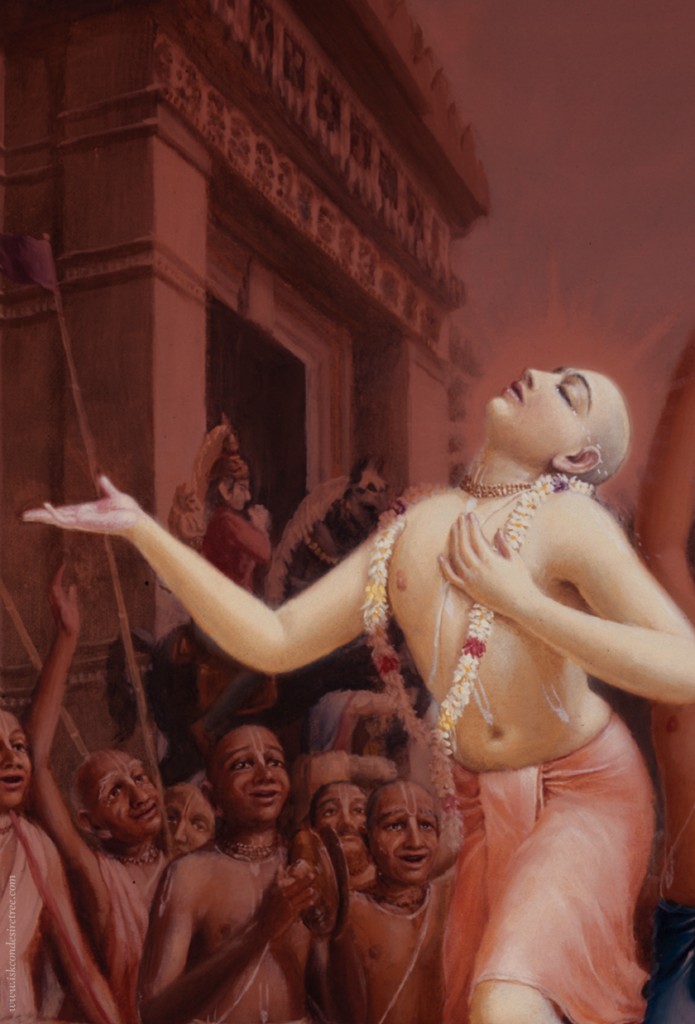
Today as most of the world celebrates Gaura Purnima, (Appearance day of Śrī Caitanya Mahāprabhu), I was reminded of a lecture given by His Divine Grace Srila Prabhupada on Gaura Purnima in Mayapur, India, March 16th, 1976. So with pleasure we are posting this famous Gaura Purnima lecture in its entirety.
Prabhupāda:…Śrī Caitanya Mahāprabhu is the Supreme Personality of Godhead, Kṛṣṇa. Śrī-kṛṣṇa-caitanya rādhā-kṛṣṇa nahe anya. You are worshiping Rādhā-Kṛṣṇa, and there is Caitanya Mahāprabhu’s Deity also. There are some parties, they protest, “Why Caitanya Mahāprabhu’s Deity should be placed along with Kṛṣṇa?” But they do not know śrī-kṛṣṇa-caitanya rādhā-kṛṣṇa nahe anya. It is not different. So Śrī Kṛṣṇa Caitanya is Kṛṣṇa. It is confirmed by the śāstras. Here it is said, channaḥ kalau yad abhava. In the Kali-yuga, directly He does not appear as the incarnation like Nṛsiṁhadeva or Vāmanadeva or Lord Rāmacandra, yes, but as devotee. So He’s the same incarnation, Lord Caitanya Mahāprabhu. Abhavat. “Therefore sometimes You are called as tri-yuga.” There are four yugas, but He is known… Because in three yugas He appears distinctly, and in the fourth yuga, the Kali-yuga, as devotee, therefore He’s called tri-yuga. So today is the birthday or appearance day of Śrī Caitanya Mahāprabhu, and this is the birthplace, this Māyāpura, and you are all present here. It is a good fortune. Always remember Śrī Caitanya Mahāprabhu and chant śrī-kṛṣṇa-caitanya prabhu-nityānanda…
Devotees: …śrī-advaita gadādhara śrīvāsādi-gaura-bhakta-vṛnda.
Prabhupāda: This will make your life perfect.
Full Lecture More
19 Mar 2013
by The Hare Krishna Movement
in A.C. Bhaktivedanta Swami Prabhupada, Caitanya Mahaprabhu, Sri Caitanya-Caritamrta, Srimati Radharani
Tags: A.C. Bhaktivedanta Swami Prabhupada, bumblebee, Krishna, Krsna, kumkuma, Mathura, Radha, Radharani, Spring, Srimati Radharani, The Song to the Bumblebee, Uddhava

“My dear bumblebee, you are a very cunning friend of Uddhava and Kṛṣṇa. You are very expert in touching people’s feet, but I am not going to be misled by this. You appear to have sat on the breasts of one of Kṛṣṇa’s friends, for I see that you have kuṅkuma dust on your mustache. Kṛṣṇa is now engaged in flattering all His young girl friends in Mathurā. Therefore, now that He can be called a friend of the residents of Mathurā, He does not need the help of the residents of Vṛndāvana. He has no reason to satisfy us gopīs. Since you are the messenger of such a person as He, what is the use of your presence here? Certainly Kṛṣṇa would be ashamed of your presence in this assembly.”
Full Text and Purport More
12 Mar 2013
by The Hare Krishna Movement
in A.C. Bhaktivedanta Swami Prabhupada, Chanting Hare Krishna, Krishna Consciousness, Mantra Meditation, Sankirtan, Srimad Bhagavatam
Tags: A.C. Bhaktivedanta Swami Prabhupada, age of kali, chant Hare Krishna, full of faults, Hare Krishna Mantra, Kali-yuga, kirtanad eva krsnasya, Krsna, krsna consciousness, Lord Caitanya Mahaprabhu, sankirtana movement, Srila Prabhupada, The Hare Krishna Movement
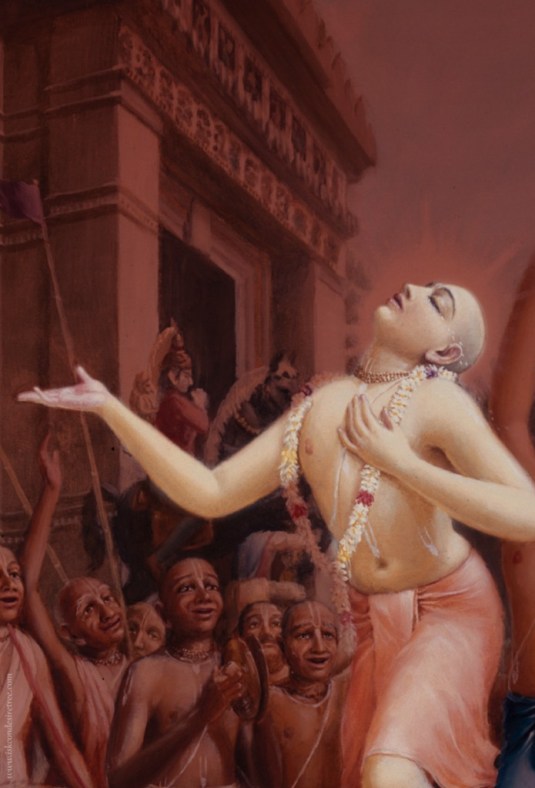
“In the sastra it is said this Kali-yuga is full of faults, so many faults. It is the ocean of faults. But there is a very nice thing, asti hy eko mahan gunah, a very great quality. What is that? Kirtanad eva krsnasya mukta-sangah param vrajet [SB 12.3.51]. If you simply chant Hare Krishna mantra, then you become perfect. Is it very difficult? Chant Hare Krishna and you become perfect. But we are so unfortunate, we are not even prepared to chant. This is our position. So you have to make little determination that ‘I shall chant henceforward Hare Krishna mantra.’ Then everything is all right.” (Srila Prabhupada from Lecture)
and this from Srimad Bhagavatam 8.5.23
When Kṛṣṇa appeared, He gave His orders, and when Kṛṣṇa Himself appeared as a devotee, as Śrī Caitanya Mahāprabhu, He showed us the path by which to cross the ocean of Kali-yuga. That is the path of The Hare Kṛṣṇa Movement. When Śrī Caitanya Mahāprabhu appeared, He ushered in the era for the saṅkīrtana movement. It is also said that for ten thousand years this era will continue. This means that simply by accepting the saṅkīrtana movement and chanting the Hare Kṛṣṇa mahā-mantra, the fallen souls of this Kali-yuga will be delivered. After the Battle of Kurukṣetra, at which Bhagavad-gītā was spoken, Kali-yuga continues for 432,000 years, of which only 5,000 years have passed. Thus there is still a balance of 427,000 years to come. Of these 427,000 years, the 10,000 years of the saṅkīrtana movement inaugurated by Śrī Caitanya Mahāprabhu 500 years ago provide the opportunity for the fallen souls of Kali-yuga to take to the Kṛṣṇa consciousness movement, chant the Hare Kṛṣṇa mahā-mantra and thus be delivered from the clutches of material existence and return home, back to Godhead.
Full Text and Purport More
11 Mar 2013
by The Hare Krishna Movement
in A.C. Bhaktivedanta Swami Prabhupada, Brahma, Krishna, KRSNA The Supreme Personality of Godhead
Tags: A.C. Bhaktivedanta Swami Prabhupada, Brahma, great swan carrier, humble obeisances, Krsna, Lord Brahma, prayers, Prayers Offered by Lord Brahma to Lord Krsna, Spiritual world, Srila Prabhupada, The Supreme Personality of Godhead, windows to the spiritual sky

Maybe it is just my mood, but I find all these stories from “Krsna, The Supreme Personality of Godhead” by Srila Prabhupada, to be transcendentally enlivening. They are like windows to the Spiritual World, and my mind just wants to hang on each and every word. So the following post is from my reading this weekend. Enjoy.
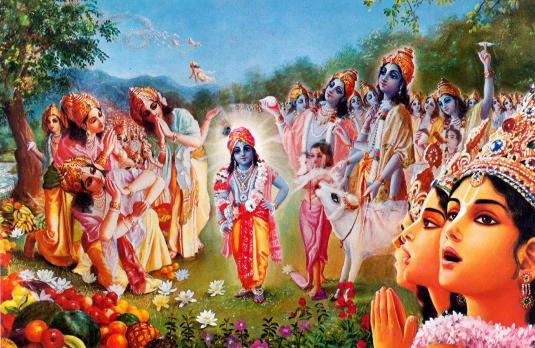
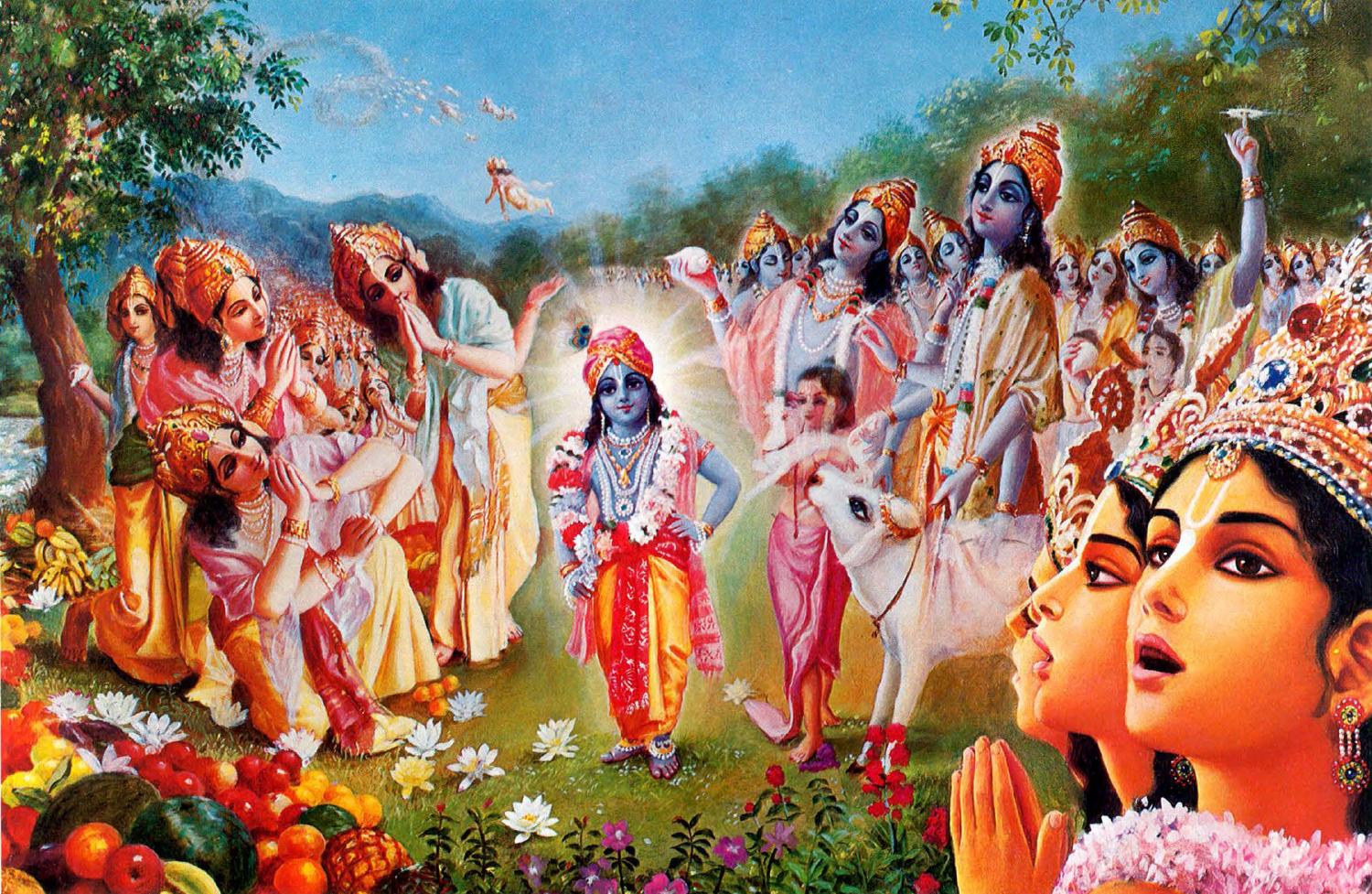
…Brahmā thus found Śrī Kṛṣṇa, the Supreme Personality of Godhead, playing the part of a small cowherd boy; he saw that little child with a lump of food in His left hand, searching out His friends, cows and calves, just as He was actually doing one year before, after their disappearance.
Immediately Brahmā descended from his great swan carrier and fell down before the Lord just like a golden stick. All the four helmets on the heads of Brahmā touched the lotus feet of Kṛṣṇa. Brahmā, being very joyful, began to shed tears, and he washed the lotus feet of Kṛṣṇa with his tears. Repeatedly he fell and rose as he recalled the wonderful activities of the Lord. After repeating obeisances for a long time, Brahmā stood up and smeared his hands over his eyes. Seeing the Lord before him, he, trembling, began to offer prayers with great respect, humility and attention. (from the end of Chapter 13, Kṛṣṇa, the Supreme Personality of Godhead)
…Brahmā said, ”My dear Lord, You are the only worshipful Supreme Lord, Personality of Godhead; therefore I am offering my humble obeisances and prayers just to please You. Your bodily features are of the color of clouds filled with water. You are glittering with a silver electric aura emanating from Your yellow garments.
“Let me offer my respectful repeated obeisances unto the son of Mahārāja Nanda who is standing before me with conchshell, earrings and peacock feather on His head. His face is beautiful; He is wearing a helmet, garlanded by forest flowers, and He stands with a morsel of food in His hand. He is decorated with cane and bugle, and He carries a buffalo horn and flute. He stands before me with small lotus feet. (beginning the 14 Chapter of Kṛṣṇa, the Supreme Personality of Godhead)
Full Chapter More
23 Feb 2013
by The Hare Krishna Movement
in A.C. Bhaktivedanta Swami Prabhupada, Balarama, Festivals, guru-tattva, Nityananda
Tags: 2-2-1977, A.C. Bhaktivedanta Swami, Balarama, Caitanya Mahaprabhu, guru, guru tattva, Krishna, Krsna, lecture by Prabhupada, Lord Nityananda's Appearance Day, Nityananda, spiritual master, Srila Prabhupada, yasya prasadad bhagavat-prasadah

click on image to enlarge
…Balarāma means guru-tattva. Balarāma represents guru. Yasya prasādād bhagavat-prasādaḥ. If we want to understand Caitanya Mahāprabhu, if we want to understand Kṛṣṇa, then we must take shelter of Balarāma. Nāyam ātmā bala-hinena labhyaḥ. This bala-hinena labhyaḥ, this Vedic injunction, means “Without the mercy of Balarāma you cannot understand, you cannot realize your spiritual identification. So that Balarāma comes as Nityānanda Prabhu.”
…So if we want actually peace of mind, if we actually want to be free from this material fatiguement, then we must take the shelter of Nityānanda Prabhu. Nityānanda Prabhu is the strength, spiritual strength. And without spiritual strength you cannot approach Kṛṣṇa.
More
18 Feb 2013
by The Hare Krishna Movement
in A.C. Bhaktivedanta Swami Prabhupada, Guru & Disciple, Krsna-katha, Srimad Bhagawatam
Tags: A.C. Bhaktivedanta Swami Prabhupada, bepetition of birth and death, bhagavad-gita, disciple, Krsna, Krsna-katha, liberated spiritual master, nivrtta-tarsaih, SB 10.1.4, Srila Prabhupada, Srimad Bhagavatam, Supreme Personality of Godhead
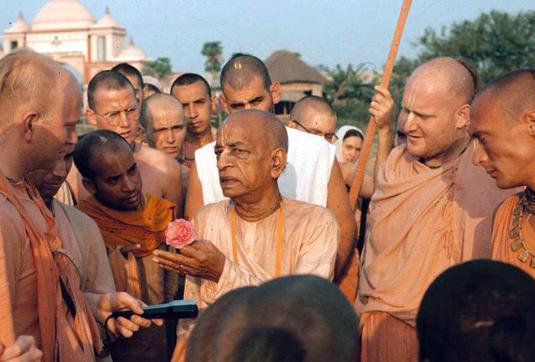
click on image to enlarge
…When discourses on kṛṣṇa-kathā take place between a liberated spiritual master and his disciple, others also sometimes take advantage of hearing these topics and also benefit. These topics are the medicine to stop the repetition of birth and death. The cycle of repeated birth and death, by which one takes on different bodies again and again, is called bhava or bhava-roga. If anyone, willingly or unwillingly, hears kṛṣṇa-kathā, his bhava-roga, the disease of birth and death, will certainly stop. Therefore kṛṣṇa-kathā is called bhavauṣadha, the remedy to stop the repetition of birth and death.
In India it is the practice among the general populace to hear about Kṛṣṇa, either from Bhagavad-gītā or from Śrīmad-Bhāgavatam, in order to gain relief from the disease of repeated birth and death. Although India is now fallen, when there is a message that someone will speak about Bhagavad-gītā or Śrīmad-Bhāgavatam, thousands of people still gather to hear. The following verse indicates, however, that such recitation of Bhagavad-gītā and Śrīmad-Bhāgavatam must be done by persons completely freed from material desires (nivṛtta-tarṣaiḥ).
If we hear the glories of the Supreme Personality of Godhead from liberated persons, this hearing will certainly free us from the bondage of material activities, but hearing Śrīmad-Bhāgavatam spoken by a professional reciter cannot actually help us achieve liberation. Kṛṣṇa-kathā is very simple. In Bhagavad-gītā it is said that Kṛṣṇa is the Supreme Personality of Godhead. As He Himself explains, mattaḥ parataraṁ nānyat kiñcid asti dhanañjaya: “O Arjuna, there is no truth superior to Me.” Simply by understanding this fact—that Kṛṣṇa is the Supreme Personality of Godhead—one can become a liberated person. (Purport SB 10.1.4)
Full Verse and Purport More
17 Feb 2013
by The Hare Krishna Movement
in Free Downloads, Free eBooks, Sri Rupa-cintamani, Vishvanatha Chakravarti
Tags: altar, and barleycorn, and conchshell, ari, barleycorn, bow, bracelet, chariot, club, conch, cow's hoofprint, earrings, elephant-goad, fish, flag, flower, halfmoon, jambu fruit, Krsna, left foot, lotus, mountain, parasol, Radha, Rupa Gosvami, sky, Sri Vishvanatha Chakravarti, svastika, the eight-pointed star, the parasol, the śakti, thunderbolt, triangle, vine, water-pot, wheel, ūrdhva-rekhā
click on image to enlarge
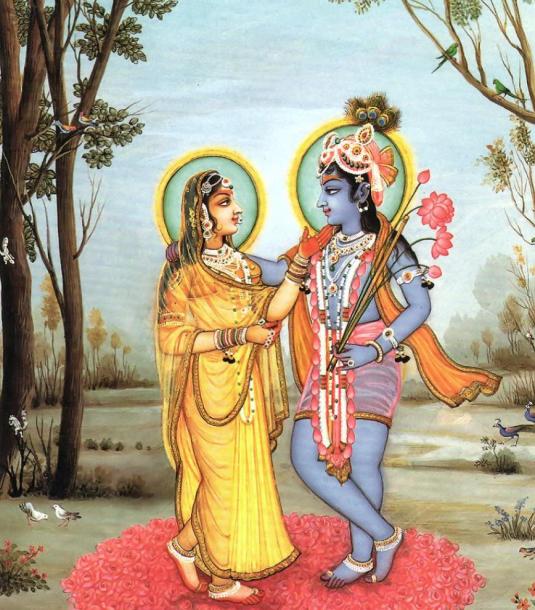
…Decorated with splendid jewel lotus petals, the youthful and fragrant divine couple are splendid as a monsoon cloud and lightning as They stand on a jeweled golden pavement under a tall kalpa-druma tree by the Yamunā in Vṛndāvana Forest. O mind, please always remember Their charming, gentle smile.
O mind, please remember Lord Hari’s splendid crown decorated with peacock feathers and guñjā, His wavy locks of hair, His forehead splendid with tilaka, His eyebrows, eyes, nose, splendid cheeks, ears, glittering jewel earrings, red lips, flute, face, arching neck marked with three lines, soft shoulders, broad arms decorated with armlets and other ornaments, hands, fingers marked with wavy lines, chest decorated with kaustubha jewel and garlands of pearls and forest flowers and the splendid mark of the goddess of fortune, the line of hairs on His splendid abdomen, His lotus navel, slender waist, tinkling bells, yellow garments, large knees, ankles decorated with tinkling ankle-bells, lotus feet, graceful toes, pink toenails, the redness that extends across the soles of His feet up to His heels, and on His right foot: the barleycorn-mark at the base of His big toe, the ūrdhva-rekhā by His fore-toe, the curved lotus in the middle of His foot, the flag on the surface of His foot, the elephant-goad and thunderbolt at the base of His little-toe, the four svastikas, the jambus, and the eight-pointed star in the middle.
A charming couple, two mountainous oceans of the nectar of the love they bear for each other, shines in Vṛndāvana Forest. The young girl, whose splendor rebukes the lightning flash, hides a gentle smile under Her blue sari. Please remember that smile.
O mind, please meditate on Rādhā’s fine, curly, braided hair, the jewel, golden leaf, tilaka, and curly hairs on Her forehead, Her eyebrows, mascara-anointed eyes, ears, the charming shark-shaped earings at Her cheeks, Her pearl-decorated nose, lips. splendid teeth, musk-dot-decorated chin, neck marked with three lines and decorated with many necklaces, gracefully sloping shoulders, armlet-decorated arms, elbows, lotus hands endowed with beautiful and auspicious lines and decorated with bracelets, jewel ūrmikās, rings, beautiful fingernails, breasts covered with a splendid red bodice, locket, flower-petal abdomen with a line of hairs, navel, slender waist marked with three lines, colorful undergarments, blue petticoat, thighs, knees, legs, ankles, anklets, ankle-bells, toe-ūrmikās, toe-rings, and toe-nails, the barleycorn and ari beneath Her left big-toe, the ūrdhva-rekhābeneath Her fore-toe, the small chariot nearby, the lotus, flag, flower, and vine in the middle, the elephant-goad beneath Her little-toe, beneath that a bracelet and parasol, on the heel a half-moon, on the heel of the other foot a fish, above that a flying mountain, on the sides a śakti and pada, under the big-toe a conchshell, under the little toe an altar, and beneath that an earring…
More
16 Feb 2013
by The Hare Krishna Movement
in A.C. Bhaktivedanta Swami Prabhupada, Radha Madhava, Science of Self Realization, Spiritual Life, Vrindavan
Tags: A.C. Bhaktivedanta Swami Prabhupada, cowherd boys, devotees, father, gopis, Kṛṣṇa’s associate as a friend, Krsna, Krsnaloks, or mother, reciprocation of love, self realization, servant, summit of self-realization, The Perfection of Self Realization
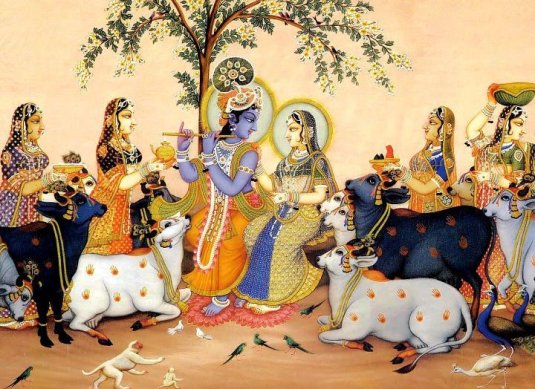
…Kṛṣṇa’s only business is satisfying the devotees, and their only business is satisfying Kṛṣṇa. This is the reciprocation of love… The Supreme Personality of Godhead, wanders on the banks of the Yamunā to please the gopīs, the cowherd boys, the birds, the bees, and the cows and calves. These are not ordinary birds, bees, cows, calves, or men; they have all reached the summit of self-realization and thus, after many, many lives, have attained a position whereby they can play with Kṛṣṇa. This Kṛṣṇa consciousness movement can enable everyone to go to Kṛṣṇaloka and become Kṛṣṇa’s associate as a friend, servant, father, or mother. Kṛṣṇa is agreeable to take any of these positions in relation to His devotee.
More
15 Feb 2013
by The Hare Krishna Movement
in A.C. Bhaktivedanta Swami Prabhupada, Book Changes, Mahesh Raja das
Tags: A.C. Bhaktivedanta Swami Prabhupada, book changes, conditioned souls, God, great scholar, Krishna, Krsna, Liberated souls, prakrta shajiyas, sahajiyas, srila prabhupada conversations, Srila Prabhupada lectures, Srila Prabhupada's writting, transcendental literature

click on image to slightly enlarge
Under the Direction of God (Krishna)
His Divine Grace Srila Prabhupada speaks as Krsna speaks
“It is not possible for a common man to write books on bhakti, for his writings will not be effective. He may be a very great scholar and expert in presenting literature in flowery language, but this is not at all helpful in understanding transcendental literature. Even if transcendental literature is written in faulty language, it is acceptable if it is written by a devotee, whereas so-called transcendental literature written by a mundane scholar, even if it is a very highly polished literary presentation, cannot be accepted. The secret in a devotee’s writing is that when he writes about the pastimes of the lord, the lord helps him; he does not write himself.
We Don’t Allow Any Literature Not Given by Liberated Soul
compiled by Sriman Mahesh Prabhu
The difference between Srila Prabhupada’s books and other so-called gurus’ (conditioned souls) writing is Srila Prabhupada’s instruction was coming directly from Krsna. This is the transcendental platform.
Srila Prabhupada encouraged his disciples, however, to write their realizations. Other conditioned souls may present their nonsense commentaries on Bhagavad-Gita etc., but they will never be quoted for references. Srila Prabhupada is on the trancendental platform and Krishna speaks through him, consequently only he will be quoted for reference.
More
07 Feb 2013
by The Hare Krishna Movement
in A.C. Bhaktivedanta Swami Prabhupada, Krishna, Subhadra
Tags: A.C. Bhaktivedanta Swami Prabhupada, Arjuna and Subhadra, Bahulasva, Goloka Vrndavana, grandmother subhadra, king bahulasva, King Pariksit, Krsna, omnipotency, opulence of the Supreme Personality of Godhead, Srutadeva, Subhadra, subhadra's kidnapping, vaibhava-prakasa

click on image to enlarge
…King Parīkṣit became more inquisitive to hear about Kṛṣṇa and His pastimes, and thus he inquired from Śukadeva Gosvāmī how his grandmother Subhadrā was kidnapped by his grandfather Arjuna at the instigation of Lord Kṛṣṇa. King Parīkṣit was very much eager to learn about his grandfather’s kidnapping and marriage of his grandmother.
Thus Śukadeva Gosvāmī began to narrate the story as follows: “Once upon a time, your grandfather Arjuna, the great hero, was visiting several holy places of pilgrimage, and while he was thus traveling all over he happened to come to Prabhāsakṣetra. In the Prabhāsakṣetra he heard the news that Lord Balarāma was negotiating the marriage of Subhadrā, the daughter of Arjuna’s maternal uncle, Vasudeva. Although her father, Vasudeva, and her brother, Kṛṣṇa, were not in agreement with Him, Balarāma was in favor of marrying Subhadrā to Duryodhana. Arjuna, however, desired to gain the hand of Subhadrā.”
As he thought of Subhadrā and her beauty, Arjuna became more and more captivated with the idea of marrying her, and with a plan in mind…
Full Chapter More
18 Jan 2013
by The Hare Krishna Movement
in A.C. Bhaktivedanta Swami Prabhupada, Brahma, KRSNA The Supreme Personality of Godhead, Vaisnava Vocabulary
Tags: A.C. Bhaktivedanta Swami Prabhupada, Brahma, chirping of the birds along with cooing of the peacocks, hearing and chanting, Krishna, Krsna, Lord Brahma, nityanavanavayamana, surrounded by the whispering of the leaves in the trees, The Stealing of the Boys and Calves by Brahma, The Supreme Personality of Godhead, vaisnava vocabulary, Vol.1 chapter 13
click on image to enlarge
Here is a new word for your vaisnava vocabulary, nityanavanavāyamāna This word is explained in following paragraph. And for an example of the word nityanavanavāyamāna in transcendental subject matter we offer the following chapter from the KRSNA Book.
It is said that it is the nature of a devotee to constantly apply his mind, energy, words, ears, etc., in hearing and chanting about Kṛṣṇa. This is called Kṛṣṇa consciousness, and for one who is rapt in hearing and chanting Kṛṣṇa, the subject matter never becomes hackneyed or old. That is the significance of transcendental subject matter in contrast to material subject matter. Material subject matter becomes stale, and one cannot hear a certain subject for a long time; he wants change. But as far as transcendental subject matter is concerned, it is called nityanavanavāyamāna. This means that one can go on chanting and hearing about the Lord and never feel tired but will remain fresh and eager to hear more and more.
More
17 Jan 2013
by The Hare Krishna Movement
in A.C. Bhaktivedanta Swami Prabhupada, Krishna, Srimad Bhagavatam
Tags: A.C. Bhaktivedanta Swami Prabhupada, Dwarka, flowers fell upon the road, garlands of flowers, Krishna, Krsna, lightning and rainbows, Lord Krsna's Entrance into Dvaraka, Lord' bodily hue, monsoon cloud, SB 1.11.27, white feathered fans, white umbrella, yellow garments

As the Lord passed along the public road of Dvārakā, His head was protected from the sunshine by a white umbrella. White feathered fans moved in semicircles, and showers of flowers fell upon the road. His yellow garments and garlands of flowers made it appear as if a dark cloud were surrounded simultaneously by sun, moon, lightning and rainbows.
…The sun, moon, rainbow and lightning do not appear in the sky simultaneously. But the situation created at the time of His passing on the roads of Dvārakā was beautiful and could not be compared to anything besides the description of natural phenomena.
full text and purport More
Previous Older Entries Next Newer Entries












 The Hare Krishna Movement