09 Jul 2013
by The Hare Krishna Movement
in A.C. Bhaktivedanta Swami Prabhupada, Chanting Hare Krishna, Free Downloads, Free eBooks, On the Way to Krsna
Tags: 2nd Ave., A.C. Bhaktivedanta Swami Prabhupada, chanting Hare Krishna, free ebook, free pdf download, Hare, Hare Krishna, Krishna, meditation, mirror of the mind, On the Way to Krishna, Rama, The Way of Chanting and knowing Krsna, transcendental sound vibration

The following chapter “The Way of Chanting and Knowing Kṛṣṇa” is from one of the small paperback books entitled On The Way to Kṛṣṇa that was printed back in 1973. I always liked these smaller paperback books because I could take them with me wherever I went. For a Free PDF download that you can save or read online follow the link at bottom of post.
On the Way to Kṛṣṇa
By His Divine Grace A. C. Bhaktivedanta Swami Prabhupāda
Chapter Two
More
03 Jul 2013
by The Hare Krishna Movement
in A.C. Bhaktivedanta Swami Prabhupada
Tags: A.C. Bhaktivedanta Swami Prabhupada, Arjuna, bhakta, devotion, devotional service, Gita, impersonal, impersonal Brahman, impersonalists, karmi, Krishna, Krsna, meditation, personalists, spiritual realization, spiritual sky, unmanifested, yogi

In this 12th chapter of the Bhagavad-gita As It Is entitled Devotional Service, the path of liberation is explained…
For one who worships Me, giving up all his activities unto Me and being devoted to Me without deviation, engaged in devotional service and always meditating upon Me, who has fixed his mind upon Me, O son of Pṛthā, for him I am the swift deliverer from the ocean of birth and death.
Also a nice description of the qualities of a devotee are given…
One who is not envious but who is a kind friend to all living entities, who does not think himself a proprietor, who is free from false ego and equal both in happiness and distress, who is always satisfied and engaged in devotional service with determination and whose mind and intelligence are in agreement with Me—he is very dear to Me.
Full Chapter More
09 Jun 2013
by The Hare Krishna Movement
in A.C. Bhaktivedanta Swami Prabhupada
Tags: 1972 Edition, A.C. Bhaktivedanta Swami Prabhupada, Arjuna, as it is, Bg. 11, bhagavad-gita, Chapter Eleven, Krishna, Krsna, prabhupada gita, spiritual master, Supreme Lord, Supreme Personality of Godhead, Universal Form
28 Apr 2013
by The Hare Krishna Movement
in A.C. Bhaktivedanta Swami Prabhupada, Journey of Self-Discovery, Krsna Consciousness
Tags: A.C. Bhaktivedanta Swami Prabhupada, everyone can see God, God, God consciousness, Gopal, Govinda, Krishna, self discovery, self realization, The Journey of Self-Discovery, Vedic literature, yoga

…The first thing Kṛṣṇa is looking for is how eager you are to see Him. Kṛṣṇa will respond. If you are actually eager to see Kṛṣṇa, then it is sure your efforts will be successful.
But you must desire Kṛṣṇa only. In this connection, Rūpa Gosvāmī has written a verse:
“My dear friend, there is one boy—His name is Govinda. He is standing on the bank of the Yamunā near the Keśi-ghāṭa, and He is playing on His flute. He is so beautiful, especially during this full-moon night. If you have any intentions to enjoy in this material world with your children, husband, or other family members, then please do not go there.”
The idea is that if you once see Kṛṣṇa, then you’ll forget all this nonsensical materialistic enjoyment. That is seeing Kṛṣṇa.
The gopīs are another example of great eagerness to see Kṛṣṇa. The gopīs came to Kṛṣṇa, being captivated by His beautiful features. They were young girls, and Kṛṣṇa was so beautiful. Actually they were lusty when they came to Kṛṣṇa, but Kṛṣṇa is so pure that they became first-class devotees. There is no comparison to the gopīs’ devotion, because they loved Kṛṣṇa with heart and soul. That is the qualification. They loved Kṛṣṇa so much that they didn’t care for family or reputation when they went out in the dead of night. Kṛṣṇa’s flute was sounding, and they were all fleeing their homes. Their fathers, their brothers, their husbands all said, “Where are you going? Where are you going in this dead of night?” But the gopīs didn’t care. They neglected their children, their family, everything. Their only thought was, “We must go to Kṛṣṇa.”
This eagerness is required. We must be very, very eager to see Kṛṣṇa.
More
22 Apr 2013
by The Hare Krishna Movement
in A.C. Bhaktivedanta Swami Prabhupada, Devotional Service, Dvaraka, Spiritual Life, Srimad Bhagavatam
Tags: A.C. Bhaktivedanta Swami Prabhupada, devotees, impersonal, just as it behooves, Krishna, reciprocates, SB 1.11.20-22, Supreme Personality of Godhead, yatha-vidhi
Everyone is Eligible for the Supreme Destination Part II
This is a continuation from yesterdays post because as I continued my reading from Chapter Eleven entitled “Lord Kṛṣṇa’s Entrance into Dvārakā”, it became apparent that:
The Supreme Lord Personality of Godhead is neither impersonal nor an inert object unable to reciprocate the feelings of His devotees. Here the word yathā-vidhi, or “just as it behooves” is significant. He reciprocates “just as it behooves” with His different types of admirers and devotees. Of course, the pure devotees are of one type only because they have no other object for service but the Lord, and therefore the Lord also reciprocates with such pure devotees just as it behooves, namely, He is always attentive to all the matters of His pure devotees. There are others who designate Him as impersonal, and so the Lord also does not take any personal interest. He satisfies everyone in terms of one’s development of spiritual consciousness, and a sample of such reciprocation is exhibited here with His different welcomers.
Yes, this is a beautiful chapter of the Srimad Bhagavatam, and Srila Prabhupada’s Purports are dripping with transcendental Knowledge.
More
17 Apr 2013
by The Hare Krishna Movement
in A.C. Bhaktivedanta Swami Prabhupada
Tags: A.C. Bhaktivedanta Swami Prabhupada, Arjuna, beauty, Bg 10, bhagavad-gita, fame wealth, Krishna, paramam, renunciation, six opulences, Sri Bhagavan uvaca, strength, Supreme Persolity of Godhead, The Opulence of the Absolute, the Suprme Lord
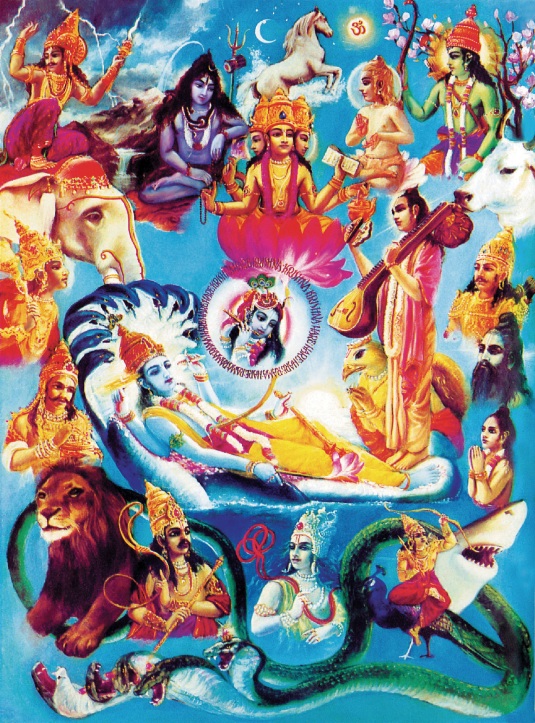
Bhagavad-gītā As It Is 1972 Edition
By His Divine Grace A. C. Bhaktivedanta Swami Prabhupāda
Chapter Ten
More
05 Apr 2013
by The Hare Krishna Movement
in Narottama Dasa Thakura, Spiritual World, Srimati Radharani, Vrndavana, Vrndavana
Tags: golden throne, gopis, Krishna, Narotama das Thakura, Radha and Krishna, Radha Krishna, Songs of the Vaisnava Acaryas, spiritual sky, Srimati Radharani, touchstones, transcendental beautiful place, transcendental lovers, Vrndavan

Vṛndāvana
by Narottama das Thakura
Vrndavan is a transcendental beautiful place. It is the spiritual sky, where everything is made of touchstone, which fulfills all desires. All the temples there are bedcked with costly jewels, In that far distant place is the River Yamuna, which is full of lotus flowers, In the midst of that throng of lotus flowers there is a golden boat, appearing like another big lotus flower, with eight petals, who are none but the eight chief gopis who always surround Radha and Krishna, In the surrounding petals there is a golden throne where the two transcendental lovers, namely Radha and Krishna are seated, but of all of them the governing Deity is Srimati Radharani. There is no comparison to Radharani’s beauty and the luster of Her transcendental body. The so-called beauty of the moon has fallen on the ground in the presence of Radharani’s beauty. In that assembly of Radha-Krishna and their principal associates there is a flood of laughing and joking as they address one another. Narottama das says that the eternal pastimes of Radha-Krishna from day to day are full of transcendental pleasure, Let us all remember them now and then and thus become happy even in this material world.
Full Song Lyrics More
28 Mar 2013
by The Hare Krishna Movement
in A.C. Bhaktivedanta Swami Prabhupada, Cow Protection, Quotes by Srila Prabhupada, Vegetarianism
Tags: A.C. Bhaktivedanta Swami Prabhupada, bhagavad-gita, cow protection, cow slaughter, cows milk, Kali-yuga, Krishna, meat-eating, miracle food milk, namo brahmanya-devaya, vegetarianism

click on image to enlarge
We compiled a few select quotes from Srila Prabhupada stressing the importance of the miracle food milk, and cow protection which is real advancement of civilization, and will help save humanity from the greatest danger.
…cow protection is essential. There is a miracle in milk, for it contains all the necessary vitamins to sustain human physiological conditions for higher achievements. (Srimad Bhagavatam 1.16.4 Purport)
…The cow is the most important animal for developing the human body to perfection. The body can be maintained by any kind of foodstuff, but cow’s milk is particularly essential for developing the finer tissues of the human brain so that one can understand the intricacies of transcendental knowledge. A civilized man is expected to live on foodstuffs comprising fruits, vegetables, grains, sugar and milk. The bull helps in the agricultural process of producing grain, etc., and thus in one sense the bull is the father of humankind, whereas the cow is the mother, for she supplies milk to human society. A civilized man is therefore expected to give all protection to the bulls and cows. (Srimad Bhagavatam 3.5.7 Purport)
…Milk is compared to nectar, which one can drink to become immortal. Of course, simply drinking milk will not make one immortal, but it can increase the duration of one’s life. In modern civilization, men do not think milk to be important, and therefore they do not live very long. Although in this age men can live up to one hundred years, their duration of life is reduced because they do not drink large quantities of milk. This is a sign of Kali-yuga. In Kali-yuga, instead of drinking milk, people prefer to slaughter an animal and eat its flesh. The Supreme Personality of Godhead, in His instructions of Bhagavad-gītā, advises go-rakṣya, which means cow protection. The cow should be protected, milk should be drawn from the cows, and this milk should be prepared in various ways. One should take ample milk, and thus one can prolong one’s life, develop his brain, execute devotional service, and ultimately attain the favor of the Supreme Personality of Godhead. (Srimad Bhagavatam 8.6.12 Purport)
More
27 Mar 2013
by The Hare Krishna Movement
in A.C. Bhaktivedanta Swami Prabhupada, Caitanya Mahaprabhu, Festivals, Gaura Purnima, Lectures
Tags: A.C. Bhaktivedanta Swami Prabhupada, appearance day of Sri Caitanya, devotee, Gaura Purnima, His Divine Grace Srila Prabhupada, Kali-yuga, Krishna, Krsna, Lord Caitianya, Mayapur, Sri Caitanya Mahaprabhu, Sri Gaura Purnima, sri-krsna-caitanya radha-krsna nahe anya, tri-yuga

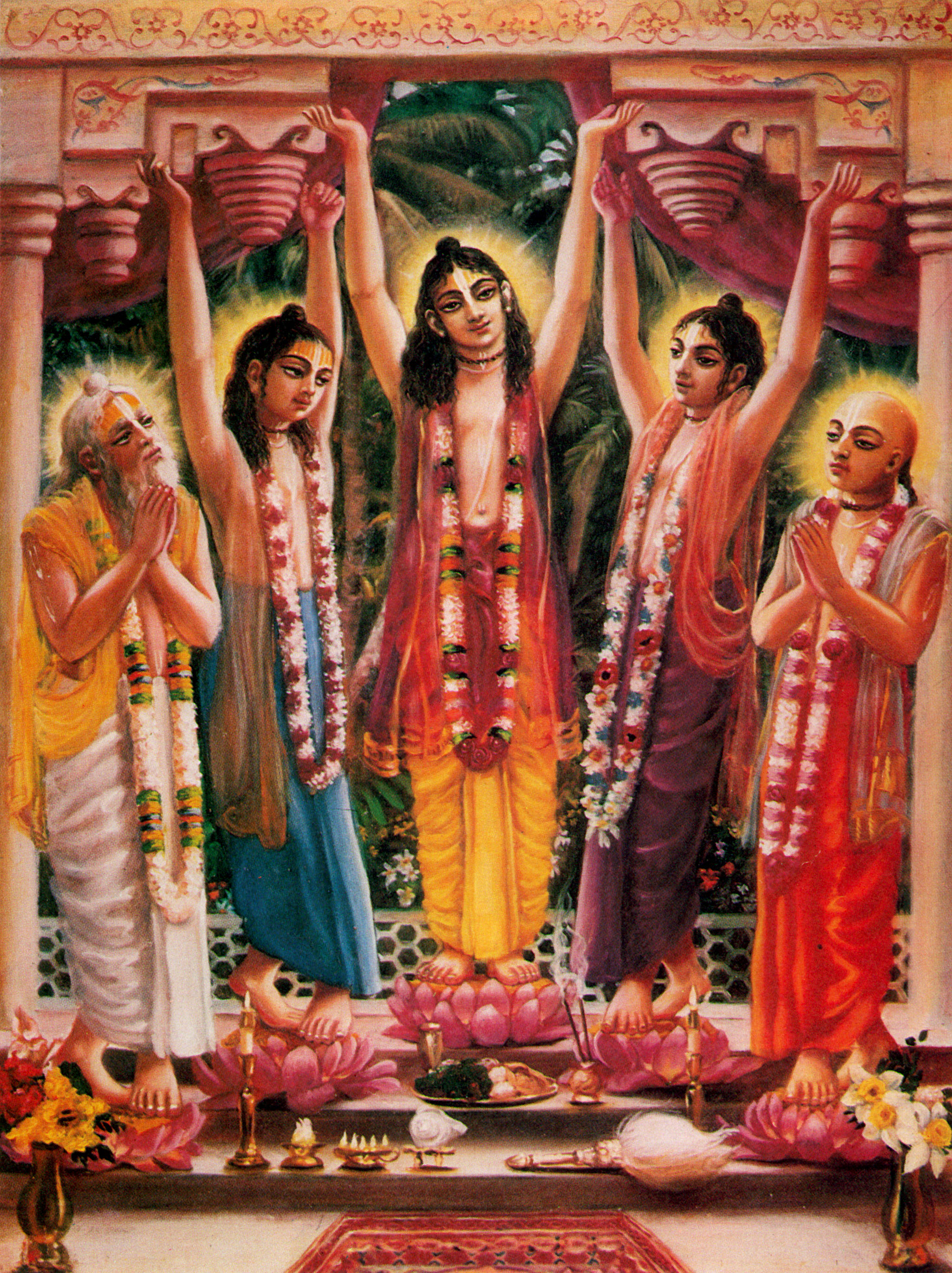
Today as most of the world celebrates Gaura Purnima, (Appearance day of Śrī Caitanya Mahāprabhu), I was reminded of a lecture given by His Divine Grace Srila Prabhupada on Gaura Purnima in Mayapur, India, March 16th, 1976. So with pleasure we are posting this famous Gaura Purnima lecture in its entirety.
Prabhupāda:…Śrī Caitanya Mahāprabhu is the Supreme Personality of Godhead, Kṛṣṇa. Śrī-kṛṣṇa-caitanya rādhā-kṛṣṇa nahe anya. You are worshiping Rādhā-Kṛṣṇa, and there is Caitanya Mahāprabhu’s Deity also. There are some parties, they protest, “Why Caitanya Mahāprabhu’s Deity should be placed along with Kṛṣṇa?” But they do not know śrī-kṛṣṇa-caitanya rādhā-kṛṣṇa nahe anya. It is not different. So Śrī Kṛṣṇa Caitanya is Kṛṣṇa. It is confirmed by the śāstras. Here it is said, channaḥ kalau yad abhava. In the Kali-yuga, directly He does not appear as the incarnation like Nṛsiṁhadeva or Vāmanadeva or Lord Rāmacandra, yes, but as devotee. So He’s the same incarnation, Lord Caitanya Mahāprabhu. Abhavat. “Therefore sometimes You are called as tri-yuga.” There are four yugas, but He is known… Because in three yugas He appears distinctly, and in the fourth yuga, the Kali-yuga, as devotee, therefore He’s called tri-yuga. So today is the birthday or appearance day of Śrī Caitanya Mahāprabhu, and this is the birthplace, this Māyāpura, and you are all present here. It is a good fortune. Always remember Śrī Caitanya Mahāprabhu and chant śrī-kṛṣṇa-caitanya prabhu-nityānanda…
Devotees: …śrī-advaita gadādhara śrīvāsādi-gaura-bhakta-vṛnda.
Prabhupāda: This will make your life perfect.
Full Lecture More
26 Mar 2013
by The Hare Krishna Movement
in A.C. Bhaktivedanta Swami Prabhupada, Caitanya Mahaprabhu, Narottama das Thakur, Sri Krsna Caitanya Prabhu
Tags: A.C. Bhaktivedanta Swami Prabhupada, disciplic succession, Krishna, krsna consciousness, Lord Caitanya, Narottama Dasa, Narottama Dasa Thakura, six gosvamis, Sri Krsna Caitanya Prabhu, Srinivasa Acarya
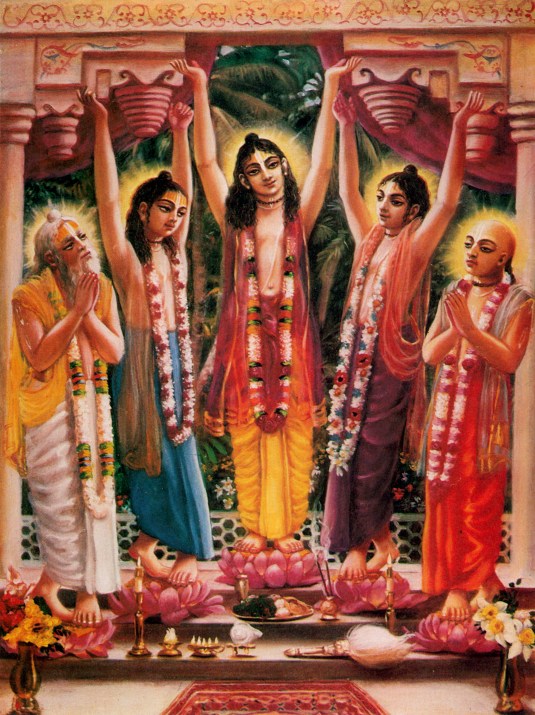
For Gaura Purnima, or the Appearance Celebration of Sri Caitanya Mahaprabhu, we are pleased to post one of our favorite songs from the “Songs of the Vaisnava Acaryas”, along with a purport by Srila Prabhupada, to honor this auspicious event.
…”My dear Lord, please be merciful to me, because who can be more merciful than Your Lordship within these three worlds?” Actually, this is a fact. Not only Narottama Dasa Thakura but Rupa Gosvami also prayed to Lord Caitanya in this way. At the time of the first meeting of Lord Caitanya and Rupa Gosvami at Prayaga (Allahabad), Srila Rupa Gosvami said, “My dear Lord, You are the most munificent of all incarnations, because You are distributing love of Krsna, Krsna consciousness.” When Krsna was personally present He simply asked us to surrender, but He did not distribute Himself so easily. He made conditions–“First of all you surrender.” But this incarnation, Lord Caitanya, although Krsna Himself, makes no such condition. He simply distributes: “Take love of Krsna.” Therefore Lord Caitanya is approved as the most munificent incarnation…(From Purport to song)
Full Song with Translation and Purport More
23 Mar 2013
by The Hare Krishna Movement
in Bhakti Yoga, Diksha, Guru & Disciple, Iskcon Bangalore, Reference Material
Tags: astanga-yoga, bhakti, bhoga, bona fide disciple, bona fide spiritual masted, chanting, deity worship, demigod worship, devotional service, dharma, disciple spiritual master guru, free pdf download, ISKCON Bangalore, Krishna, Prasadam, reference material on spiritual life, vapu and vani

Some time back I found this nice download of reference material and study guide for aspiring devotees. I printed it out, which took 80 pieces of paper, punched holes, and put it in a ring folder. It is arranged very professionally, and is broken down into eight basic areas of study.
1) Spiritual Master
2) Disciple
3) Deity Worship
4) Devotional Service
5) Chanting
6) Demigod Worship
7) Prasadam
8) General Information
For a free pdf download to view or save follow link; Harinam_Diksha_Reference_Material_for_Written_Test_new
19 Mar 2013
by The Hare Krishna Movement
in A.C. Bhaktivedanta Swami Prabhupada, Caitanya Mahaprabhu, Sri Caitanya-Caritamrta, Srimati Radharani
Tags: A.C. Bhaktivedanta Swami Prabhupada, bumblebee, Krishna, Krsna, kumkuma, Mathura, Radha, Radharani, Spring, Srimati Radharani, The Song to the Bumblebee, Uddhava

“My dear bumblebee, you are a very cunning friend of Uddhava and Kṛṣṇa. You are very expert in touching people’s feet, but I am not going to be misled by this. You appear to have sat on the breasts of one of Kṛṣṇa’s friends, for I see that you have kuṅkuma dust on your mustache. Kṛṣṇa is now engaged in flattering all His young girl friends in Mathurā. Therefore, now that He can be called a friend of the residents of Mathurā, He does not need the help of the residents of Vṛndāvana. He has no reason to satisfy us gopīs. Since you are the messenger of such a person as He, what is the use of your presence here? Certainly Kṛṣṇa would be ashamed of your presence in this assembly.”
Full Text and Purport More
19 Mar 2013
by The Hare Krishna Movement
in A.C. Bhaktivedanta Swami Prabhupada, Bhagavad-gita
Tags: A.C. Bhaktivedanta Swami Prabhupada, Bg. 10.35, bhagavad-gita, flowers and trees blossom and flourish, I am the flower bearing spring, Krishna, of seasons, Spring, spring is the representative of the Supreme Lord Krishna
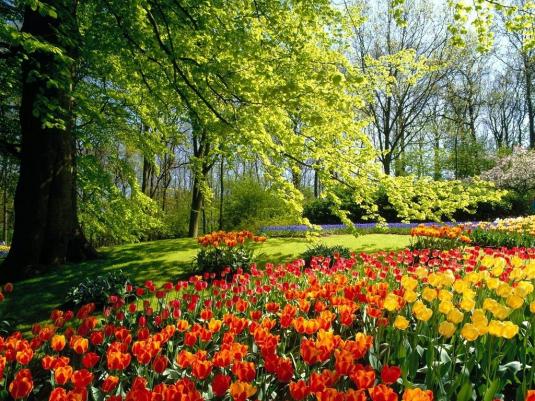
click on image to enlarge
Well it seems that Spring is almost here, saw the first Robin of the year, have witnessed the blooming of the crocus and daffodils, and as the days get longer and the nights stay warmer, I am reminded of the verse from the Bhagavad-gita where Krishna says:
…and of seasons I am flower-bearing spring (Bhagavad-gita 10.35)
…Of course spring is a season universally liked because it is neither too hot nor too cold, and the flowers and trees blossom and flourish. In spring there are also many ceremonies commemorating Kṛṣṇa’s pastimes; therefore this is considered to be the most joyful of all seasons, and it is the representative of the Supreme Lord Kṛṣṇa. (from purport to verse)
Full Text and Purport More
16 Mar 2013
by The Hare Krishna Movement
in A.C. Bhaktivedanta Swami Prabhupada, Gopis, KRSNA The Supreme Personality of Godhead
Tags: A.C. Bhaktivedanta Swami Prabhupada, gopis, Krishna, Krsna Book, meditation of seeing Krishna, samadhi, The Gopīs Attracted by the Flute, topmost yogi. Krsna, transcendental mediation, yoga, yogis

click on image to enlarge
…Kṛṣṇa was very expert in playing the flute, and the gopīs were captivated by the sound vibration, which was not only attractive to them, but to all living creatures who heard it. One of the gopīs told her friends, “The highest perfection of the eyes is to see Kṛṣṇa and Balarāma entering the forest and playing Their flutes and tending the cows with Their friends.”
Persons who are constantly engaged in the transcendental meditation of seeing Kṛṣṇa, internally and externally, by thinking of Him playing the flute and entering the Vṛndāvana forest, have really attained the perfection of samādhi. Samādhi (trance) means absorption of all the activities of the senses on a particular object, and the gopīs indicate that the pastimes of Kṛṣṇa are the perfection of all meditation and samādhi. It is also confirmed in the Bhagavad-gītā that anyone who is always absorbed in the thought of Kṛṣṇa is the topmost of all yogīs.
Kṛṣṇa, The Supreme Personality of Godhead 1970 Edition
By His Divine Grace A. C. Bhaktivedanta Swami Prabhupada
Vol. 1, Chapter 21
The Gopīs Attracted by the Flute
Kṛṣṇa was very pleased with the atmosphere of the forest where flowers bloomed and bees and drones hummed very jubilantly. While the birds, trees and branches were all looking very happy, Kṛṣṇa, tending the cows, accompanied by Śrī Balarāma and the cowherd boys, began to vibrate His transcendental flute. After hearing the vibration of the flute of Kṛṣṇa, the gopīs in Vṛndāvana remembered Him and began to talk amongst themselves about how nicely Kṛṣṇa was playing His flute. When the gopīs were describing the sweet vibration of Kṛṣṇa’s flute, they also remembered their pastimes with Him; thus their minds became disturbed, and they were unable to describe completely the beautiful vibrations. While discussing the transcendental vibration, they remembered also how Kṛṣṇa dressed, decorated with a peacock feather on His head, just like a dancing actor, and with blue flowers pushed over His ear. His garment glowed yellow-gold, and He was garlanded with a vaijayantī necklace. Dressed in such an attractive way, Kṛṣṇa filled up the holes of His flute with the nectar emanating from His lips. So they remembered Him, entering the forest of Vṛndāvana, which is always glorified by the footprints of Kṛṣṇa and His companions.
More
01 Mar 2013
by The Hare Krishna Movement
in A.C. Bhaktivedanta Swami Prabhupada, Bhagavad-gita, Guru & Disciple, Krishna Consciousness
Tags: A.C. Bhaktivedanta Swami Prabhupada, Arjuna, Bg 10.12-14, brahman, guru, Krishna, param brahma param dhama, pavitram paramam bhavan, spiritual master, Srila Prabhupada, Supreme Brahman, Supreme Personality of Godhead

click on image to enlarge
…The Bhagavad-gītā should be taken up in a spirit of devotion. One should not think that he is equal to Kṛṣṇa, nor should he think that Kṛṣṇa is an ordinary personality or even a very great personality. Lord Śrī Kṛṣṇa is the Supreme Personality of Godhead, at least theoretically, according to the statements of Bhagavad-gītā or the statements of Arjuna, the person who is trying to understand the Bhagavad-gītā. We should therefore at least theoretically accept Śrī Kṛṣṇa as the Supreme Personality of Godhead, and with that submissive spirit we can understand the Bhagavad-gītā. Unless one reads the Bhagavad-gītā in a submissive spirit, it is very difficult to understand Bhagavad-gītā because it is a great mystery.
Although I have read and re-read the introduction to the Bhagavad-gita many times now, every time it seems fresh, and new realizations are evident. For instance this morning I was reading how one should accept the Bhagavad-gita in a ‘submissive spirit’. This instruction just jumped out at me because recently I was having a discussion with one devotee friend who was describing from Srila Prabhupada’s letters that Krishna Consciousness cannot be achieved…
Krishna Consciousness is a transcendental science which can be revealed to a sincere devotee who is prepared to render service to the Lord. Krishna Consciousness is not achieved by dry arguments or by academic qualifications. (Letter to Subala – Delhi 29 September, 1967)
…but rather is received, through the mercy of the spiritual master and Krishna.
More
26 Feb 2013
by The Hare Krishna Movement
in A.C. Bhaktivedanta Swami Prabhupada, Mangalacarana Prayers, Songs of the Vaisnava Acaryas
Tags: A.C. Bhaktivedanta Swami Prabhupoada, feet of all vaisnavas, Gadadhara, Krishna, Lord Kṛṣṇa Caitanya and Lord Nityānanda along with Advaita Ācārya, lotus feet of my spiritual master, respectful obeisances, Sanatana Goswami, six goswami's, spiritual master, Sri Lalita, Sri Visakha, Srila Rupa Gosvami, Srimati Radharani, Srivasa, vande
click on image to enlarge
Maṅgalācaraṇa Prayers
vande ’haṁ śrī-guroḥ śrī-yuta-pada-kamalaṁ śrī-gurun vaiṣṇavāṁś ca
śrī-rūpaṁ sāgrajātaṁ saha-gaṇa-raghunāthānvitaṁ taṁ sa-jīvam
sādvaitaṁ sāvadhūtaṁ parijana-sahitaṁ kṛṣṇa-caitanya-devaṁ
śrī-rādhā-kṛṣṇa-pādān saha-gaṇa-lalitā-śrī-viśākhānvitāṁś ca
I offer my respectful obeisances unto the lotus feet of my spiritual master and unto the feet of all Vaiṣṇavas. I offer my respectful obeisances unto the lotus feet of Śrīla Rūpa Gosvāmī along with his elder brother Sanātana Gosvāmī, as well as Raghunātha Dāsa and Raghunātha Bhaṭṭa, Gopāla Bhaṭṭa, and Śrīla Jīva Gosvāmī. I offer my respectful obeisances to Lord Kṛṣṇa Caitanya and Lord Nityānanda along with Advaita Ācārya, Gadādhara, Śrīvāsa, and other associates. I offer my respectful obeisances to Śrīmatī Rādhārāṇī and Śrī Kṛṣṇa along with Their associates, Śrī Lalitā and Viśākhā.
Purport to the Maṅgalācaraṇa Prayers
by His Divine Grace A.C. Bhaktivedanta Swami Prabhupada
Los Angeles, January 8, 1969
More
23 Feb 2013
by The Hare Krishna Movement
in A.C. Bhaktivedanta Swami Prabhupada, Balarama, Festivals, guru-tattva, Nityananda
Tags: 2-2-1977, A.C. Bhaktivedanta Swami, Balarama, Caitanya Mahaprabhu, guru, guru tattva, Krishna, Krsna, lecture by Prabhupada, Lord Nityananda's Appearance Day, Nityananda, spiritual master, Srila Prabhupada, yasya prasadad bhagavat-prasadah

click on image to enlarge
…Balarāma means guru-tattva. Balarāma represents guru. Yasya prasādād bhagavat-prasādaḥ. If we want to understand Caitanya Mahāprabhu, if we want to understand Kṛṣṇa, then we must take shelter of Balarāma. Nāyam ātmā bala-hinena labhyaḥ. This bala-hinena labhyaḥ, this Vedic injunction, means “Without the mercy of Balarāma you cannot understand, you cannot realize your spiritual identification. So that Balarāma comes as Nityānanda Prabhu.”
…So if we want actually peace of mind, if we actually want to be free from this material fatiguement, then we must take the shelter of Nityānanda Prabhu. Nityānanda Prabhu is the strength, spiritual strength. And without spiritual strength you cannot approach Kṛṣṇa.
More
15 Feb 2013
by The Hare Krishna Movement
in A.C. Bhaktivedanta Swami Prabhupada, Book Changes, Mahesh Raja das
Tags: A.C. Bhaktivedanta Swami Prabhupada, book changes, conditioned souls, God, great scholar, Krishna, Krsna, Liberated souls, prakrta shajiyas, sahajiyas, srila prabhupada conversations, Srila Prabhupada lectures, Srila Prabhupada's writting, transcendental literature

click on image to slightly enlarge
Under the Direction of God (Krishna)
His Divine Grace Srila Prabhupada speaks as Krsna speaks
“It is not possible for a common man to write books on bhakti, for his writings will not be effective. He may be a very great scholar and expert in presenting literature in flowery language, but this is not at all helpful in understanding transcendental literature. Even if transcendental literature is written in faulty language, it is acceptable if it is written by a devotee, whereas so-called transcendental literature written by a mundane scholar, even if it is a very highly polished literary presentation, cannot be accepted. The secret in a devotee’s writing is that when he writes about the pastimes of the lord, the lord helps him; he does not write himself.
We Don’t Allow Any Literature Not Given by Liberated Soul
compiled by Sriman Mahesh Prabhu
The difference between Srila Prabhupada’s books and other so-called gurus’ (conditioned souls) writing is Srila Prabhupada’s instruction was coming directly from Krsna. This is the transcendental platform.
Srila Prabhupada encouraged his disciples, however, to write their realizations. Other conditioned souls may present their nonsense commentaries on Bhagavad-Gita etc., but they will never be quoted for references. Srila Prabhupada is on the trancendental platform and Krishna speaks through him, consequently only he will be quoted for reference.
More
07 Feb 2013
by The Hare Krishna Movement
in A.C. Bhaktivedanta Swami Prabhupada, Teachings of Lord Chaitanya, The Lords Omnipotency, Vaisnava Vocabulary
Tags: A.C. Bhaktivedanta Swami Prabhupada, Brahma stealing the cows and calves, Dwaraka, Krishna, Narada Muni, omnipotency, prabhava, rasa dance, svayam-rupa, Teachings of Lord Chaitanya, the Lord's Omnipotency, transcendental form, vaibhava, vaibhava-prakasa
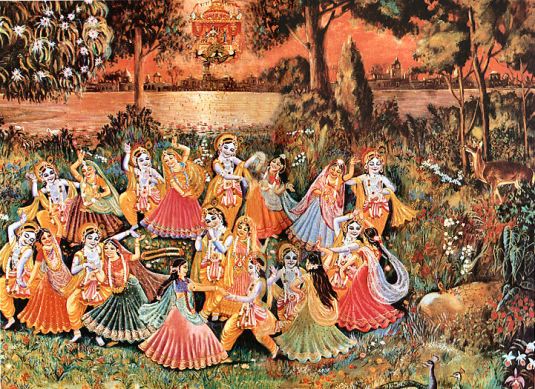
click on image to slightly enlarge
Here is a new word for your Vaisnava Vocabulary; vaibhava-prakāśa. As I was reading the Krsna Book the other day this word vaibhava-prakāśa just jumped out from the pages, and I was reminded again of the Lord’s omnipotency.
“The Lord’s omnipotency is displayed by His simultaneous presence in every place. He is present always in His eternal abode Goloka Vṛndāvana, and still He is present in everyone’s heart and even within every invisible atom.” (SB 1.9.10 purport)
“The personal form of Kṛṣṇa can be divided into two: svayam-rūpa and svayam-prakāśa. As far as His svayam-rūpa (or pastime form) is concerned, it is in that form that He remains always in Vṛndāvana with the inhabitants of Vṛndāvana. This personal form (svayam-rūpa) can be further divided into the prābhava and vaibhava forms. For instance, Kṛṣṇa expanded Himself in multiple forms during the rāsa dance in order to dance with each and every gopī who took part in forms in order to accommodate His 16,108 wives.
… As far as Kṛṣṇa is concerned, when He manifested Himself in different forms, each and every one of them was a separate individual. When Nārada Muni visited Kṛṣṇa at different palaces at Dvārakā, he was astonished at this,…He wondered how the Lord was present with His queens in each and every one of His 16,108 palaces. With each queen, Kṛṣṇa Himself was in a different form, and He was acting in different ways. In one form He was engaged in playing with His children, and in yet another form He was performing some household work. These different activities are conducted by the Lord when He is in His “emotional” forms, which are known as vaibhava-prakāśa expansions. Similarly, there are other unlimited expansions of the forms of Kṛṣṇa, but even when they are divided or expanded without limit, they are still one and the same. There is no difference between one form and another. That is the absolute nature of the Supreme Personality of Godhead.” ( Teachings of Lord Chaitanya)
More
Previous Older Entries Next Newer Entries











 The Hare Krishna Movement