11 Oct 2011
by The Hare Krishna Movement
in Chanting Hare Krishna, Krishna Consciousness
Tags: chant Hare Krishna, chanting Hare Krishna, Hare Krishna, His Divine Grace A.C. Bhaktivedanta Swami Prabhupada, Kali-yuga, kirtanad eva krsnasya
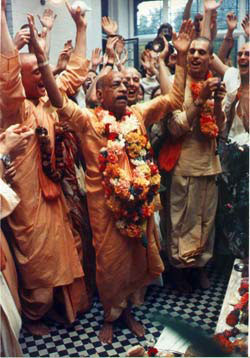
Srila Prabhupada Chanting & Dancing
By His Divine Grace A.C. Bhaktivedanta Swami Prabhupada
Founder-Acarya of the International Society for Krishna Consciousness
“In the sastra it is said this Kali-yuga is full of faults, so many faults. It is the ocean of faults. But there is a very nice thing, asti hy eko mahan gunah, a very great quality. What is that? Kirtanad eva krsnasya mukta-sangah param vrajet [SB 12.3.51]. If you simply chant Hare Krishna mantra, then you become perfect. Is it very difficult? Chant Hare Krishna and you become perfect. But we are so unfortunate, we are not even prepared to chant. This is our position. So you have to make little determination that ‘I shall chant henceforward Hare Krishna mantra.’ Then everything is all right.“
More
05 Sep 2011
by The Hare Krishna Movement
in Devotee's, Mukunda das Goswami, Srila Prabhupada
Tags: A.C. Bhaktivedanta Swami Prabhupada, Hare Krishna, Indian Swami, Mukunda das, servant of God, Srila Prabhupada, The Science of Self Realization
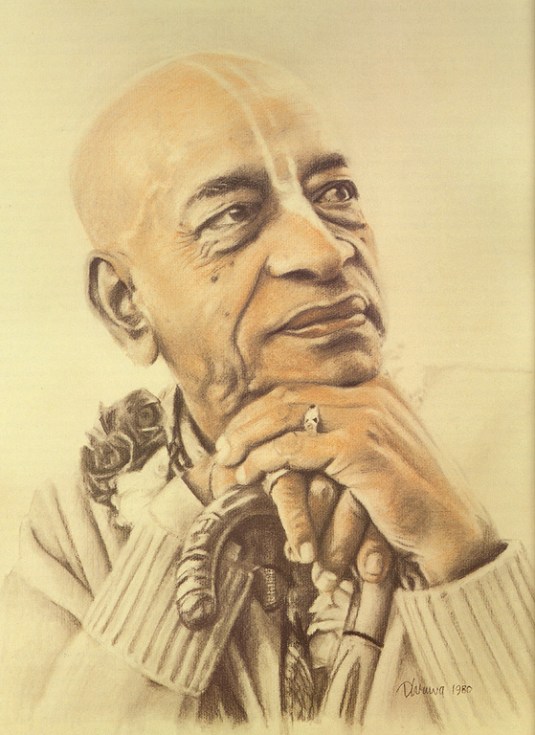
The Science of Self Realization
Foreword By Mukunda Das
From the very start, I knew that His Divine Grace A. C. Bhaktivedanta Swami Prabhupāda was the most extraordinary person I had ever met. The first meeting occurred in the summer of 1966, in New York City. A friend had invited me to hear a lecture by “an old Indian svāmī” on lower Manhattan’s Bowery. Overwhelmed with curiosity about a svāmī lecturing on skid row, I went there and felt my way up a pitch-black staircase. A bell-like, rhythmic sound got louder and clearer as I climbed higher. Finally I reached the fourth floor and opened the door, and there he was.
About fifty feet away from where I stood, at the other end of a long, dark room, he sat on a small dais, his face and saffron robes radiant under a small light. He was elderly, perhaps sixty or so, I thought, and he sat cross-legged in an erect, stately posture. His head was shaven, and his powerful face and reddish horn-rimmed glasses gave him the look of a monk who had spent most of his life absorbed in study. His eyes were closed, and he softly chanted a simple Sanskrit prayer while playing a hand drum. The small audience joined in at intervals, in call-and-response fashion. A few played hand cymbals, which accounted for the bell-like sounds I’d heard. Fascinated, I sat down quietly at the back, tried to participate in the chanting, and waited.
More
19 Aug 2011
by The Hare Krishna Movement
in Chanting Hare Krishna, Sri Caitanya-Caritamrta
Tags: Caitanya Caritamrta, Hare Krishna, Hare Rama, holy name, liberation, Maha Mantra, Srila Prabhupada

The holy name of Lord Krishna is an attractive feature for many saintly, liberal people. It is the annihilator of all sinful reactions and is so powerful that save for the dumb who cannot chant it, it is readily available to everyone, including the lowest type of man, the candala. The holy name of Krishna is the controller of the opulence of liberation, and it is identical with Krishna.
Simply by touching the holy name with one’s tongue, immediate effects are produced. Chanting the holy name does not depend on initiation, pious activities or the purascarya regulative principles generally observed before initiation. The holy name does not wait for all these activities. It is self-sufficient. (Caitanya-caritmrta Mad.15.110)
Hare Krishna, Hare Krishna, Krishna Krishna, Hare Hare,
Hare Rama, Hare Rama, Rama Rama, Hare Hare…
07 Jul 2011
by The Hare Krishna Movement
in Back to Godhead, Ganesha, Satyaraja das
Tags: elephant head, Ganapati, Ganesa, Ganesh, Govinda, Hare Krishna, Hindu pantheon, Krsna, lotus feet, Pillaiyar, Saryaraja das, Vinayaka
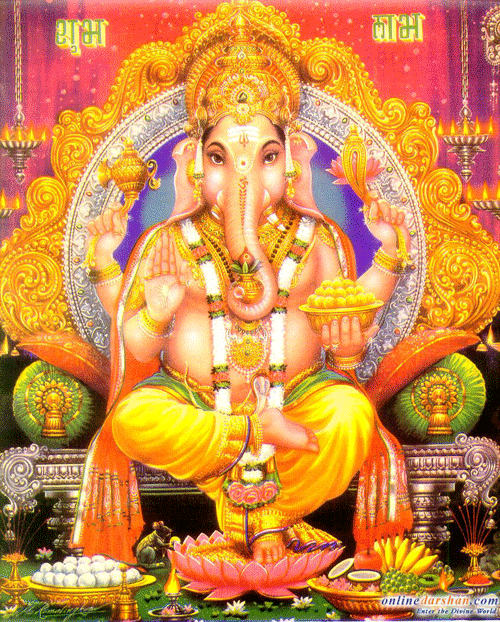
Ganesha (Sanskrit: गणेश; IAST: Gaṇeśa) also spelled Ganesa or Ganesh, also known as Ganapati (Sanskrit: गणपति;IAST: gaṇapati), Vinayaka (Sanskrit: विनायक; IAST: Vināyaka), and Pillaiyar (Tamil: பிள்ளையார்), is one of the deities best-known and most widely worshipped in the Hindu pantheon. His image is found throughout India and Nepal. Hindu sects worship him regardless of affiliations. Devotion to Ganesha is widely diffused and extends to Jains, Buddhists, and beyond India.
Ganesha is Vighneshvara or Vighnaraja, the Lord of Obstacles, both of a material and spiritual order. He is popularly worshipped as a remover of obstacles, though traditionally he also places obstacles in the path of those who need to be checked. [pasted from; Wikipedia.org]
Ganesa: Remover of Obstacles
By Satyaraja Dasa
from; Back to Godhead Magazine
The joyous elephant-faced deity known as Ganesa is revered by one billion Hindus worldwide, and though his worship has little place in the modern-day Hare Krsna movement, his personality and pastimes are part of ISKCON’s heritage.
Ganesa is often seen as the creator and remover of obstacles, as the guardian at entrances, and as a spiritually potent figure who can avert all evil influences. In popular Hindu lore he is thus the god to be worshiped first, before all religious ceremonies, public and private. Things tend to start off with Ganesa, and this is reflected even in common idiomatic phrases. For example, in Maharashtra when a dedication or inauguration is to be performed, a Marathi speaker may refer to the occasion as Sri ganesa karane (“doing the Sri Ganesa”). Another such expression is ganapatice kele (“to conceive a child”). Similar phrases are found in other Indian languages.
More
25 Jun 2011
by The Hare Krishna Movement
in Ratha-yatra
Tags: Balarama, Hare Krishna, jagannath svami nayana pathagame, Lord Krishna, Rathayatra, San Francisco Rathayatra, Srila Prabhupada lecture, Subhsdra

Ratha-yatra Address
Given by Srila Prabhupada
San Francisco, June 27, 1971
Jagannatha svami nayana-pathagami bhavatu me. (crowd repeats) Hare Krishna, Hare Krishna, Krishna Krishna, Hare Hare/ Hare Rama, Hare Rama, Rama Rama, Hare Hare. (crowd repeats) Thank you very much. Ladies and Gentlemen, I thank you very much for your kindly participating in this great Ratha-yatra festival.
I have already explained what is this Ratha-yatra festival. It is in commemoration of a grand visit by Lord Krishna along with His elder brother, Balarama, and His younger sister, Subhadra, in a solar eclipse ceremony at Kuruksetra.
This occasion is the subject matter of this Ratha-yatra festival. Apart from these historical references in the matter of Ratha-yatra festival, there is another spiritual meaning, that the Lord is situated in everyone’s heart, and this body is just like ratha, or car.
More
18 Jun 2011
by The Hare Krishna Movement
in Back to Godhead, Chanting Hare Krishna
Tags: devotees, Hare Krishna, impersonalists, Krsna, Kurappiah Chockalingam, Om, omkara, pranava, spiritual vibration, Srimati Radharani

Om or Hare Krishna?
By Kurappiah Chockalingam
Though the sacred sound om is often associated with impersonalists, only the devotees understand its full import.
The Gosvamis of Vrndavana have analyzed om (a-u-m) as follows: The letter a refers to Krsna, the master of all planets and all living entities. The letter u indicates Srimati Radharani, the pleasure potency of Krsna, and m indicates the living entities. Thus omkara represents Krsna; His name, fame, pastimes, potencies, and devotees; and everything else pertaining to Him.
THROUGHOUT THE VEDAS there is much mention of the syllabel om. This spiritual vibration, which is sometimes called omkara or pranava, comprises three Sanskrit sounds – a, u, and ma (the a in ma is silent). When these three sounds are combined, the result is the single-syllabled vibration om.
An unusual attribute of om is that it has no direct translation from Sanskrit into English. And though every Vedantist will accept om to be a representation of God, exactly how om is viewed differs according to various schools to thought. These schools can be classified into two main categories, the Mayavadi, or impersonalist, and the Vaisnava, or devotee.
The impersonalist, as the name suggests, is happy to treat om as an impersonal, formless, representation of the Absolute Truth. Therefore, the Mayavadi will very openly chant om, being careful to avoid names such as Krsna and Rama, which according to them, are limited. A Mayavadi might explain his theory of pranava om like this: “Since this whole universe has been created by Him (God), whatever there is in the universe is Him alone.
As such, He has no name. But if He has to have a name, then all names are His, for He alone is appearing in all forms. The first sound in most languages is a; the last sound to leave as our mouth closes is m; u is the center of the two. Together, they represent all the basic sounds from which words are produced. And threfore, these three sounds, making up the syllable om, represent the entire universe of names and forms.”
More
26 Apr 2011
by The Hare Krishna Movement
in Madhudvisa das, What Happened to the Hare Krishna's?
Tags: bhakti yoga, chanting the holy names of the Lord, devotees, devotional service, Hare Krishna, Kali-yuga, Krishna consciousnss, Madhudvisa das, Srila Prabhupada, Vedic texts of India

One of the most common questions people ask is “What happened to the Hare Krishna’s?” Many people remember the devotees colorful chanting, festivals and book distribution which were so common in the seventies, but have now practically disappeared. This booklet written by Sriman Madhudvisa Prabhu, will shed some light on why the Hare Krishna’s disappeared. He has kindly agreed to let us post this fine publication from our site, and we will share it with you over the next 13 weeks.
What Happened to the Hare Krishna’s?
By Sriman Madhudvisa Prabhu
This booklet is dedicated to the Founder and Acarya of the International Society for Krishna Consciousness, His Divine Grace A.C. Bhaktivedanta Swami Prabhupada, who has dedicated his life to giving us, the fallen conditioned souls, a chance to achieve the greatest goal. He presented the timeless Vedic texts of India in English so clearly and unambiguously that even we, the most sinful and fallen persons, have a chance to understand the topmost goal of human life…To develop pure love for Krishna, the Supreme Personality of Godhead.
Introduction
Even a person with no knowledge can immediately acquire all knowledge simply by the benediction of Sri Caitanya Mahaprabhu. Therefore I am praying to the Lord for His causeless mercy upon me.
I offer my respectful obeisances unto Sri Krishna Caitanya and Lord Nityananda, who are like the sun and moon. They have arisen simultaneously on the horizon of Gauda to dissipate the darkness of ignorance and thus wonderfully bestow benediction upon all.
Glory to the all-merciful Radha and Madana-Mohana! I am lame and ill-advised, yet They are my directors, and Their lotus feet are everything to me.
In a temple of jewels in Vrndavana, underneath a desire tree, Sri Sri Radha Govinda, served by Their most confidential associates, sit upon an effulgent throne. I offer my humble obeisances to Them.
May Gopinathaji, who attracts all the gopis with the songs of His flute and who has begun the most melodious rasa dance on the bank of the Yamuna in Vamsivata, be merciful upon us. (Srila Krishnadas Kaviraja CC Mad 1.1-5)
Krishna consciousness is not a new creation. Krishna consciousness has always existed. It is our original pure consciousness. While we are in contaminated consciousness here in the material world we are in material consciousness, but if that material consciousness is purified our original consciousness, Krishna consciousness, is revived. There are different processes for reviving our original Krishna consciousness, basically divided into three: mental speculation, meditation yoga and devotional service. There are different ages, or yugas, which this universe passes through on a cycle lasting for 4,300,000 years. This cycle is similar to the changing seasons we see every year. We know that after winter there will be spring and after spring there will be summer. Similarly, on a larger scale, there are four ages, Satya-yuga, Tretya-yuga, Dvarpa-yuga and Kali-yuga. Satya-yuga is called the golden age because in this age everyone is pure and spiritually advanced. The conditions in the Satya Yuga are particularly suitable for the practice of meditational yoga as people have long lifetimes and are undisturbed. The conditions degrade until Kali Yuga, the present age, which is the most degraded age, people being short-lived, always disturbed, very sinful and not at all intelligent. Because in this age we are very unfortunate there is no chance for us to practice either meditational yoga or mental speculation. The only practical option open to us is devotional service, Krishna consciousness.
The Krishna consciousness movement of congregational chanting of the holy names of God actually began in full force five hundred years ago. At this time Lord Sri Caitanya Mahaprabhu, who was none other than Krishna, the Supreme Personality of Godhead Himself, took mercy on us, the fallen souls in Kali-yuga by flooding the subcontinent of India with the chanting of the maha mantra Hare Krishna, Hare Krishna, Krishna Krishna, Hare Hare / Hare Rama, Hare Rama, Rama Rama, Hare Hare. Lord Caitanya was delivering pure love of God, the topmost spiritual achievement, freely to everyone without consideration of their qualifications. No other incarnation of God has ever been so merciful. To reveal the secret of what real love is, Krishna came to earth in the guise of His own devotee – as Lord Caitanya Mahaprabhu. With his chief associates – Nityananda, Advaita, Gadadhara and Srivasa – He taught how to develop love of Godhead simply by chanting Hare Krishna and dancing in ecstasy.
Pasted from; http://krishna.org/ISKCON/WHTTHK/msg00int.html
23 Apr 2011
by The Hare Krishna Movement
in Chanting Hare Krishna, The Hare Krishna Movement
Tags: chanting Hare Krishna, Hare Krishna, Maha Mantra, prabhupada, spiritual sound, Srimad Bhagavatam, The Hare Krishna Movement, transcendental vibration

What is the meaning of Hare Krishna?
It is the short form of the maha-mantra, the great spiritual sound of final liberation:
Hare Krishna Hare Krishna Krishna Krishna Hare Hare
Hare Rama Hare Rama Rama Rama Hare Hare
“By vibrating this transcendental sound, the meaning of everything, both material and spiritual, is revealed. This Hare Krishna is nondifferent from the Personality of Godhead.” (from Bhaktivedanta Prabhupada Commentary, Srimad Bhagavatam 4.24.40)
What is the deeper meaning of the Hare Krishna mantra?
Caitanya Mahaprabhu teaches us that we should only beg God for His service life after life. This is the actual meaning of the Hare Krsna maha-mantra. When we are chanting Hare Krsna, Hare Krsna, Krsna Krsna, Hare Hare. Hare Rama, Hare Rama, Rama, Rama, Hare Hare, we are actually addressing God and His energy, Hara. Hara is Krsna’s internal potency, Srimati Radharani or Laksmi. Jaya radhe! This is daivi prakrti, and the devotees take shelter of the daivi prakrti, Srimati Radharani. Thus the Vaisnavas worship Radha-Krsna, Laksmi-Narayana and Sita-Rama. In the beginning of the Hare Krsna maha-mantra we first address the internal energy of Krsna, Hare. Thus we say, “O Radharani! O Hare! O energy of the Lord!” When we address someone in this way, he usually says, “Yes, what do you want?” The answer is, “Please engage me in Your service.” This should be our prayer. We should not say, “O energy of the Lord, O Krsna, please give me money. Please give me a beautiful wife. Please give me many followers. Please give me some prestigious position. Please give me the presidency.” These are all material hankerings, which should be avoided. Lord Buddha advocated that we give up all material desires. It is not possible to become desireless, but it is possible to give up material desires. It is the nature of the living entity to desire; it is not possible to be desireless. If one is desireless, he is dead. Desirelessness means purifying one’s desire, and desire is purified when we only desire the service of Krsna. (from “Teachings of Lord Kapila”)
Why is the Hare Krishna mantra so special?
Lord Krsna says in Bhagavad-gita (7.8), pranavah sarva-vedesu: ‘In all the Vedic mantras, I am represented by pranava, or omkara.’ Thus chanting of the Vedic mantras beginning with omkara is directly chanting of Krsna’s name. There is no difference. Whether one chants omkara or addresses the Lord as ‘Krsna’, the meaning is the same, but Sri Caitanya Mahaprabhu has recommended that in this age one chant the Hare Krsna mantra (harer nama eva kevalam). Although there is no difference between Hare Krsna and the Vedic mantras beginning with omkara, Sri Caitanya Mahaprabhu, the leader of the spiritual movement for this age, has recommended that one chant Hare Krsna, Hare Krsna, Krsna Krsna, Hare Hare. Hare Rama, Hare Rama, Rama Rama, Hare Hare. (from Bhaktivedanta Prabhupada Commentary, Srimad Bhagavatam 6.5.26)
Pasted from; http://www.harekrsna.de/artikel/faq.htm
14 Apr 2011
by The Hare Krishna Movement
in Diksha, Disciplic succession, Guru & Disciple, Siksa
Tags: Founder Acarya, GBC, Hare Krishna, Hare Krishna Society, His Divine Grace A.C. Bhaktivedanta Swami Prabhupada, Iskcon, July 9th Letter, krishnaconsciousnessmovement.com, Krsna consciousness movement, prabhupadanugas, Will

I, A.C. Bhaktivedanta Swami Prabhupada, founder-acarya of the International Society for Krishna consciousness, Settlor of the Bhaktivedanta Book Trust, and disciple of Om Visnupada 108 Sri Srimad Bhaktisiddhanta Sarasvati Gosvami Maharaja Prabhupada, presently residing at Sri Krsna-Balarama Mandir in Vrndavana, make this my last will:
ANALYSIS OF SRILA PRABHUPADA’S LAST WILL AND JULY 9TH LETTER
Dear Maharajas and Prabhus,
Please accept my humble obeisances. All glories to Srila Prabhupada.
We would like to present two papers signed and approved by His Divine Grace Srila Prabhupada. The will of His Divine Grace and his last instructions for continuing the process of initiation. We ask only that you read the following statements of Srila Prabhupada with an open heart. Instead of analyzing his words to fit today’s circumstances, try to take these instructions just as they have been written. Without reading between the lines, try simply to accept his words. Rather than imagining esoteric meanings try to understand his commands, as they are. Srila Prabhupada often said that Krishna Consciousness is a simple process. The instructions that he gave us were always straightforward and clear. His language was never obscure or lacking in explanation. If something was important he always gave us a clear cut presentation. Before reading these last instructions of Srila Prabhupada’s, try to take to heart the following explanation from Caitanya Caritamrita on the nature of direct and indirect meanings. In it, Srila Prabhupada, Srila Bhaktisiddhanta Sarasvati Thakura and Lord Chaitanya, clearly explain the difference between a true understanding and an imaginary interpretation.
More
25 Mar 2011
by The Hare Krishna Movement
in Krishna Consciousness
Tags: Advaita, Gadadhara, Hare Hare, Hare Krishna, Hare Rama, krsna consciousness, Lord Caitanya, Nityananda, Padmapani das, Prabhupada's instructions, simple method, Sri Panca-Tattva, Srivasa

The Simple Method
by Sriman Padmapani Prabhu
Sometimes it appears very difficult to make advancement in Krsna consciousness, and we become impatient. If we expect immediate results and they aren’t forthcoming, we can easily become discouraged. For those of us who are unable to live in a temple (or even near a temple), this is especially true. So what’s the solution?
In November of 1969, while speaking in London’s Conway Hall, Srila Prabhupada stated the following:
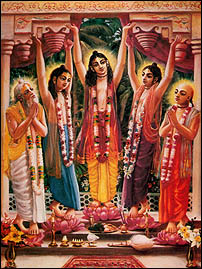
“The process is very simple. Just keep a picture of Lord Caitanya with His associates. Lord Caitanya is in the middle, accompanied by His principal associates — Nityananda, Advaita, Gadadhara, and Srivasa. One simply has to keep this picture. One can keep it anywhere. It is not that one has to come to us to see this picture. Anyone can have this picture in his home, chant this Hare Krsna mantra, and thus worship Lord Caitanya. That is the simple method. But who will capture this simple method? Those who have good brains. Without much bother, if one simply keeps a picture of Sri Caitanya Mahaprabhu at home and chants Hare Krsna, then one will realize God. Anyone can adopt this simple method. There is no expenditure, there is no tax, nor is there any need to build a very big church or temple. Anyone, anywhere, can sit down on the road or beneath a tree and chant the Hare Krsna mantra and worship God. Therefore it is a great opportunity.”
More
23 Mar 2011
by The Hare Krishna Movement
in Book Changes, Devotee's, Locanananda das
Tags: bhagavad-gita, Gupta das, hansadutta das, Hare Krishna, Krsna Book, Locnananda das, Srila Prabhupada's original books, Teachings of Lord Caitanya, true potency of the Hare Krishna Movement
 Why Not Just Print Prabhupada’s Original Books
By Sriman Locanananda Prabhu
Srila Prabhupada said that our purpose was unity, and even though the legal documents seem to create a workable arrangement by which both editions of his books can be made available, the true potency of the Hare Krishna movement will be manifested when the deviation is removed and we are all distributing the same Bhagavad-gita As It Is, the same Krishna Book and the same Teachings of Lord Caitanya, just as we all chant the same Mahamantra, offer obeisances to the same spiritual master and worship the same Supreme Personality of Godhead
More
14 Mar 2011
by The Hare Krishna Movement
in Arsha Prayoga, Bhagavad-gita, Book Changes, Locanananda das
Tags: 1972 MacMillian, 1972 printing, Arsha Prayoga, BBT, bhagavad-gita, book changes, Hare Krishna, Krsna consciousness movement, Locanananda das, Maha Mantra, original edition, revised and enlarged edition, Srila Prabhupada

EDITORIAL
BY LOCANANANDA DAS – 11-01-04
While planning to print the unabridged version of the Bhagavad-gita, Srila Prabhupada often referred to it as the revised and enlarged edition. When the BBT published its unauthorized adulterated Gita years later, they would henceforward refer to the 1972 printing as the original edition while calling theirs the revised and enlarged edition. This appears to be a subtle act of deception meant to validate the irreverent practice of changing Srila Prabhupada’s Books.
The remainder of this article will focus mainly on the Bhagavad-gita As It Is, which contains the essence of Vaishnava philosophy. Srila Prabhupada said that the Krishna consciousness movement is genuine, historically authorized, natural and transcendental due to its being based on the Bhagavad-gita As It Is. It was his conviction that the entire human society could embrace one God, Krishna, and live harmoniously by practicing one religion, devotional service to God, by chanting one mantra, the Hare Krishna Maha Mantra, and by following one scripture, the Bhagavad-gita As It Is. Because the Bhagavad-gita is so vitally important to the spreading of Krishna consciousness, the adverse effect of changing its original wording without the approval of the Acharya can hardly be estimated.
More
04 Mar 2011
by The Hare Krishna Movement
in Chanting Hare Krishna, Krishna Consciousness
Tags: Caitanya-caritamrita, chanting Hare Krishna, hansadutta das, Hare Hare, Hare Krishna, Hare Rama, Krishna consciousness, Krishna Krishna, Srila Prabhupada

Krishna Consciousness in a Nutshell
By Sriman Hansadutta Prabhu
Self-realization the Aim of Life
Krishna consciousness is the original consciousness of every living being, and it is explained in different Vedic literatures. One of these literatures is the Chaitanya-charitamrita. Chaitanya-charitamrita means “characteristic of the eternal living force”. Every living being is eternal by nature, and because he is eternal, he cannot be happy in this material world, which is a temporary arrangement, however wonderful it may be. It is the duty of every living entity to learn the science of Krishna, or the science of the self, and to make himself perfect. He will attain freedom from the temporary world of material creation by reviving his original love of Krishna. In this way, he will return home, back to Godhead, which is the aim of all human endeavors, be they scientific, economic, artistic or cultural.
No one lives forever
Every living creature is subjected to four basic miseries, beginning with birth, continuing into old age and disease, and ending in death. No one wants to be miserable—everyone wants to be happy—but material nature functions in such a way that no one can be happy.
Ignoring this basic truth, modern thinkers, politicians, scientists, educators and artists are all struggling against the stringent laws of nature. They think by material adjustments they will find the happiness they hanker for. In spite of all comforts and the advancement of science, economics and politics, no one is happy—if for no other reason than life is temporary.
More
04 Mar 2011
by The Hare Krishna Movement
in Hayagriva das, The Hare Krishna Explosion
Tags: beads, chant and sing the Lord's holy names, chapter 5, devotees, Hare Hare, Hare Krishna, Hare Rama, hayagriva das, Krishna Krishna, Mott Street, Rama Rama, Srila Prabhupada, Swamiji, the hare krishna explosion, The Hare Krishna Movement, vegetarian
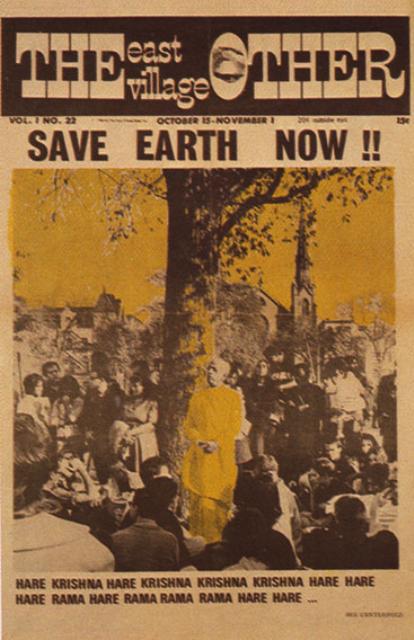
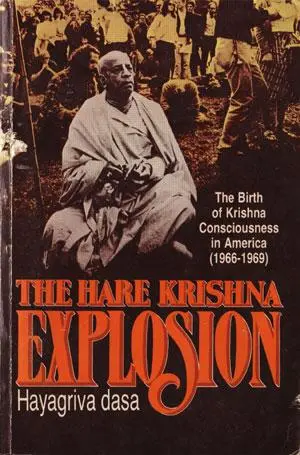
The Hare Krishna Explosion
by Hayagriva Prabhu
Part I: New York, 1966
Chapter 5
The Hare Krishna Explosion
“If Krishna sees you are taking one step toward Him,” Swamiji says, “He will take ten toward you. He is so happy to see you turn to Him. He is more eager to see us return to Godhead than we are to go.”
Back in the Mott Street apartment, I stare at myself in the mirror and repeat my new name. “Now you are Krishna’s,” I think, inspecting the new kanthi beads around my neck. “These are Krishna’s dog collars, and they don’t come off.”
We all optimistically resolve to try to follow the rules. For most of us, meat eating and gambling pose no problems. Rules governing sex and intoxicants, however, force some rapid changes in living patterns. I decide to convert the old Mott Street apartment into a brahmachari ashram. Down come the psychedelic posters, and up go pictures of lotus-eyed Krishna.
The next day at the temple, we find a new notice posted on the bathroom door. There are additional rules and regulations written neatly in ink by Swamiji himself.
NOTICE
All initiated devotees must attend morning and evening classes. Must not be addicted to any kind of intoxicants, including coffee, tea and cigarettes. They are forbidden to have illicit sex-connections. Must be strictly vegetarian. Should not extensively mix with non-devotees. Should not eat foodstuffs cooked by non-devotees. Should not waste time in idle talks nor engage in frivolous sports. Should always chant and sing the Lord’s holy names, Hare Krishna, Hare Krishna. Krishna Krishna, Hare Hare, Hare Rama, Hare Rama, Rama Rama, Hare Hare.
Thank you.
A.C. Bhaktivedanta Swami, Acharya
Umapati says nothing when he reads the notice. Rayarama simply chuckles.
“No coffee, no tea,” he says, shaking his head.
More
28 Feb 2011
by The Hare Krishna Movement
in Letters by Srila Prabhupada, Science of Self Realization
Tags: Arjuna, chanting, Hare Hare, Hare Krishna, J.F. Staal, Krishna Krishna, Krsna, liberation devotional service, sound vibration, Supreme Brahman

Excerpt from The Science of Self-Realization
by A.C. Bhaktivedanta Swami Prabhupada
Letter to J.F. Staal Professor of Philosophy and of South Asian Languages
January 30, 1970
“By sound vibration one becomes liberated.” By devotional service, by understanding well the Supreme Personality of Godhead, one can go to His abode and never come back again to this material condition. How is it possible? The answer is, simply by chanting His name constantly.
This is accepted by the exemplary disciple, Arjuna, who has perfectly learned the conclusion of spiritual science from the yogeśvara, the master of mystic knowledge, Kṛṣṇa. Recognizing Kṛṣṇa to be the Supreme Brahman, Arjuna addresses Him, sthāne hṛṣīkeśa…: “The world becomes joyful hearing Your name, and thus do all become attached to You.” (Bg. 11.36) The process of chanting is herein authorized as the direct means of contacting the Supreme Absolute Truth, the Personality of Godhead. Simply by chanting the holy name Kṛṣṇa, the soul is attracted by the Supreme Person, Kṛṣṇa, to go home, back to Godhead.
In the Nārada-pañcarātra it is stated that all the Vedic rituals, mantras, and understanding are compressed into the eight words Hare Kṛṣṇa, Hare Kṛṣṇa, Kṛṣṇa Kṛṣṇa, Hare Hare. Similarly, in the Kali-santaraṇa Upaniṣad it is stated that these sixteen words, Hare Kṛṣṇa, Hare Kṛṣṇa, Kṛṣṇa Kṛṣṇa, Hare Hare/ Hare Rāma, Hare Rāma, Rāma Rāma, Hare Hare, are especially meant for counteracting the degrading and contaminating influence of this materialistic age of Kali.
17 Jan 2011
by The Hare Krishna Movement
in Hayagriva das, The Hare Krishna Explosion
Tags: A.C. Bhaktivedanta Swami Prabhupada, Calcutta, guru, Hare Krishna, hayagriva das, New York 1966., spiritual master, Srila Prabhupada, the hare krishna explosion, Visitor from Calcutta

The Hare Krishna Explosion
by Hayagriva dasa
Part I: New York, 1966
Chapter 1
Visitor From Calcutta
I first see him just after crossing the Bowery at Houston Street. As he passes before the iron-mesh fence of a playground, I distinctly glimpse the aura of saintliness. I watch him through the rushing traffic and stumbling derelicts.
He strolls almost jauntily down the sidewalk. He is an old man whom age has never touched. Aloof from the people and bustle about him, he walks proudly, independently, his hand in a cloth beadbag. He wears the saffron robes of a sannyasi, and on his feet are quaint, pointed white shoes.
Only seven months ago, I had seen many saffron-robed monks and holymen walking the dirt roads of Hardwar and Rishikesh, and stopping beside the Ganges to bathe. For me, that had been a futile journey to the mystic East in search of the all-knowing guru.
But now—what’s this?
I look again at the pointed white shoes. Did this man follow me all the way from North India? Or did he just suddenly descend from the clouds onto Manhattan sidewalks? I decide I must speak to him.
More
Next Newer Entries










 The Hare Krishna Movement