Today we celebrate the Appearance of Lord Nityananda with a few select verses from the Sri Caitanya-caritamrta, Adi Lila Chapter 5, entitled “The Glories of Lord Nityananda Balarama”.
“Let me offer my obeisances to Lord Śrī Nityānanda, the Supreme Personality of Godhead, whose opulence is wonderful and unlimited. By His will, even a fool can understand His identity.” (Adi 5.1) “The Supreme Personality of Godhead, Kṛṣṇa, is the fountainhead of all incarnations. Lord Balarāma is His second body.” (Adi 5.4) “That original Lord Kṛṣṇa appeared in Navadvīpa as Lord Caitanya, and Balarāma appeared with Him as Lord Nityānanda.” (Adi 5.6)
Śrī Caitanya-caritāmṛta By His Divine Grace A. C. Bhaktivedanta Swami Prabhupāda Ādi-līlā, Chapter 5, Text 1-12
Some years back I was reading from one book and the author was explaining how within each of us, we have the Keys to the gates of the Kingdom of Heaven, and we also have the Keys to the gates of Hell. It is our choice at every moment which we choose to use. Evolution can work both ways.
The Evolutionary Process
…All living entities within this material world are undergoing the cycle of birth and death according to the laws of nature. This struggle of birth and death in different species may be called the evolutionary process, but in the Western world it has been wrongly explained. Darwin’s theory of evolution from animal to man is incomplete because the theory does not present the reverse condition, namely evolution from man to animal.
Human life, which is obtained in the course of the evolutionary process, is a chance for elevation (svargāpavarga) or for degradation (tiraścām punar asya ca). If one uses this human form of life properly, he can elevate himself to the higher planetary systems, where material happiness is many thousands of times better than on this planet, or one may cultivate knowledge by which to become free from the evolutionary process and be reinstated in one’s original spiritual life. This is called apavarga, or liberation. (from purport to SB 7.13.25)
Today I shall speak to you of the history of a boy devotee named Prahlāda Mahārāja. He was born in a family that was stubbornly atheistic. There are two kinds of men in this world: the demons and the demigods. What is the difference between them? The main difference is that the demigods, or godly persons, are devoted to the Supreme Lord, whereas the demons are atheistic. They do not believe in God because they are materialists. These two classes of men always exist in this world. At the present moment, due to the Age of Kali (Age of Quarrel), the number of demons has increased, but the classification has existed since the beginning of creation. The incident I am narrating to you occurred very, very long ago, a few million years after the time of creation.
Prahlāda Mahārāja was the son of the most atheistic person and the most materially powerful as well. Because the society was materialistic, this boy had no opportunity to glorify the Supreme Lord. The characteristic of a great soul is that he is very eager to broadcast glorification of the Supreme Lord. Lord Jesus Christ, for example, was very eager to broadcast the glorification of God, but demoniac people misunderstood him and crucified him.
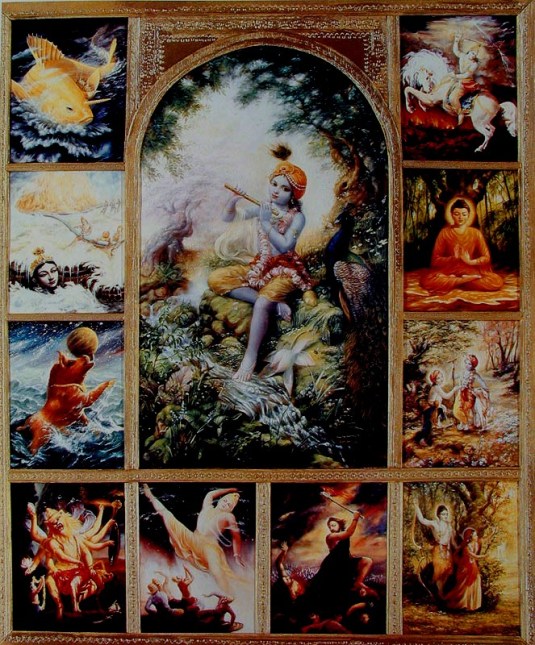
Lord Krsna appears in every millennium, in various incarnations, to annihilate the demons, protect the devotees and reestablish the principles of religion. From upper left-hand corner: Lord Matsya, the fish incarnation; Lord Kurma, the tortoise incarnation; Lord Varaha, the boar incarnation; Lord Nrsimhadeva, the man-lion incarnation; Lord Vamana, the dwarf-brahmana incarnation; Lord Parasurama, the warrior incarnation; Lord Ramacandra; Lord Krishna and Lord Balarama; Lord Buddha; and Lord Kalki, who destroys all demons at the end of the millennium.
In order to deliver the pious and to annihilate the miscreants, as well as to reestablish the principles of religion, I advent Myself millennium after millennium. (Bhagavada-gita As It Is 4.8)
This morning this verse kept going through my head:
Whatever inauspicious things I have done out of ignorance or unknowingly, please forgive that, and accept me as Your insignificant servant.
I had a hard time remembering where it came from. Then I remembered it was from the Sri Aparada-shodhana prayers. So I share them with you again. Hare Krishna!
Sri Aparadha-shodhana (Verses for Requesting Forgiveness for One’s Offences)
mantra-hinam kriya-hinam bhakti-hinam janardana yat pujitam maya deva paripurnam tad astu me
O my Lord, O Janardana, whatever little puja or worship that has been performed by me, although it is without devotion, without proper mantras, and without the proper performance, please let that become complete.
The Nectar of Devotion is specifically presented for persons who are now engaged in the Krsna consciousness movement. I beg to offer my sincere thanks to all my friends and disciples who are helping me to push forward the Krsna consciousness movement in the Western countries, and I beg to acknowledge, with thanks, the contribution made by my beloved disciple Śrīmad Jayānanda Brahmacari. My thanks are due as well to the directors of ISKCON Press, who have taken so much care in publishing this great literature. Hare Krsna.
A.C. Bhaktivedanta Swami
“Prabhupada: Hare Krsna. So we have published our Nectar of Devotion. So every one of you should read this Nectar of Devotion repeatedly. The whole substance of Vaisnava philosophy and activities, everything is there. So every one of you read this Nectar of Devotion once, twice, thrice.”
There has been so much misinformation lately, on the news networks, on social media, in politics, etc. about election results, relief funds for hurricane victims, eating pets in Springfield Ohio, etc., that it got me thinking about truthfulness. The English definition is simply: the quality of being honest and not containing or telling any lies. However according to the Vedic definition which goes a little deeper: Satyam, truthfulness, means that facts should be presented as they are for the benefit of others.
Satyam, truthfulness, means that facts should be presented as they are for the benefit of others. Facts should not be misrepresented. According to social conventions, it is said that one can speak the truth only when it is palatable to others. But that is not truthfulness. The truth should be spoken in a straight and forward way, so that others will understand actually what the facts are. If a man is a thief and if people are warned that he is a thief, that is truth. Although sometimes the truth is unpalatable, one should not refrain from speaking it. Truthfulness demands that the facts be presented as they are for the benefit of others. That is the definition of truth. (from purport Bhagavada-gita 10. 4-5)
Bhagavad-gītā As It Is by His Divine Grace A. C. Bhaktivedanta Swami Prabhupada
PICTURE INDEX
The illustrations of Bhagavad-gītā As It Is were painted by members of the International Society for Krishna Consciousness working under the personal direction of the author, their spiritual master, In the following descriptive index, the numbers in boldface type which follow each plate number refer to the chapter and verse of the Gītā that the picture illustrates.
Here in the West Mothers Day is being celebrated; a day to honor our Mothers.
…According to scriptures also, there are seven mothers: (1) the real mother, (2) the wife of the spiritual master, (3) the wife of a brāhmaṇa, (4) the wife of the king, (5) the cow, (6) the nurse, and (7) the earth. All of them are mothers.
Srimad Bhagavatam By His Divine Grace A.C. Bhaktivedanta Swaim Prabhupada from Canto 1, Chapter 11, Text 28-
praviṣṭaḥ—after entering; tu—but; gṛham—houses; pitroḥ—of the father; pariṣvaktaḥ—embraced; sva-mātṛbhiḥ—by His own mothers; vavande—offered obeisances; śirasā—His head; sapta—seven; devakī—Devakī; pramukhā—headed by; mudā—gladly.
After entering the house of His father, He was embraced by the mothers present, and the Lord offered His obeisances unto them by placing His head at their feet. The mothers were headed by Devakī [His real mother].
It appears that Vasudeva, the father of Lord Kṛṣṇa, had completely separate residential quarters where he lived with his eighteen wives, out of whom Śrīmatī Devakī is the real mother of Lord Kṛṣṇa. But in spite of this, all other stepmothers were equally affectionate to Him, as will be evident from the following verse. Lord Kṛṣṇa also did not distinguish His real mother from His stepmothers, and He equally offered His obeisances unto all the wives of Vasudeva present on the occasion. According to scriptures also, there are seven mothers: (1) the real mother, (2) the wife of the spiritual master, (3) the wife of a brāhmaṇa, (4) the wife of the king, (5) the cow, (6) the nurse, and (7) the earth. All of them are mothers. Even by this injunction of the śāstras, the stepmother, who is the wife of the father, is also as good as the mother because the father is also one of the spiritual masters. Lord Kṛṣṇa, the Lord of the universe, plays the part of an ideal son just to teach others how to treat their stepmothers.
tāḥ—all of them; putram—the son; aṅkam—the lap; āropya—having placed on; sneha-snuta—moistened by affection; payodharāḥ—breasts filled up; harṣa—delight; vihvalita-ātmānaḥ—overwhelmed by; siṣicuḥ—wet; netrajaiḥ—from the eyes; jalaiḥ—water.
The mothers, after embracing their son, sat Him on their laps. Due to pure affection, milk sprang from their breasts. They were overwhelmed with delight, and the tears from their eyes wetted the Lord.
When Lord Kṛṣṇa was at Vṛndāvana even the cows would become moistened by affection towards Him, and He would draw milk from the nipples of every affectionate living being, so what to speak of the stepmothers who were already as good as His own mother.
I have always enjoyed SrilaPrabhupada’s sense of humor.
Prabhupada: ”Krsna has got accountant. [laughter] He keeps nice account of the activities of His devotees.”……
Prabhupada: So one thing is guaranteed. If you engage in Krsna consciousness, and suppose you do not become perfectly mature, some way or other you fall down… We should not fall down. Because if we have got enthusiasm and patience, we shall not fall down. But suppose we fall down. There is nothing inauspicious, because whatever you have done sincerely, that is recorded in the book, in the Krsna’s book. Krsna has got accountant. [laughter] He keeps nice account of the activities of His devotees. That’s a fact. Just like the non devotees’ accounts are kept by Yamaraja for punishment, similarly, devotees’ accounts are kept by Krsna, personally. Unless He keeps account, how He says, “I respond to the devotee to the proportionate surrender”? The real business is surrender to Krsna. If we surrender immediately, cent percent, then Krsna also gives you the result immediately, cent percent. ( The Nectar of Devotion Lecture , October 20, 1972, Vrndavana)
Happy New Year! My first post of the New Year, an issue very dear to my heart, Cow Protection.
…The Srimad-Bhagavatam says the cow is an offenseless living being. It’s Krsna’s arrangement that the cow takes so little and gives so much. From her milk you can make hundreds of delicious preparations. She simply performs her service very peacefully without any bother to anyone.
Cow Protection – Practical Necessity for a Peaceful Society
(excerpted from Back to Godhead Magazine January 1976 Vol. 11, No. 1)
by Visakha-devi dasi
Speaking on the troubled condition of our modern world, the late historian Arnold Toynbee once said, “The cause of it [the world’s malady] is spiritual. We are suffering from having sold our souls to the pursuit of an objective which is both spiritually wrong and practically unobtainable. We have to reconsider our objective and change it. And until we do this, we shall not have peace, either amongst ourselves or within each of us.”
The conditions of our urbanized, technology-oriented society that prompted Dr. Toynbee’s remarks are no mystery to us. Especially in the West, and increasingly in the rest of the world, the mad quest for artificial luxuries has created a chaotic atmosphere pervaded by greed and power-seeking.
One of the first slokas I ever memorized from the Bhagavad-gita was 9.26 patraṁ puṣpaṁ phalaṁ toyaṁ…“If one offers Me with love and devotion a leaf, a flower, fruit or water, I will accept it.” (Full text and purport follows). This was practically the beginning of my spiritual life. ‘Just try to love God by offering Him something, with devotion. A leaf, a flower, fruit or water.’
One does not need great wealth, education or opulence to satisfy the Supreme Personality of Godhead. If one is fully absorbed in love and ecstasy, he need offer only a flower and a little water. As stated in Bhagavad-gītā, patraṁ puṣpaṁ phalaṁ toyaṁ yo me bhaktyā prayacchati: “If one offers Me with love and devotion a leaf, a flower. fruit or water, I will accept it.” (Bg. 9.26)
The Supreme Lord can be pleased only by devotional service: therefore it is said here that the Lord is surely satisfied by devotion and nothing else. Quoting from the Gautamīya-tantra, the Hari-bhakti-vilāsa states:
“Śrī Kṛṣṇa, who is very affectionate toward His devotees, sells Himself to a devotee who offers merely a tulasī leaf and a palmful of water.” The Supreme Lord is causelessly merciful upon His devotee, so much so that even the poorest of men can offer Him a little water and a flower in devotion and thus please Him. This is due to His affectionate dealings with His devotees. (SB 5.3.6 purport)
Everyone is searching after peace of mind. This is obtainable only when one is completely freed from the desire for material sense gratification and is engaged in the devotional service of the Lord. As stated in Bhagavad-gītā: patraṁ puṣpaṁ phalaṁ toyaṁ yo me bhaktyā prayacchati (9.26). Worship of the Lord is not at all expensive. One can offer the Lord a leaf, a flower, a little fruit and some water. The Supreme Lord accepts these offerings when they are offered with love and devotion. In this way, one can become freed from material desires. As long as one maintains material desires, he cannot be happy. As soon as one engages in the devotional service of the Lord, his mind is purified of all material desires. Then one becomes fully satisfied. (SB 5.7.11, purport)
Practicing Krishna Consciousness @ Home
The Simple Method
“The process is very simple. Just keep a picture of Lord Caitanya with His associates. Lord Caitanya is in the middle, accompanied by His principal associates — Nityananda, Advaita, Gadadhara, and Srivasa. One simply has to keep this picture. One can keep it anywhere. It is not that one has to come to us to see this picture. Anyone can have this picture in his home, chant this Hare Krishna mantra, and thus worship Lord Caitanya. That is the simple method. But who will capture this simple method? Those who have good brains. Without much bother, if one simply keeps a picture of Sri Caitanya Mahaprabhu at home and chants Hare Krishna, then one will realize God. Anyone can adopt this simple method. There is no expenditure, there is no tax, nor is there any need to build a very big church or temple. Anyone, anywhere, can sit down on the road or beneath a tree and chant the Hare Krishna mantra and worship God. Therefore it is a great opportunity.” (Srila Prabhupada lecture, London’s Conway Hall, Nov. 1969)
For some reason (supersoul, I guess), I have been reading the “Transcendental Teachings of Prahlada Maharaja”. There are so many books on my shelves, but I searched for this small paper back book amongst the many small books in our library. We have included it here today as a post. You can also download it as a free pdf file, or as a scanned pdf of the original. Just click on following links to download.
The Nectar of Devotion Lecture
By His Divine Grace A. C. Bhaktivedanta Swami Prabhupada
Vṛndāvana, October 19, 1972
Pradyumna: (reading) “…happiness immediately terminates with his body as long as his life, as soon as his life is over. Death is therefore taken as the representative of God for the atheistic class of men. The devotee realizes the presence of God by devotional service, whereas the atheist realizes the presence of God in the shape of death.”
Prabhupāda: Yes. This point we have discussed last night that everyone can see God. To see God is not very difficult job. There are so many points described in the Bhagavad-gītā. For the devotees, those who are serious about seeing God, they can see God. God is present everywhere. And God Himself, Kṛṣṇa, is describing, raso ‘ham apsu kaunteya prabhāsmi śaśi-sūryayoḥ [Bg. 7.8]. So everyone drinks water. Now Kṛṣṇa says, “The taste of the water, I am.” So who has not tasted the water? Everyone drinks water at least four times, five times. So as soon as you drink water, the taste of the water is Kṛṣṇa. Kṛṣṇa says, “I am this.” Kṛṣṇa has described Himself in so many ways. “Amongst the trees, I am this. Amongst the aquatics, I am this. Amongst the nonmovable, I am this.” So why not see God in that way? The atheist class of men, they say, “Can you show me God?” So why don’t you see God? Why you close your eyes? If you have got eyes to see, you can see God everywhere.
…Yes. Those who are spiritually advanced, their photograph and ordinary photograph is different. Just like here is statue of Kṛṣṇa. He’s not different from Kṛṣṇa. The original person Kṛṣṇa and this statue of Kṛṣṇa is the same. Similarly, a spiritually perfect person and his photograph is the same. Because it is in the absolute stage. In the absolute stage there is no difference. In the material stage there is difference. Is that clear?… (Srila Prabhupada Bhagavad-gita Lecture Sept. 16, 1966)
When Kṛṣṇa and His devotees meet, the meeting is technically called yoga, or linking up with the Lord. (Nectar of Devotion Chapter 39)
Durning the month of Damadora (Kartika) I like to focus my attention on the childhood pastimes of Krsna in Vrndavan. So with this in mind we decided to post a chapter from the Nectar of Devotion which focus’s on the Lords relationships with His devotees in the fraternal mellow or better known as friendship.
When a devotee is permanently situated in devotional service, and by different symptoms of ecstasy he has developed and matured a fraternal mellow or flavor in relationship with the Personality of Godhead, his feeling is called fraternal love of Godhead.
The impetus for such fraternal love of God is God Himself. When one is liberated and discovers his eternal relationship with the Supreme Lord, the Lord Himself becomes the impetus for increasing fraternal love. The eternal associates of the Lord in Vṛndāvana have described this as follows: “The Lord, Hari, whose bodily hue is like the indranīla jewel, whose smiling is as beautiful as the kunda flower, whose silk dress is as yellow as golden autumn foliage, whose chest is beautified with garlands of flowers and who is always playing upon His flute—this enemy of the Agha demon is always attracting our hearts by wandering about Vṛndāvana.” (Nectar of Devotion Chapter 41)
Yesterday I was cleaning out the abandoned barn at Bahulavan, which is now being put back together again, and I found an old issue of Back to Godhead Magazine mixed in with so much debris. I pulled it out, cleaned it off, and added it to my collection of Back to Godhead Magazines. I had always heard of this famous sailing ship, and finally got a chance to see it.
Sailing Back to Godhead
Article excerpted from Back to Godhead Magazine Vol. 16, No. 6, 1981
A teakwood ketch and a devotee’s determination help bring Lord Krsna’s message to the Hawaiian Islands.
“…Krsna consciousness is the only established religion I know of that openly respects all other bonafide religions. My wife and I chant Hare Krsna and read Srila Prabhupada’s books daily. It’s added a dimension to my life that I feel is essential.”








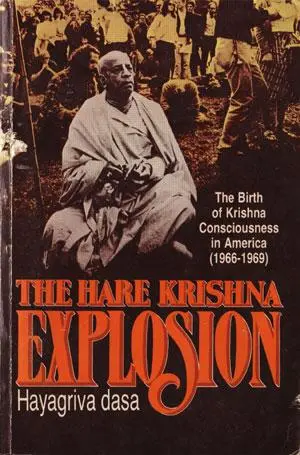

 The Hare Krishna Movement
