When I first began reading this verse from the Srimad Bhagavatam this morning, I thought it was just about hearing, but as I read and re read the purport, it was also about love.
“Simply by giving aural reception to this Vedic literature, the feeling for loving devotional service to Lord Kṛṣṇa, the Supreme Personality of Godhead, sprouts up at once to extinguish the fire of lamentation, illusion and fearfulness.” (Srimad Bhagavatam 1.7.7.)
There are various senses, of which the ear is the most effective. This sense works even when a man is deep asleep. One can protect himself from the hands of an enemy while awake, but while asleep one is protected by the ear only. The importance of hearing is mentioned here in connection with attaining the highest perfection of life, namely, getting free from three material pangs…
…And it is definitely suggested herein that simply by hearing the message of Śrīmad-Bhāgavatam one gets attachment for the Supreme Personality of Godhead Śrī Kṛṣṇa, and as soon as this is effected the symptoms of the material diseases disappear. Śrīla Vyāsadeva saw the all-perfect Personality of Godhead, and in this statement the all-perfect Personality of Godhead Śrī Kṛṣṇa is clearly confirmed.
The ultimate result of devotional service is to develop genuine love for the Supreme Personality. Love is a word which is often used in relation with man and woman. And love is the only word that can be properly used to indicate the relation between Lord Kṛṣṇa and the living entities.
Loving devotional service to the Lord begins with hearing about the Lord. (from purport)
The world seems to be in a state of chaos, what with cities being bombed, thousands of people being displaced, and left without home, power, heat, food or water. There is death and destruction in so many places around the globe. It is ‘man’s inhumanity to man”, and I often wonder how is it possible that man can act in such deplorable and sinful way
Those who are demoniac do not know what is to be done and what is not to be done. Neither cleanliness nor proper behavior nor truth is found in them. (Bg. 16.7)
Following such conclusions, the demoniac, who are lost to themselves and who have no intelligence, engage in unbeneficial, horrible works meant to destroy the world. (Bg. 16.9)
PURPORT
The demoniac are engaged in activities that will lead the world to destruction. The Lord states here that they are less intelligent. The materialists, who have no concept of God, think that they are advancing. But, according to Bhagavad-gītā, they are unintelligent and devoid of all sense. They try to enjoy this material world to the utmost limit and therefore always engage in inventing something for sense gratification. Such materialistic inventions are considered to be advancement of human civilization, but the result is that people grow more and more violent and more and more cruel, cruel to animals and cruel to other human beings. They have no idea how to behave toward one another. Animal killing is very prominent amongst demoniac people. Such people are considered the enemies of the world because ultimately they will invent or create something which will bring destruction to all. Indirectly, this verse anticipates the invention of nuclear weapons, of which the whole world is today very proud. At any moment war may take place, and these atomic weapons may create havoc. Such things are created solely for the destruction of the world, and this is indicated here. Due to godlessness, such weapons are invented in human society; they are not meant for the peace and prosperity of the world.
The following are the prayers by Gajendra, the King of the elephants, offered to the Supreme Personality of Godhead, during his difficult struggle with the crocodile. It appears that the King of the elephants was formerly a human being known as Indradyumna and that he learned a prayer to the Supreme Lord. Fortunately he remembered that prayer and began to chant it. First he offered his respectful obeisances to the Supreme Personality of Godhead, and because of his awkward position in having been attacked by the crocodile, he expressed his inability to recite prayers nicely. Nonetheless, he tried to chant the mantra and expressed himself in the prayers that follow.
…It is imperative that all devotees in Kṛṣṇa consciousness practice chanting some mantra. Certainly one should chant the Hare Kṛṣṇa mantra, which is the mahā-mantra, or great mantra, and also one should practice chanting cintāmaṇi-prakara-sadmasu or the Nṛsiṁha strotra (ito nṛsiṁhaḥ parato nṛsiṁho yato yato yāmi tato nṛsiṁhaḥ). Every devotee should practice in order to chant some mantra perfectly so that even though he may be imperfect in spiritual consciousness in this life, in his next life he will not forget Kṛṣṇa consciousness, even if he becomes an animal. Of course, a devotee should try to perfect his Kṛṣṇa consciousness in this life, for simply by understanding Kṛṣṇa and His instructions, after giving up this body one can return home, back to Godhead. Even if there is some falldown, practice of Kṛṣṇa consciousness never goes in vain. For example, Ajāmila, in his boyhood, practiced chanting the name of Nārāyaṇa under the direction of his father, but later, in his youth, he fell down and became a drunkard, woman-hunter, rogue and thief. Nonetheless, because of chanting the name of Nārāyaṇa for the purpose of calling his son, whom he had named Nārāyaṇa, he became advanced, even though he was involved in sinful activities. Therefore, we should not forget the chanting of the Hare Kṛṣṇa mantra under any circumstances. It will help us in the greatest danger, as we find in the life of Gajendra.(From Purport to text 1)
Śrīmad-Bhāgavatam By His Divine Grace A. C. Bhaktivedanta Swami Prabhupāda Canto 8, Chapter Three, Text 1-29
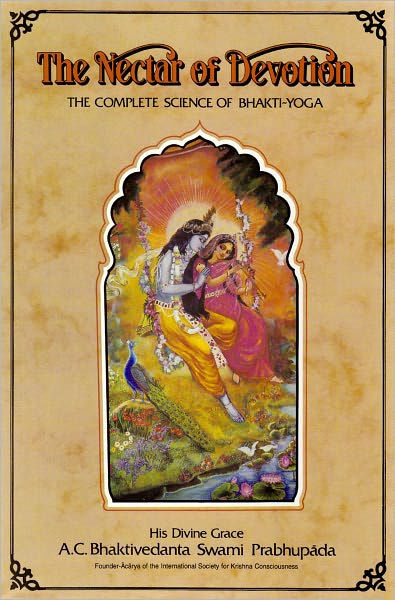
Here is another word for your vaisnava vocabulary; Āśā-bandha. It is used in The Nectar Of Devotion, Chapter 18 under the Heading “Great Hope”.
” The purport is that under this heading of asa-bandha, one should continue to hope against hope that some way or other he will be able to approach the lotus feet of the Supreme Lord.
The strong conviction that one will certainly receive the favor of the Supreme Personality of Godhead is called in Sanskrit Āśā-bandha. Āśā-bandha means to continue to think, “Because I’m trying my best to follow the routine principles of devotional service, I am sure that I will go back to Godhead, back to home.”
In this connection, one prayer by Rupa Gosvāmī is sufficient to exemplify this hopefulness. He says, “I have no love for Krsna, nor for the causes of developing love of Krsna-namely, hearing and chanting. And the process of bhakti-yoga, by which one is always thinking of Krsna and fixing His lotus feet in the heart, is also lacking in me. As far as philosophical knowledge or pious works are concerned, I don’t see any opportunity for me to execute such activities. But above all, I am not even born of a nice family. Therefore I must simply pray to You, Gopi-jana-vallabha [Krsna, maintainer and beloved of the gopīs]. I simply wish and hope that some way or other I may be able to approach Your lotus feet, and this hope is giving me pain, because I think myself quite incompetent to approach that transcendental goal of life.” The purport is that under this heading of asa-bandha, one should continue to hope against hope that some way or other he will be able to approach the lotus feet of the Supreme Lord.
I have read and re-read this chapter many times this election year, and this is a perfect description on the demoniac man.
dambho darpo ’bhimānaś ca krodhaḥ pāruṣyam eva ca ajñānaṁ cābhijātasya pārtha sampadam āsurīm
dambhaḥ—pride; darpaḥ—arrogance; abhimānaḥ—conceit; ca—and; krodaḥ—anger; pāruṣyam—harshness; eva—certainly; ca—and; ajñānam—ignorance; ca—and; abhijātasya—one who is born; pārtha—O son of Pṛthā; sampadam—nature; āsurīm—demoniac.
Arrogance, pride, anger, conceit, harshness and ignorance—these qualities belong to those of demonic nature, O son of Pṛthā. (Bg 16.4)
In this verse, the royal road to hell is described. The demoniac want to make a show of religion and advancement in spiritual science, although they do not follow the principles. They are always arrogant or proud in possessing some type of education or so much wealth. They desire to be worshiped by others, and demand respectability, although they do not command respect. Over trifles they become very angry and speak harshly, not gently. They do not know what should be done and what should not be done. They do everything whimsically, according to their own desire, and they do not recognize any authority. These demoniac qualities are taken on by them from the beginning of their bodies in the wombs of their mothers, and as they grow they manifest all these inauspicious qualities. (From purport to Bg. 16.4)
The demoniac man knows no limit to his desire to acquire money. That is unlimited. He only thinks how much assessment he has just now and schemes to engage that stock of wealth farther and farther. For that reason, he does not hesitate to act in any sinful way and so deals in the black market for illegal gratification. He is enamoured by the possessions he has already, such as land, family, house and bank balance, and he is always planning to improve them…
Food prepared for and offered to Krishna with love and devotion becomes completely spiritualized. Such food is called Krishna prasadam, which means “the mercy of Lord Krishna.”
Lord Caitanya said of prasadam…”now that they have been prepared for Krishna and offered to Him with devotion, these foods have acquired extraordinary tastes and uncommon fragrances. Just taste them and see the difference! Apart from the taste, even the fragrance pleases the mind and makes one forget any other fragrance. Therefore, it should be understood that the spiritual nectar of Krishna’s lips must have touched these ordinary foods and imparted to them all their transcendental qualities.”
Eating only food offered to Krishna is the perfection of vegetarianism. In the Bhagavad-gita Lord Krishna says that unless one eats only food that has been offered to Him in sacrifice, one will suffer the reactions of karma. He also states, “If one offers Me with love and devotion a leaf, a flower, a fruit, or water, I will accept it.”
Wwe can offer Krishna foods prepared from milk products, vegetables, fruits, nuts, and grains. Meat, fish and eggs are not offerable. And a few vegetarian items are also forbidden— garlic and onions, for example, which are in the mode of darkness. (Hing, or asafoetida, is a tasty substitute for them in cooking.) Nor can you offer Krishna coffee or tea.
In preparing food, cleanliness is the most important principle. Nothing impure should be offered to God, so keep your kitchen very clean. Always wash your hands thoroughly before entering the kitchen. While preparing food, do not taste it, for you are cooking the meal not for yourself but for the plea¬sure of Krishna. Arrange positions of the food on dinnerware kept especially for this purpose; no one but the Lord should eat from these dishes. The easiest way to offer food is simply to pray, “My dear Lord Krishna, please accept this food,” and to chant each of the following prayers three times while ringing a bell.
Today we celebrate the Appearance of Srila Bhaktisiddhanta Saraswati Thakura, the son of Srila Bhaktivinoda Thakura, and Spiritual Master of our Srila Prabhupada. We will honor it with a half day fast, rememberances and readings. I happened upon the following post some years ago on the Sampradaya Sun, and because it was so nicely assembled, we will share it with you here today.
The Appearance of Srila Bhaktisiddhanta by Sun Staff CANADA (SUN)
Srila Bhaktisiddhanta Saraswati Thakura appeared in Purusottam Ksetra, Jagannatha Puri, Orissa, on February 6, 1874. He was born in the family home next to the Narayan-chhata of Sri Jagannatha Temple, which always reverberated with the chanting of the Holy Name. Named Bimala Prasad, He was the fourth son of Srila Bhaktivinoda Thakura and Srimati Bhagavati Devi.
By the age of twelve, Bhaktisiddhanta Sarasvati was well versed in astronomy. Hearing news of this, Srila Jagannatha dasa Babaji summoned him one day and instructed him to make a Vaisnava calendar that included the appearance and disappearance days of all Lord Caitanya Mahaprabhu’s and Visnupriya Thakurani’s associates. Following these instructions, Srila Bhaktisiddhanta Sarasvati made the necessary calculations and began publication of “Sri Nabadvipa Panjica”.
…Sometimes an ever-liberated personal associate of the Supreme Personality of Godhead descends into this universe just as the Lord descends. Although working for the liberation of conditioned souls, the messenger of the Supreme Lord remains untouched by the material energy. Generally ever-liberated personalities live in the spiritual world as associates of Lord Kṛṣṇa, and they are known as kṛṣṇa-pāriṣada, associates of the Lord. Their only business is enjoying Lord Kṛṣṇa’s company, and even though such eternally liberated persons come within this material world to serve the Lord’s purpose, they enjoy Lord Kṛṣṇa’s company without stoppage. The ever-liberated person who works on Kṛṣṇa’s behalf enjoys Lord Kṛṣṇa’s company through his engagement.
… The conditioned soul subjected to the threefold material miseries is ceaselessly kicked by māyā, and this is his disease. If by chance he meets a saintly person who works on Kṛṣṇa’s behalf to deliver conditioned souls, and if he agrees to abide by his order, he can gradually approach the Supreme Personality of Godhead, Kṛṣṇa.(from purport to Madhya-lila 22.14-15)
Last night as I was falling asleep, this prayer just popped into my head:
SRI RUPA PRANAMA
sri-caitanya-mano-‘bhistam sthapitum yena bhtu-tale svayam rupah kada mahyam dadati sva-padantikam
sri-caitanya-of Lord Caitanya; manah– mind; abhistam-what is desired; sthapitam-established; yena-by whom; bhu-tale-on the surface of the globe; svayam-himself; rupah-Srila Rupa Gosvami; kada-when; mahyam-unto me; dadati-will give; sva-his own; pada-lotus feet; antikam-proximity to.
When will Srila Rupa Gosvami Prabhupada, who has established within this material world the mission to fulfill the desire of Lord Caitanya, give me shelter under his lotus feet?
And as I drifted off to sleep I was thinking about Srila Rupa Goswami, I don’t know why. But I woke still thinking about him. The following is an article from Back to Godhead Magizine.
Obstacles on the Path of Eternity An Excerpt from Srila Rupa Gosvami’s Upadesamrta from Back to Godhead Magazine Vol. 1, No.88, 1973
[SRILA RUPA GOSVAMI was one of six exalted devotees especially chosen through the Krsna conscious chain of spiritual masters to teach the devotional service of the Supreme Lord in a scientific manner. Although all of these six great devotees were erudite scholars and prolific writers, Srila Rupa Gosvami is the most prominent, for he most greatly appreciated the nectar of Krsna consciousness. His Upadesamrta (Nectarean Instructions), a short work of only eleven verses, teaches the basic principles for arousing one’s dormant love of Krsna, the Supreme Lord. Written in Sanskrit some 400 years ago, it has now been translated into English, with an illuminating explanation of each verse, by His Divine Grace A.C. Bhaktivedanta Swami Prabhupada.]
O son of Kuntī [Arjuna], I am the taste of water, the light of the sun and the moon, the syllable om in the Vedic mantras; I am the sound in ether and ability in man.(Bg 7.8)
“Water is our life. So when you take water, quench your thirst, you can immediately thank God because that taste is God. So immediately you can remember, “O my dear Lord, You have created so nice thing, water. Oh, I am so thirsty. It is quenching my thirst. Thank You.” Is it very difficult? But the nonsense, they will not do even this. They’ll say, “Oh, God is dead.” Therefore we are suffering. We are so ungrateful that we even do not give thanks. In the ordinary way, if somebody gives me a glass of water when I am thirsty—it is etiquette—I say, “Thank you.” And God has given us so vast mass of water in the ocean, in the sea, in the sky. Without water we cannot live. There is no thanksgiving. There is no thanksgiving.” (Śrīla Prabhupāda, 68/08/20 – Lecture SB 07.09.12-13 – Montreal)
That supreme abode is called unmanifested and infallible, and it is the supreme destination. When one goes there, he never comes back. That is My supreme abode. (Bhagavad-gita 8.21)
Purport
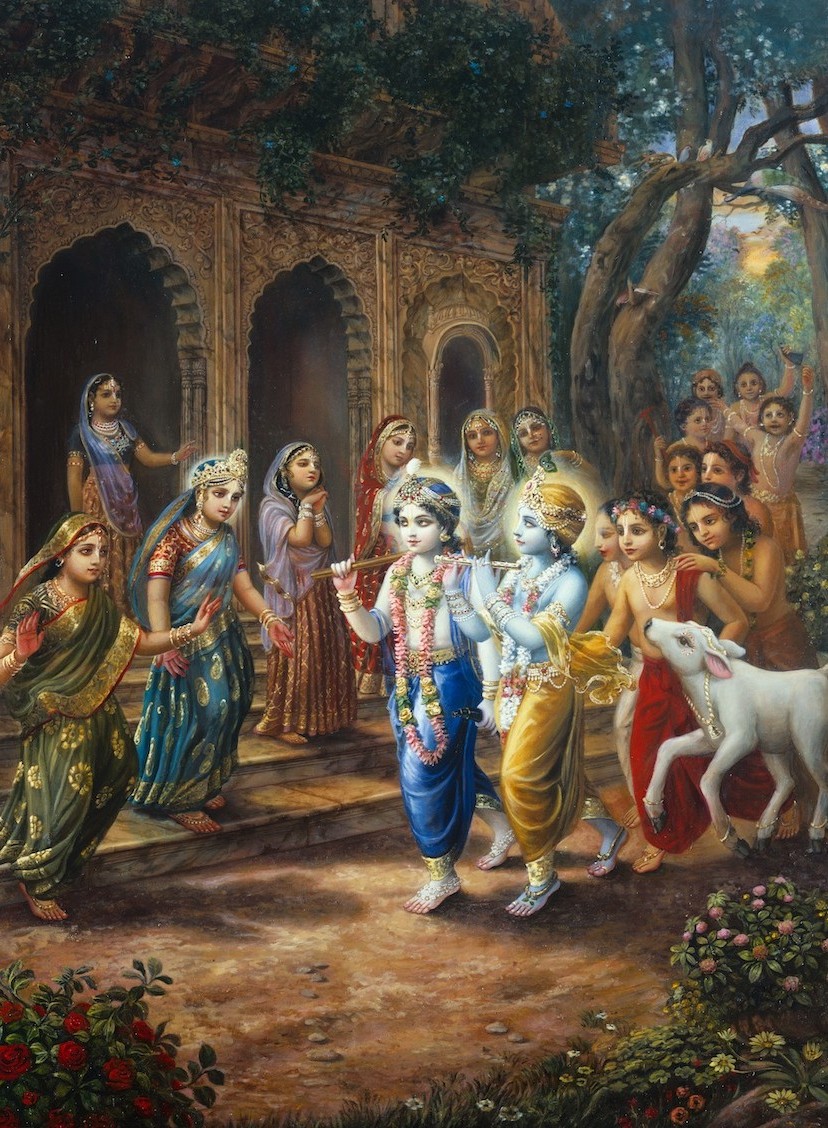
The supreme abode of the Personality of Godhead, Kṛṣṇa, is described in the Brahma-saṁhitā as cintāmaṇi-dhāma, a place where all desires are fulfilled. The supreme abode of Lord Kṛṣṇa known as Goloka Vṛndāvana is full of palaces made of touchstone. There are also trees which are called “desire trees” that supply any type of eatable upon demand, and there are cows known as surabhi cows which supply a limitless supply of milk. In this abode, the Lord is served by hundreds of thousands of goddesses of fortune (Lakṣmīs), and He is called Govinda, the primal Lord and the cause of all causes. The Lord is accustomed to blow His flute (venum kvanantam). His transcendental form is the most attractive in all the worlds—His eyes are like the lotus petals and the color of His body like clouds. He is so attractive that His beauty excels that of thousands of cupids. He wears saffron cloth, a garland around His neck and a peacock feather in His hair. In the Gītā Lord Krṣṇa gives only a small hint of His personal abode (Goloka Vṛndāvana) which is the supermost planet in the spiritual kingdom. A vivid description is given in the Brahma-saṁhitā. Vedic literature states that there is nothing superior to the abode of the Supreme Godhead, and that that abode is the ultimate destination. When one attains to it, he never returns to the material world. Kṛṣṇa’s supreme abode and Kṛṣṇa Himself are non different, being of the same quality. On this earth, Vṛndāvana, ninety miles southeast of Delhi, is a replica of that supreme Goloka Vṛndāvana located in the spiritual sky. When Kṛṣṇa descended on this earth, He sported on that particular tract of land known as Vṛndāvana in the district of Mathurā, India.
When we were in Butler PA, this summer for thefor the 60th aniversary of Srila Prabhupada’s arrival in the USA, We visited the home of Sally Agarwal, where Srila Prabhupada first stayed as their guest when he arrived in America. We heard many sweet stories of his stay in Butler, and how Sally’s daughter referred to Srila Prabhupada as Swami Jesus.
…I am obliged to your good daughter for awarding me a good degree as SWAMIJESUS which is actually a great honour for me. Some time the Lord speaks through innocent child and I take this honour as sent by Lord Jesus through an innocent child free from all formalities of the current society. Lord Jesus preached the message of God and I have taken up the same mission, and it would be a good luck for me if I can follow the foot prints of Lord Jesus who preached the message of God in spite of all persecution. Lord Jesus is a living example how one has to suffer in this material world simply for the matter of preaching the message of God… (letter to Sally Agarwal)
I remember back many years ago, when I was a new devotee traveling with the RDTSP, we attended a Rainbow Festival in Oregon. There were many hippy type personalities, and aspiring spiritualists, and I meet this one man, who looked like Jesus, with long hair and sandals, with a sign around his neck that said, “I Am God”.
So I said to him, “If you are God, then show me your Universal Form”. It was stunned silence. He could not reply. I guess maybe he wasn’t God after all. Or I didn’t have the divine vision to see. But either way, he wasn’t still wearing the sign at the end of the day.
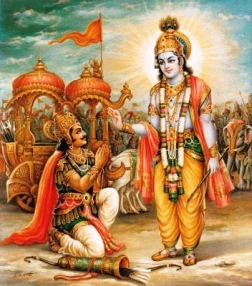
O greatest of all personalities, O supreme form, though I see here before me Your actual position, I yet wish to see how You have entered into this cosmic manifestation. I want to see that form of Yours. (Bg. 11. 3)
If You think that I am able to behold Your cosmic form, O my Lord, O master of all mystic power, then kindly show me that universal self. (Bg 11 .4)
The Blessed Lord said: My dear Arjuna, O son of Pṛthā, behold now My opulences, hundreds of thousands of varied divine forms, multicolored like the sea. (Bg 11. 5)
But you cannot see Me with your present eyes. Therefore I give to you divine eyes by which you can behold My mystic opulence. (Bg. 11. 8)
Arjuna saw in that universal form unlimited mouths and unlimited eyes. It was all wondrous. The form was decorated with divine, dazzling ornaments and arrayed in many garbs. He was garlanded gloriously, and there were many scents smeared over His body. All was magnificent, all-expanding, unlimited. This was seen by Arjuna. (Bg 11. 10-11
The Kṛṣṇa consciousness movement is conducted under the supervision of Śrīla Rūpa Gosvāmī. The Gauḍīya Vaiṣṇavas, or Bengali Vaiṣṇavas, are mostly followers of Śrī Caitanya Mahāprabhu, of whom the six Gosvāmīs of Vṛndāvana are direct disciples. Therefore Śrīla Narottama dāsa Ṭhākura has sung:
rūpa-raghunātha-pade ha-ibe ākuti kabe hāma bujhaba se yugala-pīriti
“When I am eager to understand the literature given by the Gosvāmīs, then I shall be able to understand the transcendental loving affairs of Rādhā and Kṛṣṇa.” Śrī Caitanya Mahāprabhu appeared in order to bestow upon human society the benediction of the science of Kṛṣṇa. The most exalted of all the activities of Lord Kṛṣṇa are His pastimes of conjugal love with the gopīs. Śrī Caitanya Mahāprabhu appeared in the mood of Śrīmatī Rādhārāṇī, the best of the gopīs. Therefore, to understand the mission of Lord Śrī Caitanya Mahāprabhu and follow in His footsteps, one must very seriously follow in the footsteps of the six Gosvāmīs—Śrī Rūpa, Sanātana, Bhaṭṭa Raghunātha, Śrī Jīva, Gopāla Bhaṭṭa and Dāsa Raghunātha.
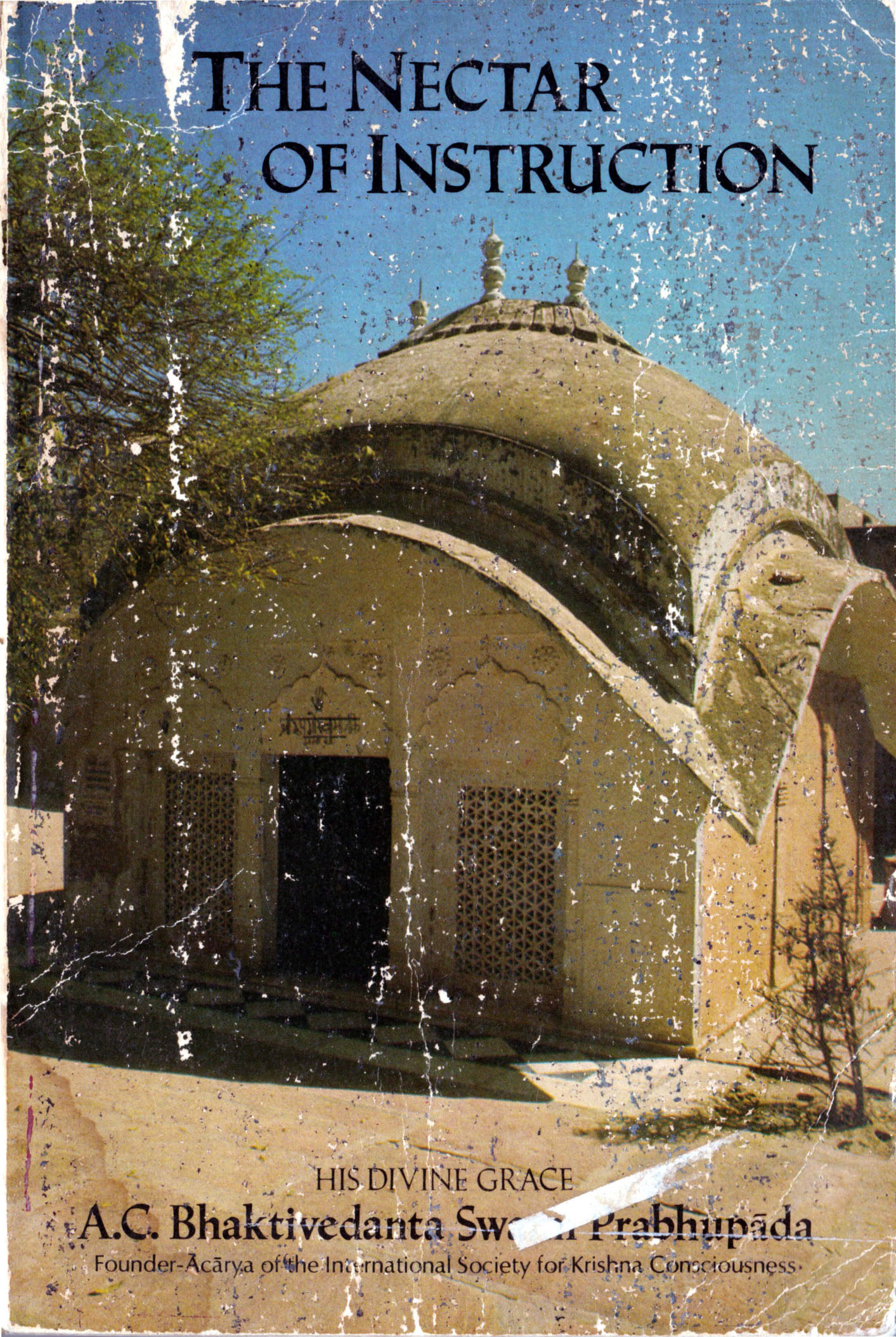
Śrī Rūpa Gosvāmī was the leader of all the Gosvāmīs, and to guide our activities he gave us this Upadeśāmṛta (The Nectar of Instruction) to follow. As Śrī Caitanya Mahāprabhu left behind Him the eight verses known as Śikṣāṣṭaka, Rūpa Gosvāmī gave us Upadeśāmṛta so that we may become pure Vaiṣṇavas.
In all spiritual affairs, one’s first duty is to control his mind and senses. Unless one controls his mind and senses, one cannot make any advancement in spiritual life. Everyone within this material world is engrossed in the modes of passion and ignorance. One must promote himself to the platform of goodness, sattva-guṇa, by following the instructions of Rūpa Gosvāmī, and then everything concerning how to make further progress will be revealed.
Advancement in Kṛṣṇa consciousness depends on the attitude of the follower. A follower of the Kṛṣṇa consciousness movement should become a perfect gosvāmī. Vaiṣṇavas are generally known as gosvāmīs. In Vṛndāvana, this is the title by which the director of each temple is known. One who wants to become a perfect devotee of Kṛṣṇa must become a gosvāmī. Go means “the senses,” and svāmī means “the master.” Unless one controls his senses and mind, one cannot become a gosvāmī. To achieve the highest success in life by becoming a gosvāmī and then a pure devotee of the Lord, one must follow the instructions known as Upadeśāmṛta, which have been given by Śrīla Rūpa Gosvāmī. Śrīla Rūpa Gosvāmī has given many other books, such as Bhakti-rasāmṛta-sindhu, Vidagdha-mādhava and Lalita-mādhava, but Upadeśāmṛta constitutes the first instructions for neophyte devotees. One should follow these instructions very strictly. Then it will be easier to make one’s life successful. Hare Kṛṣṇa.
A.C. Bhaktivedanta Swami September 20, 1975 Viśvarūpa-mahotsava Kṛṣṇa-Balarāma Mandira Ramaṇa-reti Vṛndāvana, India
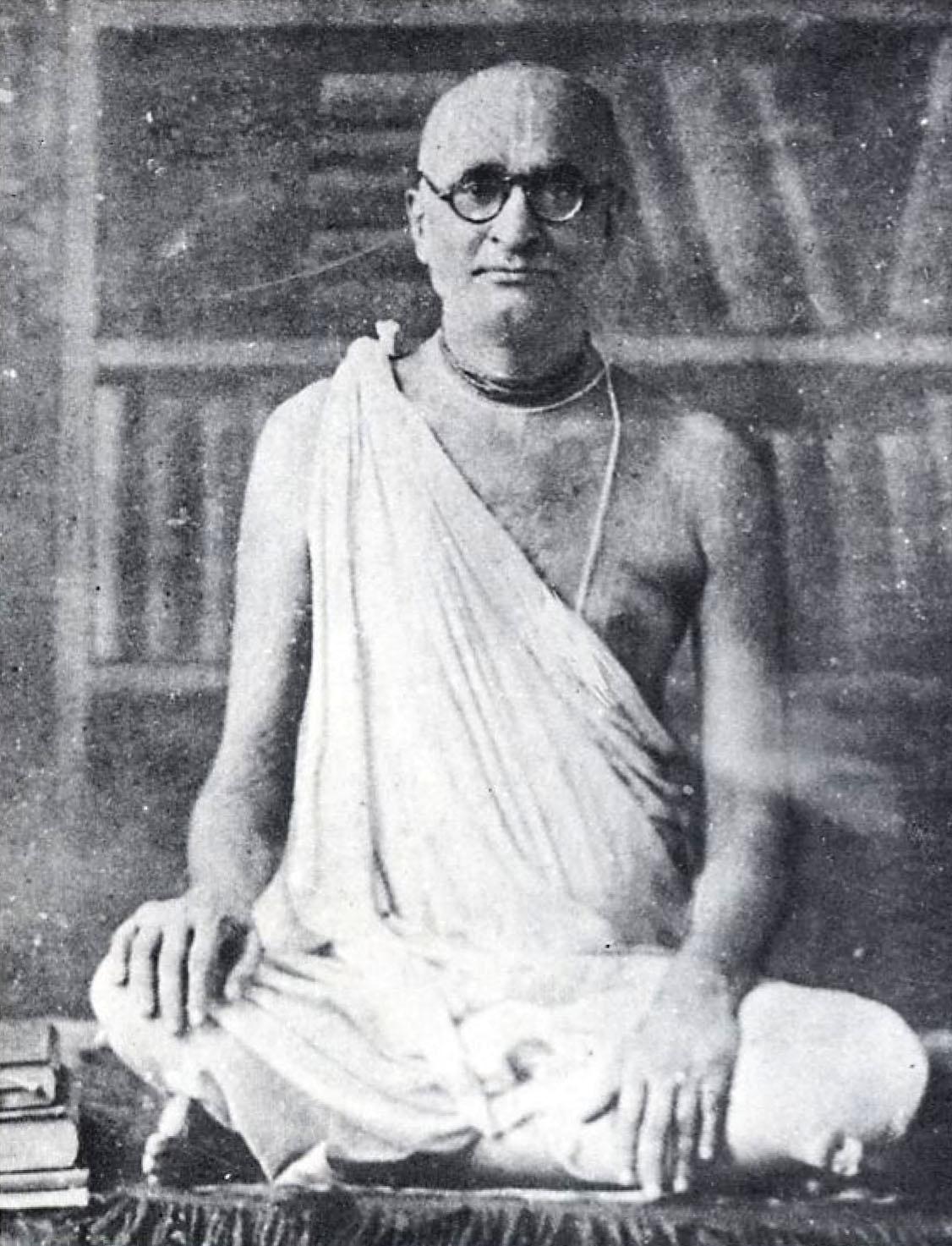
His Divine Grace Śrīla Bhaktisiddhānta Sarasvatī Gosvāmī Prabhupāda’s Disappearance Day, Lecture By His Divine Grace A. C. Bhaktivedanta Swami Prabhupāda Los Angeles, December 13, 1973
Prabhupāda:
nama oṁ viṣṇu-pādāyakṛṣṇa-preṣṭhāya bhūtaleśrīmate bhaktisiddhāntasarasvatīti nāmine
Bhaktisiddhānta Sarasvatī Ṭhākura passed away from this material world on 31st December, 1936. So almost forty years past. So there are two phases, prakaṭa and aprakaṭa, appearance and disappearance. So we have nothing to lament on account of disappearance because Kṛṣṇa and Kṛṣṇa’s devotee… Not only devotees, even the nondevotees, nobody disappears. Nobody disappears because every living entity… As Kṛṣṇa is eternal… It is confirmed in the Vedic literature, nityo nityānāṁ cetanaścetanānām. The description of the Supreme Lord is that He is also nitya, eternal, and the living entities are also eternal. But He is the chief eternal. Nityo nityānāṁ cetanaś cetanānām. So qualitatively, there is no difference between Kṛṣṇa and the living entities. And quantitatively, there is difference. What is the difference between nitya, the singular number nitya, and the plural number nitya? The plural number nitya is subordinate, eternal servants of the singular number nitya. Just like if you want to serve somebody, so the master is also exactly like you. He has got two hands, two legs, or the same sentiments. He also eats. Everything is same there. But the difference is the master and the servant. That’s all. Otherwise, equal in every respect.
Śrī Caitanya Mahaprabhu is none other than the combined form of Sri Radha and Krsna.
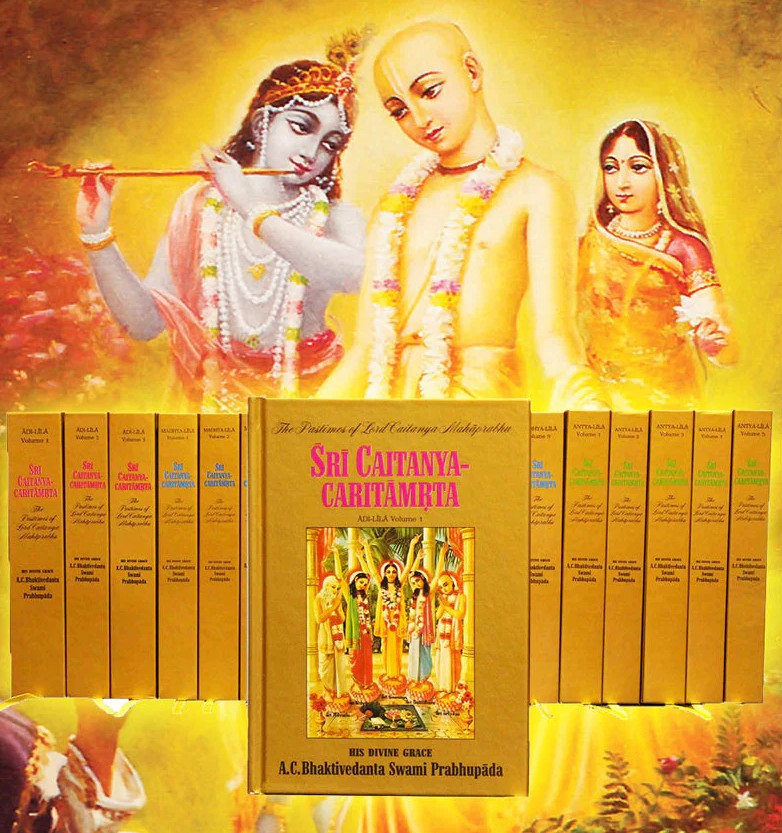
This morning I happened to open the Sri Caitanya-caritamrta Vol.1, and just began reading from the Preface. Every time I read from Srila Prabhupada’s books, something important is revealed, or something important is remembered.This morning I was reminded of the six guidelines for the process of surrender.
A pure devotee is a soul who is forever surrendered to the Lord, just as a child is surrendered to his parents or an animal to its master. In the surrendering process, one should: (1) accept things favorable for discharging devotional service, (2) reject things unfavorable, (3) believe firmly in the Lord’s protection, (4) feel exclusively dependent on the mercy of the Lord, (5) have no interest separate from the interest of the Lord, and (6) always feel oneself meek and humble.
I didn’t expect so many people. But literally there were five to six hundred people in the temple room and more were standing outside, and they were all very, very much anxious to see Srila Prabhupada. So Srila Prabhupada gave a wonderful lecture. I wish I could remember some of the things that he said, but one of the things they asked was, “Why do you wear these marks on your forehead?” And he said, “So this is simply to make people chant Hare Krsna, that when they see these marks on our foreheads they will remember, ‘Oh, that is a Hare Krsna devotee.’ And therefore they are beginning to chant, and by chanting they can become happy. The only way to become happy is to chant. So our business is to make everyone chant by one way or another.” So everyone was very pleased with his answers.
God’s word cannot be changed. Then what will be the difference between God and ourself? He is always perfect. He is always perfect. What He said forty millions of years ago, what He said five thousand years ago, that is also correct up to date. That is sastra. Not that “So many years have passed and it has become old. Now let us reform it and put it into new way.” No.
Please accept my humble obeisances, and kindly forgive my offences.
I offer my most humble and heartfelt obeisance’s on this most auspicious day of your disappearance. As Srila Bhaktivinoda Thakur has reminded us:
He reasons ill who says that Vaiṣṇavas die, When thou art living still in sound! The Vaiṣṇavas die to live, and living try To spread the holy name around.
For me there is no difference between your appearance day and your disappearance day, for you are very much alive, in the hearts of you disciples. You live on, in your words and instructions.
Recently we visited Buttler PA, where you first preached the mission of Sri Caitanya Mahaprabhu, and we witnessed your humble introduction to America.
Thank you for coming to this world to save us in spite of the tremendous difficulties and obstacles which you had to face alone, depending solely on the mercy of the Supreme Lord Krishna and your eternal spiritual master, Srila Bhaktisiddhanta Sarasvati Thakura.
Thank you for coming to America, and bringing with you so many matchless gifts. Not only did you bring the message of Krishna and Lord Caitanya, but you brought with you music and art, Vedic medicine, the science of cooking vegetarian food, and the keys to a healthy and productive life, in the service of God. I may never have learned who is God, had you not appeared on our shores.
Although I am an unworthy disciple, full of faults, I approach you with the greatest appreciation, and utmost respect, for you are the greatest spiritual ambassador to spread Krishna Consciousness all over the world.
I don’t have the words to properly glorify you, so instead, in closing, I want to quote from you, in your closing address to your Spiritual master Srila Bhaktisiddhanta, given in homage in 1936:
Personally, I have no hope for any direct service for the coming crores of births of the sojourn of my life, but I am confident that some day or other I shall be delivered from this mire of delusion in which I am at present so deeply sunk. Therefore let me with all my earnestness pray at the lotus feet of my divine master to allow me to suffer the lot for which I am destined due to my past misdoings, but to let me have this power of recollection: that I am nothing but a tiny servant of the Almighty Absolute Godhead, realized through the unflinching mercy of my divine master. Let me therefore bow down at his lotus feet with all the humility at my command. -Abhay Charan Das 1936
Today we celebrate Govardhana-puga, when Krishna exhibited His transcendental pastime of lifting Govardhana Hill to protect the inhabitants of Vrndavan.
…The sacrifice known as Govardhana Pūjā is observed in the Kṛṣṇa consciousness movement. Lord Caitanya has recommended that since Kṛṣṇa is worshipable, so His land, Vṛndāvana and Govardhana Hill, are also worshipable. To confirm this statement, Lord Kṛṣṇa said that Govardhana Pūjā is as good as worship of Him. From that day, the Govardhana Pūjā has been still going on and is known as Annakūṭa. In all the temples of Vṛndāvana or outside of Vṛndāvana, huge quantities of food are prepared in this ceremony and are very sumptuously distributed to the general population. Sometimes the food is thrown to the crowds, and they enjoy collecting it off the ground. From these instances, we can understand that prasādam offered to Kṛṣṇa never becomes polluted or contaminated, even if it is thrown on the ground. The people, therefore, collect it and eat with great satisfaction. (from Kṛṣṇa, The Supreme Personality of Godhead, chapter 24)
On this auspicious day, we like to read from KRSNA Book, and I have included the entire 25th chapter emtitled, “Devastating Rainfall in Vrndavana”.













 The Hare Krishna Movement