Transcendental Knowledge

Bhagavad-gītā As It Is
By His Divine Grace A. C. Bhaktivedanta Swami Prabhupāda
Chapter 4

Transcendental Knowledge

More

Karma-Yoga


Bhagavad-gita As It Is – Macmillan 1972 Edition
By His Divine Grace A.C. Bhaktivedanta Swami Prabhupada
Chapter 3

TEXT 1
arjuna uvāca
jyāyasī cet karmaṇas te
matā buddhir janārdana
tat kiṁ karmaṇi ghore māṁ
niyojayasi keśava

arjunaḥ—Arjuna; uvāca—said; jyāyasī—speaking very highly; cet—although; karmaṇaḥ—than fruitive action; te—your; matā—opinion; buddhiḥ—intelligence; janārdana—O Kṛṣṇa; tat—therefore; kim—why; karmaṇi—in action; ghore—ghastly; mām—me; niyojayasi—engaging me; keśava—O Kṛṣṇa.

TRANSLATION

Arjuna said: O Janārdana, O Keśava, why do You urge me to engage in this ghastly warfare, if You think that intelligence is better than fruitive work?

PURPORT

The Supreme Personality of Godhead Śrī Kṛṣṇa has very elaborately described the constitution of the soul in the previous chapter, with a view to deliver His intimate friend Arjuna from the ocean of material grief. And the path of realization has been recommended: buddhi-yoga, or Kṛṣṇa consciousness. Sometimes Kṛṣṇa consciousness is misunderstood to be inertia, and one with such a misunderstanding often withdraws to a secluded place to become fully Kṛṣṇa conscious by chanting the holy name of Lord Kṛṣṇa. But without being trained in the philosophy of Kṛṣṇa consciousness, it is not advisable to chant the holy name of Kṛṣṇa in a secluded place where one may acquire only cheap adoration from the innocent public. Arjuna also thought of Kṛṣṇa consciousness or buddhi-yoga, or intelligence in spiritual advancement of knowledge, as something like retirement from active life and the practice of penance and austerity at a secluded place. In other words, he wanted to skillfully avoid the fighting by using Kṛṣṇa consciousness as an excuse. But as a sincere student, he placed the matter before his master and questioned Kṛṣṇa as to his best course of action. In answer, Lord Kṛṣṇa elaborately explained karma-yoga, or work in Kṛṣṇa consciousness, in this Third Chapter.

More

Contents of the Gita Sumarized 2B

This is the second half of Chapter Two “Contents of the Gita Sumarized”

Bhagavad-gita As It Is 1972 Macmillan Edition
By His Divine Grace A.C. Bhaktivedanta Swami Prabhupada
Chapter 2, Text & Purports 37-72

TEXT 37
hato vā prāpsyasi svargaṁ
jitvā vā bhokṣyase mahīm
tasmād uttiṣṭha kaunteya
yuddhāya kṛta-niścayaḥ

hataḥ—being killed; vā—either; prāpsyasi—you gain; svargam—the heavenly kingdom; jitvā—by conquering; vā—or; bhokṣyase—you enjoy; mahīm—the world; tasmāt—therefore; uttiṣṭha—get up; kaunteya—O son of Kuntī; yuddhāya—to fight; kṛta—determination; niścayaḥ—uncertainty.

TRANSLATION

O son of Kuntī, either you will be killed on the battlefield and attain the heavenly planets, or you will conquer and enjoy the earthly kingdom. Therefore get up and fight with determination.

PURPORT

Even though there was no certainty of victory for Arjuna’s side, he still had to fight; for, even being killed there, he could be elevated into the heavenly planets.

TEXT 38
sukha-duḥkhe same kṛtvā
lābhālābhau jayājayau
tato yuddhāya yujyasva
naivaṁ pāpam avāpsyasi

sukha—happiness; duḥkhe—in distress; same—in equanimity; kṛtvā—doing so; lābhālābhau—both in loss and profit; jayājayau—both in defeat and victory; tataḥ—thereafter; yuddhāya—for the sake of fighting; yujyasva—do fight; na—never; evam—in this way; pāpam—sinful reaction; avāpsyasi—you will gain.

TRANSLATION

Do thou fight for the sake of fighting, without considering happiness or distress, loss or gain, victory or defeat-and, by so doing, you shall never incur sin.

PURPORT

Lord Kṛṣṇa now directly says that Arjuna should fight for the sake of fighting because He desires the battle. There is no consideration of happiness or distress, profit or gain, victory or defeat in the activities of Kṛṣṇa consciousness. That everything should be performed for the sake of Kṛṣṇa is transcendental consciousness; so there is no reaction to material activities. He who acts for his own sense gratification, either in goodness or in passion, is subject to the reaction, good or bad. But he who has completely surrendered himself in the activities of Kṛṣṇa consciousness is no longer obliged to anyone, nor is he a debtor to anyone, as one is in the ordinary course of activities. It is said:

devarṣi-bhutāpta-nṛṇāṁ pitṝṇāṁ
na kiṅkaro nāyamṛṇī ca rājan
sarvātmanā yaḥ śaraṇaṁ śaraṇyaṁ
gato mukundaṁ parihṛtya kartam

(Bhag. 11.5.41)

“Anyone who has completely surrendered unto Kṛṣṇa, Mukunda, giving up all other duties, is no longer a debtor, nor is he obliged to anyone-not the demigods, nor the sages, nor the people in general, nor kinsmen, nor humanity, nor forefathers.” That is the indirect hint given by Kṛṣṇa to Arjuna in this verse, and the matter will be more clearly explained in the following verses.

More

Contents of the Gita Summarized 2A

As this is a very long chapter we are posting it in two parts. Today we are posting text 1-35, and tomorrow we will conclude the chapter entitled “Contents of the Gita Summarized”

Bhagavad-gita As It Is 1972 Macmillan Edition
By His Divine Grace A.C. Bhaktivedanta Swami Prabhupada
Chapter Two, Text and Purports 1-35

Contents of the Gita Summarized

TEXT 1
sañjaya uvāca
taṁ tathā kṛpayāviṣṭam
aśru-pūrṇākulekṣaṇam
viṣīdantam idaṁ vākyam
uvāca madhusūdanaḥ

sañjayaḥ uvāca—Sañjaya said; tam—unto Arjuna; tathā—thus; kṛpayā—by compassion; āviṣṭam—overwhelmed; aśru-pūrṇa—full of tears; ākula—depressed; īkṣaṇam—eyes; viṣīdantam—lamenting; idam—this; vākyam—words; uvāca—said; madhusūdanaḥ—the killer of Madhu.

TRANSLATION

Sañjaya said: Seeing Arjuna full of compassion and very sorrowful, his eyes brimming with tears, Madhusūdana, Kṛṣṇa, spoke the following words.

PURPORT

Material compassion, lamentation and tears are all signs of ignorance of the real self. Compassion for the eternal soul is self-realization. The word “Madhusūdana” is significant in this verse. Lord Kṛṣṇa killed the demon Madhu, and now Arjuna wanted Kṛṣṇa to kill the demon of misunderstanding that had overtaken him in the discharge of his duty. No one knows where compassion should be applied. Compassion for the dress of a drowning man is senseless. A man fallen in the ocean of nescience cannot be saved simply by rescuing his outward dress-the gross material body. One who does not know this and laments for the outward dress is called a śūdra, or one who laments unnecessarily. Arjuna was a kṣatriya, and this conduct was not expected from him. Lord Kṛṣṇa, however, can dissipate the lamentation of the ignorant man, and for this purpose the Bhagavad-gītā was sung by Him. This chapter instructs us in self-realization by an analytical study of the material body and the spirit soul, as explained by the supreme authority, Lord Śrī Kṛṣṇa. This realization is made possible by working with the fruitive being situated in the fixed conception of the real self.

More

The Law of Karma

This begins a new series on Karma (cause and effect) which was compiled by Urdhvaga Prabhu, based on the teachings of the Bhagavad-gita As It Is by His Divine Grace A.C. Bhaktivedanta Swami Prabhupada. Urdhvaga Prabhu has kindly allowed us to reprint it here.

The Law of Karma – cause and effect 

Karma is the great law of “cause and effect”, of “action and reaction”, which controls the destiny of all living entities.

This great law functions on the principle, that any action performed produces an equal and opposite reaction, which directly influences our very existence.

Karma, like time and gravity, is a universal principle and every one is effected by its influence. While the law of physics applies to the interaction of material objects only, the law of karma however, applies to any action performed by living entities and governs the interrelations of all living beings. The state laws for example, are grossly observed; but the law of material nature [karma] being subtle to our gross understanding, cannot be experienced grossly or understood by mental speculation.

The law of karma states, that every action performed in life creates another reaction which in turn produces a new counter action. Thus an endless chain of actions and reactions is produced which binds the living entity to his good and bad deeds. This is the way how karma works. It creates an action and another reaction simultaneously and this increases the chain of material activities, keeping the performer in material bondage.

More

Advent of Bhagavad-gita


The Advent of Bhagavad-gita

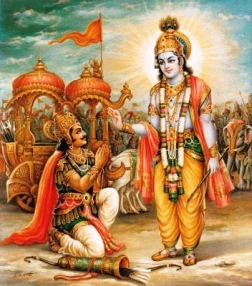
Today is the anniversary commemorating the day when Sri Krishna spoke Bhagavad-gita to Arjuna, at the place known as Kurukṣetra.

Traditionally devotees go to Kurukṣetra (dharma-kṣetra, a place where religious rituals are performed) ) and recite Bhagavad Gita from early morning until the next morning, perform arati to Bhagavad Gita and to Krishna and Arjuna upon the chariot, offer lamps, and discuss the significance of the Bhagavad-gita.

Devotees who cannot get to Kurukṣetra, can honor the blessed event by reading or reciting the Bhagavad-gita, and discussing the subject matter of Bhagavad Gita in the association of devotees.

Distribution of Bhagavad-gita’s on this day is also a very auspicious activity to perform.

Bhagavad-gita As It Is – Macmillan 1972 Edition
By His Divine Grace A.C. Bhaktivedanta Swami Prabhupada

dhṛtarāṣṭra uvāca
dharma-kṣetre kuru-kṣetre
samavetā yuyutsavaḥ
māmakāḥ pāṇḍavāś caiva
kim akurvata sañjaya

dhṛtarāṣṭraḥ—King Dhṛtarāṣṭra; uvāca—said; dharma-kṣetre—in the place of pilgrimage; kuru-kṣetre—in the place named Kurukṣetra; samavetāḥ—assembled; yuyatsavaḥ—desiring to fight; māmakāḥ—my party (sons); pāṇḍavāḥ—the sons of Pāṇḍu; ca—and; eva-certainly; kim—what; akurvata—did they do; sañjaya—O Sañjaya.

Translation

Dhṛtarāṣṭra said: O Sañjaya, after assembling in the place of pilgrimage at Kurukṣetra, what did my sons and the sons of Pāṇḍu do, being desirous to fight?

Purport

Bhagavad-gītā is the widely read theistic science summarized in the Gītā-māhātmya (Glorification of the Gītā). There it says that one should read Bhagavad-gītā very scrutinizingly with the help of a person who is a devotee of Śrī Kṛṣṇa and try to understand it without personally motivated interpretations. The example of clear understanding is there in the Bhagavad-gītā itself, in the way the teaching is understood by Arjuna, who heard the Gītā directly from the Lord. If someone is fortunate enough to understand Bhagavad-gītā in that line of disciplic succession, without motivated interpretation, then he surpasses all studies of Vedic wisdom, and all scriptures of the world. One will find in the Bhagavad-gītā all that is contained in other scriptures, but the reader will also find things which are not to be found elsewhere. That is the specific standard of the Gītā. It is the perfect theistic science because it is directly spoken by the Supreme Personality of Godhead, Lord Śrī Kṛṣṇa.

More

Thiruvananthapuram; Lost City of Gold

The Opulence of the Absolute

Know that all beautiful, glorious, and mighty creations spring from but a spark of My splendor.

PURPORT
Any glorious or beautiful existence should be understood to be but a fragmental manifestation of Kṛṣṇa’s opulence, whether it be in the spiritual or material world. Anything extraordinarily opulent should be considered to represent Kṛṣṇa’s opulence.(Bhagavad-gita As It Is 10.41)

Temple of boom in Thiruvananthapuram: Rs 1 lakh crore and counting

Ananthakrishnan G, TNN Jul 4, 2011, 01.27am IST
THIRUVANANTHAPURAM: Call it the mother of all treasure hunts. The stock-taking by a panel of experts at the Sree Padmanabha Swamy temple has catapulted the shrine located in Thiruvananthapuram to the country’s richest, with reports claiming that the value of recoveries may have touched close to Rs 1 lakh crore, more than Kerala public debt of Rs 70,969 crore.

With one more “secret” vault yet to be opened, the figure in all likelihood will go up further. But sources said the figures could only be speculation as it wasn’t possible to determine the antique value of the precious gems and jewellery. “These are antique pieces and it’s not possible to determine their prices,” said historian and former director of Indian Council of Historical Research M G S Narayanan. In other words, the worth of the treasure could be intimidatingly higher.

More

“We are not against ISKCON”


“We are not against ISKCON”
By: Madhu Pandit Dasa (ACBSP)
PR Log (Press Release) – Apr 28, 2010 –

We are against the corrupt leadership of ISKCON

So, therefore in this temple we only sell Prabhupada’s original Bhagavad Gita As It Is. Now compare it with what is happening in other ISKCONs. They are selling the other Bhagavad Gita. So these are the mistakes happening there. We are not against ISKCON, we are against spiritually corrupt ISKCON leadership.

We are not against ISCKON, how can we be against ISKCON? ISKCON is Prabhupada’s. How can we be against ISKCON? We are not against ISKCON. We are against the corrupt leadership of ISKCON. People misunderstand. We are not trying to separate from ISKCON. So, the organization is not bad, the leadership is bad. Why? Evidence we are giving. They have got the courage to make 5000 changes, number 1 and 2, what are the key things I mentioned?

Prabhupada’s kripa means his vani, his sound, that is what is what is coming, the rain from the spiritual world, which is going to shower on everybody and change their lives. So the vani has to be received with great faith as a spiritual master by the disciple. Now today, you walk into ISKCON, first there is MacMillan gita. And then there is, next they ask, if you have a tilak they ask, whose disciple are you? Before Prabhupad left, let’s say in 1976, you walk into an ISKCON temple, will anybody ask you: whose disciple are you?

Only Prabhupada. Now they ask whose disciple are you? Innocent people are misled. Now, when Prabhupada is available, Prabhupada’s vani is available and Prabhupada has not authorized anybody to take up that position to be an acharya, how can they become acharyas? So, it is self made acharya. Self made acharya doesn’t work.

Acharya has to be authorized. Like Shukadeva Goswami was concluded as being authorized based on the fact that how can Shukadeva Goswami arrive in our midst of all the places? It is definitely inspired and sent by lord Krishna.

That is what is this verse is saying. Similarly, we also have read Chaitanya Charitamrita, without Krishna’s mercy it’s not possible to spread the holy name all around the world. Therefore Srila Prabhupada is authorized by Krishna as the acharya.

Web: www.madhupanditdasa.info

Observing the Armies on the Battlefield of Kurukṣetra

Bhagavad-gita As It Is
By His Divine Grace A.C. Bhaktivedanta Swami Prabhupada

Observing the Armies on the Battlefield of Kurukṣetra

Duryodhana clearly felt that the victory of the Kurus depended on the presence of Bhīṣmadeva. He was confident of the full support of Bhīṣmadeva and Droṇācārya in the battle because he well knew that they did not even speak a word when Arjuna’s wife Draupadī, in her helpless condition, had appealed to them for justice while she was being forced to strip naked in the presence of all the great generals in the assembly.

…it is already concluded that all of them would die in the Battle of Kurukṣetra for joining the party of the sinful Duryodhana. Duryodhana was, of course, confident of his victory on account of the above-mentioned combined strength of his friends.

TEXT 1

TRANSLATION

Dhṛtarāṣṭra said: O Sañjaya, after assembling in the place of pilgrimage at Kurukṣetra, what did my sons and the sons of Pāṇḍu do, being desirous to fight?

PURPORT

Bhagavad-gītā is the widely read theistic science summarized in the Gītā-māhātmya (Glorification of the Gītā). There it says that one should read Bhagavad-gītā very scrutinizingly with the help of a person who is a devotee of Śrī Kṛṣṇa and try to understand it without personally motivated interpretations. The example of clear understanding is there in the Bhagavad-gītā itself, in the way the teaching is understood by Arjuna, who heard the Gītā directly from the Lord. If someone is fortunate enough to understand Bhagavad-gītā in that line of disciplic succession, without motivated interpretation, then he surpasses all studies of Vedic wisdom, and all scriptures of the world. One will find in the Bhagavad-gītā all that is contained in other scriptures, but the reader will also find things which are not to be found elsewhere. That is the specific standard of the Gītā. It is the perfect theistic science because it is directly spoken by the Supreme Personality of Godhead, Lord Śrī Kṛṣṇa.

The topics discussed by Dhṛtarāṣṭra and Sañjaya, as described in the Mahābhārata, form the basic principle for this great philosophy. It is understood that this philosophy evolved on the Battlefield of Kurukṣetra, which is a sacred place of pilgrimage from the immemorial time of the Vedic age. It was spoken by the Lord when He was present personally on this planet for the guidance of mankind.

The word dharma-kṣetra (a place where religious rituals are performed) is significant because, on the Battlefield of Kurukṣetra, the Supreme Personality of Godhead was present on the side of Arjuna. Dhṛtarāṣṭra, the father of the Kurus, was highly doubtful about the possibility of his sons’ ultimate victory. In his doubt, he inquired from his secretary Sañjaya, “What did my sons and the sons of Pāṇḍu do?” He was confident that both his sons and the sons of his younger brother Pāṇḍu were assembled in that Field of Kurukṣetra for a determined engagement of the war. Still, his inquiry is significant. He did not want a compromise between the cousins and brothers, and he wanted to be sure of the fate of his sons on the battlefield. Because the battle was arranged to be fought at Kurukṣetra, which is mentioned elsewhere in the Vedas as a place of worship—even for the denizens of heaven—Dhṛtarāṣṭra became very fearful about the influence of the holy place on the outcome of the battle. He knew very well that this would influence Arjuna and the sons of Pāṇḍu favorably, because by nature they were all virtuous. Sañjaya was a student of Vyāsa, and therefore, by the mercy of Vyāsa, Sañjaya was able to envision the Battlefield of Kurukṣetra even while he was in the room of Dhṛtarāṣṭra. And so, Dhṛtarāṣṭra asked him about the situation on the battlefield.

Both the Pāṇḍavas and the sons of Dhṛtarāṣṭra belong to the same family, but Dhṛtarāṣṭra’s mind is disclosed herein. He deliberately claimed only his sons as Kurus, and he separated the sons of Pāṇḍu from the family heritage. One can thus understand the specific position of Dhṛtarāṣṭra in his relationship with his nephews, the sons of Pāṇḍu. As in the paddy field the unnecessary plants are taken out, so it is expected from the very beginning of these topics that in the religious field of Kurukṣetra where the father of religion, Śrī Kṛṣṇa, was present, the unwanted plants like Dhṛtarāṣṭra’s son Duryodhana and others would be wiped out and the thoroughly religious persons, headed by Yudhiṣṭhira, would be established by the Lord. This is the significance of the words dharma-kṣetre and kuru-kṣetre, apart from their historical and Vedic importance.

TEXT 14

TRANSLATION

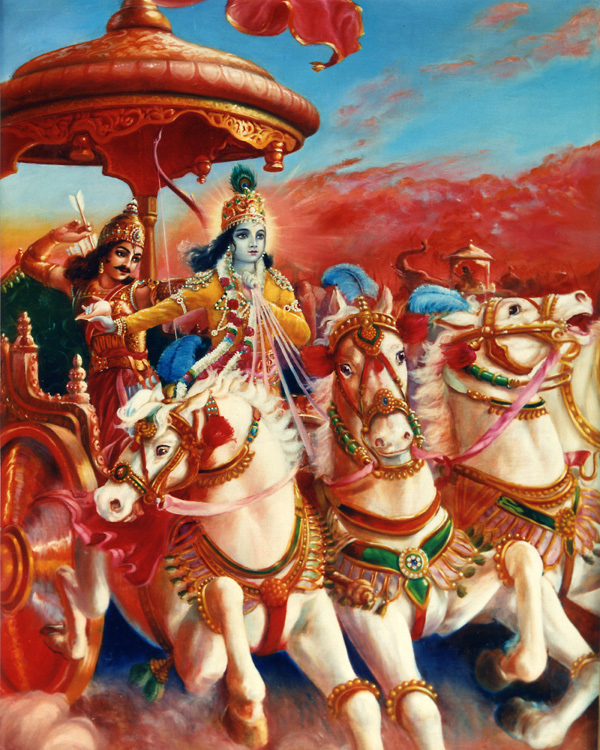
On the other side, both Lord Kṛṣṇa and Arjuna, stationed on a great chariot drawn by white horses, sounded their transcendental conchshells.

PURPORT

In contrast with the conchshell blown by Bhīṣmadeva, the conchshells in the hands of Kṛṣṇa and Arjuna are described as transcendental. The sounding of the transcendental conchshells indicated that there was no hope of victory for the other side because Kṛṣṇa was on the side of the Pāṇḍavas. Jayas tu pāṇḍu-putrāṇāṁ yeṣāṁ pakṣe janārdanaḥ. Victory is always with persons like the sons of Pāṇḍu because Lord Kṛṣṇa is associated with them. And whenever and wherever the Lord is present, the goddess of fortune is also there because the goddess of fortune never lives alone without her husband. Therefore, victory and fortune were awaiting Arjuna, as indicated by the transcendental sound produced by the conchshell of Viṣṇu, or Lord Kṛṣṇa. Besides that, the chariot on which both the friends were seated was donated by Agni (the fire-god) to Arjuna, and this indicated that this chariot was capable of conquering all sides, wherever it was drawn over the three worlds.

The Divine and Demoniac Natures

The Divine and Demoniac Natures

We are in the middle of a pandemic that is killing thousands of people worldwide.

Here in America we have a president that instead of acting in a sympathetic, compassionate way towards the sufferings of others, is instead criticizing and blaming others. This is not a good quality for a leader who should be taking responsibility for the safety and welfare of his citizens. All his self glorification, and his attack on others, in this time of turmoil, I find very disturbing and reminiscent of the description given in the 16th chapter of the Bhagavad-gita entitled “The Divine and Demon Natures”

Arrogance, pride, anger, conceit, harshness and ignorance—these qualities belong to those of demonic nature… (Bg. 4.16)

Those who are demoniac do not know what is to be done and what is not to be done. Neither cleanliness nor proper behavior nor truth is found in them. (Bg. 7.16)

The demoniac person thinks: “So much wealth do I have today, and I will gain more according to my schemes. So much is mine now, and it will increase in the future, more and more. He is my enemy, and I have killed him; and my other enemy will also be killed. I am the lord of everything, I am the enjoyer, I am perfect, powerful and happy. I am the richest man, surrounded by aristocratic relatives. There is none so powerful and happy as I am. I shall perform sacrifices, I shall give some charity, and thus I shall rejoice.” In this way, such persons are deluded by ignorance. (Bg. 13-15.16)

Full Chapter Texts and Purports More

Bhagavad-gita As It Is (Original) in Portuguese!

Bhagavad-gita As It Is (Original) in Portuguese!
By: Krishna Kirtan das

www.bhagavad-gita.com.br

The Bhagavad-gita.com.br project is born with the purpose of disclosing the famous and unique “Bhagavad-gita As It Is” (“Bhagavad-gita Como Ele É “) of A.C. Bhaktivedanta Swami Prabhupada to the population of the Portuguese language.

There is not enough words of gratitude to thank Sriman Visvavandya Prabhu for this magnificent, accurate, and genuine translation of the original Bhagavad-gita As It Is from 1972. Only due to his dedication and sincerity we can now read and admire the Bhagavad-gita as it really is, and as never before available in Portuguese. This is a translation of the original version of Bhagavad-gita As It Is (1972) from the original English version, without any change, addition, or extrapolation.

This Portuguese version of the Bhagavad-gita As It Is (1972) of A.C.  Bhaktivedanta Swami Prabhupada is an unprecedented and unique event, and deserves your complete attention and observation. When you start reading this translated Portuguese version of the Bhagavad-gita As It Is you will immediately realize and start to experience the incredible clarity, purity, and accuracy of the words chosen by Srila Prabhupada, and will start seeing the full clarity and precision of his commentaries and of his translation from original Sanskrit verses, in their full form and unadulterated beauty.

The original Bhagavad-gita As It Is (1972) is now recognized and highly desired for the sincere study of the Bhagavad-gita. Srila Prabhupada himself lectured by reading directly from this version of the Gita, and he was also pleased with his own work. A large segment of the Vaishnava community in the world today is beginning more and more to recognize the immense value to humanity that is the original version of Bhagavad-gita As It Is from 1972. 

Bhagavad-gita Como Ele É – Online

www.bhagavad-gita.com.br

With your help, this project can be expanded and improved.

Ideas such as integration with Facebook, interactive commentary, audio/video of the verses, lectures, online courses, and visual mapping technology for the study of topics, are just some of the ideas and concepts that the project has for the future.

(Find us on Facebook also at www.facebook.com/gita.1972)

If you like the project and the idea and want to contribute, please feel free. Your help is very welcome.

Only with the grace of Guru and Krishna, and with the blessings of the Vaishnavas, that everything is possible!

Om Tat Sat.
A servant and friend,
Krishna Kirtan

Pasted from

Bhagavad-gita [Ch.2 Text 4o]


TEXT 40

nehābhikrama-nāśo ‘sti
pratyavāyo na vidyate
sv-alpam apy asya dharmasya
trāyate mahato bhayāt

SYNONYMS
na—there is not; iha—in this world; abhikrama—endeavoring; nāśaḥ—loss; asti—there is; pratyavāyaḥ—diminution; na—never; vidyate—there is; svalpam—little; api—although; asya—of this; dharmasya—of this occupation; trāyate—releases; mahataḥ—of very great; bhayāt—from danger.

TRANSLATION
In this endeavor there is no loss or diminution, and a little advancement on this path can protect one from the most dangerous type of fear.

PURPORT
Activity in Kṛṣṇa consciousness, or acting for the benefit of Kṛṣṇa without expectation of sense gratification, is the highest transcendental quality of work. Even a small beginning of such activity finds no impediment, nor can that small beginning be lost at any stage. Any work begun on the material plane has to be completed, otherwise the whole attempt becomes a failure. But any work begun in Kṛṣṇa consciousness has a permanent effect, even though not finished. The performer of such work is therefore not at a loss even if his work in Kṛṣṇa consciousness is incomplete. One percent done in Kṛṣṇa consciousness bears permanent results, so that the next beginning is from the point of two percent; whereas, in material activity, without a hundred percent success, there is no profit. Ajāmila performed his duty in some percentage of Kṛṣṇa consciousness, but the result he enjoyed at the end was a hundred percent, by the grace of the Lord. There is a nice verse in this connection in Śrīmad-Bhāgavatam:

tyaktvā sva-dharmaṁ caraṇāmbujaṁ harer
bhajan na pakko ‘tha patet tato yadi
yatra kva vābhadram abhūd amuṣya kiṁ
ko vārtha āpto ‘bhajatāṁ sva-dharmataḥ

“If someone gives up self-gratificatory pursuits and works in Kṛṣṇa consciousness and then falls down on account of not completing his work, what loss is there on his part? And, what can one gain if one performs his material activities perfectly?” (Bhāg. 1.5.17) Or, as the Christians say, “What profiteth a man if he gain the whole world yet suffers the loss of his eternal soul?”

Material activities and their results end with the body. But work in Kṛṣṇa consciousness carries the person again to Kṛṣṇa consciousness, even after the loss of the body. At least one is sure to have a chance in the next life of being born again as a human being, either in the family of a great cultured brāhmaṇa or in a rich aristocratic family that will give one a further chance for elevation. That is the unique quality of work done in Kṛṣṇa consciousness.

Next Newer Entries

108 Imporant Slokas from the 1972 Bhagavad-gita As It Is

Click on image to go to Post

Click on image to go to Post

The Hare Krishna Cookbook

Songs of the Vaisnava Acaryas

Bhagavad-gita As It Is 1972 Edition “Online”

click on image

click on image to visit site

Srimad Bhagavatam Online

click on image

Raja-Vidya the King of Knowledge

click on image

click on image

Blog Stats

  • 4,572,989 hits

Enter your email address to subscribe to this blog and receive notifications of new posts by email.

Join 3,906 other subscribers

Important Slokas from the Brahma-samhita

click on image

click on image

Slokas from the Sri Isopanisad

click on image

click on image

Prayers By Queen Kunti (Slokas)

click on image

Gajendra’s Prayers of Surrender (Slokas)

click on image

A Short Statement of the Philosophy of Krishna Consciousness

click on image

click on image

July 9th Letter

click on image

click on image

The Hare Krishna Explosion

Reference Material/Study Guide

click on image

click on image

  • LINKS