05 Aug 2012
by The Hare Krishna Movement
in Krishna, Opulence of the Absolute, Sri Caitanya-Caritamrta, Srimati Radharani
Tags: A.C. Bhaktivedanta Swami Prabhupada, Aprakrta-madana, cupid, Krishna, Krsna, Mad. 8.139, Madana, Madana-mohana, Manmatha-madana, Nectar of Devotion, sac-cid-ananda-vigraha, Sri Caitanya-caritamrta
click on image to enlarge
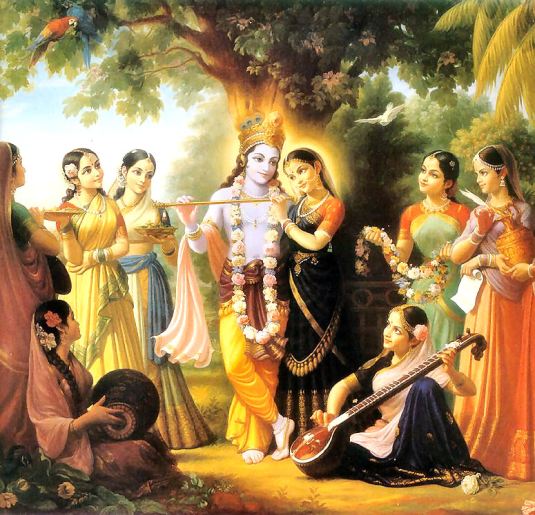
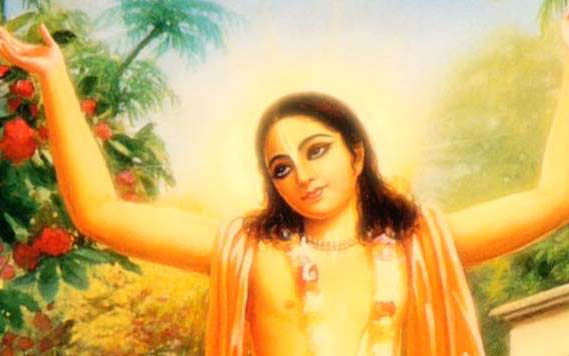
“The very name Kṛṣṇa means that He attracts even Cupid. He is therefore attractive to everyone-male and female, moving and inert living entities. Indeed, Kṛṣṇa is known as the all-attractive one.
“Śrīla Rūpa Gosvāmī has stated that devotional service attracts even Kṛṣṇa. Kṛṣṇa attracts everyone, but devotional service attracts Kṛṣṇa. The symbol of devotional service in the highest degree is Rādhārāṇī. Kṛṣṇa is called Madana-mohana, which means that He is so attractive that He can defeat the attraction of thousands of Cupids. But Rādhārāṇī is still more attractive, for She can even attract Kṛṣṇa. Therefore devotees call Her Madana-mohana-mohinī, the attractor of the attractor of Cupid. To perform devotional service means to follow in the footsteps of Rādhārāṇī…” (Nectar of Devotion Lecture, Nov. 11, 1972, Vrindavan)
…The name Madana refers to Cupid, but Kṛṣṇa is the spiritual Madana. His body is not material like the body of Cupid in this material universe. Kṛṣṇa’s body is all-spiritual-sac-cid-ānanda-vigraha. Therefore He is called Aprākṛta-madana. He is also known as Manmatha-madana, which means that He is attractive even to Cupid.
More
03 Aug 2012
by The Hare Krishna Movement
in Bhagavad-gita, Death and Dying, Practicing Krishna Consciousness at Home
Tags: A.C. Bhaktivedanta Swami Prabhupada, ananda, anta-kale ca mam eva, Arjuna, asat, Attaining the Supreme, Bg 8.5, chanting Hare Krishna, cit, death, He attains My nature, Krishna, Krishna's form, Krishna's names, material activities, nirananda, quits his body, remembering Me alone, sac-cid-ananda-vigraha, sat
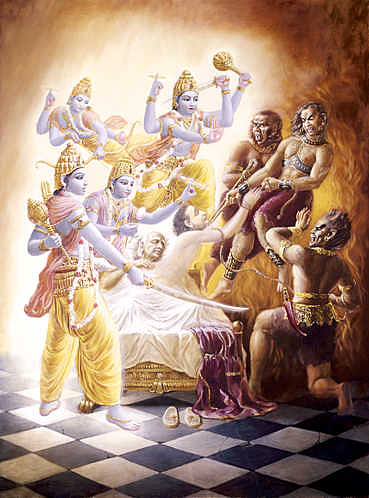
Next, one may raise the question of how one goes about approaching that abode of the Supreme Lord. Information of this is given in the Eighth Chapter of the Bhagavad-gita. It is said there:
And whoever, at the time of death, quits his body, remembering Me alone, at once attains My nature. Of this there is no doubt.
Whatever state of being one remembers when he quits his body, that state he will attain without fail.
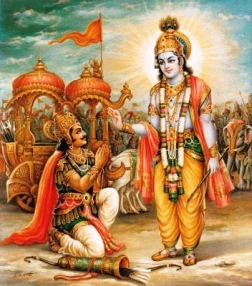
Therefore, Arjuna, you should always think of Me in the form of Kṛṣṇa and at the same time carry out your prescribed duty of fighting. With your activities dedicated to Me and your mind and intelligence fixed on Me, you will attain Me without doubt.
…This instruction to Arjuna is very important for all men engaged in material activities. The Lord does not say that one should give up his prescribed duties or engagements. One can continue them and at the same time think of Kṛṣṇa by chanting Hare Kṛṣṇa. This will free one from material contamination and engage the mind and intelligence in Kṛṣṇa. By chanting Kṛṣṇa’s names, one will be transferred to the supreme planet, Kṛṣṇaloka, without a doubt.
More
02 Aug 2012
by The Hare Krishna Movement
in Bhagavad-gita, Spiritual Life, Spiritual World
Tags: A.C. Bhaktivedanta Swami Prabhupada, abode of the Supreme Lord, Bg 15.6, brahmajoti, effulgence, Goloka Vrndavana, Krsnaloka, self-luminous, spiritual sky, Spiritual world, The Spiritual Abode, Vaikunthas

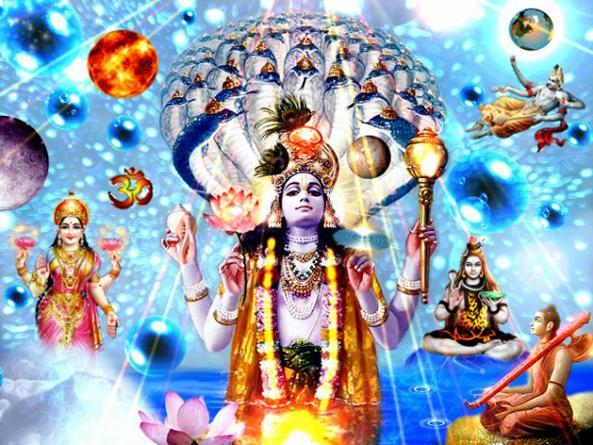
…The spiritual world, the abode of the Supreme Personality of Godhead, Kṛṣṇa-which is known as Kṛṣṇaloka, Goloka Vṛndāvana-is described here. In the spiritual sky there is no need of sunshine, moonshine, fire or electricity, because all the planets are self-luminous. We have only one planet in this universe, the sun, which is self-luminous, but all the planets in the spiritual sky are self-luminous. The shining effulgence of all those planets (called Vaikuṇṭhas) constitutes the shining sky known as the brahmajyoti. Actually, the effulgence is emanating from the planet of Kṛṣṇa, Goloka Vṛndāvana. Part of that shining effulgence is covered by the mahat-tattva, the material world. Other than this, the major portion of that shining sky is full of spiritual planets, which are called Vaikuṇṭhas, chief of which is Goloka Vṛndāvana.
The abode of Lord Śrī Kṛṣṇa is described in the Bhagavad-gītā, Fifteenth Chapter, sixth verse:
na tad bhāsayate sūryo na śaśāṅko na pāvakaḥ
yad gatvā na nivartante tad dhāma paramaṁ mama
“That abode of Mine is not illumined by the sun or moon, nor by electricity. And anyone who reaches it never comes back to this material world.” (Bg. 15.6)
This verse gives a description of that eternal sky. Of course we have a material conception of the sky, and we think of it in relationship to the sun, moon, stars and so on, but in this verse the Lord states that in the eternal sky there is no need for the sun nor for the moon nor fire of any kind because the spiritual sky is already illuminated by the brahmajyoti, the rays emanating from the Supreme Lord. We are trying with difficulty to reach other planets, but it is not difficult to understand the abode of the Supreme Lord. This abode is referred to as Goloka. In the Brahma-saṁhitā it is beautifully described: Goloka eva nivasaty akhilātma-bhūtaḥ. The Lord resides eternally in His abode Goloka, yet He can be approached from this world, and to this end the Lord comes to manifest His real form, sac-cid-ānanda-vigraha. When He manifests this form, there is no need for our imagining what He looks like. To discourage such imaginative speculation, He descends and exhibits Himself as He is, as Śyāmasundara. Unfortunately, the less intelligent deride Him because He comes as one of us and plays with us as a human being. But because of this we should not consider that the Lord is one of us. It is by His potency that He presents Himself in His real form before us and displays His pastimes, which are prototypes of those pastimes found in His abode.
More
01 Aug 2012
by The Hare Krishna Movement
in A.C. Bhaktivedanta Swami Prabhupada, Balarama, KRSNA The Supreme Personality of Godhead
Tags: A.C. Bhaktivedanta Swami Prabhupada, Balarama, dvivida gorilla, Krishna and Balarama, Krishna book, Krsna The Supreme Personality of Godhead, Lord Balarama, The Deliverance of Dvivida Gorilla

Today being the Appearance Day of Lord Balarama, we post this nice pastime of Lord Balarama delevering Dvivida gorilla.
…Dvivida was as powerful as 10,000 elephants. Sometimes he would go to the seashore, and with his powerful hands he would create so much disturbance in the sea that he would overflood the neighboring cities and villages. Often he would go to the hermitages of great saintly persons and sages and cause a great disturbance by smashing their beautiful gardens and orchards. Not only did he create disturbances in that way, but sometimes he would pass urine and stool on their sacred sacrificial arena. He would thus pollute the whole atmosphere.
While creating such great disturbance all over the country, sometimes he heard very sweet musical sounds from the Raivataka Mountain, and so he entered that mountainous region. There he saw that Lord Balarāma was present in the midst of many beautiful young girls, enjoying their company while engaged in singing and dancing. He became captivated by the beautiful features of Lord Balarāma’s body, each and every part of which was very beautiful, decorated as He was with a garland of lotus flowers. Similarly, all the young girls present, dressed and garlanded with flowers, exhibited much beauty. Lord Balarāma seemed to be fully intoxicated from drinking the vāruṇī beverage, and His eyes appeared to be rolling in a drunken state. Lord Balarāma appeared just like the king of the elephants in the midst of many she-elephants…
Kṛṣṇa, the Supreme Personality of Godhead
By His Divine Grace A. C. Bhaktivedanta Swami Prabhupāda
Chapter 67
The Deliverance of Dvivida Gorilla
While Śukadeva Gosvāmī continued to speak on the transcendental pastimes and characteristics of Lord Kṛṣṇa, King Parīkṣit, upon hearing him, became more and more enthusiastic and wanted to hear further. Śukadeva Gosvāmī next narrated the story of Dvivida, the gorilla who was killed by Lord Balarāma.
More
31 Jul 2012
by The Hare Krishna Movement
in Balarama, Festivals
Tags: A.C. Bhaktivedanta Swami Prabhupada, Aug. 1 2012, Balarama Jayanthi, Balarrama appearance day, India Heritage Foundation, Lord Balarama, Sri Krishna Balarama Mandir, Sunnyvale CA

click on image to inlarge
Balarama Jayanthi
Appearance of Lord Balarama
Aug. 1, 2012
Sri Krishna Balarama Mandir,
Serving the mission of His Divine Grace A.C. Bhaktivedanta Swami Prabhupada)
India Heritage Foundation
1235 Reamwood Avenue
Sunnyvale California 94089
United States
30 Jul 2012
by The Hare Krishna Movement
in A.C. Bhaktivedanta Swami Prabhupada, Back to Godhead, Caitanya Mahaprabhu
Tags: A.C. Bhaktivedanta Swami Prabhupada, Avatara, Back to Godhead Magazine, golden avatara, Krsna, Krsna-prema-pradaya te, namo maha-vadanyaya, Rupa Gosvami, Sri Caitanya Mahaprabhu

… When Rupa Gosvami, the principal disciple of Lord Caitanya, first saw Caitanya Mahaprabhu, he offered a nice prayer to Lord Caitanya. This prayer says, namo maha-vadanyaya krsna-prema-pradaya te/ krsnaya krsna-caitanya-namne gaura-tvise namah. “My dear Lord, You are the most munificent of all the incarnations.” Why? Krsna-prema-pradaya te: “You are directly giving love of God. You have no other purpose. Your process is so nice that one can immediately learn to love God. Therefore You are the most munificent of all incarnations. And it is not possible for any personality other than Krsna Himself to deliver this benediction; therefore I say that You are Krsna.” Krsnaya krsna-caitanya-namne: “You are Krsna, but You have assumed the name Krsna Caitanya. I surrender unto You.”
Lord Caitanya: The Golden Avatara
By His Divine Grace A.C. Bhaktivedanta Swami Prabhupada
Excerpted from Back to Godhead Magazine Vol. 1, Number 39
Sri Caitanya Mahaprabhu, the golden avatara, appeared in India nearly 500 years ago. It is the custom in India that when a child is born, an astrologer is called for. When Lord Krsna, the Supreme Personality of Godhead, appeared 5,000 years ago, Gargamuni was called by His father, and he said, “This child formerly incarnated in five complexions, such as red and golden, and now He has appeared in blackish color.” Krsna’s color is described in the scriptures as blackish, just like a cloud. Lord Caitanya is understood to be Krsna appearing in golden complexion.
More
29 Jul 2012
by The Hare Krishna Movement
in Rupa Goswami, Six Goswamis, Teachings of Lord Chaitanya
Tags: A.C. Bhaktivedanta Swami Prabhupada, chanting Hare Krishna, holy name of Krsna, Lord Sri Caitanya Mahaprabhu, Rupa Goswami, Sanatana Gosvami, six Gosvamis of Vrndavan, Srila Rupa Gosvami, Teachings of Lord Caitanya, The Hare Krishna Movement

Today we honor the disappearance day of Srila Rupa Goswami.
Teachings of Lord Caitanya
By His Divine Grace A. C. Bhaktivedanta Swami Prabhupāda
Chapter One
Teachings to Rūpa Gosvāmī
Śrīla Rūpa Gosvāmī, the younger brother of Sanātana Gosvāmī, went to Prayāga, the modern city of Allahabad, with his younger brother Vallabha. When the two brothers heard that Lord Śrī Caitanya Mahāprabhu was staying there, they both became very happy and went to see the Lord. At that time the Lord was on His way to visit the temple Bindumādhava. On the way to the temple, the Lord was chanting and dancing, and thousands of people were following Him. Some of these people were crying, and some were laughing. Some were dancing, and some were singing, and some were falling on the ground, offering obeisances to the Lord. In all cases, all of them were roaring the holy name of Kṛṣṇa. It is said that in spite of being at the confluence of the rivers Ganges and Yamunā, Prayāga was never flooded until the appearance of Caitanya Mahāprabhu, at which time the city was overflooded by love of Kṛṣṇa.
More
29 Jul 2012
by The Hare Krishna Movement
in Bhagavad-gita, Opulence of the Absolute
Tags: A.C. Bhaktivedanta Swami Prabhupada, all beautiful, beautiful existence, Bg 10.41-41, bhagavad-gita, fragmental manifestations of Krsna's opulence, glorious mighty creations, material world, Spiritual world, spring bu from a spark of My splendor, yad yad vibhutimat sattvam

Bhagavad-gita As It Is 1972 Edition
By His Divine Grace A.C. Bhaktivedanta Swami Prabhupada
Chapter Ten, Text 41-42
yad yad vibhūtimat sattvaṁ
śrīmad ūrjitam eva vā
tat tad evāvagaccha tvaṁ
mama tejo ‘ṁśa-sambhavam
Know that all beautiful, glorious, and mighty creations spring from but a spark of My splendor.
Purport
Any glorious or beautiful existence should be understood to be but a fragmental manifestation of Kṛṣṇa’s opulence, whether it be in the spiritual or material world. Anything extraordinarily opulent should be considered to represent Kṛṣṇa’s opulence.
More
29 Jul 2012
by The Hare Krishna Movement
in People, Srimad Bhagavatam
Tags: A.C. Bhaktivedanta Swami Prabhupada, artists, Brahma, Candra, demigods, engineres, Indra, inventors, kings, leaders, learned scholars, politicians, powerful deities, scientists, Siva, Srimad Bhagavatam

…There are many powerful kings, leaders, learned scholars, scientists, artists, engineers, inventors, excavators, archaeologists, industrialists, politicians, economists, business magnates, and many more powerful deities or demigods like Brahmā, Śiva, Indra, Candra, Sūrya, Varuṇa and Marut, who are all protecting the interest of the universal affairs of maintenance, in different positions, and all of them are different powerful parts and parcels of the Supreme Lord.
The Supreme Lord Śrī Kṛṣṇa is the father of all living entities, who are placed in different high and low positions according to their desires or aspirations. Some of them, as particularly mentioned above, are specifically endowed with powers by the will of the Lord. A sane person must know for certain that a living being, however powerful he may be, is neither absolute nor independent. All living beings must accept the origin of their specific power as mentioned in this verse. And if they act accordingly, then simply by discharging their respective occupational duties they can achieve the highest perfection of life, namely eternal life, complete knowledge and inexhaustible blessings.
As long as the powerful men of the world do not accept the origin of their respective powers, namely the Personality of Godhead, the actions of māyā (illusion) will continue to act. The actions of māyā are such that a powerful person, misled by the illusory, material energy, wrongly accepts himself as all in all and does not develop God consciousness. As such, the false sense of egoism (namely myself and mine) has become overly prominent in the world, and there is a hard struggle for existence in human society. The intelligent class of men, therefore, must admit the Lord as the ultimate source of all energies and thus pay tribute to the Lord for His good blessings. Simply by accepting the Lord as the supreme proprietor of everything, since He is actually so, one can achieve the highest perfection of life.
More
28 Jul 2012
by The Hare Krishna Movement
in Shiva, Srimad Bhagavatam
Tags: A.C. Bhaktivedanta Swami Prabhupada, autumn season, blossoming petals of the lotus flower, darkness in the heart, effulgence, Krishna's lotus feet, Lord Siva, lotus feet, pada, padma, SB 4.25.52, Shiva, Srimad Bhagavatam, yasya deve para bhaktir
click on image to slightly enlarge
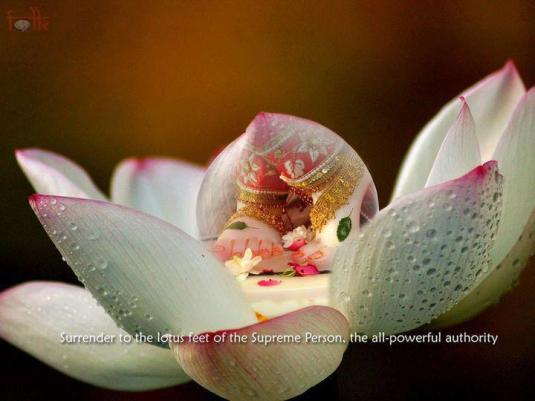
My dear Lord, Your two lotus feet are so beautiful that they appear like two blossoming petals of the lotus flower which grows during the autumn season. Indeed, the nails of Your lotus feet emanate such a great effulgence that they immediately dissipate all the darkness in the heart of a conditioned soul. My dear Lord, kindly show me that form of Yours which always dissipates all kinds of darkness in the heart of a devotee. My dear Lord, You are the supreme spiritual master of everyone; therefore all conditioned souls covered with the darkness of ignorance can be enlightened by You as the spiritual master.
Srimad Bhagavatam
By His Divine Grace A.C. Bhaktivedanta Swami Prabhupada
Canto Four, Chapter 25, Verse 52
Chanting the Song Sung by Lord Siva
More
26 Jul 2012
by The Hare Krishna Movement
in Guru & Disciple, Spiritual Master
Tags: A.C. Bhaktivedanta Swami Prabhupada, bona fide guru, disciple, disciplic succession, God, guru, guru disciple relationship, material world, prabhupada, spiritual master, Srila Prabhupada

The bona fide guru will simply present what the supreme guru, God, says in bona fide scripture. A guru cannot change the message of the disciplic succession.
The guru’s business is to bring his disciples from darkness to light.
The guru’s business is to see that no human being suffers in this material world. No one can claim that he is not suffering. That is not possible. In this material world, there are three kinds of suffering; adhyatmika, adhibhautika, and adhidaivika. These are miseries arising from the material body and mind, from other living entities and from the forces of nature. We may suffer mental anguish, or we may suffer from other living entities-from ants or mosquitoes or flies-or we may suffer due to some superior power. There may be no rain, or there may be flood. There may be excessive heat or excessive cold. So many types of suffering are imposed by nature. Thus there are three types of miseries within the material world, and everyone is suffering from one, two, or three of them. No one can say that he is completely free from suffering.
Guru-Disciple Relationship
The Guru – Guide to the Spiritual World
from the Bhakta Handbook
On hearing the word guru, we tend to envision a caricature like image: a bizarre-looking old fellow with a long, stringy beard and flowing robes, meditating on distant, esoteric truths. Or we think of a cosmic con man cashing in on young seekers’ spiritual gullibility. But what really is a guru? What does he know that we don’t? How does he enlighten us?
In a talk given in England in 1973, Srila Prabhupada provides some enlightening answers.
More
25 Jul 2012
by The Hare Krishna Movement
in Bhagavad-gita, Changing Bodies, Science of Self Realization
Tags: A.C. Bhaktivedanta Swami Prabhupada, bhagavad-gita, blood corpuscles, changing bodies, changing body, dehino smin yatha dehe, from boyhood to youth to old age, krsna consciousness, self realization, soul, soul is eternal, Srila Prabhupada
We Are Not These Bodies, We Are Soul
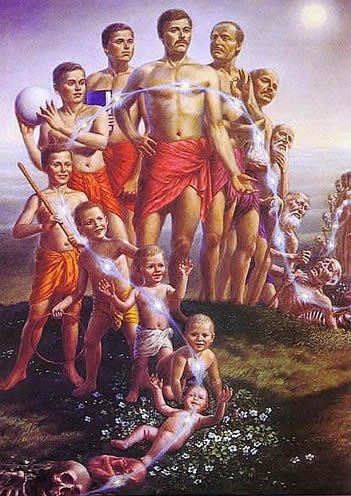
…within this body there is soul, and the body is changing every moment, but the soul is there. Just as a soul comes from the womb of his mother with a small body, and that small body changes—it becomes the body of a boy, it becomes the body of a youth, then it becomes the body of an old man, then it vanquishes… That we have to admit. We may say that the body is growing, but actually, the fact is, body is changing. It is medically admitted that we are changing our body every second. We are changing our blood corpuscles, and therefore a change of the body is taking place, and that is being manifested in a different shape only. Actually, we are changing every moment our body. So the ultimate change, when this body cannot be worked any more, just like a dress, when it is torn, when it is too old, you have to change it. Similarly, when this body becomes useless, no more, it cannot be pulled on any more, you take another body. Tathā dehāntara-prāptir. As we are, in our practical life, we are changing our body every moment, similarly, the last stage of changing this body is called death. Just as I give up this body, I have to enter into the womb of some kind of mother. These things are explained in the Vedic literatures. (Srila Prabhupada from lecture; San Francisco, April 2, 1968)
The soul is eternal, it is changing body, different bodies, and there are 8,400,000 different forms of body. According to his desire, he is entering another body.
…in the hundreds and thousands of universities all over the world there is no department of knowledge where the science of the soul is taught. Actually, we are all spirit soul. From Bhagavad-gītā we understand that we are transmigrating from one body to another, even in our present lives. All of us had at one time the body of a small baby. Where is that body? That body is gone. Presently I am an old man, but I remember that I was once a small baby. I still remember when I was about six months old; I was lying down on the lap of my elder sister, who was knitting, and I was playing. I can remember that, so it is possible for everyone to remember that he had a small body. After the baby’s body I had a boy’s body; then I had a youthful body, and now I am in this body. Where are those bodies? They are gone now. This is a different body. It is explained in Bhagavad-gītā that when I give up this body, I will have to accept another body. It is very simple to understand. I have changed so many bodies, not only from childhood to boyhood to youth, but according to medical science we are changing bodies every second, imperceptibly. This Process indicates that the soul is permanent. Although I have changed many bodies, I remember my baby body and my childhood body—I am the same person, soul. Similarly, when ultimately I change this body, I shall have to accept another. This simple formula is stated in Bhagavad-gītā. Everyone can reflect on it…(Srila Prabhupada from; Krsna Consciousness The Topmost Yoga System)
A person or an animal is not the material body; rather, the material body is the covering of the living being. Bhagavad-gītā compares the body to a dress and elaborately explains how one changes dresses one after another. The same Vedic knowledge is confirmed here. The living being, the soul, is constantly changing bodies one after another. Even in the present life, the body changes from childhood to boyhood, from boyhood to youth, and from youth to old age; similarly, when the body is too old to continue, the living being gives up this body and, by the laws of nature, automatically gets another body according to his fruitive activities, desires and ambitions. The laws of nature control this sequence, and therefore as long as the living entity is under the control of the external, material energy, the process of bodily change takes place automatically, according to one’s fruitive activities.
More
24 Jul 2012
by The Hare Krishna Movement
in KRSNA The Supreme Personality of Godhead, Vaisnava-aparadha
Tags: A.C. Bhaktivedanta Swami Prabhupada, blasphemy of the Lord, blasphemy of the pure devotee, Krsna The Supreme Personality of Godhead, Kuru dynasty, Rajasuya yajna, Sisupala, The Deliverance of Sisupala

click on image to enlarge
…Śiśupāla went crazy because of Kṛṣṇa’s being elected the supreme first-worshiped person in that meeting, and he spoke so irresponsibly that it appeared that he had lost all his good fortune. Being overcast with misfortune, Śiśupāla continued to insult Kṛṣṇa further, and Lord Kṛṣṇa patiently heard him without protest. Just as a lion does not care when a flock of jackals howl, Lord Kṛṣṇa remained silent and unprovoked. Kṛṣṇa did not reply to even a single accusation made by Śiśupāla, but all the members present in the meeting, except a few who agreed with Śiśupāla, became very agitated because it is the duty of any respectable person not to tolerate blasphemy against God or His devotee. Some of them, who thought that they could not properly take action against Śiśupāla, left the assembly in protest, covering their ears with their hands in order not to hear further accusations. Thus they left the meeting condemning the action of Śiśupāla. It is the Vedic injunction that whenever there is blasphemy of the Supreme Personality of Godhead, one must immediately leave. If he does not do so, he becomes bereft of his pious activities and is degraded to the lower condition of life.
All the kings present, belonging to the Kuru dynasty, Matsya dynasty, Kekaya dynasty and Sṛñjaya dynasty, became very angry and immediately took up their swords and shields to kill Śiśupāla. Śiśupāla was so foolish that he did not become even slightly agitated, although all the kings present were ready to kill him. He did not care to think of the pros and cons of his foolish talking, and when he saw that all the kings were ready to kill him, instead of stopping, he stood to fight with them and took up his sword and shield. When Lord Kṛṣṇa saw that they were going to engage in fighting in the arena of the auspicious Rājasūya yajña, He personally pacified them. Out of His causeless mercy He Himself decided to kill Śiśupāla. When Śiśupāla was abusing the kings who were about to attack him, Lord Kṛṣṇa took up His disc, which was as sharp as the blade of a razor, and immediately separated the head of Śiśupāla from his body.
…Śukadeva Gosvāmī assured Mahārāja Parīkṣit that the pastimes of Lord Kṛṣṇa–the killing of Śiśupāla and Jarāsandha and the releasing of the imprisoned kings–are all transcendental vibrations, and anyone who hears these narrations from the authorized persons will be immediately freed from all the reactions of the sinful activities of his life.
Kṛṣṇa, The Supreme Personality of Godhead 1970 Edition
By His Divine Grace A.C. Bhaktivedanta Swami Prabhupada
Vol. 2, Chapter 19
The Deliverance of Śiśupāla
Full Chapter More
22 Jul 2012
by The Hare Krishna Movement
in Guru & Disciple, Quotes by Srila Prabhupada, Siksa
Tags: A.C. Bhaktivedanta Swami Prabhupada, disciple, guru, quotes by Srila Prabhupada, spiritual master, Srila Prabhupada, vani, vaniseva, what we have heard from the Spiritual Master that is living

…”What we have heard from the Spiritual Master, that is living.”
Paramananda:
We’re always feeling your presence very strongly, Srila Prabhupada, simply by your teachings and your instructions. We’re always meditating on your instructions.
Srila Prabhupada:
Thank you. That is the real presence. Physical presence is not important.
“But always remember that I am always with you. As you are always thinking of me, I am always thinking of you also. Although physically we are not together, we are not separated spiritually. So we should be concerned only with this spiritual connection.”
Does the Guru have to be physically present?
Quotes by His Divine Grace A.C. Bhaktivedanta Swami Prabhupada
“Physical presence is immaterial. Presence of the transcendental sound received from the Spiritual Master should be the guidance of life. That will make our spiritual life successful. If you feel very strongly about my absence you may place my pictures on my sitting places and this will be source of inspiration for you.”
(SP Letter to Brahmananda and other students, 19/1/67)
“But always remember that I am always with you. As you are always thinking of me, I am always thinking of you also. Although physically we are not together, we are not separated spiritually. So we should be concerned only with this spiritual connection.”
(SP Letter to Gaurasundara, 13/11/69)
“So we should associate by vibration, and not by the physical presence. That is real association.”
(SP Lectures SB, 18/08/68)
More
22 Jul 2012
by The Hare Krishna Movement
in Lectures, Vedas
Tags: A.C. Bhaktivedanta Swami Prabhupada, bhagavad-gita, brahmana, Conway Hall, Hindu, ksatriya, Lecture by Srila Prabhupada, Sanskrit, sudra, Teachings of the Vedas, vaisya, varnasrama, Veda, Vedas, Vedic knowledge

…The Vedas are not compilations of human knowledge. Vedic knowledge comes from the spiritual world, from Lord Krsna.
“Teachings of the Vedas”
[Delivered as a lecture by His Divine Grace A. C. Bhaktivedanta Swami Prabhupada on October 6, 1969, at Conway Hall, London, England.]
Ladies and gentlemen, today’s subject matter is the teachings of the Vedas. What are the Vedas? The Sanskrit verbal root of veda can be interpreted variously, but the purpose is finally one. Veda means knowledge. Any knowledge you accept is veda, for the teachings of the Vedas are the original knowledge. In the conditioned state, our knowledge is subjected to many deficiencies. The difference between a conditioned soul and a liberated soul is that the conditioned soul has four kinds of defects. The first defect is that he must commit mistakes. For example, in our country, Mahatma Gandhi was considered to be a very great personality, but he committed many mistakes. Even at the last stage of his life, his assistant warned, “Mahatma Gandhi, don’t go to the New Delhi meeting. I have some friends, and I have heard there is danger.” But he did not hear. He persisted on going and was killed. Even great personalities like Mahatma Gandhi, President Kennedy — there are so many of them — make mistakes. To err is human. This is one defect of the conditioned soul.
Another defect: to be illusioned. Illusion means to accept something which is not: maya. Maya means what is not. Everyone is accepting the body as the self. If I ask you what you are, you will say, “I am Mr. John; I am a rich man; I am this, I am that.” All these are bodily identifications. But you are not this body. This is illusion.
The third defect is the cheating propensity. Everyone has the propensity to cheat others. Although a person is fool number one, he poses himself as very intelligent. Although it is already pointed out that he is in illusion and makes mistakes, he will theorize: “I think this is this, this is this.” But he does not even know his own position. He writes books of philosophy, although he is defective. That is his disease. That is cheating.
Lastly, our senses are imperfect. We are very proud of our eyes. Often, someone will challenge, “can you show me God?” But do you have the eyes to see God? You will never see if you haven’t the eyes. If immediately the room becomes dark, you cannot even see your hands. So what power do you have to see? We cannot, therefore, expect knowledge (veda) with these imperfect senses. With all these deficiencies, in conditioned life, we cannot give perfect knowledge to anyone. Nor are we ourselves perfect. Therefore we accept the Vedas as they are.
More
21 Jul 2012
by The Hare Krishna Movement
in Disciplic succession, Guru & Disciple, Nectar of Devotion
Tags: A.C. Bhaktivedanta Swami Prabhupada, Acaryas, accepting the shelter of a bona fide spiritual master, bhakti yoga, Bhakti-rasamrta-sindhu, guru disciple, Initiation, Krishna consciousness, Nectar of Devotion, NOD 7, spiritual master, Srila Rupa Goswami, suffering humanity

click on image to enlarge
The Nectar of Devotion is a summary study of Bhakti-rasāmṛta-sindhu, which was written in Sanskrit by Śrīla Rūpa Gosvāmī Prabhupāda. He was the chief of the six Gosvāmīs, who were the direct disciples of Lord Caitanya Mahāprabhu, and has since been translated into English by His Divine Grace A.C. Bhaktivedanta Swami Prabhupada, Founder-Acarya of the International Society for Krishna Consciousness.
The author of Bhakti-rasāmṛta-sindhu, Śrīla Rūpa Gosvāmī, very humbly submits that he is just trying to spread Kṛṣṇa consciousness all over the world, although he humbly thinks himself unfit for this work. That should be the attitude of all preachers of the Kṛṣṇa consciousness movement, following in the footsteps of Śrīla Rūpa Gosvāmī. We should never think of ourselves as great preachers, but should always consider that we are simply instrumental to the previous ācāryas, and simply by following in their footsteps we may be able to do something for the benefit of suffering humanity. (From introduction to Nectar of Devotion)
Nectar of Devotion
By His Divine Grace A. C. Bhaktivedanta Swami Prabhupāda
Chapter 7 “Evidence Regarding Devotional Principles”
Accepting the Shelter of a Bona Fide Spiritual Master
In the Eleventh Canto of Śrīmad-Bhāgavatam, Third Chapter, verse 21, Prabuddha tells Mahārāja Nimi, “My dear King, please know for certain that in the material world there is no happiness. It is simply a mistake to think that there is happiness here, because this place is full of nothing but miserable conditions. Any person who is seriously desirous of achieving real happiness must seek out a bona fide spiritual master and take shelter of him by initiation. The qualification of a spiritual master is that he must have realized the conclusion of the scriptures by deliberation and arguments and thus be able to convince others of these conclusions. Such great personalities who have taken shelter of the Supreme Godhead, leaving aside all material considerations, are to be understood as bona fide spiritual masters. Everyone should try to find such a bona fide spiritual master in order to fulfill his mission of life, which is to transfer himself to the plane of spiritual bliss.”
The purport is that one should not accept as a spiritual master someone who is fool number one, who has no direction according to the scriptural injunctions, whose character is doubtful, who does not follow the principles of devotional service, or who has not conquered the influence of the six sense-gratifying agents. The six agents of sense gratification are the tongue, the genitals, the belly, anger, the mind and words. Anyone who has practiced controlling these six is permitted to make disciples all over the world. To accept such a spiritual master is the crucial point for advancement in spiritual life. One who is fortunate enough to come under the shelter of a bona fide spiritual master is sure to traverse the path of spiritual salvation without any doubt.
More
18 Jul 2012
by The Hare Krishna Movement
in Caitanya Mahaprabhu, Lectures, Sri Caitanya-Caritamrta
Tags: A.C. Bhaktivedanta Swami Prabhupada, Caitanya Caritamrta, Krsna, krsnera svarupa ananta, Lord Caitanya, Mad. 20.146-151, photo by Gurudas, prabhupada, Prabhupada lectures, transcendental forms of Krsna, Vedas, Vedic knowledge points to Krishna

“Vedic Knowledge Points To Krsna”
Lecture on Caitanya-caritamrta Madhya 20.146-151
New York, December 3, 1966
By His Divine Grace A.C. Bhaktivedanta Swami Prabhupada
Prabhupada:
mukhya-gauna-vrtti, kimva anvaya-vyatireke
vedera pratijna kevala kahaye krsnake
So Lord Caitanya says, “You study Vedas in any way, directly, indirectly. In whatever way you like you study Vedas, but the ultimate objective is Krsna.”
Now, Caitanya, Lord Caitanya, is describing about the various forms of Krsna. This is very important subject. How Krsna is all-pervading, He is describing.
krsnera svarupa-ananta, vaibhava-apara
cic-chakti, maya-sakti, jiva-sakti ara
Krsnera svarupa ananta. The transcendental forms of Krsna, innumerable, vaibhava, and His opulence, that is also innumerable. Nobody can estimate. How many forms are there of Krsna or how much opulent He is, nobody can estimate; nobody can measure. This is inconceivable. The first proposition. Cic-chakti maya-sakti jiva-sakti ara. And His potencies are also unlimited, out of which, three potencies are generally accepted: cit-sakti, spiritual potency; material potency; and marginal potency. These three potencies I have described many times. Cit-sakti, the spiritual potency, is a manifestation of the spiritual world, and material potency is a manifestation of this material world, and the marginal potency, we are, we living entities. We are marginal potency. Why it is marginal? Because although we belong to the spiritual potency, but we have got tendency to come into contact of this material potency. Therefore it is called marginal, “this way or that way.” That a slight independence which is there in every living entity, he can use that, and he may select either to live in the spiritual potency or in the material potency. Therefore the living entities are called marginal potency. So parasya saktir vividhaiva sruyate [Cc. Madhya 13.65, purport]. Although the energies of the Supreme Lord are innumerable — nobody can count or measure — but they are divided into three.
More
16 Jul 2012
by The Hare Krishna Movement
in A.C. Bhaktivedanta Swami Prabhupada, Meditation, Srimad Bhagavatam, Visnu, Yoga
Tags: A.C. Bhaktivedanta Swami Prabhupada, Absolute Truth, impersonal conception of the Absolute Truth, Lord Visnu, material energy, pantheism, Personality of Godhead, Srimad Bhagavatam, Visnu
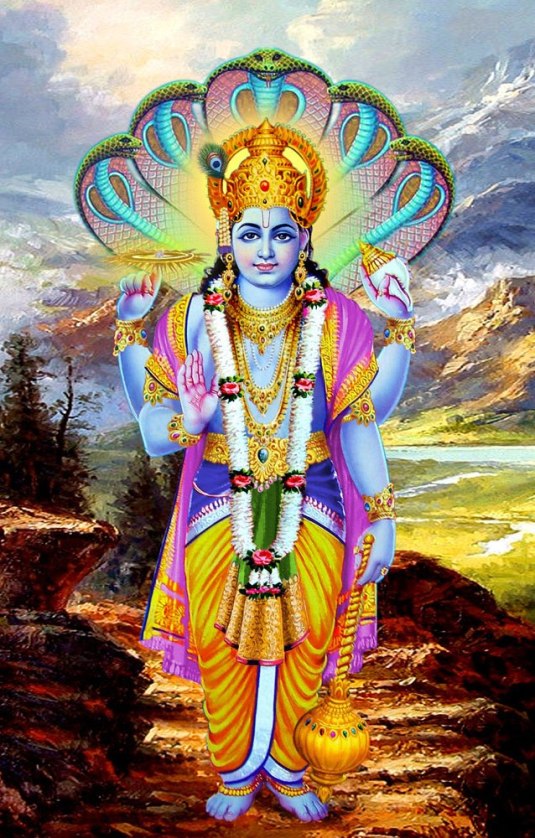
In our previous post Fix your mind upon the Supreme Personality of Godhead it was recommended that we should fix one’s mind in the service of the Personality of Godhead. Now the next step is to meditate upon the form of the Lord. To move from the impersonal to the more personal aspects of the Absolute Truth.
Thereafter, you should meditate upon the limbs of Viṣṇu, one after another, without being deviated from the conception of the complete body. Thus the mind becomes free from all sense objects. There should be no other thing to be thought upon. Because the Supreme Personality of Godhead, Viṣṇu, is the Ultimate Truth, the mind becomes completely reconciled in Him only.
…Therefore, thinking of Viṣṇu or meditating upon the transcendental form of Viṣṇu, specifically upon Lord Kṛṣṇa, is the last word on the subject of meditation.
…it is definitely assured that the Supreme Lord is not impersonal. He is a person, but His body is different from those of conditioned persons like us. Otherwise, meditation beginning from the praṇava (oṁkāra) up to the limbs of the personal body of Viṣṇu would not have been recommended by Śukadeva Gosvāmī for the attainment of complete spiritual perfection. The Viṣṇu forms of worship in great temples of India are not, therefore, arrangements of idol worship, as they are wrongly interpreted to be by a class of men with a poor fund of knowledge; rather, they are different spiritual centers of meditation on the transcendental limbs of the body of Viṣṇu. The worshipable Deity in the temple of Viṣṇu is identical with Lord Viṣṇu by the inconceivable potency of the Lord.
More
16 Jul 2012
by The Hare Krishna Movement
in A.C. Bhaktivedanta Swami Prabhupada, Meditation, Srimad Bhagavatam, Yoga
Tags: A.C. Bhaktivedanta Swami Prabhupada, God realization, meditation, Om, omkara, Personality of Godhead, pranava, SB 2.1.18, self realization, Srimad Bhagavatam, yoga

In our previous post Om, Oṁkāra, or the Praṇava, is the Seed of Transcendental Realization Oṁkāra, or the praṇava, which is the seed of transcendental realization, and it is composed of the three transcendental letters a-u-m, was discussed. By its chanting by the mind, in conjunction with the breathing process, was a means of changing the habit of the mind, to bring the mind under control. But in this next verse, Śukadeva Gosvāmī recommends the next step in God Realization, namely to fix one’s mind in the service of the Personality of Godhead.
Gradually, as the mind becomes progressively spiritualized, withdraw it from sense activities, and by intelligence the senses will be controlled. The mind too absorbed in material activities can be engaged in the service of the Personality of Godhead and become fixed in full transcendental consciousness.
More
15 Jul 2012
by The Hare Krishna Movement
in Lectures, Srimad Bhagavatam
Tags: A.C. Bhaktivedanta Swami Prabhupada, bhagavata, Book Bhagavata, Devotee Bhagavata, Krishna, Lord Siva, maya, Parvati, prabhupada, Pradyumna, SB 1.2.18, Siva Purana
click on image to enlarge
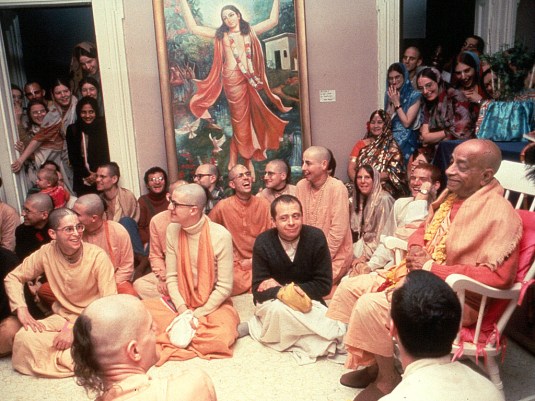
…So Krsna and maya are side by side. As soon as you forget Krsna, or as soon as you want to utilize Krsna for your sense gratification, it is immediately maya, darkness. And as soon as you want to serve Krsna, immediately it is light. So if we keep ourself on this side, light side, always serving Krsna, then there is no possibility of our being in contact with maya.
“The Choice; Krishna Or Maya”
Srimad-Bhagavatam 1.2.18
August 21, 1972, Los Angeles
Pradyumna: (leads chanting, etc.)
nasta-prayesv abhadresu
nityam bhagavata-sevaya
bhagavaty uttama-sloke
bhaktir bhavati naisthiki
[SB 1.2.18]
Translation: “By regularly hearing the Bhagavatam and rendering service unto the pure devotee, all that is troublesome to the heart is practically destroyed, and loving service unto the glorious Lord, who is praised with transcendental songs, is established as an irrevocable fact.”
Prabhupada: So here it is said bhagavata-sevaya, not bhagavan-sevaya. Bhagavan is Krsna, the Supreme Personality of Godhead, and bhagavata means in relation with Bhagavan, who has got relationship with Bhagavan. So here it is recommended bhagavata-sevaya, not bhagavan-sevaya. The idea is that you cannot approach Bhagavan, God, directly. That is not possible. First of all, you have to serve bhagavata, the devotee bhagavata.
There are two kinds of bhagavata: book bhagavata and devotee bhagavata. So in the Siva Purana, there was a question by Parvati to Lord Siva. Lord Siva and Parvati, husband and wife. Parvati means the material nature. Srsti-sthiti-pralaya-sadhana-saktir eka chayeva yasya bhuvanani bibharti durga [Bs. 5.44]. Durga-devi. Durga-devi is in charge of this material world. It is called durga, durga, just like fort. And the superintendent of this fort is Durga. You cannot go out of this fort; you are imprisoned. So such Durga-devi, who is so powerful energy — she can create, annihilate, maintain, srsti-sthiti-pralaya-sadhana — she is always sitting by the side of her husband, Lord Siva, and questioning about spiritual enquiries. Just see. Such powerful deity is also ignorant about spiritual life. So the husband, Lord Siva, is Vaisnava, and she’s always asking, and sitting down underneath a bael tree. She can create so many universes, but for her, no building; only underneath a tree.
More
Previous Older Entries Next Newer Entries









 The Hare Krishna Movement