03 Oct 2012
by The Hare Krishna Movement
in A.C. Bhaktivedanta Swami Prabhupada, Mohine-Murti, Srimad Bhagavatam
Tags: A.C. Bhaktivedanta Swami Prabhupada, ankle bells, blackis lotus, bumblebees, demigods, demons, incarnation as a woman, lusty desires, mallika flowers, Mohini-murti, Srila Prabhupada, The Supreme Personality of Godhead, Visnu

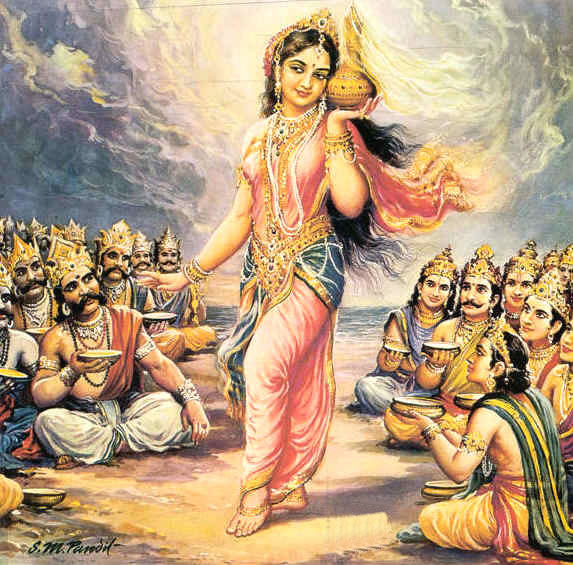
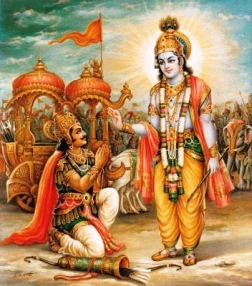
The following is from the Srimad Bhagavatam, Eight Canto, Chapter Nine, entitled “The Lord Incarnates as Mohinī-Mūrti”. The full chapter follows this beautiful verse from preceding chapter.
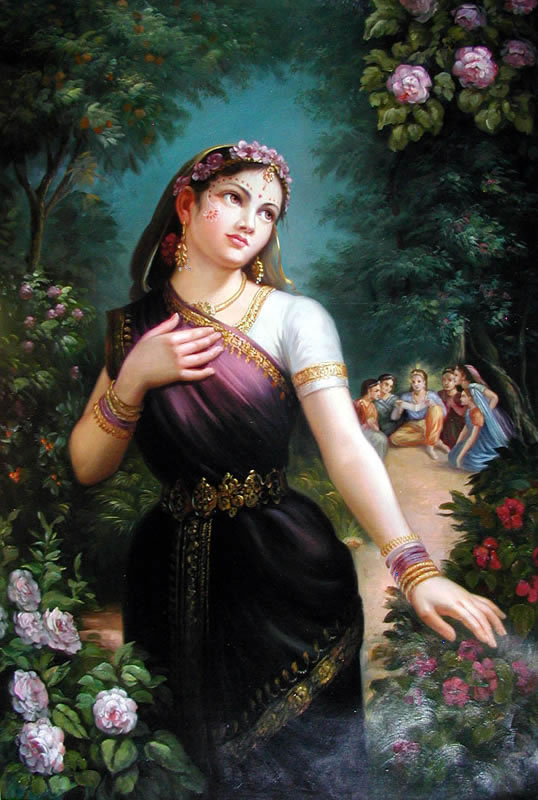
The Supreme Personality of Godhead, Viṣṇu, who can counteract any unfavorable situation, then assumed the form of an extremely beautiful woman. This incarnation as a woman, Mohinī-mūrti, was most pleasing to the mind. Her complexion resembled in color a newly grown blackish lotus, and every part of Her body was beautifully situated. Her ears were equally decorated with earrings, Her cheeks were very beautiful, Her nose was raised and Her face full of youthful luster. Her large breasts made Her waist seem very thin. Attracted by the aroma of Her face and body, bumblebees hummed around Her, and thus Her eyes were restless. Her hair, which was extremely beautiful, was garlanded with mallikā flowers. Her attractively constructed neck was decorated with a necklace and other ornaments, Her arms were decorated with bangles, Her body was covered with a clean sari, and Her breasts seemed like islands in an ocean of beauty. Her legs were decorated with ankle bells. Because of the movements of Her eyebrows as She smiled with shyness and glanced over the demons, all the demons were saturated with lusty desires, and every one of them desired to possess Her. (SB 8.8.41-48)
Because of the Supreme Lord’s assuming the form of a beautiful woman to arouse the lusty desires of the demons, a description of Her complete beauty is given here.
More
03 Oct 2012
by The Hare Krishna Movement
in A.C. Bhaktivedanta Swami Prabhupada, Bob Cohen, Perfect Answers Perfect Questions, Srila Prabhupada Conversations, Varnasrama Dharma
Tags: A.C. Bhaktivedanta Swami Prabhupada, Bob Cohen, marriage, material world, perfect questions perfect answers, sex life, varnasrama-dhama, Vedic culture
Continuing with our series of a True account entitled Perfect Questions, Perfect Answers… A search for meaning carries Bob Cohen, a young American Peace Corps worker halfway around the world, to an ancient village in the midst of West Bengal. There, in a small bamboo hut, he finds a teacher who is able to tell him everything he ever wanted to know.
Perfect Questions, Perfect Answers
By His Divine Grace A.C. Bhaktivedanta Swami Prabhupada
Chapter 2, Vedic Culture: Varṇāśrama-dharma
February 28, 1972
Bob: I’ve asked devotees about how they feel towards sex in their relations, and I see the way they feel, but I can’t see myself acting the same way. See, I’ll be getting married at the end of this summer.
Śrīla Prabhupāda: Hm-m?
Bob: I’ll be getting married at the end of this summer, in September or August when I return to America. And the devotees say that the householders only have sex to conceive a child, and I cannot picture myself at all in such a position, and—What kind of sex life can one lead, living in the material world?
More
02 Oct 2012
by The Hare Krishna Movement
in Guru & Disciple, Quotes by Srila Prabhupada
Tags: A.C. Bhaktivedanta Swami Prabhupada, association, association with guru, Godbrothers, guru, guru maharaj, service to the spiritual master, spiritual master, Srila Prabhupada, vani, vaphu

Follow the Instruction, not the Body.
Quotes by Srila Prabhupada from books, letters and lectures
“So far as personal association with Guru is concerned, I was only with Guru Maharaj 4 or 5 times, but I have never left his association, not even for a moment. Because I am following his instruction, I have never felt any separation. There are some of my Godbrothers here in India, who had constant personal association with Guru Maharaja, but who are neglecting his orders. This is just like the bug who is sitting on the lap of the king. He may be very puffed up by his position but all he can succeed in doing is biting the king. Personal association is not so important as association through serving.”
(SP Letter to Satyadhana, 20/2/72)
More
30 Sep 2012
by The Hare Krishna Movement
in A.C. Bhaktivedanta Swami Prabhupada, Back to Godhead, Caitanya Mahaprabhu
Tags: A.C. Bhaktivedanta Swami Prabhupada, Back to Godhead Magazine, BTG, Buddhist, Caitanya Mahaprabhu, Haridas Thakrua, holy names, Jagai and Madhai, Jharikhanda forest, jungle animals, Krsna! Krsna!, Lord Caitanya, love of God, Nityananda Prabhu, Sri Caitanya-caritamrta
click on image to enlarge
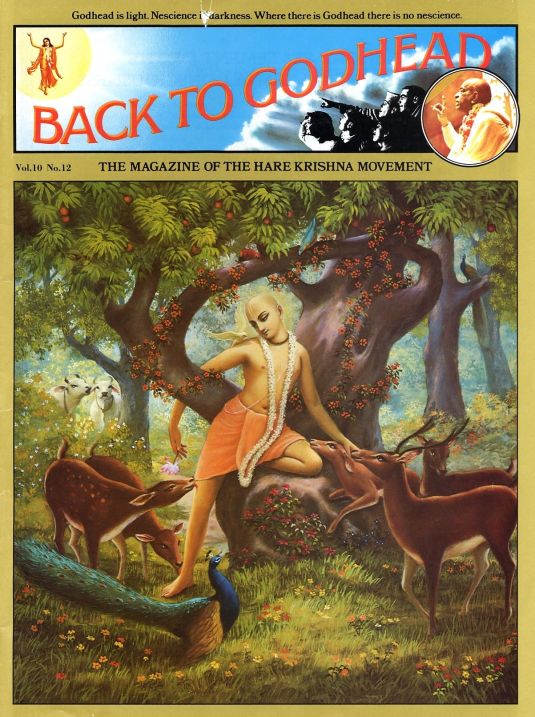
The Special Kindness of Lord Caitanya
Sri Caitanya Mahaprabhu, an incarnation of the Supreme Lord, appeared in India in the fifteenth century. His mission was to freely distribute pure love of God to everyone without considering who was qualified or unqualified. He predicted that the whole world would one day hear the chanting of the Lord’s holy names. The first of the following three narratives is excerpted from Srila Prabhupada’s introduction to Srimad-Bhagavatam. The final two are taken from his English translation of Sri Caitanya-caritamrta, an extensive account of Lord Caitanya’s life and teachings.
More
28 Sep 2012
by The Hare Krishna Movement
in A.C. Bhaktivedanta Swami Prabhupada, Chanting Hare Krishna, Haridasa Thakura
Tags: A.C. Bhaktivedanta Swami Prabhupada, appearance of haridasa thakur, freedom from reactions of sinful life, Haridasa Thakura, liberation, loving service to the Supreme Personality of Godhead, Madhya-lila 7.37, Sri Caitanya-caritamrta

Today we honor the Appearance Day of Srila Haridasa Thakura, an associate of Sri Caitanya Mahaprabhu, Haridāsa Ṭhākura daily chanted 300,000 names of the Lord. Certainly the chanting of 300,000 holy names of the Lord is wonderful. No ordinary person can chant so many names, nor should one artificially imitate Haridāsa Ṭhākura’s behavior. It is essential, however, that everyone fulfill a specific vow to chant the Hare Kṛṣṇa mantra.
Haridāsa Ṭhākura said that liberation and freedom from the reactions of sinful activities are only by-products of chanting the holy name of the Lord. If one chants the holy name of the Lord purely, he attains the platform of loving service to the Supreme Personality of Godhead. (SB 5.24.20)
More
27 Sep 2012
by The Hare Krishna Movement
in A.C. Bhaktivedanta Swami Prabhupada, Bhaktivinoda Thakura, Songs of the Vaisnava Acaryas
Tags: A.C. Bhaktivedanta Swami Prabhupada, appearance of bhaktivinoda thakura, gauracanda bole, jiv jago, Songs of the Vaisnava Acaryas, Srila Bhaktivinoda Thakura

Today we honor the Appearance Day of one of our great spiritual fathers; Srila Bhaktivinoda Thakura, with this famous song.
Jiv Jago Jiv Jago
Official Name: Arunodaya Kirtana Song 2
By Srila Bhaktivinoda Thakura
jīv jāgo, jīv jāgo, gauracānda bole
kota nidrā jāo māyā-piśācīra kole
1) Lord Gaurānga is calling, “Wake up, sleeping souls! Wake up, sleeping souls! How long will you sleep in the lap of the witch called Māyā?
bhajibo boliyā ese saḿsāra-bhitare
bhuliyā rohile tumi avidyāra bhare
2) You have forgotten the way of devotional service and are lost in the world of birth and death.
tomāre loite āmi hoinu avatāra
āmi binā bandhu āra ke āche tomāra
3) I have descended just to save you; other than Myself you have no friend in this world.
enechi auṣadhi māyā nāśibāro lāgi’
hari-nāma mahā-mantra lao tumi māgi’
4) I have brought the medicine that will wipe out the disease of illusion from which you are suffering. Take this mahā-mantra-Hare Kṛṣṇa, Hare Kṛṣṇa, Kṛṣṇa Kṛṣṇa, Hare Hare/Hare Rāma, Hare Rāma Rāma Rāma, Hare Hare.”
bhakativinoda prabhu-caraṇe pariyā
sei hari-nāma-mantra loilo māgiyā
5) Śrīla Bhaktivinoda Thākura says: “I fall at the Lord’s feet, having taken this mahā-mantra.”
Purport by His Divine Grace A.C. Bhaktivedanta Swami Prabhupada More
26 Sep 2012
by The Hare Krishna Movement
in A.C. Bhaktivedanta Swami Prabhupada, Srimad Bhagavatam
Tags: A.C. Bhaktivedanta Swami Prabhupada, chanting the holy name of the lord, devotee, devotee is called punya-sloka, instructions on the execution of devotional service, Jai Prabhupada, punya-sloka, pure devotee, SB 3.28.18

This is a very nice verse from Srila Prabhupada’s Srimad Bhagavatam. A good friend of mine is always quoting this verse and requested we include it in our daily postings. So without further ado, this one’s for you.
“…Another significant word in this verse is puṇya-śloka-yaśaskaram. The devotee is called puṇya-śloka. As one becomes purified by chanting the holy name of the Lord, so one can become purified simply by chanting the name of a holy devotee. The pure devotee of the Lord and the Lord Himself are nondifferent. It is sometimes feasible to chant the name of a holy devotee. This is a very sanctified process…” Jai Prabhupada!
Srimad-Bhagavatam
By His Divine Grace A.C. Bhaktivedanta Swami Prabhupada
Canto 3, Chapter 28, Text 18
Kapila’s Instructions on the Execution of Devotional Service
kīrtanya-tīrtha-yaśasaṁ
puṇya-śloka-yaśaskaram
dhyāyed devaṁ samagrāṅgaṁ
yāvan na cyavate manaḥ
kīrtanya—worth singing; tīrtha-yaśasam—the glories of the Lord; puṇya-śloka—of the devotees; yaśaḥ-karam—enhancing the glory; dhyāyet—one should meditate; devam—upon the Lord; samagra-aṅgam—all the limbs; yāvat—as much as; na—not; cyavate—deviates; manaḥ—the mind.
The glory of the Lord is always worth singing, for His glories enhance the glories of His devotees. One should therefore meditate upon the Supreme Personality of Godhead and upon His devotees. One should meditate on the eternal form of the Lord until the mind becomes fixed.
One has to fix his mind on the Supreme Personality of Godhead constantly. When one is accustomed to thinking of one of the innumerable forms of the Lord—Kṛṣṇa, Viṣṇu, Rāma, Nārāyaṇa, etc.—he has reached the perfection of yoga. This is confirmed in the Brahma-saṁhitā: a person who has developed pure love for the Lord, and whose eyes are smeared with the ointment of transcendental loving exchange, always sees within his heart the Supreme Personality of Godhead. The devotees especially see the Lord in the beautiful blackish form of Śyāmasundara. That is the perfection of yoga. This yoga system should be continued until the mind does not vacillate for a moment. Oṁ tad viṣṇoḥ paramaṁ padaṁ sadā paśyanti sūrayaḥ: the form of Viṣṇu is the highest individuality and is always visible to sages and saintly persons.
More
26 Sep 2012
by The Hare Krishna Movement
in Chanting Hare Krishna, The Hare Krishna Movement
Tags: A.C. Bhaktivedanta Swami Prabhupada, chanting Hare Krishna, Hare Krishna mahamantra, hare krishna tree, Hare Krsna, Lord Caitanya Mahaprabhu, plaque, sankirtan movement, Srila Prabhupada, The Hare Krishna Movement, Tompkins Square Park
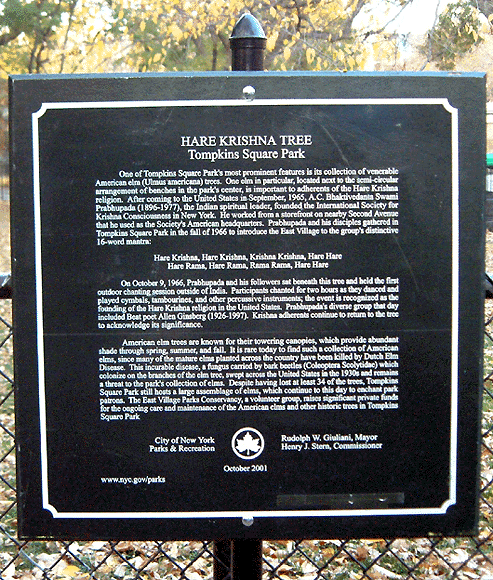
In 1966, Srila Prabhupada began chanting the Hare Krsna mahamantra under a tree in New York’s Tompkins Square Park, thereby inaugurating the western advance of Lord Caitanya Mahaprabhu’s glorious Sankirtana movement.
On November 18, 2001, Srila Prabhupada’s Disappearance Day, a plaque was placed in Tompkins Square Park in honor of His Divine Grace, who brought the Hare Krishna Movement to the west 35 years before.
Inscription on Plaque:
“One of Tompkins Square Park’s most prominent features is its collection of venerable American elm (Ulmus americana) trees. One elm in particular, located next to the semi-circular arrangement of benches in the park’s center, is important to adherents of the Hare Krishna religion. After coming to the United States in September, 1965, A.C. Bhaktivedanta Swami Prabhupada (1896-1977), the Indian spiritual leader, founded the International Society for Krishna Consciousness in New York. He worked from a storefront on nearby Second Avenue that he used as the Society’s American headquarters. Prabhupada and his disciples gathered in Tompkins Square Park in the fall of 1966 to introduce the East Village to the group’s distinctive 16-word mantra:
Hare Krishna, Hare Krishna, Krishna Krishna, Hare Hare
Hare Rama, Hare Rama, Rama Rama, Hare Hare
On October 9, 1966, Prabhupada and his followers sat beneath this tree and held the first outdoor chanting session outside of India. Participants chanted for two hours as they danced and played cymbals, tambourines, and other percussive instruments; the event is recognized as the founding of the Hare Krishna religion in the United States. Prabhupada’s diverse group that day included Beat poet Allen Ginsberg (1926-1997). Krishna adherents continue to return to the tree to acknowledge its significance.
American elm trees are known for their towering canopies, which provide abundant shade through spring, summer, and fall. It is rare today to find such a collection of American elms, since many of the mature elms planted across the country have been killed by Dutch Elm Disease. This incurable disease, a fungus carried by bark beetles ( Coleoptera Scolytidae) which colonize on the branches of the elm tree, swept across the United States in the 1930s and remains a threat to the park’s collection of elms. Despite having lost at least 34 of the trees, Tompkins Square Park still hosts a large assemblage of elms, which continue to this day to enchant park patrons. The East Village Parks Conservancy, a volunteer group, raises significant private funds for the ongoing care and maintenance of the American elms and other historic trees in Tompkins Square Park.
City Of New York
Parks and Recreation
Rudolph Giuliani, Mayor
Henry J. Stern, Commissioner
October 2001
pasted from; harekrsna.com
25 Sep 2012
by The Hare Krishna Movement
in A.C. Bhaktivedanta Swami Prabhupada, Bob Cohen, Books by Srila Prabhupada, Perfect Answers Perfect Questions
Tags: A.C. Bhaktivedanta Swami Prabhupada, conversation with Srila Prabhupada, perfect questions perfect answers, science, Science of Self Realization, scientist

click on image to enlarge
Perfect Questions, Perfect Answers
By His Divine Grace A. C. Bhaktivedanta Swami Prabhupāda
February 27, 1972
Chapter One
Kṛṣṇa, the All-Attractive
Bob: What is a scientist?
Śrīla Prabhupāda: One who knows things as they are.
Bob: He thinks he knows things as they are.
Śrīla Prabhupāda: What?
Bob: He hopes he knows things as they are.
Śrīla Prabhupāda: No, he is supposed to know. We approach the scientist because he is supposed to know things correctly. A scientist means one who knows things as they are. Kṛṣṇa means “all-attractive.”
Bob: All-attractive.
Śrīla Prabhupāda: Yes. So unless God is all-attractive, how can He be God? A man is important when he is attractive. Is it not?
Bob: It is so.
Śrīla Prabhupāda: So, God must be attractive and attractive for all. Therefore, if God has any name, or if you want to give any name to God, only “Kṛṣṇa” can be given.
Bob: But why only the name Kṛṣṇa?
Śrīla Prabhupāda: Because He’s all-attractive. Kṛṣṇa means“all-attractive.”
Bob: Oh, I see.
More
24 Sep 2012
by The Hare Krishna Movement
in A.C. Bhaktivedanta Swami Prabhupada, Letters by Srila Prabhupada, Yosomatinandana das
Tags: A.C. Bhaktivedanta Swami Prabhupada, Back to Godhead Magazine, Krishna, Krishna philosophy, Letters by Srila Prabhupada, Supreme Personality of Godhead, Yasomatinandana

click to enlarge
Back to Godhead Magazine
Letters, Volume-01 Number-55, 1973
My dear Yasomatinandana,
Please accept my blessings. I am in due receipt of your letter, and I am so much pleased to read it. Your letter is so nice that I am advising that it be published in Back to Godhead. In the meantime you can immediately begin translating all our books into the Gujarati language. All these translations will be published in series in our Gujarati BTG, and if you are serious about it, you can be the Editor. So immediately begin translating and regularly produce books in Gujarati, and it will be a great service for you. The more you render service, the more you will be enlightened by the Supreme Personality of Godhead. Thank you once more for understanding our philosophy very nicely.
Hoping this will meet you in good health,
Your ever well-wisher, A.C. Bhaktivedanta Swami
Full letter by Yasomatinandana dasa More
24 Sep 2012
by The Hare Krishna Movement
in Book Changes, Book Distribution, Madhudvisa das
Tags: A.C. Bhaktivedanta Swami Prabhupada, BBT, book changes, Book Distribution, free download, Madhuvisa das, original 1974 sri caitanya-caritamrta, pdf, prabhupada, Sri Caitanya-caritamrta, Srila Prabhupad

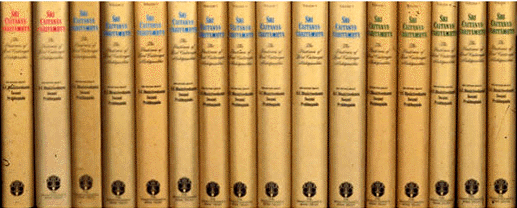
With great pleasure we are forwarding this download information on the seventeen volumes of Srila Prabhupada’s original 1974 Sri Caitanya-caritamrta, which we have Madhudvisa Prabhu to thank for making them available on digital PDF. For a free download please visit Krishna.org
Original Sri Caitanya-caritamrta PDF Downloads
By Sriman Madhudvisa Prabhu
Srila Prabhupada stressed so much to Radhavallabha Prabhu, the production manager at the BBT when Sri Caitanya-caritamrta was first printed, that once this book was printed they could not change anything. Of course Prabhupada did not want changes made to any of his books but he very strongly forbade the BBT from making any changes at all to his Caitanya-caritamrta once it was printed. Prabhupada forced them to print it very quickly and they wanted to add new paintings and ‘finish’ paintings that were already in the book after it was printed… Mithiladhisa Prabhu, a friend of Radhaballabha, relates the situation as follows:
“Soon after the intense marathon for completing the publication of Caitanya Caritamrita, Radhaballabha Prabhu approached Srila Prabhupada and mentioned that the artists are now completing the paintings in preparation for the second printing. To this, Srila Prabhupada replied “No changes”. A further attempt was made to explain, stating that there were to be no actual changes, but that the same painting would simply be completed because there was insufficient time during the marathon, and that the paintings were actually published in an unfinished state. Srila Prabhupada replied to him again, “NO changes”.
More
22 Sep 2012
by The Hare Krishna Movement
in A.C. Bhaktivedanta Swami Prabhupada, Letters by Srila Prabhupada
Tags: A.C. Bhaktivedanta Swami Prabhupada, bhagavad-gita, God conscious, Lecture by Srila Prabhupada, Maharaja Yudhisthira, SB 1.9.49, Srimad Bhagavatam, Srimad Bhagavatam lecture

click on image to enlarge
…But this Kṛṣṇa consciousness movement is so nice that even caṇḍālas can be also raised to the platform of brāhmaṇa. Even if a caṇḍāla is trained up as a devotee, he can be better than a qualified brāhmaṇa. These are the shastric injunctions. The yavanas’ names are there also. Yavana-mleccha means generally they are meat-eaters, especially cow meat, cow flesh eaters. They are called yavana-mlecchas. So the higher caste, they cannot become meat-eaters. Meat-eating is there. That is for the lower class, not for the higher class. If anyone gives up meat-eating or the bad habits of lower class, illicit sex, meat-eating, intoxication, gambling, and if he’s trained how to become a qualified brāhmaṇa, then he can be accepted.
…So our this movement is not for the kṛpaṇas. It is meant for the brāhmaṇas. We want to become ourself brāhmaṇa, and we want to make others also brāhmaṇa. Because there is need of brāhmaṇa at the present moment. The whole human society is now running by the śūdras, all śūdras. Kalau śūdra-sambhavaḥ. In this Kali-yuga, everyone is a śūdra. Maybe born of a brāhmaṇa family, but because he has no culture… The first culture is garbhādhāna-saṁskāra. If garbhādhāna-saṁskāra is not observed even in a brāhmaṇa family, he becomes immediately śūdra. This is the statement of the śāstra. So nobody is observing garbhādhāna-saṁskāra. Therefore, according to śāstra, everyone is a śūdra. Now because everyone is śūdra, therefore he cannot be trained up as brāhmaṇa? No. He can be trained up. Caṇḍālo ‘pi dvija-śreṣṭho hari-bhakti-parāyaṇaḥ. If that śūdra or caṇḍāla can be turned into a devotee of Kṛṣṇa, hari-bhakti-parāyaṇaḥ, then under training he can become better than brāhmaṇa.
Lecture by His Divine Grace A.C. Bhaktivedanta Swami Prabhupada
Māyāpura, June 15, 1973 More
21 Sep 2012
by The Hare Krishna Movement
in A.C. Bhaktivedanta Swami Prabhupada, Krishna Consciousness, KRSNA The Supreme Personality of Godhead, Srimati Radharani
Tags: A.C. Bhaktivedanta Swami Prabhupada, bumblebee, Goloka Vrndavana, gopis, inhabitants of Vrndavana, Krishna, Krsna, Nanda Maharaja, Radha, Radhastami, Srimati Radharani, srimati radharani appearance day, Uddhava, Yasoda
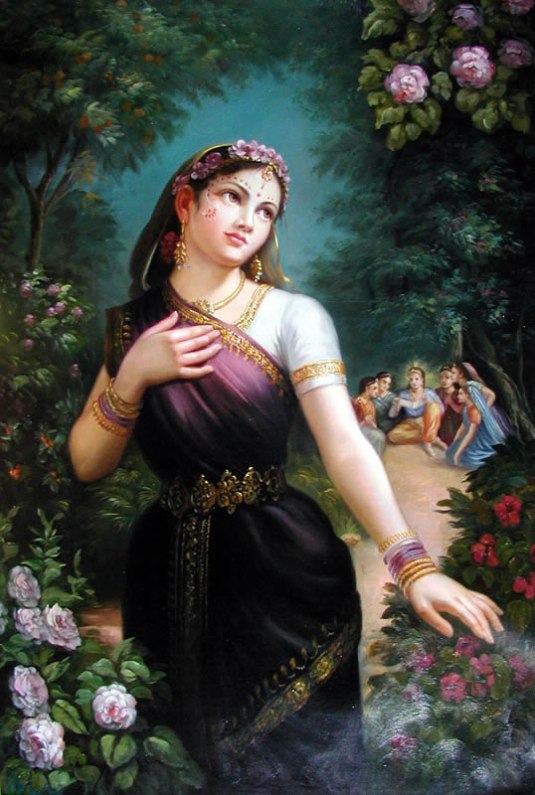
On this eve of Srimati Radharani’s appearance day (Radhastami) celebration I am reminded of one of my favorite KRSNA Book stories; Delivery of the Message of Kṛṣṇa to the Gopīs. We share the entire chapter with you here.
…One of the gopīs, namely Śrīmatī Rādhārāṇī, was so much absorbed in thoughts of Kṛṣṇa by dint of Her personal touch with Him that She actually began to talk with a bumblebee which was flying there and trying to touch Her lotus feet. While another gopī was talking with Kṛṣṇa’s messenger Uddhava, Śrīmatī Rādhārāṇī took that bumblebee to be a messenger from Kṛṣṇa and began to talk with it as follows. “Bumblebee, you are accustomed to drinking honey from the flowers, and therefore you have preferred to be a messenger of Kṛṣṇa, who is of the same nature as you. I have seen on your moustaches the red powder of kuṅkuma, which was smeared on the flower garland of Kṛṣṇa while He was pressing the breast of some other girl who is My competitor. You are feeling very proud by touching that flower, and your moustaches have become reddish. You have come here carrying a message for Me. You are anxious to touch My feet. But My dear bumblebee, let me warn you–don’t touch Me! I don’t want any messages from your unreliable master. You are the unreliable servant of an unreliable master.” It may be that Śrīmatī Rādhārāṇī purposely addressed that bumblebee sarcastically in order to criticize the messenger Uddhava. Indirectly, Śrīmatī Rādhārāṇī saw Uddhava as not only resembling Kṛṣṇa’s bodily features but as being equal to Kṛṣṇa. In this way She indicated that Uddhava was as unreliable as Kṛṣṇa Himself. Śrīmatī Rādhārāṇī wanted to give specific reasons why She was dissatisfied with Kṛṣṇa and His messengers.
She addressed the bumblebee, “Your master Kṛṣṇa is exactly of your quality. You sit down on a flower, and after taking a little honey you immediately fly away and sit in another flower and taste. You’re just like your master Kṛṣṇa. He gave us the chance of tasting the touch of His lips and then left altogether. I know also that the goddess of fortune, Lakṣmī, who is always in the midst of the lotus flower, is constantly engaged in Kṛṣṇa’s service. But I do not know why she has become so captivated by Kṛṣṇa. She is attached to Him, although she knows His actual character. As far as we are concerned, we are more intelligent than that goddess of fortune. We are not going to be cheated anymore by Kṛṣṇa or His messengers…”
Kṛṣṇa, The Supreme Personality of Godhead
By His Divine Grace A.C. Bhaktivedanta Swami Prabhupada
Chapter 46
Delivery of the Message of Kṛṣṇa to the Gopīs More
21 Sep 2012
by The Hare Krishna Movement
in A.C. Bhaktivedanta Swami Prabhupada, Radha-kunda, Sri Caitanya-Caritamrta, Srimati Radharani
Tags: A.C. Bhaktivedanta Swami Prabhupada, kunda, Madhya-lila 18.4-13, Radha Krishna, Radha-kunda, Sri Caitanya Mahaprabhu, Sri Caitanya-caritamrta, Sri Radha, Srila Prabhupada, Srimati Radharani, Syama-kund
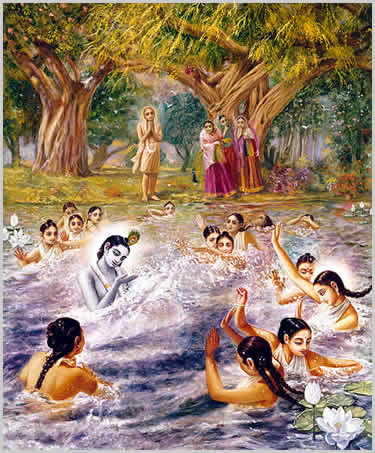
In honor of the appearance day of Srimati Radharani we again post from the Śrī Caitanya-caritāmṛta by His Divine Grace A.C. Bhaktivedanta Swami Prabhupada. The Glories of Śrīmatī Rādhārāṇī and Her lake known as Rādhā-kuṇḍa. The following verses are from Madhya-līlā, Chapter 18, Text 4-13.
Śrī Caitanya Mahāprabhu asked the local people,“Where is Rādhā-kunda?” No one could inform Him, and the brāhmaṇa accompanying Him did not know either.
The Lord then understood that the holy place called Rādhā-kuṇḍa was no longer visible. However, being the omniscient Supreme Personality of Godhead, He discovered Rādhā-kuṇḍa and Śyāma-kuṇḍa in two paddy fields. There was only a little water, but He took His bath there.
When the people of the village saw Śrī Caitanya Mahāprabhu taking His bath in those two ponds in the middle of the paddy fields, they were very astonished. The Lord then offered His prayers to Śrī Rādhā-kuṇḍa.
More
20 Sep 2012
by The Hare Krishna Movement
in A.C. Bhaktivedanta Swami Prabhupada, Advaita Acarya, Sita Thakurani, Sri Caitanya-Caritamrta
Tags: A.C. Bhaktivedanta Swami Prabhupada, Adi-lila 13.111-119, Advaita Acharya, Gokula, Jagannatha Misra, Krsna, Lord Caitanya Mahaprabhu, Nimai, Sita Thakurani, Sitadevi, Sri Caitanya-caritamrta, transcendental bodily effulgence

In honor of the Appearance day of Sītā Ṭhākurāṇī (the eternal wife of Sri Advaita Acharya), we are posting a brief pastime from Srila Prabhupada’s Śrī Caitanya-caritāmṛta: Ādi-līlā Chapter 13, Text 111-119, which gives the following account of Sita Thakurani’s visit to the house of Jagannatha Mishra after the birth of the Lord
One day shortly after Lord Caitanya Mahāprabhu was born, Advaita Ācārya’s wife, Sītādevī, who is worshipable by the whole world, took her husband’s permission and went to see that topmost child with all kinds of gifts and presentations
She brought different kinds of golden ornaments, including bangles for the hand, armlets, necklaces and anklets.
There were also tiger nails set in gold, waist decorations of silk and lace, ornaments for the hands and legs, nicely printed silken sārīs and a child’s garment, also made of silk. Many other riches, including gold and silver coins, were also presented to the child.
Riding in a palanquin covered with cloth and accompanied by maidservants, Sītā Ṭhākurāṇī came to the house of Jagannātha Miśra, bringing with her many auspicious articles such as fresh grass, paddy, gorocana, turmeric, kuṅkuma and sandalwood. All these presentations filled a large basket.
When Sītā Ṭhākurāṇī came to the house of Śacīdevī, bringing with her many kinds of eatables, dresses and other gifts, she was astonished to see the newly born child, for she appreciated that except for a difference in color, the child was directly Kṛṣṇa of Gokula Himself.
Seeing the transcendental bodily effulgence of the child, each of His nicely constructed limbs full of auspicious signs and resembling a form of gold, Sītā Ṭhākurāṇī was very much pleased, and because of her maternal affection, she felt as if her heart were melting.
She blessed the newly born child by placing fresh grass and paddy on His head and saying, “May You be blessed with a long duration of life.” But being afraid of ghosts and witches, she gave the child the name Nimāi.
On the day the mother and son bathed and left the maternity home, Sītā Ṭhākurāṇī gave them all kinds of ornaments and garments and then also honored Jagannātha Miśra. Then Sītā Ṭhākurāṇī, being honored by mother Śacīdevī and Jagannātha Miśra, was greatly happy within her mind, and thus she returned home.
In this way mother Śacīdevī and Jagannātha Miśra, having obtained a son who was the husband of the goddess of fortune, had all their desires fulfilled. Their house was always filled with riches and grains. As they saw the beloved body of Śrī Caitanya Mahāprabhu, day after day their pleasure increased.
For full Text and Purport More
17 Sep 2012
by The Hare Krishna Movement
in Back to Godhead, Dr. O.B.L Kapoor, Remembering Srila Prabhupada, Srila Prabhupada
Tags: A.C. Bhaktivedanta Swami Prabhupada, Back to Godhead Magazine, dr. kapoor, Dr. O.B.L. Kapoor, hari sauri das, prabhupada, Remembering Srila Prabhupada, Srila Prabhupada

A godbrother of Srila Prabhupada’s remembers their early friendship and their meeting again after many years.
Dr. O.B.L. Kapoor: I didn’t know much about his household affairs, because we met mostly at the matha in the evening. He had a shop. He sold medicines, and he also manufactured them. Once he manufactured a tonic, and he gave it to me.
I said, “That’s nice, this gift of yours. I must accept it. But I wish you would give me the tonic which you yourself take the tonic of Krsna-prema [love of Krsna].”
He said, “I don’t have that tonic. But I have the formula.”
I said, “Oh, wonderful! If it is not a secret, tell me what the formula is.”
He said, “No, it is not a secret at all:
trnad api sunicena
taror iva sahisnuna
amanina manadena
kirtaniyah sada harih*
This is the formula, and I am going to preach it all over the world.”
*”One should chant the holy name of the Lord in a humble state of mind. One should be more tolerant than a tree, devoid of all sense of false prestige, and ready to offer all respects to others. In that way one can chant the holy name of the Lord constantly.” (Siksastaka 3)
At that time I couldn’t recognize the significance of his words, but he was going to preach it all over the world. I thought it was just a casual statement. But now I look back, and I can see that he was even then thinking and planning to preach all over the world, which he did.
More
16 Sep 2012
by The Hare Krishna Movement
in Practicing Krishna Consciousness at Home, Prasadam, Vegetarian Cooking, Vegetarianism
Tags: A.C. Bhaktivedanta Swami Prabhupada, cooking for Krsna, Krsna prasadam, Lord's mercy, Prasadam, service of the lord, Srila Prabhupada, vegetarian cooking, vegetarianism

…By development of Kṛṣṇa consciousness one can know that everything has its use in the service of the Lord.
…After cooking is finished and when it is offered to the Deity, then you take as much as you like, as much as you like. So that means there is God consciousness, that “This thing is being cooked for the Lord.” The cooking will go on. If you don’t think of God, you require cooking because you want to eat. The cooking is there in the program. But if you think that this cooking is done for God, then your God consciousness is there. The cooking you cannot avoid. As a householder you have to cook for yourself, you have to cook for your children, you have to cook for somebody else or for your own self. Just like I am cooking. I have no here family or children, but I am cooking for myself. So cooking you cannot stop. But if you cook with the understanding that “This foodstuff is being cooked for the Lord. The Lord may be offered first; then we shall take,” this is God consciousness. This is God consciousness. But is it very difficult thing? Anyone can accept this.” (Srila Prabhupada Lecture on Bhagavad-Gita, 04-01-66, New York)
…So on the higher platform, there is nothing material when everything is accepted in relationship with Krishna or the Supreme Spirit.
More
16 Sep 2012
by The Hare Krishna Movement
in Free Downloads, Free eBooks, Sri Isopanisad
Tags: A.C. Bhaktivedanta Swami Prabhupada, God realization, impersonal Brahman, invocation, ISKCON Books, KBI, Krishna, Krishna Path, Paramatma, prabhupada purports, Sri Isopanisad, supreme absolute truth, Supreme Personality of Godhead, the complete whole, The Hare Krishna Movement

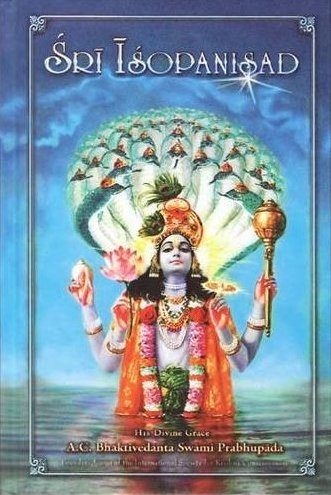
This begins a new series on the Sri Isopanisad (The knowledge that brings one nearer to the Supreme Personality of Godhead, Krishna). It begins with the Invocation and is followed by eighteen mantras and purports by Srila Prabhupada. To purchase the book you can visit The Hare Krishna Movement or to download free pdf you can click on link at bottom of post or visit Krishna Path for free downloads and epub’s.
Śrī Īśopaniṣad
By His Divine Grace A.C. Bhaktivedanta Swami Prabhupada
Original text found in first edition published by ISKCON BOOKS in 1969
INVOCATION
oṁ pūrṇam adaḥ pūrṇam idaṁ
pūrṇāt pūrṇam udacyate
pūrṇasya pūrṇam ādāya
pūrṇam evāvaśiṣyate
oṁ—the Complete Whole; pūrṇam—perfectly complete; adaḥ—that; pūrṇam—perfectly complete; idam—this phenomenal world; pūrṇāt—from the all-perfect; pūrṇam—complete unit; udacyate—is produced; pūrṇasya—of the Complete Whole; pūrṇam—completely, all; ādāya—having been taken away; pūrṇam—the complete balance; eva—even; avaśiṣyate—is remaining.
TRANSLATION
The Personality of Godhead is perfect and complete, and because He is completely perfect, all emanations from Him, such as this phenomenal world, are perfectly equipped as complete wholes. Whatever is produced of the Complete Whole is also complete in itself. Because He is the Complete Whole, even though so many complete units emanate from Him, He remains the complete balance.
PURPORT
The Complete Whole, or the Supreme Absolute Truth, is the complete Personality of Godhead. Realization of impersonal Brahman or of Paramātmā, the Supersoul, is incomplete realization of the Absolute Complete. The Supreme Personality of Godhead is sac-cid-ānanda-vigraha [Bs. 5.1]. Realization of impersonal Brahman is realization of His sat feature, or His aspect of eternity, and Paramātmā realization is realization of His sat and cit features, His aspects of eternity and knowledge. But realization of the Personality of Godhead is realization of all the transcendental features-sat, cit and ānanda, bliss. When one realizes the Supreme Person, he realizes these aspects of the Absolute Truth in their completeness. Vigraha means “form.” Thus the Complete Whole is not formless. If He were formless, or if He were less than His creation in any other way, He could not be complete. The Complete Whole must contain everything both within and beyond our experience; otherwise He cannot be complete.
More
15 Sep 2012
by The Hare Krishna Movement
in A.C. Bhaktivedanta Swami Prabhupada, Back to Godhead, Krsna Consciousness, Spiritual Life
Tags: A.C. Bhaktivedanta Swami Prabhupada, Back to Godhead Magazine, gopis, Krishna, Krsna, material world, materialistic enjoyment, Spiritual Life, tri-bhanga form
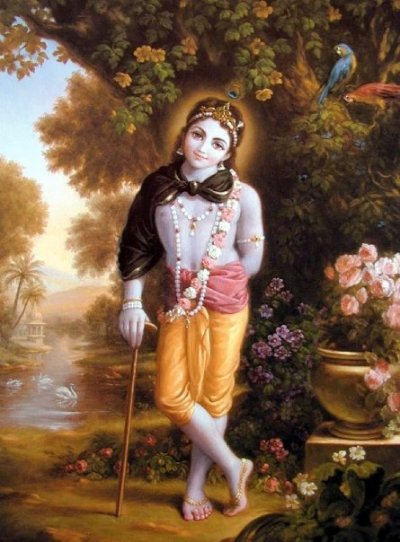
…The gopis are another example of great eagerness to see Krsna. The gopis came to Krsna, being captivated by His beautiful features.
The first thing Krsna is looking for is how eager you are to see Him. Krsna will respond. If you are actually eager to see Krsna …your efforts will be successful. But you must desire Krsna only. In this connection, Rupa Gosvami has written a verse:
smeram bhangi-traya-paricitam saci-vistirna-drstim
vamsi-nyastadhara-kisalayam ujjvalam candrakena
govindakhyam hari-tanum itah kesi-tirthopakanthe
ma preksisthas tava yadi sakhe bandhu-sange ‘sti rangah
The idea is that one gopi is advising another gopi, “My dear friend, there is one boy His name is Govinda. He is standing on the bank of the Yamuna near the Kesi-ghata, and He is playing on His flute. He is so beautiful, especially during this full-moon night. If you have any intention to enjoy in this material world with your children, husband, or other family members, then please do not go there.” Bhangi-traya: Krsna always stands in a three-curved way with His flute. That is Krsna’s tri-bhanga form, bending in three places. So the one gopi says to the other, “If you think that you’ll enjoy your life more in this material world, then do not go to see Krsna. Do not go there.” The idea is that if you once see Krsna, then you’ll forget all this nonsensical materialistic enjoyment. That is seeing Krsna.
More
13 Sep 2012
by The Hare Krishna Movement
in Krsna Consciousness, Lectures
Tags: A.C. Bhaktivedanta Swami Prabhupada, anyabilasita-sunyam, Bhagavad-gita lecture, Brahma-samhita, Krishna, krsna-prema, Lecture by Srila Prabhupada, love of God, namo maha-vadanyaya, no material desire, pure devotee
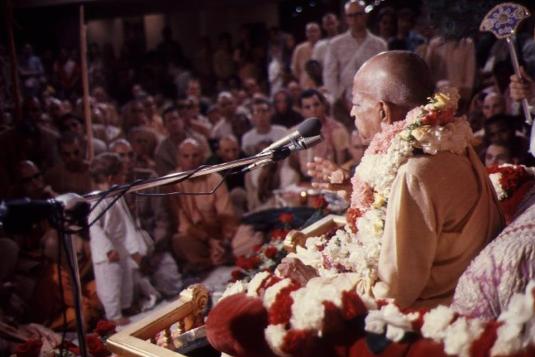
Click on image to enlarge
Pure devotee means he has no other desire, no material desire. Anyābhilāṣitā-śūnyam, zero.
…And if it is mixed up, anyābhi…, with material desire or spiritual emancipation or fruitive activities, then it is not pure devotee.
So if you can approach such pure devotee… As it is stated in the Brahma-saṁhitā, adurlabham ātma-bhaktau. This is ātma-bhaktau, a pure devotee. He can deliver you Kṛṣṇa. “Take Kṛṣṇa. Here is Kṛṣṇa.” Kṛṣṇa-prema… That is…
The symbolic representation is Śrī Caitanya Mahāprabhu. He’s described by Rūpa Gosvāmī:
namo mahā-vadānyāya kṛṣṇa-prema-pradāya te kṛṣṇāya kṛṣṇa-caitanya-nāmne gaura-tviṣe namaḥ [Madhya 19.53]
When Rūpa Gosvāmī… He was minister in the government of Nawab Hussain Shah. At that time, very exalted personality. He could understand Caitanya Mahāprabhu’s mission. Therefore when he first met Him at Allahabad, Prayāga, he offered his respect with these words: namo mahā-vadānyāya, the most munificent incarnation. Why? Kṛṣṇa-prema-pradāya te. “You are distributing kṛṣṇa-prema. It is very difficult to understand Kṛṣṇa, but You are so kind that You are immediately delivering love of Kṛṣṇa.”
You can know one person. But to develop love for him, that is another transaction. So people cannot understand even Kṛṣṇa, and what is the saying of Kṛṣṇa’s love? But Caitanya Mahāprabhu is so kind that He’s immediately giving kṛṣṇa-prema, love of Kṛṣṇa. Therefore He is described as the most munificent incarnation. Kṛṣṇa Himself could not deliver Himself. He wanted. “First of all you surrender.” Sarva-dharmān parityajya mām ekaṁ śaraṇaṁ vraja [Bg. 18.66] But Caitanya Mahāprabhu is so kind. Simply through this chanting and dancing, He is distributing love of Kṛṣṇa.
You can see practically. These boys from European and American countries, means all over the world, why they are chanting and dancing in this way? Do you think they have become mad? And one says, “Yes, they have become mad.” Why? For love of Kṛṣṇa. Now they have began they have become lover of Kṛṣṇa. So kṛṣṇa-prema is like that. That is through the mercy of Śrī Caitanya Mahāprabhu.
Therefore Śrī Caitanya Mahāprabhu is the symbolic representation of devotee. Bhaktāvatāraṁ bhaktākhyaṁ namāmi bhakta-śaktikam. Namāmi bhakta-śaktikam. He can give the strength to the devotee so that he can develop his dormant love of Kṛṣṇa. Therefore in the Brahma-saṁhitā it is stated that adurlabham ātma-bhaktau. If one is pure devotee, for him, Kṛṣṇa is available very easy. He says in the Bhagavad-gītā. Bhaktyā mām abhijānāti yāvān yaś cāsmi tattvataḥ [Bg. 18.55] “One can understand Me in truth…” Yāvān yaś cāsmi tattvataḥ. “Which is very, very difficult.”
manuṣyāṇāṁ sahasreṣu kaścid yatati siddhaye yatatām api siddhānāṁ kaścin māṁ vetti tattvataḥ [Bg. 7.3]
To understand Kṛṣṇa as He is, it is difficult. But if you take to this process of devotional service…
śravaṇaṁ kīrtanaṁ viṣṇoḥ smaraṇaṁ pāda-sevanam arcanaṁ vandanaṁ dāsyaṁ sakhyam ātma-nivedanam [SB 7.5.23]
Either of these process. All the process or either of these. You become successful to develop your dormant Kṛṣṇa consciousness, and then your life becomes successful. Thank you very much. (end)
Full lecture More
Previous Older Entries Next Newer Entries