The Case Against Animal Slaughter
From Back to Godhead Magazine 1976 Vol. 11 No. 1
From the standpoints of health, economics and ethics, animal slaughter and meat-eating are detrimental to human society.
Health
Although meat is certainly a source of concentrated protein it is a very poor source of other food elements like minerals, vitamins and carbohydrates. In addition, eating flesh from the cow or any other animal is detrimental to the health of human beings for many reasons. For example, if a human, who has a much longer colon than the carnivorous animals, eats flesh, the following problems will ensue:
” ‘The scent of Kṛṣṇa’s transcendental body surpasses the aroma of musk and attracts the minds of all women. The eight lotus like parts of His body distribute the fragrance of lotuses mixed with that of camphor. His body is anointed with aromatic substances like musk, camphor, sandalwood and aguru. O My dear friend, that Personality of Godhead, also known as the enchanter of Cupid, always increases the desire of My nostrils.’
Sri-Caitanya-caritamrta 1975 Edition
By His Divine Grace A.C. Bhaktivedanta Swami Prabhupada
Antya 19 Text 88-106
The Inconceivable Behavior of Lord Sri Caitanya Mahaprabhu
The entire garden was filled with the scent of Lord Śrī Kṛṣṇa’s transcendental body. When Srī Caitanya Mahāprabhu smelled it, He fell unconscious at once.
The scent of Kṛṣṇa’s body, however, incessantly entered His nostrils, and the Lord became mad to relish it.
Śrīmatī Rādhārāṇī expressed to Her gopī friends how She hankers for the transcendental scent of Kṛṣṇa’s body. Śrī Caitanya Mahāprabhu recited that same verse and made its meaning clear.
There is a very nice story. One rat, he was troubled with cat. So he came to a saintly person: “My dear sir, I am very much troubled.”
“What is the difficulty?”
The rat said, “The cat always chases. So I’m not in peace of mind.”
“Then what do you want?”
“Please make me a cat.”
“All right, you become a cat.” After few days, the same cat again came to the saintly person, says, “My dear sir, I am again in trouble.”
“What is that?”
“The dogs are chasing me.”
“Then what do you want?”
“Make me a dog.”
“All right, you become a dog.” Then after few days, again he comes. He says, “I am again in trouble, sir.”
“What is that?”
“The foxes are chasing me.”
“Then what do you want?”
“To become a fox.”
“All right, you become a fox.” Then again he comes. He says, “Oh, tigers are chasing me.”
“Then what do you want?” “I want to become a tiger.” “All right, you become a tiger.” And when he became a tiger, he began to stare his eyes on the saintly person: “I shall eat you.”
“Oh, you shall eat me? I have made you tiger, and you want to eat me?”
“Yes, I am tiger. I shall eat you.”
Oh, then he cursed him, “Again you become a rat. Again you become a rat.” So he became a rat.
News update on the Battle over ISKCON Bangalore. Very sad to see so much time and energy is being wasted in trying to stop a successful preaching mission, that is promoting Srila Prabhupada and the Sankirtan Mission of Lord Caitanya Mahaprabhu.
ISKCON Mumbai’s petition to vacate status quo refused
By: Chanchalapathi Dasa
ISKCON Bangalore to continue management of the temple on Hare Krishna Hill.
For transparency a committee headed by Justice Raveendran will oversee and advice the management of the temple ISKCON Bangalore and ISKCON Mumbai have been litigating for the past twelve years about who owns the famous ISKCON temple on Hare Krishna Hill in Rajajinagar, Bangalore.
The Supreme Court bench consisting of Justice Altamus Kabir and Justice Cyriac Joseph had given a status quo order on July 5th 2011 allowing the plaintiff society (ISKCON Bangalore) to continue management of the affairs of the temple till further orders.
In response to this, ISKCON Mumbai filed an Interim Application appealing to vacate the status quo order and to permit a Supervisory Committee of ISKCON Mumbai to supervise the affairs of ISKCON Bangalore temple. The Supreme Court bench consisting of Justice Altamus Kabir, Justice Surendra Singh Nijjar and Justice J Chalameswar heard this interim application on Dec 14th, 2011 and declined to vacate the status quo order and disallowed the Supervisory Committee of ISKCON Mumbai. The bench confirmed that ISKCON Bangalore shall continue to oversee the affairs of the temple on Hare Krishna Hill. And for the sake of transparency and to oversee and advice the management of the temple, the bench ordered formation of a committee headed by the retired Supreme Court judge, Justice Raveendran. The committee will also consist of one representative from ISKCON Bangalore (Stoka Krishna Das) and one representative from ISKCON Mumbai (Ananda Tirtha Das).
The bench also ordered that the case should be heard for final disposal on February 16th, 2012.
“We welcome this order of the Supreme Court and extend full support to the Committee,” said Madhu Pandit Das, President, ISKCON Bangalore.
The words “Matchless Gifts” means something very special to the followers of this Hare Krsna movement. The founder and Acharya of this movement, His Divine Grace A.C.Bhaktivedanta Swami Prabhupada, arrived in the United States from India. Alone, and at the late age of 69, and practically penniless; in September of 1965, on the order of His Spiritual Master, Bhaktisiddanta Saraswati Swami, He came by freighter steamboat, to attempt to spread this Krsna Consciousness to the western countries. He also asked Him to print books. In July 1966, in a storefront in New York City, He began the International Society for Krsna Consciousness, ISKCON, practically single-handed; except for a small group of bohemians and hippies, whom He attracted, while walking the streets of New York City.This small storefront building, had been a curiosity shop before Srila Prabhupada rented it, and someone had painted “Matchless Gifts” over the storefront window. At that time, no one realized just how prophetic these words were; for it was there, that this worldwide movement was started, at the storefront called “Matchless Gifts”. -Krsnadas
The Story of MATCHLESS GIFTS
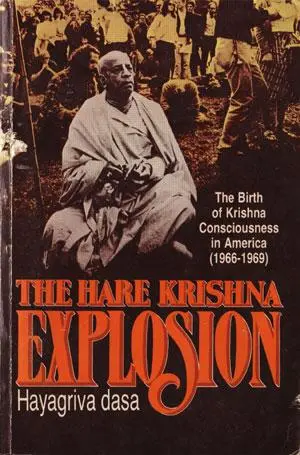
By Hayagriva das
I walked around the corner with him, and he pointed out a small storefront building between First and Second Streets, next door to a Mobil filling station. It had been a curiosity shop, and someone had painted Matchless Gifts over the window. At the time I didn’t realize how prophetic the words were.
When I first met my spiritual master, His Divine Grace A. C. Bhaktivedanta Swami Prabhupada, I felt that there was never a time when I did not know him. I never tire of telling of my first meeting with him on the streets of Lower East Side New York. At the time, I was hurrying from my Mott Street apartment, which had become a refuge for psychedeliacs, to a much quieter apartment on Fifth Street where I hoped to get some peace.
I was walking down Houston Street and across Bowery, past the rushing traffic and stumbling derelicts, and after crossing Bowery, just before Second Avenue, I saw His Divine Grace jauntily strolling down the sidewalk, his head high in the air, his hand in a beadbag. He struck me like a famous actor in a very familiar movie. He seemed ageless, though later I found out that he was seventy years old. He was wearing the traditional saffron-colored robes of a sannyasi; the renounced order, and quaint white shoes with points. Coming down Houston Street, he looked like the genie that popped out of Aladdin’s lamp. I was fresh from a trip to India, and His Divine Grace reminded me of the many holy men I had recently seen walking the dirt roads of Hardwar and Hrishikesh and bathing in the Ganges. I had gone to India to look for a guru but had returned disappointed. It was on this bright July morning, when I was least expecting it, that Sri Krsna, out of His infinite mercy, sent guru to me.
Srila Bhaktisiddhanta Saraswati Thakur and his disciples
Dec 14, 2001 is the Disappearance Day of Srila Bhaktisiddhanta Sarasvati Goswami, and we honor him with a prayer written by Srila Prabhupada written aboard the ship Jaladuta, on his way to fulfill the order (mission) of his spiritual master, Srila Bhaktisiddhanta.
Prayer unto the Lotus Feet of Krsna
by His Divine Grace A.C. Bhaktivedanta Swami Prabhupāda
on board the ship Jaladuta, September 13, 1965
(refrain) kṛṣṇa taba puṇya habe bhāi
e-puṇya koribe jabe rādhārāṇī khusī habe
dhruva ati boli tomā tāi
I emphatically say to you, O brothers, you will obtain your good fortune from the Supreme Lord Kṛṣṇa only when Śrīmatī Rādhārāṇī becomes pleased with you.
śrī-siddhānta saraswatī śacī-suta priya ati
kṛṣṇa-sebāya jāra tula nāi
sei se mohānta-guru jagater madhe uru
kṛṣṇa-bhakti dey ṭhāi ṭhāi
Śrī Śrīmad Bhaktisiddhānta Sarasvatī Ṭhākura, who is very dear to Lord Gaurāṅga, the son of mother Śacī, is unparalleled in his service to the Supreme Lord Śrī Kṛṣṇa. He is that great saintly spiritual master who bestows intense devotion to Kṛṣṇa at different places throughout the world.
In the first verse of this Ninth Chapter, by the word guhyatamam, Śrī Kṛṣṇa intimates that He is imparting the most confidential knowledge to Arjuna. Why is He proclaiming this to Arjuna? It is because Arjuna is anasūyu—non-envious. In the material world if someone is greater than us, we are envious. We are not only envious of one another, but of God. Also when Kṛṣṇa says, “I am the proprietor,” we disbelieve it. But this is not the case with Arjuna, who listens to Kṛṣṇa without envy. Arjuna does not cavil with Kṛṣṇa but agrees with whatever He says. This is his special qualification, and this is the way of understanding Bhagavad-gītā. It is not possible to understand what God is by our own mental speculations; we have to hear, and we have to accept.
Raja – Vidya: The King of Knowledge
By His Divine Grace A.C. Bhaktivedanta Swami Prabhupada
Chapter One
śrī bhagavān uvāca
idaṁ tu te guhyatamaṁ
pravakṣyāmy anasūyave
jñānaṁ vijñāna-sahitaṁ
yaj jñātvā mokṣyase ’śubhāt
“The Supreme Lord said: My dear Arjuna, because you are never envious of Me, I shall impart to you this most secret wisdom, knowing which you shall be relieved of the miseries of material existence.” (Bg. 9.1)
The opening words of the Ninth Chapter of Bhagavad-gītā indicate that the Supreme Godhead is speaking. Here Śrī Kṛṣṇa is referred to as Bhagavān. Bhaga means opulences, and vān means one who possesses. We have some conception of God, but in the Vedic literature there are definite descriptions and definitions of what is meant by God, and what is meant is described in one word—Bhagavān. Bhagavān possesses all opulences, the totality of knowledge, wealth, power, beauty, fame and renunciation. When we find someone who possesses these opulences in full, we are to know that he is God. There are many rich, wise, famous, beautiful and powerful men, but no one man can claim to possess all of these opulences. Only Kṛṣṇa claims to possess them in totality.
Srila Prabhupada’s transcendental books are his loud chanting of the holy name. Such loud chanting is giving the people of the world Harinama diksa.
Regarding Sankirtana and book distribution, book distribution is also chanting. Anyone who reads the books that is also chanting and hearing. Why distinguish between chanting and book distribution? These books I have recorded and chanted, and they are transcribed. It is spoken kirtanas. So book distribution is also chanting. These are not ordinary books. It is recorded chanting. Anyone who reads, he is hearing. Book distribution must not be neglected. (S.P.L. to Rupanuga dasa, 19th October, 1974)
When a devotee is perfectly qualified in chanting the transcendental vibration of the holy name, he is quite fit to become a spiritual master and to deliver all the people of the world. The chanting of the holy name is so powerful that it gradually establishes its supremacy above everything in the world. The devotee who chants it becomes transcendentally situated in ecstasy and sometimes laughs, cries and dances in his ecstasy. Sometimes the unintelligent put hindrances in the path of chanting this maha-mantra, but one who is situated on the platform of love of Godhead chants the holy name loudly for all concerned. As a result everyone becomes initiated in the chanting of the holy names–Hare Krsna, Hare Krsna, Krsna Krsna, Hare Hare/ Hare Rama, Hare Rama, Rama Rama, Hare Hare. (T.L.C. Chapter 18)
Vrndavana—Land of No Return
By His Holiness Brahmananda Swami
Originally Published in Back to Godhead 1975 Vol. 10, No. 11
Part 2
I once visited Vrndavana, India with His Divine Grace Srila Prabhupada. As I accompanied him on his daily walk one morning we suddenly came upon a particularly beautiful spot. The cool sands were thick with foliage; the tall trees full of singing birds. As the sun brightened the clear morning sky, peacocks filled the air with their peculiar call.
Srila Prabhupada looked over his shoulder and said to me, “So, Brahmananda, this is Vrndavana. How do you like it?”
“It’s wonderful, Srila Prabhupada,” was all I could reply. I felt that he was actually revealing the glories of Vrndavana to me even though I had no particular spiritual qualification.
Vrndavana is the place where the Supreme Lord Sri Krsna appeared five thousand years ago. Lord Krsna descended there from His own spiritual planet, Goloka Vrndavana to attract us by displaying His supernatural pastimes. Srila Prabhupada has explained that when Krsna descends to the material world, this same Vrndavana descends with Him just as an entourage accompanies an important personage. Because when Krsna comes His land also comes, Vrndavana is not considered to exist in the material world. Therefore devotees take shelter of the Vrndavana in India, for it is considered to be a replica of the original Goloka Vrndavana.
This is a recent post published on the Sampradaya Sun which we felt was noteworthy, and worth re-printing here.
Where’s the House the Whole World Could Live In?
BY: ANONYMOUS DAS
Dec 08, 2011 — CALIFORNIA (SUN)
Anonymous das writes…
I recently received the email below (my reply follows) from an old Bhakta friend who I contacted after several years of separation. It’s very revealing, as it tells the same story I and many Godbrothers and Godsisters speak and write about almost on a daily basis. However, it is even more telling because it gives the same perspective from a non-initiated well-wisher of ISKCON who happened to also be present to experience firsthand the potency of the Krishna consciousness movement during the latter days of Srila Prabhupada’s presence, through the Zonal Acarya period on up to the present. It really gives a birdseye view of what’s happened to the house Srila Prabhupada built for the whole world to live in.
“Hare Krsna.
As I mentioned I have been to the temple a handful of times since 1988. This is between you and I what I’m now writing and I would appreciate your feedback. Over the years I had a lot of difficulty due to my involvement with the temple. Let’s call it disillusionment. I had gone there religiously since 1976 and it was an integral part of my life. Over time my enthusiasm gradually diminished as I felt the place changed dramatically. With the advent of the new breed the temple culture became highbrow, clickish, judgmental and downright cold hearted. The priorities changed to how much money you had…it became quite yuppy.
I no longer felt comfortable there whatsoever. I can truly say that I don’t care for any of the devotees. In general I found it had become anything but personal. Let me add that I felt branded as some kind of low-class sudra due to not being initiated. I never aspired to be initiated and never requested that. I lived in the temple and followed the principles long enough but never inquired into it. I viewed the lifestyle and responsibility as being too serious of a commitment… generally I never knew what I was doing the next week.
My understanding was that the guru suffered for my mistakes and I simply could not accept that responsibility. I never knew clearly what I was going to do in the future and most certainly could not accept a lifetime vow. To me that was honesty. How many people remain that took those vows? I could not have lived with what I would have considered a failure.
…What the Lord Caitanya Mahaprabhu Himself proclaims to be the prime benediction for mankind, and the activity that He Himself appeared in this world to inaugurate, has been very badly neglected by ISKCON’s leaders. To attract devotees, to engage devotees and to elevate the awareness of the public, there is no better method than to perform nama-sankirtana. This same instruction was given to Lord Caitanya by His spiritual master:
“My dear child, continue dancing, chanting and performing sankirtana in association with devotees. Furthermore, go out and preach the value of chanting Krishna-nama, for by this process You will be able to deliver all fallen souls.”
Nama Sankirtana
Editorial (VNN) – by Locanananda Das
Originally Published on Vaishnava News
By reading the Sri Caitanya Caritamrita, one should become convinced that the Krishna consciousness movement is the vehicle through which the mercy of Caitanya Mahaprabhu will deliver the entire world. But events taking place within the movement over the last twenty years have shaken everyone’s faith, and it has become very difficult to take pride in being a member of ISKCON, the organization that Srila Prabhupad risked his life to create. The year of the Centennial having come and gone, ISKCON continues to be plagued by a malaise that is rooted in its leaders’ lack of vision and apparent lack of concern for the spiritual well-being of the devotees. Compounded by the offensive banning of vaisnavas and the enactment of deviant policies, the movement has been thrown into a tailspin from which some think it may not recover.
Personally, I have tremendous faith in the system established by Srila Prabhupad. I am thoroughly convinced that there can be a reconciliation of the parties on the different sides of all current issues, but it will require that we rise above false ego and agree to do what is best for the Krishna consciousness movement.
…It is related that by his constant association with the Lord, Sudama had wiped away from his heart whatever contamination was remaining, and he was very shortly transferred to the eternal spiritual kingdom, which is the goal of all saintly persons in the perfectional stage of life. It is stated in the Krsna Book that whoever hears this history will become qualified like Sudama and will be transferred to the spiritual kingdom of Lord Krsna.
Lord Krsna’s Friend Sudama
Published in Back to Godhead Magizine 1971 Vol. 1, Number 49
By Satsvarupa dasa adhikari
The wonderful history of Krsna and His friend Sudama is told in its entirety in the Krsna Book, Volume II, by His Divine Grace A.C. Bhaktivedanta Swami Prabhupada. Srila Prabhupada is kindly presenting to the western world the pastimes of Lord Krsna, which can act as a merciful shower upon the hearts of all of us. It is true that we have forgotten our eternal, blissful and loving relationships as servants of Krsna or God. The remedy to forgetfulness or ignorance of God is to hear about Him from the lips of His pure devotee. This is the view of authorized scriptures.
When Krsna descends from His eternal abode in the spiritual world and appears to this mundane world, as He did 5,000 years ago, He engages with others just as if He were an ordinary human being. Although He is unborn, He appears to have a mother and father. In the village of Vrndavana Krsna plays as a cowherd boy. He enacts these pastimes for His own transcendental pleasure and to attract all the suffering living entities back home, back to Godhead. Sudama was among those devotees who were childhood friends with Krsna, and Sudama was also His intimate school friend.
“…one should concentrate his mind upon Kṛṣṇa-the very form with two hands carrying a flute, the bluish boy with a beautiful face and peacock feathers in His hair. There are descriptions of Kṛṣṇa found in the Brahma-saṁhitā and other literatures. One should fix his mind on this original form of Godhead, Kṛṣṇa. He should not even divert his attention to other forms of the Lord. The Lord has multi-forms, as Viṣṇu, Nārāyaṇa, Rāma, Varāha, etc., but a devotee should concentrate his mind on the form that was present before Arjuna. Concentration of the mind on the form of Kṛṣṇa constitutes the most confidential part of knowledge, and this is disclosed to Arjuna because Arjuna is the most dear friend of Kṛṣṇa’s.”
Bhagavad-gita As It Is – Macmillan 1972 Edition
By His Divine Grace A.C. Bhaktivedanta Swami Prabhupada
Chapter 18, Text 65
man-manā bhava mad-bhakto
mad-yājī māṁ namaskuru
mām evaiṣyasi satyaṁ te
pratijāne priyo ‘si me
Always think of Me and become My devotee. Worship Me and offer your homage unto Me. Thus you will come to Me without fail. I promise you this because you are My very dear friend.
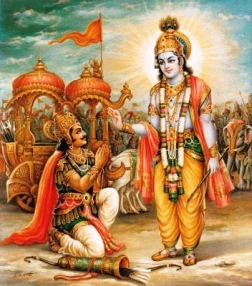
Today is the anniversary commemorating the day when Sri Krishna spoke Bhagavad-gita to Arjuna, at the place known as Kurukṣetra.
Traditionally devotees go to Kurukṣetra (dharma-kṣetra, a place where religious rituals are performed) ) and recite Bhagavad Gita from early morning until the next morning, perform arati to Bhagavad Gita and to Krishna and Arjuna upon the chariot, offer lamps, and discuss the significance of the Bhagavad-gita.
Devotees who cannot get to Kurukṣetra, can honor the blessed event by reading or reciting the Bhagavad-gita, and discussing the subject matter of Bhagavad Gita in the association of devotees.
Distribution of Bhagavad-gita’s on this day is also a very auspicious activity to perform.
Bhagavad-gita As It Is – Macmillan 1972 Edition
By His Divine Grace A.C. Bhaktivedanta Swami Prabhupada
dhṛtarāṣṭraḥ—King Dhṛtarāṣṭra; uvāca—said; dharma-kṣetre—in the place of pilgrimage; kuru-kṣetre—in the place named Kurukṣetra; samavetāḥ—assembled; yuyatsavaḥ—desiring to fight; māmakāḥ—my party (sons); pāṇḍavāḥ—the sons of Pāṇḍu; ca—and; eva-certainly; kim—what; akurvata—did they do; sañjaya—O Sañjaya.
Translation
Dhṛtarāṣṭra said: O Sañjaya, after assembling in the place of pilgrimage at Kurukṣetra, what did my sons and the sons of Pāṇḍu do, being desirous to fight?
Purport
Bhagavad-gītā is the widely read theistic science summarized in the Gītā-māhātmya (Glorification of the Gītā). There it says that one should read Bhagavad-gītā very scrutinizingly with the help of a person who is a devotee of Śrī Kṛṣṇa and try to understand it without personally motivated interpretations. The example of clear understanding is there in the Bhagavad-gītā itself, in the way the teaching is understood by Arjuna, who heard the Gītā directly from the Lord. If someone is fortunate enough to understand Bhagavad-gītā in that line of disciplic succession, without motivated interpretation, then he surpasses all studies of Vedic wisdom, and all scriptures of the world. One will find in the Bhagavad-gītā all that is contained in other scriptures, but the reader will also find things which are not to be found elsewhere. That is the specific standard of the Gītā. It is the perfect theistic science because it is directly spoken by the Supreme Personality of Godhead, Lord Śrī Kṛṣṇa.
In honor of the Advent of Srimad Bhagavad-gita we are reprinting an Essay on the Bhagavad-gita written by Srila Prabhupada and published on the advent of Bhagavad-gita in 1948
Interpretations of Bhagavad-gita
Originally published c. 1948, on the auspicious observance of the advent of Srimad Bhagavad-gita.]
By His Divine Grace A.C. Bhaktivedanta Swami
It has become a luxurious fashion of the day, along with the progress of material civilization, that everyone can make his interpretation of the great Indian philosophy called the Bhagavad-gītā. This concise form of Vedic knowledge, known as the Gītopaniṣad, is acknowledged by all sections of transcendental scholars, in India especially, as the cream of all Upaniṣads and that of Vedānta-sūtras also. Scholars and ācāryas like Śrīpāda Śaṅkarācārya and some of his followers also could not leave out this very important book of knowledge, although such scholars of the Māyāvāda school did not acknowledge the bona fides of the Purāṇas. But the interpretation of Śrī Śaṅkarācārya differs from the interpretations of the Vaiṣṇava ācāryas headed by Śrī Ramanujācārya and Madhvācārya. There are innumerable interpretations of the Bhagavad-gītā in the market, and it is certainly a puzzling business to select which of the various interpretations shall be accepted as bona fide and which of them shall be rejected as mala fide.
In order to make a distinction between these two classes of bona fide and mala fide interpretations, we have to make an impartial study of the book, and such unbiased study only will make us able to discern the bona fide from the mala fide.
In this connection, we may first of all try to find out the origin of the Bhagavad-gītā. It is wrong to understand that The Bhagavad-gītā was first spoken in the battlefield of Kurukṣetra as it is a part of the great history of India, namely, the Mahābhārata. We can understand from the talks of Śrī Kṛṣṇa and Arjuna, as it is stated in the Bhagavad-gītā, that long, long before the battle of Kurukṣetra, this philosophy was once spoken by Śrī Kṛṣṇa to Vivasvān (the Sun), and from Vivasvān the knowledge was transferred to Manu, and from Manu it was transferred to King Ikṣvāku. And, in that way of disciplic succession, the knowledge has come down to generations after generations, but in course of time, such disciplic succession broke, and therefore, Śrī Kṛṣṇa again repeated the same yoga or transcendental knowledge to Arjuna. In the beginning of the 4th Chapter of Bhagavad-gītā, this fact is stated as follows:
This song written by Srila Bhaktivinoda Thakura, and made famous in the West by the illustrious Visnujana Swami, has always been a favorite of mine, and the devotees of The Hare Krishna Movement.
Kabe Ha’be Bolo
(Invocation of the Holy Name)
By Srila Bhaktivinoda Thakura
When, oh when will that day be mine?
When my offenses ceasing, taste for the name increasing.
When in my heart will your mercy shine?
When, oh when, will that day be mine.
Lower than a blade of grass, more tolerant than a tree.
When will my mind attain this quality?
Respectful to all, not expecting their honor,
then shall I taste the name’s nectar sublime.
Great wealth or followers, feminine beauty,
I won’t care for them or the comforts of my body.
Birth after birth, give me, Oh Lord Caitanya,
causeless devotion to Your feet divine.
When will I utter Krsna, Krsna, Krsna,
with words choked up and shivering body?
When will I be trembling all over, lose bodily color,
tears pouring from my eyes.
When in Navadvipa along the Ganges bank,
shouting ‘Gaura-Nityananda’ as a surrendered soul,
dancing, chanting, running everywhere,
when will I become half mad of mind?
When will Lord Nityananda show mercy upon me,
when will I reject the world of Maya:
Bestow unto me the shade of Your lotus feet,
let the right to preach the name be mine.
I will beg, borrow, or steal the nectar of the name.
By the name’s effect I will feel paralyzed.
Oh! Enjoyed of the nectar of the name
when will I touch your lotus feet till the end of time?
When kindness to all beings will be appearing
with free heart forget myself comforting
Bhaktivinoda in all humility prays
“Now I will set out to preach Your order sublime.”
Vegetarian Health and Nutrition
From the book “The Hare Krishna Book of Vegetarian Cooking”
By Adiraja Dasa
“Can a vegetarian diet improve or restore health? Can it prevent certain diseases?
Advocates of vegetarianism have said yes for many years, although they didn’t have much support from modern science until recently. Now, medical researchers have discovered evidence of a link between meat-eating and such killers as heart disease and cancer, so they’re giving vegetarianism another look.
Since the 1960s, scientists have suspected that a meat-based diet is somehow related to the development of arteriosclerosis and heart disease. As early as 1961, the Journal of the American Medical Association said: “Ninety to ninety-seven percent of heart disease can be prevented by a vegetarian diet.” Since that time, several well-organized studies have scientifically shown that after tobacco and alcohol, the consumption of meat is the greatest single cause of mortality in Western Europe, the United States, Australia, and other affluent areas of the world.
Because Vrndavana is the eternal and entirely spiritual abode of the Lord, it is nondifferent from Him. At Vrndavana, one will find unlimited wealth, strength, fame, wisdom, beauty and renunciation—all the six opulences possessed by the Supreme Personality of Godhead, Bhagavan Sri Krsna. Indeed Vrndavana is Krsna, and, to go there is to perceive God Himself.
Vrndavana—Land of No Return (Part 1)
By His Holiness Brahmananda Swami
Back to Godhead Magazine 1975 Volume 10 Number 9
From the beginning of time, man has yearned for the perfect home—a paradise, a Shangri-la, a Walden—where he could live eternally in peace and happiness. Such a place cannot be found anywhere in the material world, however, for the material world is by its very nature temporary and frustrating. To end our weary searching, we must go beyond this world of duality, beyond the boundaries of space and time, into the spiritual realm.
Vrndavana, India, is that sought-after eternal resting place because it is at Vrndavana that Lord Sri Krsna, the Supreme Personality of Godhead, descended to this planet five thousand years ago. The Lord’s appearance and activities are not mundane; they are completely transcendental. Just as a king may travel with all his retinue, set up camp, and conduct his affairs of state in the same style as if he were in his palace, Lord Krsna brought with Him all His transcendental associates and paraphernalia and created on earth an exact replica of the spiritual world, known as Goloka Vrndavana.








 The Hare Krishna Movement