“One has to qualify himself to see and understand God, and that process of qualification is called Kṛṣṇa consciousness. By engaging ourselves in God’s service, we become qualified to see God. Otherwise it is not possible.“
“One cannot understand the form, name, quality, or paraphernalia of God with one’s material senses.” (Cc Madya 17.136)
Just as God is eternal, we are also eternal, and when we establish our eternal relationship with the supreme, complete eternal, we realize our eternality.
God is the supreme living entity among all living entities, the supreme eternal among all eternals. By Kṛṣṇa consciousness, by purification of the senses, this knowledge will be realized, and we will come to see God.
The following post is Chapter 3 from the book “The Path to Perfection”which gives some instruction on Seeing God (Krsna) and on the yoga system.
So we are finishing our series on the five types of relationships (rasa’s) with the Lord. Today we are exploring Devotional Service in Conjugal Love (Madhurya-rasa) as explained in chapter 44 of “The Nectar of Devotion”.
Because of the sensitive nature of this topic, we have posted the entire chapter from the the original 1970 edition of “The Nectar of Devotion”, by His Divine Grace A C Bhaktivedanta Swami Prabhupada.
A pure devotee’s attraction to Krsna in conjugal love is called devotional service in conjugal love. Although such conjugal feelings are not at all material, there is some similarity between this spiritual love and material activities. Therefore, persons who are interested only in material activities are unable to understand this spiritual conjugal love, and these devotional reciprocations appear very mysterious to them. Rupa Gosvāmī therefore describes conjugal love very briefly.
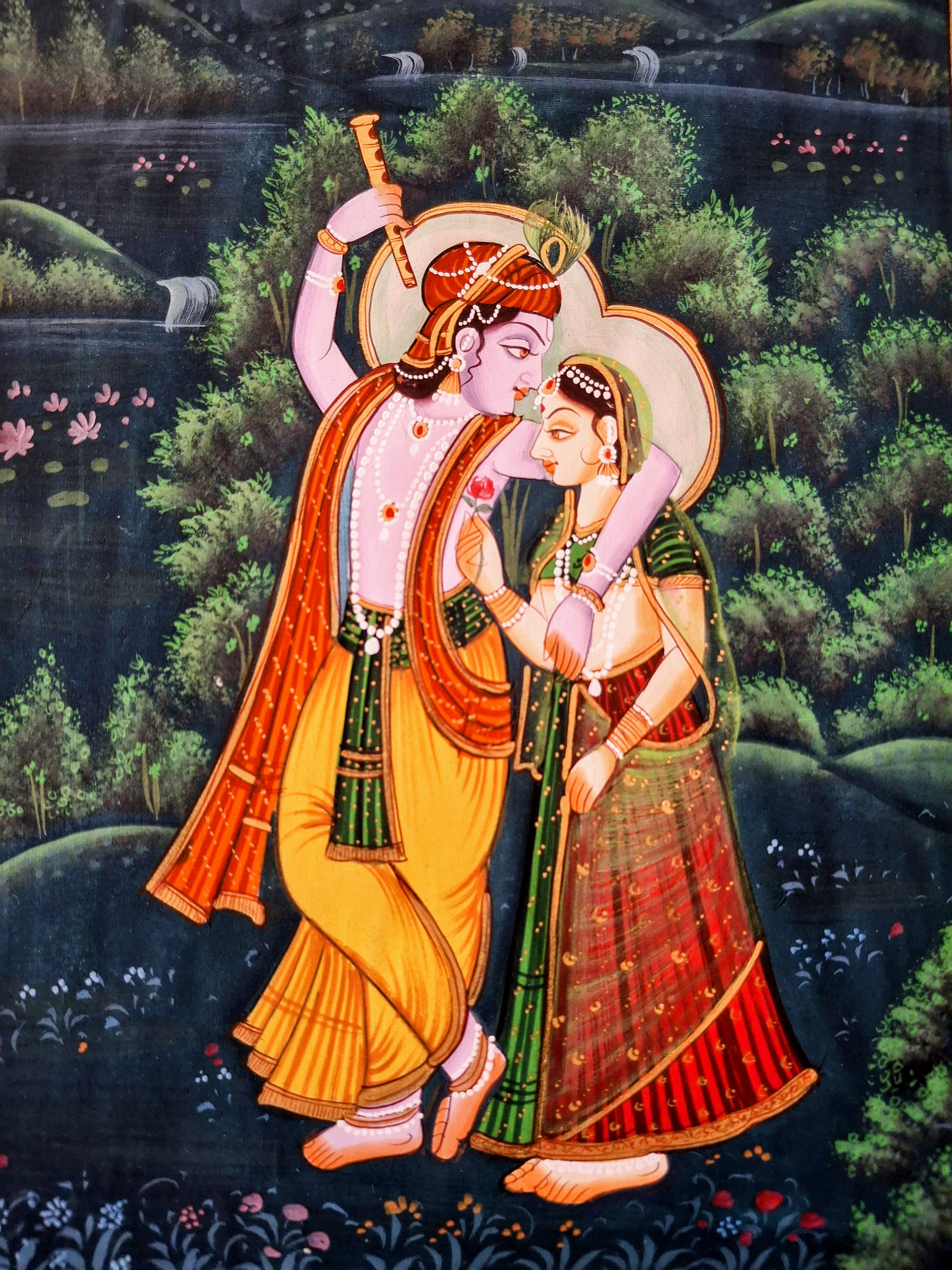
The impetuses of conjugal love are Krsna and His very dear consorts, such as Rādhārāṇī and Her immediate associates. Lord Krsnahas no rival: no one is equal to Him, and no one is greater than Him. His beauty is also without any rival, and because He excels all others in the pastimes of conjugal love, He is the original object of all conjugal love.
So we are continuing our series on the five types of relationships (rasa’s) with the Lord. Today we are exploring the Paternal Devotional stage of Love of God (Vatsalya-rasa) as explained in chapter 43 of “The Nectar of Devotion”.
When ecstatic love develops into the relationship of parenthood and becomes steadily established, the relationship is called vatsalya-rasa. The exhibition of this vatsalya-rasa standard of devotional service can be found in the dealings of Krishna with His devotees who represent themselves as superior personalities like father, mother, teacher, etc.
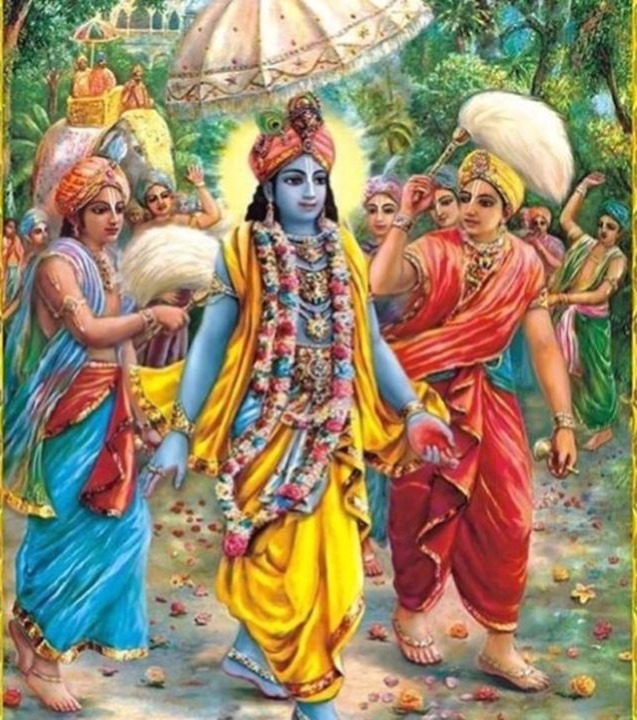
Learned scholars have described the impetuses of parental love for Krishna, existing in the elderly personalities who are in relation with Him, as follows: “The Supreme Personality of Godhead, whose bodily complexion is just like a bluish, new-grown lotus flower, whose body is very delicate and whose lotus eyes are surrounded by scattered hair as black as bees, was walking on the streets of Vrindavan when Mother Yasoda, the beloved wife of Nanda Mahārāj, saw Him. Immediately the milk began to flow from her breasts, soaking her body.” Some specific provocations for parental love of Krishna are listed as His blackish bodily hue, which is very attractive and pleasing to see, His all-auspicious bodily features, His mildness, His sweet words, His simplicity, His shyness, His humility, His constant readiness to offer respect to the elderly, and His charity. All of these qualities are considered ecstatic provocations for parental love.
So we are continuing our series on the five types of relationships (rasa’s) with the Lord. Today we are exploring the Fraternal Devotional stage of Love of God (Sakhya-rasa) as explained in chapter 41 of “The Nectar of Devotion”. Also included in todays post are some select verses from the Bhagavad-gita describing Arjuna’s friendship with Krishna.
When a devotee is permanently situated in devotional service, and by different symptoms of ecstasy he has developed and matured a fraternal mellow or flavor in relationship with the Personality of Godhead, his feeling is called fraternal love of Godhead.
The impetus for such fraternal love of God is God Himself. When one is liberated and discovers his eternal relationship with the Supreme Lord, the Lord Himself becomes the impetus for increasing fraternal love. The eternal associates of the Lord in Vrindavan have described this as follows: “The Lord, Hari, whose bodily hue is like the indranīla jewel, whose smiling is as beautiful as the kunda flower, whose silk dress is as yellow as golden autumn foliage, whose chest is beautified with garlands of flowers and who is always playing upon His flute-this enemy of the Agha demon is always attracting our hearts by wandering about Vrindavan.”
There are similar statements of fraternal love expressed outside the jurisdiction of Vrindavan. When the sons of Pandu, headed by Mahārāj Yudhisthira, saw Krishna in His four handed form on the battlefield of Kuruksetra, holding His conchshell, disc, club and lotus flower, they completely forgot themselves and became merged in the ocean of nectarean happiness. This shows how the sons of Pandu-King Yudhisthira, Bhima, Arjuna, Nakula and Sahadeva-were all caught up in fraternal love for Krishna.
From the Bhagavad-gita we are reminded of Arjuna’s friendship with Krishna.
So today we are exploring the Servitude stage of Love of God (Dasya-rasa) as explained in chapter 36 of “The Nectar of Devotion”.
Each soul, according to its constitutional nature, possesses a unique loving relationship with Krishna in one of five principal categories. When devotees return to the spiritual world, they engage in direct loving devotional service to Krishna in their particular rasa.
Devotees engaged in servitude are attached to Krishna in the affection of reverence. Some of the inhabitants of Gokula (Vrindavan) as exhibited on earth) are attached to Krishna on this platform of affection in reverence. The inhabitants of Vrindavan used to say, “Kṛṣṇa is always manifest before us with a complexion like a blackish cloud. He holds His wonderful flute in His lotus hands. He is dressed in yellow silks and bedecked with a peacock feather on His head. When Krishna walks near Govardhan Hill with these personal features, all the inhabitants of the heavenly planets, as well as the inhabitants of this earth, feel transcendental bliss and consider themselves the eternal servants of the Lord.”
Today we are exploring the Neutral stage of Love of God, (santa-rasa), as explained in chapter 35 of “The Nectar of Devotion”.
“When the yogi sees the eternal form of Visnu and appreciates the Lord’s beauty in awe and veneration, he is situated in the neutral stage of love of God.”
…Some great sages have attained this neutral position by practicing austerity, penance and meditation to control the senses. Such sages are generally called mystic yogīs, and in most cases they are inclined to appreciate the spiritual pleasure of the impersonal feature of the absolute truth. They are practically unaware of the transcendental pleasure derived from personal contact with the Supreme Godhead.
When some great saintly persons who had undergone penances and austerities saw the four-handed transcendental form of Visnu, they began to remark as follows: “This four-handed form of the Lord, manifested in a bluish color, is the reservoir of all pleasure and the center of our living force. Actually, when we see this eternal form of Visnu, we, along with many other paramahaṁsas, become immediately captivated by the beauty of the Lord.” This appreciation of Lord Visnu by saintly persons is an instance of situation in santa-rasa, or the neutral stage of devotional service. In the beginning, those who are aspiring for salvation try to get out of the material entanglement by performing painful austerities and penances, and ultimately they come to the impersonal status of spiritual realization. At this brahma-bhuta [SB 4.30.20] stage of liberation from the material entanglement, the symptoms, as explained in the Bhagavad-gita, are that one becomes joyous beyond any hankering or lamentation and gains a universal vision. When the devotee is situated in the santa-rasa, or neutral stage of devotional service, he appreciates the Visnu form of the Lord.
This morning I was thinking about the different relationships one can have with the Lord. In “The Nectar of Devotion”, Srila Prabhupada describes the five primary kinds of devotional service-namely, neutrality, servitude, fraternity, parenthood and conjugal love.Over the course of the next five posts, I want to explore these five primary relationships.
But for today, I want to start with this nice verse from the Bhagavad-gita, where these five types of relationships are mentioned in purport.
For one who remembers Me without deviation, I am easy to obtain, O son of Pṛthā, because of his constant engagement in devotional service. (Bg 8.14)
…Bhakti-yoga is very simple and pure and easy to perform. One can begin by simply chanting Hare Kṛṣṇa. Kṛṣṇa is very merciful to those who engage in His service, and He helps in various ways that devotee who is fully surrendered to Him so he can understand Him as He is. The Lord gives such a devotee sufficient intelligence so that ultimately the devotee can attain Him in His spiritual kingdom.
…Generally, the bhakti-yogīs are engaged in five different ways: 1) śānta-bhakta, engaged in devotional service in neutrality; 2) dāsya-bhakta, engaged in devotional service as servant; 3) sākhya-bhakta, engaged as friend; 4) vātsalya-bhakta, engaged as parent; and 5) mādhurya-bhakta, engaged as conjugal lover of the Supreme Lord. (from purport)
Today as most of the Western World celebrates Easter Sunday, we thought we word honor the life of Lord Jesus Christ with some select writings by our spiritual master A.C. Bhaktivedanta Swami Prabhupada.
The Śrīmad-Bhāgavatam states that any bona fide preacher of God consciousness must have the qualities of titikṣā (tolerance) and karuṇā (compassion). In the character of Lord Jesus Christ we find both these qualities. He was so tolerant that even while he was being crucified, he didn’t condemn anyone. And he was so compassionate that he prayed to God to forgive the very persons who were trying to kill him. (Of course, they could not actually kill him. But they were thinking that he could be killed, so they were committing a great offense.) As Christ was being crucified he prayed, “Father, forgive them. They know not what they are doing.”
…Of course, the message that Christ preached was just according to his particular time, place, and country, and just suited for a particular group of people. But certainly he is the representative of God. Therefore we adore Lord Jesus Christ and offer our obeisances to him.
Once, in Melbourne, a group of Christian ministers came to visit me. They asked, “What is your idea of Jesus Christ?” I told them, “He is our guru. He is preaching God consciousness, so he is our spiritual master.” The ministers very much appreciated that.
Actually, anyone who is preaching God’s glories must be accepted as a guru. Jesus Christ is one such great personality. We should not think of him as an ordinary human being. The scriptures say that anyone who considers the spiritual master to be an ordinary man has a hellish mentality. If Jesus Christ were an ordinary man, then he could not have delivered God consciousness. (Science of Self Realization, Chapter 4, “Understanding Krsna and Christ)
Ever since I was a small child, I have been attracted to the statue of Buddha. Don’t know why, but I had a statue of Buddha in my bedroom, and it was a Christian home. I didn’t really know about Krishna then or who the Buddha was…but I was so attracted to everything Eastern. As I learned latter in life Buddha was actually an incarnation of Krsna. “From the Bhāgavatam we understand that Lord Buddha is the incarnation of Kṛṣṇa who appeared when materialism was rampant and materialists were using the pretext of the authority of the Vedas.” (from purport Bg 4.7)
The Four Noble Truths & The Eightfold Path
The Four Noble Truths
The Buddha’s first sermon after his Enlightenment centered on the Four Noble Truths, which are the foundation of Buddhism. The truths are:
The truth of suffering (dukkha) The truth of the cause of suffering (samudaya) The truth of the end of suffering (nirhodha) The truth of the path that frees us from suffering (magga)
…”Everyone and everything is attracted to Kṛṣṇa–that is the perfect description of Kṛṣṇa’s attraction. The example of the gopīs is very instructive to persons who are trying to be absorbed in Kṛṣṇa consciousness. One can very easily associate with Kṛṣṇa simply by remembering His transcendental pastimes. Everyone has a tendency to love someone. That Kṛṣṇa should be the object of love is the central point of Kṛṣṇa consciousness. By constantly chanting the Hare Kṛṣṇa mantra and remembering the transcendental pastimes of Kṛṣṇa, one can be fully in Kṛṣṇa consciousness and thus make his life sublime and fruitful.”
Kṛṣṇa, The Supreme Personality of Godhead By His Divine Grace A. C. Bhaktivedanta Swami Prabhupada Vol. 1, Chapter 34
The Gopīs’ Feelings of Separation
The gopīs of Vṛndāvana were so attached to Kṛṣṇa that they were not satisfied simply with the rāsa dance at night. They wanted to associate with Him and enjoy His company during the daytime also. When Kṛṣṇa went to the forest with His cowherd boy friends and cows, the gopīs did not physically take part, but their hearts went with Him. And because their hearts went, they were able to enjoy His company through strong feelings of separation. To acquire this strong feeling of separation is the teaching of Lord Caitanya and His direct disciplic succession of Gosvāmīs. When we are not in physical contact with Kṛṣṇa, we can associate with Him like the gopīs, through feelings of separation. Kṛṣṇa’s transcendental form, qualities, pastimes, and entourage are all identical with Him. There are nine different kinds of devotional service. Devotional service to Kṛṣṇa in feelings of separation elevates the devotee to the highest perfectional level, to the level of the gopīs.
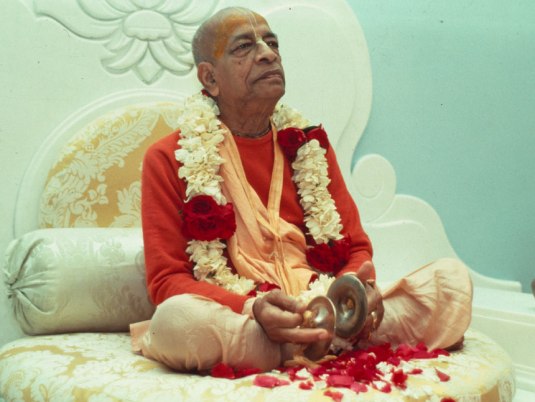
At various times people have called him a scholar, a philosopher, a cultural ambassador, a prolific author, a religious leader, a spiritual teacher, a social critic, and a holy man. In truth, he was all these things and more.
Over five hundred years ago, Lord Sri Krishna appeared as Sri Chaitanya Mahaprabhu in Navadvipa, a village in West Bengal. The purpose of His appearance was to inaugurate the Sankirtana Movement, the Yuga Dharma for this age of Kali. He declared that the chanting of His holy names would spread beyond the shores of India to every town and village in the world. He predicted that His commander-in-chief would appear to accomplish this mission.
Yes… Srila Prabhupada appeared to fulfill this prophecy.
Well the Golden Jubilee at Krishna Balarama Mandir is over, and its time for many of us to return to their respective homes. The above photo are the Prabhupada disciples, sannayasi’s, and other participants, taken on the last day of festival. Many thanks to the management and festival organizers, as well as all the Vrindavan residents who helped make this a memorable occasion.
The Sri Sri Krishna Balaram Mandir, situated in the Raman Reti area of Vrindavan, holds a special significance for the devotees of the International Society for Krishna Consciousness. This grand temple represents the fulfilled dream of Srila Prabhupada, Founder Acharya of ISKCON, who wished to construct a temple of unparalleled beauty for the worship of the transcendental brothers Krishna and Balaram in the same village where They played more than five thousand years ago. Srila Prabhupada directly oversaw all the aspects of design and construction and personally called the Lord to come and accept the worship of His devotees from around the world. He said, “Lord Balaram is the source of spiritual strength, and I have built this temple just to give strength to the devotees”.
Today, the Sri Sri Krishna Balaram Mandir is a booming spiritual center. Every day of the week pilgrims flood in the gate in great numbers from all over the world. In fact, the large green government signs posted over the highway turn off to Vrindavan only give directions to two temples: Banke Bihari and ISKCON.
The Opening of Krishna Balarama Mandir 50 years ago
Today we are celebrating The Appearance day of Lord Ramachandra (Rama Navami), at the Krishna Balarama Mamdir, for the 50th Golden Jubille Grand Opening. It was 50 years ago today, this beautiful temple was opened.
It has been a very blissful morning thus far, with ecstatic kirtan, memories given by Senior devotees who were here with Srila Prabhupada for the opening, and a Big Surprise was seeing the Ashtasakhi Gopis, who joined Radha Shyamasundar on the altar for the first time.
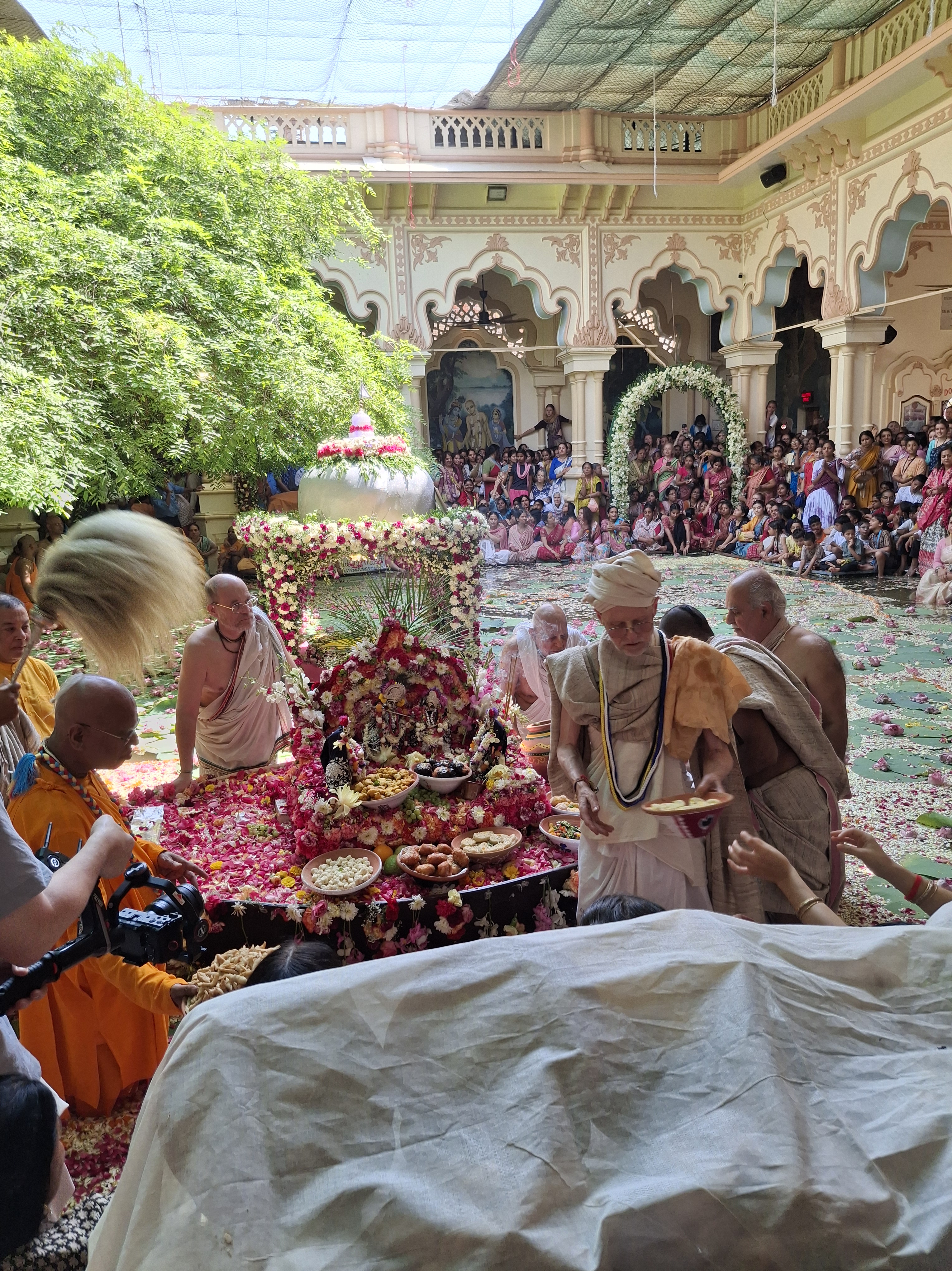
What an incredible morning here at Sri Sri Krishna-Balarama Mandir in Vrindavan India. We just participated in the Boat Festival, where Radha and Krishna were floated around the Temple courtyard, which was filled with water, and adorned with lotus leafs, decorated with lotus’s and flower petals. It was very beautiful and there were smiles all around.
There must have been hundreds of food offerings, as Radha Krsna’s boat floated by, then, the offered food (prasadam) was distributed to all in attendance. And when it was over, the mass of people splashed in the water, as flower petals fell from above. We witnessed something truly amazing, and so much fun.
Padmapani Prabhu was a very dear friend, and a dear disciple of Srila Prabhupada who is well known as the web master of the pagePrabhupada Connection. He will be greatly missed.
Please join us in prayers for a very special Godbrother, Padmapani Prabhu who just left us in Canada. I never knew him personally, but loved to hear of his daring exploits in the mideast when it was quite a dangerous area! Then I knew him from the marvellous website he managed, The Prabhupada Connection. He’s on the left with Tribhuvanath in Sri Radha Rasabihari Mandir ( Deena Bandhu Das )
Recently, while discussing Srila Prabhupada and his glories with a younger devotee, I was surprised to hear him say, “You’re so lucky. You got Srila Prabhupada, but what about us?” Startled by hearing such a despondent remark by a newcomer who should be brimming with hope and enthusiasm in Krsna consciousness, I proceeded to explain that Srila Prabhupada is, in fact, as present now as he has ever been. Throughout his books, letters and conversations, Srila Prabhupada emphasized this point again and again, so there should be no cause for misunderstanding.
In 1975, when asked by a reporter in Berkeley what would happen to the movement after his departure, Srila Prabhupada replied, “I will never die. I will live forever in my books.” In the Caitanya-caritamrta (Adi-lila 1.35, purport), Srila Prabhupada explains, “There is no difference between the spiritual master’s instructions and the spiritual master himself.” Further assuring us all, Prabhupada spoke the following words just prior to his departure in 1977: “If I depart, there is no cause for lamentation. I will always be with you through my books and my orders. I will always remain with you in that way.”
I have been reading the Krsna Book lately, and just yesterday we were reading chapter 14 “Prayers Offered by Lord Brahma to Lord Krsna”, and I was reminded this was the last chapter Srila Prabhupada was working on in the Srimad Bhagavatam series before his passing. So I had another look at the Tenth Canto, part 3, and thought it a good idea to share it with all our readers.
This is the final Śrīmad-Bhāgavatam volume translated by His Divine Grace A. C. Bhaktivedanta Swami Prabhupada, Founder-Acarya of the International Society for Krishna Consciousness, before his untimely departure. We share it with you as a free PDF download. You can click on the above link to view the complete volume or save it to your computer.
Foward
This is the final Śrīmad-Bhāgavatam volume translated by His Divine Grace A. C. Bhaktivedanta Swami Prabhupada, founder-acarya of the International Society for Krishna Consciousness. It is smaller than the earlier volumes because it ends where the renowned author stopped translating just before his departure from this mortal world on November 14, 1977, at the Krsna-Balarama Mandira in Vrndavana, India.
The first part of this volume was produced in the usual fashion. Srila Prabhupada would sit and read silently from the Sanskrit text and then speak the translation and commentary into his dictaphone. Later, due to illness, it became necessary for his disciples to assist him personally.
In these last days Srila Prabhupada was gravely ill. Unable to eat for weeks, his health had deteriorated, making even the slightest movement excruciatingly painful.
As he lay still, a devotee would softly read the Sanskrit to him. Another disciple, sitting on his bed, held the microphone to him, nearly touching his mouth. And then Srila Prabhupada would speak, voice sometimes barely audible.
These recordings, made in his quarters at the temple, constitute the balance of this book.
In these final moments, the physician attending His Divine Grace confided that an ordinary man in such critical condition would have been crying out from the intense pain. Srila Prabhupada’s disciples were awestruck as they watched their spiritual master work quietly, undisturbed.
In the last part of the book we find Srila Prabhupada’s usual clarity of thought, constant scriptural references, scrupulous attention to detail, and rigorous philosophical exposition fully intact, just as they were in the preceding twenty-nine volumes of the Śrīmad-Bhāgavatam.
Srila Prabhpada’s last days and this translation will stands an inspiring reminder that even the severest material circumstances cannot impede the activities of a pure devotee of the Supreme Personality of Godhead.
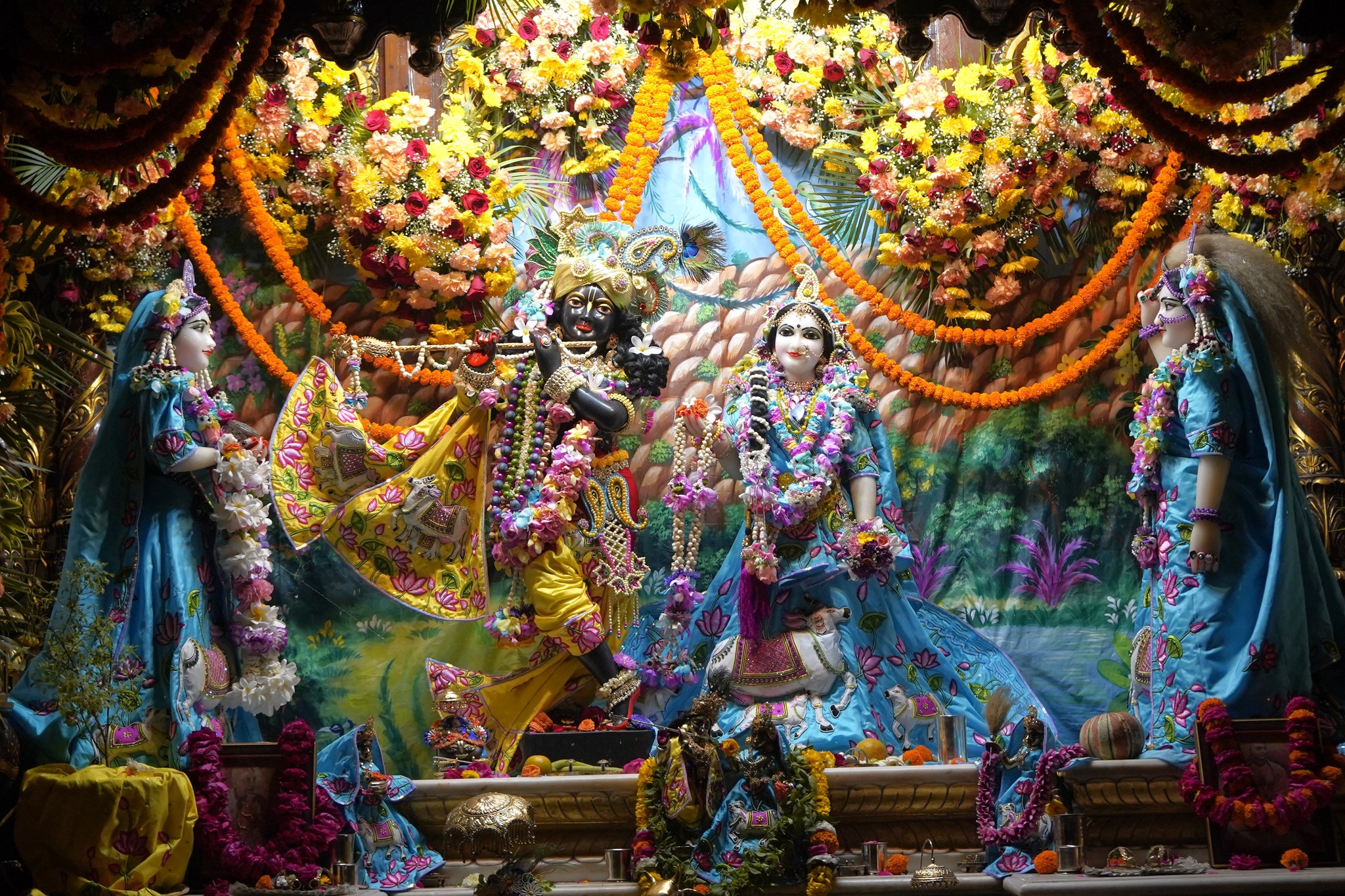
We are currently in Vrindavan, India, at the Krsna Balaram Mandir, with the most beautiful Radha Shyam. All the deities looked so gorgeous this morning, in their black outfits.
Have been doing the parikaram of the twelve forests of Vrindavan, and it has been amazing, and feel exceptional fortune, at being here, and experiencing so much devotional nectar.
I wish to share some from the Preface to the”Nectar of Devotion” By A. C. Bhaktivedanta Swami:
The basic principle of the living condition is that we have a general propensity to love someone. No one can live without loving someone else. This propensity is present in every living being. Even an animal like a tiger has this loving propensity at least in a dormant stage, and it is certainly present in the human beings. The missing point, however, is where to repose our love so that everyone can become happy. At the present moment the human society teaches one to love his country or family or his personal self, but there is no information where to repose the loving propensity so that everyone can become happy. That missing point is Krsna, and The Nectar of Devotion teaches us how to stimulate our original love for Krsna and how to be situated in that position where we can enjoy our blissful life.
“I liked Prabhupada’s humbleness. I always liked his humility and his simplicity. The servant of the servant of the servant is really what it is, you know. None of us are God—just His servants. He just made me feel so comfortable. I always felt very relaxed with him, and I felt more like a friend. I felt that he was a good friend. Even though he was at the time seventy-nine years old, working practically all through the night, day after day, with very little sleep, he still didn’t come through to me as though he was a very highly educated intellectual being, because he had a sort of childlike simplicity. Which is great, fantastic. Even though he was the greatest Sanskrit scholar and a saint, I appreciated the fact that he never made me feel uncomfortable. In fact, he always went out of his way to make me feel comfortable. I always thought of him as sort of a lovely friend, really, and now he’s still a lovely friend.
“That was the thing about Prabhupada, you see. He didn’t just talk about loving Krishna and getting out of this place, but he was the perfect example. He talked about always chanting, and he was always chanting. I think that that in itself was perhaps the most encouraging thing for me. It was enough to make me try harder, to be just a little bit better. He was a perfect example of everything he preached.
We are currently in Vrindavan, India, doing the twelve day Parikrama of the forests of Vrindavan. We have visited many Holy sites, and have had Darshana with so beautiful deities, and gotten water sprinkled on us, from many sacred Kunds (ponds, bathing sites). It has been a wonderful trip thus far, although the traffic, and dust, has been rather exhausting. Hare Krishna! -V
The 12 principal forests of Vraja
The 12 principal forests of Vraja, where Krishna and Radha are said to have performed their divine pastimes, are Madhuvana, Talavana, Kumudavana, Bhulavana, Kamyavana, Khadiravana, Vrindavana, Bhadravana, Bhandiravana, Baelvana, Lohavana, and Madhavana.
Seven forests on the west side of the Yamuna River:
Madhuvana, Talavana, Kumudavana, Bahulavana, Kamyavana, Khadiravana, and Vrindavana.
Five forests on the east side of the Yamuna River:
Bhadravana, Bhandiravana, Baelvana, Lohavana, and Mahavana.
Significance:
These forests are considered sacred and are revered places of pilgrimage for devotees.















 The Hare Krishna Movement