05 Jul 2013
by The Hare Krishna Movement
in A.C. Bhaktivedanta Swami Prabhupada, Spiritual World, Teachings of Lord Chaitanya
Tags: A.C. Bhaktivedanta Swami Prabhupada, Aniruddha, Damodara, devotees, four-handed, Hrsikesa, Krsna, Madhava, Madhusudana, Narayana, Padmanabha, prabhava form, Pradyumna, Sankarsana, spiritual sky, Sridhara, Teachings of Lord Chaitanya, Trivikrama, universe, vaisnava calendar, Vamana, Vasudeva, vilasa-murti, Visnu

click on image
Sometime back I ran across this picture and saved it to my files thinking I could use it in a post someday. While posting this chapter from the Teachings of Lord Caintanya, entitled “Unlimited Forms of Godhead”, I was looking for an image to use. So I selected the above image and to my surprise when I clicked on it, it moved. I had forgotten how cheesy cool this image was, and why it captured my interest, back when I saved it. So we share it today with our readers, and thank the unknown artist who put this picture to life.
…The different forms of Kṛṣṇa are distributed throughout the universe to give pleasure to the devotees. It is not that devotees are born only in India. There are devotees in all parts of the world, but they have simply forgotten their identity. These forms incarnate not only to give pleasure to the devotee but to reestablish devotional service and perform other activities which vitally concern the Supreme Personality of Godhead.
Teachings of Lord Chaintanya
By His Divine Grace A.C. Bhaktivedanta Swami Prabhupada
Chapter Seven
More
05 Apr 2013
by The Hare Krishna Movement
in Narottama Dasa Thakura, Spiritual World, Srimati Radharani, Vrndavana, Vrndavana
Tags: golden throne, gopis, Krishna, Narotama das Thakura, Radha and Krishna, Radha Krishna, Songs of the Vaisnava Acaryas, spiritual sky, Srimati Radharani, touchstones, transcendental beautiful place, transcendental lovers, Vrndavan

Vṛndāvana
by Narottama das Thakura
Vrndavan is a transcendental beautiful place. It is the spiritual sky, where everything is made of touchstone, which fulfills all desires. All the temples there are bedcked with costly jewels, In that far distant place is the River Yamuna, which is full of lotus flowers, In the midst of that throng of lotus flowers there is a golden boat, appearing like another big lotus flower, with eight petals, who are none but the eight chief gopis who always surround Radha and Krishna, In the surrounding petals there is a golden throne where the two transcendental lovers, namely Radha and Krishna are seated, but of all of them the governing Deity is Srimati Radharani. There is no comparison to Radharani’s beauty and the luster of Her transcendental body. The so-called beauty of the moon has fallen on the ground in the presence of Radharani’s beauty. In that assembly of Radha-Krishna and their principal associates there is a flood of laughing and joking as they address one another. Narottama das says that the eternal pastimes of Radha-Krishna from day to day are full of transcendental pleasure, Let us all remember them now and then and thus become happy even in this material world.
Full Song Lyrics More
02 Apr 2013
by The Hare Krishna Movement
in A.C. Bhaktivedanta Swami Prabhupada, Conchshell, Krishna, Krishna Consciousness, Spiritual World, Srimad Bhagawatam
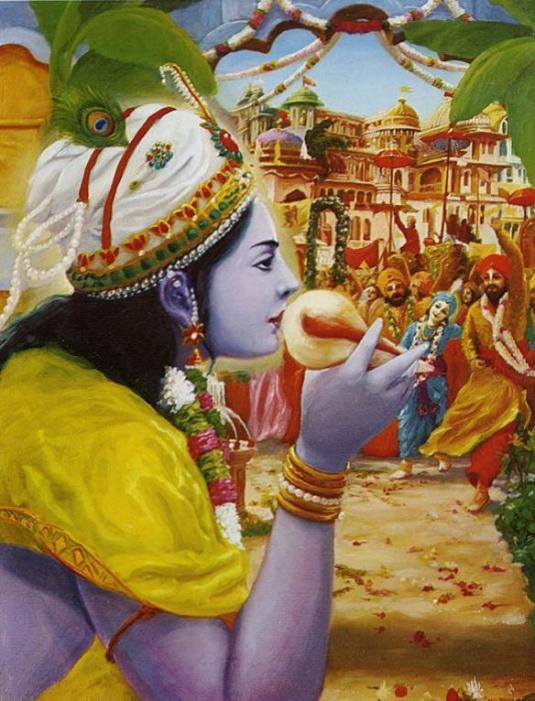
This is a nice description of Lord Kṛṣṇa’s transcendental conchshell, and of how He was recieved by the citizens of Dvārakā. Beautiful!
Sūta Gosvāmī said: Upon reaching the border of His most prosperous metropolis, known as the country of the Ānartas [Dvārakā], the Lord sounded His auspicious conchshell, heralding His arrival and apparently pacifying the dejection of the inhabitants.
The white and fat-boweled conchshell, being gripped by the hand of Lord Kṛṣṇa and sounded by Him, appeared to be reddened by the touch of His transcendental lips. It seemed that a white swan was playing in the stems of red lotus flowers.
The citizens of Dvārakā, having heard that sound which threatens fear personified in the material world, began to run towards Him fast, just to have a long desired audience with the Lord, who is the protector of all devotees.
…The sound heralded by Lord Kṛṣṇa was something like the heralding of the sunrise in the morning. This sound of the Lord is identical with the Lord. We are always fearful due to our ignorance of the next problem. The whole material existence is full of problems, and thus the fear problem is always prominent. This is due to our association with the illusory energy of the Lord, known as māyā or external energy, yet all fear is vanished as soon as there is the sound of the Lord, represented by His holy name, as it was sounded by Lord Śrī Caitanya Mahāprabhu in the following sixteen words:
Hare Kṛṣṇa, Hare Kṛṣṇa, Kṛṣṇa Kṛṣṇa, Hare Hare
Hare Rāma, Hare Rāma, Rāma Rāma, Hare Hare
We can take advantage of these sounds and be free from all threatening problems of material existence.
SB 1.11.1-3 Full text and purport More
30 Mar 2013
by The Hare Krishna Movement
in A.C. Bhaktivedanta Swami Prabhupada, Gopis, Krsna Consciousness, KRSNA The Supreme Personality of Godhead, Spiritual World
Tags: A.C. Bhaktivedanta Swami Prabhupada, bank of the Yamuna, disciplic succession, Durga, goddess durga, goddess katyayani, gopi girls, gopis, Katyayani, Krsna, Lord Caitanya, Stealing the Garments of the Unmarried Gopi Girls, The Supreme Personality of Godhead, unmarried girsl, Vrndavana, Yamuna

…The unmarried gopīs used to prepare the deity of goddess Durgā and worship it with candana pulp, garlands, incense lamps and all kinds of presentations-fruits, grains and twigs of plants. After worshiping, it is the custom to pray for some benediction. The unmarried girls used to pray with great devotion to goddess Kātyāyanī, addressing her as follows: “O supreme eternal energy of the Personality of Godhead, O supreme mystic power, O supreme controller of this material world, O goddess, please be kind to us and arrange for our marriage with the son of Nanda Mahārāja, Kṛṣṇa.”
…Early in the morning, the gopīs used to go to the bank of the Yamunā to take bath. They would assemble together, capturing each other’s hands, and loudly sing of the wonderful pastimes of Kṛṣṇa. It is an old system among Indian girls and women that when they take bath in the river they place their garments on the bank and dip into the water completely naked. The portion of the river where the girls and women take bath was strictly prohibited to any male member, and this is still the system. The Supreme Personality of Godhead, knowing the minds of the unmarried young gopīs, benedicted them with their desired objective. They had prayed for Kṛṣṇa to become their husband, and Kṛṣṇa wanted to fulfill their desires.
More
30 Mar 2013
by The Hare Krishna Movement
in A.C. Bhaktivedanta Swami Prabhupada, Spiritual Life, Spiritual Master, Spiritual World, Srimad Bhagavatam
Tags: Bs. 5.28, cintamani-dhama, cintamani=arakara-sadmasu, cows, goddesses of fortune, gopis, Govinda, kalpa-vrksa, Laksmis, Lord Govinda, SB 1.11.26, spiritual gems, Spiritual Life, spiritual master A.C. Bhaktivedanta Swami Prabhupada, Spiritual world, Srimad Bhagavatam, touchstone, transcendental abode, transcendental windows

Sometimes when I am sitting and reading from Srila Prabhupada’s Srimad Bhagavatam, a verse or sentence from the purport just jumps out from the page almost like it is in 3D, and I catch a glimpse of what the Spiritual World must be like. It is beyond even my imagination, but sometimes I catch a glimmer of light, through a transcendental window, by the grace of my spiritual master His Divine Grace A. C. Bhaktivedanta Swami Prabhupada.
…The transcendental abode of the Lord where the trees are all desire trees and the buildings are made of touchstone. The Lord Govinda is engaged there in herding the surabhi cows as His natural occupation.
“I worship Govinda, the primeval Lord, the first progenitor who is tending the cows, yielding all desire, in abodes built with spiritual gems, surrounded by millions of purpose trees, always served with great reverence and affection by hundreds of thousands of lakṣmīs or gopīs.” (Bs 5.29)
…And those who are artists, overtaken by the beautiful creation, should better see to the beautiful face of the Lord for complete satisfaction. The face of the Lord is the embodiment of beauty. What they call beautiful nature is but His smile, and what they call the sweet songs of the birds are but specimens of the whispering voice of the Lord.
More
16 Jan 2013
by The Hare Krishna Movement
in A.C. Bhaktivedanta Swami Prabhupada, Bhaktivinoda Thakura, Lectures, Radha Madhava, Songs of the Vaisnava Acaryas, Spiritual Life, Spiritual World
Tags: Bhaktivinoda Thakura
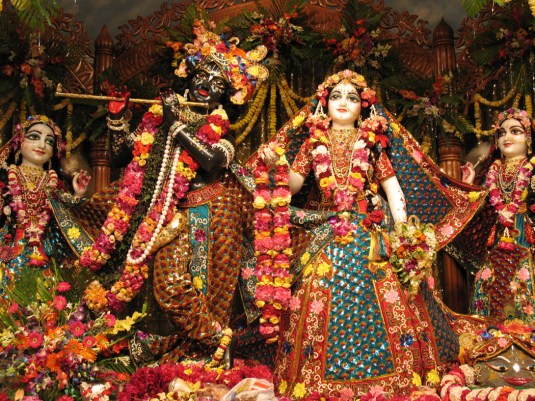
click on image to enlarge
…Ladies and gentlemen, I thank you very much for your coming here to participate in this Kṛṣṇa consciousness movement. We are calling everyone to go back to home, back to Godhead. This is our movement, Kṛṣṇa consciousness movement. Just now we described the place where we intend to go. That is Goloka Vṛndāvana. There the Supreme Personality of Godhead is residing with His consort Rādhārāṇī. Rādhā-Mādhava. (from lecture by Srila Prabhupada, Laguna Beach 9-30-1972)
So this is the original nature of Krsna. He is Radha-Madhava. He is the lover of Srimati Radharani.
Full Lecture plus song More
25 Nov 2012
by The Hare Krishna Movement
in A.C. Bhaktivedanta Swami Prabhupada, Spiritual Life, Spiritual World
Tags: A.C. Bhaktivedanta Swami Prabhupada, abode, abode of the Supreme Lord, bhagavad-gita, Brahma-samhita, brahmajyoti, eternal sky, Goloka, goloka eva nivasty, Lord Sri Krsna, material conception, spiritual sky, Spiritual world, Supreme Lord, Vrndavana

…The Lord descends to this mortal world to show His pastimes in Vṛndāvana, which are full of happiness. When Lord Śrī Kṛṣṇa was in Vṛndāvana, His activities with His cowherd boy friends, with His damsel friends, with the inhabitants of Vṛndāvana and with the cows were all full of happiness. The total population of Vṛndāvana knew nothing but Kṛṣṇa. But Lord Kṛṣṇa even discouraged His father Nanda Mahārāja from worshiping the demigod Indra because He wanted to establish the fact that people need not worship any demigod. They need only worship the Supreme Lord because their ultimate goal is to return to His abode.
The abode of Lord Śrī Kṛṣṇa is described in the Bhagavad-gītā, Fifteenth Chapter, sixth verse: More
08 Nov 2012
by The Hare Krishna Movement
in A.C. Bhaktivedanta Swami Prabhupada, Devotional Service, Krishna Consciousness, Spiritual World
Tags: A.C. Bhaktivedanta Swami Prabhupada, all-beautiful face, Brahma, cintamani, cintamani-dhama, devotees, goddesses of fortune, Krishna, lotus face of the Lord, lotus feet of the Lord, Spiritual world, Srila Rupa Goswami, touchstone
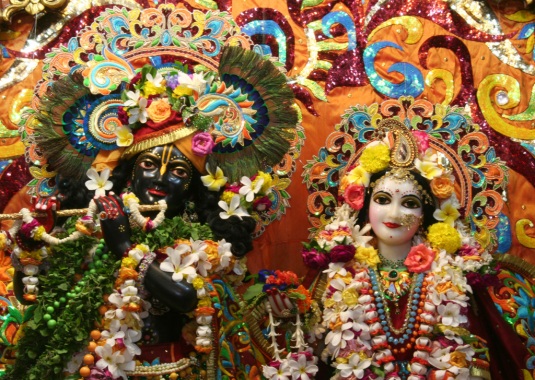
click on image to enlarge
…The essence of everything is the Supreme Lord: He is called the sāram. And those who sing and talk about Him are called the sāraṅgas, or the pure devotees. The pure devotees are always hankering after the lotus feet of the Lord. The lotus has a kind of honey which is transcendentally relished by the devotees. They are like the bees who are always after the honey. Śrīla Rūpa Gosvāmī, the great devotee ācārya of the Gauḍīya-Vaiṣṇava-sampradāya, has sung a song about this lotus honey, comparing himself to the bee: “O my Lord Kṛṣṇa, I beg to offer my prayers unto You. My mind is like the bee, and it is after some honey. Kindly, therefore, give my bee-mind a place at Your lotus feet, which are the resources for all transcendental honey. I know that even big demigods like Brahmā do not see the rays of the nails of Your lotus feet, even though they are engaged in deep meditation for years together. Still, O infallible one, my ambition is such, for You are very merciful to your surrendered devotees. O Mādhava, I know also that I have no genuine devotion for the service of Your lotus feet, but because Your Lordship is inconceivably powerful, You can do what is impossible to be done. Your lotus feet can deride even the nectar of the heavenly kingdom, and therefore I am very much attracted by them. O supreme eternal, please, therefore, let my mind be fixed at Your lotus feet so that eternally I may be able to relish the taste of Your transcendental service.”
for full verse and purport More
23 Aug 2012
by The Hare Krishna Movement
in Gajendra, Spiritual World, Srimad Bhagavatam
Tags: A.C. Bhaktivedanta Swami Prabhupada, Brahma, demigods, Gajendra, gandharvas, king of the elephants, sages, Siva, Spiritual world, Srimad Bhagavatam, Sukadeva Gosvami

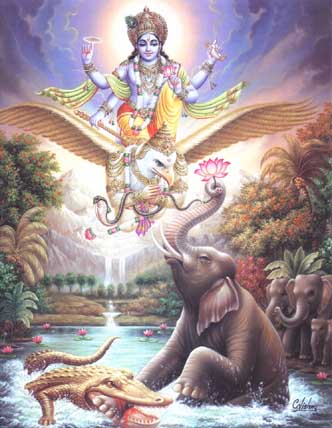
The Fourth Chapter of the Eight Canto of Srimad Bhagavatam describes the previous birth of Gajendra and the crocodile. It tells how the crocodile became a Gandharva and how Gajendra became an associate of the Supreme Personality of Godhead.
…in his birth as an elephant, when he was dangerously attacked by the crocodile, he remembered his past life in devotional service and remembered a prayer he had learned in that life. Because of this prayer, he again received the mercy of the Lord.
Śukadeva Gosvāmī ends this chapter by describing the good fortune of the elephant. Śukadeva Gosvāmī says that by hearing the narration of Gajendra’s deliverance, one can also get the opportunity to be delivered.
“One who seeks Your compassion and thus tolerates all kinds of adverse conditions due to the karma of his past deeds, who engages always in Your devotional service with his mind, words and body, and who always offers obeisances unto You, is certainly a bona fide candidate for liberation.”
A devotee who tolerates everything in this material world and patiently executes his devotional service can become mukti-pade sa dāya-bhāk, a bona fide candidate for liberation. The word dāya-bhāk refers to a hereditary right to the Lord’s mercy. A devotee must simply engage in devotional service, not caring about material situations. Then he automatically becomes a rightful candidate for promotion to Vaikuṇṭhaloka. The devotee who renders unalloyed service to the Lord gets the right to be promoted to Vaikuṇṭhaloka, just as a son inherits the property of his father.
Full Text & Purports More
02 Aug 2012
by The Hare Krishna Movement
in Bhagavad-gita, Spiritual Life, Spiritual World
Tags: A.C. Bhaktivedanta Swami Prabhupada, abode of the Supreme Lord, Bg 15.6, brahmajoti, effulgence, Goloka Vrndavana, Krsnaloka, self-luminous, spiritual sky, Spiritual world, The Spiritual Abode, Vaikunthas

…The spiritual world, the abode of the Supreme Personality of Godhead, Kṛṣṇa-which is known as Kṛṣṇaloka, Goloka Vṛndāvana-is described here. In the spiritual sky there is no need of sunshine, moonshine, fire or electricity, because all the planets are self-luminous. We have only one planet in this universe, the sun, which is self-luminous, but all the planets in the spiritual sky are self-luminous. The shining effulgence of all those planets (called Vaikuṇṭhas) constitutes the shining sky known as the brahmajyoti. Actually, the effulgence is emanating from the planet of Kṛṣṇa, Goloka Vṛndāvana. Part of that shining effulgence is covered by the mahat-tattva, the material world. Other than this, the major portion of that shining sky is full of spiritual planets, which are called Vaikuṇṭhas, chief of which is Goloka Vṛndāvana.
The abode of Lord Śrī Kṛṣṇa is described in the Bhagavad-gītā, Fifteenth Chapter, sixth verse:
na tad bhāsayate sūryo na śaśāṅko na pāvakaḥ
yad gatvā na nivartante tad dhāma paramaṁ mama
“That abode of Mine is not illumined by the sun or moon, nor by electricity. And anyone who reaches it never comes back to this material world.” (Bg. 15.6)
This verse gives a description of that eternal sky. Of course we have a material conception of the sky, and we think of it in relationship to the sun, moon, stars and so on, but in this verse the Lord states that in the eternal sky there is no need for the sun nor for the moon nor fire of any kind because the spiritual sky is already illuminated by the brahmajyoti, the rays emanating from the Supreme Lord. We are trying with difficulty to reach other planets, but it is not difficult to understand the abode of the Supreme Lord. This abode is referred to as Goloka. In the Brahma-saṁhitā it is beautifully described: Goloka eva nivasaty akhilātma-bhūtaḥ. The Lord resides eternally in His abode Goloka, yet He can be approached from this world, and to this end the Lord comes to manifest His real form, sac-cid-ānanda-vigraha. When He manifests this form, there is no need for our imagining what He looks like. To discourage such imaginative speculation, He descends and exhibits Himself as He is, as Śyāmasundara. Unfortunately, the less intelligent deride Him because He comes as one of us and plays with us as a human being. But because of this we should not consider that the Lord is one of us. It is by His potency that He presents Himself in His real form before us and displays His pastimes, which are prototypes of those pastimes found in His abode.
More
20 Jun 2012
by The Hare Krishna Movement
in KRSNA The Supreme Personality of Godhead, Spiritual World
Tags: A.C. Bhaktivedanta Swami Prabhupada, astronomical summer, excessive heat, high summer temperatures, June 20 2012, Krsna The Supreme Personality of Godhead, scorching heat of the sun, summer, summer season, summer solstice

The astronomical summer (Northern Hemisphere) begins today Wednesday, June 20, 2012, and ends Friday, September 21, 2012.
…The summer season in India is not very much welcomed because of the excessive heat, but in Vṛndāvana everyone was pleased because summer there appeared just like spring. This was possible only because Lord Kṛṣṇa and Balarāma, who are the controllers even of Lord Brahmā and Lord Śiva, were residing there. In Vṛndāvana there are many falls which are always pouring water, and the sound is so sweet that it covers the sound of the crickets. And because water flows all over, the forest always looks very green and beautiful.
The inhabitants of Vṛndāvana were never disturbed by the scorching heat of the sun or the high summer temperatures. The lakes of Vṛndāvana are surrounded by green grasses, and various kinds of lotus flowers bloom there, such as the kalhāra-kañjotpala, and the air blowing in Vṛndāvana carries the aromatic pollen of those lotus flowers. When the particles of water from the waves of the Yamunā, the lakes and the waterfalls, touched the bodies of the inhabitants of Vṛndāvana, they automatically felt a cooling effect. Therefore they were practically undisturbed by the summer season. (from: KRSNA The Supreme Personality of Godhead)
Full Chapter More
02 May 2012
by The Hare Krishna Movement
in Journey of Self-Discovery, Lectures, Spiritual World
Tags: A.C. Bhaktivedanta Swami Prabhupada, journey of self-discovery, journey through life, Krishna, material world, Radha Krishna, self realization, Spiritual world

“Everything in the spiritual world is substantial and original. This material world is only an imitation…. It is just like a cinematographic picture, in which we see only the shadow of the real thing.” In this lecture, delivered in October 1966 in New York City, Śrīla Prabhupāda gives an amazing glimpse into the nature of the spiritual world and some positive instructions on how to arrive there at the end of life’s perilous journey.
The Journey of Self-Discovery
By His Divine Grace A.C. Bhaktivedanta Swami Prabhupada
paras tasmāt tu bhāvo ’nyo
’vyakto ’vyaktāt sanātanaḥ
yaḥ sa sarveṣu bhūteṣu
naśyatsu na vinaśyati
“Yet there is another unmanifest nature, which is eternal and is transcendental to this manifested and unmanifested matter. It is supreme and is never annihilated. When all in this world is annihilated, that part remains as it is.” [Bhagavad-gītā 8.20]
We cannot calculate the length and breadth of even this universe, yet there are millions and millions of universes like this one within the material sky. And above this material sky there is another sky, which is called the spiritual sky. In that sky all the planets are eternal, and life is eternal, also. We cannot know these things by our material calculations, so we must take this information from the Bhagavad-gītā.
More
01 May 2012
by The Hare Krishna Movement
in Spiritual World, Srimad Bhagavatam
Tags: A.C. Bhaktivedanta Swami Prabhupada, bhagavate, Brahma, Devaki, Krishna, Krsna, om namo bhagavate vasudevaya, Personality of Godhead, primeval Lord, SB 1.1.1, Sri Krsna, Srimad Bhagavatam, Vasudeva, Vyasadeva

Śrīmad-Bhāgavatam:
by His Divine Grace A. C. Bhaktivedanta Swami Prabhupāda
Canto 1: “Creation”, Chapter 1, Text 1
Questions by the Sages
oṁ namo bhagavate vāsudevāya
janmādy asya yato ’nvayād itarataś cārtheṣv abhijñaḥ svarāṭ
tene brahma hṛdā ya ādi-kavaye muhyanti yat sūrayaḥ
tejo-vāri-mṛdāṁ yathā vinimayo yatra tri-sargo ’mṛṣā
dhāmnā svena sadā nirasta-kuhakaṁ satyaṁ paraṁ dhīmahi
om—O my Lord; namaḥ—offering my obeisances; bhagavate—unto the Personality of Godhead; vāsudevāya—unto Vāsudeva (the son of Vasudeva), or Lord Śrī Kṛṣṇa, the primeval Lord; janma-ādi—creation, sustenance and destruction; asya—of the manifested universes; yataḥ—from whom; anvayāt—directly; itarataḥ—indirectly; ca—and; artheṣu—purposes; abhijñaḥ—fully cognizant; sva-rāṭ—fully independent; tene—imparted; brahma—the Vedic knowledge; hṛdā—consciousness of the heart; yaḥ—one who; ādi-kavaye—unto the original created being; muhyanti—are illusioned; yat—about whom; sūrayaḥ—great sages and demigods; tejaḥ—fire; vāri—water; mṛdām—earth; yathā—as much as; vinimayaḥ—action and reaction; yatra—whereupon; tri-sargaḥ—three modes of creation, creative faculties; amṛṣā—almost factual; dhāmnā—along with all transcendental paraphernalia; svena—self-sufficiently; sadā—always; nirasta—negation by absence; kuhakam—illusion; satyam—truth; param—absolute; dhīmahi—I do meditate upon.
TRANSLATION
O my Lord, Śrī Kṛṣṇa, son of Vasudeva, O all-pervading Personality of Godhead, I offer my respectful obeisances unto You. I meditate upon Lord Śrī Kṛṣṇa because He is the Absolute Truth and the primeval cause of all causes of the creation, sustenance and destruction of the manifested universes. He is directly and indirectly conscious of all manifestations, and He is independent because there is no other cause beyond Him. It is He only who first imparted the Vedic knowledge unto the heart of Brahmājī, the original living being. By Him even the great sages and demigods are placed into illusion, as one is bewildered by the illusory representations of water seen in fire, or land seen on water. Only because of Him do the material universes, temporarily manifested by the reactions of the three modes of nature, appear factual, although they are unreal. I therefore meditate upon Him, Lord Śrī Kṛṣṇa, who is eternally existent in the transcendental abode, which is forever free from the illusory representations of the material world. I meditate upon Him, for He is the Absolute Truth.
PURPORT
Obeisances unto the Personality of Godhead, Vāsudeva, directly indicate Lord Śrī Kṛṣṇa, who is the divine son of Vasudeva and Devakī. This fact will be more explicitly explained in the text of this work. Śrī Vyāsadeva asserts herein that Śrī Kṛṣṇa is the original Personality of Godhead, and all others are His direct or indirect plenary portions or portions of the portion. Śrīla Jīva Gosvāmī has even more explicitly explained the subject matter in his Kṛṣṇa-sandarbha. And Brahmā, the original living being, has explained the subject of Śrī Kṛṣṇa substantially in his treatise named Brahma-saṁhitā. In the Sāma-veda Upaniṣad, it is also stated that Lord Śrī Kṛṣṇa is the divine son of Devakī. Therefore, in this prayer, the first proposition holds that Lord Śrī Kṛṣṇa is the primeval Lord, and if any transcendental nomenclature is to be understood as belonging to the Absolute Personality of Godhead, it must be the name indicated by the word Kṛṣṇa, which means the all-attractive. In Bhagavad-gītā, in many places, the Lord asserts Himself to be the original Personality of Godhead, and this is confirmed by Arjuna, and also by great sages like Nārada, Vyāsa, and many others. In the Padma Purāṇa, it is also stated that out of the innumerable names of the Lord, the name of Kṛṣṇa is the principal one. Vāsudeva indicates the plenary portion of the Personality of Godhead, and all the different forms of the Lord, being identical with Vāsudeva, are indicated in this text. The name Vāsudeva particularly indicates the divine son of Vasudeva and Devakī. Śrī Kṛṣṇa is always meditated upon by the paramahaṁsas, who are the perfected ones among those in the renounced order of life.
More
18 Feb 2012
by The Hare Krishna Movement
in Back to Godhead, Hayagriva das, Krishna, Spiritual World
Tags: A.C. Bhaktivedanta Swami Prabhupada, Back to Godhead Magazine, Gokula, Goloka, Goloka Vrndavana, hayagriva das, Krsna lila, Lord Krsna's pastimes, spiritual sky, Spiritual world, the Divine Forms and Pastimes

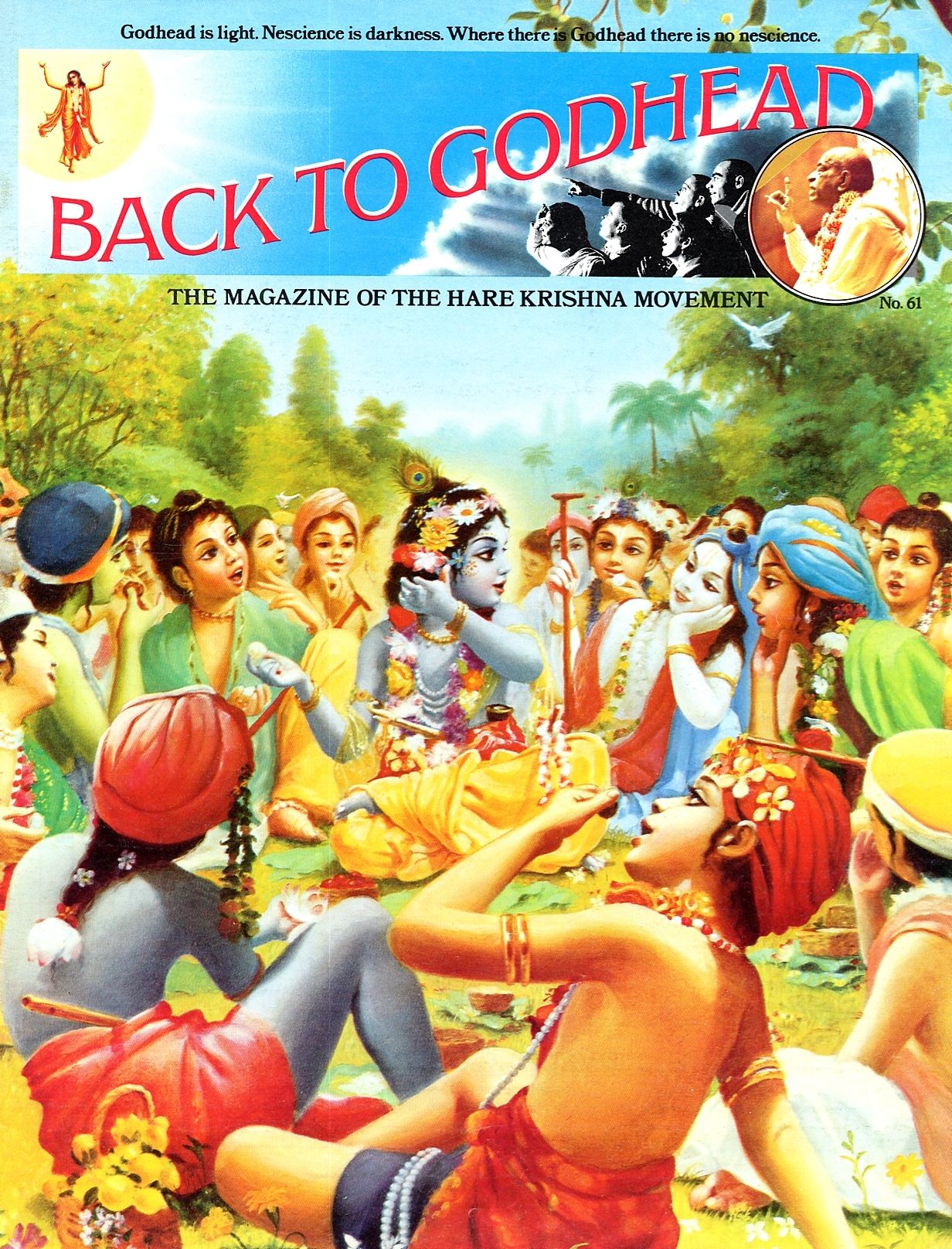
…The boys who are playing with Krsna and herding cows in Vrndavana are not ordinary living entities. They are highly developed sages who have acquired perfection by the accumulation of pious activities in past lives. For those who are under the spell of materialism, Krsna is an ordinary boy, but these cowherd boys in Vrndavana accept Him as their Master, and their Supreme Lovable Object. Consequently, all the individual boys and girls who sport in Goloka Vrndavana enjoy Krsna’s spiritual bliss. Similarly, the gopis are not ordinary cowherd girls, but are great sages who transform themselves in order to enjoy conjugal love with Krsna. Lord Caitanya spoke of them in this way: “Oh what penances did the gopis perform to eternally enjoy the beauty of the Lord Krsna? They drink His beauty with their eyes and they fill their eyes, their limbs and their hearts with celestial visions of His beauty. O, blessed are they, for they enjoy that sublime beauty which is the sweetest in the creation and which has no equal. The pure love of the gopis is like a glass that reflects this sweetness and these attributes. As the Lord sees these reflections, His sweetness increases and so does the love of the gopis. And both His sweetness and their love grow and grow as though competing with one another. And though both attain new brilliances, neither admits defeat in this wonderful competition…”
Krsna lila: The Divine Forms and Pastimes
By Sriman Hayagriva das Adhikari
From Back to Godhead Magazine 1970 Vol. 1, No. 32
Lord Krsna’s pastimes, His appearance and disappearance, are continuous and eternal throughout the universe. As far as these pastimes are concerned, there is no stoppage. It is hard for the common man to understand how Krsna’s lilas (pastimes) can be eternal. To our conception He was present on earth 5,000 years ago, and now He is gone. We compare Him to ourselves. We remain on this planet for 100 years at the most and then, like a bubble, we pop and disappear. Although this is true for ourselves, we should not compare our condition to that of the Absolute Godhead. His Body is eternal, blissful and full of knowledge, whereas ours is mortal and full of misery and ignorance. Consequently we cannot understand how Krsna’s lilas are eternal.
More
26 Jan 2012
by The Hare Krishna Movement
in Krishna Consciousness, KRSNA The Supreme Personality of Godhead, Spiritual Life, Spiritual World
Tags: A.C. Bhaktivedanta Swami Prabhupada, Balarama, Dvaraka, Krishna, Krsna and Balarama, Krsna The Supreme Personality of Godhead, Kuruksetra, Lord Parasurama, Vrndavana, Yadu dynasty
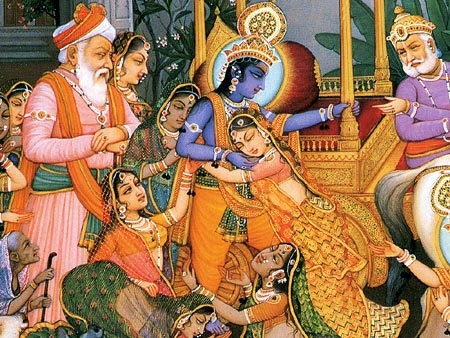
“For one who remembers Me without deviation, I am easy to obtain, O son of Prtha, because of his constnt engagement in devotional service. (Bhagavad-gita 8.14)
…The special qualification of the pure devotee is that he is always thinking of Kṛṣṇa without considering the time or place. There should be no impediments. He should be able to carry out his service anywhere and at any time. Some say that the devotee should remain in holy places like Vṛndāvana or some holy town where the Lord lived, but a pure devotee can live anywhere and create the atmosphere of Vṛndāvana by his devotional service. It was Śrī Advaita who told Lord Caitanya, “Wherever You are, O Lord-there is Vṛndavana.” (From Purport)
So to help us in remembering the Lord, we are posting this very nice chapter from “KRSNA The Supreme Personality of Godhead” by His Divine Grace A.C. Bhaktivedanta Swami, who is teaching us how to always think of Krishna.
…All the members of the Yadu dynasty were naturally very beautiful, and yet on this occasion, when they appeared duly decorated with gold necklaces and flower garlands, dressed in valuable clothing and properly armed with their respective weapons, their natural beauty and personalities were a hundred times enhanced. The members of the Yadu dynasty came to Kurukṣetra in their gorgeously decorated chariots resembling the airplanes of the demigods, pulled by big horses that moved like the waves of the ocean, and some of them rode on sturdy, stalwart elephants that moved like the clouds in the sky. Their wives were carried on beautiful palanquins by beautiful men whose features resembled those of the Vidyādharas. The entire assembly looked as beautiful as an assembly of the demigods of heaven…
KRSNA The Supreme Personality of Godhead (1970 Edition)
By His Divine Grace A.C. Bhaktivedanta Swami Prabhupada
Vol.2 Chapter 27
Lord Kṛṣṇa and Balarāma Meet the Inhabitants of Vṛndāvana
Once upon a time while Lord Kṛṣṇa and Balarāma were living peacefully in Their great city of Dvārakā, there was the rare occasion of a full solar eclipse, such as takes place at the end of every kalpa, or day of Brahmā. At the end of every kalpa the sun is covered by a great cloud, and incessant rain covers the lower planetary systems up to Svargaloka. By astronomical calculation, people were informed about this great eclipse prior to its taking place, and therefore everyone, both men and women, decided to assemble at the holy place in Kurukṣetra known as Samanta-pañcaka.
More
17 Jan 2012
by The Hare Krishna Movement
in Krishna, Krishna Consciousness, Spiritual World, Srimad Bhagavatam
Tags: A.C. Bhaktivedanta Swami Prabhupada, brahmanas, chariots, conchshells, elephants, Krishna, Krsna enters Dwaraka, Lord Krishna, lotus flowers, Srimad Bhagavatam, The Supreme Personality of Godhead, unbroken seeds, Vedic hymns
Srimad Bhagavatam
By His Divine Grace A.C. Bhaktivedanta Swami Prabhupada
Canto 1, Chapter 11
Lord Kṛṣṇa’s Entrance into Dvārakā
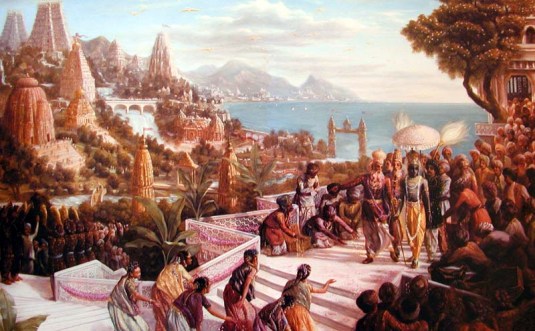
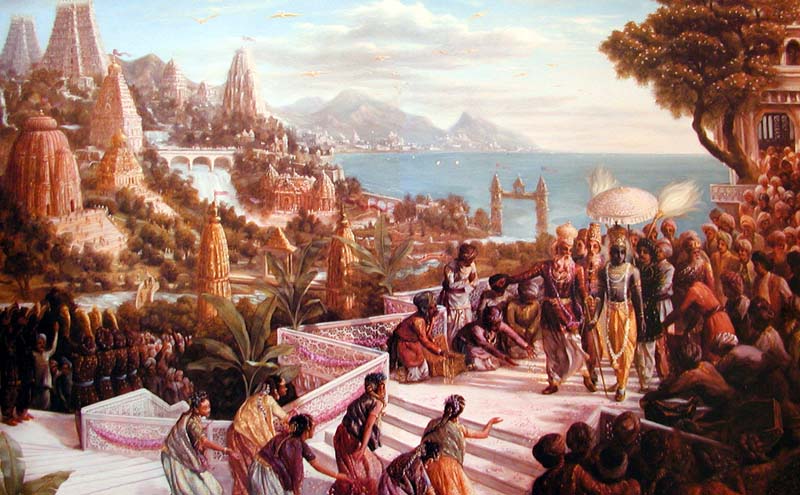
While entering the city of Dvaraka, Lord Krishna acknowledged all the inhabitants’ by casting His transcendental glance over them. The city was filled with the opulences of all seasons. There were hermitages, orchards, flower gardens, parks and reservoirs of water filled with lotus flowers. The highways, subways, lanes, markets and public meeting places were all thoroughly cleansed and then moistened with scented water, And to welcome the Lord, the residents of Dvaraka strew flowers, fruits and unbroken seeds everywhere. The residents hastened toward the Lord on chariots, upon which rode brahmanas bearing flowers, In front of the chariots were elephants, which are emblems of good fortune. Conchshells and bugles were sounded, and Vedic hymns were chanted. Thus, the residents offered their respects, which were saturated with affection, In return, Lord Krishna, the Personality of Godhead, approached them and offered due honor and respect to each and every one of the friends, relatives, citizens and others who came to receive and welcome Him. As the Lord passed along the public road of Dvaraka, His head was protected from sunshine by a white umbrella. White feathered fans moved in semicircles, and showers of flowers fell upon the road. His yellow garments and garlands of flowers made it appear as if a dark cloud were surrounded simultaneously by the sun, the moon, lighting and rainbows.
Lord Kṛṣṇa’s attraction is so powerful that once being attracted by Him one cannot tolerate separation from Him. Why is this so? Because we are all eternally related with Him as the sun rays are eternally related with the sun disc. The sun rays are molecular parts of the solar radiation. Thus the sun rays and the sun cannot be separated. The separation by the cloud is temporary and artificial, and as soon as the cloud is cleared, the sun rays again display their natural effulgence in the presence of the sun. Similarly, the living entities, who are molecular parts of the whole spirit, are separated from the Lord by the artificial covering of māyā, illusory energy. This illusory energy, or the curtain of māyā, has to be removed, and when it is so done, the living entity can see the Lord face to face, and all his miseries are at once removed. Every one of us wants to remove the miseries of life, but we do not know how to do it. The solution is given here, and it rests on us to assimilate it or not. (Srimad Bhagavatam 1.11.10 Purport)
Painting by-Ramadasa Abhirama dasa
11 Dec 2011
by The Hare Krishna Movement
in Back to Godhead, Brahmananda das, Spiritual Life, Spiritual World, Vrindavan
Tags: Back to Godhead Magazine, Brahmananda dasa, devotional service, Krishna, Land of No Return, Srila Prabhupada, Vrindavan forest, Vrndavan

Vrndavana—Land of No Return
By His Holiness Brahmananda Swami
Originally Published in Back to Godhead 1975 Vol. 10, No. 11
Part 2
I once visited Vrndavana, India with His Divine Grace Srila Prabhupada. As I accompanied him on his daily walk one morning we suddenly came upon a particularly beautiful spot. The cool sands were thick with foliage; the tall trees full of singing birds. As the sun brightened the clear morning sky, peacocks filled the air with their peculiar call.
Srila Prabhupada looked over his shoulder and said to me, “So, Brahmananda, this is Vrndavana. How do you like it?”
“It’s wonderful, Srila Prabhupada,” was all I could reply. I felt that he was actually revealing the glories of Vrndavana to me even though I had no particular spiritual qualification.
Vrndavana is the place where the Supreme Lord Sri Krsna appeared five thousand years ago. Lord Krsna descended there from His own spiritual planet, Goloka Vrndavana to attract us by displaying His supernatural pastimes. Srila Prabhupada has explained that when Krsna descends to the material world, this same Vrndavana descends with Him just as an entourage accompanies an important personage. Because when Krsna comes His land also comes, Vrndavana is not considered to exist in the material world. Therefore devotees take shelter of the Vrndavana in India, for it is considered to be a replica of the original Goloka Vrndavana.
More
07 Dec 2011
by The Hare Krishna Movement
in Back to Godhead, Krishna Consciousness, Satsvarupa das Goswami, Spiritual Life, Spiritual World
Tags: back to Godhead, His Divine Grace A.C. Bhaktivedanta Swami Prabhupada, Krishna, Krsna Book, Lord Krsna, Satsvarupa dasa, Sudama
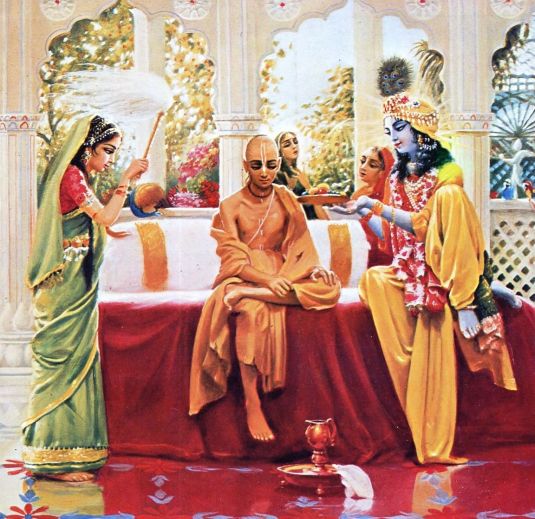
…It is related that by his constant association with the Lord, Sudama had wiped away from his heart whatever contamination was remaining, and he was very shortly transferred to the eternal spiritual kingdom, which is the goal of all saintly persons in the perfectional stage of life. It is stated in the Krsna Book that whoever hears this history will become qualified like Sudama and will be transferred to the spiritual kingdom of Lord Krsna.
Lord Krsna’s Friend Sudama
Published in Back to Godhead Magizine 1971 Vol. 1, Number 49
By Satsvarupa dasa adhikari
The wonderful history of Krsna and His friend Sudama is told in its entirety in the Krsna Book, Volume II, by His Divine Grace A.C. Bhaktivedanta Swami Prabhupada. Srila Prabhupada is kindly presenting to the western world the pastimes of Lord Krsna, which can act as a merciful shower upon the hearts of all of us. It is true that we have forgotten our eternal, blissful and loving relationships as servants of Krsna or God. The remedy to forgetfulness or ignorance of God is to hear about Him from the lips of His pure devotee. This is the view of authorized scriptures.
When Krsna descends from His eternal abode in the spiritual world and appears to this mundane world, as He did 5,000 years ago, He engages with others just as if He were an ordinary human being. Although He is unborn, He appears to have a mother and father. In the village of Vrndavana Krsna plays as a cowherd boy. He enacts these pastimes for His own transcendental pleasure and to attract all the suffering living entities back home, back to Godhead. Sudama was among those devotees who were childhood friends with Krsna, and Sudama was also His intimate school friend.
More
01 Dec 2011
by The Hare Krishna Movement
in Back to Godhead, Brahmananda das, Spiritual World, Vrindavan
Tags: back to Godhead, Brahmananda dasa, Krishna, Land of No Return, material world, Shangri-la, Spiritual world, Srila Prabhupada, Vrindavan
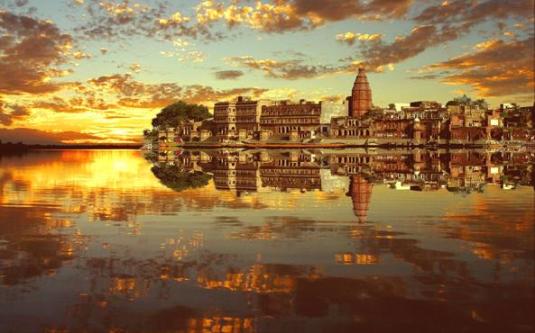
Because Vrndavana is the eternal and entirely spiritual abode of the Lord, it is nondifferent from Him. At Vrndavana, one will find unlimited wealth, strength, fame, wisdom, beauty and renunciation—all the six opulences possessed by the Supreme Personality of Godhead, Bhagavan Sri Krsna. Indeed Vrndavana is Krsna, and, to go there is to perceive God Himself.
Vrndavana—Land of No Return (Part 1)
By His Holiness Brahmananda Swami
Back to Godhead Magazine 1975 Volume 10 Number 9
From the beginning of time, man has yearned for the perfect home—a paradise, a Shangri-la, a Walden—where he could live eternally in peace and happiness. Such a place cannot be found anywhere in the material world, however, for the material world is by its very nature temporary and frustrating. To end our weary searching, we must go beyond this world of duality, beyond the boundaries of space and time, into the spiritual realm.
Vrndavana, India, is that sought-after eternal resting place because it is at Vrndavana that Lord Sri Krsna, the Supreme Personality of Godhead, descended to this planet five thousand years ago. The Lord’s appearance and activities are not mundane; they are completely transcendental. Just as a king may travel with all his retinue, set up camp, and conduct his affairs of state in the same style as if he were in his palace, Lord Krsna brought with Him all His transcendental associates and paraphernalia and created on earth an exact replica of the spiritual world, known as Goloka Vrndavana.
More
14 Sep 2011
by The Hare Krishna Movement
in Spiritual World, Srimati Tulasi Devi
Tags: Spiritual world, Srimad Bhagavatam, Srimati Tulasi Devi, Tulasi, tulasi garlands, tulasi leaves

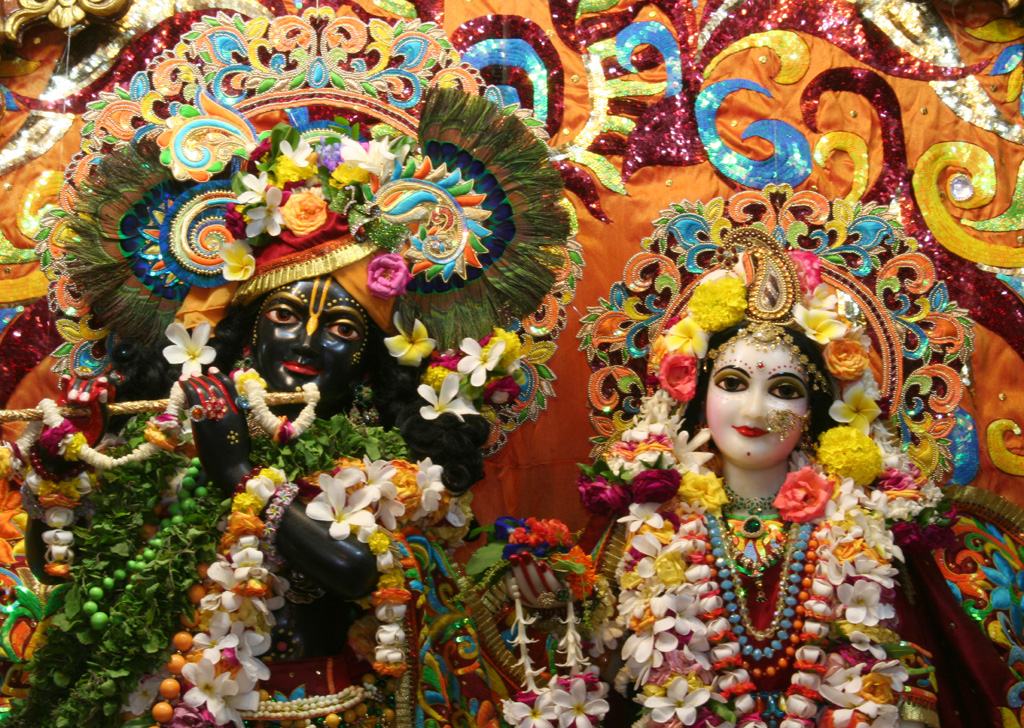
Srimati Tulasi and Sri Sri Radha Vrindavan Chandra
The most important thing about the spiritual world is that there is no envy among the devotees there. This is true even among the flowers, which are all conscious of the greatness of tulasī.
Although flowering plants like the mandāra, kunda, kurabaka, utpala, campaka, arṇa, punnāga, nāgakeśara, bakula, lily and pārijāta are full of transcendental fragrance, they are still conscious of the austerities performed by tulasī, for tulasī is given special preference by the Lord, who garlands Himself with tulasī leaves.
Purport
The importance of tulasī leaves is very clearly mentioned here. Tulasī plants and their leaves are very important in devotional service. Devotees are recommended to water the tulasī tree every day and collect the leaves to worship the Lord. One time an atheistic svāmī remarked, “What is the use of watering the tulasī plant? It is better to water eggplant. By watering the eggplant one can get some fruits, but what is the use of watering the tulasī?” These foolish creatures, unacquainted with devotional service, sometimes play havoc with the education of people in general.
The most important thing about the spiritual world is that there is no envy among the devotees there. This is true even among the flowers, which are all conscious of the greatness of tulasī. In the Vaikuṇṭha world entered by the four Kumāras, even the birds and flowers are conscious of service to the Lord. (Srimad Bhagavatam)
Previous Older Entries Next Newer Entries















 The Hare Krishna Movement