09 Sep 2012
by The Hare Krishna Movement
in KRSNA The Supreme Personality of Godhead, Spiritual Life
Tags: A.C. Bhaktivedanta Swami Prabhupada, books by Srila Prabhupada, consciousness, Dhenukasura, Kaliya, Krishna The Supreme Personality of Godhead, Krsna, Krsna and Balarama, krsna consciousness, Spiritual Life, Yamuna river
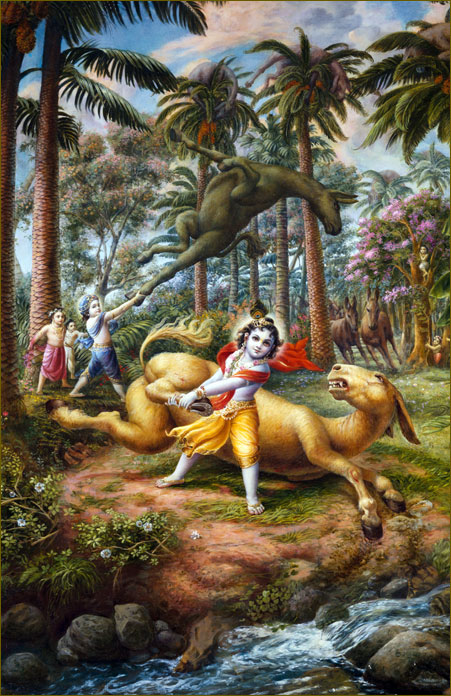
During the Purusottama Month, it is always good to read and chant more. It is also important is to remember the wonderful pastimes of the Lord.
…After the demon was thrown into the trees, all the friends and associates of Dhenukāsura immediately assembled and attacked Balarāma and Kṛṣṇa with great force. They were determined to retaliate and avenge the death of their friend. But Kṛṣṇa and Balarāma began to catch each of the asses by the hind legs and, exactly in the same way, wheeled them around. Thus They killed all of them by throwing them into the palm trees. Because of the dead bodies of the asses, there was a panoramic scene. It appeared as if clouds of various colors were assembled in the trees. Hearing of this great incident, the demigods from the higher planets began to shower flowers on Kṛṣṇa and Balarāma and began to beat their drums and offer devotional prayers.
More
19 Aug 2012
by The Hare Krishna Movement
in Practicing Krishna Consciousness at Home, Spiritual Life, Uncategorized, Vedas
Tags: back to Godhead, daily puja, Hare Krishna, Lord Narayana, Naimisaranya, Narada Muni, Padma Purana, Purusottama, Purusottama month, sages of naimisaranya, Sri Sri Radha Krishna, Supreme Personality of Godhead, Suta Goswami, The Glories of Purosottama Month, Vaisnava dasa, Yoga of the Supreme Person
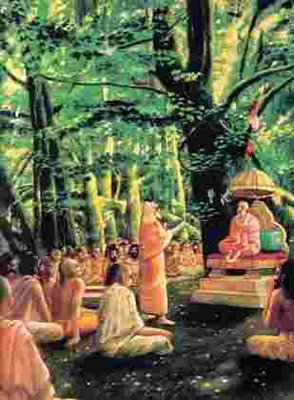
Purusottama Month begins Saturday, August 18, 2012
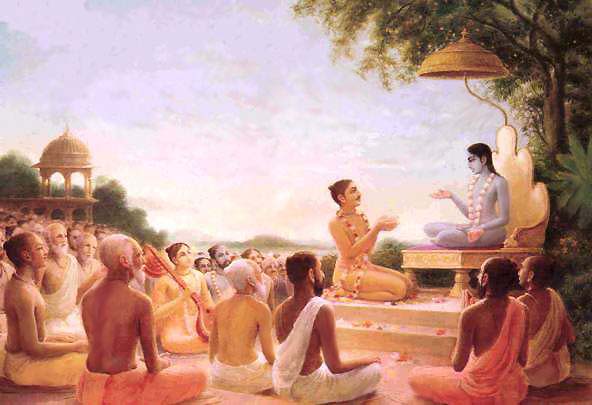
…Once upon a time, thousands of sages came together in the holy place called Naimisaranya to perform sacrifice. To their very good fortune the great sage Suta Goswami, who had been traveling to different pilgrimage sites, arrived there along with his disciples. The sages present were very enlivened to see him. They all stood up immediately to pay their respects to the great sage, offered him a very nice Vyasasana, and requested him with folded hands to sit down on it.
The sages of Naimisaranya said to Suta Goswami with folded hands, “O Sutaji! We humbly request you to tell us something about the wonderful activities and pastimes of the Supreme Personality of Godhead. There are many thousands of such narrations, but we want to hear the most perfect one, by following which we can all be delivered from this Material Ocean and return back to Godhead.
Simplified Recommended Worship for the Purushottama month:
* Establish the Deity or Picture of Sri Sri Radha Krishna in your home and worship Them with love and devotion.
* Offer daily puja and by chanting the mahamantra: Hare Krishna, Hare Krishna, Krishna Krishna, Hare Hare, Hare Rama, Hare Rama, Rama Rama, Hare Hare
* Study Srimad Bhagavatam and Bhagavad gita, especially Chapter Fifteen, Purushottama Yoga.
* Daily offer a ghee lamp to Sri Sri Radha Krishna.
* Give charity to qualified Brahmanas. Engage in Go Seva and distribute prasadam.
* Bathe in the holy rivers and associate with saintly devotees.
More
02 Aug 2012
by The Hare Krishna Movement
in Bhagavad-gita, Spiritual Life, Spiritual World
Tags: A.C. Bhaktivedanta Swami Prabhupada, abode of the Supreme Lord, Bg 15.6, brahmajoti, effulgence, Goloka Vrndavana, Krsnaloka, self-luminous, spiritual sky, Spiritual world, The Spiritual Abode, Vaikunthas

…The spiritual world, the abode of the Supreme Personality of Godhead, Kṛṣṇa-which is known as Kṛṣṇaloka, Goloka Vṛndāvana-is described here. In the spiritual sky there is no need of sunshine, moonshine, fire or electricity, because all the planets are self-luminous. We have only one planet in this universe, the sun, which is self-luminous, but all the planets in the spiritual sky are self-luminous. The shining effulgence of all those planets (called Vaikuṇṭhas) constitutes the shining sky known as the brahmajyoti. Actually, the effulgence is emanating from the planet of Kṛṣṇa, Goloka Vṛndāvana. Part of that shining effulgence is covered by the mahat-tattva, the material world. Other than this, the major portion of that shining sky is full of spiritual planets, which are called Vaikuṇṭhas, chief of which is Goloka Vṛndāvana.
The abode of Lord Śrī Kṛṣṇa is described in the Bhagavad-gītā, Fifteenth Chapter, sixth verse:
na tad bhāsayate sūryo na śaśāṅko na pāvakaḥ
yad gatvā na nivartante tad dhāma paramaṁ mama
“That abode of Mine is not illumined by the sun or moon, nor by electricity. And anyone who reaches it never comes back to this material world.” (Bg. 15.6)
This verse gives a description of that eternal sky. Of course we have a material conception of the sky, and we think of it in relationship to the sun, moon, stars and so on, but in this verse the Lord states that in the eternal sky there is no need for the sun nor for the moon nor fire of any kind because the spiritual sky is already illuminated by the brahmajyoti, the rays emanating from the Supreme Lord. We are trying with difficulty to reach other planets, but it is not difficult to understand the abode of the Supreme Lord. This abode is referred to as Goloka. In the Brahma-saṁhitā it is beautifully described: Goloka eva nivasaty akhilātma-bhūtaḥ. The Lord resides eternally in His abode Goloka, yet He can be approached from this world, and to this end the Lord comes to manifest His real form, sac-cid-ānanda-vigraha. When He manifests this form, there is no need for our imagining what He looks like. To discourage such imaginative speculation, He descends and exhibits Himself as He is, as Śyāmasundara. Unfortunately, the less intelligent deride Him because He comes as one of us and plays with us as a human being. But because of this we should not consider that the Lord is one of us. It is by His potency that He presents Himself in His real form before us and displays His pastimes, which are prototypes of those pastimes found in His abode.
More
11 Jul 2012
by The Hare Krishna Movement
in A.C. Bhaktivedanta Swami Prabhupada, Back to Godhead, Lectures, Spiritual Life
Tags: A.C. Bhaktivedanta Swami Prabhupada, BTG Magazine, Gurudas, krsna consciousness, Lecture by Srila Prabhupada, photo by Gurudas, religious system, Spiritual Life, spiritual understanding

…So if we are serious, if we actually want to be happy, we must take to the cultivation of spiritual understanding, an understanding of Krsna consciousness. Of course, in every country of the world there is some religious system, some system for understanding spiritual life. But unfortunately, almost nobody is interested in spiritual life because people have been induced to become addicted to material, or sensual, activities. They are going further and further away from spiritual life and becoming more and more confused. Disappointment is rising all over the world.
So to mitigate this disappointment and confusion, one has to take to Krsna consciousness. Try to understand the philosophy of Krsna consciousness, and act accordingly. Then you will be happy.
A Call to Spiritual Life
By His Divine Grace A.C. Bhaktivedanta Swami Prabhupada
An address given in September 1973 (upon arriving for his first visit in Stockholm).
Thank you very much for kindly receiving me on this first visit of mine to your country.
The Krsna consciousness movement is gradually spreading all over the world, but it is a little difficult to understand the purport of this movement because it is completely on the spiritual platform. Generally, people do not understand what the spiritual platform is. But it is quite simple. Every one of us every living being is a combination of two things: matter and spirit. Matter we can understand, but on account of our long association with matter we cannot understand what spirit is.
More
25 Mar 2012
by The Hare Krishna Movement
in Bhagavad-gita, Krishna Consciousness, Raja-Vidya, Spiritual Life
Tags: A.C. Bhaktivedanta Swami Prabhupada, Action in Knowledge of Krsna, bound by karma, Brahma-samhita, fruitive reaction, karma, Krishna, material body, nature's arrangment, Raja-Vidya, the king of knowledge

…We must understand the meaning of relationships with Kṛṣṇa. In this material world we have many relationships as father, mother, wife or husband. Whatever relationship we find here is but a perverted reflection of the relationship we have with the Supreme Lord. Whatever we find in this material world is born of the Absolute Truth, but here it is pervertedly reflected in time. Whatever relationship we have with Kṛṣṇa goes on. If we have a relationship in friendship, that friendship is eternal and continues from life to life. In the material world, a friendship exists for a few years and then breaks; therefore it is called perverted, temporal, or unreal. If we make our friendship with Kṛṣṇa, it will never break. If we make our master Kṛṣṇa, we will never be cheated. If we love Kṛṣṇa as our son, He will never die. If we love Kṛṣṇa as our lover, He will be the best of all, and there will be no separation. Because Kṛṣṇa is the Supreme Lord, He is unlimited and has an unlimited number of devotees. Some are trying to love Him as lover or husband, and therefore Kṛṣṇa accepts this role. In whatever way we approach Kṛṣṇa, He will accept us, as He states in Bhagavad-gītā.
ye yathā māṁ prapadyante
tāṁs tathaiva bhajāmy aham
mama vartmānuvartante
manuṣyāḥ pārtha sarvaśaḥ
“All of them—as they surrender unto Me—I reward accordingly. Everyone follows My path in all respects, O son of Pṛthā.” (Bg. 4.11)
Raja-Vidya: The King of Knowledge
By His Divine Grace A.C. Bhaktivedanta Swami Prabhupada
Chapter 8
Action in Knowledge of Kṛṣṇa
na māṁ karmāṇi limpanti
na me karma-phale spṛhā
iti māṁ yo ’bhijānāti
karmabhir na sa badhyate
“There is no work that affects Me; nor do I aspire for the fruits of action. One who understands this truth about Me also does not become entangled in the fruitive reactions of work.”(Bg. 4.14)
The whole world is bound by karma. We all know of the existence of microbes or germs which exist by the million within the measurement of one millimeter. In the Brahma-saṁhitā it is stated that beginning with the microbe, which is called indragopa, up to Indra, the king of the heavenly planets, all are bound by karma, the reaction of work. We all have to suffer or enjoy the reactions of our work, be they good or bad. As long as we have to suffer or enjoy these reactions, we are bound to these material bodies.
By nature’s arrangement the material body is given to the living entity for his suffering or enjoying. Different types of bodies are acquired for different purposes. The body of a tiger is made for killing and eating raw meat. Similarly, the hogs are made in such a way that they can eat stool. And as human beings our teeth are made for eating vegetables and fruits. All of these bodies are made according to the work done in past lives by the living entity. Our next bodies are being prepared according to the work which we are now doing, but in the previously quoted verse Śrī Kṛṣṇa indicates that one who knows the transcendental nature of His activities becomes free from the reactions of activities. Our activities should be such that we will not again become entangled in this material world. This can be made possible if we become Kṛṣṇa conscious by studying Kṛṣṇa, learning of the transcendental nature of His activities, and understanding how He behaves in this material world and in the spiritual world.
More
11 Mar 2012
by The Hare Krishna Movement
in Bhagavad-gita, Raja-Vidya, Spiritual Life
Tags: A.C. Bhaktivedanta Swami Prabhupada, Arjuna, bhagavad-gita, faith, guru, Krishna, material world, Raja-Vidya, spiritual knowledge, spiritual master, Spiritual world, surrender, the king of knowledge

As spirit souls we are part and parcel of the Supreme Spirit, but due to our desire to enjoy this material world, we have been put into material nature. Yet in whatever species of life we may be, Kṛṣṇa is the Father. Thus Bhagavad-gītā is not meant for any particular party or nation but for everyone all over the world… In this way people may realize their true spiritual nature and their relationship to the supreme spiritual whole.
“And when you have thus learned the truth, you will know that all living beings are but parts of Me—and that they are in Me, and are Mine. Even if you are considered to be the most sinful of all sinners, when you are situated in the boat of transcendental knowledge, you will be able to cross over the ocean of miseries. As a blazing fire burns firewood to ashes, O Arjuna, so does the fire of knowledge burn to ashes all the reactions to material activities.” (Bg. 4.35–37)
Raja-vidya: The King of Knowledge
By His Divine Grace A.C. Bhaktivedanta Swami Prabhupada
Chapter 7
Knowledge as Faith in Guru and surrender to Kṛṣṇa
In the Fourth Chapter of Bhagavad-gītā Śrī Kṛṣṇa concludes that of all sacrifices, the best is the acquisition of knowledge.
śreyān dravya-mayād yajñāj
jñāna-yajñaḥ parantapa
sarvaṁ karmākhilaṁ pārtha
jñāne parisamāpyate
“O chastiser of the enemy, the sacrifice of knowledge is greater than the sacrifice of material possessions. O son of Pṛthā, after all, the sacrifice of work culminates in transcendental knowledge.” (Bg. 4.33)
Knowledge is the best sacrifice because this conditional life is due to ignorance. The purpose of sacrifice, penance, yoga and philosophical discussion is to acquire knowledge. There are three stages of transcendental knowledge by which one realizes the impersonal aspect of God (Brahman realization), the localized aspect of God within the heart and within every atom (Paramātmā or Supersoul realization) and the realization of the Supreme Personality of Godhead (Bhagavān realization). But the very first step in acquiring knowledge is coming to understand that “I am not this body. I am spirit soul, and my aim of life is to get out of this material entanglement.” The point is that whatever sacrifice we make is intended to enable us to come to the point of real knowledge. The highest perfection of knowledge is given in Bhagavad-gītā as surrender to Kṛṣṇa (bahūnāṁ janmanām ante jñānavān māṁ prapadyate) (Bg. 7.19). The jñānavān, not the fool, surrenders unto Kṛṣṇa, and that is the highest stage of knowledge. Similarly, at the end of Bhagavad-gītā Śrī Kṛṣṇa advises Arjuna:
More
26 Feb 2012
by The Hare Krishna Movement
in Remembering Srila Prabhupada, Spiritual Life, Srila Prabhupada
Tags: Bahushiras das, Krishna, Memories-Anecedotes of a Modern-day Saint, Remembering Srila Prabhupada, Siddhanta das, Srila Prabhupada, When Lord Krishna Garlanded Prabhupada
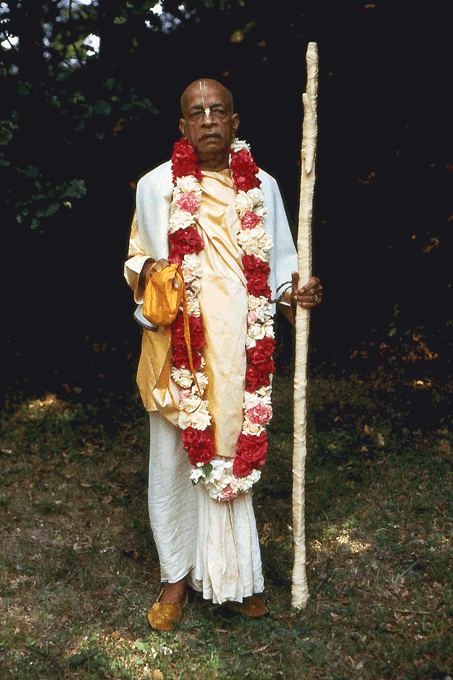
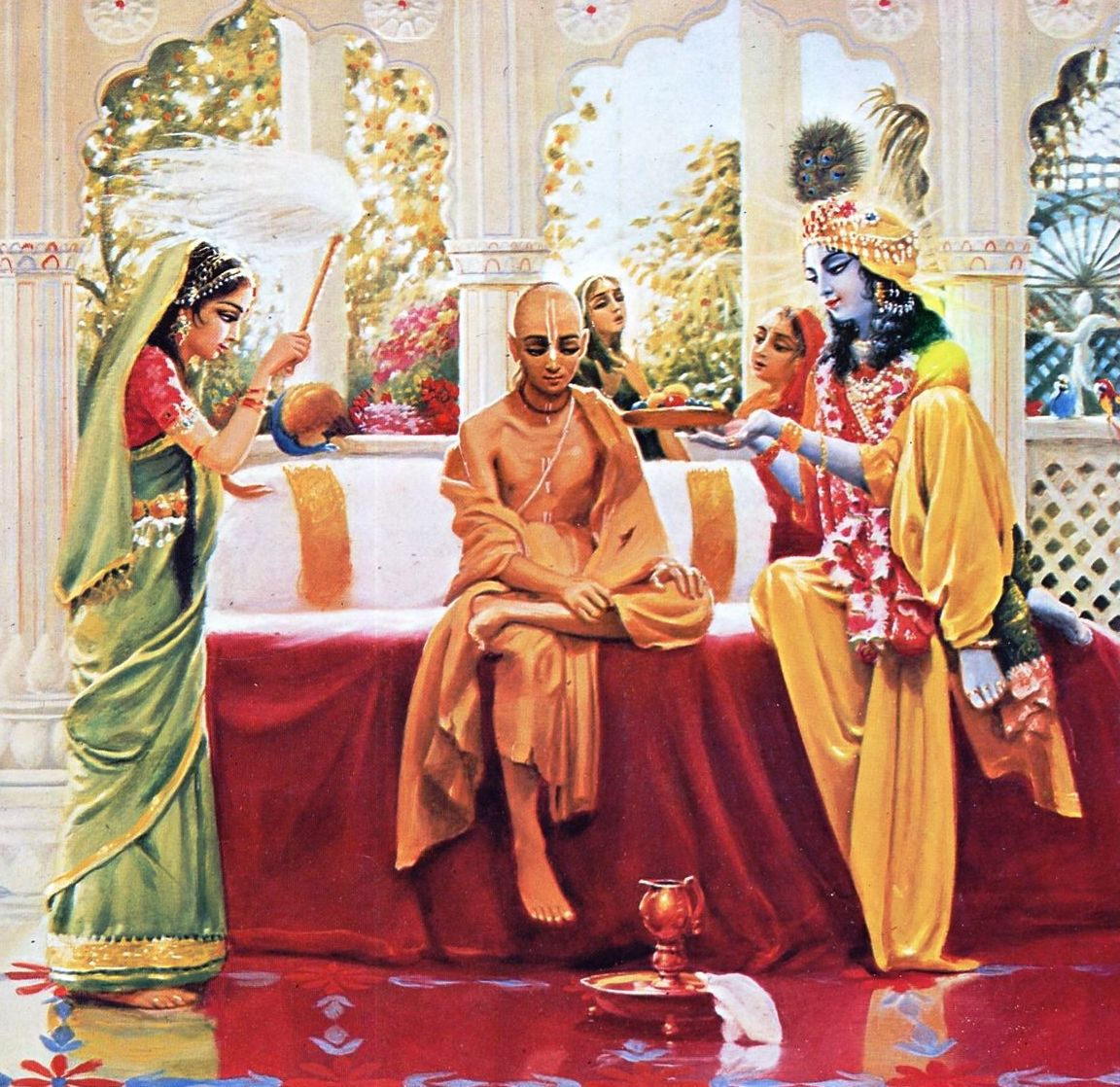
When Lord Krishna Garlanded Prabhupada
Bahushiras Das Adhikary
The following narration is from the visionary Memories series of Shriman Siddhanta das Adhikary. It is the remembrance of Shriman Bahushiras das Adhikary given in DVD 44 and in vol. 3, p. 334 of the book Memories-Anecdotes of a Modern-Day Saint.
After Shrila Prabhupada’s disappearance, [Patita Pavana das] asked if I’d like to assist Satswarupa’s Lilamrita project by interviewing people in India who had known Shrila Prabhupada. One of them was Acharya Prabhakar Misra, Prabhupada’s first disciple. Acharya Prabhakar Misra was clean-cut, well-behaved and articulate. His demeanor impressed me. He held a MA and PhD and was a very cultured Sanskrit scholar and teacher. In Jhansi, Prabhupada had told Acharya Prabhakar. “I met you because I saw you in a dream and I knew that I was supposed to come here.” Prabhupada and he would do bhajan together. They’d hold Rathayatra festivals and they’d have programme in villages in the area.
Acharya Prabhakar said that on Shri Krishna Janmashtami in 1954, he had to go to Delhi. When he returned to Jhansi, he took a little rest, woke up at 1:00 am and heard Shrila Prabhupada ecstatically playing mridanga in the temple room. Prabhupada was chanting in total bliss. Acharya Prabhakar went upstairs and saw Shrila Prabhupada bouncing around the temple room performing kirtan. Prabhupada was wearing a kadamba flower garland that went all the way down to his feet. Kadamba flowers are very rare in Jhansi and when they are available they are usually the size of a golf ball. But the ones Prabhupada was wearing were big, the size of tennis balls. And he said that the atmosphere right down to the atoms in the room was not material, aprakrita. The place was surcharged with the fragrance of the heavenly planets. Acharya Prabhakar wanted to ask Shrila Prabhupada, “Where did this garland come from? It is not available from the market.” But Shrila Prabhupada would not answer. His Divine Grace just kept on performing kirtan, bouncing round the room and chanting. The next morning Acharya Prabhakar asked Shrila Prabhupada, “Where did you get the garland, why did it have such a rich fragrance, and why were you feeling so blissful?”
Shrila Prabhupada told him, “I was chanting to Krishna and feeling some love for Him. And He appeared and gave me this garland. I went to touch His feet and He disappeared. Because of that I was dancing around the temple room.” Shrila Prabhupada was crying.
More
26 Jan 2012
by The Hare Krishna Movement
in Krishna Consciousness, KRSNA The Supreme Personality of Godhead, Spiritual Life, Spiritual World
Tags: A.C. Bhaktivedanta Swami Prabhupada, Balarama, Dvaraka, Krishna, Krsna and Balarama, Krsna The Supreme Personality of Godhead, Kuruksetra, Lord Parasurama, Vrndavana, Yadu dynasty
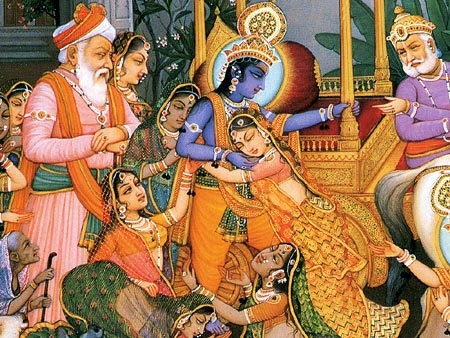
“For one who remembers Me without deviation, I am easy to obtain, O son of Prtha, because of his constnt engagement in devotional service. (Bhagavad-gita 8.14)
…The special qualification of the pure devotee is that he is always thinking of Kṛṣṇa without considering the time or place. There should be no impediments. He should be able to carry out his service anywhere and at any time. Some say that the devotee should remain in holy places like Vṛndāvana or some holy town where the Lord lived, but a pure devotee can live anywhere and create the atmosphere of Vṛndāvana by his devotional service. It was Śrī Advaita who told Lord Caitanya, “Wherever You are, O Lord-there is Vṛndavana.” (From Purport)
So to help us in remembering the Lord, we are posting this very nice chapter from “KRSNA The Supreme Personality of Godhead” by His Divine Grace A.C. Bhaktivedanta Swami, who is teaching us how to always think of Krishna.
…All the members of the Yadu dynasty were naturally very beautiful, and yet on this occasion, when they appeared duly decorated with gold necklaces and flower garlands, dressed in valuable clothing and properly armed with their respective weapons, their natural beauty and personalities were a hundred times enhanced. The members of the Yadu dynasty came to Kurukṣetra in their gorgeously decorated chariots resembling the airplanes of the demigods, pulled by big horses that moved like the waves of the ocean, and some of them rode on sturdy, stalwart elephants that moved like the clouds in the sky. Their wives were carried on beautiful palanquins by beautiful men whose features resembled those of the Vidyādharas. The entire assembly looked as beautiful as an assembly of the demigods of heaven…
KRSNA The Supreme Personality of Godhead (1970 Edition)
By His Divine Grace A.C. Bhaktivedanta Swami Prabhupada
Vol.2 Chapter 27
Lord Kṛṣṇa and Balarāma Meet the Inhabitants of Vṛndāvana
Once upon a time while Lord Kṛṣṇa and Balarāma were living peacefully in Their great city of Dvārakā, there was the rare occasion of a full solar eclipse, such as takes place at the end of every kalpa, or day of Brahmā. At the end of every kalpa the sun is covered by a great cloud, and incessant rain covers the lower planetary systems up to Svargaloka. By astronomical calculation, people were informed about this great eclipse prior to its taking place, and therefore everyone, both men and women, decided to assemble at the holy place in Kurukṣetra known as Samanta-pañcaka.
More
11 Dec 2011
by The Hare Krishna Movement
in Back to Godhead, Brahmananda das, Spiritual Life, Spiritual World, Vrindavan
Tags: Back to Godhead Magazine, Brahmananda dasa, devotional service, Krishna, Land of No Return, Srila Prabhupada, Vrindavan forest, Vrndavan

Vrndavana—Land of No Return
By His Holiness Brahmananda Swami
Originally Published in Back to Godhead 1975 Vol. 10, No. 11
Part 2
I once visited Vrndavana, India with His Divine Grace Srila Prabhupada. As I accompanied him on his daily walk one morning we suddenly came upon a particularly beautiful spot. The cool sands were thick with foliage; the tall trees full of singing birds. As the sun brightened the clear morning sky, peacocks filled the air with their peculiar call.
Srila Prabhupada looked over his shoulder and said to me, “So, Brahmananda, this is Vrndavana. How do you like it?”
“It’s wonderful, Srila Prabhupada,” was all I could reply. I felt that he was actually revealing the glories of Vrndavana to me even though I had no particular spiritual qualification.
Vrndavana is the place where the Supreme Lord Sri Krsna appeared five thousand years ago. Lord Krsna descended there from His own spiritual planet, Goloka Vrndavana to attract us by displaying His supernatural pastimes. Srila Prabhupada has explained that when Krsna descends to the material world, this same Vrndavana descends with Him just as an entourage accompanies an important personage. Because when Krsna comes His land also comes, Vrndavana is not considered to exist in the material world. Therefore devotees take shelter of the Vrndavana in India, for it is considered to be a replica of the original Goloka Vrndavana.
More
07 Dec 2011
by The Hare Krishna Movement
in Back to Godhead, Krishna Consciousness, Satsvarupa das Goswami, Spiritual Life, Spiritual World
Tags: back to Godhead, His Divine Grace A.C. Bhaktivedanta Swami Prabhupada, Krishna, Krsna Book, Lord Krsna, Satsvarupa dasa, Sudama
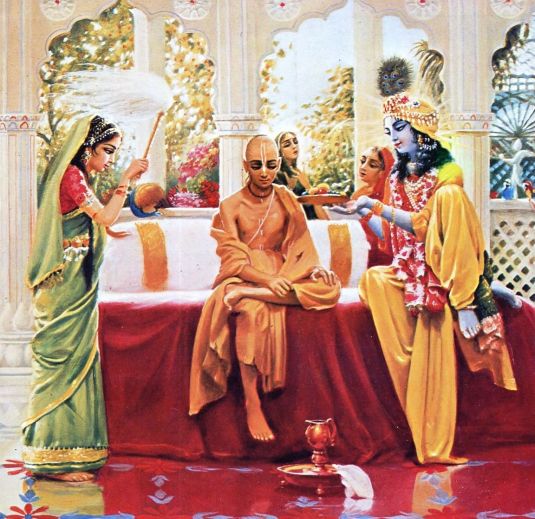
…It is related that by his constant association with the Lord, Sudama had wiped away from his heart whatever contamination was remaining, and he was very shortly transferred to the eternal spiritual kingdom, which is the goal of all saintly persons in the perfectional stage of life. It is stated in the Krsna Book that whoever hears this history will become qualified like Sudama and will be transferred to the spiritual kingdom of Lord Krsna.
Lord Krsna’s Friend Sudama
Published in Back to Godhead Magizine 1971 Vol. 1, Number 49
By Satsvarupa dasa adhikari
The wonderful history of Krsna and His friend Sudama is told in its entirety in the Krsna Book, Volume II, by His Divine Grace A.C. Bhaktivedanta Swami Prabhupada. Srila Prabhupada is kindly presenting to the western world the pastimes of Lord Krsna, which can act as a merciful shower upon the hearts of all of us. It is true that we have forgotten our eternal, blissful and loving relationships as servants of Krsna or God. The remedy to forgetfulness or ignorance of God is to hear about Him from the lips of His pure devotee. This is the view of authorized scriptures.
When Krsna descends from His eternal abode in the spiritual world and appears to this mundane world, as He did 5,000 years ago, He engages with others just as if He were an ordinary human being. Although He is unborn, He appears to have a mother and father. In the village of Vrndavana Krsna plays as a cowherd boy. He enacts these pastimes for His own transcendental pleasure and to attract all the suffering living entities back home, back to Godhead. Sudama was among those devotees who were childhood friends with Krsna, and Sudama was also His intimate school friend.
More
13 Oct 2011
by The Hare Krishna Movement
in Spiritual Life, Sri Damodarastakam, Visnujana Swami
Tags: Damodara-lila, Daomdara, Gokula, Krishna's childhood pastimes, Lord Damodara, Sri Damodarastakam, Visnujana Swami
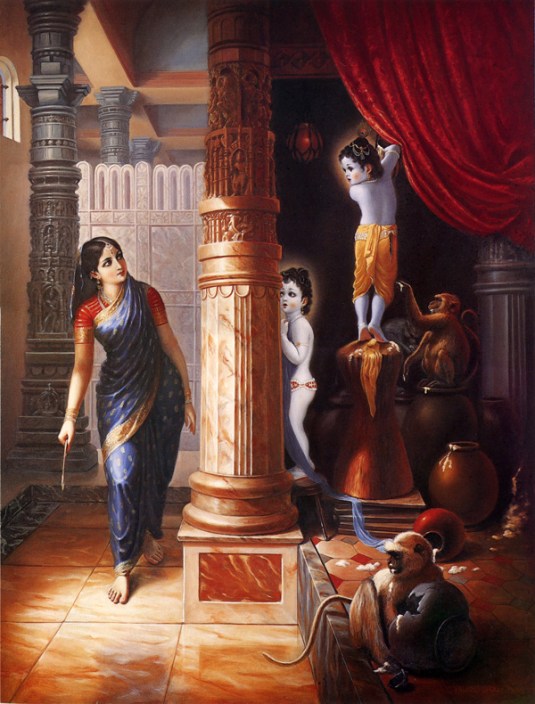
Those superexcellent pastimes of Lord Krsna’s babyhood drowned the inhabitants of Gokula in pools of ecstasy
itīdṛk sva-līlābhir ānanda-kuṇḍe
sva-ghoṣaḿ nimajjantam ākhyāpayantam
tadīyeṣita-jñeṣu bhaktair jitatvaḿ
punaḥ prematas taḿ śatāvṛtti vande
iti īdṛk–displaying in this way (childhood pastimes such as the Dāmodara-līlā and so forth); sva-līlābhiḥ–by His own pastimes; ānandakuṇḍe–in a pool of bliss; sva-ghoṣam–His own family and the other residents of Gokula; nimajjantam–immersing; ākhyāpayantam–makes known; tadīya-īśita-jñeṣu–to those desirous of knowing His majesty (aiśvarya); bhaktaiḥ jitatvam–His quality of being conquered by His loving devotees (who are devoid of aiśvarya-jñāna); punaḥ–again; premataḥ–with love and devotion; tam–unto that Lord Dāmodara; śataāvṛtti–hundreds and hundreds of times; vande–I praise.
3) Those superexcellent pastimes of Lord Krsna’s babyhood drowned the inhabitants of Gokula in pools of ecstasy. To the devotees who are attracted only to His majestic aspect of Narayana in Vaikuntha, the Lord herein reveals: “I am conquered and overwhelmed by pure loving devotion.” To the Supreme Lord, Damodara, my obeisances hundreds and hundreds of times.
Purport
The attributes of His excellent qualities, guna-visesa, are described in this verse. The first word, iti, indicates this Damodara lila, or all of His childhood pastimes like the Damodara lila. Next, sva-lilabhih denotes His own transcendental pastimes by which (sva-ghosam) all the residents of Gokula become immersed in pools of ecstatic mellows (ananda-kunde nimajjantam). The word sva connotes svasya, His own glory, or svanam, the glories of the residents of Gokula, which are displayed by these pastimes (akyapayantam). Moreover, sva-ghosam may refer to child Krishna, since He is also a resident of Gokula.
Then a warning to those who cultivate knowledge of His majesty and opulence (tadiyesita-jnesu). He only reveals Himself to the pure devotees (bhaktair jitatvam), being conquered by their love. Again, this is proclaimed for all to know (akhyapayantam).
More
12 Oct 2011
by The Hare Krishna Movement
in Spiritual Life, Sri Damodarastakam, Visnujana Swami
Tags: Damodara, Mother Yasoda, rudantam muhur netra-yugman mrjantam, Sri Damodarastakam, Sri Krishna, The Supreme Personality of Godhead, Visnujana Swami

Mother Yasoda bound His belly with ropes, He shivered in fright and His pearl necklace shook.
rudantaḿ muhur netra-yugmaḿ mṛjantam
karāmbhoja-yugmena sātańka-netram
muhuḥ śvāsa-kampa-trirekhāńka-kaṇṭha-
sthita-graivaḿ dāmodaraḿ bhakti-baddham
rudantam–crying; muhuḥ–again and again; netra-yugmam–His two eyes; mṛjantam–rubbing; kara-ambhoja-yugmena–with His two lotus-like hands; sa-ātańka-netram–with very fearful eyes; muhuḥ–again and again; śvāsa–quick breathing and sighing; kampa–trembling; tri-rekhaańka-kaṇṭha–neck marked with three lines (just like a conchshell); sthita–situated; graiva–pearl necklaces and other neck-ornaments; dāma-udaram–unto He with a rope around His belly; bhakti-baddham– who is bound by devotion.
2) Upon seeing His mothers whipping stick, He cried and rubbed His eyes again and again with His two lotus hands. His eyes were fearful and His breathing quick, and as Mother Yasoda bound His belly with ropes, He shivered in fright and His pearl necklace shook. To this Supreme Lord, Sri Damodara, who is bound with His devotee’s love, I offer my humble obeisances.
Purport
The second verse continues describing the lila-visesa. He is crying (rudantam) because He sees the stick in Mother Yasoda’s hand. Perceiving that she may strike Him, He appears fearful, hoping her natural empathy may save Him from punishment. Due to fear, tears are forming in His eyes, so He rubs his eyes with his lotus-like hands in the normal manner of children to wipe away the tears that are beginning to flow.
Then (satanka-netram) His fearful eyes reveal how much He is dreading punishment. It also indicates His glancing here and there in great fear, trying to avoid being punished. The confidential pastime is revealed in this way. Therefore, due to his continual sobbing He is trembling, (muhuh svasa-kampa) and thus, (sthita-graiva) the pearl necklaces and earrings that adorn Him are also shaking.
More
11 Oct 2011
by The Hare Krishna Movement
in Spiritual Life, Sri Damodarastakam, Visnujana Swami
Tags: blissful knowledge, Gokula, Mother Yasoda, namamisvarm sac-cid-ananda-rupam, Radha-Damodara, Sri Damodara, Sri Damodarastakam, Supreme Controller, Visnujana Swami
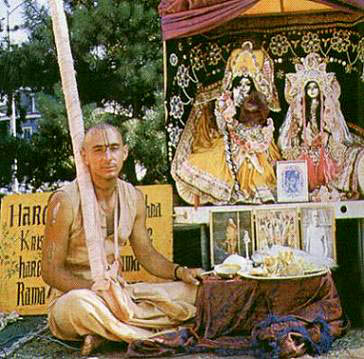
Vishnujana Swami with Radha Damodara
This will be an eight part series, with an explanation on each of the eight verses of the Sri Damodarastakam, given by Visnujana Swami. This eight sloka prayer is sung morning and evening during the month of Damodara, and which began today.
Sri Damodarastakam as explained by Visnujana Swami
namāmīśvaraḿ sac-cid-ānanda-rūpaḿ
lasat-kuṇḍalaḿ gokule bhrājamanam
yaśodā-bhiyolūkhalād dhāvamānaḿ
parāmṛṣṭam atyantato drutya gopyā
namāmi–I bow down; īśvaram–to the supreme controller; sat-cit-ānandarūpam–whose form is composed of eternity, knowledge and bliss; lasatkuṇḍalam–whose earrings play and swing; gokule bhrājamānam–who is splendrously manifest in Gokula; yaśodā-bhiyā–in fear of mother Yaśodā; ulūkalāt-dhāvamānam–who gets down from the wooden ricegrinding mortar and runs away; para-āmṛṣṭam–catching Him by the back; atyam–very much; tatam drutya–chasing after Him quickly; gopyā–by the gopī (Srī Yaśodā).
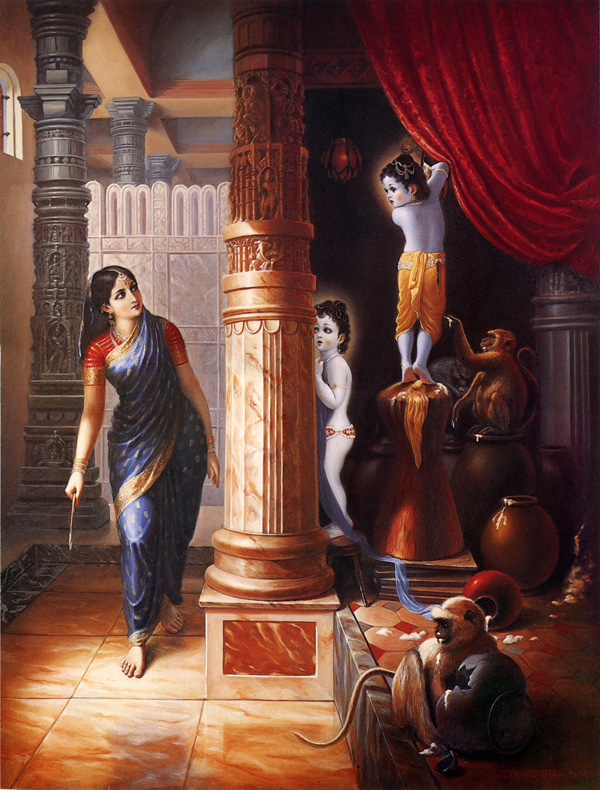
1) To the supreme controller who possesses an eternal form of blissful knowledge, whose glistening earrings swing to and fro, who manifested Himself in Gokula, who stole the butter that the gopis kept hanging from the rafters of their storerooms and who then quickly jumped up and ran in retreat in fear of Mother Yasoda, but was ultimately caught. To that Supreme Lord, Sri Damodara, I offer my humble obeisances.
Purport
The specific attributes of the Absolute Truth of the Lord, tattva-visesa, are addressed first. Satyavrata Muni begins with the offering of obeisances (namami) as an auspicious invocation, mangalacarana. He invokes the mercy of Lord Damodara to empower him to offer this prayer by the word isvara, the supreme controller. It also indicates that the Supreme Lord alone is worthy of the highest praise. It further implies the specific nature of devotional service, bhakti. The Lord manifests Himself in a form that embodies eternal existence, knowledge, and bliss. Thus, His supreme sovereignty is established.
The attribute of His enchanting beauty, rupa visesa, is described next. As He runs from Mother Yasoda, His earrings begin to swing back and forth lasat-kundalam. The earrings naturally sport upon His cheeks as He plays in the courtyard of Mother Yasoda. All the ornaments that adorn the Lord have become super-excellent by contact with His divine body, yet these earrings have attained superiority overall by the great fortune of constantly kissing His divine cheeks while swinging. They are glistening (lasanti) due to being enriched with the effulgence from the Lord’s complexion.
Uddhava describes Krishna’s beauty as so supremely enchanting that His transcendental body is the ornament of all ornaments.
Only in Gokula does Krishna display His most splendid pastimes that surpass all other manifestations of His excellence (gokule bhrajamanam) The word, gokule, indicates the place where cows and cowherds reside. The attributes of His family, parivara-visesa, thus further portray His unique excellence.
The last two lines of the verse describe the lila-visesa, the attributes of His excellent pastime as the butter thief. In fear of Mother Yasoda (yasoda-bhiya) He quickly runs away dhavamanam) from the mortar (ulukalat). Then, she also runs very swiftly (atyantato drutya).
“Krishna, at that time, was sitting on an upside-down wooden mortar for grinding spices and was distributing milk preparations, such as yogurt and butter, to the monkeys as He liked. Because of having stolen, He was looking all around with great anxiety, suspecting that He might be chastised by His mother. Mother Yasoda, upon seeing Him, very cautiously approached Him from behind. When Lord Sri Krishna saw His mother, stick in hand, He very quickly got down from the top of the mortar and began to flee as if very much afraid. Although yogis try to capture Him as Paramatma by meditation, desiring to enter into the effulgence of the Lord with great austerities and penance, they fail to reach Him. But Mother Yasoda, thinking that same Personality of Godhead Krishna, to be her son, began following Krishna to catch Him.
More
06 Oct 2011
by The Hare Krishna Movement
in Lectures, Spiritual Life, Srimad Bhagavatam
Tags: Krishna, Krishna consciousness, Parikshit Maharaja, Srila Prabhupada, Srimad Bhagavatam, Sukadeva Goswami, Vedic literatures, what is my duty

Chanakya Pandit says that “If you want to make spiritual advancement, then you should always think that “Death is next moment. Death is next moment.”
Excerpt from lecture on Srimad-Bhagavatam
Canto 1, Chapter 4, Text 25, Montreal, June 20, 1968
By His Divine Grace A. C. Bhaktivedanta Swami Prabhupada
Parikshit Maharaja, he was a powerful king. He was equipped with all, everything, but he did not counteract the curse [1]. He could counteract that curse. He was so powerful, but he accepted: “All right. I am cursed. I shall give up my life within seven days.” That means he took it as an opportunity that “I am going to death within seven days. That is certain. And I must prepare myself fully so that my next life I can approach Krishna.” So this is a good opportunity, that “I have got seven days’ time.” We haven’t got seven seconds’ time. We do not know. Nobody has served me notice. We find by practical experience that we are walking on the street—all of a sudden there is some accident, and we die. There is possibility. So the important point is that Maharaja Parikshit was fortunate enough to get seven days’ time before his death. But we do not know how much time is there for our death. So how much serious we shall be. Chanakya Pandit says that “If you want to make spiritual advancement, then you should always think that “Death is next moment. Death is next moment.” Because there is no guarantee when death is coming. If I think that death is next moment, that is not any utopian. The next moment may be my death. And Chanakya Pandit says, “But if you want to be materially happy, you should always think that ‘I shall never die,’ ” although it is false idea. Everyone will die.
More
16 Aug 2011
by The Hare Krishna Movement
in Guru & Disciple, Spiritual Life
Tags: Acarya, authority of guru, disciplic succession, false gurus, guru, Spiritual Life, spiritual master, Srila Prabhupada
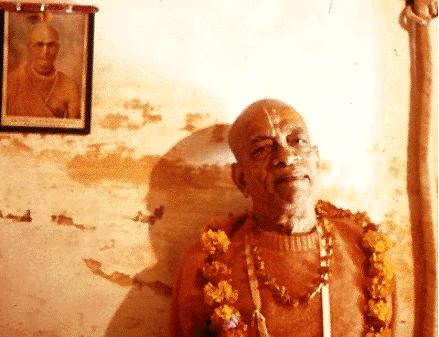
Srila Prabhupada speaks out on false Gurus
The principle of accepting a spiritual master is essential. Satisfaction of the self-realized spiritual master is the secret of advancement in spiritual life. Our Srila Prabhupada is the qualified, self-realized, spiritual master and is directly in line with the disciplic succession. And one can take shelter of him by simply reading his books and following his instructions, and make rapid advancement in spiritual life.
We should be very careful before accepting a Guru
“The sastras enjoin that before we take a guru we study him carefully to find out whether we can surrender to him. We should not accept a guru suddenly, out of fanaticism. That is very dangerous.”
(The Science of Self Realization, chapter 2, ‘Choosing a Spiritual Master’)
Ambition to be Guru is very dangerous
“Our mission is to serve (…). Not that you take the place of the guru. That is nonsense, very dangerous. Then everything will be spoiled. As soon as you become ambitious to take the place of guru-gurusu nara-matih . That is the material disease.”
(Srila Prabhupada Conversation, April 20, 1977)
“That is the difficulty. Everyone sees that “Some way or other, I become guru. Then so many persons will offer me respect. Somehow or other, create some situation. Then I become guru.” This is going on. Not bona fide guru. (…) They will drink, they will hunt after woman and have some attractive singing or dancing and become guru. What is meaning of guru, they do not know. Somehow or other become popular and become guru. This is going on.”
(Srila Prabhupada Conversation, May 2nd, 1976)
One who is disobedient to the order of the Guru cannot be a Guru
“If you become disobedient to guru, then your business is finished.”
(Srila Prabhupada’s Srimad-Bhagavatam Lecture, August 10th, 1974)
More
12 Jun 2011
by The Hare Krishna Movement
in Guru & Disciple, Spiritual Life, Srimad Bhagavatam
Tags: back to Godhead, bona fide spiritual master, Lord Krsna, Maharaja Pariksit, Personality of Godhead, Sri Suta Gowvami, Srimad Bhagavatam, Sukadeva Goswami, Vyasadeva

Srimad-Bhagavatam
By His Divine Grace A. C. Bhaktivedanta Swami Prabhupada
Canto 1:”Creation”
SB 1.19: The Appearance of Sukadeva Gosvami
The great sage Śukadeva Gosvāmī was certainly inspired by Lord Kṛṣṇa to appear voluntarily before Mahārāja Parīkṣit, the great devotee of the Lord, just to give him the teachings of Śrīmad-Bhāgavatam. One can achieve the nucleus of the devotional service of the Lord by the mercy of the spiritual master and the Personality of Godhead. The spiritual master is the manifested representative of the Lord to help one achieve ultimate success. One who is not authorized by the Lord cannot become a spiritual master. Śrīla Śukadeva Gosvāmī is an authorized spiritual master, and thus he was inspired by the Lord to appear before Mahārāja Parīkṣit and instruct him in the teachings of Śrīmad-Bhāgavatam.
Simply by such questioning and hearing, one can achieve the highest perfectional stage of life.
Text 37
You are the spiritual master of great saints and devotees. I am therefore begging you to show the way of perfection for all persons, and especially for one who is about to die.
Purport
Unless one is perfectly anxious to inquire about the way of perfection, there is no necessity of approaching a spiritual master. A spiritual master is not a kind of decoration for a householder. Generally a fashionable materialist engages a so-called spiritual master without any profit. The pseudo- spiritual master flatters the so-called disciple, and thereby both the master and his ward go to hell without a doubt. Mahārāja Parīkṣit is the right type of disciple because he puts forward questions vital to the interest of all men, particularly for the dying men. The question put forward by Mahārāja Parīkṣit is the basic principle of the complete thesis of Śrīmad-Bhāgavatam. Now let us see how intelligently the great master replies.
Text 38
Please let me know what a man should hear, chant, remember and worship, and also what he should not do. Please explain all this to me.
Text 40
Śrī Sūta Gosvāmī said: The King thus spoke and questioned the sage, using sweet language. Then the great and powerful personality, the son of Vyāsadeva, who knew the principles of religion, began his reply.
More
12 Feb 2011
by The Hare Krishna Movement
in Spiritual Life, Srimad Bhagavatam
Tags: BBT, Bhisma, Bhismastami, HDG A.C. Bhaktivedanta Swami, Lord Krishna, purports, Srimad Bhagavatam

Feb 10, 2011 — CANADA (SUN) — Bhismastami, observed on February 11th, from Srimad Bhagavatam Chapter Nine with select Purports by HDG A.C. Bhaktivedanta Swami Srila Prabhupada.
The Passing Away of Bhismadeva in the Presence of Lord Krsna
TEXT 1
Suta Gosvami said: Being afraid for having killed so many subjects on the Battlefield of Kuruksetra, Maharaja Yudhisthira went to the scene of the massacre. There, Bhismadeva was lying on a bed of arrows, about to pass away.
PURPORT
In this Ninth Chapter, as it is willed by Lord Sri Krsna, Bhismadeva will impart instructions to King Yudhisthira on the subject of occupational duties. Bhismadeva will also offer his last prayer to the Lord on the verge of passing away from this mortal world and thus become liberated from the bondage of further material engagements. Bhismadeva was endowed with the power of leaving his material body at will, and his lying down on the bed of arrows was his own choice. This passing away of the great warrior attracted the attention of all the contemporary elites, and all of them assembled there to show their feelings of love, respect and affection for the great soul.
More
03 Feb 2011
by The Hare Krishna Movement
in Chanting Hare Krishna, Krishna Consciousness, Spiritual Life
Tags: Caitanya Mahaprabhu, Gauranga, Lord Krishna, loving ecstasies, spiritual dream, Srimati Radharani, vaisnava aparadha

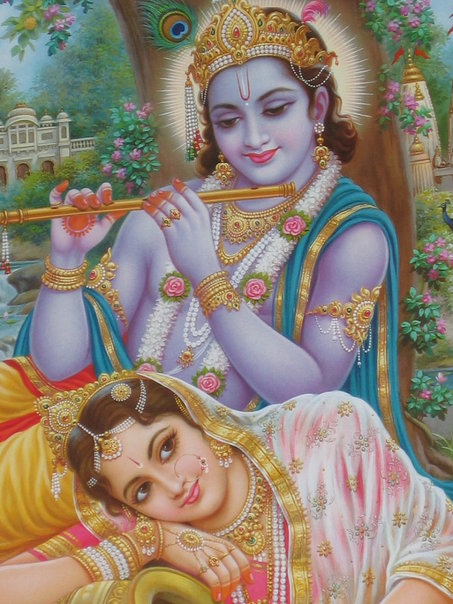
Once Srimati Radharani woke up with a start.
She was next to Sri Krishna on the flower bedecked pastimes bed – and looked
with deep questioning eyes into His eyes:
“O My beloved,” She asked, “I dreamt of someone extraordinarily – I am
ashamed to admit, He stole My heart. Could it be You, of whom I dreamt – but
in a different form? It must be!”
Krishna was smiling: “Tell Me more.”
More
01 Jan 2011
by The Hare Krishna Movement
in Devotee's, Remembering Srila Prabhupada, Spiritual Life
Tags: books, devotee, guru, Krishna, spiritual master, Srila Prabhupada, Vyasasan das

Your Ever Well Wisher
My First Book
by Vyasasan das
I think we all remember very clearly where we were and what we were doing the day Srila Prabhupada first entered our lives. Many of the older devotees remember where they were when President John F. Kennedy was shot, or where they were when “The Beatles” appeared on the Ed Sullivan show. But our remembrance of Srila Prabhupada will outlive any mundane event in our lives, as our relationship with our Srila Prabhupada is an eternal relationship.
More
01 Jan 2011
by The Hare Krishna Movement
in Devotee's, Krishna Consciousness, Spiritual Life
Tags: bona fied spiritual master, mahat-tattva, master of spirit, Padmapani das, Prabhupada connect, spiritual master, Srila Prabhupada

Prabhupada connect
by Padmapani Prabhu
Yet many times we still receive letters asking us how to connect with Srila Prabhupada now that he is apparently absent from our material vision. This should not be a mystery, since after all, Srila Prabhupada is a bona fide spiritual master, i.e. a master of spirit.
“A pure devotee of the Lord does not live on any planet of the material sky, nor does he feel any contact with material elements. His so-called material body does not exist, being surcharged with the spiritual current of the Lord’s identical interest, and thus he is permanently freed from all contaminations of the sum total of the mahat-tattva. He is always in the spiritual sky, which he attains by being transcendental to the sevenfold material covering by the effect of his devotional service. The conditioned souls are within the coverings, whereas the liberated soul is far beyond the cover.”
More
Previous Older Entries Next Newer Entries










 The Hare Krishna Movement