We are now in the month of Damodara (Kartika). In honor and in celebration of the month of Damodara, we will be focusing our attention on the pastimes of Krishna in Vrndavan. Especially Krishna’s childhood pastimes. The following is the first verse from the Damodarastkam prayer which is sung morning and evening, and it is customary to offer a candle or gee lamp as well to a picture of Lord Krsna and Mother Yasoda.
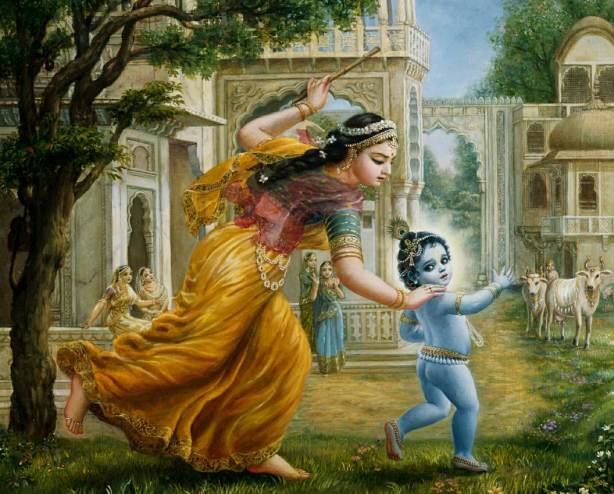
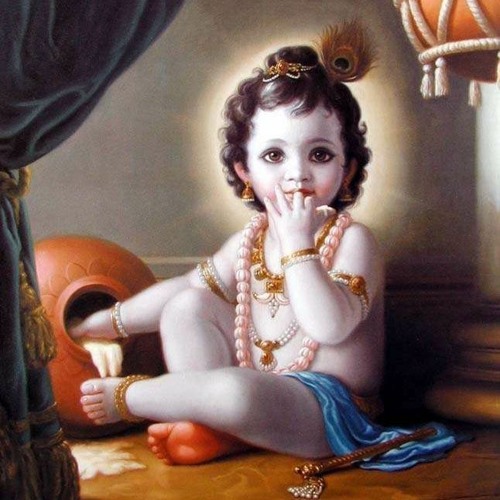
“To the supreme controller who possesses an eternal form of blissful knowledge, whose glistening earrings swing to and fro, who manifested Himself in Gokula, who stole the butter that the gopis kept hanging from the rafters of their storerooms and who then quickly jumped up and ran in retreat in fear of Mother Yasoda, but was ultimately caught-to that Supreme Lord, Sri Damodara, I offer my humble obeisances.“ (Sri Damodarastakam verse 1)
The Opening of Krishna Balarama Mandir 50 years ago
Today we are celebrating The Appearance day of Lord Ramachandra (Rama Navami), at the Krishna Balarama Mamdir, for the 50th Golden Jubille Grand Opening. It was 50 years ago today, this beautiful temple was opened.
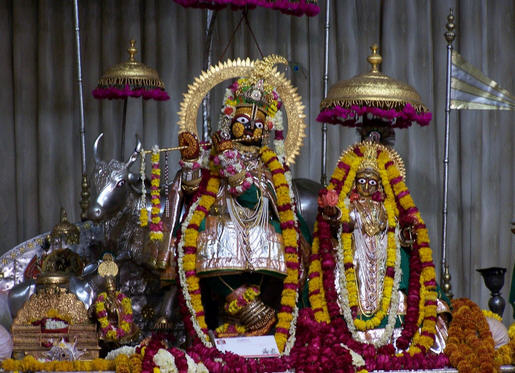
It has been a very blissful morning thus far, with ecstatic kirtan, memories given by Senior devotees who were here with Srila Prabhupada for the opening, and a Big Surprise was seeing the Ashtasakhi Gopis, who joined Radha Shyamasundar on the altar for the first time.
We are currently in Vrindavan, India, at the Krsna Balaram Mandir, with the most beautiful Radha Shyam. All the deities looked so gorgeous this morning, in their black outfits.
Have been doing the parikaram of the twelve forests of Vrindavan, and it has been amazing, and feel exceptional fortune, at being here, and experiencing so much devotional nectar.
I wish to share some from the Preface to the”Nectar of Devotion” By A. C. Bhaktivedanta Swami:
The basic principle of the living condition is that we have a general propensity to love someone. No one can live without loving someone else. This propensity is present in every living being. Even an animal like a tiger has this loving propensity at least in a dormant stage, and it is certainly present in the human beings. The missing point, however, is where to repose our love so that everyone can become happy. At the present moment the human society teaches one to love his country or family or his personal self, but there is no information where to repose the loving propensity so that everyone can become happy. That missing point is Krsna, and The Nectar of Devotion teaches us how to stimulate our original love for Krsna and how to be situated in that position where we can enjoy our blissful life.
We spent the last two nights in Jaipur, which is home to some of the deities of Vrindavan that were brought here for safekeeping during the Mughal invasions. It was our good fortune the have visited many of these temples, and had darshan with the Vrindavan deities, here in Jaipur.
The Seven Goswami Temples of Vrindavan are:
Radha Damodar
Radha Shyamsundar
Radha Govind Dev
Radha Gokulananda
Radha Madan Mohan
Radha Gopinath
Radha Raman
Jaipur is home to several deities originally from Vrindavan, including Govind Dev, Radha Gopinath, Madan Mohan, Radha Damodar, and others, brought to Jaipur for safekeeping during Mughal invasions
This morning as I was looking at a picture of Srila Prabhupada, this verse from the Bhagavad-gita just came into my mind:
O Kṛṣṇa, I totally accept as truth all that You have told me. Neither the gods nor demons, O Lord, know Thy personality. (Bg 10.14)
And I was thinking, that is exactly how I think of Srila Prabhupada’s instructions, to us. “I totally accept as truth all that You have told me“. Ever since I picked up my first book by Srila Prabhupada, I have just accepted every thing he has written as truth. I didn’t always believe my school teachers, or the nuns, or my parents for that matter. Sure they knew some things, and much of it true, but they didn’t know everything.
For some reason I just accepted as truth everything Prabhupada told us. He told us who was God (Krsna), then he told us what God looked like, what God was doing, where God lived, who’s Gods friends were, and much much more. There wasn’t a question he couldn’t answer, and he backed it up with sastric evidence.These were questions I asked of the nuns and priests, of parents and college professors, but I never got a reasonable answer from anyone when I asked; ‘Who is God, who am I, what is my relationship with Him?’
Today we celebrate Govardhana-puja, when Krishna exhibited His transcendental pastime of lifting Govardhana Hill to protect the inhabitants of Vrndavan. In honor of this auspicious day, we are posting the entire chapter from the KRSNA Book entitled “Devastating Rainfall in Vrndavana”. Enjoy!
…Lord Kṛṣṇa picked up Govardhana Hill with one hand, exactly as a child picks up a mushroom from the ground. Thus He exhibited His transcendental pastime of lifting Govardhana Hill. Lord Kṛṣṇa then began to address His devotees, “My dear brothers, My dear father, My dear inhabitants of Vṛndāvana, you can now safely enter under the umbrella of Govardhana Hill, which I have just lifted. Do not be afraid of the hill and think that it will fall from My hand. You have been too much afflicted from the heavy rain and strong wind; therefore I have lifted this hill, which will protect you exactly like a huge umbrella. I think this is a proper arrangement to relieve you from your immediate distress. Be happy along with your animals underneath this great umbrella.” Being assured by Lord Kṛṣṇa, all the inhabitants of Vṛndāvana entered beneath the great hill and appeared to be safe along with their property and animals. …The inhabitants of Vṛndāvana and their animals remained there for one week without being disturbed by hunger, thirst or any other discomforts. They were simply astonished to see how Kṛṣṇa was holding up the mountain with the little finger of His left hand.
… After this incident, the Supreme Personality of Godhead, surrounded by His dear friends and animals, returned to His home. As usual, the gopīs began to chant the glorious pastimes of Lord Kṛṣṇa with great feeling, for they were chanting from the heart. (Kṛṣṇa, the Supreme Personality of Godhead Chapter 25)
It is said that it is the nature of a devotee to constantly apply his mind, energy, words, ears, etc., in hearing and chanting about Kṛṣṇa. This is called Kṛṣṇa consciousness, and for one who is rapt in hearing and chanting Kṛṣṇa, the subject matter never becomes hackneyed or old. That is the significance of transcendental subject matter in contrast to material subject matter. Material subject matter becomes stale, and one cannot hear a certain subject for a long time; he wants change. But as far as transcendental subject matter is concerned, it is called nityanavanavāyamāna. This means that one can go on chanting and hearing about the Lord and never feel tired but will remain fresh and eager to hear more and more.
…” Lord Kṛṣṇa brought His friends to the bank of the Yamunā and addressed them as follows: ’My dear friends, just see how this spot is very nice for taking lunch and playing on the soft sandy Yamunā bank. You can see how the lotus flowers in the water are beautifully blown and how they distribute their flavor all around. The chirping of the birds along with cooing of the peacocks, surrounded by the whispering of the leaves in the trees, combine and present sound-vibrations that echo one another. And this just enriches the beautiful scenery created by the trees here. Let us have our lunch in this spot because it is already late and we are feeling hungry. Let the calves remain near us, and let them drink water from the Yamunā. While we engage in our lunch-taking, the calves may engage in eating the soft grasses that are in this spot.’“
On hearing this proposal from Kṛṣṇa, all the boys became very glad and said, ”Certainly, let us all sit down here to take our lunch.“ They then let loose the calves to eat the soft grass. Sitting down on the ground and keeping Kṛṣṇa in the center, they began to open their different boxes brought from home. Lord Śrī Kṛṣṇa was seated in the center of the circle, and all the boys kept their faces toward Him. They ate and constantly enjoyed seeing the Lord face to face. Kṛṣṇa appeared to be the whorl of a lotus flower, and the boys surrounding Him appeared to be its different petals. The boys collected flowers, leaves of flowers and barks of trees and placed them under their different boxes, and thus they began to eat their lunch, keeping company with Kṛṣṇa. While taking lunch, each boy began to manifest different kinds of relations with Kṛṣṇa, and they enjoyed each other’s company with joking words. While thus enjoying lunch with His friends, Lord Kṛṣṇa’s flute was pushed within the belt of His cloth, and His bugle and cane were pushed in on the left-hand side of His cloth. He was holding a lump of foodstuff prepared with yogurt, butter, rice and pieces of fruit salad in His left palm, which could be seen through His petal-like finger joints. The Supreme Personality of Godhead, who accepts the results of all great sacrifices, was laughing and joking, enjoying lunch with His friends in Vṛndāvana. And thus the scene was being observed by the demigods from heaven. As for the boys, they were simply enjoying transcendental bliss in the company of the Supreme Personality of Godhead. (excerpted from: KRSNA Book Chapter 13 entitled “The Stealing of the Boys and Calves by Brahmā”)
Purport to the Damodara Prayer which is Recited During the month of Kartika
Question: What Two Personalities Became Great Devotees of Krsna in His Damodara Lila?
Prabhupada: There is a statement in Padma Puräna describing the ritualistic function during the month of Kärttika (October-November). During this month, in Vrndävana it is the regulative principle to pray daily to Lord Krsna in His Dämodara form. The Dämodara form refers to Krsna in His childhood when He was tied up with rope by His mother, Yasodä. Däma means “ropes,” and udara means “the abdomen.” So Mother Yasodä, being very disturbed by naughty Krsna, bound Him round the abdomen with a rope, and thus Krsna is named Dämodara. During the month of Kärttika, Dämodara is prayed to as follows: “My dear Lord, You are the Lord of all, the giver of all benedictions.”
Today, here in the Western half of the World, we are celebrating Janmastami: the appearance day of Lord Sri Krishna. So let us take advantage of this auspicious day and hear, chant, and remember the pastimes of the Lord. Hare Krishna!
The following is Lord Krishna’s Appearance Day Lecture given by Srila Prabhupada on August 16, 1968, Montreal Canada.
So today we honor Lord Sri Krishna’s appearance day with a full day fast, followed by a small feast after His appearance at midnight. We will try to increase our remembrance of Him by additional chanting and reading ,and singing His glories.
My good friend Padmapani Prabhu over at The Prabhupada Connection sent me the following post in my email this morning, we share the text with you.
“There are many statements about the festive days in connection with Kṛṣṇa’s different activities. One of these festive days is Janmāṣṭamī, the day of Kṛṣṇa’s birth. This Janmāṣṭamī day is the most opulent festival day for the devotees, and it is still observed with great pomp in every Hindu house in India. Sometimes even the devotees of other religious groups take advantage of this auspicious day and enjoy the performance of the ceremony of Janmāṣṭamī. Ecstatic love for Kṛṣṇa is also aroused on the days of Ekādaśī, which are other festive days in connection with Kṛṣṇa.” (Nectar of Devotion, Chapter 26)
“Of course, this Janmāṣṭamī ceremony is observed by all Hindus. Irrespective of becoming Vaiṣṇava or not, this ceremony is observed in India every home. Just like in your Western countries the Christmas is observed in every home, similarly Janmāṣṭamī is observed in every home. Today is a great ceremonial day. So our program is, at twelve o’clock night the Lord will take birth and we shall receive Him.” (Srila Prabhupada Janmastami Lecture, Montreal, August 16, 1968)
In a temple of jewels in Vṛndāvana, underneath a desire tree, Śrī Śrī Rādhā-Govinda, served by Their most confidential associates, sit upon an effulgent throne. I offer my humble obeisances unto Them. (CC/Adi/1/16)
Govinda resides eternally in Vṛndāvana. In the spiritual world of Vṛndāvana the buildings are made of touchstone, the cows are known as surabhi cows, givers of abundant milk, and the trees are known as wish-fulfilling trees, for they yield whatever one desires.
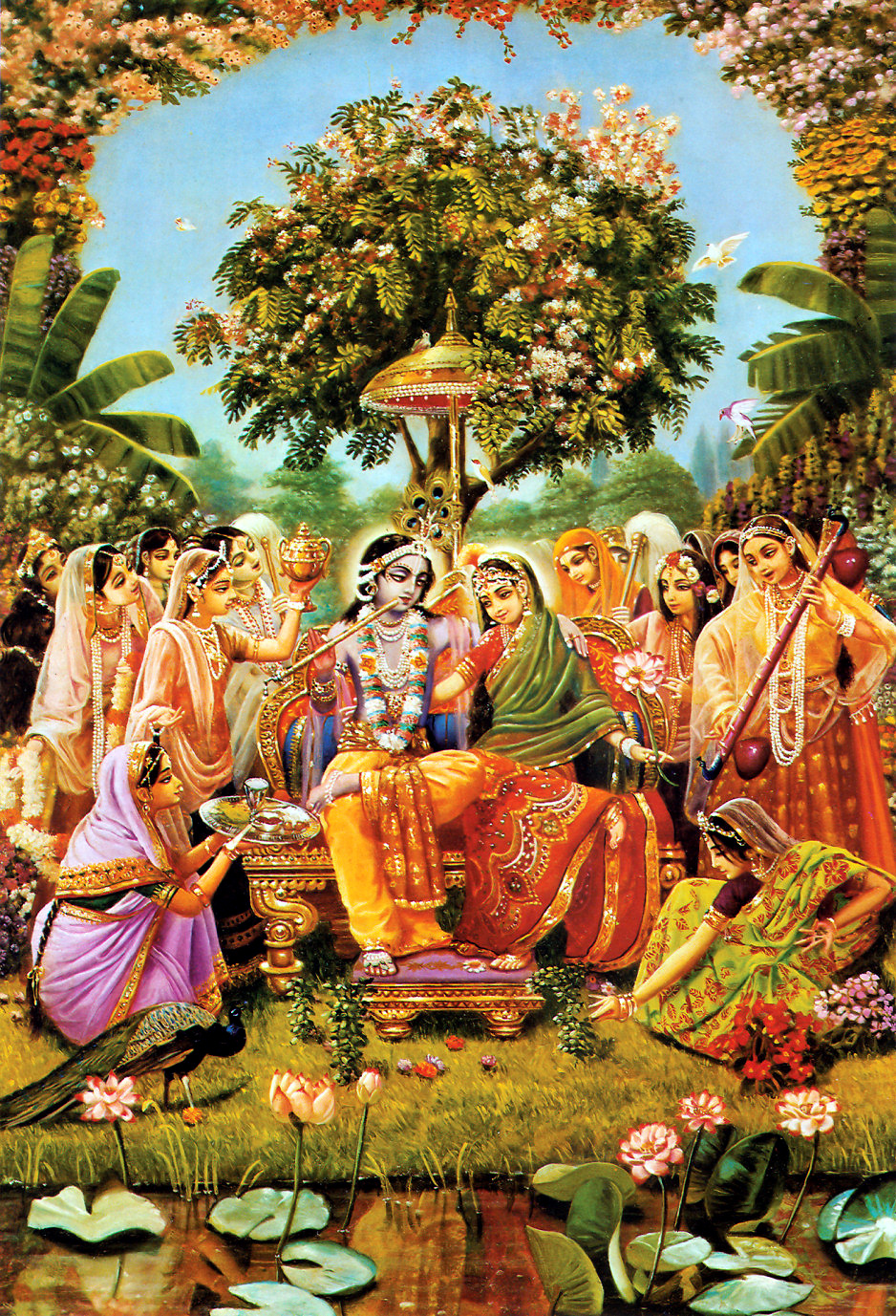
Rādhārāṇī and Kṛṣṇa as seated beneath a wish-fulfilling tree in Vṛndāvana on a throne decorated with valuable jewels. There Kṛṣṇa’s dear friends, the cowherd boys and the gopīs, serve Rādhā and Kṛṣṇa by singing, dancing, offering betel nuts and refreshments and decorating Their Lordships with flowers.
In Vṛndāvana Kṛṣṇa herds the surabhi cows, and He is worshiped by hundreds and thousands of gopīs, cowherd girls, who are all goddesses of fortune.
I worship Govinda, the primeval Lord, the first progenitor who is tending the cows, yielding all desire, in abodes built with spiritual gems, surrounded by millions of purpose trees, always served with great reverence and affection by hundreds of thousands of lakṣmīs or gopīs.
When Kṛṣṇa descends to the material world, this same Vṛndāvana descends just as an entourage accompanies an important personage. Because when Kṛṣṇa comes, His land also comes, Vṛndāvana is not considered to exist in the material world. Therefore devotees take shelter of the Vṛndāvana in India, for it is considered to be a replica of the original Vṛndāvana. Although one may complain that no kalpa-vṛkṣa, wish-fulfilling trees, exist there, when the Gosvāmīs were there, the kalpa-vṛkṣa were present. It is not that one can simply go to such a tree and make demands; one must first become a devotee. The Gosvāmīs would live under a tree for one night only, and the trees would satisfy all their desires. For the common man this may all seem very wonderful, but as one makes progress in devotional service, all this can be realized.
Vṛndāvana is actually experienced as it is by persons who have stopped trying to derive pleasure from material enjoyment. “When will my mind become cleansed of all hankering for material enjoyment so I will be able to see Vṛndāvana?” one great devotee asks. The more Kṛṣṇa conscious we become and the more we advance, the more everything is revealed as spiritual. Thus Kṛṣṇadāsa Kavirāja Gosvāmī considered Vṛndāvana in India to be as good as the Vṛndāvana in the spiritual sky, and in Caitanya-caritāmṛta he describes Rādhārāṇī and Kṛṣṇa as seated beneath a wish-fulfilling tree in Vṛndāvana on a throne decorated with valuable jewels. There Kṛṣṇa’s dear friends, the cowherd boys and the gopīs, serve Rādhā and Kṛṣṇa by singing, dancing, offering betel nuts and refreshments and decorating Their Lordships with flowers. Even today in India people decorate thrones and recreate this scene during the month of July. Generally at that time people go to Vṛndāvana to offer their respects to the Deities there. [TLC/introduction]
With all the news of deaths in our Nation due to the Coronavirus, it seems that people are more aware of their own immortality. We were reading this morning from the Srimad-Bhagavatam in the chapter entitled “The Passing Away of Bhīṣmadeva in the Presence of Lord Kṛṣṇa” how all the living beings who participated on the Battlefield of Kurukṣetra, on both sides, attained their svarūpa (eternal form) because they died in the presence of the Lord.
Simply by remembering the Lord at the time of death one can obtain liberation from this material existence. The conclusion is that whoever dies looking on the Personality of Godhead within or without attains his svarūpa, which is the highest perfection of life.
At the moment of death, let my ultimate attraction be to Śrī Kṛṣṇa, the Personality of Godhead. I concentrate my mind upon the chariot driver of Arjuna who stood with a whip in His right hand and a bridle rope in His left, who was very careful to give protection to Arjuna’s chariot by all means. Those who saw Him on the Battlefield of Kurukṣetra attained their original forms after death. (Srimad-Bhagavatam 1.9.39)
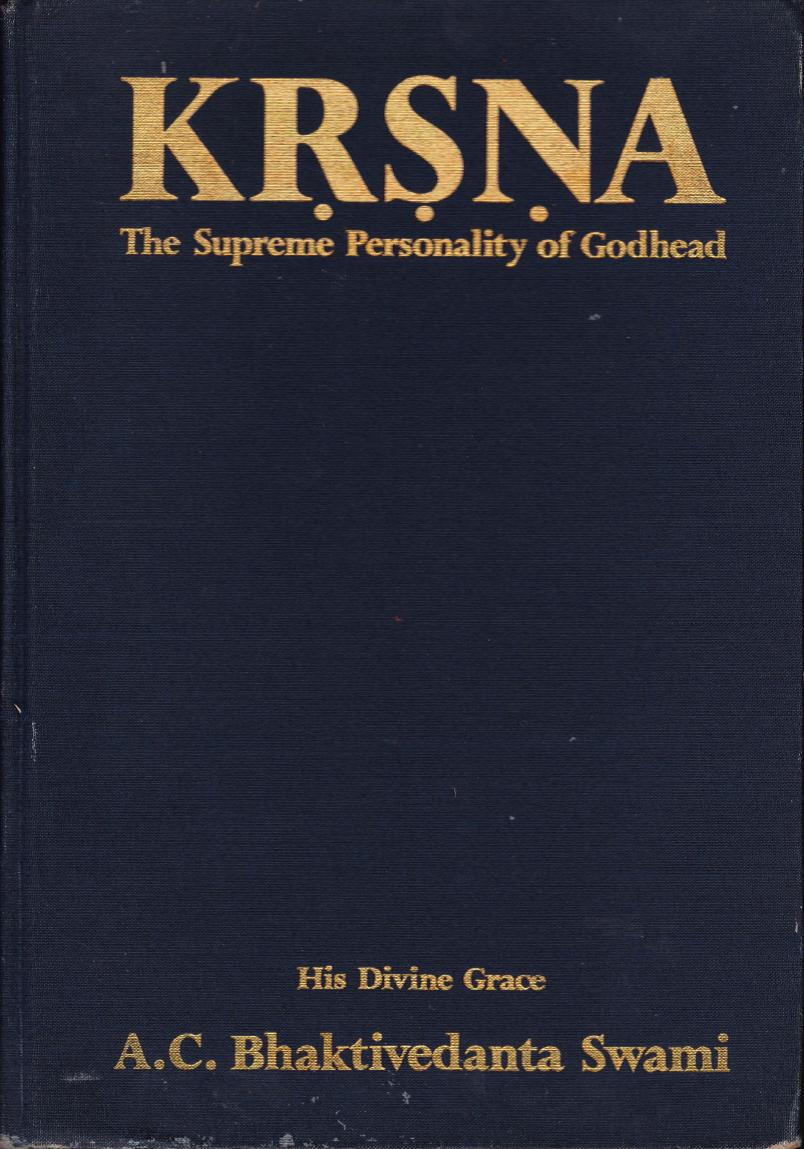
Kṛṣṇa, the Supreme Personality of Godhead
by His Divine Grace A. C. Bhaktivedanta Swami Prabhupāda
Chapter 22
I love the KRSNA Book. It was the first book I ever received by Srila Prabhupada, and was handed to me by a very compassionate Hare Krishna devotee at the Chicago Ohara Airport way back in 1972. Love all the stories and especially like the following one we share with you today.
Lord Krishna’s Appearance Day Lecture
By His Divine Grace A.C. Bhaktivedanta Swami Prabhupada
(London, August 21, 1973)
Prabhupāda: His Excellency, the High Commissioner; ladies and gentlemen, I thank you very much for your coming here and participating in this ceremony, Janmāṣṭamī, advent of Kṛṣṇa. The subject matter I’ve been ordered to speak on is advent of Kṛṣṇa. Kṛṣṇa says in the Bhagavad-gītā,
janma karma me divyaṁ
yo jānāti tattvataḥ
tyaktvā dehaṁ punar janma
naiti mām eti kaunteya
(BG 4.9)
This fact, that we can achieve such a stage of life when we can stop our birth and death… Sa ‘mṛtatvāya kalpate. This morning, I was explaining this verse:
yaṁ hi na vyathayanty ete
puruṣaṁ puruṣarsabha
sama-duḥkha-sukhaṁ dhīraṁ
so ‘mṛtatvāya kalpate
Amrtatva means immortality. So the modern civilization, they have no idea, either the great philosopher, great politician or great scientist, that it is possible to attain the stage of immortality. Amṛtatva. We are all amṛta. In the Bhagavad-gītā it is said, na jāyate na mrīyate vā kadācin. We living entities, we never die, never take birth. Nityaḥ śāśvato yaṁ, na hanyate hanyamāne śarīre (BG 2.20). Every one of us, we are eternal, nityaḥ śāśvato; Purāṇa, the oldest. And after annihilation of this body, we do not die. Na hanyate. The body is finished, but I have to accept another body. Tathā dehāntara prāptir dhīras tatra na muhyati. Dehino ‘smin yathā dehe kaumāraṁ yauvanaṁ jarā (BG 2.13).
This simple thing, at the present moment, they are lacking knowledge, that we, all living entities, part and parcel of Kṛṣṇa, we are eternal, we are blissful, and we are cognizant. Kṛṣṇa is described in the Vedic śāstras:
In the following conversation, taped at George’s home in England on September 4, 1982, George reveals some memorable experiences he has had chanting Hare Krishna and describes in detail his deep personal realizations about the chanting. He reveals what factors led him to produce “The Hare Krishna Mantra” record, “My Sweet Lord,” and the LPs All Things Must Pass and Living in the Material World, which were all influenced to a great extent by the Hare Krishna chanting and philosophy. He speaks lovingly and openly about his association with His Divine Grace A. C. Bhaktivedanta Swami Prabhupada, Founder-Acarya (spiritual master) of the Hare Krishna movement. In the following interview George speaks frankly about his personal philosophy regarding the Hare Krishna movement, music, yoga, reincarnation, karma, the soul, God, and Christianity. The conversation concludes with his fond remembrances of a visit to the birthplace of Lord Krishna in Vrndavana, India, home of the Hare Krishna mantra, and with George discussing some of his celebrity friends’ involvement with the mantra now heard and chanted around the world.
This morning I was reading from the Srimad Bhagavatam Canto 1, Chapter 15, Text 27, wherein Srila Prabhupada was describing the glories and importance of the the Bhagavad-gita As It Is. The following is some excerpts from this amazing purport, followed by full text and purport. I found this one purport to be a very nice synopsis of the entire Bhagavad-gita As It Is.
…The Lord left behind Him the instructions of the Bhagavad-gītā not for the benefit of Arjuna alone, but also for all time and in all lands. The Bhagavad-gītā, being spoken by the Supreme Personality of Godhead, is the essence of all Vedic wisdom. It is nicely presented by the Lord Himself for all who have very little time to go through the vast Vedic literatures like the Upaniṣads, Purāṇas and Vedānta-sūtras.
…the Bhagavad-gītā can be consulted in all critical times, not only for solace from all kinds of mental agonies, but also for the way out of great entanglements which may embarrass one in some critical hour.
…The merciful Lord left behind Him the great teachings of the Bhagavad-gītā so that one can take the instructions of the Lord even when He is not visible to material eyesight.
…There is no difference between the sound representation of the Lord and the Lord Himself. One can derive the same benefit from the Bhagavad-gītā as Arjuna did in the personal presence of the Lord.
…The Bhagavad-gītā begins with the problems of life by discriminating the soul from the elements of matter and proves by all reason and argument that the soul is indestructible in all circumstances and that the outer covering of matter, the body and the mind, change for another term of material existence which is full of miseries. The Bhagavad-gītā is therefore meant for terminating all different types of miseries, and Arjuna took shelter of this great knowledge, which had been imparted to him during the Kurukṣetra battle. (from Purport to SB 1.15.27)
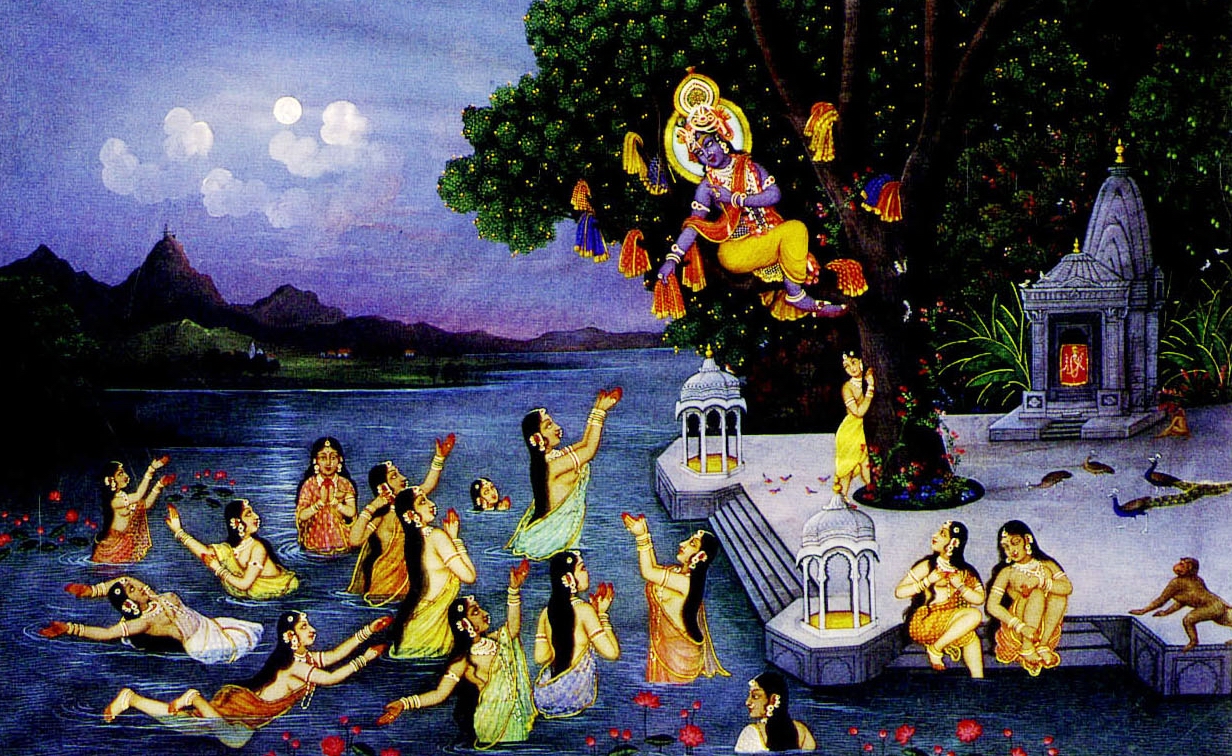
Today we are posting some some of the Transcendental Art work of B.G. Sharma.
B. G. Sharma is recognized as the Foremost legendary painter of Indian miniature paintings and religious paintings. He is famous throughout India and abroad for his originality in composition, design, detail and ornamentation, he has influenced and inspired many other artists all around the world. B.G. Sharma Art Studio
Today, being Krsna Janmastami, we are offering a free scanned copy of the original ISKCON Press 1970 Edition of KRSNA Book Vol. 1, which you can download. Just click on the following link to began downloading. This could take a while depending on the speed of your connection. This free scanned copy includes all the original art work as well.
Today marks the auspicious celebration of the Appearence Day Of Lord Sri Krishna, Janmastami. We will fast all day and have a small feast at midnight. The following are some selected quotes by Srila Prabhupada on understanding Krishna.
“Let us understand Krishna. That is Krishna consciousness movement. Let us understand Krishna. And if you simply understand Krishna, as it is stated in the Bhagavad-gita, janma karma me divyam yo janati tattvatah… Tattvatah, in truth, not superficially. Learn this science of Krishna. Janma karma me divyam yo janati tattvatah. Tyaktva deham punar janma naiti mam eti kaunteya (BG 4.9). This is the instruction: if you simply try to love. The process is that you worship the Deity, you take the prasadam, you chant the holy name, you follow the instruction of the spiritual master. In this way you’ll be trained up how to understand Krishna, and then your life is successful. This is Krishna consciousness movement.” (Srila Prabhupada lecture, September 9, 1973)
“Some way or other, be in relationship with Krishna, and you’ll be happy. You’ll be happy, this life and next life.
yo janati tattvatah
tyaktva deham punar janma
naiti mam eti kaunteya
This is the simplest point. You simply try to understand Krishna. There is no difficulty. If you do not foolishly misinterpret Bhagavad-gita, it is very easy to understand Krishna. Very easy. There is no difficulty. But we are rascals. We misinterpret.” (Srila Prabhupada lecture, January 7, 1973)













 The Hare Krishna Movement
